THE MIRROR OF LITERATURE, AMUSEMENT, AND INSTRUCTION.
Reading edition
VOL. XIV. NO. 381.] SATURDAY, JULY 18, 1829. [PRICE 2d.
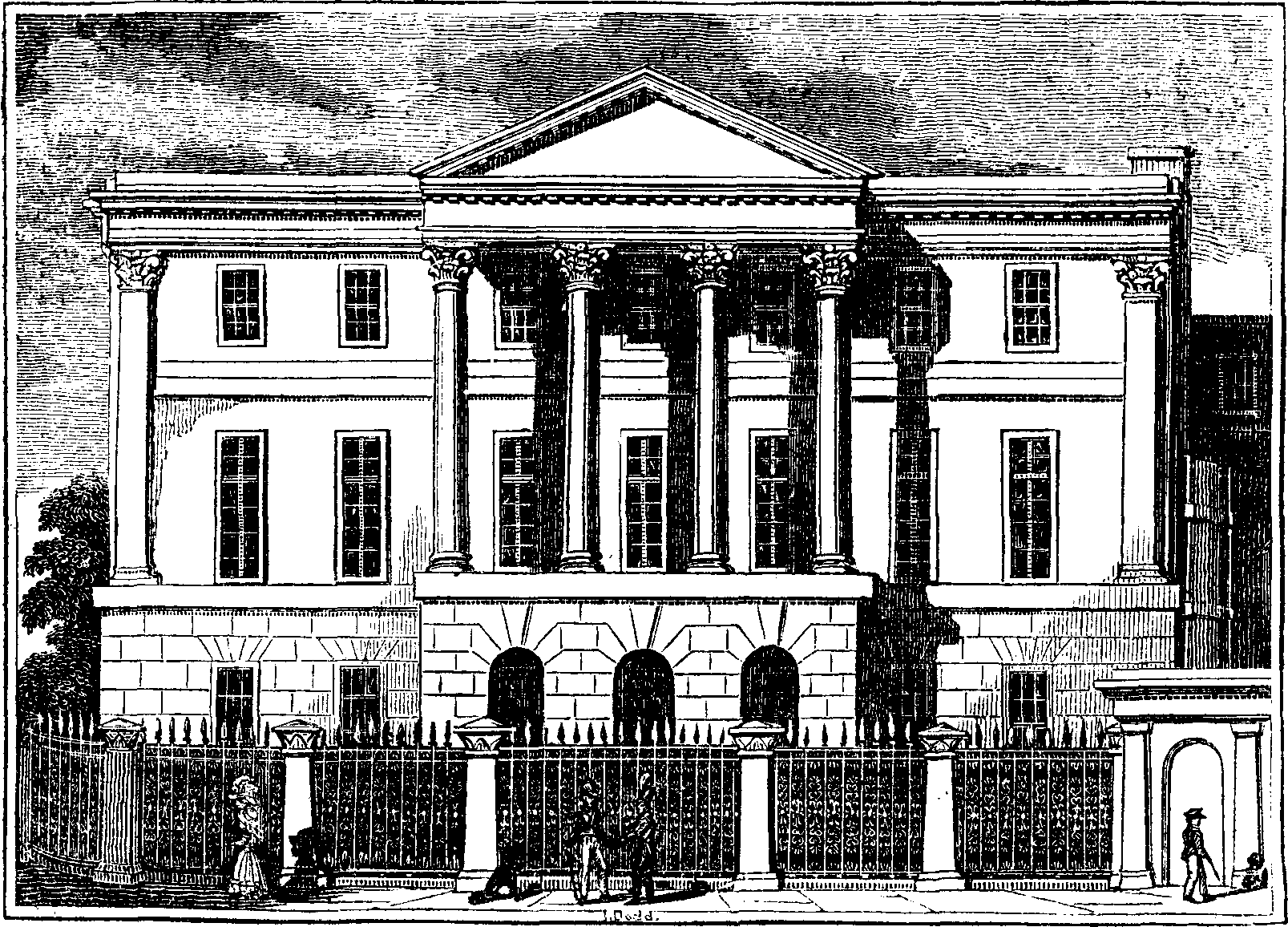
THE MANSION OF HIS GRACE THE DUKE OF WELLINGTON.
The town mansions of our nobility are generally beneath all architectural criticism; and it has been pertinently observed that "an educated foreigner is quite astonished when shown the residences of our higher nobility and gentry in the British capital. He has heard speak of some great nobleman, with a revenue equal to that of a principality. He feels a curiosity to look at his palace, and he is shown a plain, common, brick house of forty or fifty feet in extent." These observations were made about three years ago, since which period, the spirit of architectural improvement has been fast extending from public buildings to individual mansions. Among the latter, the renovation or encasement of Apsley House, at Hyde Park Corner, with a fine stone front, is entitled to foremost notice.
This splendid improvement is from the designs of Benjamin Wyatt, Esq. and is of the Palladian style. The basement story is rusticated, and the principal front has a handsome pediment supported by four columns of the Corinthian order. A bold cornice extends on all sides, which are decorated at the angles with Corinthian pilasters. The whole has an air of substantial elegance, and is in extremely good taste, if we except the door and window cases, which we are disposed to think rather too small. The Piccadilly front is enclosed with a rich bronzed palisade between leaved pillars, being in continuation of the classical taste of the entrance gates to Hyde Park, and the superb entrance to the Royal Gardens on the opposite side of the road. Throughout the whole, the chaste Grecian honey-suckle is introduced with very pleasing effect.
Besides the new frontage, Apsley House has been considerably enlarged, and a slip of ground from Hyde Park added to the gardens. The ball-room, extending the whole depth of the mansion, is one of the most magnificent salons in the metropolis; and a picture gallery is in progress. Altogether, the improvement is equally honourable to the genius of the architect, and the taste of the illustrious proprietor of the mansion; for no foreigner can gainsay that Apsley House has the befitting splendour of a ducal, nay even of a royal palace.
WATLING STREET.
(To the Editor of the Mirror.)
Hoveden thinks it was called the Watling Street from Wathe, or Wathla, a British king. Spelman fancies it was called Werlam Street, from its passing through Verulam. Somner derives the name from the Belgic Wentelen, volvere, versare se, a sinuosis flexibus. Baxter contends that it was made by the original Britons, Weteling, or Oedeling signifying in their language, originarius civis vel ingenuus. Stukeley's opinion, in which he is joined by Whitaker, the Manchester historian, is, that it was the Guetheling road—Sarn Guethelin, or the road of the Irish, the G being pronounced as a W. Dr. Wilkes says, that it is more indented and crooked than other Roman Roads usually are, and supposes that it was formed of Wattles, which was the idea also of Pointer. Mr. Duff is not pleased with the opinion of Camden, that it derives its name from an unknown Vitellianus, but conjectures that its etymology is from the Saxon Wadla, a poor man, a beggar, because such people resorted to this road for the charity of travellers.
The same author, in his Life of Vitellius, seems to strengthen or rather establish the conjecture of its being the Vitellii Strata Via, for he says, (chapter 1,) "indicia, stirpis (Vitelliorum) diu mansisse, Viam Vitelliam ab Janiculo ad mare usque, item coloniam ejusdem nominis." Or, "Some monuments of the family continued a long time, as the Vitellian Way, reaching from the Janiculum to the sea, and likewise a colony of that name." From the abovementioned extracts, it seems not improbable that one of the thirty battles mentioned by Suetonius, might have been fought during the time the Romans were forming this road through the Forest of Arden, which extended from Henley, in Warwickshire, to Market Harborough, in Leicestershire; and that it was called in compliment to Vitellius, the Vitellian Way, afterwards corrupted to the Watling Way.
These were probably raised in honour of some military chiefs who were slain in the battle.
Si quid novisti rectius istis Candidus imperti: si non, his utere mecum.