INTRODUCTORY REMARKS.
Reading edition
The following is a literal transcript of a Journal kept by a common soldier named Samuel Haws, of Wrentham, Massachusetts, who appears to have been one of the minute-men, organized toward the close of 1774 and early in 1775. At that time there were about three thousand British troops in Boston, under General Thomas Gage, who was also governor of the colony of Massachusetts. He was popularly regarded as an oppressor; and act after act of the British government, during a year preceding, had convinced the American people that they must choose the alternative to submit or fight. They resolved to fight, if necessary. During the summer of 1774, the people commenced arming, and training themselves in military exercises; the manufacture of arms and gunpowder was encouraged; and throughout Massachusetts, in particular, the people were enrolled in companies, and prepared to take up arms at a moment's warning. From this circumstance they were called "Minute-Men."
With his strong force, Gage felt quite certain that he could suppress the threatened insurrection, and keep the people quiet. Yet he felt uneasy concerning the gathering of ammunition and stores by the patriots at Concord, sixteen miles from Boston; and on the night of the 18th of April, 1775, he sent a detachment of soldiers to seize them. They proceeded by the way of Lexington, where they arrived at dawn of the 19th. The expedition became known, and the country was aroused. When the British approached Lexington, they were confronted by about seventy minute-men. A skirmish ensued: eight patriots were killed, and several were wounded. That was the first bloodshed of the Revolution. The British then went on to Concord, to seize the stores, where they were again confronted by minute-men. Indeed, they had been annoyed all the way by them, as they fired from behind buildings, stone-walls, and trees. They destroyed the stores, and in a skirmish killed several more American citizens. The country was now thoroughly aroused, and the minute-men hastened toward Lexington and Concord from all directions. The British found it necessary to retreat, and nothing saved the whole troop sent out the night before from utter destruction, but a strong reinforcement under Lord Percy. The whole body retreated hastily to Charlestown, and across to Boston, with a loss, in killed and wounded, of two hundred and seventy-three men. Intelligence of the tragedy soon spread over the country, and from the hills and valleys of New England thousands of men, armed and unarmed, hastened toward Boston, and formed that force (of which our Journalist was one) that, for nine months, kept the British army prisoners upon the peninsulas of Boston and Charlestown. By common consent, Artemas Ward, a soldier of the French and Indian war, was made commander-in-chief, and he performed the duties of that office with zeal until he was superseded by Washington, early in July, 1775.
A JOURNAL FOR 1775.
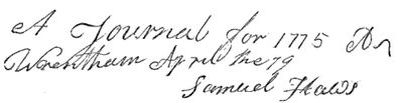
Fac-simile of a Portion of the Manuscript Journal.
D 21. Nothing remarkable this day.
D 22. Nothing Strange this D nor comical.
D 24. Nothing strange to day.
D 25. Nothing remarkable to day.
D 26. We were guarded and a party draughted out for the mane guard.
D 29. About nine o clock the said cheney died about fore in the afternoon We had another alarm but their was nothing done.
May.
1d. Nothing very remarkable this day.
2d-11. Nothing of consequence hapened.
12-14. No great for news.
15, 16. No news worth mentioning.
17. At night their was a fire broke out in Boston ocationed by the kings troops that were a dealing out their Stores when one of the Soldiers letting a candle fall amongst some powder and set it on fire which ocationed the Destruction of a great number of Buildings and killed some Soldiers and destroyed a considerable deal of their amunition Besides a great quantity of flower.
18, 19. Nothing very remarkable.
20. Nothing strange to day.
22. Nothing to day for news.
23-26. Nothing remarkable.
the 29. Nothing remarkable this day.
the 31. Being election day we drank the Ladies health and success.
June the 1. Nothing remarkable hapened this day.
the 2-8. Nothing remarkable hapened.
the 10. Their was a man Whiped for Stealing.
the 12. Nothing Strange this day.
the 13. Dito.
the 15. Nothing remarkable this day.
the 16. Nothing of consiquence this day.
the 19. Nothing remarkable this day.
the 20. Dito.
the 21. Nothing worth a mentioning.
the 22. Dito.
the 23. Nothing remarkable to day.
the 25. Sunday Nothing remarkable.
the 27. Nothing remarkable this day.
the 28. We moved to a little house that capt Bligs formerly Lived in but we Soon moved from there to Slaks house again.
the 29. Nothing remarkable this day.
the 30. Nothing hapened only there was a Smart shower.
July.
the 1. Nothing remarkable this day.
the 4. Their was a flag of truce come out of town to our centry on the neck.
the 5. Nothing worth a mentioning to day.
the 6. Nothing remarkable this day.
the 8, 9. Nothing remarkable.
the 11. Nothing remarkable this day.
the 13. Nothing remarkable this day.
the 14. Nothing remarkable untill night and then their was a man killed at the main guard with a canon Ball.
the 15-17. Nothing remarkable.
the 19. We had an alarm and we went to our alarm Post and stayed their about one hour and could not discover any thing and so we returned to our Baracks again.
the 21-24. Nothing remarkable.
the 25. Our Regement with four more were under arms and marched towards cambridg to meet general Ward.
the 26. General Heaths regement moved from Dorchester to cambridg and Jeneral Wards regement moved from cambridg to Dorchester and took general Heath's Baracks.
the 27. Nothing remarkable this day.
the 28. Dito.
the 29. Nothing bad.
August Domina 1775.
the 2. Nothing remarkable this day.
the 3. Dito.
the 4. Nothing remarkable to day only I went to the main guard and the enemy fired at us as we came up.
the 5. Dito.
the 6. Being Sunday nothing remarkable at night I went on the piquet guard.
the 7. Nothing strange.
the 8. Dito.
the 9. Nothing remarkable this day only I went upon fatigue.
the 10. Nothing strange We had a great rain.
the 11. Their was three men whipt for deserting they were whipt ten stripes apiece they belonged to the conecticut forces.
14. Their was Nothing Remarcable I went upon fatigue down to the George tavern.
the 16. This day they fired at our main guard but no material Damage was done the remaining part of their mallice seemed to be postponed to a future season our american guard kept their ground and the night passed without any alarm &c. &c.
the 17. About nine Oclock the enemy fired upon our main guard and fatigue men they through 4 Balls and 2 Bombs and one of the Balls struck 2 guns which belonged to the main guard and the men had them on their Shoulders but did not hurt them much.
the 18. Behold their Spite this morning before the sun rise the enemy fired at our working party on the neck this side the george tavern our rifle men fired at them and it is thought killed too of them but notwithstanding all their fireing of balls and bombs though some of them came so near that it could hardly be called an escape yet their was not one man wounded on our side one bomb was thrown in the evening but did no Damage one of the enemy came to our centrys and is now in our guard house.
the 19. I went upon fatigue the morning began with fireing from the wicked enemy at our guard but did no hurt in the afternoon they rifle men fired at the enemy and they enemy at them and they wounded one of the rifle men in the foot Slitely but what Damage we did them is uncertain let this Suffice for a short acount of the tranactions of the 19 day.
the 21. Nothing remarkable hapened this day at night one of the enemy deserted and came to us.
the 22. We paraded nothing remarkable I went down to the piquet.
the 23, 24. Nothing remarkable.
the 25. A flag of truce came out of town but for what I dont know.
the 26. This morning their was a man ran away from the floating battery.
the 28. But they still hold up their firing at Bunkers hill nothing more remarkable this day.
the 29. I went upon the piquet down to the george tavern and the enemy fired several small arms at us but did us no Damage.
the 30. Very rainy nothing extraordinary this day.
Septem.
the 3. Being Sunday we turned out about day and went to our alarm post and it rained and we cam home and John coleman drinkt 3 pints cyder at one draught nothing more remarkable this day.
the 5. Nothing remarkable only Benjamin Mc Lain sent home 10 Letters at one draught by Lieutenant Bacon and Lieutenant Foster had Likt to have been put under guard for playing ball.
the 6. Nothing remarkable this day at Night our men went down below the george tavern for a safe guard for the centrys.
the 8. Came of the creek guard and nothing remarkable hapned onely they enemy fired at our fatigue party but did no damage at night upon the door guard.
the 10. Being Sunday our men went on fatigue and the enemy fired upon them and broke three guns that were paraded but hurt no man at night their was a man deserted from cambridg and went to the enemy.
the 11. We turned out and went to our alarm post and Ensign Parot shook one of his men for disobying orders this day their was a boat drove ashore belonging to the regulars and a Seargent and 5 men on board and they were all taken prisoners at night I went upon the piquet and was almost frozen to Death.
the 12. Our men went down to Lambs Dam to entrenching not above half a mile from the enemys brest work but nothing remarkable hapened.
the 16. Nothing remarkable hapened only the regulars fired several Shot at our men that were upon fatigue but did no Damage.
the 17. Being Sunday I went upon the fatigue and the enemy fired several times at our men but did no Damage and they threw several Bombs.
the 18. I came of the creek guard and the enemy fired several canon at our men but killed none and onely wounded one or too slitely and Last night their was several men ran away from a man of war and toward night the enemy fired several Shots from the Ship in cambridg bay and our men fired one Shot from Prospect hill at the Ship in the Bay but did not strike her.
the 19. The enemy began to fire about eight oclock into the street but did no damage except slitely wounding one or too at night I went upon the piquet and Nothing remarkable hapened also their was a man put under guard for comeing on to the parade Drunk.
the 20. Nothing remarkable hapened this day the enemy fired one shot at our fatigue party but did no damage they fired over at Bunkers hill and threw several Bombs.
the 21. Last night I was on the door guard and this morning the enemy fired small arms at our men but did no Damage in the afternoon they fired canon but to no purpose.
the 24. Being Sunday we went to meting and heard a fine Sermon from psalms 14-11 this day our men went on fatigue as usual but the enemy did not fire upon them.
the 25. I went on fatigue down in the thicket in the forenoon and at noon I was taken not well and did not go in the afternoon our men fired three field peices at the enemy but what execution they did we canot determine nothing more.
the 26. Nothing remarkable hapened this day onely their was 200 men draughted out to go to the governors Island to take some cattle.
the 28. Nothing remarkable hapened this day there was too guns fired from the ship in Cambrige Bay.
the 29. This day the Ship sailed out of cambridge Bay and their was another came and took her place at night I went on the piquet without any supper nothing remarkable.
the 30. This morning our men fired one field peice as the regulars came to relieve their main guard and that afronted them and they began to fire their canon from their brest work and floating Batry and they fired about 30 canon but did no damage also last night their was too regulars deserted and came to our centrys on the neck nothing more remarkable this day.
October A 1775.
the 2. Nothing remarkable hapned this day General Thomas Brigade passt Mustter about Sunset as our piquet paraded on the grand parade the enemy fired 3 or 4 shots up to the meeting house one of the balls went through the shed by the Providence tavern but did no damage of consequence at night our chimney Swallow went on the piquet for nothing and found himself.
the 3. Nothing remarkable hapened this day at night I went upon the piquet.
the 4. We past muster nothing remarkble hapened this day onely their was four of the enemy deserted at night.
the 6. The enemy fired between 80 and 90 Canon at our men but killed nine onely cut of one mans arm and killed too cows So much for this day.
the 7. I went upon the creek guard and nothing remarkable hapned at night their was a regular deserted and the regular guard fired upon him but did not hurt him.
the 8. Being Sunday it rained and we had no preaching nothing remarkable hapned at night their was a regular deserted and came to our men and their was another set out but they were discovered and they took one of them.
the 10. I went up on the creek guard and nothing remarkable hapened their.
the 12. This day nothing remarkable hapned only I went to work along with the general at Mr. Parkers at night I went upon the piquet.
the 13. About 2 or 3 o clock their was one of our men taken and caried to the quarter guard for thieft abel Weatheril by name but it was made up and he was taken out at night and returned to his Duty.
the 14. This day nothing remarkable hapned.
the 18. I went upon the creek guard and John Bates was Lanch corporeal also in the afternoon their was 3 Boston men came out under pretence of fishing but they made their escape to Dorchester point.
the 19. Was rainy and nothing remarkable hapned.
the 22. Being Sunday nothing remarkable this day.
the 23. Nothing remarkable hapned at night I went upon the piquet and nothing hapned worth a mentioning.
the 26. This morning early their was several Laidies came down from wrentham and they went to cambridg and the rest of their acts are they not writen in the Lamentations of Samuel Haws, finis.
the 27. This day I went upon fatigue and we got our Stents done about noon.
the 28. Nothing remarkable this day onely I was chose cook for our room consisting of 12 men and a hard game too.
the 29. Being Sunday the officers had hard work to get hands for meting it was so cold nothing more this day.
the 30. This day nothing remarkable hapned.
November 1775.
the 1. Las night the fire ran over Samuel Hawes's hair and that provoket him to wrath Nothing very remarkable hapned this day that I know of.
the 2. their was Some gentlemen and Laidies came down from Wrentham and they went to cambridg.
the 3. It was a very rainy day and we went to childses and had an old fudg fairyouwell my friends.
the 4. Nothing remarkable hapned this day onely the gentry went home to Wrentham.
the 5. Being the memorial 5th of novem. the enemy fired from every Ship in the harbour nothing more remarkable this day.
the 6. Nothing remarkable hapned this day.
the 7. Their was a vendue opened att this house and their was not Less than a hundred and twenty Dollars worth of things vendued and sold at private sale and Swapt.
the 8. Nothing remarkable hapned this day that I know of.
the 11. I went to captain whitings and nothing remarkable hapned.
the 12. Being Sunday I went to meting Nothing more this day.
the 13. This day the Long faced People trained at Wrentham and Serg Felt went upon the piquet and fired several times upon the centrys.
the 17. Very blustering and their was a man Whipt thirty and nine Lashes for Stealing and getting Drunk and running away and afterwards he was drummed out of the camps thus he &c.
the 18. Nothing remarkable hapned this day that I know of.
the 19. This day being Sunday it was very pleasant and we had Preaching Nothing more this day.
the 20. This day nothing very remarkable at night their was a regular deserted and Swam over to Dorchester and escaped.
the 21. This day Nothing very remarkable this day the piquet was made easier by half &c. &c.
the 22. To morrow is thanksgiveing this day ended without any thing remarkable.
the 24. Nothing hapned very remarkable this day that I know of.
the 26. Being Sunday it was Stormy Nothing remarkable this day.
the 27. Nothing very remarkable hapned this day.
the 28. Nothing very Strange onely Peperiss curacle came out of Boston that old tory Dog.
the 30. Nothing extreordenary this day that I know of.
December.
the 1. Nothing remarkable this day.
the 3. Being Sunday it rained nothing remarkable hapned this day.
the 5. Nothing Strange hapned this day.
the 7. This day nothing Strang.
the 8. This day I with several more inlisted for the year 1776 under captain Oliver Pond.
the 9. Nothing remarkable this day.
the 12. This day it was very cold and the melitia had to mount guard that is good for them.
the 15. This day nothing very remarkable.
the 19. This day nothing remarkable hapned.
the 20. Nothing strange this day.
the 21. This day it was very cold nothing strange this day.
the 22. Nothing remarkable this day.
the 23. Nothing strange this day.
the 24. Ditto Ditto Ditto.
the 25. Good.
the 26. Very cold this day nothing remarkable this day.
the 27. Nothing remarkable to day.
the 28. Nothing strange this day.
the 30, 31. Nothing remarkable.
January.
the 2. Nothing strange this day.
the 4. Nothing remarkable this day.
the 5-7. Nothing strange.
the 9. Nothing remarkable this day.
the 10. Nothing very remarkable this day it was very cold.
the 11. Nothing very remarkable this day.
the 12. All furlows stopt this day.
the 13. Nothing strange this day.
the 14. Being Sunday nothing remarkable this day.
the 16. Nothing remarkable hapened this day at night we were all ordered to Ly upon our arms.
the 18. Nothing strange this day.
the 20. Nothing remarkable this day.
the 21. Ditto.
the 22. Nothing strange.
the 23. Nothing remarkable.
the 24. This day capt Pond came from Wrentham Nothing remarkable.
the 25. Nothing remarkable this day.
the 26. Nothing very remarkable.
the 27. Nothing remarkable this day.
the 28. Nothing remarkable.
the 29. This day we moved to Dorchester into the widow Birds house.
the 30. Nothing strange this day.
the 31. Ditto.
February.
the 1. This day nothing remarkable.
the 2. Ditto.
the 3. Nothing Remarkable this day.
the 4. Ditto.
the 5. The Lobsters came out almost to copple hill and took 3 cows and killed them and were fired upon from copple hill and they were obligd to mak of Leaving their Booty behind them.
the 7. Nothing very remarkable this day.
the 8. Their was a number of our men went a Scating on the Bay near Bosston common and the Enemy fired upwards of a hundred small arms that did no damage.
the 9. Nothing very remarkable at night their was thre of our Amarican Boys made their escape from the Enemy in Boston and were taken up by our men who were Patroling on Dorchester Point to and they brought of things to considerable value.
SUPPLEMENT, CONTAINING OFFICIAL PAPERS ON THE SKIRMISHES AT LEXINGTON AND CONCORD, AND A LIST OF REVOLUTIONARY ARTICLES IN THE POUGHKEEPSIE MUSEUM.
SUPPLEMENT.
OFFICIAL PAPERS concerning THE SKIRMISHES AT LEXINGTON AND CONCORD.
In the preceding Journal of a Soldier, in 1775, his narrative commences on the day of the skirmishes at Lexington and Concord, the opening conflicts of the Revolution. Some official matters relating to those events, which are inaccessible to the general reading-public, will doubtless be acceptable, as they certainly are appropriate, in this connection.
The skirmishes occurred on the 19th of April, 1775. On the 22d, the Provincial Congress of Massachusetts assembled, and, deeming it important to have the whole truth known, appointed a committee to take depositions in relation to the transactions of the British troops in their route to and from Concord. Another committee was appointed the following day, consisting of Dr. Church, Elbridge Gerry, and Thomas Cushing, to draw up a narrative of the massacre. The committee to take depositions held their sessions at Concord and Lexington, on the 23d and 25th of April. Feeling it to be expedient to send an account immediately to England, a committee, consisting of Dr. Warren, Mr. Freeman, Mr. Gardiner, and Colonel Stone, was chosen to prepare a letter to Dr. Franklin, the colonial agent in London. They reported a letter, and also an "Address to the Inhabitants of Great Britain," on the same day. Captain Richard Derby, of Salem, was employed to proceed immediately with the despatches. He placed them in the hands of Doctor Franklin on the 29th of May, and on the following day the address was printed and circulated. It gave the first intelligence of the skirmishes at Lexington and Concord, to the British public.
The following, copied from the Journals of the Continental Congress, are the several papers referred to:—
"To the Hon. Benjamin Franklin, Esq., at London.
"In Provincial Congress, Watertown, April 26, 1775.
"Sir: From the entire confidence we repose in your faithfulness and abilities, we consider it the happiness of this colony that the important trust of agency for it, in this day of unequalled distress, is devolved on your hands, and we doubt not your attachment to the cause and liberties of mankind will make every possible exertion in our behalf a pleasure to you; although our circumstances will compel us often to interrupt your repose, by matters that will surely give you pain. A singular instance hereof is the occasion of the present letter. The contents of this packet will be our apology for troubling you with it.
"From these you will see how, and by whom, we are at last plunged into the horrors of a most unnatural war.
"Our enemies, we are told, have despatched to Great Britain a fallacious account of the tragedy they have begun; to prevent the operation of which to the public injury, we have engaged the vessel that conveys this to you, as a packet in the service of this colony, and we request your assistance in supplying Captain Derby, who commands her, with such necessaries as he shall want, on the credit of your constituents in Massachusetts Bay.
"But we most ardently wish that the several papers herewith enclosed may be immediately printed and dispersed through every town in England, and especially communicated to the lord-mayor, aldermen, and council, of the city of London, that they may take such order thereon as they may think proper. And we are confident your fidelity will make such improvement of them as shall convince all, who are not determined to be in everlasting blindness, that it is the united efforts of both Englands that can save either: but that whatever price our brethren in the one may be pleased to put on their constitutional liberties, we are authorized to assure you that the inhabitants of the other, with the greatest unanimity, are inflexibly resolved to sell theirs only at the price of their lives.
"Signed by order of the Provincial Congress, "Joseph Warren, President, P. T.
"A true copy from the original minutes, "Samuel Freeman, Sec. P. T."
The depositions relative to the commencement of hostilities are as follows:—
"Lexington, April 25, 1775.
"We, Solomon Brown, Jonathan Loring, and Elijah Sanderson, all of lawful age, and of Lexington, in the county of Middlesex, and colony of the Massachusetts Bay in New England, do testify and declare that, on the evening of the 18th of April, instant, being on the road between Concord and Lexington, and all of us mounted on horses, we were, about ten of the clock, suddenly surprised by nine persons, whom we took to be regular officers, who rode up to us, mounted and armed, each having a pistol in his hand, and, after putting pistols to our breasts, and seizing the bridles of our horses, they swore, if we stirred another step, we should be all dead men, upon which we surrendered ourselves. They detained us until two o'clock the next morning, in which time they searched and greatly abused us, having first inquired about the magazine at Concord, whether any guards were posted there, and whether the bridges were up, and said four or five regiments of regulars would be in possession of the stores soon. They then brought us back to Lexington, cut the horses' bridles and girths, turned them loose, and then left us.
"Solomon Brown, "Jonathan Loring, Elijah Sanderson."
"Lexington, April 25, 1775.
"I, Elijah Sanderson, above named, do further testify and declare, that I was on Lexington common, the morning of the 19th of April aforesaid, having been dismissed by the officers above mentioned, and saw a large body of regular troops advancing toward Lexington company, many of whom were then dispersing. I heard one of the regulars, whom I took to be an officer, say, "Damn them, we will have them;" and immediately the regulars shouted aloud, run and fired upon the Lexington company, which did not fire a gun before the regulars discharged on them. Eight of the Lexington company were killed while they were dispersing, and at a considerable distance from each other, and many wounded; and, although a spectator, I narrowly escaped with my life.
"Elijah Sanderson."
"Lexington, April 23, 1775.
"I, Thomas Rice Willard, of lawful age, do testify and declare that, being in the house of Daniel Harrington, of said Lexington, on the 19th instant, in the morning, about half an hour before sunrise, looked out at the window of said house, and saw (as I suppose) about four hundred regulars in one body, coming up the road, and marched toward the north part of the common, back of the meeting-house of said Lexington; and as soon as said regulars were against the east end of the meeting-house, the commanding officer said something, what I know not, but upon that the regulars ran till they came within about eight or nine rods of about a hundred of the militia of Lexington, who were collected on said common, at which time the militia of Lexington dispersed. Then the officers made a huzza, and the private soldiers succeeded them: directly after this, an officer rode before the regulars to the other side of the body, and hallooed after the militia of said Lexington, and said, "Lay down your arms, damn you, why don't you lay down your arms?"—and that there was not a gun fired till the militia of Lexington were dispersed. And further saith not.
"Thomas Rice Willard."
"Lexington, April 25, 1775.
"Simon Winship, of Lexington, in the county of Middlesex, and province of Massachusetts Bay, New England, being of lawful age, testifieth and saith, that on the 19th April instant, about four o'clock in the morning, as he was passing the public road in said Lexington, peaceably and unarmed, about two miles and a half distant from the meeting-house in said Lexington, he was met by a body of the king's regular troops, and being stopped by some officers of said troops, was commanded to dismount. Upon asking why he must dismount, he was obliged by force to quit his horse, and ordered to march in the midst of the body; and, being examined whether he had been warning the minute-men, he answered, 'No, but had been out, and was then returning to his father's.' Said Winship farther testifies that he marched with said troops, till he came within about half a quarter of a mile of said meeting-house, where an officer commanded the troops to halt, and then to prime and load: this being done, the said troops marched on till they came within a few rods of Captain Parker's company, who were partly collected on the place of parade, when said Winship observed an officer at the head of said troops, flourishing his sword, and with a loud voice giving the word, 'Fire! fire!' which was instantly followed by a discharge of arms from said regular troops; and said Winship is positive, and in the most solemn manner declares, that there was no discharge of arms on either side, till the word 'Fire' was given by the said officer as above.
"Simon Winship."
Lexington, April 25, 1775.
"I, John Parker, of lawful age, and commander of the militia in Lexington, do testify and declare that, on the 19th instant, in the morning, about one of the clock, being informed that there were a number of regula-officers riding up and down the road, stopping and insulting people as they passed the road; and also was informed that a number of regular troops were on their march from Boston, in order to take the province stores at Concord, ordered our militia to meet on the common in said Lexington, to consult what to do, and concluded not to be discovered, nor meddle or make with said regular troops (if they should approach), unless they should insult or molest us; and, upon their sudden approach, I immediately ordered our militia to disperse, and not to fire. Immediately said troops made their appearance, and rushed furiously, fired upon, and killed eight of our party, without receiving any provocation therefor from us.
"John Parker."
Lexington, April 24, 1775.
"I, John Robins, being of lawful age, do testify and say that, on the 19th instant, the company under the command of Captain John Parker, being drawn up (some time before sunrise) on the green or common, and I being in the front rank, there suddenly appeared a number of the king's troops, about a thousand, as I thought, at the distance of about sixty or seventy yards from us, huzzaing, and on a quick pace toward us, with three officers in their front on horseback, and on full gallop toward us, the foremost of which cried, 'Throw down your arms, ye villains, ye rebels!' upon which said company dispersing, the foremost of the three officers ordered their men, saying, 'Fire, by God! fire!' at which moment we received a very heavy and close fire from them; at which instant, being wounded, I fell, and several of our men were shot dead by me. Captain Parker's men, I believe, had not then fired a gun. And further the deponent saith not.
"John Robins."
"Lexington, April 25, 1775.
"We, Benjamin Tidd, of Lexington, and Joseph Abbot, of Lincoln, in the county of Middlesex, and colony of Massachusetts Bay, in New England, of lawful age, do testify and declare that, on the morning of the 19th of April instant, about five o'clock, being on Lexington common, and mounted on horses, we saw a body of regular troops marching up to the Lexington company, which was then dispersing. Soon after, the regulars fired, first, a few guns, which we took to be pistols from some of the regulars who were mounted on horses, and then the said regulars fired a volley or two before any guns were fired by the Lexington company; our horses immediately started, and we rode off. And further say not.
"Benjamin Tidd, Joseph Abbot."
"Lexington, April 25, 1775.
"We, Nathaniel Mullokin, Philip Russell, Moses Harrington, jun., Thomas and Daniel Harrington, William Grimes, William Tidd, Isaac Hastings, Jonas Stone, jun., James Wyman, Thaddeus Harrington, John Chandler, Joshua Reed, jun., Joseph Simonds, Phineas Smith, John Chandler, jun., Reuben Cock, Joel Viles, Nathan Reed, Samuel Tidd, Benjamin Lock, Thomas Winship, Simeon Snow, John Smith, Moses Harrington the 3d, Joshua Reed, Ebenezer Parker, John Harrington, Enoch Willington, John Hornier, Isaac Green, Phineas Stearns, Isaac Durant, and Thomas Headley, jun., all of lawful age, and inhabitants of Lexington, in the county of Middlesex, and colony of the Massachusetts Bay, in New England, do testify and declare, that, on the 19th of April instant, about one or two o'clock in the morning, being informed that several officers of the regulars had, the evening before, been riding up and down the road, and had detained and insulted the inhabitants passing the same; and also understanding that a body of regulars were marching from Boston toward Concord, with intent (as it was supposed) to take the stores, belonging to the colony, in that town, we were alarmed, and having met at the place of our company's parade, were dismissed by our captain, John Parker, for the present, with orders to be ready to attend at the beat of the drum. We further testify and declare, that, about five o'clock in the morning, hearing our drum beat, we proceeded toward the parade, and soon found that a large body of troops were marching toward us. Some of our company were coming up to the parade, and others had reached it, at which time the company began to disperse. While our backs were turned on the troops, we were fired on by them, and a number of our men were instantly killed and wounded. Not a gun was fired by any person in our company on the regulars, to our knowledge, before they fired on us, and they continued firing until we had all made our escape.
"Signed by each of the above deponents,"
"Lexington, 25th of April, 1775.
"We, Nathaniel Parkhurst, Jonas Parker, John Munroe, jun., John Winship, Solomon Pierce, John Muzzy, Abner Meeds, John Bridge, jun., Ebenezer Bowman, William Munroe the 3d, Micah Hager, Samuel Saunderson, Samuel Hastings, and James Brown, of Lexington, in the county of Middlesex, and colony of the Massachusetts Bay, in New England, and all of lawful age, do testify and say, that, on the morning of the 19th of April instant, about one or two o'clock, being informed that a number of regular officers had been riding up and down the road the evening and night preceding, and that some of the inhabitants, as they were passing, had been insulted by the officers, and stopped by them; and being also informed that the regular troops were on their march from Boston, in order (as it was said) to take the colony stores then deposited at Concord, we met on the parade of our company in this town. After the company had collected, we were ordered by Captain Parker (who commanded us) to disperse for the present, and to be ready to attend the beat of the drum; and accordingly the company went into houses near the place of parade. We further testify and say, that, about five o'clock in the morning, we attended the beat of our drum, and were formed on the parade; we were faced toward the regulars then marching up to us, and some of our company were coming to the parade with their backs toward the troops, and others, on the parade, began to disperse, when the regulars fired on the company, before a gun was fired by any of our company on them. They killed eight of our company, and wounded several, and continued their fire until we had all made our escape.
"Signed by each of the deponents."
"Lexington, April 25, 1775.
"I, Timothy Smith, of Lexington, in the county of Middlesex, and colony of Massachusetts Bay, in New England, being of lawful age, do testify and declare, that, on the morning of the 19th of April instant, being on Lexington common, as a spectator, I saw a large body of regular troops marching up toward the Lexington company, then dispersing, and likewise saw the regular troops fire on the Lexington company, before the latter fired a gun. I immediately ran, and a volley was discharged at me, which put me in imminent danger of losing my life. I soon returned to the common, and saw eight of the Lexington men who were killed, and lay bleeding at a considerable distance from each other; and several were wounded. And further saith not.
"Timothy Smith."
"Lexington, April 25, 1775.
"We, Levi Mead and Levi Harrington, both of Lexington, in the county of Middlesex, and colony of Massachusetts Bay, in New England, and of lawful age, do testify and declare, that, on the morning of the 19th of April, being on Lexington commons, as spectators, we saw a large body of regular troops marching up toward the Lexington company; and some of the regulars, on horses, whom we took to be officers, fired a pistol or two on the Lexington company, which was then dispersing. These were the first guns that were fired, and they were immediately followed by several volleys from the regulars, by which eight men belonging to said company were killed, and several wounded.
"Levi Harrington, Levi Mead."
"Lexington, April 25, 1775.
"I, William Draper, of lawful age, and an inhabitant of Colrain, in the county of Hampshire, and colony of Massachusetts Bay, in New England, do testify and declare, that, being on the parade of said Lexington, April 19th instant, about half an hour before sunrise, the king's regular troops appeared at the meeting-house of Lexington. Captain Parker's company, who were drawn up back of said meeting-house on the parade, turned from said troops, making their escape, by dispersing. In the meantime, the regular troops made a huzza, and ran toward Captain Parker's company, who were dispersing; and, immediately after the huzza was made, the commanding officer of said troops (as I took him) gave the command to the said troops—"Fire! fire! damn you, fire!"—and immediately they fired, before any of Captain Parker's company fired, I then being within three or four rods of said regular troops. And further say not.
"William Draper."
"Lexington, April 23, 1775.
"I, Thomas Fessenden, of lawful age, testify and declare, that, being in a pasture near the meeting-house, at said Lexington, on Wednesday last, at about half an hour before sunrise, I saw a number of regular troops pass speedily by said meeting-house, on their way toward a company of militia of said Lexington, who were assembled to the number of about one hundred in a company, at the distance of eighteen or twenty rods from said meeting-house; and after they had passed by said meeting-house, I saw three officers, on horseback, advance to the front of said regulars, when one of them, being within six rods of the said militia, cried out, "Disperse, you rebels, immediately!" on which he brandished his sword over his head three times: meanwhile, the second officer, who was about two rods behind him, fired a pistol, pointed at said militia, and the regulars kept huzzaing till he had finished brandishing his sword; and when he had thus finished brandishing his sword, he pointed it down toward said militia, and immediately on which the said regulars fired a volley at the militia, and then I ran off as fast as I could, while they continued firing till I got out of their reach. I further testify, that, as soon as ever the officer cried, "Disperse, you rebels," the said company of militia dispersed every way, as fast as they could; and, while they were dispersing, the regulars kept firing at them incessantly. And further saith not.
"Thomas Fessenden."
"Lincoln, April 23, 1775.
"I, John Bateman, belonging to the fifty-second regiment, commanded by Colonel Jones, on Wednesday morning, on the 19th day of April instant, was in the party marching to Concord, being at Lexington, in the county of Middlesex, being nigh the meeting-house in said Lexington, there was a small party of men gathered together at that place, when our said troops marched by; and I testify and declare that I heard the word of command given to the troops to fire, and some of said troops did fire, and I saw one of said small party lay dead on the ground nigh said meeting-house; and I testify that I never heard any of the inhabitants so much as fire one gun on said troops.
"John Bateman."
"Lexington, April 23, 1775.
"We, John Hoar, John Whithead, Abraham Garfield, Benjamin Munroe, Isaac Parks, William Hosmer, John Adams, Gregory Stone, all of Lincoln, in the county of Middlesex, Massachusetts Bay, all of lawful age, do testify and say that, on Wednesday last, we were assembled at Concord, in the morning of said day, in consequence of information received that a brigade of regular troops were on their march to the said town of Concord, who had killed six men at the town of Lexington. About an hour afterward, we saw them approaching, to the number, as we apprehended, of about twelve hundred, on which we retreated to a hill about eighty rods back, and the said troops then took possession of the hill where we were first posted. Presently after this we saw the troops moving toward the north bridge, about one mile from the said Concord meeting-house. We then immediately went before them and passed the bridge just before a party of them, to the number of about two hundred, arrived. They there left about one half of their two hundred at the bridge, and proceeded with the rest toward Colonel Barrett's, about two miles from the said bridge. We then, seeing several fires in the town, thought the houses in Concord were in danger, and marched toward the said bridge; and the troops that were stationed there, observing our approach, marched back over the bridge, and then took up some of the planks. We then hastened our march toward the bridge, and, when we had got near the bridge, they fired on our men—first three guns, one after the other, and then a considerable number more; and then, and not before (having orders from our commanding officers not to fire till we were fired upon), we fired upon the regulars, and they retreated. On their retreat through the town of Lexington to Charlestown, they ravaged and destroyed private property, and burnt three houses, one barn, and one shop.
"Signed by each of the above deponents."
"Lexington, April 23, 1775.
"We, Nathan Barret, captain; Jonathan Farrar, Joseph Butler, and Francis Wheeler, lieutenants; John Barret, ensign; John Brown, Silas Walker, Ephraim Melvin, Nathan Buttrick, Stephen Hosmer, jun., Samuel Barret, Thomas Jones, Joseph Chandler, Peter Wheeler, Nathan Pierce, and Edward Richardson, all of Concord, in the county of Middlesex, in the province of Massachusetts Bay, of lawful age, testify and declare, that, on Wednesday, the 19th instant, about an hour after sunrise, we assembled on a hill near the meeting-house in Concord aforesaid, in consequence of an information that a number of regular troops had killed six of our countrymen at Lexington, and were on their march to said Concord; and, about an hour afterward, we saw them approaching, to the number, as we imagine, of about twelve hundred; on which we retreated to a hill about eighty rods back, and the aforesaid troops then took possession of a hill where we were first posted. Presently after this, we saw them moving toward the north bridge, about one mile from said meeting-house; we then immediately went before them, and passed the bridge just before a party of them, to the number of about two hundred, arrived. They there left about one half of these two hundred at the bridge, and proceeded with the rest toward Colonel Barret's, about two miles from the said bridge. We then, seeing several fires in the town thought our houses were in danger, and immediately marched back toward said bridge, and the troops who were stationed there, observing our approach, marched back over the bridge, and then took up some of the planks. We then hastened our steps toward the bridge, and when we had got near the bridge, they fired on our men—first three guns, one after the other, and then a considerable number more; upon which, and not before (having orders from our commanding officer not to fire till we were fired upon), we fired upon the regulars, and they retreated. At Concord, and on their retreat through Lexington, they plundered many houses, burnt three at Lexington, together with a shop and barn, and committed damage, more or less, to almost every house from Concord to Charlestown.
"Signed by the above deponents."
"We, Joseph Butler and Ephraim Melvin, do testify and declare, that, when the regular troops fired upon our people at the north bridge, in Concord, as related in the foregoing depositions, they shot one, and we believe two, of our people, before we fired a single gun at them.
"Joseph Butler, Ephraim Melvin. "Lexington, April 23, 1775."
"Concord, April 23, 1775.
"I, Timothy Minot, jun., of Concord, on the 19th day of this instant, April, after that I had heard of the regular troops firing upon Lexington men, and fearing that hostilities might be committed at Concord, thought it my incumbent duty to secure my family. After I had secured my family, some time after that, returning toward my own dwelling, and finding that the bridge on the north part of said Concord was guarded by regular troops, being a spectator of what had happened at said bridge, declare that the regular troops stationed on said bridge, after they saw the men that were collected on the westerly side of said bridge, marched toward said bridge; then the troops returned toward the easterly side of said bridge, and formed themselves, as I thought, for regular fight: after that they fired one gun, then two or three more, before the men that were stationed on the westerly part of said bridge fired upon them.
"Timothy Minot, jun."
"Lexington, April 23, 1775.
"I, James Barret, of Concord, colonel of a regiment of militia, in the county of Middlesex, do testify and say that, on Wednesday morning last, about daybreak, I was informed of the approach of a number of the regular troops to the town of Concord, where were some magazines belonging to this province, when there was assembled some of the militia of this and the neighboring towns, I ordered them to march to the north bridge (so called), which they had passed and were taking up. I ordered said militia to march to said bridge and pass the same, but not to fire on the king's troops unless they were first fired upon. We advanced near said bridge, when the said troops fired upon our militia, and killed two men dead on the spot, and wounded several others, which was the first firing of guns in the town of Concord. My detachment then returned the fire, which killed and wounded several of the king's troops.
"James Barret."
"Lexington, April 23, 1775.
"We, Bradbury Robinson, Samuel Spring, Thaddeus Bancroft, all of Concord, and James Adams, of Lexington, all in the county of Middlesex, all of lawful age, do testify and say, that, on Wednesday morning last, near ten of the clock, we saw near one hundred of the regular troops, being in the town of Concord, at the north bridge in said town (so called); and having passed the same, they were taking up said bridge, when about three hundred of our militia were advancing toward said bridge, in order to pass said bridge, when, without saying anything to us, they discharged a number of guns on us, which killed two men dead on the spot, and wounded several others; when we returned the fire on them, which killed two of them, and wounded several, which was the beginning of hostilities in the town of Concord.
"Bradbury Robinson, Thaddeus Bancroft, "Samuel Spring, James Adams."
"Worcester, April 26, 1775.
"Hannah Bradish, of that part of Cambridge called Menotomy, and daughter of Timothy Paine, of Worcester, in the county of Worcester, Esq., of lawful age, testifies and says, that, about five o'clock on Wednesday last, afternoon, being in her bedchamber, with her infant child, about eight days old, she was surprised by the firing of the king's troops and our people, on their return from Concord. She being weak and unable to go out of her house, in order to secure herself and family, they all retired into the kitchen, in the back part of the house. She soon found the house surrounded with the king's troops; that upon observation made, at least seventy bullets were shot into the front part of the house; several bullets lodged in the kitchen where she was, and one passed through an easy-chair she had just gone from. The door of the front part of the house was broke open; she did not see any soldiers in the house, but supposed, by the noise, they were in the front. After the troops had gone off, she missed the following things, which, she verily believes, were taken out of the house by the king's troops, viz., one rich brocade gown, called a negligee, one lutestring gown, one white quilt, one pair of brocade shoes, three shifts, eight white aprons, three caps, one case of ivory knives and forks, and several other small articles.
"Hannah Bradish."
Province of the Massachusetts Bay, Worcester, ss., April 26, 1775.
"Mrs. Hannah Bradish, the above deponent, maketh oath before us, the subscribers, two of his majesty's justices of the peace for the county of Worcester, and of the quorum, that the above deposition, according to her best recollection, is the truth. Which deposition is taken in perpetuam rei memoriam.
"Thomas Steel, "Timothy Paine."
"Concord, April 23, 1775.
"I, James Marr, of lawful age, testify and say, that, in the evening of the 18th instant, I received orders from George Hutchinson, adjutant of the fourth regiment of the regular troops stationed at Boston, to prepare and march: to which orders I attended, and marched to Concord, where I was ordered by an officer with about one hundred men to guard a certain bridge there. While attending that service, a number of people came along, in order, as I suppose, to cross said bridge, at which time a number of the regular troops first fired upon them.
"James Marr."
"Medford, April 25, 1775.
"I, Edward Thoroton Gould, of his majesty's own regiment of foot, being of lawful age, do testify and declare, that, on the evening of the 18th instant, under the orders of General Gage, I embarked with the light infantry and grenadiers of the line, commanded by Colonel Smith, and landed on the marshes of Cambridge, from whence we proceeded to Lexington. On our arrival at that place, we saw a body of provincial troops, armed, to the number of about sixty or seventy men. On our approach, they dispersed, and soon after firing began, but which party fired first I can not exactly say, as our troops rushed on shouting and huzzaing previous to the firing, which was continued by our troops so long as any of the provincials were to be seen. From thence we marched to Concord. On a hill, near the entrance of the town, we saw another body of provincials assembled: the light-infantry companies were ordered up the hill to disperse them; on our approach, they retreated toward Concord. The grenadiers continued the road under the hill toward the town. Six companies of light infantry were ordered down to take possession of the bridge which the provincials retreated over; the company I commanded was one. Three companies of the above detachment went forward about two miles. In the meantime, the provincial troops returned, to the number of about three or four hundred. We drew up on the Concord side of the bridge; the provincials came down upon us, upon which we engaged and gave the first fire. This was the first engagement after the one at Lexington. A continued firing from both parties lasted through the whole day. I myself was wounded at the attack of the bridge, and am now treated with the greatest humanity, and taken all possible care of by the provincials at Medford.
"Edward Thoroton Gould, "Lieut. King's Own Regiment."
"Province of Massachusetts Bay, "Middlesex County, April 25, 1775.
"Lieutenant Thoroton Gould, aforenamed, personally made oath to the truth of the foregoing declaration by him subscribed, before us,
"Thad. Masson, "Josiah Johnson, Simon Tufts, Justices of the peace for the county aforesaid, quorum unus."
"Province of Massachusetts Bay, Charlestown, ss.
"I, Nathaniel Gorham, notary and tabellion public, by lawful authority duly admitted and sworn, hereby certify to all whom it may or doth concern, that Thaddeus Masson, Josiah Johnson, and Simon Tufts, Esqrs., are three of his majesty's justices of the peace (quorum unus) for the county of Middlesex; and that full faith and credit is and ought to be given to their transactions as such, both in court and out. In witness whereof, I have hereunto affixed my name and seal, this twenty-sixth day of April, Anno Domini one thousand seven hundred and seventy-five.
"Nathaniel Gorham, Notary Public." (L. S.)
(All the above depositions are sworn to before justices of the peace, and duly attested by notaries public, in manner of the last one.)
"In Provincial Congress, Watertown, April 26, 1775. "To the Inhabitants of Great Britain.
"Friends and Fellow-Subjects: Hostilities are at length commenced in this colony by the troops under the command of General Gage; and it being of the greatest importance that an early, true, and authentic account of this inhuman proceeding, should be known to you, the Congress of this colony have transmitted the same, and, from want of a session of the Hon. Continental Congress, think it proper to address you on the alarming occasion.
"By the clearest depositions relative to this transaction, it will appear that, on the night preceding the 19th of April instant, a body of the king's troops, under the command of Colonel Smith, were secretly landed at Cambridge, with an apparent design to take or destroy the military and other stores, provided for the defence of this colony, and deposited at Concord; that some inhabitants of the colony, on the night aforesaid, while travelling peaceably on the road between Boston and Concord, were seized and greatly abused by armed men, who appeared to be officers of General Gage's army; that the town of Lexington by these means was alarmed, and a company of the inhabitants mustered on the occasion; that the regular troops, on their way to Concord, marched into the said town of Lexington, and the said company on their approach began to disperse; that notwithstanding this, the regulars rushed on with great violence, and first began hostilities, by firing on said Lexington company, whereby they killed eight, and wounded several others; that the regulars continued their fire until those of said company, who were neither killed nor wounded, had made their escape; that Colonel Smith, with the detachment, then marched to Concord, where a number of provincials were again fired on by the troops, two of them killed and several wounded, before the provincials fired on them; and that these hostile measures of the troops produced an engagement that lasted through the day, in which many of the provincials and more of the regular troops were killed and wounded.
"To give a particular account of the ravages of the troops, as they retreated from Concord to Charlestown, would be very difficult, if not impracticable. Let it suffice to say, that a great number of the houses on the road were plundered, and rendered unfit for use; several were burnt; women in childbed were driven, by the soldiery, naked into the streets; old men peaceably in their houses were shot dead; and such scenes exhibited as would disgrace the annals of the most uncivilized nations.
"These, brethren, are marks of ministerial vengeance against this colony, for refusing, with her sister-colonies, a submission to slavery; but they have not yet detached us from our royal sovereign. We profess to be his loyal and dutiful subjects, and so hardly dealt with as we have been, are still ready, with our lives and fortunes, to defend his person, family, crown, and dignity. Nevertheless, to the persecution and tyranny of his cruel ministry we will not tamely submit: appealing to Heaven for the justice of our cause, we determine to die or be free.
"We can not think that the honor, wisdom, and valor of Britons will suffer them to be long inactive spectators of measures in which they themselves are so deeply interested—measures pursued in opposition to the solemn protests of many noble lords, and expressed sense of conspicuous commoners, whose knowledge and virtue have long characterized them as some of the greatest men in the nation—measures executing contrary to the interest, petitions, and resolves of many large, respectable, and opulent counties, cities, and boroughs in Great Britain—measures highly incompatible with justice, but still pursued with a specious pretence of easing the nation of its burdens—measures which, if successful, must end in the ruin and slavery of Britain, as well as the persecuted American colonies.
"We sincerely hope that the great Sovereign of the universe, who hath so often appeared for the English nation, will support you in every rational and manly exertion, with these colonies, for saving it from ruin; and that, in a constitutional connection with the mother-country, we shall soon be altogether a free and happy people.
"Per order: "Joseph Warren, President, P. T."
NAMES OF THE KILLED AND WOUNDED AT LEXINGTON AND CONCORD.
The following list of the names of those first martyrs in the cause of American liberty is given in the eighteenth volume of the "Massachusetts Historical Collections:"—
Lexington.—Killed: Jonas Parker, Robert Monroe, Samuel Hadley, Jonathan Harrington, jr., Isaac Muzzy, Caleb Harrington, John Brown, Jedediah Moore, John Raymond, Nathaniel Wyman, 10. Wounded: John Robbins, Solomon Pierce, John Tidd, Joseph Comee, Ebenezer Monroe, jr., Thomas Winship, Nathaniel Farmer, Prince Estabrook, Jedediah Monroe, Francis Brown, 10.
Concord.—Wounded: Charles Miles, Nathan Barrett, Abel Prescott, jr., Jonas Brown, George Meriot, 5.
Cambridge.—Killed: William Marcy, Moses Richardson, John Hicks, Jason Russell, Jabez Wyman, Jason Winship, 6. Wounded: Samuel Whittemore, 1. Missing: Samuel Frost, Seth Russell, 2.
Needham.—Killed: John Bacon, Elisha Mills, Amos Mills, Nathaniel Chamberlain, Jonathan Parker, 5. Wounded: Eleazer Kingsbury, —— Tolman, 2.
Sudbury.—Killed: Josiah Haynes, Asahel Reed, 2. Wounded: Joshua Haynes, jr., 1.
Acton.—Killed: Isaac Davis, Abner Hosmer, James Hayward, 3. Wounded: Luther Blanchard, 1.
Bedford.—Killed: Jonathan Wilson, 1. Wounded: Job Lane, 1.
Woburn.—Killed: Daniel Thompson, Asahel Porter, 2. Wounded: George Reed, Jacob Bacon, —— Johnson, 3.
Medford.—Killed: Henry Putnam, William Polly, 2.
Charlestown.—Killed: James Miller, Edward Barber, 2.
Watertown.—Killed: Joseph Coolidge, 1.
Framingham.—Wounded: Daniel Heminway, 1.
Dedham.—Killed: Elias Haven, 1. Wounded: Israel Everett, 1.
Stowe.—Wounded: Daniel Conant, 1.
Roxbury.—Missing: Elijah Seaver, 1.
Brookline.—Killed: Isaac Gardner, 1.
Billerica.—Wounded: John Nichols, Timothy Blanchard, 2.
Chelmsford.—Wounded: Aaron Chamberlain, Oliver Barron, 2.
Salem.—Killed: Benjamin Pierce, 1.
Newton.—Wounded: Noah Wiswell, 1.
Danvers.—Killed: Henry Jacobs, Samuel Cook, Ebenezer Goldthwait, George Southwick, Benjamin Deland, Jotham Webb, Perley Putnam, 7. Wounded: Nathan Putnam, Dennis Wallace, 2. Missing: Joseph Bell, 1.
Beverly.—Killed: Reuben Kerryme, 1. Wounded: Nathaniel Cleves, Samuel Woodbury, William Dodge, 3.
Lynn.—Killed: Abednego Ramsdell, Daniel Townsend, William Flint, Thomas Hadley, 4. Wounded: Joshua Felt, Timothy Monroe, 2. Missing: Josiah Breed, 1.
Total: Killed, 49; Wounded, 39; Missing, 5 = 93.