VI. LANGUAGE. (continued 2)
Reading edition
a stalk
thī-rok-re
lying-not
chō-èt.
it devoured.
Ànsī
Then
thèngthē,
maize,
hànjàng,
millet,
nòk,
sugar-cane,
phingu,
plantain
ārchē-lo,
he dibbled in,
āphū-thàk-tā
over and above also
mīr phèk-ē,
(name of a flower),
tādo,
white lily,
mīr-kādòmphui,
marigold,
āsòn-sòn
various kinds
mīr
flowers
ē-lo.
he planted.
Ànsī
Then
Bārī-thē
Palace-great
Rēchō
King’s
āsōmār
daughters
làng
(in the) river
nàng-chinglu-lēlo:
there-to bathe-arrived:
nàng-klō-èt-jō
there they descended beautifully,
kemē
lovely
thèk-thē-òng
to impossibility
pukē—chiklō-lē
so—moon-as-if
vàng-phlòt,
came down
ārnī-lē
sun-as-if
vàng-phlòt
came down
thēlālàk.
just like.
Ànsī
Then
chinglu-tàngdèt
having finished bathing
chingthī-tàngdèt,
having finished washing themselves,
H. K.
H. K.’s
āteràn
garden-plot
nàng-thèklo.
they saw there.
Ànsī
So
pulo—
they said—
“Mai!
“Oh!
komàt
whose
ārīt-mā?
field is it?
mē-òng-hē.”
it is very pretty.”
Āklèng
The eldest
thàk-dèt—
answered—
“Ē-kòrpō
“Our cousin (brother-in-law)
H. K.
H. K.’s
āteràn-lē-mā.”
garden plot it must be.”
Ànsī
Then
sining
to heaven
chingjār-thū-èt-jō-lo.
they flew away again beautifully together.
H. K.
H. K.
“nàmtusī
“how
ke-èn-lòng-po-mā?”
shall I succeed in getting her?”
pu
saying
māthā-ding,
continued to think,
ànsī
and
āphī
his granny
ārju-thū-lē-lo—
went and asked again—
“Ai
“Oh,
phī!
granny!
nàmtu-ching-sī
when and how
ke-èn-lòng-āpòtlo-mā?”
am I to succeed in getting one?”
Āphī
His granny
thàkdèt—
answered—
“Lā-pu-pē-lòng,
“That-way-not,
āsu-pō:
grandson-dear:
hèm-thàp
a jungle hut
chi-kīm-thā.”
build for yourself.”
Ànsī
So
ādàp
in the morning
hèm-thàp
a jungle hut
kīm-dàm-lo.
he went to build.
Ārnī-sī-pèt
In one day only
hèm-thàp
a jungle hut
thēpī
very big
kīm-dèt-sī
having-built
hèm
home
chevoilo,
he returned,
ànsī
and
“hèm-thàp
“the jungle hut
tànglo,
I have finished,
phī,”
granny,”
pu
saying
thàn-lo.
he explained.
“Tàngtē
“Then
pòngsī
(in) a flute
che-èt-nòn,”
bore a hole for yourself,”
pusī
saying
āphī
his granny
pinkhàt-lo.
advised him.
Ànsī
Then
pòngsī
flutes
che-èt-ō.
he bored several for himself.
Ànsī
So
thèngthē-āpòr
maize-time
hànjàng-āpòrlo.
millet-time it became.
Āphī
His granny
pinkhàt-lo—
advised him—
“Hèm-thàp
“In your jungle hut
chehòn-dàm-rā
going to watch
pòngsī
flute
but-nòn.”
blow.”
Ārīt putàngtē,
His field as-for,
pālòm-pèt
in a very little time
lālē
there
mīr
flowers
kàngthu-pukē,
blossomed-so,
māthā thèk-thē-dèt.
it could not be imagined.
Ànsī
Then
Bārī-thē
great-Palace
Rēchō
King’s
āsōmār
children
làng
in the river
nàng-chinglu-lē-lo:
there to bathe arrived:
nàng-ingjār-èt-jō
there flying beautifully
īnut
one
ākàn
her clothes
chi-bī-kòk
laying aside
làng
in the river
sun-phit,
jumped straight,
īnut
another
ākàn
her clothes
chi-bī-kòk
laying aside
làng
in the river
sun-phit,
jumped straight,
lālē
there
kāchinglu
bathed
lālē
there
kāchingthī.
washed themselves.
Ànsī
Then
āklèng
the eldest
nàng-pinkhàt-lē-lo—
there advised them again—
“Dā,
“Come,
ètmārlī,
dears,
dàm-po-nàng.”
let us go.”
H. K.
H. K.
lālē
thereupon
pòngsī
his flute
kebut
blew
pukē,
so,
māthā-thèk-thē-dèt.
it could not be imagined.
“Mai!
“Oh!
pòngsī-kebut-tā
flute-playing indeed
ju-mē-òng:
is very good to hear:
H. K.
H. K.
ābàng
a person
do-āvī:
it is surely:
dā
come,
ètmārlī,
dears,
mīr
flowers
che-hàng-dàm-sī-nàng”;
to beg let us go”;
ànsī
so
vànglo.
they went.
“H. K.,
“H. K.,
nitum
we
mīr
flowers
chilòk-pòn-chòt-làng,
for ourselves pluck take a few wish,
chilòk-pòn
pluck and take
ningkē-mā,
are you willing that we,
pō?”
sir?”
“Chilòk-pòn
“Pluck and take,
ningkē-mā,”
I am willing certainly,”
pu,
saying,
H. K.
H. K.
pulo.
said.
Ànsī
So
ābàng-phū-tā
each one of them
mīr
flowers
chilòk-pòn-sī
having plucked and taken
dàmlo,
went away,
ingjār-pòn-èt-jō.
they flew away gracefully together.
Sining
In heaven
lut-lē-tiktàk,
(they) not entered so long,
H. K.
H. K.
lālē
there
kelàng-dun-pukē
continued gazing so,
āmèk
his eyes
chi-pesō-koi,
became quite sore,
ānō
his ears (i.e. eyes)
chi-pesō-koi.
became quite sore.
Ànsī
So
sining
the heaven
lut-koi-lo:
they entered completely:
thèk-dun-dē-lo-pu-ànsī,
he-could-no-longer-see-them-when,
H. K.
H. K.
tā
also
hèm
home
chevoilo.
returned.
Ànsī
Then
āphī
his granny
hèm-ēpī
the widow
nàng-ārjulo—
there asked him—
“Mīnī
“To-day
Bārī-thē
great-Palace
Rēchō
King’s
āsōmār
children
nàng
with you
chingkī-pòn-mā?”
did converse?”
“Chingkī-pòn-tē;
“Yes, they conversed;
mīr-tā
flowers even
nē
me
kehàng-pòn-lànglē.”
they asked to be allowed to gather.”
Ànsī
Then
āphī
his granny
bīdī
a plan
thànlo:
explained:
“Menàp-tā ārnī kemē:
“To-morrow (is) a day good:
Bārī-thē
Great palace
Rēchō
King’s
āsōmār
children
làng
in the river
nàng-chinglu-lē-jī-āpòtkē,
there to bathe-arriving-on-as-soon-as,
chipātu-joi-rā
hiding yourself quietly
làng-dun-tòn-nòn.
watch secretly.
Lā
Those
āklèng-ātum
elder (plural)
kòrtē
sisters
bàng-phòngō-kē
persons five
āpèngnàn
husbands
do-àngsē-lo.
have all got.
Ākibī-sī
The youngest
dèt-lo,
only,
lātu
her
Mòn
Mon
Rēchō
Rājā
(King of the winds)
āsōpō-āphàn
his son-for
kerai-dun;
is asking in marriage;
hòrbòng
the beer-gourds
hòrtē
(doublet)
lē-koi-lo.
have all arrived.
Bòntā
Nevertheless
lā-dèt-lo,
her only,
lā-āpīnī-lē
her petticoat (accus.)
pàngthèk-dun-rā
having carefully singled out,
làng
in the river
kāchinglu-āphī
they-have-plunged-after,
dàk
here
vàn-nòn.
bring to me.
Nē
I
lā-sòntòt
it-just like
āpīnī
a petticoat
ālār-thàk-po:
in exchange will weave:
lālē
that
pòn-rā
taking
ādim-thòt
in that same place
bī-pī-dàm-thū-nòn.
go and set it down again.
Lā-āpīnī-binòng-kē
Her-petticoat-own
pātu-joi-po-nàng.
hide-quietly-let-us.
Ànsī
Then
ālàng
she
ingiār-dun-thèk-thē-lo.
to fly away with the others will not be able.
Lālē
There
āpīnī
her petticoat
nàng
you
che-hàng-lo-tē,
she asks for-if,
‘īnut-lē-īnut
‘one or other of you
nē-do-nòn’
become my wife’
pu-rā
saying
pu-nòn.”
say.”
“Tō,
“Yes,
mē-òng-chòt-lo,
very good indeed,
Phī,”
granny,”
pu
saying
H. K.
H. K.
pulo.
said.
Āphī
His granny
lābàngsō
that
ābīdī
plan
thàn-chèk-pèn-āpārā,
having explained-after,
H. K.
H. K.’s
āning
mind
āròng
cheerful
kedo
became
māthā-thèk-thē-dèt;
as you cannot imagine;
ājō-tā
the whole night
āmèk
his eyes
jàngthèk-thē
close he could not
ā-nō jàng-thèk-thē
(doublet),
māthā-ding.
but continued thinking.
Ànsī
Then
ādàp
morning
ing-thànglo:
fully dawned:
àn-chōdèt
having eaten rice
jundèt
having drunk
ārīt
his field
chedàmlo.
(to) he went.
“Nàmtu-ching-sī
“When
nērlo
day
chitīm-po-mā?”
middle will it be?”
pu
saying
inghòng-ding;
he continued waiting;
ànsī
then
sàngtī-ārlo
sand-beneath
chi-pātu-dām-joi.
he hid himself quietly.
Ànkē
So
nērlo-chitīm
at mid-day
Bārī-thē
Great Palace
Rēchō
king’s
āsōmār
children
vànglo:
came:
nàng-ingjār-èt-jō,
there they flew down gracefully,
īnut
one
ākàn
her clothes
nàng-chi-bī-kòk
putting aside
làng-sun-phit
plunged into the river,
īnut
another
ākàn
her clothes
nàng-chi-bī-kòk
laying aside
làng-sun-phit,
plunged into the river,
ànsī
and
làngkāchinglu-āphī
they had entered the water after
H. K.
H. K.
thur-joi-sī
rising quietly
lā-kibī-sī
that youngest one’s
āpīnī
petticoat
ājīso
striped cloth
inghu-pòn-dèt-sī
stealing and taking away
āphī
his granny
hèm-ēpī
the widow-
ālòng
to
pòn-phit-lo.
took it straightway.
Ànsī
And
āphī
his granny
lā-sòntòt
it just like
āpīnī
a petticoat
ājīso
a striped cloth
thàk-thū-lo,
wove in exchange,
pālòm-pèt
in a very short time
thàk-dèt.
she wove them.
Ànsī
Then
H. K.
H. K.
nàng-kàt-thū-voi-lo,
there ran back again,
ādim-thòt-sī
place-that-same-in
pīnī
petticoat
jīso
striped cloth
bī-dàm-thū-sī,
putting down in exchange,
āhèm-thàp
his jungle-hut
chevàngsī
going into,
pòngsī
the flute
but-lo:
played:
lālē
there
kebut
he played
pukē
so that
māthā-thèk-thē
it could not be imagined
jādī-thèk-thē.
(doublet).
Ànsī
Then
chinglu dòr-lo,
they had enough of bathing
chingthī-dòr-lo.
they had enough of washing themselves.
Ànsī
Then
āklèng
the eldest
nàng-pinkhàt-lē-lo—
there admonished them again—
“Ai
“O
ètmārlī,
my dears!
dàm-po-nàng;
let us go;
ketòk-āpòr,
it is (rice) pounding time,
kesèt-āpòrlo;
it is time for the second pounding;
ketun-āpòr
it is cooking-time,
kedàng-āpòrlo;
it is setting-on time;
kebē-āpòr,
it is time to heat the beer,
kesòr-āpòrlo.”
time to squeeze it out.”
Ànsī
Then
ākàn
her clothes
nàng-chi-ī-dèt-sī
there having put on
pu-thū-lē-lo—
she said again—
“Dā,
“Come,
mīr
flowers
che-hàng-dàm-sī-nàng.”
let us go and beg.”
Ànsī
Then
mīr
flowers
chelòk-dàm-dèt
having gone to pluck
ànkē
thereupon
āphràngsī
first
āklèng
the eldest
ingjārlo;
flew up;
ànsī
then
ākibī-ātum-tā
the younger ones also
ingjār-dun-èt-jō-lo;
flew up with her gracefully all together;
ànsī
then
ākibī-tā
the youngest also
ingjār-dun-lo
tried to fly with them,
ingjār-dun-thèk-thē-dèt:
but found she was unable to fly:
ingjār-tàng-tē,
if she flew up,
nàng-klō-thū-bup;
there she fell back again;
ingjār-dun-chòt,
if she tried to fly with them,
nàng-klō-thū-bup.
there she fell back again.
Ànsī
Then
āklèng
the eldest
pulo—
said—
“Mai!
“Oh!
kopi-ching āpòtlo-mā?”
what in the world is the matter?”
Ànsī
Then
āklèng-ātum-tā
the elder ones also
nàng-chihīr-thū-voiphàk-lo,
there came down again,
ànsī
and
H. K.
H. K.’s
ālòng
place
vàngsī
coming
pulo—
said—
“Ai H. K.,
“O H. K.,
nàng sī
you it is who
nē-mu
our younger sister’s
āpīnī
petticoat
lār-dèt
have changed
āvī,
without doubt,
āpòt-kē
therefore
vàn-nòn”
bring it back”
pu-hàng-lo.
saying they called out.
Ànsī
Then
H. K.
H. K.
thàk-dèt—
answered—
“Īnut-lē-īnut
“One or other of you
nē-do-tē.”
be my wife.”
Bārī-thē
Great-Palace
Rēchō
King’s
āsōmār
children
pudèt:
said:
“Kopusī
“How
nàng-kedo
you to marry
āpòtlo?
is it possible?
nētum
we
nē-pèngàn
our-husbands
kedo-tàng,
have got already,
nē-pèngàn kedo-tàng rèp-lē.”
our husbands have got already married to us.”
H. K.
H. K.
pudèt—
said—
“Tangtē
“Then
nē
I
pīnī
petticoat
nàng-pī-thèk-thē:
you give up cannot:
īnut-lē-īnut
one or other of you
nē-do-mā-sī.”
me must marry.”
Ànsī
Then
Bārī-thē
Great-Palace
Rēchō
King’s
āsōmār
children
chepulo:
said one to another:
“Tē,
“Sister (elder),
nàng-do-nòn.”
do you marry him.”
Āklèng
The eldest
thàk-dèt:
answered:
“Kopusī
“How
nē-lē
should I
kedo-jī?
marry him?
nē-sō
I-children
kechàn-jai-lē.”
several have already.”
“Tàngtē
“Then
ādàk-vàm,
the next,
nàng-lē
do you
do-nòn.”
marry him.”
“Kopusī
“How
nē
I
kedo-thèk-po?
should be able to marry him?
nē
I
ningkē
myself also
nē-sō bàng-philī
my children four
tàng-dèt-lē.”
have got already.”
“Ādàkvàm-ādun,
“Second sister-next-to,
nàng-lē do-nòn
do you marry him
tàngtē.”
then.”
“Kopusī
“How
kedo-thèk-jī?
can I possibly marry him?
nē
I
ningkē
also
nē-sō
my children
bàng-kethòm
three
tàng-dèt-lē.”
have got already.”
“Tàngtē
“Then
ādàkvàm-àdun-lē-thòt,
second sister-next-to-next,
nànglē
do you
do-nòn.”
marry him.”
“Nē-tā nē-sō
“I too children
bàng-hīnī
two
tàng-dèt-lē,
have got already,
kopusī
how
kedo-po?”
should I marry him?”
“Nàng
“You
ādàk-vàm-ādun-lē-thòt,
second-sister-next-to-next following,
nàng-lē do-nòn.”
do you marry him.”
“Do-thèk-thē,
“I cannot marry him,
nē-tā
I too
nē-sō
my child
īnut
one
tàng-dèt-lē-mā?”
have I not already?”
“Tàngtē
“Then
nàng
you
ākibī-sī-lē do-nòn.”
the youngest, do you marry him.”
Ākibī-sī
The youngest
thàk-dèt—
answered—
“Nē-tu,
“As for me,
Mòn Rēchō
Mon Rājā
āsōpō-āphàn
his son-for
nē
me
kerai-dun
is asking in marriage
tàng-dèt-lē:
already:
hòr-bòng hòr-tē
the gourds of beer
nàng-lē-koi-lo;
there arrived all have;
pusī
how
kedo-thèk-po?”
can I possibly marry him?”
Āklèng-ātum
The elder sisters
pudèt—
said—
“Bòntā
“But
nàng
you
pàngrī-rē-dèt-làng-lē-mā:
are not married yet:
nàng-lē do-nòn-èt!
do you marry him, dear!
Ingting-po,
It will be dark soon,
nētum dàm-po:
we must be going:
hā
there
hèm-tā
at home
ē-vo
our fowls
ē-phàk
our pigs
ingrèng-jō-sī-do-po;
will all be calling out for us;
āphū-thàk-tā
moreover
ē-pī
our mother
ē-pō
our father
nàng-làng-phròng-sī-do-po.
there will be looking out for us.
Nētum-tā
We also,
vàng-bòm-jī-le-mā?”
shall we not continue to come and see you?”
Ànsī
Then
ākibī-tā
the youngest
pulo—
said—
“Pu làng-mā
“What is to be done,
tē-mārlī?
sisters?
do-po,
I will marry him,
nàng-tum dàm-nòn;
do you go;
ē-pī
our mother
ē-pō
our father
āningthī-dèt-jī.”
will be very angry.”
Ànsī
Then
āklèng-ābàng
the eldest one
pulo—
said—
“H. K.,
“H. K.,
nàng
you
thàn-bòm-tā
(our) instruction from time to time
ārju-jē-dèt-lo,
would not listen to,
āpòtkē
therefore
nē-mu
our youngest sister
nàng-tekàng-po;
here we are leaving;
bòntā
nevertheless
āduk
grief
pī-rī
give her not,
ālàk
trouble
pī-rī;
give her not;
ketun
to cook
toi-rī,
send her not,
kedàng
to serve up
toi-rī;
send her not;
āphū-thàk-tā
moreover
ā-rī
her hand
su-rī-thā,
touch not,
ākèng
her foot
su-rī-thā.”
touch not.”
Ànsī
So
ā-mu
their younger sister
che-perē-tekàng-sī
having instructed and left behind
sining
to heaven
chingjār-thū-èt-jō-lo.
they flew up again beautifully together.
Sining
Heaven
lut-lē
not entered
tiktàk,
so-long-as,
chi-làng-dun-ding:
they (H. K. and his wife) continued gazing together:
ànsī
then
thèk-dun-dē-lo.
they could see them no more.
Pu-ànsī
Then
H. K.
H. K.
pulo—
said—
“Ingting-po,
“It is getting dark,
ē-tum-tā
let us also
dàm-po-nàng.”
go our way.”
Ànsi
So
H. K.
H. K.
āning
his mind
āròng do-lo,
joyful lived,
jō-ārnī
night-and-day
thījòk
deer
ke-àp
shooting
phàk-lèng
wild-pig
ke-àp
shooting,
ā-ur
his platform (for drying flesh)
krèng-krē
was never dry
ā-ràp
his shelf
krèng-krē.
was never dry.
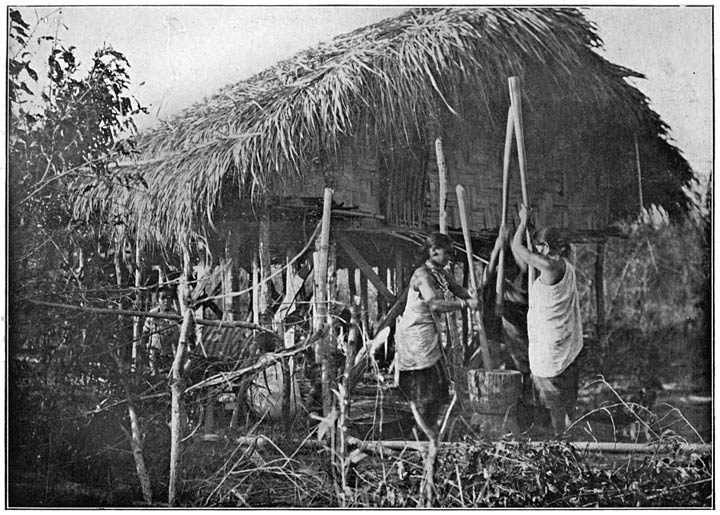
MIKIR WOMEN POUNDING PADDY.
(Jaintia Hills).
p. 132
Ànsī
So
ningkān
a year
īsī
one
ingtàng-lo.
came to an end.
“Ai phī,
“O granny,
‘nē
‘I
hèm
home
chedàmpo’
I will go’
pusī
saying
nē-kepulo,
I say to myself,
kolopu-lo-mā?”
what am I to do?”
pu
saying
H. K.
H. K.
pulo.
said.
“Nàng
“You
hèm-tàng-dèt,
have your own house,
nàng
you
rīt-tàng-dèt-lē-mā,
have your own field indeed,
chedàm-tā
you can go,
mē;
well;
bòntā
but
nàng-pēsō
your wife
nàng-che-mē-mē-làng.”
with you does not get on well yet.”
“Bòntā,”
“But,”
H. K.
H. K.
pudèt,
said,
“ningkàn-īsī-lo-lē-mā-thī,
“a year one (whole) it is, though,
phī.”
granny.”
“Bòntā
“Nevertheless,
nàng
you
che-mē-mē-lā.”
have not hit it off yet.”
Ànsī
Then
“Ai tàngtē,
“Oh, then,
dàm-thèk-thē-làng-po”
go I cannot yet,”
H. K.
H. K.
pulo.
said.
Ànsī
Then
H. K.
H. K.
lālē
there
kātiki lālē
working in the field
kànghoi
(doublet)
puru
barns-full
kelòng
getting
phàndār
granary-full
kelòng,
getting,
hèm-ēpī
the widow’s
āhèm
house
pukē
so
ingkrō
cylindrical receptacle for rice
ingtòng
conical basket
ārdung-dung.
were so many (i.e. was filled with).
Ànsī
And
H. K.
H. K.
āsō
a child
Ārnàm
God
pīlo,
gave,
āsō
a child
īnut-lo.
one only.
Ànsī
Then
āphī
his granny
ārju-thū-lē-lo:
he asked again:
“Ai phī
“Oh, granny,
nē-pī
‘my mother
nē-pō-ātum
my father’s
ā-lòng
place (to)
chedàmpo-sī
I will go’
nē
I
kepu.”
say to myself.”
Hèm-ēpī
The widow
thàkdèt:
answered:
“Nàng-pēsō
“Your wife
nàng
(to) you
chemē-mē-làng-tī,
is not yet well reconciled,
āsupō.”
grandson dear.”
“Kālī
“Not so,
phī,
granny,
chemēlo:
she is reconciled:
nē
me
sō
child
īnut
one
tàng-dèt-lo-lē-mā?”
has she not already given me?”
“Dā tàngtē:
Go then:
nàng
you
thàn-bòm-tā,
I repeatedly advised,
nàng
you
ārju-thèk-thē-dèt-lo;
would not listen to me;
chedām-nòn;
go together;
bòntā
nevertheless
nàng-pēsō
your wife
nàng-chemē-mē-làng
is not thoroughly reconciled,
dē.”
indeed.”
Ànsī
Then
H. K.
H. K.
āpēsō
his wife
chepulo
(to) said
“Ai nàng-pī,
“O thou dear one,
ī-lī-tā
we two
ē-hèm
to our home
chedàm-po-nàng.”
let us go.”
Āpēsō
His wife
thàkdèt,
replied,
“Dā,
“Go,
nàng
you
nē
me
kepòn
taking
āling-lo-hē.”
wherever you will.”
Ànsī
So
ādàp-lo:
it became morning:
àn-chō-dèt
rice having eaten
jun-dèt
having drunk
dàmlo.
they started.
Tovār
Road
ē-bèng
a piece (of)
lēlo.
they arrived.
Ànsī
Then
āsōpō-pèn āpēsō-pèn
his child and his wife
āvàm
his waist
tàmpòng-hèt-sī,
putting between waist and girdle firmly,
poho-pèn
with his turban
che-vàm-phòng-hèt-lo.
he bound well round his body.
Ànsī
So
dàm dàm dàm,
as they went on their way,
vo-hār
a jungle-fowl
ālopō
male
inglòng
on the mountain (side)
nàng
there
ārkē-dut,
was scratching,
ārlòk
the precipice
nàng-ārkē-dut
was scratching
māthā-thèk-thē
inconceivably
jādī-thèk-thē.
(doublet).
Ànsī
Then
H. K.
H. K.
pulo—
said—
“Chī,
“Oh,
vohār-ālopō,
jungle-cock,
kopi
what
kācheplàng-mā?
are you doing there?
nē
I
hèm
home
kāchedàm-tòng
am-going-in-a-hurry,
tovār
the way
nē
to me
pèk-nòn.”
leave free.”
Vohār ālopō
The jungle cock
thàkdèt—
answered—
“Tovār
“The way
nàng
to you
kepèk-jī
I will leave free by no
kālī:
means:
‘mīnī
‘to-day
H. K.
H. K.
āpēsō
his wife
āsō chevàn-po’
his child will bring’
tàng
so much
pusī
saying to myself,
ākhàt ākhàt
the way he is coming
āmàng āmàng
(doublet)
nē
I
nàng
here
ketòn-lē.”
am watching.”
H. K.
H. K.
pu-voiphàk—
rejoined—
“Chē,
“Oh,
pulèm-dèt-rī!
joke do not!
ēmōkē
hereafter
‘H. K.
‘H. K.
āpēsō
his wife
āsō
his child
hèm
house
rīt
field (to)
chevàn-ànsī
bringing while,
nē-pràn
my life
nē-mui
my soul
dàmlo’
is gone’
pu
thus
pupā-nā.”
do not have to say.”
Vohār ālopō
The jungle cock
pudèt,
said,
“Pupē.
“I do not say so.
Mīnī
To-day
nàng-tā-mē nē-tā-mē.”
either you or I (will prevail).”
H. K.
H. K.
pulo
said
“Sākhit-mā?”
“Is that true?”
“Sākhit.”
“Yes, true.”
“Dohai-mā?”
“Do you swear it?”
“Dohai.”
“I swear.”
Ànsī
So
H. K.
H. K.
āthai
his bow
chepāching-kàngsī
having set
ābòp.
shot him.
Ànsī
Then
dàm-thū-chòt,
a little further he went,
vo-rèk ālopō
a cock pheasant
tovār
the way
nàng-pārpàn-pèt
right across
inglòng
the mountain
nàng-ārkē-dut,
there was scratching,
ārlòk
the precipice
nàng-ārkēdut
there was scratching
māthā-thèk-thē jādī-thèk-thē.
in an extraordinary manner.
Ànsī
Then
H. K.
H. K.
pulēlo
said again
“Chī
“Oh,
vo-rèk-ālopō,
cock pheasant,
kopī
what
nàng-cheplàng-mā?
are you doing there?
nē
I
hēm
home
kāche-dàm-tòng,
am in a hurry to go,
tovār
the way
nē-pèk-nòn.”
leave free for me.”
Vo-rèk
The cock
ālopō
pheasant
pudèt—
said—
“Tovār
“The road
nàng
to you
kepèk-jī
I will yield
kālī:
by no means:
‘mīnī
‘to-day
H. K.
H. K.
āpēsō
his wife
āsō
his son
chevàn-po-tàng’
will bring along’
pusī
saying
ākhàt
the way
ākhàt
he is
āmàng
coming
āmàng
(doublet)
nē
I
nàng-ketòn-lē.”
am watching.”
H. K.
H. K.
pudèt—
said—
“Chī,
“Oh,
pulèm-dèt-rī!
don’t joke!
ēmōkē
hereafter
‘H. K.
‘H. K.
āpēsō
his wife
āsō
his son
chevàn-ànsī
bringing-while
nē-pràn
my life
nē-mui
my soul
dàm-lo’
departed’
pupā-nā.”
don’t have to say.”
Vorèk ālopō
The cock-pheasant
pudèt
said
“pupē.”
“I don’t say so.”
H. K.
H. K.
pu-lē-lo—“Sākhit-mā?”
said again “Is that true?”
“Sākhit.”
“True.”
“Dohai-mā?”
“Do you swear?”
“Dohai.”
“I swear.”
Ànsī
Then
H. K.
H. K.
āthai
his bow
chepāching-kàngsī
having set
ābòp.
shot him.
Ākō
Forward
dàm dàm dàm,
as they went,
phàk-lèng ālopō
a wild boar (male)
kethē
great
pukē
so as
māthā
could
thèk-thē
not be imagined
jādī-thèk-thē,
(doublet),
àngthur
his snout
àngni
his tusks
pàn-lòk-phòng,
overlapping so,
tovār
road
nàng-pār-pàn-pèt
there-right-across
inglòng
the mountain|
nàng-thīmur-phàk
there was rooting
ārlòk
the precipice
nàng-thīmur-phàk
there was rooting
ābīdī thèk-thē-dèt.
in an extraordinary way.
Ànsī
Then
H. K.
H. K.
pulo:
said:
“Chī,
“Oh,
phàk-lèng ālopō,
wild boar,
kopi
what
nàng
you
cheplàng-mā?
are doing there?
Tovār
The way
nē-pèk-thā:
leave free for me:
nē
I
hèm
home
kāpelē
want to get
serāràk-jī.”
quickly.”
Phàklèng ālopō
The wild boar
thàkdèt—
answered—
“Tovār
“The road
nàng
for you
kepèk-jī
I will leave free
kālī:
by no means:
‘mīnī
‘to-day
H. K.
H. K.
āpēsō
his wife
āsō
and child
chevàn-po-tàng’
will bring along,’
pusī
saying to myself
ākhàt-ākhàt
the way
āmàng-āmàng
he is coming (doublet)
nē
I
nàng
here
ketòn-lē.”
am watching.”
H. K.
H. K.
pudèt
said
“Chī,
“Oh,
pulèm-dèt-rī!
don’t jest!
jāsemèt mā-pu-mā?”
is it true or not?”
Phàk-lèng ālopō
The wild boar
pulo
said
“Jāsemèt.”
“It is true.”
H. K.
H. K.
pudèt—
said—
“Ēmōkē
“Hereafter
‘H. K.
‘H. K.
āpēsō
his wife
āsō
his son
hèm
home
chevàn-ànsī
while bringing
nē-pràn
my life
dàm-lo
is gone,
nē-mui
my soul
dàm-lo’
is gone’
pupā-nā.”
don’t have to say.”
Phàklèng ālopō
the wild boar
pudēt—
said—
“Pu-pē.”
“I don’t say so.”
“Sākhit-mā?”
“Is that true?”
“Sākhit.”
“It is true.”
“Dohai-mā?”
“Do you swear?”
“Dohai.”
“I swear!”
“Chī,
“Oh,
tàngtē”—
then”—
pu
saying
ā-thai
his bow
chepāching-kàngsī
having set
ābòp.
he shot him.
Ànsī
So
hèm-lē-jī-dòk-dòk-lo,
(when) he had nearly arrived at his home,
chilònghē
worm casts
thàm-theròk
clods six
pàngrum-sī
having collected
H. K.
H. K.
sārnung
the roof (on) went
vārdàmlo.
and threw them.
Ànsī
Thus
ātēpī
his elder sister-in-law
pulo—
said—
“H. K.
“H. K.
vànglo!
has arrived!
Tō
Then
inghoi
the stools
kechàm
wash
inghu
the seats
kechàm.”
wash!”
Ànsī
So
inghoi
the stools
inghu
seats
kāpàt
planks
kāplèng
benches
chàm-lo.
they washed.
Ànsī
Then
H. K.
H. K.
phàklèng
wild-boar
ē-jòn
one
vàn-sī,
having brought,
pai-ā-rē
the hedge beside
nàng-bīkòk-sī
there having set it down
hèm
home
vànglo.
came.
Ànsī
Then
kelēpèn
on his arrival
ātēpī
his eldest sister-in-law
hòrlàng
beer
hòrpō
(doublet)
hīm
bread
sàng-phēr
parched rice
nàng-pī-lo.
gave him there.
Āpēsō
His wife
kemē-òng
very beautiful
pukē,
so,
ārnī
sun’s
ātur
splendour
thēlālàk
like,
chārsàp un-ē.
be looked in the face could not.
Ànsī
Then
ā-īk-ātumkē—
his brothers—
“pāningvē
“To-night
kopi-ching
what in the world
āhàn-lo-mā?”
has happened?”
pu
saying
ning-rī-jō.
were perplexed.
Ànsī
Then
H. K.
H. K.
pulo:
said
“Nē
“I
mō
a while ago
tovār
on the way
phàksō
a little pig
nàng-ābòp:
there-shot:
jā
there
pai-ārē-sī
beside the hedge
mē
well
bī-tekàng-kòk:
I placed and left it:
lālē
there
chō-phī
scorch it for eating
dàm-nòn.”
go.”
Ànsī
Then
ā-īkmār-ātumkē
his brothers,
kòrtē-bàng-phòngō
the brothers five,
dàmlo;
went;
āphàk
the boar
kethē-òng
(was) so very big,
peklèm-àn-tā
move it even
un-ē:
they could not:
thàngtā
anything
chònghoi
do by themselves
thèk-thē.
they could not.
Ànsī
Then
H. K.
H. K.
dun-lo:
accompanied them:
ārī
hand
ē-hòng
one (with)
rum-dàm-kòk:
he lifted and brought it away:
ànsī
then
phī-sī
having scorched it
ingthàn-lo,
they cut it up,
ànsī
and
hèm
home
vàn-lo,
brought,
chō-tun-lo
cooked it,
chōdànglo.
served it up.
Ànsī
And
āròng
joyful,
bohòng
noisy,
chingnèk
laughing
chingnī-sī
and making merry,
chō-lo,
they ate,
jun-lo.
they drank.
Ànsī
So
puthòt-ādàplo.
next morning dawned.
“H. K.
“H. K.
āpēsō
his wife
chevànlo”
has brought”
tàng
so much
pu
saying
ārju-lòng-sī
having got to hear
ā-ràt-īsī ādèt-īsī
the whole country-side
nàng
there
kelàng
to see
chethòr-prē
kept coming and going
māthā-thèk-thē
as you could not imagine
jādī-thèk-thē.
(doublet).
Ànsī
And
H. K.
H. K.
āpēsō
his wife’s
āpīnī
petticoat
binòng,
own
ājīsō
striped cloth
binòng,
own,
āsēr
gold jewels,
ālèk,
necklace,
pòng-ting-kē,
gold-drum (in a)
làng-pòng
bamboo joint
thàp
putting away
mēsèn-sī
carefully,
kārdòng
(in the) pitch of the roof
ràklòk.
tied up.
Ànsī
So
H. K.-kē
H. K.
ròng-phū-rī
the village people
dàmlo,
each went to visit
rūp-phū-rī-dàmlo:
(doublet):
āràt
the ryots,
ādèt
the country
chi-phū-rī dàm:
in turn came to visit him:
āphī
afterwards
āpēsō
his wife
nàng
there
kelàng
to gaze on they
vàng-prē.
kept coming and going.
Mānē-kē
Some
“nī”
“aunt”
mānē-kē
some
“nèng”
“sister-in-law” (brother’s wife),
mānē-kē
some
“tē”
“elder sister”
mānē-kē
some
“pīnu”
“paternal aunt”
pu-ābàng-tā-dolo.
saying each one was.
“Vai!
“Oh!
mē-òng-tē-mā?”
is she not beautiful, sister?”
pu
saying
pāsingnàk-jō.
they all admired.
Ànsī
Then
H. K.
H. K.’s
āpēsō
wife
thàk-dun-lo—
answered them—
“Àn-chòt
“So much
kālī
not
lànghē!
yet!
Nē
My
pīnī
petticoat
binòng,
own,
nē
my
jīsō
striped cloth
binòng,
own,
nē
my
lèk
necklace
binòng,
own,
nē
my
roi
bracelet
binòng
own
lē
again
nē
I
chepindèng-lòng-tē,
to put on were to get-if,
āpārtā sō-sē-làng.”
it would not be thus only.”
Ànsī
Then
mānē
some
āsārpī
old woman
pulo—
said—
“Chī,
“Oh,
tàngtē
then
nàng pī-thā.”
do you give them to her.”
Ànsī
Then
H. K.
H. K.’s
āsārpō
old father
pulo—
said—
“Konàt-tòng
“Where ever
lā osō ingchàm
(did) that boy mad
bīpīkòk-lo-nē-lē?
stow them away?
kopi āthē-tàng
for what reason
āpīnī
her petticoat
jīsō
striped cloth
binòng
own
kepī-pē-dèt?”
did he not give her?
Ànsī
Then
H. K.
H. K.’s
āpēsō
wife
thàn-lo—
explained—
“Hālā
“That
kārdòng-lē
pitch of roof-in
keràk-chèk-kē.”
he has tied them in a bundle.
Ànsī
Then
phrī-dàm-sī
having untied
nàng-pī-lo.
there he gave her (the things).
Ànsī
Then
chepindèng-lō
she put them on herself
che-sum-pòt-lo.
(doublet).
Lālē
Thereupon
kemē-pukē
beautiful so
māthā-thèk-thē-dèt
inconceivably
chi-plàng-lo.
she became.
Ànsī
Then
“Ai!
“Oh!
mē-kē
beautiful,
mēsèn-tē-mā!
lovely indeed!
ārnàm-āsō
God’s child,
ārnī-āsō
the sun’s child,
pu
called
pai-pē-lo.”
not for nothing is she.”
Ànkēphòng
Thereupon
H. K.
H. K.’s
āpēsō
wife
thur-phlut-sī
rising up her full height
chehijīr-phlum-phlum-lo,
shook out her clothes flap-flap,
ingjār-èt-dàn-lo.
flew away gracefully
(thither whence she came).
Ànkē
Then
H. K.
H. K.
hā-tovār-pèn
from a distant path
nàng-chethèk-dun-sī,
there having watched her,
thai-pèn
bow (accus.)
jō-dun-ràng-ràng-lo.
continually kept bending.
Ànsī
Then
āpēsō
his wife
pu-tekàng-lo,
said on leaving him,
“Thā, thā,
“Wait, wait,
mō
hereafter
chiphōjī.”
we shall meet again.”
Ànsī
Then
H. K.
H. K.
chirū
weeping
chērnàp
lamenting
mòn-duk mòn-sā-sī
sad and sorry
hèm
at his house
nàng-lē-lo.
arrived.
Nàng-kelē-pèn
Immediately on arrival,
chō-chē
not eating,
jun-jē
not drinking,
ā-osō
his child
nàng-chi-bu-dèt-sī
having taken on his back,
hā
to
āphī
his granny
hèm-ēpī
the widow’s
āhèm
house
chedàm-phit-lo.
he started to go.
Ànsī
So
dàm dàm dàm
going along
āphī
his granny
hèm-ēpī
the widow’s
āhèm
house (at)
lēlo:
he arrived:
kelē-pèn
on arriving
lālē
there
kāchirū
he wept
lālē
there
kāchērnāp
he lamented
māthā-thēk-thē jādī-thèk thē.
as you could not imagine.
Ànsī
Then
āphī
his granny
pulo—
said—
“Hākō-pèn
“From the first
‘Nàng-pēsō
‘Your wife
nàng-chemē-mē-làng’
is not yet united with you’
nàng-pulo-hē;
I told you verily;
kopusī
how
nòn-lē
now
nàng-kelàng-jī-làng?
will you get to see her again?
Nàng
You
sining-lē
heaven-to
kopusī
how
kedun-thèkjī?”
will you be able to follow her?”
Ànkē
Then
chirū-pèt àn-muchòt
weeping so much the more
chō-chē
not eating
jun-jē
not drinking
āphī
his granny
kedàm-āling
went-wherever
dun-krī,
following,
bār-pī
outgoings-great
bār-sō-lē
outgoings-little-in
kedàm-tā
going also
hundun-krī,
he kept dogging her,
kethī
one-dying,
kejàng-sī
one-perishing (like)
kedo-po.
he remained.
Ànsī
At last
āphī
his granny
pulo:
said:
“H. K.
“H. K.,
ākhī
food
lō-du-dèt-lē
leaf (in) having wrapped up
chō-thā:
eat (imper.):
nē
I
mō
thereafter
bīdī
a plan
nàng-thàn-jī.”
to you will explain.”
Ànsī
Then
ākhī-lō-du
food-in-a-leaf-wrapped
hīm
bread
sàngphēr
parched rice
chō-lo.
he ate.
Ànsī
Then
āphī
his granny
bīdī
a plan
thàn-lo:
explained:
“Mīnàp-kē
“To-morrow
nàng-pēsō
your wife
Mòn Rēchō
Mon Raja’s
āsōpō
son
nàng-kāchepàngrī-jī
there to marry
vàng-po.
will come.
Ākō
Before that
nàng-hupō
your father-in-law’s
àngnār-tā
elephant-also
nàng-làng-chinglu-jī
there in the river to bathe
vàng-po.
will come.
Lālē
There
nàng
do you
sàngtī-ārlo
sand-underneath
chi-pātu-dàm-joi-nòn;
go and hide yourself quietly;
ingnār
the elephant
dàm-jī
to go
dòkdòk-lo-tē,
is-making-ready-when,
lā-ārmē
its tail (to)
rīp-hèt-rā
holding on tightly
nàng-poho-pèn
your-turban-with
nàng-sō
your child
che-vàm-phòng-hèt-nòn.
to your waist bind firmly.
Lālē
There
ingnār
the elephant
nàng-ārju-lo-te,
you asks if,
‘Nē-tā
‘I also
hā
to
nē-pēsō ālòng
my-wife’s place
nàng-kechedun-jī’
am going along with you’
pu-rā
saying
pu-nòn.
say.
Ànkē
Then
menàp
to-morrow
ārnī-kàngsàm-sī
in the afternoon
nàngtum
you both
lē-po.
will arrive.
Nàngkē
Do you
làng-kung-lē
the-river-bank-on
dokòk-non.
wait.
Ànkē
Then
nàng-pēsō
your wife
làng-kepànglu-jī-āphàn
with-water-to-bathe-for-the-purpose
ābàn-ātum
her male slaves
āsòt-ātum
her female slaves
làng
water
nàng-sòk-po.
will-draw-there.
Ànkē
Then
‘osō-āphàn
‘For the child
làng-ējoi-pèt
water one draught only
nē pī-thā’
me give’
purā
saying
hàng-dun-nòn.
call out.
Ànkē
Then
làng
water
nàng-pī-lo-tē
you-give-if,
thibuk-ārlo
the water pot-into
nàng-sēr-ārnàn
your-gold-ring
jòk-dun-thòt-nòn.
drop in.
Ànkē
Then
nàng-phàn
for you
nàng-hàng-po:
there she will call:
ànkē
then
dun-nòn:
go with them:
kelē-pèn
on arriving
nàng-sōpō
your child
ō-dàm-kòk-nòn;
set down on the ground;
ànkē
then
osō
the child
āpē-ālòng
its mother-towards
chedàmpo.”
will go of itself.”
Ànsī
So
ādàp
the morning
ingthàng-lo:
dawned:
chōdèt
having eaten
jundèt
and drunk
H. K.
H. K.
hā
to
làng-kung
the river bank
dàmsī
having gone
sàngtī-ārlo
under the sand
chipātu-dàm-joi-lo.
went and hid himself quietly.
Ànsī
Then
ingnār
the elephant
làng
in the river
nàng-chinglu-jī
there to bathe
vànglo.
came.
Ànkē
Then
chinglu-dèt
having bathed
dàmjī
to go
dòkdòklo.
it made ready.
H. K.
H. K.
ārmē
its tail
rīp-dun-lòk-sī,
holding-on-tight-to,
āpoho-pèn
his turban-with
ā-sō
his child
che-vàm-phòng-dèt-lo.
tied firmly to his waist.
Ànsī
Then
ingnār
the elephant
hā sining
to heaven flew up,
ingjār-pòn-lo,
taking him with him,
ànsī
and
hā
there
làng-kung
on the river bank
ō-dàm-kòk-lo.
set him down.
Ànkē
Then
Mòn Rēchō-ātum-tā
Mon Raja’s people also
H. K.
H. K’s
āpēsō-pèn
wife-with
āsōpō
his son
nàng-kāpàngrī-jī-sī
in order to marry
Bārī-thē
great palace
Rēchō
King’s
āhèm
house
vànglo.
(to) had come.
Ànsī
Then
Bārī-thē
great-palace
Rēchō
King’s
ābàn-ātum
male slaves
āsòt-ātum
female slaves
H. K.
H. K.’s
āpēsō
wife
làng-kāpànglu-jī-āphàn
with-water-to-bathe-for-the-purpose
làng
water
nàng-kesòk-jī vànglo.
there to draw came.
Ànsī
Then
H. K.
H. K.
āsōpō-āphàn
his child-for
làng
water
hàng-pī-dun-lo:
begged them to give:
“Làng
“Water
ējoi-pèt
one draught only
nē-pī-thā
give me
nē-sōpō-āphàn,
my son-for,
pē-mārlī.”
good mothers.”
Ànsī
Then
īnut-tā
one-even
pī-pē
would not give
īnut-tā
one-even
pī-pē.
would not give.
Ànsī
Then
āphī-sī
at last
sārpī
an old woman
nàng-dun-lo:
came up to them:
ànsī
then
hàng-dun-thū-lo
called out again
H. K.—
H. K.—
“Làng
“Water
ējoi-pèt
one draught only
nē pī-thā,
me give,
pē-ārnàm-pī,
good Madam,
nē-sōpō āphàn.”
my-child-for.”
Ànsī
Then
sārpī
the old woman
làng
water
pī-lo;
gave him;
thibuk
the water-jar
pheroidun
to touch
pelèm-pelàm-sī,
making as though,
H. K.
H. K.
sēr ārnàn
gold ring
jòk-dun-thòt-lo.
dropped into it.
Ànsī
So
H. K.
H. K.’s
āpēsō
wife
làng-pànglu-lo:
they bathed with water:
a-rī
her arms
ā-kèng
her legs
chàm-èt
washing-beautifully
āphī-sī
after
sārpī-ālàng-thibuk
the old woman’s water-jar
āphū
her head (over)
nàng-dunglo:
they poured there:
sēr-ārnàn
the gold ring
nàng-klō-bup.
there fell out.
Ànsī
Then
H. K.
H. K.’s
āpēsō
wife
pulo—
said—
“Ai!
“Oh!
nàng
here
chelē-dun-tànglo
has arrived to us
komàtching
whose in the world
ālàng-thibuk mā?”
water-jar?”
pu
saying
bisār-lo.
she enquired.
Ànsī
Then
īnut-tā—
one—
“Nē thibuk
“My jar
kālī”
it is not,”
īnut-tā—
another—
“Nē thibuk
“My jar
kālī”
it is not”
pulo.
said.
Ànsī
Then
“sārpī ā-thibuk”
”(it is) the old woman’s jar”
pu-hur-lo.
they all said.
Ànsī
So
sārpī-āphàn
to the old woman
pulo—
she said—
“Konàtsī
“Where
nàng
did you
bàngsō
this
ārnàn
ring
kelòng-lòk?
get hold of?
Lābàngsō
That
ārlèng
man
èn-dàm-nòn!
go and fetch!
Lā-lē
Him if
nàng
you
vàn
bring
thèk-thē-dèt,
cannot,
tàngtē
then
(it is a matter of)
nàng
your
pràn!”
life!”
pulo.
she said.
Ànsī
Then
sārpī
the old woman
chirū
weeping
chērnàp-sī
lamenting
H. K. ālòng
towards H. K.
dàm-lo,
went,
ànsī
and
hàng-dàm-lo—
called out to him—
“Nē-dun
“With me be
īk-nòn:
pleased to come:
kopi-āpòtsī
for what reason
‘Làng
‘Water
nē
me
pī-thā’
give’
sī pu-tē
this having said
nē-pràn
my life
nē-mui
(doublet)
nē-kāpedàm-jī-lē
me to cause to lose
māthā-thuròng-mā?”
did you have it in your mind?”
Ànsī
So
H. K.
H. K.
āsō
his child
chibu-sī
carrying on his back
dun-lo.
went with her.
Kelēpèn
On arriving
osō
the boy
ō-dàm-kòk-lo.
he set down on the ground.
Ànsī
Then
osō
the boy
kàt-tàng-tàng-sī
running straightway
āpē
his mother’s
chērbàk
lap (into)
dàm-kràp-lo,
climbed up,
ànsī
and
mòk
her breast
chu-lo.
sucked.
Ànsī
Then
Bārī-thē
the great palace
Rēchō
King
pulo:
said:
“Ai!
“Oh!
ābīdī
a thing
thèk-thē-lo!
never seen before!
ā-sō-sī
a child-even
chi-pethē-ràp-tàng-dèt-lo-lē-mā?”
have they got great between them already?”
Ànsī
Then
Mòn-Rēchō-ātum
Mon-Raja’s people
theràk-lo
were ashamed,
ingringlo:
were disgusted:
mòn-duk mòn-sā
grieved and sorry
hèm
home
chevoi-lo.
they returned.
Ànsī
Then (of)
H. K.
H. K.
pèn
and
Bārī-thē-Rēchō
great palace King’s
āsōpī
daughter
pàngrī-lo
they celebrated
pàngdòn-lo.
the wedding.
Ànsī
So
ningkàn-īsī
year-one
ningkàn-hīnī
year-two
do-dun-sī
living with them
tiki-lo
he laboured in the fields
inghoi-lo,
and worked,
ànsī
and
puru-krēhīnī
granaries-twelve
phàndār-krēhīnī
barns-twelve
lòng-lo.
got.
Ànsī
Then
H. K.
H. K.
āpēsō āphàn
his wife-to
chipulo:
said privately:
“Ai
“O
nàng pī!
my dear!
īlī-tā
we two also
vo-phrī āsòn
sparrows-like
vo-thung āsòn
doves-like
ē-tār
a nest
àn-kē
at least
do,
have,
ē-thòn
a roosting-place
ān-kē
at least
do;
have;
āpòtkē
therefore
chedàm-po-nàng:
let us go away together:
ònghai
father-in-law
pèn
and
ānīhai
mother-in-law
ārju-nòn.”
ask.”
Ànsī
So
āningvē
that night
H. K.
H. K.’s
āpēsō
wife
āpē
her mother
āpō
her father
chērjulo:
asked privately:
“Ai
“O
pē
mother
pèn
and
pō!
father!
nànglī osā
your son-in-law
kepu-kē:
says:
‘īlī-tā
‘we two also
vo-phrī āsòn
sparrows-like
vo-thung-āsòn
doves-like
ē-tār
a nest
ànkē
at least
do,
have,
ē-thòn
a roosting-place
ànkē
at least
do:
have:
ònghai
father-in-law
pèn
and
ānīhai
mother-in-law
ārju-nòn:
ask:
chedām po-nàng’—
let us go away together’—
pusī pu:
so he says:
Nàngtum
Ye
kopi
what
ābīdā-sī
order
nē
me
phār-dun-po-mā?”
will command?”
Ànsī
Then
Bārī-thē-Rēchō
palace-great-King
pulo—
said—
“Che
“O
pē!
daughter!
lō-thui
a bundle of greens
āsòn
like,
hànthui
a bundle of vegetables
āsòn
like,
ēboi-sī
once for all
nàng
you
chochòk-pālār
given away, or
chothèng-pālār
in exchange (doublet)
tàng-dèt-lō-lē-mā.
completely I have.
Mīnàp-lē
On the morrow
dàm-thā
go away
chidun,
together,
mīnī-lē
to-day
dàm-thā
go away
chidun.”
together.”
Ànsī
Then
āpō
her father
pu-thū-lo:
said again:
“Kopisī
“What
nàngtum kārī-mā?
do you desire of me?
bàn-mā?
male slaves?
sòt-mā?
female slaves?
ārmo-mā?
ryots?
òkso-mā?
husbandmen?
sēr-mā?
gold?
rūp-mā?”
silver?”
Ànsī
So
H. K.
H. K.
che-thàn-dàm lo:
she went and told:
“Ai
“O
nàngpō!
my dear!
nē-pē
my mother
pèn
and
nē-pō
my father
kepu-kē—
say—
‘mīnī-lē
‘this very day
dàm-thā
go away
mīnàp-lē
to-morrow
dàm-thā
go away
chi-dun-tā-mē;
together if you like;
āphūthàk,
moreover,
bàn-mā?
slaves?
sòt-mā?
handmaids?
ārmo-mā?
ryots?
òkso-mā?
cultivators?
sēr-mā?
gold?
rūp-mā?
silver?
Kopisī
What
nàngtum
do you
kārī-mā?’
desire?’
pusī
they
pu.”
say.”
Ànsī
Then
H. K.
H. K.
pulo:
said:
“Thàngtā
“Anything
nàngnē.”
I need not.”
Ànsī
So
ādàplo.
it became morning.
Ànsī
Then
H. K.
H. K.
ānīpī
his mother-in-law
pèn
and
āhupō
his father-in-law
ārdòm-lo
saluted respectfully
ārdī-lo.
(doublet).
Ànsī
And
āhupō
his father-in-law
pulo:
said:
“Kopisī
“What
nānglī
do you
kārī-mā?
desire?
bàn-mā,
slaves,
sòt-mā,
handmaids,
ārmo-mā,
ryots,
òkso-mā,
cultivators,
sēr-mā,
gold,
rūp-mā?”
silver?”
Ànsī
Then
H. K.
H. K.
pulo
said
“Thàngtā nàngnē.”
“I need nothing.”
Ànsī
So
H. K.
H. K.
ātum
and his wife
pèngnànsō
the wedded pair
tàngtē
and also
āsōpō
their son
hèm chedàm-lo ànsī hèm
started for home and arrived
chilē-lo.
there.
Rēchō
A king
chōlo
he became,
kethē
a great one
chōlo,
he became,
jō-ārnī
night and
mē,
day he was happy,
jō-ārnī
night and day
thē,
he was great,
ànsī
and
ārēchō
his kingdom
ākethē
was great
thīrlo.
and stable.
NOTES.
Āmehàng-kethèk-pèn-āpārā: āmehàng-kethèk, “to see the face,” is equivalent to “being born”; pèn and āpārā, the latter borrowed from the Assamese parā, have the same signification, and the latter is really superfluous. Phàk-lèng, shortened for phàk-belèng, “wild boar”; see the explanation of the term in the notes to No. I, p. 94. Tiki-kē inghoi-hē: notice that both verbs are given in the negative form; this is unusual.
Màn, “perquisites”; Assamese loan-word.
Kovē, “betel-nut,” Khasi kwai, Ass. guwā. Chidhīr, “spirit,” the doublet of āràk (itself a Hindi loan-word) is perhaps the Khasi kiad-hiar. Notice how, instead of using the ordinal numbers for second, third, fourth, and fifth brothers, the father employs clumsy periphrases to indicate the sequence. Phàndār, “store,” Ass. loan-word (bhandār).
Ā-bàn ā-sòt: in this doublet the second member, sòt, properly means “female slave”; a similar use of a word of different meaning as a duplicate term will be found below (p. 129), where ā-mèk “his eye” is followed by ā-nō “his ear,” the meaning being “his eyes.”
Kādo-kāvē, literally, “being-not-being,” a periphrasis for “all of them.” Mīsō, “a black ant,” used verecundiæ causâ for rèk, “louse.” Notice the idiom pē-mā-pē-lo, where the insertion of mā between the repeated roots indicates the time during which an act is done.
An-tàngtē, “and also,” literally, “so much not finished.” Pherē nàng-nē: nàng is the verb of necessity, nē the negative particle: “there is no need for fear.” Promàn, “proof,” Ass.
Chitū, the plant called in Assamese puroi-sāk, Basella lucida; its fruit has a red juice.
Ārlèng ki-ī, “a sleeping man”: observe that ārlèng here evidently means a human being in general (see note, p. 4). Àn-chō-mèk-bur: see note, p. 96. Vàng-noi; noi is a variant of nòn, imperative particle. Chīr-ēpàk: “one spear”; notice that the generic class-word for flat things, pàk, is used with chīr, a spear, referring of course to the head only.
Dā in Dā-nàng seems to be a shortened imperative of dàm, to go. Ārlu-rā tòk-dàm-nòn: notice how ārlu, usually a postposition (= up in), becomes a verb when necessary; similarly, further on, in ē-kòr tàngdèt, kòr, “brother,” is furnished directly with the suffix for the past tense; ē- and ī- are used interchangeably for the pronoun of the 1st person plural inclusive; the second is perhaps employed when the vowel-harmony calls for it. Tòng-ràp-chòm: ràp, “to help,” is employed as an adverbial supplement to indicate that two persons do the same thing together; chòm is a doublet of ràp. Pātèng, pāju, words for a second wife.
Bhin kālī, bhā kālī: bhin is Ass. bahin, sister; bhā, must be Ass. bhāī, brother, but is used as a doublet of bhin.
Notice the energetic reduplication of the negative in plàng-plē-plē-lē. Pinsō, male, virile, “worthy of being called men.”
Kopi tàng-ā “what are you saying?” tàngā is only used in this way as a question, as tànghō (see above, p. 100) is used in carrying a message, for pu, to say.
Bòr-ī-dèt-sī “with great difficulty”; bòr-ī-bòr-ā, “by hook or by crook.”
Arlēn-thu-ròng, māthā-thu-ròng: ārlèn is “to aim at,” māthā “to think about”; thu a particle meaning “again,” and ròng one of the affixes indicating the plural. Chiru-rap-jō-sī: jō is an affix indicating the plural.
Nàng-bàng-do? “are you there?” lit. “is your body (bàng) present?” Kopi kevàng mā pō? pō, “father,” is used as an endearing word in addressing a son, or as here a grandson (see ante, pp. 99, 101).
Sòk is paddy, rice in the husk; sàng is rice freed from husk and ready for cooking; àn is boiled rice; tē, a verb, “to spread out paddy to dry.”
“Hārlo,” a verb, “to turn over” (the spread-out paddy); rèng, a verb, of the spread-out paddy, “to become dry”; oi, a verb, “to collect into a heap” the dried paddy. Làng-thàk nàng-dàm-sī nàng-làng-dàm-jī-làng: in this sentence the word làng, which occurs thrice, has three different significations: the first làng is a noun, “water, river”; the second is a verb, “to see, look at”; the third làng is an auxiliary verb, “to continue doing, or being,” used here pleonastically.
Sēr, rūp, “gold, silver,” see note, p. 111, ante. Notice the rare form nèng for nē, “I”; nasals seem occasionally to be added or dropped at will at the end of words: e.g. dā and dàm, “go”; òng and ō, “much, many”; lā and làng, auxiliary verb. Komàt-ching-ā-lànghē nē: ching is a particle strengthening the interrogative komàt,—“who-ever?” lànghē, a ghāt or watering place: nē the interrogative particle borrowed from Assamese, = mā in Mikir.
Bārī-thē Rēchō, “king of the Great Palace”; bārī, “a large house,” loan-word from Assamese: thē, “great.”
Nàng-klō-èt-jō “there they descended beautifully”; klō, “to fall or sink down from a height”; èt a syllable indicating beauty or charm; Mr. Stack notes that it is perhaps connected with the word ètpī, “yellow, golden”; it is also used as an affectionate form of address in èt-mār-lī, “my dears!” jō, plural affix. Kàn, a ceremonious word for clothes; the ordinary expression is pē or rī. Sun-phit: phit means “all at once,” “suddenly.” Tur, “the brightness, splendour” (of the moon and sun).
The syllable jīn in ārnī ingsàm-jīn-lo indicates the day gradually drawing on to evening. Āpòr-lo: notice the verbal affix -lo appended to the noun pòr, “time.” Bèng, “to house animals for the night.” Hijīr, “to shake out,” as a bird its wings before starting to fly.
Phlum-phlum, onomatopoetic adverb imitating the sound of flapping; ī, “to put on one’s clothes”: ā-rī kāchi-ī, “he is putting on his dhoti”; pīnī kāchi-ī, “she is putting on her petticoat”; in this sense the verb ī takes lòk as its constant adverbial supplement: when it means “to lie down,” “to sleep,” it takes lòt. Observe how the distributive force of the sentence is expressed by repeating the whole phrase. Āngphun chepekèk-koi “he made his neck (ingphun) crooked (kèk-dàng or kèk-juk)”; koi, a particle meaning “completely, altogether.” Èn “take,” and kīm, “build,” both mean “to marry”; the latter implies the building of a separate house for the newly wedded couple, or perhaps the wedding bower.
Arlèng-āsō: notice that here the word ārlèng evidently means a human being, opposed to ārnàm-āsō, the child of a divine person. Pàn, “to cut down and clear the jungle for cultivation.” Làng-ding “continue to watch”: ding a particle of continuance (cf. keding, tall, long). Pàn-dèt pī-dèt; here pī has the sense of “to cut down” (a tree, or something thick): so also thī. Màm, “the jungle.” Further on, in thī-ròk-rē, thī means “to lie”: Pisī dàk-lē kethī-ròk-mā? “why are you lying here?” ròk is an adverbial supplement.
Ārchē is used of sowing or planting many things together, as here: to sow or plant only one thing is ē: thèngthē ke-ē, “he is sowing maize”; sòk ke-rīk, “he is sowing rice broad-cast”; sòk ke-ē, “he is transplanting rice.” Mīr-phèk-ē: mīr, “flower,” phèk-ē, “rice-husks”: “a flower that grows out of heaps of rice-husks; has a long narrow leaf and a flower which is red and white mixed” (Stack); tādo, “a kind of white lily or arum with a yellow style” (id.). Kemē-thèk-thē-òng pukē: “so (pukē) beautiful (kemē) excessively (òng) as never was seen (thèk-thē).” Vàng-phlòt: phlòt: a particle indicating suddenness. Teràn, an individual plot, as distinguished from the rīt or general field. E-kòrpō H. K. āteràn-lē-mā: kòrpō, “cousin (mother’s brother’s son),” also indicates the relationship between a woman and her sister’s husband; here of course it is used in the latter sense, proleptically; it is characteristic of this story-teller that he discloses the dénouement of his tale well in advance. Notice the idiom -lē -mā, “it must be,” an indirect question = “is it not?”
Pòngsī, Ass. baṅsī, “a flute,” made of a piece of bamboo; èt, to bore a hole. Che-èt-ō “he (cut and) bored holes in a number of flutes”; ō seems to be a shortened form of òng, many: hēm kīm-ō, “they built a number of huts”; nē vo nàm-ō-lo, “I have bought a lot of fowls.”
Ju-mē-òng, “it is very good to hear”: ju is shortened from ārju: the prefix ār- is separable in this word and in ārnī, “day, sun,” ārlòng “stone,” and several other words, which appear in composition as nī and lòng, etc.; it seems probable that it is connected with the Tibetan prefix r-, to which the Mikir relative particle, ā-, has been prefixed. Notice nitum for nētum, possibly by vowel-harmony with the following words mīr and chilòk. Chilòk-pòn ningkē-mā: observe that this phrase stands both for the request and its answer—ningkē, “willing”; ning, “mind”;—mā is thus not only the interrogative particle, but also indicates its corresponding affirmative reply. Ā-mèk, ā-nō, “eyes and ears” = eyes only. Mīnī, menàp (minàp), alternative terms for pinī, pēnàp, “to-day, to-morrow.”
Do-àngsē-lo = do-koi-lo, “have all got.”
Mòn Rēchō, probably shortened for Tomòn-Rēchō; tomòn, “wind.” Rai-dun, special verb for “to ask in marriage.” Bòng, “gourd for holding beer”; tē, doublet. Thàk, “to weave.” Thàn chèk, “to explain”; chèk strengthens verbs for imparting information. Āning āròng kedo: ròng, “delight,” Ass. loan-word.
Notice again āmèk ānō for “eyes” only.
Tòk, a verb with the general meaning “to thrust, poke”; used already above (p. 116) for thrusting with a spear; here for pounding the rice with a long pestle (lèngpum) in the mortar (lòng); another sense is “to write” (“to poke with a pen”). Sèt, “to give the half-cleaned rice a second pounding.” Dàng, “to serve up the cooked food.” Bē “to heat the fermented rice”; sòr, “to press out the beer” from the grains, mixed with warm water, which have been put in the conical strainer of woven bamboo, sī, by pressing down upon them a gourd, bòng.
Rèp seems to be a variant of ràp (explained above, p. 118), and indicates that all of them have been married together. Chàn-jai, “to have several children.”
Pāngrī-rē-dèt-làng-lē-mā; here again two verbs each have the negative affix, pàngrī and làng, the latter an auxiliary signifying “to continue to be.” Pàngrī in the sense “to marry,” is the causal of ingrī, “to drink copiously of liquor”; the description of the marriage ceremony at p. 18 shows the important part which is taken in it by alcoholic drinks. Ingting-po, “it will be dark”: observe the impersonal use of the verb, without a substantive: we may say ājō kàngting-pār, “the night is very dark.”
Nàng-làng-phròng-sī-do-po; phròng is one of the particles used to indicate plurality: “they will all be looking out for (làng) us there (nàng).” Bòm, one of the verbs indicating continuance may be rendered “from time to time.”
A-rī su-rī-thā, ā-kèng su-rī-thā: this injunction not to touch the hand or foot of the fairy princess has different parallels in other lands; in the Celebes version referred to on p. 72 it is the hair that is not to be touched. Pe-rē, causal of rē, “to be knowing, clever.” Ur, a platform or screen for drying flesh in the sun; ràp includes also a shelf in the house.
Krèng, to be dry, bears the same relation to rèng, dry (ante, p. 122), as klàng (p. 99), to perceive, does to làng, to look at; in both the prefix ke- has apparently been incorporated in the root.
Chedàm-tā-mē “You can go if you like”: observe the force of mē, “well, good.” Che-mē-mē-làng: the verb mē here seems to be the Assamese mēl, “agreement,” not the Mikir word for “good.” Observe the idiomatic expression ningkàn īsī-lo-lē-mā thī, in answer to an objection: so one says, in reply to a request for payment, nē nàng pī-tàng-dèt-lo-lē-mā-thī “but I have paid you already!” Observe that in nàng che-mē-mē-lā the last syllable = làng without its nasal. Āsō Ārnàm pī-lo, “God gave a child”: possibly this phrase is due to the narrator, who it will be remembered was a Christian. Tī, a particle = “not yet reconciled.” Dē, a particle of asseveration, “indeed,” probably the Assamese dēi.
Hèt, a particle used with verbs meaning to tie, bind, in the sense of “firmly, securely.” Dut, a particle used with verbs of scratching or cutting. Tòng, a particle indicating hurry or haste. Ēmōkē, “in a little time”: mō, “space or interval of time,” ē-, particle of unity, as in ē-jòn, ē-bèng. Pulèm, “to say in joke”: pu, “say,” lèm, “seem, pretend.” Pràn, Assamese. Pu-pā-nā, “don’t have to say”: nā, Assamese. Nàng-tā-mē, nē-tā-mē, idiomatic, “it will be well with you or it will be well with me,” i.e. “either you or I will come off the better.” Dohai, “an oath”; probably the Assamese dōhāi, “call for justice”: semē (the Khasi smai) is also used.
Bòp, to shoot a bird or animal; àp, to let off a bow or gun.
Dòk-dòk, particles used to indicate that an event has nearly happened (with jī, future affix). Tō, imperative particle borrowed from Khasi, and prefixed, as in that language.
Pai-ā-rē “beside the hedge (pai)” = pai-ā-kung. Chō-phī; the Mikirs scorch (phī) every bird or animal before preparing it for cooking. Chònghoi, reflexive form of inghoi, “to do,” = “to do by themselves.” Ā-rī-ē-hòng: hòng is the generic class-word for a limb (see ante, p. 79). Ingthàn, “to cut up fish or flesh, whether raw or cooked.” Chingnèk reflexive of ingnèk, to laugh, “laughing together.” Chingnī, reflexive of ingnī, doublet of ingnèk; the verb also means “to sit.”
Puthòt-ādàp-lo; puthòt, “next”: cf. lē-thòt in ādàk-vàm ā-dun-lēthòt on p. 114 above; the time-affix -lo is joined directly to ādàp, “morning.”
Ā-ràt, ā-dèt, both Assamese loan-words; ràt is raīyat, “ryots,” dèt, dēh, “country.” Chethòr-prē, vàng-prē, are both used for “continually coming and going, of many people”; the former expression indicates greater numbers and frequency than the latter. Pòng-ting, “a gold drum, worn on the breast, strung in the middle of a set of strings on which black, coral, and gold beads are arranged in alternate rows six deep” (Stack); in Assamese mādolī. Nī, nèng, tē, pīnu: see the table of terms of relationship on p. 20. Āpār-tā-sō-sē-làng: this sentence appears to be made up thus: āpār, “greatly, much,” tā, corroborative particle: sō, diminutive particle, negatived by sē, làng, auxiliary verb, “continue”; the force of it, then, would be—“the effect would not be only the poor result you see, fine though that is, but ever so much more!”
Konàt-tòng = konàt-ching, “wherever?” Kopi-āthē = kopi-āpòt.
Pai-pē-lo: this idiom is illustrated by the following phrases: klèm-dàm pai-pē-lo, “he is not working gratis, for nothing”; là āklèng pai-pē-lo, “he is not the elder for nothing”; i.e. he can do better than his younger brothers. Ingjār-èt-dàn-lo: the element dàn gives the force of returning to her own place whence she came. Jō, verb, “to bend a bow,” ràng, particle of continuance. Thā, “wait!” Assamese loan-word. Phō, verb, “to touch, arrive at,” as a boat comes to the shore with chi, “to touch one another, to meet” (see p. 112, lines 1 and 2).
Akhī-lō-du; ākhī, “something to eat,” lō, “leaf,” du, “wrap up,” = “so much food as can be wrapped up in a leaf,” a morsel.
Ē-joi, “one draught”; joi is perhaps Ass. jol, “water.” Ō, verb, “to leave, set down.”
Mòn Rēchō-ātum; notice that here tum has its original sense of “company”; “Mòn Rājā’s company, or following.”
Pu-hur-lo: hur is one of the particles indicating plurality.
Nē dun-īk-nòn: īk, “elder brother,” used as a respectful form of address; observe its place in the compound imperative. Māthā-thuròng, lit. “you had another (thu) meaning” (viz. to make me lose my life). Notice how -sī, the mark of the conjunctive participle, is affixed to the reported utterance of H. K. Chērbàk = che-ārbàk; ārbàk, the lap or bosom; also a verb: osō kārbàk, “she holds the child to her bosom.” Kràp is said to be used only of a child climbing up into its mother’s lap.
Ingring, used as homonym of theràk, “to be ashamed,” also means “to be afraid, disturbed in mind.”
Chērju-lo = che-ārju-lo. Phār, “to order”; nàng nē kephār āling-lo, “as you order me”; nē phār-dun pemē-sèn-lo, “I gave him careful instructions.” Bīdā = Ass. bidāi, “leave to depart.”
Che pē; notice that pē, “mother,” is used as an affectionate term of address to a daughter, exactly as pō, “father,” is used above to a son or grandson. Lō-thui-hàn-thui, “a bundle of vegetables, with a leaf wrapped round it.” Chòk and thèng mean literally “to beat,” but are here jocularly used for getting rid of a person. Pālār causal of lār, “to be changed or exchanged,” also apparently used jocularly of giving in marriage.
H. K.-ātum: notice the plural affix used to indicate H. K. and his wife. Chō-lo, “he became”; this seems to be a different verb from chō, “to eat.” Notice ā-rēchō “his kingship”; rēchō stands for rāj as well as rājā. Thīr, Ass. thīr, “steady, stable.”
Additional Notes.
Divisions of time. On p. 95, note, the divisions of the day are given. To these may be added those of the year, as recorded by Mr. Stack. A year is ning-kàn (cf. Lushei kum, Shö kun, “year,” and Lushei ni-kum, Thado ningkūm, Shö yan-kun, “last year”). A month is Chiklo, “moon”; but the Assamese months, which are solar divisions of the year, not lunations, appear to be followed. The days of the month are not generally counted, and there is said to be no week. (This is borne out by S. P. Kay’s English-Mikir vocabulary, which gives hopta, the Hindustani hafta, as the word for “week,” with nī-thròksī, “seven days,” as an alternative. In the Mikir Primer published by the American Baptist missionaries in 1903, however, rui is said (p. 21) to be the word for “week.”)
Kechung-āpòr (chung, to be cold) is the cold season. Ning-krèng (krèng, to be dry) is the dry portion of winter. Chung-phàng-òk (chung, cold; phàng-òk, hot), is the spring, merging into summer. Bārlā is the rainy season, followed by Chung-jir-jir (“becoming cold by degrees”) autumn. The following are the names of the months, with the corresponding Assamese names, as set down by Mr. Stack:—
Literary form. As pronounced in Assam. Mikir names.
Chaitra Soit Thàngthàng
Vaisākha Boihāg Thērē
Jyēshṭha Jēṭh Jàngmī
Āshāḍha Āhār Āru
Śrāvana Srābon Vosik
Bhādra Bhādur Jākhòng
Āświni Āhin Paipai
Kārtika Kārti Chiti
Mārgaśirsa Mārg Phrē
Paushya Pōh Phaikuni
Māgha Māgh Mātijòng
Phālguni Phāgun Ārkoi
According to the Mikir Primer, however, the Mikir names (which agree with those given by Mr. Stack) correspond with periods earlier by at least a month, Thàngthàng being the equivalent of February, instead of Chaitra (which begins at the vernal equinox), and the other months in ordinary sequence (Thērē, March, Jàngmī, April, etc.). Thàngthàng is said by Mr. Stack to be called Chànglāchòng-ròng-do, “the stay-at-home month.” Thērē is the month in which the jungle is cut and strewn to dry (this would agree well with the equivalent of the Primer, rather than with Boihāg, April-May, when the firing would take place). Vosik (“sprout”) should indicate the month of vigorous growth, when the rains have set in. Phaikuni seems to be borrowed from the Sanskrit Phālguni, but does not correspond with it. The other names are not explained.
Musical instruments. A flute, pongsī, cut from a bamboo, is mentioned on p. 128: pongsī is the Assamese baṅsī, the well-known instrument of the youthful Krishna (Baṅsī-dhar). Other instruments known to the Mikirs are muri, a fife; chèng, a drum; chèng-brup, the small handdrum used by the rīsōmār to accompany their dancing at funeral feasts; and kum, a one-stringed fiddle. The last is made by stretching a string made from a creeper, màngrī, across a gourd, bòng, which provides an air-chamber. It is played with a bow, kum-ālīsō (lī, a bow, sō, diminutive particle) made of bamboo, the string of which is a tough fibre of bamboo. (Compare the one-stringed fiddle, pena, of the Meitheis: Meithei Monograph, p. 56.)