V. FOLK-LORE AND FOLK-TALES.
Reading edition
Three Mikir stories—Legend of creation (Mr. Allen).
The Mikirs are fond of telling stories, but the historical material which they contain does not appear to be of very ancient date. Reference has already been made to the deliverance of the Arlengs from slavery to the Khasis, and their contests with the Kacharis under the leadership of Thòng-Nòkbē; also to their early relations with the Ahoms. They have also myths dealing with the creation of the earth and man, one of which has been related by Mr. Allen, of the American Presbyterian Mission, and will be found in the Appendix to this Section; it seems doubtful, however, whether it is a genuine legend, or due to imagination stimulated by questions: the concluding episode strongly resembles the Biblical story of the Tower of Babel. These legends have not been handled by Mr. Stack, and are therefore not reproduced here. The Rev. Mr. Moore notes that “Mikir stories in general do not agree very minutely,” and this appears to be particularly the case in respect of tales of the intervention of the gods in human affairs.
Mr. Stack wrote down, chiefly from the dictation of a Mikir named Sārdokā, who had become a Christian, a number of excellent stories, which well deserve separate publication. Three specimens of these are given here. They correspond in every respect, as will be seen, with the general characteristics of folk-literature all over the world. Folk-tales containing the same incidents, as is well known, are found from Iceland to Japan, from Alaska to Patagonia. The original source of such a tale is now incapable of identification. The same sequence of events and general form recur everywhere; what is distinctive and characteristic is not the progress of incident, but the local dressing, the narrator’s point of view, the colour of his daily life which he lends to the details of the story.
The first of the three specimens is the favourite Indian form of a sequence, well known in Sanskrit literature, but quite as popular in Europe and in general folk-lore. It is given here, because another version of the same narrative has been included by Dr. Grierson in his Linguistic Survey, vol. iii. Part III. p. 223, as found among the Aimol Kukis, a race of Tibeto-Burmans dwelling, far away from the Mikir country, in the hills bordering the valley of Manipur on the east.
The second specimen tells of the adventures of an orphan, the son of a widow, a stock figure in Mikir folk-tales, and abounds in local colour. Here too the incidents in part coincide with those of a folk-tale belonging to a very distant country, the part of Kumaon bordering on Tibet, which will be found in vol. iii, Part I. of the Linguistic Survey, pp. 483, 495, 510, 522.
The third is a remarkably complete and interesting version of the wide-spread folk-tale of the Swan-maidens. It was most probably derived from some Indian source, though, so far as known, no version of the tale in its entirety, as told by Hindus, has yet been published. The name of the hero, Hārātā-Kuṅwar, may be the Indian Sarat-Kumār, and is evidently not Mikir. But all the setting—the colloquies of the six brothers and their father, the attempt on Harata-Kuṅwar’s life, his methods in defeating his treacherous kinsmen, his device for winning his fairy wife, and many other features of the story—seems genuinely local. The narrative is an excellent specimen of Mikir diction, and shows no little skill in composition. In vol. iii. Part II. of the Linguistic Survey, there will be found, at pp. 218–220, a short story, entitled, “How Jesu got a goddess for his wife,” which is identical in motive with this tale of Harata-Kuṅwar. It is current among the Angāmī Nagas, a race much less influenced by Hindu culture than the Mikirs.
The original Mikir text of these tales will be found in the next Section; the English translation here given is as literal as it was possible to make it. In the Linguistic Survey, vol. iii. Part II. pp. 395–403, two other short stories of the same character, both text and translation, have been printed. The second of these, the story of the clever swindler Tèntòn, evidently belongs to the cycle of tales called Tenton-Charit, mentioned, in its Assamese version, as existing in manuscript by Mr. E. A. Gait, at page 68 of his Report on the Progress of Historical Research in Assam, 1897.
1. Story of a Frog.
Then the Raja held a court to try the case. “Who is it that killed my son?” “Oh, the rock rolled down and killed him,” they said. So they summoned the rock. “O rock, rock! why did you roll down and slay my son?” The rock answered, “Oh, Lord God King! how was I to help rolling down and killing him? The deaf elephant uprooted me on a sudden from my place, and then gave me a push. As for me, I have no hands or legs; how then could I withstand him? Your son being in the way where I was rolling down, I rolled upon him and killed him.”
Then the Raja said, “Oh, then that deaf elephant was the cause of all this trouble,” and summoned the elephant. “O elephant, elephant! what did you root up the rock for?” The elephant answered, “Oh! how could I help uprooting it, Lord God? The sparrow flew into my ear, and I lost all control of myself, and so I tore up the rock.”
Then the Raja said, “Oh, then that sparrow was the cause of it all,” and summoned the sparrow. “O sparrow, sparrow! why did you fly into the elephant’s ear?” The sparrow answered, “Oh, Lord, how could I help it? The plantain-stalk fell upon my nest and smashed it, and being very disturbed in mind, I flew into the elephant’s ear.”
Then the Raja said, “Oh! then that plantain-tree was the cause of the trouble,” and called the plantain. “O plantain, plantain! what did you tumble on the sparrow’s nest and smash it for?” The plantain answered, “Oh, how could I help it, Lord God? The wild boar tore me up out of the ground, and I had no root left at all. How was I to go on standing in my place? I have neither hands nor feet.”
“Oh! then that pig was the cause of it all,” the Raja said, and summoned the pig. “O pig, pig! what did you tear up the plantain for?” The pig answered, “How could I help it? As I was feeding quietly by myself, the gourd fell plump on my back. I was in great pain, and therefore tore up the plantain tree.”
Then the king said, “Oh, the gourd caused all this trouble,” and summoned the gourd. “O gourd, gourd! what did you tumble on the wild boar’s back for?” “How was I to help it, Lord God? The squirrel cut through my stem. I have neither hands nor feet, nothing but a stalk; if that is cut through, I cannot but fall. So I was obliged to tumble on the wild boar’s back.”
Then the Raja said, “Oh, that squirrel caused all the mischief,” and summoned the squirrel. “O squirrel, squirrel! what did you cut through the stem of the gourd for?” The squirrel answered, “Oh, how could I help it, Lord God? The frog jumped on my ladder and broke it. Then I had no road to get out, and I had to cut the stalk of the gourd.”
The Raja said, “Oh, then that frog caused the mischief,” and summoned the frog. “O frog, frog! what did you jump on the squirrel’s ladder and break it for?” The frog answered, “How was I to help it? A big black ant bit me sharply in the loins, and with the pain of the bite, not knowing what I was doing, I jumped on the squirrel’s ladder and broke it.”
Again the Raja said, “Oh, it was the ant that caused all the trouble,” and summoned the ant. “O ant, ant! what did you bite the frog in the loins for?” The ant said, “How could I help biting him? In the morning I was carrying my uncle’s rice along the road. The frog sat down and blocked the way. I said, ‘Please make room for me to pass.’ ‘Creep under me,’ said he. I crept under him, and he sat down tight on the top of me. That was why I bit his loins.”
2. Story of an Orphan and his Uncles.
So when they got home they seized the orphan, and having shut him up in an iron cage they took him to the bank of a great pool in a river in the jungle. Then they said, “In a little while we will drown him; now there is no chance for him to escape us, so let us go and eat our rice.” So saying, they went to eat their food. When they had gone away, a certain king’s son, who was hunting deer, came by. When he arrived where the orphan was, he asked him, “What is the reason why you are tied up in that iron cage?” The orphan answered, “My uncles have a daughter, so lovely! You cannot imagine how fair she is. They tell me to marry her, but I always answer that I will not. So my uncles, becoming angry, have shut me up in this cage.” Then the king’s son said, “Oh! then can I get her to wife?” “If you get into this cage and stay there, you will be able to get her,” the orphan answered; “after a while my uncles will come, and will say, ‘Have you nothing more to say?’ If they ask you this, then answer them, ‘All I have to say is that I will take her, uncles.’” “Very good then,” said the prince. Then the orphan said to the king’s son, “If you go into the cage wearing your own fine clothes, they will recognize you at once. So let me out. I will give you my clothes, and then you can enter the cage.” So the king’s son opened the cage and let out the orphan, and the orphan gave his clothes to the prince, while the prince gave his coat, dhoti, necklace, and bracelets in exchange to the orphan, and entered into the cage. Then the orphan made fast the door of the cage, and having dressed himself in the prince’s clothes, necklace, and bracelets, went away to his home. Then the orphan’s uncles returned from eating their rice, and coming up to the cage asked, “Have you anything more to say, nephew?” “All right, uncles, I agree to take her,” answered the king’s son, as the orphan had told him to say. Then they threw him in the iron cage into the deep pool. Thereupon the six brothers, the orphan’s uncles, said one to another, “How much trouble that fellow caused us all! Now, however, he is dead and done with!” Then they returned home.
So the orphan became rich, and there was no one left to envy him. And having become a great king, he lived a happy life.
Note.—Two incidents in this story, viz. the profit made by the orphan by disposing of the flesh of his slaughtered calf, and his gain by selling the ashes of his burnt house, and the disappointment of his uncles when they endeavoured to imitate him, much resemble the incidents of a folk-tale given as an illustration of the Tibeto-Burman dialects of Rangkas, Dārmā, Chaudāngs, and Byāngs in vol. iii. Part I., of the Linguistic Survey. These dialects are spoken in the northern portion of Kumaon, on the borders of Tibet. In this version the animals slaughtered are goats and sheep, and the profit is made out of their skins, while the ashes of the burnt house are by an accident exchanged for a load of flour. Still, the motif is the same, and the great distance of the country where this tale is current from that of the Mikirs, and the impossibility of inter-communication, make the coincidences interesting.
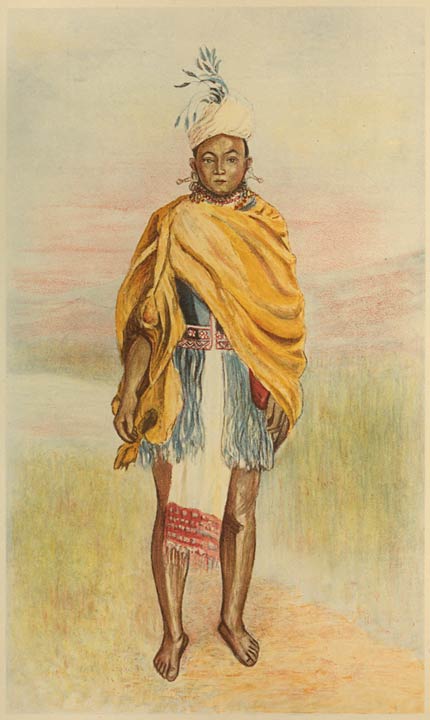
MIKIR BOY.
p. 56
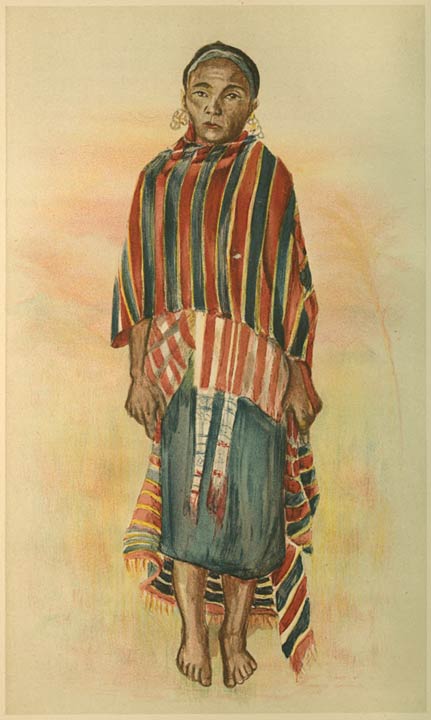
OLD MIKIR WOMAN.
p. 59
3. Story of Harata Kunwar
Then, as they went on still further, a wild boar, so big as you never saw or imagined, with his tusks overlapping his mouth, was straddling across the road, and rooting up the earth there on the mountain side in an extraordinary way. And Harata Kunwar said, “Oh, wild boar, what are you doing there? leave me the road open, I want to get home quickly.” The wild boar answered, “I will by no means leave you the road; saying to myself, ‘To-day Harata Kunwar will bring along his wife and child,’ I am watching the road he is coming.” Harata Kunwar said, “Oh, don’t joke! is it true or not?” The wild boar answered, “It is true.” Harata Kunwar said, “Be careful, lest in a little while you have to say, ‘when Harata Kunwar brought along his wife and child, my life was lost.’” The wild boar said, “I don’t say so.” “Are you in earnest?” “Yes.” “Do you swear it?” “I swear it.” “Oh, then——” So saying, Harata Kunwar set his bow and shot him.
Then, when he had nearly arrived at his house, he collected six clods from the worm-casts, and threw them on the roof. Then his sister-in-law said, “Harata Kunwar has come home! Wash the stools and the benches!” Then they washed all the stools and seats and planks and benches. And Harata Kunwar, bringing along with him that wild boar, put it down beside the hedge, and entered the house. And as soon as he arrived, his sister-in-law gave him there beer, bread, and parched rice. His wife was so very beautiful that no one could look her in the face, as one cannot look straight at the brightness of the sun. Then his brothers were perplexed, saying, “What in the world has happened to us this night?” And Harata Kunwar said, “A short time ago I shot a little pig on the road. I just put it down there beside the hedge. Go and get it and scorch it (for cooking).” So his five brothers went, but the boar was so very big that they could not even move it; they could do nothing with it at all. So Harata Kunwar went with them. With one hand he easily lifted it and brought it away; and they scorched it and cut it up. So home they brought it and cooked it and served it up, and joyful, noisy, laughing and jesting, they ate and drank.
Then next morning dawned. Hearing that Harata Kunwar had brought his wife home, all the people of the whole country-side kept coming and going to gaze upon her, in such crowds as you never saw. And Harata Kunwar put away carefully in a bamboo chunga his wife’s own petticoat and striped cloth, with her gold ornaments, her necklace, and her gold drum (Ass. mādolī) worn on the breast, and tied them up in the pitch of the roof. So Harata Kunwar went to pay visits to the people of the village, and the ryots of the country-side came to visit him; and then they went on to gaze upon his wife. And all the women—aunts on mother’s and father’s side, sisters-in-law, elder brothers’ wives—each one said, “Oh! is she not lovely, sister!” Thus they wondered at her. Then Harata Kunwar’s wife answered, “Not so lovely yet as I might be. If I were to put on again my own petticoat, my striped cloth, my necklace and my bracelets, then, indeed, there would be something to see!” Then some old woman said, “Oh, then, give them to her.” And Harata Kunwar’s old father said, “Where in the world did that idiot of a boy put them away? Why did he not give her her own petticoat and striped cloth?” Then Harata Kunwar’s wife explained: “They are there in the roof-pitch where he has tied them up.” So his father untied the bundle and gave it to her. Then she put the things on and arrayed herself. Thereupon she became inconceivably beautiful. “Oh!” they cried, “lovely! beautiful indeed! It is not for nothing that she is called child of the Sun-god!” Thereupon Harata Kunwar’s wife rose up to her full height, and flapped her clothes, and gracefully flew away back to her own place. Then Harata Kunwar, happening to see her from where he was on a distant road, kept continually bending his bow. And his wife said, as she left him: “Wait, wait! hereafter we shall meet again.” So Harata Kunwar, weeping bitterly, sick and sorry at heart, came to his house. Immediately he got there, without eating or drinking, he took his child on his back, and straightway set out for the house of his grandmother the widow woman. Thus he went on till he arrived, and at once on arrival began to weep and wail as you could not imagine. Then his grandmother said: “I told you from the first that your wife was not yet reconciled to her lot with you. How will you get to see her now? How will you be able to reach her in heaven?” This only aggravated his weeping; refusing meat and drink, he followed his grandmother wherever she went, continually dogging her steps, and was like to die of grief. At last his grandmother said, “Harata Kunwar, take a little food, and then I will tell you of a plan.” So he took something to eat, bread and parched rice, and then his grandmother told him her scheme. “To-morrow,” she said, “the son of the King of the Winds will come there to marry your wife. Before that, your father-in-law’s elephant will come here to bathe. Do you go and hide yourself there under the sand. When the elephant (after its bath) is just about to go, hold on tight to its tail, and bind your child firmly to your waist with your turban. If the elephant asks you anything, say that you also are going to the place where your wife is. Then to-morrow, in the evening, you will arrive there. Remain concealed on the river bank. Then male and female slaves will come to draw water there in order to bathe your wife. Call out to them, ‘Give me one draught of water for the child.’ Then, if they give you the water, drop into the water-pot a gold ring. Then she (i.e. your wife) will call for you. Go to her, and when you arrive, put down your child on the ground; then the child will go of itself towards its mother.”
The morning dawned, and Harata Kunwar, after eating and drinking, went to the river bank and hid himself quietly under the sand. Then the elephant came down to bathe in the river, and having bathed, was just about to go away, when Harata Kunwar grasped firmly hold of its tail, and with his turban tied his child securely to his waist. Then the elephant flew up with him to heaven, and put him down on the river bank there. And all the people of the King of the Winds had come to the house of the King of the Great Palace in order to celebrate the marriage of the son of the King of the Winds with Harata Kunwar’s wife. And the King’s slaves, male and female, came to draw water in order to bathe Harata Kunwar’s wife. And Harata Kunwar called out to them for water for his child: “Give me just one draught of water for my son, good mothers!” One after another paid no attention to his request, till at last an old woman came up. So Harata Kunwar called out again: “Give me water, one draught only, good madam, for my child.” So the old woman gave him some water. Making as though he would take hold of the water-jar, Harata Kunwar dropped into it a gold ring. Then they brought the water for Harata Kunwar’s wife’s bath. After washing delicately her arms and her legs, they poured the old woman’s water-jar over her head, and the gold ring fell out. Then Harata Kunwar’s wife asked, “Oh! who is the person whose water-jar has just reached me?” Then one after another they said, “It’s not my water-jar.” Then all called out together, “It is the old woman’s jar.” Then she said to the old woman: “Where did you get hold of this ring? Seize that man and bring him here at once. If you cannot bring him, it will be a matter of your life.” So the old woman, weeping and lamenting, came to Harata Kunwar and called out to him, “Be pleased to come with me! What was the reason why your Honour, under pretence of asking me to give you water, had it in your mind to make me lose my life?” So Harata Kunwar, taking the child on his back, went with her. Immediately on arriving he put the boy down on the ground, and the child ran straight into its mother’s lap and began to suck her breast. Then the King of the Great Palace said: “Why! such a thing as this was never seen! They have got a child big between them already!” So the King of the Winds’ folk were ashamed and disgusted, and returned home sad and sorry. So they celebrated the wedding of Harata Kunwar and the daughter of the King of the Great Palace.
So Harata Kunwar remained there one year, two years, and laboured at tilling the fields, so that he got twelve barns, twelve granaries full of grain. Then said Harata Kunwar to his wife: “My dear! we two, like the sparrow or the dove, should have a nest at least, a roosting-place of our own. Therefore let us go away together. Do you ask father-in-law and mother-in-law.” So at night Harata Kunwar’s wife asked her parents: “O father and mother, your son-in-law says, ‘we two, like a sparrow or a dove, should at least have a nest, a roosting-place of our own. Let us go away together,’ and he bade me ask you about it. What are your commands in the matter?” So the King of the Great Palace said: “My daughter! I have once for all given you away to this man like a bundle of greens, and have nothing more to do with you. Go away together, to-morrow if you like, or to-day if you prefer it.” Then he went on to say, “What do you two desire of me? slaves, male or female? ryots, husbandmen? gold? silver?” So she went and told Harata Kunwar: “My dear! my mother and father say, ‘You may go away together to-day or to-morrow as you please: moreover, slaves, male and female, ryots, husbandmen, gold, silver,—mention whatever you desire’—so they say.” And Harata Kunwar said, “I want nothing at all.” And morning dawned. Then Harata Kunwar went and did obeisance to his father and mother-in-law. And his father-in-law said to him, “What do you desire? slaves—handmaids—ryots—husbandmen—gold—silver?” Harata Kunwar said, “I need nothing.” Then Harata Kunwar and his wife, the wedded pair, and their son started for home, and in due course arrived there. A king he became, a great man, and night and day he lived in happiness and greatness, and his kingdom was great and stable.
APPENDIX.
THE LEGEND OF CREATION.
Condensed from Mr. Allen’s (of the American Presbyterian Mission) replies to ethnographical questions, dated October, 1900.
Long ago the gods Hèmphū and Mukràng took counsel together for the creation of the world. They marked the limits of their work, setting up four great posts to fix the boundaries of things, and fastened them immovably with six of their mother’s hairs. Then they looked for seed to produce the earth, but found none. Then they consulted a hundred other gods, with their wives, making, with themselves and their wives, two hundred and four in all. It was decided to send one of the wives to beg for some earth from the god Hājòng, and Bāmon’s wife was sent on this errand. But Hājòng refused to give any earth from his world from which a rival world might be fashioned, and sent the goddess Bāmonpī away empty-handed. But as she returned she noticed the worm-casts on the road, and carried off one and hid it in her bosom. But even with this piece of warm earth nothing could be done, until the gods sent for Hēlòng Rēchō, the king of the earth-worms, who came and worked up the piece of earth, till in one day it became a heap many feet in diameter; so he continued, till eventually it became this earth of ours. But it was still soft moist earth, on which no one could travel. So they called Kāpràng the blacksmith, who with his bellows produced a wind which dried the mud to solid earth. Then the gods said, “We must cause plants to grow on it.” They searched everywhere for seed, and at last sent to Rèkbēpī in the west, by the great post that marked the place of the setting sun, to ask her for seed. Rèkbēpī came, and herself brought seed and sowed it. (Another version states that Rèkbēpī and Rèk-krōpi, wives of two gods, went to Kānā, beyond the boundaries of this world, and obtained from him the various seeds of trees and plants. As they were returning, the sinàm, or head-strap, which held the baskets on their heads broke, and the winds scattered the seeds on the surface of the earth. This occurred on the bank of the river Kallang, in the south-eastern part of Nowgong. But all the bamboos that grew from these seeds were jointless, and therefore weak: strong winds would break down the entire crop in a single storm. So the goddesses who brought the seed tied round the stems pieces of thread to strengthen them; the threads made scars, until at last all the bamboos we have now are marked with scars at the joints.)
Next came the creation of animals. Hèmphū and Mukràng were the leaders, but they were helped by Pīthē and Pōthē (“great mother” and “great father”). The elephant was first created to be a servant to man. Then the tiger was made, and bidden to eat the wicked; any one killed by a tiger is still thought to have committed some great crime.
Then a great council was held, and it was decided to create a being called ārlèng (man). The first man’s name was Bāmon-pō, and he had created for him two wives, one a Mikir and the other an Assamese. But no offspring was born to the man for a long time. At last the Assamese wife sent her husband to her elder brother, who understood the secrets of nature. He sent Bāmonpō into his garden, and bade him pick an orange for each of his wives, and give it to her to eat, when all would be well. Bāmonpō did so, and went homewards with his two oranges. On the way, becoming hot, he stopped at a river to bathe. While he was in the water, a crow came and carried away one of the oranges. Bāmonpō sadly returned to his home, and gave the one orange left to his Assamese wife, who ate it. But the Mikir wife picked up a piece of the peel and ate it, and in process of time she had a son, whom she named Rām. The Assamese wife also had a son, whom she called Chāputi. He, however, was weak and puny, while Rām was strong and valiant. Rām could pull up trees by the roots, and break them down as he pleased. He could fight and conquer any demon who attacked him, and any man whom he met. But he had no wife. One day while out hunting he became thirsty, and climbed a tree to look for water. He saw a pool, at which he quenched his thirst. As he did so, he noticed in the grass a white thing, which he put in his basket and carried home. It was a large egg. For some days he forgot to look at it, and later on, when he went to see it, he found that the egg was broken, and a beautiful woman had come forth from it. The demons tried to seize her and carry her off, but Rām vanquished them all, and made her his wife. She was very fruitful, and her children multiplied until they were numbered by thousands. Rām’s fame spread throughout the world, till at last he disappeared, and was deified by a race of his descendants, called Hindus. They were a mighty race of men, and in the course of time, becoming dissatisfied with the mastery of the earth, they determined to conquer heaven, and began to build a tower to reach up to the skies. Higher and higher rose the building, till at last the gods and demons feared lest these giants should become the masters of heaven, as they already were of earth. So they confounded their speech, and scattered them to the four corners of the earth. Hence arose all the various tongues of men.
Additional note to p. 45.—A very exact parallel to the story of Harata Kunwar will be found in Mr. S. J. Hickson’s book entitled A Naturalist in North Celebes (London, 1889), pp. 264–6. It is a story current among the Minahassa people of that region, of heavenly nymphs in whose clothes resided their power to fly, and one of whom was captured by a man who made her his wife; other details agree closely with those of the Mikir story.