WALTER SCOTT By HAMILTON W. MABIE
Reading edition
Author and Editor
MENTOR GRAVURES MENTOR GRAVURES
LUCY AND THE MASTER FLORA MacIVOR
"The Bride of Lammermoor" "Waverley"
THE BLACK KNIGHT AT THE HERMITAGE MEG MERRILIES DIRECTS BERTRAM TO THE CAVE
"Ivanhoe" "Guy Mannering"
VARNEY, LEICESTER AND AMY ROBSART EFFIE DEANS AND GEORDIE
"Kenilworth" "Heart of Midlothian"
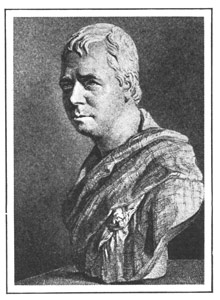
Bust of Sir Walter Scott By Sir Francis Chantrey
THE MENTOR · DEPARTMENT OF LITERATURE SEPTEMBER 15, 1916
Entered as second-class matter March 10, 1913, at the postoffice at New York, N. Y., under the act of March 3, 1879. Copyright, 1916, by The Mentor Association, Inc.
A NOTED English critic said that he never sat down to write about Sir Walter Scott without a sense of elation and happiness; and he might have added without a sense of satisfaction. For the author of the Waverley Novels was a clean, wholesome, loyal human soul. The out-of-door vigor of the Highlands found in him not only a chronicler but an incarnation. At the end, when his strength was failing, his brain becoming darkened, the battle apparently going against him, his struggle against disaster became a moral victory and his character took on heroic proportions. At a time when so much writing is impaired by egotism, and mental and moral disease give prose and verse the odor of the hospitals, Scott brings a tonic atmosphere with him.

He was a fortunate man; he was born in a country which he understood, at a time when the men, women, and events he wrote about were in the past but not too far in the past; and he was well born in the best sense. He came at the right time, in the right place, and of the right ancestry. In a word, he was in harmony with the conditions of his life, and he was spared the antagonism which often bends and sometimes breaks a promising talent and distorts a wholesome nature. Like Goethe he had a methodical father, of orderly habit, and a mother of generous heart, a vivid memory and the gift of pictorial talk. He said of her that if he had been able to paint past times it was largely because of "the studies with which she presented me." She had talked with a man who remembered the battle of Dunbar; and the day before her last illness she told, with great accuracy of detail, the real story of the Bride of Lammermoor, and indicated the points in which it differed from her son's famous novel. To his father Scott owed his steadiness of aim and his indomitable industry; to his mother he owed his vivid energy of mind, his tireless curiosity.
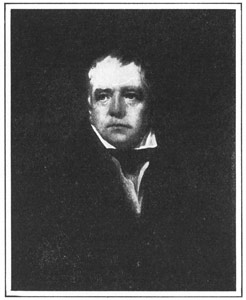
PORTRAIT OF SCOTT
By Sir Henry Raeburn
To Scotland his debt was even greater. Born in Edinburgh in 1771, four years before the beginning of the American Revolution, an illness in his second year sent him to reside with his grandfather in a country of crags and in the neighborhood of a ruined tower. In fine weather the shepherd took him to the places where the sheep were grazing and laid him on the ground among them. He was forgotten one day, and a thunderstorm broke on him. When he was found he was calling out, "bonny! bonny!" at each flash of lightning. His illness made him lame for life, but he was a boy of sweet temper and a winning disposition. Lameness did not daunt him; he learned to climb with great agility and to keep his saddle with the best of them. At the age of six he was reciting ballads with zest and fire, and he showed very early the spirit which made him a story-teller and a man of dauntless courage.
The Boyhood of Scott
At school he was noted as a daring climber, a pertinacious fighter, an irregular student, and a teller of fascinating tales. In the High School he was "more distinguished in the yards than in the class." In 1783 he entered the Humanity and Greek classes in the University of Edinburgh, but his education was directed by his genius rather than by the school and college curriculum. He began on his grandfather's farm, Sandy-Knowe, in a landscape that runs to the Cheviot Hills and the slopes of Lammermoor, where he lay, a "puir lame laddie," on the turf among the sheep. Out of a volume of Ramsay's "Tea Table Miscellany" he was taught "Hardy Knute," long before he could read the ballad. "It was the first poem I ever learned," he wrote years afterwards, "the last I shall ever forget." His grandmother knew all the wild and romantic stories of the Border and the eager boy listened with his heart and imagination. He had only to look across the countryside to see many of the places where these moving events had happened: the peaks of Peebleshire, the crags of Hume, the landmarks of Ettrick and Yarrow; the Brethren Stanes were among the objects that "painted the earliest images on the eye of the last and greatest of the Border Minstrels."
When he was thirteen years old he came upon one of those books that open the world of imagination to boys and girls of genius. He was visiting his aunt in Kelso, which he describes as the most beautiful if not the most romantic village in Scotland. The house stood in a garden in which there was a great platanus tree (plane tree), and under its branches, one summer afternoon, he opened "Percy's Reliques," which had appeared nineteen years before, and the magic of the old, stirring ballads which Bishop Percy had piously brought together, laid a spell upon him which was never broken. "The summer day sped onward so fast," he wrote long afterwards, "that notwithstanding the sharp appetite of thirteen, I forgot the hour of dinner, was sought for with anxiety, and was still found entranced in my intellectual banquet." As soon as he could "scrape five shillings together" he bought the volumes and read no other books so often or with such enthusiasm.
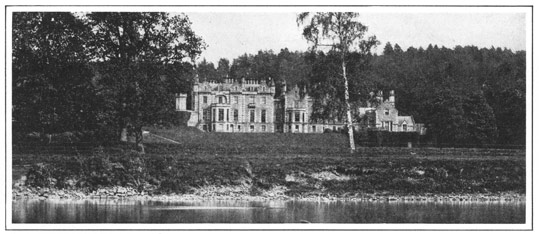
ABBOTSFORD, SCOTLAND
The home of Walter Scott
This vital education for the work he was to do was not interrupted by his studies at the University. Hosts of Americans have climbed Arthur's Seat and picked bluebells and looked down on one of the most picturesque cities in Europe. Scott climbed this famous hill and Salisbury Crags or Blackford Hill on Saturdays and in vacation, carrying a bundle of books from a circulating library; and, overlooking one of the most enchanting landscapes in Scotland, read Spenser, Ariosto and other masters of romance. He learned to read Italian and Spanish so as to get direct access to "Don Quixote" and the "Decameron"; and Froissart he came to know almost by heart.
Edinburgh and the Highlands
Edinburgh was an illustrated edition of a great deal of Scotch history, and Scott left no part of the old town unvisited. He spent so much time exploring the country within reach that his father protested that he was becoming a strolling peddler. "Show me an old castle or a battlefield," he wrote, "and I was at home at once, filled it with its combatants in their proper costume, and overwhelmed my hearers by the enthusiasm of my description." So he came to know not only the spirit but the "form and presence" of feudalism and the ideals and code of manners of chivalry.
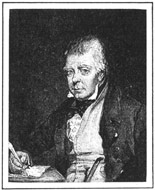
SIR WALTER SCOTT
From the painting by J. P. Knight
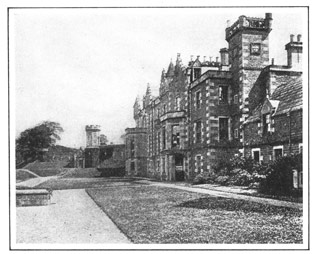
ABBOTSFORD
A near view
His education went a step farther when he saw the Highlands for the first time in 1787. The traditions of 1715 and 1745, when the Highland chiefs had engaged in brave but futile attempts to restore the exiled Stuarts to the throne which those ill-starred Kings had forfeited by their inability to understand the English people, were still fresh on the Border. Men who had taken part in the rising of 1745 were still living, and Scott was fortunate enough to be the guest of one of them. He was to write the stories of wild Scotland as no historian had or could write them, and on this memorable visit he was to hear the tales of stirring and romantic deeds from one who had played a part in them, and he was to see with the eyes of youth the landscape on which they had been enacted. It was a happy hour in which the boy who was to write "Waverley" and "Rob Roy" heard from a veteran the stories of battle, of dashing foray, of daring deeds and hairbreadth escapes. "To know men who had known Rob Roy, to hear the story of the two risings which had shaken Scotland like an earthquake, to be a guest in remote and lonely castles, to be guided through wild defiles and over vast mountain ranges by kilted clansmen whose speech was only Gaelic and whose claymores were still at the service of their chiefs—this was the real education of the writer who was to be the scribe of his country, the truest of her historians."
This first-hand education in romantic history was supplemented by the eager reading of military exploits, of medieval romance and legend, of the songs of the Border, of Ariosto and Cervantes. The author of "Don Quixote," he said later, "first inspired him with the ambition to excel in fiction." He was also fortunate in the possession of a memory which held tenaciously everything that contributed to his future work and let unrelated things slip through its meshes.
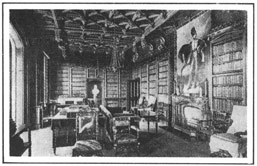
THE LIBRARY, ABBOTSFORD
He studied law and practised at the bar in a desultory way for fourteen years. He was appointed "Sheriff of the Court" of Ettrick, a position to which a comfortable salary was attached, and for five years he acted, without salary, as a Clerk of Sessions in the court in Edinburgh. He was recognized as an able man, and he was interested in the historical aspects of Scotch law, in its "quips and quiddities," and his knowledge of its processes was shown in his novels; but he was an impatient and uninterested practitioner, and long before he formally gave up the profession he was writing poetry. While poetry and law have often been on good terms they have never been happy partners.
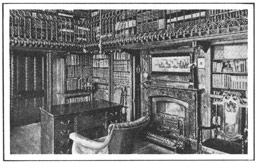
THE STUDY, ABBOTSFORD
This room is lined with Scott's favorite books and works of reference. The bedroom that he used opens directly into the study.
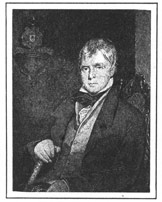
SIR WALTER SCOTT
From the painting by C. R. Leslie, R. A.
Marriage
During this period Scott's affections were deeply engaged, and but for the interference of parents he would probably have married a young woman of singularly beautiful nature. His love had a very deep influence on his character, and it remained to the end the great passion of his life. In 1797 he married the daughter of a French royalist who, after her brother's death, came to England. She was described as a "lively beauty," of no great depth of nature, but she had humor and high spirits and she was true-hearted. He protected her from care, and their life together was a happy one. She was not a mate for her husband, but she basked in the sunshine of his prosperity, and she was brave in adversity.
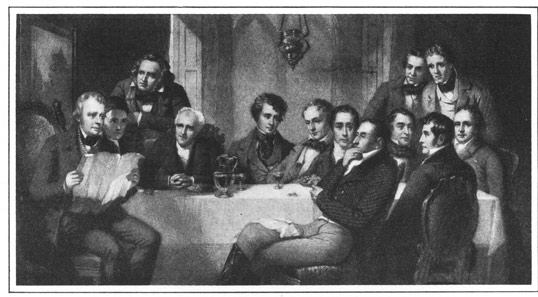
SIR WALTER SCOTT AND HIS FRIENDS AT ABBOTSFORD
From the painting by Thomas Faed. Those in the picture, reading from left to right, are, sitting: Sir Walter Scott; Henry Mackenzie, the Scottish novelist; George Crabbe, the English poet; John Gibson Lockhart, the son-in-law of Scott, and his biographer; William Wordsworth, the English Poet Laureate from 1843 to 1850; Francis, Lord Jeffrey, the Scottish critic, essayist, and jurist; Adam Ferguson, the Scottish philosopher and historian; John Moore, the Scottish physician and writer; Thomas Campbell, the writer, and Lord Rector of the University of Glasgow from 1826 to 1829; Archibald Constable, Scott's publisher from 1805 to 1826; standing: John Wilson, who wrote under the pseudonym of Christopher North; John Allen, the British political and historical writer; Sir David Wilkie, the Scottish painter.]
Entrance Into Literature
Scott made the transition from law to literature gradually. He published a translation of Burger's "Lenore" in 1795. While he was at the University he began to collect the materials which made up the three volumes of "The Minstrelsy of the Scottish Border," a collection of ballads old and new in which the "old, simple, violent world" lived again in song and story. The making of these books was congenial work, and carried still further Scott's education in the spirit and temper of the Scotland of clans and feuds, of reckless border warfare, dashing foray, fierce revenge and superstition. The various introductions and notes which accompanied the ballads show Scott's painstaking care for fact and detail; he combined in rare degree the romantic spirit, the antiquarian's zeal for the small details of history, and the methodical habits of the literary drudge.
In 1805, in his thirty-fourth year, "The Lay of the Last Minstrel" appeared and secured a popular success of unprecedented proportions. The picturesque or pictorial quality of the poem and its unqualified romanticisms gave it a very broad appeal. It was popular in the good sense of the word. Mountains and wild landscapes generally, which had been shunned for generations, were coming into fashion, so to speak. They have been "in fashion" ever since, and today their appeal to city folk, to tired people, to men and women of imagination and active temperament, is irresistible. To Dr. Johnson Scotland was a wild and dreary waste, to Scott it was a wonderland; and a wonderland it has remained ever since. In the confusion of an age when every sort of opinion gets into print the "call of the wild" has a trumpet tone. "I am sensible," wrote Scott, "that if there be anything good about my poetry or prose either, it is a hurried frankness of composition which pleases soldiers, sailors, and young people of bold and active dispositions."
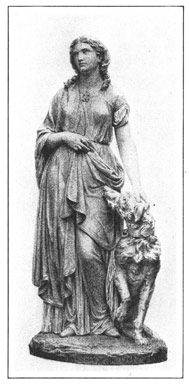
THE LADY OF THE LAKE
From the group by J. Adams Acton
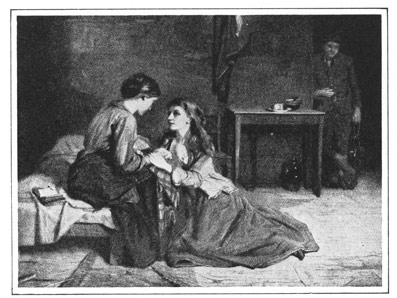
EFFIE DEANS AND HER SISTER, JEANIE, IN PRISON
This picture, illustrating Jeanie Deans' visit to her accused sister, as related in "Heart of Midlothian," is from the painting by R. Herdman
Three years later the strongest and most stirring of the poems, "Marmion," appeared. It is a poem of scenery as well as of action, its descriptions are both exact and living; it tells a story with clear and compelling vigor, and it shows at their best two of Scott's really great qualities: simplicity and energy. It lacked the delicate shading of the verbal music which gave some later English poetry a magical charm; but it had a fine strength of outline, a noble ruggedness. He said later that he loved the sternness and bold nakedness of the Border landscape, and that if he did not see the heather at least once a year he believed he would die. "The Lady of the Lake," "The Lay of the Last Minstrel," "The Lord of the Isles," were less effective, but the fresh vitality of the Highlands was in them all.
The Crash of His Fortunes
The Waverley Novels have so long stood in the forefront of Scott's literary achievements that it is difficult to put them out of view and remember that in 1814, when Scott was forty-four years old, he was known to the world as a poet who had laid a spell on the imagination of his generation. He had "broken the record" so far as monetary returns for poetry were concerned. Milton received about one hundred dollars for "Paradise Lost" and Dr. Johnson was paid about seventy-five dollars for "The Vanity of Human Wishes," while "The Lay of the Last Minstrel" brought Scott nearly four thousand dollars; for "Marmion" he received five thousand dollars in advance of publication, and for one-half the copyright of "The Lord of the Isles" he was paid over seven thousand five hundred dollars. He was unaware of the enormous earning powers which he was later to develop; he had given up his profession, and he longed for an income which would support his family on the scale which his tastes and natural generosity dictated. To secure financial independence he brought James Ballantyne, a former school-mate and editor of a local newspaper, to Edinburgh and lent him money enough to start a printing business. This was in 1802; three years later he became a silent partner with Ballantyne and his brother. In 1809 he took a still more venturesome step and started the publishing house of John Ballantyne & Company. The two brothers were men of small ability, and entirely without knowledge of the business on which they embarked; they knew something about printing but nothing about publishing. Scott was equally ignorant of business methods; he was a man of generous nature and lavish tastes, and between the recklessness of his partners, for which he was largely responsible, and his lavish use of money, he was soon in financial difficulties and a crash would have come early if the phenomenal popularity of the novels had not postponed the evil day.
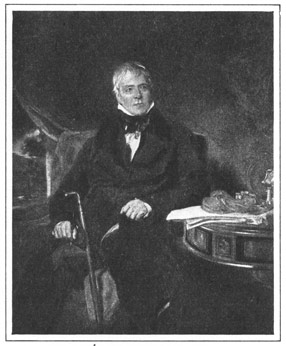
PORTRAIT OF SCOTT
By Sir Thomas Lawrence
In 1812 he bought the farm at Abbotsford, to the ownership of which he had long looked forward. The country was lovely, the four acres grew into a great estate, the farm cottage became a stately mansion, as all traveled Americans know, and the owner lived like a Scotch laird but without a laird's steady income. He entertained lavishly and lived in feudal state, happy in his friends, his tenants, his horses and dogs. But the land alone cost more than a hundred and fifty thousand dollars!
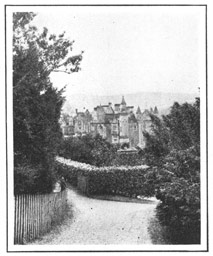
A GLIMPSE OF ABBOTSFORD
In 1805 Scott was the most popular poet in Great Britain. He had opened a fresh field, he had command of the magic of romance which always has and always will, in spite of temporary changes of taste, cast a spell over the imagination of men; his style was simple and his method plain; all classes of readers could understand him. During the next ten years he published six or seven long poems of varying merit. When the last of these, "The Lord of the Isles," appeared in 1815, the popular interest had diminished in volume and intensity, and the poet was in serious financial difficulties as the result of his lavish scale of living and the mismanagement of his business enterprises.
The Waverley Novels
At the moment when ruin faced him he found himself suddenly in the possession of a great income from an unexpected source. In 1805 he had written, almost at a sitting, an instalment of a story of the uprising of 1745 in a futile attempt to restore the exiled Stuart, Charles Edward, to the throne. In 1814 he completed the story and published it anonymously under the title of "Waverley." The novel was written in what the oarsmen call a "spurt"; not because the novelist was writing carelessly at breakneck speed for immediate income, but because he was a tremendous worker and more concerned with the general movement and human interest of the story in hand than with the details of its workmanship. To immense energy of mind and body Scott united patience and methodical habits of work, as he added to a romantic imagination keen interest in the business of life and in the smallest detail of practical affairs. His appetite for facts was as marked as his capacity for sentiment. Scott had breadth and vigor rather than delicacy of imagination; that is one reason why he is out of fashion at a time when men want to know not only what people do but why and how they do it. He saw men and events in the rough; he was interested in striking historical incidents and events, in strongly-marked characters, in actions rather than in moods. In a word, Scott was a writer who took the world as he found it, and described it as he saw it, without any strong desire to reform it. He was a Tory in politics, a strong adherent of an ordered society; a good, sound man not haunted by misgiving and questioning about the general order of things.
Scott's novels were literally poured out during fifteen wonderful years; and even then the broken man could still apply the whip to his exhausted and crippled brain. The popular success of the novels was unprecedented in the history of literature. It is estimated that Scott earned with his pen not less than three-quarters of a million dollars. The earlier stories were the best: "The Antiquary," "Old Mortality," "Rob Roy," "Heart of Midlothian," "Guy Mannering." These were followed by the series of semi-historical novels with their brilliant historical portraits: "Ivanhoe," the most popular though by no means the best of Scott's stories, "The Monastery," "The Abbot," "Kenilworth," "Quentin Durward," "The Bride of Lammermoor," "The Talisman."
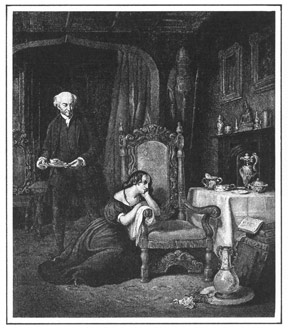
THE EMPTY CHAIR, ABBOTSFORD
From the painting by Sir W. Allan, R. A., in the Royal Collection
The defects of these novels and those which came later have been clearly pointed out since the analytical novel and the novel of purpose have come into vogue. Scott did not command the constructive skill of even the second-rate novelist of today; he was often an awkward builder and clumsy in putting his materials together in a coherent whole; his style is often loose and diffuse; he dealt largely with the outside of the spectacle of living; his women have no magic of loveliness, no mystery of temperament, though they sometimes stand out with great distinctness; his heroes are rarely heroic, they are often commonplace.
Scott was the chronicler of feudalism, the primitive social order of the clan, of an aristocratic society. He was as little interested in Democracy as was Shakespeare; and largely for the same reason: his age was not anti-democratic, it had not reached the democratic stage. Bagehot, the famous English critic, put his limitations under two heads: he gives us the stir of the world but not its soul, and he leaves the abstract intellect unreported.
His vital interest in the moving spectacle of life has given us an almost unrivalled report of that world, and of a great group of men and women whose careers, as Scott reports them, have the reality of fact and the dramatic interest of fiction. Jeanie Deans, Madge Wildfire, Diana Vernon, Meg Merrilies, Wandering Willie, Andrew Fairservice, and a crowd of their companions, are more alive today, after a century has passed, than most of the people whose names are in the telephone directories.
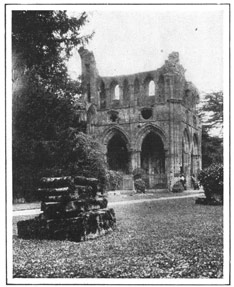
THE GRAVE OF SCOTT
At Dryburgh Abbey, Scotland
Scott was a man of the kind men love to remember. His faults of nature are as obvious as his faults of art; but his splendid vitality makes them trivial. He was large hearted, frank, generous, honorable; he made life seem more noble by the richness of his nature and his splendid courage. His career was as romantic in achievement and vicissitude as his most striking novel. In 1826, when he was fifty-five years old, the two business houses in which he was a partner failed, with obligations amounting to nearly six hundred thousand dollars. Scott had recently spent large sums on the enlargement of Abbotsford, in settling his sons in life, and for other people; and he held the bills of Constable for four novels to be written in the future; the novels were written, but the bills were not honored. Four months after the failure Lady Scott died, and Scott's health was breaking. Two days after the failure he resumed work on "Woodstock," and set himself to pay the debt of half a million dollars. In two years he earned for his creditors nearly two hundred thousand dollars, the major part of which came from the sales of "Woodstock" and "The Life of Napoleon Bonaparte." If his brain had not given out he would have discharged the entire indebtedness in a few years. Working with a disabled brain but with heroic resolution, he wrote "Count Robert of Paris" and "Castle Dangerous." In five years more than three hundred thousand dollars had been paid; meantime he had had a stroke of paralysis. After a second stroke, when "Count Robert" was practically finished, the publishers objected to the work in the last volume. "The blow is a stunning one," wrote the broken man. "God knows I am at sea in the dark, and the vessel leaky.... I often wish I could lie down and sleep without waking. But I will fight it out if I can." And he fought it out; he died on July 12, 1832, and on February 21, 1833, the creditors were paid in full. Never was a heroic fight more nobly won.
On his death-bed Scott called his son-in-law Lockhart, who was to tell the story of his life in one of the great biographies, to his bedside. "I have but a minute to speak to you," he said. "My dear, be a good man.... Nothing else will give you any comfort when you come to lie here."
SUPPLEMENTARY READING
LIFE OF SIR WALTER SCOTT (In "Everyman's Library") By J. G. Lockhart
SIR WALTER SCOTT By R. H. Hutton
SIR WALTER SCOTT Chapter in "Gray Days and Gold" By William Winter
DICTIONARY OF THE CHARACTERS IN THE WAVERLEY NOVELS OF SIR WALTER SCOTT By M. F. A. Husband
SIR WALTER SCOTT STUDIED IN EIGHT NOVELS By A. S. G. Channing
THE SCOTT COUNTRY By W. S. Crockett
*** Information concerning the above books may be had on application to the Editor of The Mentor.