Kenilworth
Reading edition
FIVE
THE central figure in "Kenilworth" is that of Queen Elizabeth of England, but the real heroine is Amy Robsart. She was the daughter of Sir Hugh Robsart. The Earl of Leicester, infatuated by her charms, married her secretly. He then established her at Cumnor Place, a lonely manor house. There she lived alone with one or two attendants. But she bore her solitude with pleasure as long as she was sure that Leicester loved her.
However, Leicester and the Earl of Surrey were rivals for the favor of Queen Elizabeth. In fact, each hoped that he might wed her; and, therefore, Leicester did not want his marriage to Amy made public.
Edmund Tressilian, who had been engaged to Amy, discovered her hiding place, and, not knowing that she was married, tried in vain to induce her to return home. Then he appealed to the queen; and when a disclosure of the truth seemed inevitable, Richard Varney, Leicester's closest friend, affirmed that Amy was his wife. Varney was then ordered to appear with her at the approaching revels at Kenilworth Castle, which belonged to the Earl of Leicester.
Leicester and Varney went to Amy and endeavored to persuade her to pose for a short time as Varney's wife.
"'How, my Lord of Leicester,' said the lady, disengaging herself from his embraces, 'is it to your wife you give the dishonourable counsel to acknowledge herself the bride of another—and of all men, the bride of that Varney?'
"'Madam, I speak it in earnest—Varney is my true and faithful servant, trusted in my deepest secrets. I had better lose my right hand than his service at this moment. You have no cause to scorn him as you do.'
"'I could assign one, my Lord,' replied the Countess; 'and I see he shakes even under that assured look of his. But he that is necessary as your right hand to your safety, is free from any accusation of mine. May he be true to you; and that he may be true, trust him not too much or too far. But it is enough to say, that I will not go with him unless by violence, nor would I acknowledge him as my husband, were all—'
"'It is a temporary deception, madam,' said Leicester, irritated by her opposition, 'necessary for both our safeties, endangered by you through female caprice, or the premature desire to seize on a rank to which I gave you title only under condition that our marriage, for a time, should continue secret. If my proposal disgust you, it is yourself has brought it on both of us. There is no other remedy—you must do what your own impatient folly hath rendered necessary—I command you.'
"'I cannot put your commands, my Lord,' said Amy, 'in balance with those of honor and conscience. I will not, in this instance, obey you. You may achieve your own dishonor, to which these crooked policies naturally tend, but I will do naught that can blemish mine. How could you again, my Lord, acknowledge me as a pure and chaste matron, worthy to share your fortunes, when, holding that high character, I had strolled the country the acknowledged wife of such a profligate fellow as your servant Varney?'"
Later Varney attempted to drug her; and in fear of her life she escaped and made her way to Kenilworth. She could not get to her husband, however; and she was discovered and misjudged by Tressilian. Queen Elizabeth found her half fainting in a grotto, but Varney kept her from learning the truth by persuading the queen that Amy was insane. He also made Leicester believe that she was false and really loved Tressilian, a thing which was not true.
For this reason Leicester gave him his signet ring and authority to act for him. Amy was hurriedly taken back to Cumnor Place.
In the meanwhile Leicester, who really loved Amy, and soon discovered the injustice of his suspicions, confessed everything to Queen Elizabeth. The queen, feeling herself insulted, treated him with scorn and contempt; but she immediately dispatched Tressilian and Sir Walter Raleigh to bring Amy back to Kenilworth. They arrived just too late. Amy, decoyed from her room, stepped on a trap-door prepared by Varney, and plunged to her death. After her tragic taking off, Tressilian fell into profound melancholy and died soon after, "young in years, but old in grief."
"Kenilworth" appeared in 1819. It was the second of Scott's great romances drawn from English history, and is regarded as one of the most delightful of English historical romances.
COURTESY, THE PAGE COMPANY
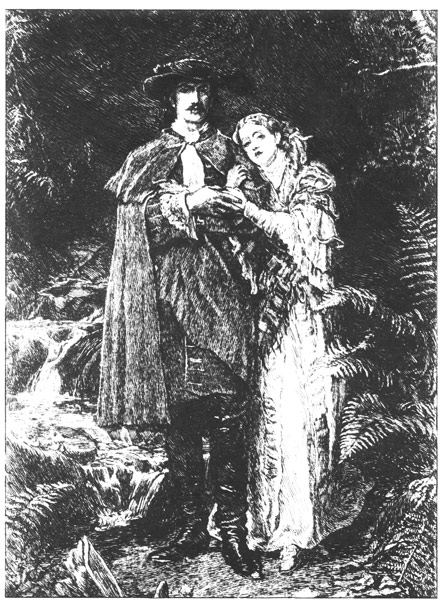
FROM THE PAINTING BY SIR J. E. MILLAIS
LUCY AND THE MASTER—"the bride of lammermoor"
WALTER SCOTT