PAINTERS of WESTERN LIFE
Reading edition
By ARTHUR HOEBER
Author and Artist
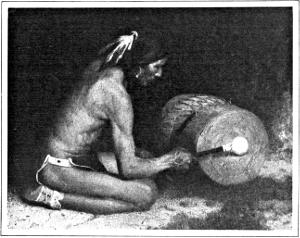
Copyright by E. Irving Couse
THE DRUMMER, by E. Irving Couse
MENTOR GRAVURES
THE LAST STAND By Frederic Remington
WILD HORSE HUNTERS By Charles M. Russell
MY BUNKIE By Charles Schreyvogel
THE CALL OF THE FLUTE By E. Irving Couse
THE SILENCE BROKEN By George de F. Brush
AN ARGUMENT WITH THE SHERIFF By W. R. Leigh

THE MENTOR · DEPARTMENT OF FINE ARTS · JUNE 15, 1915
Entered at the Post-office at New York, N. Y., as second-class matter. Copyright, 1915, by The Mentor Association, Inc.
The present generation has taken its pictures of life in the Far West mainly through the paintings of such artists as Frederic Remington, Charles M. Russell, Charles Schreyvogel, and others who will be referred to in this article. And yet two of these men—Remington and Schreyvogel—who were our contemporaries are already dead, and it was only about eighty-four years ago that the first American artists went to the land of the setting sun to paint the Indian in his native lair. This artist was a young Philadelphian named George Catlin, a lawyer by profession, who was born in 1796 and died in 1872. Though trained for the bar, his artistic tendencies were too strong for him. He set forth in 1830, with practically no knowledge of the technic of art, going as a guest of Governor Clark of St. Louis, then United States superintendent of Indian affairs. Governor Clark went for the purpose of arranging treaties with the Winnebagos, Menominees, Shawanos, Foxes, and others, and the opportunities for young Catlin were unusual.
CATLIN AND CARY, THE PIONEER PAINTERS
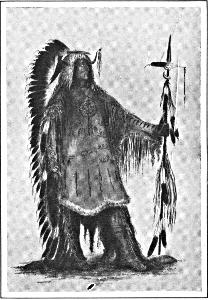
ONE OF CATLIN’S INDIANS
A second trip the next season inspired Catlin to still a third, in 1832, when he ascended the Missouri on a steamer, to the mouth of the Yellowstone. He returned some two thousand miles in a canoe with a companion, and on the trip sketches were made of the Crows, Blackfeet, Sioux, and Iowas. It was all a revelation to Catlin, who made a serious study of the savage as far as his artistic equipment permitted. Subsequent trips followed, and in 1836 he accompanied a detachment of the first regiment of Mounted Dragoons to the Comanches and other tribes. These visits of course were at a time when the Indians were in a primitive and picturesque condition, before the change that was to come subsequently through association with the whites. The result was an enormous collection of drawings and paintings, together with many written accounts and descriptions of manners and customs, and for years Catlin reigned supreme in a field that no one had hitherto explored.
Catlin, however, was far more interesting from a historical standpoint than from any artistic conception he gave to his theme. With his indifferent training, unfortunately, he lacked imagination. He recorded what he saw, then a great novelty to the public; but his work now arouses little emotion. For years, however, engravings of his drawings, colored reproductions, and photographs were the only data for reference, and as the artist was scrupulously correct in all details of adornment, local color, costume and implements, manner of life and ceremonials, his work still has considerable value. The modern men do not by any means scorn taking a hint from him. In the Centennial Exhibition in 1876, a great showing of Catlin’s work was more or less in the nature of a sensation.
The next painter of the West was William de la M. Cary, who in 1861 made a trip across the plains with an army officer. There was still plenty of excitement, and the traveler had to be prepared against both wild man and beast. Mr. Cary made many sketches in the manner of Catlin, and sent home illustrations to the magazines, occasionally recording the humorous side of his adventures. His sketches were well received and appreciated.
GEORGE DE FOREST BRUSH
Some years ago George de Forest Brush gave considerable attention to the life of the Indian, and signed many pictures that remain classics in American art. Some of the themes were of the early Aztecs. Among the titles were “The Sculptor and the King” and “Aztec Sculptor.” More modern works were “The Silence Broken,” “Mourning Her Brave,” “Indian Hunter,” and many more, all of them works of fine imagination and admirable composition lines. Mr. Brush, who was born in Tennessee in 1855, was a pupil of the Paris government art school under the late J. L. Gérôme (zhay-romé), and is a distinguished draftsman as he is a commanding figure in American art. Of recent years, however, he has chosen other fields in which to exploit his talent; but of all the native painters, he has brought to his work on the Indian the best artistic equipment of any, and of the dozen subjects of the aborigines all are unusual, and of the highest excellence.
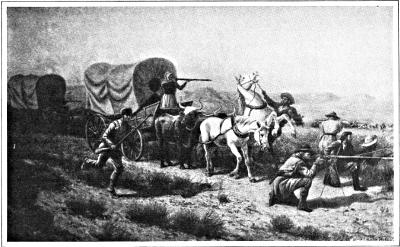
Copyright by W. de la M. Cary
“FORTY-NINERS” CROSSING THE PLAINS
By William de la M. Cary
REMINGTON AND THE SPIRIT OF THE WEST
The painters of the Great West, however, were yet to come. Men were to arrive who would catch something of the spirit of the life there, who were to record the romance of the savage, the soldier, the cowboy; the latter in particular,—a picturesque group of men the outcome of peculiar conditions, men who rounded up the cattle, and were apparently a race apart, of prodigious recklessness, hardihood, and bravery, who lived in the saddle almost continuously, save when occasionally they strayed into the frontier town to squander their pay. These were, as the late Frederic Remington quaintly phrased it, “Men with the bark on.” Remington (1861-1909) was himself to be the first of the modern group to treat the West with artistic sympathy, and his name rises instantly when any mention is made of the plains. First of all, the man himself was a genuine lover of the open, of nature in its wildest aspects. For him the horse, the prairie, the blue sky! He should have been an army officer. He was, almost; for he accompanied the troops on many of their campaigns and was as well known to the captains as he was to the troopers and many of the Indians.
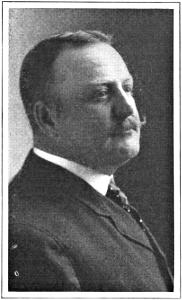
Photo by Davis & Sanford
FREDERIC REMINGTON
Somewhere about the middle ’80’s he began to send illustrations to the various periodicals; crude affairs, as he admitted later and himself characterized as “half-baked.” But they had that vital, convincing touch to them that meant subsequent success. Somehow, even in his tentative efforts, he had a vim and go that held the spectator. The man knew his Indian, soldier, cowboy, hunter, from the ground up. They had in them plenty of red blood, even though the first drawings were crude. There was that about them which disclosed astonishing feeling, clear insight into character, distinct sympathy. The public was profoundly interested, and saw great promise. Nor was there any disappointment; for the man made rapid progress. His Indian fairly reeked of savagery; his soldier was an epitome of the hard-working, modest, simple, splendid man of action; his cowboy was a picturesque and vital character.
It is almost pathetic to realize that so commonplace and commercial an invention as a wire fence was the means of doing away with the cowboy. This introduction of a cheap and effective means of coralling the animals at one fell swoop put the cowboy out of business, destroyed forever the usefulness of this race of picturesque, hard-riding, reckless youth of the plains. Mr. Cowboy rides on his raids but seldom now.
Remington knew these cowboys well. He had mingled with them, ridden after the herds, joined in their boisterous revels, and there came from his brush and pencil a picturesque lot of out-of-door characters, to the very life. Remington had camped in the open, had ridden hard and long, had been with the United States cavalry in its expeditions, was the intimate of the officers and men of the then little army of this nation, and he saw history made. In all this crowd there was no more picturesque figure, whether cowboy, Indian, or soldier, than Remington himself. He wrote as entertainingly as he painted, and before his death (he was stricken untimely) was to follow his beloved comrades in the army as war correspondent to Cuba, in the Spanish War. It is nowise to the disparagement of the men who followed Remington to say that they were all under an everlasting debt of gratitude to him for his initial insight into the breezy outlook on life in the Far West, and for his way of presenting his facts.
Remington was an indefatigable worker, constantly filling his sketch-book with notes, and making mental memoranda of the happenings about him. And he showed steady progress in the technic of his art, each succeeding picture disclosing genuine advance. Nor was he content simply with painting and drawing. He sought artistic expression in sculpture too, modeling much during the later years of his life with great success. Personally, the man was a delight to a host of friends, with his inimitable stories, his genial manner, and his thorough naturalness. One of the best known of his sculptural works is “The Broncho Buster,” which has long been a public favorite, and been reproduced in bronze.
RUSSELL, THE COWBOY ARTIST
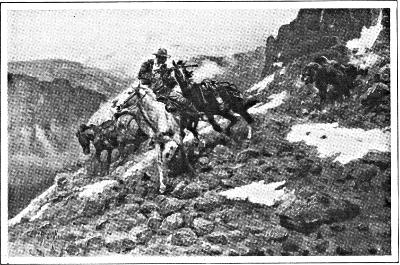
Copyright by C. M. Russell
A DANGEROUS CRIPPLE
By Charles M. Russell
There followed Remington an artist very distinctive of the soil, one who was of the land in that he had been a veritable cowboy, knew his West thoroughly, had lived with the Indians, spoke several of the tribal languages, and, still more useful accomplishment, was familiar with that picturesque, poetic, universal means of communication among savages of the Great West, the sign language. This was Charles M. Russell (1865). In Great Falls, Montana, where he lives and has a home and studio, he is one of the institutions. Few travelers in that part of this country fail to pay him a visit. They call him the “Cowboy Painter,” and with reason; for during several years he followed that profession. Also he lived long among the Indians, sharing their camps, their food, riding after game, winter and summer, dwelling with them as a brother.
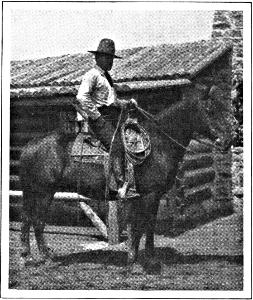
CHARLES M. RUSSELL
The Cowboy Artist
Though he always drew pictures, he never saw the inside of an art school, nor had he ever a teacher. Artistically, like Topsy, he just grew. He cannot recollect the time when a lead pencil did not seem part of his equipment, and he filled sketchbooks with notes. Somewhere about 1892 he concluded to take up seriously the profession of artist, and turned his attention to illustrative work. Among his efforts in this direction were drawings for Stewart Edward White’s delightful “Arizona Nights,” Emerson Hough’s “Story of the Outlaw,” and Wheeler’s “Trail of Lewis and Clark.”
Russell went from St. Louis, his birthplace, to Montana when he was but a lad, so that he learned much of woodcraft and the ways of the plainsman. Today there are few who excel him in throwing the lariat; he is an adept with the pistol; horses are second nature to him; buffaloes he hunted and killed by the hundred in earlier days. So it will be seen that when Mr. Russell started in to paint the West he was reasonably well equipped and rendered whereof he knew.
Since some years now stern men in blue and khaki have seen to it that the Indian is kept on his reservation; business men with the wire fences now look after the interests of investors in ranch property; life in the West has lost much of its picturesqueness; civilization and order control affairs. But Russell’s memory of all these earlier conditions remains. So distinctly were his first illustrations of the soil that they attracted the attention of some of the English weeklies, which made arrangements for his work. From this to painting was an easy transition. No one was more surprised at his sudden success than the artist himself, who had drawn these pictures because of his great love of the work and to whom financial gain was the last consideration.
So it came about that Mr. Russell turned his attention to compositions of various sorts,—the lassoing of cattle, the intimate glimpses of Indian life, the ways of the cowboys, and occasionally episodes of army life. They were all true transcripts, painted with considerable sympathy and enthusiasm. Many of his pictures found favor in England, titled people of that nation hunting in the West regarding these canvases not only entertaining but as remarkably faithful. He has been spoken of as the painter of the “West that has Passed.” Like Remington, Mr. Russell has attempted with no little success the task of representing by sculpture some of the Indians and animals of the plains.
SCHREYVOGEL’S “MY BUNKIE”
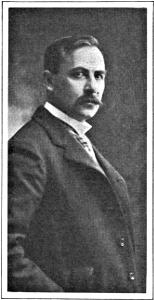
CHARLES SCHREYVOGEL
During the exhibition at the National Academy of Design in New York in 1900 a young painter awoke one fine morning to find himself famous. He was a youth of German extraction by the name of Charles Schreyvogel (1861-1912), and his painting, “My Bunkie,” was the sensation of the display. It was an episode of the United States army campaign against the Indians, a cavalryman rescuing his chum, whom he had drawn up on his horse. Another painter of western life had appeared, and had made astonishingly good. Schreyvogel followed this picture with many more of no less excellence. He painted the life of the plains,—the Indian hunting the buffalo, attacking settlers, at his war dance, the fighting of the American trooper,—in short, he disclosed a fine pictorial insight in that wild and stirring life that has now practically passed away.
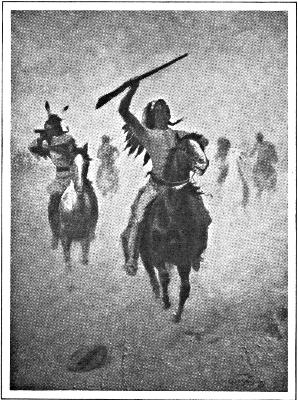
Copyright, 1900, by Charles Schreyvogel.
A HOT TRAIL
By Charles Schreyvogel
E. IRVING COUSE
Trained in the Paris schools, E. Irving Couse (1866-), after doing some decorative work, devoted his attention entirely to painting the Indians of the Southwest, depicting rather the intimate life out of doors, or at the peaceful occupation of weaving, hunting, and other distractions. He gives these canvases a decorative treatment, and they disclose an intimate knowledge of his subject. Mr. Couse has a studio at Taos, New Mexico, and is represented in many public collections throughout the country. Besides he has had many medals and honors.
PAINTERS OF PLAIN AND FOREST
Another artist to paint the same sort of subject with distinguished success is Ernest L. Blumenschein (1874-), who began as an illustrator, and after work at portraiture became interested in the life of the Indian. He too went some years ago to Taos, where quite a colony of painters assembled. His first important picture to attract attention was his “Wiseman, Warrior, and Youth,” a group of three characteristic red men. Both Mr. Couse and Mr. Blumenschein may be said to represent the “tame” Indian; for all their canvases depict the savages at peaceful occupations.
W. Herbert Dunton is still another of the Taos colony, where he paints much of the year; though he gives attention to illustrative work as well. He has seized upon the characteristics of the Indian with artistic fidelity.
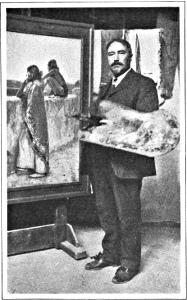
E. IRVING COUSE
In His Studio
In a similar manner N. C. Wyeth, both in painting and in illustrative work, has been no less successful. Mr. Wyeth was a pupil of the late Howard Pyle, whose influence is felt strongly in his work.
Other pupils of that noted illustrator have attained distinctive positions in portraying varied forms of Western life. The legends and traditions of the Indian have attracted Remington Schuyler. The pictorial aspect of his active life in the open, together with his contact with wild animal life, has supplied subjects for Philip Goodwin; while the life of the frontiersman and the pioneer has inspired the sturdy work of Allen True and Harvey Dunn. These five men have pictured the West in the same large spirit in which their master worked in rendering the buccaneers of the sea and the continental soldier. Most of the painters of the West have been illustrators first and painters later.
At Cody, Wyoming, for a large part of the year lives William R. Leigh. He was born in West Virginia in 1866. He was a pupil of the Munich art schools, and received medals in Paris. He has painted much of the West that has passed,—of Indian and soldier, of settler and cowboy, of some of the battles of the ’60’s between the United States troops and the savages,—and has given some of the wonderful landscape backgrounds, devoting no less attention to the extraordinary local color than to the figure.
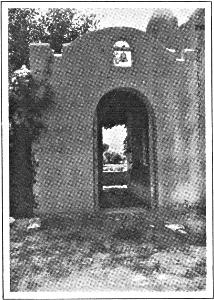
THE HOUSE OF E. IRVING COUSE
At Taos, New Mexico
Edward W. Deming, who has both painted and modeled the Indian, executed some years ago a large decoration for the home of Mrs. E. H. Harriman, at Arden, New York, with the title “The Hunt,” showing the red men after big game. Similarly Maynard Dixon has executed decorative work of the Indian for some California homes. His training was through several years of illustrative work for the magazines, and in this work he always had a distinctly decorative composition of his subject, though his rendering was realistic and virile.
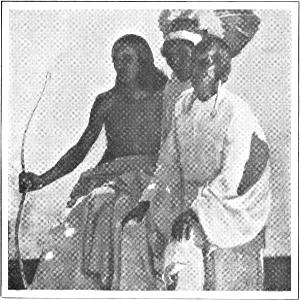
WISEMAN, WARRIOR, YOUTH
By E. L. Blumenschein
Howard McCormack, who studied the Southwest as far as Mexico, has also given attention to decorative work with the Indian for his theme. Another who began as illustrator is J. N. Marchand, who now paints the story-telling picture of the prospector and the cowboy. He knows well his types and the color of their setting. The name of De Cost Smith is frequently signed to strong Indian pictures. His “Defiance,” a group of Indian warriors on the crest of a hill, shown a dozen years ago, had great vitality and beauty. Louis Aitken was one who had much of that vitality and beauty—but he passed away too early for great fame. Another who is now known in mural work, W. de Leftwith Dodge, began his career in Paris by showing in the Salon the “Death of Minnehaha” and “Burial of a Brave,” subjects novel to that old art center. In recent water color exhibitions still another illustrator, Frank Tenney Johnson, has had many distinguished showings of the present day Indian. His oil paintings, too, are full of the poetry of the open. Moonlight and sun-glare are to him equally alluring. Two painters who glory in showing vast sketches of the open, who use the human figure, but minimize it in their pictures, are Frank Vincent Du Mond and Fernand Lungren, both permanent residents of the Southwest.
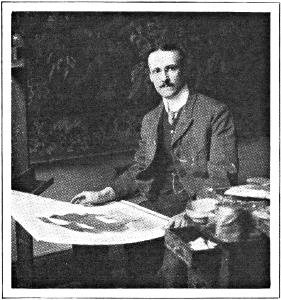
E. L. BLUMENSCHEIN
All painters of the West regard that country and its life with a deep reverence, and this feeling shows in their work. “God’s Country,” though the familiar phrase of all, expresses their enthusiasm and their devotion. In subject it is the most distinctly American of all themes, and enthusiasm for the theme will go on producing the technical skill to render it adequately.
Some of these later men bring to their work a technical skill perhaps not possessed by the earlier men. Yet with this they lack some of the convincing quality of the pioneers. For remaining traces of the picturesque the painter of today goes to New Mexico, where he finds even more color than farther north; but there he has to portray the arts of peace rather than those of war. Who shall say his theme is no less satisfactory and inspiring? Certainly not we who have lived to see the art of combat brought up to the nth power!
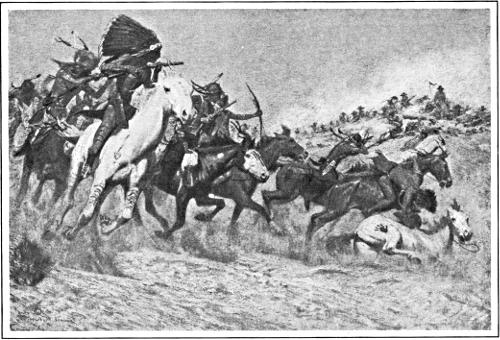
Copyright, The Knapp Company, N. Y.
CUSTER’S LAST STAND
By W. H. Dunton
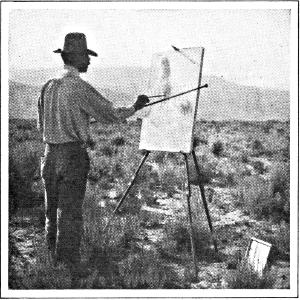
W. H. DUNTON
The Painter of the Plains at Work
THE INDIAN AS AN ART SUBJECT
There is still infinite opportunity to make the subject of the Indian an important factor in American art. His decorative costume gives an element of color, while his life of action gives rhythm and movement, and the background of prairie and mountain provides dignity and grandeur for the composition. In but little of the mural work has this opportunity been used, though some of the decoration of state capitols has included isolated instances—Douglas Volk in the Minnesota capitol being one. Lawrence C. Earle has decorated a bank building with scenes of pioneer days. Ralph Blakelock, one of the most individual of painters, in his best period pictured the Indian. Elbridge A. Burbank has made many paintings of types and representatives of various tribes—since 1897 over 125 portraits. H. F. Farny, who did fine illustrative work in the ’80’s, has been one of the most prolific painters of the Indian subject. Two of his best are “The Silent Guest” and “Renegade Apaches.” Joseph Henry Sharp has also been a tremendous producer of the western life picture. He has painted nearly one hundred portraits of Indians and Indian pictures for the University of California and eleven Indian portraits for the Smithsonian Institution, Washington.
Sculptors have made ample use of the Indian as a subject. His muscular development, as well as his stoicism, is a monumental quality akin to certain aspects in the Egyptians.
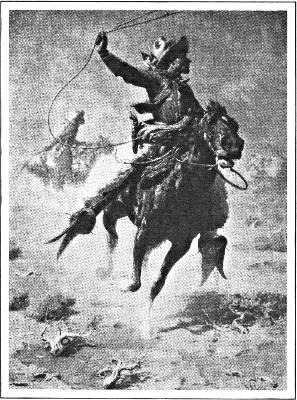
Copyright, 1914 Courtesy Snedecor & Co.
THE ROPING
By W. R. Leigh
SUPPLEMENTARY READING
CROOKED TRAILS By Frederic Remington
JOHN ERMINE OF THE YELLOWSTONE By Frederic Remington
MEN WITH THE BARK ON By Frederic Remington
PONY TRACKS By Frederic Remington
STORIES OF PEACE AND WAR By Frederic Remington
SUNDOWN LEFLARE, Short Stories By Frederic Remington
THE WAY OF AN INDIAN By Frederic Remington
All of these books are descriptions and stories of life in the Great West as Remington saw it. They are all illustrated by the artist and author.
GOOD HUNTING AND PURSUIT OF BIG GAME IN THE WEST By Theodore Roosevelt
HUNTING TRIPS OF A RANCHMAN By Theodore Roosevelt
RANCH LIFE AND THE HUNTING TRAIL By Theodore Roosevelt Illustrated by Frederic Remington
MY BUNKIE AND OTHERS A volume of pictures by Charles Schreyvogel
RECOLLECTIONS OF FREDERIC REMINGTON By Augustus Thomas Century Magazine, July, 1913.