MAKERS OF MODERN AMERICAN FICTION
Reading edition
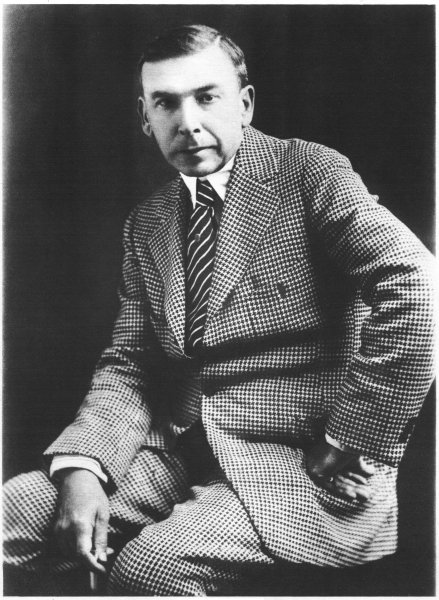
BOOTH TARKINGTON
Booth Tarkington ONE
Towards the close of the last century Booth Tarkington wrote “The Gentleman from Indiana.” It is as the Gentleman from Indiana that Mr. Tarkington has been widely known ever since. There was a time, some fifteen or twenty years ago, when every native Hoosier was supposed to have the manuscript of a “Best-Selling” novel concealed somewhere about his person. Some of the authors died, and some of them went into other occupations, and the state has managed to live the belief down. But Mr. Tarkington remains the most conspicuous living figure linking Indiana with letters.
Born in Indianapolis on July 29, 1869, he studied at Phillips-Exeter, and later at Princeton. In both places he was recognized as one likely to go far. Princeton he entered as a junior, but “made” the editorial boards of both college publications, the Tiger and the Lit—his sketches for the former being rather better than his literary contributions to the latter. He wrote the play for the Triangle Club, and, at graduation, was voted the most popular and promising man in the Class of 1893. There followed, however, lean years, when the prophecies seemed unlikely of fulfillment. That was a period, when, like the John Harkless of his own story (“The Gentleman from Indiana”), he was figuratively “sitting on a rail fence in Indiana.” Always a hard worker, he toiled unremittingly at invention and rewriting, only to have the manuscripts that he submitted with bright hopes come back to him with disheartening regularity. That was the story of the five or six years after 1893. His first tale to be sold was “Cherry,” a whimsical romance of the country about Princeton and undergraduate life at the College of New Jersey in pre-Revolutionary days. Accepted by Harper’s, it was not published until long after. Then, suddenly, success came. Almost simultaneously “The Gentleman from Indiana” and “Monsieur Beaucaire” appeared, the first a full-length novel of mid-western life, the second a charming little romance of eighteenth-century manners at Bath when Beau Nash reigned and a Prince of the Blood came over from France in the guise of a barber in the French Minister’s train. The recognition won with those two books has widened with the years. After the “Gentleman” and “Beaucaire” came “The Two Van Revels,” the germ of which had been a short tale of two thousand words written in the author’s undergraduate days. As a result of a brief fling at political life Mr. Tarkington wrote the stories collected under the title “In the Arena.” That was followed by “The Conquest of Canaan,” the story of a discredited boy who leaves his native town under a shadow, and returns to win its reluctant admiration. The years spent about that time in Europe suggested “The Guest of Quesnay,” and two shorter stories with scenes laid in Italy, “The Beautiful Lady,” and “Mine Own People.” The chief distinction of “The Flirt,” in which the author returned to the Indiana setting of the earlier books, was the picture of the heroine’s impish brother, Hedrick Madison. “The Turmoil,” dealing with the evolution of one of the great mid-western cities, showed Mr. Tarkington in the full maturity of his power. After that book he struck a new and rich vein in his sketches delineating boy life, the stories dealing with Penrod Schofield and William Sylvanus Baxter having found a response in every corner of the land. Mr. Tarkington has also to his credit considerable achievement as a playwright. “The Man From Home,” written in collaboration with Harry Leon Wilson, was one of the most successful plays of the American stage of recent years. Other plays from his pen are “Cameo Kirby,” “Springtime,” “Mister Antonio,” “The Country Cousin,” and “Seventeen.” Calling Indianapolis his home town, Mr. Tarkington spends much of his time at Kennebunkport, Maine, and usually passes a month or two every year in Princeton, New Jersey.
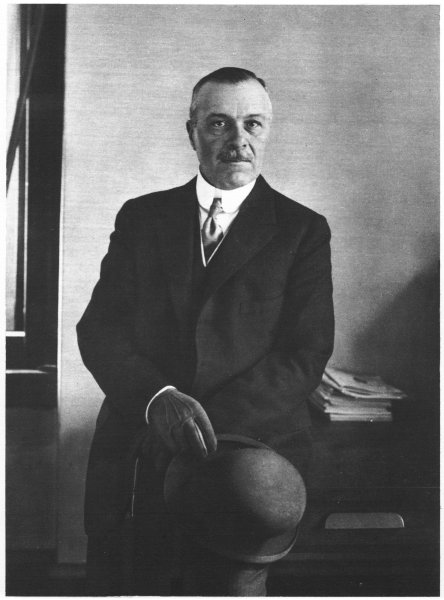
PHOTOGRAPH BY PETER A. JULEY
ROBERT W. CHAMBERS
Robert W. Chambers TWO
What impresses one most about Mr. Robert W. Chambers is his amazing versatility. In addition to being a popular novelist, he is an expert on rare rugs; an artist, and so well qualified a judge of fine art that he can talk intelligently to the curators and directors of museums about the old masters on exhibition there; equipped with an understanding of Chinese and Japanese antiques so that he can detect forgeries in that art; an authority on mediæval armor; a lover of outdoors, of horses, dogs, and an ardent collector of butterflies; and, in addition, a thorough man of the world, who knows Paris and Petrograd, and many of the out-of-the-way corners of the earth. These are the qualities that come to mind readily, but the list is far from complete. The longer one knows Mr. Chambers, the more varied the knowledge he finds in him.
Out of such rich mental resources Mr. Chambers draws his material for fiction. He writes two novels a year for a large public that eagerly devours them. Mr. Chambers’ life is a full and active one.
He was born in Brooklyn, New York, on May 26, 1865, and in his youth he aspired to be a painter. He studied art in Paris at Julien’s Studio from 1886 to 1893, then returned to New York, and for a while contributed illustrations to the current publications. Then one day a novel, “In the Quarter,” appeared with his name as author. From that time on his life was given largely to writing fiction, and the record of the years has been a brilliant one. In 1893 he published the haunting, uncanny, but fascinating “The King in Yellow,” a collection of stories of art life. He turned to France first as a background for romance. At irregular intervals from 1894 to 1903 appeared “The Red Republic,” “Lorraine,” “Ashes of Empire,” and “Maids of Paradise.” They all had the France-Prussian War as their setting, and dashing young Americans as their heroes. Then in 1901 with “Cardigan” and other books he gave expression in fiction to the spirit of the American Revolution. It has not been simply as an historical or a semi-historical novelist, however, that Mr. Chambers has made his widest appeal. In the foibles, extravagances, superficialities and eccentricities of contemporary American society, he has found his richest vein. It does not matter whether the background of a particular tale be New York, or Washington, or Palm Beach. The underlying social and ethical problems are of real importance. Marriage, the giving or selling in marriage, the reasons of heredity that make for or against a certain marriage: these are fundamentals common to all humanity. In “The Younger Set” and “The Firing Line” hero and heroine have unwisely married, and the story hinges largely on problems raised subsequently by divorce. In “The Fighting Chance” (1906), and “The Danger Mark” (1909) the problem is that of unfitness to marry. In the former it is the man who inherits a craving for alcohol, and the woman for sentimental philandering; in the latter the woman is given to intemperance and the man to excessive gallantry. In one of his later books, “The Hidden Children” (1915), Mr. Chambers returns to a favorite setting of the earlier years, upper New York of the Colonial period.
On a basis of solid fact, it would seem impossible for one man to do all this work. Where does he ever find time to do it? The answer lies in the fact that Mr. Chambers keeps regular hours—office hours, almost—for his writing, all of which is done in long hand. At that he is not a rapid writer, frequent revision is essential, and a passion for the verification of details consumes much time. Yet the bulk and excellence of the accomplished performance remains an established fact; and in many ways it is little less than marvelous.
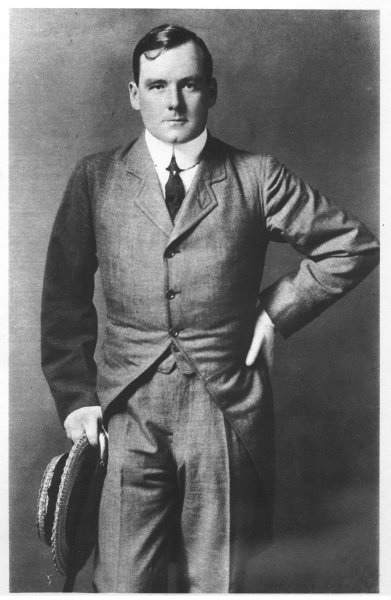
PHOTOGRAPH BY PACH BROS.
RICHARD HARDING DAVIS
Richard Harding Davis THREE
In 1890 there appeared in Scribner’s Magazine a short story entitled “Gallegher.” It gave an account of a smart young office boy employed on one of the newspapers, who succeeded in “beating the town” by bringing home a big, sporting story to his paper. It was held at once as one of the best newspaper tales ever printed. When the name of the author, Richard Harding Davis, was mentioned, the reading public recognized him as the son of Rebecca Harding Davis, a fiction writer of established reputation. Davis’ fifty-two years of life were full of color and manly achievement. He was a novelist, short story writer, war correspondent, editor and playwright. He began as newspaper reporter, a pursuit most natural, for his father, L. Clarke Davis, was a brilliant journalist and editor.
Richard Harding Davis was born in Philadelphia in 1864, and attended the Episcopal Academy and afterwards Lehigh and Johns-Hopkins Universities. In his college days he was weak in mathematics, but strong in all that made life full, joyous and vital. He entered eagerly into sports and wrote stories for the Lehigh magazines.
In 1887 he began newspaper work on the Philadelphia Record, also occasionally contributing to the Press and other Philadelphia papers. His first big assignment was in connection with the Johnstown Flood in 1889. It was in the Press office that Davis discovered the original Gallegher—the office boy who was immortalized in Davis’ famous story, just as the mongrel dog was vindicated in Davis’ later story “The Bar Sinister.” In 1889 he made a trip to London as correspondent to the Philadelphia Telegraph, and while there wrote of the Whitechapel murders in a way that attracted attention. He got his first job in New York in this way. In London he came to know Arthur Brisbane, who was then English correspondent of the New York Sun, and afterward editor of the Evening Sun. On his return to America he sought a newspaper job in New York, and Brisbane took him on the Evening Sun. His first experience was strikingly characteristic. A bunco man accosted him near the ferry. Davis gave him some marked money, then had him arrested and walked him boldly into the Evening Sun office, showed him up for the crook he was—and then wrote him up in the form of a news story for the paper. Aside from his regular assignments as a reporter, Davis busied himself with pictures of various types of New York life. Among these the most famous were the Van Bibber stories, in which Davis presented types of New York society. In 1891 Davis went to Harper’s Weekly and remained there for three years as managing editor. Then he became a free lance. It was not necessary for him to “hold down a job.” All magazines and book publishers were eager for his work. His first engagement as war correspondent was on the battlefields of the Greco-Turkish War. He was a prominent figure among newspaper correspondents in all the great wars that followed. He made a genuine sensation by his war letters written from Cuba during the Spanish-American War of 1898. In that war Davis formed a friendship with Theodore Roosevelt that remained firm through life.
In 1898, with the publication of “Soldiers of Fortune” in Scribner’s Magazine, the reputation of Davis as a novelist became established, and, thereafter, the fiction that flowed from his pen found an eager and growing audience. His extensive travels enabled him to set his stories in widely varied scenes. “Soldiers of Fortune” told of revolution and political intrigue in a South American republic. That also was the vein and atmosphere of “Captain Macklin” and later of “The White Mice.” In “The Exiles” he invaded Morocco for his background and characters. Later, in “The King’s Jackal,” he laid his scenes in Tangier. “Ranson’s Folly” is a story of American army life—afterwards dramatized, as was “Soldiers of Fortune.” “Princess Aline” is a romantic story of the “Graustark” kind. Besides fiction, Davis wrote many books of adventure and travel impression, such as “Rulers of the Mediterranean,” “Three Gringos in Venezuela,” “The West from a Car Window,” “A Year from a Reporter’s Note Book,” “The Congo and Coasts of Africa.” His later books, based on war correspondence, include “With the French,” “Somewhere in France,” and “With the Allies.”
We have named scarcely half the titles of Davis’ work. He was busy always with his pen, and, as one of his fellow craftsmen in literature observed, he “never penned a dull line.” In all his stories he left a record of his sturdy Americanism and his passionate devotion to a just cause, wherever he found it.
He died suddenly of heart disease on April 12, 1916. The loss to literature was great and was keenly felt in a history-making time like this that demands an eloquent chronicler. Davis will always be remembered as one of the most buoyant, brave, heroic and industrious workers in the field of American literature, a man who saw life fully and clearly, and who reflected it truly, in healthy, ringing, inspiring tones.
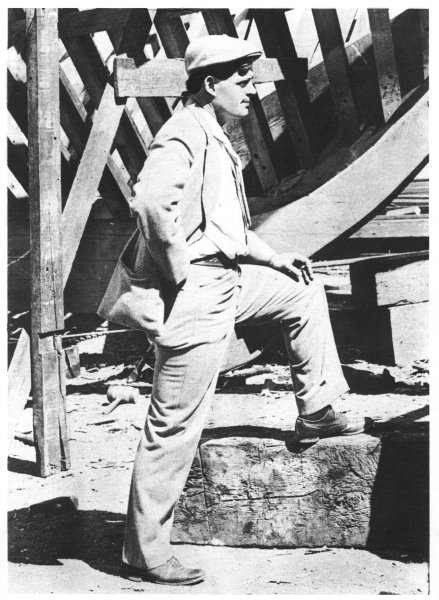
JACK LONDON
Jack London FOUR
Jack London’s stories were written largely out of his own life. If they were not actual experiences cast in fiction form, they were narratives spun out of the fiber of his own experiences. Life was never certain for London. He was always on the go, and his life was an ever vigorous, vital present, with the future undetermined and unguessed. He was born in San Francisco on January 12, 1876. When he was eleven years old he left his ranch in the Livermore Valley and set out to satisfy his longing for a knowledge of the world and an expression of himself. He first went to Oakland, where, in the public library, he came under the romantic influence of such fiction writers as Washington Irving, Ouida and others. Out of Irving’s “Alhambra” he built castles in the air for himself, and launched upon a great literary career with a strong under-current of romance and an irresistible longing for adventure. He left home and joined the oyster pirates in San Francisco Bay. Then, tiring of the excitement of piracy, he turned with equal enthusiasm to the prosecution of it by joining the Fish Patrol, and was entrusted with the arrest of some who were his former comrades. Thrilling accounts of this life appeared under the title of “Tales of a Fish Patrol.” In them is a wild buccaneer spirit, and the savor of the sea. Those of us that read the “Sea Wolf” can find there a passionate expression of the author’s own experiences before the mast while seal hunting in Behring Sea or along the coast of Japan. It is full of strong appealing character and strange sea lore. The same wild breath of adventure is to be found in “The Mutiny of the Elsinore,” in which London describes thrilling experiences in a trip around the Horn. London was a worker, and labored hard among the rougher elements of life—with longshoremen and shovellers in San Francisco; in factories and on the decks of coastwise vessels. He was as good a tramp, too, as he was a laboring man. He walked the Continent over from ocean to ocean, gathering the materials for a “vast understanding of the common man.” Out of these experiences came “The Road,” which is an appealing record of sympathy with the vagrant poor, and an absorbing narrative of adventurous journeying.
London tried schooling at different times in his early life, working between hours to pay for his education. After several months of stern, hard application, in which he covered about three years’ preparatory work, he entered the University of California. The strain, however, of work and study combined was too much for him, and after three months he had to give up. Turning to things quite different, and with a desperate hope that he might find fresh inspiration in a new kind of life, he set off for the widely advertised Klondike to seek for gold. In the Klondike “nobody talks; everybody thinks; you get your true perspective; I got mine,” he says. After a year of hard toil in the north, London returned home and assumed the burden of supporting his family, his father having died while he was away. He wrote story upon story, and finally gained acceptance and success. As book after book came out, the public grew to know and recognize Jack London as one of the strongest figures in American fiction.
He passed away on November 22, 1916, in the full swing of his intellectual vigor, and it will be long before his splendid achievement is forgotten, or the last of his books is consigned to the high shelves that spell oblivion. No matter how sparing one may be in the use of the word genius, for him it could be claimed. His name is one of the few among those of the writing men of our time with which the magic word is, without hesitation, to be linked. There was genius in his invention, in his imagery, in his nervous style. To him was given to know the moods of Arctic wastes and California valleys. The struggles of his own soul and mind and body he dissected and portrayed in “Martin Eden” (1909) and “John Barleycorn” (1913). He was practically the only American writer to invade magnificently the prize-ring as a field for romantic narrative. Its seamy side, its sordid corruption, its driftage, as well as its brutal heroism, are reflected in such tales as “The Game,” “The Abysmal Brute,” “The Shadow and the Flash,” and “The Mexican.” “The Call of the Wild” (1903) challenges the very best dog-stories of all time. “The Sea Wolf” (1904) is an epic of salt brine, and creaking rigging, and man’s inhumanity to man, and the “blond masters of the world.” There followed “Burning Daylight” (1910), and “The Valley of the Moon” (1913), and “The Mutiny of the Elsinore” (1914), which is “The Sea Wolf” “in a lower key,” and “The Strength of the Strong” (1914), and a dozen more. Whatever the field, there was a sureness of touch, and a power of graphic description that made the man always a figure and a force.
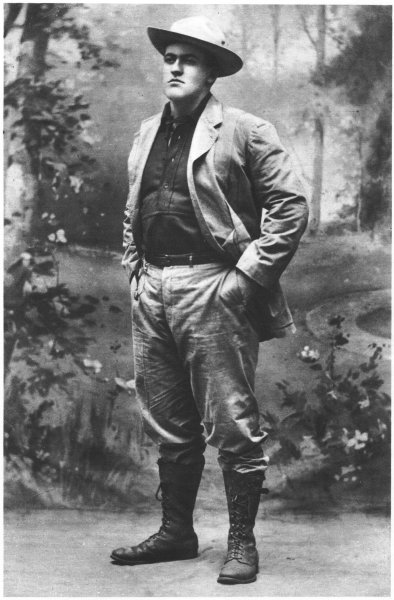
REX BEACH
Rex Beach FIVE
It was in Alaska—the field of “The Forerunner,” the Kipling poem that was for so many years lost and entirely forgotten by its author, the field of Robert W. Service’s “Songs of a Sourdough,” the field of so many of the tales of Jack London and Stewart Edward White, that Rex Beach first found literary expression. He did not set out in life to be a literary man. He was a husky youth, full of vitality and, even in his teens, a giant in strength. He was born in Atwood, Michigan, September 1, 1877, and he left his native place for the city of Chicago when he was eighteen years of age. He meant to study law, but, as he said, he “had no money—therefore had to find a place to eat.” In those days the athletic associations of several of the large cities maintained football teams of giant gladiators to entertain the multitude. Young Beach had seen just one game of football, but when he presented himself, his physical architecture was so imposing that he was engaged without hesitation, as tackle, by the athletic association football manager. The college teams used to play an annual series with these huge professionals. Later they gave it up, because the “truck-horse professionals” hired by the athletic associations could not be hurt by anything short of an ax, while the college players, as Beach said, were apt to “tear under the wing.” Beach played through the season, taking part in the games by which his team won the championship of America. Then, being desirous of eating regularly, he attached himself to the athletic association’s swimming team and broke an indoor record at water polo. That was in 1897, when the Klondike excitement broke out. He stampeded with the rest. It was the spirit of adventure and no thought of finding material for fiction that took him to the Yukon.
With two partners from Chicago, Beach was dumped off the boat at Rampart, on the Yukon, one rainy night. The three hadn’t a dollar amongst them, but they had plenty of goods. Then things began to happen. “We prepared to become exorbitantly rich,” in the words of Beach, “but it was a bad winter. There were fifteen hundred rough-necks in town, very little food and plenty of scurvy. I soon found that my strength was my legs. I could stampede with anybody. So I stampeded faithfully whenever I heard of a gold strike, all that winter.” He became dissatisfied with his two Chicago partners, because they preferred to sit around the cabin cooking tasty messes to tearing through blizzards at the tail of a dog team. They wanted to wait for their million dollars until spring, but Beach wanted his by Christmas at the latest. And so he set off, and quickly fell under the spell of the Yukon. The glare of the white Arctic night, the toil of the long trail, the complicated struggle for existence, the reversion to primitive passions inevitable in a new civilization in process of formation, made an imperative call to him, and held him fascinated. The life about him moved him to write, and before long he was embarked on a literary career. “Pardners,” his first story, appeared in 1904, and this was followed by the novel that gave him reputation—“The Spoilers,” which appeared in 1906. Then came “The Barrier” in 1907, and “The Silver Horde” in 1909. They are all virile stories of Alaskan life that have stirred many thousands of readers. Some have gone into dramatic form, “The Barrier” having attained a new and distinguished success as a film picture. In “The Ne’er Do Well” and in “The Net” Beach sought Southern scenes, the former novel having Panama as its background, and “The Net” New Orleans during the Mafia days. “The Auction Block,” published in 1914, deals with the favorite activities of modern Metropolitan life, and the sale of young girls into the marriage tie.
Mr. Beach was christened “Rex E. Beach,” and he retained the middle initial for some time, but when correspondents who had read his books sent letters to him in which they addressed him as “Rev. E. Beach,” he dropped the middle initial. He lives in New York City and has a summer residence at Landing, Lake Hopatcong, N. J.
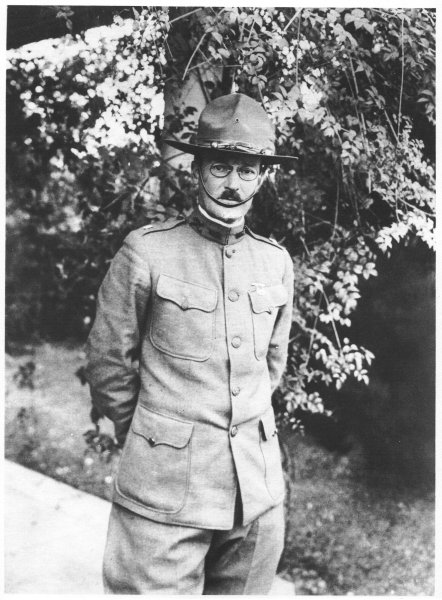
STEWART EDWARD WHITE
Stewart Edward White SIX
Readers often link the name of Jack London and Stewart Edward White. The men were of the same literary stature, though different from each other in almost every respect. Both found inspiration in the same theme—the struggle of man with primeval forces. In their technique we find the difference. There is a sharp contrast between the fire of Jack London and the held-in strength of Stewart Edward White. White was once asked if it was not possible to lay hold of the heart and imagination of the public through a novel which had no human love interest in it—whether man matched against nature was not, after all, the eternal drama. White considered for a moment and then said: “In the main, that is correct. Only I should say that the one great drama is that of the individual man’s struggles toward perfect adjustment with his environment. According as he comes into correspondence and harmony with his environment, by that much does he succeed. That is what an environment is for. It may be financial, natural, sexual, political, and so on. The sex element is important, of course—very important. But it is not the only element by any means; nor is it necessarily an element that exercises an instant influence on the great drama. Anyone who so depicts it is violating the truth. Other elements of the great drama are as important—self-preservation, for example, is a very simple and even more important instinct than that of the propagation of the race. Properly presented, these other elements, being essentially vital, are of as much interest to the great public as the relation of the sexes.” These words express clearly the trend of Stewart Edward White’s work.
From the beginning, Mr. White’s career has been one of prompt recognition and well-ordered prosperity. He was born at Grand Rapids, Michigan, on March 12, 1873. He attended no school until he was sixteen years of age, and yet, far from being behind his schoolmates, he entered the high school in the junior class with boys of his own age and graduated at eighteen, president of his class. He excelled in athletics and held the long distance running record of his school. He graduated a few years later from the University of Michigan, and then spent two years in the Columbia Law School, New York.
With private tutors, and then amidst the best university surroundings, Stewart Edward White’s education was obtained under advantageous auspices. He read and traveled a great deal, and had time to indulge his love of outdoor life. His first production was a story entitled “A Man and His Dog,” and under the advice of Professor Brander Matthews, of Columbia, he offered it for publication. It was bought by Short Stories for $15. This was Mr. White’s first income from literary work. Then, after a trip to the Hudson Bay country, he wrote a story entitled “The Claim Jumpers,” which was published in 1901 and met with an encouraging reception. “The Westerners,” which was finished later, was bought for serial publication for about $500. This was a distinct advance in his literary affairs, and when “The Blazed Trail” was published in 1902, Mr. White came truly into his own. “The Blazed Trail” was written in a lumber camp in the depth of a western winter, and it was composed during the early hours from four A. M. till eight, before he put on his snow-shoes for a day’s lumbering. “The Conjurer’s House” came out in 1903, and in that same year “The Forest,” which Mr. White regards as one of the most instructive books he has written. It is the story of a canoe trip. The immediate success of “The Forest” led to the writing of “The Mountains,” which told the adventures of a camping trip in the Sierras. Then “The Mystery,” “Camp and Trail,” “The River Man,” “The Rules of the Game,” “The Call of the North,” “The Rediscovered Country,” “The Adventures of Bobby Orde,” “The Gray Dawn,” “The Leopard Woman,” and other books followed. In all his books he told the vigorous story of life in its primitive forms. “Gold” is a picture of the madness of ’49. “The Dawn” is a story of California, “The Leopard Woman” a romance of the African wilds. In his later books, Africa became to Mr. White a very real and commanding subject—and one that still holds him in its lure.
Mr. White produces his books fast and in highly finished form. He is essentially a realist. Human achievement, with all its vital interest and meaning, laid hold early on his imagination and gave to his stories their all-pervading sense of truth to life. As a critic has said, “One puts down a book by him with a feeling of having read through experiences, dramatic and full of romance, yet never breaking the bounds of probability—and that is fine art.” Mr. White’s home is in Santa Barbara, California, and his field of active experience includes a substantial part of the whole surface of the earth.
Mr. White entered the U. S. Service shortly after war was declared. The picture on the opposite side of this sheet shows him in uniform as Major of U. S. Field Artillery.
PREPARED BY THE EDITORIAL STAFF OF THE MENTOR ASSOCIATION ILLUSTRATION FOR THE MENTOR, VOL. 6, No. 14, SERIAL No. 162 COPYRIGHT, 1918, BY THE MENTOR ASSOCIATION, INC.
THE MENTOR · DEPARTMENT OF LITERATURE
Entered as second-class matter March 10, 1913, at the postoffice at New York, N. Y., under the act of March 3, 1879. Copyright, 1918, by The Mentor Association, Inc.
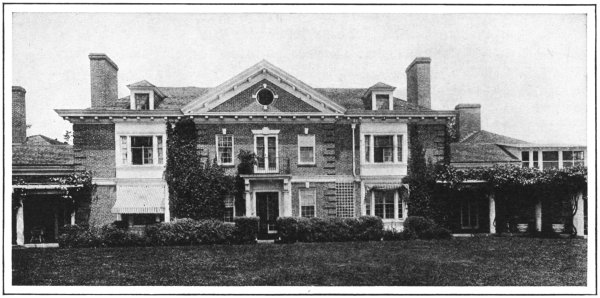
HARLEKENDEN HOUSE, THE HOME OF WINSTON CHURCHILL, CORNISH, N. H.