GUYNEMER, THE WINGÈD SWORD OF FRANCE His Youth and Apprenticeship
Reading edition
TWO

Though hampered by illness and enforced vacations, Guynemer graduated from Stanislas College in his fifteenth year with honors. In the autumn he re-entered the school for a further course of study. His leisure hours were passed installing miniature telephones, and experimenting with paper airplane models. His ability for invention and mechanics was marked. All the sciences held interest for him, but he had special liking for chemistry and mathematics. He was fond of reading, but his choice of books fell solely on those that dealt with war, chivalry and adventure.
One of young Guynemer’s intimates was Jean Krebs, whose father was a pioneer in the development of aerostatics and aviation. He was then director of the great Panhard automobile works, and on Sundays the two youths spent hours studying motor parts. With their fellow students at the college they were often taken to visit technical establishments after school. Georges was always to be found beside the one that explained the operations of the machinery. When they were permitted to attend automobile and airplane exhibitions, his delight was boundless. Keen, excited, agitated, he passed from one exhibit to another, commenting, interrogating, and incidentally filling his pockets with catalogues and pamphlets about the different makes of cars and planes. While still at school he fashioned a small airplane, which he launched with glee over the heads of his companions.
At that time (1910), the eyes of Europe were on the sky. Blériot had crossed the Channel; Paulhan had soared to a record height of over four thousand feet. It was the ambition of all French youth to fly. With Guynemer the desire was an obsession. From the aerodrome near Compiègne he secretly made his first flight, crouched behind an obliging pilot, cramped and uncomfortable, but ecstatically happy. So determined was he to follow the profession of the air that pleasures of world travel, enjoyed for months in the fond companionship of his mother and sisters, served in no way to distract him from his purpose. “What career shall you adopt?” his father inquired, when they returned. And Georges answered, as if it were the most natural thing in the world, “I shall be an aviator.” His parent protested that aviation was not a career, but a sport. The boy was obstinate. He confessed that his life was already dedicated to this passion. That on the morning he had first seen a birdman fly above the college of Stanislas, he had been possessed by a sensation he could not explain. “I felt an emotion so deep it seemed sacred,” he told his father. “I knew then that I must ask you to let me become an aviator.”
Refused admission to the École Polytechnique because the professors believed him too frail to finish the courses, he was taken with his family to Biarritz on the coast of France, and there rumors came to them of the war, in the month of July, 1914. War was declared August second. The following day Georges presented himself for medical examination at Bayonne,—was rejected, and when he tried still other times, was rejected again. Finally his persistence, his devotion to France, his resolve to serve her in the way he felt he could be of the most value, won him the reward of acceptance in the training school at Pau.
In January, 1915, Guynemer received his first lessons as a student-aviator, after having studied two months as a mechanic. On February first, according to his own narrative, his apprenticeship as a pilot took on aerial character. “I drove a ‘taxi,’ and then the following week I mounted an airplane, going in straight lines, turning and gliding, and on March tenth I made two flights lasting twenty minutes in daylight. At last I had found my wings. I passed the examination the next day.”
Once, Guynemer barely escaped being scratched from the list of military aviators at the school of Avord, because a head pilot complained that he was imprudent in making flights that were too difficult for one of his experience, and because he persisted in flying when the weather was unfavorable.
When he had flown for six months, he was sent one day on a photographing mission. The enemy discovered him. A rain of shells fell on his plane. Keeping on amid the deluge, Guynemer made not a single turn to escape the attacks. For an hour he went straight toward his objective until his observer gave the signal to return. Even then the pilot continued to drive on toward the guns that were trying to beat him down, and, handing his personal photographic apparatus to his companion, asked him to take some pictures of the mortar attacking the airplane. From that day, no one in the squadron doubted the future of this youth, “this eagle of the birdmen, this young Frenchman with the face of a woman and the heart of a lion.”
PREPARED BY THE EDITORIAL STAFF OF THE MENTOR ASSOCIATION ILLUSTRATION FOR THE MENTOR, VOL. 6, No. 18. SERIAL No. 166 COPYRIGHT, 1918. BY THE MENTOR ASSOCIATION, INC.
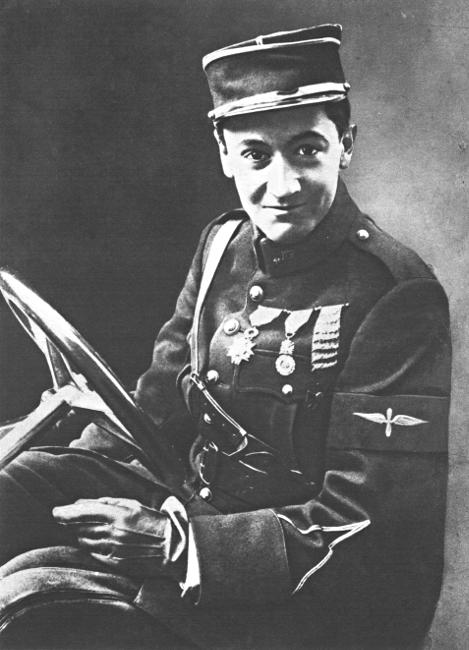
COPYRIGHT BY UNDERWOOD & UNDERWOOD
GUYNEMER AT THE WHEEL