GEORGES GUYNEMER The Wingèd Sword of France
Reading edition
By HOWARD W. COOK
Entered as second-class matter March 10, 1913, at the postoffice at New York, N.Y., under the act of March 3, 1879. Copyright, 1918, by The Mentor Association, Inc.
MENTOR GRAVURES
GUYNEMER WHEN HE BEGAN HIS FLIGHTS
GUYNEMER AND HIS FAITHFUL GUNNER, GUERDER
GUYNEMER AT THE WHEEL

MENTOR GRAVURES
GUYNEMER BROUGHT DOWN BY THE BOCHE
GUYNEMER AND A BOCHE VICTORY
GUYNEMER, THE ACE OF ACES
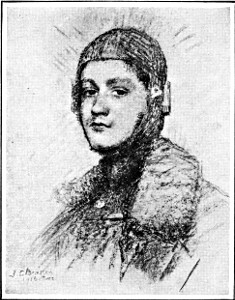
By courtesy of the Century Co. From the drawing by Madame J.C. Breslau.
GEORGES GUYNEMER
NOTE—The following article is based on Guynemer’s own records and the account of his exploits published by his close friend and authorized reporter, Jacques Mortane.
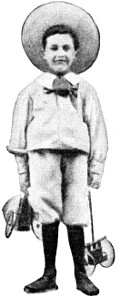
GUYNEMER WHEN SIX YEARS OLD

When the history of the World War is finally written, one of the names conspicuous in its pages will be that of Georges (jorje) Guynemer (gee-ne-mare). The name of Guynemer has become synonymous with brave deeds and symbolical of the great spiritual glory that belongs to France. Guynemer has been called “The Ace of Aces” and “The Wingèd Sword of France”; but these names express only in part the characteristics of a world-famous hero whose life, as Clemenceau (klem’-ahng-so) so aptly terms it, “even though short, was a sufficiently beautiful adventure.” Guynemer’s part in the World War is over. His own active chapter is done, but his spirit lives on in the hearts of every allied airman.
Guynemer, born in December, 1894, was the son of a retired officer. As a boy he was agile and ambitious in sports, though of slender build and somewhat delicate. He was especially fond of mechanical toys and miniature airplanes, and even in the early school days, when flying was looked upon more as a sport than an actual military factor, Georges declared to his father his ambition to become an aviator.
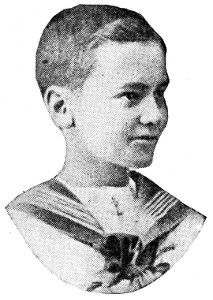
GUYNEMER AT TEN YEARS OF AGE
And then came the war. The youth, who because of physical weakness was refused admission to the army no less than five times, was finally accepted at the age of twenty, on November 23, 1914. Then began a career that in a few short years was destined to make the name of Georges Guynemer immortal.
Guynemer’s First Victory
In describing his first meeting with the Boche (bosh) on July 19, 1915, to his friend, Jacques Mortane, Guynemer said:
“I was on a two-seated ‘Parasol’ with Guerder, my mechanic, as passenger. I had promised myself for some time to undertake a pursuit in my airplane, but I had always been ordered on reconnaissances or photographic missions, and that kind of work did not suit me at all. It is always set aside for the newcomers in the squadrons, and I wanted to show that grit was not the exclusive possession of the older men.”
A Boche had been sighted at Coeuvres (koev-r), and Guynemer took flight with Guerder and was soon in pursuit of the enemy. As the Boche’s plane was faster there was no possibility of catching him. Nevertheless, the joy of finding a first adversary made Guynemer eager to attempt anything. From a great distance he fired at his opponent—possibly without any hope of hitting him, but steadily nevertheless. He pursued him as far as the Coucy aerodrome, where he saw him alight. This displeased Guynemer greatly. He had gone out to “get” a Boche and had to go back empty-handed.
“There we were,” he said, “with these sad thoughts, when suddenly another black point appeared on the horizon. As we came nearer, the point became larger and was soon plain, as a Boche. He was moving towards the French lines, thinking only of what he might find ahead. He did not dream that on his track were two young fellows determined not to return to the squadron without performing their task, two young fellows who believed that to return to headquarters without a Boche would mean derision.
“It was not until Soissons (swahs-sohng) was reached that we came up with him, and there the combat took place. During the space of ten minutes everybody in the city watched the fantastic duel over their heads. I kept about fifteen meters from my Boche—below, back of and to the left of him, and, notwithstanding all his twistings, I managed not to lose touch with him. Guerder fired 115 shots, but could not fire precisely, as his gun jammed continually. On the other hand, in the course of the fight my companion was hit by one bullet in the hand and another ‘combed’ his hair. He answered with his rifle, shooting well. We began to ask ourselves how this duel was going to end, but at the 115th shot fired by Guerder I saw the pilot fall to the bottom of his car, while the ‘look-out’ raised his arms in a gesture of despair, and the plane did a nose spin, and plunged down into the abyss in flames. He fell between the trenches. I hastened to land not far away.
“At last I was able to live my dream! I, who had so long desired to join in the fighting, had managed to gain a victory. What shall I say about the reception given me by the troops on the ground—ovations, congratulations, all under the vengeful cannon of the enemy. I have beaten down other Boches since that time, but when I think over my aerial duels my recollections always fly back to that first one.”
Official recognition came to Guynemer the next day when the Military Medal was awarded him for being “a pilot full of spirit and boldness.”
In considering Guynemer’s personal accounts of his various flights, it is evident that the Ace, while not inspired by the same craving for combat that Major Bishop acknowledges, was a hero of unusually high-pitched nerves, inspired with dreams of battle, and whose quests for the Boche were insatiable.
Guynemer talked much concerning his “will.” It was his will to get into service in spite of his five rejections and being compelled to enter as a mechanic. He would scorn an observer’s work and become a hunter. He would make his score larger and larger. He would fly regardless of climatic conditions or his own health, going up even when convalescing from injuries. And it was this will which doubtless made him the terror of his enemies and the glory of France.
Among the first duties assumed by an airman when he is learning the mastery of his machine is that of reconnoitering. But Guynemer, fast becoming specialized in pursuit, soon stopped all reconnoitering and found himself assigned to a single-seated airplane. It was on February 3, 1916, that in the course of a single flight he succeeded in getting his first official “double.”
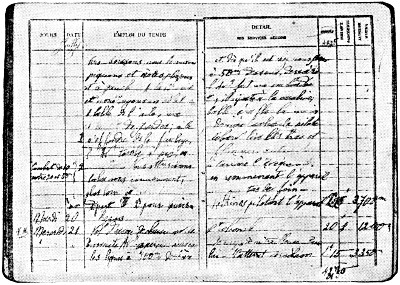
A PAGE FROM GUYNEMER’S NOTE BOOK OF FLIGHT
Showing record of his first victory, July 19, 1915
He was making his usual round in the Roy section just before noon, and was about to end his flight, when he saw an airplane in the distance. “The game was coming to me,” he said. All he had to do was not to let it escape. Guynemer gave chase and soon caught up with it. The enemy did not seem to wish to avoid the fight. Possibly he had not seen Guynemer at all. Being faster than he, Guynemer got behind him, opening fire at 100 meters,[A] and, as he fired at rapid intervals, his cartridges were soon exhausted. At that instant a cloud of smoke, which increased rapidly, made a sinister tail to the Boche, who dived, severely wounded. He fell, however, within his own lines, and Guynemer could not follow him to earth. It was certainly one enemy less, but Guynemer’s total record was not improved.
Fortune, however, favored him. “I was coming back,” he said, “thinking over the methods of fighting, considering how I had attacked, asking myself whether I would not have done better to approach from some other direction, when at almost 11.30 I found another hunting plane. Yes, I had made a mistake just now, when I opened fire from so far away—I should have waited. At 100 meters we cannot be sure of the aim. My method, which up to this time always consisted in attacking almost point-blank, seemed to me much better. It is more risky, but everything lies in maneuvering so as to remain in the dead angle of fire. Certainly it is rather difficult, but nevertheless it can be mastered with skill.
“While going over these things to myself I had come near enough to the Boche without running any great danger. At 20 meters I fired. Almost at once my adversary tumbled in a tail-spin. I dived after him, continuing to fire my weapon. I plainly saw him fall in his lines. That was all right, no doubt about him. I had my fifth! I was really in luck, for less than ten minutes later another plane, sharing the same lot, spun downward with the same grace, taking fire as it fell through the clouds.
“The second day afterwards, before Frise, in a new tête-à-tête with a hunting Boche, I leaped forward, caught up with him, got in back of him, a little below to avoid his fire, and at 15 meters fired 45 cartridges. He swayed sadly, in the shock of death, which I was beginning to be able to diagnose, then fell like a stone, taking fire on the way. He must have been burned up between Assevillers and Herbecourt. Although he was really my seventh Boche, he alone gained me the honor of a special mention.”
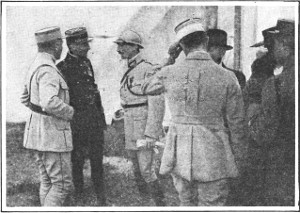
GUYNEMER BEING DECORATED WITH THE ROSETTE OF THE LEGION OF HONOR
Guynemer (in dark uniform) has just received the Rosette
Guynemer’s fifth citation rewarded him for this exploit, and declared him a hunting pilot with audacity and energy for any adventure.
According to Guynemer’s own testimony, one of the most difficult things an airman of the Allies has to do is to compel the Boche to accept a duel, not that the latter lacks courage, but rather that he prefers not to run the risk of being brought down. As a result of forcing engagements, Guynemer seldom returned from a flight without a wound of some sort or other. On several occasions his garments were drilled with holes, his clothing more than once taking on the appearance of a sieve. This was the youth who in less than eight months from the downing of his fifth Boche had been awarded seven palms for his war cross.
Guynemer and His Parents
Like Nungesser, Dormé (dor-may) and Triboulet (trib-oo-lay), Guynemer would not rest when he had left the hospital convalescent from some of his more serious wounds, and it is by signs like these that we find the souls of great heroes who know nothing about “vacations,” even for their health, so long as others are fighting. Guynemer was not strong and should have rested after his stay in the hospital. His parents begged him to rest, so Guynemer compromised by agreeing to establish himself near his family at Compiègne (kom-pee-ane), where at the same time he could serve France. Not far from his paternal home, at Vauciennes (vo-see-enn), his Baby Nieuport rested in a hangar, ready to carry him into those great open spaces to search for the enemy whenever the atmosphere permitted.
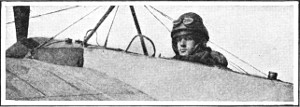
GUYNEMER READY FOR FLIGHT
One of the hero’s sisters was entrusted with the task of studying the atmosphere at dawn each day to see if it were “Boche weather.” And as soon as it was light enough, slyly, like a boy planning mischief against the orders of his elders, the Second Lieutenant Ace came down from his room and mounted his Nieuport for a prospective fray.
He was convinced that no one in the house suspected his escapades except his sister. How little he understood the hearts of a father and mother! Father Guynemer has told of the anxieties, the worries lived through during that convalescence. The boy had gone. Would he come back? Would some hateful enemy appear on the way and prevent his return to the bosom of his family? The minutes of anxiety were as long as centuries. As for the loving Mother Guynemer, she did not dare show her son that she was undeceived by his stratagems, nor did she wish him to see her when she watched him fly away. Through the blinds, with tear-dimmed eyes, she watched him depart in the service of his country. When she saw her boy draw far away, she returned to her household duties—but not until Georges’ machine had become a tiny speck.
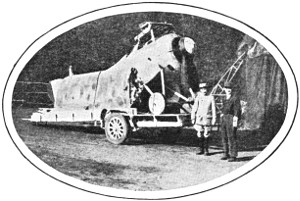
GUYNEMER AND MACHINE AFTER 3,000-METER TUMBLE
Here is one of the most moving pages in the hero’s life—this feigned ignorance on the part of the parents, the plotting of brother and sister. Guynemer, face to face with his family, pretended that he would run no danger. He insisted on his own prudence. Nothing serious could happen to him, because he avoided all risks. But as soon as he began to turn the conversation upon the subject which was all his life, the comforting words which he had spoken were at once contradicted by the many adventures and varied anecdotes which he recalled. No peril had been too great for him. He played with danger, and looked for it.
A Fall of 3,000 Meters
Guynemer hated the word “luck,” perhaps because he was accused of having so much of it, and when his Spad was struck by a shell 3,000 meters from the earth, the airman falling the entire distance, he repudiated the suggestion that his was a lucky star!
This phenomenal escape took place on September 23, 1916, Guynemer having just finished an exploit humorously set down by his friend Mortane as follows: “Put an egg in boiling water when the Ace of Aces begins a battle; you wait until he has downed three Boches, you take out the egg, and it is done to a turn. What a triumph for the restaurant menus!”
While contemplating the immensity of the azure heavens at an altitude of 3,000 meters above the earth, Guynemer suddenly felt a shell strike one of the wings of his airplane with all its force. The left wing was torn to shreds, the canvas sent floating in the wind, as the airman and his machine began a descent.
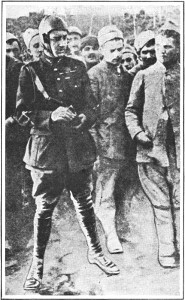
GUYNEMER FACE TO FACE WITH A DEFEATED BOCHE
“My apparatus fell,” said Guynemer, “broke apart, crumpled up in the abyss, unable to bear me any longer. I really felt the call of death and I seemed to be hastening towards it. It seemed that there was nothing to prevent my crashing to the earth. A tail-spin, terrible, fearful, began at 3,000 meters and continued to 1,600 meters.
“I felt as if I were indeed lost, and all that I asked of Providence was that I should not fall in enemy territory. Never that! They would have been too happy. Can you think of me buried with my victims? But I was powerless to exert my will, my airplane refused to obey.
“At 1,600 meters I tried anyway. The wind had driven me almost over our lines. I was already half-happy. Now I dreamed of being interred with sympathetic comrades following my body. That was not a fine dream, but at least it was better than the other.
“I had no longer to fear the pointed helmets. But, nevertheless, I felt all that death might be, and it was not a pleasant thought. The fall continued. The steering gear would not respond to my tugging. Nothing worked. I tried it to the right, to the left, pulling, pushing, but got no result. The comet did not slow a bit, I was drawn invincibly towards the earth where I was about to be crushed.
“There it was! One last brutal effort, but in vain. I closed my eyes, I saw the earth, I was plunging towards it at 180 kilometers[A] an hour, like a plummet. A terrible crashing, a great noise, I looked around. There was nothing left of my Spad.
“How did it happen that I was still alive? I asked myself, but I felt that it was so, and that was enough. However, I think that it was the straps which held me in my seat that had saved me. Without them I would have been thrown forward or would have broken some bones. On the contrary, they were dug deep into my shoulders, a silent proof, doubtless, that I should give them full consideration. Had it not been for them I would certainly have been killed.”
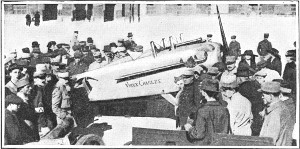
GUYNEMER’S FAVORITE AIRPLANE, VIEUX CHARLES (OLD CHARLES), ON EXHIBITION IN PARIS
Infantrymen hurried to the spot to pick up the pieces. Finding Guynemer not only alive, but unhurt except for a bruised knee, they conducted him home in triumph, singing the “Marseillaise” at the top of their voices.
Guynemer went to view the remains of the Boche that he had brought down first. The pilot had on his body a card, almost burned up, on which a feminine hand had written these words: “I hope that you will bring back many victories.”
A Quadruple Victory
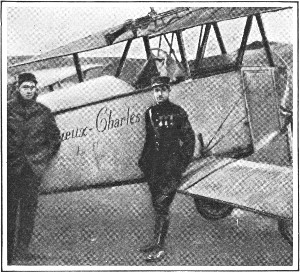
GUYNEMER WITH THE MILITARY MEDAL AND “LEGION OF HONOR”
The Magic Quadruple,—the successive defeat of four airplanes, was Guynemer’s achievement, one of which was downed in one minute, on May 25, 1917, according to the following schedule:
1st airplane, 8.30, 2nd airplane, 8.31, 3rd airplane, 12.01, 4th airplane, 6.30.
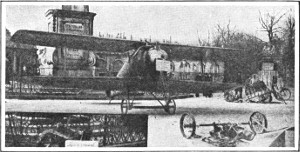
THE DEBRIS OF THREE AIRPLANES BROUGHT DOWN BY GUYNEMER IN ONE DAY
Four airplanes beaten down on one day by the same aviator was a record. On February 26, 1916, Navarre secured his first “double.” Nungesser, on the Somme, destroyed a balloon and two airplanes on a single morning. But by his quadruple victory Guynemer exceeded these two earlier records and the one established by himself in the Lorraine when he brought down three airplanes in one day. On the morning of May 25th Guynemer saw three enemy airplanes flying in concert toward French lines. He pounced upon them, and they took to flight. He attacked one of them, maneuvering to get him in the line of fire, then fired, and after the first shots the enemy machine dived and fell in flames.
Meanwhile the danger for the single-seated machine was surprise from the rear. While he was attacking in front, it was necessary for Guynemer to watch the rear. Guynemer turned, and saw a second adversary coming full at him, trying to reach him. But he had fired already from above downward, and hit him with an explosive bullet. Like the first, this airplane took fire. The victories of Guynemer were lightning-like, requiring only a few seconds of fighting.
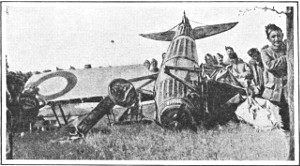
GUYNEMER BROUGHT DOWN BY A SHELL FROM A HEIGHT OF OVER 9,000 FEET
His only injury was a bruised knee
Towards noon an audacious German airplane flew over the aviation field. French squadrons have taught the enemy respect for their lines and the unfortunate fellow who ventures above them seldom returns home. It was something of a mystery how this one had broken through the barrage. But to ascend to the sky after him and to reach him, no matter how speedy the machine, required several minutes, time enough for the enemy to flee, his mission accomplished. All of the machines had come down except the one driven by Guynemer.
Guynemer came upon his adversary like a whirlwind. He fired. Only one shot from his machine-gun was heard. The airplane fell, the propeller revolving at full speed, and dug itself into the earth. Guynemer had killed the pilot with a bullet in the head.
That evening Guynemer went out for the third time. It was about seven o’clock, over the gardens of Guignicourt (geen-ye-koor), that a fourth machine, beaten down by him, fell in flames.
And as the young conqueror came down at sunset, he executed all kinds of fancy figures in the air to announce his victory to his comrades,—all the turns, and twists and loopings of which he was so great a master.
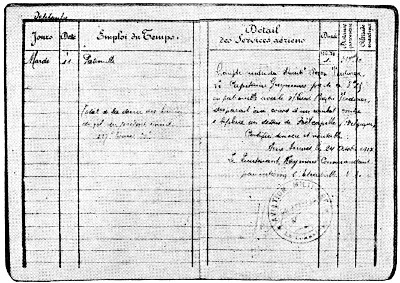
LAST PAGE OF GUYNEMER’S FLIGHT-BOOK
Recording his final departure
But some facts must be added as a sequence to the official announcements. The first airplane brought down was a two-seater, one of whose wings was broken in descent; it fell into the trees near Corbeny. The second, another two-seater, fell on fire near Juvincourt. The third was also brought down afire near Courlandon. Finally, the fourth, also set on fire, dropped between Condé-sur-Suippes (sweep) and Guignicourt. Add to this that, on that same day, Guynemer had collaborated with Captain Auger (the slain Ace) in putting to flight a group of six single-seaters.
It was the quadruple that brought Captain Guynemer the Rosette of the Legion of Honor with this commendation:
“An élite officer, a fighting pilot as skillful as audacious. He has rendered glowing service to the country, both by the number of his victories and the daily example he has set of burning ardor and even greater mastery increasing from day to day. Unconscious of danger, on account of his sureness of method and precision of maneuvers, he has become the most redoubtable of all to the enemy. On May 25, 1917, he accomplished one of his most brilliant exploits, beating down two enemy airplanes in one minute, and gaining two more victories on the same day. By all of his exploits he has contributed towards exalting the courage and enthusiasm of those who, from the trenches, were the witnesses of his triumphs. He has brought down forty-five airplanes, received twenty citations and been seriously wounded twice.”
One of the most conspicuous virtues of Guynemer was his extreme modesty. He wore his crosses and medals not from love of show, declaring that while it was sweet to know one was celebrated, that glory was accompanied by many drawbacks.
“You no longer belong to yourself,” said Guynemer, “you belong to everybody. To be well known is to see around you all the time a number of persons who never cared for you before but have suddenly assumed a pseudo-friendship for you. All at once they find out that you are a charming conversationalist, an infinitely fine soul, and more of the same kind of gush. Their object is to go out with you, and to take you to see their people. And when they look at you they imagine that you admire them. Such is the misfortune of renown! You no longer know where sincerity begins, whether they are pleasant to you out of friendship or vanity. We are apt to become unjust to those who do not deserve it, and confide in others who deserve it still less.”
The Last Flight
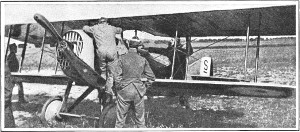
ON THE EVE OF HIS DEATH, SEPTEMBER 10, 1917
Guynemer—on the further side of the airplane—was obliged to land at a Belgian aerodrome for repairs
It was on August 20, 1917, that Guynemer, piloting “Old Charles,” achieved his last official triumph,—a German plane, which crashed to earth at Poperinghe, Belgium. A few days after this Guynemer took command of the Stork Squadron. Thus the difficult task of guiding the administrative work of The Storks fell upon the shoulders of this young soldier. With these new duties he might have abstained from flying. But this would not have been like Guynemer. He flew from five to six hours each day. On September 11th, notwithstanding the bad weather, Guynemer started upon a cruise with Second Lieutenant Verduraz. After furrowing space for a long time without success, for atmospheric conditions kept the Boches on the earth, the two pilots at last saw a two-seater which appeared to be lost in the clouds. The hero darted forward, attacked, but his gun missed fire. He maneuvered for position again without even trying to dodge the answering fire, so sure was he of himself in dealing with this Boche. A single two-seater was but a trivial thing to him.
Second Lieutenant Bozon Verduraz had gone towards other fights with the conviction that his comrade would, without a doubt, come out of the duel victorious; but he found nothing there when he returned. Guynemer, the hero of dreams, had vanished in mystery.
And here above Poelcapelle the career of this most brilliant pilot of the air was terminated, after he had added up 755 hours of airplane flight!
The censor forbade the announcement of Guynemer’s disappearance, but the news was passed from mouth to mouth. Guynemer? Every one deemed him invulnerable—no one believed that he could be killed.
But many days afterward came the news from a German source. The Ace of Aces had been beaten down near the cemetery of Flemish Poelcapelle. Two soldiers had been present at the place of the catastrophe. One wing of the Spad had been broken. The pilot lay there, killed, with a bullet in his head, and one leg broken. On him was found his commission, which made it possible to identify the body.
The district in which Guynemer had ended his career in a burst of glory was being hammered by the English artillery. Attacks followed. The Allies looked for his grave in the cemetery of Poelcapelle when they took it. But they never succeeded in finding it. It was learned later that, on account of the incessant danger, the Germans had not been able to remove the remains to inter them. The soul of Guynemer in the Great Beyond had the supreme satisfaction of knowing that the body was not defiled by his enemy.
Lieutenant Weisemann, the German airman who had brought Guynemer’s career to a close, survived his success but a few days.
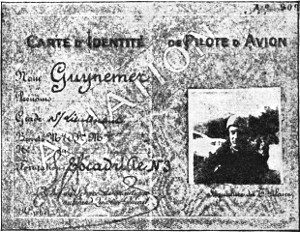
GUYNEMER’S PILOT CARD, REPRODUCED IN “DIE WOCHE” (THE WEEK) OF BERLIN, AFTER HIS DEATH
SUPPLEMENTARY READING
GUYNEMER, THE ACE OF ACES. A Record of His Achievements.
By His Friend, Jacques Mortane
EPIC OF THE AIR
Article in The Living Age, June 8, 1918
GEORGES GUYNEMER, KNIGHT OF THE AIR.
A Biography, Translated from the French of Henry Bordeaux.
GEORGES GUYNEMER, ACE OF ACES
Literary Digest, October 13, 1917
⁂ Information concerning the above books may be had on application to the Editor of The Mentor.