GAME BIRDS OF AMERICA
Reading edition
RUFFED GROUSE
BOB WHITE
WILD TURKEY
CANADA GOOSE
MALLARD
CANVASBACK
By EDWARD H. FORBUSH, State Ornithologist of Massachusetts
Author of “Useful Birds and Their Protection,” “A History of Game Birds, Wild Fowl, and Shore Birds,” etc.
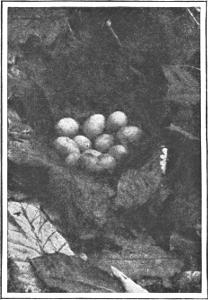
YOUNG GROUSE
The young bird learning to perch above the reach of prowling enemies.
North America, when discovered by Columbus, probably contained more game birds than any other continent. The great falling off in the number of these birds in recent times has been accentuated by the extinction of the passenger pigeon and the Eskimo curlew, and the rapid disappearance of many others, among which are the whooping crane and the sandhill crane, great birds that are gradually being swept from the continent. The upland plover, formerly abundant in every suitable grassy region east of the Rocky Mountains, is now facing extinction, and its salvation is beyond hope, unless the regulations, protecting it at all times, recently made by the United States Department of Agriculture, under the Weeks-McLean law, can be enforced. The rails do not appear to have decreased in number quite so rapidly as have the shore birds; but from the king rail, the finest of them all, down to the sora they are much less numerous than in the early years of the last century.
THE RUFFED GROUSE
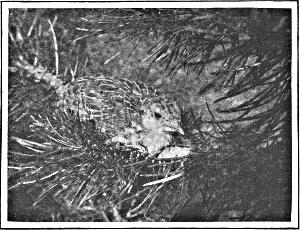
A RUFFED GROUSE NEST
“Whir-r-r-r-r-r-r—clip-clip-clip—” Heavens! what was that? Anyhow, it’s gone, and nobody’s hurt. How well I recall the startling sound that checked in an instant my headlong pursuit of a baby cottontail rabbit when, from the leaves almost beneath my feet, up sprang a feathered projectile with thundering wings, which sped away in headlong flight through whirling leaves and bending twigs, disappearing in an instant in the thick of the trees. There I (aged eight) stood, gazing after this new wonder, while little Cottontail made good its escape. I had seen my first grouse, the king of game birds.
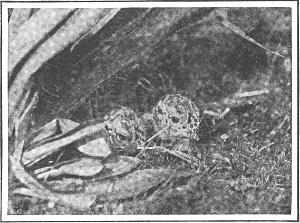
YOUNG GROUSE
Confident that they are hidden from the camera man.
In the North this grouse is known as the partridge; Southerners recognize it as the pheasant; but how few of us know more about it! How few realize that it flies quietly when undisturbed, or that it has a variety of notes, ranging from the soft, cooing mother’s call to the harsh scream or squeal with which she hurls herself at some enemy of her brood. Many have heard the drumming of the male, “Thump—thump—thump—thump, thump; thump, thump-rup, rup rup rup r-r-r-r-r-r-r-r-r”; but how many know that some seasons in some localities they do not drum at all? And why not?
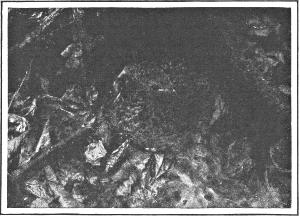
RUFFED GROUSE ON NEST
This picture was taken by leaving the camera set all night. The bird itself pulled a thread which released the shutter early in the morning.
In my notebooks the nest of the ruffed grouse figures as a hollow in the ground, lined with dead leaves or pine needles. The eggs range from seven to twelve; in one case fifteen. The mother does not commonly cover them on leaving the nest; although a bird was once seen to do so by dropping straws and leaves on her back and then sliding out from under.
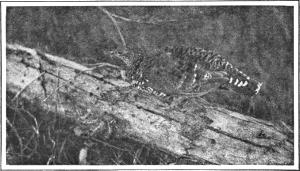
GROUSE
A favorite drumming log and trysting place.
What keeps the eggs from harm for weeks in the open woods? The grouse often brings off her young safely not far from the home of hawk, crow, or fox. Does the mother bird leave no scent by which her many four-footed enemies can find her? In one case, at least, well trained pointer and setter dogs could not find the bird on the nest, even after she had walked away and returned to it. Sometimes a dog or a fox blunders on the nest, and then the mother, every feather on end, flies at him in an attempt to drive him away; but this does not scare or deceive cunning Reynard, and in an instant his mouth is full of eggs. Sometimes a prowling cat catches the mother on her eggs at night, and that ends the family history; but in the majority of cases the eggs safely hatch.
The little ones all come from the shell together, and are fully equipped to find their own living. They need the mother only as guard, defender, and shelter. When they pop out of the eggs they leave the nest forever, and thenceforth they are at home in Robin Hood’s barn, and sleep wherever weariness or night overtakes them. A little roving band of downy, brownie, striped chicks, they keep close together, running here and there, always hunting, picking insects from grass, ground, and foliage; while the mother, stalking behind, herds them along with soft and gentle calls, acting as rear guard, to give warning of any enemy that may be upon their trail, to lead the destroyer away if she can, to defend them with her life if she cannot, and to brood them beneath her maternal breast whenever they are wet, cold, tired, or sleepy. Wherever night finds them there they snuggle down to sleep, protected from cold and storm by her tireless devotion. Probably the little ones do not leave much scent; but the fox, raccoon, mink, weasel, dog, and cat may cross their trail at any moment, crows, owls, and hawks menace them; yet commonly about half of them escape all danger and grow and thrive while the summer waxes and wanes. They learn to fly by the end of the first week. Before they are half grown they leave the ground at night, and roost with the mother in the trees.
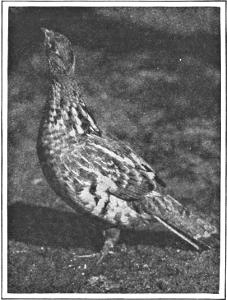
A YOUNG GROUSE
This grouse was but nine months old. At this age the male is not distinguishable from the female.
When the “leaves begin to turn” the well grown brood seeks the wild grapevines and the wild apple and thorn trees that it may eat the fruit. When the first heavy snow falls the few that have safely run the gantlet of the guns squat beneath the low-spreading branches of some evergreen tree and calmly allow the snow to cover them if it will. They are ready for winter now, and have donned their snowshoes. What! really? Yes, actually. They have grown horny processes on both sides of the toes which will help to support their weight on packed snow or thin crust, and they are perfectly at home on or under the snow. If a crust freezes over them, they make their way beneath it, feeding on twigs and ground vegetation until they can break out. When pursued they dive from on wing into the snow, and push their way below the surface, to burst out again farther on. It is exceedingly difficult to starve the grouse. They will live on frozen twigs, buds, laurel leaves, sumac berries, or birch and alder catkins. So my notebooks cover the history of the grouse through all the seasons of the livelong year.
THE BOB WHITE
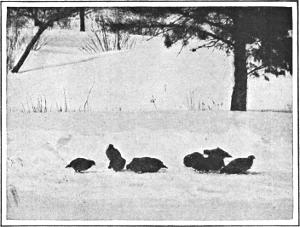
BOB WHITE IN WINTER
These little birds have a hard time finding food when the snow is on the ground.
“Bob white! You bob white!” cries a brave little fowl from the top rail of the old fence. His call is the embodiment of cheerfulness. There is something heartening in the sound. This is due in part to its rich and vigorous quality, and in part to its rising termination—the question in the final note—as if it said “All right there, Fellows?” How different from the note of the whippoorwill, with its falling inflection and its general expression of sad finality. The whippoorwill may be a cheerful bird. One is inclined to doubt it; but we know Bob White is happy. Just hear him! He looks it too. Thus this cheerful little optimist makes his way to the hearts of men. Even the sportsmen who slay him love him, and are often his best friends,—after the shooting season,—and the epicure loves him—on toast. Down South they call him partridge. In the North he is known as the quail; but the ornithologists, who try to settle such matters for all, have taken his word for it and have named him Bob White.
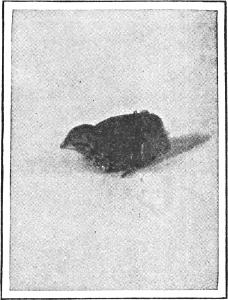
A YOUNG BOB WHITE
This cheery little manikin is about the most important North American bird that flies, not excepting even the American eagle. He is the farmer’s friend. Almost every insect pest of the garden and field is grist for his mill. All spring and summer he slays his thousands and tens of thousands, and in the fall he fattens up on millions of weed seeds. Yes, grain too; but only the waste grain left in the stubble. That is about all the grain he takes—and, after all this, many farmers get the sportsman to pay off the taxes on their farms for the privilege of shooting their little friend! Thus the school taxes are paid, and Bob White settles for the education of the children.
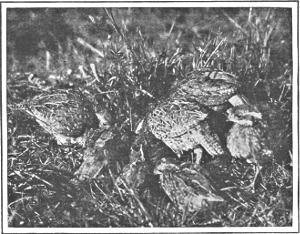
YOUNG BOB WHITES
The birds in this group are seven weeks old.
The pursuit of Bob White is a blessed boon to many jaded and brain-wearied business and professional men. Some believe that they have lengthened their lives by trying to shorten his. How the bird has survived with so many “friends” thirsting for his blood is hard to tell; but for all his trustfulness he is not so easily taken. Many gunners have believed that he can sometimes fool the best dog by “holding his scent.” I have seen him several times squat close to the ground on the approach of a dog, draw his head flat between his shoulders, and “sit tight” while the dog poked along, his nose to the ground, absolutely unconscious of the whereabouts of the little bird; but let a man appear, and the bird shows more anxiety and takes greater pains to get away or hide. I have seen him, when alarmed, disappear as if he had put on a coat of invisibility, and then, when the danger was past, grow out of the scenery, and walk right toward me from the very spot on which my powerful glass had been focused all the time. How he does this is another story.
Why talk about his habits? Everybody who does not know them can have a good time studying them; for his life is open for all to see. What concerns us most is how we can make this useful, companionable friend to man more plentiful. In the District of Columbia they have solved the problem by forbidding shooting for the last few years, and there in some places the chorus of Bob Whites sounds like that of the little frogs in springtime. A close season for five years on this bird would do more to stock the country than any other method now known; except, perhaps, in the northernmost part of its range, where it is sometimes almost exterminated by a severe winter. Eventually artificial propagation may solve our problem; for Bob White is a very prolific bird.
THE WILD TURKEY
Copyright, 1912, by Outdoor World and Recreation
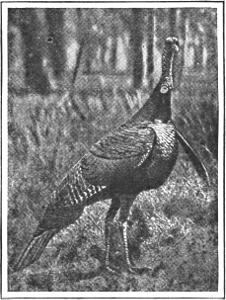
THE WILD TURKEY
Often called the grandest bird of America.
The ruffed grouse may be the king of game birds in the field; but the wild turkey, the largest game bird that flies, is to my mind king of them all on the table. A young wild turkey, well roasted, is a dish for the gods. The domesticated turkey is not in the same class; nor is it a descendant of our wild turkey. It was bred from the Mexican turkey, a bird of another race, not so handsome as ours, and having a white rump. This turkey was domesticated by the Aztecs, and hundreds of thousands were bred by them in domestication long before America was discovered by Columbus. Europeans received the bird from the hands of the Indians. The white man never has succeeded in domesticating any American game bird sufficiently to bring it into general use. The task still lies before us. The American Ornithologists’ Union now recognizes but one species and five subspecies of the wild turkey, all of which are natives of this continent.
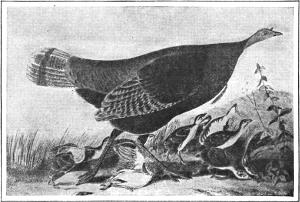
WILD TURKEY
This picture shows a female with its young. It is reproduced from one of the famous set of plates of “Birds of America,” made by J. J. Audubon.
The range of the species formerly extended over Mexico, most of the United States, and into southern Ontario. The early explorers found it roving in large flocks along the Atlantic seaboard, and at times migrating in great armies in search of food.
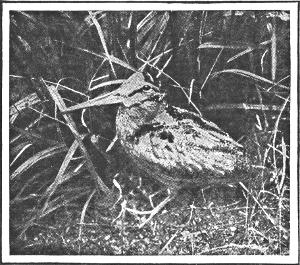
A WOODCOCK
We can form little idea today of the former almost incredible abundance of these noble birds. Our forefathers were accustomed to hunt them for the Thanksgiving dinner, and they rarely failed to secure a good supply. The bird is now extinct through the greater part of its former range. It was hunted, trapped, and shot at all seasons, and is likely to vanish from the earth unless it can be propagated under partial domestication and restored to its former habitat.
THE CANADA GOOSE
There is a quality in the cry of the wild geese returning northward in the spring that stirs the blood of all to whom the “Red Gods” call. That wild and solemn clamor ringing down the sky is as “the voice of one crying in the wilderness.” All eyes are turned to follow the baseless triangle drifting fast across the sky. What memories are awakened by that resounding call,—memories of open marsh or prairie, sounding shore and placid bay, lake or river, scenes of a wilderness of waters or of plains; for the wild goose is a bird of the waste places! Two hundred years ago it nested over the greater part of the continent; but civilization and market hunting have confined it now mainly to the vast morasses of the North, where it seeks some island in the marshy lands and there makes its nest.
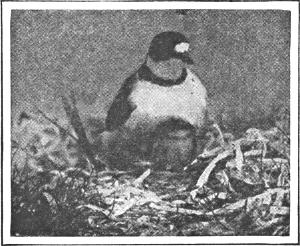
RING-NECK PLOVER
This bird mother is brooding a chick.
The goose normally mates for life, and as its life is reckoned to last about one hundred years the partnership, barring accidents, is a long one; but life is full of accidents. The goose does not reach maturity early, and therefore does not breed for the first few years. The gander is not such a goose as he looks; for in his constant watch over mate, nest, and young he shows both courage and sagacity. He defends his mate and brood to the utmost extremity. He is said to be a victor sometimes over the crafty fox, and he easily drives away the deer or elk when his young are in danger. The goslings take to the water early; but they like to go ashore to feed on the green grass and herbage of the uplands, and there they often run into trouble. One of their greatest aquatic enemies is the snapping turtle. I have known one of these monsters to capture a full grown goose by catching its foot. In the fierce struggle that followed the goose escaped only by tearing its leg from the socket, and died a miserable death from the result of its fearful wound.
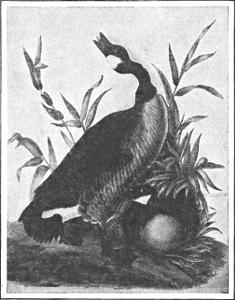
CANADA GOOSE
The male is standing and the female sitting.
When advancing winter seals the waters of their northern home, the geese gather in flocks, rise in air, and turn their faces to the south. They travel by well known landmarks, and unlike many sea fowl often become confused in a fog. Therefore, I believe they never intentionally fly out of sight of land; though they often cross wide bays and inlets.
THE MALLARD
The mallard is a cosmopolitan, the wild duck of the world, the progenitor of the domestic duck, and the chief water fowl of the game preserve. Its eggs and flesh formed a considerable part of the food of Indians and early settlers. Vast numbers of mallards formerly bred not only in Canada and Alaska, but in the western United States. Tons and tons of these birds were killed for their feathers by Indians and halfbreeds in the South and West. Boats loaded to the gunwales, wagons piled with ducks, to be given away; tons of birds spoiled before they could be shipped, then hauled out and dumped into the coulées; markets glutted and marketmen unable to handle the birds,—these were all episodes of the time of plenty. The result of this appalling waste, and the settlement of a large part of their breeding grounds, has been a tremendous decrease in the number of mallards in the country; but the birds may be readily replaced by protection and artificial propagation, and the mallard is not in any immediate danger of extinction.
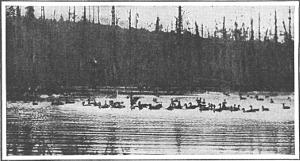
BLACK DUCKS
The birds are gathering to feed.
It nests in marsh or slough wherever it is undisturbed. The little ones, when hatched, soon reach shallow water, where they are perfectly at home. They swim about the sedge and water plants, catching insects, and when danger threatens keep concealed and sheltered by the herbage. They are often in peril, not only from hawks, owls, eagles, gulls, and herons, foxes, minks, and dogs, but they are attacked on all sides in their own element. Great frogs and fish spring to seize them with open mouths. Turtles prey upon them, and in the South alligators devour many. When a dog scents the little family in shoal waters and rushes in, the mother throws herself in his way and flutters off as if sorely wounded. While he chases her eagerly, his open mouth close to her tail, the little ones dive and swim away, more under water than above it, and, leaving the slough, crawl through the grass to the next refuge, hiding there safely until all danger is passed. Inherited experience has taught them the way of life, that their species may be perpetuated.
THE CANVASBACK
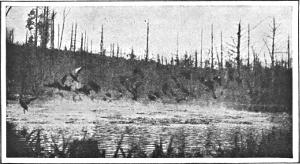
BLACK DUCKS
These birds were purposely flushed and taken on the first upward spring.
Long live the canvasback! His fame has gone farther, perhaps, than that of any other American game bird. Some epicures rank him above the little-neck, the lobster, or the terrapin, and he is considered a greater luxury than quail on toast. Yet the canvasback, when deprived of its favorite food, the wild celery, is hardly superior to the despised mud-hen. Wilson tells us that many years ago a vessel loaded with wheat was wrecked near Great Egg Harbor. The wheat floated out in quantities, and soon the bay was “covered” with a new kind of duck unknown to the local gunners. They had great sport for three weeks, shooting canvasbacks, and sold them for twenty-five cents a pair; but did not discover the particular excellence of their flesh. They finally learned what they were and that they might have disposed of them for four times the sum they had received.
Redheads, which feed to a great extent on wild celery, often appear on the table masquerading as canvasbacks. In one case, at least, the gunner sold to some innocent clerks a lot of fish-eating sheldrakes or mergansers under the name of canvasbacks. I am told that the dishes that resulted were about as palatable as a bundle of old stewed kerosene lampwicks.
No longer ago than 1850 canvasbacks hovered in interminable flocks about Chesapeake Bay. Over ten thousand people were accustomed to shoot there. These ducks were then plentiful in all first class restaurants and hotels of the East. The glories of Chesapeake Bay as a shooting ground have largely departed, and canvasback ducks are now rarely seen on tables where they formerly appeared often; but there is still a stock of breeding birds left, and with adequate protection it will be long before we see the last of the species. So far as I know, no one has as yet succeeded in breeding this bird in captivity. Therefore we cannot depend on artificial propagation; but must protect the stock of wild birds.
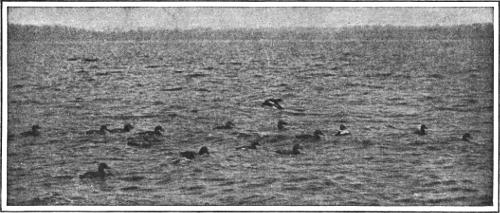
DUCKS SWIMMING ACROSS A BAY
SUPPLEMENTARY READING—Wild Fowl of North America, and North American Shore Birds, by Daniel Giraud Elliot; Feathered Game of the Northeast, by Walter H. Rich; American Game Bird Shooting, by George Bird Grinnell.
THE MENTOR
ISSUED SEMI-MONTHLY BY
The Mentor Association, Inc.
381 Fourth Ave., New York, N. Y.
Vol. 1 No. 34
ANNUAL SUBSCRIPTION, FOUR DOLLARS. SINGLE COPIES TWENTY CENTS, FOREIGN POSTAGE, SEVENTY-FIVE CENTS EXTRA. CANADIAN POSTAGE, FIFTY CENTS EXTRA. ENTERED AT THE POST OFFICE AT NEW YORK, N. Y., AS SECOND-CLASS MATTER.