GAME BIRDS OF AMERICA Canada Goose (Bernicla canadensis)
Reading edition
FOUR

There is no more exhilarating sound in nature than the sonorous honking of wild geese. Who has not at some time in his life heard, far aloft, the well-known trumpet “Honk!” and the prompt answers all down the two lines as the V-shaped flock winged swiftly forward? Usually the geese fly in a broad, V-shaped line; but this is not constant, and one sometimes sees them flying in a long, whiplike curve. This seems to be when they are temporarily disturbed, as by some strong change in the air currents. But it seldom lasts long, as the birds soon rearrange themselves in their geometrical angle formation. In the raw, windy days at winter’s end, as the flocks fly north, the old gander’s cry is accepted as a guarantee of spring, and hailed with joy.
The Canada goose is the largest of the wild geese of North America. Its average length is about thirty-five inches, and it usually weighs fifteen pounds or even more. This bird has a jet black head and neck, with a conspicuous white crescent encircling the throat. The black on the neck ends abruptly where the neck joins the body, and the general tone of the latter is gray-brown. Its neck is longer, and generally more slender, than those of other birds.
There are few warier birds than the Canada goose. Unless the hunter has much experience or exceptional advantages, he will find them very hard to get. The number of birds that still survive testify to the wariness, the keenness of vision, and the good judgment of this much prized bird. For this reason they will probably long continue to lend their wonderful charm to our spring and autumn skies, and to be an inspiring index upon which the weatherwise base their forecasts.
The Canada goose winters in Texas, along the Gulf of Mexico, and in the sounds and bays of Virginia and the Carolinas, and goes north early in the spring. In the summer it inhabits the far North, from Labrador and the Saskatchewan regions north to the Arctic Ocean. In August, like many of the ducks, these birds molt the entire wing, and at that season their chief enemies are the Indians and Eskimos, who catch them in great numbers.
However, for eating the gander is not very good. His flesh is strong, tough, and unpleasant. The females and tender goslings are far more highly prized as food.
The gander is very energetic and courageous in defending his mate on the nest. W. T. Hornaday, director of the New York Zoölogical Park, tells an anecdote that illustrates this. “Last spring,” he says, “two of our geese paired off and built a nest on the south bank of the Mammals’ Pond, in a very exposed situation. From that time until the young were hatched the gander never once wandered from his post. It was his rule never to go more than sixty feet from the nest, and whenever anyone approached it he immediately hastened to intercept the intruder, hissing and threatening with his wings in a most truculent manner. Had anyone persisted in disturbing the female he would willingly, even cheerfully, have shed his blood in her defense. His unswerving devotion to his duty attracted the admiring attention of thousands of visitors, and the proudest day of his life was when the first live gosling was led to the water, and launched with appropriate ceremonies.”
PREPARED BY THE EDITORIAL STAFF OF THE MENTOR ASSOCIATION ILLUSTRATION FOR THE MENTOR, VOL. 1, No. 34, SERIAL No. 34 COPYRIGHT, 1913, BY THE MENTOR ASSOCIATION, INC.
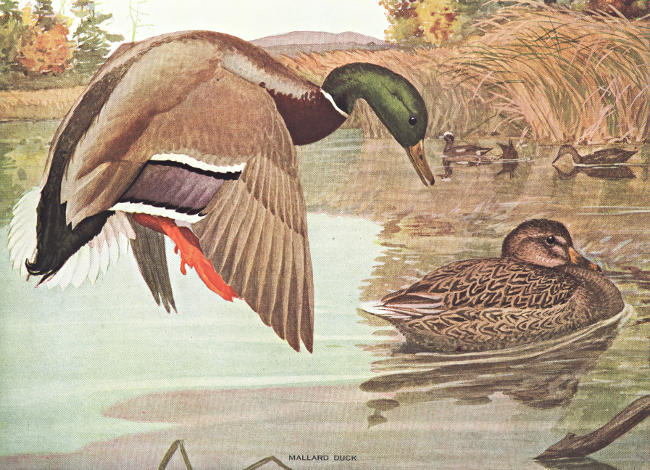
MALLARD DUCK
COPYRIGHTED BY LOUIS AGASSIZ FUERTES, 1906