SUPPLEMENTARY READING
Reading edition

A Study of Prose FictionBliss Perry
Criticism and FictionW. D. Howells
Essays on Modern Novelists William L. Phelps
American Prose Masters (Cooper, Hawthorne, Emerson, Poe, Lowell and Henry James)W. C. Brownell
American Poetry and FictionC. F. Richardson
Great American WritersTrent and Erskine
Some American StorytellersFrederick Taber Cooper
American Short StoriesCharles Baldwin, Editor
The American Short StoryElias Lieberman

QUESTIONS ANSWERED
Subscribers desiring further information concerning this subject can obtain it by writing to
The Mentor Association
381 Fourth Avenue, New York City
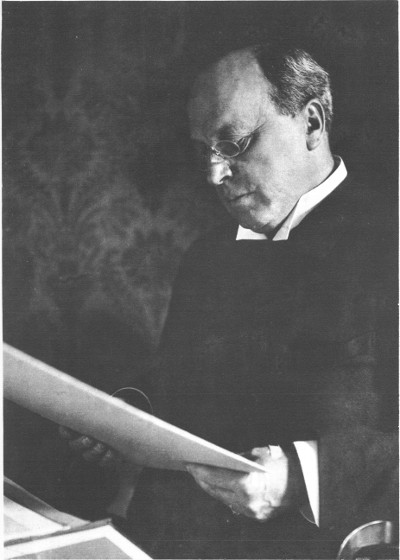
HENRY JAMES

Henry James, a careful and thoughtful writer, is the subject of one of the six intaglio-gravure pictures illustrating “American Novelists.”
HENRY JAMES
Monograph Number One in The Mentor Reading Course
A number of years ago Henry James was at work on a volume of short stories. “And when will it be ready?” he was asked.
“Oh, I never know,” he said. “I work by easy stages.”
That sentence gives the keynote to the character of the great novelist himself and of his writings. He wrote carefully, easily, and neatly.
Born in New York City on April 15, 1843, Henry James spent most of his boyhood in Europe. His father was Henry James, the theological writer, and from him the novelist derived his idiomatic, picturesque English. His brother became Professor William James, the psychologist and philosopher, who died in 1910.
Henry James entered Harvard Law School in 1860; but found out soon that he cared more for literature than for law. His first short story was published in 1865, and many stories and sketches quickly followed this.
After 1869 he made his home in England, living in London, or Rye in Sussex, for the most part. He was a member of the American Academy of Arts and Letters, and in 1911 received the degree of L. H. D. from Harvard.
Mr. James dictated all his work to a secretary, and he rewrote and polished it from a typewritten copy. With his writing he took infinite pains. His sentences are long and involved at times; but in spite of this confusing fact his sentences are balanced and complete.
His whole life showed the same ordered neatness as his books. His library was carefully selected and shelved. His letters were always arranged in little piles of the same size. One man tells that during a call on the novelist he saw him, when the ash had collected on the end of his cigarette, walk the length of his study and snip it out of the open window.
Henry James has been called a modern of the moderns as a novelist. He described contemporary life. His characters are people of the world; but they are subtle and complex. The human element predominates.
He is not widely read, because the public finds him hard to read. As someone said, “His books need to be translated for the average reader.” This is due in part to his use of long and involved sentences, and in part to his subject matter.
His career was a happy one. It was long, and was free from serious mistakes. His talent and point of view were personal. He had a crowd of imitators; but none of these approached the master in greatness.
There was one side of the character of Henry James, the man, of which few people knew. Never did a man in need come to him whom he did not offer to help. Years ago, when James was deriving an income of less than $1,500 a year from his writing, a novelist died in England. He died in poverty, leaving two little children absolutely alone in the world. A friend assisted the children and wrote to other literary men asking for help. One literary man, whose income was over $200,000, was appealed to in vain. Among those from whom aid was asked was Henry James. A check for $250, more than a sixth of his whole year’s income, arrived from him by return mail.
Henry James died in London on February 29, 1916.
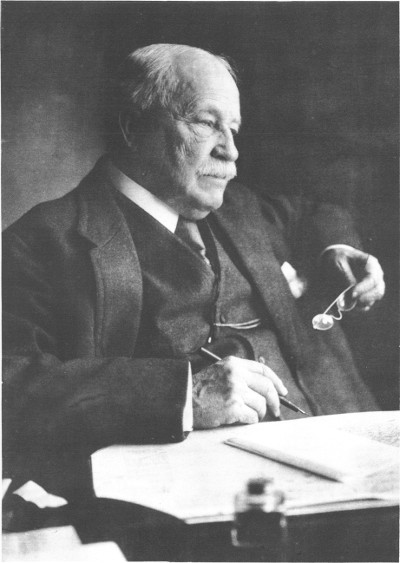
WILLIAM DEAN HOWELLS

William Dean Howells, a close student of American character and a realist in his writings, is the subject of one of the six intaglio-gravure pictures illustrating “American Novelists.”
WILLIAM DEAN HOWELLS
Monograph Number Two in The Mentor Reading Course
The “Dean of American Letters”—that is what William Dean Howells is called. He is and has been for half a century the literary leader of America, and well he deserves the title! James Russell Lowell said of him that he “is one of the chief honors of our literature.” He has never written a bad sentence, never struck a false note. He is the leading representative of the realistic school of American fiction.
William Dean Howells might with truth be called a “self-made man of letters.” He was born at Martin Ferry, Ohio, on March 1, 1837. His father, William Cooper Howells, was a printer and editor, whose library was large and well chosen for that time. It was in this library that the future novelist picked up most of his education. As usual in a small country town, the regular schooling consisted only of the “three R’s”; but Howells was an omniverous reader. He particularly enjoyed poetry. It is said that even as a small boy he wrote verse, setting it into type himself. Whether this was ever printed is not known; but surely some space in his father’s newspaper must have been found for these productions of his juvenile pen.
In 1851 the family fortunes met with disaster, and Howells went to work as compositor on the Ohio State Journal at a salary of four dollars a week. He soon graduated into journalism, and at the age of twenty-two was news editor of the Columbus, Ohio, State Journal.
Howells’ first published work appeared in 1860. The “Poems of Two Friends” were written with John J. Piatt. He began to contribute to the Atlantic Monthly, then just founded, about this time also. A campaign biography of Abraham Lincoln was written by him in 1860. For this he was appointed consul at Venice, where he remained until 1865. There he studied the Italian language and literature, and broadened his education considerably.
On his return to the United States he wrote for the New York Tribune and the Nation for a time. Then in 1866 he became assistant editor of the Atlantic Monthly, becoming editor six years later. He was a model magazine editor.
For awhile he contributed to Harper’s Magazine; then he became editor of the Cosmopolitan, and in 1900 revived “The Editor’s Easy Chair” for Harper’s. He is at present the writer of this department.
Mr. Howells has received many honorary degrees. Harvard and Yale have both conferred on him the degree of Master of Arts, while he has received the degree of Doctor of Letters from Yale, Oxford, Columbia, and Princeton, and the degree of Doctor of Laws from Adelbert College. In 1909 he was elected president of the American Academy of Arts and Letters. Since 1885 the novelist has lived in New York City.
Howells is a great realist and a perfect artist in words. He was once asked if he never lost himself in his work and was carried away by what he was writing.
“Never,” he answered. “The essence of achievement is to keep outside, to be entirely dispassionate, as a sculptor must be, molding his clay.”
And indeed of all American writers Howells comes the nearest to success in holding the mirror up to Nature.
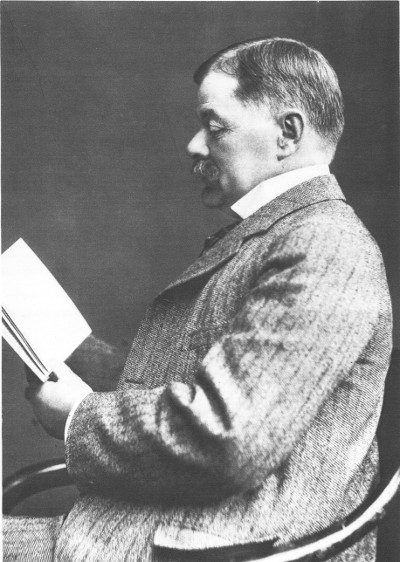
THOMAS NELSON PAGE

Thomas Nelson Page, a novelist who writes of the fast vanishing old order of the South, is the subject of one of the six intaglio-gravure pictures illustrating “American Novelists.”
THOMAS NELSON PAGE
Monograph Number Three in The Mentor Reading Course
Above all things Thomas Nelson Page is a Virginian, by birth, by family, and in his writings. Born on the old plantation of Oakland in Hanover County, Virginia, he can boast of two grandfathers who were governors of the state, one of these, Thomas Nelson, being a signer of the Declaration of Independence. It is Virginia and Virginians “before the war” and during the reconstruction period that he has sought to portray in his books.
Thomas Nelson Page opened his eyes in old Virginia on April 23, 1853. He was a rather precocious boy. Many a beating did he receive at school for stealing time from his lessons to write short stories on his slate for the amusement of his companions. He entered Washington and Lee University when he was only sixteen years old. He remained there three years, and then after spending a little time in Kentucky decided to enter the law department of the University of Virginia in 1873. He finished the work there in about half the time usually required, and began practising in Richmond, where he remained until 1893.
Page had always felt the charm of times gone by. He tried to follow the law faithfully; but more and more strongly came the call to picture artistically “a civilization which, once having sweetened the South, has since well nigh perished from the earth.” He yearned for the old plantation life,—the stately mansions of his forefathers, the grandeur to which those men and women of other days attained, and the overgrown fence rows and fields of his own country home.
Finally he decided to write. “Marse Chan” was published in 1884, and won the author immediate recognition. People of both the North and South were enthusiastic about it. The author himself tells how he came to write this tale:
“Just then a friend showed me a letter which had been written by a young girl to her sweetheart in a Georgia regiment, telling him that she had discovered that she loved him, after all, and that if he would get a furlough and come home she would marry him; that she had loved him ever since they had gone to school together in the little schoolhouse in the woods. Then, as if she feared such a temptation might be too strong for him, she added a postscript in these words: ‘Don’t come without a furlough; for if you don’t come honorably I won’t marry you.’ This letter had been taken from the pocket of a private dead on the battlefield of one of the battles around Richmond, and, as the date was only a week before the battle occurred, its pathos struck me very much. I remember I said ‘The poor fellow got his furlough through a bullet.’ The idea remained with me, and I went to my office one morning and began to write ‘Marse Chan,’ which was finished in about a week.”
“In Ole Virginia,” a collection of three stories of negro life and character, was published in 1887. This is perhaps his most characteristic work. Many stories, essays, and poems followed.
Uncle Billy in Page’s story “Meh Lady” is a distinct creation. At the wedding of his mistress and the Union captain in the old, dismantled home, the minister asks, “Who giveth this woman to be married to this man?” His lady is without a relative, and Uncle Billy sees that it is up to him. But he doesn’t want to take the responsibility; so stepping forward he answers solemnly, “Gord.”
Thomas Nelson Page is never sectional in his writing. Everything that he writes tends to bring about better feeling between the North and the South.
He is now ambassador to Rome, appointed by President Wilson.
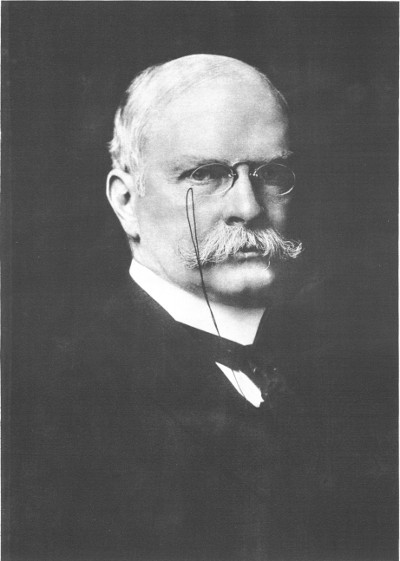
JAMES LANE ALLEN

James Lane Allen, a romanticist of Kentucky, is the subject of one of the six intaglio-gravure pictures illustrating “American Novelists.”
JAMES LANE ALLEN
Monograph Number Four in The Mentor Reading Course
A historical novelist worthy to rank with Nathaniel Hawthorne, James Lane Allen has been called. Both have given us pictures of the lives of our forefathers; but, while Hawthorne has shown us New England, Allen draws the Blue Grass region of Kentucky and its people.
It may be due to the fact that James Lane Allen was a seventh child that he has achieved such remarkable success in literature. He was born in Fayette County, near Lexington, Kentucky, in 1849, the youngest child of Richard and Helen Allen. He can number among his paternal ancestors some of the first settlers of Virginia. One of these ancestors, Richard Allen, moved to Kentucky, where he lived the easy, hospitable life of a gentleman farmer on his large estate.
Mr. Allen’s mother was a descendant of the Pennsylvania Scotch-Irish and the Brooks family of Virginia. A native of Mississippi, she was a lover of nature and literature. She inspired in her son a love for reading old romances, poetry, and history.
Although Allen was only twelve years old when the storm of Civil War broke over our country, he was old enough to realize its horrors and the suffering that it brought to the people of the South. Just before the beginning of the war his father lost his fortune; so the formal education that Allen received was small; but under his mother’s guidance he pursued his studies at home. Long walks in the fields and forests about his home gave him a keen insight into nature.
He was graduated from Transylvania University at Lexington, Kentucky, in 1872, and three years later received a degree of A. M. from there. A little before this his father died, and James had to begin teaching in order to meet expenses. He spent a year as master in a country school, walking six miles to and from the school every day.
For two years he taught in Missouri and then came back to Kentucky as a private tutor. He was called to his alma mater to teach, and two years later Bethany College, in West Virginia, offered him the chair of Latin and higher English.
He planned to go to Germany for a time; but gave this up when the idea of becoming a doctor of medicine attracted him. This was when he was doing graduate work at Johns Hopkins in Baltimore. But his love of literature led him to take up writing, and in 1884 he moved to New York. He arrived there unknown and with no letters of introduction; but “he took up his abode in a garret and started out in a very humble way.” He sent letters to the New York Evening Post, poems to Harper’s and the Atlantic Monthly, and essays to the Critic and the Forum. A criticism of Henry James’ “Portrait of a Lady” first attracted attention to the young author, and soon there was a strong demand for his sketches of Kentucky life. “The Blue Grass Region of Kentucky” was the title given to the collected volume of these sketches.
Mr. Allen then moved to Cincinnati; but later moved again to Washington, believing that the capital of the country would be the future home of literature and art in America. In Washington, however, he found too much social and official distraction; so he returned to New York.
“The Kentucky Cardinal,” published in 1895, is one of Mr. Allen’s best books. It is a sort of pastoral poem in prose, showing the struggle between Nature and Love. “The Choir Invisible” shows the noble love of a married woman for a man who is not her husband.
James Lane Allen is best known as a writer of fiction; but he has also published many critical articles and much verse. He is recognized as one of the most poetic and dramatic of American novelists.
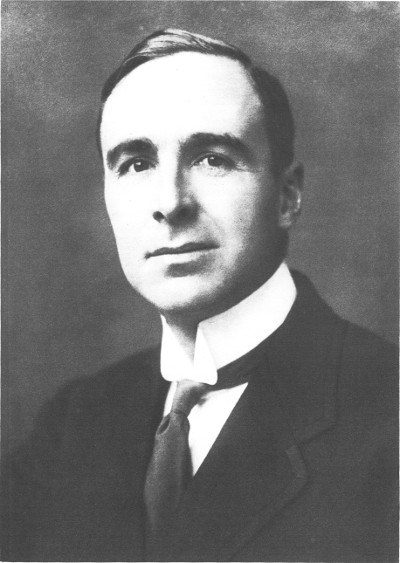
WINSTON CHURCHILL
Winston Churchill, a master of the historical novel, is the subject of one of the six intaglio-gravure pictures illustrating “American Novelists.”
WINSTON CHURCHILL
Monograph Number Five in The Mentor Reading Course
Although he graduated from Annapolis in 1894, Winston Churchill never served in the navy. Instead, immediately after completing his studies he began writing. He had found out that he could write when he was still at Annapolis, and decided that fiction rather than the navy was his line of work. For this the young graduate had fine equipment. Annapolis gave him self-reliance and determination. Those graduates of the Naval Academy who have not gone into the navy have usually been successful in whatever they have done. This is particularly true in the case of Churchill. Well educated, at the same time he is full of the joy of life itself, and likes all sorts of outdoor sports. He is a favorite everywhere.
Winston Churchill was born in St. Louis, Missouri, on November 10, 1871, and spent the first sixteen years of his life there. From a school in St. Louis he went to Annapolis. There he became strongly interested in American history and problems, and made up his mind to devote his life and energies to these. In the brief intervals between studies and drills he gathered much of the material that he afterward used in his novels.
While at Annapolis he stood among the first five or six in his class. He also reorganized the crew and was captain for a year. He likewise played a good game of football. Fencing, tennis, and horseback riding are his favorite sports.
For awhile after graduation he worked on the Army and Navy Journal, and then joined the staff of the Cosmopolitan Magazine. During this time he wrote a great deal; but did not attempt to publish these first experiments in fiction.
He married in 1895 and moved not long afterward to his home at Cornish, New Hampshire. Churchill was very fortunate. He did not have to earn a living by doing hackwork, and could take plenty of time with anything that he wrote.
It is said that genius is the capacity for taking great pains. Winston Churchill surely illustrates this adage. Hard work, determination, and a keen sense of values made him the successful novelist that he is. He was ambitious to write the very best he knew how. Once, when living in St. Louis, he hired an office and went down to it as regularly as any other man of business. His writing was business, and was treated as such.
He rewrote “Richard Carvel” at least five times. He worked from breakfast until one o’clock, after lunch for two or three hours, and after dinner often far into the night. This, the first of three of Winston Churchill’s novels dealing with American history, became the most popular book in the United States. “The Crisis,” the second of these historical novels, appeared a few years after “Richard Carvel,” and in 1904 “The Crossing,” the last of the trilogy, was published. The background for “The Crisis” was the Civil War, and “The Crossing” dealt with the great western movement across the country.
Churchill has served in the New Hampshire legislature, and also ran for the governorship of that state. “Coniston” was a direct outgrowth of his political associations. The novel is a story of politics, with a charming love story running through it.
Winston Churchill is still a young man, and there is every reason to believe that his best and biggest work is still to come.
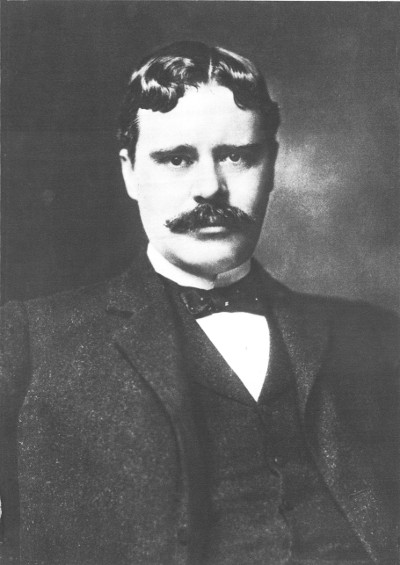
OWEN WISTER

Owen Wister, a drawer of real, vital characters, is the subject of one of the six intaglio-gravure pictures illustrating “American Novelists.”
OWEN WISTER
Monograph Number Six in The Mentor Reading Course
It is remarkable how many successful writers get into literature by accident. Very few novelists begin by taking up writing as a profession: most of them drift into it from other fields. Owen Wister was no exception to this. He settled down in Philadelphia to practise law; but the call of the pen was too strong for him. He was thirty-one years old before he began to write.
Owen Wister is a grandson of Frances Anne Kemble, better known as Fannie Kemble, the famous actress. He was born on July 14, 1860, in Philadelphia. When he was ten years old he was taken to Europe, where he remained three years. On his return to this country he entered St. Paul’s School, Concord, whence he went to Harvard, graduating in 1882. He took highest honors in music.
At Harvard he showed that he could write when he produced a libretto, “Dido and Æneas,” for one of the Hasty Pudding Club entertainments. When there he also edited one of the college papers, and in his junior year wrote a poem on Beethoven, which was published in the Atlantic Monthly.
With the intention of becoming a music critic Wister went abroad once more. He began the study of composition under Liszt in Paris. In 1883 he changed his plans and returned to America. His health was bad; so he went hunting in Wyoming and Arizona.
He found not only new strength, but a new world. The stirring atmosphere of the West woke in him a desire to write about it; but he did nothing at this time. He returned east and entered the Harvard Law School. He graduated in 1888, and a year later was admitted to the bar in Philadelphia.
But the West had great attraction for him. In the next ten years he made fifteen trips there. He soon saw that law was not his career.
In 1891 a series of studies and stories of the West by Wister started in Harper’s Magazine. These were later gathered together in a volume called “Red Men and White.” All the characters in these sketches were true to life; the Indian was the Indian of fact, and the cowboy was the cowboy of reality.
When Wister first began to write a fellow-townsman and critic of him said, “Owen Wister has written some creditable stories; but so, to be sure, have many others. His real strength lies in musical criticism.” This opinion hardly holds good today.
“The Virginian” is the best thing that Wister has done. It is absolutely realistic. This is a quality of all this author’s work, as is shown by an anecdote he himself tells:
“Once a cowpuncher listened patiently while I read him a manuscript. It concerned an event on an Indian reservation. ‘Was that the Crow reservation?’ he inquired at the finish. I told him that it was no real reservation and no real event; and his face expressed displeasure. ‘Why,’ he demanded, ‘do you waste your time writing what never happened, when you know so many things that did happen?’”
So well was the story told that the cowboy had believed he was listening to facts.
“Lady Baltimore” was another successful novel of Wister’s, and besides he has written several interesting biographies, the best of which is “The Seven ages of Washington.”
Wister is not only a writer. He has actively fought for decent government in Philadelphia. At one election he ran for city councilman of his ward, knowing that his fight was hopeless. He is an American through and through, and in his books he portrays the best things in the life of our country.
PREPARED BY THE EDITORIAL STAFF OF THE MENTOR ASSOCIATION ILLUSTRATION FOR THE MENTOR, No. 25