SECOND PART FROM THE DEATH OF HIM I HAD BELIEVED MY FATHER UNTIL THE PRESENT TIME (continued 2)
M. Harriet M. (Magdalen Harriet Mary) Capes translation
In consequence, I composed a letter well suited to her profound modesty and her noble disinterestedness.
Some days passed and no answer came; and, beginning to think that my letter had not been given to her, I decided to write another, which I sent by sure hands to our chaste Susannah.
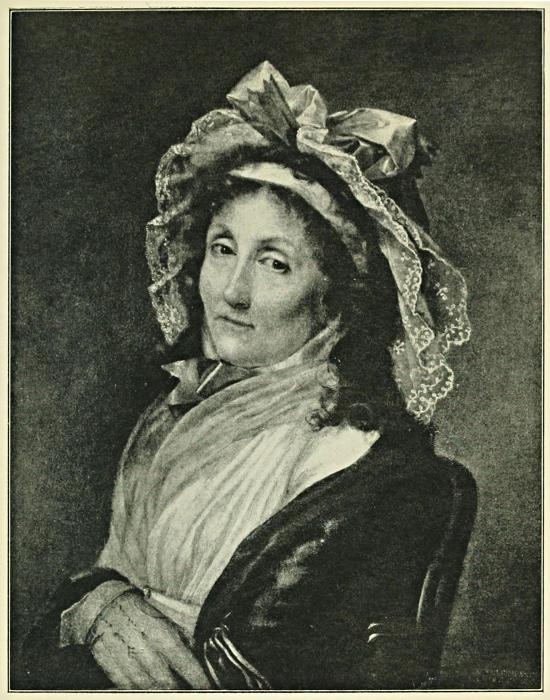
MME. DE GENLIS
The next day but one, M. de Saint-Aubin was announced, and there entered a rather good-looking young man, refined and open in manner, who told me he had seen what I had written to Mme. de Genlis, with whom he lived and in whose confidence he was; adding that if I would give him mine, by degrees he would persuade her to speak out.
“Has she not already confessed to me,” he went on, “that your affairs formerly caused her much trouble, and that the evil genius who had bewitched the late Duc de Chartres was an Italian and still living? Anyhow, madame, the only motive I had for coming to see you was the desire to be of use to one who is oppressed.”
He then showed me several letters from our virtuous heroine, in which she lauded his talents, told him of her own doings, called him her best friend, etc., etc.
In a word, the young rascal left no stone unturned to delude me; and when he thought I was well prepared, he offered to go a journey which, to judge by his hints and mysterious speeches, ought to be to my immense advantage.
Dazzled by this display of verbosity and his gorgeous promises, I sanctioned his plan, and offered him 1000 francs to carry it out. He asked me for 3000, and we split the difference.
In acknowledgment of the sum I handed over to him, all he gave me was this meaningless memorandum: “I have received from Madame la Comtesse de Newborough 2000 francs, on an agreement between us. Given in Paris, December 6th, 1828. S. D. de Saint-Aubin.”
A few days later he announced to me his arrival at Nancy, and said he had already got important information.
I had just received this news, when an ill-dressed man holding a paper made his appearance, calling out to me: “Didn’t you write this letter to the Comtesse de Genlis?” And as I took it from his dirty and disgusting hands, to see if it was really mine, he went on: “The Comtesse won’t have anything to do with your affair, which can’t be anything but an imposture. What! you claim to be the daughter of the Duc d’Orléans? For shame! you deserve to be finely laughed at.”
I had him turned out at once, throwing my letter, which he wanted to get back, into the fire; and not only this, but I begged a lady, a friend of mine, to call for me upon my considerate confidante to express to her my displeasure and to ask her for the papers I had been foolish enough to send her.
My friend insisted on seeing her, and, after a long delay, she grew angry in her turn, promised haughtily to return everything to me, shut her door and disappeared.
Although my packet never arrived, I thought it would henceforth be beneath me to have any intercourse with such a person, who, doubtless, would have preferred remitting it to her dear adopted son, in the hope of reaping golden harvest from this fresh proof of her boundless devotion.
Meantime, the cunning Saint-Aubin wrote again, assuring me that he was greatly pleased with his mission, and had found out many things, about which he would tell me on his return.
Shortly after he wrote that he had just discovered the dwelling of a very aged Italian woman, the former nurse of Chiappini’s son, who possessed a very precious medallion and alone could give me more valuable information than any I had yet got. He promised to bring her to Paris, provided I could enable him to give her a gratuity. To my shame I confess that again I was so foolishly simple as to send him 500 francs, begging him to manage to let me make her acquaintance as soon as possible.
Seven long weeks having passed with no word from him, I began to get impatient, when he took it into his head to send me the well-worn excuse of an unforeseen accident. This is his amusing note—
“Madam, I may truly say that I have come back from the other world. Some days after receiving your second letter—that is to say, in January last—I had set out for a place I wanted to find. I had hired a carriage for the journey. As the roads were very difficult on account of the ice and snow, the carriage was upset; it was a terrible disaster; I was carried away unconscious, and it was only after six weeks that I began to recover. During the lucid moments of my illness I wished very much to write to you, but I dared not confide in any one.
“For the last fortnight I have been much better. As this misfortune happened to me near Strasburg, I write to you from that town.
“My friends and relations must be very anxious about me, for I have not been able to write to them; besides, it would have alarmed them too much if they had known of my condition.
“I shall be in Paris in eight days.
“I am longing to see you and to relieve the terrible anxiety you must have been in at the total want of news.
“I have done all I could, and have much to tell you.
“Your humble and devoted servant,
“Saint-Aubin.”
It may well be supposed that I was somewhat surprised that severe suffering should have made him completely forget both the old nurse and the interesting medallion.
Alas! my doubts turned to cruel certainties when I saw him come in plump and blooming, and with a look of long-standing health.
After having at great length bewailed his unlucky adventure, he rose, took leave, and contented himself with saying, as he left the room, that he would come again and give me a full report.
Tired of waiting, after a few days I sent to the address he had given me, only to be told that he was known there only as being sometimes seen in the company of other young scapegraces who had left without paying, and that Saint-Aubin was no better than his companions.
This was the end of the adventure.
I have since discovered that this chevalier d’industrie was the near relative of the venerable Comtesse de Genlis, née Ducrest de Saint-Aubin!
While all this was going on, I had need of an English lawyer to manage my London affairs.
A Mr. Mills was recommended to me as a model of integrity. I sent for him; he came, showed me the greatest respect, condoled with me on my troubles; took the liveliest interest in my concerns, and undertook not only to manage everything in England, but to obtain for me, free of interest, the sum necessary to meet the unjust claims of Cooper in Paris.
Delighted to have made his acquaintance, I put myself into his hands; and in a little while he became my guide, my steward, my banker, and my manager.
By his advice, and against my own judgment, I wrote to the British Ambassador to ask his protection against my unworthy extortioner.
To this request his lordship condescended to have an answer sent to me in these terms—
“Lord Stuart de Rothesay presents his compliments to Lady Newborough-Sternberg, and begs her to send him a detailed account of the business. Without this it will not be in his power to be of any service to her.
“The English Embassy, April 22, 1829.”
At once I put together my papers and sent them, with the following letter—
“Lady Newborough-Sternberg presents her compliments to Lord Stuart de Rothesay, and, in accordance with the wish expressed in his kind note, sends him the details of her case, begging him to be good enough to give it his consideration.
“If his Excellency should desire fuller information, Lady N.-S. will ask Mr. Mills to give it to him, etc.”
Unluckily, amongst my papers there was a mention of my most important affair.
The Ambassador, confounding the two, and fearing to compromise himself, sent the whole back to me with this laconic note—
“Milady, in returning the documents sent to me in your letter of yesterday, I beg you to accept the regret I feel that I cannot give you the help you ask by interfering in a dispute between you and his Most Christian Majesty.
“I have the honour to be your Excellency’s most obedient servant,
“Stuart de Rothesay.”
Astounded at so prompt a change, I seized my pen and wrote—
“It appears, Milord, that you have misunderstood my meaning. Please feel quite assured that I asked your help only in my dispute with Cooper. If I had supposed for one moment that you were to be helpful to me in my delicate affair, I should have well deserved the mortification of being refused.
“But I thought I ought to have recourse to you to obtain justice in a scandalous dispute arisen between two subjects of the monarch whose representative you are.
“Is it possible, Milord, that you should regard my complaints with indifference, and that you should refuse me the help you so generously bestow on all those who implore it?…”
Thus ended my correspondence with the noble gentleman, and I refrain from saying anything about his subsequent behaviour.
IX
Ragazzini sent off—Proposal of Mr. Mills—Offers to Cooper—His Account—His Disgust—His Calumnies—My Vindication—Decision of the Arbitrators—Fresh Quibbles—Divers Sentences.
To all my outside troubles were added a host of domestic misfortunes, for the most part caused by the unworthy confidant to whom my husband had, so to speak, handed me over. I mean M. Ragazzini, who, proud of the authority the Baron had conferred on him, became day by day more arrogant, and now took no trouble to conceal his hateful vices.
No longer able to endure his presence, I made up my mind to dismiss him ignominiously.
Being now alone and needing some diversion, Mr. Mills offered me one of his sisters-in-law, whom he described as a real miracle of nature. I thanked him for his kindness, but gave an equivocal answer. He returned to the charge, but I still made only complimentary rejoinders.
At last he spoke with such warmth, whether of the dangers of my solitary state, or of the rare qualifications of the young person, that I consented to take her as my dame de compagnie.
She came, and I very soon found her to be an insipid creature, to say the least of it, whose wardrobe stood in much more need of my help than I did of her society. The tradesmen’s invoices can bear witness to the zeal I displayed on her behalf as well as on that of her sisters and brother-in-law. But what would I not have done for a family whom I considered as my only resource for getting out of the hands of the infamous Cooper?
When the second arbitration concerning the agreement as to the management of the larger affairs took place, I asked for the cancelling of that agreement, offering to make good Cooper’s disbursements and fees, deducting only the bills handed over by me on April 1, 1828.
At the invitation of the arbitrators he produced his account, in which a sum of 6,526 francs was placed to my credit.
My counsel, astonished at this, since he had reclaimed only the bills of £75 sterling each, asked for explanations, and it turned out that besides those two bills, Cooper had received another for 5000 francs which, among the many deeds and bills of exchange he had successively extorted from me, I had forgotten. In consequence, I amended my plea, and asked for the deduction of this new amount.
It would be impossible to imagine the disgust of our honest man when he realized that he might have hidden for all eternity the existence and the payment of my bill. According to him it was not just that a fit of absence of mind should make him lose £200 sterling.
Unluckily he could not do away with what was written in his account by his own hand; but to evade the consequences of his fatal admission he had recourse to calumny.
According to him, every one in Geneva had been alarmed at the first hint of my approaching departure, my debts were so numerous, and my reputation for laxity so well known! Upholsterers and tradesmen had come in crowds, and I had all at once found myself in the toils of Rabelais’ terrible quarter of an hour.
Having nothing with which to pay off my debts, I had vainly implored the help of M. Hentsch, a banker of Geneva; but he himself, poor Cooper, touched with compassion, had at once handed over to me 5000 francs which he had in his purse, etc.[14]
I should disgust my readers too greatly if I repeated here the vile abuse with which he spiced this heap of inventions.
Anxious to undeceive a public that did not know me, I wrote to Geneva, and found no difficulty in obtaining a large number of excellent testimonials, of which I will quote but three.
1st. “Milady, we have received the letter your ladyship was kind enough to write to us, and have been much grieved at the lies which wickedness and calumny have dared to invent about you; only a consummate scoundrel could be capable of it.
“Messrs. Hentsch have told me that they will write to you at once, so as to undeceive the small number of persons who could have believed this tissue of falsehoods. The Cramers will do the same; and I can assure your ladyship that every one in Geneva who had the pleasure of your acquaintance is indignant at what you must have gone through.
“But we trust the culprit will speedily be punished, and that we shall soon have the pleasure of having you amongst us again, which we look forward to greatly.
“Madame Galiffe asks me to give you her respects, and to assure you of the sincere pleasure it will be to see you again.
“Accept the assurance of my profound respect, and of the great esteem with which I have the honour to be your ladyship’s very humble and obedient servant.
“Galiffe,
“Colonel.”
2nd. “Madame, I was less surprised than deeply grieved at the contents of your letter to Colonel Galiffe; for my wife and I felt only too much anxiety as to the result of your journey. M. Cooper has quite justified the opinion of him we formed when we saw him at your house, for we feared just what has happened.
“Good God! into what hands you have fallen! And how could so fine and spotless a character as yours be blackened by calumny?
“But I have no doubt that you have speedily turned aside the shafts of malice. As to what is said about your debts, I can certify that I have known you to be most scrupulous in paying all your accounts; that I have never heard of your being in arrears with any creditor, and that I am in a good position to judge, having had several conversations about your concerns with M. Hentsch, who, I have no doubt, will testify to the same.
“But what need is there, madame, to continue in this strain, or to undertake to clear so unjustly attacked a reputation?
“Many other better-known persons than I will come to your aid, and in a little while you will receive from all sides documents wherewith to crush your vile calumniators.
“I will conclude, madame, by sending you my most sincere wishes that your enemies may get what they deserve, and may their punishment be as certain as all I have said is true.
“My wife asks me to give you all kind messages, and I beg you, Madame la Baronne, to accept the expression of my respect and my sincere attachment.
“J. L. Cramer,
“Lt.-Colonel.”
3rd. “Madame, and respected friend; what! there are villains in the world who, not content with having taken advantage of your ignorance of business, venture to attack the reputation of one whose private life it seems to us ought to have been more than safe from the tongue of calumny.
“We are shocked at it, and ready to send you voluminous testimonials as to the high reputation you left behind you here.
“If necessary, we will state in Court that we know you to have been held in constant affection and respect by all around you; that benevolence was your especial virtue, and that your steps were followed by actions recorded in the book of heaven, when unnoticed or unfelt by men.
“We can say that you gave happiness to many here; we can say (though it is impossible that such a question should be put to us), we can say that it is false, absolutely false, that you left debts behind, and that, on the contrary, before you left, you had the forethought to leave 2000 francs on deposit to pay the rent of your country house in case of its not being sub-let; which event happened.
“We can say that your charming son gave the highest hopes of inheriting the striking virtues that distinguish you, and which he could have gained only in the bosom of a mother worthy of all honour and best formed for an example of all that society loves and welcomes.
“Speak, Madame la Baronne, only speak! What can we do to communicate to your judges the feelings of the highest esteem which we have for you?
“Your very humble servant,
“H. Hentsch, fils.”
It needed nothing more to obliterate the disastrous impressions my audacious calumniator’s lies might have made.
I was summoned to declare if I had, or had not, received from him the amount of my bill; and on my formal answer in the negative, the arbitrators of course said to us—
“Since you disagree as to facts, we cannot pronounce for one or the other; we must give our decision according to the wording of the bill. If it was endorsed, ‘Sum received in cash,’ Mr. Cooper is right; if not, he is wrong. Therefore, produce this bill.”
I wrote at once to my London banker to get an authentic copy; but before it arrived, the extension of time for the arbitration expired, and the arbitrators gave their decision. They cancelled the agreement concerning the larger interests, fixed Mr. Cooper’s disbursements at 4,169 francs 51; assigned him 3000 francs for his trouble,[15] and ended by making this order—
“We declare and decree that on Mr. Cooper returning the deeds, papers and all other effects, the Lady de Sternberg shall be under the obligation to pay him the sum of 7,169 francs 51; that Mr. Cooper, on payment of the said sum, shall return to her the two bills of £75 sterling each, unless their worth is deducted from the 7,169 francs 51.
“We reserve to both parties their respective rights as to the deduction, claimed by the Lady de Sternberg, of £200 sterling, the amount of the third bill received by Mr. Cooper.
“On the fulfilment by Lady de Sternberg of the above directions, we declare that she shall be freed from all obligations to Mr. Cooper arising out of the agreement of April 27, 1828.”
The execution of this judgment could present no difficulties except for that concerning the bill for £200 sterling, with which it could not deal.
A few days later the bill arrived; it was endorsed: “Sum received on my account from the testamentary executors of the late Lord Newborough”; and Cooper had sworn that it was endorsed, “Sum received in cash.”
The 5000 francs therefore ought to be deducted from the 7,169 francs 51. Cooper refused to deduct them; I proposed to him to submit this difficulty anew to the arbitrators, who, knowing the business in all its details, could decide on it at once.
An honest man would have gladly accepted this expeditious settlement; but our scoundrel, who had already seen his way to take advantage of his position, absolutely refused.
Having extra-judicially called upon him to name his arbitrator, and on his failing to respond to this summons, I applied to the President of the Court, who assigned me one.
On the day appointed for the meeting of the “friendly arbitrators,” Driver-Cooper sent word to them that he opposed their proceeding until after the cancelling of the bills; and they thought themselves bound to abstain from a decision until there had been legal enactment on this opposition.
At the same time my rascal sent me orders to pay him the full sum of 7,169 francs 51, which he must receive at once, so depriving me by his frivolous objections of the power of previously effecting the deduction of the 5000 francs, which had nevertheless been so expressly reserved for me by the decree of the arbitrators. But I knew my man too well not to foresee that after obtaining the payment he demanded, he would take every means to refuse my demand, even to the declinatory plea of the French Courts.
In consequence I made him an actual offer of the sum of 2,169 francs 51, and as to the 5000 francs representing the value of my bill of £200 sterling, I proposed to deposit it in the Caisse de Consignations, not to be withdrawn by Mr. Cooper until it was decided that the aforesaid deduction could not be made.
Moreover, I summoned Mr. Cooper to make a declaration of my available effects, and to be ordered to return to me all my deeds, under pain of damages to the amount of 100 francs for each day’s delay.
Even this did not stop him, and I was obliged to make an application to the President to make him cease his persecution.
The President having made an order entirely agreeing with my wishes, Cooper appeared disconcerted, and did not dare to appeal against it.
It was in this condition that the case was brought into Court. There my rascal once more took up his rôle, and, as usual, bristled with objections and quibbles which prolonged the disgusting dispute till October 8. All his cunning and ingenuity could not save him from the condemnation he deserved.
But, alas! my triumphs were but funeral honours, and my gains nothing but actual losses.
Yes, my over-great belief in so unworthy a man had cost me more than 28,000 francs, my peace of mind, and my health.
X
Insertion in the Newspapers—Visit from M. Laurentie—His Letter and its Publication—His Advice—A Bold Venture—My Discretion—Insidious Answers—Behaviour of the Mills Family—Letters from my Children.
When I found that my troublesome dispute was coming to an end and that I was about to recover both my documents and my own full liberty, I had the following article inserted in several newspapers—
“In the year 1773, two illustrious French personages were travelling incognito in Italy, under the names of the Comte and Comtesse de Joinville. On the 16th of April of that same year the Comtesse gave birth to a daughter in the little town of Modigliana. The parents, urged by ambition, resolved to exchange their daughter for the son of a jailer, named Chiappini, whose wife at the same time gave birth to a boy, who has in consequence enjoyed the rank and fortune belonging to the other child. It has pleased Providence to allow this unjust usurpation to last for many years. But, to prove that justice, though sometimes slow, is always sure, it has lately permitted this unnatural action to be brought to light; the proofs were sufficient to convince any impartial mind, and a decisive decree of the Ecclesiastical Court of Faenza, given upon the most undoubted evidence, has pronounced as to the truth of the facts.
“The father, many years ago, met with a violent death; the mother survived him, but has now been eight years dead; and there is no doubt that the parents during their lifetime entrusted certain papers and documents to persons who were then in their confidence.
“It is needless to add that these documents are of the highest importance to the daughter who was deprived of her proper position. In the name of justice and humanity, she entreats any persons who may be in possession of documents concerning this matter, to send such information, in writing, to the Baronne de S., 18 Rue Vivienne, Paris.
“They may feel assured of a large reward from the person concerned.”
A few days later I had almost the same words again put in; at last, M. Mills having called a third time at the office of the Quotidienne, M. Laurentie said he would like to see me before the third insertion was made, alleging that he could be of much more use to me when he was perfectly acquainted with my affair.
I was urged to receive him, and I fixed a day for his coming.
The first thing he did on seeing me was to give a start of astonishment.
He told me that he had known at once that my paragraph related to the Duke of Orleans, and that, fearing his Highness’s anger, he wanted to see my papers before going further.
I at once got together some imperfect copies that had chanced to escape the insatiable Cooper’s greedy rapacity, and handed him the parcel.
He strongly advised me against any mysterious or partial publication of my story, but to bring it to the full light of day.
I told him that such was my intention.
“You will do well,” he said; “and I assure you your likeness to Louis XIV is so striking that only to see you is to be convinced.”
It would not be easy to describe my surprise when, three days later, I received my packet, accompanied, for all apology, by the following brief communication—
“Madame la Baronne,
“I have the honour of returning you the papers you committed to my care.
“I have had an opportunity of tracing the truth to its source, and have ascertained that M. le Duc and Mme. la Duchesse d’Orléans did not quit Paris or the Court in the year 1773.”[16]
“Therefore I cannot permit the Quotidienne to print a single line concerning the extraordinary and mysterious event spoken of in these papers.
“I have the honour to be, Madame la Baronne,
“Your very humble and obedient servant,
“Laurentie.”
To astonishment succeeded just indignation when in the numbers for the 2nd and 3rd of November I read what follows—
“The public may have remarked, some time ago, a notice in the Quotidienne in which there was mention of a Comte and Comtesse de Joinville, who, in 1773, when in Italy, had a child of the female sex for which a male child was substituted, and information was asked as to this mysterious substitution.
“Whatever may have been the purpose of the person who sent us this notice, it is our duty to declare that we take no responsibility for it.
“We have even been able to ascertain that its publication masks an intrigue in which we could not be expected to meddle, and we retract the notice sent to our office, and which, at first sight, might seem to be simply an announcement relating to family matters.”
At first I wanted to force the audacious editor to insert in his journal an answer which would have let every one know of his criminal abuse of confidence, and ask him how he dared brand with the odious name of intrigue a claim which, from my papers so trustfully given over to him, he knew to be based on the depositions of numerous witnesses, and on an episcopal judgment given with the most imposing formalities.
But on consideration I decided that my complete Memoirs being about to appear, France and the whole of Europe would do me enough justice after reading them.
I wanted some one to correct the many mistakes which my pen, so unskilled in the French language, had made without taking from my story its original simplicity.
M. Lafont d’Aussonne, author of the Mémoires universels de la Reine de France, called on me, discoursed on his literary talents, offered me his services, and succeeded in getting me to give him a copy of my notes. Here is his letter of the next day—
“Madame,
“I have spent part of the night in reading your papers. I find them convincing, and am astonished only at one thing—that you have been so long in attacking the unlawful possessor. I shall have the honour of seeing you this evening at the same hour as yesterday.
“Your very respectful and devoted servant,
“Lafont d’Aussonne.”
I was much pleased with his way of looking at it, and with all the arguments with which he supported my interesting affair; but with a swift change of front he wrote to me a few days later—
“However long the time I have devoted to the papers you committed to me, madame, I grudge neither the time nor the work if I may keep your confidence and your esteem. From things I know of and approaching events, I am convinced that your cause has its dangers, and that you must be prepared for oppositions, humiliations, delays and troubles innumerable.
“Your last years will be years of grief and affliction; I am not exaggerating.
“An opportunity is now offered me of rendering you the greatest of services by giving you rest and peace of mind.
“You are a good wife and tender mother; you might, at the same time, give delight to your family and to the excellent persons who have given such proof of their constancy and their devotion by combining with you.
“As for myself, madame, I have no thought but to repeat the assurance of my respectful and sincere devotion.
“Lafont d’Aussonne.”
At once I saw through the plot, and wishing to find out what offers would be made me, I replied in such a fashion as to let it be believed that I was quite willing to make concessions.
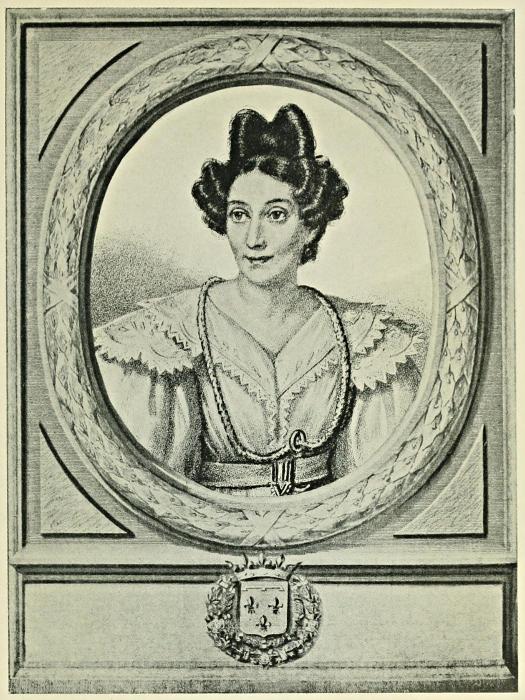
MARIA STELLA, LADY NEWBOROUGH, BARONNE DE STERNBERG
My friend fell into the trap, loudly applauded my quite futile letter and sent me a curious composition, of which M. d’Aussonne declared he had secretly sent a copy to my adversary.
“Monseigneur,
“As M. de Broval’s illness or sufferings may last some long time, I take the respectful liberty of addressing you directly.
“I have not forgotten that, five years ago, your Royal Highness did me the honour to send for me to your gallery that I might give my opinion on some wrongly-named or doubtful portraits, and that you received me with marked affability.
“Something has now happened, monseigneur, which, in a fashion, brings me again to your notice.
“Lady Newborough, Baronne de Sternberg, having read with great interest at Nice, where she was then living, my Mémoires universels de la Reine de France, wished to know its author; and this lady, pleased with my eagerness, has entrusted me with the revision of her own Memoirs written entirely in her own hand, that I may put them into shape and give them a literary style.
“Devoted as my whole life has been to the defence of the greatly unfortunate, I did not hesitate to accept this commission; and I think I have made some improvements in a book good society seems to me to be eagerly expecting, here and elsewhere.
“With my mind full of the strange details contained in these Memoirs, I cannot help looking upon the prodigious noise such revelations will make in the world as a great political event; and I ask myself if I should not be doing a good action in endeavouring to find some means for bringing about conciliation and peace.
“There is no room for doubt, monseigneur, that milady, by the advice of her lawyers, will find herself obliged to prove, by numberless traits, character and conduct that the inhuman father, by whom she was forsaken, made the criminal exchange for his own immoral ends. After this, we shall see this father, already so notorious, handed over to the judgment of all Europe. As to the gist of the principal question, monseigneur, you must already know everything. You know of Lorenzo Chiappini’s clear statement, made but a few moments before his death; you know of the numerous depositions of so many candid and unexceptionable witnesses; you know of the solemn decree of the august Tribunal which restored to Maria Stella her original position, and as a consequence, her rights.
“From the moment that striking judgment was pronounced, milady was enabled fearlessly to sign herself née de Joinville; and we have no other Joinvilles but the Princes of the House of Orleans.
“The documents obtained in Italy are already very considerable; those discovered in France are not less so; and the two journeys in Italy are proved.
“To these remarkable details I beg your Highness to be pleased to add the following facts.
“Milady’s profile is extraordinarily like that of Madame la Dauphine; seen at three-quarters her face is the image of that of Mademoiselle d’Orléans, etc. Lord Newborough, her eldest son, bears so strong a resemblance to Louis XIV, and her second son, M. Chevalier Wins (sic) to the late Comte de Beaujolais, that the artists are amazed.
“And now, monseigneur, I will add, by your gracious permission, a fact which is as extraordinary and seems miraculous; the two brothers Chiappini, each the image of his father, have the honour of resembling you. The inhabitants of Florence and Modigliana are all agreed on this point.
“I have given you but a short summary of this important affair, known to no one better than to myself since I have had everything under my own eyes.
“My great respect for the name of Bourbon leads me to hope that confidential matter of this kind may not be told in the market-place, to become the fable or the romance of all parties. With all my heart I desire that the life of our beloved Duc de Bordeaux may be spared; but if, by a stroke of fate, that fragile olive-branch were snatched from France, the Salic Law would call your children to the throne, and it might be painful, perhaps dangerous, for them not to have public opinion with them.
“You anticipate, monseigneur, what would be my respectful advice, and I beg you to see in my action no motives but those dictated by kindness, wisdom and prudence.
“The excellent milady, who admires my works, has favoured their author with her partial confidence; but I have the honour of writing to you without her knowledge.
“I wish to help her to the ease of mind so astounding a trial could not fail to destroy; and, if you have sufficient trust in me to accept me as intermediary, I feel a secret presentiment that I shall be able to induce her to make peace.
“I am a daily witness of her respect and admiration for Louis XIV, Henri IV, etc., whom she looks upon as her ancestors; but I know, too, that she adores her beloved Edward, her youngest son, from whom she has been cruelly separated; and by this very natural way I think I may reach her heart.
“If so, I shall rejoice at having restored her to life and peace, and to have spared you, monseigneur, an unpleasant dispute through which your children, sooner or later, must have suffered.
“Allow me with the greatest respect to sign myself your Royal Highness’s very humble and obedient servant,
“Lafont d’Aussonne.”
All this inspired me with invincible dread of a man who, like so many others, thus played me false. To escape his snares I began by politely refusing to see him; then, under various pretexts, I asked him to send back my books and papers, and tried to make him understand my very natural apprehensions. His letters will prove the accuracy of my statements—
1st. “Madame, I have the honour to return you the books relating to the great affair. I will also collect the papers you ask for and this evening you shall receive them in a sealed parcel. I like to take back such important things myself.
“For God’s sake don’t allow yourself to have any doubt of me or my doings. I am doing what is for the best, and for your sole and veritable benefit.
“If I asked to see you for a moment, it was to tell you of a most important matter which has to do with what you were told in Italy—that a French ecclesiastic knew a great secret concerning all this.
“While I write to you, a person in my confidence is taking the necessary steps for discovering what the Duke wishes to do as to the matter about which I wrote to him.
“Rest assured, milady, that God decreed your acquaintance with me, and that you will never find another with a heart so good and large as mine, or so noble a probity.
“But your misfortunes have naturally made you timid and suspicious, and you may feel quite certain that I am too reasonable to take offence. Your most respectful and devoted servant,” etc.
2nd.—“Madame, What I told you in my letter of yesterday rests on the evidence of two persons, of whom one, aged and infirm, and of a timid and nervous disposition, has told me what she knows, and by her explanations has enabled me to explain to myself things which formerly did not sufficiently influence me, for I was the best friend and vindicator of him who knew all.
“The other person, who is still alive, will play no part whatever in all this, so greatly does she dread the vengeance of the Duke of Orleans.
“But I, who do not fear him, promise you that, if we go on acting in unison, I will state and proclaim everything.
“How could you, madame, suppose for one moment that my actions concealed any plot—actions as clear as day?
“After making a thorough examination of your case, I perceived many probabilities, but, unfortunately, not enough proofs; and that is why, as an honourable and kindly man, I advised you to consent to a compromise, supposing your wealthy adversary able to make up his mind to a sacrifice.
“In this way you would have gained an increase of fortune to the benefit of your son, while the Prince, real or supposed, would have retained the votes and the respect of the common people which your Memoirs and the noise of the trial must inevitably have lost for him.
“No, milady, Mme. Fleury and I have not joined in any plot against you; since that wicked Irishwoman wanted the Duke to crush you by his power without giving you anything out of his riches; while what I desire is that if he and you come to some arrangement, he shall make over to you a considerable sum.
“The letter I sent him is surely proof enough of that.
“Is that letter, wherein I made such outspoken and humiliating statements, nothing in your eyes? Is that possible? And what can I do, Madame, to prove to you my sincerity and integrity?
“Oh! what a lesson for me!
“I must end here a letter I did not think to make so long.
“I have served you zealously, milady; and I don’t regret it, for I believe your cause to be a just one in the sight of God and of nature.
“I withdraw without resentment, although I am much hurt by the insult offered to me.
“If the Duke comes to know what has taken place, he will be much rejoiced, for he dreads my pen and the strength of my writings.
“With all respect, madame,” etc.
In spite of all these protestations, he could not win back my confidence, and I would have nothing more to do with him.
Mills’s sister-in-law was still with me; but for the last few days I had noticed a complete change in her for which I could not account and which she would explain to me only by pleading indisposition.
One morning her younger sister made her appearance and told me she wished to take her sister back with her to stay while the carnival lasted, as while she was with me she had no chance of enjoying the entertainments connected with it.
Glad of this opportunity, I replied at once—
“With pleasure; I should be very sorry to put her out. Let her stay at home as long as she likes.”
The two ungrateful creatures went off at once to collect the munificent gifts I had made them, packed up their parcels, and, from that moment, never once took the trouble to inquire after me.
I saw at last—but too late—what sort of family this was, and to what a set of people I had so generously given myself over.
It was only with the greatest difficulty that I managed to get a statement of my accounts, and when I did receive it, I found myself finely tricked!
For a few private consultations of no importance, and a few drives about Paris, the considerate lawyer was content with asking me the bagatelle of 6000 francs; inadvertently indebted me with £300 sterling, and exacted the rigorous payment to him of interest for which he had promised I should not be liable!
I held my tongue, hoping he would not force me to divulge what I knew of myself or had heard spoken of.
My eldest son had known him better than I did; he wrote later to me from Marseilles that he had always had strong suspicions about him and had never ceased to look upon him as a professional humbug.
This letter from the young Lord Newborough, as well as showing the great affection he had for me, gave me besides two strong grounds for consolation in the midst of my trouble, by assuring me of the restoration of his own health and of his undying attachment to my dear Edward.… I knew that for some time he had been suffering from a weak lung, and remembering his antecedents, I had felt grave fears; on the other hand, the future of my third son was a source of painful anxiety to me.
But his kind brother did away with all my troubles on both matters by telling me that the mild climate of southern Europe had quite restored his strength, and by asking me to tell Edward that he could henceforth look upon Glynllifon Castle as his own house.
Could anything be sweeter to the heart of a loving mother? And it was not the only sign of filial love that came to ease my mind. The youngest of my children never failed from time to time to send me the expression of his ardent love for me. This is one of his recent letters—
“I am delighted to see that our great affair is beginning to get cleared up and looks so well. I wish with all my heart that it may go in our favour, and that you may at last be able to enjoy some compensation for the vicissitudes and cares and worries which you have had to bear for the last seven or eight years.
“Believe me, my dear mother, my most earnest prayer is that I may see you win the victory in a trial you have so much at heart and which so nearly concerns our family and your name, etc.”
XI
The Cause of my Delay—My Trustfulness—Louis-Philippe, Duke of Orleans—Louis-Philippe-Joseph, his Son—Chief Vices of the Last—Bad Son—Bad Husband—Bad Father Bad Friend—Bad Citizen—Consequent Results.
I ask my readers to forgive me for having so long entertained them with so many tiresome details. I had no thought at first of doing so, but the recent attempts at the most impudent frauds[17] have more and more fully convinced me that I cannot make too well known the various events which have brought about the deferring of my just claims.
And if my silence since I succeeded in getting back my deeds from the hateful Cooper causes some surprise, it must be told that they were hardly once more in my possession before I handed them over to a lawyer of reputation, who, after keeping them a couple of months, wrote to me that, before definitely undertaking my case, he wished, through the medium of M. de Broval or M. Dupin,[18] to get leave to make researches in the archives of the house of Orleans.
“The result of this step,” he said, “would be decisive, and, when it had been taken, we could decide as to the following up or the relinquishing of the trial.”
It will be believed that I could not consent to be thus put at the mercy of my adversary. I asked for the return of my papers; but once more I could not get them without the payment of 100 francs for the time my comic lawyer had thought good to make me lose.
I then decided to have recourse to one of those colossal celebrities whose sublime eminence seems to place them so high above the fatal bait of bribes;[19] and these were at first his fine promises—
“Madame la Baronne, I have not yet been able to examine the papers you were kind enough to send me. I propose to devote the whole day to them to-morrow, and I will at once give you my opinion on this important business.
“Pray accept, madame, the humble respects of your obedient servant,
“B. F.”
Who could believe that more than fifty days after I received this letter, my packet had not even been opened, and that the important business rested in oblivion?
At last I put it into the hands of a man whose excellent references proved him worthy of my confidence; he will not abuse it, and most certainly neither he nor those he will employ in my service will behave like those who, acting for me in the Cooper business, so cruelly ground me down.
Yes, I hope Providence has not quite forsaken me, and that the day of victory will come; the many valuable discoveries the base machinations of my enemies have been unable to prevent me making, vouch for it, and give me confidence amidst my many tribulations. Kindly lend me your ears still.
In 1773, at the time of the infamous substitution, these were the members of the house of Orleans.
The Prince of that name was Louis-Philippe, who married first Louise-Henriette de Bourbon-Conti, and, secondly, Madame de Montesson; but this last union was always kept secret.
Of the first marriage was born Louis-Philippe-Joseph, then commonly called Duc de Chartres, who, in his turn, became Duke of Orleans, a title he gave up later to assume the ludicrous nickname of Egalité, under which he made himself so ignominiously notorious. He had married Mademoiselle Louise Marie Adélaïde, daughter of the Duc de Bourbon Penthièvre, who died in 1821, under the name of the Dowager Duchess of Orleans.
Louis-Philippe-Joseph is precisely the person who, according to a host of admitted facts, seems to us to have been the guilty perpetrator of the criminal exchange; I say seems, for submitting beforehand to the final decision of my judges, I will do nothing to prejudice it.
I will not say, with the historians of his life,[20] that the Duc de Chartres, when scarcely out of his boyhood, showed the most depraved tastes, and took no pleasure but in wickedness.
I will not say that from his youth upwards his degrading vices made him the object of universal contempt, and ended by earning for him the vilest names.
I will not repeat that in his inextinguishable passion for riches he was not afraid to show the greatest impatience at the prolongation of his father’s life; that, not satisfied with degrading himself, he was willing publicly to dishonour her who had borne him in her bosom, and shamelessly forswore his glorious descent from the most august blood.
I will not repeat that his wife had the constant affliction of finding her efforts to lead him into the ways of a wise moderation quite useless, and that she had to endure hardships of all sorts from a husband both hard and unfaithful.
I will not repeat that he pitilessly sent the sad fruits of his profligacy to the asylum for the poor, and that his legitimate children, given over very early into the hands of strangers, were never the objects of his care, seldom of his endearments.
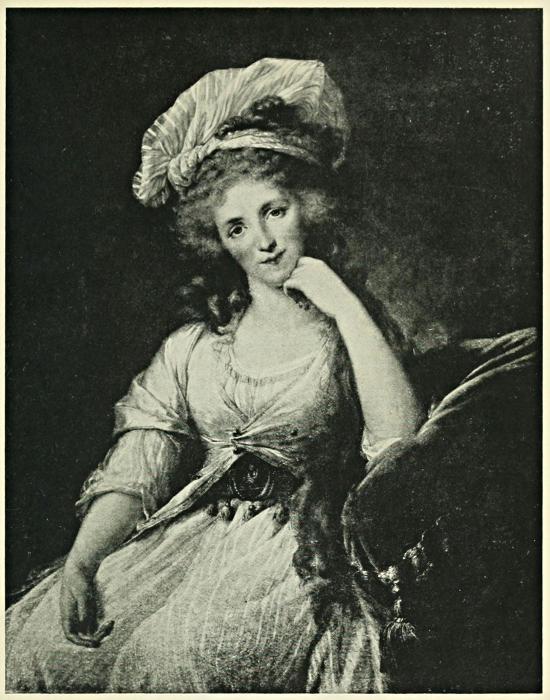
THE DUCHESS OF ORLEANS
LOUISE MARIE ADÉLAÏDE DE BOURBON-PENTHIÈVRE WIFE OF PHILIPPE-ÉGALITÉ
I will not repeat that, bad son, bad husband, bad father, he could not fail to be a bad friend, and that many of his confidants were the victims of his perfidy or his rage.[21]
I will not repeat that his presumptuous rebellion, his implacable hatred for the best of kings; the murderous outcries against him he so shamelessly raised, and which, even in his own eyes, proved him the most hateful of citizens, forced from him that admission, as true as humiliating, “I would as soon be guillotined as banished, for where is the country that would receive me?”
But no more—for I blush as I write these lines and my heart bleeds with shame!
Besides, does it need more to represent the man we have just described as quite capable of the crime we think we have the right to impute to him?
Still, we admit that the reality of a thing cannot be deduced from its mere possibility, so we will enforce it by arguments of quite another nature.
XII
An Incontestable Principle—Title and Fief of Joinville—Travels under that Name—The Comte’s Titles—His Description—His Character—Deposition of the Signora Galuppi-Toschi—Certificate of the Conte Falopio—That of the Priest Carlo Brunone—Letter from Baron Vincy—Attestation of M. D.—Summary.
Identity of name, title, description, character, position, time and place, are doubtless enough to establish identity of person, or nothing would be able to prove it.
Let us apply this clear principle to the matter in hand, and it will end in proof.
1st. The name. Let us remember that the chief agent of the hateful substitution was a Frenchman called Louis, Comte de Joinville. Now, as history and the whole of the aristocracy are silent on the matter, we cannot even imagine that this title in 1773 belonged to any one not of the Orleans family. Let us see if it could then be found in that family.
The Fief of Joinville, raised to a barony at the beginning of the eleventh century, and to a principality under Henri II, after passing successively to several lords, had at last fallen into the female line by the death, on March 16, 1675, of the Duc de Guiche, Prince de Joinville; and Mademoiselle, the daughter of Gaston de France, having inherited it in her own right from her maternal grandmother, Catherine-Henriette de Joyeuse, Duchesse de Guise, left it by will to her cousin-german, Philippe de France, Monsieur, only brother of Louis XIV, and head of the Orleans branch. Whence it follows that this principality is actually patrimonial in that family, and that the Duc de Chartres, son of its chief, had the right to call himself by that name.
I say more: open the books written about him, and the frontispiece will show that he was not only Duc de Valois, de Nemours, de Montpensier, d’Etampes, but also Comte de Beaujolais, de Joinville, de Vermandois, and de Soïssons.[22]
I say still more: that is precisely the name under which he and his wife were accustomed to travel.
In 1778 she assumed it to go to Holland; he had taken it in 1777 to visit the Netherlands; the year before it was the title borne by the Duchess during the whole of her tour in Italy;[23] and to speak only of the year of the exchange, the newspapers of the day forbid any doubt that, under that name, and in the summer, the Duke had made a pretty long journey.[24] And worthy witnesses, whose valuable evidence we shall presently quote, declare that the august couple bore that title precisely at the time of the exchange and in the very districts where this horrible agreement was made.[25]
2nd. The Rank. According to the decree of Faenza, the Comte de Joinville was a French nobleman; almost all the witnesses testified to his being rich and powerful, and if we may believe the evidence of one who ought to have known more than any one else, since he had it direct from the man who no doubt had categorically interrogated the Comte after his arrest at Brisighella—he was nothing less than a prince in disguise.[26]
It will be remembered, too, that having been led before the Cardinal-Legate at Ravenna, the Cardinal, on recognizing him, welcomed him warmly, affectionately embraced him, and at once set him entirely at liberty.
Now, it must be pointed out that the etiquette of the Roman Church is that Cardinals must embrace only the members of reigning houses, and it could have been only the consideration due to so august a rank that could have cut short the prosecution already set on foot by the inexorable agents of the Inquisition.
Now, supposing the titles of Comte de Joinville, a great French nobleman belonging in 1773 to a reigning family to be united in a single person, who would not at once recognize Louis-Philippe-Joseph?
3rd. The Description. The Comte de Joinville, the Italian witnesses tell us, had a fine figure; he was rather stout, had a brownish complexion, a red and pimply nose, and splendid legs.
But is not this the exact description of the Duc de Chartres as given me by the Abbé de Saint-Fare, who was his natural brother? A description agreeing completely with that of all who knew him. Here is one among many written by a man who had, so to speak, always lived with him—
“Louis-Philippe-Joseph was a fine man in every sense of the word. His figure, of more than middle height, was gracefully and faultlessly proportioned. The lower part of his body, from the waist downwards, could not have been better made; the rest was rather heavy, but this stoutness was not ungraceful.
“As a result of his debauches, his nose and the lower part of his forehead were covered with small red pimples; and this sort of mask, which in fact disfigured him, but which he owed to his dissolute life and not to nature, made many people say that his face was hideous.”[27]
4th. Character. The Comte de Joinville’s habits led him to extreme familiarity with people of low condition, and to great generosity where the success of his ambitious projects was concerned; the positive evidence of witnesses, his sudden intimacy with the jailer, and the presents he made him, leave no room for doubt on that question. But by these signs how can we do anything but believe in the portrait drawn by all historians alike of the Duc de Chartres?
“He loved,” they say, “to mix with the crowd, and was never so happy as when he was able to cast off restraint and etiquette; he had a lively and caustic wit, liked to banter his inferiors, and showed no displeasure at their bantering him. Despite the avarice of which he gave so many proofs, which went so far as to make him say that ‘a crown in his pocket was worth more to him than all public esteem,’ he made no difficulty in scattering his sordid gains with profusion, either to obtain nominations to the States-General or to gain the affection of the great nation he wished to captivate.”[28]
5th. The Circumstances. We have seen that the Comte de Joinville had some reason to fear that his wife would never give him a male child, and that, in that case, he was afraid of losing a great inheritance absolutely depending on the birth of a son.
Now all the world knows that, in 1773, the Duchesse de Chartres, though in the full bloom of her radiant youth, had, in the four years of her marriage, borne only one daughter, who died at birth on the 10th of October, 1771.[29]
Her ambitious and covetous husband must therefore have greatly dreaded not only the fading away of his flattering hope of winning for his line the good graces of his compatriots, so as to obtain from them the happy transference of that crown of France, the object of so many longings, so many intrigues, so many secret manœuvres—it may be obscure crimes—but also to fail in concentrating on his family the whole affection of his father-in-law, the richest of princes, who, still only forty-eight years old, had, since the death of his wife,[30] pretty often shown his intention of contracting a second alliance.[31]
Here again, one feels, the identity is absolute. Finally, let us come to the point which seems to us to sum up everything, and is the most important and the best proved of all.
6th. The Time and Place. It was in the spring of the year 1773 that on the heights of the Apennines and in a diocese under the rule of the Papal States, the Comte de Joinville, by means of a most atrocious agreement, succeeded in securing an heir to his name and his lofty hopes.
Can it be true that Louis-Philippe-Joseph and his wife were actually in those districts at that time?
Let us boldly declare that there is no doubt about it.
During my stay at Genoa I learnt that at Reggio there lived a lady formerly in the service of the d’Este family, and who had heard the mysterious journey spoken of.
It will be easily believed that I lost no time in writing to her, and in her turn she made no delay in answering my questions, and assured me she would willingly testify, in a Court of Law if necessary, to everything she had told me.
Delighted at this promise, I gave my orders so as to make sure of a properly drawn-up document.
I chose my lawyer; a proxy was appointed for the Comte and Comtesse de Joinville and any other person absent interested in the case.
In a word, all preliminary formalities having been duly performed, the interrogation was carried out, in consideration of her circumstances, at the lady’s own house.
After having sworn to speak the whole truth, and being questioned as to the reason of her appearance, her age, her domicile, and her memory, she answered—
“It is in order to obey the command I have legally received from M. le Président that I have consented to this examination. I am sixty-four years old; I live at Reggio, my native town, and I was actually born in the palace of S. A. S. the Duchess Maria-Teresa Cybo d’Este, where my late father, Josophat Galuppi, held the post of auditor of accounts and wardrobe keeper to the Duke Francesco.
“My memory is very good, and I have a clear recollection of things that happened in my young days.”
Asked as to whether, while the aforesaid Duchess was living at Reggio, a certain remarkable prince and princess had come there, she answered—
“During the year 1773, and, it seems to me, in the late spring, their Royal Highnesses the Duc Louis-Philippe de Chartres and his wife, the Duchesse Louise-Marie, passed through this town, on their way, I think, from the Papal States.
“I know this because I was present when Count Manetti, the Duchess Maria-Teresa Cybo’s major-domo, was sent to the hotel to welcome the aforesaid Prince and Princess and invite them to the Court. I know it also because I was in a back room when Count Manetti came back, and I quite distinctly heard him say that their Highnesses sent their thanks, but could not accept the invitation, partly because of the incognito they wanted to preserve, as they were travelling under the name of the Comtes de Joinville, French, and partly because of the short time they were staying.”
Questioned as to whether she knew of any visit of this Prince and this Princess of Chartres to the town at any other time than the above, she answered—
“In 1776, just at the time of the fair in the month of May and when several other princes were also at Reggio, this same Princesse Louise-Marie de Chartres arrived in this town and stayed here till June. She lived in the Giucciardi Palace which my father had got ready for her by order of the Duke Francesco. This time I saw her come to the Court where I was then living. When she came, every one told me she was the Duchesse de Chartres, and it was as such that she was known and saluted by all persons of distinction.”
After these questions the examination was gone over again in the order of the records of the trial which the notary public read to this valuable witness, who said—
On the first: “It is quite true that during the spring of the year 1773 their Serene Highnesses the Duc Louis-Philippe de Chartres and the Duchesse Louise-Marie, his wife, passed through Reggio on their way from the Papal States; and that the same Princess in 1776, with other Princes, came to the fair being held at Reggio in the month of May.”
On the second: “It is equally true that the aforesaid Prince and Princess were travelling incognito and with a small suite, and called themselves the Comte and Comtesse de Joinville.”
On the third: “It is also the absolute truth that at the news of their arrival in Reggio, the Duchess Maria-Teresa Cybo d’Este sent her major-domo, Count Manetti, to welcome these illustrious personages and to ask them to come to Court. But they did not accept the invitation, alleging the strict incognito they were keeping, and the preparations already made for an early departure. And all this I know for the reasons already given.”
Finally, to other minor questions put to her she gave pertinent answers: that she professed the Catholic religion; that she married the noble Signore Maria-Toschi of Reggio; that she was not a relation of mine, nor connected with me in any way; that her statement had not been prompted by any one, and that she had been guided solely by her love of right and justice.
Her deposition having been read, she ratified it and confirmed it by her signature.
In the letter she did me the honour of writing to me she mentions two things omitted in the interrogatory: i.e. that the answer given to the Count Manetti had often since been repeated to her by the people about the Court, and that the illustrious travellers, after spending the night in the hotel they had come to, left very early the next morning.
After such satisfactory evidence as this I sought further, and found means for fully corroborating it.
First, this is the declaration of one who occupies a very distinguished position—
“To give homage to truth, I testify to the whole world that towards the spring or the beginning of summer, of either the year 1772 or 1773—I am not sure which, but I am certain that it was either one or the other—his Royal Highness, the Duke of Orleans, passed through Reggio, where he slept one night, and I remember his appearance perfectly. Of middle height, rather stout; a full face that looked as if it were pitted with the small-pox, pimply; a red nose, and rings in his ears:
“This highly respectable personage was travelling incognito with a woman who was said to be his wife, and under the name of the Comte de Joinville. I can all the better attest and confirm this fact to any one, let him be who he may, because at that time I was at the Court of Modena and in the service of his Serene Highness, Ercole III of glorious memory.
“In testimony whereof I affix to my signature the arms of my family.
“Bernadin Grilenzone-Falopio,
“Chamberlain to his Imperial Highness, the Archduke of Austria, etc.”
In support of these conclusive declarations there is also the following—
“The undersigned, of the town of Alessandria in Piédmont, where he resides; sixty-seven years of age; formerly professor of rhetoric, pensioned by his Majesty the King of Sardinia after having served forty years; being still quite sound in mind, recollects, as well as if it had taken place yesterday, and is ready to take his oath that it was about fifty years ago, though on account of the lapse of time he cannot absolutely swear to the year, that with his own eyes he saw the Duke of Orleans, who then bore the title of Duc de Chartres, pass through Alessandria, coming from Italy and going towards Piédmont.
“In proof whereof he declares that he saw him in his barouche which, with his large suite, waited more than half-an-hour before the Countess Govone’s palace, a short distance from the post-house, for what reason nobody knew.
“The undersigned stopped about the same length of time, and remembers that it was in the morning, but has only a faint recollection of the features of this nobleman. He feels certain it was in the summer, and affirms that this is the exact, unalloyed and whole truth.
“In testimony whereof he will affix his signature to it in order that it may serve as an authentic and historical document.
“Alessandria, December 17, 1824.
“The Priest, Carlo Brunone, etc.”
M. le Baron de Vincy de la B., in a letter he was so good as to write me lately, declares in set terms that “being in the bosom of his family in 1773, news was spread about in the country that the Duc de Chartres had passed through Berne under the name of Monsieur le Comte de Joinville.”
Which, according to the reiterated assertions of d’Alquier-Caze,[32] would seem to prove that the Prince crossed Switzerland either in going to Italy or on his return.
And finally, M. D., formerly attached to the Orleans family, testifies that the late Madame the Dowager-Duchess had made one journey to beyond the Alps before that of 1776; and though he only dimly remembers that it was in 1773, he knows for certain that the incognito name was that of Comtesse Joinville, etc.
Therefore, to sum up, between Louis-Philippe-Joseph, Duc de Chartres, and Louis, Comte de Joinville, perpetrator of the shameful substitution, there is no difference; everything about them is identical, everything proves, everything shows them to be the same person, one and the same individual.
XIII
Circumstances in my Favour—Incognito of the Princes—The Journey of 1776—Extraordinary Precautions—The Duke’s Attention to his Wife—Sudden Alteration—Delivery of the Princess—Complaisant Witnesses—Parliament Absent—Dread of Self-betrayal—Secret Sorrows—Mutual Indifference—Speech of Louis XVI—Others made by d’Orléans—Striking Resemblances—Important Traces.
My task would doubtless be finished if there were no question but of inspiring confidence and giving conviction; but when I think of the advantageous position of him I am going to fight, can I be too anxious to equip myself with weapons and support?
Let us therefore consider certain circumstances which furnish us with further arguments in our favour.
1st.—When, wishing to rid those who will receive him of the strict rules of a tiresome etiquette, a prince resolves to travel under the little-known name of one of his estates, he takes care to make public his voluntary metamorphosis, so that, under the borrowed title, none will fail to recognize him who bears it for the moment; and, far from avoiding the palaces of kings, he visits them in order to enjoy their delights more at his ease.
As an instance, let us take the journey of 1776.
Madame de Chartres, having accompanied her husband to Toulon, where he was to embark for his campaign at sea, resolved to visit the Peninsula, without having previously obtained the permission of the Court.[33]
Surely she ought to have taken every care to conceal this freak, for which she expected to be banished at least.[34]
Despite this fear, she had it pompously announced that she should travel under the name of Comtesse de Joinville, published her itinerary, showed herself everywhere in public, and everywhere accepted the homage paid to her.[35]
Why, then, was nothing of all this done three years earlier? Why this profound silence, this impenetrable mystery? Why the secret incognito, as the witnesses call it? Why did the Duke and Duchess wish to remain unknown, even to the extent of going to an inn, in a town over which their nearest relations reigned,[36] and preferring to pass the night at a hotel rather than accept the invitation sent them to come to Court?
Do not these precautions, this secrecy, point to the committing of a crime, and a crime still far more heinous than that of disregarding the deference due to one’s sovereign?
But let us ask, what was that crime?
Point it out to us!
In Heaven’s name, could we be told of any other but that very one with which so many incontestable proofs have made us acquainted?
2nd.—During his wife’s first pregnancy, the Duc de Chartres never left her side, redoubled his endearments as her time approached, gave up his former evil courses and behaved to the Princess in the most exemplary manner. “Which,” says a writer, “gave immense delight to the Duke of Orleans, and still more to M. le Duc de Penthièvre.”[37]
True to this way of behaving, in 1773, he did not leave the Duchess during the months preceding my birth; the most he did was to take a short journey to Chanteloup to see the Duc de Choiseul;[38] while after the month of April it was nothing but a series of absences on his part, excursion upon excursion, journey upon journey;[39] and, so far from exercising any restraint, or restricting himself in any way, he spent the whole day with jugglers and pickpockets, cast about for new ways of sinning, and carried his excesses and debauchery to such a pitch as to amaze and shock the by no means susceptible servants of the Palais Royal.[40]
What are we to conclude from so great and sudden a change?
One of two things: either that the Duchess was no longer enceinte, or that the Duke had ceased to care about the child she might give him.
This second hypothesis is evidently inadmissible, especially when we remember that the stillbirth of 1771 must naturally fill his ambitious spirit with the gravest fears.
And if he had become so indifferent to the birth of a firstborn, why, six years later, did he express such delight on finding himself the father of a third son?
We must perforce come back to the first supposition, and acknowledge the delivery of the Princess as already accomplished; which entirely agrees with the account of certain inhabitants of Forges,[41] who state that she left their town towards the end of July 1772, with all the signs of the beginning of a pregnancy which would naturally find its termination in the following April.
But if she was no longer enceinte in April 1773, was it not impossible that on the 6th of October of the same year she should have given birth to the Duc de Valois?[42]
What is told about the time of that confinement is therefore a fable, and a fable of which my story alone explains the motive.
3rd.—It is evident that this event, which was said to have happened five and a half months after I was exchanged, required no precautions if it was a reality; but, on the other hand, very many if it was a pretence.
Accordingly, it was not in the parish church and in public, nor even in the Palais-Royal Chapel, but in some unascertained spot in that dwelling, that the child, born, it was said, at three o’clock in the morning, was privately baptized in the presence of two obscure witnesses in the service of the Orleans family. No Minister of the King’s, no Gentleman of the Court was to be seen; in a word, no one was there of whose devotion there could be any doubt.
And that is not all; in the Gazette de Modène, called Le Messager, No. 44, Nov. 3, 1773, we read under date of Paris, October 11—
“Every one knows that here, on the birth of sons of the royal blood, a report is drawn up in evidence, in the presence of Parliamentary Commissioners who sign it.
“This formality was neglected in the case of the Duc de Valois, and all that was done was to add to the report made on the occasion the words, Parliament absent.
“The report was presented to the King for his signature, and it is said that, paying no attention to these words, his Majesty at once signed it.”
But the thing, according to the journal we quote, seemed so astonishing that the public, not understanding it, thought to discover in it a sign foretelling very great political events.
4th.—The journey of 1776 had been long planned, and even before leaving Paris there was a positive intention of carrying it out.[43]
Nevertheless it was only in a letter dated from Antibes that the Duchess told the King of her plan, assuring him there had been no premeditation, and alleging, as excuses, her wish to see her grandfather, the Duke of Modena.[44]
But why was this excellent excuse sent from afar; why not dare to give it in person; why put oneself under the sad necessity of lying about it?
Ah! no doubt one feared for one’s own countenance; one feared to blush in speaking the word travel, and, above all, the name of Italy; one might dread the withering look of a sovereign to whom indiscreet tongues might already have revealed everything.
5th.—On her return from this same journey, the Princess had hardly crossed the boundary of her own country when, as reported by Mme. de Genlis, she burst into tears.[45]
Now, these tears, after a short and voluntary absence, a simple pleasure-trip, would surely have been senseless tears if they were caused by nothing, as pretends our veracious historian, but joy at being once more on French soil.
Would it not be more natural, more reasonable, to attribute them to importunate memories, for ever connected with the country just left?
6th.—M. Delille, the Dowager’s private secretary, tells us in his journal[46] that this lady confided to her father-in-law hidden troubles which she dared not reveal to the Duc de Penthièvre for fear of grieving him too greatly.
Can it be said that this refers to the grief caused to the Duchess by her husband’s misconduct?
Alas! there was no secret about that; everything was but too well and publicly known; and it is to be supposed that Madame de Chartres would have preferred going for comfort to her virtuous father to complaining about it to the Duke of Orleans, who, in such matters, was no more blameless than his son.
These hidden troubles, requiring so much discretion, must therefore have been of quite another nature, and arose from a different cause.
7th.—The sensitive Princess could never reconcile herself to seeing her children given over to the management of a governess. Her complaints never ceased; over and over again she made warm and urgent protests.[47]
Yet who would believe it? These cares and anxieties had nothing to do with the one of her sons who, by right of primogeniture, would have seemed most likely to be most dear to her.
If he informs her that he will be much away with his friend,[48] she is quite willing; assures him that what suits him will always suit her, and tells him that she does not want to restrain him in any way.[49]
Whence arose such indifference in a heart otherwise so warm?
And, on the other side, could real filial love, the love nature must perforce create, exist in one who thought himself lucky that he was not obliged to go to see his mother more than twice a week,[50] and whose affection for his governess was so far greater than that he felt for his own parents?[51]
8th.—His reputation having become somewhat inconvenient, Louis-Philippe-Joseph, in 1782, went to Versailles to ask permission from Louis XVI to absent himself.
“The King,” writes an historian, “received him rather coldly, and answered him in words to this effect—
“I have a Dauphin; Madame may perhaps be enceinte; Monsieur le Comte d’Artois has several children. You can do as you please. I do not see in what way you can be of use to the country; so go when you like and return when it seems good to you.”
Why this momentary silence and thoughtfulness, if it were not to remember a fact about to be the object of veiled rebuke from august lips? And what fact? What cause for so severe a reprimand?
According to all evidence it related to the paternity of the traveller, and to the dangers with which his absence might have threatened the succession to the crown if it had not been for the existence of several children of the elder branch.
Who would not feel sure that the monarch, knowing of the whole adventure, took this opportunity of moving the culprit to shame and repentance?
9th.—The Convention, after the defection of Dumouriez, having, at its sitting of the 4th of April, 1793, ordered that the citizens Egalité and Sillery were to be watched, Sillery mounted the tribune and stammered out these words: “If my son-in-law is guilty, he ought to be punished; I remember Brutus and his sentence on his own son, and I will imitate him.”
Then came Orleans, and, as he gazed at the bust of the First Roman Consul, he, too, said, “If I am guilty, needless to say, my head should fall; if my son is—I do not believe it, but, if he is,[52] I, too, remember Brutus.”
These horrible words, from which Nature revolts from the lips of a father, can be well believed from those of a complaisant husband;[53] but could the well-known virtue of Madame la Duchesse allow of such an explanation relative to her husband?[54]
To all these forcible arguments may be added one already mentioned, and which, after all that precede it, would be too extraordinary if it were the effect of pure chance.
I speak of the resemblance.
That of the present Duke to the various members of his supposed family is absolutely non-existent,[55] while he has all Chiappini’s features: loose-hung jaw; tanned complexion; brown eyes; black hair; slightly crooked legs, etc.
As for myself, I can proudly boast that I have nothing in common with the former jailer; but every one is struck by the many points of resemblance seen between Mademoiselle d’Orléans and me—manners, tone of voice, physique, shape and colour of face, all identical.
I have the honour of bearing on my body certain marks distinguishing the late Dowager; at first sight her handwriting and mine display the most astounding similarity of character.
We need not add that whoever knows the history of Louis-Philippe-Joseph must have already discovered the disastrous source of the maladies I have suffered from since my birth, and that I have so unfortunately transmitted to my dear children, who themselves, in their turn, are the perfect image of the illustrious ancestors that I hold myself right in claiming.
What more could be wished for in the way of proof?
We must not lose sight of the fact that power and riches are two great means of corruption; that their own chief interests forced the perpetrators of the exchange to destroy as quickly as possible all essential traces of the deed; that fear and cupidity indubitably kept silent the greater number of witnesses, who, in any case, could not be very many, since, in 1773, they were already of a certain age, and fifty-seven years have gone by since then.
It must be remembered, also, that during this lengthy period took place that revolutionary tempest which spared private rights no more than public monuments.
Still, with lively gratitude, I say it once again, Providence has had compassion on me, and my latest investigations have furnished me with fresh pleas, which I feel I cannot with delicacy communicate to any one but my judges.
XIV
Objections and Answers—Chiappini’s Ignorance—Name of the Maker of the Exchange—Prolonged Pregnancy—Absence from Paris—Motive of the Second Journey—Birth of the Duc de Montpensier and the Comte de Beaujolais—Letter dated from Turin—Apparent Contradictions—Virtues of the Duchess.
In setting forth the strong arguments in my own favour, I have also considered those that might be urged against me, and I hasten to answer them.
1st. “In his letter Chiappini said that I was born in a position almost similar to, but still lower than that given me by my marriage to Lord Newborough. Yet how great a difference between them! How superior was the first to the second, if I really had the honour of belonging to the august house of Orleans.”
This mistake can be corrected in a few words.
Every one must see how extremely important it was to guard against any indiscretion on the part of the jailer, perhaps even such involuntary revelations as his pride in the lofty position of his son might draw from him.
Every sort of precaution, therefore, was taken to keep him in ignorance of the exalted rank of the Sieur de Joinville, whom he never knew but as a rich nobleman simply bearing the title of Count, a title so common in Italy that no one pays any attention to it, so to speak.
It was by this title he must have called my true father, in order to do away with milord’s constant suspicions, when he came to London; and my husband, knowing more about the French nobility than he did, and having a notion that I might have its blood in my veins, gave me his commands, then so inconceivable, to avoid the great people of that nation,[56] fearing, no doubt, that some unlooked-for circumstance might let me discover my origin through them, which would infallibly have parted me for ever from him whose only means of overcoming my insurmountable repugnance was his perpetual references to the low estate from which he claimed to have raised me.
2nd. “Does it not seem strange that the Duc de Chartres, anxious to consign an atrocious crime to everlasting oblivion, should have assumed a name belonging to his family, and one so easily recognizable?”
There is nothing to prove that when he first came to live at Modigliana, under the name of Comte de Joinville, he had formed the fatal plan. Perhaps the simultaneous pregnancy of his wife and Chiappini’s may have really given him the first idea.
LOUIS-PHILIPPE, KING OF FRANCE
But let us suppose, as is more probable, that this hateful plan had been long made; how could he know what were the decrees of Providence?
The Duchess might just as well be about to give him a boy as a girl. In that case, it would have been made public at once; Bishops, Cardinals, the Pope himself, would have been informed of it; a courier would have been dispatched to Versailles; the Prince and Princess would have excused themselves at Court by saying that the reason of their secret journey was to go to invoke the Virgin of Loretto for the granting of a happy accouchement, which they had believed would not take place for some months yet. Therefore a name not belonging to their family would not only have made them look foolish, but might have led to their being accused of falsehood, or have even given rise to legitimate suspicions.
3rd. “Why, even admitting the substitution, should the birth of the supposed Prince not have been immediately made public? Why bring back to France the reputed mother with the false appearances of a pregnancy which was made to last some months longer?”
An invincible sense of shame must necessarily have prevented a course which would infallibly have been taken in the absence of all fraud, under the hypothesis of deceit.
Not only was self-betrayal to be dreaded, but some possible imprudent talker; and after that there would be no way of concealing a secret that the mere inspection of the infants must reveal to the least skilful physiognomists.
The correctness of this conjecture was suddenly proved by experience; there is some indiscreet talk, and, in spite of the determined silence of the interested party, a little more and all would have been discovered.[57]
Hence a thousand anxieties, a thousand cares;[58] hence the absolute necessity of having recourse to expedients and thinking out new stratagems; and hence, above all, the very natural idea of putting a long interval between the real and the fictitious accouchement, so as to stop tongues, and, if need arose, to fall back upon the difference in dates.
4th. “Is it absolutely certain that the accused Prince and Princess were absent from Paris at the time of the exchange? The papers of the day seem to show the contrary. Do they not report that the Duke was in the Chapel Royal on April 8, being Holy Thursday; that, on the 13th of the following May, he accompanied his Majesty to the great review of the troops on the Plain of Sablons, and that in the month of June of that same year the Duchess was seen at the opera?”
We could, no doubt, content ourselves with sending our readers back to the unimpeachable testimony which has already vouched for the actual fact,[59] without taking the trouble to reconcile it with the vague and often incorrect assertions of many newspapers; but, for the sake of fuller proof, we are willing to discuss the matter briefly.
As to the Duchess, it is incontestable that her absences after the 10th of October, 1771, were so lengthy and so mysterious that certain historians, not knowing how to account for them, have maintained that she stayed at the waters of Forges during two consecutive years; while several eye-witnesses still living testify that she spent there only two of what they call their seasons, of about three weeks each.
It was on the 16th of June, exactly two months after my birth[60]—a time quite long enough for her return—that she was first seen at the opera. Monseigneur the Dauphin and Madame la Dauphine were expected; and the Duchess de Chartres, says a writer, “had taken care to be in her box before the arrival of the august couple; so much was she in doubt as to their demeanour towards her.”[61]
It is equally well known that the Duke was not in Paris towards the end of May 1773, and that, failing him, recourse had to be had to the Princes of the house of Condé to appear at the funeral-service for the King of Sardinia celebrated at Notre-Dame.
The list of assistants at the Holy Thursday ceremonies and at the Sablons review ought to be looked upon as mere official etiquette rather than historical and accurate reports of events; the constant uniformity during a long series of years to be noted is a convincing proof of this.
And even admitting that the Duc de Chartres was actually in Paris on Holy Thursday 1773, what does that prove?
At most that he was not at Modigliana the following Friday, the day of my birth.
But this, far from being against me, becomes, in a fashion, a presumption in my favour, as being absolutely in accordance with the deposition of the sisters Bandini, who swore to having seen the Sieur Joinville before and after the exchange, but said nothing of his being there on the day it was made.
What they said about that fatal day related to the Borghi family, the two children, the two mothers, even to Chiappini; the Comte alone is not mentioned.[62]
It might well be believed, then, that, the better to deceive inquiry, after having sealed his infamous compact, he went back to Court to perform his usual function at that sacred solemnity;[63] and, as he was an expert traveller, and even able to drive a chariot himself, it would have been still possible for him to start at once for the Apennines and get back there during the five weeks between the 8th of April and the 13th of May.
5th. “Supposing the Duke and Duchess of Chartres to have been the perpetrators of this abominable traffic, would the Duchess have returned to Italy three years later? Would she have reappeared under the same name of Comtesse Joinville and with such a display of luxury and magnificence?”
Although at the time the Prince and Princess must have suffered from grave fears, they had, nevertheless, ground for hoping that influence and money would, if necessary, be able to stifle the accusing voices of a few poor and timid witnesses.
But could they be certain of equally good luck in the future?
Therefore it was necessary to think of and provide for everything. Well, what more efficacious and advantageous way of doing this was there than to put people on a wrong scent by confusing the dates? And supposing that some unlucky echoes of the old rumours at Brisighella and Ravenna[64] were still to be heard, what more likely to destroy them than boldness and bravado? What more plausible, deluding and beguiling than a visit in state after so short a lapse of time, a procedure which our opposers think so improbable?
In this matter we feel that the objection absolutely contradicts itself. Let us examine it in detail.
Nature does not easily give up its rights; it makes itself heard even in the hardest hearts, and the heart of a mother cannot possibly remain deaf to its mighty voice.
Therefore the Duchess’s whole mind is drawn and attracted to the spot that holds the first-fruit of her maternity, and there is born in her the ardent desire to turn her steps thither.
Despite convenances, despite obstacles, despite a thousand objections, this desire must needs find fulfilment, with these two remarkable circumstances: i.e.[65] the first, that the Duke seems to have consented to his wife’s request, only on the condition that she would bind herself in a very special fashion to keeping the secret inviolable by becoming a Freemason;[66] the second, that the arrival of the Princess at Florence exactly coincides with the time when great influence must have been used with regard to Chiappini, who was not only suddenly called to fill a more honourable and lucrative post, but was admitted to some sort of intimacy with his sovereign, who was good enough also to take a quite wonderful interest in me.[67]
Among the patrimonial estates belonging to the Orleans family, that of Joinville was the finest;[68] it was therefore the most natural name to take for an incognito; to choose another might possibly serve to increase the King’s displeasure and to awake dangerous suspicions. Moreover, the correct pronunciation of the word is so strange to Italian lips that it was hardly probable that the wretched inhabitants of Modigliana would recognize it by the mere reading of the newspapers, which the greater number of them never saw.[69]
Finally, if Madame de Chartres displayed such magnificence and brilliancy in the places she condescended to visit, it was only to put every one on the wrong scent and the better to convince them that she had absolutely nothing to do with the simple and retiring lady so few people had seen some years earlier.
6th. “Supposing that Louis-Philippe-Joseph had determined on the substitution before his wife had given him a male child, would not the subsequent births of the Duc de Montpensier and the Comte de Beaujolais have induced him to make every effort to return the substituted child to its real position?”
But, admitting in our turn the possibility of such a reparation, there was always time enough to carry it out; and it was expedient to make sure if the two first would live long; for, from their earliest years alarming symptoms must have given rise to very sad and, alas! but too true forebodings,[70] while the health of their elder brother was so assured and excellent that there was no need for fear about him.
A reputable personage wrote to us lately—
“I have been carefully examining the portraits of the present Duke of Orleans and of his two brothers, the Duc de Montpensier and the Comte de Beaujolais. There is a striking contrast between that of the first and those of the two others. In fact, the Duke of Orleans has, as is well known, a strong constitution, a robust temperament, and is common-looking, having coarse features.
“As for the two others, they look poor and weak in constitution and temperament, and of distinguished appearance, and bear no resemblance whatever to their brother,” etc.
7th. “The Comte de Joinville wrote from Turin that, ‘having lost the substituted child, he no longer felt any scruples on his account.’[71]
“Would there be any meaning in such words from the lips of the Duc de Chartres? Had he lost a single son in his life? Could this assertion relate to the Duc de Valois, who is still alive?”
Let us recall for an instant the insatiable avidity of the Chiappinis, and the whole difficulty will vanish. Is it not easy to believe that, far from satisfied with the considerable sums they had received from my father, and the annual pension handed over to them by the Countess Borghi, they must have kept up an incessant demand for more? Tired of the worry, Pompeo and his mother must themselves have begged the Comte de Joinville to write them a letter which would thenceforth put a check on the intolerable pestering of the sbirro and his wife. The style, the oddness, the curtness of this missive, all proclaim it the result of an arrangement between the two noble families. As it might always be of use, it was carefully preserved; the other portions of the correspondence might have been compromising, and were perhaps destroyed on the very day they were received.
8th. “According to the Signora Galuppi, the Duke and Duchess of Chartres had but few of their people with them at Reggio;[72] how, then, did the priest Brunone see them pass through Alessandria with a numerous suite?”[73]
To dispose of this contradiction—in itself proof positive that there was no plot or bribery—there are two ways of fully reconciling the double evidence.
1st. The Signor Brunone, living in a town far from Court-doings, may well have thought considerable what to a person living since her birth in a royal residence seemed insignificant.
2nd. Who knows if the Duke, when he started, did not leave in the Alps the greater number of the suite, which he took on again afterwards, so as to destroy any sign of his having anything whatever to do with a man who had been seen almost by himself on the other side of the mountains?
9th. “If it is easy enough to attack the memory of Louis-Philippe-Joseph, who does not know with what just and profound veneration that of his wife is looked upon, and which must, nevertheless, be tarnished by an accusation of unworthy complicity?”