Part III. (continued 2)
John Addington Symonds translation
The handling of the five fixed characters is masterly throughout. Whether Gozzi writes their lines or only indicates a theme for their impromptu declamation, he shows himself in perfect sympathy with an intelligent and practised group of actors. The humour of the man comes out to best advantage in this department. His language is most idiomatic and spontaneous here. Here too we find his raciest characters. Powerfully conceived and boldly projected, each comic personage breathes and moves with vivid realism. Study of the Masks, as Gozzi treated them, makes us feel what a wonderful thing of plastic beauty the Commedia dell' Arte must have been. Here, in a work of carefully considered literary art, we have its long tradition and its manifold capacities preserved for us. Reading a Fiaba is like opening a bottle of rare old wine. The bouquet of the fragrant vintage exhales into the chamber, and we taste the bloom of bygone summers. But the very conditions under which Gozzi exhibited this side of his dramatic mastery render translation impossible. In a translation the colours of the dialects are lost. The gradations of style, passing from a laconically worded scenario through half-dialogue into elaborated scenes, are bound to disappear. Tuned to a foreign language, our inward eye and ear fail to reconstruct the lazzi, which rendered this part of the drama humorous. That is why Schiller's Turandot is inferior to Gozzi's; and yet, when Schiller selected this piece for the German stage, he showed a right artistic instinct. It is the one in which the fable predominates, and can best be separated from the humours of the Masks.
I dare not enlarge here upon the variety of shades and complexions given to the five fixed types of character, according as the plot demanded more or less of serious action from the several personages. This inquiry would be interesting, since it reveals their singular elasticity beneath a master's touch. It must, however, be left to amateurs of curiosities in art. The development of the subject in detail implies previous acquaintance with the ten Fiabe, and would involve a lengthy dissertation. Some general points may, nevertheless, be indicated.
Pantalone retains marked psychological outlines under all his transformations. He is the good-humoured, honourable, simple-hearted Venetian of the middle class, advanced in years, Polonius-like, with stores of worldly wisdom, strong natural affections, and healthy moral impulses. Gozzi has drawn the character in a favourable light, purging away those baser associations which gathered round it during two centuries of the Commedia dell' Arte. His Pantalone recalls the Cortesani, described in a chapter of the Memoirs; but a touch of senility has been added, which lends comic weakness to the type.
Tartaglia stammers, and preserves something of the knave in his composition, burnished with Neapolitan abandonment to appetite and brazen disregard for moral rectitude. This general conception of the character explains the transformation of Tartaglia, in the Three Oranges, into the Tartaglia of the Augellino Belverde.
Brighella is an intriguing, self-interested individuality, trying to turn the world round his fingers, and not succeeding, or succeeding only by some lucky accident. He frequently assumes the form of a simpleton befooled by his short-sighted cunning.
Truffaldino blossoms before us as an ubiquitous and chameleon-like creature of caprice and humour; the liberal, carnal, careless boon-companion; the genial rogue and witty fool; bred in the kitchen; uttering words of wisdom from his belly rather than his brains; pliable, fit for all occasions; a prodigious coward; trusty in his own degree; taking the mould of fate and circumstance, adapting himself to external conditions; understanding nothing of the higher sentiments and awful destinies which rule the drama; but turning up at its conclusion with a rogue's own luck in the place he started from, and on which his heart is set, the larder. He runs like an inexpressibly comic thread of staring scarlet through the warp and woof of Gozzi's many-coloured loom. The most serious use made of him is when, in the Augellino Belverde, for purposes of pungent parody, Gozzi invests him with the vizard of a Machiavellian egotist. At the close of that supremely caustic scene, Truffaldino drops his disguise, and willingly assumes the rôle of a domestic buffoon. Our author's trenchant irony, that "smile on the lips with venom in the heart," of which Goldoni wrote so lucidly, that touch of bitterness which renders him akin to Swift, was displayed by a stroke of genius here. Truffaldino, the whelp whose antics dispelled melancholy, becomes for once in Gozzi's hands a stick wherewith to beat the dog of modern science.
Smeraldina, under her numerous manifestations, maintains the lineaments of vulgar womanhood. Sometimes a good mother or nurse, sometimes a shifty waiting-woman, sometimes a blustering amazon, sometimes a bad wife or would-be virgin, she never soars into the regions of ideality, and mates eventually with Truffaldino, if she escapes from being burned for blundering atrocities upon the road to commonplace felicity.
With these fixed characters, which form the most delightful ingredients of the Fiabe, Gozzi interweaves a fairy-tale, abounding in magic, flights of capricious fancy, marvels, transformations, perilous adventures. There is always a conflict of beneficent and malignant supernatural powers, ending in the triumph of good over evil, the reward of innocence, and the punishment of crime. There is a fate to which the heroes and heroines are subject, and which can only be overcome by protracted trials, by patience through dark years, by sustained endurance, terrible struggles, and faith in supernatural protectors. Thus the texture of the Fiabe is similar to that of our pantomimes, except that in the former the fairy-tale and the harlequinade are interwoven instead of being disconnected.
The fairy-tale is always treated in a serious spirit. The didactic allegory, on which the author set such store, and which he regarded as the main purpose of his art, finds expression here. The fairy-tale is romantic, pathetic, heroic, sometimes acutely tragic. Gozzi interests himself in the creatures of fantastic fiction, and forces them to utter tones which vibrate in our entrails. Some scenes, written under the high pressure of dramatic œstrum, stir tears by their poignancy, by the accents of grief and anguish on the lips of fantoccini. It is a singular species of art, soaring by spasms and short gasps to dramatic sublimity, casting flashes of electric light on human nature in the garb of puppets, then passing away by abrupt transitions into mechanical improbabilities and burlesque absurdities—an art for marionettes rather than living actors, yet withal so vivid that able representation on the stage might translate it to our senses as an allegory of the masquerade world in which man lives:—
"We are such stuff
As dreams are made of, and our little life
Is rounded with a sleep."
The Masks take part in the action, generally as subordinate personages, sometimes as persons of the first rank, never as mere accessories to move laughter, nor as a stationary chorus. In this way the comic element is ingeniously connected with the tragic and didactic. This sounds like a contradiction of what I have said above, about the want of plastic unity in Gozzi's work. Yet the two apparently contradictory statements are true together. Gozzi interweaves the wires of humour and romance with remarkable skill. But he does not fuse them into one poetic substance. He fails to create an ideal world in which both tragedy and comedy are necessary to the spiritual order, as are the systole and diastole of the heart to an organised being. Though interlaced, they stand apart, each upon its own clearly defined basis. You pass from the one sphere to the other, and have sudden shocks communicated to your sensibility. There is a lack of atmosphere in the wonderfully brilliant and exciting picture, an absence of spontaneous transition from this mood to that, a suggestion that the playwright's sympathies have been touched to diverse issues by divers portions of his task. Very probably, the atmosphere, which I have indicated as wanting in the Fiabe, may have been communicated by the interaction of the members of Sacchi's troupe upon the stage at Venice. But this is only tantamount to admitting that Gozzi understood the theatre. It does not prove that he was a dramatic poet in the highest sense of that term. Had he been this, we should have submitted to his magic wand while reading him. That is precisely what we wish to do, and cannot always actually do. His Fiabe remain stupendous sketches in a style of audacious and suggestive originality. They are not the inevitable products of creative genius, fusing and informing—the children of imagination, "dead things with inbreathed sense able to pierce."
Had Gozzi been a great spontaneous poet, or a consummate artist, this invention of the dramatised Fiaba might have become one of the rarest triumphs of artistic fancy. It is difficult to state precisely what his work misses for the achievement of complete success. Perhaps we shall arrive at a conclusion best by inquiry into points of style and details of execution.
VIII.
By singular irony of accident, the author of the Fiabe, though he dealt so much in the fantastic, the marvellous, and the pathetic, was far more a humorist and satirist than a poet in the truer sense. Of sublime imagery, lyrical sweetness or intensity, verbal melody and felicity of phrase, there is next to nothing in his plays. The style, except in the parts written for the Masks, is coarse and slovenly, the versification hasty, the language diffuse, commonplace, and often incorrect. Yet we everywhere discern a lively sense of poetical situations and the power of rendering them dramatically. The resources of Gozzi's inventive faculty seem inexhaustible; and our imagination is excited by the energy with which he forces the creations of his capricious fancy on our intelligence. The passionate volcanic talent of the man almost compensates for his lack of the finer qualities of genius.
What he wants is not the power of poetical conception, but the power of poetical projection; and the defects of his work seem due to the partly contemptuous, partly didactic, mood in which he undertook them. It would be difficult to surpass the pathos of Jennaro's devotion to his brother in Il Corvo, or the dramatic intensity of Armilla's self-sacrifice at the conclusion of that play. Turandot is conceived throughout poetically. The melancholy high-strung passion of Prince Calaf passes through it like a thread of silver. In the Rè Cervo, Angela has equal beauty. Her love of the man in the king, and her discernment of her real husband under his transformation into the person of a decrepit beggar, are humanly and allegorically touching. Cherestani, the Persian fairy, who loves a mortal in spite of the doom attending her devotion, is admirably presented at the opening of La Donna Serpente. The subterranean labyrinth of lost women, degraded to monstrous shapes by their tyrannical seducer, in Zobeide, merits comparison with one of the bolge in Dante's Hell. Its horror is almost appalling. The love of Barbarina for her brother in L'Augellino Belverde, which melts the stony hardness of the girl's heart, and changes her from a vain worldling to a woman capable of facing any danger, is no less romantic than Jennaro's love in Il Corvo. The picture of Pantalone and his daughter Sarchè, in Zeim Rè de' Genj, passing their quiet life aloof from cities on the borders of an enchanted forest, touches our imagination with something of the charm we find in Cymbeline. Il Mostro Turchino is romantically passionate and highly-wrought. It seems to call for music, such music as Mozart invented for the Zauberflöte. Or, since Gozzi had little in common with the gracious spirit of Mozart, we might wish that this wild fable had fallen into the hands of Verdi. The composer of Aïda would have given it the wings of immortality. Gulindi, by the way, in this last fable, is a terrible portrait of the Messalina-Potiphar's-wife.
In selecting these passages for emphatic praise, I wish to call attention to the power and beauty of Gozzi's conception. Not as finished literature, but as the raw material of dramatic presentation, are they admirable. They need the life of action, the adjuncts of scenery, the illusion of the stage. And for this reason it seems to me that, by means of prudent adaptation, the Fiabe might furnish excellent libretti to composers of opera. This is a hint to musicians of the school of Wagner—to that rare dramatic genius, Boito! Could the Masks be revived, and their burlesque parts be spoken on the stage, while orchestra and song were reserved for the serious elements of the fable, I feel convinced that a new and fascinating work of art might still be evolved from such pieces as La Donna Serpente and Il Mostro Turchino.[82]
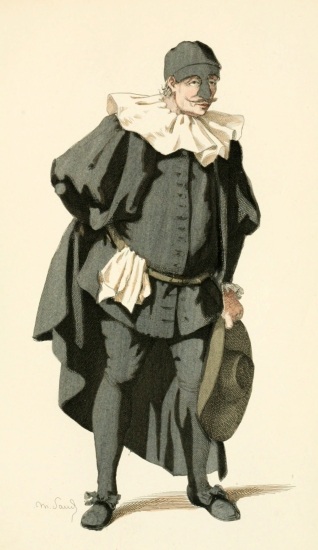
IL DOTTORE (1653) Illustrating the Italian Commedia dell'Arte, or Impromptu Comedy
But this is a digression, which has for its object to indicate the region in which Gozzi's chief merit as a playwright seems to me to lie. The satire, which forms so prominent a feature in the Fiabe, impairs their artistic harmony. So far as this is literary (in the Tre Melarancie, Il Corvo, and elsewhere), it has lost its interest at the present day. So far as it is philosophical and didactic (as in L'Augellino Belverde and Zeim), it tends to break the unity of effect by the author's over-earnestness. So far as it is purely ethical, as in Zobeide, Gozzi loads his palette with colours too sinister and sombre. Perhaps, the political touches of satire in I Pitocchi Fortunati are the lightest and most genially used. Gozzi, as we have seen already, was a confirmed conservative. An optimist as regarded the institutions, religion, and social manners of the past, he was a bitter pessimist in all that concerned the changes going on around him. The new literature, the new philosophy, the new luxury, the new libertinism, which seemed to be flooding Italy from France, were the objects of his hatred and abhorrence. Calmon, in the Augellino Belverde, expresses Gozzi's personal convictions and beliefs in their fullest extent. But the following speech may be extracted from Zeim Ré de Genj as a fair summary of his social stoicism.[83] A Princess of Balsora, who has been brought up by one of the capricious tricks of fortune as a slave is speaking:
"Who am I? That I know not. An old man,
With snows upon his beard, in snow-white robes
Attired, of serious and austere aspect,
Reared me beneath a humble cottage roof.
He told me that one day upon the bank
Of foaming Tigris, wrapped in swaddling-clothes,
He found me; peradventure by my kin
Abandoned, the cast fruit of shame and scorn.
This good man taught me I was born to serve,
To suffer, to endure; and that I ought
To bow beneath the will of supreme Heaven.
'Providence, holy, in her ways unknown,'
He said, 'rules all things: in the scale ordained
Of human beings great folk have their seat;
And so, by steps descending through all ranks,
Down to the lowest folk, men live and work
Subordinate. Ah! do not be seduced,
(He often warned me) by sophistic sages,
Who bent on malice paint of liberty
False lures for mortals, your own place to quit,
The order due designed by Heaven for man!
These sophists breed confusion, anarchy,
Duty neglected at the cost of peace;
They stir up murders, thefts, impieties,
And glut with blood the shambles of the state.
Daughter, respect the great, love them, endure
What in they lot seems bitter, woo content,
And stifle that snake envy in thy breast!
In the just eyes of Heaven a great man's acts,
Rightly performed, have no superior merit
To those of servants rightly done; the road
Toward immortality lies open unto kings
And children of the people; 'tis all one.
Only the soul that suffers and is strong,
Finds happiness.' So spake the firm old man;
And firmly, in his strength of soul unshaken,
He sold me slave; so I account me blessed,
As you shall trust me for a faithful slave."
IX.
Gozzi drew the subjects of his Fiabe from divers sources. The chief of these was a book of Neapolitan fairy-tales called Il Pentamerone del Cavalier Giovan Battista Basile, ovvero lo Cunto de li Cunti. This collection enjoyed great vogue in Italy during the seventeenth and eighteenth centuries, and is still worthy of attentive study by lovers of comparative folklore. Some of the motives of the Fiabe have been traced to the Posilipeata di Massillo Repone, the Biblioteca dei Genj, the Gabinetto delle Fate, the Arabian Nights, and those Persian and Chinese stories which were fashionable a hundred and fifty years ago. It was Gozzi's habit to interweave several tales in one action; and this renders researches into the texture of his dramatic fables difficult. But the inquiry is not one of great importance, and may well be dismissed until the star of Gozzi shall reascend the heavens, if time's whirligig should ever bring about this revenge.
L'Amore delle Tre Melarancie is both the simplest in construction and also the most artistically perfect of the ten Fiabe. In it alone the fairy-tale and the Masks are brought into complete harmony. No serious note breaks the burlesque style of the piece, while a sustained parody of Chiari's and Goldoni's mannerisms lends it the interest of satire. As he advanced, Gozzi gradually changed the form of his original invention. That fusion of fairy-tale and impromptu comedy in subordination to literary satire, which distinguishes the Tre Melarancie, was never repeated in his subsequent performances. The fable, with its romance, pathos, passion, adventure, magic marvels, and fantastic transformations, began to detach itself against the comedy. Both formed essential factors in Gozzi's later work; but the links between them became more and more mechanical. Satire, in like manner, did not disappear; but this was either used occasionally and by accident, or else it absorbed the whole allegory. The three ingredients, which had been so genially combined in the first piece, were now disengaged and treated separately. The sunny light of sportive humour, which bathed that wonder-world of fabulous absurdity, darkened as the clouds of didactic purpose gathered. The fairy-tale acquired an inappropriate gravity. Becoming aware of his dramatic talent, Gozzi assumed the tone of tragedy. He treated the loves and hatreds, the trials and triumphs, the vices and virtues, the heroism and the baseness, of his puppets seriously. Nevertheless, he preserved the preposterous accidents of the fable. On those enchantments, whimsical oracles of fate, metamorphoses, talking statues, monsters, good and wicked genii, he was of course unable to bestow the same reality as on his human characters. Yet, having carried the latter out of the sphere of burlesque, he had to maintain a tone of realism with the former. But he could not wield the Prospero's wand of imaginative insight which brings the supernatural and the incredible within the range of actualities. Thus the marvellous elements of the fable remained stiff and artificial beside the natural pathos and passion of humanity.
Having recapitulated the chief features of the Fiabe in their later form, I will now analyse L'Augellino Belverde.
X.
Many years have elapsed since Tartaglia married Ninetta. His father is dead, and he has fallen under the malignant influence of the Queen-Mother, Tartagliona. She persuades him that Ninetta has given birth to a pair of puppies, male and female, whereas the twins are really a fine boy and girl, called Renzo and Barbarina. Ninetta is condemned to be buried alive; and Pantalone, Tartaglia's minister, receives commission to drown the supposed puppies. Instead of executing these orders, Pantalone sews the children up in oil-cloth, and sets them floating down a river. They are found and rescued by Smeraldina, a woman of good heart, who is married to the dissolute and worthless Truffaldino, a pork-butcher. When the play opens, eighteen years are supposed to have elapsed since the burial of Ninetta. All this while she has been kept alive by the Beautiful Green Bird, who is the King of Terradombra, condemned to take this form by magic arts. The Green Bird also has become the lover of Barbarina. Meanwhile Tartagliona is being courted by Brighella, who now appears in the character of a burlesque poet and seer. His pindaric prophecies and exaggerated flights of passion, alternating with the lowest language of the proletariate, afford excellent opportunities for caricature.
Renzo and Barbarina, growing up in the house of the pork-butcher, have improved their minds by assiduous reading of French philosophical treatises sold for waste paper. This education has persuaded them that all human actions and affections proceed from self-love, and that it is the duty of rational beings to preserve a cold impartiality, indifferent to emotions, regardless of comfort and vain pleasures, governed only by the dictates of the reason. Accident reveals to them that Smeraldina is not their mother, and that they are nameless foundlings. They determine to go forth alone, and seek their fortunes in the world. The scene in which they take leave of their kindly warm-hearted foster-mother is excellent. Gozzi has painted a pair of consummate prigs, whose natural instincts have been perverted by a false theory of life, and who have learned to call that reason which is really inhumanity. They tell Smeraldina that her unselfish charity to the foundling infants was a form of self-love, and that her continued attention to them for the last eighteen years had no higher motive.
Having quitted Smeraldina, with the loftiest airs of condescension, they set forth upon their travels. Getting lost in the wilderness, it begins to dawn upon them that self-love is one of the cardinal facts of human nature, to which even the most philosophical characters, when threatened with death by cold and famine, are subject. In the midst of these reflections, they are terrified with an earthquake and sudden darkness. A statue appears walking toward them, who informs them that he too was once a miserable philosopher, who petrified his own humanity and that of others by perverse principles analogous to those which have infected them. Consequently, he was doomed to be a statue, lying lifeless and inert among the rubbish of neglected things, until one of Renzo's and Barbarina's ancestors rescued him from filth and set him up in a garden of the city. This benefit he now means to repay by watching over the twins. First of all, he ardently desires to save them from the petrifaction which awaits all souls made frigid by a false philosophy. Next, he tells them that, though he knows the secret of their parentage, he may not reveal it. They have a dreadful doom impending over them; and their eventual happiness can only be secured by the assistance of the Green Bird. His own name in the world was Calmon; and he has now become the King of Images:[84]—
"Molti viventi
Sono forse più statue, ch'io non sono.
Tu proverai qual forza abbia una statua,
E come simulacro un uom diventi."
Then Calmon gives the twins a stone. They are to return to the city, and Barbarina is to throw the stone down before the royal palace. They will immediately become rich. In any great disaster, let them call on Calmon.
In this way Gozzi allegorises his own prejudice against the cold and shallow theories of society, which were infiltrating Italy from France.
The second act reveals Tartaglia. He is the victim of remorse, haunted by the memory of Ninetta, whom he buried alive in a hole beneath the scullery-sink. There is the floor on which she used to walk. There is the kitchen where she fluttered in the form of a dove. "O spirit of Ninetta, where art thou?" Tartaglia preserves the burlesque note of his Mask. Only one friend remains to him, his old henchman Truffaldino; but Truffaldino has become a pork-butcher, and forgotten him. Truffaldino at this juncture appears. He too gives himself philosophical airs, without concealing his gross appetites and greedy love of self. Tartaglia kicks him out of doors, and then passes to a scene of vituperation against his wicked mother, Tartagliona, the Queen of Tarocchi,[85] who has been the cause of all his misery. Tartagliona shows the worst side of her coarse malignant nature in the ensuing altercation, and departs vowing vengeance.
Her only consolation is that she is beloved by Brighella, the most famous poet of the age:[86]—
"Non mancano
In me vezzi, e lusinghe, ond' al mio fianco
Fedel sia sempre. Ah, non vorrei, che alfine
Le mie finezze a lui, negli altri amanti
Destasser gelosia."
A new scene introduces Renzo and Barbarina. They have returned to the city, and are standing in front of the palace. Renzo begs his sister to throw the magic stone. Barbarina reminds him that if they become rich, all will be over with their philosophy. At last he persuades her to throw it, and she does so, bidding herself be mindful that a wretched pebble is the source of her future magnificence. In a moment a gorgeous palace rises, fronting the royal dwelling. Renzo's and Barbarina's rags are exchanged for splendid raiment. Moorish servants issue from the great gates with torches, and welcome their princely masters.
No sooner have the twins taken up their abode in this magic palace, than they begin to act like parvenus and nouveaux riches. Every folly, vanity, and false desire enters their heads. Their philosophy is forgotten. Brighella, in his character of seer, divines, meanwhile, that their presence threatens danger to the person of Tartagliona. He therefore endeavours to persuade the Queen to make her will in his favour. She very sensibly refuses, and bids him do all in his power to prolong the life of one whom he adores. He is obliged to meet her wishes, and divulges a plan whereby the twins shall be destroyed. The fairy Serpentina, he reminds her, owns apples which sing, and golden water which plays and dances. The adventure of stealing these magical objects involves the greatest peril. Certainly Barbarina will be ruined if she longs to have them. Accordingly, when she appears at the window of her palace, Tartagliona from the opposite balcony is to repeat these rhymes:[87]—
"Voi siete bella assai; ma più bella sareste,
S'un de'pomi, che cantano, in una mano areste.
. . . . . . . . . .
Figlia voi siete bella; ma più bella sareste,
S'acqua, che suona e balla, nell'altra mano areste."
The scene now changes to the interior of the palace of the twins. Barbarina is contemplating her charms in the looking-glass, when Smeraldina suddenly enters, full of affection. She has heard of the good fortune of her foundlings, and forgetting their recent ill-treatment of her, has come to congratulate them. Barbarina exclaims against her rudeness, calls the servants, throws a purse of gold at her foster-mother, and bids her depart. Smeraldina, who cannot stifle her affection for the ungrateful girl, changes tone, and humbly asks to be allowed to stay and serve her. Barbarina, much to her own surprise, feels touched by this display of feeling, and magnanimously allows the good woman to remain as a menial. Smeraldina's soliloquy at the end of the scene reveals her sound sense no less than her warm heart:[88]
"Questa è quella filosofa, che andava
Ieri per legna al bosco, ed oggi! ... basta ...
Seco volea restar, perchè l'adoro,
E seco resto alfin; del tacer poi
Ci proveremo; ma non sarà nulla.
Non la conosco più. Quanta superbia!
Che diavol l'ha arrichita in questa forma?
Io non vorrei, che questa frasconcella ...
Forse qualche milord ... ma saprò tutto."
[Entra.
Next we have Renzo. He has fallen desperately in love with a beautiful statue which he found in the garden of the palace. Truffaldino enters, frankly confesses that he has come to live at ease with his quondam foster-child, professes himself a true sage, and expounds the cynical philosophy of interested motives. Renzo cannot resist laughing at the knave's candour, but is not yet disposed to bear his insolence. Truffaldino sees that he must alter his tone. So he begins to whine and flatter. Renzo is softened, and consents to keep him as a buffoon. His cynicism and his hyperbolical adulation will serve to make the hours pass pleasantly.
Tartaglia and Pantalone appear upon the royal balcony. Barbarina enters on the other side, and Tartaglia falls head over ears in love with her at first sight. The scene is carried out with much burlesque humour, until Tartagliona and Brighella join the group below. Tartagliona utters the magic verses, and Barbarina becomes madly bent upon the apples which sing and the water which plays and dances. Renzo, touched by his sister's despair, agrees to attempt the adventure; but before he goes, he gives her a dagger. So long as this is bright, he will be alive. If it drops blood, that is a sign that her brother has died in the attempt.
A scene between Ninetta in her living tomb and the Green Bird who brings her food, is here interpolated, in order to prepare the audience for what ensues.
Renzo and Truffaldino arrive at Serpentina's garden, and fail in their adventure. Then Renzo calls on Calmon, who appears, and summons a band of statues—the female figure on the fountain at Treviso and the Moors of the Campo de'Mori at Venice[89]—to his aid. By their assistance a singing apple is procured, and some of the dancing water is bottled in a phial. But Calmon and his band of statues remind Renzo that he is in duty bound to be grateful. Calmon lacks his nose; the fountain of Treviso's breasts are injured; the Moors have, each of them, some broken limb. Renzo must undertake to restore them properly, and all will go well with him.
Renzo promises; but he very soon forgets the shattered statues. Lost in admiration before the image of beautiful Pompea, he spends his days in wooing her. At length Pompea finds her voice, and confides to him her previous experience. She was the daughter of a great Italian prince, the prince of a corrupt but mighty city; and she has now become an idol through her self-idolatry.
At this juncture enters Truffaldino with exciting news. Tartaglia has made a declaration of his love through Pantalone to Barbarina. She wavers between the splendid prospects of a royal match and the affection which she feels for the Green Bird, her lover and consoler in their days of poverty. Meanwhile Tartagliona breaks negotiations off by declaring that Barbarina must bring the Green Bird as dower; else she can never be Tartaglia's bride. At this announcement Barbarina falls into hysterics, kicking Pantalone downstairs, and screaming out that nothing but the Green Bird will satisfy her. Truffaldino, partly out of compassion for Barbarina's state, partly from a sense of modesty, leaves her presence. He arrives to rouse his master to a sense of the situation. This is no time to make platonic love to statues, &c.
Renzo replies that he is quite ready to attempt the adventure of the Green Bird. He knows from Calmon that the bird alone is capable of solving the problem of his own parentage, and also of evoking Pompea from her marble immobility. Consequently he has a strong personal interest in the capture of the bird; and his sister's troubles are an additional reason why he should no longer delay. With Truffaldino for his squire, he will ride forth into the forest of the Goblin, who holds the bird in meshes of diabolical enchantments. Let Smeraldina remind his sister that the dagger which he gave her will assure her of his good or evil fortune in the perilous essay.
While Renzo is on his journey, Barbarina keeps continually gazing on the dagger. It does not cease to shine. But Smeraldina and the speaking statue of Pompea work upon her feelings by suggesting the perils her brother is undergoing, to which her own vanity has exposed him. Moved at last by simple human sympathy, she finds the situation intolerable, and resolves to follow Renzo to the place of danger. It is this return to nature which saves her, and brings about a happy catastrophe. Barbarina renounces her wish to wed Tartaglia, and thinks only of arresting Renzo in his dangerous course. She sets off with Smeraldina; and the magic palace is left desolate, in mourning, all its splendour gone.
Renzo and Truffaldino have now reached the Goblin's hill, where the Green Bird is seen upon a perch, chained by the leg. Trying to capture him, Renzo turns into a statue; and there is a whole gathering of similar statues in the place—men who essayed the same adventure, and failed.
Barbarina and Smeraldina arrive at the scene of action. The dagger drops blood. Barbarina's mask of false philosophy and selfish vanity drops off. She becomes a simple woman, filled with repentance and anguish for her brother who is dead. She flings herself upon the bosom of poor Smeraldina, whom she had so villainously treated. At this juncture, when all seems lost, Calmon appears, and reads her a sound moral lecture. Then he points to a scroll before her feet, and instructs her what she has to do. She must walk up to within a hair's-breadth—no more and no less—of the bird, and take good heed that he does not utter a sound before she has read aloud the words inscribed upon the scroll. If she succeeds in this feat, all may yet come right. There is a breathless moment, during which Barbarina executes what Calmon told her. The bird is captured, and begins to talk. Let her take a feather from his tail. That will restore the statues to life.
The drama is quickly wound up. By means of the bird's tail-feather, Renzo and Pompea are made happy lovers. Ninetta returns from her hole. Tartagliona is changed into a tortoise, and Brighella into a donkey. The Green Bird resumes his form as King of Terradombra and plights his faith to Barbarina. Tartaglia recognises his lost son and daughter, and is fain to be contented with the resuscitated wife whom he had so wantonly condemned to a lingering death.
. . . . . . . . . . . . . . . . . . . . . . . . .
This analysis, if any one takes the trouble to read it, will suffice to show the sprightliness of Gozzi's invention, and also the essential weakness of his artistic method. The magic and the transformations at the close are mechanical. The fate of the Green Bird is connected by no proper motive with the fate of Tartaglia and the twins. Calmon and the statues, allegorically useful, are in like manner independent of the main dramatic action. Ninetta's doom is atrocious. Tartaglia is only saved from being disgusting by his burlesque absurdity.
XI.
In the spring of 1762, having exhibited Le Tre Melarancie, Il Corvo, Il Rè Cervo, and Turandot, Gozzi proved that he had won the game against Chiari and Goldoni. Sacchi's company removed from the theatre at S. Samuele to a more commodious house at S. Angelo. Chiari retired to his native city, Brescia, and left off writing for the stage. Goldoni departed for Paris. None of Goldoni's biographers deny that he took this step in consequence of Gozzi's triumph. In his own Memoirs he omitted all references to the literary quarrels of the years 1756-62; and he gives excellent reasons, quite independent of Gozzi, for his setting off to seek fortune in the French capital. Certainly, the last piece he presented to the Venetian public, Una delle ultime sere di Carnovale, was received with enthusiasm. "It closed the theatrical year of 1761," he says;[90] "and the evening of Shrove Tuesday brought me an ovation. The theatre rang with thunders of applause, among which could be distinguished these farewells: A happy journey! Come back to us! Be sure you do not fail to do so! I confess that I was touched to tears." Yet the simultaneous retirement of both Chiari and Goldoni at this critical moment justifies our believing that the latter judged it expedient to leave Venice after the revolution effected by Gozzi. He did so without ill-will on either side. Count Gasparo Gozzi, Carlo's brother, and a distinguished member of the Granelleschi, undertook the charge of seeing a new edition of Goldoni's plays through the press in his absence.
For some years after this event, Carlo Gozzi and Sacchi's company had the theatres of Venice pretty much at their own disposal. But the success of the Fiabe was ephemeral. Before their author's death, he saw his own dramatic novelties cast into the shade and Goldoni's realistic comedies restored to favour. A poet of such eminence as Goethe, surveying all things Italian with curiosity in 1786, paid a well-considered tribute to Gozzi's sympathy with the Venetian public, praised the energy and nature of the Commedia dell' Arte, but reserved his highest panegyric for a representation of Goldoni's Baruffe Chiozzote at the theatre of S. Luca.[91] "At last I am able to say that I have seen a comedy," are the emphatic words with which Goethe opens a detailed description of this piece.
In the course of the last hundred years, Goldoni has secured a signal and irreversible victory over his rival. One of the best theatres at Venice is called by his name. His house is pointed out by gondoliers to tourists. His statue stands almost within sight of the Rialto on the Campo S. Bartolommeo, where people most do congregate. His comedies are repeatedly given by companies of celebrated actors. Gozzi's Fiabe have been relegated to the marionette stages, where some of their scenari in a mutilated form may still be seen. There exist no memorials to his fame in Venice. Not even a tablet with the words Qui nacque Carlo Gozzi is to be found upon the ancient palace at S. Cassiano. The sacristan of the church, where his dust is gathered to his fathers, cannot point to the Gozzi vault.
The vicissitudes of Gozzi's reputation turn upon the different views which have been taken of his merits in relation to Goldoni. In Italy the balance of opinion tends to sink against him. Baretti, that fiery member of Sam Johnson's club, the fierce opponent of Goldoni, pronounced at first in Gozzi's favour, lamented that he could not bring Garrick to one of his plays, proposed to translate the Fiabe into English, and swore that Gozzi stood next to Shakespeare in dramatic genius. But when Baretti read the Fiabe in print, he declaimed against the buffooneries of the Masks, and dropped his enthusiasm. Tommasei found no words too strong to express his contempt for a writer whose genius he denied, and whose character inspired him with repugnance. Tommasei was a champion of Goldoni. Omitting further details, it is enough to say that Italy has elected to ignore Gozzi and to deify Goldoni. The causes are not far to seek. Gozzi's vogue depended partly upon controversy and satire. It was confined to the locality of Venice. His plays required the co-operation of the Masks; and these expired in his own lifetime. Moreover, they appealed to a rare combination of sensibilities, romantic and humorous, which is not common in Italy. Lastly, for their proper mounting on the stage, they demanded an expenditure of ingenuity and money, which their fading popularity prohibited. Goldoni, on the other hand, suited the temper of the growing age by his simplicity, his truth to nature, his realism, and the freshness of eternal youth which lends charm to the facile productions of his amiable genius. His comedies can be put upon the stage without the least difficulty; and they afford scope for the display of varied talents in actors of several descriptions.
In Germany Gozzi enjoyed wide posthumous reputation, not as a playwright with the public, but as a poet among men of letters. He was early chosen, during the Sturm und Drang period, to perform the part of champion of Romantic against Classical forms of art. How mistaken this view of Gozzi really is, I have attempted to prove. Yet if critics ignore what Gozzi wrote about the origin of his Fiabe, and keep out of sight his intentions while composing them—if they only regard the printed plays—it is not difficult to make him assume this false position. Franz A. C. Werthes translated the Fiabe into German so early as 1777-79, and published them at Bern. No less than twelve separate versions of selected plays have since appeared, up to the date 1877.[92] Among these may be mentioned Schiller's Turandot, which was executed from the translation of Werthes, and a reproduction of I Pitocchi Fortunati by Paul Heyse. Schlegel introduced the Fiabe to public notice, emphasising their value as specimens of the Romantic style, and connecting them with the indigenous art of Italy. Hoffmann declared his enthusiasm for Gozzi; and if he did not borrow motives from the Fiabe and the Memoirs for his own fantastic productions, he undoubtedly regarded their author as a genius of the same species as himself. Wagner, I may parenthetically observe, based one of his earliest operatic productions on La Donna Serpente. It was composed in 1833, and was first exhibited at Munich in 1888. To follow the several steps by which Gozzi came to be regarded in Germany as a Romanticist, snuffed out by the Revolution, would lead me beyond the limits of this introduction. I suspect that he was known there mainly in the translation of Werthes, and that his works were quarried as a mine of motives by writers of romantic tendencies, who lacked invention. There is a pocket edition of the Fiabe in Italian, 3 vols., published by Hitzig, 1808.
The German conception of Gozzi as a Romantic poet of the purest water spread to France. It took the French imagination just when the Romantic movement was at its height. Philarète Chasles treated his works from the point of view of Spanish dramatic literature. Paul de Musset pounced upon the Memoirs, condensed them into a small volume with considerable literary ability, and so ingeniously manipulated their text in the process as to create the illusion that Gozzi had pronounced himself to be in fact what his German admirers found in him. This clever travesty of Gozzi's autobiography presented him to the world as the victim of sprites, the creature of his own inventions, the plaything of superstition, instead of the caustic, practical, sometimes dissembling, and often sinister, man of thwarted passion, violent caprice, hard head, and conservative heart, who will presently be revealed in my version of the Memoirs. I do not blame Paul de Musset for his literary escapade. I understand his motive, and appreciate the joke. He wanted, at one and the same time, to place Gozzi, as the Germans had already placed him, among the fathers of Romanticism, and also to construct a telling novel of adventure out of the copious materials furnished by the Memoirs. But, by so doing, Paul de Musset misled writers who had no access to the sole edition of Gozzi's Memorie, or who were perhaps too careless to seek this document out. Among these I may mention M. Paul Royer, the translator of five of Gozzi's Fiabe into French,[93] and Vernon Lee, the talented authoress of a deservedly popular book entitled Studies of the Eighteenth Century in Italy.[94] Both of these distinguished writers have fallen into the trap laid for them by Paul de Musset, and have accepted a false conception of the man who forms the subject of these volumes.
Gozzi, who plumed himself upon his Democritean philosophy of laughter, his Stoic-Epicurean acceptance of every wayward stroke of fortune, would have been the first to smile sardonically, yet not without a touch of benignant humour, upon the mask he has been made to wear by Germans and by Frenchmen. English critics, with the exception of Vernon Lee, have had little or nothing to do with him up to this date.[95] Let the man speak for himself in the account of his own life, which I now for the first time present to the multitude of English readers.
August 8, 1888.