Part 3 — CARLO GOZZI.
John Addington Symonds translation
I. My Pedigree and Birth.
THERE are people foolish enough to make every family history the object of their ridicule and satire. For the sake of wits of this sort I shall give a short but truthful account of my ancestry, in order that they may have something to quiz.
Our stock springs in the fourteenth century from a certain Pezòlo de'Gozzi. This is proved by an authentic genealogy, which we possess; the authority of which has never been disputed, and which has been accepted as evidence in law-courts, although it is but a dusty document, worm-eaten and be-cobwebbed, not framed in gold or hung against the wall. Since I am no Spaniard, I never applied to any genealogist to discover a more ancient origin for our race. There are historical works, however, which derive us from the family de'Gozze, extant at the present epoch in Ragusa, and original settlers of that venerable republic. The chronicles of Bergamo relate that the aforesaid Pezòlo de'Gozzi was a man of weight and substance in the district of Alzano, and that he won the gratitude of the most serene Republic of Venice for having imperilled his property and person against the Milanese in order to preserve that district for her invincible and clement rule. His descendants held office as ambassadors and podestàs for the city of Bergamo, which proves that they were members of its Council; while two privileges of the sixteenth century show that two separate branches of the family obtained admission to the citizenship of Venice.[96] They erected houses for the living and provided tombs for their dead in the quarter and the Church of San Cassiano, as may be seen at the present day.[97] One of these branches was honoured with adoption into the patrician families of Venice in the seventeenth century,[98] and afterwards expired. The branch from which I am descended remained in the class of Cittadini Originari, on which they certainly brought no discredit whatsoever.
None of my ancestors aspired to the honourable and lucrative posts which are open to Venetian citizens.[99] They were for the most part men of peaceful unambitious temper, contented with their lot in life, or perhaps averse from the disturbances of competition. Had they entered upon a political career, I am quite sure that they would have served their Prince faithfully, without pride and without vain ostentation.
About two centuries ago, my great-great-grandfather purchased some six hundred acres of land,[100] together with buildings, in Friuli, at the distance of five miles from Pordenone. A large portion of these estates consists of meadow-land, and is held by feudal tenure. All the heirs-male are bound to renew the investiture, which costs some ducats. Upon this point the officials of the Camera de' Feudi at Udine are extremely vigilant. If the fine is not paid immediately after the death of the last feudatory, they confiscate the crops derived from the meadows subject to this tenure. That happened to me after my father's decease. A few months' negligence cost me a considerable sum in excess of the customary fine. It is probably by right of some old parchment that we own the title of Count, conceded to our family in public acts and in the addresses of letters.[101] I should feel no resentment, if this title were refused me; but it would anger me extremely, if my hay were withheld.
My father was Jacopo Antonio Gozzi; a man of fine and penetrative intellect, of sensitive and delicate honour, of susceptible temper, resolute, and sometimes even formidable. His father Gasparo died while he was yet a child, leaving this only son to the guardianship of his mother, the Contessa Emilia Grampo, a noble woman of Padua. The estate was sufficient to sustain his dignity with credit; but he indulged dreams of magnificence. Sole heir, and educated by a tender mother, who humoured every fancy of her son, he early acquired the habit of following his own inclinations. These led him into lordly extravagances—stables full of horses; kennels of hounds; hunting-parties; splendid banquets—nor did he reflect upon the consequences of a marriage, which he made without deliberation in his early manhood, to indulge a whim of the heart. My mother was Angela Tiepolo, the daughter of one branch of that patrician house, which expired in her brother Almorò Cesare.[102] He died, a Senator of the Republic, about the year 1749.
I shall perhaps have wearied my readers with these facts about my pedigree and birth. Satirists will not, however, find in them anything to excite ambition in myself or to wing their pen with ridicule. Social ranks have always been regarded by me as accidental, though necessary for the proper subordination on which our institutions depend. As for my birth, I think less of whence I came than of whither I am going. Conduct unworthy of a decent origin might cause sorrow to my deceased parents, whose memory I hold in honour, and might cover myself and all my posterity with shame.
My name is Carlo. I was the sixth child born by my mother into the light, or shall I say the shadows of this world. I am writing on the last day of April in the year 1780. I have passed fifty, and not yet reached the age of sixty.[103] I shall not put the sacristan to trouble in order to view the register of my baptism, being quite sure that I was christened, and not having the stupid vanity to pass for a curled dandy. That is obvious, and has been always obvious, from the fashion of my clothes and the way I dress my hair. Besides, I set no value on the age of men. Human beings die at all ages; and I have seen boys who are adult, while grown-up men or grey-beards are often nothing better than peevish and ridiculous children.
II. My Education and Circumstances down to the Age of Sixteen—Concerning the Art of Improvisation, and my Literary Studies.
Our family consisted of eleven children, male and female. I could record nothing but what is creditable of my brothers and sisters, had I proposed to write their memoirs. But this is not my thought; and they are capable of writing their own, if the whim should take them; for the epidemic of literature was always chronic in our household.
A succession of priests with little learning were our domestic pedagogues up to a certain age. I say a succession advisedly; each in turn having earned his dismissal by impertinent behaviour and intrigues with the serving-maids.
From early childhood I was always a silent observer of men and things, by no means insolent, of imperturbable serenity, and extremely attentive to my lessons. My brothers used my taciturn and peaceable temper to their own advantage. They accused me to our common tutor of all the naughtinesses of which they had been guilty. I did not condescend to excuse myself or to accuse them, but bore my unjust punishments with stoicism. I venture to affirm that no boy was ever more supremely indifferent than I was to the terrible penalty of being sent away from table just as we were sitting down to dinner. Smiling obedience was my only self-defence. Enemies may conclude from these traits of character that I was a stupid lout, and friends that I was a philosopher in embryo. Nothing is rarer than the eye of equal justice. Yet any one who takes the trouble to inquire of my acquaintances and servants, will learn that my taciturnity, my tolerance, my stoical endurance, have not changed with years—that I continue to view the events of this life with a smile, and that only those have nettled me which touched my honour.
SCARAMOUCH (1645) Illustrating the Italian Commedia dell'Arte, or Impromptu Comedy
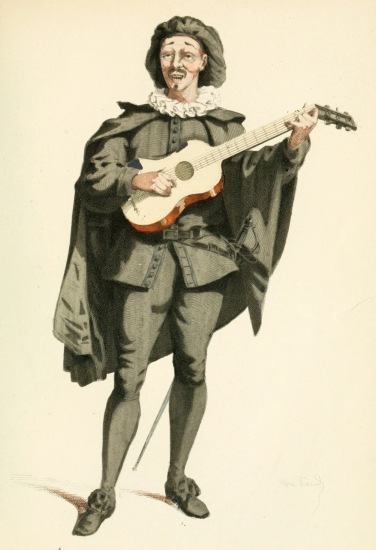
The growing disorder in our family affairs did not at first deprive us boys of a sound education. My two elder brothers, Gasparo and Francesco, went to public schools,[104] and were in time to drink at all the fountains of the regular curriculum. Extravagant expenditure, however, combined with the needs of a numerous progeny, soon rendered anything like an adequate course of studies impossible for the younger children. I was intrusted for some years to a learned country-parson, and then to a priest in Venice, of decent acquirements and excellent morality. After this I entered the academy of two Genoese priests, who supplied instruction to some youths of noble birth, and to some of no nobility whatever. There were about twenty-five pupils in this academy. We pursued the same studies, with some difference according to our classes. Here I had the opportunity of observing that teachers are very valuable guides to youths who love learning, and mere images of ineffectual deities to such as hate it. For my part, being fond of books and eager for information, I imbibed my fill of such instruction as a boy can acquire before the age of fourteen. But sloth and vicious habits extirpate the seeds of learning planted by preceptors in the minds of ill-conditioned lads. Therefore I saw, and still see, more than two-thirds of my fellow-pupils sunk in a slough of baseness. Grammar, the classics, and rhetoric only taught them to get drunk in taverns, to carry sacks for hire upon their shoulders, and to cry "Baked apples, plums, and chestnuts!" about the streets, with a basket on their heads and a pair of scales slung round their waists. Wretched fate to be a father!
When I became aware that our domestic difficulties would prove an obstacle to my remaining long at school, I determined to utilise the little I had already learned, and to carry on my education by myself. My elder brother Gasparo's example, whose passion for study had won public recognition, and my own good-will, kept me nailed to books of all sorts; nor could I imagine any pleasure worth a thought, beyond reading, meditating, and writing.
Poetry, choice Italian, and correct style were then in vogue. The young men of Venice met to discuss these three topics, which have now been utterly forgotten—possibly for the greater advantage and convenience of our citizens. I see crowds of young people, hair-brained, conceited, idle, frivolous, presumptuous, and harmful to society. Heaven knows what their studies are! Not poetry, not the niceties of the Italian language, not correction of style. And then, forsooth, I am to admire a hurly-burly of well-born persons, who claim in their foolhardiness to be omniscient, who produce nothing whatsoever, who cannot write three lines of a letter which shall express their sentiments, and which shall not swarm with revolting faults of grammar and of spelling!
I will omit to observe that respect for nobles in a state is necessary; but that the respect shown simply for their birth and wealth is not respect but false feigned adulation. I will refrain from asserting that a daily correspondence, maintained with a large variety of persons—people who may not perhaps be scientific, but who understand whether a letter is well written or ridiculous—may be capable of securing a large part of the regard, or of occasioning a large part of the contempt, bestowed on nobles. I make no mention of the rich man in Signor Mercier's comedy of Indigence, who found it impossible to write a letter of the utmost importance because his secretary was away from home. I will say nothing to those scientific tutors of the scions of our aristocracy, who instil derision and disdain for polite literature and the art of elegance in diction into the brains of their pupils, moulding them into geometricians, mathematicians, philosophers, physicists, astronomers, algebraical professors, naturalists, a whole deluge of sciences, but who cannot after all their labour express in writing what they have taught or what the common business of life requires.
All these things, and everything which imposture has presented to my senses and impressed upon my mind, must remain unwritten in my pen. I have no wish to make enemies.
Yet we cannot prevent drops of ink from falling sometimes from the pen and making blots upon our papers. Just so, while I am dictating these memoirs of my life, I shall not be able to avoid splutterings, however out of place and inconvenient.
I am almost ashamed to confess the intense assiduity with which I applied myself to those frivolous literary studies of which I have been speaking. They brought on a hæmorrhage from the nostrils, so violent and so frequent, that I was more than once or twice given up for dead in the manner of Seneca.[105] In their anxiety about my health, my friends hid away all my books, and deprived me of paper and inkstand; but I was the cleverest of thieves in searching for them, and went on doggedly reading and writing by stealth in the uninhabited attics of our mansion. After relating this fact about my boyhood, malicious people may think that I am claiming to be considered worthy of a panegyric. They are quite mistaken. I fix them with my eyeglass, and assure them that it is rather my intention to provide them with another good reason for quizzing me. The famous Doctor Tissot angrily rebukes excessive application to those studies which are universally esteemed as useless. He reserves his praise for folk who ruin their health in pursuits considered beneficial to humanity; and such, I do not doubt, are the studies affected by himself and his admirers.
The Abbé Giovan Antonio Verdani, keeper of the select and extensive library of the patrician family Soranzo, was a man of vast literary erudition. He felt compassion for my weakness, which coincided with his own, and directed my reading by lending me the rarest books, masterpieces of pure Italian diction in prose and poetry. To estimate the quantities of paper which I covered with my thoughts in verse and prose, would be beyond my powers. I tried to imitate the style of all the early Tuscan writers who are most admired. Assuredly I never approached the perfection of their language; but I am none the less sure that the diligent and attentive perusal of a mass of the best works, treating of a vast variety of subjects, cannot fail to furnish a better head than mine with instruction and ideas, with the power of making just reflections and probable conjectures, and with the principles of sound morality. I am also convinced that the imitation of style in writing, pursued methodically, enables a man to express his own thoughts with facility, propriety of colouring, exactitude of phrase and term, according to the variety of images, grave or gay, familiar or dignified, which we desire to develop and to communicate under their true aspect in prose or poetry.
Without attaining to the mastery of style at which I aimed, I acquired the miserable satisfaction of finding myself in the very select group of persons who know this truth. I also earned the wretchedness of being forced to read with insuperable aversion and disgust the works of many modern Italian authors, which are full of false fancies and sophisms, the rhetoric and diction of which never vary however the subject-matter changes, which are defiled by all manner of gibberish, bombast, nonsense, with periods involved in unintelligible vortices, and with preposterous phraseology. The sciences, the discoveries, the branches of new knowledge which are now so loudly vaunted, ought to be accepted as useful, and are worthy of respect. For this reason it is wrong to profane them and to render them contemptible by barbarous impurity and impropriety of diction. Francesco Redi, that great man, great philosopher, great physician, great naturalist, confirms my doctrine by his written works.[106] As regards the literature of art and wit and fancy, it is obvious that without correction of style this is absolutely worthless and condemned to merited oblivion. No one could count the fine and ample sentiments which perish, smothered in the mire of inartistic writing. Not less numerous, on the other hand, are the small but brilliant thoughts, duly coloured with appropriate terms, and placed at the right point of view by a master-hand, which sparkle before the eyes of every reader, be he learned or simple.
There is no disputing about tastes. Yet I think it could be easily maintained that our century has lapsed into a shameful torpor with regard to these things. I have written and printed quite enough upon the subject; without effect, however; and now I see no reason why I should not utter a last funeral lament over the mastery of art I longed to possess. That mastery, which nowadays is reckoned among the inutilities of existence, has been freely conceded to me by the verdict of contemporaries—blind judges, governed not by intelligence but by ignorant assumption—so that their opinion does not sustain me with the sure conviction of having attained my purpose. Nevertheless I am grateful even to the blind and deaf, who see and hear what gives them pleasure in my writings.
My pursuit of culture advanced on the lines I have described, whether for my happiness or my misfortune it is worthless to inquire. I read continually, and wasted enormous quantities of ink; paid close attention to men and manners; profited by the encouragement of the Abbé Verdani and Antonio Federigo Seghezzi; walked in the steps of my brother Gasparo; and frequented a literary society which met daily at our house. From a Piedmontese, who knew how to read and nothing more, I learned the first rudiments of French; not that I wished to talk French in Italy, an affectation which I loathed; but because it was my desire, by the help of grammar and dictionary, to study the books, most excellent in part, in part injurious to society, which issue daily from the French press. It was thus that I formed those literary tastes, to which I have always clung for innocent and disinterested amusement, and which, now that my hairs are grey, will be my solace till the hour of death. The giants of science, to whom I dare not raise my quizzing-glass for fear of committing an unpardonable sin, will perceive that in describing the scanty sources of my education, I am only painting the portrait of a literary pigmy in all humility.
As regards my moral training, it is only necessary to observe that the family of which I was a member has always cherished a deep and fervent reverence for the august image of religion, and that my father, careless as he was in matters of economy, never neglected religious duties or the good ensample of honourable conduct. He was a bitter enemy of falsehood. His delicate susceptibility detected a lie by the inflection of the voice, and he punished it upon the spot with sounding boxes on the ears of his offspring.
Being a bold rider and passionately fond of horses, he taught us to ride, and liked to see us every day on horseback during our summer visits to the country. It was useless to plead timidity, or to shrink from the snortings and jibbings of some half-broken beast he wanted us to back. Up we went; a cut or two of the switch across our legs set us off at a gallop; and there we were in full career, without a thought for broken shins or necks. Some jockeys, who came to break in vicious colts, put me up to tricks for mastering a hard-mouthed bolting animal. One of these tricks stood me in good stead upon an occasion I shall afterwards relate. Indeed, I may say that I owe my life to a jockey.
We had a little theatre of no great architectural pretensions in our country-house; and here we children used to act.[107] Brothers and sisters alike were gifted with some talent for comedy; and all of us, before a crowd of rustic spectators, passed for players of the first quality. Beside tragic and comic pieces learned by heart, we frequently improvised farces with a slight plot upon some laughable motive. My sister Marina and I had the knack of imitating certain married couples notorious in the village for their burlesque humours. We used to interpolate our farces with scenes and dialogues in which the famous quarrels of these women with their drunken husbands were reproduced to the life. Our clothes were copied from the originals; and the imitation was so exact that our bucolic audience hailed it with Homeric peals of laughter, measuring their applause by the delight it afforded their coarse natures. My father and mother took a fancy to see themselves represented in this way. My sister and I were shy at first, but we had to obey our parents. Finally, we regaled them with a perfect reproduction of their costume, their gestures, their way of talking, and some of their familiar household bickerings. Their astonishment was great, and their laughter was the only punishment of our dutiful temerity.
I learned to twang the guitar with a certain amount of skill, and vied with my brother Gasparo in improvising rhymed verses, which I sang to music in our hours of recreation. This was done with all the foolhardiness inseparable from a display which the vulgar are only too apt to regard as miraculous. Since I have touched upon the point, I will digress a little on this so-called miracle. In my opinion, the immense crowds of people hanging with open mouths upon the lips of an improvisatore only prove that, in spite of the contempt into which poetry has fallen, it still possesses that power over the minds and the brains of men which their tongues deny it. Cristoforo Altissimo, a poet of the fifteenth century, is said to have publicly improvised his epic in octave stanzas on the Reali di Francia; the words were taken down from his lips, just as he composed them at the moment. The book was published; and though it is extremely rare, I have read it through the kindness of the Abbé Verdani. Only a few stanzas, out of all that ocean of verse, are worthy of the name of poetry; and yet we may believe that before the work was given to the press, some pains had been bestowed upon it. I have listened to many extempore versifiers, male and female, the most famous of our century. It has always struck me that if the deluges of verses which they spout forth with face on fire, to the applause of frantic multitudes, were written down, they would have very little poetical value, and that nobody would have the patience to read the twentieth part of them. Padre Zucchi, of the Olivetan Order, whom I heard in my youth, surpassed his rivals; now and then he produced sensible stanzas; but he improvised so slowly that reflection may have had some part in the result. I do not deny that these extempore rhymesters may be people of culture and learning, qualified to discourse well upon the themes proposed to them. Yet they would not be listened to, if they spoke ever so divinely in prose. In order to draw a crowd, they are forced to express their thoughts and images, just as they come, with voluble rapidity, in bad rhymed verses, which often are no better than a gabble of words without sense. This throws their audience into a trance of astonishment. Humanity has always quested after the marvellous like a hound. If a painter sought to depict foolhardiness or imposture wearing the mask of poetry, I could recommend nothing better than the portrait of an improvisatore, with goggle-eyes and arms in air, and a multitude staring up at him in stupid dumb amazement. These being my sentiments, I am willing, out of mere politeness and good manners, to approve the coronation of a Cavaliere Perfetto or a Corilla on the Capitol. But I can only accept with cordial and serious enthusiasm the honours of that sort paid to a Virgil, a Petrarch, and a Tasso.
The Arcadians will laugh when I proceed to speak about an improvisatore, whom I knew and whom I have listened to a hundred times. Yet I should be committing an injustice if I did not mention him, and declare my opinion that he was the single really wonder-worthy artist in this kind, with whom I ever came in contact. He used to pour forth anacreontics, octave stanzas, any and every metre, extempore, to the music of a well-touched guitar. His verses rhymed, but had no Clio, Euterpe, Plettro, Parnaso, Aganippe, Ruscelletto, Zefiretto, and such stuff, in them. They composed a well-developed discourse, flowing evenly, not soaring, but with abundance of well-connected images, and natural, lively, graceful thoughts. He invariably used either the Venetian or the Paduan dialect; which will augment the derisive laughter of Arcadia, and make the Campidoglio ring. On one occasion, while he was improvising on the theme: diligite inimicos vestros, it happened that two enemies were present. At another time, he dilated on his own grief for a cavaliere[108] who had been kind to him, and who was then dying, given over by the doctors. Not only did the audience hang upon his lips with rapt attention; but in the former case, the enemies were reconciled, while in the latter tears were freely shed for the poet's expiring benefactor. Such influence over the passions of the heart reveals a true poet; for such a man I reserve the laurel crown upon my Campidoglio. His name was Giovanni Sibiliato, brother of the celebrated professor of literature in the University of Padua.
Returning from this digression, I will resume the narrative of my boyhood. I learned to fence and to dance; but books and composition were my chief pastime. Before a numerous audience in our literary assemblies I felt no shyness. In private visits, among people new to me, the reserve of my demeanour often passed for savagery. My first sonnet of passable quality was written at the age of nine. Beside the applause it won me, I was rewarded with a box of comfits; and for this reason I have never forgotten it. The occasion of its composition was as follows. A certain Signora Angela Armano, midwife by trade, had a friend at Padua whose pet dog died and left her inconsolable. Signora Angela wished to comfort her friend; indulged in condolements for her loss; and sent a little spaniel of her own, called Delina, to replace the defunct pet. Delina was to be given as a present, and a sonnet was to accompany the gift, expressing all the sentiments which a lady of Signora Angela's profession might entertain in a circumstance of such importance. Though our family was a veritable lunatic asylum of poets, no one cared to translate the good creature's gossipping garrulity into verse. Moved by her entreaties, I undertook the task; and the following Bernesque sonnet was the result:—
"Madama io vi vorrei pur confortare
Con qualche graziosa diceria,
Ma la sciagura vuole, e vostra, e mia,
Che in un sonetto la non vi può stare.
Non vi state, mia cara, a disperare,
Che la sarebbe una poltroneria,
L'entrar per un can morto in frenesia;
Chi nasce muor, convien moralizzare.
Vi sovvenite, ch' egli avrà pisciato
Alcuna volta in camera, o in cucina,
Che in quell' istante lo avreste ammazzato.
Io vi spedisco intanto la Delina
Che più d'un cane ha d'essa innamorato,
E può farvi di cani una dezina.
È bella, e picciolina;
Di lei non voglio più nuova, o risposta,
Servitevi per razza, o di supposta."
Two years later, a new edition of the poems of Gaspara Stampa appeared in Venice, at the expense of Count Antonio Ramboldo di Collalto of Vienna, a prince distinguished for his birth and writings. Scholars know that this sixteenth-century Sappho sighed her soul forth in love-laments to a certain Count Collaltino di Collalto, doughty warrior and polished versifier, and that she was reputed to have died of hopeless passion in her youth.[109] The ladies of our century will hardly believe her story; for Cupid has changed temper since those days, and kills his victims with far different and less honourable weapons. Some verses by contemporary writers in praise of our literary heroine were to be appended to this edition of her works. I dared to enter the lists, and wrote a sonnet in the style of the earliest Tuscan poets. Such as it is, the sonnet may be found printed in the book which I have indicated. It appears from this juvenile production that I already acknowledged a mistress of my heart; compliance with fashion was alone responsible for my precocity.
This trifling composition was read by the famous Apostolo Zeno. He deigned to inquire for the author, who had reproduced the antique simplicity of Cino da Pistoja, Guittone d'Arezzo, and Guido Cavalcanti. On my presenting myself, Signor Zeno politely expressed surprise at discovering a mere boy in the learned writer of the sonnet, treated me with kind attention, and placed his choice library at my disposal.[110] The encouragement of this distinguished poet, true lover of pure style, and foe to seventeenth-century conceits, added fuel to the fire of my literary passion. From that day forward not one of those collections of verses appeared, in which marriages, the entrance of young ladies into convents, the election of noblemen to offices of state, the deaths of people, cats, dogs, parrots, and such events, are celebrated in Venice and other towns of Italy, but that it contained some specimen of my Muse in grave or playful verse.
Books, paper, pens and ink formed the staple of my existence. I was always pregnant, always in labour, giving birth to monsters in remote corners of our mansion. I scribbled furiously, God knows how, up to my seventeenth year. Besides innumerable essays in prose and multitudes of fugitive verses, I wrote four long poems, entitled Berlinghieri, Don Quixote, Moral Philosophy (based upon the talking animals of Firenzuola), and Gonella in twelve cantos. The Abbé Verdani took a fancy to this last, and wished to see it printed. Signor Giulio Cesare Beccelli, however, had published a poem at Verona on the same subject, which robbed my work of novelty; and though mine was richer in facts drawn from good old sources, I did not venture to enter into competition with him. The three years' absence from home, which I shall presently relate, and the revolution in our domestic affairs which surprised me on my return, exposed these boyish literary labours to ruin and dispersion. It is probable that pork-butchers and fruit-vendors exercised condign justice on the children of my Muse.
III. The Situation of my Family, and my Reasons for Leaving Home.
In the course of these years, the early deaths of a brother and a sister had reduced our numbers from eleven to nine. Meanwhile, our annual expenditure exceeded the resources at our command, and left but little for the needs of a numerous offspring, too old to be contented with a toy or plaything. Some lawsuits, which we lost, diminished the estate. Clouds of doubt and care began to obscure the horizon, and in a few years the family was plunged in pecuniary embarrassment.
My brother Gasparo had taken a wife in a fit of genial poetical abstraction. Even poetry has its dangers. This man, who was really singular in his absolute self-dedication to books, in his indefatigable labours as an author, and in a certain philosophical temper or indolence, which made him indifferent to everything which was not literary, learned to fall in love from Petrarch. A young lady, ten years older than himself, named Luigia Bergalli,[111] better known among the shepherdesses of Arcady as Irmenia Partenide, a poetess of romantic fancy, as her published works evince, was my brother's Laura. Not being a canon, like Petrarch, he married her in Petrarch's spirit, but with due legal formalities. This woman, of fervent and soaring imagination, which fitted her for high poetic flights, undertook to regulate the disorder in our affairs. Impelled by the instincts of a good nature, with something of ambition and a flattering belief in her own practical ability, she did the best that in her lay. Yet all her projects and administrative measures revolved within a circle of romantic raptures and Pindaric ecstasies. Thirsting with soul-passion after an ideal realm, she found herself the sovereign of a state in decadence. It was the desire of her heart to make us all happy, in the most disinterested way. Yet she accomplished nothing beyond involving every one, and herself to boot, in the meshes of still greater misfortune. Her husband, poring perpetually upon his books, could only oppose her at the sacrifice of ease and quiet. This he was incapable of doing.—In order to judge people equitably, it is necessary that character, temperament, and circumstances should be thoroughly explained.
I know how unphilosophical it is to ascribe the discords of a family to malignant planetary influences. Our domestic circle consisted of a father, a mother, four brothers, and five sisters, all of them good-hearted, honourable, mutually well-inclined; and yet it became the very mirror of infelicity at every moment and in each of the persons who composed it. Minute investigation into the causes of this painful fact would probably reveal them. But it is better to adopt the language of the vulgar, and to say that a bad star pursued our family. Otherwise, analysis might lead one into acts of unkindness, and involve one in hatred.
The confusion in which we lived at that period, and the bitter discomforts we had to bear, were augmented by expenses due to my brother's increasing progeny. Our worst disaster, however (and this wound I carry in my heart even to the present day), was a cruel stroke of apoplexy which laid my beloved father low. He continued to exist, an invalid, for about seven years after the sad event; dumb and paralytic, but in possession of all his mental faculties—a circumstance which rendered his deplorable condition almost unbearable to a man of my father's extreme sensibility.
The tears of five sisters, the births of nephews and nieces, a house swarming with female go-betweens, brokers, and the Hebrew ministers of our decaying realm—all this whirlpool of economical extravagance and folly, to utter one word against which was reckoned mutiny or treason, drove my second brother, Francesco, into exile. He went into the Levant with the Provveditore Generale di Mare,[112] his Excellency the Cavaliere Antonio Loredano, of happy memory. At that period I was about thirteen.
Letters written from Corfu by this brother describing the kindness shown him by his Provveditore, and the rank of ensign to which he soon attained, awoke in me a burning desire to escape like him from those domestic turmoils, the gravity of which I felt in experience and measured by anticipation, but which my state of boyhood rendered me unable to remedy. Our uncle on the mother's side, Almorò Cesare Tiepolo, recommended me to his Excellency Girolamo Quirini, Provveditore Generale elect for Dalmatia and Albania. Furnished with a modest outfit, in which my book-box and guitar were not forgotten, I bade farewell to my parents at the age of seventeen,[113] and went across seas as volunteer into those provinces, to study the ways and manners of my fellow-soldiers, and of the peoples among whom we were quartered.
IV.
I Embark upon a Galley, and Cross the Seas to Zara.
I was not slow to perceive that I had adopted a career by no means suited to my character, the proper motto for which was always the following verse from Berni:
"Voleva far da se, non commandato."
My natural dislike of changeableness kept me, however, from showing by outward signs of any sort that I repented of my choice; and I reflected that abundant opportunities were now at least offered for observations on the men of a world new to me. This thought sufficed to keep me in good spirits and a cheerful humour through all the vicissitudes of my three years' sojourn in Illyria.
According to orders received from his Excellency, the Provveditore Generale Quirini, I embarked before him on a galley called Generalizia, which was riding at the port of Malamocco. There I was to wait for his arrival. A band of military officers received me with glances of courtesy and some curiosity. In a Court where all the members are seeking fortune, each newcomer is regarded with suspicion. Whether he has to be reckoned with or may be disregarded on occasions of promotion, concerns the whole crew of officials, who, like him, are dependent on the will of the Provveditore. It was perhaps insensibility which made me indifferent to these preoccupations; this the sequel of my narrative will show; and yet such thoughts are very wood-worms in the hearts of courtiers.
I had to swallow a great quantity of questions, to which I replied with the laconic brevity of an inexperienced lad upon his guard. Some of those gentlemen had known my brother Francesco at Corfu. When they discovered who I was, they seemed to be relieved of all anxiety on my account, and welcomed me with noisy demonstrations of soldierly comradeship. I expressed my thanks in modest, almost monosyllabic phrases. They set me down for an awkward young fellow, unobliging, and proud. This was a mistake, as they freely confessed a few months later on. I had retired into myself, with the view of studying their characters and sketching my line of action. The quick and penetrative intuition with which I was endowed at birth by God, together with the faculty of imperturbable reserve, enabled me in the course of a few hours to recognise in that little group some men of noble birth and liberal culture, some nobles ruined by the worst of educations, and some plebeians who owed their position to powerful protection.
Gaming, intemperance, and unbridled sensuality were deeply rooted in the whole company. I laid my plans of conduct, and found them useful in the future. My intimacies were few, but durable. The vices I have named, clung like ineradicable cancers to the men with whom I associated. Sound principles engrafted on me in my early years, regard for health, and the slenderness of my purse helped me to avoid their seductions. At the same time, I saw no reason why I should proclaim a crusade against them. Holding a middle course, I succeeded in winning the affection of my comrades. They invited me to take part in their orgies. I did not play the prude. Without yielding myself to the transports of brutal appetite, I proved the gayest reveller at all those lawless meetings. Some of my seniors, on whom a career of facile pleasure had left its inevitable stigma, used to twit me with being a reserved young simpleton. I did not heed their raillery, but laughed at the inebriation of my comrades, studied the bent of divers characters, observed the animal brutality of men, and used our uproarious debauches as a school for fathoming the depths of human frailty.
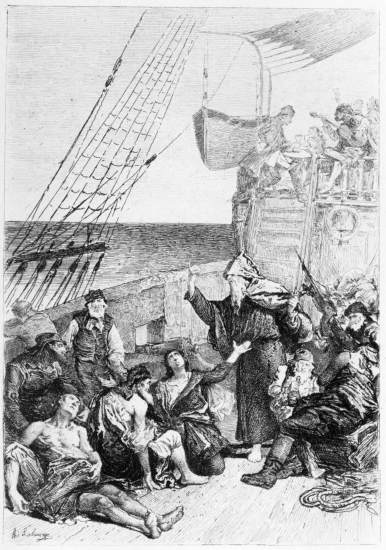
Now I will return to the point of my embarkation on the galley Generalizia in the port of Malamocco. While awaiting the arrival of the Provveditore, I had two whole days and nights to spend in sad reflections on humanity. These were suggested by the spectacle of some three hundred scoundrels, loaded with chains, condemned to drag their life out in a sea of miseries and torments, each of which was sufficient by itself to kill a man. An epidemic of malignant fever raged among these men, carrying away its victims daily from the bread and water, the irons, and the whips of the slavemasters. Attended in their last passage by a gaunt black Franciscan friar, with thundering voice and jovial mien, these wretches took their flight—I hope and think—for Paradise.
THE FRANCISCAN FRIAR ON THE GALLEY Original Etching by Ad. Lalauze
The Provveditore's arrival amid the din of instruments and roar of cannon roused me from my dismal reveries. I had visited this gentleman ten times at least in his own palace, and had always been received with that playful welcome and confidential sweetness which distinguish the patricians of Venice. He made his appearance now in crimson—crimson mantle, cap, and shoes—with an air of haughtiness unknown to me, and fierceness stamped upon his features. The other officers informed me that when he donned this uniform of state, he had to be addressed with profound and silent salaams, different indeed from the reverence one pays at Venice to a patrician in his civil gown.[114] He boarded the galley, and seemed to take no notice whatever of the crowd around him, bowing till their noses rubbed their toes. The affability with which he touched our hands in Venice had disappeared; he looked at none of us; and sentenced the young captain of the guard, called Combat, to arrest in chains, because he had omitted some trifle of the military salute. My comrades stood dumbfounded, staring at one another with open eyes. This singular change from friendliness to severity set my brains at work. By the light of my boyish philosophy I seemed to comprehend why the noble of a great republic, elected general of an armament[115] and governor of two wide provinces, on his first appearance in that office, felt bound to assume a totally different aspect from what was natural to him in his private capacity. He had to inspire fear and a spirit of submission into his subordinates. Otherwise they might have taken liberties upon the strength of former courtesy displayed by him, being for the most part presumptuous young fellows, apt to boast about their favour with the general. For my own part, since I was firmly bent on doing my duty without ambitious plans or dreams of fortune, this formidable attitude and the harsh commands of the great man made a less disheartening impression on me than on my companions. I whispered to myself: "He certainly inspires me with a kind of dread; but he has taken immense trouble to transform his nature in order to produce this effect; I am sure the irksomeness which he is suffering now must be greater than any discomfort he can cause me."
The general retired to his cabin in the bowels of our floating hell, and sent Lieutenant-Colonel Micheli, his major in the province, to make out a list of all the officers and volunteers on board, together with the names of their protectors. Nobody expected this; for we had been personally presented to the general at Venice, and had explained our affairs in frequent conversations. Once more I reflected that this was his way of damping the expectations which might have been bred in scheming brains before he exchanged the politenesses of private life for the austerities of office. The Maggiore della Provincia Micheli—a most excellent person and very fat—bustled about his business, sweating, and scribbling with a pencil on a sheet of paper, as though the matter was one of life or death. Everybody began to shy and grumble and chafe with indignation at passing under review in this way. When my turn came, I answered frankly that I was called Carlo Gozzi, and that I had been recommended by the patrician Almorò Cesare Tiepolo. I withheld his title of senator and the fact that he was my maternal uncle, deeming it prudent not to seem ambitious.
The Generalizia, convoyed by another galley named Conserva and a few light vessels of war, got under way for the Adriatic;[116] and the night fell very dark upon the waters. I shall not easily forget that night, because of a little incident which happened to me, and which shows what a curious place of refuge a galley is for young men leaving their homes for the first time. A natural necessity made me seek some corner for retirement. I was directed to the bowsprit; on approaching it, an Illyrian sentinel, with scowling visage, bushy whiskers, and levelled musket, howled his "Who goes there?" in a tremendous voice. When he understood my business, he let me pass. My next step lighted on a soft and yielding mass, which gave forth a kind of gurgling sound, like the stifled breath of an asthmatic patient, into the dark silent night. Retracing my path, I asked the sentinel what the thing was, which responded with its inarticulate gurgling voice to the pressure of my feet. He answered with the coldest indifference that it was the corpse of a galley-slave, who had succumbed to the fever, and had been flung there till he could be buried on the sea-shore sands in Istria. The hair on my head bristled with horror. But my happy disposition for seeing the ludicrous side of things soon came to my assistance.
After twelve days of much discomfort, and twelve noisome nights, passed in broken slumbers under the decks of that galley, which only too well deserved its name, our little fleet entered the port of Zara. We went on shore at first privately and quietly; and after a few days the public ceremonies of official disembarkation were gone through. The Provveditore Generale Jacopo Cavalli handed his baton of command over to the Provveditore Generale Girolamo Quirini with all the formalities proper to the occasion. This solemnity, which is performed upon the open sea, to the sound of military music, the thunder of artillery, and the crackling of musket-shots, deserves to be witnessed by all who take an interest in imposing spectacles. An old man, fat and short of stature, with a pair of moustachios bristling up beneath his nostrils, a merry and most honest fellow to boot, who bore the name of Captain Girolamo Visinoni, was appointed master of these ceremonies, on account of his intimate acquaintance with their details. I had no other duty that day but to wear my best clothes, which did not cost much trouble.
V.
I Fall Dangerously Ill; Recover; Form the only Intimate Acquaintance I made in Dalmatia.
When the new Regency had been established and the Court settled, I had but eight days to learn my duties as volunteer or adjutant[117] to his Excellency, as it is called there, before I fell ill of a fever which was declared to be malignant. Alone among people whom I hardly knew, at the commencement of my career, poorly provided with money, and lying in a wretched room, the windows of which were closed with torn and rotten paper instead of glass, I could not but compare my present destitution with the comforts of our home. Here I was battling with a mortal disease in solitude. There, at the least touch of illness, I enjoyed the tender solicitude of a sister or a servant at my pillow, to brush away the flies which settled on my forehead. Fortunately, I was not so strongly attached to life as to be rendered miserable by unavailing recollections and gloomy forebodings.
It happened one day, as I lay there burning, that a convict presented himself at the door of my miserable den, and asked me if I wanted anything which he could fetch me. He was one of those men who prowl around the officers' quarters, wrapped in an old blanket with a bit of rope about the waist, ready to do any dirty business and to pilfer if they find the opportunity. I gave him a few farthings and told him to send me a confessor—an errand very different from what he had expected. Before long a good Dominican appeared, who prepared me to die with the courage of an ancient Roman. Our modern sages may laugh at this plebeian wish of mine to make my peace with Heaven; but I have never been able to dissociate philosophy from religion. Satisfied to remain a little child before the mysteries of faith, I do not envy wise men in their disengagement from spiritual terrors.
The chief physician, Danieli, a man of prodigious corpulence and blackness, who had been sent to my assistance by the Governor, spared no attentions and no remedies. As usual, they proved unavailing; and he bade me prepare myself for death by receiving the holy sacrament. I summoned what remained to me of vital force, and went through this ceremony with devotion. There seemed to be so little difference between a sepulchre and the room in which my body lay, that I felt no disgust at relinquishing my corpse to the grave-diggers. I was now ready for the last unction, when an attack of hemorrhage from the nostrils, like those which had already nearly brought me to death's door, recalled me for the nonce to life. All the ordinary remedies—ligatures, powders, herbs, astringent plasters, sympathetic stones, muttered charms, old wives' talismans—were exhibited in vain. After filling two basons with blood, I lapsed into a profound swoon, which the doctor styled a syncope. To all appearances I was dead; but the blood stopped; in a quarter of an hour I revived; and three days afterwards I found myself, weak indeed, but wholly free from fever and on the road to recovery. My ignorance could not reconcile this salutary crisis with Danieli's absolute prohibition of blood-letting in my malady. But I suppose that a score of learned physicians, each of them upon a different system of hypotheses, conjectures, well-based calculations, and trains of lucid argument, would be able to demonstrate the phenomenon to their own satisfaction and to the illumination or confusion of my stupid brain. Stupendous indeed are the mental powers which Almighty God has bestowed on men!
The readers of these Memoirs will hardly need to be informed that my slender purse had nothing in it at the termination of this illness. Under these painful circumstances I found a cordial and open-hearted friend in Signor Innocenzio Massimo, nobleman of Padua, and captain of halbardiers at the Dalmatian Court. This excellent gentleman, of rare distinction for his mental parts, the quickness of his spirit, his courage, energy, and honour, was the only intimate friend whom I possessed during my three years' absence from home. When they were over, our friendship continued undiminished by lapse of time, distance, and the various vicissitudes of life. I have enjoyed it through thirty-five years, and am sure that it will never fail me. Some qualities of his character have exposed him to enmity; among these I may mention a particular sensitiveness to affronts, an intolerance of attempts to deceive him, and a quick perception of fraud, together with a firm resolve to stem the tide of extravagance and fashionable waste in his own family. His many virtues, the decent comfort of his household, his hospitality to friends and acquaintances, his careful provision for the well-being of his posterity, his benevolence to the poor and afflicted, his successful efforts as a peacemaker among discordant fellow-citizens, his expenditure of time and trouble upon all who come to him for advice or assistance, have not sufficed to disarm the malignity of a vulgar crowd, corrupted by the false philosophy of our century, which goes from bad to worse in dissolution and ill manners.
VI. Short Studies in the Science of Fortification and Military Exercises.—Some Reflections which will pass for Foolishness.
On the restoration of my health, his Excellency placed me under Cavaliere Marchiori, Lieutenant-Colonel of Engineers, to learn mathematics as applied to fortification. This gentleman sent for me, and said that he had heard from my uncle of my aptitude for study, adding that the subject he proposed to teach me was of the greatest consequence to a soldier. I perceived at once that I was being treated on a different footing from the other volunteers, and that the studied forgetfulness of the Provveditore had been, as I suspected, a politic device to humble ambitious schemers. I thanked Signor Marchiori, and followed his instructions with pleasure, without however abandoning my own interest in literature.
He questioned me regarding my knowledge of arithmetic, which was only elementary; and when I saw that I must master it, in order to pursue the higher branch of study, I gave my whole head to the business. In the space of a month, I could cipher like a money-lender, and was ready to receive my master's teaching. My friend Massimo possessed a good collection of instruments for engineering draughtsmanship, and a library of French works on geometry, mathematics, and fortification, both of which he placed at my disposal. Signor Marchiori's lectures, long discussions with Signor Massimo, perusal of Euclid, Archimedes, and the French books, soon plunged me in the lore of points and lines and calculations. I burned with the enthusiasm, droll enough to my way of looking at the world, which inspires all students of this science. Yet I did not, like them, regard moral philosophy and humane literature as insignificant frivolities. I bore in mind for what good reasons the Emperor Vespasian dismissed the mathematicians who offered their assistance in the building of his Roman edifices. I knew that innumerable vessels, fabricated on the principles of science, have perished miserably in the tempests; that hundreds of fortresses, built by science, have been destroyed and captured by the same science; that inundations are continually sweeping away the dykes erected by science, to the ruin of thousands of families, and that the inundations themselves are attributable to the admired masterpieces of science bequeathed to us by former generations; that, in spite of science and her creative energy, the buildings she erects are not secured from earthquakes, conflagrations, and the thunderbolt. It remains to be seen whether Professor Toaldo's lightning-conductors will prove effectual against the last of these disasters. Then I reckoned up the blessings and curses which this vaunted science has conferred on humanity, arriving at the conclusion that the harm which she has done infinitely exceeds the good. I shuddered at the hundreds of thousands of human beings ingeniously massacred in war or drowned at sea by her devices; and took more pleasure in consulting my watch, her wise invention, for the dinner-hour than at the hour of keeping an appointment with my lawyer. Without denying the utility of sciences, I stuck resolutely to the opinion that moral philosophy is of more importance to the human race than mechanical inventions, and deplored the pernicious influence of modern Lyceums and Polytechnic schools upon the mind of Europe.
Signor Massimo and I kept house together in a little dwelling on the city walls, facing the sea. The sun, in his daily revolutions, struck this habitation on every side; and there was not an open space of wall or window-sill without its dial, fabricated by my skill, and adorned with appropriate but useless mottoes on the flight of time. A lieutenant named Giovanni Apergi, upright and pious, especially when the gout he had acquired in the world's pleasures made him turn his thoughts to Heaven, gave me friendly lessons in military drill. I soon learned to handle my musket, pike, and ensign; and sweated a shirt daily, fencing with Massimo, who was ferociously expert in that fiendish but gentlemanly art. We also spent some hours together over a great chessboard of his, covered with wooden soldiers, which we moved from square to square, forming squadrons, and studying the combinations which enable armies to kill with prodigality and to be killed with parsimony,—fitting ourselves, in short, for manuring cemeteries in the most approved style.
I was already half a soldier, and meant to make myself perfect in my profession; not, however, without a firm resolve to quit the army[118] at the expiration of my three years' service. Twelve months spent in studying my comrades convinced me that, though some worthy fellows might be found among them, their society as a whole was uncongenial to my tastes. I had neither the ambition nor the greed of gain which might have sapped this resolution; and my persistence during the appointed time was mainly due to a dislike of seeming fickle. I wanted to gain the respect of my relatives, whom I hoped to help one day with my counsel, my credit, and the example of my perseverance.
After eight months spent in the study of fortification, I lost my poor master. He died suddenly of a fit of spleen a few days after winning his company in a regiment called Lagarde. This promotion he obtained by competition; and some insulting words dropped upon the occasion, which he was unable to resent, caused his mortal illness. Every one deplored the death of Marchiori; but no one more than I did. His goodness, sweetness, affability, and friendly patience left a powerful impression on my memory. Gradually my interest in geometry declined, and I resumed my former studies with fresh ardour, attending meanwhile to my military duties, and waiting philosophically till the three years should be over.
VII. This Chapter proves that Poetry is not as useless as people commonly imagine.
I am bound to confess that my weakness for poetry and Italian literature was great. In the Venetian service, and particularly in Dalmatia, there were very few indeed who shared these tastes. I wrote and read my compositions to myself, without seeking the applause of an audience or boring my neighbours with things they do not care for, as is the wont of most scribblers.
The secretary of the Generalate, Signor Giovanni Colombo, took some interest in literature. I may mention, by the way, that he afterwards rose to high dignity, which involved a calamity for him, sweetened, however, by a splendid funeral; in other words, he died Grand Chancellor of our most serene Republic.[119] This man, of gentle spirit and jovial temper, knowing the epidemic of poetry which possessed the Gozzi family, encouraged me to read him some of my trifles, and seemed to take pleasure in listening to them. He owned a small but well-chosen library, which he courteously allowed me to use. My verses, satirical for the most part and descriptive of characters—without scurrility indeed, though based on accurate observation of both sexes—were communicated to him and Massimo alone.
The town of Zara was bent on testifying its respect for our Provveditore Generale Quirini by a grand public display. A large hall of wood was accordingly erected on the open space before the fort, and hung with fine damask. Tickets of invitation were then distributed to various persons, who were to compose an Academy upon the day of the solemnity. Every academician had to recite two compositions in prose or verse, as he thought fit. The subjects were set forth on the tickets, and were as follows:—First, Is a prince who preserves, defends, and improves his dominions in peace, more praiseworthy than one who seeks to extend them by force of arms? The second was to be a panegyric of the Provveditore Generale. An old nobleman of Zara, named Giovanni Pellegrini, was chosen to preside in the Academy and to dispense the invitations. He wore a black velvet suit and a huge blonde wig, done up into knotted curls, and possessed a fund of eloquence in the style of Father Casimir Frescot.[120]
I did not receive an invitation, which proves either that I was an amateur of poetry unknown to fame, or that Signor Pellegrini, in his gravity and wisdom, judged me a mere boy, unworthy of consideration in an enterprise which he treated with true Illyrico-Italian seriousness. Signor Colombo and my friend Massimo urged me to prepare two compositions on the published themes; but I reminded them that I had no right to appear uninvited. Nevertheless, I amused myself by scribbling a couple of sonnets, which I consigned to the bottom of my pocket. As may be imagined, I defended peace in the one, and did my best to belaud his Excellency in the other.
The Provveditore Generale, attended by his officers and by the magnates of the city, entered the temporary hall, and took his seat upon a rich fauteuil raised many steps above the ground. A covey of literary celebrities, collected Heaven knows where, ranged their learned backs along a row of chairs, which formed a semicircle round him.
Strolling outside the damasked tabernacle, I saw some servants who were preparing beverages and refreshments with a mighty bustle. I was thirsty, and thought I should not be committing a crime if I asked one of them for a lemonade. He replied that express orders had been given not to quench the thirst of anybody who was not a member of the Academy. This discourteous rebuff, repeated to the sitio of several officers, raised a spirit of silent revolt among us. I resolved to put a bold face on the matter, and to proclaim myself an academician, thinking that the title of poet might win for me the lemonade which was denied to the dignity and the weapons of an officer.
This little incident confirmed my opinion of the usefulness of poetry against the universal judgment which regards it as an inutility. Poetry stood me in good stead by procuring me a lemonade and saving me from dying of thirst. Having swallowed the beverage, I proceeded to one of the seats in the assembly, exciting some surprise among its members, who were, however, kind enough to tolerate my presence. For three whole hours the air resounded with long inflated erudite orations and poems not remarkable for sweetness. A yawn from the General now and then did honour to the Academy and the academicians. I must in justice say that some tolerable compositions, superior to what I had expected, struck my ears. A young abbé in holy orders gushed with poetic eloquence. I have heard that he is now become a bishop. Who knows whether poetry was not as serviceable to him in the matter of his mitre, as she was to me in the matter of my lemonade!
I declaimed my sonnets in their turn; the second of which, by Apollo's blessing, pleased his Excellency, and consequently was received with general approval. It established my reputation among the folk of Zara, and led to a comic scene two days later. The Provveditore Generale was in the habit of riding in the cool some four or five miles outside the city; a troop of officers galloped at his heels, and I galloped with them. While we were amusing ourselves in this way, his Excellency took a fancy to hear my sonnet over again; for it had now become famous, as often happens with trifles, which go the round of society upon the strength of adventitious circumstances. He called me loudly. I put spurs to my horse, while he, still galloping, ordered me to recite. I do not think a sonnet was ever declaimed in like manner since the creation of the world. Galloping after the great man, and almost bursting my lungs in the effort to make myself heard, with all the trills, gasps, cadences, semitones, clippings of words, and dissonances, which the movement of a horse at full speed could occasion, I recited the sonnet in a storm of sobs and sighs, and blessed my stars when I had pumped out the fourteenth line. Knowing the temper of the General, who was haughty and formidable in matters of importance, but sometimes whimsical in his diversions, I thought at the time that he must have been seeking a motive for laughter. And indeed, I believe this was the case. Anyhow, he can only have been deceived if he hoped to laugh more at the affair than I did. Yet I was rather afraid of becoming a laughing-stock to my riding-companions also. Foolish fear! These honest fellows, like true courtiers, vied with each other in congratulating me upon the partiality of his Excellency and the honour he had done me. They were even jealous of a burlesque scene in which I played the buffoon, and sorry that they had not enjoyed the luck of performing it themselves.
VIII. Confirmation of a hint I gave in the Second Chapter of these Memoirs relating to a great danger which I ran.
I related in the second chapter of this book that I once owed my life to a trick taught me by a jockey. The incident happened during one of our cavalcades with the Provveditore Generale.
At the hour appointed for riding out, all the officers of the Court sent their saddles and bridles to the General's stables, and each of us mounted the animal which happened to be harnessed with his own gear. Now the Bashaw of Bosnia had presented the governor with a certain Turkish stallion, finely made, but so vicious that no one liked to back the brute. One day I noticed that the grooms had saddled this untamable Turk for me. Who knows what motives determine the acts of stable-boys? I am not accustomed to be easily dismayed; besides, I had ridden many dangerous horses in my time, and this was not the minute to show the white feather before a crowd of soldiers. I leapt upon the animal like an antique paladin, without looking to see whether the bit and trappings were in order. Our troops started; but my Bucephalus reared, whirled round in the air, and bolted toward his stable, which lay below the ramparts. Pulling and working at the reins had no effect upon the brute; and when I bent down to discover the cause, I found that the bit had not been fastened, either through the negligence or the malice of the grooms.
Rushing at the mercy of this demon through the narrow streets and low doors of the city, I began to reflect that I was not likely to reach the stables with my head upon my shoulders. Then I remembered the jockey's advice, and rising in my stirrups, leaned forwards, and stuck my fingers into the two eyes of the stallion. Suddenly deprived of sight, and not knowing whither he was going, he dashed furiously up against a wall, and fell all of a heap beneath me. I leapt to earth with the agility of a practised rider, and made the Turk get up; he was trembling like a leaf, while I with shaky fingers fastened the bit firmly; then I mounted again, and rejoined my company among the shouts of applause which always greet dare-devil escapades of this kind. The middle finger of my left hand had been flayed by striking against the wall. I still bear the scar of this glorious wound.
IX. Little incidents, trifling observations, moral reflections of no value, gossip which is sure to make the reader yawn.
Our forces had little to occupy them in those provinces, so that my sonnet in praise of peace exactly fitted. Some interesting incidents, and several journeys which I undertook, furnished me, however, with abundant matter for reflection. I shall here indulge myself by setting down a few observations which occur to my memory.
The regular troops which garrison the fortresses of Dalmatia had been recalled to Italy, in order to defend the neutrality of Venice during the wars which then prevailed among her neighbours. In these circumstances the Senate commissioned our Provveditore Generale to levy new forces from the subject tribes, not only for maintaining the military establishment of Dalmatia, but also for drafting a large number of Morlacchi[121] into Italy. It was a matter of no difficulty to enrol garrisons for the Illyrian fortresses; but the exportation of the Morlacchi cost his Excellency the greatest trouble. These ruffianly wild beasts, wholly destitute of education, are aware that they are subjects of Venice; yet their firm resolve is to indulge lawless instincts for robbery and murder as they list, refusing obedience in all things which do not suit their inclinations. To reason with them is the same as talking in a whisper to the deaf. They simply resisted the command to form themselves into a troop and leave their lairs for Italy.
Their chiefs, who were educated men, brave and loyal to their prince, strained every nerve to carry out these orders. It was found needful to recall the bandits, who swarm throughout those regions, outlawed for every sort of crime—robberies, homicides, arson, and such-like acts of heroism. Bribes too were offered of bounties and advanced pay, in order to induce the wild and stubborn peasants to cross the seas. I was present at the review of these Anthropophagi; for indeed they hardly merited a more civilised title. It took place on the beach of Zara under the eyes of the Provveditore, with ships under sail, ready for the embarkation of the conscripts. Pair by pair, they came up and received their stipend; upon which they expressed their joy by howling out some barbarous chant, and dancing off together with uncouth gambols to the transport ships. I revered God's handiwork in these savages while deploring their bad education, and felt a passing wish to explore the Eden of eternal beatitude in which the Morlacchi dwell.
It is certain that the Italian cities under our benign government were more disturbed than guarded by these brutal creatures. At Verona, in particular, they indulged their appetite for thieving, murdering, brawling, and defying discipline, without the least regard for orders. At the close of a few months, they had to be sent back to their caves, in order to deliver the Veneto from an unbearable incubus. Even at the outset, their spirit of insubordination let itself be felt. Scarcely had the transports sailed, when the sight of the Illyrian mountains made them burn to leap on shore. The seamen did their best to restrain the unruly crew; but finding that they ran a risk of being cut in pieces, they finally unbarred the pens before this indomitable flock of rams.
What I am now writing may seem to have little to do with the narrative of my own life, and may look as though I wished to calumniate the natives of Dalmatia. The rulers of those territories will, however, bear me out in the following remarks. I have visited all the fortresses, many districts, and many villages of the two provinces. In some of the cities I found well-educated people, trustworthy, cordial, and liberal in sentiment. In places far removed from the Provveditore Generale's Court the manners of the population are incredibly rough. All the peasants may be described as cruel, superstitious, and irrational wild beasts. In their marriages, their funerals, their games, they preserve the customs of pagan antiquity. Reading Homer and Virgil gives a perfect conception of the Morlacchi. They hire a troop of women to lament over their dead. These professional mourners shriek by turns, relieving one another when voice and throat have been exhausted by dismal wailings tuned to a music which inspires terror. One of their pastimes is to balance a heavy piece of marble on the lifted palm of the right hand, and hurl it after taking a running jump. The fellow who projects this missile in a straight line to the greatest distance, wins. One is reminded of the enormous boulders hurled by Diomede and Turnus.
In their mountain homes the Morlacchi are fine fellows, useful to the State of Venice on occasions of war with the Turks, their neighbours, whom they cordially detest. The inhabitants of the coast make bold seamen, apt for fighting on the waters. Toward Montenegro the tribes become even more like savages. Families, who have been accustomed for some generations to die peaceably in their beds or kennels, and cannot boast of a fair number of murdered ancestors, are looked down upon by the rest. On the beach outside the city walls of Budua, for which these men and brothers leave their hills in summer-time to taste the coolness of sea-breezes, I have witnessed their exploits with the musket and have seen three corpses stretched upon the sands. A member of one of the pacific families I have described, being taunted by some comrade, burned to wipe out the shame of his kindred, and opened a glorious chapter in their annals by slaughtering and being slaughtered. Fierce battles and armed encounters between village and village are frequent enough in those parts. The men of one village who kill a man of the next village, have no peace unless they pay a hundred sequins or discharge their debt by the death of one of their own folk. Such is the current tariff, fixed without consulting their sovereign, among these people, who regard brutality as justice. I learned much about these traits of human nature from a village priest of Montenegro, who conversed with me nearly every day upon the beach at Budua. He talked a strange Italian jargon, narrated the homicides of his flock with complacency, and let it be understood that a gun was better suited to his handling than the vessels of the sanctuary.
The thirst for vengeance is never slaked there. It passes from heir to heir like an estate in tail. Among the Morlacchi, who are less bloodthirsty than the Montenegrins, I once saw a woman of some fifty years fling herself at the feet of the Provveditore Generale, extract a mummied head from a game-bag, and cast it on the ground before him, weeping as though her heart would burst, and calling aloud for pity and justice. For thirty years she had preserved this skull, the skull of her mother, who had been murdered. The assassins had long ago been brought to justice, but their punishment was insufficient to lay the demon of ferocity in this affectionate daughter. Accordingly, she presented herself indefatigably through a course of thirty years before each of the successive Provveditori Generali, with the same maternal skull in her game-bag, with the same shrieks and tears and cries for justice.
I liked seeing the Montenegrin women. They clothe themselves in black woollen stuffs after a fashion which was certainly not invented by coquetry. Their hair is parted, and falls over their cheeks on either shoulder, thickly plastered with butter, so as to form a kind of large shiny bonnet. They bear the burden of the hard work of the field and household. The wives are little better than slaves of the men. They kneel and kiss the men's hands whenever they meet; and yet they seem to be contented with their lot. Perhaps it would not be amiss if some Montenegrins came to Italy and changed our fashions with regard to women; for ours are somewhat too marked in the contrary direction.
Climate renders both the men and women of those provinces extremely prone to sensuality. Legislators, recognising the impossibility of controlling lawless lust here, have fixed the fine for seduction of a girl with violence at a trifle above the sum which a libertine in Venice bestows on the purveyor of his venal pleasures. At the period of my residence in Dalmatia, the cities retained something of antique austerity. This did not, however, prevent the fair sex from conducting intrigues by stealth. It is possible that, since those days, enlightened and philosophical Italians, composing the courts of successive Provveditori Generali, may have removed the last obstacles of prejudice which gave a spice of danger to love-making.
In Dalmatia the women are handsome, inclining for the most part toward a masculine robustness; among the Morlacchi of the villages, a Pygmalion who chose to expend some bushels of sand in polishing the fair sex up, would obtain fine breathing statues for his pains. These women of Illyria are less constant in their love than those of Italy; but merit less blame for their infidelity than the latter. The Illyrian is blinded and constrained by her fervent temperament, by the climate, by poverty and credulity; the Italian errs through ambition, avarice, and caprice. I consider myself qualified for speaking with decision on these points, as will appear from the chapter I intend to write upon the love-adventures of my youth.
The land of those provinces is in great measure mountainous, stony, and barren. There are, however, large districts of plain which might be extremely fertile. Neither the sterile nor the fertile regions are under cultivation, but remain for the most part fallow and unfruitful. Onions and garlic constitute the favourite delicacies of the Morlacchi. The annual consumption of these vegetables is enormous; and it would not be difficult to raise a large supply of both at home. They insist, however, on importing them from Romagna; and when one takes the peasants to task for this sluggish indifference to their own interests, they reply that their ancestors never planted onions, and that they have no mind to change their customs. I often questioned educated inhabitants of those regions upon the indolence and sloth which prevail in rural Dalmatia. The answer I received was that nobody, without exposing his life to peril, could make the Morlacchi do more than they chose to do, or introduce the least reform into their agriculture. I observed that the proprietors might always import Italian labour and turn those fertile plains into a second Apulia. This remark was met with bursts of laughter; and when I asked the reason, my informants told me that many Dalmatian gentlemen had brought Italian peasants over, but that a few days after their arrival, they were found murdered in the fields, without the assassins having ever been detected. I perceived that my project was impracticable. Yet I wondered at my friends laughing rather than shedding tears, when they gave me these convincing answers.
It is a pity that Illyria and Dalmatia cannot be rendered fertile and profitable to the State. As it is, they cost our treasury more than they yield, through the expenses incidental to their forming our frontier against Turkey. But I never made it my business to meddle in affairs of public policy; and perhaps there are good reasons why these provinces should be left to their sterility. The opinion I have continually maintained and published, that we ought to begin by cultivating heads and hearts, has raised a swarm of hostile projectors against me. Such men take the truths of the gospel for biting satires, if they detect the least shadow of opposition to their views regarding personal interest, personal ambition, or particular prejudice. Yet the real miseries which I noticed in Dalmatia, the wretched pittance which proprietors draw from their estates, and the dishonesty of the peasants, suffice to demonstrate my principles of moral education beyond the possibility of contradiction.
During my three years in Dalmatia I used to eat superb game and magnificent fish for a mere nothing; often against my inclination, and only because the opportunity could not be neglected. When you are in want of something, you rarely find it there. The fishermen, who live upon the rocky islands,[122] ply their trade when it pleases them. They take no thought for fasts, and sell fish for the most part on days when flesh is eaten. The fish too is brought to market stuffed into sacks. I could multiply these observations; but let what I have already said suffice. It is my firm opinion that the economists of our century are at fault when they propose material improvements and indulge in visions of opulence and gain, without considering moral education. Wealth is now regarded by the indigent with eyes of envy and the passions of a pirate; rich people act as though they knew not what it was to possess wealth, and make a shameless abuse of it in practice. The one class need to learn temperance, moderation, and obedience to duty; the other ought to be trained to reason and subordination. The sages of the present day entertain very different views from these. In their eyes nothing but material interest has any value; and instead of deploring bad morals and manners, they seem to glory in them.
X. I am enrolled in the Cavalry of the Republic.—What my military services amounted to.
Some fifteen months of my three years' service had elapsed, when the recall of our regular troops and the enrolment of fresh forces in Dalmatia, which have been described by me above, took place. I have now to mention that the Provveditore Generale chose this moment for placing me upon the roll of the Venetian service.
He had me inscribed as a cadet noble[123] of cavalry. Accordingly I blossomed out into a proper soldier at the age of about eighteen. Signor Giorgio Barbarigo, the paymaster,[124] a short, fat, honest fellow, informed me that my commission was registered, and that I was qualified to draw the salary of thirty-eight lire in good Venetian coin monthly at his office. The news surprised me, and I went at once to pay my acknowledgments to his Excellency.
He told me that, nearly all the regular troops having been recalled to Italy, he saw no prospect of awarding me a higher rank during the term of his administration, a considerable part of which had already elapsed. To this he added some ironical remarks to the following effect—"Although, indeed, I do not think you mean to follow a military career, having observed from many points in your behaviour that you are rather inclined to assume the clerical habit." I chose to interpret the irony of my chief to my advantage, and answered cheerfully that although I felt little inclination for the military profession, nothing would ever induce me to become an ecclesiastic; meanwhile I was glad to have studied human nature as one finds it in an army and in those provinces; above all things, I recognised the advantage of having been allowed to serve his Excellency during the three years of his office. I perceived that this reply had not been unacceptable, and retired after making the regulation bow.
I discharged my military duties with punctuality; and if my courage had been put to the test, I feel sure that I should have faced death with romantic enthusiasm. Yet I cannot boast of having earned my monthly pay by any particular services. In addition to the daily and nightly routine of discipline, I attended his Excellency upon visits of inspection by sea and land to the various fortified places of the territory. When the plague broke out, I spoiled my shirts and ruffles in fumigating the mass of correspondence which used to reach the Provveditore Generale from infected villages. I delivered sentences of arrest by word of mouth to Venetian patricians, noblemen, and officers—always much against the grain. I lay, together with several of my comrades, under arrest on a false charge of malpractice, and owed my liberation after a few hours to the intercession of a gentle lady of the Veniero family. While enumerating these martial deserts, I ought not perhaps to include the sufferings endured upon my journeys, whether riding the worst of nags under a fierce sun and sleeping in jackboots upon the open fields, or rocking at sea all night aboard some galley on a coil of cable, half devoured by myriads of bugs. Great as these sufferings were, I must admit that I endured greater in the disorderly garrison amusements which I joined of my own accord. Some account of these I intend to give in another chapter.
It will be observed that my services to the State were but slender. Yet many men have gained promotion or a pension on the strength of nothing better. And now I think upon it, I will mention one notable achievement, which, though it be not martial, might have put some other soldier laddie in the way of rising to his colonelcy. I hardly expect to be believed, but I am telling the truth, when I affirm that I acquired renown throughout Dalmatia as a soubrette in improvised comedy upon the boards of a theatre.
XI. My theatrical talents; athletic exercises; imprudences of all kinds; dangers to which I exposed myself; with reflections which are always frivolous.
All through the carnival, tragedies, dramas and comedies used to be performed by amateurs in the Court-theatre, for the amusement of his Excellency, the patricians on the civil staff, officers of the garrison, and the good folk of Zara.[125]
Our troop was composed exclusively of male actors, as is the case in general with unprofessional theatres; and young men, dressed like women, played the female parts. I was selected to represent the soubrette.
On weighing the tastes of my audience, and taking into account the nation for whom I was to act, I invented a wholly new kind of character. I had myself dressed like a Dalmatian servant-girl, with hair divided at the temples, and done up with rose-coloured ribbands. My costume corresponded at all points to that of a coquettish housemaid of Sebenico. I discarded the Tuscan dialect, which is spoken by the soubrettes of our theatres in Italy, and having learned Illyrian pretty well by this time, I devised for my particular use a jargon of Venetian, altering the pronunciation and interspersing various Illyrian phrases. This produced a very humorous effect, and lent itself both in dialogue and improvised soliloquies to the expression of sentiments in keeping with my part. Courage and loquacity were always at my service; after studying the plot of a comedy, which had to be performed extempore, I never found my readiness of wit at fault. Accordingly, the new and unexpected type of the soubrette which I invented was welcomed with enthusiasm alike by Italians and natives. It created a furore in my audience, and won for me universal sympathy.
My sketches of Dalmatian manners studied from the life, my satirical repartees to the mistresses I served, my piquant sallies upon incidents which formed the talk of town and garrison, my ostentatious modesty, my snubs to impertinent admirers, my reflections and my lamentations, made the Provveditore Generale and the whole audience declare with tears of laughter running down their cheeks that I was the wittiest and most humourous soubrette who ever trod the boards of a theatre. They often bespoke improvised comedies, in order to enjoy the amusing chatter and Illyrico-Italian jargon of Luce; for I ought to add that I adopted this name, which is the same as our Lucia, instead of Smeraldina, Corallina, or Colombina.
Ladies in plenty were eager to know the young man who played Luce with such diablerie and ready wit upon the stage. But when they met him face to face in society, his reserve and taciturnity were so unlike the sprightliness of his assumed character, that they fairly lost their temper. Now that I am well stricken in years, I recognise that their disappointment was anything but a misfortune for me. The conduct of those few who concealed their feelings and pretended that my self-control and seriousness had charms to win their heart, justifies this moral reflection. Meanwhile my talent for comedy relieved me of all military duties so long as carnival lasted. Each year, at the commencement of this season, the Provveditore Generale sent for me, and affably requested me to devote my time and energy to his amusement in the Court-theatre.
During summer he set the fashion of pallone-playing, which had hitherto been unknown at Zara.[126] I had made myself an adept in this game at our Friulian country-seat. Accordingly his Excellency urged me to display my accomplishments for the entertainment of the public. In a short time my seductive costume of fine white linen, with a waistband of black satin and fluttering ribands, cut a prominent figure among the competitors in this noble sport. My turn for study, literary talent, grave demeanour, and seriousness of character made far less impression on the fair sex than my successes on the stage and the pallone-ground. It was these and these alone which put my chastity to the test and conquered it, as will appear in the chapter on my love-adventures. I might here indulge in a digression hardly flattering to women. But I prefer to congratulate them on their emancipation from the ideality of Petrarch's age. Now they are at liberty to float voluptuously on the tide of tender and electrical emotions, in company with youths congenial to their instincts, who have abandoned tedious studies for occupations hardly more exacting than a game at ball or the impersonation of a waiting-maid.
The truth of history compels me to touch upon some incidents which put my boyish courage to the proof; yet I must confess that my deeds of daring in Dalmatia were nothing better than mad and brainless acts of folly. While recording them, I dare hardly hope—although I should sincerely like to do so—that they will prove useful to parents by exposing the kind of life which young men lead on foreign service, or to sons by pointing out the errors of my ways.
We had no war on hand, and our valour was obliged to find a vent for itself. I should have passed for a poltroon if I had not joined the amusements and adventures of my comrades. These consisted for the most part in frantic gambling, serenading houses which returned our serenades with gunshots, entertaining women of the town at balls and supper-parties, brawling in the streets at night, disguising ourselves to frighten people, and breaking the slumbers of the good folk of the towns and fortresses where the Court happened to be fixed. I remember that one summer night in the city of Spalato, eight or ten of us dressed up for the latter purpose. Each man put on a couple of shirts, thrusting his legs through the sleeves of one and his arms through the other, with a big white bonnet on his head and a pole in his hand. Thus attired, we scoured the town like spectres from the other world, knocking at doors, uttering horrid shrieks to rouse the population, and striking terror into the breasts of women and children. Now it is the custom there to leave the stable-doors open, because of the great heat at night. Accordingly we undid the halters of some fifty horses, and drove them before us, clattering our staves upon the pavement. The din was infernal. Folk leaped from their beds, thinking that the Turks had made a raid upon the town, and crying from their windows: "Who the devil are you? Who goes there? Who goes there?" They screamed to the deaf, while we went clattering and driving on. In the morning the whole city was in an uproar, discussing last night's prodigy and skurrying about to catch the frightened animals.
My guitar-playing accomplishments made me indispensable in these dare-devil escapades of hair-brained boys, which by some miracle never seemed to reach the Provveditore Generale's ears. Had they done so, I suppose they would have been punished, as they deserved; for he was a man who knew how to maintain discipline. The Italians and Illyrians do not dwell together without a certain half-concealed antipathy. This leads to frequent trials of strength and valour, in which the Italians are most to blame. They insult the natives and pick quarrels with a people famous for their daring and ferocity. The courage displayed in maintaining these quarrels and facing their attendant dangers deserves the name of folly rather than of bravery. After stating this truth, to which indeed I was never blind, I dare affirm that no one met musket-shots and menaces with a bolder front than I did. Physicians versed in the anatomy of the human frame may be able to explain my constitutional imperturbability under all circumstances of peril. I am content to account for it as sheer stupidity.
We were at Budua, toward Montenegro, my friend Massimo and I. In this city women are guarded with a watchful jealousy of which Italians have no notion; while homicides occur with facility and frequency. Massimo began a gallant correspondence from the window of our lodging with a girl who was our neighbour. She belonged to one of the noblest families of the place, and was engaged to a gentleman of the city. Nevertheless, she returned my friend's advances with the eagerness of one who has been kept in slavery. I must add that the future bridegroom obtained some inkling of this aërial intrigue. He was a rough Illyrian of no breeding. One morning this fellow opened conversation with us officers in a little square, where we were seated together on stone benches. With much circumlocution and a kind of awkward sprightliness, addressing himself to Massimo, and smiling half-sourly and half-sillily, he expressed his own stupid contempt for Italian customs with regard to women. The long and the short of this involved discourse was simply that all the men in Italy were cuckolds, and all the women no better than they should be. Massimo took care not to emphasise the meaning of the fellow's innuendoes, which would have called for blood and vengeance; but contented himself with bluntly defending our social institutions. In the course of his argument he proved that the barbarity and tyranny of men toward women, who are always sharp of wit and full of cleverness in every climate, caused more of immorality and intrigue in Illyria than freedom of intercourse between the sexes caused in Italy. To my mind, he spoke what was partly true and partly false; for it cannot be maintained that the facilitation and toleration of licentiousness remove it from our midst. The Illyrian, however, lacked eloquence, and felt ill at ease in carrying on a wordy warfare. So he did not attempt to confute Massimo; but rolled his head and knit his brows, and told him that he might soon be taught at his own cost how badly the Italians conduct themselves in this respect.
Nothing more was wanted in the way of challenge to set us Italians on our mettle. A trifle of this sort turned us at once into knights-errant, championing our nation's cause among half-savages, who murder men with the same indifference as they kill quails or fig-peckers. Massimo turned to me and said that, when night fell, I must take my guitar and follow him. Obeying the rash romantic impulse of my heart, I replied that nothing should prevent me from attending on him. The other Italians who were present at this interview, with more prudence than ourselves, affected to hear nothing.
It happened that a young Florentine named Steffano Torri was at this time clerk in the secretary's office of the Generalato. He played female parts in our comedies and tragedies with much ability, and sang like a nightingale. In order to give our nocturnal enterprise the character of a serenade—a thing quite alien to the customs of that district—Massimo invited this poor lad to warble, without informing him of what, had happened. He was only too glad to let his fine voice be heard; and being besides an obliging creature, he gave his promise on the spot.
IL CAPITANO (1668) Illustrating the Italian Commedia dell'Arte, or Impromptu Comedy.

Night came. It was September; the season warm, and the moon shining brightly. We girt our swords, stuck a brace of pistols in our belts, and took up our station in the principal street, which was long and straight, beneath the windows of Massimo's Dulcinea. Torri sent melody after melody forth into the silent air, while I twanged my guitar-strings for a good hour's space. Suddenly a window, belonging to the mansion we were honouring with our duet, flew violently open. A great black head appeared, from which there issued a hoarse voice like that of Charon in Dante's Inferno. "What insolence!" it uttered with a bad Italian accent. We knew that the huge skull was consecrate, and belonged to a certain Canon, uncle of the girl. But something more was needed than the big bovine voice of an ecclesiastic to disturb our tranquillity. Torri, however, being a civilian and no soldier, began to be aware that his melodious airs were out of place. The prudence which is born of fear made him reflect upon the situation, and he asked leave to retire. We persuaded him to stay awhile, pointing out that the street was public, that our amusement was lawful and innocuous, and that it conferred an honour on our nation. He resumed his singing; but from this moment the melodies had a certain quaver in them, which the composer had not calculated. The first assault by the Canon was sustained and repulsed; for after roaring out "What insolence!" three or four times, he shut the window in our faces with a crash.