VIII
Reading edition
A red feather
The sun shone with the fervent heat of noonday in mid-July, as the long line of cannon and caissons came lumbering down the incline of the roadway that leads from the mountainside into the little railway village. The breath of the guns was still offensively sulphurous, for there had been no time in which to cleanse them since their work of yesterday. The officers and non-commissioned officers on their horses, and the cannoniers who rode upon the ammunition-chests, were powder-grimed and dusty—for there had been no opportunity on this hurried march for those ablutions that all soldiers so eagerly delight in.
There were no shouted commands given, for this battery had been three times under fire, and one of the first things an officer learns in real war is not to shout his orders except when the din of battle renders shouting necessary. Three months ago on parade the captain of this battery would have bellowed, "Forward into battery!" by way of impressing his importance upon the lookers-on. Now that he had learned to be in earnest, he merely turned to his bugler, and said, as if in a parlour, "Forward into battery, then halt."
A little musical snatch on the bugle did the rest, and with the precision of a piece of mechanism, the guns were moved into place, each with its caissons at a fixed distance in the rear, and the command, "At ease," was followed by a stable-call, in obedience to which the drivers set to work to feed and groom their horses. For while men may be allowed to go grimed and dirty on campaign, the horses at least must be curried and rubbed and sponged into perfect health and comfort whenever there is opportunity.
Here at the little railway station were assembled all the womankind from a dozen miles round about. These had come to look upon the Army of the Shenandoah, with which Johnston, after several days of skirmishing in the valley with the Federals under Patterson, was hurrying onward to Manassas to join Beauregard there, in the battle which was so obviously at hand.
The women of every degree had come, not merely to see the spectacle of war, but to cheer the soldiers with smiles and words of encouragement, and still more to minister in what ways they could to their needs. The maids and matrons thus assembled were gaily clad, for war had not yet robbed them of the wherewithal to deck themselves as gaily as the lilies do. They were full of high confidence and ardent hope, for war had not yet brought to them, and for many moons to come was not destined to bring to them, the realisation that defeat and disaster are sometimes a part of the bravest soldiers' fortune. These women believed absolutely and unquestioningly in the righteousness of the Southern cause, and they had not yet read the history of Poland, and La Vendée, and the Huguenots with discretion enough to doubt that victory always in the end crowns the struggles of those who stand for the right.
How much of disappointment and suffering this curiously perverse reading of history has wrought, to be sure! And how confidently, in every case, the men and women on either side of a war commend their cause to Heaven, in full confidence that God, in his justice, cannot fail to give victory to the right, and cannot fail to understand that they are right and their enemies hopelessly wrong. Probably every educated woman among those who were assembled at the little village on that twentieth day of July, 1861, had read Motley's histories; every one of them knew the story of Poland and of Ireland and of La Vendée and the Camisards; but they still believed that God and not the guns decides the outcome of battles.
In one article of their faith at least they were absolutely right. They believed in the courage, the devotion, the unflinching prowess of the men who had enlisted to fight for their cause. They had come now, at the approach of a first great battle, to bid these men Godspeed. Four years later, when war had well-nigh worn out the gallant Army of Northern Virginia, and when the very hope of ultimate victory, over enormously superior numbers and against incalculably superior resources, was scarcely more than an impulse of faith-inspired insanity, these women of the South were still present and helpful wherever their presence could cheer, and wherever their help was needed.
To-day, they looked to the morrow for a victory that should make an end of the war. The victory came with a startling completeness wholly unmatched in all the history of battles. But the end did not come, and the war wore itself out, through four long years of brilliant achievement, alternated with terrible disaster. At Petersburg these women did not look to the morrow at all, but their courage was the same, their cheer the same, their devotion the same. It was still their chosen task to encourage the little remnant of an army which still held the defensive works with a line stretched out to attenuation. To the very end—and even after the end—these brave women faltered not nor failed.
When the war began, the women of the South made a gala-day of every day when soldiers were in sight. As the war neared its calamitous end, all days were to them days of mourning and of always willing self-sacrifice.
On that twentieth day of July, 1861, the women gathered together were full of high hope and confidence. Some were perched upon goods boxes, arranged to serve as seats. Some were tripping about on foot, gliding hither and thither in gladness, as girls do in a dance, simply because their nerves were tuned to a high pitch, and their sympathetic feet refused to be still. But for the most part they sat in their carriages, with the tops thrown back in defiance of the fervour of the sun. Defiance was in the air, indeed, and the troops on their way to the battle-field were not more resolute in their determination to do and to dare, than were the dames and damsels there gathered together in their purpose to disregard sunshine and circumstance, while bestowing their smiles upon these men, their heroes.
After the fashion of the time among volunteers who were presently to become war-worn into veterans, but who were never to be reduced to the condition of hireling regulars, the men were free, as soon as a halt was called, to move about among the feminine throng, greeting their acquaintances when they had any, and being cheerily greeted by strangers, in utter disregard of those conventions with which womanhood elsewhere than in Virginia surrounds itself. There womanhood had always felt itself free, because it had always felt itself under the protection of all there was of manhood in the land. No woman in that time and country was ever in danger of affront, for the reason that no man dared affront her, lest he encounter vengeance, swift, sure, and relentless, at the hands of the first other man who might hear of the circumstance. No Virginian girl of that time had her mind directed to evil things by the suggestion of chaperonage; and no Virginia gentleman was subjected to insulting imputation by the refusal of a woman's guardians to entrust her protection against himself, as against all others, to his chivalry. So far was the point of honour pressed in such matters, that no man was free even to make the most deferential proposal of marriage to any woman while she was actually or technically under his charge and protection. To do that, it was held, was to place the woman in an embarrassing position, to subject her to the necessity of accepting the offer on the one hand, or of declining it while yet under obligation to accept escort and protection at the hands of the man making it.
Under this rigid code of social intercourse, which granted perfect freedom to all women, and exacted scrupulous respect for such freedom at the hands of all men, the intercourse between gentlemen volunteers and the young women who had come to visit them in camp was even less restrained than that of a drawing-room, in which all are guests of a common host, and all are guaranteed, as it were, by that host's sponsorship of invitation.
In all their dealings with the volunteers, the women of Virginia brought common sense to bear in a positively astonishing degree, reinforcing it with abounding good-will and perfect confidence in the manhood of men as their sufficient shield against misinterpretation. And they were entirely right in this. For "battle, murder, and sudden death," would very certainly have been the part of any man in those ranks who should have failed in due respect to this generosity of mind on the part of womanhood. The dignity of womanhood was never so safe as when women thus confidently left its guardianship to the instinctive chivalry of men.
For a time after the halt, Baillie Pegram was too busy to inquire whether or not any friends of his own were among the throng. For something had happened to Baillie Pegram over there in the Valley of the Shenandoah two or three days before. The gun to whose detachment he belonged as a cannonier had been detached and sent to an exposed position on the Martinsburg road. The sergeant in command of it had been killed by a bullet, and the two corporals—the gunner and the chief of caisson—had been carried to the rear on litters, with bullets in their bodies. There was absolutely nobody in command of the gun, but Baillie Pegram was serving as number one at the piece—that is to say, as the cannonier handling the sponge and rammer. Seeing the badly weakened gun-crew disposed to falter for lack of anybody to command them, and seeing, too, the necessity of continuing the fire, Baillie assumed an authority which did not belong to him in any way.
"Stand to the gun, men!" he cried. "If any man flunks till this job is done, I'll brain him with my rammer-head, orders or no orders."
A moment later the faltering of number three called upon him for the execution of his threat, and he instantly did what he had said he would do, felling the man to the grass, stunned for the time by a quick blow with the iron-bound rammer-head. Then he called upon number five to take the recreant's place, and that gun continued its work until the hot little action was over.
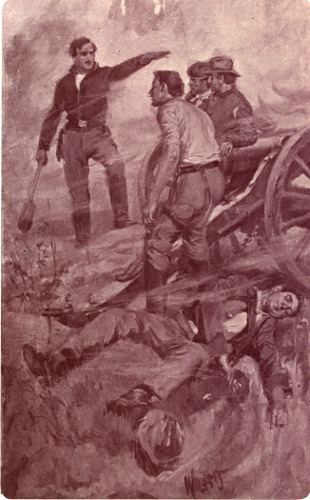
"'If any man flunks—I'll brain him'"
A slouchy-looking personage had been standing by all the while. At the end of it all he demanded Baillie Pegram's name and rank, and the name of his battery. That evening Baillie Pegram's captain sent for him, and said:
"I am going to make you my sergeant-major. I have General Jackson's request to recognise your good conduct under his eye to-day. Even without his suggestion I should wish to have you with me as my staff sergeant. I have kept that post open until now, in order that I might choose the best man for it."
It should be explained that the rank of sergeant-major is the very highest non-commissioned rank known to military life. Ordinarily, the sergeant-major is a regimental non-commissioned officer. But following the French system, the Confederate regulations allowed every battery of field-artillery a sergeant-major, if its captain so desired. He outranked all other non-commissioned officers, and usually exercised a lieutenant's command in battle—always if any commissioned officer were absent or disabled.
Thus it came about that Sergeant-Major Baillie Pegram was too busy on that morning to look up acquaintances among the spectators gathered there. He had orders to execute, and details of many kinds to look after, including the making out of that morning report which every company in the service must daily render, and upon which the commanding general must rely for information as to the exact number of fighting men he has available for duty.
Baillie had just completed this task, when some one brought him news that a lady in a carriage near by wished to speak with him. Having nothing now to do, he responded to the call, and found Agatha Ronald awaiting him. She sat in her carriage alone. In her lap was a work-basket, fully equipped for that mending which these women always came prepared to do when soldiers were passing by. Baillie had no mending to be done, but Agatha bade him remove his jacket and deliver it into her charge.
"We've heard what happened in the Valley the other day," she said, "and it is not seemly for a sergeant-major to be on duty without the insignia of his rank. Red is the artillery colour, I believe, and your marks are three chevrons, with three arches connecting them, are they not? Fortunately, I brought a roll of red braid. So let me have your coat, please, and I'll readjust your costume to your rank."
Agatha spoke glibly, but it was under manifest constraint. She forced and feigned a lightness of mood which she did not feel, and her manner deceived Baillie Pegram completely, as it was meant to do.
"What a fool I am," he thought, "to expect anything else. She was embarrassed when I last saw her, and worried, but that was all on account of her aunts. She is her own mistress to-day, and—well, it is better so. There'll be a fight to-morrow, and that's fortunate."
At that point the girl interrupted his meditations by saying, in her assumed tone of lightness, which he so greatly misinterpreted:
"I know there is war between your house and mine, but I'm going to give aid and comfort to the enemy, if it comforts you to have your chevrons properly sewed on."
"There can surely be no war between me and thee," he answered, with earnestness in his tone. "At any rate, I do not make war upon a woman, and least of all—"
"You must not misunderstand, Mr. Pegram," the girl broke in, looking at him earnestly out of her great brown eyes. "I esteem you highly, and I am sorry there is trouble between your house and mine. But I am not disloyal to the memory of my father. You must never think that. It is only that you are a gentleman who has been kind to me, and a soldier whom I honour. But the war endures between your house and mine."
Had she slapped him in the face with her open palm, she could not have hurt his pride more deeply. He snatched his jacket from her hand. Only one sleeve was finished, and the needle still hung from it by a thread.
"I'll wear it so," he said. "I, at any rate, have no house. I am the last of my race, and let me say to you now—for I shall never see you again of my own free will—that the war between our houses will completely end when I receive my discharge from life."
Then a new thought struck him.
"It is not for Baillie Pegram, the master of Warlock, that you have done this," touching the braided sleeve, "but for Baillie Pegram, the soldier on his way to battle. Let it be so."
Stung by his own words, and controlled by an impulse akin to that which had seized him at the gun two days before, he reached out and plucked from her headgear the red feather that she wore there, saying:
"Here! fasten that in my hat. I've a mind to wear it in battle to-morrow. Then I'll send it back to you."
What demon of the perverse had prompted him to this action, he did not know, but the girl in her turn seemed subject to its will. Instead of resenting what he had done, she took the feather and with some quickly plied stitches fastened it securely to his already soiled and worn slouch hat. Then handing it back to him, she said:
"Good-bye. God grant that when the feather comes back to me, it be not stained to a deeper red than now."
At that moment the bugle blew. Baillie touched his hat, bowed low, and said:
"At least you are a courteous enemy."
"And a generous one?" she asked.
But he did not answer the implied question.
When he had gone, Agatha bent low over her work-basket, as if in search of something that she could not find. If two little tear-drops slipped from between her eyelids, nobody caught sight of them.
Presently another bugle blew, and as Baillie Pegram's battery took up the march, the guns and men of Captain Skinner took its place. But this time there was no mingling of the men with the spectators. Captain Skinner was too rigid a disciplinarian to permit that, and he knew his ruffians too well. The moment the battery halted, the sergeant of the guard posted his sentries, and the men remained within the battery lines.
Seeing this, Agatha tripped from her carriage, and, work-basket in hand, started to enter the battery. She was instantly halted by a sentry, whose appearance did not tempt her to dispute his authority. She therefore simply said to him, "Call your sergeant of the guard, please." To the sergeant, when he came, she said, "Will you please report to Captain Skinner that Miss Agatha Ronald, of Willoughby, asks leave to enter the battery lines, in order to do such mending for the men as may be needed?"
But it was not necessary for the sergeant to deliver his message, for Captain Skinner, way-worn and dusty, at that moment presented himself, and greeted the visitor.
"It is very gracious of you," he said, "but, my dear young lady, my men do not belong to that class with which alone you are acquainted. You had better not visit my camp."
"Your men are soldiers, sir," she said, "and their needs may be quite as great as those of any others. We are not living in drawing-rooms just now. I crave your permission to enter the battery."
The captain touched his hat again, signed to the sentry to let the young woman pass, and then, turning to the sergeant of the guard, said:
"Post ten extra sentinels among the guns, with orders to arrest instantly any man who utters an oath or in any other way offends this young lady's ears. See to it yourself that this order is obeyed to the letter."