XXXIII
Reading edition
Under red leaves
Agatha's note, coming after her curt message, was a sore puzzle to its recipient. One might interpret it to mean anything or nothing. It was courteous enough, but its courtesy was colourless and cold. It was such a note as might have been addressed to the veriest stranger. There was nothing in it to reassure the master of Warlock as to Agatha's view of his conduct, nothing to allay his fear that she had resented his inquiries as an impertinence. On the contrary, if that were the meaning of the former silence and of the morning's message, this note was precisely such as a sensitively self-respecting young woman might have written when compelled by his persistence to write to him at all.
It was a very bad quarter of an hour with him, during which he read the missive a dozen times, unable to make out what it meant.
But Baillie Pegram was not a man to despair until he must, or to rest under a painful uncertainty. It was his habit of mind to meet dangers and difficulties half-way, and question them insistently concerning their extent. He called Sam, therefore, and bade him bring the easy-going pacer which he had begun to ride for exercise, and mounting the animal he set off at a gentle gait toward The Forest.
He appeared there half an hour before the four o'clock dinner was announced, and his welcome by his hostesses, Miss Blair and her sister, was all the warmer for the reason that his arrival indicated, more surely than any message from Warlock could have done, the extent of his convalescence.
Perhaps he was welcome also on another account. For the Misses Blair were deeply concerned about Agatha, and they hoped that he might persuade her, as they had failed to do, to give up her plan of going to Richmond and seeking service as a hospital nurse or in some other capacity in which a woman might employ herself. They were deeply concerned as to the matter of nursing for the reason that it was deemed highly improper in Virginia for any but married women to nurse in the military hospitals, where the patients, of course, were men.
Agatha had told them as little as possible of her affairs. She had said nothing whatever of her quarrel with her aunts, only telling them that she had left The Oaks finally, and asking them to send thither for such personal belongings as she had there, so that she might remain overnight at The Forest, and go to Richmond on the morrow. The younger Miss Blair had volunteered to go in person on this errand, and from her the ladies at The Oaks had first learned that Agatha had finally quitted the place in her resentment. They were greatly distressed, and immediately ordered their carriage and drove to The Forest, where Baillie Pegram found them on his arrival.
Their pleadings with Agatha had been earnest, insistent, and wholly fruitless. She had manifested no anger, and they had discovered no resentment in her voice as she replied to them. She had made no complaints and uttered no reproaches. To all their pleadings she had answered, simply:
"I have quite decided upon my course. I shall not change my plans."
The good dames were in such despair that they even welcomed Baillie's coming.
"We have done everything, said everything," they hastily explained to him; "why, we have almost apologised to the child, and all to no purpose. Perhaps you can have some influence, Captain Pegram. Will you not speak to her?"
"I shall speak to her, of course," was his reply. "I am here indeed for that express purpose. But I shall certainly not try to dissuade her from any course that she may desire to pursue. That would be an impertinence of which I am incapable."
The Oaks ladies flushed as he spoke the word "impertinence," remembering their own recent use of the term in connection with his conduct. Perhaps Agatha had told him of that in her letter, they thought. If so it would be most embarrassing for them to dine in his company and hers. So, pleading their great agitation of mind as their excuse, they returned at once to The Oaks, leaving Baillie and Agatha as the only guests of the Misses Blair at dinner.
When left alone with the young woman after dinner, the master of Warlock opened the conversation as promptly as it was his custom to open fire when the proper moment had come.
"Agatha," he began, as the two stood in the piazza in the glow of the early setting sun and in the midst of the blood-red Virginia creepers that embowered the place, "Agatha, do you remember the words I spoke to you on the picket-line at Fairfax Court-house?" Then without waiting for her reply, he continued: "I have come to you now to say those words over again, at a more fitting time and in a more appropriate place. I love you. I have loved you ever since those days in Richmond, those precious days when I first began to know you for what you are. I loved you all through that cruel time when, in obedience to what you believed was your duty, you decreed that there should be 'war between me and thee.' And now after all that you have done and dared for me, my love for a nature so pure, so noble, so heroic, passes understanding. I have a right to tell you this now. Tell me in return, if it displeases you?"
With that absolute truthfulness which was the basis of her nature, Agatha replied as frankly as he had spoken.
"It pleases me," she said. "I had not expected this. I thought I had repulsed you so rudely that—oh! Baillie, you will never know."
In a torrent of tears that were a more welcome answer than any words could have been, she buried her face in her hands.
Half an hour later these two sat by a crackling fire, arranging practical affairs.
"You do not wish to go back to The Oaks, then, even for a few weeks, and to save appearances?"
"No, Baillie, I cannot. I should have to act a lie every hour of my stay there. I should be obliged to pretend friendship for my aunts when I feel nothing of the kind. They have insulted the memory of my grandfather, and they have spoken of you in a way that never so long as I live will I let any human being speak of you without resenting it. I do not care to 'save appearances,' as you put it. Appearances may look out for themselves. 'Saving appearances' is only a sneaking way of lying. No. I will go to some friends in Richmond, if they will let me—"
"Why not go to Warlock?" he asked.
"Why, that would outrage the proprieties beyond forgiveness now that we—well, under the circumstances."
So Mistress Agatha did "care for appearances" and conventions after all. But Baillie did not think of that.
"Why not go there as the mistress of Warlock—as my wife?" he asked. "Why should we not be married to-morrow at Christ-Church-in-the-Woods? I am a soldier. I shall be strong enough to return to duty presently. When I do so I shall want to feel that you are safe at Warlock, that you are mine, my wife to cherish while I live. Say that it shall be so, Agatha! Let me send word to Mr. Berkeley, the rector, to-night, that we shall be at the church at noon to-morrow!"
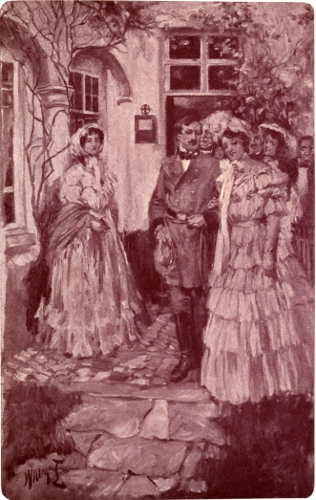
"'At Christ-church-in-the-wood'"
The girl thought for a moment, and then said:
"Yes, that will be best. For then, if you fall ill or are wounded again, I shall have a right to go to you and care for you. Let it be so. Now you must not ride to Warlock on horseback to-night. It is very cool, and you have already overtaxed your strength. I shall ask Miss Blair to send you over in her carriage."
When he had gone Agatha announced the news to her hostesses and straightway set about writing a score of little notes to be despatched by negro messengers early in the morning, to her friends in the neighbourhood. To her aunts she wrote simply, and without formal address of any kind, the bare statement:
"Captain Baillie Pegram and I are to be married to-morrow, Thursday, at noon, at Christ-Church-in-the-Woods."
This note she sent before going to bed. When it was received at The Oaks, a conversation ensued which was largely ejaculatory:
"How shocking!"
"Yes, and how scandalous!"
"What will people say!"
"The girl must be bewitched!"
"And yet it is better than nursing soldiers, and she an unmarried woman!"
"Perhaps. At any rate it is clear that we can exercise no restraint over the poor, headstrong child."
"No, Captain Pegram has completely undermined our influence. Of course we cannot lend our countenance to the affair by attending!"
"I think we must. Otherwise people will talk. They might even call it a runaway match."
"That would be too dreadful!"
"Yes. I think we must put the best face we can on the affair by attending. In these war-times everything is topsyturvy. Ah, me! What a pity we couldn't have had the child's bringing-up to ourselves!"
"Yes, we should have made a very different woman of her. Anyhow, with this marriage all our responsibility for her will be at an end. And after all, perhaps it is as well to have it so, for if she had remained single there is no knowing at what moment she would have done something else as scandalous as her going North to nurse Mr. Pegram was."
And so they cackled for half the night.