Part III (continued 2)
Reading edition
Sir Giles, however, had hit on an idea which had some reason at the back of it. The far western border of the land was some half-day’s ride away and the country beyond, though no one knew anything definite about it, had a very unsavoury reputation. It was generally considered to be the part where the dragons and caitiffs and others had gone during the past few centuries, and he considered it probable that Mother Meldrum and Golithos had selected it as a suitable spot for their future home; therefore he had taken his squire and ten picked men and gone there at full speed. The idea, as I have said, was on the whole a good one. The one reason against its being a successful one was that Mother Meldrum and Golithos had gone in the opposite direction.
While King Kul was discussing the situation and making suggestions, King Merse rushed off with Gorbo and collected his men, and Vanderdecken joined them with his immediately afterwards. But they, like the others, had little notion of which would be the best direction to take until Gorbo gave them a second shock by making a really practical suggestion.
While the men were formed up and waiting for orders, with King Merse and Vanderdecken at their wits’ end to know what orders to give, Gorbo suddenly ran off and peered between the legs of some citizens who formed a little crowd near the ancient Cloth Hall. The citizens were looking at a cat of exceeding bigness and blackness which was engaged with a bone. There were none present who had visited Mother Meldrum professionally so no one recognized this as one of her cats; they were merely wondering at its appearance, the cats of Banrive being as a rule small and either fawn colour or grey with stripes.
Gorbo acted with a promptness inspired by his grief and his knowledge that time was flying. He rushed to a fish stall and demanded a pound of sprats on the King’s affairs and a straw-bag to put them in. He returned and, pushing his way through the crowd, offered the animal a sprat. It took it with a fierce growl and ate it, and then looked up hopefully for more. Gorbo did not give it another yet but patted and stroked it instead, allowing it to sniff at the bag.
“Did ums old cats want um sprats?” he said soothingly. “Then um good old cats must work for um sprats.”
The animal, though evidently intelligent above its kind, could not of course wholly understand. It got easily as far as understanding that this small man (whom it remembered seeing before) was one who had control of fish in a bag, and he set up a roaring purr and rubbed hard against him in the hope that he would do the decent thing and give him another.
Gorbo held out another sprat and walked backwards towards his brother Snergs, the cat following.
“See!” he said to King Merse; “one of Mother Meldrum’s cats! Perhaps it can lead us to her.”
King Merse stared at him in wonder at his penetration. Vanderdecken smote Gorbo on the shoulder. “This man of yours is improving,” he said. “We can but try it.”
“We will,” said the King. “Go ahead, Gorbo, with your cat, and we will follow some way behind.”
The inhabitants were ordered to clear the road and Gorbo, after giving a third sprat for encouragement, walked towards the town-gate. The cat followed him, chewing and growling. On arriving at a clear space beyond the walls Gorbo urged it by gestures to take the road. After a few moments it looked about and sniffed the ground; went on a bit and sniffed again. Gorbo looked on anxiously.
“Home to mother then!” he said, holding up his bag. “Home to other old black cats.”
The animal turned and looked at him and then, giving a terrific wail, started off at a trot. Gorbo followed and the cat, merely stopping an instant to make sure that the bag of fish was coming close behind, went on down a narrow trail that led to some woods.
It went steadily on and Gorbo trotted steadily behind it. And a quarter of a mile or so behind them came the soft padding footsteps of the Snergs and the clumping of the Dutchmen’s sea-boots as they followed at the double.
The Reform of Golithos
As Gorbo appeared in the open space beyond the trees, Mother Meldrum shook her fist fiercely at Golithos to encourage him, and for an instant had her attention taken away from the children. But this instant was enough for Joe, who had been working his hands loose from the rope (he had learned rope tricks in his circus life), and who now had them free. He quickly untied Sylvia’s hands and then very gently helped her to her feet. “Run,” he whispered close to her ear. And with a bound they were off, Joe holding her hand with a tight grip and hauling her along through the trees.
They heard a savage yell from behind them; but they were out in the open and running up to Gorbo, who sprang forward to meet them with a shout.
“Hide in the trees!” screamed Joe. “There’s Golithos coming!”
Gorbo jumped and looked quickly round. Then in an instant he sprang with them into the shade of the trees on the other side of the open space. He gave a little sound of wonder and joy, something like a sob, and then faced round, again with his bow held ready. “Lie down and hide,” he said, without turning his head.
“But there’s Golithos there!” wailed Sylvia. “Let’s run, Gorbo!”
“Not me,” said Gorbo. “Just lie quiet.”
There was a dead silence for a time. Then they heard the voice of Golithos hailing from the opposite side of the open spot.
“Is that you, Gorbo?” he called.
“It’s me,” replied Gorbo.
“Look here,” went on the voice, “you go away and I’ll let you keep the little ones. There!”
“Thanks,” said Gorbo.
“Oh, but do be reasonable. Let’s talk it over quietly; it’s no good being unfriendly. Just come out in the open and we’ll talk it over.”
“All right,” said Gorbo. “You come too.” He walked to the edge of the trees and stood looking across at the other side.
“But I can’t see you,” said Golithos. “You must really show some confidence in me, and then I’ll come.”
“Will this suit you?” Gorbo walked out some half-dozen steps.
“Yes, that’s better, Gorbo. You see I don’t want to harm you.” (From their hiding-place the children could hear him blundering through the bushes and twigs.) “I’ve always rather liked you and if we can just talk over matters——”
With a rush and roar he sprang out, his mighty axe swung up high.
Whang.
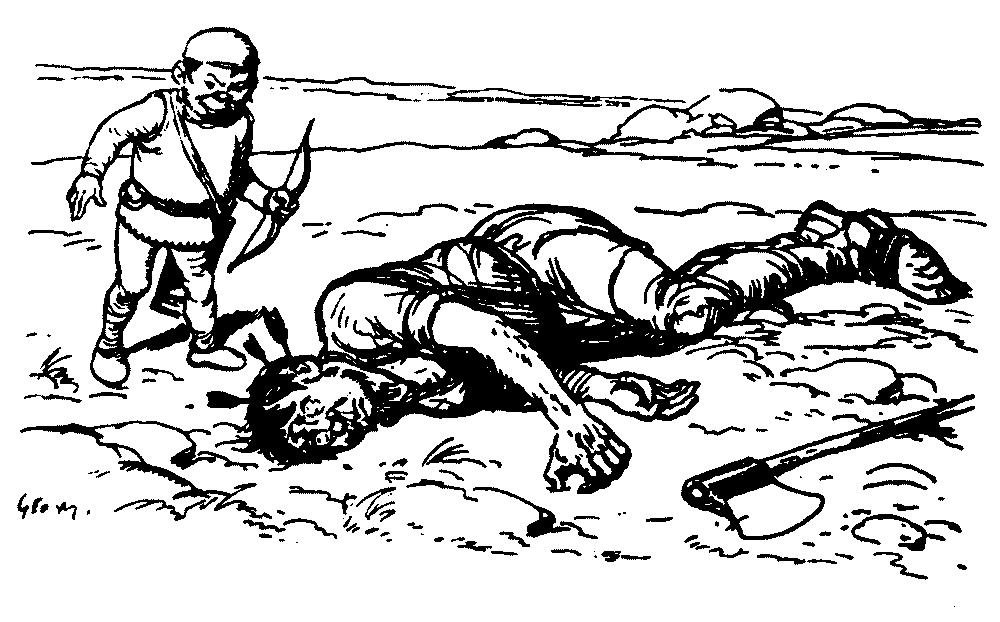
Golithos stopped his rush within six feet of Gorbo and stood swaying. His axe fell crashing to the ground.
Whang—Whang.
Golithos toppled and fell headlong with a thump that shook the ground. Three arrows stuck out from behind his head.
Mother Meldrum goes
The children flung themselves at Gorbo and hugged him, and Sylvia was shaking with sobs. He squeezed them to him for just one instant and then jumped away. “Where’s Mother Meldrum?” he said quickly.
“She’s in there,” replied Joe, pointing across.
Gorbo crept up cautiously, looking about him as he went. Suddenly he gave an exclamation. “Look!” he cried, pointing to the opposite side of the ravine.
The old witch was climbing, climbing up the rocks, and behind her came the black cats. Gorbo rushed to the edge of the ravine and shot. The arrow fell short. He shot again and again, but it was useless; the distance was too great for a bow. And Mother Meldrum climbed and climbed, with an agility and strength that appeared miraculous.
Gorbo turned again, for there was a mighty trampling behind him. Up came the Snergs and the Dutch seamen, headed by their leaders. The children and fallen body of Golithos took but an instant of their attention for Gorbo shouted that Mother Meldrum was escaping.
The Snergs ranged along the edge of the ravine and shot thick and fast so that the air was full of arrows, but the old witch was well out of range and she knew it. She had reached a flat part near the summit of the cliff, and the tunnel that led through the barren rocks was close at hand. With a shrill screaming laugh that sounded horridly across the ravine she danced a fantastic dance of triumph, something between an Irish jig and a coranto. O hideous sight!
But little did this hag of mediæval days know of the strides of science. The voice of Vanderdecken (who had so wisely trained his seamen in the part) rang out:
“Musketeers, advance! Handle your muskets! Cock your muskets! Aim your muskets! Fire! Recover your muskets!”
At the word “Fire,” three-and-thirty shots shook the air and echoed from the rocky crags. A dark cloud of smoke hung over the scene.
The smoke drifted away.
“Where,” said King Merse, “is Mother Meldrum?”
Vanderdecken handed him his telescope. “There is something like bits of rags sticking on the rocks,” he said. “And I think I can see a hand hanging over the edge of the cliff. See what you can make of it.”
“Yes,” agreed King Merse as he looked, “it is undoubtedly as you say. That is Mother Meldrum—or part of her.”
Thus it was. When three-and-thirty muskets of the kind made in Vanderdecken’s day, loaded with double bullets and a half handful of buckshot, are fired simultaneously by expert marksmen at the same target the result is effective. Mother Meldrum had been blown to bits.
All Troubles Over
There was a good deal of ringing of bells at Banrive when the joyous band of Snergs and Dutchmen arrived with the children safe and sound, and it was known that Golithos and Mother Meldrum had passed away.
The ass had been found trying to rub its load off against a tree, and the Snergs had untied the bundles and selected whatever there was of value in them and thrown the rest away. Then they put Joe and Sylvia on the ass and started back, singing sea chanties which the Dutchmen had taught them. Sylvia soon got over the worst of her shock, and though she was a good deal worried about the crumpled and dirty state of her pretty new dress, she was able in time to join modestly in the chorus. Joe did not have so much shock to get over because he was the sort that does not trouble about troubles that are past and he sang lustily.
Gorbo was given the place of honour in front and he came along with a light step although he was carrying Golithos’ enormous axe, which was his according to the rules of war. He was the subject of a good deal of jovial badinage on account of the cat Gubbins, which had not gone to join its brother cats (now doubtless great hunters in the land of barren rocks) but had attached itself to him. It may have been that it liked Gorbo’s cast of countenance or it may have been that it considered a man with a bag of fish something to stay by, but I leave this for naturalists to decide; all I know is that it went ahead of him, with its tail well up, stepping rather in the manner of goats belonging to certain British regiments.
King Kul embraced the children, almost with tears, and with his own hands gave Sylvia the puppy, which had been wandering disconsolately about looking for them. He made a speech thanking the Snergs and the seamen for their great service in his dominions. When King Merse told him that Gorbo had slain Golithos single-handed he merely said, “Indeed? And very creditable of him—considering.” He could never quite overcome his dislike of Gorbo.
But nobler feelings prevailed. He went to his privy-chambers and rummaged in a little chest of drawers. Returning to the hall he bade Gorbo approach and kneel.
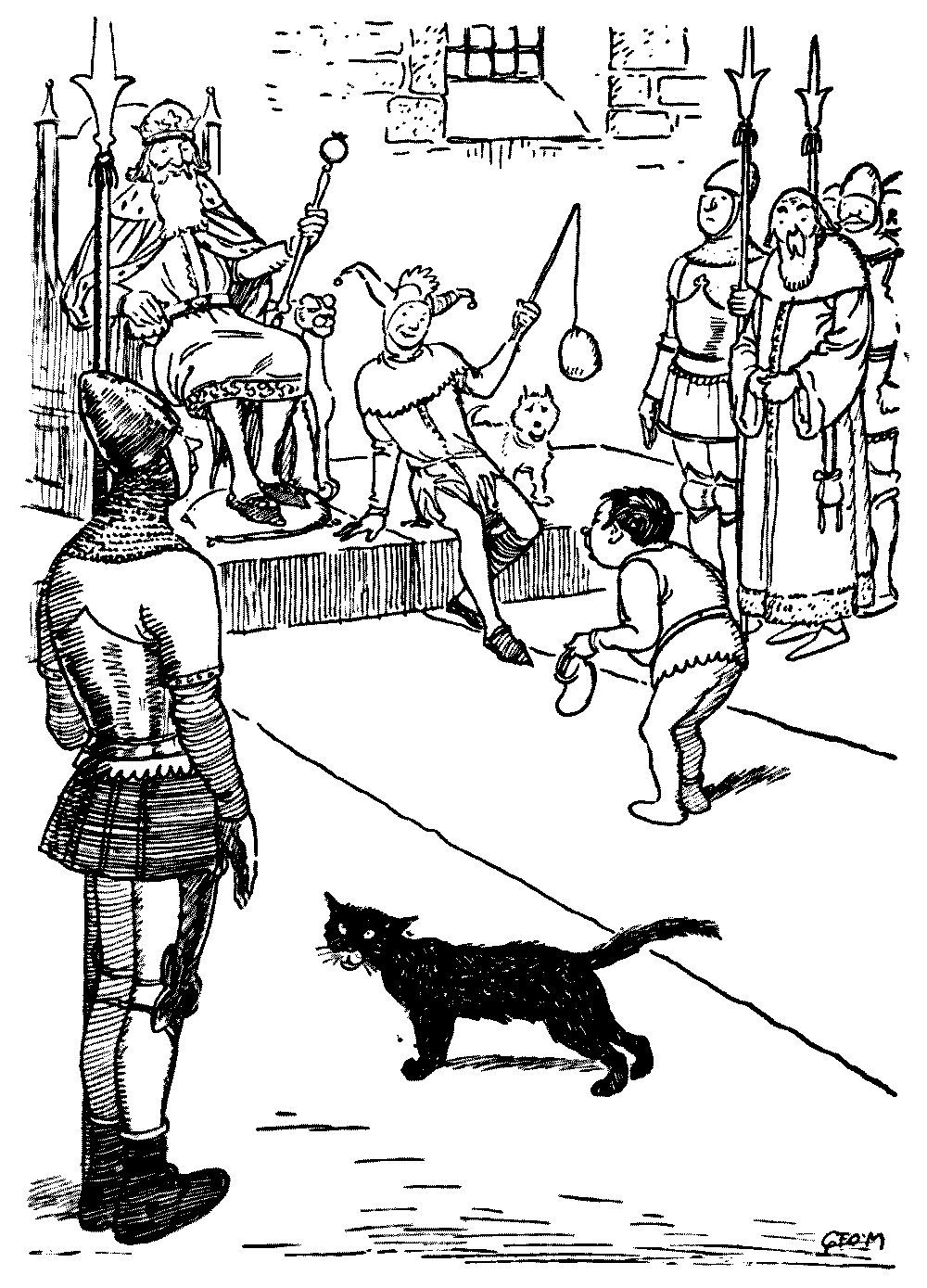
“By this,” he said, placing round his neck a cherry-coloured ribbon with a medallion, “I make you a Companion of the Order of Errant Tinkers. See that you wear it worthily.”
Amid a murmur of applause the blushing Gorbo rose and thanked him gratefully and retired backwards. He was filled with a pride and joy that left him dizzy. At last it was officially recognized that he had escaped from the reproach of being the biggest fool of the race of Snergs. Sylvia and Joe ran to him and demanded to see. The medallion was a tasteful thing, representing a man in full armour mending a saucepan (Sir Bors, a tinker knighted on the field of battle). The order was an ancient one and Gorbo had full reason to be proud. It carried with it the freedom of the City and the right to remove his boots (if they hurt him) in the presence of the King.
The Lady Ermyntrude took charge of the children and told them to change into their Watkyns Bay uniforms (which had been washed and ironed) while their new clothes were sent to the dry cleaners. These were expeditious people and they promised to have them restored to their original beauty by noon on the following day; to the great joy of Sylvia, who loved her dress with the golden bees.
It was a happy time for all. Sir Giles returned in a very peevish frame of mind at the ill-success of his journey, but when he heard that the children had been brought safely back he came clashing in and embraced them with ardour. He said that perchance now they would let him look forward to a good night’s rest. He changed from his travel-stained armour into a suit of murrey-coloured velvet in which he looked rather well, and he sat with the Lady Ermyntrude behind some curtains and held her hand, in spite of her warnings that people would see. Baldry (who I fear will never learn) tried to promote the gaiety of courts by creeping behind him and smiting him on the head with his bladder stick; but he had to flee from the palace and hide for the rest of the day, since the King refused to grant him protection, saying: “Now perhaps you’ll think before acting.”
Back across the River
Another day passed and then, at an early hour, the homeward journey was begun. Cheerful farewells were exchanged and amid the shouts of the populace the Expeditionary Force passed out of the town-gate which they had entered with such doubtful anticipations a few days before, with Joe and Sylvia riding on small ponies (wearing their fancy clothes) and two sumpter-mules in the charge of responsible churls. One mule was laden with presents from King Kul for the royal house of Snerg and other presents for Miss Watkyns and her staff (including some curiously wrought silver cups and an antique carved unicorn’s horn suitable for a centre-piece), and the second mule bore two barrels of special wine for Vanderdecken.
King Kul promised to visit the Snergs if something in the way of a bridge could be made across the deep river, and Vanderdecken said he would give thought to the matter and devise a substantial swinging bridge that would not wobble too much.
They stayed for the night at the comfortable little castle of the Lord of the King’s Marches, who was at home when they arrived and who, they found, was an agreeable man though with a slight touch of pomposity, like his steward. He accepted apologies for their former invasion of his stronghold and occupation of his best beds, and was quite nice about it, telling them that he appreciated the urgency of the case and they were heartily welcome. He seemed on the whole rather relieved to find his job gone. Throughout a long life he had been (nominally) guarding the border against a chance attack of Snergs, and now they had proved to be a good-natured and friendly people and he might have just as well been attending to other matters. He said that in future he would devote his time to gardening, for which he had a passion.
They bade him farewell in the morning and in a few hours were on the precipitous cliff that overhung the river, where they were greeted with great joy by the band of Snergs who had been left there to prevent any interference with the rope. They had made a little fort with a trench round it and they had sentries posted in the proper way. King Merse gave them a word or two of soldierly praise.
Sylvia was sent across with Tiger in a large basket, which the seamen rigged up in the manner of life-saving devices, and arrived safely, though rather giddy and frightened owing to the terrific height over which she had passed. Joe declined to go in the basket and jerked himself across the rope at great speed, as did the Snergs and Dutchmen. The presents were then put in the basket and hauled across, and then came the two barrels of wine. Vanderdecken superintended the lashing up of these himself as he said he wasn’t going to take any silly risks with them. Gorbo swarmed over (amid cheers and laughter) with the cat clinging to his person, because they could not induce it to go in the basket.
Back to the Town
It was only a league or a bit more to the town, where the news had already arrived. As the children drew near they noticed three figures conspicuous for their height among the small Snergs. Miss Watkyns, together with the Misses Scadging and Gribblestone, had come on good steady bears on the previous day to meet them, and there they had heard for the first time of their terrible final adventure.
When they saw the children coming along in their beautiful costumes of a long bygone age, they burst into weeping. This, though something in accord with the character of two of these ladies, came rather as a surprise from Miss Watkyns, who loathed display of sentiment. But she did not weep much. With a stern word to the others to have done with sloppiness she asked both children whether they were, or were not, thoroughly ashamed of themselves. It occurred to both Sylvia and Joe at this point that perhaps they ought to be, and they said they were ashamed. I believe this to be true, though most of the feeling wore off in ten minutes.
It is almost unnecessary to say that this was the occasion for a feast, and it must be noted that Gorbo no longer sat in the suburbs but was only seven places down from the King. In addition to the Order of Errant Tinkers (regarded rather enviously by many present) a brazen nutmeg glittered upon his breast, for King Merse felt that he had fairly earned it.
Back to Watkyns Bay
It occurs to me here that there is some difficulty in proving a really useful moral from this tale, although I have almost boastfully referred to it as coming in due course for the instruction of my younger readers. For however reprehensible the children were in their disobedience and irresponsibility it cannot be denied that the general results of their conduct were beneficial. They were instrumental in bringing a swift finish to two persons who constituted a serious menace to the public. They had brought about the establishment of friendly relations between two countries, and removed doubts that had existed for centuries. Lastly, they had returned magnificently dressed and bearing expensive gifts. So perhaps the only definite moral that can be deduced is, if you by any chance meet an ogre who claims to be reformed, pretend to believe him until you have got a gun and then blow his head off at the first opportunity.
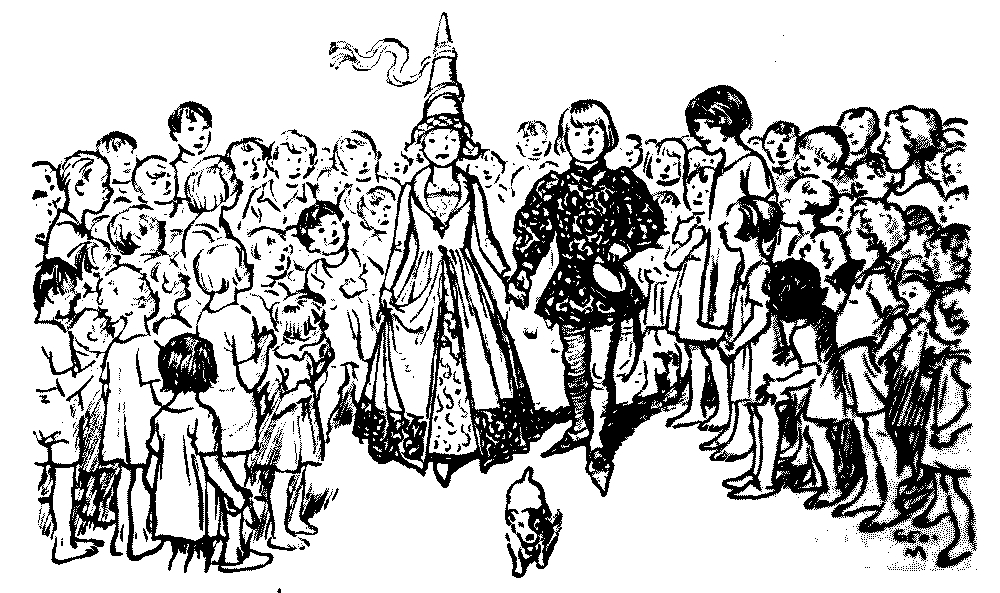
On their arrival at Watkyns Bay the other children crowded round Sylvia and Joe with cries of delight and admiration, for nothing more gorgeous had been seen even in a picture-book, and there was at this point some danger of the swollen-headedness which Miss Watkyns had dreaded. But she soon put it right by ordering them both to change into their plain but serviceable two-piece garments, and stating that the others should be kept for very special occasions, such as fancy-dress affairs. This, by the way, led to the institution of fancy-dress dances and caused a great deal of extra needlework and ironing.
Sylvia and Joe were very glad to get back to their little cots with the hop mattresses, and when at last they dropped off to sleep (very late, for there was a good deal of whispering because the other children wanted to hear more) lulled by the distant breaking of the sea and the light rubbing of cinnamon bears against the fence without, they felt very peaceful and happy and resolved to be really good for a reasonably long time.
To finish up
Vanderdecken set to work and made a neat swinging bridge, light but strong, across the deep river, and King Kul made a visit to the Snergs and spent two days at Watkyns Bay. He distributed the prizes at the term end, and made one of those speeches about even little children having their responsibilities. Invitations had been sent to Joe and Sylvia and six other children to attend the wedding of Sir Giles and Lady Ermyntrude, but Miss Watkyns thanked His Majesty deeply and said she thought it inadvisable for them to go, as tending to unsettle their minds. She sent a wedding-present of a dainty tortoise-shell toilet and manicure-set, and the bride wrote to her on a piece of parchment that she considered it the most charming of all her presents. It was really good; it had been bought in Bond Street, at an expensive shop. Baldry overdid it at last at the wedding and got seven days. He had buttered the steps of the palace hall.
Gorbo is passing the time quite nicely, occasionally doing a job of work but more often resting. Gubbins, the black cat, sticks close to him and travels with him everywhere. It has great ability for catching game, such as birds and young rabbits and the like, and has learned to retrieve quite well, so Gorbo has his hunting cat like the Egyptian kings of old. He goes now and then to visit at Banrive and see what new trouble Baldry has got into, and to pay his respects to the King. He never fails to say, “Oh, this corn of mine!” and pulls off one boot.
The door in the region of twisted trees and the one on the other side were built up with masonry. It was agreed that though Gorbo and the children found enormous supplies of mushrooms in the cavern, there was a nasty flavour of magic about the place and it was as well to leave it alone. I never heard what happened in the dark woods after Mother Meldrum had gone and the bats and other grisly things had it all to themselves, because no one, I believe, ever went there, which shows sense.
The knight Sir Percival gave up chivalrous doings on the day that he had the adventure at the castle. He did not slacken his anxious pace until he was back at his own little moated grange, and there he hung his armour and lance over the fireplace in the hall and decided to live quietly, and if he could not get a wife except by fighting for her, to go without. He went in for breeding a superior kind of pig and did rather well at it, taking several prizes.
Vanderdecken and his men make special efforts every now and then to clean up the old ship for her voyage home; but there is so much to do, what with weeds and barnacles and the gear having to be rove afresh and so forth, that they generally get tired of it after a short spell and say to the effect that it is no good overworking and it would be best to go for a day or two’s hunting with the Snergs. It is my belief that they never will go away. And there is no particular reason why they should; things are very well as they are.
There is little more to tell now. It is possible that Joe and Sylvia may be sent to England if suitable new parents can be found for them, this being the usual thing after some years with the Society (but not of course years in the ordinary way), but I don’t know if anything definite has been done in the matter. It is my opinion that Miss Watkyns will not let them go for a long time because they certainly keep the place lively. She tried to make them have a sense of responsibility by giving them charge of a new arrival, a little girl who was very thin and weepy, but the result was she became a riotous handful and broke a window for fun.
Tiger is doing well, though he had a touch of distemper last August. But nothing serious.
Lack of space prevents me from going into details of costs, etc., of the S.R.S.C., which is to be regretted as I am sure they would prove of absorbing interest to my more serious readers. I will therefore merely state that the Society is flourishing and on a sound financial basis, and that Miss Watkyns and the other ladies have an immense amount of work to do, which keeps them fit, sundry improvements of buildings and extensions having been put in hand at Watkyns Bay. The children go on happily year after year, slowly increasing in numbers as fresh cases arrive, and they splash about in the sea and play their various games and roam the woods and fleet the time carelessly as they did in the golden world.
Printed in Great Britain by The Edinburgh Press, 9 and 11 Young Street, Edinburgh