Part II
Reading edition
Trouble at Watkyns Bay
Bitter was the grief and deep the perplexity of Miss Watkyns and all the ladies when news came by other fleet messengers that Sylvia and Joe had disappeared again, and this time in a quite unaccountable way. A little while later King Merse II himself came to Watkyns Bay and explained how bands of responsible Snergs had been sent to explore everywhere and especially in the region of twisted trees, taking with them little sacks of lime to mark their trails, and how they had shouted and yelled until they were hoarse, but without avail, since no answer had come from anywhere, and they had returned home with sore hearts and sore throats. He tried to cheer them up by saying that the children would certainly be found in time, but he did not say anything about his real fear, which was that they had somehow got mixed up with one or other of the magic snares which, tradition had it, were very plentiful among the twisted trees. He quoted old sayings to comfort them, such as it is best not to meet trouble half-way, and that care killed the cat when there was really nothing amiss with the animal. He added that as Providence looked after fools there was cause for cheerful hopes, since Gorbo was the biggest fool even among the Snergs, who, though having many good qualities, are not celebrated for brain waves.
These kind efforts had some effect in restoring confidence and the ladies were able to discuss the matter with comparative calm. Miss Gribblestone had at first wondered whether by some untoward combination of chances the children had slipped back to the scene of their former life, and she drew a pathetic picture of Sylvia and Joe wandering about the streets of London with bare legs and only slinkers on their feet, and possibly starving, and she suggested the advisability of her instant departure for London with a bundle of warm underthings and two woolly coats. Miss Watkyns reproved her with some sharpness, pointing out the impossibility of such a thing: leaving out fifty other reasons the moon was only a quarter full and the air currents would be in opposition, and this alone made the suggestion absurd. Miss Scadging advanced an even wilder theory that the children had suffered such mental anguish from the reproof and punishment given that they had wandered away and died of broken hearts, and at this Miss Watkyns begged her to consider the extravagance of such a suggestion applied to either Sylvia or Joe and to give her energies to a more practical solution of the problem.
When the rest of the children heard the news they were slightly awe-struck but not immoderately grieved, for their experience of Joe and Sylvia had led them to believe they were capable of coming safely out of any trouble, and the general opinion was that they were having a continuation of their surprising and interesting adventures somewhere and would return in due time, full of glory and slightly swollen headed. Poor things, they knew little of the harsh, real world; they had forgotten what happened to them in the past; as has been said, the air of the place was grand for forgetting.
The King next went over to see Vanderdecken and had a long conference with him, and then returned across the forest with his retinue. He had left word with Miss Watkyns that he and a band of picked men would leave next day on an expedition, but for the present he preferred not to say where to, in order to avoid raising either fears or hopes. On his arrival at the town he made a short speech, and then personally superintended preparations. Swords and axes were sharpened, quivers were stuffed with arrows, steel casques had old dents knocked out, cuirasses had the buckles put in order, provisions were packed into little wallets. The air smelt of war, as in the brave days of old.
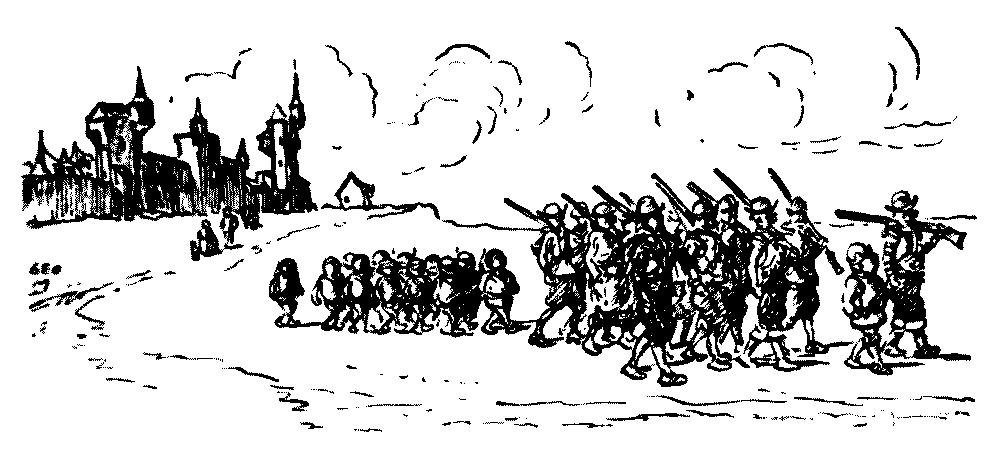
Miss Watkyns, pacing with knitted brow on her verandah, was disturbed by the sound of shrieks and expletives. Looking up in anger, she saw Vanderdecken and all his men coming up the path, the foremost seaman bearing the parrot’s cage—this accounting for the noise, for the bird was enraged. All had their sea-boots on, and they bore muskets, powder-horns, pouches with slugs and bullets, cutlasses and snickersnees; each man had also a bag containing pickled beef, biscuits, a cake of tobacco, and a small bottle of Schnapps. Vanderdecken said that they were going away for an indefinite period and asked Miss Watkyns if she would kindly give an eye to the camp in their absence and see that things were aired occasionally and the weeds kept down in the garden. Also, if it was not too much trouble, would she see to it that the Snergs did at least half an hour’s pumping of the old ship every morning and evening. He then handed over the parrot with a request that it be supplied with nuts and fruit, and a bit of sulphur in its water to prevent it getting scaly feet, and begged her to pardon any of its verbal lapses. She agreed readily to these requests, and they departed across the forest and joined King Merse and his men on the following morning. An hour later they were all trooping together over the hillside beyond the town.
Beyond the Door
While Gorbo was battering himself against the heavy little door, which had closed so gently and firmly as if pushed to from without, Sylvia clung to Joe and hid her face and trembled. Joe held her tight without speaking; he, too, tough and adventurous as he was, had received a shock.
Gorbo turned round at last, and in the faint light that came from somewhere below they could see a badly scared look on his face, and it was all twisted as if he were going to cry. He was thinking of the horrid mess he had got the little ones into.
“I’ve done it this time,” he said. “So the old woman was right after all.”
“Which old woman?” asked Joe.
“An old woman who told my mother that she would only have one son and that he would be the biggest fool among the Snergs.”
“Then it isn’t your fault,” said Joe, to comfort him. “If it was all settled before you were born.”
“That’s so!” exclaimed Gorbo. “I must be a fool not to think of that before. But then if I had thought of it,” he added mournfully, “I wouldn’t be a fool and the old woman would have been wrong; so it works out all right.”
“But you’re sometimes quite sensible,” said Joe. “Isn’t he, Sylvia?”
“Y—y—yes,” agreed Sylvia. “But I wish we could get out.”
“It seems to me,” said Gorbo, “—not that I am much of a man to listen to—that we should see what we can see down these steps.”
“Well, we can’t stay here for ever,” said Joe, “so let’s go.”
“I’ll go ahead,” said Gorbo. “If there are any fierce things that bite below, they can have first bite at me and serve me right.”
With this cheerful remark he started off. Joe went next and Sylvia came close behind him. The way was very narrow and so low that their heads nearly touched the roof, small as they were. And they went down and down and down, and the more they went down the lighter it got with a sickly yellowish-green light that seemed to come from a little growth on the walls, like fungus. There was absolutely nothing to see but steps and walls, very neatly cut out of solid rock. It must have been an awful job for those who did all this work, whoever they were.
“Do you think these steps go on for ever and ever?” asked Joe after a time.
“No,” replied Gorbo, stopping suddenly. “They’ve come to an end.” He was standing in a little flat place, from which five narrow passages branched out like the fingers of a hand. The question of which passage to take was indeed a hard one.
“We’d better start with the first one,” said Gorbo. “Then if it’s a wrong one we’ll try the next, and so on.”
“But suppose we go miles and miles before we find it’s a wrong one,” objected Joe. “We’d be hours over it, wouldn’t we?”
Gorbo scratched his head. “That sounds sound,” he observed.
“I know!” cried Joe. “We’ll see which one is ‘out.’ Let Sylvia try. She knows all the out poems.”
“All right.” Sylvia began to take great interest in the matter now. “Which one shall I try it with?”
“Try the cat one,” suggested Joe, after consideration.
So Sylvia pointed her finger at the little tunnels one after the other and repeated:
“If you want to stroke a cat Lay it flat upon a mat. Hold it firmly by the tail Smack it if it starts to wail. If it starts to spit and shout Pick it up and throw it out.”
She stopped with her finger pointing at the fourth tunnel and she looked excitedly at the others, because it was becoming like a game.
“Here we go,” said Gorbo, making his way into the fourth tunnel.
They went on and on and on along the tunnel, and just at the exact moment when they agreed that it would never have any end, they fetched up against a blank wall. But on either side was a passage going at right angles, and the question was of course, which was the right one to take?
Sylvia repeated her little mystic rhyme, and “out” was the left-hand turning, so they went along it. After a dozen steps it turned to the right, and a little further on to the left; then it went straight on until it came to an end, with a smooth wall in front and on both sides. There was nothing for it but to go back and take the other turning. They wondered why the people who had done all this work had made this extra blind passage. Joe said they had done it to make it more interesting and adventurous. Sylvia said they had done it because they were pigs. Gorbo said it was merely because they were worse fools than he was and it quite cheered him up.
The other road soon began to turn gently to the left; then without rhyme or reason it turned gently to the right; then to the right and left alternately in very sharp turns. And just when they were convinced that it would go on turning idiotically for ever and ever they came suddenly into what appeared to be a mighty cavern, lighted by the same yellowish-green light of the tunnels, only more so, and full of monster mushrooms.
The Mushroom Cavern
When I say that the mushrooms were monsters, it hardly gives a correct idea of their size. Under the moderately small ones the three could stand upright, and the large ones were as high as a good-sized cottage and reached nearly to the roof of the cavern. The floor was hard and dry and perfectly flat, and the huge stalks of the mushrooms could be seen like a forest of giant skittles, going into the far distance on all sides. Above, the pink underneaths of those strange specimens showed like an unnecessarily large assortment of giant fancy umbrellas, opened. These, of course, accounted for the cheese-like smell that Gorbo had observed when he first put his head in the little door and sniffed. (It was not exactly like cheese, of course, but cheese is near enough.)
Gorbo showed himself a man of resource in a way. He said that, after all, mushrooms were mushrooms and good breakfast food, and that they might at least have a meal, whatever else happened afterwards. This cheered up Sylvia tremendously and she helped to gather heaps of dried stalks from the floor, and Gorbo got out his flint and steel from his bundle—he rarely went anywhere without his little bundle of tools and other matters and his bow and arrows—and soon had a fire going (to those who may object that mushroom stalks do not burn I have only to say that these did). With the aid of his useful trowel he provided an appetizing series of mushroom steaks, which they all enjoyed tremendously.
They found that the smaller ones were on the whole of a better flavour, and it was while they were searching for some tiny specimens, scarcely as high as a table, in order to cook some more, that they all got a sudden shock. They found that certain mushrooms had large semicircular pieces bitten out of them; the mouth that did it must have been a foot wide, with tremendous teeth. A very disturbing discovery you will say. They looked about them fearfully; and then they heard what sounded like heavy, shuffling footsteps, and a satisfied purring, as of a giant cat.
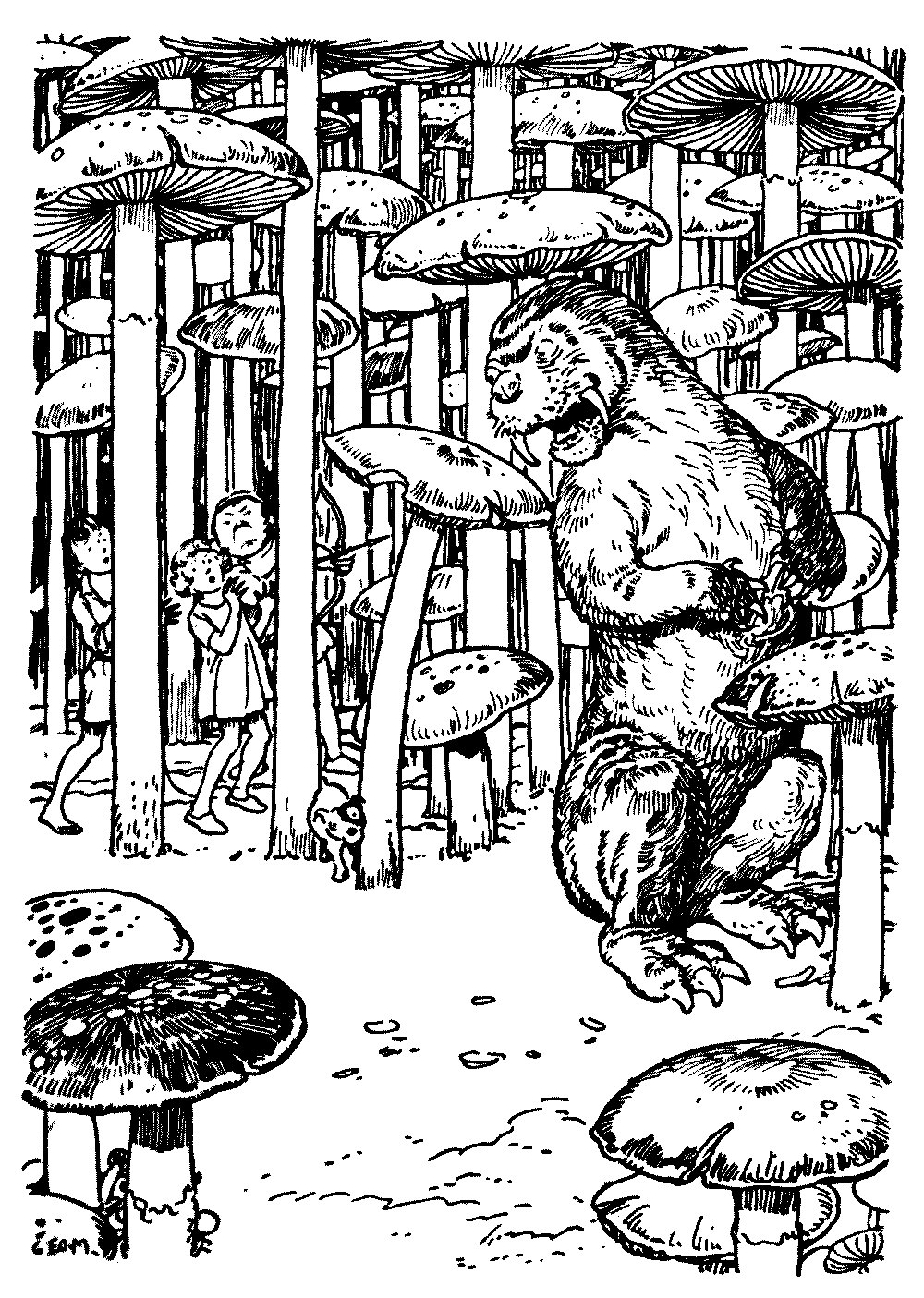
Gorbo put the children behind him in a hurry and fitted an arrow to his bow (the Snergs’ bows are on the small size, but they can send an arrow through a two-inch board at close range). Then to their horror appeared an animal that I can only describe as resembling a blonde four-footed walrus walking on its hind legs. It was covered with sleek, ginger-coloured hair, and it had goggling eyes, a mouth that corresponded closely with the estimate they had formed of it from the big bites, and a white drooping moustache. Strange to say, it was a marsupial—that is to say, it had a pouch—but no young ones were peeping out of the pouch as in the case of kangaroos and other marsupials. No, it seemed full of large chunks of mushroom, and the animal was walking upright because it was evidently the only way he could carry them in his pouch without tipping them out. He waddled clumsily up to one of the biggest mushrooms, sniffed at it, purred horribly with delight, bit a large section out of it, and bent his head carefully so as to place it in his pouch. And then Sylvia let out a loud scream.
I do not blame her; perhaps I should have screamed myself if I had been there. But the effect was marvellous. The animal turned its head smartly and stared at them, its fore-paws held up as if in fear and astonishment. The big mouth drooped, giving it a weak appearance; bits of mushroom dribbled from the corners. Then, with a sound like a roaring sob, the animal turned and scuttled away on all fours, scattering sections of mushroom from its pouch as it went.
The sounds of scuttling feet and sobs died away in the far distance and all was silent as before. Gorbo put his arrow back into his quiver. “There’s a cowardly custard for you,” he remarked, using an expression he had heard from the children. They went back to the fire and had some more breakfast, greatly relieved to find that the denizens of this strange part, so far as they could judge from this sample, were not ferocious ones.
Joe was apparently the bright one: he discovered that there was something like a path going more or less straight through the forest of monstrous fungi, and suggested that it would be a wise idea to follow it. They did so, walking on and on until they were weary of the sight of the thick white stalks, and a good long time afterwards. Strange, is it not, that here Nature should be so lavish of mushrooms, while in England they are so rare that hard-worked men are forced by their wives to rise from their beds before they have had their fill of sleep in order to gather a few poor specimens?
The path came to an end at a blank face of rock. They had reached the other side of the cavern. Sylvia repeated her little poem again, and “out” was to the left, so to the left they went. This time they did not go so very far before they were rewarded by the strange sight of a stone seat, and in front of it, a stone table, both very neatly carved.
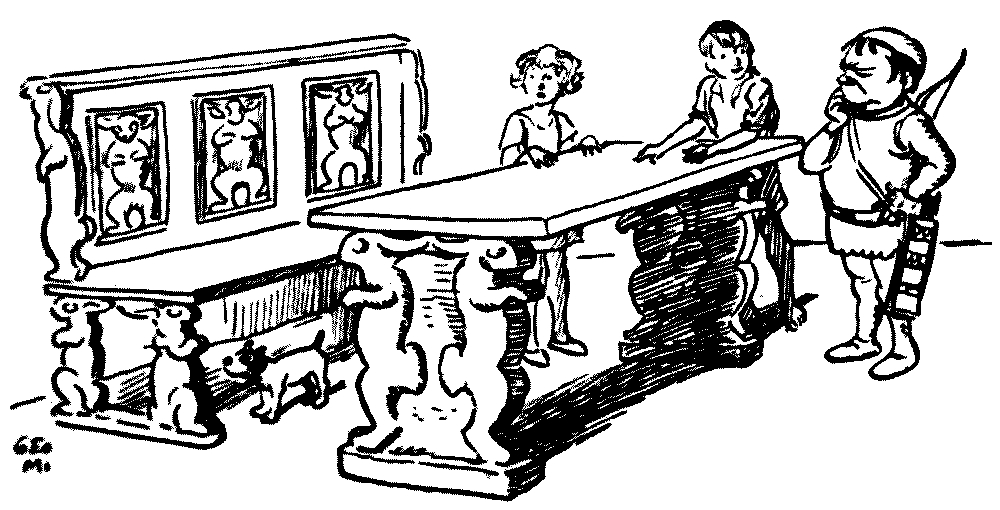
What was it doing here? What strange forgotten race had gone to the trouble of chopping a stone seat and table out of hard rock—and not only chopping them out but carving some strange figures on them and smoothing the legs down? They all looked carefully at the carvings; so far as they could judge they were intended to represent rabbits walking upright. Why?
“This cheers me up,” said Gorbo. “I can’t be the biggest fool. When I consider that people have gone to the length of making this difficult table and bench and carving rabbits on it for the sole purpose—apparently—of eating mushrooms in this dismal cavern, I feel that there is hope for me.”
“But we don’t think you’re a fool, Gorbo,” said Sylvia soothingly.
“No, Sylvia,” replied Gorbo with a sigh. “But you haven’t seen me at my best.”
“But there must be some way out close by here!” exclaimed Joe. “Of course they’d put this table near the coming-in place, wouldn’t they?”
“You’ve got it, Joe,” said Gorbo. “Unless the people who did it were much worse than me.”
Joe was right; at a very little distance away they found a tunnel. It was as narrow as the tunnel they had passed through on the other side and it was just as smooth, but it had this difference, that it sloped upwards, on a gentle slope. They went up it until they were sick and tired of the monotony, and at last they had to sit down, for Sylvia was getting very tired.
When they started off again Gorbo picked up Sylvia in his arms and carried her. “This beastly tunnel’s going on like this for about five miles,” he said, as he walked on with her. After about twenty steps he put her down again.
“We get fooled every time,” he observed bitterly. They had arrived at a little flat place, like a room. Two passages branched out from it, and there was a stone bench on either side, highly finished and each with what appeared to be a pig carved on it.
“Pigs, you see,” remarked Gorbo. “However, I suppose they couldn’t help it.”
Again Sylvia repeated the rhyme and they took the right-hand passage. It went winding about with bold curves for a long distance and then came to a sudden end, but this time, to their great joy, it ended in a small door, iron bound and rusty; like the one they had unfortunately found under the twisted trees. They raised a shout of joy, for surely their long strange journey was over—that is, the underground part of it.
Gorbo pushed at the door, but it did not move. Then he pushed harder. Then he put his shoulder to it and shoved with all his might. And still the door remained shut hard and fast.
“I’ll do it!” he cried. “Luckily there’s plenty of room for a run.” With that, he ran and hurled himself at the door with a mighty crash. And he might as well have flung himself against Westminster Abbey. He sat down and looked mournfully at the children and they looked mournfully back at him.
There seemed nothing for it but to try what the left-hand passage would show them. So they went back and followed it through devious twists and turns until it ended in a small bare chamber, on the walls of which were carved what was undoubtedly meant to represent goats. There was absolutely nothing else to see.
“Goats this time,” said Gorbo sourly. “Well, well, well! Yes, it’s clear to me that I’m not the worst.”
They sat down on the floor and thought melancholy thoughts, for the adventure was beginning to have a very black look. Sylvia hugged the small dog to her, feeling very unhappy. At last Gorbo sprang up and said he was going to have another try at that door if he broke his back at it.
He examined the door all over very carefully. In the sickly greenish light he could see huge iron hinges and plates; certainly it was a very massive type of door for its size. He bent down and put his eye to a tiny chink on one side.
“I can see daylight,” he cried excitedly. “We’ve got to get out! Just watch me this time.”
He took a good long run and then came against it with a terrific smash. Then he did it again. After that he did it again. It takes a good deal of bumping to hurt a Snerg, but Sylvia was frightened that he would overdo it.
“Don’t, Gorbo!” she cried. “You’ll hurt yourself badly.”
“I deserve it,” said Gorbo. “Yes, I am the worst.” He sat down and buried his face in his hands.
“I wonder whether——” began Sylvia. Then she stopped and thought.
“You wonder what?” asked Joe.
“Just an idea of mine. Perhaps—yes I’ll try.”
She got up and went to the door and grabbed hold of a piece of iron-work where it stuck out a little. Then she pulled as well as she could with her little fingers.
The door opened inwards smoothly and sweetly, and a flood of daylight poured in.
Gorbo looked up, and then smote his head with his clenched fist.
“Never mind,” said Sylvia, going up to him and stroking his head tenderly. “Poor old Gorbo!”
The Other Side of the River
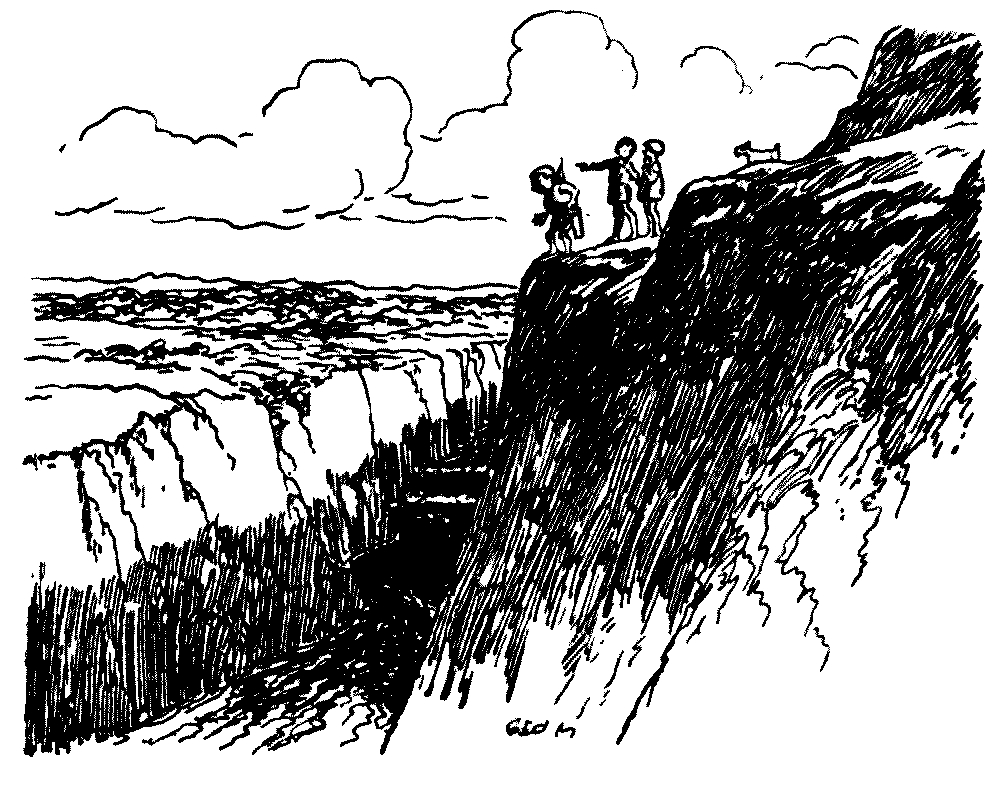
The first glance that Gorbo gave as he came out into the warm sunlight showed him that they were now (as the reader will have guessed from the heading of this piece) on the other side of the river.
This was more serious news to him than to Sylvia or Joe. To them it meant daylight, freedom from the subterranean gloom; possibly the prelude to new adventures (it was). To him it meant trouble and danger and the fear of unknown things. The wide deep river, rushing far below between steep cliffs, had been a barrier keeping the Snergs secure from a horror-haunted land, a land of distressful legends of dragons and other fierce monsters, of Kelps and giants, and a ruthless king who tyrannized over his people. No wonder he gazed sadly at the fair green woods on the other side and wished—chiefly for the sake of the children—that he was less of a fathead.
“It isn’t such a nice part on this side,” said Sylvia, looking about at a dull landscape, dotted here and there with patches of coarse grass and clumps of thorny trees. “But it’s jolly to get out of that dark place.”
“Yes, isn’t it,” agreed Joe contentedly. At his age the present time lasts quite a good bit. “I’m jolly glad we got here. Perhaps we’ll have some real adventures now.”
“I’m thinking we will,” said Gorbo.
They went on a little way and, coming to the top of a gentle slope, saw before them a round grey tower some half-mile or so away. It was surrounded by a high outer wall and looked very lonely and dreary. Gorbo stared long and hard at it.
“Yes,” he said at length, “that’s old Golithos’ tower. I can see him outside, doing something to the wall. I know him by his whiskers.”
“Then,” said Joe logically, “we’d better scoot. Come along, Sylvia!”
“No, don’t scoot,” said Gorbo; “it’s safe enough. Golithos is quite harmless now because he’s reformed. We’d better go over and see if he can tell us how to get back. Don’t be frightened, Sylvia, I’ve heard he’s quite kind-hearted now. In fact they say he’s rather overdoing it.”
Though they were not exactly at their ease (what child is at the thought of visiting an ogre?) they were impressed by Gorbo’s confidence, and they went on hand-in-hand with him towards the tower, Joe carrying the puppy.
Golithos the Ogre
A huge man, about seven feet high, was working with a heap of mortar and some big stones, repairing a loose part of the wall. As they drew near he turned and saw them; then he smacked his hands together to knock the mortar off and rubbed them in his hair and waited for them with a friendly but weak-looking smile. He had a great silly face and coarse hair and whiskers like bits of a cheap goatskin rug. His dress was the usual shabby dress of ogres in books. It is perhaps slightly unfair to call him an ogre, for as Gorbo had said, he was reformed. Not a child had passed his lips for years, and his diet was now cabbage, turnip-tops, cucumbers, little sour apples and thin stuff like that.
“Aha!” he said as they came up, “you are all heartily welcome. It is long since I had any nice visitors. How are you, my little maid? And you, my little man? And you also, my dear Snerg? Let me see, have I had the pleasure of meeting you before?” He shook hands with them in a very friendly way.
“I don’t think so,” replied Gorbo. “You see,” he added delicately, “I was quite a boy when they—I mean when you—well, when you changed your address.”
“Exactly,” said Golithos, with a conscious blush. “Well, come inside and make yourselves at home.”
There seemed nothing for it but to go on through his door, though all Gorbo wanted was to ask the way back across the river, not to make morning calls. When they were inside Golithos slammed the heavy door and locked it.
“I get so nervous if I leave it open,” he explained. “But come in and I’ll have a meal ready for you. You must be tired and hungry after your long journey from wherever you have come.”
“Look here,” said Gorbo, “we don’t want to trouble you too much. All we want to know is how to get back across the river.”
“To get back across the river,” replied Golithos, bending down and placing a hand affectionately on his shoulder, “is easier than you think. Much easier. In fact I think I am right in saying that however easy you think it is it will prove to be easier still.”
“Well, I’m glad of that,” said Gorbo.
“Naturally you would be. But come inside and make yourselves at home.”
“Thanks, but I should really like to know the way.”
“The way?” Golithos looked a bit puzzled.
“Yes, the way across the river of course.”
“Oh, yes, of course. What am I thinking of? Well, it’s perfectly easy. All you have to do is to—but one thing at a time. Come inside and make yourselves at home.”
He led the way up some steep steps to a door in the wall of the tower and into a large round room which took the whole of one story. It was big enough, but the most comfortless room possible. At one side was a great four-foot post bedstead, and in the middle was a big heavy table and one big heavy chair. And that was all the furniture, unless you count an accumulation of mixed litter—old clothes and gardening tools and pots and pans and sacks and barrels and so forth scattered on the floor. Some wooden steps led to a trap-door in the ceiling and in the stone floor was another trap-door, with a big iron ring to lift it by, which led apparently to a cellar. There was only one window, with little round panes of dull green glass.
“This is my kitchen-dining room,” he said with a look of pride. “I sleep here too—that structure over there is my bed—so it is a bedroom as well. Please take chairs—I mean, one of you take the chair and the others sit on the floor. But whatever you do, make yourselves at home.”
“Thanks,” said Gorbo. “But what about the way across the river?”
“The river?” Golithos did not seem to grasp his meaning.
“Yes, the river outside. All that wet stuff over there. We want to get back.”
“Undoubtedly. Well, you needn’t worry about that, because it’s a very simple matter. I’ll show you how it can be done in the easiest way. But first let’s see about dinner.” He picked up a pan and a knife and rushed blunderingly down the steps.
“I’ve heard it said that he’s getting very slow since he reformed,” said Gorbo after a minute’s thinking, “but he’s worse than I expected. Somehow or other he makes me feel that I want to contradict him. And I’m not like that usually.”
“But he’s going to give us something to eat,” Joe observed.
“Yes, Joe. But I don’t think it will be very strengthening. That’s the worst of reformed people. Here he comes.”
Golithos came in like a mighty bumble bee, bumping against things and getting his feet entangled with things on the floor and dropping vegetables about and stooping to pick them up and dropping others as he did so. “I’m going to give you the feed of your lives,” he said, chopping up lettuce and smiling in his feeble way. “I always think there’s nothing so appetizing as fine fresh lettuce and raw onions, especially if they have lots of salt.”
Dinner with Golithos
In a minute or so he placed a large pan on the table, and then he got two empty barrels and laid a plank across them to make a seat for the children. Sylvia whispered rather anxiously to Gorbo, who had been watching their host with a discontented expression, and indicated that Tiger’s contour was losing its curves.
“Look here, Golithos,” said Gorbo, “can you give this little dog something to eat?”
Golithos scratched his head. “Let me see—I suppose he doesn’t eat salad?”
“No, he doesn’t. He’s a dog, not a grasshopper. Haven’t you got any bread?”
“I may have some odd bits in a sack somewhere. You see I don’t eat bread very much. I find its heating to the blood. But I’ll try to find some nice bits for him later. In the meantime, let us eat heartily. Would you like the chair or do you prefer standing?”
“Chair for me, thanks,” replied Gorbo, seating himself. “Look here, Golithos, this is all very kind and considerate and jolly of you, but these young ones will want something a bit solider than this.”
“No solids here,” said Golithos quickly. “It wouldn’t do.”
“Well, you’ve got a cow outside. Why don’t you give them some milk?”
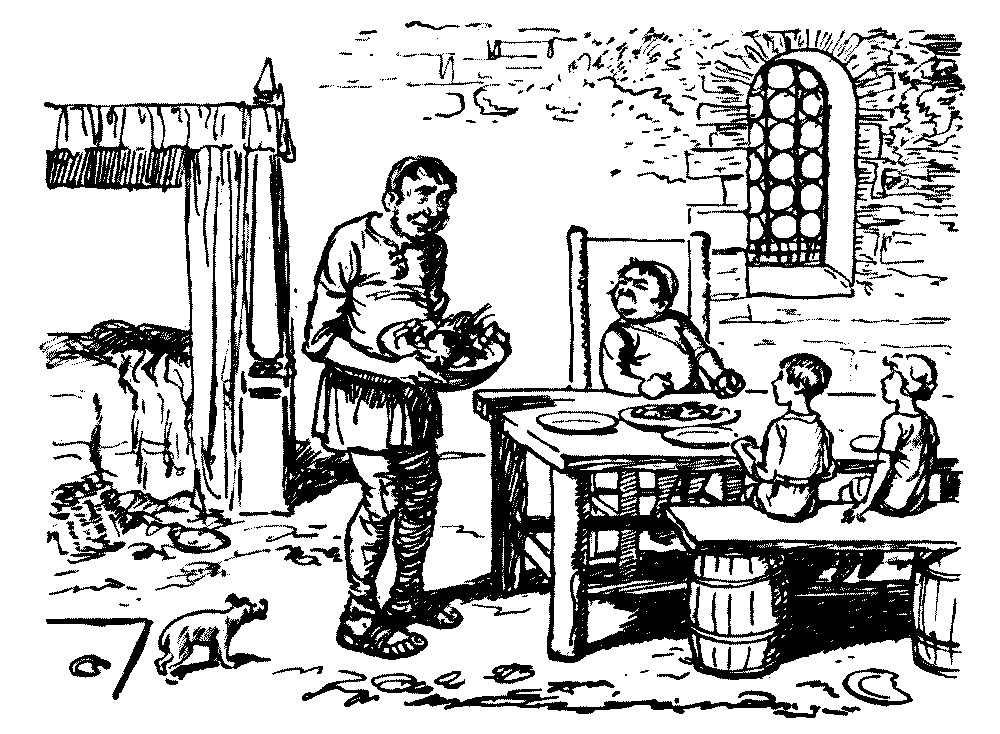
“Milk? Yes, but do you think it would be good for them? It’s rather heady stuff.”
Gorbo clapped the table smartly. “You hop out and milk that old cow of yours!” he said loudly. “These children want milk. They can’t live on lip and lettuce.”
Golithos looked fearfully abashed. “Yes, yes, I’ll go,” he said. “Don’t be violent.” He blundered out and down the steps.
“Can’t quite make him out,” said Gorbo. “He was a wicked old rascal once, but if he was rough he was ready—and a bit interesting if you’re not too particular. But I think the watercress diet has weakened his brain.”
He felt his responsibility in the matter keenly; if he had not been a born fool he would not have got the children into this mess; and his easy-going disposition seemed to have suddenly disappeared with regard to his host. After a minute he jumped out of the big chair and ran to the window and poked his head out. “Golithos!” he called in a warning voice. “Waiting!”
Golithos appeared, bearing a pitcher of milk and looking highly flustered. “Shall I put some water in it?” he asked.
“Give it to me,” ordered Gorbo, taking the pitcher. He looked round the littered table and found two earthenware mugs. “Wash them,” he said, passing them over his shoulder to Golithos. “Dear, dear, this is barely decent!”
The milk at any rate was nice and warm, and the children felt greatly refreshed by it. A small bowlful was given to Tiger, who lapped it up and then went to sleep on a sack. Then all set to on the salad, Golithos standing by and pressing them to take more whenever they paused. Gorbo took his portion in a dissatisfied way, sometimes looking at a morsel with scorn before putting it into his mouth (I may mention that they were eating with their fingers; there were no forks in this disgusting ménage). After a time he made a crude attempt at polite conversation.
“Doing well here, Golithos?” he asked.
“Pretty well, thank you. Oh, yes. It’s lonely, of course; people seem to shun me so. But I have plenty of time to meditate on my past sins.”
“Ah, that ought to fill in the time. Keeping pretty fit, Golithos?”
“Tolerably so, thank you. I suffer from stomach trouble occasionally.”
“Only occasionally, eh? That’s strange. Sleep well, Golithos?”
“Fairly well, I thank you. I have nightmares sometimes.”
“What do you expect? This all you’re going to give us, Golithos?”
“I’m really afraid I haven’t anything else—Yes, I have! I can give you a fine fresh young cucumber.”
“Keep it, Golithos.” Gorbo stretched himself and yawned and turned to the children. “Well, Sylvia, what do you think of this for a hole?”
Sylvia glanced at the feeble though gigantic face of the once child-eater and felt some pity for him. “Oh, it’s very nice,” she answered, though not, I am afraid, very truthfully. “Isn’t it, Joe?”
“It’s fine,” said Joe. Then he put his hands before his mouth and spluttered, for his manners were not good. Their host looked very unhappy.
“Just fancy it on a rainy day,” went on Gorbo. “Well, Golithos, what’s the country like in these parts?”
“I don’t know very much about it, because I don’t go about very much, but I’ve heard it’s very bad. You see there’s the land of King Kul not so very far off, and he’s got a very bad character.”
“Yes, we’ve heard of him. What does he do especially?”
“Well, he persecutes the people. You see he makes a hobby of it. And from what I’ve heard they’re the sort of people who ought to be persecuted. But I don’t really know much about them because I don’t often see any of them. And when I do I lock myself up tight until they’ve gone. Old Mother Meldrum comes over to see me sometimes and she tells me about the goings-on.”
“And who’s old Mother Meldrum?”
“Well, she’s a witch, that’s what she is. She says nothing will go right until King Kul is laid out, and she keeps trying to get me to go for it. But somehow or other I don’t feel up to violent exercise since I got reformed.”
“You’re losing your nerve, Golithos. But why doesn’t somebody else try to do him in?”
“I think it’s because they’re afraid. It’s risky, you see. Mother Meldrum says that his castle is three-quarters dungeons. And he keeps six headsmen busy all the time except on Saturday afternoons and Sundays.”
“That fits in with what I’ve heard of him myself,” said Gorbo, looking anxiously at Sylvia and Joe, who were taking all this in. “But cheer up, Sylvia, we’ll soon get out of it. Now, Golithos, what about how to get across the river?”
Golithos Explains
The giant took Gorbo by the arm and led him to the window. “Do you see that tree?” he asked, pointing out a tall pine standing far off.
“Yes, Golithos.”
“Well, that tree’s close by the river, and I pointed it out because it’s quite useless your trying to get across the river at that point. Or for the matter of that, at any other point, if you understand me.”
“Well, I don’t, if you understand me. I can tell you fifty ways how not to get across the river. Rouse your wits, Golithos!”
“You make me nervous. And if you do that you’ll drive all the fine ideas out of my head. You see the fact is that you don’t get across the river at all. But, notwithstanding, it’s a perfectly easy matter to get to the other side if you know the way how. Now do you see my point?”
“I thought I was something of a born fool, Golithos, but since I’ve met you I’m quite proud of myself.”
“Don’t speak to me like that; it gives me the all-overs. Look here, all you have to do is to go under the river. You go through a little door.”
“I thought so. You’ve been a long time coming to it, Golithos. As a matter of fact we came that way, but the little door shut up tight as soon as we got out of it. And there’s another door on the other side. How do we get them open?”
“It’s quite easy. But I don’t quite remember how it’s done—now don’t get violent! You see it’s not exactly difficult; it’s only something to do with some little magic spells. You make a circle on the ground and divide it into six parts—or sixteen parts, I forget which. And then you bring some simple little charms—twenty-eight altogether, I think. I know one of them is the toe-nail of the seventh son of a seventh son born on a Friday. And then you repeat something out of a book—oh, if you’re going to look at me like that I shall get thoroughly nervous and forget the rest.”
“Look here, Golithos,” said Gorbo, “do you think Mother Meldrum has more sense than you?”
“Oh, yes, she’s got ever so much more! She knows the way to get the door open.”
“Oh, does she? Then where can we find her?”
“She may come here at any time. You see she comes because I amuse her—at least that’s what she says—and if you wait here a day or two she’s bound to turn up. I can give you a lovely room upstairs. I’ll move the turnips to one side and give you some nearly clean straw to sleep on. I’d give my own bed to the little ones, but I’m afraid the mattress is rather bumpy; I think some brickbats must have got into it. You see I air the mattress every November, and last November I was doing some building, and as there were a few holes in it, you see——”
“Don’t worry, Golithos, we’ll take your upstairs room. So come and move the turnips.”
The Upstairs Room
The upstairs room was much worse than the one below, which is saying something. It was furnished chiefly with turnips and sacks of lime, and these Golithos began to move to one side in a muddle-headed way, while Gorbo sat on the window-ledge and watched him. At length there was a clear space for the straw, which was spread out in the manner advocated for sick horses.
“There!” said Golithos proudly, resting on his hay-fork, “There’s a bed for you!”
Gorbo only snorted and said nothing, and there was silence for a time.
“Those are dear little children,” remarked Golithos, trying to be amiable and interesting.
“Yes,” said Gorbo shortly.
“It’s a long time since I saw any. In my bad old days I saw plenty, as you know, but I thought it best—after I reformed—to keep away from them for a good long time.”
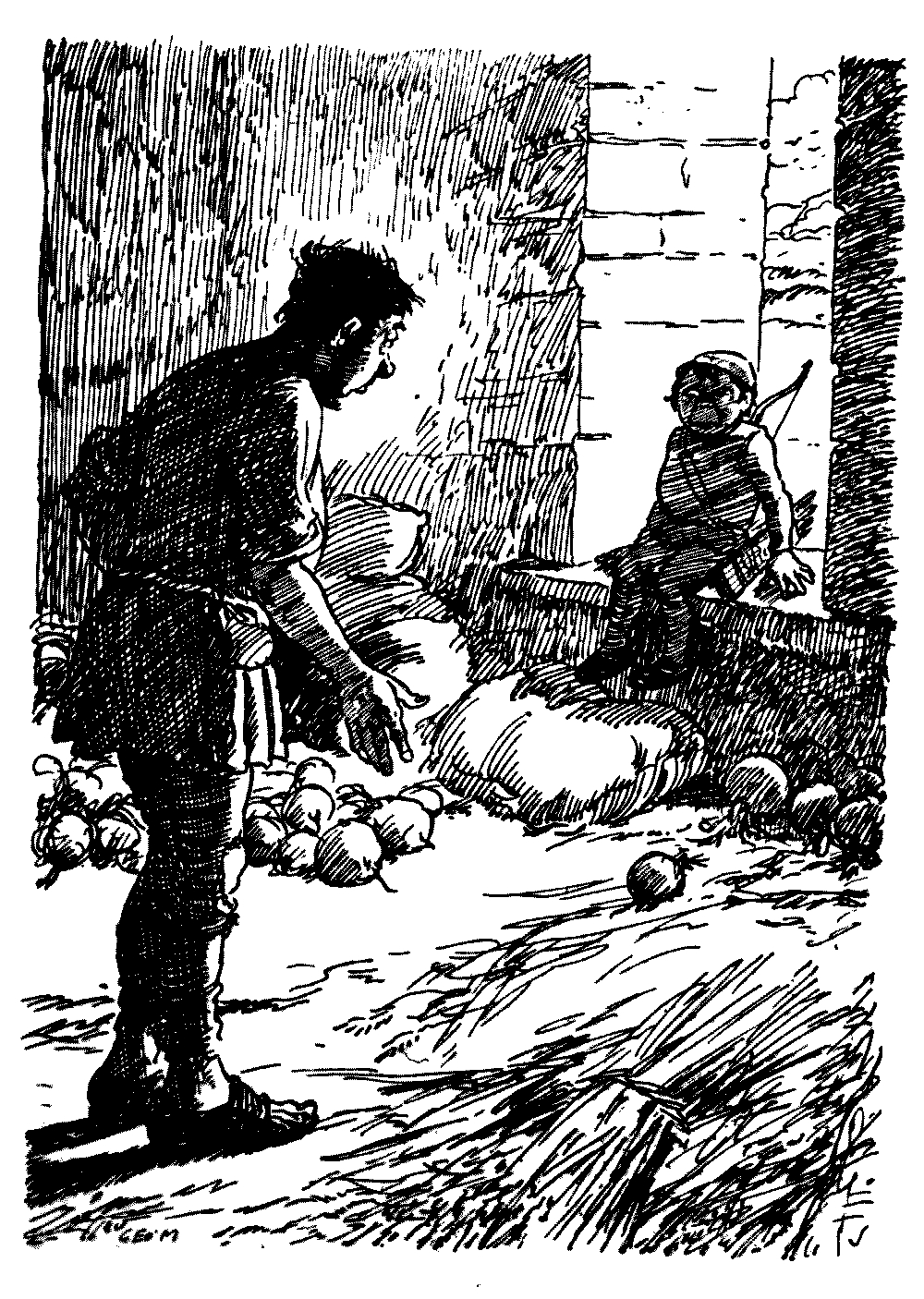
“Sound idea.”
“Yes, wasn’t it? But as I say, these are very dear little things, especially the little girl. Do you know,” he went on chattily, “it used to be a saying amongst us in the bad old days that the lighter the hair the tenderer the meat—however, I don’t suppose that interests you.”
“Not a bit.”
“Of course not. But I have taken quite a strong liking to these little ones. The little girl is very pretty, and they are both well formed. Not fat exactly. I should describe them as well filled out. Chubby, if you understand my meaning.”
Gorbo slipped down from the window and went down the ladder in a leisurely way. “Tidy up the place properly,” he ordered as he went.
Golithos obediently went on messing about, crooning a little song about a rose that loved a butterfly and faded away.
Gorbo’s Doubts
It will probably occur to the thoughtful reader at this point that a change had come over the character of Gorbo. A sense of responsibility, mingled with self-reproach, had brought forth qualities hitherto unsuspected, and though he was to some extent losing his natural desire to please all whom he met by conciliatory speech and helpful ways, he was gaining in ability to make quick decisions, as also in verbal fluency and a capacity for what is known among our famed comedians as back-chat.
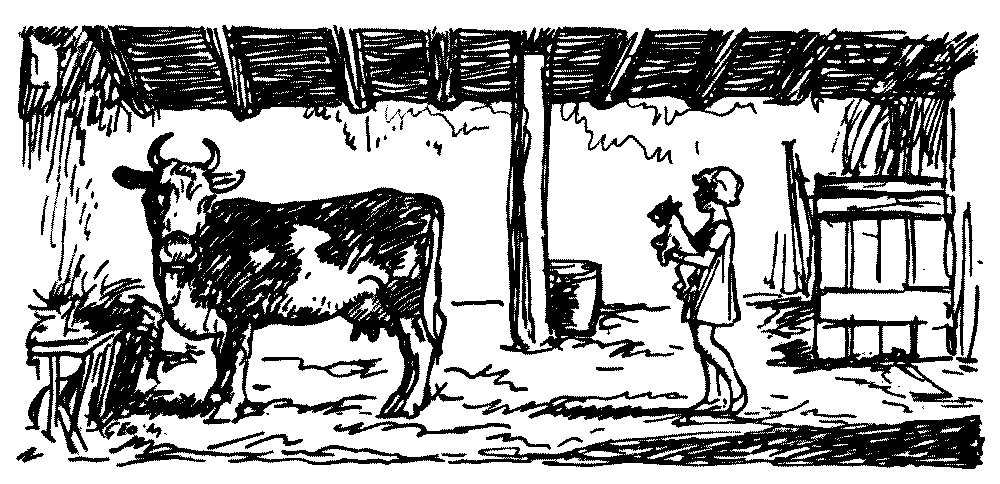
He found the children in the cabbage patch trying to amuse themselves with Tiger, but not succeeding very well because they were getting very tired of this dismal place. Their surroundings were horrible—all nettles and cheap-looking vegetables and rank grass and stones, and a high wall (on which were lots of snails) shutting out everything but the sky. Sylvia took the puppy to show to the cow, which was the only nice thing in the place and which lived in a rotten old shed in a corner, and Gorbo then had a chance to talk to Joe.
“Joe,” he said, “I don’t want to frighten Sylvia, but you’re a man like me. It seems to me that this is not a healthy place to stay in very long. In the first place we’ll get bored to screaming fits, and in the second place I’m having doubts of old Golithos.”
“Oo-er!” said Joe, now thoroughly startled.
“Yes, I’m beginning to think he’s not so reformed as he thinks he is. Of course it may be only my fancy, but I’m not going to take any risks, and you and Sylvia must keep close by me always. We’ll have to stay here a little while because, though it’s plain that he won’t be able to tell us how to get those little doors open, that old witch may come along at any time, and then I can get it out of her. I’ll give her my drinking-horn to tell us how; it’s the only thing I’ve got that’s worth anything, but it’s got silver on it and perhaps it’ll do. But if it’s not enough I’m afraid Sylvia will have to give over her little coral necklace. I don’t know what witchs’ charges are, but I should say the two together would be plenty.”
“But won’t it be awfully risky staying here?” asked Joe. This was becoming rather more of an adventure than he had bargained for.
“Not so much, because you won’t go out of my sight and I’ve always got my bow tucked under my arm. Of course I could make it quite safe by sending an arrow through his hairy old throat, but somehow I don’t quite like to do it until I’m dead certain sure. But don’t you worry, Joe. And don’t let Sylvia know.”
The day wore on. They had a light supper of cold sliced turnips and some of the milk that was left over from the midday feast. They gave a third part of the milk to Tiger in order to moisten some very hard crusts that Golithos found for him. Tiger did not worry, it was quantity he wanted, not quality, and his little abdomen began to take on bold curves again.
Golithos is Tempted
The night passed without trouble. The children slept soundly on their straw; Gorbo had made his bed on top of the trap-door so they felt safe enough. But in the morning there was more than a hint that some good old-fashioned trouble was coming.
Said Golithos to Gorbo (taking him quietly aside by the arm), “Would you oblige me by keeping these dear little children always close by you?”
Said Gorbo to Golithos (removing his arm), “I’m going to. But not particularly to oblige you. What’s the little game?”
“It is no little game; it is something more serious. You see I have a horrid fear that I may go back to my old disgraceful ways. The sight of these dear little plump things is a very, very great temptation to me, and I want you to help me to fight against it. I don’t want you to go away, because if I don’t have the temptation there will be no credit in conquering it—and I really hope and believe that I will be able to. Do you know that last night I wanted to have a look at them asleep, but I couldn’t open the trap-door. There seemed to be something heavy on it.”
“There was,” said Gorbo.
“I thought so. And then, do you know, I came down and sat thinking about them, and after a time I found myself sharpening a big knife in an absent-minded way. It gave me quite a shock. Now promise me that you will help me to overcome this temptation.”
“Oh, I’ll help you,” replied Gorbo.
He called to Sylvia and Joe to come down and to bring Tiger, and then he went with them down the steps to the door in the outer wall.
“Come and open this door, Golithos,” he called.
“Oh, you’re surely not thinking of leaving me!” exclaimed Golithos, clumping down after them. “I shall be greatly upset if you run away like that.”
Gorbo jerked out an arrow and laid it on his bow.
“You’ll be more upset in a moment perhaps,” he said, “if that door isn’t opened before I count ten there’ll be three of these sticking out of your silly fat head.”
Golithos jumped for the door and had it open just as Gorbo had counted up to six. As the children passed out, shrinking away from him, he bent down and held out his hand to them.
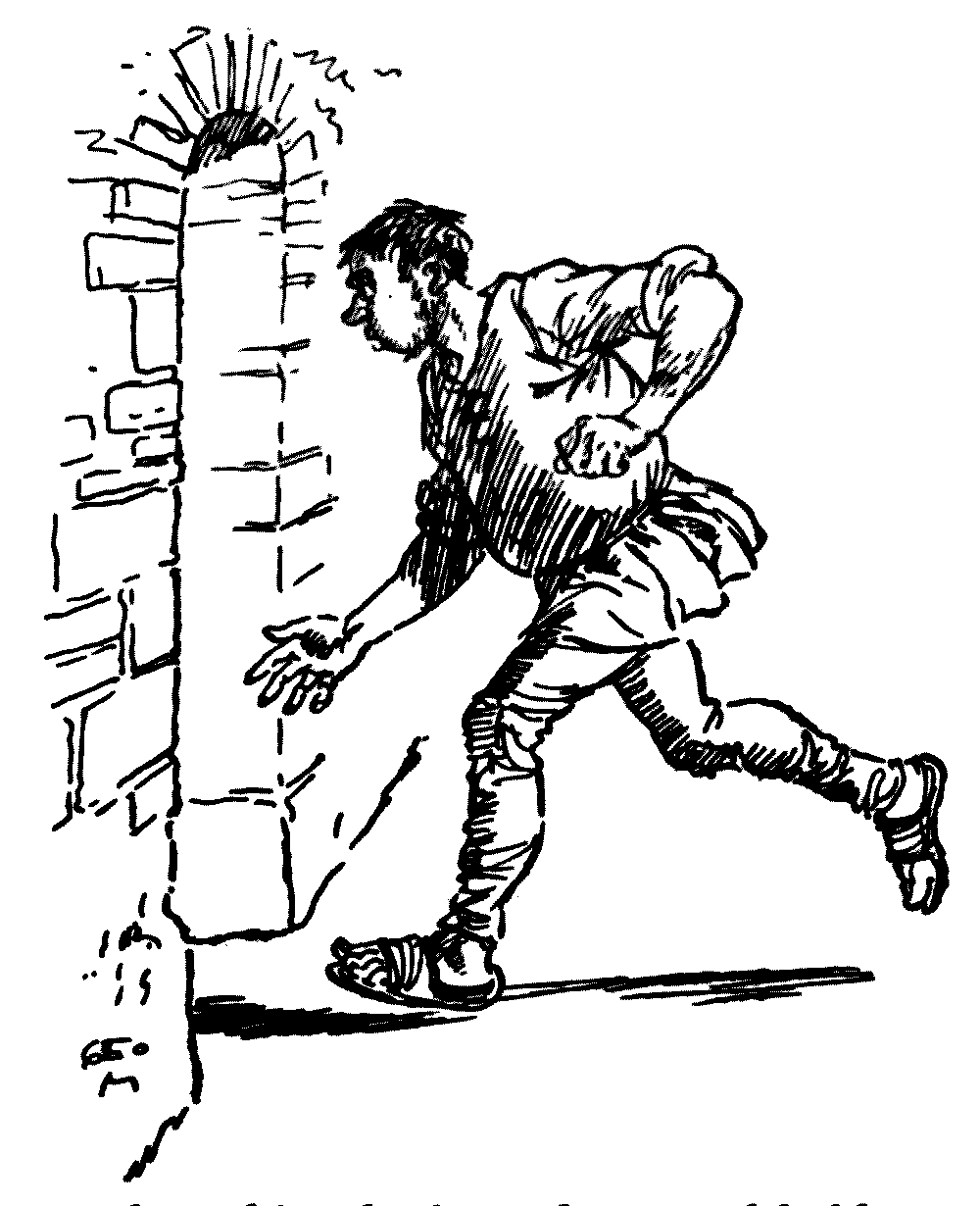
“Good-bye, little dears,” he said. “Won’t you shake hands with an old reformed person? Oh, this is unkind!”
Gorbo put his arrow back in the quiver and stood for a moment looking up at him. “You stick to watercress,” he said tauntingly. “Watercress and cold water. A slice of mangel-wurzel for Christmas. That’s about your form.”
“You have hurt me,” said Golithos, drawing himself to his full height (seven feet, one inch). His tone was not without a certain dignity.
“Get inside!” shouted Gorbo, slipping out an arrow again. “I’m not so sure I shan’t——”
But Golithos had scuttled in and banged the door and locked it. They walked along a narrow stony track that led towards some rising ground. Looking back, they saw the head of Golithos peeping over the top of his wall. So far as they could judge at that distance it had a wistful look.
Beyond the Tower
When they had got to the other side of the rising ground and the tower was hidden from view, Gorbo paused in order to take off his cap and tear his hair a little. Then he embraced both children remorsefully, and they gave him such words of comfort as occurred to them.
“The next question,” he said, rousing himself, “is the question of what we are to do next. If I knew where Mother Meldrum lived, we’d go straight there at once. But I don’t know, and it’d be hopeless my going back to ask Golithos. I’ve scared what little wits he had clean out of him.”
“Perhaps we’ll meet somebody if we go on walking,” suggested Sylvia. “Then we can ask where she lives.”
“Yes, let’s,” said Joe. “I’d like to meet a witch. We’ve just had one nice adventure and perhaps we’ll have another. Think of it, Sylvia! We are the only two kids in the world who have ever been in an ogre’s castle—I mean the only two who have ever got out of it afterwards. Won’t the others be jealous!”
“Yes, Joe, but I wish we could go back to them. It’s getting too beastly like one of those tales Norah told me.”
They walked on and on and on, over a plain which was dotted here and there with clumps of trees but which showed nothing else of interest, until they came to what looked like a road, and this they followed for a couple of hours. Then, suddenly, they saw coming across the plain a man on a horse. The strange thing was that both man and horse were shining all over in the bright morning sun, and they stopped and looked in wonder.
“It’s a knight!” Joe exclaimed. “Look, Sylvia! Look at his shining armour and his long lance! I’ll bet it’s swift and keen.” (Miss Watkyns used to sing “I fear no foe” at the Saturday evening concerts.)
“I hope his heart is pure,” said Sylvia, rather anxiously. (Miss Ffolijambe used to recite “Sir Galahad”.)
Gorbo said nothing, but he tried his bowstring to see if it was all right.
The Knight-Errant
The man in armour pulled up his horse when he reached the road a little way ahead and waited for them. Both children found him rather a disappointment when they came near for he did not seem quite up to the standard of knights in books. It is true that he had shining armour and the lance as long as a barge pole and so forth, but it seemed that his mail suit had not been made to measure. The breastplate was tied on to the back part with what looked like bootlaces, and they did not join well; bits of cloth showed at the sides. The armour on his legs was on the large size and rattled whenever he moved. His helmet also was much too big and it wobbled. The plume, though not a bad plume, should have been smaller to give a good effect. The horse was big and white and hairy, and had a thing like a spiked saucepan lid on its brow.
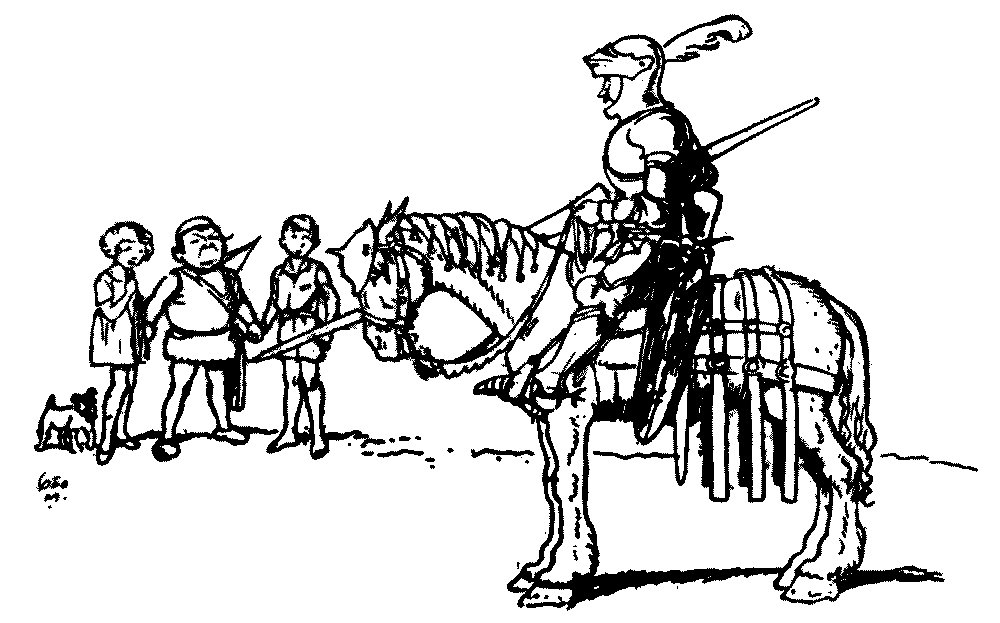
As they came near he raised the visor of his helmet and stared haughtily at them. From what they could see of his face he had peepy eyes, a long nose and rather puddingy cheeks.
“Who are ye?” he asked in an important way, “and wherefore come ye——” here his voice was cut off suddenly, for the visor had slipped down like a trap and he had to struggle with it.
He got it up at last: “As I was saying, wherefore come ye thus unattended on the King’s ways, two children and a dwarf?”
“Who are you calling a dwarf?” said Gorbo disagreeably. “Dwarf yourself!”
The knight gave him a long contemptuous stare in reply, a stare that might have lasted a long time if the visor had not come down again and put an end to it.
“Temper!” said the knight sharply when he had got his visor open. “But we will let it pass. Tell me, have you any wrongs to redress? Sir Percival am I, sworn to succour damsels, to slay giants, wasters, caitiffs and perishers, to rescue——”
“As I was saying,” he went on lifting his visor again and propping it up with one hand, “I am sworn to rescue the oppressed, to right wrongs, and to—well, to generally make things happy all round.”
“That’s very nice of you,” said Gorbo. “Then perhaps you’ll kindly tell us the way to the witch——”
“Which witch?” interrupted Sir Percival.
“Mother Meldrum. If you’ll kindly——”
“Ay, she is known as a parlous witch. She lives in the dark woods where fly the large black bats, all alone with her large black cats, and she gathers herbs o’ moonlight nights and brews foul potions to harm honest folk. Which means that I am not going there with you.”
“Who asked you to?” said Gorbo. “I only want to know the way there.”
“Then in that case you had better travel with me, for I am going within a mile or so of the dark woods. And if anybody should try to oppress you on the way, why, I shall be there to defend you.”
“That will be jolly,” said Gorbo. “Many thanks. But what about these little ones? Can’t you give them a lift—one in front and one behind?”
“H’m!” The knight thought over this for a time. “I’d like to oblige, of course—especially as I am sworn to do good deeds—but wouldn’t that make me look rather ridiculous?”
“Not a bit,” said Gorbo. “As a matter of fact you’d look rather sweet. Come Sylvia, I’ll lift you up.”
Before Sir Percival could make any further objection he found that Sylvia had been hoisted up and placed in front of him. The saddle was a roomy one and well padded, so it made quite a comfortable seat for her.
“Catch hold of his belt,” said Gorbo. “Then you’ll be quite safe. Now then, Joe.”
Joe, as a circus-trained boy should, took a run and a flying leap on to the horse’s crupper, where he sat at his ease.
“I say,” said Sir Percival peevishly, “aren’t you rather taking liberties with me?”
“I beg your pardon?” replied Gorbo, who was busy with Sylvia, making a comfortable pair of stirrups for her out of some odd bits of straps on the saddle.
“I said, ‘Aren’t you rather taking liberties with me?’”
“No, not a bit. Are you quite comfortable, Sylvia?”
“Yes, it’s lovely,” replied Sylvia.
“And you, Joe?”
“I’m fine. This is a real adventure!”
“I hope this is not incommoding you at all,” said Gorbo politely, struck with a sudden idea.
“Oh, no,” replied Sir Percival with bitter irony. He couldn’t hold his lance properly and he had to reach right round Sylvia to handle the reins. “Who would be incommoded by a little thing like this?” Then his visor fell down again and he roared angrily, though in a muffled way. But Sylvia’s handy little fingers soon propped it open again, and she asked Gorbo to find a little bit of stick and sharpen it with his knife. Then she deftly wedged the stick between the visor and the helmet.
“There,” she said, patting his steel-cased cheek, “now it will keep up nicely. But what you really need is some large hooks and eyes.” She had seen, with the unerring instinct of childhood, that not only was Sir Percival’s heart pure but that his head was rather soft.
His perhaps excusable irritation was soothed by this attention, and he smiled at her.
“If any enemies come,” she explained, “all you have to do is to pull out this bit of stick and there you are, ready for battle.”
Sir Percival was aroused at the mention of battle. “If any caitiffs should oppress you, little golden-haired maid,” he said proudly, “I will show you how great a man with his hands is Sir Percival. Evil-doers shake at the mention of my name.”
“I don’t believe you,” said Sylvia, giggling. The child was actually trying on with this belted knight the same ways that had tempted Joe to such flagrant acts of folly and disobedience, and to which their present position might be directly traced. Minx.
“I suppose you can’t find room for this little dog?” said Gorbo, holding up Tiger.
“No,” replied Sir Percival with stern decision. “I draw the line at little dogs.” He then shook the reins and the big white horse started off at a quick comfortable walk.
Sir Percival’s Job
Sir Percival seemed to have settled down to inconvenience and (I must own) grotesque appearance due to his having children fore and aft of him on the saddle, and he was quite ready to talk about himself. He was out looking for adventures because he had become enamoured of a young lady, and she had told him that if he would go forth as a knight-errant for one year and conquer a reasonable number of knights and caitiffs and slay some dragons and the like, she would have something to say to him, but she did not say what. So far he had not conquered anybody because he hadn’t met anybody who would fight, and as for dragons he really believed they had all left the country. One man, a miller, had told him where there was a dragon, but it turned out that the ribald fellow meant his own wife, who used to go for him with ferocity, and probably with plenty of reason. But he told them he had now great hopes, for he was on his way to a castle he had heard about as being likely—though he didn’t know whose it was—for in a castle there were always knights, and knights were always spoiling for a fight. This was very good news to Gorbo because he worked it out that in a castle there was always something to eat, and the children were delighted when he told them this, for the sun was now getting high and they had had nothing to eat since last night’s turnips.
In time they came to nice wooded country, which was a pleasant change from the rather bare plain. Then they caught sight of battlemented towers peeping above the tree-tops, and a little later they halted by the outer wall of a small cosy castle, all alone by itself. There seemed to be nobody about, inside or outside, and everything was very peaceful and sunny and still. And hanging on the outer gate was a slug-horn like the one outside the Dark Tower that Childe Roland came to.
The Mysterious Castle
“I am going to wind this horn,” said Sir Percival to Gorbo (he meant, to blow it). “And if you will oblige me by pretending to be my squire, I shall think it very nice of you.”
“Yes, I’ll be your squire,” replied Gorbo, quite interested. He lifted Sylvia down to get her out of the way in case battle should take place suddenly. “I’d like to—Jump down, Joe—I’ll tell them you’ll take on any six of them and——”
“Not so brisk, please,” said the knight. “What I want you to do is to say that I am the famed Sir Percival and—and so on and so forth. Give them the idea that I am something of a terror. Don’t know what fear is, and that sort of thing. You see I don’t want to injure anybody if it can be avoided, and if any knight prefers to give in without fighting, why, let him do so by all means and save needless bloodshed. Do you get the idea?”
“Yes, I think so. Hot stuff, as it were. Now blow hard.”
Sir Percival blew at the small end of the slug-horn and a long melancholy note came out of the other end. Then there was silence for a time; but at length they heard the sound of slow shuffling footsteps coming to the gate.
“Nothing to-day, thank you kindly,” said a weak and quavering voice.
“Open, varlet!” cried Sir Percival angrily. “What discourtesy is this to keep a champion waiting at your gate? Open, I say, lest I believe that the knights of this castle fear to meet me.”
“Save you, good sir!” replied the quavering voice, “here are no knights, none at all, nor indeed anybody but me and my old dame Margery who look after the castle while the family are away visiting cousins, though we should be glad if they had taken us too for a change of air would do us both good who have been in this same castle until we are sick and tired of the shape of it, to say nothing of the damp which has settled in old Margery’s bones so that she goes ever doubled up and——”
“Look here,” interrupted Gorbo, putting his hands to his mouth and shouting through the keyhole, “this is the valiant Sir Percival, who has slain so many knights that he has forgotten how many, to say nothing of dragons and such like. And I am his valiant squire, Gorbo, who is famed for a big appetite, and we have with us two children and a little dog who are also hungry, and the question is whether you are going to be a sport and give us something to eat or whether you are simply going to drive us into smashing up this castle.”
“Nay, be not rash, good squire,” replied the voice. “I’ll open the gate and let you in, for my master hath bidden me give food and drink to wayfarers that need it and especially to those who are liable to damage his stronghold if it be denied them.”
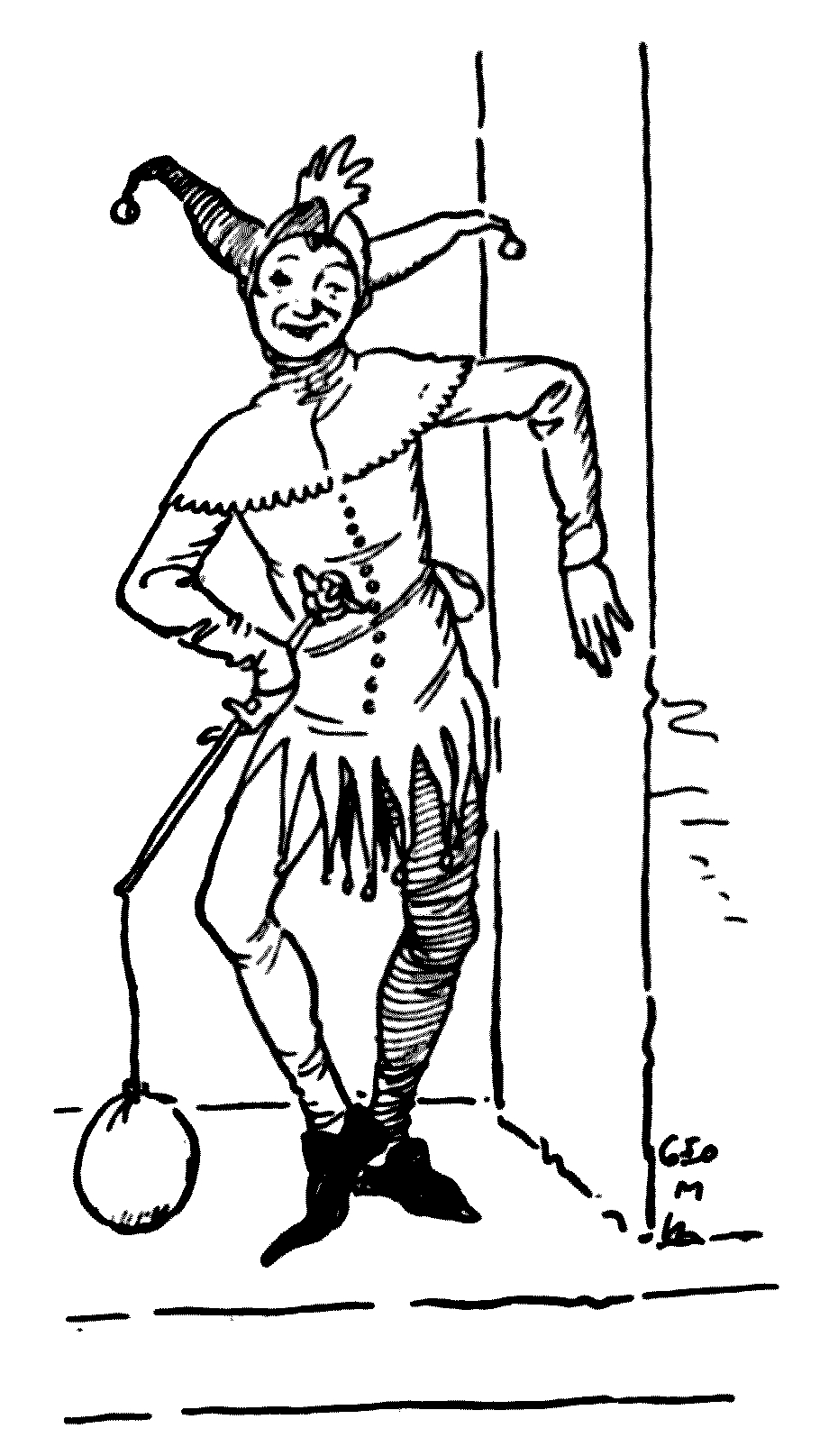
The door opened, and to their astonishment there appeared before them, not a doddering old henchman, but a pert young man dressed in the brilliant and fantastic costume of a jester, with one leg of his tights red and the other yellow, and who seemed, from his immoderate laughter, to be having the time of his life.
“Ha, ha!” he cried, joyously, leaping out and slapping Sir Percival on the nose with a bladder tied to the end of a stick. “Did I not befool thee, thou pumpkin face? Even now your jaw is dropped and your eyes goggle with wonder and you have a general resemblance (saving your presence) to a parboiled codfish. Laugh, thou jingling hundredweight of ill-fitting harness”—hitting him again—“and grant this to be a pleasing jest.”
Sir Percival’s Annoyance
Sir Percival recovered from his astonishment and prepared to do what seemed the only fitting thing to in a case like this. He heaved up his lance to smite this gay young man to the earth.
“For shame!” The young man had dexterously leapt out of the way and crouched down with Sylvia and Joe caught to his bosom. “Would you strike a child?”
“Malapert insect!” said Sir Percival. “Unhand those young ones that I may cudgel you.”
“Listen to reason!” bellowed the other, now grovelling on the earth. “This castle is deserted, and I alone know where the larder is. Without my help you will go away an hungered!”
“There is something in that,” said Sir Percival, lowering his lance.
“There is a whole lot in it,” shouted Gorbo. “Don’t hit the poor man!”
The jester bounded up like a tennis ball and flew at Gorbo, enfolding him in his arms. “By this kiss” (kissing him daintily on the top of his head) “I swear eternal friendship.”
“Lead on, thou nimble loon,” said Sir Percival. “I pardon you if you will take us to the larder without delay.”
The jester turned swiftly to the children. “You see yonder door,” he said, pointing to a small open door in the main building of the castle, “I’ll give you a start of half-way and race you there. Are you ready? Go!”
Sylvia and Joe went off at top speed, and when they were half-way the jester gave a shrill whoop and flew after them, catching up with them just as they reached the door.
The Castle Kitchen
“This is glorious!” cried the jester, taking a hand of each and leading them into a large comfortable kitchen. Then he turned and looked anxiously at the top of the open door. “No, there’s no time to make a booby-trap. Come along and put on aprons.”
Sylvia and Joe, both highly delighted with these joyous happenings, were soon dressed in little aprons and caps made out of napkins and busily helping their new friend. He sliced up a ham and got two large frying-pans going, while they put stools round a big table in the middle of the floor and laid plates and mugs and so on.
“Do you think forty eggs will be enough?” asked the young man.
“I think it will be almost more than enough,” replied Sylvia, doing a quick sum in her head. “It will be eight each.”
“I’ll make it fifty then,” said the strange being, breaking them thick and fast into the frying-pans.
A heavy clanging sound without indicated that Sir Percival was coming; he and Gorbo had been attending to the horse, supplying it with hay and so forth. As the knight entered the door, the jester turned with an egg poised ready to throw at his head. But he hesitated; then broke it into the pan instead. “I dare not,” he said to Joe. “What a pity!”
Gorbo paused as he came in and stood sniffing the delicious smell. He went across to the jester. “Bend low towards me,” he said. And when the other had done so Gorbo kissed him on the top of his head. “I also swear a friendship. What are you going to give us to drink?”
“I have here,” replied the other, making a flying leap over the table to a rough sideboard, “both milk for these little ones and beer for us men. Kindly pledge me,” he added, filling up two mugs.
While these two sportsmen were clinking their mugs and gossiping, Sylvia, standing on a stool by the stove, was dripping hot butter on the eggs to give them a choice flavour, and Joe was on another stool pronging out the slices of ham and laying them on a hot dish. They were very happy, because this was a really superior adventure, with food and cheerful things taking place. The castle, too, judging from the kitchen, was a self-respecting place, clean and well kept, and a nice change from the beast of a tower they had spent the night in.
Breakfast
Sir Percival was given a stool at one of the tables and Sylvia was put at the other—to serve the food, as she was the only lady present. The ham and eggs were perfect, and they had in addition buttered toast and a pot of damson preserve which the jester said they really must taste as he had made it himself. Tiger had a large plateful of everything and was busily engaged in putting his shape as it should be. (It may be noticed that almost all the news I have to give of this little dog is of the rotundity or otherwise of his stomach.)
“Tell me,” said Sir Percival at length, coming to business, “to whom does this castle belong?”
“It belongs to my master,” replied the jester. “One Gunthorn, a fierce and rather unscrupulous baron who is something of a scourge to the countryside. I am his privy jester—Baldry is my name—and I ought to know. Many knights have come here, striving to joust with him—but they have all gone, alas!”
“Oh! Where did they go to?”
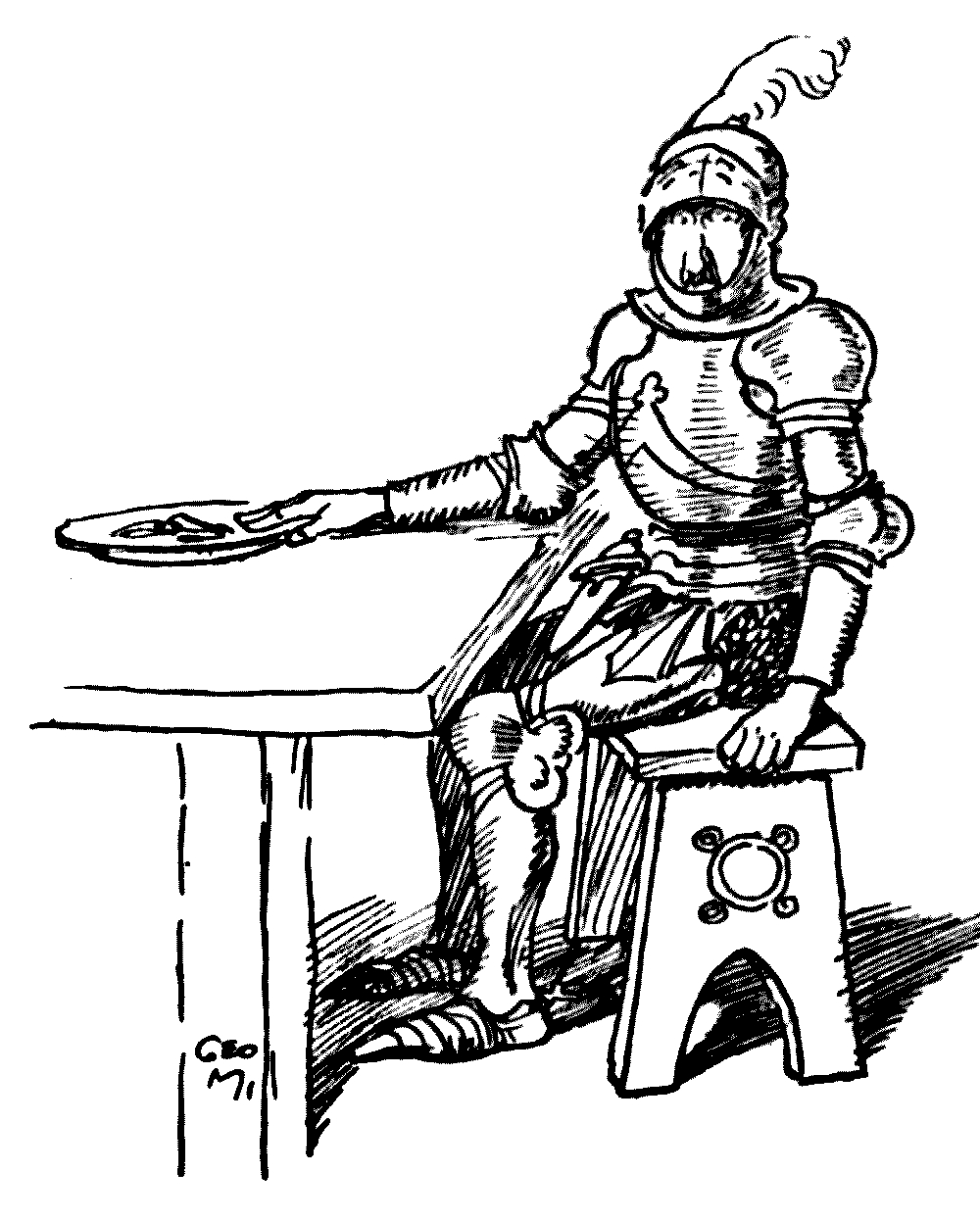
“Not far, sir knight. There is a graveyard some furlong or so beyond these walls, and there they lie at peace, to each his little headstone. Will you pass your plate for another morsel of ham and some extra egg?”
“No, thank you,” answered Sir Percival. “I seem to have lost my appetite. And where is the baron Gunthorn at this moment?”
“Why, sir knight, he may be many, many long leagues from here, and——”
“If I can change my mind,” interrupted Sir Percival cheerfully, “I think I could eat another rasher.”
“And on the other hand,” continued Baldry, passing up the plate, “he may come home at any moment. He went off this morning to look for a wandering knight he had heard about, taking with him his men-at-arms and his cook and household varlets, as is his quaint custom. He left me in charge of his stronghold, knowing that no man dare set foot within these walls, so famed is he for ruthlessness. He has another quaint custom of sneaking in by the postern gate, so that he may observe if all is kept well in his household when he is away. But you do not eat, sir knight.”
Sir Percival pushed away his plate and thought deeply. “And what will he do if he finds you entertaining guests during his absence?”
“Good sir,” said Baldry earnestly, “I prithee talk of cheerful things while we may. Were he to—but pardon me a moment, did I hear sounds?”
A Terrible Moment
He sprang to his feet and stood an instant anxiously listening. Then he bounded over to a door in the corner of the kitchen, flung it open, and disappeared up a spiral stone staircase.
A moment later they heard the distant clanking of mail and a harsh roaring voice raised in anger. The sounds came nearer and nearer and they heard mighty feet descending the stone stairs. Gorbo snatched up his bow and pushed the children towards the door. Sir Percival was struggling to get his helmet on, and making heavy weather of it.
“Good, my lord,” they heard the voice of Baldry saying, “if you will but listen to reason——”
“Reason me no reason,” interrupted the roaring voice. “If I find unbidden guests in my kitchen I’ll first flay them and afterwards slay them——”
The door was flung open and Baldry appeared alone, sweetly smiling and smiting together two pot-lids to imitate the tread of mailed feet.
“Be seated, I pray you,” he said with a ringing laugh. “Now was not this a pretty jest?”
“Ay, a right joyous jape,” said Sir Percival, pulling his helmet off with violence and displaying a pale and angry face. “Thou art altogether a choice merry varlet. Though how you manage to go on day by day without getting slain passes my understanding.”
More Trouble
“Look!” exclaimed Baldry, suddenly pointing through the open doorway. They could see across the courtyard to the door in the outer wall, and this having been left open showed a perspective of white road leading through the woods. And not so very far along the road horsemen could be seen coming up.
“Now this is no jest at all,” continued Baldry, “for here comes the ruthless baron. Let us all go far away and quickly.”
“I’m on,” said Gorbo, grabbing Sylvia’s hand. “But what do you want to go for if you belong to the place?”
“Alas! I never saw or heard of the place before this morning,” said Baldry sadly. “I was a-tramping the high road, when by ill-chance I saw that door open and nobody about, and I had just gone in and helped myself to a snack when up comes this valiant knight, thundering at the door and blowing the horn—But all is well!” he cried joyfully, leaping into the air. “He will protect us! Come along, little ones, and let’s find a nice spot to see from. Now for the shock of steeds! Now for splintering of lances! Oh, this is heavenly!”
“Well, I don’t know so much about that,” said Sir Percival disagreeably. He had now managed to get his helmet fixed on and was leading his horse through the door in the outer wall. “You see I don’t want to take an unfair advantage of this Gunthorn. He is tired from his journey, belike, and there is no honour in conquering a man who is not fresh and lively. Nay, that were a coward’s deed!” He blundered about, trying to mount his horse.
“But, sir knight,” pleaded Baldry piteously, throwing himself in front of him, “why spoil the fun? Here is my dear friend Gorbo, who would love to see a jousting. And these little ones, too, see their eager faces! Come, sir, here hangs the horn. One blast and Gunthorn will come spurring up to give you your heart’s desire!”
“I know my job better than you,” said Sir Percival coldly. “Stand aside, fellow, you will not induce me to take advantage of a weary man—And now you’ve done it!” he wailed, for Baldry had jumped for the horn and let out a blast that made the echoes ring.
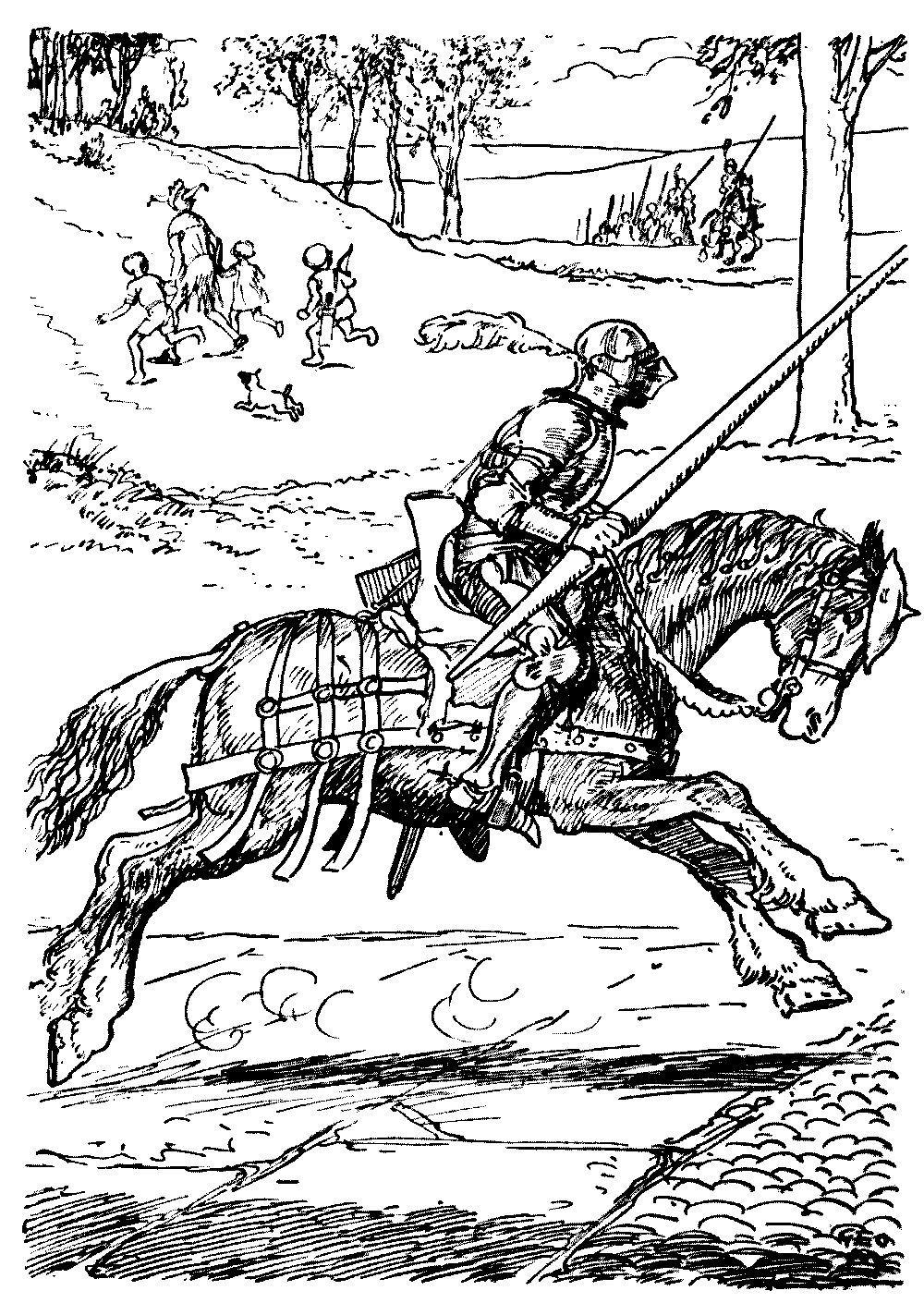
A moment later they saw a man detach himself from the little group of approaching horsemen and speed towards them, handling the longest kind of lance in a manner that bespoke both strength and dexterity. Sir Percival muttered something that sounded like an oath (though I hope it was not) and by a desperate effort managed to get into the saddle. He went in a bumping and jangling gallop in one direction under the trees, and Gorbo and Baldry and Sylvia and Joe and the puppy went swiftly in the opposite direction.
The Sorrows of Baldry
They heard distant shouts, as of annoyed people, which naturally encouraged them to keep up a good speed. Gorbo and Baldry helped the children along with great leaps and bounds, and they were soon deep in the silent woods, far from risk of pursuit. There they rested on a mossy bank and took things easily for a time.
“That was a jolly breakfast, you know,” said Baldry, to start the talk well.
“Yes, it was,” agreed Gorbo. “But what will this Gunthorn person say when he finds out about your making so free with the place?”
“I don’t know. And another strange thing about it is I don’t care. And his name’s not Gunthorn—at least I don’t suppose it is. You see I just made it up suddenly.”
“It’s quite a good name for a pretence baron,” said Sylvia.
“Yes, isn’t it?” Baldry was highly pleased at this remark. “It sounds so ruthless. I’m rather good at making up things.”
“I’m glad of that,” Gorbo said, “because perhaps you can make up some way of getting out of this mess. Do you know the way to get across the river?”
“No, I don’t. And I don’t know anybody who knows. And I don’t know anybody who knows anybody who knows. I wish I did, because I’d like to go with you and see Life. It’s very dull in these parts; the people have no sense of humour. And that makes it so difficult for me,” he added sadly. “I’m always misunderstood.”
“Never mind, poor thing,” said Sylvia, who had taken a great liking to him.
“The hollow world,” continued Baldry, with a suspicion of tears in his eyes, “believes a jester’s job to be all jollity; but little do they think that there may be an aching heart beneath what I must term superficial gaiety.”
Sylvia stroked his hand soothingly.
“But on the other hand,” he went on in a brighter tone, “there may not be. There isn’t in my case at any rate; though I have had a peck of trouble lately. You see, only yesterday I was the King’s High Jester, and now I am wandering the earth with only three friends to love me. Four to be exact, because I include this little dog.”
“Did you get turned out?” asked Joe.
“No, not exactly; I ran too fast for that. And yet,” he went on, with a return to melancholy musing, “it was a quaint conceit, one that might have pleased. Who would have thought that the King was so obtuse. But that is the worst of tyrants, you never know how they’ll take things.”
“Tell us about it,” said Gorbo, “then you’ll feel better.”
“Well, it was merely a little idea of mine to brighten up Court life, which has a tendency to become dull and stuffy sometimes. You see it is the King’s custom to walk alone through the streets on the day before his birthday so as to show himself to his subjects, and to show that he is willing to unbend from State ceremonial, and so forth. It also serves to brisken their memories with regard to presents.”
“What does he do?” asked Sylvia.
“He just walks along, wearing a crown and in his best robes. And he speaks to people here and there—in a dignified way, of course—and he pats children on the head and asks their mothers how old they are, and if they had mumps—and all that sort of thing.”
“He seems quite a nice king,” Sylvia observed.
“You wait,” said Baldry, with dark meaning. “It’s only once a year that he bothers about mumps. Well, to go on with my unhappy story, I thought out a scheme for making the whole affair brighter. Though I am young and thin and have no hair to my chin, and though the King is middle-aged and fat and has a flowing beard, I so padded myself up with straw and so painted and behorsehaired myself that when I appeared in the public ways, clad in furred and tinselled robes and wearing a brass crown, there were none that did not take the jester for the king.”
“I say, this sounds rather good!” Gorbo exclaimed.
“Oh, it was very good. But listen. In lieu of the customary stately strut of His Majesty, I proceeded in a lively dance, which I have invented myself and which I have named ‘The fawn at play.’ There is in it a great deal of fanciful gesture and nimble leg work. In my right hand I bore a six-hooped pot; my left hand held my robe on high to give free play for my gambols. And thus, with shrill whoops of joy, I pranced among the amazed citizens.”
“Did they laugh?” asked Joe.
“Some few of the keener spirits did; but the general expression was of stolid wonder. I redoubled my efforts. Suddenly, on the completion of a series of backward somersaults, I found myself face to face with the King himself. There was that in his countenance that caused me to turn and flee, but I tripped over my robe and fell. In another instant I was seized by the guards and hurried to a dungeon.”
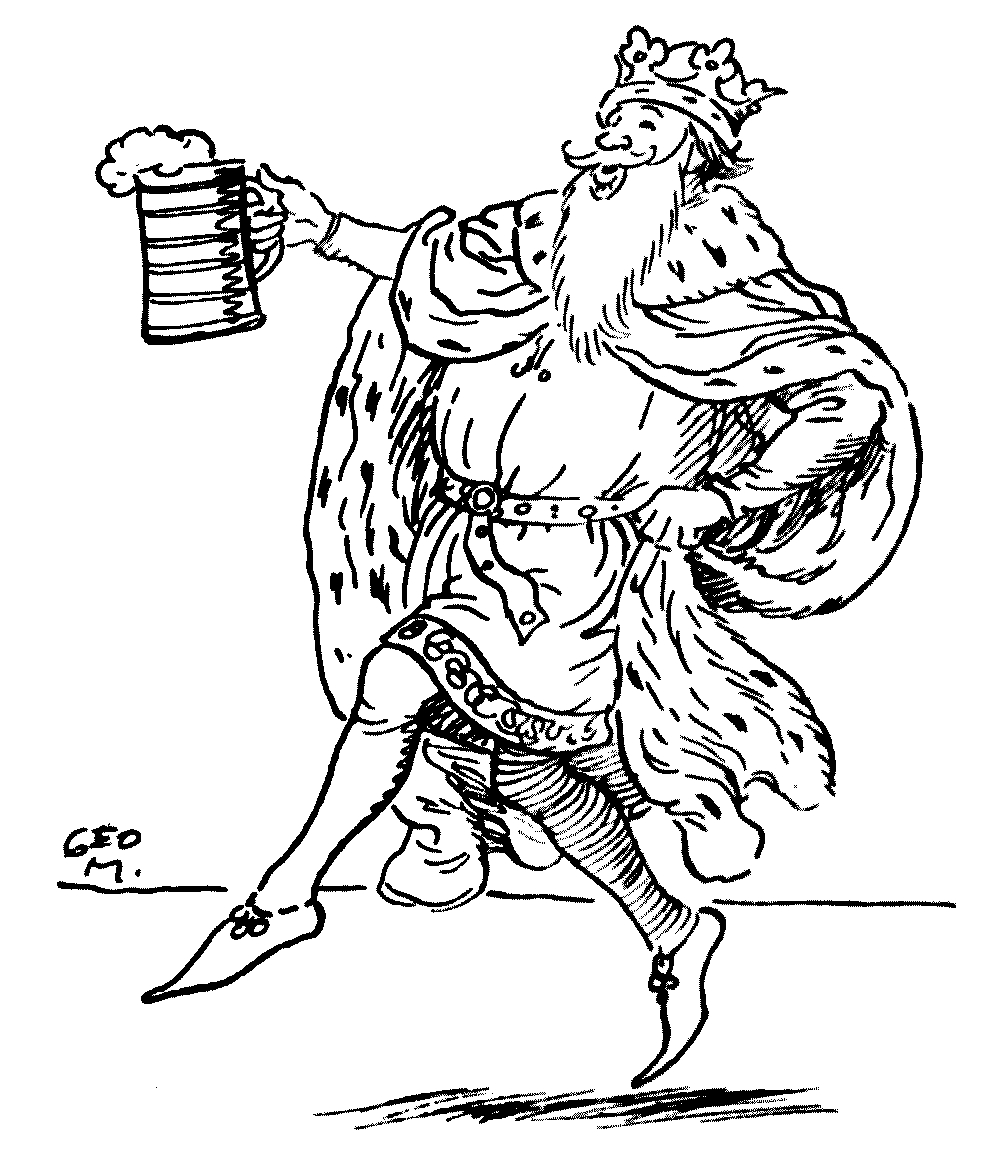
“What beasts!” exclaimed Sylvia.
“Yes, Sylvia, that’s what they were. And when my gossip, the jailer, told me that the King was frothing at the mouth and had sent for his High Executioner, it seemed to me a choice moment to leave his service if it could be done. My prison was in a tower which had, by great good luck, a drain-pipe outside the window, so I washed off all traces of my kingly colour and slipped down. I reached the ground without other mishap than a rasping of my knees and knuckles and fled afar. Better to roam the cold world than to await the vengeance of a tyrant. So here I am, alone with you dear things in the greenwood. And very nice too.”
“Is the King very ruthless?” asked Sylvia anxiously.
“Ruthless! Oh, my! However, I’m not going to go into details because that would only frighten you and serve no useful purpose.”
“We’ve heard that things are pretty bad on this side,” said Gorbo. “And Golithos said the same.”
“Oh, yes, dear old Golithos. You told me you’d stayed a night with him. I’ve never seen him myself, but I thought of paying him a visit.”
“Don’t you do it,” said Gorbo. “He’ll bore you stiff—and there’s nothing to eat at his place but the stuff rabbits eat.”
“Then that settles that,” said Baldry. “Well, where shall we go?”
“We’d better try to find Mother Meldrum somehow. She’ll be able to tell us how to get back home.”
“Dear old Mother Meldrum!” exclaimed Baldry. “Yes, let’s go and find her; she lives somewhere in the dark woods, which are somewhere about here. I’ve always wanted to meet that dear old lady, and now I shall!”
“Is she nice then?” asked Sylvia, rather relieved at his enthusiasm.
“Well, I wouldn’t go as far as that. She’s a witch, and she’s rather noted for blighting crops and injuring folks generally and she makes a fairly good living by selling curses and nobody of any sense will go near her. But she may have her good points. Let’s go at once!”
“Look here, my dear friend,” said Gorbo, “this is all very well for you and me, but what about Sylvia and Joe? You stay here and look after them and I’ll go and see her. There’s no need for all of us to come.”
“No, Gorbo,” cried Sylvia, “we’re going where you go.”
“Of course we are,” said Joe. “Besides, it’d be rather fun to meet a real witch.”
“That’s my way of looking at it,” said Baldry. “Fun is the correct word. Come along, Joe, let’s look for the dark woods. I’ll race you to the top of that tree.”
He ran to an enormous tree a little distance away and Joe ran after him. In another minute the two disappeared among the leaves. Then cries of joy were heard from aloft.
“It’s lovely up here,” called Joe. “Swinging about like Billy O!”
“And the dark woods!” called Baldry. “Miles and miles and miles and miles of dark woods. Oh, this makes life really worth living!” (Certainly he seemed the kind that is easily pleased.) “Come down, Joe, we’ll show them the way.”
The two came scrambling down, and they all went on and on until the trees came to an end at a wide stretch of turf that sloped gently away before them. And about half a mile or so away there were other woods, stretching as far as they could see on either hand. Undoubtedly the dark woods, for nothing in the shape of woods could be darker or more dismal looking.
The Dark Woods
They went on and soon reached the edge of the sombre trees on the opposite side, and then the question was, of course, which way were they to go. Gorbo was of opinion that they had better go as straight as they could and keep their eyes open for anything like a witch’s house, but Baldry suggested that they should sit down comfortably and shout for Mother Meldrum at intervals and see if she would turn up. And considering the vast extent of the dark woods both proposals seem to me ridiculous.
The question was settled for them by the sudden appearance of a man who came walking out from the wood. He was dressed in a woollen jerkin and hose and instead of a hat he had a hood with a cape to it, as in the pictures of the cheaper sorts of mediæval people, and he carried in his hand a little packet done up in leaves. From the expression of his face they judged he was not a nice man. He stared at them for an instant and then spoke angrily:
“Oh, yes, a man can’t buy a little curse without a lot of busybodies following him about! I’m not going to use it on you, am I?”
“We hope better things of you, sweet chuck,” replied Baldry. “All we want is the way to Mother Meldrum’s place.”
“Oh, then all you have to do is to follow this little path.” The man appeared to be greatly relieved. “But she’s out of curses; I got the last one. You see there’s been rather a run on them lately.”
“We’ve only come for a couple of blessings,” said Baldry, as he took Sylvia’s hand and ran along the little path, followed by the others. They heard the man shouting that in that case they were going to the wrong shop, but they did not stop to argue the matter, and in a few minutes they found themselves deep in the shadow of tall mournful trees that shut out all but little chance glimpses of the sky. On either hand they could see patches of black swampy water, but the track was fairly plain (giving a hint that Mother Meldrum did a brisk business) and they went along at a good rate. There were no birds or cheerful little animals in this horrid place, but there were—as they soon became aware—bats.
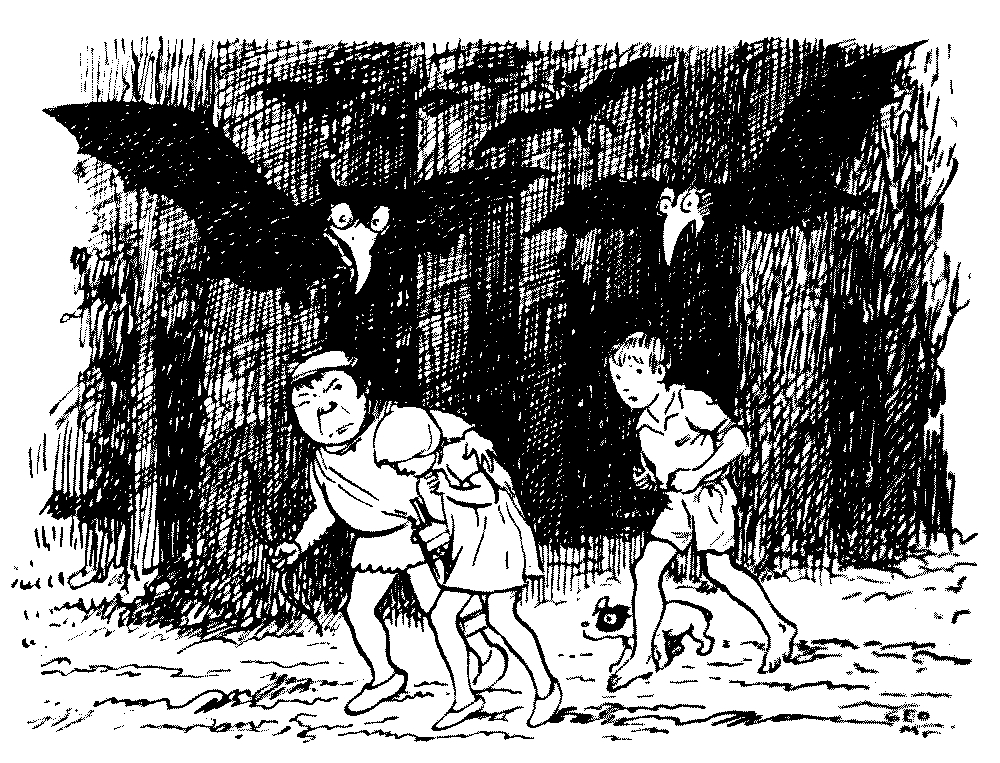
Compared to these the bats of the twisted trees were little pets. These measured six feet or more across the wings and they had beaks of enormous size, from which issued hoarse bubbling sounds. Sylvia, who liked bats as much as she liked black-beetles, pulled her napkin cap over her eyes (she still wore this little stolen head-dress) and shuddered; but it was too late to think of turning back now however much she would have liked to. She kept close under Gorbo’s arm, and in time she began to be more used to them; after all they only flopped about and bubbled, and did not bite, which is the main thing.
At length, late in the afternoon, after a journey that was very tiring to the young ones, they came to a part where the forest seemed a little clearer and lighter and not so swampy. The track went on for another half-hour’s travel and then they saw before them a house which they knew must be Mother Meldrum’s, if only because nobody but a witch would select it for a home.
Mother Meldrum’s House
There was a little shabby patch of grass in front of the house, but behind and at the sides it was closely surrounded by trees and thick bushes. It seemed to be mostly roof—an untidy roof of thatch that reached nearly to the ground in some places and twisted up into gables here and there over ugly little windows like eyes. Although it was by no means a big house it looked somehow as if it had rather a lot of little lopsided secret rooms, and it had what I may call a generally wicked appearance. One could not imagine kind silver-haired people living in it and doing good deeds to the poor. It had its effect on Sylvia, who hung back a little as they came near; and even Joe showed no anxiety to get inside.
“I think we’d better tie Tiger up in one of these napkins,” said Sylvia. “You see Sir Percival said she had black cats, and if Tiger takes to chasing them about she may get angry.”
“Yes, Sylvia,” said Gorbo. “That’s a good idea. We must keep her in a good temper.”
So the puppy was tied up carefully in a napkin, with only his nose out, and carried in Sylvia’s arms. Then Baldry—who suggested that he should be the spokesman because of his ready wit—rapped smartly at the door.
“Who knocks?” called a disagreeable voice.
“I, good mother, Baldry the King’s High Jester. And I have with me my dear old friend Gorbo and my dear little friends, Sylvia and Joe, to say nothing of their small hound. And we have come a long, long way to pay our respects to you.”
“Pull the string of the latch and come in,” said the voice.
Baldry did as he was told and they all went into a fairly large low-ceilinged room which looked like a kitchen. At the chimney-place a tall old woman was standing, stirring up a pot. She turned and looked at them, and Sylvia gave a little squawk at the sight of her face, which was indeed horrible.
“Here we are again!” cried Baldry, cutting a swift caper and then striking an attitude calculated to put anybody into a good humour.
“What do you mean by ‘again’?” asked the old woman with a scowl. “You’ve never been here before.”
“Well, good dame, it means—well, it means ‘Here we are and let’s be jolly’ or words to that effect. It’s an expression in common use among jesters,” he added lamely, for the old woman merely turned round and went on stirring the pot.
“So that’s what it means.” She tasted a spoonful of soup from the pot in a leisurely way. “I see. And does the King laugh when you say that?”
“Yes—sometimes.”
“Ah!” she said, “I’ve heard he’s not quite in his right mind.”
Now this was an unsatisfactory reception, and they all four felt very uncomfortable standing in the middle of the kitchen, with the old woman’s back turned to them as she went on stirring. The room was very dark, for there was only one small window at one end, shaded with thatch, and there was not too much light outside owing to the trees. But every now and then the fire would flicker up and give them glimpses of articles such as a witch would be likely to have about her—bundles of herbs that looked poisonous and a stuffed alligator hanging from the rafters, and so forth. Poor Sylvia need not have worried about Tiger chasing the witch’s cats, for things were the other way about. Six or seven of the biggest and blackest cats that ever lashed a tail came crawling out of corners and rubbing themselves against her so that she could hardly keep her feet, all the while purring like horrible snores, their green eyes fixed on the napkin that held the shivering Tiger.
After a couple of minutes or so the old woman turned round and seated herself on a stool and looked at them. “Are you the one who squealed just now?” she asked Sylvia.
“Ye—yes, Mrs Meldrum,” replied Sylvia faintly.
“You’d better not do it again. Now then, one of you! What do you want?”
“We only want to know how to get back across the river, please, Mum,” said Gorbo politely.
“Ah, you’re a Snerg, I see. How did you get here?”
Gorbo gave her a brief account of the result of his fatheadedness, and Mother Meldrum chuckled.
“What will you give me if I tell you?” she asked after a while.
Gorbo brought out his silver-tipped horn and laid it on the table. “If this little christening present will do, Mum——”
“What else?”
“I’m afraid I haven’t anything else really valuable, Mum. But Sylvia here has a little coral necklace——”
“Let’s see your necklace, Sylvia,” said Mother Meldrum.
Sylvia took it off and gave it to Gorbo, who handed it to the old woman. She glanced contemptuously at it and threw it on the table.
“What else?”
“That’s all we’ve got, Mum—except clothes.”
She looked at the clothes of all of them in a general way. Then she reached out her arm and fingered the material of Sylvia’s frock. Then she sniffed.
“This little lot,” she said, nodding at the horn and necklace, “will just about pay a tenth part of what I want to show you the way.”
There was an unpleasant silence for a time. Even Baldry appeared to have mislaid his blithe disposition. Though he had expressed a desire to meet the witch, now that he had the opportunity he did not seem to enjoy it. The truth is he was overwhelmed by what is known as the personality of the old lady.
“Make me laugh,” she said, suddenly turning to him.
More Sorrow for Baldry
“Er—laugh, good mother?” he replied. “Oh, yes, of course. Would you like——”
“I want to be amused,” she interrupted angrily rapping on the table. “It’s your job, isn’t it? Don’t stand there like a pump but say amusing things!”
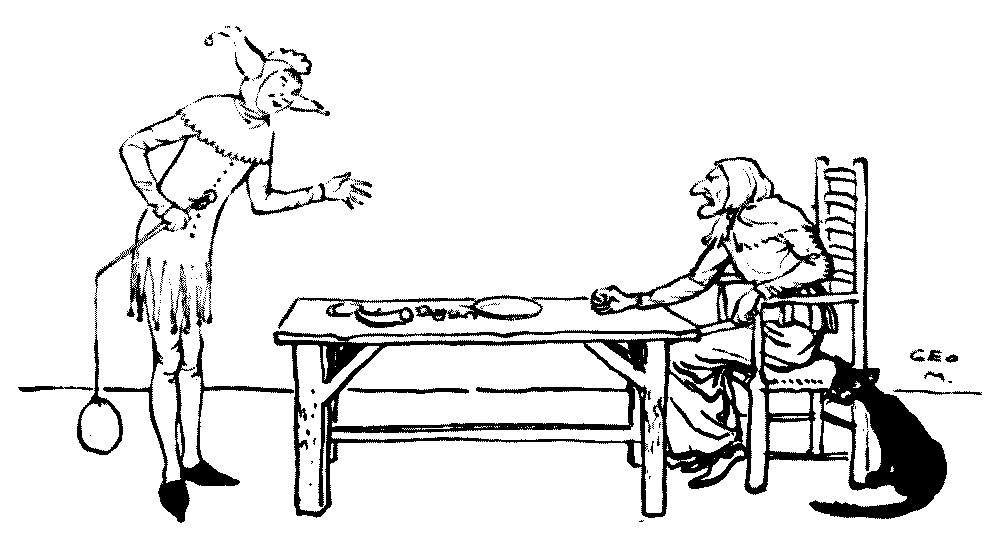
“I’ll do my best, dame,” said Baldry, rousing himself. “Perhaps a few rib-tickling conundrums will please you. If so, tell me the difference between an unripe gooseberry——”
“Shan’t!” shouted Mother Meldrum.
“Oh—then would you like a merry song?”
“Not a bit.”
“Oh—then perhaps—perhaps a jolly tale would please you.”
“Let’s hear your jolly tale,” she said, after a moment’s consideration.
“Well, then, good dame,” said Baldry, making a special effort, “there was once an honest collector of the King’s taxes who——”
“Don’t believe it.”
“But this one was honest,” pleaded Baldry.
“Then why didn’t you say he was a freak? Go on.”
“And this collector of taxes was on his way home after the day’s toil, riding on his ass, when he met three beggars, who begged of him——”
“Well, that’s what they usually do, isn’t it? What’s there funny about that?”
“Nothing very much,” replied Baldry. “But it will get better as I go on.”
“Go on, then, what are you waiting for?”
“And so, good dame, being charitable as well as honest, he gave to the first beggar a penny, to the second a piece of sausage, and to the third a small loaf of bread. But the first beggar, having had a full meal some half-hour before——”
“Excuse me for stopping you,” interrupted Mother Meldrum, “but I don’t think I care to hear any more. You say it is meant to be a funny tale, don’t you?”
“It is generally so considered,” replied Baldry sulkily.
“To me,” said the old woman, “it’s about as funny as a bilious attack.”
To those who know from experience—as I confess I do—how painful it is to have one’s verbal efforts to be sparkling received with cold, unappreciative looks or smiles in which pity lurks behind a mere pretence at mirth, will appreciate how Baldry suffered from this really pointed rudeness. He stood looking miserably at the venomous old person, too distressed to notice that Sylvia was endeavouring to console him by patting his hand. His profession was to make laughter, to spread good humour, to (at meal times) set the table in a roar; yet he was roaming the earth, an outcast, because of the ill-success of his late jest with the King, and now he had failed again. Was he losing his power to captivate? That is what troubled him.
A Change of Tone
Mother Meldrum got up and went back to her cooking, leaving them standing, with Sylvia still knee deep in black cats.
“Look here, Mum,” said Gorbo, after an uncomfortable interval of silence, “Golithos told me you’d be kind enough to tell me——”
“Golithos?” The old woman turned round smartly. “So you saw Golithos, did you?”
“Yes, Mum, we stayed one night at his place. He said you came to see him sometimes, and he told us to wait there for you.”
“Then what made you leave him?”
“Because—well, because——” Gorbo felt that perhaps, if she was friendly to Golithos, she might not think highly of his offer to send three arrows through his head.
Mother Meldrum went to her stool and sat thinking and thinking, with her eyes wandering from Gorbo to the children. Suddenly she gave a tremendous chuckle that made them all jump. Then she jumped up briskly and patted Sylvia on the shoulder and told her to sit down.
“And sit down, all of you,” she went on. “What are you all standing for? There are stools enough. You must be hungry too, but I’ll soon have some dinner ready. I wouldn’t like you to go away saying that old Mother Meldrum didn’t feed you properly.”