Part 4 — XXI
Reading edition
Kitty fell back in silence, staring at William. She loosened her mantle and threw it off, then she sat down in a chair near the wood fire, and bent over it, shivering.
"Of course you didn't mean that, William?" she said, at last.
Ashe turned.
"I should not have said it unless I had meant every word of it. It is, of course, the only thing to be done."
Kitty looked at him miserably. "But you can't mean that—that you'll resign because of that book?"
She pulled it towards her and turned over the pages with a hand that trembled. "That would be too foolish!"
Ashe made no reply. He was standing before the fire, with his hands in his pockets, and a face half absent, half ironical, as though his mind followed the sequences of a far distant future.
"William!" She caught the sleeve of his coat with a little cry. "I wrote that book because I thought it would help you."
His attention came back to her.
"Yes, Kitty, I believe you did."
She gulped down a sob. His tone was so odd, so remote.
"Many people have done such things. I know they have. Why—why, it was only meant—as a skit—to make people laugh! There's no harm in it, William."
Ashe, without speaking, took up the book and looked back at certain pages, which he seemed to have marked. Kitty's feeling as she watched him was the feeling of the condemned culprit, held dumb and strangled in the grip of his own sense of justice, and yet passionately conscious how much more he could say for himself than anybody is ever likely to say for him.
"When did you have the first idea of this book, Kitty?"
"About a year ago," she said, in a low voice.
"In October? At Haggart?"
Kitty nodded.
Ashe thought. Her admission took him back to the autumn weeks at Haggart, after the Cliffe crisis and the rearrangement of the ministry in the July of that year. He well remembered that those weeks had been weeks of special happiness for both of them. Afterwards, the winter had brought many renewed qualms and vexations. But in that period, between the storms of the session and Kitty's escapades in the hunting-field, memory recalled a tender, melting time—a time rich in hidden and exquisite hours, when with Kitty on his breast, lip to lip and heart to heart, he had reaped, as it seemed to him, the fruits of that indulgence which, as he knew, his mother scorned. And at that very moment, behind his back, out of his sight, she had begun this atrocious thing.
He looked at her again—the bitterness almost at his lips, almost beyond his control.
"I wish I knew what could have been your possible object in writing it?"
She sat up and confronted him. The color flamed back again into her pale cheeks.
"You know I told you—when we had that talk in London—that I wanted to write. I thought it would be good for me—would take my thoughts off—well, what had happened. And I began to write this—and it amused me to find I could do it—and I suppose I got carried away. I loved describing you, and glorifying you—and I loved making caricatures of Lady Parham—and all the people I hated. I used to work at it whenever you were away—or I was dull and there was nothing to do.
"Did it never occur to you," said Ashe, interrupting, "that it might get you—get us both—into trouble, and that you ought to tell me?"
She wavered.
"No!" she said, at last. "I never did mean to tell you, while I was writing it. You know I don't tell lies, William! The real fact is, I was afraid you'd stop it."
"Good God!" He threw up his hands with a sound of amazement, then thrust them again into his pockets and began to pace up and down.
"But then"—she resumed—"I thought you'd soon get over it, and that it was funny—and everybody would laugh—and you'd laugh—and there would be an end of it."
He turned and stared at her. "Frankly, Kitty—I don't understand what you can be made of! You imagined that that sketch of Lord Parham"—he struck the open page—"a sketch written by my wife, describing my official chief—when he was my guest—under my own roof—with all sorts of details of the most intimate and offensive kind—mocking his speech—his manners—his little personal ways—charging him with being the corrupt tool of Lady Parham, disloyal to his colleagues, a man not to be trusted—and justifying all this by a sort of evidence that you could only have got as my wife and Lord Parham's hostess—you actually supposed that you could write and publish that!—without in the first place its being plain to every Tom, Dick, and Harry that you had written it—and in the next, without making it impossible for your husband to remain a colleague of the man you had treated in such a way? Kitty!—you are not a stupid woman! Do you really mean to say that you could write and publish this book without knowing that you were doing a wrong action—which, so far from serving me, could only damage my career irreparably? Did nothing—did no one warn you—if you were determined to keep such a secret from your husband, whom it most concerned?"
He had come to stand beside her, both hands on the back of a chair—stooping forward to emphasize his words—the lines of his fine face and noble brow contracted by anger and pain.
"Mr. Darrell warned me," said Kitty, in a low voice, as though those imperious eyes compelled the truth from her—"but of course I didn't believe him."
"Darrell!" cried Ashe, in amazement—"Darrell! You confided in him?"
"I told him all about it. It was he who took it to a publisher."
"Hound!" said Ashe, between his teeth. "So that was his revenge."
"Oh, you needn't blame him too much," said Kitty, proudly, not understanding the remark. "He wrote to me not long ago to say it was horribly unwise—and that he washed his hands of it."
"Ay—when he'd done the deed! When did you show it him?" said Ashe, impetuously.
"At Haggart—in August."
"Et tu, Brute!" said Ashe, turning away. "Well, that's done with. Now the only thing to do is to face the music. I go home. Whatever can be done to withdraw the book from circulation I shall, of course, do; but I gather from this precious letter"—he held up the note which had been enclosed in the parcel—"that some thousands of copies have already been ordered by the booksellers, and a few distributed to 'persons in high places.'"
"William," she said, in despair, catching his arm again—"listen! I offered the man two hundred pounds only yesterday to stop it."
Ashe laughed.
"What did he reply?"
"He said it was impossible. Fifty copies had been already issued."
"The review copies, no doubt. By next week there will be, I should say, five thousand in the shops. Your man understands his business, Kitty. This is the kind of puff preliminary he has been scattering about."
And with sparkling eyes he handed to her a printed slip containing an outline of the book for the information of the booksellers.
It drew attention to the extraordinary interest of the production as a painting of the upper class by the hand of one belonging to its inmost circle. "People of the highest social and political importance will be recognized at once; the writer handles cabinet ministers and their wives with equal freedom, and with a touch betraying the closest and most intimate knowledge. Details hitherto quite unknown to the public of ministerial combinations and intrigues—especially of the feminine influences involved—will be found here in their lightest and most amusing form. A certain famous fancy ball will be identified without difficulty. Scathing as some of the portraits are, the writer is by no means merely cynical. The central figure of the book is a young and rising statesman, whose aim and hopes are touched with a loving hand—the charm of the portrait being only equalled by the venom with which the writer assails those who have thwarted or injured his hero. But our advice is simply—'Buy and Read!' Conjecture will run wild about the writer. All we can say is that the most romantic or interesting surmise that can possibly be formed will fall far short of the reality."
"The beast is a shrewd beast!" said Ashe, as he raised himself from the stooping position in which he had been following the sentences over Kitty's shoulder. "He knows that the public will rush for his wares! How much money did he offer you, Kitty?"
He turned sharply on his heel to wait for her reply.
"A hundred pounds," said Kitty, almost inaudibly—"and a hundred more if five thousand sold." She had returned again to her crouching attitude over the fire.
"Generous!—upon my word!" said Ashe, scornfully turning over the two thick-leaved, loosely printed Mudie volumes. "A guinea to the public, I suppose—fifteen shillings to the trade. Darrell didn't exactly advise you to advantage, Kitty."
Kitty kept silence. The sarcastic violence of his tone fell on her like a blow. She seemed to shrink together; while Ashe resumed his walk to and fro.
Presently, however, she looked up, to ask, in a voice that tried for steadiness:
"What do you mean to do—exactly—William?"
"I shall, of course, buy up all I can; I shall employ some lawyer fellow, and appeal to the good feelings of the newspapers. There will be no trouble with the respectable ones. But some copies will get out, and some of the Opposition newspapers will make capital out of them. Naturally!—they'd be precious fools if they didn't."
A momentary hope sprang up in Kitty.
"But if you buy it up—and stop all the papers that matter," she faltered—"why should you resign, William? There won't be—such great harm done."
For answer he opened the book, and without speaking pointed to two passages—the first, an account full of point and malice of the negotiations between himself and Lord Parham at the time when he entered the cabinet, the conditions he himself had made, and the confidential comments of the Premier on the men and affairs of the moment.
"Do you remember the night when I told you those things, Kitty?"
Yes, Kitty remembered well. It was a night of intimate talk between man and wife, a night when she had shown him her sweetest, tenderest mood, and he—incorrigible optimist!—had persuaded himself that she was growing as wise as she was lovely.
Her lip trembled. Then he pointed to the second—to the pitiless picture of Lord Parham at Haggart.
"You wrote that—when he was under our roof—there by our pressing invitation! You couldn't have written it—unless he had so put himself in your power. A wandering Arab, Kitty, will do no harm to the man who has eaten and drunk in his tent!"
She looked up, and as she read his face she understood at last how what she had done had outraged in him all the natural and all the inherited instincts of a generous and fastidious nature. The "great gentleman," so strong in him as in all the best of English statesmen, whether they spring from the classes or the masses, was up in arms.
She sprang to her feet with a cry. "William, you can't give up politics! It would make you miserable."
"That can't be helped. And I couldn't go on like this, Kitty—even if this affair of the book could be patched up. The strain's too great."
They were but a yard apart, and yet she seemed to be looking at him across a gulf.
"You have been so happy in your work!" This time the sob escaped her.
"Oh, don't let's talk about that," he said, abruptly, as he walked away. "There'll be a certain relief in giving up the impossible. I'll go back to my books. We can travel, I suppose, and put politics out of our heads."
"But—you won't resign your seat?"
"No," he said, after a pause—"no. As far as I can see at present, I sha'n't resign my seat, though my constituents, of course, will be very sick. But I doubt whether I shall stand again."
Every phrase fell as though with a thud on Kitty's ear. It was the wreck of a man's life, and she had done it.
"Shall you—shall you go and see Lord Parham?" she asked, after a pause.
"I shall write to him first. I imagine"—he pointed to the letter lying on the table—"that creature has already sent him the book. Then later I daresay I shall see him."
She looked up.
"If I wrote and told him it was all my doing, William?—if I grovelled to him?"
"The responsibility is mine," he said, sternly. "I had no business to tell even you the things printed there. I told them at my own risk. If anything I say has any weight with you, Kitty, you will write nothing."
She spread out her hands to the fire again, and he heard her say, as though to herself:
"The thing is—the awful thing is, that I'm mad—I must be mad. I never thought of all this when I was writing it. I wrote it in a kind of dream. In the first place, I wanted to glorify you—"
He broke into an exclamation.
"Your taste, Kitty!—where was your taste? That a wife should praise a husband in public! You could only make us both laughing-stocks."
His handsome features quivered a little. He felt this part of it the most galling, the most humiliating of all; and she understood. In his eyes she had shown herself not only reckless and treacherous, but indelicate, vulgar, capable of besmirching the most sacred and intimate of relations.
She rose from her seat.
"I must go and take my things off," she said, in "a vague voice," and as she moved she tottered a little. He turned to look at her. Amid his own crushing sense of defeat and catastrophe, his natural and righteous indignation, he remembered that she had been ill—he remembered their child. But whether from the excitement, first of the meeting in the Vercelli palace, and now of this scene—or merely from the heat of the fire over which she had been hanging, her cheeks were flushed, her eyes blazed. Her beauty had never been more evident; but it made little appeal to him; it was the wild, ungovernable beauty from which he had suffered. He saw that she was excited, but there was an air also of returning physical vigor; and the nascent feeling which might have been strengthened by pallor and prostration died away.
Kitty moved as though to pass him and go to her room, which opened out of the salon. But as she neared him she suddenly caught him by the arm.
"William!—William! don't do it!—don't resign! Let me apologize!"
He was angered by her persistence, and merely said, coldly:
"I have given you my reasons, Kitty, why such a course is impossible."
"And—and you start to-morrow morning?"
"By the early train. Please let me go, Kitty. There are many things to arrange. I must order the gondola, and see if the people here can cash me a check."
"You mean—to leave me alone?" The words had a curious emphasis.
"I had a few words with Miss French before you came in. The packet arrived by the evening post, and seeing that it was books—for you—I opened it. After about an hour"—he turned and walked away again—"I saw my bearings. Then I called Miss French, told her I should have to go to-morrow, and asked her how long she could stay with you."
"William!" cried Kitty again, leaning heavily on the table beside her—"don't go!—don't leave me!"
His face darkened.
"So you would prevent me from taking the only honorable, the only decent way out of this thing that remains to me?"
She made no immediate reply. She stood—wrapped apparently in painful abstraction—a creature lovely and distraught. The masses of her fair hair loosened by the breeze on the canal had fallen about her cheeks and shoulders; her black hat framed the white brow and large, feverish eyes; and the sable cape she had worn in the gondola had slipped down over the thin, sloping shoulders, revealing the young figure and the slender waist. She might have been a child of seventeen, grieving over the death of her goldfinch.
Ashe gathered together his official letters and papers, found his check-book, and began to write. While he wrote he explained that Miss French could keep her company at least another fortnight, that he could leave with them four or five circular notes for immediate expenses, and would send more from home directly he arrived.
In the middle of his directions Kitty once more appealed to him in a passionate, muffled voice not to go. This time he lost his temper, and without answering her he hastily left the room to arrange his packing with his valet.
When he returned to the salon Kitty was not there. He and Miss French—who knew only that something tragic had happened in which Kitty was concerned—kept up a fragmentary conversation till dinner was announced and Kitty entered. She had evidently been weeping, but with powder and rouge she had tried to conceal the traces of her tears; and at dinner she sat silent, hardly answering when Margaret French spoke to her.
After dinner Ashe went out with his cigar towards the Piazza. He was in a smarting, dazed state, beginning, however, to realize the blow more than he had done at first. He believed that Parham himself would not be at all sorry to be rid of him. He and his friends formed a powerful group both in the cabinet and out of it. But they were forcing the pace, and the elements of resistance and reaction were strong. He pictured the dismay of his friends, the possible breakdown of the reforming party. Of course they might so stand by him—and the suppression of the book might be so complete—
At this moment he caught sight of a newspaper contents bill displayed at the door of the only shop in the Piazza which sold English newspapers. One of the lines ran, "Anonymous attack on the Premier." He started, went in and bought the paper. There, in the "London Topics" column, was the following paragraph:
"A string of extracts from a forthcoming book, accompanied by a somewhat startling publisher's statement, has lately been sent round to the press. We are asked not to print them before the day of publication, but they have already roused much attention, if not excitement. They certainly contain a very gross attack on the Prime Minister, based apparently on first-hand information, and involving indiscretions personal and political of an unusually serious character. The wife of a cabinet minister is freely named as the writer, and even if no violation of cabinet secrecy is concerned, it is clear that the book outrages the confidential relations which ought to subsist between a Premier and his colleagues, if government on our English system is to be satisfactorily carried on. The statements it makes with every appearance of authority both as to the relations between Lord Parham and some of the most important members of his cabinet, and as to the Premier's intentions with regard to one or two of the most vital questions now before the country, are calculated seriously to embarrass the government. We fear the book will have a veritable succès de scandale."
"That fellow at least has done his best to kick the ball, damn him!" thought Ashe, with contempt, as he thrust the paper into his pocket.
It was no more than he expected; but it put an end to all thoughts of a more hopeful kind. He walked up and down the Piazza smoking, till midnight, counting the hours till he could reach London, and revolving the phrases of a telegram to be sent to his solicitor before starting.
Kitty made no sign or sound when he entered her room. Her fair head was turned away from him, and all was dark. He could hardly believe that she was asleep; but it was a relief to him to accept her pretence of it, and to escape all further conversation. He himself slept but little. The mere profundity of the Venetian silence teased him; it reminded him how far he was from home.
Two images pursued him—of Kitty writing the book, while he was away electioneering or toiling at his new office—and then, of his returns to Haggart—tired or triumphant—on many a winter evening, of her glad rush into his arms, her sparkling face on his breast.
Or again, he conjured up the scene when the MS. had been shown to Darrell—his pretence of disapproval, his sham warnings, and the smile on his sallow face as he walked off with it. Ashe looked back to the early days of his friendship with Darrell, when he, Ashe, was one of the leaders at Eton, popular with the masters in spite of his incorrigible idleness, and popular with the boys because of his bodily prowess, and Darrell had been a small, sickly, bullied colleger. Scene after scene recurred to him, from their later relations at Oxford also. There was a kind of deliberation in the way in which he forced his thoughts into this channel; it made an outlet for a fierce bitterness of spirit, which some imperious instinct forbade him to spend on Kitty.
He dozed in the later hours of the night, and was roused by something touching his hand, which lay outside the bedclothes. Again the little head!—and the soft curls. Kitty was there—crouched beside him—weeping. There flashed into his mind an image of the night in London when she had come to him thus; and unwelcome as the whole remembrance was, he was conscious of a sudden swelling wave of pity and passion. What if he sprang up, caught her in his arms, forgave her, and bade the world go hang!
No! The impulse passed, and in his turn he feigned sleep. The thought of her long deceit, of the selfish wilfulness wherewith she had requited deep love and easy trust, was too much; it seared his heart. And there was another and a subtler influence. To have forgiven so easily would have seemed treachery to those high ambitions and ideals from which—as he thought, only too certainly—she had now cut him off. It was part of his surviving youth that the catastrophe seemed to him so absolute. Any thought of the fresh efforts which would be necessary for the reconquering of his position was no less sickening to him than that of the immediate discomforts and humiliations to be undergone. He would go back to books and amusement; and in the idling of the future there would be plenty of time for love-making.
In the morning, when all preparations were made, the gondoliers waiting below, Ashe's telegram sent, and the circular notes handed over to Margaret French, who had discreetly left the room, William approached his wife.
"Good-bye!" said Kitty, and gave him her hand, with a strange look and smile.
Ashe, however, drew her to him and kissed her—against her will. "I'll do my best, Kitty," he said, in a would-be cheery voice—"to pull us through. Perhaps—I don't know!—things may turn out better than I think. Good-bye. Take care of yourself. I'll write, of course. Don't hurry home. You'll want a fortnight or three weeks yet."
Kitty said not a word, and in another minute he was gone. The Italian servants congregated below at the water-gate sent laughing "A rivederlas" after the handsome, good-tempered Englishman, whom they liked and regretted; the gondola moved off; Kitty heard the plash of the water. But she held back from the window.
Half-way to the bend of the canal beyond the Accademia, Ashe turned and gave a long look at the balcony. No one was there. But just as the gondola was passing out of sight, Kitty slipped onto the balcony. She could see only the figure of Piero, the gondolier, and in another second the boat was gone. She stayed there for many minutes, clinging to the balustrade and staring, as it seemed, at the sparkle of autumnal sun which danced on the green water and on the red palace to her right.
All the morning Kitty on her sofa pretended to write letters. Margaret French, working or reading behind her, knew that she scarcely got through a single note, that her pen lay idle on the paper, while her eyes absently watched the palace windows on the other side of the canal. Miss French was quite certain that some tragic cause of difference between the husband and wife had arisen. Kitty, the indiscreet, had for once kept her own counsel about the book, and Ashe had with his own hands packed away the volumes which had arrived the night before; so that she could only guess, and from that delicacy of feeling restrained her as much as possible.
Once or twice Kitty seemed on the point of unburdening herself. Then overmastering tears would threaten; she would break off and begin to write. At luncheon her look alarmed Miss French, so white was the little face, so large and restless the eyes. Ought Mr. Ashe to have left her, and left her apparently in anger? No doubt he thought her much better. But Margaret remembered the worst days of her illness, the anxious looks of the doctors, and the anguish that Kitty had suffered in the first weeks after her child's death. She seemed now, indeed, to have forgotten little Harry, so far as outward expression went; but who could tell what was passing in her strange, unstable mind? And it often seemed to Margaret that the signs of the past summer were stamped on her indelibly, for those who had eyes to see.
Was it the perception of this pity beside her that drove Kitty to solitude and flight? At any rate, she said after luncheon that she would go to Madame d'Estrées, and did not ask Miss French to accompany her.
She set out accordingly with the two gondoliers. But she had hardly passed the Accademia before she bid her men take a cross-cut to the Giudecca. On these wide waters, with their fresher air and fuller sunshine, a certain physical comfort seemed to breathe upon her.
"Piero, it is not rough! Can we go to the Lido?" she asked the gondolier behind her.
Piero, who was all smiles and complaisance, as well he might be with a lady who scattered lire as freely as Kitty did, turned the boat at once for that channel "Del Orfano" where the bones of the vanquished dead lie deep amid the ooze.
They passed San Giorgio, and were soon among the piles and sand-banks of the lagoon. Kitty sat in a dream which blotted the sunshine from the water. It seemed to her that she was a dead creature, floating in a dead world. William had ceased to love her. She had wrecked his career and destroyed her own happiness. Her child had been taken from her. Lady Tranmore's affection had been long since alienated. Her own mother was nothing to her; and her friends in society, like Madeleine Alcot, would only laugh and gloat over the scandal of the book.
No—everything was finished! As her fingers hanging over the side of the gondola felt the touch of the water, her morbid fancy, incredibly quick and keen, fancied herself drowned, or poisoned—lying somehow white and cold on a bed where William might see and forgive her.
Then with a start of memory which brought the blood rushing to her face, she thought of Cliffe standing beside the door of the great hall in the Vercelli palace—she seemed to be looking again into those deep, expressive eyes, held by the irony and the passion with which they were infused. Had the passion any reference to her?—or was it merely part of the man's nature, as inseparable from it as flame from the volcano? If William had cast her off, was there still one man—wild and bad, indeed, like herself, but poet and hero nevertheless—who loved her?
She did not much believe it; but still the possibility of it lured her, like some dark gulf that promised her oblivion from this pain—pain which tortured one so impatient of distress, so hungry for pleasure and praise.
In those days the Lido was still a noble and solitary shore, without the degradations of to-day.
Kitty walked fast and furiously across the sandy road, and over the shingles, turning, when she reached the firm sand, southward towards Malamocco. It was between four and five, and the autumn afternoon was fast declining. A fresh breeze was on the sea, and the short waves, intensely blue under a wide, clear heaven, broke in dazzling foam on the red-brown sand.
She seemed to be alone between sea and sky, save for two figures approaching from the south—a fisher-boy with a shrimping-net and a man walking bareheaded. She noticed them idly. A mirage of sun was between her and them, and the agony of remorse and despair which held her blunted all perceptions.
Thus it was that not till she was close upon him did her dazzled sight recognize Geoffrey Cliffe.
He saw her first, and stopped in motionless astonishment on the edge of the sand. She almost ran against him, when his voice arrested her.
"Lady Kitty!"
She put her hand to her breast, wavered, and came to a stand-still. He saw a little figure in black between him and those "gorgeous towers and cloud-capped palaces" of Alpine snow, which dimly closed in the north; and beneath the drooping hat a face even more changed and tragic than that which had haunted him since their meeting of the day before.
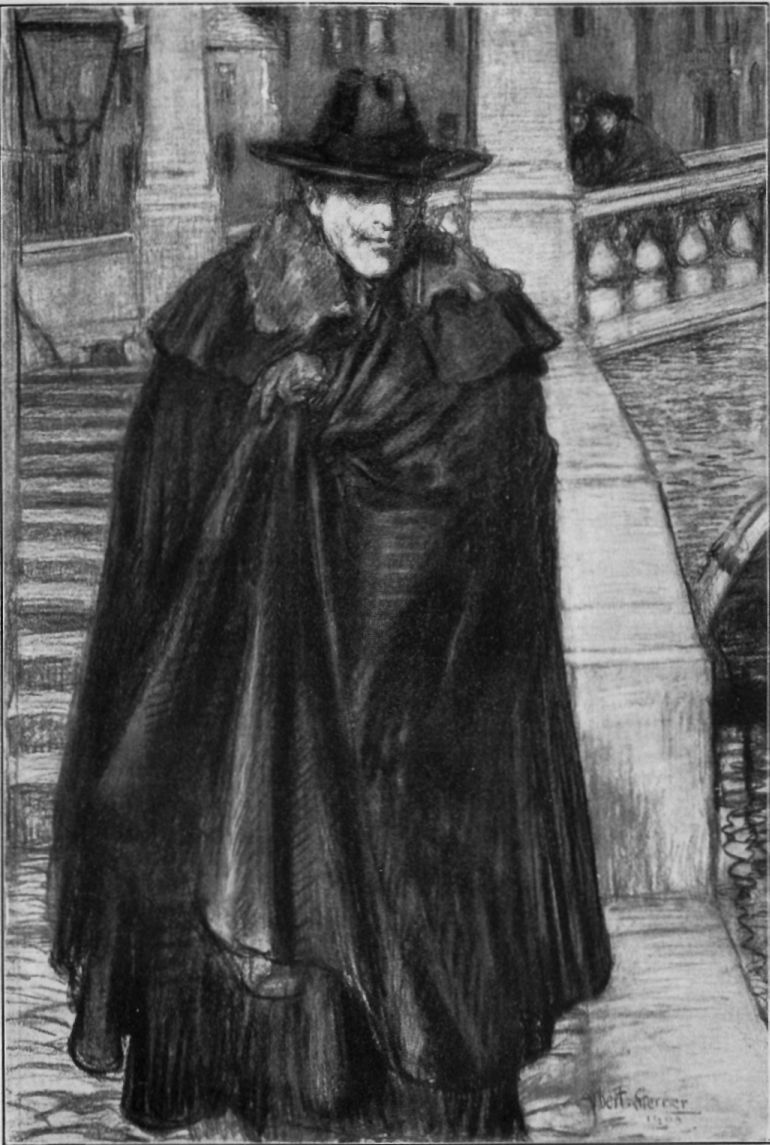
"SHE THOUGHT OF CLIFFE STANDING BESIDE THE DOOR OF THE GREAT HALL."
"How do you do?" she said, mechanically, and would have passed him. But he stood in her path. As he stared at her an impulse of rage ran through him, resenting the wreck of anything so beautiful—rage against Ashe, who must surely be somehow responsible.
"Aren't you wandering too far, Lady Kitty?" His voice shook under the restraint he put upon it. "You seem tired—very tired—and you are perhaps farther from your gondola than you think."
"I am not tired."
He hesitated.
"Might I walk with you a little, or do you forbid me?"
She said nothing, but walked on. He turned and accompanied her. One or two questions that he put to her—Had she companions?—Where had she left her gondola?—remained unanswered. He studied her face, and at last he laid a strong hand upon her arm.
"Sit down. You are not fit for any more walking."
He drew her towards some logs of driftwood on the upper sand, and she sank down upon them. He found a place beside her.
"What is the matter with you?" he said, abruptly, with a harsh authority. "You are in trouble."
A tremor shook her—as of the prisoner who feels on his limbs the first touch of the fetter.
"No, no!" she said, trying to rise; "it is nothing. I—I didn't know it was so far. I must go home."
His hand held her.
"Kitty!"
"Yes." Her voice was scarcely audible.
"Tell me what hurts you! Tell me why you are here, alone, with a face like that! Don't be afraid of me! Could I lift a finger to harm a mother that has lost her child? Give me your hands." He gathered both hers into the warm shelter of his own. "Look at me—trust me! My heart has grown, Kitty, since you knew me last. It has taken into itself so many griefs—so many deaths. Tell me your griefs, poor child!—tell me!"
He stooped and kissed her hands—most tenderly, most gravely.
Tears rushed into her eyes. The wild emotions that were her being were roused beyond control. Bending towards him she began to pour out, first brokenly, then in a torrent, the wretched, incoherent story, of which the mere telling, in such an ear, meant new treachery to William and new ruin for herself.