Book 2 — CHAPTER III. THE POPE GREGORY VII.
Reading edition
The career of Hildebrand up to the moment in which he ascended the papal throne could scarcely be called other than a successful one. He had attained many of his aims. He had awakened the better part of the Church to a sense of the vices that had grown up in her midst, purified in many quarters the lives of her priests, and elevated the mind and ideal of Christendom. But bad as the vices of the clergy were, the ruling curse of simony was worse, to a man whose prevailing dream and hope was that of a great power holding up over all the world the standards of truth and righteousness in the midst of the wrongs and contentions of men. A poor German priest holding fast in his distant corner by the humble wife or half-permitted female companion at whose presence law and charity winked, was indeed a dreadful thought, meaning dishonour and sacrilege to the austere monk; but the bishops and archbishops over him who were so little different from the fierce barons, their kin and compeers, who had procured their benefices by the same intrigues, the same tributes and subserviences, the same violence, by which these barons in many cases held their fiefs, how was it possible that such men could hold the balance of justice, and promote peace and purity and the reign of God over the world? That they should help in any way in that great mission which the new Pope felt himself to have received from the Head of the Church was almost beyond hope. They vexed his soul wherever he turned, men with no motive, no inspiration beyond that of their fellows, ready to scheme and struggle for the aggrandisement of the Church, if you will—for the increase of their own greatness and power and those of the corporations subject to them: but as little conscious of that other and holier ambition, that hope and dream of a reign of righteousness, as were their fellows and brethren, the dukes and counts, the fighting men, the ambitious princes of Germany and Lombardy. Until the order of chiefs and princes of the Church could be purified, Hildebrand had known, and Gregory felt to the bottom of his heart, that nothing effectual could be done.
The Cardinal Archdeacon of Rome, under Popes less inspired than himself—who were, however, if not strong enough to originate, at least acquiescent, and willing to adopt and sanction what he did—had carried on a holy war against simony wherever found. He had condemned it by means of repeated councils, he had poured forth every kind of appeal to men's consciences, and exhortations to repentance, without making very much impression. The greatest offices were still sold in spite of him. They were given to tonsured ruffians and debauchees who had no claim but their wealth to ascend into the high places of the Church, and who, in short, were but secular nobles with a difference, and the fatal addition of a cynicism almost beyond belief, though singularly mingled at times with superstitious terrors. Hildebrand had struggled against these men and their influence desperately, by every means in his power: and Pope Gregory, with stronger methods at command, was bound, if possible, to extirpate the evil. This had raised him up a phalanx of enemies on every side, wherever there was a dignitary of the Church whose title was not clear, or a prince who derived a portion of his revenue from the traffic in ecclesiastical appointments. The degenerate young King not yet Emperor, who supported his every scheme of rapine and conquest by the gold of the ambitious priests whom he made into prelates at his will, was naturally the first of these enemies: Guibert of Ravenna, more near and readily offensive, one of the most powerful ecclesiastical nobles in Italy, sat watchful if he might catch the new Pope tripping, or find any opportunity of accusing him: Robert Guiscard, the greatest of the Normans, who had been so much the servant and partisan of the late Popes, remained sullen and apart, giving no allegiance to this: Rome itself was surrounded by a fierce and audacious nobility, who had always been the natural enemies of the Pope, unless when he happened to be their nominee, and more objectionable than themselves. Thus the world was full of dark and scowling faces. A circle of hostility both at his gates and in the distance frowned unkindly about him, when the age of Hildebrand was over, and that of Gregory began. All his great troubles and sufferings were in this latter part of his life. Nothing in the shape of failure had befallen him up to this point. He had met with great respect and honour, his merit and power had been recognised almost from his earliest years. Great princes and great men—Henry himself, the father of the present degenerate Henry, a noble Emperor, honouring the Church and eager for its purification—had felt themselves honoured by the friendship of the monk who had neither family nor wealth to recommend him. But when Pope Gregory issued from his long probation and took into his hand the papal sceptre, all these things had changed. Whether he was aware by any premonition of the darker days upon which he had now fallen who can say? It is certain that confronting them he bated no jot of heart or hope.
He appears to us at first as very cautious, very desirous of giving the adversary no occasion to blaspheme. The summons issued in the name of the late Pope to Henry requiring him to appear and answer in Rome the charges made against him, seems to have been dropped at Alexander's death: and when his messengers came over the Alps demanding by what right a Pope had been consecrated without his consent, Gregory made mild reply that he was not consecrated, but was awaiting not the nomination but the consent of the Emperor, and that not till that had been received would he carry out the final rites. These were eventually performed with some sort of acquiescence from Henry, given through his wise and prudent ambassador, on the Feast of St. Peter, the 29th June, 1073. Gregory did what he could, as appears, to continue this mild treatment of Henry with all regard to his great position and power. He attempted to call together a very intimate council to discuss the state of affairs between the King and himself: a council of singular construction, which, but that the questions as to the influence and place of women are questions as old as history, and have been decided by every age according to no formal law but the character of the individuals before them, might be taken for an example of enlightenment before his time in Gregory's mind. He invited Duke Rudolf of Suabia, one of Henry's greatest subjects, a man of religious character and much reverence for the Holy See, to come to Rome, and in common with himself, the Empress Agnes, the two Countesses of Tuscany, the Bishop of Como (who was the confessor of Agnes), and other God-fearing persons, to consider the crisis at which the Church had arrived, and to hear and give advice upon the Pope's intentions and projects. The French historian Villemain throws discredit upon this projected consultation of "an ambitious vassal of the King of Germany and three women, one of whom had once been a prisoner in the camp of Henry III., the other had been brought up from infancy in the hate of the empire and the love of the Church, and the last was a fallen empress who was more the penitent of Rome than the mother of Henry." This seems, however, a futile enumeration. There could surely be no better defender found for a son accused than his mother, who we have no reason to suppose was ever estranged from him personally, and who shortly after went upon an embassy to him, and was received with every honour. Beatrice, on the other hand, had been the prisoner of his father the great Emperor, and not of young Henry of whom she was the relative and friend, and between whom and the Pope, as all good statesmen must have seen, it was of the greatest importance to Europe that there should be peace; while any strong personal feeling which might exist would be modified by Gregory himself, by Raymond of Como, and the wisest heads of Rome.
But this board of advice and conciliation never sat, so we need not comment upon its possible concomitants. In every act of his first year, however, Gregory showed a desire to conciliate Henry rather than to defy him. The young king had his hands very full, and his great struggle with the Saxon nobles and people was not at the moment turning in his favour. And he had various natural defenders and partisans about the Roman Court. The Abbot Hugo of Cluny, who was one of Gregory's dearest friends, had been the young king's preceptor, and bore him a strong affection. We have no reason to believe that the influence of Agnes was not all on the side of her son, if not to support his acts, at least to palliate and excuse them. With one of these in his most intimate council, and one an anxious watcher outside, both in command of his ear and attention, it would have been strange if Gregory had been unwilling to hear anything that was in Henry's favour.
And in fact something almost more than a full reconciliation seems to have been effected between the new Pope and the young king, so desirous of winning the imperial crown, and conscious that Gregory's help was of the utmost importance to him. Henry on his side wrote a letter to his "most loving lord and father," his "most desired lord," breathing such an exemplary mind, so much penitence and submission, that Gregory describes it as "full of sweetness and obedience:" while the Pope, if not altogether removing the sword that hung suspended over Henry's head, at least received his communications graciously, and gave him full time and encouragement to change his mind and become the most trusted lieutenant of the Holy See. The King was accordingly left free to pursue his own affairs and his great struggle with the Saxons without any further question of ecclesiastical interference: while Gregory spent the whole ensuing year in a visitation of Italy, and much correspondence and conference on the subject of simony and other abuses in the Church. When he returned to Rome he endeavoured, but in vain, to act as peacemaker between Henry and the Saxons. And it was not till June in the year 1074, when he called together the first of the Lateran Councils, an assembly afterwards renewed yearly, a sort of potential Convocation, that further steps were taken. With this the first note of the great warfare to follow was struck. The seriousness of the letters by which he summoned its members sufficiently shows the importance attached to it.
"The princes and governors of this world, seeking their own interest and not that of Jesus Christ, trample under foot all the veneration they owe to the Church, and oppress her like a slave. The priests and those charged with the conduct of the Church sacrifice, the law of God, renounce their obligations towards God and their flocks, seeking in ecclesiastical dignities only the glory of this world, and consuming in pomp and pride what ought to serve for the salvation of many. The people, without prelates or sage counsellors to lead them in the way of virtue, and who are instructed by the example of their chiefs in all pernicious things, go astray into every evil way, and bear the name of Christian without its works, without even preserving the principle of the faith. For these reasons, confident in the mercies of God, we have resolved to assemble a Synod in order to seek with the aid of our brethren for a remedy to these evils, and that we may not see in our time the irreparable ruin and destruction of the Church. Wherefore we pray you as a brother, and warn you in the name of the blessed Peter, prince of apostles, to appear at the day fixed, convoking by this letter, and by your own, your suffragan bishops; for we can vindicate the freedom of religion and of ecclesiastical authority with much more surety and strength according as we find ourselves surrounded by the counsels of your prudence, and by the presence of our brethren."
A few Italian princes, Gisulfo of Salerno, Azzo d'Este, Beatrice and Matilda of Tuscany, were convoked to the council and held seats in it. The measures passed were very explicit and clear. They condemned the simoniacal clergy in every rank, deposing them from their positions and commanding them to withdraw from the ministrations of the altar. The same judgment was passed upon those who lived with wives or concubines. Both classes were put beyond the pale of the Church, and the people were forbidden, on pain of sharing their doom, to receive the sacraments from them, or to yield them obedience. Nothing more thorough and far-reaching could be. Hitherto the Popes had proceeded by courts of investigation, by examination of individuals, in which the alternative of repentance and renunciation was always open to the prelate who had perhaps inadvertently fallen into these crimes. But such gentle dealings had been but very partially successful. Here and there an archbishop or great abbot had been convicted by his peers, and made to descend from his high estate—here and there a great personage had risen in his place and made confession. Some had retired to the cloister, putting all their pomps and glories aside, and made a good end. But as is usual after every religious revival, life had risen up again and gone upon its usual course, and the bishoprics thus vacated had probably been sold to the highest bidder or yielded to the most violent assailant, as if no such reformation had ever been.
The matter had gone too far now for any such occasional alleviations; and Gregory struck at the whole body of proud prelates, lords of secular as well as ecclesiastical greatness, men whose position was as powerful in politics and the affairs of the empire as was that of the princes and margraves who were their kin, and whom they naturally supported—as the others had supported them by money and influence in their rise to power: but who had very little time for the affairs of the Church, and less still for the preservation of peace and the redress of wrong.
The other measures passed at this council were more searching still; they were aimed against the disorders into which the clergy had fallen, and chiefly what was to Gregory and his followers the great criminality, of married priests, who abounded in the Church. In this the lower orders of the clergy were chiefly assailed, for the more important members of the hierarchy did not marry though they might be vicious otherwise. But the rural priests, the little-educated and but little-esteemed clerks who abounded in every town and village, were very generally affected by the vice—if vice it was—of marriage, which was half legal and widely tolerated: and their determination not to abandon it was furious. Meetings of the clergy to oppose this condemnation were held in all quarters, and often ended in riot, the priests declaring that none of the good things of the Church fell to their lot, but that rather than give up their wives, their sole compensation, they would die. This was not likely to make Gregory's proceedings less determined: but it may easily be imagined what a prodigious convulsion such an edict was likely to make in the ecclesiastical world.
It is said by the later historians that the Empress Agnes was made use of, with her attendant bishop and confessor, to carry these decrees to Henry's court: though this does not seem to be sanctioned by the elder authorities, who place the mission of Agnes in the previous year, and reckon it altogether one of peace and conciliation. But Henry still continued in a conciliatory frame of mind. His own affairs were not going well, and he was anxious to retain the Pope's support in the midst of his conflicts with his subjects. Neither do the great dignitaries appear to have made any public protest or resistance: it was the poor priests upon whom individually this edict pressed heavily, who were roused almost to the point of insurrection.
One of the most curious effects of the decree was the spirit roused among the laity thus encouraged to judge and even to refuse the ministrations of an unworthy priest. Not only was their immediate conduct affected to acts of spiritual insubordination, but a fundamental change seems to have taken place in their conception of the priest's character. No doubt Gregory's legislation must have originated that determined though illogical opposition to a married priesthood, and disgust with the idea, which has had so singular a sway in Catholic countries ever since, and which would at the present moment we believe make any change in the celibate character of the priesthood impossible even were all other difficulties overcome. We are not aware that it had existed in any force before. The thing had been almost too common for remark: and there seems to have been no fierce opposition to the principle. It arose now gradually yet with a force beyond control: there were many cases of laymen baptizing their children themselves, rather then give them into the hands of a polluted priest—until there arose almost a risk of general indifference to this sacrament because of the rising conviction that the hands which administered it were unworthy: and other religious observances were neglected in the same way, an effect which must have been the reverse of anything intended by the Pope. To this hour in all Catholic countries an inexpressible disgust with the thought, mingles even with the theory that perhaps society might be improved were the priest a married man, and so far forced to content himself with the affairs of his own house. Probably it was Gregory's strong denunciation, and his charge to the people not to reverence, not to obey men so soiled: as well as the conviction long cultivated by the Church, and by this time become a dogma, that the ascetic life was in all cases the holiest—which originated this powerful general sentiment, more potent in deciding the fact of a celibate clergy than all the ecclesiastical decrees in the world.
In the second Lateran Council held in the next year, at the beginning of Lent, along with the reiteration of the laws in respect to simony and the priesthood, a solemn decree against lay investiture was passed by the Church. This law transferred the struggle to a higher ground. It was no longer bishops and prelates of all classes, no longer simple priests, but the greatest sovereigns, all of whom had as a matter of course given ecclesiastical benefices as they gave feudals fiefs, who were now involved. The law was as follows:
"Whosoever shall receive from the hands of a layman a bishopric, or an abbey, shall not be counted among the bishops and abbots, nor share their privileges. We interdict him from entrance into the Church and from the grace of St. Peter until he shall have resigned the dignity thus acquired by ambition and disobedience, which are equal to idolatry. Also, if any emperor, duke, marquis, count, or other secular authority shall presume to give investiture of a bishopric or other dignity of the Church, let him understand that the same penalty shall be exacted from him."
The position of affairs between Pope and Emperor was thus fundamentally altered. The father of Henry, a much more faithful son of the Church, had almost without opposition made Popes by his own will where now his son was interdicted from appointing a single bishop. The evil was great enough perhaps for this great remedy, and Gregory, who had gone so far, was restrained now by no prudent precautions from proceeding to the utmost length possible. The day of prudence was over; he had entered upon a path in which there was no drawing back. That it was not done lightly or without profound and painful thought, and a deep sense of danger and impending trouble, is apparent from the following letter in which the Pope unbosoms himself to the head of his former convent, the great Hugo of Cluny, his own warm friend, and at the same time Henry's tutor and constant defender.
"I am overwhelmed (he writes) with great sorrow and trouble. Wherever I look, south, north, or west, I see not a single bishop whose promotion and conduct are legal, and who governs the Christian people for the love of Christ, and not by temporal ambition. As for secular princes, there is not one who prefers the glory of God to his own, or justice to interest. Those among whom I live—the Romans, the Lombards, the Normans—are, as I tell them to their faces, worse than Jews and Pagans. And when I return within myself, I am so overwhelmed by the weight of life that I feel no longer hope in anything but the mercy of Christ."
Notwithstanding the supreme importance of this question, and Gregory's deep sense of the tremendous character of the struggle on which he had thus engaged, matters of public morality in other ways were not sacrificed to these great proceedings for the honour of the Church. He not only himself assumed, but pressed upon all spiritual authorities under him, the duty and need of prompt interference in the cause of justice and public honesty. The letters which follow were called forth by a remarkable breach of these laws of honesty and the protection due to strangers and travellers which are fundamental rules of society. This was the spoliation of certain merchants robbed in their passage through France, and from whom the Pope accuses the young King Philip I. to have taken, "like a brigand, an immense sum of money." Gregory addresses himself to the bishops of France in warning and entreaty as follows:
"As it is not possible that such crimes should escape the sentence of the Supreme Judge, we pray you and we warn you with true charity to be careful and not to draw upon yourself the prophet's curse: 'Woe to him who turns back his sword from blood'—that is to say, as you well understand, who does not use the sword of the Word for the correction of worldly men; for you are in fault, my brethren, you who, instead of opposing these vile proceedings with all the rigour of the priesthood, encourage wickedness by your silence. It is useless to speak of fear. United and armed to defend the just, your force will be such that you will be able to quench evil passions in penitence. And even if there were danger, that is no reason for giving up the freedom of your priesthood. We pray you, then, and we warn you by the authority of the Apostles, to unite in the interest of your country, of your glory and salvation, in a common and unanimous counsel. Go to the king, tell him of his shame, of his danger and that of his kingdom. Show him to his face how criminal are his acts and motives, endeavour to move him by every inducement that he may undo the harm which he has done.
"But if he will not listen to you, and if, scorning the wrath of God, and indifferent to his own royal dignity, to his own salvation and that of his people, he is obstinate in the hardness of his heart, let him hear as from our mouth that he cannot escape much longer the sword of apostolic punishment."
These are not such words as Peter was ever commissioned in Holy Writ to give forth; but granting all the pretensions of Peter's successors, as so many good Christians do, it is no ignoble voice which thus raises itself in warning, which thus denounces the vengeance of the Church against the evil-doer, be he bishop, clown, or king. Gregory had neither armies nor great wealth to support his interference with the course of the world—he had only right and justice, and a profound faith in his mission. He risked everything—his life (so small a matter!), his position, even the safety of the Church itself, which these potentates could have crushed under their mailed shoes; but that there should be one voice which would not lie, one champion who would not be turned aside, one witness for good, always and everywhere, against evil, was surely as noble a pretension as ever was lifted under heaven. It was to extend the power of Rome, all the historians say; which no doubt he wished to do. But whether to extend the power of Rome was his first object, or to pursue guilt and cruelty and falsehood out of the very boundaries of the world if one man could drive them forth, God only can judge. When there are two evident motives, however, it is not always wise to believe that the worst is the one to choose.
In most curious contrast to these great and daring utterances is the incident, quite temporary and of no real importance, in his life, which occurred to Pope Gregory at the very moment when he was thus threatening a world lying in wickedness with the thunderbolts of Rome. The city which had gone through so many convulsions, and was now the centre of the pilgrimages of the world, was still in its form and construction the ancient Rome, and more or less a city of ruins. The vast open spaces, forums, circuses, great squares, and amphitheatres, which made old Rome so spacious and magnificent, still existed as they still to a certain extent exist. But no great builder had as yet arisen among the Popes, no one wealthy enough or with leisure enough to order the city upon new lines, to give it a modern shape, or reduce it to the dimensions necessary for its limited population. It was still a great quarry for the world, full of treasures that could be carried away, a reservoir and storehouse of relics to which every man might help himself. Professor Lanciani, the accomplished and learned savant to whom we owe so much information concerning the ancient city, has shown us how much mediæval covetousness in this way had to do with the actual disappearance of ancient buildings, stone by stone. But this was not the only offence committed against the monuments of the past. The great edifices of the classic age were often turned, not without advantage in the sense of the picturesque, into strongholds of the nobles, sometimes almost as much isolated amid the great gaps of ruins as in the Campagna outside. The only buildings belonging to the time were monasteries, generally surrounded by strong walls, capable of affording protection to a powerful community, and in which the humble and poor could find refuge in time of trouble. These establishments, and the mediæval fortresses and towers built into the midst of the ruins, occupied with many wild spaces between, where the luxuriant herbage buried fallen pillars and broken foundations, the wastes of desolation which filled up half the area of the town. The population seems to have clustered about the eastern end of the city; all the life of which one reads, except an occasional tumult around St. Peter's and north of St. Angelo, seems to have passed on the slopes or under the shadow of the Aventine and Cœlian hills, from thence to the Latin gate, and the Pope's palace there, the centre of government and state—and on the hill of the Capitol, where still the people gathered when there was a motive for a popular assembly. The ordinary populace must have swarmed in whatsoever half-ruined barracks of old palaces, or squalid huts of new erection hanging on to their skirts, might be attainable in these quarters, clustering together for warmth and safety, while the rest of the city lay waste, sprinkled with ruins and desolate paths, with great houses here and there in which the strangely mixed race bearing the names, often self-appropriated, of ancient Roman patrician families, lived and robbed and made petty war, and besieged each other within their strong walls.
One of these fortified houses or towers, built at or on the bridge of St. Angelo—in which the noble owner sat like a spider, drawing in flies to his web, taking toll of every stranger who entered Rome by that way—belonged to a certain Cencio[3] or Cencius of the family of Tusculum, the son of the Præfect of Rome. The Præfect, unlike his family, was one of the most devoted adherents of the Popes; he is, indeed, in the curious glimpse afforded to us by history, one of the most singular figures that occur in that crowded foreground. A mediæval noble and high official, he was at the same time a lay-preacher, delighted to exercise his gift when the more legitimate sermon failed from any cause, and only too proud, it would appear, of hearing his own voice in the pulpit. That his son should be of a very different disposition was perhaps not to be wondered at. Cencius was as turbulent as his father was pious; but he must have been a soldier of some note, as he held the post of Captain of St. Angelo, and in that capacity had maintained during a long siege the anti-pope Cadalous, or Honorius II., from whom, brigand as he was, he exacted a heavy ransom before permitting the unfortunate and too ambitious prelate to steal away like a thief in the night when his chance was evidently over. Cencius would seem to have lost his post in St. Angelo, but he maintained his robber's tower on the other end of the bridge, and was one of the most dangerous and turbulent of these internal enemies of Rome. During an interval of banishment, following a more than usually cruel murder, he had visited Germany, and had met at young Henry's court with many people to whom Pope Gregory was obnoxious, from Gottfried the Hunchback, the husband of the Countess Matilda, to the young king himself. Whether what followed was the result of any conspiracy, however, or if it was an outburst of mad vengeance on the part of Cencius himself, or the mere calculating impulse of a freebooter to secure a good ransom, is not known. A conspiracy, with Godfrey at the head of it, not without support from Henry, and the knowledge at least of the Archbishop of Ravenna and Robert Guiscard, all deeply irritated by the Pope's recent proceedings, was of course the favourite idea at the time. But no clear explanation of motives has ever been attained, and only the facts are known.
On Christmas-eve it was the habit of the Popes to celebrate a midnight mass in the great basilica of Sta. Maria Maggiore in what was then a lonely and dangerous neighbourhood, though not very far from the Lateran Church and palace. It was usually the occasion of a great concourse from all parts of the city, attracted by the always popular midnight celebration. But on Christmas-eve of the year 1076 (Muratori says 1075) a great storm burst over the city as the hour approached for the ceremony. Torrents of rain, almost tropical in violence, as rain so often is in Rome, poured down from the blackness of the skies, extinguishing even the torches by which the Pope and his diminished procession made their way to the great church, blazing out cheerfully with all its lighted windows into the night. Besides the priests only a very small number of the people followed, and there was no such murmur and rustle of sympathy and warmth of heart as such an assembly generally calls forth. But the great altar was decorated for Christmas, and the Pope attired in his robes, and everything shining with light and brightness within, though the storm raged without. The mass was almost over, Gregory and the priests had communicated, the faithful company assembled were receiving their humbler share of the sacred feast, and in a few minutes the office would have been completed, when suddenly the church was filled with noise and clamour and armed men. There was no one to defend the priests at the altar, even had it been possible in the suddenness of the assault to do so. Cencius's band was composed of ruffians from every region, united only in their lawlessness and crime; they seized the Pope at the altar, one of them wounding him slightly in the forehead. It is said that he neither asked for mercy nor uttered a complaint, nor even an expostulation, but permitted himself without a word to be dragged out of the church, stripped of his robes, placed on a horse behind one of the troopers, and carried off into the night not knowing where.
All this happened before the terrified priests and people—many of the latter probably poor women from the hovels round about—recovered their surprise. The wild band, with the Pope in the midst, galloped out into the blackness and the rain, passing under garden walls and the towers of silent monasteries, where the monks, too much accustomed to such sounds to take much notice, would hear the rush of the horses and the rude voices in the night with thankfulness that no thundering at the convent gates called upon them to give the free lances shelter. It appears that it was not to Cencius's stronghold on the bridge but to the house of one of his retainers that this great prize was conveyed. Here Gregory, in the cassock which he had worn under his gorgeous papal dress, wet and bleeding from the wound in his forehead, was flung without ceremony into an empty room. The story is that some devout man in the crowd and a Roman lady, by some chance witnessing the arrival of the band, stole in with them, and found their way to the place in which the Pope lay, covering him with their own furs and mantles and attending to his wound. And thus passed the Christmas morning in the misery of that cruel cold which, though rare, is nowhere more bitter than in Rome.
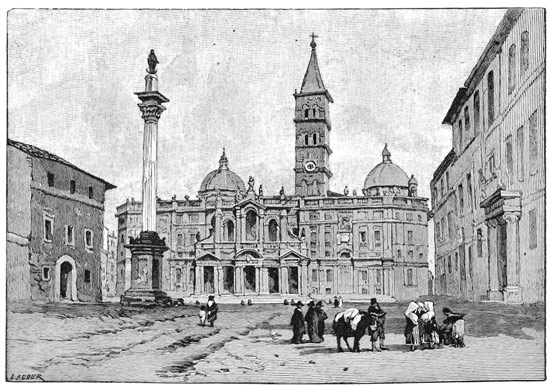
SANTA MARIA MAGGIORE. To face page 246.
In the meantime the terrified congregation in Sta. Maria Maggiore had recovered its senses, and messengers hurried out in all directions to trace the way by which the freebooters had gone, and to spread the news of the Pope's abduction. The storm had by this time passed over, and the people were easily roused on the eve of the great festival. Torches began to gleam by all the darkling ways, and the population poured forth in the excitement of a great event. It would seem that in all the tumultuous and factious city there was but one thought of horror at the sacrilege, and determination to save the Pope if it were still possible. Gregory was not, like his great predecessor the first of that name, the idol of his people. He had not the wealth with which many great ecclesiastics had secured the homage of the often famished crowd; and a stern man, with no special geniality of nature, and views that went so far beyond the local interests of Rome, he does not seem the kind of ruler to have secured popular favour. Yet the city had never been more unanimous, more determined in its resolution. The tocsin was sounded in all the quarters of Rome during that night of excitement; every soldier was called forth, guards were set at all the gates, lest the Pope should be conveyed out of the city; and the agitated crowd flocked to the Capitol, the only one of the seven hills of Rome where some kind of repair and restoration had been attempted, to consult, rich and poor together, people and nobles, what was to be done. To this spot came the scouts sent out in search of information, to report their discoveries. They had found that the Pope was still in Rome, and where he was—a prisoner, but as yet unharmed.
With one impulse the people of Rome, forming themselves into an undignified but enthusiastic army, rushed down from their place of meeting towards the robber's castle. We hear of engines of war, and all the cumbrous adjuncts of a siege and means of breaching the walls, as if those articles had been all ready in preparation for any emergency. The palace, though strong, could not stand the assault of the whole population, and soon it was necessary to bring the Pope from his prison and show him at a window to pacify the assailants. Cencius did all that a ruffian in such circumstances would naturally do. He first tried to extract money and lands from the Pope's terrors, and then flung himself on his knees before Gregory, imploring forgiveness and protection. The first attempt was useless, for Gregory was not afraid; the second was more successful, for remorseless to the criminals whose evil acts or example injured the Church, the Pope was merciful enough to ordinary sinners, and had never condemned any man to death. "What you have done to me I pardon you as a father; but what you have done against God and the Church must be atoned for," said Gregory, still at the mercy of any rude companion in that band of ruffians: and he commanded his captor to make a pilgrimage to Jerusalem, to cleanse himself from this sin. The Pope was conveyed out of his prison by the excited and enthusiastic crowd, shouting and weeping, half for joy, and half at sight of the still bleeding scar on his forehead. But weak and exhausted as he was, without food, after a night and almost a day of such excitement, in which he had not known from one hour to another what might happen, helpless in the hands of his enemies, Gregory had but one thought—to conclude his mass which he had not finished when he was interrupted at the altar. He went back in his cassock, covered by the stranger's furred cloak, along the same wild way over which he had been hurried in the darkness; and followed by the entire population, which swarmed into every corner and blocked every entrance, returned to the great basilica, where he once more ascended the altar steps, completed the mass, offered his thanksgivings to God, and blessed and thanked his deliverers, before he sought in the quick falling twilight of the winter day the rest of his own house.
It is common to increase the effect of this most picturesque scene by describing Gregory as an aged man, old and worn out, in the midst of his fierce foes; but he was barely sixty and still in the fulness of his strength, though spare and shrunken by many fasts and still more anxieties. That he had lost nothing of his vigour is evident, and in fact the incident, though never forgotten as a dramatic and telling episode by the historians, was a mere incident of no importance whatever in his life.
In the meantime the Emperor Henry, who had been disposed to humility and penitence by the efforts of his mother, and by the distresses of his own position during a doubtful and dangerous intestine war, in which all at the time seemed to be going against him, had subdued the Saxons and recovered the upper hand: and, thus victorious in his own country, was no longer disposed to bow his neck under any spiritual yoke. He had paid no attention to Gregory's commands in respect to simony nor to the ordinance against lay investiture which had proceeded from the Council of 1075; but had, on the contrary, filled up several bishoprics in the old way, continued to receive the excommunicated nobles, and treated Gregory's decrees as if they had never been. His indignation at the Pope's interference—that indignation which every secular prince has always shown when interfered with by the Holy See, and which so easily translates the august titles of the successor of St. Peter, the Vicar of Christ, into a fierce denunciation of the "Italian priest" whom mediæval princes feared and hated—was only intensified by his supreme pretensions as Emperor, and grew in virulence as Gregory's undaunted front and continued exercise, so far as anathemas would do it, of the weapons of church discipline, stood steadily before him. It is very possible that the complete discomfiture of Cencius's attempt upon the Pope's liberty or life, to which Henry is believed to have been accessory, and the disgrace and ridicule of that failure, irritated and exasperated the young monarch, and that he felt henceforward that no terms could be kept with the man whom he had failed to destroy.
Gregory, on the other hand, finding all his efforts unsuccessful to gain the submission of Henry, had again taken the strong step of summoning him to appear before the yearly council held in Rome at the beginning of Lent, there to answer for his indifference to its previous decisions. The following letter sent to Henry a short time after the attempt of Cencius, but in which not a word of that attempt is said, is a remarkable example of Gregory's dignified and unyielding attitude:
"Gregory, servant of the servants of God.
"To Henry, king, salutation and the blessing of the apostles, if he obeys the apostolic see, as becomes a Christian king.
"Considering with anxiety, within ourselves, to what tribunal we have to give an account of the dispensation of the ministry which has been extended to us by the Prince of the apostles, we send you with doubt our apostolic blessing, since we are assured that you live in close union with men excommunicated by the judgment of the Apostolic See and the censure of the synod. If this is true, you will yourself perceive that you cannot receive the grace of blessing either divine or apostolic, until you have dismissed from your society these excommunicated persons, or in forcing them to express their repentance have yourself obtained absolution by penitence and expiation. We counsel your highness, if you are guilty in this respect, to have recourse, without delay, to the advice of some pious bishop, who, under our authority, will direct you what to do, and absolve you, informing us with your consent of your penitence."
The Pope goes on to point out, recalling to Henry's mind the promises he had made, and the assurances given—how different his conduct has been from his professions.
"In respect to the church of Milan, how you have kept the engagements made with your mother, and with the bishops our colleagues, and with what intention you made these promises, the event itself shows. And now to add wound to wound, you have disposed of the churches of Spoleto and of Fermo. Is it possible that a man dares to transfer or give a church to persons unknown to us, while the imposition of hands is not permitted, except on those who are well known and approved? Your own dignity demands, since you call yourself the son of the Church, that you should honour him who is at her head, that is the blessed Peter, the prince of the apostles, to whom, if you are of the flock of the Lord, you have been formally confided by the voice and authority of the Lord—him to whom Christ said 'Feed my sheep.' So long as we, sinful and unworthy as we are, hold his place in his seat and apostolical government, it is he who receives all that you address to us either by writing or speech; and while we read your letters or listen to your words, it is he who beholds with a penetrating eye what manner of heart it is from which they come."
In this dignified and serious remonstrance there is not a word of the personal insult and injury which the Pope himself had suffered. He passes over Cencius and his foiled villainy as if it had never been; but while Gregory could forget, Henry could not: and historians have traced to the failure of this desperate attempt to subdue or extinguish the too daring, too steadfast Pontiff, the new spirit—the impulse of equally desperate rage and vengeance—which took possession of the monarch, finding, after all his victories, that here was one opponent whom he could not overcome, whose voice could reach over all Christendom, and who bore penalties in his unarmed hand at which no crowned head could afford to smile. To crush the audacious priest to the earth, if not by the base ministry of Roman bravos, then by the scarcely more clean hands of German barons and excommunicated bishops, was the impulse which now filled Henry's mind. He invoked a council in Worms, a month after the failure in Rome, which was attended by a large number, not only of the German nobility, but of the great ecclesiastics who nowhere had greater power, wealth, and influence than in Teutonic countries. Half of them had been condemned by Gregory for simony or other vices, many of them were aware that they were liable to similar penalties. The reformer Pope, who after the many tentatives and half-measures of his predecessors, was now supreme, and would shrink from nothing in his great mission of purifying the Church, was a constant danger and fear to these great mediæval nobles varnished over with the names of churchmen. One stroke had failed: but another was quite possible which great Henry the king, triumphant over all his enemies, might surely with their help and sanction bring to pass.
The peers spiritual and temporal, the princes who scorned the interference of a priest, and the priests who feared the loss of all their honours and the disgrace and humiliation with which the Pope threatened them, came together in crowds to pull down their enemy from his throne. Nothing so bold had ever been attempted since Christendom had grown into the comity of nations it now was. Cencius had pulled the Pope from the altar steps in the night and dark: Henry and his court assembled in broad day, with every circumstance of pomp and publicity, to drag him from his spiritual throne. It would be difficult to say whether the palm of fierceness and brutality should be given to the brigand of the Tusculan hills, or to the great king, princes, archbishops, and bishops of the Teutonic empire. Cencius swore in his beard, unheard of after generations; the others, less fortunate, have left on record what were the manner of words they said. This is the solemn act signed by all the members of the assembly, by which the Pope was to learn his doom. It is a long and furious scold from beginning to end.
"Hildebrand, taking the name of Gregory, is the first who, without our knowledge, against the will of the emperor chosen by God, contrary to the habit of our ancestors, contrary to the laws, has, by his ambition alone, invaded the papacy. He does whatever pleases him, right or wrong, good or evil. An apostate monk, he degrades theology by new doctrines and false interpretations, alters the holy books to suit his personal interests, mixes the sacred and profane, opens his ears to demons and to calumny, and makes himself at once judge, witness, accuser, and defender. He separates husbands from wives, prefers immodest women to chaste wives, and adulterous and debauched and incestuous connections to legitimate unions; he raises the people against their bishops and priests. He recognises those only as legally ordained who have begged the priesthood from his hands, or who have bought it from the instruments of his extortions; he deceives the vulgar by a feigned religion, fabricated in a womanish senate: it is there that he discusses the sacred mysteries of religion, ruins the papacy, and attacks at once the holy see and the empire. He is guilty of lèse-majesté both divine and human, desiring to deprive of life and rank our consecrated emperor and gracious sovereign.
"For these reasons, the emperor, the bishops, the senate, and the Christian people declare him deposed, and will no longer leave the sheep of Christ to the keeping of this devouring wolf."
Among the papers sent to Rome this insolent act is repeated at greater length, accompanied by various addresses to the bishops and people, and two letters to the Pope himself, from one of which, the least insolent, we quote a few sentences.
"Henry, king by the grace of God, to Hildebrand.
"While I expected from you the treatment of a father, and deferred to you in everything, to the great indignation of my faithful subjects, I have experienced on your part in return the treatment which I might have looked for from the most pernicious enemy of my life and kingdom.
"First having robbed me by an insolent procedure of the hereditary dignity which was my right in Rome, you have gone further—you have attempted by detestable artifices to alienate from me the kingdom of Italy. Not content with this, you have put forth your hand on venerable bishops who are united to me as the most precious members of my body, and have worn them out with affronts and injustice against all laws human and divine. Judging that this unheard-of insolence ought to be met by acts, not by words, I have called together a general assembly of all the greatest in my kingdom, at their own request, and when there had been publicly produced before them things hidden up to that moment, from fear or respect, their declarations have made manifest the impossibility of retaining you in the Holy See. Therefore adhering to their sentence, which seems to me just and praiseworthy before God and men, I forbid to you the jurisdiction of Pope which you have exercised, and I command you to come down from the Apostolic See of Rome, the superiority of which belongs to me by the gift of God, and the assent and oath of the Romans."
The other letter ends with the following adjuration, which the king prefaces by quoting the words of St. Paul: "If an angel from heaven preach any other doctrine to you than that we have preached unto you, let him be accursed":
"You who are struck by this curse and condemned by the judgment of the bishops and by our own, come down, leave the apostolic chair; let another assume the throne of St. Peter, not to cover violence with the mantle of religion, but to teach the doctrine of the blessed apostle. I, Henry, king by the grace of God, and all my bishops, we command you, come down, come down!"
These letters were sent to Rome by Count Eberhard, the same who had come to inquire into the election of Gregory two years before, and had confirmed and consented to it in the name of his master. He was himself one of the excommunicated barons whom Gregory had struck for simoniacal grants of benefices; but he had not the courage to carry fire and flame into the very household of the Pope. He did, however, all the harm he could, publishing the contents of the letters he carried in the great Italian cities, where every guilty priest rejoiced to think that he had thus escaped the hands of the terrible Gregory. But when he came within reach of Rome the great German baron lost heart. He found a substitute in a priest of Parma, a hot-headed partisan, one of those instruments of malice who are insensible to the peril of burning fuse or sudden explosion. The conspirators calculated with a sense of the dramatic which could scarcely have been expected from their nationality, and which looks more like the inspiration of the Italian himself—that he should arrive in Rome on the eve of the yearly council held in the Lateran at the beginning of Lent. This yearly synod was a more than usually important one; for already the news of the decision at Worms was known in Italy, and a great number of the clergy, both small and great, had crowded to Rome. A hundred and ten prelates are reckoned as present, besides many other dignitaries. Among them sat, as usual on such occasions, Beatrice and Matilda of Tuscany, the only secular protectors of Gregory, the greatest and nearest of Italian sovereigns. It was their presence that was aimed at in the strangely abusive edict of Worms as making the Council a womanish senate: and it was also Matilda's case which was referred to in the accusation that the Pope separated husbands from their wives. The excitement of expectation was in the air as all the strangers in Rome, and the people, ever stirred like the Athenians by the desire to hear some new thing, thronged the corridors and ante-chapels of the Lateran, the great portico and square which were for the moment the centre of Rome. Again the vast basilica, the rustling mediæval crowd in all its glow of colour and picturesqueness of grouping, rises before us. Few scenes more startling and dramatic have ever occurred even in that place of many histories.
The Pope had seated himself in the chair of St. Peter, the long half-circular line of the great prelates extending down the long basilica on either side, the princes in a tribune apart with their attendants, and the crowd of priests filling up every corner and crevice: the Veni Creator had been sung: and the proceedings were about to begin—when Roland of Parma was introduced, no doubt with much courtesy and ceremony, as the bearer of letters from the Emperor. When these letters were taken from him, however, the envoy, instead of withdrawing, as became him, stood still at the foot of the Pope's chair, and to the consternation, as may be supposed, of the assembly, addressed Gregory. "The king, my master," he cried, "and all the bishops, foreign and Italian, command you to quit instantly the Church of Rome, and the chair of Peter." Then turning quickly to the astonished assembly, "My brethren," he cried, "you are hereby warned to appear at Pentecost in the presence of the king to receive your Pope from him; for this is no Pope but a devouring wolf."
The intensity of the surprise alone can account for the possibility of the most rapid speaker delivering himself of so many words before the assembly rose upon him to shut his insolent mouth. The Bishop of Porto was the first to spring up, to cry "Seize him!" but no doubt a hundred hands were at his throat before the Prætorian guard, with their naked swords making a keen line of steel through the shadows of the crowded basilica, now full of shouts and tumult, came in from the gates. The wretch threw himself at the feet of the Pope whom he had that moment insulted, and who seems to have come down hurriedly to rescue him from the fury of the crowd: and was with difficulty placed under the protection of the soldiers. It is not difficult to imagine the supreme excitement which must have filled the church as they disappeared with their prisoner, and the agitated assembly turned again towards their head, the insulted pontiff. Gregory was not the man to fail in such an emergency. He entreated the assembly to retain its composure and calm. "My children," he said, "let not the peace of the Church be broken by you. Perilous times, the gospel itself tells us, shall come: times in which men shall be lovers of their own selves, covetous, boasters, disobedient to parents. It must needs be that offences come, and the Lord has sent us as sheep into the midst of wolves. We have long lived in peace, but it may be that God would now water his growing corn with the blood of martyrs. We behold the devil's force at length displaying itself against us in the open field. Now, therefore, as it behoves the disciples of Christ with hands trained to the war, let us meet him and bravely contend with him until the holy faith which through his practices appears to be throughout the world abandoned and despised shall, the Lord fighting through us, be restored."
It seems a strange descent from the dignity of this address, that the Pope should have gone on to comment upon a marvellous egg which it was said had been found near the church of St. Peter, with a strange design raised upon its surface—a buckler with the figure of a serpent underneath, struggling with bent head and wriggling body to get free. This had seemed, however, a wonderful portent to all Rome, and though his modern historians censure Gregory for having no doubt prepared the prodigy and taken a despicable advantage of it, there does not seem the slightest reason to suppose either that Gregory was guilty of this, or that he was so little a man of his time as not to be himself as much impressed by it as any one else there. Appearances of the kind, which an age on the lookout for portents can define, and make others see, are not wanting in any period. The crowd responded with cries that it was he, the father of the Church, who was supreme, and that the blasphemer should be cut off from the Church and from his throne.
The sensation was not lessened when the full text[4] of Henry's letters, parts of which we have already quoted, was read out to the reassembled council next day. The words which named their Pope—their head who had been the providence and the guide of Rome for so many years—with contemptuous abuse as "the monk Hildebrand," must have stirred that assembly to its depths. The council with one voice demanded from Gregory the excommunication of the Emperor, and of the impious bishops, false to every vow, who had ventured to launch an anathema against the lawful head of the Church. The solemn sentence of excommunication was accordingly pronounced against Henry: his subjects were freed from their oath of allegiance, and his soul cut off from the Church which he had attempted to rend in twain. Excommunications had become so common in these days that the awe of the extraordinary ceremonial was much lessened: but it was no mere spiritual deprivation, as all were aware, but the most tremendous sentence which could be launched against a man not yet assured in his victories over his own rebellious tributaries, and whose throne depended upon the fidelity of powerful vassals, many of whom were much more impressed by the attitude of the Pope than by that of the king.
Thus after so many preliminaries, treaties of peace and declarations of war, the great conflict between Pope and Emperor, between the Church and the State, began. The long feud which ran into every local channel, and rent every mediæval town asunder with the struggles of Guelfs and Ghibellines, thus originated amid events that shook the world. The Synod of Worms and the Council of Rome, with their sudden and extraordinary climax in the conference of Canossa, formed the first act in a drama played upon a larger stage and with more remarkable accompaniments than almost any other in the world.
The effect of Henry's excommunication was extraordinary. The world of Christendom, looking on beyond the sphere of Henry's immediate surroundings and partisans, evidently felt with an impulse almost unanimous that the anathema launched by a partly lay assembly and a secular King against a reigning Pope unassailable in virtue, a man of power and genius equal to his position, was a sort of grim jest, the issue of which was to be watched for with much excitement, but not much doubt as to the result, the horror of the profanity being the gravest point in the matter. But no one doubted the power of Gregory on his part, amid his lawful council, to excommunicate and cut off from the Church the offending king. Already, before the facts were known, many bishops and other ecclesiastics in Germany had sent timid protests against the act to which in some cases they had been forced to append their names: and the public opinion of the world, if such an expression can be used, was undoubtedly on Gregory's side. Henry's triumphant career came to a pause. Not only the judgment of the Church and the opinion of his peers, but the powers of Heaven seemed to be against him. One of his greatest allies and supporters, Gottfried, surnamed Il Gobbo, the son of that Gottfried of Lorraine who married Beatrice of Tuscany, and who had imposed his hunchback son as her husband upon the young Matilda, the daughter of Beatrice—was murdered immediately after. The Bishop of Utrecht, who had been one of the king's chief advisers and confidants in his war with Gregory, died in misery and despair, declaring with his last breath that he saw his bed surrounded by demons, and that it was useless to offer prayers for him. On the other hand, the great Dukes of Suabia, Bavaria, and Carinthia, all faithful to the Church, abandoned the excommunicated king. Some of the greater bishops, trembling before the just ire of the Pope whom they had bearded, took the same part. The half-assuaged rebellion of the Saxon provinces broke forth with greater force than ever. Henry had neither arms nor supporters left to secure further victories, and the very air of the empire was full of the letters of Gregory, in which all his attempts to win the young king to better ways, and all the insults which that king had poured forth against the Holy See, were set forth. The punishment, as it appeared on all sides, was prompt as thunderbolts from heaven to follow the offence.
While Henry hesitated in dismay and alarm, not knowing what step to take, seeing his friends, both lay and clerical, abandon him on every side, consequences more decisive still followed. The great princes met together in an assembly of their own in Ulm without any reference to Henry, whom they named in their proceedings the ex-king, and decided upon another more formal meeting later to choose a new sovereign. These potentates became doubly religious, doubly Catholic, in their sudden revulsion. They surrounded Gregory's legates with reverence, they avoided all communion with simoniacal prelates, and even—carrying the Pope's new influence to the furthest extent—with the married priests against whom he had long fulminated in vain. A reformation of all evils seemed to be about to follow. They formally condemned the excommunicated Henry on every point moral and political, and though they hesitated over the great step of the threatened election of a king in his place, they announced to him that unless he could clear himself of the interdict before the beginning of the following year, when they had decided to call a diet in Augsburg to settle the question, his fall would be complete and without remedy. At the same time they formally and solemnly invited the presence of the Pope at Augsburg to preside over and confirm their conclusions. This invitation Gregory accepted at once, and Henry, with no alternative before him, consented also to appear before the tribunal of his subjects, and to receive from their hands, and those of the Pope whom he had so insulted and outraged, the sentence of his fate. His humiliation was complete.
The assembly which was to make this tremendous decision was convoked for the 2nd February, 1077, the feast of the Purification, at Augsburg. Gregory had accepted the invitation of the German potentates without fear; but there was much alarm in Rome at the thought of such a journey—of the passage through rebellious Lombardy, of the terrible Alps and their dangers, and at the end of all the fierce German princes, who did not always keep faith, and whose minds before this time might have turned again towards their native prince. The Pope set out, however, under the guard of Matilda of Tuscany and her army, to meet the escort promised him from beyond the Alps. On the other hand, Henry was surrounded by dangers on every side. He had been compelled to give up his own special friends, excommunicated like himself; he had no arms, no troops, no money; the term which had been allowed him to make his peace with the Pope was fast passing, and the dreadful moment when it would be his fate to stand before his revolted subjects and learn their decision, appeared before him in all its humiliation and dishonour. Already various offenders had stolen across the mountains privately, to make their submission to Gregory. It seemed the only course for the desperate king to take. At length, after much wavering, he made up his mind, and escaping like a fugitive from the town of Spires to which he had retired, he made his way in the midst of a rigorous winter, and with incredible difficulty, across the Alps, with the help and under the guardianship of Adelaide of Susa, his mother-in-law, who, however, it is said, made him pay a high price for her help. He had begged of the Pope to give him audience at Rome, but this was refused: and in partial despair and confusion he set out to accomplish his hated mission somehow, he did not know where or by what means. A gleam of comfort, however, came to Henry on his travels. He was received with open arms in Lombardy where the revolted bishops eagerly welcomed him as their deliverer from Gregory and his austerities: but there was too much at stake for such an easy solution of the matter as this.
In the meantime Gregory travelled northwards surrounded by all the strength of Tuscany, accompanied by the brilliant and devoted Matilda, a daughter in love and in years, the pupil and youthful friend, no doubt the favourite and beloved companion, of a man whose age and profession and character alike would seem to have made any other idea impossible even to the slanderers of the middle ages. Matilda of Tuscany has had a great fate: not only was she the idol of her own people and the admired of her own age—such an impossible and absurd piece of slander as that which linked the name of a beautiful young woman with that of the austere and aged Gregory being apparently the only one which had ever been breathed against her:—but the great poets of her country have placed her, one in the sweeter aspect of a ministering angel of heaven, the other in that of the most heroic of feminine warriors, on the heights of poetic fame. Matilda on the banks of that sacred river of Lethe where all that is unhappy is forgotten, who is but one degree less sacred to Dante than his own Beatrice in Paradise: and Clorinda, the warrior maiden of Tasso, have carried the image of this noble princess to the hearts of many an after age. The hunchback husband imposed upon her in her extreme youth, the close union between her and her mother Beatrice, the independent court held by these two ladies, their prominent place among all the great minds of their time—and not least the faithful friendship of both with the great Gregory, combine to make this young princess one of the most interesting figures of her day. The usual solaces of life had been cut off from her at the beginning by her loveless marriage. She had no children. She was at this period of her career alone in the world, her mother having recently died, following Il Gobbo very closely to the grave. Henceforward Matilda had more to do in the field and council chamber than with the ordinary delights of life.
The Pope had left Rome with many anxieties on his mind, fully appreciating the dangers of the journey before him, and not knowing if he might ever see the beloved city again. While he was on the way the news reached him that Henry, whom he had refused to receive in Rome, was on his way across the Alps, and as probably the details of that painful journey were unknown, and the first idea would be that the king was coming with an army in full force—still greater anxieties, if not alarms, must have been awakened among the Pope's supporters. It was still more alarming to find that the German escort which was to have met him at Mantua had not been sent, the hearts of the princes having failed them, and their plans having fallen into confusion at the news of the king's escape. Henry had been received with enthusiasm in Lombardy, always rebellious, and might make his appearance any day to overpower the chivalry of Tuscany, and put the lives of both Pope and Princess in danger. They were on the road to Mantua when this news reached them, and in the anxious council of war immediately held, it was resolved that the strong castle of Canossa, supposed to be impregnable, should be, for the moment at least, the Pope's shelter and resting-place. One of the great strongholds of Italy, built like so many on a formidable point of rock, of itself almost inaccessible, and surrounded by three lines of fortified walls, among which no doubt clustered the rude little dwellings of a host of retainers—the situation of this formidable place was one which promised complete protection: and the name of the Tuscan castle has since become one of the best-known names in history, as the incident which followed contains some of the most picturesque and remarkable scenes on record. The castle had already a romantic story; it had sheltered many a fugitive; forlorn princesses had taken refuge within its walls from the pursuit of suitors or of enemies, the one as dangerous as the other. Painfully carried up in his litter by those steep and dangerous ways, from one narrow platform of the cliff to another, with the great stretch of the landscape ever widening as he gained a higher point, and the vast vault of heaven rounding to a vaster horizon, the Pope gained this eyrie of safety, this eagle's nest among the clouds.
We hear of no luxuries, not even those of intellectual and spiritual discourse, which to many an ascetic have represented, and represented well, the happiness of life, in this retreat of Gregory with his beautiful hostess, amid his and her friends. By his side, indeed, was Hugo, Abbot of Cluny, one of his most cherished and life-long companions; but the Pope spent his days of seclusion in prayer and anxious thought. The great plain that lay at his feet, should it be deluged with Christian blood once more, should brother stand against brother in arms, and Italy be crushed under the remorseless foot which even the more patient Teuton had not been able to bear? Many melancholy thoughts were no doubt in Gregory's mind in that great fastness surrounded by all the ramparts of nature and of art. He had dreamed—before the name of Crusade had yet been heard or thought of—of an expedition to Jerusalem at the head of all who loved the Lord, himself in his age and weakness the leader of an army composed of valiant and generous hearts from every quarter of the world, to redeem the Sepulchre of the Lord, and crush the rising power of the Saracens. This had been the favourite imagination of his mind—though as yet it called forth little sympathy from those about him—for some years past. Instead of that noble expedition was it possible that, perhaps partly by his fault, Christians were about to fly at each other's throats and the world to be again torn asunder by intestine warfare? But such thoughts as these were not the thoughts of the eleventh century. Gregory might shed tears before his God at the thought of bloodshed: but that his position in the presence of the Highest was the only right one, and his opponent's that of the most dangerous wrong, was no doubt his assured conviction. He awaited the progress of events, knowing as little as the humblest man-at-arms what was going to happen, with a troubled heart.
Nevertheless the retirement of these first days was broken by many hurried arrivals which were more or less of good omen. One by one the proud German bishops specially designated in Gregory's acts of excommunication, and nobles more haughty still, under the same burden, climbed the steep paths of Canossa, and penetrated from gate to gate, barefooted pilgrims denuding themselves of every vestige of power. "Cursed be he who turns back his sword from the blood," that is, who weakly pauses in the execution of a divine sentence—was one of Gregory's maxims. He received these successive suppliants with more sternness than sweetness. "Mercy," he said, "can never be refused to those who acknowledge and deplore their sins; but long disobedience, like rust on a sword, can be burned out only by the fire of a long repentance;" and he sent them one by one to solitary chambers in which, with the sparest of nourishment, they might reflect upon their sins. After a sufficient seclusion, however, they were liberated and sent away, reprimanded yet blessed—at least the laymen among them. It remained now to see what Henry would do.
ARCH OF DRUSUS (1860) To face page 266.
Henry was no longer at the lowest ebb of his fortunes. The princes of Germany had come to a pause: they had not sent the promised escort for the Pope; they were irresolute, not knowing what step to take next: and all Lombardy had risen to welcome the king; he had the support of every schismatic bishop, every censured priest, and of the excited people who were hostile to the pretensions of Rome, or rather to the severe purity of Gregory which was so uncompromising and determined. But by some unaccountable check upon his high spirit Henry, for the moment, was not moved to further rebellion either by the support of a Lombard army at his back, or by the hopes of his reviving followers at home. He was accompanied by his wife and by her mother, Adelaide of Susa, and perhaps the veneration of the women for the authority of the Church and dread of its penalties, affected him, although he had no love for the wife of whom he had tried so hard to get rid. Whatever was the explanation it is very evident, at least, that his spirit was cowed and that he saw nothing before him but submission. He went on probably to Parma, with a small and unarmed retinue, leaving his turbulent Lombard followers behind. On the way he sent various messengers before him, asking for an interview with Matilda, who was supposed likely to move the Pope in his favour. We are not told where the meeting took place, but probably it was in some wondering village at the foot of the hill, where the princely train from the castle, the great Contessa, the still greater abbot, Hugo of Cluny, and "many of the principal Italian princes," met the wandering pilgrim party, without sign or evidence of royalty—Henry and his Queen, the Marchesa Adelaide of Este, her son Amadeo, and other great persons in the same disguise of humility. The ladies on either side were related to each other, and all belonged to that close circle of the reigning class, in which every man calls his neighbour brother or cousin. Hugo of Cluny was the godfather of the king and loved him, and Adelaide, though on the side of her son-in-law, and now his eager champion, was a true and faithful daughter of the Church. Henry declared on the other side to his anxious friends that the accusations of the Germans were not true, that he was not as they had painted him: and implored their intercession with the Pope, not for any temporal advantage, but solely to be delivered from the anathema which weighed upon his soul. And Matilda and the others were but too anxious to make peace and put faith in all he said.
It is very likely that Gregory believed none of these protestations, but now or never, certainly he was bound to fulfil his own maxim, and not to turn back his sword from the blood. All the arguments of Henry's friends could not induce him to grant an easy absolution at the king's first word. Finally he consented to receive him as a penitent, but in no other character. Probably it was while the prayers and entreaties of Matilda and of Abbot Hugo were still going on in the castle that Henry came day by day, barefooted, in a humble tunic of woollen cloth, and waited at the gates to know the result. It was "an atrocious winter," such as had never been seen before, with continual snowstorms, and the rugged paths and stairs up the cliff, never easy, were coated with frost. Twice over the king climbed with naked feet as far as the second circle of the walls, but only to be turned away. It seems little short of a miracle that such a man, in such circumstances, should have so persevered. On the third day the pleaders within had been successful, and Henry was admitted, on the generous guarantee of Matilda, who took upon her to answer for him that his repentance was genuine. At last the culprit was led into the Pope's presence. He was made to give various promises of amendment, which were accepted, not on his oath, a last and supreme humiliation, but on the undertaking of various of his friends who swore, rashly one cannot but think, on the relics of the saints that the king would keep his promises. This is the document to which these generous friends set their seals.
"I, Henry, King, in respect to the complaints of the archbishops, bishops, dukes, counts and other princes of the Teutonic kingdom, and of all those who follow them, within the time fixed by the Lord Pope will do justice according to his sentence, or make peace according to his advice if no unavoidable hindrance occurs; and in that case, the moment the hindrance is taken away I will be ready to fulfil my promise. In addition, if the Lord Pope Gregory desires to cross the Alps, or go into other countries, he shall be held safe on my part, and on the part of those whom I command, from all danger of death, mutilation, or captivity, himself and those who form his escort, both during the journey, as long as he remains, and on the return; nothing shall be done by me contrary to his dignity, and if anything is done by others, I will lend him my help in good faith according to my power."
This does not seem a very large bond.
Next day, the 25th January, 1077, Henry came again in the same penitential dress, but this time according to formal appointment. He came into the room where the Pope awaited him, followed by all the excommunicated princes in his train, barefooted and half frozen with the painful climb up the rocky paths; and throwing himself on the floor before Gregory, asked his pardon, which Gregory gave, shedding many tears over the penitents. They were then received back into the Church with all the due ceremonials, the Pope in his vestments, the penitents naked to the waist, despoiled of all ornaments and dignities. In the castle church, of which now nothing but the foundations remain, Gregory solemnly absolved the miserable party, and offered them the Communion. At this act a very strange scene took place. The Pope, the great assailant of Simony, had himself been accused of it, ridiculous as was the accusation in a case like his, of which every circumstance was so perfectly known, and formally by Henry himself in the insolent command already quoted to abandon the papal see. At the moment of communion, in the most solemn part of the service, the Pope turned to Henry, standing before the altar, with the host in his hands. He appealed to God in the most impressive manner according to the usage of the time.
"You have long and often accused me," said the Pope, "of having usurped the Apostolical chair by Simony.... I now hold the body of the Saviour in my hands, which I am about to take. Let Him be the witness of my innocence: let God Himself all powerful absolve me to-day of the crime imputed to me if I am innocent, or strike me with sudden death if I am guilty." Then after a solemn pause he added: "My son, do as I have done: if you are certain of your innocence, if your reputation is falsely attacked by the lies of your rivals, deliver the Church of God from a scandal and yourself from suspicion; take the body of Our Lord, that your innocence may have God for witness, that the mouth of your enemies may be stopped, and that I—henceforward, your advocate and the most faithful defender of your cause—may reconcile you with your nobles, give you back your kingdom, and that the tempest of civil war which has so long afflicted the State may henceforth be laid at rest."
Would a guilty king in these unbelieving days venture upon such a pledge? Henry at least was incapable of it. He dared not call God to witness against the truth, and refused, trembling, murmuring confused excuses to take this supreme test. The mass was accomplished without the communion of the king; but not the less he was absolved and the anathema taken from his head.
In a letter written immediately after, Gregory informed the German princes of what he had done, adding that he still desired to cross the Alps and assist them in the settlement of the great question remaining, Henry having been avowedly received by him as a penitent, but not in any way as a restored king.
This great historical event, which has been the subject of so much commentary and discussion, and has been supposed to mark so great a step in the power and pretensions of the Popes, was in fact without any immediate effect in history. Henry went forth wroth and sore, humiliated but not humbled, and thinking of nothing so much as how to return to Gregory the shame he had himself suffered. And Gregory remained in his stronghold as little convinced of any advantage attained, as he had been of Henry's repentance. He is said to have answered the Saxon envoys who reproached him with his leniency, by a grim reassurance which is almost cynical. "He goes back worse than he came," said the Pope. It was indeed impossible that the eye of a man so conversant with men as Gregory should not have perceived how entirely his penitent's action was diplomatic and assumed for a purpose, and what a solemn farce Henry was playing as he stood barefooted in the snow, to obtain the absolution which was his only chance for Germany. It is perfectly permissible to believe that not only the determination not "to turn back his sword from the blood" or to fail in exacting every punctilio of penance, but a natural impulse of scorn for the histrionic exhibition made for the benefit of the great audience across the Alps, induced the Pope to keep the king dangling at those icy gates. That there should have been in Gregory's mind, along with this conviction, momentary relentings of hope that the penitent's heart might really be touched, was equally natural, and that it was one of these sudden impulses which moved him to the startling and solemn appeal to God over the sacramental host which formed so remarkable an incident in the ceremonial, may be taken for granted. In that age miracles were more than common, they were looked for and expected; and in all ages the miracle which we call conversion, the sudden and inexplainable movement of a heart, touched and turned in an instant from evil to good, has been known and proved. That a priest at the altar should hope that it might be his, by some burning word or act, to convey that inexpressible touch was a very human and natural hope: and yet Gregory knew well in his after survey of what had passed that the false penitent went away worse than he came. He wrote, however, an account of the matter to the German princes, who looked on trembling for the consequences, and probably blaming the Pope for an action that might destroy all their combinations—in which he described to them Henry's penitence and promise, without implying a doubt of the sincerity of either, but with a full statement of the fact that the absolution awarded to the man made no difference in respect to the king.
"Things being thus arranged [writes the Pope] in order to secure, by the help of God, the peace of the Church and the union of the Kingdom, which we have so long desired, we are anxious to pursue our journey into your countries on the first occasion possible; for we desire you to know, as you may perceive from the written engagements, that everything is still in suspense, so that our arrival among you and the unanimity of your council is absolutely necessary to settle matters. Therefore be very attentive to continue as you have begun in faith and the love of justice, and understand that we have done nothing for the king, except to tell him that he might trust to us to help him in such things as may touch his salvation and his honour, with justice and with mercy, without putting our soul and his in peril."
In the meantime Henry had enough to do in winning back again to his side the rebellious Lombards, who considered his submission to the Pope, however artificial, a desertion of their cause, and shut upon him the gates of their cities, which before his visit to Canossa had been thrown wide open. He had apparently, though only for a moment, lost them, while he had not regained the sympathies of Germany. There was nothing for it but a new apostasy, throwing over of his promises, and reassumption of the leadership of the schismatic party, which made the position of Gregory, surrounded by that angry sea of Lombard rebellion which beat against the base of his rocky stronghold, a very dangerous one. Through the whole spring of 1077 the Pope was more or less confined to the Castle of Canossa or other similar fortresses, under the vigilant care of Matilda; and it was from these strong places that he wrote a succession of remarkable letters to the nobles of Germany, who, strongly set upon the Diet in which the affairs of the kingdom were to be placed on a permanent footing, were proceeding to carry out their intention without waiting either for the presence of Gregory which they had invited, or Henry whose interests were at stake. Gregory did everything that was possible to delay the Diet until he could be present at it. He was anxious also to delay whatever great step might be in contemplation until the mind of the country was a little less anxious and disturbed: and he desired to be present, not only in the position of Arbitrator, but also to moderate with his counsels the excited spirits, and prevent if possible any great catastrophe.
We may allow, as it is one of the conventionalities of history to assert, that Gregory's intention was to establish in such matters the jurisdiction of the Popes and make it apparent to the world that thrones and principalities were at the disposition of the Church. But at the same time Gregory was, like all men, chiefly moved by the immediate question before him, and he was a man sincerely occupied with what was best for both Church and State, fearing the rashness of an angry and excited assembly, and remembering his promise to do what he could for his most unworthy penitent; and we see no reason to believe that his purposes were not, according to his perception of his duty, honest and noble. He retained his hope of proceeding to Germany as long as that was possible, asking again and again for the guide and escort promised, even asking from Henry a safe conduct through the territory now held by him. Even after the election at Forchheim of Rudolf of Suabia as king in the place of Henry, he continued to urge upon the legates whom he had sent to that assembly the necessity for his presence. And he undoubtedly did this on the highest ground possible, putting forth his right to judge in the matter in the very clearest words. He bids his messengers in the name of St. Peter to summon the heads of both parties, Henry and Rudolf, to make his journey possible.
"With the advice of the clergy and laymen fearing God, we desire to judge between the two kings, by the grace of God, and point out which of the two parties is most justly to be entrusted with the government of the State. You are aware that it is our duty, and that it appertains to the providential wisdom of the Apostolic See, to judge the governments of the great Christian kingdoms and to regulate them under the inspiration of justice. The question between these two princes is so grave, and the consequences may be so dangerous, that if it was for any reason neglected by us, it would bring not only upon us and upon them, but on the Church entire, great and lamentable misfortune. Therefore, if one or other of these kings refuses to yield to our decision and conform to our counsels, and if, lighting the torch of pride and human covetousness against the honour of God, he aspires in his fury to the desolation of the Roman Empire, resist him in every way, by every means, to the death if necessary, in our name and by the authority of the blessed Peter."
The Pope in another letter makes his appeal no longer to the ruling class but to the entire people. He informs "all the faithful of Christ in the Teutonic empire" that he has sent his legates to both kings to demand of them both "either in their own persons or by sufficient messengers" to open the way for his journey to Germany in order with the help of God to judge the question between them.
"Our heart is full of sadness and sorrow to think that for the pride of one man so many thousands of Christians may be delivered over to death both temporal and eternal, the Christian religion shaken to its foundations, and the Roman Empire precipitated into ruin. Both of these kings seek aid from us, or rather from the Apostolic See, which we occupy, though unworthy; and we, trusting in the mercy of Almighty God, and the help of the blessed Peter, with the aid of your advice, you who fear God and love the Church, are ready to examine with care the right on either side and to help him whom justice notoriously calls to the administration of the kingdom....
"You know, dear brethren, that since our departure from Rome we have lived in the midst of dangers among the enemies of the faith; but neither from fear nor from love have we promised any help, but justice to one or other of these kings. We prefer to die, if necessary, rather than to consent by our own will that the Church of God should be put from her place; for we know that we have been ordained and set upon the apostolic chair in order to seek in our life not our own interests but those of Christ, and to follow through a thousand labours in the steps of the fathers to the future and eternal repose, by the mercy of God."
The reader must remember that Gregory had very good reason for all that he said, and that irrespective of the claims of the Church a wise and impartial umpire at such a moment might have been of the last importance to Germany; also that his services had been asked for in this capacity, and that therefore he had a right to insist upon being heard. The position which he claimed had been offered to him; and he was entitled to ask that such an important matter should not be settled in his absence.
The remonstrances which the Pope continued to make by his own voice and those of his legates as long as any remonstrance was possible, were however regarded by neither party. Neither the authority of Rome nor the visible wisdom of settling a question which must convulse the world and tear Germany in pieces, peacefully and on the foundation of justice if that were possible, as urged by Gregory—could prevail, nor ever has prevailed on any similar occasion against the passions and ambitions of men. It was a devout imagination, appealing to certain minds here and there by the highest motives, and naturally by very different ones to all the interested souls likely to be advantaged by it, which always form the reverse of the medal; but men with arms in their hands and all the excitements of faction and party, of imperial loss and gain around them, were little like to await a severe and impartial judgment. The German bishops made a curious remonstrance in their turn against the reception by Gregory of Henry's professions of penitence, and on either side there was a band of ecclesiastics, presumably not all good or all bad perplexing every judgment.
We have fortunately nothing to do with the bloody struggles of Rudolf and Henry. When the latter made his way again over the Alps, to defend his rights, carrying with him the Iron Crown which Gregory's refusal had prevented him from assuming—he carried it away however, though he did not dare to put it on, a curious mixture of timidity and furtive daring—the Pope, up to that moment virtually confined within the circle of the mountain strongholds of Tuscany, returned to Rome: where he continued to be assailed by constant and repeated entreaties to take up one or the other side, his own council of the Lateran inclining towards Henry. But nothing moved him from his determination that this question should be decided by a Diet under his own presidence, and by that alone. This question runs through the entire story of the period from year to year. No council—and in addition to the usual yearly council held always in the beginning of Lent, at the Lateran, there seem to have been various others between whiles, made compulsory by the agitation of the time—could take place without the arrival of the two bands of German ambassadors, one from Henry and the other from Rudolf, to plead the cause of their respective masters, both professing all obedience, and inviting a decision in their favour by every argument: but neither taking a single step to bring about the one thing which the Pope demanded—a lawful assembly to settle the question.