THE PLATES
Reading edition
PLATE 1
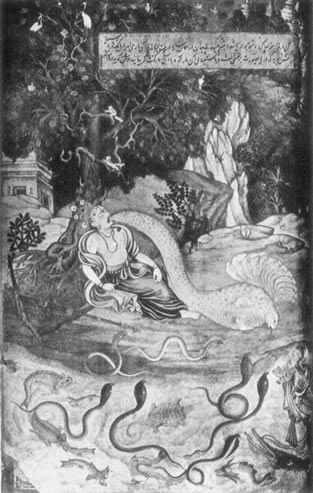
The Death of Balarama Illustration to the Persian abridgement of the Mahabharata, the Razmnama (or Book of the Wars) By Basawan Mughal (Akbar period), c. 1595 Collection H.H. the Maharaja of Jaipur, Jaipur
Although illustrations of the Hindu epic, the Mahabharata, were rarely commissioned by Hindu patrons, the gigantic text possessed a unique appeal to Indian minds and for this reason the Mughal emperor, Akbar, chose it for translation into Persian. 'Having observed the fanatical hatred prevailing between Hindus and Muslims,' writes his biographer, Abul Fazl, 'and convinced that it arose only from their mutual ignorance, the enlightened monarch wished to dispel the same by rendering the books of the former accessible to the latter.' The work of translation was begun in 1582 and was probably concluded in 1588 when Abul Fazl wrote the preface. It is unlikely, however, that the illustrations were completed before 1595.
The present picture by one of Akbar's greatest Hindu artists illustrates the sensitive naturalism which from antecedents in Khurasan came to elegant maturity in Mughal India between 1585 and 1600. Certain details—the drapery with its shaded folds, the steeples rising in the distance—are modelled on the European Renaissance pictures which by 1580 had already reached the court. Other details such as the lithe squirrels gambolling in the tree, the rearing snakes and dense luxuriant foliage can only have been painted by an artist devoted to the Indian scene.
In subject, the picture represents what Krishna saw on his return from destroying the Yadavas at Prabhasa. Balarama, his half-brother, has gone down to the sea and has there yielded up his spirit. Sesha, the great serpent, who is part of Vishnu himself, is now issuing from the body Balarama having been his incarnation. Snakes come to greet him while Varuna, the god of water, stands as 'an old man of the sea' ready to escort him to his long home.
PLATE 2
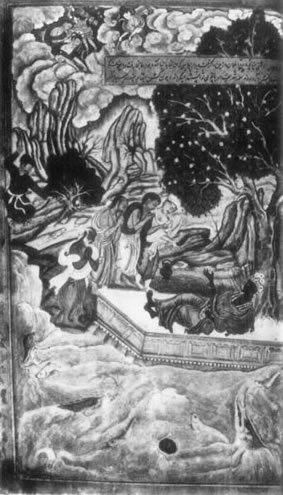
The Death of Krishna Illustration to the Persian abridgement of the Mahabharata, the Razmuama (or Book of the Wars) By Mukund Mughal (Akbar period), c. 1595 Collection H.H. the Maharaja of Jaipur, Jaipur
Following the death of Balarama, Krishna prepares to leave the world. He sits in meditation and is shot in the sole of his right foot by Jara, a Bhil hunter—the arrow which kills him being tipped with part of the iron which has caused the destruction of the Yadavas.
The picture shows Krishna reclining on a platform of the kind still constructed in India at the base of sacred trees. An arrow transfixes his right foot while the hunter, dressed as a courtier in Mughal dress, is shown releasing the bow. In front of Krishna stand four awe-struck figures, representing the celestial sages and devotees of Vishnu who have come to attend his passing. In the sky four gods look down. To the right is Siva. Then, a little to the left, is four-headed Brahma, below him, Indra, his body spotted with a thousand eyes and finally a fourth god of uncertain identity. Around the platform surges the snarling sea as if impatiently awaiting Krishna's death before engulfing the doomed Dwarka.
The painting is by a colleague of Basawan (Plate 1) and illustrates the same great text.
PLATE 3
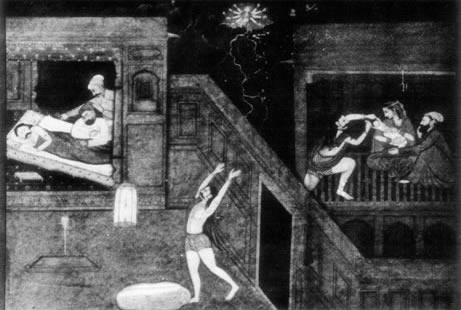
The Slaughter of an Innocent Illustration to the Bhagavata Purana Kangra, Punjab Hills, c. 1790 J.K. Mody collection, Bombay
Following the expansion of Indian miniature painting in the early seventeenth century, illustrated versions of the tenth book of the Bhagavata Purana began to be produced in parts of Hindu India. It was in the Punjab Hills, at the end of the eighteenth century, however, that romance and religion achieved their most delicate expression. The artist chiefly responsible was a certain Nainsukh who had arrived at the State of Guler in about 1740. His way of painting had marked affinities with that of Basawan (Plate 1) and represents a blend of early Mughal naturalism with later Hindu sentiment. The style founded by him influenced members of his own family, including his nephew Kushala and ultimately spread to Kangra and Garhwal where it reached its greatest heights. The present picture, together with Plates 5, 6, 8, 9, 11 and 16, is possibly by the Kangra artist Purkhu and with others of the series illustrates perhaps the greatest interpretation of the Bhagavata Purana ever produced in Indian painting.
In the picture, the tyrant ruler Kansa is sleeping on a bed as a courtier prepares to break the fateful news of Krishna's birth. To the right, Devaki, Krishna's mother, nurses the baby girl whom her husband, Vasudeva, has substituted for the infant Krishna. Kansa is wresting the baby from her in order to dash its head against a boulder. As he does so, she eludes his grasp and ascends to heaven in a flash, being, in fact, the eight-armed goddess Devi.
PLATE 4
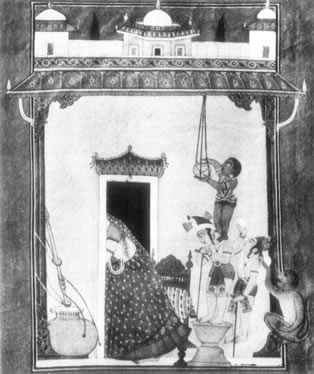
Krishna stealing Butter Illustration to an incident from the Bhagavata Purana Basohli, Punjab Hills, c. 1700 N.C. Mehta collection, Bombay
Besides illustrating the tenth book of the Bhagavata Purana as a whole, Indian artists sometimes chose isolated episodes and composed their pictures around them. The present picture is an instance of this practice, its subject being the baby Krishna pilfering butter. As Yasoda, Krishna's foster-mother, goes inside the house, Krishna and the cowherd children stage an impudent raid. A cowherd boy mounts a wooden mortar and then, balanced on his shoulders, the young Krishna helps himself to the butter which is kept stored in a pot suspended by strings from the roof. A second cowherd boy reaches up to lift the butter down while edging in from the right, a monkey, emblematic of mischievous thieving, shares in the spoil.
The picture illustrates the wild and vehemently expressive style of painting which suddenly appeared at Basohli, a tiny State in the Punjab Hills, towards the end of the seventeenth century. The jagged form of Yasoda, cut in two by the lintel of the doorway, the stabbing lines of the churning pole, grazing sticks and cords, as well as the sharp angles of the house and its furniture, all contribute to a state of taut excitement.
PLATE 5
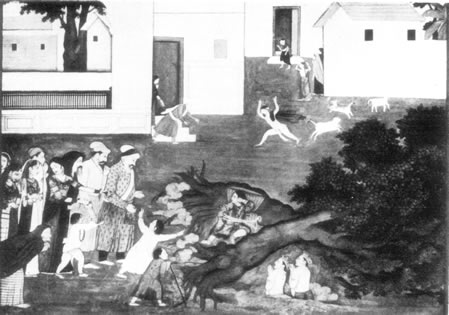
The Felling of the Trees Illustration to the Bhagavata Purana Kangra, Punjab Hills, c. 1790 State Museum, Lucknow
From the same great series as Plate 3, here attributed to the Kangra artist Purkhu.
The young Krishna, tied to a mortar to keep him out of mischief, has dragged it between two trees and thereby uprooted them. The cowherds, led by the bearded Nanda, Krishna's foster-father, have hurried to the scene and Balarama, Krishna's half-brother, is excitedly pointing out that Krishna is safe. In the foreground, emerging from the earth are two crowned figures—Nala and Kuvara, the sons of the yaksha king, Kubera, who, as a consequence of a curse had been turned into the two trees. Doomed to await Krishna's intervention, they have now been released. Reclining on the trunks, still tied to the mortar, the young Krishna surveys the scene with pert satisfaction.
PLATE 6
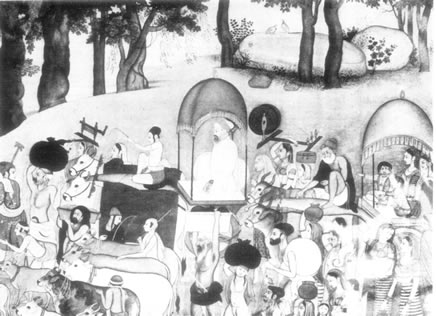
The Road to Brindaban Illustration to the Bhagavata Purana Kangra, Punjab Hills, c. 1790 National Museum, New Delhi
With Plates 3 and 5, part of the series attributed to Purkhu.
Led by Nanda, the majestic figure in the front bullock-cart, the cowherds are moving a day's march across the River Jumna to enjoy the larger freedom of Brindaban. Their possessions—bundles of clothes, spinning-wheels, baskets of grain and pitchers—are being taken with them and mounted with Yasoda on a second cart go the children, Balarama and Krishna. With its great variety of stances, simple naturalism and air of innocent calm, the picture exactly expresses the terms of tender familiarity on which the cowherds lived with Krishna.
PLATE 7
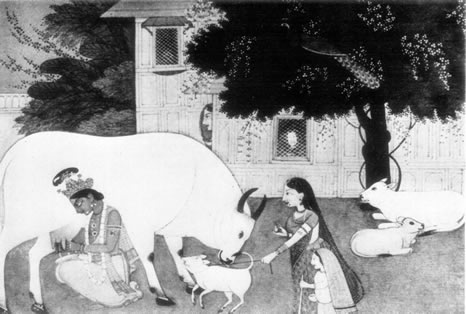
Krishna milking Illustration to the Bhagavata Purana Garhwal, Punjab Hills, c. 1800 G.K. Kanoria collection, Calcutta
Like Plate 4, an illustration of an isolated episode. Krishna, having graduated from tending the calves, is milking a cow, his mind filled with brooding thoughts. A cowgirl restrains the calf by tugging at its string while the cow licks its restive offspring with tender care. Other details—the tree clasped by a flowering creeper, the peacock perched in its branches—suggest the cowgirls' growing love. The image of tree and creeper was a common symbol in poetry for the lover embraced by his beloved and peacocks, thirsting for rain, were evocative of desire.
In style, the picture represents the end of the first great phase of Garhwal painting (c. 1770-1804) when romantic themes were treated with glowing ardour.
PLATE 8
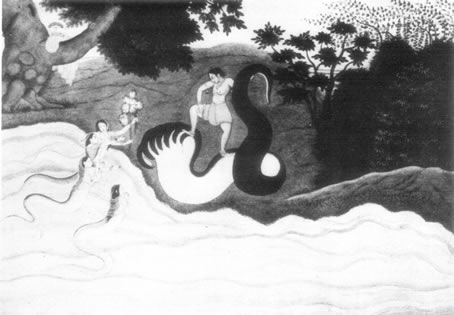
The Quelling of the Snake Kaliya Illustration to the Bhagavata Purana Kangra, Punjab Hills, c. 1790 J.K. Mody collection, Bombay
With Plates 3, 5 and 6, an example of Kangra painting in its most serene form.
Krishna, having defied the hydra-headed snake whose poison has befouled the River Jumna, is dancing in triumph on its sagging heads. The snake's consorts plead for mercy—one of them holding out bunches of lotus flowers, the others folding their hands or stretching out their arms in mute entreaty. The river is once again depicted as a surging flood but it is the master-artist's command of sinuous line and power of suffusing a scene of turmoil with majestic calm which gives the picture greatness.
Although the present study is true to the Bhagavata Purana where the snake is explicitly described as vacating the water and meeting its end on dry land, other pictures, notably those from Garhwal[129] follow the Vishnu Purana and show the final struggle taking place in the river itself.
[129]
Reproduced A.K. Coomaraswamy, Rajput Painting (Oxford, 1916), Vol. II, Plates 53 and 54.
PLATE 9
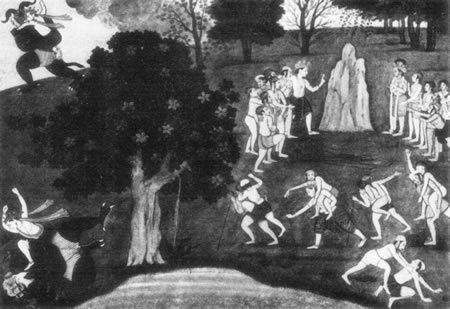
Balarama killing the Demon Pralamba Illustration to the Bhagavata Purana Kangra, Punjab Hills, c. 1790 National Museum, New Delhi
A further example from the Kangra series, here attributed to Purkhu.
As part of his war on Krishna and young boys, the tyrant Kansa sends various demons to harry and kill them, the present picture showing four stages in one such attack. To the right, the cowherd children, divided into two parties, face each other by an ant-hill, Krishna with arms crossed heading the right-hand group and Balarama the left. Concealed as a cowherd in Krishna's party, the demon Pralamba awaits an opportunity of killing Balarama. The second stage, in the right-hand bottom corner, shows Balarama's party giving the other side 'pick-a-backs,' after having been vanquished in a game of guessing flowers and fruit. The third stage is reached in the top left-hand corner. Here Pralamba has regained his demon form and is hurrying off with Balarama. Balarama's left hand is tightly clutched but with his right he beats at the demon's head. The fourth and final stage is illustrated in the bottom left-hand corner where Balarama has subdued the demon and is about to slay him.
The picture departs from the normal version, as given in the Bhagavata Purana, by showing Balarama's side, instead of Krishna's, carrying out the forfeits. According to the Purana, it was Krishna's side that lost and since Pralamba was among the defeated, he was in a position to take Balarama for a ride. It is likely, however, that in view of the other episode in the Purana in which Krishna humbles his favourite cowgirl when she asks to be carried (Plate 14), the artist shrank from showing Krishna in this servile posture so changed the two sides round.
PLATE 10
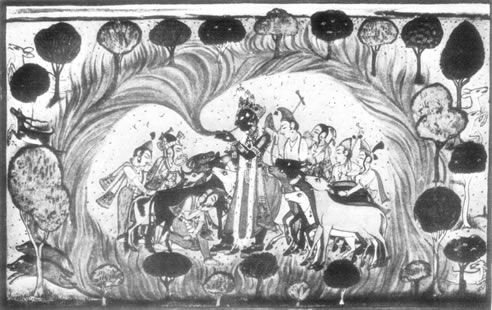
The Forest Fire Illustration to an incident from the Bhagavata Purana Basohli, Punjab Hills, c. 1680 Karl Khandalavala collection, Bombay
Under Raja Kirpal Pal (c. 1680-1693), painting at Basohli attained a savage intensity of expression—the present picture illustrating the style in its earliest and greatest phase. Surrounded by a ring of fire and with cowherd boys and cattle stupefied by smoke, Krishna is putting out the blaze by sucking the flames into his cheeks. Deer and pig are bounding to safety while birds and wild bees hover distractedly overhead.
During his life among the cowherds, Krishna was on two occasions confronted with a forest fire—the first, on the night following his struggle with Kaliya the snake when Nanda, Yasoda and other cowherds and cowgirls were also present and the second, following Balarama's encounter with the demon Pralamba (Plate 10), when only cowherd boys were with him. Since Nanda and the cowgirls are absent from the present picture, it is probably the second of these two occasions which is illustrated.
For a reproduction in colour of this passionately glowing picture, see Karl Khandalavala, Indian Sculpture and Painting (Bombay, 1938) (Plate 10).
PLATE 11
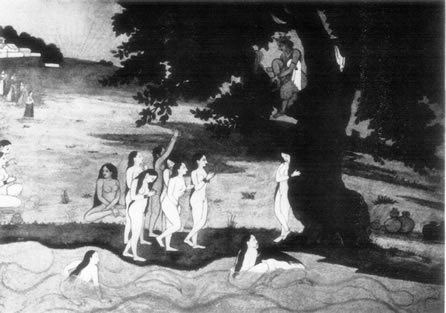
The Stealing of the Clothes Illustration to the Bhagavata Purana Kangra, Punjab Hills, c. 1790 J.K. Mody collection, Bombay
Despite the Indian delight in sensuous charm, the nude was only rarely depicted in Indian painting—feelings of reverence and delicacy forbidding too unabashed a portrayal of the feminine physique. The present picture with its band of nude girls is therefore an exception—the facts of the Purana rendering necessary their frank inclusion.
The scene illustrated concerns the efforts of the cowgirls to win Krishna's love. Bathing naked in the river at dawn in order to rid themselves of sin, they are surprised by Krishna who takes their clothes up into a tree. When they beg him to return them, he insists that each should freely expose herself before him, arguing that only in this way can they convince him of their love. In the picture, the girls are shyly advancing while Krishna looks down at them from the tree.
PLATE 12
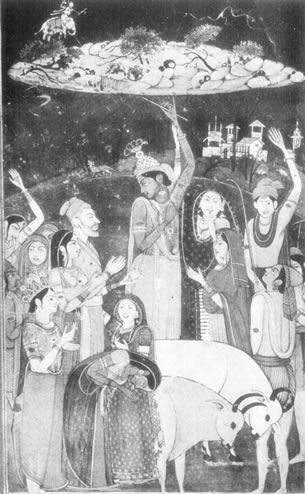
The Raising of Mount Govardhana Illustration to an incident from the Bhagavata Purana Garhwal, Punjab Hills, c. 1790 National Museum, New Delhi
With Plate 7, an example of Garhwal painting and its use of smoothly curving line.
Krishna is lifting Mount Govardhana on his little finger and Nanda. the cowherds and cowgirls are sheltering underneath. The occasion is Krishna's slight to Indra, king of the gods and lord of the clouds, whose worship he has persuaded the cowherds to abandon. Incensed at Krishna's action, Indra has retaliated by sending storms of rain.
In the picture, Indra, a tiny figure mounted on a white elephant careers across the sky, goading the clouds to fall in torrents. Lightning flickers wildly and on Govardhana itself, the torn and shattered trees bespeak the gale's havoc. Below all is calm as the cowherds acclaim Krishna's power.
PLATE 13
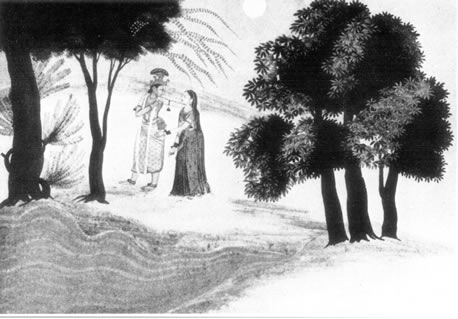
Krishna with his Favourite after leaving the Dance Illustration to the Bhagavala Purana Kangra, Punjab Hills, c. 1790 J.K. Mody collection, Bombay
Besides Purkhu, at least two other master-artists worked at Kangra towards the end of the eighteenth century—one, responsible for the present picture and Plates 14 and 15, being still unknown. He is here referred to as 'the master of the moonlight' on account of his special preoccupation with moonlight effects.
The present picture shows Krishna and a girl standing by an inlet of the River Jumna. The girl is later to be identified as Radha but in the Bhagavata Purana she is merely referred to as one who has been particularly favoured, her actual name being suppressed. The moment is some time after they have left the circular dance and before their sudden separation. Krishna, whose hand rests on the girl's shoulder, is urging her forward but the girl is weary and begs him to carry her. The incident illustrates one of the vicissitudes in Radha and Krishna's romance and was later to be endowed with deep religious meaning.
PLATE 14
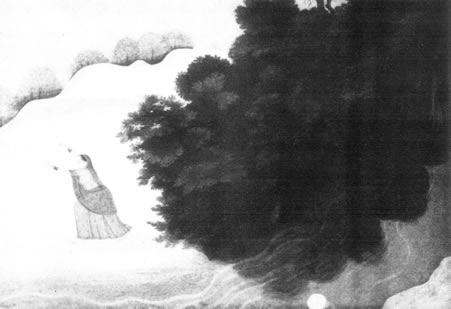
Krishna's Favourite deserted Illustration to the Bhagavata Purana Kangra, Punjab Hills, c. 1790 National Museum, New Delhi
From the same series as Plates 13 and 15 by 'the master of the moonlight.'
The girl's request (Plate 13) that Krishna should carry her brings to a head the question of Krishna's proper status. To an adoring lover, the request is not unreasonable. Made to God, it implies an excess of pride. Despite their impassioned love-making, therefore, the girl must be humbled and as she puts out her arms and prepares to mount, Krishna vanishes.
In the picture, the great woods overhanging the rolling Jumna are tilting forward as if to join the girl in her agonized advances while around her rise the bleak and empty slopes, their eerie loneliness intensified by frigid moonlight.
PLATE 15
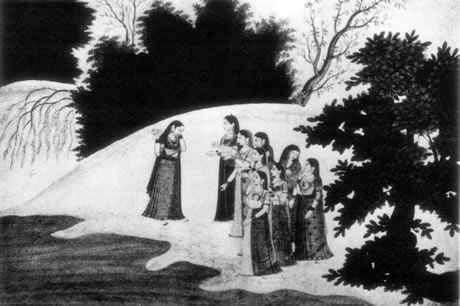
The Quest for Krishna Illustration to the Bhagavata Purana Kangra, Punjab Hills, c. 1790 J.K. Mody collection, Bombay
By the same 'master of the moonlight' as Plates 13 and 14.
Krishna's favourite, stunned by his brusque desertion, has now been met by a party of cowgirls. Their plight is similar to her own, for, after enjoying his enchanting love, they also have been deserted when Krishna left the dance taking his favourite with him. In the picture, Radha holds her head in anguish while to the right the cowgirls look at her in mute distress. Drooping branches echo their stricken love while a tree in the background, its branches stretching wanly against the sky, suggests their plaintive yearning.
PLATE 16
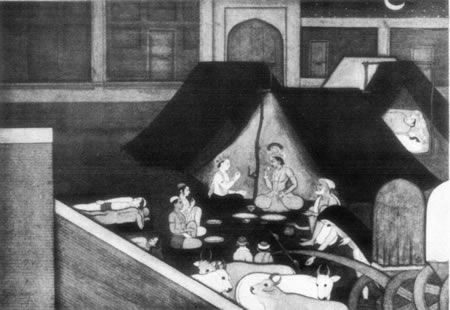
The Eve of the final Encounter Illustration to the Bhagavata Purana Kangra, Punjab Hills, c. 1790 J.K. Mody collection, Bombay
From the same series as Plates 3, 5, 6, 8, 9 and 11, here attributed to the Kangra artist Purkhu.
Invited by Kansa, the tyrant king, to attend a festival of arms, Nanda and the cowherds have arrived at Mathura and pitched their tents outside the walls. Krishna and Balarama are eating their evening meal by candle-light, a cowherd, wearing a dark cloak to keep off the night air, is attending to the bullocks while three cowherd boys, worn out by the day's march, rest on string-beds under the night sky. In the background, Krishna and Balarama, having finished their meal, are peacefully sleeping, serenely indifferent to the struggle which awaits them the next day. The moon waning in the sky parallels the tyrant's declining fortunes.
PLATE 17
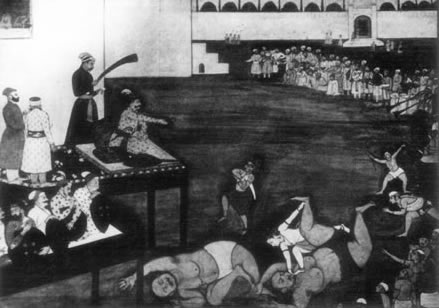
The End of the Tyrant Illustration to the Bhagavata Purana Kangra, Punjab Hills, c. 1790 Chester Beatty Library, Dublin
In the same style as Plate 16, but perhaps from a different series.
The festival of arms is now in progress but has already taken an unexpected turn. Set on by the savage elephant, Krishna and Balarama have killed it and taken out the tusks. They have then engaged two giant wrestlers, Krishna killing his opponent outright. In the picture Balarama is about to kill the other wrestler and Krishna, holding an elephant tusk under his arm, looks at the king with calm defiance. The king's end is now in sight for a little later Krishna will spring on the platform and hurl him to his death. Gathered in the wide arena, townspeople from Mathura await the outcome, while cowherd boys delightedly encourage the two heroes.
PLATE 18
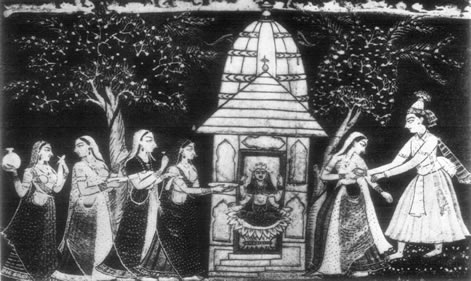
The Rape of Rukmini Illustration to the Bhagavata Purana Bilaspur, Punjab Hills, c. 1745 British Museum. London
Compared with Krishna's life among the cowherds, his adventures as a prince were only scantily illustrated in Indian painting—his consort Rukmini being totally eclipsed in courtly favour by the adored cowgirl, Radha. The present picture—one of the very few to represent the theme—shows Rukmini and her maids worshipping at the shrine to Devi, the earth mother, on the morning of her wedding. Her proposed husband is Sisupala and already he and his party have arrived to claim her hand. In despair Rukmini has apprised Krishna of her fate but does not know that he will intervene. As she worships, Krishna suddenly appears, places her on his chariot and, in the teeth of Sisupala's forces, carries her away. The picture illustrates the dramatic moment when after descending on the shrine, Krishna effects her rescue.
The picture is in an eighteenth-century style of painting which, from antecedents in Kashmir and the Punjab Plains, developed at Bilaspur. This small Rajput State adjoined Guler in the Punjab Hills and shared in the general revival of painting caused by the diffusion of artists from Basohli.
PLATE 19
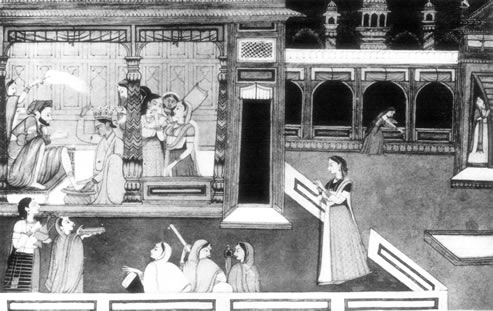
Krishna welcoming the Brahman Sudama Illustration to the Sudama episode in the Bhagavata Purana Garhwal, Punjab Hills, c. 1785 Chester Beatty Library, Dublin
Sudama is a poor Brahman whose devotion leads him to go to Dwarka, and seek out Krishna. Krishna remembers the time when they had shared the same preceptor and warmly welcomes him to his princely palace. The picture shows Sudama in rags seated on a stool while Krishna washes his feet and hails him as a Brahman. In close attendance are various ladies of the court, their graceful forms transcribed with sinuous delicacy and suave poetic charm.
Although an episode in Krishna's later career as a prince and one designed to buttress the priestly caste of Brahmans, the story—with its emphasis on loving devotion—is actually in close accord with Krishna's life among the cowherds. For this reason, it probably continued to excite interest long after other aspects of his courtly life had been ignored. In this respect. Sudama's visit to Krishna is as much a parable of divine love as Krishna's dances with the cowgirls.
PLATE 20
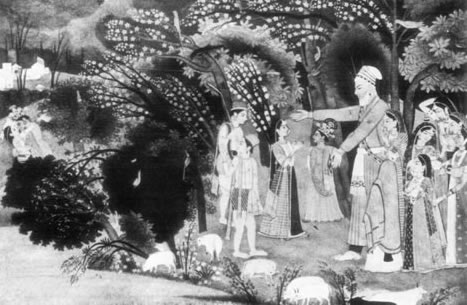
The Beginnings of Romance Illustration to the Gita Govinda Garhwal. Punjab Hills, c. 1790 National Museum, New Delhi
The first poem to celebrate Radha as Krishna's supreme love is the Gita Govinda of Jayadeva, written at the end of the twelfth century. The poem recounts Radha's anguish at Krishna's fickleness, his subsequent repentance and finally their passionate re-union.
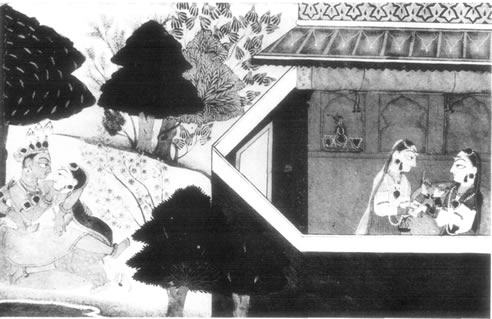
The present picture with its glamorous interpretation of the forest in spring illustrates the poem's opening verse and re-creates the setting in terms of which the drama will proceed. Nanda, the tall figure towering above the cowherd children, is commanding Radha to take Krishna home. The evening sky is dark with clouds, the wind has risen and already the flower-studded branches are swaying and bending in the breeze. Krishna is still a young boy and Radha a girl a few years older. As Radha takes him home, they loiter by the river, passion suddenly flares and they fall into each other's arms. In this way, the verse declares, the loves of Radha and Krishna began. The left-hand side of the picture shows the two lovers embracing—the change in their attitudes being reflected in their altered heights. Krishna who originally was shorter than Radha is now the taller of the two, the change suggesting the mature character of their passionate relations.
The picture with its graceful feminine forms and twining lines has the same quality of rhythmical exaltation as Plates 19 and 35, a quality typical of the Garwhal master-artist in his greatest phase.
PLATE 21
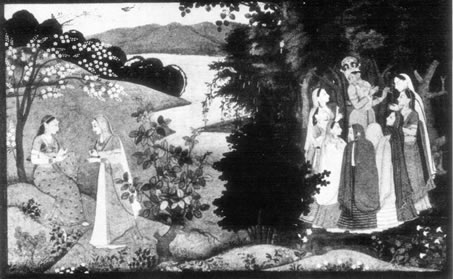
Krishna playing on the Flute Illustration to the Gita Govinda Kangra, Punjab Hills, c. 1790 N.C. Mehta collection, Bombay
As Radha wilts in lonely anguish, a friend describes how Krishna is behaving.
'The wife of a certain herdsman sings as Krishna sounds a tune of love Krishna here disports himself with charming women given to love.'
In the picture, Radha sits beneath a flowering tree, conversing with the friend while, to the right, Krishna plays the flute to a circle of adoring girls.
The painting is by a Kangra master, perhaps Kushala, the nephew of the Guler artist, Nainsukh, and illustrates the power of Kangra painters to imbue with innocent delicacy the most intensely emotional of situations. It was the investment of passion with dignity which was one of the chief contributions of Kangra painting to Indian art.
PLATE 22
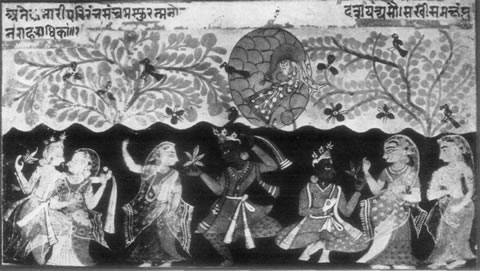
Krishna dancing with the Cowgirls Illustration to the Gita Govinda Western Rajasthan, c. 1610 N.C. Mehta collection, Bombay
Besides describing Krishna's flute-playing, Radha's friend gives her an account of his love-making.
'An artless woman looks with ardour on Krishna's lotus face.' 'Another on the bank of the Jumna, when Krishna goes to a bamboo thicket, Pulls at his garment to draw him back, so eager is she for amorous play.' 'Krishna praises another woman, lost with him in the dance of love, The dance where the sweet low flute is heard in the clamour of bangles on hands that clap. He embraces one woman, he kisses another, and fondles another beautiful one.' 'Krishna here disports himself with charming women given to love.'
The present picture illustrates phases of this glamorous love-making—Krishna embracing one woman, dancing with another and conversing with a third. The background is a diagram of the forest as it might appear in spring—the slack looseness of treatment befitting the freedom of conduct adumbrated by the verse. The large insects hovering in the branches are the black bees of Indian love-poetry whose quest for flowers was regarded as symbolic of urgent lovers pestering their mistresses. In style the picture illustrates the Jain painting of Western India after its early angular rigidity had been softened by application to tender and more romantic themes.
PLATE 23
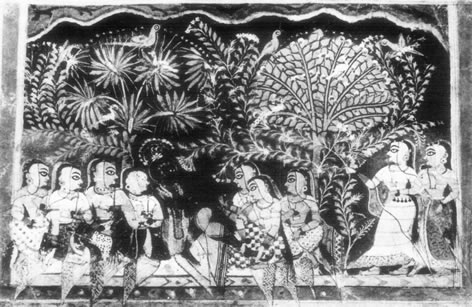
Krishna seated with the Cowgirls Illustration to the Gita Govinda Jaunpur, Eastern India, c. 1590 Prince of Wales Museum, Bombay
After flute-playing and dancing (Plates 21 and 22), Krishna sits with the cowgirls.
'With his limbs, tender and dark like rows of clumps of blue lotus flowers. By herd girls surrounded, who embrace at pleasure any part of his body, Friend, in spring, beautiful Krishna plays like Love's own self Conducting the love sport, with love for all, bringing delight into being.'
And it is here that Radha finds him.
'May the smiling captivating Krishna protect you, whom Radha, blinded by love, Violently kissed as she made as if singing a song of welcome saying, "Your face is nectar, excellent," ardently clasping his bosom In the presence of the fair-browed herdgirls dazed in the sport of love.'
The picture shows Krishna surrounded by a group of cowgirls, one of whom is caressing his leg. To the right, Radha and the friend are approaching through the trees. The style with its sharp curves and luxuriating smartness illustrates a vital development of the Jain manner in the later sixteenth century.[130]
[130]
For a first discussion of this important series, see a contribution by Karl Khandalavala, 'A Gita Govinda Series in the Prince of Wales Museum,' Bulletin of the Prince of Wales Museum. Bombay (1956), No. 4.
PLATE 24
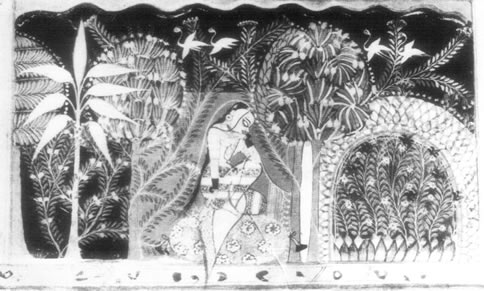
The neglected Radha Illustration to the Gita Govinda Jaunpur, Eastern India, c. 1590 Prince of Wales Museum, Bombay
Following his revels with the cowgirls, Krishna is smitten with remorse. He roams the forest, searching for the lovely Radha but finding her nowhere. As he pursues his quest, he encounters the friend and learns of Radha's dejected state.
'Her body is wholly tormented by the heat of the flame of desire; But only of you, so loved, she thinks in her langour, Your extinguishing body; secluded she waits, all wasted— A short while, perhaps, surviving she lives. Formerly even a moment when weary she closed her eyes. The moment's parting she could not endure, from the sight of you; And now in this long separation, O how does she breathe Having seen the flowery branch of the mango, the shaft of Love?'
In the picture, Radha is sitting in the forest, lonely and neglected. Trees surround her, suggesting by their rank luxuriance the upward surge of spring while cranes, slowly winging their way in pairs across the blackening sky, poignantly remind her of her former love.
PLATE 25
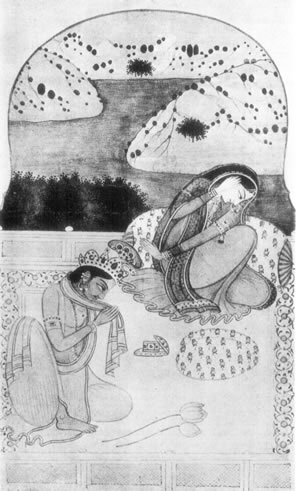
Krishna repentant Illustration to the Gita Govinda Garhwal, Punjab Hills, c. 1790
Learning of Radha's plight, Krishna longs to comfort her. Before approaching her, however, he spends a night passionately dallying with another cowgirl and only in the morning tenders his submission. By this time, Radha's mood has turned to bitter anger and although Krishna begs to be forgiven, Radha tells him to return to his latest love.
'Go, Krishna, go. Desist from uttering these deceitful words. Follow her, you lotus-eyed, she who can dispel your trouble, go to her.'
In the picture, Krishna is striving to calm her ruffled feelings while Radha, 'cruel to one who loves you, unbending to one who bows, angry with one who desires, averting your face from this your lover,' has none of him.
According to the poem, the scene of this tense encounter is not a palace terrace but the forest—the Garhwal artist deeming a courtly setting more appropriate for Radha's exquisite physique. The suavely curving linear rhythm, characteristic of Garhwal painting at its best, is once again the means by which a mood of still adoration is sensitively conveyed.
PLATE 26
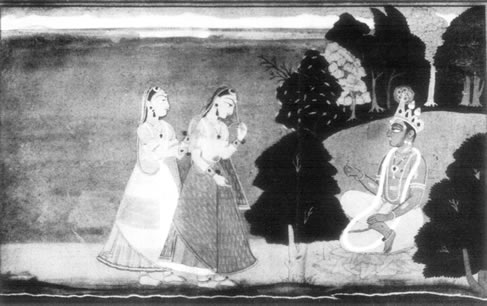
The last Tryst Illustration to the Gita Govinda Basohli. Punjab Hills, c.* 1730 State Museum, Lahore
Having brusquely dismissed Krishna, Radha is overcome with longing and when he once again approaches her she showers on him her adoring love. The friend urges her to delay no longer.
'Your friends are all aware that you are ready for love's conflict Go, your belt aloud with bells, shameless, amorous, to the meeting.'
Radha succumbs to her advice and slowly approaches Krishna's forest bower.
In the picture, Krishna is impatiently awaiting her while Radha, urged onward by the friend, pauses for a moment to shed her shyness. The picture is part of an illustrated edition of the poem executed in Basohli in 1730 for a local princess, the lady Manaku. As in other Basohli paintings, trees are shown as small and summary symbols, the horizon is a streak of clouds and there is a deliberate shrinkage from physical refinement. The purpose of the picture is rather to express with the maximum of power the savagery of passion and the stark nature of lovers' encounters.
PLATE 27