"A Tale of Sonora" (continued 3)
Reading edition
“Let me go alone.”
All eyes turn upon him inquiringly and in wonder, none more than those of his father, who exclaims:
“You go alone, my son! Why do you propose that?”
“Because it will be best, father.”
“How best? I do not understand you.”
“Crusader can only carry one.”
“Ah! Crusader—that’s what you’re thinking of?”
“Por Dios!” exclaims the senior partner, “I see what your son means, Don Roberto; his idea is admirable!”
“Yes,” says the English youth in answer to his father; “I’ve been thinking of it ever since yesterday. On Crusader’s back I can be at Arispe days before any foot messenger could arrive there. Once I had him between my legs, no fear of Indians overtaking me.”
“The very thing!” cries Don Estevan, delighted. “But, Señor Henrique, are you sure you can catch the horse?”
“Catch him! he will come to my call. Once on the plain, and within hearing of my voice, I’ve no fear of his soon being by my side.”
“But why not let me take him?” puts in Pedro Vicente, as if to spare the generous youth from undertaking such a risk. “I know the road better than you, muchacho.”
“That may be,” returns the other. “But I know it well enough. Besides, Crusader will let no one catch him but myself—much less ride him.”
During all this conversation the bystanders regard the young Englishman with looks of admiration. Never before have they seen so much courage combined with intelligence. And all to be exerted in their favour; for they have not forgotten the fate of their two comrades, put to death in such a cruel fashion. Every one of them fears that the like may befall himself, should it be his ill luck to draw a black pinon out of the sombrero.
Not the least in admiration is Robert Tresillian himself: his heart swells with pride at the gallant bearing of the boy, his own son, worthy of the ancestral name; and when Don Estevan turns to him to ask whether he objects to the proposal, it is to receive answer:
“On the contrary, I approve of it. Foot messengers might not reach in time, if at all. My brave boy will do it if it can be done; it may be the means of bringing rescue to us all. If he fail, then I, like the rest of you, must submit to fate.”
“I’ll not fail,” cries the impetuous youth, rushing forward and throwing his arms round his father. “Fear not. I have a belief that God’s hand is in it, else why should my noble horse have stayed? Why is he still there?”
“Virgen santissima!” exclaims Don Estevan in devout tone. “It would even seem so. Let us hope and pray that the Almighty’s hand is in it. If so, we shall be saved.”
Henry Tresillian is the hero of the hour, though he has been a favourite with the people of the caravan all along, doing kind offices to this one and that one, helping all who needed help. But now, when they hear he has volunteered on this dangerous service, as it were offering up his life for theirs, encomiums are loud on all sides. Women fall upon their knees, and, with crucifix in hand, offer up prayers for his protection. But Gertrude? Oh, the sad thoughts—the utter woe that strikes through her heart—when she hears tidings of what is intended! She receives them with a wild cry, almost a shriek, with arms outstretched staggering to the side of her mother for support.
“Mamma, father must not let him go. He will be lost, and then—then—”
“Have no fear. Think, hija mia, we may all be lost if he do not.”
“But why cannot some other go in his place? There are many who know the way as well as he, and that brave gambusino, I’m sure, would be willing.”
“No doubt he would, dearest; there’s some reason against it I do not quite understand. We shall hear all soon, when father returns to the tent.”
They do hear the reason; but not any the more to reconcile Gertrude. The young girl is half beside herself with grief, utterly indifferent as to who may observe it. The bud of her love has bloomed into a flower, and she recks not that all the world know her heart is Henry Tresillian’s. The cousin left behind at Arispe, supposed to be an aspirant to her hand, is forgotten. All are forgotten, save the one now near, so soon to be cruelly torn away from her. Neither the presence of her father and mother, nor that of his father, restrain her in her wild ravings. She knows she has their approval of her partiality, and her young heart, innocent of guile, yields to nature’s promptings.
Her appeals are in vain: what must be must be, and she at length resigns herself to the inevitable. For Henry himself tells her how it is, and that no one possibly could take his place.
It is in dialogue between them, just as the twilight begins to cast its purple shadows over the plain. For the time is drawing nigh for action, and the two have gone apart from the camp to speak the last words of leave-taking. They stand under a tree, hands clasped, gazing into each other’s eyes, those of the young girl full of tears.
“Querida” he says, “do not weep. ’Twill be all well yet—I feel sure of it.”
“Would that I could feel so, Henrique; but, oh! dearest, such danger! And if the cruel savages capture you. Ay Dios! to think of what they did with the others!”
“Let them catch me if they can. They never will if I once get alongside Crusader. On his back I may defy them.”
“True, I believe it. But are you sure of getting upon his back? In the darkness you may not find him.”
“If not, it will be but to return to the cliff and be drawn up again.”
This assurance somewhat tranquillises her. There is at least the hope, almost certainty, he will not, as the others, be sacrificed to a fruitless attempt; and, so trusting, she says in conclusion: “Go, then, querido mio. I will no more oppose it, but pray all night long for your safety. I see now it is for the best, and feel that the blessed Mary, mother of God, will listen to my prayers.”
No longer hands clasped, but arms entwined, and lips meeting in a kiss of pure holy affection, sanctified by parental consent. Then they return to the camp, where the final preparations are being made for that venture upon which so much depends.
Chapter Twenty Three.
A Ride in Mid-Air.
It turns out just such a night as was wished for—moonless, still not obscurely dark. Too much darkness would defeat the end in view. They need light for the lowering down, a thing that will take some time with careful management.
But the miners are the very men for such purpose. Not one of them who has not dangled at a rope’s end in a shaft hundreds of feet sheer down into the earth. To them it is habitude—child’s play—as to him who spends his life scaling sea-coast cliffs for the eggs and young of birds.
It is yet early when the party entrusted with the undertaking assemble on the edge of the precipice, at the point where the daring adventurer is to make descent. Some carry coils of rope, others long poles notched at the end for fending the line off the rocks, while the gambusino is seen bearing a burden which differs from all the rest. A saddle and bridle it is; his own, cherished for their costliness, but now placed at the service of his young friend, to do what he will with them.
“I could ride Crusader without them,” says the English youth: “guide him with my voice and knees; but these will make it surer, and I thank you, Señor Vicente.”
“Ah, muchacho! if they but help you, how glad ’twill make me feel! If they’re lost, it wouldn’t be for that I’d grudge the twenty doblones the saddle cost me. I’d give ten times as much to see you seated in it on the plaza of Arispe.”
“I’ll be there, amigo, in less than sixty hours if Crusader hasn’t lost his strength by too long feeding on grass.”
“I fancy you need not fear that, señorito; your horse is one that nothing seems to affect. I still cling to the belief he’s the devil himself.”
“Better believe him an angel—our good angel now, as I hope he will prove himself.”
This exchange of speech between the two who have long been compagnons de chasse, is only an interlude occurring while the ropes are being uncoiled and made ready.
Instead of a loop to be passed around the adventurer’s body, a very different mode for his making descent has been pre-arranged. He is to take seat in the saddle, just as though it were on the back of a horse, and, with feet in the stirrups and hands clutching the cords that suspend it, be so let down. A piece of wood passed under the tree, and firmly lashed to pommel and cantle, will secure its equilibrium.
Finally all is ready, and, the daring rider taking his seat, is soon swinging in mid-air. Hand over hand they lower him down, slowly, cautiously, listening all the while for a signal to be sent up. This they get in due time—a low whistle telling them that he has reached the first ledge, though they could tell it by the strain upon the rope all at once having ceased.
Up it is drawn again, its owner himself, in turn, taking seat in it, to be lowered down as the other. Then again and again it is hoisted up and let down, till half a score of the miners, stalwart men, Robert Tresillian among them, stand on the bench below.
Now the saddle is detached and fastened on to another rope, when the same process is repeated; and so on, advantage being taken of the sloping ledges, till the last is arrived at.
Here it is but a repetition of what has gone before, only with a longer reach of rope; and here Pedro Vicente takes last leave of the youth who has become so endeared to him.
In the eye of the honest gambusino there is that not often seen there, a tear. He flings his arms around the English youth, exclaiming:
“Dios te guarda, muchacho valiente! (God guard you, my brave lad).”
The parting between the two is almost as affectionate as that between Henry and his father, the last saying, as he enfolds his son in his arms:
“God go with you, my noble boy!” In another moment the daring youth is once more in the saddle, going down, down, till he feels his feet upon the plain. Then stepping out of it, and sending up the preconcerted signal, he detaches saddle and bridle from the cords, leaving the latter to swing free.
Shouldering the horse gear with other impedimenta, he looks round to get his bearings, and, soon as satisfied about these, starts off over the plain in search of Crusader.
He is not the only one at that moment making to find the horse. From the Indian camp a picked party has issued forth, urged by the chief. For the new leader of the Coyoteros longs to possess that now famous steed as much as did the deceased one.
“Ten of my best mustangs, and as many of my mules, will I give for the black horse of the paleface. He who captures him may claim that reward.”
More than once has El Zopilote thus declared himself, exciting the ardour and cupidity of his followers. Withal they have chased Crusader in vain, over and over again, till in their superstitious fancy they begin to think him a phantom.
But as yet they have never tried to take him by night; and now, having ascertained the place where he usually passes the nocturnal hours, they start out in quest of him.
Not rashly nor incautiously; instead, they proceed deliberately, and with a preconceived plan, as though stalking game. Their intention is first to enfilade the animal at long distance off, then contract the circle, so as to have him sure.
In execution of their scheme, on reaching the western side of the lake, they divide into two parties. One moves along the mountain’s foot, dropping a file here and there; the other strikes out over the llano, in a circular line, as it proceeds doing the same.
It is too dark for them to see horse or other object at any great distance, so they take care that their circle be wide enough to embrace the stretch of pasture where the coveted animal is known to browse.
Noiselessly they execute the movement, going at a slow walk, lest the hoof-strokes of their horses may alarm the one they would enclose; and when the heads of the separated parties again come together, all know it by a signal agreed upon—the cry of the coyote transmitted along their line admonishes them that the cordon is complete.
Chapter Twenty Four.
Once More Upon Crusader.
Henry Tresillian has hardly advanced a hundred yards from the cliff, when the Indian party, turning northward, passes close to the spot where he had been let down. Luckily not so close as to observe the rope still hanging there, and far enough from himself to hinder their seeing him. For the obscurity makes it impossible to distinguish objects unless very near.
Neither sees he them, nor has any suspicion of their dangerous proximity; and without stop or stay he keeps on towards the point where he expects to find his horse.
He goes not without a guide. At the latest hour of twilight he had seen Crusader about a mile off, in a direction due west; and although the night is dark, some of the stars are visible, among them the Polar. With this on his right shoulder he cannot mistake the way, so continues on in confidence.
He knows he will not need to go groping about, if the horse be still there, as it is hoped he is: a peculiarly intoned call with a whistle will bring him up from far as he can hear it. Many a time has his master, while hunting on the hills round Arispe, so summoned Crusader to his side.
He has advanced more than half a mile, and is thinking whether he shall not give the signal and put an end to all uncertainty. He should now be near enough for it to be heard, and it will tell him if the animal be still there or has wandered away to some other part of the llano. In the latter case all his labours will be lost, and no alternative left him but return to the cliff and get hoisted up again.
Still a thought holds him silent. The activity of the Indians, with their frequent patrol parties, more by night than by day, has long been a matter of curiosity and speculation among the miners. What if such a party be now out and within hearing? For he knows that to his voice Crusader will respond with a neigh, and that might undo all. Therefore, curbing his impatience, he proceeds on, silent as a spectre, his glances directed now this way, now that, endeavouring to penetrate the gloom.
All at once he hears the tramp of a horse, on the instant after seeing and recognising Crusader. To his surprise also; for the animal is not at rest or browsing, but moving excitedly about, every now and then uttering a snort, as though he scented danger. His master knows he himself cannot be the cause of this unlooked-for behaviour. The horse is up wind, and could not possibly be aware of his approach. What, then, is exciting him?
Wolves—coyotes? Yes, it must be that; and as a proof of its being so, just then he hears the whining howl of the jackals simultaneously all around.
Such a chorus resounding on every side seems odd, the more from its being heard for but a brief moment, then silence as before. But Henry Tresillian stays not to reflect on its oddity. He fears that the howling repeated may start Crusader into a stampede, and without further delay gives him that signal he knows will be answered. Answered it is, and instantly, by a neigh sent back in response; and in twenty seconds after the horse stands face to face with his young master, his velvet muzzle pressing the latter’s cheek. On one side there are words of endearment, on the other a low, joyous whimpering, as though the dumb brute was trying to speak its delight at their being together again.
Crusader opens his mouth to receive the bit, and seems almost to stoop for the saddle to be thrown over him. He is caparisoned in a trice; but just as Henry Tresillian, stooping to tighten the girths, gets the buckle into its hole, he hears that which causes him to rise erect, and clutch at the bridle: the sound of hoofs on all sides; horses evidently, with men upon their backs. Indians!—they can be no other!
Quick as thought he vaults into the saddle, and sets himself ready to make a dash.
In what direction? He knows that which he should take for Arispe. But is it open to him? This he cannot tell, nor, indeed, that any way is open to him. For he now hears the tramp of horses all around, and before he can resolve himself, sees the horses themselves. It has grown a little clearer, for the moon is about to rise, and Crusader’s neigh had guided the Indians to the spot.
If he stay, Henry Tresillian is conscious he will soon be encircled by a crowd with no chance to get clear of it. Already he sees its ring closing around him.
But the Indians are still some fifty yards distant, come to a halt; suddenly and with shouts of surprise, for they have sighted him. There is even terror in their accents, with awe in their hearts—awe of the supernatural. They supposed themselves making surround of a horse, when lo! there is a man upon his back, all in keeping with the mysterious character Crusader has obtained among those who have vainly chased him.
The young Englishman notes their strange behaviour, but without thought of the cause. He knows, however, they will not stay long at rest, and, by the better light, seeing a break in their line, sets his horse’s head for it, gives the word with touch of knee, and springs forward at full speed, determined to take his chance.
In a dozen strides he is between two of the Coyotero horsemen, when he feels his bridle arm suddenly drawn back and held tight to his body; then, with a quick jerk he is lifted clean out of the saddle and flung with violence to the earth!
Fortunately he is neither stunned nor loses consciousness, but has all his senses about him; he knows what has happened, and that he is in the noose of a lasso. But his right arm is free, and, instantly regaining his feet, he draws his knife, and, severing the cord in twain, releases himself.
It would have been to little purpose had his horse been other than he is. But the sagacious animal, seeming to comprehend all, instead of galloping away, has stayed by his side, and in another moment has its master on its back again.
With to all appearance a clear track before him now, the daring youth once more makes forward, favoured by the confusion that has arisen among the savages. In the dim light they are unable to distinguish the strange horseman from one of themselves, and their surprise is but increased with their superstitious terror, both holding them spellbound. They but cry out, and question one another, without making any effort to pursue.
Henry Tresillian begins to think himself safe away, when he sees one of the Coyoteros, who had lagged behind their line, come full tilt towards him in a gallop as himself. Before he can check his pace, their animals meet in violent collision, and the mustang of the Indian is flung back on its haunches, dismounting its rider. The man has his gun in hand, and, seeing a paleface, instinctively raises the piece, taking aim at him. But before he can touch the trigger, the English youth has also a piece levelled—a pistol, which cracks first; and the savage, uttering a wild agonised yell, staggers a pace or two, and falls backward on the grass.
With nothing more in his way now, his young master again gives Crusader the word, and off go they at highest race-course speed.
Chapter Twenty Five.
Up the Cliff Again.
It is some time before the Indians recover from their mystification. Is the black horse flesh and blood, or a phantom?
Not until they have closed together and taken counsel of one another is this question resolved. The wiser of them affirm that in some way one of the palefaces must have got down the cliff, caught the horse, and mounted him. That the rider, at least, is a mortal being they have ample evidence in their comrade stretched dead upon the plain by a bullet.
The sight rekindles all their ire, and shouts of vengeance make the welkin ring. But only for a while. Silence again reigns, and the hoof-strokes of the retreating fugitive can be heard through the tranquil calm of the night, stirring them to pursuit.
Away go they in gallop after; but not all, nearly half of them turning their horses’ heads towards the cliff. For if the white men have let one of their number down, there should be some sign of it, which they proceed to search for.
Impossible to depict the feelings of those on the mesa, above all, the ones who have been standing on the ledges to await the result. They cannot have themselves hoisted up again till sure their messenger has either failed or got free, and from the moment of his parting from the cliff’s base, to them all had been uncertainty. Terrible suspense, too, from the very first; for although they saw not the Indians passing underneath, they heard their horses’ tread, now and then a hoof striking against stone, or in dull thud upon the hard turf. Though they could not make out what it meant, they knew it was something adverse—hostile. Horses would not be there without men on their backs, and these must be enemies.
Listening on, with hearts anxiously beating, they hear that strange concatenation of cries, the supposed howling of coyotes, all around the plain. It puzzles them, too; but before they have time to reflect on it a sound better understandable reaches their ears—the neighing of a horse—most of them recognising it as Crusader’s, for most are familiar with its peculiar intonation.
More intently than ever do they listen now, but for a time hear nothing more. Only a brief interval; then arise sounds that excite their apprehension to its keenest—voices of men, in confused clamouring, the accent proclaiming them Indians.
Robert Tresillian, still standing beside the gambusino on the lowest ledge, feels his heart sink within him, as he exclaims: “My poor boy! lost—lost!”
“Wait, señor,” says Vicente, with an effort to appear calm. “That’s not so sure. All’s not lost that’s in danger. If there be a chance of escape your brave son’s the very one to take advantage of it. Oiga! what’s that?”
His question has reference to another chorus of cries heard out on the plain; then a moment’s lull, succeeded by a crashing sound as of two heavy bodies brought into collision. After that a shot, quickly followed by a yell—a groan.
“A pistol!” exclaims the gambusino, “and sure the one Señorito Henrique took with him. I’ll warrant he’s made good use of it.”
The father is too full of anxious thought to make reply; he but listens on with all ears, and heart audibly pulsating.
Next to hear the hoof-strokes of a horse in gallop as if going off; which in a way cheers him: it may be his son escaped.
But then there is more confused clamour, with loud ejaculations—voices raised in vengeance; and after the trampling of other horses, apparently starting in pursuit.
What is to be done now?—draw up the rope, and have themselves drawn up? There seems no reason for their waiting longer. The messenger is either safe off, or has been captured; one way or the other he will not get back there. So they may as well reascend the cliff.
Besides, a thought of their own safety now forces itself upon them. A streak of light along the horizon admonishes them of the uprising moon. Already her precursory rays, reflected over the plain, begin to lighten the obscurity, rendering objects more distinct, and they now make out a dark mass on the llano below, a party of horsemen, moving in the direction of the mesa.
“We’d better pull up, Don Roberto,” says the gambusino; “they’re coming this way, and if they see the rope it will guide their eyes to ourselves, and we’re both lost men. They carry guns, and we’ll be within easy range, not over thirty yards from them. Por Dios! if they sight us we’re undone.”
Don Roberto makes neither protest nor objection. By this his son has either got clear or is captured: in either case, he cannot return to them. And, as his companion, he is keenly sensible to the danger which is now threatening, so signifies assent.
Silently they draw up the rope, and soon as it is all in their hands, signal to those above to hoist them also. First one, making it fast round his body, is pulled up; then the loop is let down, and the other ascends, raised by an invisible power above.
Four are now on the next ledge, and, by like course of proceeding are lifted one after another to that still higher, the sloping benches between helping them in their ascent. All is done noiselessly, cautiously; for the savages are now seen below in dark clump, stationary near the foot of the precipice.
They have reached the last bench, and so far unmolested, begin to think themselves out of danger,
But alas, no! The silence long prevailing is suddenly broken by a rock displaced and rolling down; while at the same moment the treacherous moon, showing over the horizon’s edge, reveals them to the eyes of the Indians.
Then there is a chorus of wild yells, followed by shots—a very fusillade; bullets strike the rocks and break fragments off, while other shots fired in return by those above into the black mass below instantly disperse it.
In the midst of all, the last man is drawn up to the summit, but when landed there, they who draw him up see that the rope’s noose is no longer round a living body, but a corpse, bleeding, riddled with bullets.
Chapter Twenty Six.
Distanced—No Danger Now.
Finding himself clear of the Indians, Henry Tresillian’s heart beats high with hope; no mischance happening, he can trust Crusader to keep him clear. And now he turns his thoughts to the direction he should take. But first to that in which he is going, for he has galloped out of the encircling line through the nearest opening that caught his eye.
The foretaste of the moonlight enables him to see where he is—luckily, on the right track. The route to Arispe lies south-eastward, and the lake must be passed at its upper or lower end. The former is the direct route, the other around about; but then there is the Indian camp to be got past, and others of the savages may be up and about. Still the wagon corral is two or three hundred yards from the water’s edge, which may give him a chance to pass between unobserved, and, with unlimited confidence in his horse, he resolves upon risking it.
An error of judgment: he has not taken into account the fracas behind, with the report of his own pistol, and that all this must have been heard by the redskins remaining in camp. It has nevertheless. The consequence being that ere he has got half round the upper end of the lake, he sees the plain in front of him thickly dotted with dark forms—men on horseback—hears them shouting to one another. A glance shows him it is a gauntlet too dangerous to be run. The fleetness of his steed were no surety against gun-shots.
He reins up abruptly, and, with a wrench round, sets head west again, with the design to do what he should have done at first—turn the lake below.
The détour will be much greater now: he has passed a large elbow of it, which must be repassed to get around; but there is no alternative, and, regretting his mistake, he makes along the back track at best speed. Not far before finding further reason to be sorry for his blunder. On that side, too, he sees mounted men directly before him—those he had lately eluded. They are scattered all over the plain, apparently in search of him, some riding towards the lake’s lower end, thinking he has gone that way. But all have their eyes on him now, and place themselves in position to intercept him. His path is beset on every side, the triumphant cries of the Coyoteros proclaiming their confidence that they have him at last—sure to capture or kill him now. And his own heart almost fails him: go which way he will, it must be through a shower of bullets.
Again he reins up, and sits in his saddle undecided. The risk seems equal, but it must be run; there is no help for it.
Ha! yes, there is. A thought has flashed across his brain—a memory. He remembers having seen the camp animals wading the lake through and through; not over belly-deep. Why cannot Crusader?
With quick resolve he sets his horse’s head for the water, and in a second or two after the animal is up to the saddle-girths, plunging lightly as if it were but fetlock-deep.
Another cry from the Indians on both sides—surprise and disappointment mingled; in tones telling of their belief in the supernatural, and come back.
But soon they, too, recall the shallowness of the lake, and see nothing strange in the fugitive attempting to escape across it. So, without loss of time, they again put their horses to speed, making to head him on its eastern shore.
They are as near as can be to succeeding. A close shave it is for the pursued messenger, who, on emerging from the water, sees on either flank horsemen hastening towards him. But he is not dismayed. Before any of them are within shot range he dashes onward; Crusader, with sinews braced by the cool bath, showing speed which ensures him against being overtaken.
He is pursued, nevertheless. The subtle savages know there are chances and mischances. One of the latter may arise in their favour; and hoping it will be so, they continue the chase.
The moon is now up, everything on the level llano distinguishable for miles, and the black horse with his pale-faced rider is still less than twenty lengths ahead; so after him they go, fast as their mustangs can be forced.
Only to find that in brief time the twenty lengths have become doubled, then trebled, till in fine they see that it is fruitless to carry the pursuit further.
With hearts full of anger and chagrin, they give it up. Some apprehension have they as well. El Zopilote is not with them; what will he say on their returning empty-handed? what do? For it is now no mere matter of the catching of a horse; instead, more serious—a courier gone off to bring succour to the besieged.
Down-hearted and dejectedly they turn their horses’ heads, and ride back for Nauchampa-tepetl.
Had the Coyoteros stuck to their faith in the probability of accidents and continued the pursuit, they might have overtaken Henry Tresillian after all. For scarce have they turned backs upon him when a mishap befalls him, not absolutely staying him in his course, but delaying him wellnigh an hour. He is making to regain the road which runs north from Arispe, at the point where the caravan, forced by want of water, had deflected from it to the Cerro Perdido. In daylight he could have ridden straight to it; for since then from the mesas summit Pedro Vicente had pointed to guide-marks indicating the spot where his initials were carved upon the palmida. But in his haste now, amid the glamour of a newly-risen moon, the messenger has gone astray, only discovering it when his horse suddenly staggering forward comes down upon his knees, shooting him out of the saddle.
He is less hurt than surprised. Never before has Crusader made false step or stumble, and why now?
A moment reveals the reason: the ground has given way beneath, letting him down knee-deep into a hole, the burrow of some animal.
Fortunately, there are no bones broken, no damage done either to horse or rider; and the latter, recovering his seat in the saddle, essays to proceed. Soon to be a second time brought to a stand, though not now unhorsed. Crusader but lurches, keeping his legs, though again near going down.
The young Englishman perceives what it is: he is riding through a warren of the kind well known on the plains of Western America as “a prairie-dog town or village.” In the moonlight he sees the hillocks of these marmots all around, with the animals themselves squatting on them; hears their tiny squirrel-like bark, intermingling with the hoot of the quaint little owl which shares their subterranean habitations.
Once more at halt, he again bethinks himself what is best to do. Shall he ride back and go round the village, or continue on across it, taking the chances of the treacherous ground?
He listens, soon to become assured that the pursuit has been abandoned, thus giving him choice to act deliberately, and do as seems best to him.
Around the dog town may be miles, while direct to the other side may be only a few score yards. They are often of oblong shape, extending far, but of little breadth, possibly because of the condition of the ground and the herbage it produces.
Having ridden into it, he resolves to keep on; but to his great annoyance and disgust finds it to extend far beyond the limits of his patience; and as Crusader’s hoofs break through the hollow crust, it becomes necessary to alight and lead him.
At length, however, he is out of it, and again on firm ground, with the level llano far stretching before him. But in the distance he discerns a mountain ridge, trending north and south, lit up by the moon’s light, along which, as he knows, lies the route to Arispe.
“We’re on the right road now, my noble Crusader, with no fear of being followed. And we must make it short as possible. The lives of many depend on that—on your speed, brave fellow. So let us on.”
Crusader responds with one of his strangely-intoned whimperings—almost speech. Then stands motionless, till his young master is in the saddle; after which he again goes off in a gallop, ventre à terre.
Chapter Twenty Seven.
In Painful Suspense.
Than the rest of that night no more anxious time has been spent by the beleaguered miners. If their new messenger fail in his errand, then they can never dispatch another. No chance for a second one to descend the cliff, or get down the gorge, for both will be hereafter guarded more carefully than ever.
All stay awake till morning, listening to every sound below, and doing what they can to interpret it. They had heard the cries near the Indian camp as Henry Tresillian attempted to pass it, those by the ravine’s head hearing them plainer. Then other cries, as in response, proceeding from the western side of the lake.
After that a moment of silence, succeeded by a plunging noise, as of a horse making his way through deep water. And soon after shouts again, for a while continuous, terminating in hoof-strokes, at each instant less distinct, at length dying away in the distance.
But just then they upon the cliff had to listen to other sounds more concerning themselves. For it was at this time their presence became known to the party remaining behind, resulting in that hurried ascent from ledge to ledge, with the loss of one of their number.
Long after, they see that which renews their excitement, their thoughts in a conflict between hope and fear. From the vidette post, around which they have all gathered, they behold a moving mass, in the early dawn distinguishable as men on horseback. It is the party who went in pursuit of their messenger returning. But whether they have him with them or no cannot be told; for they come back in a thick clump, and he may be in its midst invisible. Nor is it opened out till they pass behind the abutment of rock, disappearing from the view of those on the mesa.
By the besieged ones the day is passed with anxiety unrelieved. For, although several had hastily proceeded to a point from which a sight of the Indian camp could be obtained, it was yet too dark to see whether the pursuers had brought back a prisoner. And when daylight came, he might be there without their being able to see him—inside the marquee, or under one of the wagons.
Gradually, however, their hopes gain the ascendant; for nothing of Crusader can be seen, and the noble steed, if there, could not well be hidden away. Besides, there is no more setting up of that ensanguined stake, no more firing at a human target, as would likely have taken place had the pale-faced courier been their captive. Instead, a certain restlessness, with signs of apprehension, is observed among themselves throughout all the day, almost proclaiming his escape.
In Don Estevan’s tent it is discussed, and this conclusion come to, giving joy to all. But to none as to his own daughter. All day a prey to keen, heart-sickening anxiety, how glad is she at hearing the gambusino say:
“I’m sure the señorito has got safe away, and is now on the road to Arispe. Were it not so, we’d have seen him ere this—tied to that accursed stake and riddled with bullets, as the others. The brutes meant doing the same with me; had almost begun it, when, thanks to the Virgin, there came a slip between cup and lip. And I think we may thank her now for giving a like chance to the brave lad. Santos Dios! he deserves it.”
Cheering words to Gertrude, who can scarce resist rushing up to the speaker and giving him a kiss for them. Chaste kiss it would be, for the gambusino is neither young nor handsome. She contents herself by saying:
“Oh, sir! if he get safe to Arispe, you shall be paid for your saddle ten times over. I’m sure father will not grudge that.”
“Saddle, niña lindissima!” exclaims Vicente, with a quizzical smile; “that’s nought to me. I’d be glad to sacrifice a hundred such—ay, a thousand, if I could afford it, for him you seem so interested in. His life’s too precious to be weighed in the scale against all the horsegear in the world.”
All signify approval of these generous sentiments, so pleasing to the youth’s father, who tacitly listens. And the brief dialogue over, they turn to discussing the chances of relief reaching them, now for the first time seeming favourable.
“If,” says Don Estevan, hopeful as any, “he meet no accident before arriving at Arispe, then we may count on receiving succour. There’s but one thing we have to fear—time! Nor need we fear that, if Colonel Requeñes be there with his regiment. By ill fortune he may not.”
“What reason have you for thinking he may not?” asks Robert Tresillian.
“I recall his telling me, just before we started, that there was a likelihood of his being ordered to Guaymas, to assist in suppressing a reported rising of the Yaquis Indians. If he has gone thither we’ll be no better off than before.”
“But the people of Arispe—surely they will not be indifferent to our situation?”
It is the Englishman who interrogates.
“Ah, true,” returns the Mexican, correcting himself, as a reassured expression comes over his countenance. “They will not. I did not think of that. I see it now.”
“’Tis not for us and ours alone we may expect them to bestir themselves; but for their own relatives and friends. Think, amigo mio! There isn’t one of our following but has left some one behind who should rush to the rescue soon as hearing how things stand.”
“You’re right, Don Roberto. Whether the soldiers be there or not. Arispe and its surroundings can surely furnish force enough to effect our deliverance. We must have patience—hope and pray for it.”
“Dear husband,” here interposes the señora, “you seem to forget my brother, Juliano, and his three hundred peones. At least half of them are brave fellows, a match for any savages as these who surround us. If Henrique succeed in reaching Arispe, he will go on to my brother’s hacienda, soldiers or no soldiers.”
This speech from an unexpected quarter further heightens their hopes, already rapidly rising. They almost feel as if the siege was being raised, and themselves about to continue their long-delayed journey.
A like sentiment pervades the people all through the camp. In every shed and booth is a group conversing on the same topic, and much in a similar way; all with trusting reliance on the friends left behind, confident they will not fail them.
At this self-same hour the feeling in the Coyotero camp is quite the contrary: instead of confidence, there is doubt, even apprehension. The white men’s messenger—for they are sure he must have been this—has got through their lines, clear away, and well do they comprehend the consequences.
They know the miners come from Arispe—marks on the wagons and other chattels tell them that—and the paleface courier will be now hastening thither. On such a swift steed he will reach it in quick time; and, with the tale which he has to tell, alike quick will be the response: a rescuing host in rush for Nauchampa-tepetl. It may even arrive before the return of their raiders from the Horcasitas.
Thus apprehensive, on the day and night following the escape of Henry Tresillian, and for many days and nights after, there is as much, if not more, anxiety in the camp of the besiegers as in that of the besieged.
The latter fear but famine; the former, fire and sword.
Chapter Twenty Eight.
Friends in Fear.
“Glad to see you, Señor Juliano! It’s not often you honour Arispe with your presence.”
Colonel Requeñes is the speaker, he spoken to being a gentleman of middle age, in civilian costume, the dress of a haciendado. It is Don Juliano Romero, brother of the Señora Villanueva, the owner of a large ganaderia or grazing estate, some six or seven miles out of Arispe.
“True,” he admits, “nor would you see me now, only that this thing begins to look serious.”
“What thing?” asks the Colonel, half divining it.
“No news from Villanueva, I came to see if you’ve had any.”
“Not a word; and you’re right about it’s beginning to look serious. I was just talking of it to your son there, before you came in.”
They are in a large apartment in Colonel Requeñes’ official residence, his receiving-room, into which the ganadero has just been ushered; the son alluded to being there already, a youth of some sixteen summers, in military uniform, with sabretasche and other insignia proclaiming him an aide-de-camp. After greeting his father, he has resumed his seat by a table on which are several open despatches, with which he seems to busy himself.
“Por Dios! I cannot tell what to make of it,” pursues the ganadero; “they must have reached the mine, wherever it is, long ago. Time enough for word to have been brought back. And my sister not writing to me, that’s a puzzle! She promised she would soon as they got there.”
“And Villanueva himself promised he would write to me. Besides, the people, many of them, have left friends behind, relatives out in the neighbourhood of the old minera. Some of them are in Arispe every day, inquiring if there be any news of those gone north; so it’s clear they’ve had no word from them either.”
“What do you suppose can be the cause, Requeñes?”
“I’ve been trying to think. At first I fancied the great drought that’s been, with every stream and pond dried up, might have forced them out of their way for water, and so lengthened their journey. But even with that there’s been time enough for them to have reached their destination long since, and us to have heard of it. As we haven’t, I fear it’s something worse.”
“What’s your conjecture, Colonel?”
“I’m almost afraid to venture on conjectures, but they force themselves on me, Don Juliano; and in the one shape you will yourself, no doubt, be thinking of.”
“I comprehend. Los Indios!”
“Los Indios,” echoes the officer; “just that. Villanueva told me the new-discovered veta lies a long way to the north-west, beyond the headwaters of the Horcasitas. That’s all country claimed by the Apaches of different bands; as you know, every one of them determinedly hostile to the whites, especially to us Mexicans, for reasons you may have heard of.”
“I know all that; you allude to the affair of Gil Perez?”
“I do; and my fear is our friends may have encountered these red-handed savages. If so, Heaven have mercy on them, and God help them; for He only can.”
“Encountering them would mean being attacked by them?”
“Surely so; and destroyed if defeated: the men butchered, the women and children carried into captivity.”
At this the young aide-de-camp turns round on his chair, his face showing an expression of pain. He says nothing, however, but continues an earnest listener to the conversation.
“Merciful Heaven!” exclaims the ganadero, with a groan, “I hope it has not come to that.”
“I hope so too, and don’t yet think it has; only that it’s probable enough—too probable. Still, even if set upon, they would resist; and when one comes to remember how many there were of them, they ought to make a stout resistance.”
“Many of them,” rejoins Don Juliano, “both miners and vaqueros, are of approved valour, and were well armed. I was at the old minera when they started off, and saw that for myself.”
“Yes, I know; but their holding out would depend on the sort of ground they chanced to be on when attacked, if they have been attacked. By good luck, our mutual brother-in-law is no novice to Indian tactics, but a soldier of experience, who’ll know how to act in any emergency.”
“True; but the worst of it is his being embarrassed by having so many women and children with him; among them, alas! my sister and niece. Pobrecitas!”
Again the young officer shifts uneasily on his chair, the expression of pain still upon his face. For he is the cousin whom Gertrude was said to have forgotten.
“They took a number of large vehicles with them?” says the Colonel, interrogatively. “American wagons, did they not?”
“They did.”
“How many? Can you remember?”
“Six or seven, I think.”
“And a large pack-train?”
“Yes; the atajo seemed to number about fourscore mules.”
For a moment the Colonel is silent, seeming to reflect, then says:
“Villanueva would know how to throw these carros into corral, and with so many pack-saddles ought to make a defensible breastwork, to say nothing of the bales and boxes of goods. If not taken by surprise while en route, he’d be sure of using that precaution. So protected, and armed as they were, they ought to hold good their ground against any number of redskins. The worst danger would be their getting dropped on in some place without water. In that case surrender would be the necessary result, and surrender to Apaches were as death itself.”
“Santissima! yes—we all know that. But, Requeñes, do you really think we’ve to fear their having met such a disaster?”
“I don’t know what to think. I’d fain not fear it, but the thing looks grave, no matter in what way one views it. There should have been word from them several days ago; none coming, what other can be the explanation?”
“Ay, true; what other?” rejoins the ganadero, despondently. “But what ought we to do?” he adds.
“I’ve been considering that for some time, but couldn’t make up my mind. I’ve made it up now.”
“To what?”
“To sending one of my squadrons along the route they took; with orders to follow it up, if need be, to the new-discovered mine; at all events, till it be ascertained what hinders our hearing from them.”
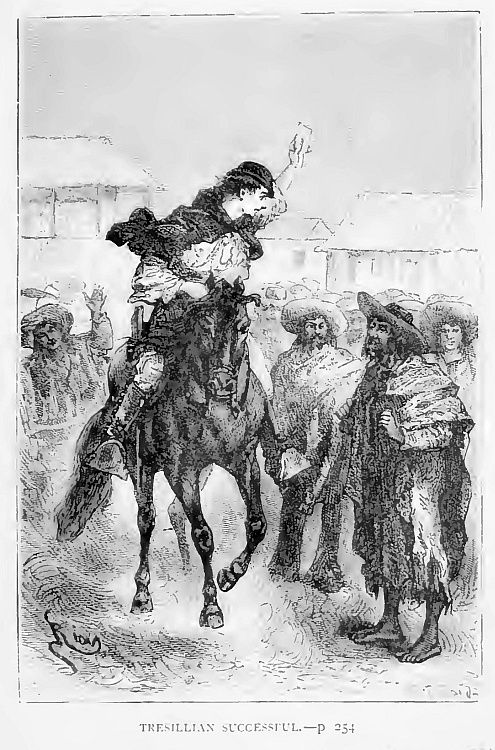
“That seems the best and only way,” returns Don Juliano. “But when do you propose your men to start?”
“Immediately—soon as they can be ready. For such an expedition, most of the way through a very wilderness, they will need supplies, however lightly equipped. But I will issue the order this moment. Cecilio,” to the aide-de-camp, “hasten down to the cuartel, and tell Major Garcia to come to me at once.”
The young officer, rising at the words and clapping on his shako, makes straight for the outer door. But before stepping over its threshold, he sees that which causes him to return instantly to the receiving-room, to the surprise of those he had left there.
“What is it?” demands the Colonel.
“Look there!”
He points out through the open window over the plaza in front of it. Springing from their seats and moving up to it, they perceive a young man on horseback advancing towards the house; his face pale, and with a wayworn look, his dress dust-stained, and otherwise out of order, the horse he bestrides steaming at the nostrils, froth clouted, and with palpitating flanks.
“Caramba!” exclaims Colonel Requeñes. “That’s young Tresillian, the son of Villanueva’s partner!”
Chapter Twenty Nine.
To the Rescue.
In an instant after Henry Tresillian is inside the room, warmly received by both the Colonel and ganadero; less so by the young officer, though the two had been formerly bosom friends. The coolness of Cecilio Romero can be easily understood; but in the scene which succeeds, with hasty questioning, and answers alike hurried, no one takes note of it.
“You bring news—bad news, I fear?” says the Colonel.
“Bad, yes. I’m sorry having to say so,” returns the messenger. “This is for you, señor—from Don Estevan Villanueva. ’Twill tell you all.”
He pulls a folded paper from under his jacket, and hands it to the Colonel.
Breaking it open, the latter reads aloud; Romero standing by and listening, for its contents concern them all.
Thus ran it:
“Hermano mio, (brother),
“If Heaven permit this to reach your hands, ’twill tell you how we are situated—in extreme peril, I grieve to say, surrounded by Apache Indians, the most hostile and cruel of all—the Coyoteros. Where and how I need not specify. The brave boy who bears this, if successful in putting it into your hands, will give you all details. When you’ve got them, I know how you will act, and that no appeal from me is necessary. On you alone depends our safety—our lives. Without your help we are lost.
“Estevan Villanueva.”
“They shall not be lost,” cries the Colonel, greatly agitated—“not one of them, if the Zacatecas Lancers can save them. I go to their aid; will start at once. Away, Cecilio! down to the cuartel! Bring Major Garcia back with you immediately. Now, señorito,” he adds, turning to Henry Tresillian, “the details. Tell us all. But, first, where are our friends in such peril? In what place are they surrounded?”
“In a place strange enough, Señor Colonel,” answers the young Englishman. “On the top of a mountain.”
“On the top of a mountain!” echoes the Colonel. “A strange situation, indeed. What sort of mountain?”
“One standing alone on the llanos, out of sight of any other, ’Tis known as the Cerro Perdido.”
“Ah! I’ve heard of it.”
“I too,” says the ganadero.
“Up somewhere near the sources of the Horcasitas. A singular eminence—a mesa, I believe. But how came they to go there? It must be some way off the route to their intended destination.”
“We were forced thither, señor, through want of water. The guide advised it, and his advice would have been for the best, but for the ill luck of the savages chancing to come along that way.”
“Muchacho, I won’t confuse you with further questioning, but leave you to tell your tale. We listen. First have a copita of Catalan brandy to refresh you. You seem in need of it.”
“There’s one needs refreshing as much as myself, Señor Colonel; ay, more, and more deserves it.”
“What one! Who?”
“My horse out there. But for him I would not be here.”
“Ah! that’s your grand steed,” says the Colonel, looking out; “I remember him—Crusader. He does seem to need it, and shall have it. Sargento!” This in loud call to an orderly sergeant in waiting outside, who, instantly showing his face at the door, receives command to see the black horse attended to.
“Now, muchacho mio! proceed.”
Henry Tresillian, still speaking hurriedly for reasons comprehensible, runs over all that has occurred to the caravan, since its departure from the worked-out mine near Arispe, till its arrival at the Lost Mountain. Then the unexpected approach of the Indians, resulting in the retreat to the summit of the Cerro, with the other incidents and events succeeding—to that, the latest, of himself being lowered down the cliff, and his after-escape through the fleetness of his matchless steed.
“How many of the Indians are there?” asks the Colonel. “Can you tell that, señorito?”
“Between four and five hundred, we supposed; but they were not all there when I left. Some days before half their number went off on a marauding expedition southward; so our guide believed, as they were dressed and painted as when on the war-trail.”
“These had not returned when you came away?”
“No, Señor Colonel; no sign of them.”
“I see it all now, and pity the poor people who live on the lower Horcasitas. That’s where they were bent for, no doubt. The more reason for our making haste to reach the Cerro Perdido. We may catch these raiders on return. Sargento!” This again in call to the orderly, who responds instantly by presenting himself in the doorway.
“Summon the bugler! Give him orders to sound the ‘assembly’ at once. We must start without a moment’s delay. How fortunate those Yaquis kept quiet, else I would be now operating around Guaymas.”
“We must, Requeñes. But will your regiment be enough? How many men can you muster?”
“Five hundred. But there’s the battery of mountain howitzers—fifty men more. Of course, I take that along.”
“And of course I go too,” says the ganadero; “and, to make sure of our having force sufficient, can take with me at least a hundred good men, the pick of my vaqueros. Fortunately they’re now all within easy summons, assembled at my house for the herradero” (cattle branding), “which was to come off to-morrow. That can be postponed. Hasta lúego, Colonel; I ride back home to bring them; so doubt not my having them here, and ready for the route soon as your soldiers.”
“Bueno! Whether needed or not, it will be well to have your valiant vaqueros with us. I’ll welcome them.”
Instantly after the plaza of Arispe displays an animated scene, people crowding into it from all parts, with air excited. For the report, brought by the young Englishman, has gone forth and all abroad, spreading like wildfire,—Villanueva and Tresillian, with all their people, surrounded by savages! “Los Indios!” is the cry carried from point to point, striking terror into the hearts of the Arispenos, as though the dreaded redskins, instead of being at an unknown distance off, were at the gates of their city.
Then succeeds loud cheering as the bugle-call proclaims the approach of the lanzeros, troop after troop filing into the plaza, and forming line in front of their colonel’s quarters, all in complete equipment, and ready for the route.
More cheering as Don Juliano Romero comes riding in at the head of his hundred retainers; vaqueros and rancheros, in the picturesque costume of the country, armed to the teeth, and mounted on their mustangs, fresh, fiery, and prancing.
Still another cheer, as the battery of mountain howitzers rolls in and takes its place in the line. Then a loud chorus of vivas! as the march commences, prolonged and carried on as the column moves through the street; the crowd following far beyond the suburbs, to take leave of it with prayers upon their lips for the successful issue of an expedition in which many of them are but too painfully interested.
Chapter Thirty.
The Raiders Returned.
Another ten days have elapsed, and they on the Cerro Perdido are held there rigorously as ever; a strong guard kept constantly stationed at both points where it is possible for them to reach the plain.
In the interval no incident of any note has arisen to vary the monotony of their lives. One day is just as the other, with little to occupy them, save the watch by the ravine’s head, which needs to be maintained with vigilance unabated.
But much change has arisen both in their circumstances and appearance. With provision wellnigh out, they have been for days on less than half allowance, and famine has set its stamp on their features. Pallid, hollow cheeks, with eyes sunken in their sockets, are seen all around; and some of the weaker ones begin to totter in their steps, till the place more resembles the grounds of an hospital than an encampment of travellers. They have miscalculated their resources, which gave out sooner than expected.
In this lamentably forlorn condition they are still uncertain as to the fate of their messenger, their doubts about his safety increasing every day—every hour. Not that they suppose him to have fallen into the hands of the Coyoteros. On the contrary, they are convinced of his having escaped, else some signs of his capture would have been apparent in the Indian camp, and none such are observed. But other contingencies may have arisen: an accident to himself, or his horse, delaying him on the route, if not stopping him altogether.
Or may it be, as Don Estevan has said, that Colonel Requeñes with his soldiers is absent from Arispe, and there is a difficulty in raising a force of civilians sufficient for effecting their rescue?
These conjectures, with many others, pass through their minds, producing a despondency, now at its darkest and deepest. For at first, in their impatience, blind to probabilities, they fancied theirs a winged messenger—a Mercury, who should have brought them succour long since. That bright dream is passed, and the reaction has set in, gloomy as shadow of death itself.
Nor seems there to be much cheer in the camp of their besiegers. They can look down upon it from a distance near enough to distinguish the individual forms of the savages, and note all their actions in the open. Through the telescope can be read even the expressions on their features, showing that they, too, have their anxieties and apprehensions; no doubt from the black horse and his rider having got away from them.
Their scouts are still observed to come and go. Some are sent northward, others to the south; the last evidently to look out for the return of the raiding party gone down the Horcasitas.
Another day passes, and they are seen coming back, at a pace which betokens their bringing a report of an important nature. That it is a welcome one to their comrades in the camp can be told by their shouts of triumph as they approach.
Soon after they upon the mesa are made aware of the cause, by seeing the red marauders themselves coming on towards the camp, in array very different from that when leaving it. Instead of only their arms and light equipments, every man of them is now laden with spoil, every horse besides his rider carrying a load, either on withers or croup. And they have other horses with them now—a caballada—mules, too, all under pack and burden.
No, not all. As the long straggling line draws closer to the Cerro, they on its summit see a number of these animals bearing on their backs something more than the loot of plundered houses. They see women, most of them appearing to be young girls.
As they are conducted on to the camp, and inside its enclosure, Don Estevan, viewing them through his telescope, can trace upon their persons, as their features, all the signs and lines proclaiming utter despair: dresses torn, hair hanging dishevelled, and eyes downcast, with not a ray or spark of hope in them.
Others look through the glass, to be pained by the heart-saddening spectacle; each of the married ones, as he views it, thinking of his own wife or daughter, in fear their fate may be the same—a fate too horrid to be dwelt upon in thought, much less to be talked about.
This day they are not permitted to see more. Twilight is already on, and night’s darkness, almost instantly succeeding, shuts out from their view everything below.
But if they see not, they can hear. There are continuous noises in the camp throughout the rest of the night—cries and joyous ejaculations. The Coyoteros have made a grand coup: much plunder acquired, many prisoners taken, and pale-faced foes slain, almost to a glut of vengeance. They are greatly jubilant, and yield themselves to a very paean of rejoicing, their boasts and exulting shouts at intervals reverberating along the cliffs.
It is another night of carousal with them, as that when they first sate down to the siege; for among the proceeds of their recent maraud are several pig-skins of aguardiente, and this fiery spirit, freely distributed, excites them almost to madness.
So loud are their yells, so angrily, vengefully intoned, that they who listen above begin to fear they may at length become reckless, and, coûte que coûte, risk the assault so long unattempted. In such numbers now, feeling their strength, they may hold a little loss light. Besides, there is still that apprehension from the side of Arispe; it may further urge them to a desperate deed, which, if not done at once, must be left undone, and the siege ingloriously abandoned.
These are but the conjectures of the besieged, who, acting upon them, keep watch throughout the remainder of the night. Never more wakeful, seemingly, though never less needed; for up till the hour of dawn, no assailant is seen approaching the gorge, no sound heard of any one attempting to scale that steep acclivity.
Of those fearing that they will try, Pedro Vicente is not among the number. Endeavouring to give confidence to his doubting companions, he says,
“I know the Coyoteros too well to suppose them such fools. Not all the aguardiente in Sonora will make them mad enough to expose themselves to our battery of stones. They don’t forget our having it here, and that we’re watching their every movement; ready to rain a storm of rocks on them if they but come under its range. So, camarados, keep up heart and courage! We’ve nothing more to fear to-day than we had yesterday. That’s hunger, not their spears or scalping-knives.”
Fortified by the gambusino’s words, they to whom they are addressed feel their confidence restored—enough to inspire them with further patience and endurance.
Chapter Thirty One.
The Rescuers en Route.
“Son! that’s the Lost Mountain, is it?”
“It is, Colonel.”
“Gracias a Dios! Glad we’ve sighted it at last. How far do you think we’re from it, señorito? Nigh twenty miles, I take it; though it looks nearer.”
“’Tis all of twenty miles, Colonel; so our guide said when we first saw it from the place.”
“I can quite believe it. On these high plains distances are very deceptive; but my experience enables me to judge pretty correctly.”
The dialogue is between Colonel Requeñes and Henry Tresillian; the latter acting as guide to the expedition en route to release those imprisoned on the Cerro Perdido. Others are beside them; Don Juliano with his son, the young aide-de-camp, and several officers of the staff; their escort forming an advanced guard. Not far behind it, the howitzer battery, followed by the lancer regiment in open order; then Romero’s irregulars, closed by a troop of lancers as rear-guard, completing the marching column.
All are at halt, brought to it as soon as the Cerro was sighted. They have been on march from an early hour by moonlight, and as the sun, now rising, has lit up the plain afar, the solitary eminence can be clearly seen. As may be deduced from the young Englishman’s words, the point they have arrived at is the same where the caravan had temporarily come to a stop—the very spot itself; for close by is the tree bearing the initials of the gambusino.
“Well, caballeros,” continues the Colonel, “we’ve done our best so far; pray God to good purpose. Let us hope we’re in time. I wonder how it is? What’s your thought, Romero?”
“I have none, Requeñes—only hopes that they’ve held out.”
“I wish,” pursues the Colonel, in half soliloquy, “we but knew for certain; ’twould make an important difference as to how I dispose of my force. Should they be still there—”
“Señor Colonel,” interposes the youthful guide, “if you’ll let me have a look through your telescope, I think I can settle that point.”
This, as he sees the commanding officer drawing his field-glass from its case.
“In welcome, señorito. Here!” and he hands him the telescope.
Instantly it is brought to his eye, and eagerly—his fingers trembling as they hold it out. What he hopes to see will tell him that his father and friends still live; if he sees it not, he will know they are dead; and she, dearer than all, condemned to a fate far worse!
What a change comes over his countenance almost on the instant of his raising the glass to his eye! Hitherto grave to apprehension, all at once it lights joyously up, as from his lips proceed the words, “They’re still on the mountain; Heaven be praised!”
“If it be so, Heaven deserves praise—all our thanks. But how know you, señorito?”
“By the flag!”
“What flag?”
“Take the glass, Colonel; look for yourself.”
Receiving back the telescope, and adjusting it to his sight, Requeñes levels it at the Lost Mountain.
“At the nearest end, up on the summit,” pursues Henry Tresillian, instructingly, “you’ll see it. It is the flag of Mexico. Don Estevan intended to have raised it over his new mine, and had it hoisted yonder in the hope it might be seen by some white men, and lead to our situation being made known. It has proved of service now; telling us our friends are still in the land of the living. If they were not it wouldn’t be there.”
“You’re right, señorito, it wouldn’t. And it is there—I see it!—yes, can even make out the national insignia—the eagle and nopal. We may thank Heaven, indeed.”
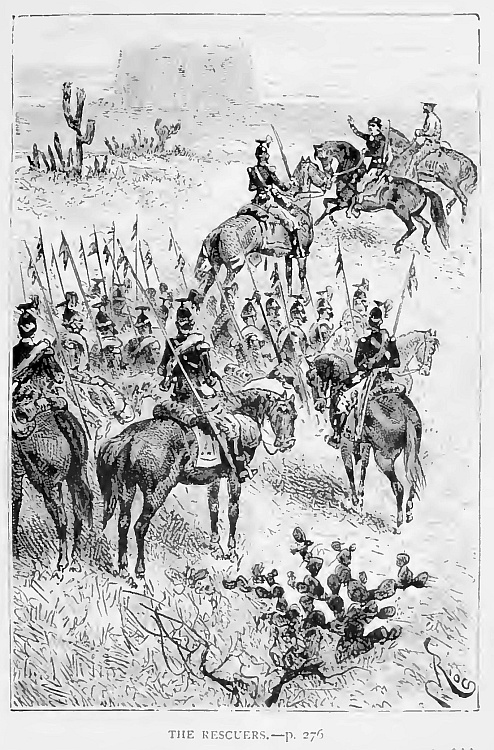
“And we do!” exclaims the ganadero, raising his hat reverentially, all following his example.
A thrill of exultation runs like wildfire backward on to the extremest rear—a joyous excitement, as the soldiers learn they have not made their long march in vain, and that the foe is before them, not far oft. For the banner waving above proclaims the siege still continued, and the Indians keeping it up.
“They are there,” affirms the Colonel, after gazing some time through his glass. “I can see the smoke ascending from their camp fires. No doubt by this they’ll be cooking their breakfasts. Well, we won’t be in time to hinder their having that meal; but if they eat dinner this day, without my leave, I shall be willing to throw up my commission as colonel of the Zacatecas Lancers. Now, gentlemen!” he adds, turning to his staff, and summoning his chief officers around him in council of war, “the enemy is yonder; no doubt of it. ’Tis a question as to how we should advance upon him. Give your opinion, Major Garcia.”
“How many are there supposed to be, Colonel?” asks the major, a sage, grizzled veteran. “Our mode of approaching them should much depend upon that.”
“Unluckily I can’t tell,” says the Commander-in-chief; “there were wellnigh five hundred all told when together; but it appears that half went off on a raid down the Horcasitas, the other half remaining to carry on the siege. If the raiders are returned and are now among the besiegers, then we’ll have their full force to deal with, and may expect a sharp fight for it. I know these redskins of old, the band of the Rattlesnake; though, as our young friend informs me, that worthy has ceased to exist, and the Vulture reigns in his stead. All the worse for us, as Zopilote was the master of Cascabel in tactics, cunning, courage—everything. Never mind, we should only be too glad to meet the renowned warrior, if but for glory’s sake.”
While the Colonel is still speaking a voice is heard to rearward, with exclamations telling of excitement there. Immediately after a subaltern officer of the rear-guard advances rapidly to the front, conducting a strange horseman, whose dress, travel-stained, with the sweat and dust upon his horse, betokens him just arrived from a journey long and hurriedly made. A messenger on some errand, which his wan, woebegone face bespeaks to be of the saddest.
“Whence come you, amigo?” demands the commanding officer, as the stranger is brought face to face with him.
“From Nacomori, on the Horcasitas, Señor Colonel,” is the answer.
“On what business?” asks Requeñes, more than half divining it.
“Oh, señor, the Indians have been there; killed scores of our people—children as grown men; plundered and burnt our houses; carried off all our young women; made rack and ruin of everything. I rode to Arispe, hoping to find you there, but you were gone, and I’ve hastened hither after you.”
“What Indians? Where did they come from?”
“From the north, señor; down the river. Apaches, we thought; but it was in the night they came upon us, and no one could be sure. When morning came they had gone off with everything.”
“What night? How long since this occurred?”
“The night of Lunes—just four days ago.”
“The raiding party of the Coyoteros, gentlemen,” says the Colonel to his surrounding. “The time corresponds, the place—everything; and likely they’ve got back, and are now by the Cerro yonder. If so, we have others to rescue beside our own friends; with chastisement to inflict on the red-handed marauders, to say nothing of revenge. So much the more reason for our not losing time. Major! order the regiment to close up and form line. Let the others be drawn in also; I want to say a word to them.”
With a quickness due to thorough discipline, the lancers are brought into battle line; not for fight now, but to receive an address. Thrown forward on one flank, and facing inwards, are the light artillerists; while on the other in file form are Romero’s irregulars.
Placing himself in a position to be heard by all, the Commander-in-chief cries out:
“Camarados! at the base of yonder hill, where you see smoke rising, is the enemy. Apaches—Coyoteros—as we know, knowing them also to be the cruellest of all the savages that infest our frontier. To say nothing of the glory gained in conquering them, ’twill be doing humanity a service to destroy them; and never more than now has there been reason.
“This gentleman,”—he points to the newly-arrived messenger, still on horseback and near by—“has brought news of a bloodthirsty massacre they have just committed at Nacomori, on the Horcasitas, where women, scores, have been carried off. Like enough they’re all over yonder now, and we may be in time to release these prisoners, and avenge the murders that have been done. The only fear is of the Indians getting away from us. Mounted on their swift mustangs, and leaving all encumbrances behind, that is still possible enough. But to prevent it, I intend dividing my force, and sending detachments around to intercept and cut off their retreat on every route they may take. We must deal them a death-blow, and I now call on you—every man to do his best. Remember how many of our people, perhaps many of your own relatives, have fallen victims to the ferocity of these ruthless marauders. Think of the crime we have just heard of at Nacomori. Think of it, camarados, and strike home!”
An enthusiastic cheer hails the Colonel’s speech; and while it is still ringing commands are issued for the disposition of the advance—the movement soon after commencing.
Chapter Thirty Two.
Succour in Sight.
Not an hour of daylight now passes, scarce a minute, without Don Estevan Villanueva or Robert Tresillian having the telescope to their eyes, scanning the plain southward. For days this has been their practice, up to that on which the red marauders are seen returning from their murderous expedition.
And on the following morning at earliest dawn the two—Pedro Vicente along with them—take their stand on an outward projection of the mesa, which commands a view of the llano all round its southern side, at the same time overlooking the Coyotero camp.
They have not been long there when, under the first rays of the rising sun, they see something sparkle which had never been observed by them before, though in a place with which they are familiar—the same where they first sighted the Cerro Perdido. Nor is the glancing object a single one, for there are many shining points as stars in a constellation. They are visible to the naked eye, for as yet none of them have looked through the telescope. As Don Estevan is levelling it, the gambusino says:
“Looks like the glitter of arms and accoutrements. Pray the Virgin it be that!”
“It is that!” cries Don Estevan, at the first glance through the glass. “Arms, and in the hands of men. I can make out a body of horse in uniform—soldiers. Requeñes and his regiment; he to a certainty. At length—at last—we may hope to be rescued, and our long imprisonment brought to an end.”
His words, spoken excitedly and aloud, attract those who are sauntering near, and soon most upon the mesa come clustering round him. To see with eyes unaided that metallic sheen, as they eagerly hearken to its interpretation. Don Estevan, with the telescope still held aloft, goes on speaking:
“Yes; ’tis they! I can see they carry lances, by the sun glinting on the blades above their heads. They can be no other than the Zacatecas regiment, with my brother-in-law at its head. Your son, Tresillian, is safe; their being yonder tells of his having reached Arispe. Brave youth! we all owe him our blessing.”
“And we give him that, with our gratitude!” shouts Pedro Vicente, the others enthusiastically echoing his words.
There is a momentary lull, all ears intently listening for what Don Estevan may next say; which is:
“They appear to be extending line, and look as if there were a good six or seven hundred. Ah! now I note there are others besides the lancers—a battery of brass guns—that’s what’s flashing back the sun. And a body of horsemen, not in uniform. They seem to be at halt. Why and for what?”
“Like enough,” suggests Tresillian, “they’ve made out our flag telling them we are still here. Requeñes, with others of his officers, will have telescopes too, and must see it, as also that smoke over the camp below. It will tell them our besiegers are there also. That would cause them to halt—to concert measures for the attack.”
“You’re right, Don Roberto, it must be as you say. But now there’s a movement among them. The mass is breaking up into detachments, some commencing to march to the right, others to the left. Ah! I see it all: they mean making a surround, cutting off the retreat of our enemy. Caramba! Requeñes is a cunning strategist, as I always believed him.”
With the glass still at his eye, the old soldier can see every movement made, comprehending all, and explaining them in succession to the audience around him. A party of lancers, seemingly a squadron, separating from the main body, moves off to the right, another party of like strength proceeding in the opposite direction. Then other detachments follow these, as if to form an enfilading line when the time comes for it. But the central force remains stationary long after the flanking parties have been extended, and is only seen to advance when they are far away. These make wide circuit, evidently designed to embrace the Coyoteros’ camp, and, if need be, the Cerro itself.
And now they draw nearer till all upon the mesa, without any artificial aid, can see they are men, and as such surely friends hastening to their rescue.
To their joy they also perceive that the occupants of the Indian camp are as yet unaware of what is approaching. Five hundred feet below, their view is more limited; and long before the soldiers become visible to them, they above see the latter distinctly, and understand their strategic scheme.
Meanwhile the savages are not acting in the ordinary way: signs of commotion are observable among them, as if some change were intended. Horses are being caught and caparisoned, while the newly acquired animals from the Horcasitas are again loaded with the spoils, those that carried the captives being also made ready for the road.
The women are themselves seen within the corral; as on the evening before, looking forlorn, every one of them a picture of despair. They are to be taken they know not whither, but to a place from which they have no hope of return. Little dream they that friends are so near.
“What a pity we can’t let them know of rescue being at hand!” says Don Estevan. “They could hear us if we call to them, but some of the Coyoteros are acquainted with our language, and it would warn them also.”
“No fear of that,” affirms the gambusino; “I think I can speak a tongue that the redskins won’t understand, and the women will.”
“What tongue?” asks Don Estevan.
“The Opata. Some of those girls are mestizas, and should know the lingo of their mothers.”
“Try them with it, then, Don Pedro.”
“With your worship’s leave, I will.”
Saying which, the gambusino advances to the outermost edge of the cliff, and, with all the strength of his lungs, utters some words altogether unintelligible to those around him, but evidently understood by the captives below.
Several of them on hearing it spring suddenly to their feet, looking up in the direction whence it came, surprised to see men above, hitherto unobserved by them, and still more to hear speech addressed to themselves. Hope and joy become mingled with their astonishment, when the gambusino goes on in the same vernacular to tell them how it is, and that succour is near.
Though listening all the while, not one of the Apaches appears to comprehend a word of what Vicente is saying. They suppose it a mere expression of sympathy; and, without giving heed to it, proceed with their preparations for departure. They are evidently bent upon this, though it may be but the raiders about to continue on to their home in Apacheria. Still, other signs seem to indicate a general clearing out of the camp; for now the whole caballada of horses are being brought in saddled and bridled, while everything portable in the way of goods is turned out within the corral, packed as if for transportation.
And in reality it is their intention to abandon both camp and siege, though reluctantly, and hating to surrender a chance of revenge that had seemed so sure and near. But they have had enough to content them for the time, and there is a fear which forces them to forego it. Ever since Henry Tresillian escaped them they have been nervously apprehensive, correctly surmising him a messenger. He must long since have reached Arispe, and may at any moment reappear, guiding back a force sufficient to overwhelm them.
While yet unrecovered from their night’s carousal, it is as the fulfilment of a dream, their worst apprehensions realised, as they behold coming towards them, though still far off, a body of men, uniformed and in serried array, with pennoned lances borne aloft!
The sight is not so much a surprise, neither does it produce a panic; for they who approach seem not in such numbers as to overawe them. The detached parties sent around are not within their view, and with their habitual contempt for the Mexican soldados, they make light of those that are, imagining them under a mistake—advancing upon an enemy whose strength they have underrated.
The error is their own; but, misled by it, they resolve to ride out, meet the pale-faced foemen, and anticipate their attack. Their chief so commands it.
Quick as thought every warrior is upon his horse, gun or spear in hand; they, too, in military formation—line of battle—pressing forward to the encounter, the sentries alone left on post.
Chapter Thirty Three.
The Thunder Guns.
As is their custom, the savages advance with loud cries and gestures of menace, intended to terrify their antagonists.
They have got several miles out from the mountain, and almost within charging distance, when they see that which brings them to sudden halt—a thing above all others dreaded by the American aboriginal—cannon “thunder guns”—as they call them. The brass howitzers, hitherto screened by the vanguard of cavalry, have been thrown to the front, instantly unlimbered, and so brought under their eyes. Then a flash, a vomiting of flame and smoke, a loud ringing report, followed by the hurtling of a shell in its flight through the air. It drops in their midst and instantly explodes, its severed fragments dealing death around.
Too much this for Coyotero courage; and without waiting for other like destructive missiles to follow, they turn tail and gallop back towards the camp. Not that they have any hope of safety there, for they believe the great thunder guns can reach them anywhere, and their flight towards it is but the impulse of a confused fear.
The sentries, seeing them in retreat, alike frightened by the report of the howitzers, forsake their posts, each hastening towards a horse—his own.
For a time the captive women are unguarded, seemingly forgotten. It gives the gambusino a cue; and, acting upon it, he again calls out as before in the Opata tongue,
“Sisters! now’s your time! Up and out of the corral; make round to the lake, fast as you can run, and on into the ravine. There you’ll find friends to meet you.”
Listening to his counsel, as one the captive women resolve to act upon it; for they are now cognisant of what is going on, and fully comprehend the situation.
The result, a rush out of the enclosure all together, and a race round to the spot indicated by that friendly voice above.
They reach it, to find there the man himself, with over two-score others around him. For the gambusino, seeing how things stood, and that the besiegers had their hands full elsewhere, has hurried down the gorge, all the fighting men of the miners’ party along with him.
It is but a moment to place the escaped captives behind the rocks standing thick all around; then, screening themselves by the same, they await the coming of the savages. But these come not; enough have they to do looking out for their own safety. The howitzers, now near, are belching forth their bombs, that burst here and there, dealing death in their ranks.
With the redskins it is no longer a question of resistance or fight, but flight, sauve qui peut. And without thought of taking along with them either spoils or captives, they deem it enough if they can but save their own lives.
They are all on horseback now, their chief at their head, who in loud command calls upon them to follow him—not to the charge, but in retreat.
First they flee northward; but short is their ride in that direction. Scarce have they commenced it, when they see in front of them a body of horse, seemingly numerous as that they are retreating from.
Shall they meet it, or turn back? The thunder guns are still more than a mile from the abandoned camp, and they will have time to repass it.
Promptly deciding to do so, they wheel round and gallop back, ventre à terre; not slowing pace nor drawing rein till they have reached the western elbow of the lake. Then only coming to a stop perforce at sight of still another party of palefaces there to confront them.
Intercepted, threatened on every side by a far superior force, they now know themselves in a trap. Panic stricken, they would surrender and cry for quarter, but well are they aware it would not be given. So, as wolves brought to bay, they at length determine on fighting—to the death.
For many of them, death it is. Beset on all sides, in the midst of a circle of fire, bombs exploding and bullets raining through their ranks, they make but a despairing resistance; which ends in half their number being killed and the other half taken prisoner.
The rescuers are now in possession of the camp, animals, everything. But the first to reach the bottom of the ravine is he who has guided them thither, Henry Tresillian; there to receive a shower of thanks and blessings, his father pressing him to his bosom, which alike beats with joy and pride. And the gambusino embraces him, too, crying out,
“I see you’ve brought back my saddle, señorito; and after the service it has done, I hope you’ll never consent to part with it. Bridle and saddle both, I make you a present of them; which I trust you’ll do me the honour to accept.”
This draws the attention of all upon Crusader standing by, who in turn becomes the recipient of an ovation.
But his young master stays not to witness it. Up on the summit is one who occupies all his thoughts, claiming him now; and up bounds he with lighter heart than he ever before made that ascent.
“Henrique!”
“Gertrudes!” are the exchanged exclamations of the youthful lovers, as they become locked in each other’s arms, their lips meeting in a kiss of rapturous joy.
All congratulations over, the corralled wagons are once more in possession of their owners. Scarce any damage has been done to the mining machinery or tools; the Indians, from neglect or ignorance of their uses, not having thought it worth while to destroy them. And for the animals and chattels they had carried off, there is ample compensation in those now taken from them—enough to furnish the wagons with fresh teams, re-establish the pack-train, in short, put the caravan in order for resuming the march. Which it does, after a couple of days spent in getting things into condition for the route, when it continues on to its original destination, the gambusino still with it as guide.
On the same day Requeñes starts out on return to Arispe, taking the Coyotero prisoners along with him; while Don Juliano and his valiant vaqueros charge themselves with the task of restoring the women of Nacomori to their homes.
When all are gone, and the Lost Mountain again left to tranquillity and solitude, it is for days the scene of a spectacle telling of the terrible strife which had occurred. The wolves and coyotes have gathered from afar, and over the bodies of the slain savages left unburied, with those of their horses killed in the encounter, hold riot and revel.
There, too, are the black vultures, some in the air, some on the ground, in flocks so thick as to darken both earth and sky. They anticipated a plenteous repast—they have not been disappointed.
Chapter Thirty Four.
At the Altar.
The last scene of our tale lies in the pueblita of Santa Gertrudes; a mining village chiefly supported by the minera bearing the same name, whose works, with the specialities of crushing-sheds, smelting-houses, and tall chimneys, are seen just outside its suburbs.
All have a modern look, as well they may. On the ground where they stand, but three years before grew a thick chapparal of mezquite, cactus, yucca, and other plants characteristic of desert vegetation. For Santa Gertrudes is in the very heart of the Sonora desert, remote from any other civilised settlement.
Its prosperity, however, has attracted settlers; for not only does the population of the village itself receive constant increase, but many fertile tracts in the country around have been taken up, and are occupied by a goodly number of graziers and agriculturists, whose chief purpose is to supply the comestibles required by the miners and their dependants.
The growth of Santa Gertrudes has been remarkably rapid, almost unprecedently so. From the first opening of the mine, every vein worked has proved a bonanza, enriching the owners, Don Estevan Villanueva and Robert Tresillian. For it is the vela discovered, denounced, and made over to them by Pedro Vicente.
The gold-seeker himself has also become rich, by the conditions already mentioned as attached to the conveyance of the property. In short, all concerned have benefited thereby—every one of that travelling party delayed, with lives endangered, on the summit of the Cerro Perdido.
In and around Santa Gertrudes—name bestowed in honour of the Señora Villanueva and her daughter, or rather their patroness saint—is every evidence of advancement. The cottages of the miners are trim and clean, the shops that supply them showing an abundance of goods, even to articles of luxe and adornment. A pretty capella, with spire and belfry, stands central by the side of the public square, for, as in all Spanish-American towns, Santa Gertrudes has its plaza.
Two other sides of the same are occupied by houses of superior pretension, with ornamental grounds—the respective residences of Don Estevan and his English partner—while here and there a house larger and better than the common denotes the dwelling of an official of the minera, some head of a department.
On this day Santa Gertrudes is en fête. Its plaza is full of people; the miners in their gala dresses, and, mingling with them, rancheros—the new settlers from the country around—resplendent in their picturesque costume. Soldiers, too, mix with the crowd, in the gay uniform of the Zacatecas Lancers. For Colonel Requeñes and his regiment, on return from an expedition to the northern frontier, have halted at the pueblita, and are encamped on the plain outside. The tall chimneys of the minera send forth no smoke, no sound proceeds from the crushing-sheds or the smelting-houses; all is silent, and work suspended as if it were a Sunday.
Different with the capilla, from whose belfry comes a continual clanging of bells—merry bells—marriage bells. Nor needs any one telling who are to be wedded. All know that the owners are about to enter into relations different from that of a mere commercial partnership; that Gertrudes Villanueva is about to become the wife of Henry Tresillian.
The hour for the happy union has at length arrived, and from the two grand houses on the plaza issue the bride and bridegroom—each with their train of attendants—and take their way to the capella, amidst the enthusiastic plaudits of the assembled people, who cry out:
“Viva la novia linda! Viva el novio valiente—nuestro Salvador!” (Long live the beautiful bride! Long live the gallant bridegroom—our saviour!)
Inside the church the ceremony proceeds, relatives and friends from afar assisting at it; among them Don Juliano Romero, and of course, also, Colonel Requeñes. And there is one present who not only disapproves of the marriage, but would forbid it, were it only in his power. This the young cornet of lancers, Colonel Requeñes’ aide-de-camp, now a captain, who stands among the spectators, with an expression upon his features telling of a heart torn with jealousy.
How different is that on the face of Pedro Vicente, luminous with delight! Joyed and proud is he to see his young protégé of the chase attain the desire of his heart, in its fullest happiness.
The procession returns to the house of the bride’s father, followed by the crowd, again vociferating, “Viva la novia linda! Viva el novio valiente!”
Then the pre-arranged sports of the day commence on a grassy plain outside the pueblita. There is correr el gallo (running the cock), colear el toro (baiting the bull), with other feats of equitation, in which Crusader bears a conspicuous part. Ridden by a famous domidor—his owner for once but a looker-on—the beautiful black wins every prize, in speed outstripping all horses on the ground.
The Lancer band makes music in accompaniment; and over an improvised pavilion, ornamented with evergreens, in which stand the chief spectators, waves the national flag—that same bit of bunting which, three years before, was run up as a signal of distress on the Lost Mountain.
The End.
|
Chapter 1
| |
Chapter 2
| |
Chapter 3
| |
Chapter 4
| |
Chapter 5
| |
Chapter 6
| |
Chapter 7
| |
Chapter 8
| |
Chapter 9
| |
Chapter 10
| |
Chapter 11
| |
Chapter 12
| |
Chapter 13
| |
Chapter 14
| |
Chapter 15
| |
Chapter 16
| |
Chapter 17
| |
Chapter 18
| |
Chapter 19
| |
Chapter 20
| |
Chapter 21
| |
Chapter 22
| |
Chapter 23
| |
Chapter 24
| |
Chapter 25
| |
Chapter 26
| |
Chapter 27
| |
Chapter 28
| |
Chapter 29
| |
Chapter 30
| |
Chapter 31
| |
Chapter 32
| |
Chapter 33
| |
Chapter 34
|