"A Tale of Sonora" (continued 2)
Reading edition
No one makes rejoinder, all intently gazing at the two marching bands, now with eyes on one, then quickly transferred to the other. The portion of the plain visible is sextant-shaped—the view on either side cut off by the flanking ridges of the ravine—and from each side the string of savage horsemen is continuously lengthening out. Not rapidly, but in slow leisurely crawl, as if confident they had already secured the enfiladement of the camp. With a thicker concentration near the head of each, and a metallic sparkle all along their line—the sheen of their armour under the rays of the meridian sun—they appear as two huge serpents of antediluvian age, deliberately drawing towards one another either for friendship or combat.
In due time their front files come together, near the central part of the sextant; though the rear ones are still invisible;—how many of these no one knows, save approximately. Enough, however, are already in sight to make a formidable array, and put all thought of conflict with them out of the question. The miners but congratulate themselves on their fortune in finding that secure place of retreat, which will enable them to shun it. Grateful are they to their guide for making it known—and they have reason. If within their late camp instead of where they now are, the hours of their life would be numbered—perhaps to count only minutes. At the best they could but save bare life for a time, but nothing to comfort or sustain it.
All this they have come to comprehend thoroughly as they continue to watch the movements of the Coyoteros, and see the cordon these have drawn around them. But for some minutes there is no movement at all, the bands after uniting having come to a halt, the files making quarter-wheel, so as to face the Cerro—all done as by trained cavalry on a parade-ground! And for a while they stay halted, the change of front giving their alignment a thinner look. But at the central point is a thicker clump, without military formation, on which Don Estevan directs his telescope. To see half a dozen of the mounted savages face to face with one another, earnestly, excitedly gesticulating. After a look through it, he tenders the glass to the gambusino, who may better understand what they are about.
“El Cascabel and his sub-chiefs in consultation,” pronounces the latter, soon as sighting them. “It’s plain they’re puzzled by seeing wagons where never were such before. Like as not they think we’re soldados, and that makes them cautious. But they’ll soon know different. Por Dios! they know it now. They’re coming on!”
Chapter Eleven.
A Camp without Occupants.
The gambusino has guessed everything aright, if words spoken in the confidence of knowledge can be called guesses. True they prove, to the spirit as the letter; for it is just that unaccustomed spectacle of wheeled vehicles with their white canvas covers that caused the Indians to keep their deploying line so far aloof, and bring it to a halt for deliberation. Notwithstanding their being masters of all that desert country, lords of the llanos, they themselves do not always traverse it without difficulties to encounter and dangers to dread. The wagons proclaim the camp occupied by white men; and knowing these to be ordinary travellers, miners on the move, or commerciantes on a trading expedition to the frontier towns, the Coyoteros would little regard them—certainly not enough to have made that long détour with so much delay in approaching them. But it may be a military encampment; and if so, will need to be dealt with differently—hence their unwonted caution.
Soon as the two bands became conjoined, El Cascabel had summoned his sub-chiefs around him, to take their opinions upon this point. For among Indians the head chief is not armed with despotic authority, but must submit his intended course of action to the approval of his following, even when on the maraud. And as the gambusino rightly conjectured, this it was which occupied them at that temporary halt.
A question without difficulty, and soon decided. In the negative as regarded the camp being occupied by soldiers. Were it so, men in uniform would be observable around it; whereas none such are seen. Nor human form of any kind; only animals—horses, and mules, with horned cattle commingled—all careering madly about as if masterless, or escaped from their masters’ control.
This might seem an odd circumstance, yet it does not to the savages. From experience they know that all animals belonging to the palefaces become affrighted at their own proximity—often to break from their fastenings, however secure. Such a scare is likely what they see now.
All the more does it assure them they will not have to deal with soldados. These would have their horses under better discipline, would indeed by this time be on their backs, at least some of them.
Satisfied of its being a camp of civilians, at a signal sent along their line the red horsemen make a move forward, their files becoming thicker as the cordon contracts into nearer and narrower curve. Still they advance slowly, not through fear or want of confidence, but because they feel sure their enfiladement is complete, and their victims enclosed. But another idea rules their cautious approach. A splendid prize is before them in that large ca Callada, and to ride hurriedly in might lead to the loose animals breaking through their ranks, and scattering off over the plain, with after difficulty of capturing them. For just then they might have enough to do with their owners. Besides, there can be no surprise. The occupants of the camp, whoever they be, must have seen them long since, and are watching them now, though not one of themselves can be seen. Nothing so strange in this; they are inside the wagon enclosure, screened by the ridge of alparejas that form a sort of breastwork around it. And the ruck of frightened animals rushing to and fro between further prevents view of them. The more reason for deliberate approach, this attitude of the white men telling of an intention to stand upon the defence.
Becoming convinced of this, the Indians give up thought of immediate attack. They will wait for the night’s darkness to give them a better opportunity; and when at such a distance as they deem beyond longest gun range, they again come to a halt.
They would dismount, holding their horses in readiness; and some are already on the ground. But before all alight, a word is sent along their circular line, ordering them up again. Something has transpired to give cause for a change of purpose.
Soon they know what, seeing that the camp animals have retreated back beyond the wagons up into an embayment of the cliff, where they stand in a clump, cowering and still showing scare, but at rest. It is not that, however, which has made the Coyoteros re-mount, but because their view of the camp now being clear they still cannot see human beings in or around it. With eyes bent in keenest quest between the corralled wagons, through the spokes of their wheels, all along the periphery of pack-saddles, nothing in the shape of human form or face can they make out. Yet the sun is in their favour, and if such was there they could not fail seeing it. Puzzled are the savages now, and for the first time—since it is the first time for them to have such an experience. For the moment it even mystifies them, and thoughts of the supernatural come creeping into their minds. They know Nauchampa-tepetl to be a place of weird repute, so figuring in many a record and legend of their race. And now to see a camp there, a camp of the palefaces, with every appointment appertaining, wheeled vehicles drawn up in corral with a grand tent inside—for the marquee, still standing, is conspicuous through a break between the wagons—with all the animals that should be there, and yet no man, no one seeming to own or control them, that is certainly strange, to the point of astonishment—even awe!
And for a time it so affects the savage warriors, their chief not excepted. But only for a time. Notwithstanding his ghostly coat-of-arms, El Cascabel is but little the slave of superstition; and, after a moment’s reflection, feels satisfied there are palefaces in the camp, though invisible to the view of him and his. In that, as the reader knows, he is wrong; but right in the way he takes to test it.
It may seem the veriest grotesquerie here to introduce that venerated weapon, known as the “Queen Anne musket,” yet the truthfulness of this record requires its introduction.
For strange as it may appear, this historical piece, with all its imperfections, has found its way to every corner of the world; even into the hands of the Apache Indians. How they became possessed of it needs but a word of explanation, which is, that they had it—took it—from their hereditary enemies, the Mexicans—from the infanterio of that nation, armed with the old condemned “Queen Anne’s” of London Tower celebrity.
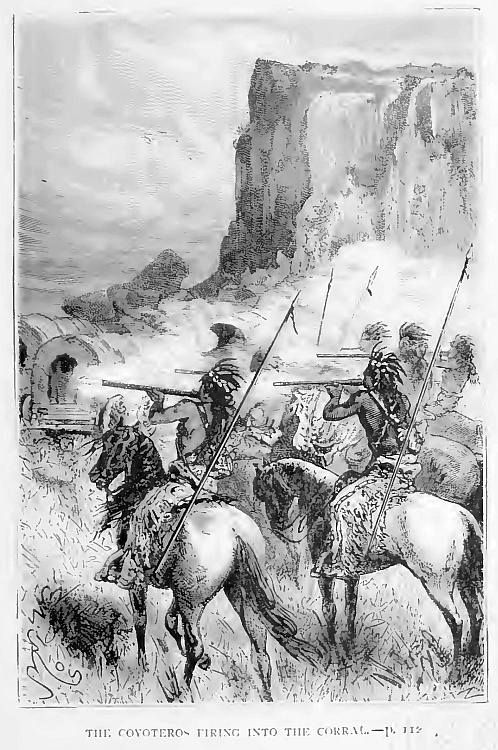
Leaving this necessary digression, and returning to the Coyoteros—more especially to their chief, we hear him call out to those of his followers who carry the ancient firelock, giving them orders to advance some paces and send shots into the white man’s camp.
Dismounting, they do so, aiming at the wagons and tent inside, so correctly that their big bullets, an ounce in weight, are seen to hit the mark. But without effect following, any more than if their shots were meant for the façade of cliff beyond, whose rocks echo back the reports of the antiquated pieces, as if in hilarious mockery.
Chapter Twelve.
The Chase of Crusader.
By El Cascabel’s orders, repeatedly are the big muskets re-loaded and fired into the corral, till every wagon has had a bullet through it, and the tent is pierced in several places. But all with the same effect, the shots eliciting no other response than their own echoes. Now the Indians know for sure that the camp is unoccupied; and, but for their foreknowledge of the topography of the place, would be mystified indeed. But most of them have themselves been on the summit of Nauchampa-tepetl, and their eyes turn interrogatively towards it. Thither the white men must have retreated, leaving everything below.
They see nothing, however; not as much as a face. For Don Estevan has directed those by the head of the gorge to keep well under cover, in hopes of tempting the savages to an ascent in the face of his formidable battery.
But the Coyotero chief is too astute for that, knowing, moreover, that there is no chance for the despised enemy to escape him. Wrathful he is withal, at having been in a way outwitted, angry at himself for having made the surround so slowly. It will cost him a siege, he knows not how long, interfering with the expedition to the Horcasitas, perhaps to its abandonment. But there is some compensation in the plunder so unexpectedly come upon, and from what he sees it should be an ample one. Six large wagons with a grand tienda—litera also—visible, to say nothing of the numerous animals, a travelling party so well-appointed should also have commodities in correspondence, promising a rich prize.
The camp is good as captured already; but instead of hastening on to take possession, he proceeds slowly and systematically as ever; for nothing can be gained by speed now, and some thing may be lost—the loose animals. They are still crowded up in the embayment between the cliffs, but with heads aloft and ears apeak, neighing, snorting, and restless, as if about to make a break.
“Leave aside arms, all—guns, and spears!” commands the chief. “Get ready the riatas!”
All together drop down from their horses, those who carry spears sticking them upright in the ground, those with firelocks laying them along it. Any impedimenta of baggage and accoutrements are also pulled off and flung beside. Then they vault back upon their animals, each with but his trail-rope carried in coil over the left arm, to be used as a lazo.
Thus disencumbered and equipped, they at length advance, not for the camp, but the caballada; but ere they can close up the mouth of the cove the white men’s animals become more affrighted than ever, and make the burst they had been threatening—horses, mules, and oxen all together. With a noise of thunder, the ground echoes the tread of their hundreds of hooves, as in frenzied madness they rush out for the open plain. Little chance would there be of their reaching it but that the Indian horses catch the stampede, too, many of them becoming unmanageable. The enfilading line is broken, and through its riven ranks the camp animals sweep as a hurricane. One is in the lead—a large horse, coal-black, on whom many an Indian had set eye, with lazo ready for his capture. Crusader it is, his neigh heard above all others, as, with head on high, mane tossed, and tail streaming afar, he dashes at the severed line; again uttered, as it were exultingly, when, having cleared it, he sees no enemy before him. Half a dozen nooses are flung at and after him, all ill-directed; all fall short, and slide from his glistening flanks, while as many disappointed cries follow him in chorus.
All is scamper and confusion now; the surround has failed, the stampede taken place, and the stampeded animals, such as succeeded in getting off—for not all went clear—can only be captured after a chase. But the Indian horses quickly get over their scare, and are laid on the pursuit till a stream of them stretches out on the llano. Fresher and in better condition than the camp animals, these are soon overtaken and noosed, now one, now another, till at length only a single horse is seen beyond the pursuing line.
Followed still, but so far beyond it, at each bound widening the distance, that a pair of eyes watching the chase, at first apprehensively, now sparkle with delight. For they are the eyes of his own master, Henry Tresillian, standing on the mesa’s summit behind a screening tree.
Half a score of the savages still continue the pursuit, among them their chief himself. For he would give much to be the owner of that matchless steed, and now strains his own to the utmost. All in vain. Crusader forges farther and farther away, till he is but a speck upon the plain. Then the baffled pursuers, one after another, give up discouraged, at length El Cascabel also coming to a stop, and turning to ride back with an air of angry disappointment.
The English youth, yielding to a thrill of proud exultation, waves his cap in the air, giving utterance to a triumphant “Hurrah!”
“I’m so glad he’s got away from them,” he says, to Vicente, by his side; “wherever he may go or whatever become of him. My noble Crusader! But wasn’t it clever? Wasn’t it grand?”
“Wonderful!” responds the gambusino, alike moved to admiration. “I never saw horse behave so in all my born life. Santissima! he must be a witch, if not the demonio himself.”
The Indians, leading back the captured animals, and recovering their arms, no longer delay entering the camp. Which, to their chagrin, they find not only abandoned, but wellnigh despoiled, as if other plunderers had been there before them! That much has been carried off, and of course of the most valuable kind, is evinced by boxes broken open, bales unroped and the contents extracted, with here and there empty spaces in the wagons, where evidently something had been stored. There is little left for them save the refuse, or effects of a nature to be of no use to them. What care they for mining tools and machinery?
More than ever are they angry and regretful of their ill-judged delay; but vow deadlier vengeance, when the time comes for it.
Still that may not be soon. The very fashion of retreat shows it to have been made with deliberation, and that the white men intend standing a siege, with the hopes and the wherewithal to hold out ever so long. And they, the Indians, knowing the danger of breasting that steep in the face of resolute defenders, have no thought of attempting it. But the goods that have been carried up must remain there, and sooner or later fall into their hands.
So consoling themselves, the new occupants of the camp settle down to the siege, after having secured their animals—both their own and those they have just come into possession of. All are put out to grass, “hoppled” or tethered on trail-ropes. Then the fires, found smouldering, are replenished with fresh fuel, and blaze up brightly as ever, with spits and roasting joints all round them.
This day the Coyoteros dine on beef, instead of their customary diet of mezcal and baked horseflesh. And a plenteous repast they make. Not for a long time have they had such an opportunity of gormandising. In their desert land of Apacheria provisions are scarce—often to starvation-point; and they now feast gluttonously, as if to make up for many a fast.
Nor are they without drinkables, though none brought they along with them. In a corner of one of the wagons is a cask—which on being tapped is found to be filled with chingarita—a fiery spirit distilled from the very plant, chief staple of their food—the mezcal. The Coyoteros know it well, and though they do not themselves distil, they drink it, and are so fond of it as to wonder why the cask is there, and not also carried up the mountain!
Drawn out, and rolled to the middle of the corral, they dance in delight around it, repeatedly quaffing from their calabash cups, with such an accompaniment of noises that the camp, lately occupied by men and women, might seem to have come into the possession of devils.
And so on till night. Then demon-like indeed are the forms seen flitting around its fires, and as much the faces, lit up by the red glare from blazing fagots of mezquite and piñon—both resinous trees. Still more the discordant sounds, a chorus of cries and ejaculations, in mad wild yelling, as of Bedlam broke loose.
Chapter Thirteen.
A Retributive Shot.
It is midnight, and darkness over mountain and plain; pitch darkness, although there is a moon in the sky. But she is not visible, obscured by a bank of thick cumulus clouds, that have rolled up from the Californian Gulf—portent of an approaching rain-storm.
The savages have gone to rest; or, at all events, brought their noisy revelry to an end, and silence reigns everywhere around, save now and then a snort from a miner’s horse, or mule, with a stamp of hoof, uneasy in their new companionship; the half howl, half bark of prowling coyote, and the wailing of chuck-will’s widow—the nightjar of Sonora—hawking for insects high over the lake. But no sound of human voice is heard, nor through the inky blackness can be seen form of man.
Yet not all are asleep, either above or below. On the plain is a line of sentries, set at distances apart on the outer edge of the triangular space where the path goes up; and inside this, by the bottom of the gorge itself, two other men, though not on sentinel duty.
All Indians, of course; one of the pair by themselves being El Cascabel, the other a sub-chief, his second in command. They are there on reconnoitring purposes, to discover whether it be possible for the besiegers to make the ascent on a dark night unseen, and so take the besieged by surprise.
Since settling down in camp the Rattlesnake has reflected, and a thought is now in his mind making him uneasy. Not regret for having to forego his raid on the settlements of the Horcasitas. Unlikely that the siege would take up any more time, and the booty alone should be ample compensation. For he has made study of the abandoned camp, found every indication of wealth, and feels sure it late held rich treasures. They would reward him for the time lost in beleaguering. And as to the revenge, a whole company of miners—nigh a hundred at least—with their wives and daughters, grand señoras among them too—death to the men, and captivity to the women—that should satisfy the keenest vengeance.
And perhaps it would his, were he sure of accomplishing it. He was before the sun went down, but is not now. For, since, he has thought of that which had not then occurred to him or to any of his following. Might not the miners have sent off a courier back to their own country, with a demand for help? If so, it would surely come; in strength sufficient, and soon enough to raise the siege. For the head men of the besieging force now know it will be a prolonged one. The fragments of provisions found in the wagons tell of a good store taken out of them and up. Game is there in abundance to supplement it, and water never-failing—a fortress in every way supplied. Not so strange, then, the Coyotero chief being nervous at the thought of a courier having been dispatched. For one might, without having been seen by him or his. A long distance it was from where they themselves must have been first sighted by those on the mountain.
But for the obscurity, there are those on it who would see himself and his second now. By the head of the gorge above a party of miners keep guard. They have just come on duty, the relief after a spell of sleep. For Don Estevan, by old experience, knowing there was no clanger of Indian attack in the earlier hours, had entrusted the guard-keeping of these to the more common men. Between midnight and morning is the time to “’ware redskin,” and the guard of this period, now commenced, has been confided to a picked party, two of those composing it being Pedro Vicente and his fidus achates, Henry Tresillian.
Guard it can scarce be called, being only a small vidette-picket. For there is little fear—scarce a thought—that the Indians will attempt the ascent, at least not so soon, or without gravely reflecting upon it.
“Perhaps never at all,” says the gambusino, in confabulation with his fellow-watchers. “And why should they? They must be well aware of the chances against them. Besides, having got us as fish in a net, they’re not likely to leap into the water themselves, where they know there are tiburones (sharks).”
Vicente has had a spell at pearl-diving in the Gulf, hence his simile drawn from the sea.
“Ay, tintoreros—these,” he adds, specifying the most dreaded of the squaline tribe, with hand caressingly rested on one of the large stones alongside which he is lying. “I only wish they would try it, the Rattlesnake leading. ’Twould give me just the opportunity I want to pay that artist off for the bit of bad engraving—he did on my breast—by hurling one of these beauties at his head. Malraya! I may never have the chance to settle that score—not likely now.”
The final words, uttered in a tone of angry disappointed vengeance, are followed by an interval of silence. For the new videttes, having just entered on their duty, deem it wise, before aught else, to make themselves acquainted with how matters are below. They are all in recumbent attitude, ventre à terre, behind the parapet of loose stones. For having witnessed that long-range practice with the “Queen Annes,” it occurs to them that a big bullet may at any moment come whizzing up the gorge, and just as well be out of its way. So elevating but their eyes over, they look cautiously down. To see nothing—not even the plain, nor yet the lake; to hear nothing which proceeds from human kind; but they know the savages are on the alert, with sentries aligned below, and for a time continue to listen.
At length, satisfied there is nothing which calls for their vigilance being kept on the strain, Vicente draws out his cajoncito of corn-husk cigarittos, lights one, and sets to smoking. His comrades of the watch do likewise; and the English youth, long since initiated into the ways of the country, smokes too, only his weed is a Havannah.
Not many minutes are they thus occupied when the gambusino, chancing to turn his eyes south-westward, sees what makes him spit the cigaritto from his mouth, and gaze intently. The object is up in the sky; a slight rift just opened in the bank of cloud, edged yellowish-white. The moon must be near it—is near it, and now in it! for while they are still regarding the blue spot, she shoots suddenly out from the black, as arrow from bow.
Instantly night’s darkness is turned into light as of day; every object on the llano, even the smallest, made visible for miles upon miles, up to the horizon’s verge. But their eyes go not so far, least of all those of Pedro Vicente, who at the first flash from the unveiled moon catches sight of that which arrests his straying glances, fixing them fast. Not the line of sentries, though he sees them too; but a pair of figures inside and closer, up nigh the point where the path steps upon the plain. One of them, recognised, rivets his gaze by a token of identification unmistakable—a death’s head in white chalk, which, with the moon full upon it, gleams conspicuous against a background of bronze.
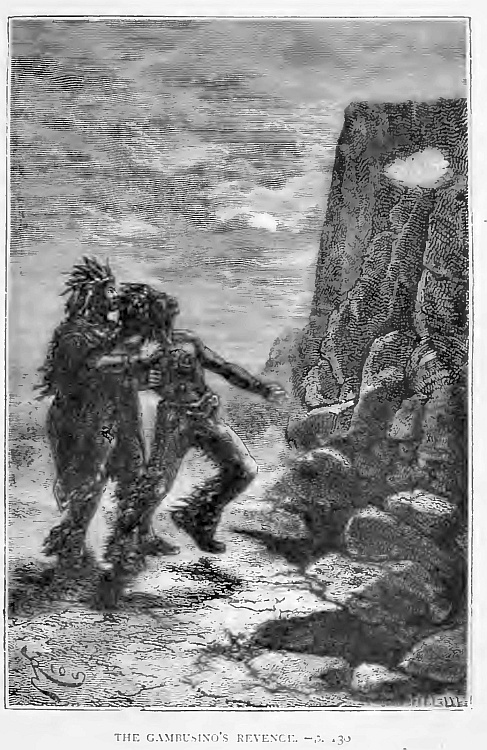
“Carria! El Cascabel!” he mechanically mutters, in tone of exultation; and without saying another word, or waiting another second, brings his rifle to shoulder, the stock to his cheek, with muzzle deep depressed.
A blaze—a crack—and the bullet is sped. A cry of agony from below—another of anger in voice different—proclaims its course true, and that the mark aimed at has been hit.
He who fired the shot knows that, by sight as well as sound. For he sees—all see—a man reeling, staggering, about to fall, and another with arms outstretched, as if partly in surprise, partly with intent to support him.
Only for an instant is the spectacle under their eyes. For suddenly as she showed herself, the moon disappears with a plunge into the opaque clouds, leaving all dark as before.
Chapter Fourteen.
The “Death Fandango.”
“You think you’ve killed him?”
It is Don Estevan who interrogates, startled out of his slumber by the report of the gambusino’s gun, which has brought him in hurried haste to the post of guard.
“Pretty sure of it, your worship,” is the rejoinder, in calm confidence.
“We all saw him staggering—he must have gone down,” says another of the videttes, confirmingly.
“If I haven’t settled his hash,” pursues Vicente, “then a man may get a bullet through midribs, and live afterwards—a thing not likely. Or I’m much mistaken, mine went straight centreways into the white—that sweet thing I’ve such reason to remember—unluckily for him painted too conspicuously.”
“It must have been El Cascabel, if you saw that.”
“He it was, or I shouldn’t have been so quick on the trigger. Indeed, I wasn’t so confident about the carry of my piece. ’Twas a long shot.”
“The bullet may have hit without killing him—spent, and only stunned him?”
“If your worship feels inclined for a bet, I’ll lay big odds that ere this the Rattlesnake has kicked his last kick, or, to put it more appropriately, wriggled his last wriggle.”
The auditory gathered around the gambusino would laugh at his quaint words, but ere they give way to the inclination it is checked by other words quick following in exclamatory tones,
“Bet’s off, your worship—too late! I’m not the man to dishonour myself by wagering on a certainty. Oigate! you hear that?”
Don Estevan does hear, as the others, sounds ascending from below—human voices, in that melancholy cadence which tells of lamentation for the dead. They come from the direction of the camp, in a wild crooning wail, now and then a stave, as if coyotes were taking part in the lugubrious chorus. At intervals, also, there are other notes, differently intoned; loud angry ejaculations, the Apache war-cry, proclaiming vengeance only to be satisfied with blood for blood.
For nearly an hour the infernal fracas is kept up, the volume of voice continuous, and redoubled by reverberation along the cliffs. Then it is abruptly brought to a close, succeeded by a silence mysterious and ominous in itself. Can it be that in their insane anger the savages have resolved upon the ascent, coûte-qui-coûte? The darkness, dense as ever, would favour, and might tempt them.
There is enough probability in it to make the videttes more vigilant, and their numbers are now greater. After an event of such serious consequence, most of the people—women and children excepted—are up and active, moving backwards and forwards between their place of bivouac by the spring and the ravine’s head, all careful not to approach this point too near. The big muskets admonish them; though as yet no shot from one, nor from any other sort of piece, has been fired by the savages. If they mean assault, it will be by stealth, and in silence.
Hushed, and listening with all ears, the watchers hear nothing; at least, no sound of a suspicious nature. But Indians can creep, or climb, noiselessly as cats—the Coyoteros especially—in this respect equalling the animal from which they have their name. And they may be worming their way up for all, snake-like among the stems of the mesquites and cactus plants.
“Speaking for myself,” says the gambusino, after a time, “I haven’t much fear of them trying that trick. But if you think it worth while, camarados, to give them a hint—and perhaps it may be as well—we can spare a few of these pebbles.” He points to the collected stones. “Half a dozen or so will do it.”
His camarades comprehend his meaning; and as Don Estevan has returned to his tent leaving him in command of the picket, they signify their approval of his design, all desiring it.
On the instant after, a rock pushed over the edge goes crashing down, breaking off branches, loosening other stones in its way, all in loud rumbling borne together to the level below. But they elicit no response, save the echo of their own noise, no shriek or cry, as if man were caught and bruised by them.
After a time another is launched, with like result, then another and another at measured intervals—for they must husband their ammunition—the watchers all the while without fear that man, red or white, will face such an avalanche, dangerous as any that ever swept down the slope of Alps.
At the earliest dawn they desist as soon as they can trust to their eyes. And now, scanning the plain below, they see at the bottom of the gorge only the rocks they had rolled down, with the other débris. Farther out they perceive the line of dusky sentinels, just as they expected it to be; but no other human form, living or dead. The Coyotero chief is dead for all that—carried to the camp of the palefaces, inside the great tent, where he now lies face upward; the pale, crepusculous light stealing in to show that hideous device on his breast, symbol of death itself, no longer a disc of white, but flaked and mottled red, with a darker spot of ragged edging in the centre where it was pierced by the gambusino’s bullet.
Just as the sun begins to show above the horizon’s edge, again go up the crooning cries, but now in more measured strain. For the savages are collected in the corral, a choice party of them under direction of their medicine man ranged about the marquee, not standing still, but circling round and round it in a slow, saltatory step—in short, dancing the “death-dance.”
It is accompanied by chants and incantations, in the voice of the medicine chief himself, pitched louder than the rest, with a pause at intervals, to speak eulogies of the deceased, praise of his valour and virtues, ending in a passionate appeal to his followers to avenge his death. They need not the stimulus of such exhortation. In the eyes of all vengeance is already glowing, burning, and but flashes a little angrier as they respond in a vociferous and united yell.
They upon the mesa are not witnesses to this odd ceremony, only a portion of the camp being within their view. But ere long they have another under their eyes—a spectacle equally exciting, and of like grave portent to themselves.
It takes place out on the open plain by the lake’s edge, upon a portion of the grass ground, all visible from the ravine’s head. The arena is purposely chosen for the palefaces to be spectators of it, that it may strike terror to their souls, by giving them a foretaste of what is to be their fate. For it is the “Fandango de crancos,” anglicé, scalp-dance.
What they on the mountain first see is some half-score of the savages issuing forth from the corral and taking their way to the appointed spot. They bear with them a long pole painted blood-red, recognisable as one of the wagon-tongues, drawn to a sharp point at its inner end. In a trice it is stuck upright in the turf, showing at its top something very different from the chains late there. It is the skin of a human head, with the hair hanging straggled down, light-coloured hair proclaiming it that of a paleface. They could crown that pole with scores of such scalps, many having their leggings fringed with them. But for the rites of the ceremony to be performed one is deemed sufficient; and to make it more terribly impressive, the one selected shows by the silken gloss of the hair with its luxuriance and length to have been taken from the head of a woman! There are women looking at it now, and young girls of different ages. For all have left the spring and come forward to the viewing-point. It is a sight to inspire them with awe enough of itself, without their being told of a certain and terrible signification attached to the fact of a woman’s scalp being fixed to the head of that pole instead of a man’s. Pedro Vicente could make it known to them, but does not.
Ere long the ceremonial of vengeful menace commences, the Indians approaching the ensanguined stake and forming in wide cordon around it; all of them in full war-paint, a fresh coat of it in their garish devices of various colours, scarlet and blood-red predominating. But there is one common to all, a symbol in white—the same borne by him who is sleeping his last sleep in the corral. They have but assumed it for the occasion to do honour to their dead chief. And a frightful form of demonstration it is. Over two hundred men, mahogany-coloured savages, all naked to the waist, each with a death’s head and crossbones done in white gypsum on the central and prominent portion of his breast! ’Twere enough to awe the heart of any one within their reach or in their power, and many of the spectators above tremble at beholding the horrid insignia.
The dance begins, the savages in circle tramping round and round the pole “how-howing” as they go, at first in slow step and with voice barely audible. Soon, however, the one quickens, the other becoming louder, till the step is a violent bounding, the voice raised to highest pitch. Louder and angrier grow the shouts as they turn their eyes upward to the scalp, and still more violent their gesticulations, arms in air with weapons whirled above their heads, till at length several rush at the reddened stake, and hack it down with their tomahawks. Then follows a confused struggle for the scalp, in which it is torn to pieces, all who can appropriating shred or tress, but to spit upon it in vindictive scorn, while still further rending it!
The demoniac dance is now over; some it has most excited come rushing towards the ravine, as though they really meant risking an assault. All above draw back out of sight, only they appointed for the defence staying by the stone artillery. But they are not called upon to hurl any more down just yet. Warned by the event of overnight, the savages think better of it, and before getting too close, come to a stop, and content themselves with wordy threats and a brandishing of weapons.
But, empty and impotent as is their menacing attitude, it makes deep impression on those against whom it is directed. For it tells them they may never more go down that gorge, or set foot upon the plain below, to live an hour, if a minute, after.
Chapter Fifteen.
Not Lost Yet.
In the great desert land of Apacheria there are Coyoteros and Coyoteros; some, abject miserable creatures among the lowest forms of humanity; others, men of fine port, courage, and strength—true Indian warriors. Of these is the band of El Cascabel, noted for its frequent hostile expeditions to the settlements of Sonora, as that on which it was bent when brought up by the Lost Mountain. So unexpectedly deprived of its chief, will it continue on that expedition? or lay siege to the party of travelling miners as he intended doing? A question asked the miners themselves of one another, but not after witnessing the scalp-dance. Then knew they for sure that the siege was to be carried out. As further evidence of it, that very afternoon the mules and horses of the caravan are collected into droves, tied head to tail, and conducted away from the ground altogether by a number of Indians placed in charge of them—evidently that there should not be too many mouths on the pastures around the camp, which, though good, are but of limited extent. Only some of the inferior animals, with the beeves, are allowed to remain as provision for the besiegers.
The miners above have meanwhile been busy getting matters regulated in their new camp, or bivouac, soon as convinced that the enemy did not intend assault. All repair thither, only a limited number of videttes keeping post by the gorge. Around the ojo de agua is witnessed a scene of curious interest. To the two tents set up on the day before are being added sheds and arbour-like huts, with such haste that ere night all are completed, for the cloud of the night before, portending rain, still covers the western sky, though not a drop has yet fallen.
Just as the last of daylight glimmers over the plain a very drown and downpour, as if to make up for its long absence. The sky is all clouded now, but with clouds at short intervals riven by forking spears of lightning, while the accompanying thunder is almost continuous.
Under the yellow light the lake glistens as if it was molten gold, while the rebound upwards from the heavy drops shows something like a golden spray hanging all over it. On beyond the out-going stream, late but a tiny rivulet, has changed to a foaming torrent, madly breaking its way across the plain; while the in-going rill from the messas summit has become a series of cascades and cataracts.
The Indians, fearing a stampede by their horses, draw them in from their picket-pins, hobble, and make them fast round the wheels of the wagons, but they are still more solicitous about the fine caballada captured and sent away; for nearly every one of these, with all the mules, has a pack saddle on its back with the distributed dry goods, and other desirable articles not taken up the messa. In short, if that pack drove be lost, they may not have much to reward them for the season’s raid. They might have sent the wagons along, but aware of the use to which these are often put by the palefaces, as sleeping-tents, are noting the approach of the storm, and determine to utilise them in similar fashion. That night at least they would need them, and it might be many more.
So, as the rain falls, lightning flashes, and thunder rolls, there is a close-packed crowd under the tilt of each, with the big tent full to its entrance-flap; and still there is not space enough to shield all from that torrent of the sky, a large number retreating under ledges of the cliffs that overhang near by.
The miners are all under shelter; they, too, sure of the approaching storm, having worked hard during the later hours of the day. The messa gave them material for wall and roof. Posts from the indigenous trees with scantling poles cut from saplings of many kinds, and a thatch of cycas and other grasslike plants, which abounded on the summit. Men accustomed as they to handling ropes and gearing, were not long in running up a house sufficient for shelter, and now every such domicile is filled to its door-jambs; men, women, and children mingled together, some standing, some seated on the bundles of goods that, but for their being inside, would have been lost. They had thought of that too.
Up to a certain hour the people of quality are all inside one tent, which shows bright from a light burning inside it: their conversation is, of course, about the circumstances which surround them. Who, then, could talk of any other? Don Estevan believes that the killing of the Rattlesnake may be a disadvantage to them rather than otherwise, making the vengeance of his followers more implacable than at least it should do. But he has yet another reason for so believing. In his own military expeditions he had become acquainted with El Cascabel’s second in command, a sub-chief, equalling the others in hostility to the whites, while far excelling him in ability.
But it is too soon yet to discuss such chances. Rest was the one thing needed; and at the usual hour for retiring, all, save those detailed for picket-guard, seek repose.
Just as on the previous night the less experienced stand the first watches of the night, keeping the rain off with waterproof serapes; only at intervals need they look down, and then, unlike as on the night before, everything is seen as under a meridian sun, for it is while the lightning gleams they make their intermittent examination of the gorge path, cascading stream, trees, and rocks illuminated by it as by a thousand torches; only towards morning do their blazes become less frequent, gradually dying out as the rain ceases to fall. Henry Tresillian is again on watch duty, having insisted upon it, notwithstanding the opposition made by the others of his party. But he has a reason they do not understand—indeed, he has not communicated it to them; during the earlier hours of the night he fancied having observed a dark object far off on the plain, seemingly in the shape of a horse; but returning several times to look, afterwards he could not see it again. Now, on the post midnight watch, at each blaze he runs his eye around the spot where he fancied the dark object to have been, only in the very last one to see it again, and make sure it was a horse; but his ears tell him more than his eyes, for in the dark spell succeeding the silence of the elements restored he several times hears a neigh, which he recognises as that of his own horse, Crusader.
And when the day at length dawns he sees the noble animal itself only a short distance beyond the lower end of the lake, with head upraised and muzzle pointed up the gorge, as though in a morning salute to himself,
Chapter Sixteen.
An Unlooked-for Enemy.
A thrill of delight sweeps through the heart of the English youth at beholding Crusader in this attitude, as if the horse said, “You see, I’ve not forsaken you.” Satisfaction also to think the animal capable of making its own way, and finding sustenance in those wilds; for should it ever be their fate to escape from that mountain, there might be a hope of horse and master coming together again. But there is fear commingled with these feelings, this causing the eyes of Henry Tresillian to turn with quick glance towards the left, where a small portion of the camp of the Indians is visible outside the flanking battlements of rock; every moment he expects to see issue from it a band of dusky horsemen in start for a new pursuit of his favourite.
Crusader seems to have some anticipation of the same; he stands restlessly, now glancing up the chine, anon at the corralled wagons with hundreds of horses around them. These he regards suspiciously, being the same with which he had already declined to associate; perhaps he may be wondering where are the other horses, his companions of the caravan? Whether or no, he hesitates to approach nearer to the old camping-ground, steadfastly keeping his place. Where he stands he is so nigh his former master that the latter might without any difficulty make himself heard, and at first the English youth had it on the tip of his tongue to call out a friendly greeting, but quick reflection showed him its imprudence. The very worst thing he could do for the horse’s sake. Crusader would be sure to recognise his voice and respond with a neigh, which would awake a chorus of yells in the Coyoteros’ camp, and at once set the savages on the alert.
For the last half-hour or more the black horse had been quiet, and there were several reasons against his being seen. He was upon the opposite, or western edge of the stream, which had a fringing of reeds and bushes, broken in places, but here and there continuous for yards, and behind one of these clumps he had come to a stand; even in bright day, as it now nearly is, he would there be invisible to the occupants of the captured camp.
But if only to water their horses, the Indians will soon be dashing down to the lake, and then all chance of his remaining longer unobserved will be at an end.
With gaze more riveted on the horse than ever, for there is something strange in his behaviour, Henry Tresillian watches him with wondering eyes, his heart audibly pulsating. What if they should again get him in a ring, and this time display more adroitness in hurling their laryettes? Crusader might not be so clever on every occasion.
While thus speculating on the result, a noise reaches the ears of the English youth, as also of others on vidette post, which causes an instant and sudden turning of their eyes in the opposite direction. Many voices, indeed, all loud and all in excited tone. Voices of men, shrieks of women, and cries of terrified children, all coming from one place, their new camp by the spring.
The videttes stay not on their post an instant longer, but forsaking it, rush towards ojo de agua. Sounds inexplicable, mysterious! What can be causing them? The only suggestion attempted is, that the Indians after all may have contrived to ascend the messa by some secret path known only to themselves, and are in the act of attacking from the rear. What other enemy could cause such a scare? Every voice in the miners’ party is seemingly convulsed with affright.
The young Englishman dashes on ahead, tearing through branches, and bounding over trunks of prostrate trees. Vicente, who had brought the watch with him, is close behind, though he has not such stimulus to haste, for amidst the fracas of noises, Henry Tresillian hears a sweet voice calling out his own name in a tone of appeal.
Not till they come to the very edge of the glade do they discover the cause of all these wild demonstrations, though something seen an instant or two earlier leads Vicente to conjecture it. Men, but chiefly boys and girls, standing on the branches of trees high as they can climb, as though there to behold some passing spectacle.
“El orso!—the grizzly!”
“It must be that,” says Vicente, pressing on. And so it proves. As the videttes so mysteriously summoned in see on getting to the nearer end of the glade which surrounds the spring, at its farther one are two gigantic animals, one a quadruped, the other to all appearances a biped. For all, both are four-footed creatures, and the most dangerous to be encountered in all the desert lands of America. So utterly are they regardless of the odds against them that they would advance to the attack of horse or man, even were there twenty of these together, and have been known to come shuffling into a well-appointed camp, and make a grand havoc, ere means may be taken to destroy or eject them.
The Indian tiger or the African lion are not more to be dreaded in their jungles than is the ursus ferox in the districts it specially affects.
Strange that the pair at the inner end of the glade had not yet shown signs of any determination to assail the camp; indeed, they seem to be amusing themselves at the stir their presence has created, or rather as if making amusement for the surprised people. He, upon his hams, for it is the male who has so erected himself, is playing his fore-paws about, as if engaged in an act of prestidigitation; while his mate, at intervals also rearing up, seems to be playing the part of juggler’s assistant, the whole spectacle being comical in the extreme. The tragical part of it had not yet commenced, and for two reasons.
First, that the grizzly bear seldom makes instant attack, appearing to enter on the field of battle more by accident than from any predetermined hostile resolve. Only after shammering about a while, and at intervals uttering a snort till their passions get the better of them, and then woe to man or horse that comes within the hug of their powerful fore-paws! With its enormous curving claws, many inches in length, a grizzly bear has been known to drag the largest ox or horse to the ground, as a terrier would a rabbit.
Henry Tresillian looks only to the two canvas tents to see the señora inside one, her face visible through the opening, while Gertrude is still without by the side of her own father and his. The young girl appears behaving herself more bravely than any of the older people around. She is inspired with fresh courage at the sight of the English youth bounding towards her, gun in hand.
By this time others have got out their guns, and a party led by the mayor-domo is advancing to fire on the bears. The gambusino, hitherto not having observed this party, now sees it, noting its intention. He would frustrate it, and makes the attempt, shouting in loudest voice, “For your lives, don’t draw trigger upon them. They may go without—”
Too late; his after-words were drowned by the report of the steward’s great gun, and the male bear came down on all fours, evidently hit, but as evidently little harmed, his active motions afterwards telling of a wound he no more regarded than the scratch of a pin. It perhaps only tickled him, and his biting at the place might be but to take the itch out. It angered him, though, to the highest pitch, for again rising on his hind legs he swung his head about, snorting continuously, with an occasional scream which bespoke either pain or vengeance.
There was no sign of intention to retreat on the part of either male or female, for they seemed to act in concert and with mutual understanding, this, in the moment after, impelling them to forsake their stationary spot and come rushing on towards the tents and boothes. Showing motion quick enough now, they are soon in their midst, the female instantly after seizing a boy who in fright had fallen from one of the branches directly in front of her, and killing the poor lad by a single stroke of her powerful fore-paw. He is not unavenged: before she has time to seek for a second victim the men with guns gather around her, and regardless of danger, for their blood is now up, go so close that some of their muzzles become buried in her long shaggy fur. Then the cracks of eight or ten guns ring out almost simultaneously, and the she-grizzly comes to ground.
But the male, the more formidable of the two, is still afoot, and where are the eight or ten guns to give him his coup de grace? Only four loaded ones are seen in hand, the majority of the people who have been able to arm themselves, in their haste, not much over a dozen, having instinctively rushed towards the bear that was attacking the lad. But now the other, having passed that spot, is making for one to be defended by the four guns in question, that tent inside which are the Señora Villanueva and her daughter. No need to say that the defenders are Don Estevan, Robert Tresillian, his son Henry, and the gambusino. A formidable defence, nevertheless, since, in addition to their guns, they carry knives and pistols, the last double-loaded.
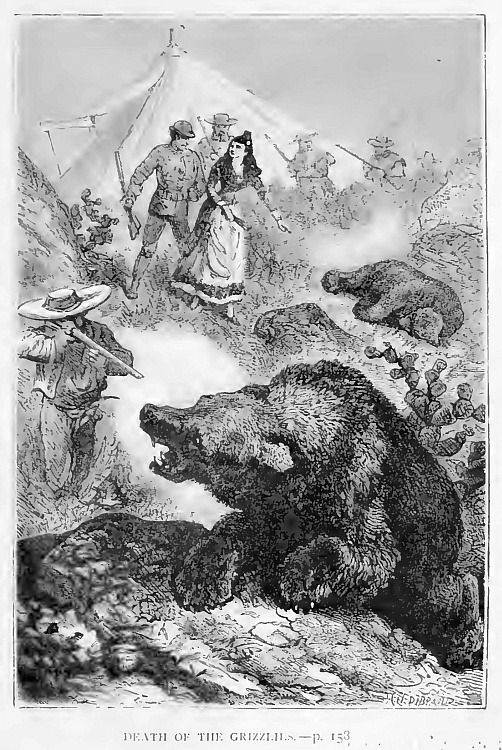
They have thrown cloaks and other dark cloths over the tents to make them less conspicuous, but the bear seems imbued by a vindictive determination to attack in that very quarter, and straight towards them comes he.
“Let me fire first, señores,” claims Vicente, “and low from my knee my bullets may turn him sideways, and if so, then your chance, pour in your broadside, aim just behind the shoulder, halfway down.”
Saying which the gambusino drops on one knee, bringing his gun to his shoulder not an instant too soon, for the huge monster is now within ten feet of him. The sharp but full report, with a tuft of hair seen starting off the bear’s right neck well back on the shoulder, tells that the animal has been hit there, just as Vicente had intended it, his design being for the others to get flanking shots, which they do, one and all, the bear instantly slewing round as before to bite the wounded spot. This brought his left shoulder to front well spread out, and making the best of marks, into which was simultaneously poured the contents of four barrels with twice as many bullets, hitting so close together as to make an ensanguined irregular disc about the size of a man’s hand. No pistols nor knives were needed, no supplementary weapons of any kind, the bear breathing his last ere the reports of the guns had ceased reverberating along the cliffs.
Chapter Seventeen.
Crusader Chased Again.
The scene, all action and excitement, has nevertheless occupied but a brief space of time: scarce two minutes since the grizzly bears first showed themselves on the edge of the glade till both lie dead within it—victims of their own ferocity.
It might have been very different, and under like circumstances nearly always is. Many cases are recorded in which half a score of camp travellers have succumbed to the insane rage of a single grizzly. Fortunate, too, had been the miners in their shots—no doubt clue to the short range at which they were fired—for the thick, tough skin of this animal is almost ball-proof, and one has been known to bear off a dozen bullets in its body, and carry them about with it afterwards.
The very openness of their danger, with no prospect of escaping it, had lent to the miners the courage of despair, and so made them more fearless in their attack; otherwise they would have fired at the enemy without approaching so near, perhaps to fail. Enough damage has been done notwithstanding, and a cry of lamentation succeeds the shots, and general shouting, as the women gather around the body of that single victim to the fury of the bears. Frightfully mutilated it is, showing parallel tears over the breast—the tracks of claws, all running blood, and a huge gash by the throat where the first stroke had been given.
“Esta Pablito Rojas!” cries a voice, identifying the lad, others adding in sympathetic chorus, “Pobre! pobre-ceti!”
There is one who takes no part in these demonstrations—Henry Tresillian. He is in fact no longer in the camp, for soon as the second grizzly had been disposed of, he started back for the vidette post, and so abruptly as to make all wonder who were observing him. Among the rest Gertrude herself, who thought it strange he should not stay to speak some words of congratulation. He but muttered one or two, with the name of his horse, well known to her, and was off.
Now, from his former point of view, he again beholds Crusader standing just as left, and still to all appearance unmolested. It is more than he expected, but there may be reasons: possibly the shouts and fusillade above have for a time drawn the attention of the Indians in that direction. This will not be for long, and Crusader’s master but counts the moments till he see him assailed and chased.
Nor are they many. Just after his return to the ravine’s head he observes nigh threescore dusky horsemen move out beyond the flanking embattlement of rock; not hastily, nor in confusion, but in deliberate and long deployed line, which stretches afar over the llano.
Crusader sees them too, and seems to regard them with indifference; he has taken to browsing on a piece of rich pasture lying along the stream’s edge, this alone for the time occupying him. That he is the objective point of their movement is evident, though none of them are heading straight towards him, their design being evidently to get around him.
After all, is he going to let himself be surrounded, and approached in this easy manner? Such is the interrogatory which passes among those watching from above, for the videttes have returned to their post, with others accompanying them.
One answers it, saying, “It’s not at all likely. He let himself be taken in a trap! More like the redskins will find themselves in one before long. See! they begin to find it now!”
This, from Pedro Vicente in his old spirit, as he points to the line of savages far extended.
The files have by this faced westward, but are advancing towards the stream; now, on nearing it, they are seen to stop abruptly as if in surprise. Then, after an instant, all wheel round and ride back eastward, till getting on their old line, they return at a gallop towards their camp. They have discovered the stream to be impassable.
“That horse is the demonio himself,” says Pedro Vicente—“neither more nor less. He must have known they could not cross the swollen streamlet, or he’d never have stopped by it as he has done. But they’ve not given him up yet. No! see: they’re going round by the head of the lake.”
Just this they intend, as is seen by their advancing towards the point where the lake commences by the mouth of the ravine. They have no difficulty in crossing its in-going stream, a few minutes after the rain ceased having reduced this to its normal condition of a tiny rivulet.
And like some dark, disagreeable vision Henry Tresillian sees pass before his eyes the savage cohort, file after file, one disappearing after another, till at length no animated form is observable on the plain below, save that their eyes have been hitherto regarding with interest.
There is a long interval without event; nearly an hour elapses ere Crusader shows any sign, his head almost continuously to the grass, raised only occasionally, as he changes place upon it. All this time the Indians are out of sight, with no sound coming from the direction they had taken.
But at length there is a sound, a startled neigh from the black horse, who, tossing his crest in air, rears upward with a curving sweep, and then darts straight away, as if in flight from an advancing enemy—the enemy seen instantly afterwards as several mounted men disclose themselves from the western framework of rock, all in a tail-on-end gallop.
Crusader has taken along the edge of the stream, and follows it in parallel direction downwards, just as he fled before from the same pursuers. There would seem no chance of their overtaking him now; for he appears to gain distance at every bound, without even straining himself. But lo! what is that?
“Santos Dios! They’ve headed him. Milraya! what a pity!”
It is the gambusino who thus exclaims, seeing other horsemen on the plain farther points on, all facing towards the stream, evidently to intercept the chased steed.
Crusader sees them too, for he is now close up to them; but forsaking the course he has hitherto followed, he makes an abrupt turn and breaks off westward, continuing this direction in full gallop, till the rocks hide him from view.
Alike the pursuers thrown round, pass out of sight one after another, and again that part of the llano resumes its wonted aspect of stern, savage tranquillity.
For most of those composing the party of spectators the chase had no particular interest, and only a few of them were gathered around the point where it could be viewed. Indeed, but a few heard of Crusader being seen, the greater and more serious event obscuring that of lesser note. And now these few, one after the other, again go back to ojo de agua, to take part in the duties of the day.
But the English youth still stays by the vidette post, with eye constantly directed on the plain below, and ears listening intently, to catch any sound that may come from the western side; apprehensively, too, for he fears to hear shots.
The savages failing to catch the black horse with their laryettes, may spitefully endeavour to bring him down with their guns. This, indeed, is the real clanger his young master has been dreading, and which for the time engrosses all his thoughts.
Luckily not for long. Within less than an hour the dusky horsemen, in twos and threes, come straggling back across the open ground between the lake’s head and their camp, so continuing till the last of them have returned, all with discomfited air, but none with Crusader as their captive. And as no report of gun has been heard, it is more than probable he has once more eluded them.
Chapter Eighteen.
Life on the Lost Mountain.
The exciting events above recorded, as occurring in quick succession, are followed by a period of repose lasting for days. Alike reigns it on the mountain summit and around its base; in the camp of the besieged as of the besiegers.
Withal, in the latter there is no lack of activity; parties go and come at all hours, but more especially during those of the night. Scouts sent out; it may be for many purposes. But one large detail is observed on a certain day to make the complete round of the mountain, every here and there halting with front towards it, as if for minute examination of its cliffs from base to summit; evidently to be satisfied whether there be any possible chance for the white men to reach the plain otherwise than down that chine cut by the watercourse.
While making this reconnaissance they have been narrowly watched by eyes from above, and as no particular point has been observed to attract their attention, it is concluded that they deem their pale-faced prisoners quite secure, only calling for a little patience ere they may evidently lay hands on them.
The same movement also gives assurance to their intended victims, but of a kind not so satisfactory. It tells them how determined their enemy is, how retentive his grasp, and implacable his vengeance. All this with no increased hope on their part of being able to escape him. Thought of how has not yet taken shape in their minds. How could it? So many present facts and fears engrossing them, they have found little time to reflect on the future.
And a new fear has now arisen which calls for steps to be taken. There may be other grizzly bears on the mesa, and if so these monsters will be prowling around the camp to assail it at any instant. Better they be met outside at a distance off, there attacked, and if possible exterminated.
This conclusion come to, Don Estevan gives orders for all to arm, and a general battue is made over the summit of the Cerro. Paths are hacked through the underwood everywhere, laying open many a spot never before trodden by foot of man. Strange birds are flushed from their nests, and strange animals are seen stealing away through the thick tangle of llianas, chiefly of the reptilian order, as armadillos, lizards, the curious horned frog (Agama cornuta), and serpents—most numerous of all that whose retreat is marked by the defiant rattle which has given it its name. Scores of cascabelés are started out of the dead leaves and branches, their vibratory “skirr” resounding everywhere.
But quadrupeds turn up as well. At intervals the crack of gun tells of one shot at, whether killed or no. Now a wild sheep, now a prong-horn antelope, or it may be but a hare or rabbit. The great wolf is also found there, and his lesser and more cowardly congener, the coyote; but no more bears—grizzly or other—nor sign of them. Evidently the two killed at the camp were the sole monarchs of the mountain.
The day’s hunt, for it occupied a whole day, gives satisfaction in more ways than one. First, by doing away with all apprehension of danger from Ursus ferox; secondly, by affording a plentiful supply of present food; and, thirdly, in there being still more on the mountain, giving proof of the abundance of them.
Nor is the vegetable element lacking, but present in all its varieties of root, fruit, and berry. The mezcal, whose baked stem forms staple food for their enemies, grows on the mesa. Its use is known to the gambusino, as others of the miners. Several sorts of mezquitè trees are found there, whose long pendulous siliques contain seeds which can be ground into a meal making nutritious bread, while the cones of the edible pine (Pinus edulis)—“piñon-nuts” as called—are in quantity all around. For fruit there are several varieties of the cactus, with that of pear-shape, and all the rich juiciness of a pear, the famed pitathaya. In short, the Cerro Perdido is a very oasis, its cornucopia peculiar to the desert. With so bountiful a supply of provisions the besieged need not fear famine, at least for a long time. Their resources, carefully husbanded, may last for weeks.
And on time rests their only hope; their sole chance of being rescued depending on that, by some means or other, their situation may become known to their friends at Arispe, or their countrymen elsewhere.
But what likelihood of this? As already stated, the Lost Mountain is out of the line of all travel and traffic. Months, a year, nay, years may elapse ere a wayfarer of any kind stray to it, or near it. So their chances of being seen there by friendly eyes, to say naught of their position being understood, are as those of castaways on a desert isle in mid-ocean.
And as shipwrecked men they hoist signals of distress. Any one approaching that solitary eminence from the south might wonder to see a flag floating from a tall staff over its southern end, giving it all the greater resemblance to a fortress with banner waving above. A tricolour flag, bearing the symbolic badge of the Mexican Republic—the Eagle upon the Nopal! It is that Don Estevan had meant to have erected over the new mine, now little likely ever to be displayed there. For now it is unfolded to tell a tale of threatening disaster, and attract the eyes of those who may do something to avert it.
But for this dark uncertainty of future there is nothing irksome, not even disagreeable, in their present life. On the contrary, it might be even called pleasant; plenty to eat, plenty to drink, sufficient freedom of range, a sapphire sky above, with an atmosphere around them whose heat is tempered by breezes ever blowing, ever laden with the fragrance of fruit and flower.
And no scene of sombre gloomy silence; instead, one enlivened by the notes of many wild warblers, both diurnal and nocturnal. By day the jarring yet cheering cry of the blue jay and the red cardinal; the mewing of the catbird, or the “hew-hew” of hawk in pursuit of his victim. By night, the more melodious, all incomparable song of the czentzontlé—mockingbird of Mexico—oft intermingled with another song, but little less powerful or sweet, that of the cuitlacoche—a second species of New World nightingale, not so well known.
Life in the odd aerial camp now settles down into a sort of routine, each day having its separate calls and duties. The watch is, of course, kept up, and with no falling off in its vigilance. For although the besiegers have not again shown any sign of an intention to try the assault, who knows what may be in the mind of these subtle savages?
Only at night need there be any fear, and only when it is darkest. At other times the vidette duty is a matter of easy fulfilment.
In truth the miners might almost fancy themselves in picnic, having a happy time of it, halfway between earth and heaven. But they are not there by choice, too well knowing its stern necessity. And this, with the dark doubtful future, robs them of all zest for enjoyment. So the hours pass not merrily, but wearily.
Chapter Nineteen.
Who to be the Forlorn Hope?
Day succeeds day with no brightening of hopes to those beleaguered on the Lost Mountain. Instead, in each something arises to make their prospects darker, if that were possible.
About ten days after the commencement of the siege the besiegers have their force increased, a fresh party coming down from the north, evidently in obedience to a summons, which they who drove off the captured caballada have carried back. But for what purpose this accession of strength, when it is not needed? They on the ground are already enough, and to spare.
The miners cannot guess what they have come about, unless it be the remaining braves of the tribe, to take part in some ceremony over their fallen chief, or be present when the time arrives for the wreaking of vengeance.
It has nothing to do with that, however, solely a conception of their new leader, El Zopilote, who has his reasons for carrying out the raid down the Horcasitas. So on the second day after, the besieging party, instead of being one hundred men the more, is all that the less; at least two hundred seen to issue forth from the camp, and proceed southward in full war-paint and panoply, with all their frightful insignia. As successive files they move off along the stream’s edge, it might seem as some gigantic serpent commencing its crawl towards prey. And many on the mountain, with a suspicion of where they are going, have a pitying heart for those who live on the banks of the lower Horcasitas.
Enough, however, to think of themselves, and each hour more than enough; for as the days pass circumstances present a still sterner front. The supply of provisions, at first seeming inexhaustible, proves to have a limit. There are over seventy mouths to feed, which calls for a large daily quantity. So one by one the wild quadrupeds give out, the birds long before these, frightened by the constant chase and fusillade, forsaking the place altogether. The store of tasajo and other preserved meats begins to be drawn upon. When these come to an end, so too must all the suspense, all the agonies of that quaint, quasi imprisonment, to terminate in real captivity, or indeed death itself.
In the tent of Don Estevan some seven or eight of the mining people are assembled; the two dueños are of course present, with the mayor-domo, the chief engineer, and other heads of departments. No need to say the gambusino is among them. They are there to take counsel on the events of the day, and the means of the morrow. Every night it has been their custom to do so, and on this one—for it is at night—there is nothing very different to speak of from any other.
Still, Don Estevan has conceived a thought which had not hitherto occurred to him, and now lays it before the assembled conclave.
“Caballeros! I can think of only one way—poor, doubtful chance it is—by which we may get rescued. Some one must contrive to pass their sentries.”
“Impossible!” is the thought of all hearing him, one or two expressing it in speech. For of all the things observed as vigorously kept up, never relaxed for an hour—even a moment—has been that sentinel line thrown across the plain from flank to flank of the ravine. All day long it has appeared there, and all through the night evidently redoubled.
“Pity if it be,” rejoins Don Estevan, yielding to what appears the general sentiment. “And to think that one word at Arispe would make all well. My own brother-in-law, Colonel Requeñes, in command there with a regiment of lancers—they of Zacatecas. In less than half an hour they could be in the saddle, and hastening to our relief. Ay Dios! if we can’t communicate with them we are lost—surely lost!”
At this, Robert Tresillian says, interrogatively:
“I wonder how many of our people could find the way back to Arispe?”
Without altogether comprehending what he means, several numbers are mentioned in a guessing way, according to the estimate of each. Pedro Vicente thinks at least thirty could,—certainly all the arrieros and vaqueros.
“What is your idea, Don Roberto?” at length asks the senior partner.
“That all of those who know the way back be mustered, and two taken from them by lot, who will run the risk of passing the Indian sentries. If they succeed, then all may be saved; if on the contrary, it will be but to lose their lives a little sooner. I propose that all submit to the lottery—all who are unmarried.”
“I agree with the Señor Tresillian,” here puts in the gambusino. “Some of us must contrive to get past them at whatever risk. For my part, I’m willing to be one, with any other.”
The generous proposal is received with applause, but not accepted,—it would not be fair; and in fine it is agreed upon, that fate shall determine who shall be the pair to run the proposed risk—the ceremony for deciding it to take place on the morrow.
In the morning it comes off soon as breakfast is eaten. All known to be eligible are summoned together on a spot of ground apart, and told the purport of their being so assembled. No one objects, or tries to evade the dangerous conscription; instead, there are even some who, like Vicente, would volunteer for the duty.
For is not one of the dueños—the brave Englishman and his son, there present—both offering themselves as candidates like any of the common men?
No volunteering, then, is allowed; fortune alone permitted to decide on whom shall be the forlorn hope.
The quaint lottery, though awe-inspiring, occupies but a brief space of time. Against the number of men who are to take part in it, a like number of piñon-nuts have been counted out, and dropped into a deep-crowned sombrero. Two of the nuts have been already stained with gunpowder, the others left in their natural colour; but no one by the feel could tell which was which. The black ones are to be the prizes.
The men stand in a ring round Don Estevan, with another who is among the exempt in the centre. These hold the hat, into which one after another, stepping from the circle, led forward blindfolded, inserts his hand, and draws out a nut. If white, he goes clear; but long before the white ones are exhausted the two blacks are taken up, which brings the ceremony to an abrupt end, that deciding all.
They who have drawn the prizes are a muleteer and a cattle drover, both brave fellows. They had need be, for this very night they will have to run the gauntlet of life and death, perhaps ere the morrow’s sun to be no more.
Chapter Twenty.
A Fatal Failure.
It is a day of anxious solicitude. If the night turn out a dark one, the messengers whom fate has chosen for the perilous enterprise are to set out on their errand. They know it is to be a moonless one, but for all, in the diaphanous atmosphere of that upland plateau, it may be too clear to make the passing of the Indian sentinels at all possible.
The afternoon begets hope: a bank of heavy clouds is seen rising along the western sky, which, rolling higher and higher, brings on a downpour of rain. It is of short continuance, however—over before sunset, the clouds again dispersing. Then the darkness comes down, but for a long time only in a glimmering of grey, the stars in grand sheen making it almost as clear if there was moonlight.
The sentinels can be seen in their old places like a row of dark stakes, conspicuous against the green turf on which they are stationed. They are at short distances apart, and every now and then forms are observed moving from one to the other, as if to keep them continuously on the alert.
So thus, nigh up to the hour of midnight, and the miners begin to despair of their messengers being able to pass out—at least, on this night.
But soon, to their satisfaction, something shows itself promising a different result. The surface of the lake has suddenly turned white, as if under a covering of snow. It is fog. Through the heated atmosphere the lately-fallen rain is rising in vapour, and within its misty shroud it envelopes not only the lake, but the plain around its edges. It rolls over the line of savage watchers, on up between the jaws of the chine, till in its damp clammy film it embraces the bodies of those who are waiting above.
“Now’s your time, muchachos!” says Don Estevan, addressing himself to those who are to adventure. “There could not be a better opportunity; if they can’t be passed now, they never can.”
The two men are there ready, and equipped for the undertaking. Young fellows both, with a brave look, and no sign of quailing or desire to back out. Each carries a small wallet of provisions strapped to his person, with a pistol in his belt, but no other arms or accoutrements to encumber them. In subtleness and activity, more than mere physical force, lie their chances of success.
A shaking of hands with such of their old comrades as are near, farewells exchanged when they pass over the parapet of loose stones to commence the descent, with many a “va con Dios!” sent after them in accents of earnest prayerfulness. Then follows an interregnum of profound silence, during which time they at the ravine’s head listen with keenest anxiety.
After a few seconds a slight rustling below tells that one of the two has made a slip, or pushed a stone out of place; but nothing comes of it. Then a horse neighs in the distant camp, and soon after another, neither of them having any significance. No more the screaming of wild-fowl at the lower end of the lake, nor the querulous cry of “chuck-will’s widow,” hawking high over it. None of these sounds have any portent as to the affair in hand, and they, listening, begin to hope that it has succeeded—for surely there has been time for the two men to have got beyond the guarded line?
Hope premature, alas! to be disappointed. Up out of the mist comes the sound of voices, as if in hail, followed by dubious response, and quick succeeding a struggle with shots. Then a cry or two as in agony, a shout of triumph, and all silent as before.
For the rest of the night they on the mesa sleep not. Too surely has their scheme failed, and their messengers fallen victims to it. If they were any doubts about this, these are set at rest at an early hour of the morning.
Sad evidence they have to convince them. On the spot where the scalp-dance had taken place a red pole is again erected, as the other ornamented with the skins of human heads. But not now to be danced around; though for a time they, looking from above, think there is to be a repetition of that savage ceremony. Soon they are undeceived, and know it to be a spectacle still more appalling. From the camp they see a man conducted, whom they identify as one of their ill-fated messengers. Taken on to the stake, he is placed back against it, with arms extended and strapped to a cross-piece, in a way representing the figure of the Crucifixion. His breast has been stripped bare, and on it is seen painted in white the hideous symbol of the Death’s head and crossbones.
For what purpose all this display? the spectators conjecture among themselves. Not long till they have the answer. They see several scores of the savages range themselves at a certain distance off, each gun in hand, one after the other taking aim and discharging his piece at the human target. Gradually the disc on the breast is seen to darken, turning red, till at length not a spot of white is visible. But long ere this the head of the hapless victim, drooped over his shoulder, tells that he is dead.
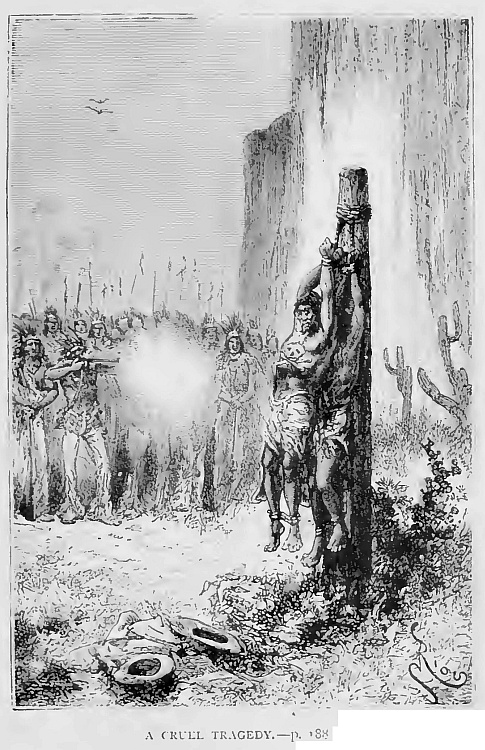
The cruel tragedy is repeated, showing now what was not known before, that both the ill-starred couriers had been taken alive. He brought forth next is recognisable, by the picturesque dress still on his person, as the vaquero. But when taken up to the stake he is stripped of it, the velveteen jaqueta pulled from off his shoulders, his shirt torn away, leaving his breast bare. Then with a hurried touch, the grim, ghastly device is limned upon him, and he is taken up to the pole as the other.
A fresh fusillade commences, the white gradually showing dimmer, till at length it is deeply encrimsoned, and the vaquero is a lifeless corpse.
When it is all over, the Coyoteros turn towards the gorge, and looking up, give utterance to wild yells of triumph, brandishing their weapons in a threatening manner, as much as to say, “That’s the way we’ll serve you all, when the time comes.”
Chapter Twenty One.
A Prodigious Leap.
Needless to say that the failure of their scheme with such fatal consequence has deepened the gloom in the minds of the besieged miners, already dark enough. Now more than ever do they believe themselves doomed. There seems no alternative left but surrender or starvation and as both are alike certain death, they dwell not on the first. True, starvation is not yet so close at hand; they have still provisions—some of the old caravan stores—sufficient for a couple of weeks, if carefully served out, while the live stock furnished by the mesa itself has not all been exhausted. Some animals as yet remain uncaptured, though how many they know not.
To make sure, another grand battue is set on foot to embrace the whole summit area. Every outlying corner and promontory are quartered and beaten, so that no four-footed creature could possibly be there without being seen or shot. The result is a bag, of but small dimensions, though with large variety; a prong-horn antelope, the last of a band that had been daily getting thinned; several sage hares, a wolf, and three or four coyotes. More of these last were startled, but not killed, as they have lairs in the ledges of the cliffs to which they betake themselves, secure from pursuit of hunter.
While the battue is at its height, one large quadruped is put up which more than any other excites the ardour of those engaged. It is a bighorn, or Rocky Mountain sheep, remnant of that flock first found upon the mesa by Vicente and Henry Tresillian; it is also a ram, a young one, but with grand curvature of horns. One after another all the rest have been made mutton of, and their bones lie bleaching around the camp; but, though several times chased, this sole survivor has ever contrived to escape, as though it had a charmed life. And now again it seems still under such protection; for at starting several shots are fired at it, none taking effect; and it bounds on, apparently unharmed, towards an outlying projection of the plateau.
Those who have emptied their guns follow without staying to re-load; for they form a line which, deployed crossways, cannot fail to enclose and cut off its retreat, making escape impossible. In fine, they effect this purpose; some, with guns still charged, confidently advancing to give the animal its coup de grâce. They are even aiming at it, when, lo! a leap upward and outward, with head bent down as one making a dive, and the bighorn bounds over the cliff.
Five hundred feet fall—shattered to atoms on the rocks below!—this their thought as they approach the precipice to see the prodigious leap that must have been taken by the animal in its panic of fear. One, however, draws nigh with a different thought, knows there was method in that seeming madness, and that the carnero sprang over with a design. Pedro Vicente it is; and with the others soon upon the cliff’s brow, and, gazing below, to their surprise they see no sheep there, dead and crushed as expected. Instead, a live one out upon the llano, making off in strides long and vigorous.
Sure of its being the same they had just driven over, all are astounded, expressing their astonishment in loud ejaculations. Alone the gambusino is silent, a pleased expression pervading his countenance, for that extraordinary feat of the horned creature has let a flood of light into his mind, giving him renewed hope that they may still be saved. He says nothing of it to those around, leaving it for more mature consideration, and to be discussed in their council of the night.
But long after the others have returned to camp he lingers on the cliff, treading backwards and forwards along its crest, surveying it from every possible point of vantage, as though in an endeavour to find out how the sheep made that extraordinary descent.
Another night is on, and, as is their wont, the chief men of those besieged are assembled in the tent of Don Estevan. Not discouraged yet, for there is a rumour among them that some new plan has been thought of for passing the Indian sentries, less likely to be disastrous than that which has failed. It has been the whisper of the afternoon, their guide being regarded as he who has conceived a scheme.
When all are together Don Estevan calls upon him to declare it, saying,
“I understand, Señor Vicente, you’ve thought of a way by which a messenger may yet elude the vigilance of their sentries, and get beyond them?”
“I have, your worship.”
“Please make it known.”
“Nothing more simple; and I only wonder at not having thought of it before. After all, that would have been useless, for only this day have I discovered the thing to be possible.”
“We long to hear what it is.”
“Well, then, señores, it’s but to give them the slip. Going out by the back door, while they are so carefully guarding the front. That can be done by our letting one down the cliff—two, if need be.”
“But where?”
“Where the carnero went over.”
“What! five hundred feet? Impossible! We have not rope enough to reach half the distance.”
“We don’t need rope to reach much more than a third of it.”
“Indeed! Explain yourself, Don Pedro.”
“I will, your worship, and it is thus. I’ve examined the cliff carefully, where the sheep went over. There are ledges at intervals; it is true not wide, but broad enough for the animal to have dropped upon and stuck. They can cling to the rocks like squirrels or cats. Some of the ledges run downwards, then zigzag into others, also with a downward slope; and the ram must have followed these, now and then making a plunge, where it became necessary, to alight on his hoofs or horns, as the case might be. Anyhow, he got safe to the bottom, as we know, and where it went down, so may we.”
There is a pause of silence, all looking pleased for the words of the gambusino have resuscitated hopes that had almost died out. They can see the possibility he speaks of, their only doubt and drawback being the fear they may not have rope enough.
“It seems but a question of that,” says Don Estevan, as if speaking reflectingly to himself.
The others are also considering, each trying to recall how much and how many of their trail-ropes were brought up in that hasty debendade from their camp below.
“Por Dios! your worship,” rejoins the gambusino, “it is no question of that whatever. We have the materials to make cords enough, not only to go down the cliff, but all round the mountain. Miles, if it were needed!”
“What materials?” demanded several of the party, mystified.
“Mira!” exclaims the gambusino. “This!” He starts up from a bundle of dry mezcal-leaves on which he has been seated, pushing it before him with his foot.
All comprehend him now, knowing that the fibre of these is a flax, or rather hemp, capable of being worked into thread, cloth, or cordage; and they know that on the mesa is an unlimited supply of it.
“No question of rope, caballeros; only the time it will take us to manufacture it. And with men such as you, used to such gearing, that should not be long.”
“It shall not,” respond all. “We’ll work night and day till it be done.”
“One day, I take it, will be enough—that to-morrow. And if luck attend us, by this time to-morrow night we may have our messengers on the way, safe beyond pursuit of these accursed redskins.”
Some more details are discussed maturing their plans for the rope-making. Then all retire to rest, this night with more hopeful anticipations than they have had for many preceding.
Chapter Twenty Two.
A Youthful Volunteer.
Another day dawns, and as the earliest rays of the sun light up the Cerro Perdido, an unusual bustle is observed in the camp of the besieged. Men are busy collecting the leaves of the mezcal-plant, those that are withered and dry from having their corms cut out days before; fortunately there are many of these lying all around. Other men, armed with rudely-shaped mallets, beat them against the trunks of trees, to separate the fibre from the now desiccated pulp; while still others are twisting this into threads, by a further process to be converted into thick ropes.
It is found that after all not so much will be needed; several lassoes had been brought up, tied round the bundles of goods; and with these and other odds and ends of cordage, a rope can be put together full two hundred feet in length, strong enough to sustain the weight of any man. So, long before night the lowering apparatus is ready, and, as before, they await the darkness to make use of it.
Meanwhile Don Estevan, the two Tresillians, and Vicente spend most of the morning on the cliff where the bighorn went over, surveying it from every possible point, taking the bearings of its ledges, and estimating their distances from one another. They are, as the gambusino had represented them, a succession of very narrow benches, but wide enough for a man to find footing; some horizontal, others with a slope downwards, then a zigzag bringing them lower, till within a hundred feet from the cliff’s base the façade of rocks shows sheer and clear. Down to this point all will be easy; and beyond it they anticipate little difficulty, now that they are sure of having sufficient rope.
While engaged in their reconnaissance, an object comes under their eyes which they gaze upon with interest. They are upon the western side of the mesa not far above its southern point, the plain on that side being invisible from the camp of the besiegers; and on this, at the distance of a mile or more, there is a spot of pasture due to a tiny rivulet, which, filtering off from the side of the lake, becomes dispersed over a considerable surface, which it moistens and makes green.
Moving to and fro over this verdant stretch is the object which has caught their attention—a horse of large size and coal-black colour, which they know to be no other than Crusader. They are not surprised at seeing him there. Habitually he frequents this spot, which has become his accustomed pasturing-ground, and more than once had Henry Tresillian stood on that cliff regarding him with fond affectionate gaze; more than once, too, had the Indians again gone in chase of him, to be foiled as before. There is he still unlassoed, free of limb as the antelopes seen flitting over the llano around him.
After completing the examination of their precipice, and noting all details that may be needed to help out their design, they stand for a time gazing at the horse, his young master with a thought in his mind which he withholds from the others. Nor does he communicate it to them till after their return to the camp, and the question comes up, who are the ones to be lowered down; for it is thought better that two messengers should be sent, as company and support to each other. That is the question to be decided, and up to this hour all expect it to be as before—by lottery.
In fine, when the time arrives for settling it, and the eligible ones are again assembled for drawing lots, a proposal is made which takes every one present by surprise. It comes from the youngest of the party, Henry Tresillian, who says: