Front matter (continued 2)
Reading edition
“I’ll get some hot water,” said Dude. “Mebbe some liniment will help it out. You take it easy, and I’ll fix yuh up fine.”
Mary watched the tall, straight-backed cowboy leave the room, and sank back in her chair with a sigh, wondering what would happen next. Her life had been adventurous indeed since she had met Cultus Collins. She had no idea just what she was to do in Oreana City. Thinking it over calmly was impossible for her. She was an impostor. And whether she could carry out the deception remained to be seen.
Someone had entered the room behind her and she turned to see Eph Wheeler, clad in an old red undershirt, overalls and a pair of mismated woolen socks. The old man’s sparse hair was standing straight up, and his face appeared very thin in the lamplight. He squinted closely at her, glanced toward the kitchen, where Dude was noisily poking wood in the stove, and then came a little closer to her.
“Just who might you be?” he asked curiously. “I thought I must be dreamin’ when I heard a woman’s voice out here.”
“I am Mary Ault,” said Mary bravely.
The old man’s mouth opened, but he did not speak. He rubbed his right hip with his right elbow, frowned at the lamp, shifted his feet.
“Mind sayin’ that again?” he asked.
Mary repeated the name. The old man nodded. Dude came in from the kitchen, saw his father, and stopped short.
“Did we wake yuh up, Dad?” he asked.
The old man did not reply; he was too interested in Mary.
“This is Miss Ault,” said Dude.
“That’s what she said. Where’d you pick her up?”
Dude explained about the runaway and how he had found Mary. He was unable to tell who had been driving the team, and Mary did not know.
“It’s a Lazy A rig,” said Dude. “Blue buggy with red wheels. It’s wrapped around one of our gate-posts. The horses are down by the corral. I can’t imagine what a Lazy A rig would be doin’ out here.”
“My suitcase was in it,” said Mary. Dude walked out, and came back in a few moments, carrying the suitcase, which was none the worse for the runaway. The old man sat down and watched Mary, while she soaked her swollen ankle in hot water.
“So Jud Ault was yore uncle, eh?” he remarked. “Know him?”
“No,” said Mary. She hadn’t the slightest idea who Jud Ault was.
“He was a dirty old pup.”
Mary flinched. She was evidently not related to a saint.
“He turned his own daughter out,” continued the old man. “But he was a dirty old pup long before that.”
“Dad, I don’t reckon she cares to know all this,” said Dude softly.
“Well, she ought to. Anyway, she might as well hear it from me, ’cause she’s goin’ to hear it sooner or later.”
“That liniment will take a lot of the soreness out,” said Dude. “I’ll soak a bandage and——”
“It seems to me yore takin’ a lot of pains with an Ault,” said the old man. Dude flushed, but did not reply.
“Been packin’ a Winchester for ’em for years; now yo’re wrappin’ up their ankles.”
Mary laughed, because she did not realize how serious had been the hatred between the two ranches.
“What is a Winchester?” she asked.
“A gun,” said Dude. His hand trembled slightly and he spilled a little of the liniment.
“Do all men carry guns out here?” she asked. Dude looked up at her, his eyes serious.
“Most of ’em do.”
“Tell me about Jud Ault turning his daughter out.”
“It’s true.” Dude did not look up at her. “She married a gambler. Some say he was also a lawyer, but he didn’t practice law here. Old Jud Ault wouldn’t speak to her again. She lives in Oreana City, with her little boy.”
“And he didn’t leave her anything when he died?”
“A dollar.”
“And the ranch is worth a million, they say,” growled the old man. “Yo’re sure lucky.”
“I—I didn’t know much about it,” faltered Mary.
“Lane sent for yuh, I reckon. He made out Jud Ault’s will.”
“Yes,” said Mary, because she didn’t know what else to say.
Dude finished bandaging the ankle and took the water back to the kitchen.
“Are you thinkin’ of stayin’ here tonight?” asked the old man.
“Why, I—I don’t know,” said Mary.
“I guess you’ll go back to town.”
Dude came back and the old man turned to him. “Yuh better harness up the team and take her back to the hotel, Dude.”
They looked at each other for several moments.
“That might be the best thing to do,” said Dude slowly then. “I’ll hitch up the team.”
He went out, softly closing the door behind him. Mary curled up on the big chair, her chin in her hand. She did not like the old man, who filled his pipe and smoked noisily.
“You’ll sell the Lazy A, won’t yuh?” he asked, not unkindly.
Mary shook her head. “I’m sure I don’t know, Mr. Wheeler.”
“Runnin’ a cow-ranch ain’t no woman’s job,” he sucked heavily on his pipe. “Of course, you might marry a cow-man.”
“I hadn’t thought of that.”
“Yo’re a queer sort of a girl. That’s about all most girls think about!”
“Do you know much about girls?”
“Hmph! Well, don’t they?”
“Do they?”
Eph Wheeler threw his pipe on the table, with a grunt of disgust. “I’m glad yo’re goin’ back to town! I hate an argument.”
“And you start them yourself.”
“I do not!” The old man drew himself up angrily, his eyes flashing. “I never—say, I dunno what this is all about. I wish Dude would hurry with that team. You make me mad. Aults always made me mad. You remind me of Jud Ault.”
Mary laughed openly at him, and he stalked from the room, swearing under his breath. He did not put in an appearance, when Dude carried her out to the buggy, and Dude did not mention him until they were well on their way to Oreana City.
The moon was up now, and the hills were bathed in a silver glow; blue in the depths, and silver, where the moonlight brushed the ridges: a mystic fairyland where the moon and stars came down close to the world. Mary leaned back in the buggy seat and looked at a world she had never seen before.
“Oh, isn’t it beautiful!” she said simply.
“Yes’m, it is. I never get tired of these hills at night. The rough edges are all gone. Lotsa nights I just ride into the hills; ride away back on the ridges. It’s like goin’ away from the rest of the world.
“I’m sorry dad talked like he did. But he’s old, and he hates the Lazy A. There’s no women at the Star X. Pretty soon our four cowpunchers will be driftin’ home from town, loaded to the gills with liquor—and it might not be a nice place for a lady—the Star X ranch. They’re a rough lot. You’ll be better off at the hotel. I put yore suitcase in the back of the buggy.”
“It’s a wonder it didn’t get all smashed.”
“And you, too.”
“Yes, that’s true. I’m sorry to have put you to all this trouble, Mr. Wheeler. I just can’t imagine what would have happened to me, if you hadn’t met that runaway.”
“Well, it was kinda lucky. About a hundred yards beyond where you was throwed out, there’s a deep washout. I reckon things would a’ gone to smash in there. It’s about thirty feet across—and there ain’t no road.”
“You mean, a deep rut?”
“Yuh might call it a rut, ma’am; it’s about twenty feet deep.”
“Oh!” Mary shuddered. “I’m glad I met you.”
“Well, so am I,” said Dude softly. “And it wasn’t any trouble; so yuh don’t need to thank me.”
“But you hate the Ault family, you know.”
“I just wonder if I do. It seems like kind of a small thing to do—this hate. It ain’t never got me anythin’. You and Faith are the only Aults I know—and I don’t hate either of yuh.”
“Faith?”
“Yeah; Jud Ault’s daughter.”
“The one he turned out of his home?”
“Uh-huh. There’s the lights of Oreana City. I’ll fix yuh up at the hotel. It ain’t no great place, but it’s all right. You’ll prob’ly go out to the Lazy A tomorrow.”
They drove up to the hotel. Dude carried her suitcase in and Mary was able to walk slowly. The proprietor was reading by the light of a smoky old oil lamp. He stared over his glasses at Mary.
“Give Miss Ault yore best room. Charley,” said Dude. “She’s only goin’ to be here one night.”
“Sure, sure! Miss Ault. Huh! Huh! Yes, ma’am! Looks like old Jud, eh? Know her any place. Naw, yuh don’t need to register. We never had but one book, and somebody stole it. I suppose they was collectin’ horse-thieves’ autographs. Ha, ha, ha, ha!”
The old man bent double over his stock joke, grabbed the lamp in one hand, the suitcase in the other and led the way down a narrow hall.
“I’ll put ye in the president’s sweet,” he chuckled. “It’s the only one that the wash-bowl ain’t cracked.”
Dude watched them turn into a room, and went outside. There was plenty of noise in the Oreana, so he went over. Klondike, Buck, Heinie and Joe were decidedly drunk. They goggled at him owlishly, sobering a trifle. It was rather unusual for Dude to come to town at that time of night. Buck invited him to have a drink, but he declined.
A sudden notion struck him, and he took Buck by the arm.
“I want to talk to yuh, Buck,” he said.
“Oh, yeah,” Buck held back. “Now lissen to me, Dude. You’ve——”
“Not in here,” whispered Dude. “Come outside.”
“Oh, all right. Shay, now lissen——”
Dude drew him outside the saloon and walked him a few steps up the sidewalk, where he braced Buck against the wall.
“I know whasha want,” said Buck knowingly. “I didn’ know Klondike was gonna bust the lines. Oh, it’s an awful thing, ol’-timer. She mush ’a’ been killed. She——”
“You stole that girl, did yuh, Buck?”
“Oh, yesh. Firs’ we had a fight with the Lazy A, and the sheriff shot Joe in the pants with a sh-shotgun. Oh, ter’ble! Idaho Breen wash in it, too. Oh, cert’nly! So we tied him up in an old saddle-blanket and stole the girl. We admit it. Cert’nly, we do. We can’t deny it. ’S too bad, but it’s done, Dude.”
“Who knows about it, except you four, Buck?”
“Thasall.”
“Did Idaho recognize yuh?”
“’F he did, he’s a good li’l recognizer.”
“Then don’t say anythin’ about it, Buck. They can’t prove it on yuh; so keep still.”
“You mean that, Dude?” Buck goggled owlishly, pawing at Dude.
“Sure I mean it.”
“Is—is that girl dead?”
“Not hardly, Buck.”
“Oh, my; thash good. Mush obliged, Dude. An’ you ain’t goin’ to fire ush?”
Dude laughed softly. “No, Buck; I think not. Mebbe I’ll thank yuh instead. Go back and finish up yore job.”
Buck weaved back to the bar, where the other three boys awaited a verdict. Buck leaned against the bar, poured out a drink, a vacant sag to his lower lip.
“Whassa matter?” gurgled Klondike. “What’d Dude want?”
“Sh-h-h-h-h!” Buck sagged back on his heels. “It’s a shecret. Dude says to keep our mouth shut about it.”
“Zasso?” Heinie nodded solemnly. “Does Dude know about it?”
“Shertenly does,” rather loftily. “Oh, shertenly he does.”
“And he wasn’t awful mad, Buck? Didn’t fire us?”
“Nossir. He—he con-con-congratulated ush.”
“By gosh, dat’s fine!” exploded Joe. “My min’ is relieve, but I’m still got de li’l duck-shot in de skin.”
“Dude wasn’t drunk?” queried Klondike.
“Jus’ as shober as—as we are,” declared Buck.
“Then it’s all right. Here’s happy days, gents.”
It was early the following morning when Idaho Breen and his three cowboys rode in to Oreana City. Each man carried a rifle in a scabbard, and an extra belt of cartridges. The Lazy A was prepared for war. Cleve Sears, the pudgy sheriff, sighed mournfully when he saw them. He wanted to be fair with both sides, even if Joe Chevrier did try to kill him the evening previous. Idaho briskly stated his intentions of going out to the Star X and demanding the girl and an explanation.
“And you better come along, Cleve,” he said. “It’s yore place to see that we get a square deal.”
“No-o-up,” the sheriff shook his head. “In the first place, yuh don’t know they took her. Last night yore outfit staged a battle with the Star X, which wasn’t noways decisive. If yuh go out there, all heeled for a scrap—you’ll git it, Idaho. And I’m not goin’ to back yore play. And I jist want yuh to know that the law ain’t back yuh. If yuh kill some of the Star X, set to kill somebody. That’s ag’in the law. If you go out there and git some of yore men killed, yuh ain’t got no law to back yuh. If yuh kill some of the Star X, all hell can’t save yuh from bein’ tried for murder. Better do quite a lot of thinkin’ about it, Idaho.”
It was a long speech for Cleve Sears to make, and it left him gasping for breath. It also left Idaho breathless.
“Are you backin’ the Star X?” demanded Idaho. “You went and used a shotgun on Joe Chevrier last night, and now yuh want to back their——”
“I’m not backin’ anybody! Chevrier tried to kill one of us; mebbe both. But that was last night. Yo’re goin’ out there to pick a fight. Well, go ahead, but remember what I told yuh.”
“But I want to find the girl,” wailed Idaho. “I’m not lookin’ for a war, Cleve. That girl was stolen, don’tcha see? Why, I’ve got a charge of horse-stealin’ I can put ag’in the man who took my team. There ain’t no law against killin’ a horse-thief.”
“Ain’t never been no law ag’in it,” said the sheriff slowly. “At least, when yo’re sure you’ve got the right man.”
“Well, I don’t think yo’re playin’ square, Cleve.”
Idaho joined his men in front of the Rawhide saloon, where they sat down to debate over their next move. The sheriff went on up to the hotel dining-room, where he usually ate his meals. He was just in the act of making an attack on a platter of ham and eggs, when Mary limped into the room and sat down.
Cleve Sears was a bachelor, but not feminine-proof. He stared at Mary, and found it difficult to concentrate on breakfast. She paid no attention to him, but ordered her breakfast from the hotel proprietor, who asked her how her “laig” was this morning.
“Much better, thank you,” she smiled.
“Don’t mention it, Miss Ault. Want yer aigs lookin’ up, or blind?”
“I don’t think I know what you mean.”
“Leave ’em as they lay, or turned over, ma’am?”
“Oh, as they lay,” laughed Mary. The man shuffled away to the kitchen. The sheriff’s breakfast was unfinished, but he hurried outside and crossed the street to where Idaho and his men were still debating what to do.
“If yo’re lookin’ for a Miss Ault—she’s eatin’ breakfast in the hotel,” announced the sheriff.
Idaho blinked rapidly. “Over there? Huh! How’d she git there?”
“I didn’t ask her,” said the sheriff coldly. “I suppose she stayed there last night. Pers’nally, I think you was drunk and didn’t meet the train.”
“No such a damn’ thing! I tell yuh—oh, well, I don’t care what you think.”
They all filed over to the hotel, and on the way they saw Miles Lane coming down the street. He was greatly surprised at the news and anxious to see her. The four cowboys stayed in the hotel lobby, while the sheriff, Idaho and Lane went into the dining-room.
Miles Lane lost no time in introducing himself, and also introduced Idaho Breen and the sheriff. Mary had finished her breakfast; so Lane asked her to go to his office with him and Idaho.
“You’ve got yore credentials, ain’t yuh?” asked Idaho. Mary produced the letter, which Lane glanced through, nodding quickly. He turned to the sheriff.
“Cleve, I wish you’d get old Judge Mears and bring him to my office. We don’t exactly need him, but I’d like to have him there when we read the will.”
The sheriff turned away, and Lane led the way to his office, ignoring the three cowpunchers, who were anxious to meet the girl. Once inside the office, Lane closed the door and motioned Mary to a seat. Idaho lounged against the closed door, looking speculatively at Mary, who tried to appear at ease.
“This letter says to keep you away from liquor,” said Lane seriously. “Maybe you understand that.”
“Yes,” said Mary softly.
“I’ll say that Loring was a good picker,” Lane laughed softly. “How much did he tell you about this deal?”
“Not very much.” Mary glanced at the floor.
“All right. You’d fool anybody, my dear. I was afraid Loring might send a hard-boiled female.”
“Yuh can’t tell by the label,” laughed Idaho.
“That’s true.” Lane moved closer to Mary and lowered his voice. “I don’t know how much Loring told you, but you don’t need to know very much. What you don’t know won’t hurt you. Just do as we say, and you’ll get your money. Is that plain?”
Mary nodded, not trusting her voice.
“All right. We’ll read that will, as soon as the men get here, and then you’ll go out to the Lazy A. And remember—you are Mary Ault as long as you are here. You play square with us, and you’ll get your profit.”
“And if she don’t——” Idaho Breen hesitated.
“We won’t discuss such a remote possibility, Idaho. Now,” Lane became quizzical, “will you please tell us what happened to you last night?”
“I—I hardly know,” faltered Mary. “A man met me at the train, put me in a buggy, and the team ran away. Another man found me, after I was thrown out, and brought me to the hotel. I hurt my ankle, but it is much better this morning.”
“Would you know these men if you seen ’em?” asked Idaho.
Mary shook her head quickly. “It was quite dark, you see.”
“Hear any names?”
“No—except the man who brought me in. His name was Wheeler.”
“Dude Wheeler, eh?” Idaho laughed harshly.
“That was his name. He was very nice to me.”
Idaho laughed, but dropped the subject, because the sheriff and old Judge Mears, the district judge, were coming in. The cowboys from the Lazy A crowded in and listened to Miles Lane read the will of Jud Ault, in which, with the exception of one dollar, the entire Lazy A property was left to his niece, Mary Ault, his brother’s only child—an orphan.
The old judge nodded over the legality of the instrument, and the reading was over. The will had been witnessed by Idaho Breen and Pie Ide.
As they came from the office, Cultus Collins met them near the door. He nodded pleasantly to everyone. Idaho turned to Pie Ide and asked him to go over to the livery stable and secure a rig to take Mary out to the ranch.
Cultus moved in close to Idaho. “I’d like to speak to you on a little business matter,” he said.
Idaho squinted narrowly at Cultus, as they moved down the street a short ways away from the crowd. Cultus drew out the letter he had brought to Jud Ault, and let Idaho read it.
“Now, I don’t know what it’s all about,” confessed Cultus. “It kinda seems to me that I’ve arrived too late; but mebbe you know what the old man wanted done.”
Idaho’s eyes hardened slightly. “I dunno just what—oh, yeah.” He looked at Cultus, a half smile on his lips. “I reckon I know what it was about. Yuh see, we’ve been losin’ a lot of cattle. Jist a while ago I found a lot of Lazy A hides in a prospect hole about three miles from our ranch. Somebody has been killin’ our stock, and the old man was worried about it. There’s been bad blood between our outfit and the Star X for years, and that bothered him, too. If you can clean up all this cattle stealin’, yore a wonder. Do yuh think yuh can?”
Cultus smiled widely. “I dunno; I’ll try.”
“Fine!” Idaho fairly beamed.
“Yuh better give me a job on the Lazy A,” suggested Cultus. “It would kinda mask my real work, don’t yuh see?”
“Well,” Idaho rubbed his chin thoughtfully. “Yeah, I can. You ain’t got no horse here, have yuh? No? Say, you git yore stuff out here and put it in the buggy, and you can drive Miss Ault out to the ranch. We’ll be along with yuh.”
“All right. But I ain’t got nothin’ to take along. Mebbe I better buy a couple of shirts. Anyway, I’ll get along.”
“Yeah. Git what yuh need. Ide will be here with the buggy in a few minutes.”
Cultus nodded and went to the New York Store, while Idaho went back and drew Miles aside, showing him the telegram he had, which was sent to Jud Ault. Then he told Miles about the letter of introduction Cultus had from the secretary of the Cattlemen’s Association, and of how he was going to keep Cultus out at the Lazy A, to hunt rustlers.
“His name is Jones, isn’t it?” asked Lane.
“That’s the name he gave last night. The letter he had didn’t mention any names. But Jones or not Jones, he’ll hunt rustlers to his heart’s content: and I’ll have him where I can watch him all the time.”
Lane laughed softly. “It’s working out fine.”
“Better than that, Miles. How do yuh like our heiress?”
“Better than I thought I would. She sure fits the part. Why, you’d almost take her for a decent girl.”
“Almost,” grinned Idaho. “Loring knew what we needed. The only thing that worries me is that Loring is in a position to demand more money. He knows too much.”
“Let him try anything like that, and I’ll send him to the penitentiary for life,” growled Lane. “Here comes the rig.”
They helped Mary into the buggy, while one of the boys got her suitcase from the hotel. She gave Lane the check for the trunk, and Idaho promised to send a wagon after it. Cultus came from the store, carrying a bundle, and Idaho motioned for him to take the lines. Lane hastened to introduce Mary, and Cultus smiled.
“I met Miss Ault on the train,” he said. “I didn’t know who she was at that time.”
“We’ll lead the way,” said Idaho. “Head straight out of town and take the road that leads to the left.”
Cultus nodded and drove slowly up the street, while the men crossed the street and mounted their horses.
“Hang onto yore nerve,” cautioned Cultus. “I’m goin’ to stay at the Lazy A and hunt rustlers. I had to show my hand, in order to keep an eye on you, Mary Elizabeth. This is a game, and we’ll play it together; but don’t let anybody know, because it’s a dangerous pastime. They’re goin’ to ride in close now; so be careful what yuh say to me.”
Mary nodded and looked straight ahead as the cowboys spurred in close to them.
“Yore name is Jones, ain’t it?” said Idaho, leaning from his saddle.
Cultus nodded quickly. “Bill Jones, to be exact.”
“From Oklahoma?”
“That’s the place.”
“Uh-huh,” Idaho straightened in his saddle, and there was a smile on his lips, as he looked straight ahead. Perhaps he didn’t know it, but there was also a smile on the lips of Jones of Oklahoma, too, and he was also looking straight ahead.
Old Jud Ault had had little pride in appearances, and as far as the Lazy A was concerned he was content to let it run down. The old ranch-house was half adobe, two stories; a very livable place, but not much to look at. A wide veranda extended the width of the front, on the ground level, with the old flagged floor still intact. The big living-room was much the same as that of the Star X, which was of decidedly masculine flavor.
Old Wang Lung, a wizen-faced old Celestial, presided over the culinary end of the Lazy A. He had been with the Lazy A for many years, and was known as “Hop,” for no reason at all. He had accepted both Mary and Cultus without comment. He was jealous of his kitchen, and woe to anyone who intruded.
Idaho Breen had told the boys confidentially that Bill Jones, of Oklahoma, was an Association detective. Cowboys, as a rule, do not care much for a range detective; and this rangy, homely specimen, with the solemn visage, rather amused them.
Pie Ide tried to frame up some practical jokes to play on the detective, but discarded each one shortly after its inception.
“I jist can’t do it,” he confided to Omaha, as they sat on the top pole of the corral together. “I git a swell idea for a joke on him, and then I can’t seem to pull it off. He looks at me with them funny eyes, and I kinda—you know how the hair raises up on the back of a dog when it’s scared? That’s the way I kinda crinkle.”
“Well, you ain’t scared of him, are yuh?” Omaha smoothed his mustache and stared at Pie Ide. The tall cowboy shook his head.
“It ain’t exactly bein’ scared, Omaha. But somethin’ tells me that he knows all about that joke. Even when I think of a new idea, he looks at me just as though he knowed what I was thinkin’ about, and that the joke was as old as the hills.”
“Aw, he ain’t so smart,” said Omaha “He’s been here a week and he ain’t done nothin’—much.”
“I know. He was over to that prospect hole, where Idaho found them cowhides. I asked him what he thought of ’em, and he jist looks at me kinda funny and says, ‘I think the cows that wore all them hides are dead.’”
Omaha snorted. “He did, eh? Gawd, he sure is a detective!”
“Idaho don’t think much of him,” said Pie. “I heard him ask Jones the other day how long he figured the Lazy A was goin’ to pay him a salary, if he didn’t do some detectin’.”
“What did he say, Pie?”
“He said he was doin’ his best. Idaho asks him how he goes about it to find a rustler, and he says he usually tries to put himself in the place of the rustler. I dunno what he meant, and I don’t think Idaho did, but Idaho says, ‘Well, have yuh done it in this case?’ Jones says he had, but it didn’t seem to work out. Idaho asks him what he intends to do now, and Jones says, ‘Well, mebbe I’ll put myself in the cow’s place, and kinda work it out from that angle.’”
“I think Jones is a plain damn’ fool,” said Omaha.
“I think,” said Pie slowly, “that that is jist what Jones of Oklahoma wants us to think. Omaha, the Association ain’t in the habit of sendin’ fools on a job of this kind.”
“Thasso? Huh! I never seen a cow-detective that had sense enough to pour sand out of a boot.”
“Allasame, I’m glad I’m pure,” grinned Pie. He lifted his head and squinted toward the main gate. “Here comes Miles Lane. Do yuh know, Omaha, I’m beginnin’ to suspect that he’s stuck on our new boss.”
“Danged fool!” growled Omaha. Pie laughed softly. “Lotsa fools around here, it seems to me. Even Cleve Sears, our estimable sheriff, ain’t losin’ no chances to come out here.”
All of which was very true, much to the disgust of Idaho Breen, who met Miles Lane at the front door.
“Well, what do yuh know?” asked Idaho.
Miles produced several pieces of mail, among which was a letter directed to Mary Ault. Idaho looked closely at it, put it in his pocket, and looked over the rest of the mail. The front door was closed behind them.
“That letter was mailed in Oreana City,” observed Lane. Idaho nodded, and walked to the far end of the veranda, followed by the lawyer. Idaho took out the letter and tore open the flap. It read:
My dear Miss Ault:
By this time you probably realize that there is little friendship lost between your ranch and mine, but after all there is no reason why we cannot be friends. You understand that I can’t very well come to see you at the Lazy A, and I do want to see you again. Can’t you meet me in town? Just drop me a note, and I’ll be waiting there for you. Make it soon.
Sincerely yours,
“Dude” Jack Wheeler.
Idaho snorted disgustedly and tore the letter into shreds, scattering them in the breeze.
“Not going to give it to her, eh?” queried Lane.
“Don’t look like it, does it?”
“Suits me. How is she?”
“All right. Sa-a-ay! Dude Wheeler’s got a lot of nerve! I’d like to see him moonin’ around here!”
Lane laughed softly. “You’ve got to expect those things. She’s a pretty girl.”
Idaho looked closely at Lane. “You ain’t lettin’ that bother you, are yuh? Her looks don’t mean anythin’ to you, do they?”
Lane flushed slightly. “Not a bit.”
“Well,” said Idaho softly, “they better not, Miles. I’ll be glad when everythin’ is fixed up, and she’s out of here. By God, I can’t git any work out of three fool punchers, who insist on wearin’ white collars and takin’ baths.”
“How about Jones of Oklahoma?”
Idaho grinned. “That poor fool. I wonder if the Association was playing a joke on the Lazy A, or if they jist wanted to git rid of Jones. Every day he saddles his horse and goes ridin’ in the hills—alone. But he ain’t found out anythin’.”
“Where does he ride?” asked Lane.
“Oh, I dunno. I don’t pay much attention to him.”
They sauntered back to the front door and went into the house. Mary was curled up on a couch, reading an old magazine, but started to leave the room, when they came in. She had grown to dislike the Oreana attorney.
“Don’t go,” said Lane. “You’re always running away, it seems.”
“She wanted to go to town today.” offered Idaho. “But I told her we’d get anythin’ she wants.”
“Sure we will,” nodded Lane.
“Does that mean that I’m a prisoner here?” asked Mary indignantly.
“Have it that way, if yuh want to,” replied Idaho. “This deal is almost settled, and we’re not takin’ any chances on you.”
“But what harm would there be in going to town?” she asked.
“You’ll stay here,” declared Idaho. “You can go when we tell yuh to go—and then we don’t care where yuh go, just so yuh go a long ways from here. You’ll be well paid for the job, and yore only instructions, after yuh leave here, is to forget that yuh ever seen the place. I reckon Loring explained that to yuh.”
Mary turned her attention to the magazine, glad to drop the subject. Lane and Idaho went outside and finished their conversation, while Mary stared out of the window. She had virtually been a prisoner since she arrived at the Lazy A. Hop served her meals to her in the living-room, keeping her away from the dining-room and from any contact with the men.
She had had no chance to talk with Cultus. Breen had treated her respectfully enough, for which she was grateful, but she did want a few words with Cultus. Idaho Breen took no chances on her, and stayed close to the ranch, while Miles Lane handled the legal end of the inheritance.
As yet she had been told nothing of what they wanted, except that she was Mary Ault, the new owner of the Lazy A. She had been given the room formerly occupied by Jud Ault, which had been scrupulously cleaned by Hop. As far as physical comforts were concerned, she was all right.
The Lazy A had furnished Cultus with a horse and saddle, and Breen had told him to do as he pleased. Cultus realized that Mary was more or less of a prisoner, but there was nothing he could do to relieve the situation. He also knew that Breen was little interested in the stolen cattle, except that he would like to make some trouble for the Star X.
That Idaho Breen and Miles Lane intended to loot the Lazy A was easy to see. Cultus realized how easy it would be for him to prove that Mary Smith was not Mary Ault, but it would be difficult to prove that there was no Mary Ault. It would only serve to brand Mary Smith as an impostor, and him as her confederate.
Cultus surmised that Breen and Lane intended to merely use the girl as a tool to get the ranch cheap. The letters proved that the girl who was shot in San Francisco was Janice Lee, or at least she was not Mary Ault. After associating with the three cowpunchers at the Lazy A, Cultus decided that they were not in the plot. It was evident that they believed, as did everyone else, that Mary Ault was genuine. In fact, there was no reason for anyone to think otherwise.
On the same day that Lane brought the letter from Dude Wheeler, Cultus rode in at the tumbledown Cross Arrow, and met Badger and Shif’less Hill. The old man was sitting on his little porch, clad in a sleeveless undershirt, faded pair of overalls, without boots or socks—his bare feet resting on the porch-rail, while he slumped back in a rickety chair, smoking his pipe.
He unbent enough to remove his pipe from his mouth and to grunt a welcome. Cultus dismounted, tied his horse, and sat down on the steps. As Cultus rolled a cigarette, Shif’less came out, stooping a little, as he stepped through the doorway.
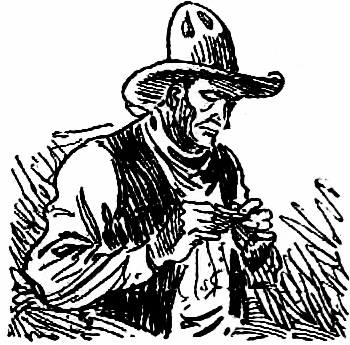
“Howdy,” he said pleasantly. “I didn’t know we had company. Yo’re Jones, ain’t yuh?”
“Yeah, I’m Jones,” Cultus got up and shook hands with Shif’less.
“Somebody—I reckon it was the sheriff—said who yuh was. Yo’re with the Lazy A, ain’t yuh?”
“I’m over there,” smiled Cultus.
“Damned outfit!” snorted the old man. Shif’less smiled.
“Don’t like ’em, eh?” queried Cultus.
“No! Why should I like ’em?”
“No reason, I suppose,” Cultus smiled over his cigarette. “Seems like a good outfit. What’s wrong with ’em?”
“I reckon it’s all right since Jud Ault died,” said Shif’less, before the old man could speak. “This girl can’t be blamed for what Jud Ault done. Mebbe she’s mighty fine.”
“She’s a fine girl,” said Cultus. “How’s things with you folks?”
“We can’t kick,” smiled Shif’less.
“As long as the other outfits raise plenty of calves—we’re doin’ well,” said the old man. “At least that’s what they say about us.”
Shif’less tried to stop him, but the old man shook his head violently. “What’s the difference? They all say it.”
Shif’less smiled grimly at Cultus, who smoked slowly, looking at the old man.
“It just happens,” said Shif’less slowly, “that Mr. Jones is an Association detective, sent here to try and find out who is stealin’ Lazy A cattle.”
The old man jerked slightly, and looked at Cultus, his eyes blazing. Cultus remarked to himself how much the old man did look like a gray old badger, angry over something.
“So that’s what yuh are, eh?” he snarled. “Kinda lookin’ over the Cross Arrow, are yuh? Well, go ahead!”
Cultus looked at Shif’less, ignoring the old man. “Who told yuh that?” he asked.
“Miles Lane, the lawyer.”
Cultus nodded. He had suspected this. He wondered if all the cattle outfits in the Oreana country didn’t know what he was doing.
“Are you a pretty good friend of Lane?” he asked.
Shif’less hesitated for a moment. “Well, I’ve known him quite a long time, Jones. He didn’t lie about yuh, did he?”
Cultus shook his head slowly. “No, he told the truth—as far as he knew it, Hill.”
“As far as he knew it?”
“Even a lawyer don’t know it all.”
“Well, what in hell are yuh doin’ here at my ranch?” rasped the old man.
“Tryin’ to be friendly.”
“Tryin’ to be—what?”
“Friendly.”
“Oh, yeah. And then see what yuh can find out, eh?”
“If you don’t steal cattle, you’ve got nothin’ to fear,” said Cultus slowly.
“Well, that’s nice of yuh.”
Shif’less studied the tall, homely cowboy. There was a world of power in that lean body. He sat, humped over on the steps, and his cotton shirt, drawn tight, showed the ripple of his back and shoulder muscles as he moved the slightest. His wide, lean hands, with the long fingers, the broad bony wrists, bespoke vise-like power.
“I didn’t come over here, because of what I’ve heard,” said Cultus slowly, “because I hardly ever believe what I hear. I’m not denyin’ that I was sent here by the Association, but it was because Jud Ault wanted me to come.”
“But he’s been dead quite a while, Jones.”
“It took quite a while to locate me, and they didn’t know the old man was dead.”
“Now, what in hell did that old crook want of a detective?” demanded Badger Hill.
“I don’t know,” confessed Cultus. “He didn’t know either. But he thought things wasn’t just right.”
“You bet they wasn’t right!” said Shif’less hotly. “Jud Ault turned his daughter out of his house, because she married a man he didn’t like. And after the man left her without any support, the old man wouldn’t help her.”
“She’s a pretty nice sort of a girl, I hear,” said Cultus. He was looking at Shif’less Hill, as he spoke. He saw the jaw of the big, indolent-looking cowboy shut tightly, and his wistful blue eyes stared out across the hills.
“Yeah, she’s—nice,” said Shif’less slowly. The old man glanced at Shif’less and at Cultus, and Cultus saw an expression of amusement in the old man’s eyes.
“They say her husband is still supportin’ her,” said Cultus.
Shif’less nodded, but did not speak.
“Has he been here since he left his wife?”
“No.”
“Yes,” said the old man quickly. “I saw him. Yuh don’t need to argue with me, Shif’less,” said the old man, when Shif’less opened his mouth to speak. He turned to Cultus. “I saw Jack Keene in Oreana City, talkin’ to Miles Lane, one night. Shif’less says I was mistaken, but I know what I see.”
“How long ago was this?”
“Over a year ago.”
“A year ago last June,” said Shif’less. “I think it was about the fifteenth of the month. We’ve argued about it enough, that I remember the date.”
They talked for a while about cattle conditions, but rustling was not mentioned again. Old Badger Hill shook hands with Cultus when he left, and asked him to visit them again.
Cultus had been to the prospect shaft, where Idaho Breen found the Lazy A cowhides, but there was no clue in a lot of hides. The animals had all been shot, and the hides showed that the cattle had been killed at intervals for several months.
He rode back to Oreana City, and found the sheriff talking to Mrs. Keene in front of his office. The sheriff introduced them. Mrs. Keene was carrying several packages, which Cultus offered to take. The little boy accepted Cultus at once, when Cultus smiled at him, and the three of them walked to Mrs. Keene’s home.
Mrs. Keene was interested in Mary Ault, and asked Cultus about her. Cultus confessed that he could tell little about her. Cultus carried the packages through the little living-room to the kitchen, and on the way back he stopped to glance at a photograph on the center table.
“That is little Jackie’s father,” said Mrs. Keene. Cultus nodded thoughtfully, as he looked down at the unmistakable features of Loring, the San Francisco lawyer, who had been killed in the café gun battle; the man he had knocked into the muddy street.
“Jack Keene?” queried Cultus.
Faith Keene nodded. “Did you know him?” she asked softly.
Cultus shook his head and turned toward the door.
“I’m mighty glad to have seen yuh, ma’am,” he said, as he held out his hand.
“It was kind of you to carry the packages for me,” she replied. He shook hands gravely with the little boy, and went down to the main street, wearing his sombrero pulled down over his eyes. He was finding out more than he had expected.
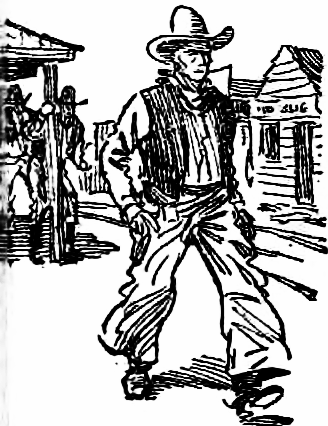
Jack Keene was the man who was sending the woman to pose as the niece of Jud Ault, and it was very evident to Cultus that Keene, or Loring, as he was known in San Francisco, was in some plot to loot the Lazy A. But Keene was dead, and Cultus did not think that either Lane or Breen knew of the shooting. The girl, Janice Lee, was probably dead or in a hospital, and possibly she did not know enough about the details of the plot to ever let Lane and Breen know what happened.
As Cultus sauntered up the crooked street, Miles Lane rode in and took his horse to the livery stable. Cultus leaned against a post in front of the Oreana saloon until Lane went to his office, and then crossed the street.
Lane greeted him pleasantly and they sat down together in the office. Lane told him that he had just returned from the Lazy A.
“I was just talkin’ to Mrs. Keene,” said Cultus.
“A nice girl,” said Lane briskly. “Too bad she lost out on the Lazy A. Possibly Jud Ault was too severe. But he hated Jack Keene, and—— Oh, well, it was his business, I suppose. What have you found out in regard to the missing cattle?”
“Not very much. What do yuh know about the Cross Arrow?”
“Less than nothing—except hearsay. I know the Hill family to speak to them. They haven’t a good reputation.”
“And the Star X?”
“You’ve heard about the feud?”
“Sure. They staged a battle in the street here the night I came. Breen talks about ’em killin’ Lazy A stock, and all that, but I can’t quite swallow it, Lane. The Star X is as big as the Lazy A, and they don’t need to kill Lazy A cattle.”
Lane looked up quickly. “Have you been at the Star X?”
“I was out there yesterday and had a talk with the Wheelers.”
“And they knew you were from the Lazy A?”
“They knew I was from the Association,” corrected Cultus.
Lane smiled crookedly. “That information won’t help you any, Jones.”
“Mebbe not,” smiled Cultus. “Yuh see, I wasn’t the one that told ’em.”
“No? Who do you suppose——?”
“They say you did, Lane.”
“That I told them? Why, that is preposterous, Jones!”
“And old man Hill——”
“Did he say I told him?”
“Shif’less did.”
“Pshaw!” Lane colored, tried to swallow, failed. “I don’t know why they would say such a thing, Jones.”
“Nor you,” said Cultus softly. “Unless yo’re tryin’ to get me killed off.”
“Why, the idea is ridiculous. Jones. I haven’t any interest in your affairs, except as they affect the Lazy A. I have been attorney for Ault for years, and naturally I am interested in anything affecting the Lazy A ranch. Idaho Breen wants you to clean up this rustling. Why, I’d be the last person on earth to seek to injure you, Jones.”
“Well, that’s fine of yuh,” drawled Cultus. He shook hands with Lane and sauntered out. Dude Wheeler was just going into the post office, and waved a salute to Cultus, who walked up and met him.
“I want to ask yuh somethin’, Jones,” said Dude, a bashful grin on his face. They moved close to the door of the post-office. “Yuh know I met Miss Ault the night she came in.” said Dude. “She’s sure a nice girl.”
Cultus grinned widely. “Go ahead, cowboy.”
“I’m glad yuh understand,” sighed Dude. “It’s thisaway, Jones. I ain’t seen her since that night, and yuh see I can’t very well go out there to the Lazy A. I wrote her a letter and posted it to her this mornin’. I just found out that Miles Lane took the Lazy A mail out to the ranch today.
“And Miles Lane,” Dude hesitated. “He’s dressin’ up to go out there. Yuh see, I don’t trust him, and I’m wonderin’——”
“If he delivered the letter, eh?”
“Yuh might put it thataway, Jones. I know him pretty well.”
“All right,” grinned Cultus. “What can I do for yuh?”
“Will yuh hand her a note from me?”
“Yeah, I’ll do it. I ain’t seen her to speak to for a long time, but if it’s possible, I’ll see that she gets it.”
Dude secured some paper and an envelope, and when Cultus rode back to the Lazy A he carried the note to Mary. It was almost supper time, and the boys were all at the ranch. Cultus went to the long wash-bench just outside the kitchen door, and began washing, while Hop stood in the kitchen door, dangling a ladle in his hand.
“Hop, do you happen to know a Chinaboy in Frisco, whose name is Wang Lee?” asked Cultus.
Old Hop smiled widely. “Yessa—my clousin. He lun chop-suey lestlant.”
Cultus grinned and nodded his head. “That’s the feller, Hop. Wang Lee good friend of mine.”
This was not true, because Cultus did not know Wang Lee, and only knew of a popular chopsuey restaurant of that name. But old Hop beamed. “Wang Lee velly lich—my clousin.”
“That’s fine,” Cultus mopped his face with a towel, as he moved in closer to the Chinaman. “Wang Lee my friend, Hop. You, his cousin, must be my friend. You sabe?”
“Yessa.”
“Good.” Cultus took the envelope from his pocket, caught it in a fold of the towel and handed it to Hop.
“That note is for Miss Ault, Hop. Nobody must see.”
The old Celestial accepted the towel, slipped the envelope inside his shirt and turned away without a word. It was evident that Mary received the note, but her reply was to Cultus, which was given to Cultus by old Hop, after they had finished supper. She wrote:
Am virtually a prisoner. Tell Mr. Wheeler I will see him as soon as possible. Would like to talk with you, but Breen says I am to talk with no one. If Hop will carry notes, it will be of some help to us. They are treating me all right.
The note was unsigned. The fact that she was a prisoner was no news to Cultus, and he knew Dude Wheeler was right in suspecting that Miles Lane had not delivered the letter to Mary. Cultus realized that under the law, it would require nearly a year to probate the will of Jud Ault, advertise for creditors, and to follow out all the legal phases of the instrument, but he also knew, that, while hardly ethical, it would be legal for an heir to sell out his or her interests to anyone who was willing to take a chance on the legality of the will in question.
And if Breen and Miles Lane intended doing such a thing, there was nothing he could do to prevent it. Mary, without the advice or assistance of anyone, would be obliged to sign the name of Mary Ault to a bill of sale to the Lazy A. Of course he could notify the authorities of fraud, possibly defeat the purpose of Breen and Lane; but only serve to throw the will into courts indefinitely—or until it might be proved that no Mary Ault existed.
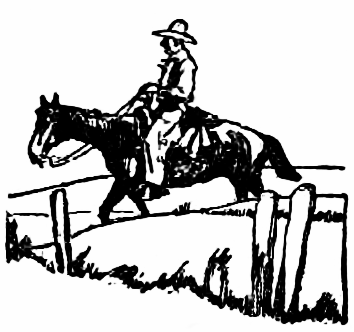
Cultus decided that there was nothing for him to do, except to wait until something happened that would give him a chance to puzzle out a solution of the case. In the meantime he decided to keep working on the cattle stealing end of the case. He had a talk with Idaho Breen about the cattle that night, but the Lazy A foreman did not seem interested. He tried to lead Breen into a discussion of Jack Keene, husband of Faith Ault, but Idaho side-stepped the subject; so Cultus dropped it and went to bed, after deciding to visit Welcome Creek the next day.
Earlier that afternoon Shif’less Hill had ridden to Oreana City, and gone to the depot. He had sent a rifle to a San Francisco gunmaker for some repairs, and it was due back. He paid the express charges and took the package outside, where he sat down on the edge of the station platform and unwrapped the rifle. It had been encased in a light wooden box and packed tightly with newspapers.
Shif’less tried the action, found it functioning perfectly, and began putting the papers back in the long, narrow box, when his eyes happened to get a flash of a pictured face on one of the wrinkled newspapers. Quickly he spread it out, emitting a grunt of wonderment.
The unmistakable features of Jack Keene stared up at him, along with the face of a pretty girl, beneath whose portrait was the name Janice Lee. But the name beneath Keene’s picture was J. Loring. Connecting the pen and ink scroll, which joined the two portraits, was an artist’s conception of the gun battle between two men, and behind one of them was a girl, dressed in a traveling suit.
The story told of a gun battle in a San Francisco café, in which J. Loring, an attorney, and Speed Evans, alleged gangster and dope peddler, had killed each other. Janice Lee had been struck twice and had died twelve hours later, without regaining consciousness. It had little to say about Loring, except that he was little known outside the tenderloin.
Shif’less read it through twice, the rifle lying across his lap. There was no question in his mind about this man being Jack Keene. He noted the date of the paper, carefully tore out the article and put it in his pocket.
Picking up the rifle and the box, he walked around the depot, threw the box into a weed patch and went back to his horse. He rode back up the street to Miles Lane’s office. It was getting late, but he found Lane there.
“What’s on your mind, Shif’less?” asked Lane, when Shif’less placed his rifle on the desk and drew out the clipping. The Oreana City attorney took the clipping and stared at the picture of Jack Keene. And as he read the story he seemed to sway slightly and his eyes blinked painfully.
He lifted a hand and wiped the tears from his eyes; not tears of grief or remorse, but tears like a man might get whose eyes had stared into a bright light. For a long time he did not speak, although Shif’less knew he had read the article.
“What do yuh know about that?” asked Shif’less softly.
“My God!” breathed Lane hoarsely. “Jack Keene dead!”
“Well, he’d prob’ly finish thataway,” said Shif’less.
Lane looked at Shif’less blankly. “What did you say?” he asked.
“I said he’d prob’ly finish thataway.”
“Oh—yes,” Lane looked at the clipping again. Shif’less had torn it through, leaving the dateline at the top of the page. Lane looked at this and glanced quickly at a calendar on the wall.
“We’ve got to keep Faith from finding it out, Miles,” said Shif’less softly. “We can’t let her know.”
“Faith? Oh, yes. Yes, we must keep it quiet, Shif’less. You won’t tell anyone, will you? I can trust you, can’t I?”
“Well, I’d be the last to tell her,” drawled Shif’less. “Heck! I wouldn’t have her find it out—not now.”
“That’s fine!” Lane almost pawed for Shif’less’ hand. “We’ll keep it dark, eh? Don’t let anybody know. If one person finds it out, they’ll all know it.”
“I won’t tell,” Shif’less shook his head. “Nossir. Say, Miles, Jack must ’a’ been pretty tough, eh? I wonder if that was his girl. Prob’ly was. Faith still thinks he’s all right,” Shif’less looked wistfully out through the window. “Still thinks he’s all right, Miles.”
“Yes, yes,” impatiently. “You never can figure a woman, Shif’less.”
“Nor anybody else,” softly. “Jack Keene took a different name and left his wife——”
“I know how you feel, Shif’less. You love Faith Keene. No, don’t shake your head. Maybe she thinks a lot of you. I’ll help you.”
“I don’t need no help, Miles. I asked her the other day why she didn’t get a divorce from Jack, and she said he was still supportin’ her; and that she couldn’t never marry anybody as long as Jack was alive. Now, Jack’s dead—and we can’t tell her. Still, what difference does it make? If she’d marry——”
“No, don’t tell her!” Lane grasped him by the arm. “Don’t do it, Shif’less. Anyway, it isn’t for you to do. Don’t you see, she’d think you—you were trying to hurry things? Don’t you see?”
“Yeah, I see,” Shif’less nodded slowly. “I reckon we better keep it dark for a while. Well, I’m headin’ home. Miles. Hang onto that piece of paper, won’t yuh?”
“Oh, I’ll keep it safe, Shif’less. Good night.”
Shif’less mounted his horse and rode out of town, carrying the rifle in the crook of his right arm, while Miles Lane locked his front door and flopped in his office chair, trying to gather his scattered senses. He studied the clipping again. Janice Lee! That was the name on the note of identification! It was evident that the girl out at the Lazy A was not Janice Lee. But who was she? Miles Lane’s brain whirled. Did this Association detective, Jones of Oklahoma, have anything to do with it, he wondered. Where did this girl come from, and where did she get the identification papers?
Jack Keene, alias J. Loring, was the man who wrote the note—and he was dead. Lane wondered if this girl at the Lazy A had stolen the papers at the time of the gun battle. And if she did, who was behind her masquerade?
Lane drew a big bottle from a desk drawer and took a drink. He left the bottle uncorked, and every few minutes he would lower the contents perceptibly. He decided to go to the Lazy A ranch and show the clipping to Idaho Breen, but the quart bottle was empty when he got his horse at the livery stable—and Mr. Lane was very drunk.
In fact, he was so muddled from drink that he took the wrong road out of Oreana City in the dark, and when he sobered to the extent that he cared to realize anything he found that he was not on any road, had no sense of direction—and nothing to drink. So he just rode on and on, wondering dully if the moon would ever come up and show him some familiar landscape.
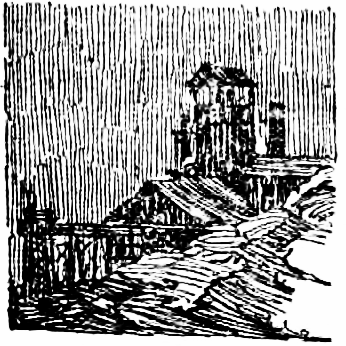
After a while he saw the silhouette of an old building, which he recognized as being the deserted stamp-mill and buildings of the abandoned Suicide mine. It had not been worked for several years. Jim Scott, the original owner, had sunk every cent he owned in it, failed to make it pay, and hung himself in the shafthouse—thus giving it a new name. Others had tried in vain to make it pay, and it was finally abandoned.
Lane did not realize that the night was nearly over; so he was not going to take any chances on getting lost. As long as he had the buildings of the old mine as landmark, he knew it would not be difficult in daylight to cut across the hills to the Lazy A.
He struck one of the old trails and rode up closer to the old shaft-house, where he intended to dismount. A cold breeze was sweeping across the hills, and Miles Lane, not dressed too warmly, needed shelter.
Suddenly he saw the dull gleam of a light shining through a crack in the old building, and almost at the same instant he realized that he had ridden in beside a saddled horse. He was still a little dazed from the liquor, but instinct told him that something was not just right.
Turning his horse around he rode slowly back down the trail, turned his horse into the shelter of a mesquite clump in a dry wash, and dismounted. Curiosity prompted him to climb back up the trail again, but this time he circled to the opposite side of the building. He took plenty of time and was particular about making unnecessary noises.
He came in against the wall of the building and worked his way around to when a broken board gave him a fairly good view of the interior. The machinery had been moved away, but there still remained the old framework of the hoist parts of the old trades, and the huge timbers were where the hoisting engine had stood.
But Miles Lane was not interested in the details of the old building. An old lantern hung from a nail in the old hoist frame, and in its faint illumination Lane could see the huge bulk of a man, his shadow dancing grotesquely on the walls, as he skinned out the carcass of a steer, which was also suspended from the hoist-frame.
Another whole beef, all dressed, hung near him. Lane could recognize him now. It was Shif’less Hill. He was working swiftly, his skinning knife flashing in the yellow light. Lane licked his lips and swallowed heavily. He could see the lantern light flash on the cartridge-heads in his belt, and against the wall near him stood a Winchester rifle. Lane was unarmed, and he suddenly realized that it might not be healthy for him, in case Shif’less suspected his presence. As though fascinated he leaned against the building and watched the big cowboy strip off the hide. He did not realize that daylight was creeping over the hills.
Shif’less finished skinning the animal and threw the hide down the shaft. Lane grinned to himself. He had plenty of evidence to send Shif’less Hill over the road for a long time—in case he needed to use it.
He shoved away from the wall, realizing it was daylight, and crept away in the direction of his horse. He did not want Shif’less Hill to find him there.
The three Lazy A cowboys were a snoring trio when Cultus left the bunkhouse and went to the stable, where he saddled his horse. It was still early, and Cultus knew that Hop would not serve breakfast for another hour, at least: so he decided to postpone his morning meal until he reached Welcome Creek.
Cultus had never been to Welcome Creek, but he knew it was not over fifteen miles east of the Lazy A, and that by traveling past where Idaho Breen had found Lazy A hides in the prospect hole, he would strike the wagon road, which led from Oreana City to Welcome Creek.
Cultus mounted and rode away from the south. Breen had given him a tall roan gelding, which had plenty of speed, and the cool of the early morning gave it plenty of condition to go ahead. The going was fairly good, and Cultus let the roan pick its own speed.
Cultus had never seen the old Suicide Mine, but had heard the boys speak about it. He rode around the side of a hill and came in view of the old buildings, shortly after daylight. His horse made little noise in the sandy soil, and he was within a hundred yards of the old shaft-house, when he saw Miles Lane sneaking away from beside the building. Cultus’ horse was poorly masked by the brush; so Cultus quickly dismounted. He recognized Lane immediately. Leading his horse to the post, he was able to watch the lawyer, who walked down a dry wash, mounted his horse behind a mesquite clump, and rode quietly away, going toward the Lazy A. “That’s kinda queer,” observed Cultus. “Now just what was a lawyer doin’ there this time in the mornin’?”
Cultus watched Lane ride across a ridge and disappear, before moving on down to the shaft-house. He dropped his reins and walked boldly to the sagging old door, where he stepped inside and jerked to a standstill, when he found himself looking the muzzle of a rifle in the hands of Shif’less Hill.
It was still half dark in the old building. Shifting his eyes from the menacing gun muzzle, Cultus could see the two beeves hanging. Neither of the men spoke for several moments. The gun muzzle did not waver.
“Well, what about it?” asked Shif’less in a flat voice.
A smile chased across Cultus’ lips and he shook his head.
“I reckon that’s up to you, Shif’less.”
“Yeah? I’m wonderin’ how yuh guessed I’d be here.”
“I didn’t,” grinned Cultus.
“No? Kinda early in the mornin’, ain’t it?”
Cultus nodded. “Yeah. I was on my way to Welcome Creek.”
“And jist stopped to look, eh?”
“Well, no-o-o. Yuh see, I didn’t have no idea of stoppin’ here until I seen our friend the Oreana City lawyer sneak away from outside there, grab his horse and fog for the Lazy A.”
“Miles Lane?”
“That’s the feller.”
Cultus could see that the big cowboy was puzzled.
“What was Miles Lane doin’ here?” he demanded.
“Search me: but he was here. Put down the gun, Shif’less.”
“I suppose I might as well, Jones. I’m caught with the goods. If Lane is headed for the Lazy A, he’ll prob’ly bring back the whole gang.”
Cultus walked past him and looked at the beef. “Threw the hides in the old shaft?” he asked.
“Yeah.”
“Intendin’ to pack the meat to Welcome Creek tonight, eh?”
The big cowboy leaned against one of the uprights and nodded gloomily. “I dunno how yuh guessed it; but yo’re right.”
“That wasn’t hard to guess. You killed those animals that wore all them Lazy A hides——”
“That Breen found,” finished Shif’less. “Yeah, I did.”
“Welcome Creek was the only possible market, I figured. You couldn’t sell all that beef. Breen had an idea that the Star X was the ones that was killin’ off his stock; but the Star X don’t need to kill beef.”
“I’ve been killin’ oft Lazy A beef for over a year,” said Shif’less slowly. “I couldn’t handle much at a time. It’s quite a job for one man. Dad wouldn’t help me. He said I was a damn’ fool; and I sure was. Now, what are yuh goin’ to do about it?”
“How deep is this shaft?”
“Two hundred feet. There’s big stopes, of course.”
“All right. How could the Lazy A find those hides? Is there any way to get down there?”
“Not unless they go down on a rope.”
“Which they won’t do,” said Cultus. “Where’d they ever find a two hundred foot rope? Lane thinks you don’t know he saw yuh; so we’ll just heave them two beeves down the shaft, which will destroy all the evidence. What little blood is scattered around won’t convict anybody. C’mon, let’s get busy.”
“What’s yore game?” queried Shif’less.
“Helpin’ out a damn’ fool.”
The Lazy A was at breakfast when Miles Lane rode in. Breen left the table and met him at the front door.
“What’s the matter with you?” asked Breen. “You look pretty tough, Miles.”
The lawyer took hold of Breen’s sleeve and drew him off the porch and around the corner.
“Is Jones and the girl still here?” he asked.
“The girl is; Jones has gone to Welcome Creek. What’s the matter?”
Lane drew out the newspaper clipping and showed it to Breen.
“There’s what’s the matter, Idaho. Jack Keene is dead. Look at the date-line on that paper. That girl’s name is Janice Lee, and she’s dead.”
Idaho lifted his eyes from the paper, staring blankly at the lawyer. “But what does it mean?” he whispered.
“What does it mean? It means that this girl is not Janice Lee; that she is somebody else! This is not the girl Jack Keene sent us. We’ve been double-crossed, Idaho!”
“You think——?”
“I know! What’s behind it—I don’t know. But this girl came on the same train with Jones, the detective. Idaho, we’ve got to work fast. They don’t know that I know this; so that helps.”
“Does anybody else know it, Miles?”
“Shif’less Hill. He gave me the clipping.”
“Then we’ve got to stop him from meetin’ Jones. I’ll bet Jones knows that Keene is dead, and he figures we don’t. If he knows that we know——”
“I’ve got the goods on Shif’less Hill!” exclaimed Lane, and then he told of seeing Shif’less butchering cattle in the old shaft-house of the Suicide mine.
“By God, we’ll get him!” snorted Breen. “Here’s what we’ll do. You beat it for town and get the papers. I’ll send the boys over to investigate this butcherin’ and we’ll make this female sign the paper while they’re gone. Jones is headin’ for Welcome Creek, and when he comes back we’ll settle with him.”
“And turn this girl loose to tell all she knows?”
“What you don’t know won’t hurt yuh. Get yore bronc and go after them papers.”
Lane got his horse and rode back toward Oreana City, while Breen went back to the dining-room. The cowboys were rolling their after-breakfast cigarette when Breen called them outside.
“You fellers saddle up and go to the old Suicide mine,” he ordered. “Lane just brought word that somebody has been doin’ a job of butcherin’ down there in the old shaft-house, and we’ve got a hunch that Shif’less Hill is the one who has been doing it. If yuh find Hill around there, yuh better watch him.”
“All right,” said Pie Ide shortly. “Supposin’ we go and get him, Idaho?”
“Yo’re runnin’ that end of it, Pie,” said Idaho grimly. “Better be sure—first Shif’less will fight. He threw the hide in the old shaft, and the devil himself couldn’t get down there to find ’em; we’ve got to take a chance that he killed Lazy A cattle. You’ll find the beef in the shaft-house.”
The cowboys hurried after their horses. Not that they disliked Shif’less Hill, but that they desired action. They rode away with their rifles, and Idaho went back to the house, where he found Mary in the living-room.
“I’m goin’ to talk turkey to you,” he told her. “In an hour or so. Miles Lane will be out here with the papers for you to sign—and you better sign ’em without any argument, sabe?”
“What papers, Mr. Breen?” Mary was frightened at Breen’s tone.
“The bill of sale to the Lazy A,” growled Breen. “He’ll have it all made out, and all you’ll have to do is to sign ’em. You turn the whole works over to me.”
“I give you a bill of sale to the Lazy A ranch?”
“Yuh sure do, young lady. As soon as that’s done I’ll take you to Oreana City and send yuh back where yuh came from.”
Breen walked over to a front window and glanced out. He was just a little suspicious of Jones of Oklahoma. Suddenly he turned and glared at Mary, who stood beside the center table, looking at him.
“You and yore detective friend thought yuh was damn’ smart, didn’t yuh?” he said. “I happen to know that yo’re not the girl who was supposed to come here. What do you think of that?”
He came toward her, grin on his hard face. “Yeah, I know all about it. You think yo’re goin’ to get a thousand dollars for signin’ them papers. Ha, ha, ha, ha, ha! You poor little fool! Do you think you was foolin’ me?
“Set down! Scared, eh? You need to be. Do you think I’m goin’ to let you beat me out of a million dollars? No, I’m not goin’ to put my hands on yuh. Yore friend has gone to Welcome Creek, and he won’t be back until later; so yuh don’t need to look toward the window. You won’t be here when he comes back, and I’ll be here to welcome him. I don’t like detectives.”
Mary sat down in a chair beside the table, wondering what to do. She was afraid of Breen. From a window she had seen the cowboys ride away. Hop was in the kitchen, washing dishes, but she knew she could expect no help from him.
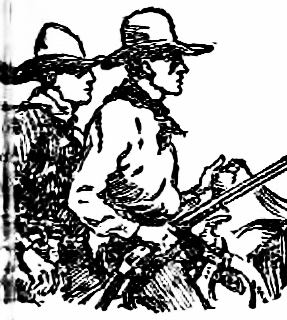
“Where are you going to send me?” she asked helplessly.
“Where?” Breen laughed shortly.
“Quien sabe. Understand Spanish? That’s Spanish for ‘who knows?’ Ha, ha, ha, ha! Who knows where we’ll send you. Why, a poor little fool, where can we send you where you can’t talk? And we can’t let you talk about this.”
“If I promise not to——”
“Promise! What’s a promise of that worth? Set still! You act sensible and sign those papers, and we’ll see about your promises—Mary Ault!” Breen laughed harshly. “Mary Ault! And you tried to fool me.”
Cultus and Shif’less rode away from the old mine, heading toward the Cross Arrow. Shif’less was still a little mystified as to why Cultus had helped him destroy the evidence. They had left nothing for the Lazy A to find as evidence, unless they were willing to search the two hundred foot level of the crumbling old shaft.
“I reckon Mr. Lane didn’t lose any time in tellin’ Breen what he saw back there,” observed Cultus.
Shif’less nodded gloomily. “Prob’ly not, Jones. I don’t sabe what Lane was doin’ there at that time in the mornin’.”
“I don’t know. Shif’less, I’ve heard that you kinda think a lot of Faith Keene.”
Shif’less turned in his saddle. “You heard it, did yuh?”
“That’s nothin’ ag’in yuh, cowboy. Why don’t yuh marry her?”
“Plenty of reasons, I reckon. In the first place, I dunno if she’d marry me if she could, and in the second place—she’s still got a husband.”
“Well,” smiled Cultus, “yuh can easy find out the first part of it, and in the second place, jist between me and you, her husband is dead.”
Shif’less stared at Cultus.
“How do yuh know, Jones?”
“I happened to be there when he was killed. I didn’t know it at the time, but I seen his picture later, and it was the face of a feller they called Loring, a cheap lawyer in Frisco.”
Shif’less nodded quickly. “There was two men killed—and a woman. Her name was Janice Lee.”
Cultus leaned closer to him. “How do you know that?”
It did not take Shif’less long to explain about finding it in the paper.
“I took it to Lane.” he said. “Lane was Keene’s friend, and I thought——”
“You took it to him last night?” Cultus jerked up his horse.
“Yeah.”
“Good gosh!” exploded Cultus. “And Lane has gone to meet Idaho Breen. Listen, Shif’less; you go to town. If Breen or Lane show up there with that girl—Mary Ault—stop ’em. No, I can’t tell yuh why. Just stop ’em, and then come out to the Lazy A.”
Cultus whirled his horse around, drew his hat down over his eyes, and sent the roan on a stiff gallop back toward the Lazy A. He realized that the newspaper clipping would prove to Lane and Breen that Mary Smith was an impostor. It was something unforeseen, and Cultus knew that Breen would stop at nothing now to get control of the Lazy A.
And about the time that Cultus had found out about the newspaper clipping, Miles Lane was riding back to the Lazy A with the papers for Mary to sign. He had had them prepared for days. They were snake-tight, and all they needed was the signature of Mary Ault, and his own, as notary public. He had made the imprint of his seal before he left the office.
Her signature would make Idaho Jim Breen owner of the Lazy A estate, and Idaho Breen would take Miles Lane in as a full partner in the holdings. Even the partnership papers were all prepared. Lane was very thorough in his crooked work.
He rode his lathering horse up to the ranch-house and went in. Mary was sitting beside the table, her face very white. On a chair against the wall sat Idaho Breen. He had been drinking from a bottle, and was just drunk enough to be alert.
“Got everythin’ ready?” he asked. Lane nodded and spread the papers on the table. “Get the pen and ink, Idaho.”
Mary stared at the typewritten sheets.
“Take a good look at ’em, sister,” laughed Breen, as he came, with the pen and ink and placed them on the table.
Lane dipped the pen in ink and handed it to her, placing his finger on the ruled line. “Put your name right there. Just write Mary Ault.”
Mary looked up at them, her hand trembling. “But that isn’t my name.”
“Nobody knows it better than we do,” laughed Breen. “Write it out, and we’ll take a chance on it. You wasn’t supposed to come here, yuh know.”
“Suppose I refuse to sign,” Mary shut her lips and looked defiantly at Breen. “You can’t make me sign.”
“Tryin’ a holdup, eh? No good, my dear. Everybody knows you are the owner of the Lazy A, and if yuh refuse to sign, we’ll fake a signature.”
“And I’ll swear it isn’t mine—and prove it.”
Breen’s jaw tightened and he leaned closer to Mary. “No, yuh won’t; you won’t prove anythin’. If you’ve got a lick of sense, you’ll sign that paper right now.”
Mary took the pen and signed the name of Mary Ault. There was nothing else for her to do. Breen laughed softly, as Lane handed him the paper, and reached for the bottle.
“Better go easy on that stuff,” advised Lane. “We’re not out of the woods yet.”
Breen took a big drink and put the bottle on the floor. He turned to Mary, who still held the pen in her hand.
“Git dressed for travelin’,” he ordered. “Pack yore suitcase. In ten minutes we’re pullin’ out. Poco tiempo!”
He turned to Lane. “You stay here with her, while I hitch up a team to the buggy.”
Mary walked back to her room and packed her clothes. She put a few things in the suitcase, but did not bother to pack the trunk. She had not worn any of Janice Lee’s clothes, as she had not been out of the house since her arrival.
She was glad to leave the Lazy A, but down in her heart was a fear that these two men were not through with her yet. She had been living in sort of a daze ever since that night at the restaurant in San Francisco. And when she had asked Breen where he was going to send her, he had said, “Quien sabe”—who knows?
She carried the suitcase in to the living room and sat down in an old rocking-chair. Lane was helping himself to Breen’s bottle, and his hand trembled as he looked at Mary.
Breen was hitching up a pair of vicious-looking grays, a half broken team. He was obliged to tie them to the corral fence and drag the buggy around to them. As soon as they were hitched he went to the house and flung open the front door.
“You pull out ahead of us, Miles,” he growled. “Hit the grit, hombre, because we’ll need an open road.”
Lane placed the bottle on the table and walked out, going straight to his horse which he mounted and rode swiftly away. “What about my trunk?” asked Mary. Breen turned from watching Lane gallop out of sight.
“You don’t need to worry about that.”
Mary shivered slightly, as Breen emptied the bottle down his throat and threw the bottle viciously aside. He picked up her suitcase and pointed toward the door.
“Start goin’,” he growled. Mary preceded him from the house and they went down to the corral, where the gray team humped angrily under the feel of the harness.
Breen threw her suitcase in the back of the buggy and motioned her to get in. As she sat down and looked at him, he half turned and was staring past the end of the stable. Then he began running toward the front of the stable, which was near the main gate.
He was within twenty yards of the gate when Cultus came in sight, swinging his horse toward the gate. Mary saw Breen jerk to a stop, throwing up his right hand which held a six-shooter. She tried to cry out to Cultus, who was partly masked from Breen by the huge gate-post, but before she could utter any sound, Cultus turned to come through the gate, and Breen fired.
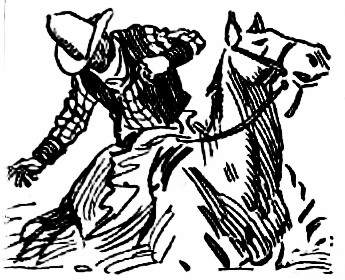
Cultus jerked sideways from the shock of the heavy bullet, and his tall roan whirled quickly, throwing Cultus heavily just inside the enclosure. The horse trotted a few yards away, whirled in against the fence and stopped, looking back at its rider.
Breen ran up to him and quickly turned him over. Evidently satisfied that Cultus was out of the game for good, he ran back to the buggy and untied the horses, which were still jerking nervously from the sound of the revolver shot.
He climbed in beside Mary, whirled the team around and went out through the gate at racing speed. The lurch of the buggy almost threw Mary out, and she did not get a look at Cultus as they raced past. Breen did not try to check the horses. His jaw was set tightly, and Mary could see that his lips were white. He did not speak to or look at her.
Mary had only been over the road once, but she knew it was even more dangerous than the one she had ridden over in the runaway the night she came to Oreana City. About a mile below the Lazy A the road looped around over some dizzy grades above a deep canyon, and she remembered that Cultus had remarked that it was a place where a driver was only allowed one mistake.
She looked at Breen, wondering why he did not make any attempt to check the running team. He was crouched on the edge of the seat, his feet drawn well under him, his eyes shut to mere slits, as the buggy lurched and bounded over the uneven road. They whirled down through a swale, where the mesquite ripped along the wheels and sides, like the sound of tearing silk.
A rock sent them skidding wildly, but the buggy did not upset. It threw Mary to her knees, but Breen, ripping out an oath, yanked her back in the seat, his elbow striking her in the mouth, as he recovered his balance. She threw up both hands to protect her face, and the next instant Breen had flung himself clear of the buggy. Mary whirled around, trying to see him, but he was blotted out in a swirl of dust.
She jerked around in the seat, and saw just ahead of her the beginning of the grades around the deep canyon. There was nothing she could do now. To attempt a jump from the buggy would mean that she would have to choose between falling into the canyon or being smashed against the rocky side of the grade.
The two horses were running at top speed, their bellies low to the ground, the lines whipping through the air, the buggy and its one occupant bounding along behind them. Mary tried to pray, but she was so dazed, so frightened that she could only hang on.
They whirled around the first turn on two wheels, straightened perilously near the outer edge, and headed for the next sharp curve. It was a sharp turn to the right, and on the left hand side was an old washout, filled with brush.
But the running team turned too late, and the inside wheels of the buggy smashed against the wall. Came a whirl of dust and gravel, a cataclysm of overturned buggy, flying hoofs, the scream of a horse, and the outfit hurtled over the edge, dropping straight down for fifty feet, where it struck the apex of a broken ledge, seemed to hang for a moment, and then went crashing and rolling into the bottom of the gorge a hundred feet below.
Cultus had seen Idaho Breen just before the shot was fired, and before the shock of the bullet had knocked him unconscious he knew that Breen had shot him. He was shocked back to consciousness by a deluge of cold water, and opened his eyes to see Hop, the Chinese cook, standing over him, bucket in hand.
“You hu’t pletty damn’ bad?” queried the Chinaman anxiously.
Cultus struggled to a sitting position, clamping his jaws to hold back the exclamation of pain which came to his lips. It seemed that a red-hot iron was searing deeply in his left shoulder. He panted for several moments, while cold perspiration dripped from his face.
But his mind cleared rapidly, and the Chinaman helped him to his feet. He wasn’t just sure why Breen had shot him. He felt for his gun and found it still in the holster.
“Why did he shoot me?” asked Cultus hoarsely.
The Chinaman shook his head. “Do’ know. I not see; I hea’.”
Cultus looked vaguely around, as though trying to see Breen.
“He go ’way,” said Hop. “He take li’l missie way in buggy. Mebbe go town. Go like hell. Team run ’way. Yo’ sabe?”
“Team run away?”
“Plitty bad team: not bloke yet.”
“For gosh sake!” Cultus wiped the back of a hand across his eyes. “Hop, was Miles Lane here today?”
“Yessa. He lide way jus’ befo’ you come. Lide damn’ fast.”
“That’s it,” muttered Cultus. “A runaway team—and those grades. Oh, Hop, I’ve been a fool.”
Cultus went gropingly out to his horse, which did not try to get away from him. He climbed into the saddle, forgetting to pick up his sombrero, and spurred the animal savagely through the gateway and down the road toward Oreana City. His shoulder was bleeding and he was racked with pain, but he shut his teeth against the hurt and weakness and drove the roan at racing speed, feeling down in his heart that nothing could save Mary Smith now.
The tall roan slowed down the moment they struck the grade, and Cultus, half blinded by pain and weakness, swayed in the saddle, as he peered over the edge of the grade, knowing that only a miracle could prevent the running team from disaster.
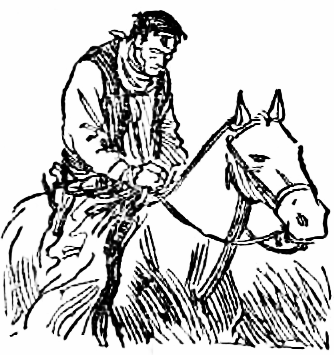
The first curve showed nothing, except that wheels had torn deeply into the outer edge of the grade. But at the next turn he found the left front wheel of the buggy, which had torn off from the impact against the rocky wall. Here was also plenty of evidence that something had gone off the edge, as the grade was sloughed off.
Cultus dismounted and leaned against his horse, trying to overcome the dizziness which caused his knees to sag. He tried to walk around the horse toward the edge of the grade, but he staggered like a drunken man and fell to his knees.
“Keep a-goin’, you quitter!” he muttered bitterly. “Are yuh goin’ to let yore own body lay down on yuh?” He stopped talking to himself and his eyes focused sharply on a spot in the brush on the left side of the road.
Then he lurched to his feet, staggered off the road and tore his way into the brush, where Mary Smith was half lying, half sitting in the brush, her eyes open, a smear of blood across her face. When the rig struck the rocky wall it had thrown her to the uphill side of the grade, and into the tangle of brush.
Cultus went to his knees beside her, trying to disentangle her from the brush while she looked at him dazedly. Summoning all of his strength he lifted her from the brush and carried her back to the road, where he went to his knees again.
“Mary Smith,” he said brokenly. “Mary Smith!”
Her eyes were open and she did not seem badly hurt, but she did not know him.
“I—I wanted to answer your note,” she told him. “But they watched me too closely. I wanted to see you again.”
She began crying softly, and Cultus pawed clumsily at her hair, trying to soothe her.
“Yeah, I know,” he whispered. She thought she was talking to Dude Wheeler. And Cultus knew.
“Where’s Idaho Breen?” he asked. Mary stared up at him. The question stirred something in her mind.
“He jumped,” she said simply.
Cultus nodded. “I thought he did.”
Cultus managed to catch his horse. It was a difficult job for him to get into the saddle with Mary Smith, but he did it. The tall roan went slowly, while Cultus reeled in the saddle, his arms locked around Mary Smith. Cultus forgot that he had been shot. It was a nightmare, he thought. Someone was coming down the grade toward him, and he laughed foolishly.
The man came up to him, shoving his horse in close. Now he was trying to take Mary Smith away from him. Cultus tried to prevent this. The man was talking to him imploring him to let him take the girl. Cultus wanted to draw his gun on the man but didn’t dare let loose of Mary with his right hand. It seemed to Cultus that he had lost his left hand.
The man’s voice seemed familiar, and Cultus tried to remember who he was. It suddenly dawned upon him that this man was Dude Wheeler, and he laughed aloud at the queer kinks of a nightmare.
“Let me have her, Jones,” begged Dude. “Man, you’re hurt!”
This statement seemed to drive the mists from Cultus’ brain. He could see Dude Wheeler plainly now, feel the surge of Dude’s sorrel against the roan.
“I want her, Jones,” said Dude.
“Aw-ri’,” Cultus nodded drunkenly.
“She wants you, I—I reckon.”
He released his hold on Mary and let Dude have her. He reeled in his saddle and grasped the horn for support.
“Got me pullin’ leather,” he grimaced painfully.
“Who shot yuh, Jones?”
“Who?” Cultus didn’t seem to remember. “Oh, that was a long time ago.”
“I met Idaho Breen. He’s headin’ to town for help. The team ran away, and he said Mary was at the bottom of the canyon.”
“Headin’ for town?” Cultus laughed weakly.
“But who shot you, Jones? You’ve been shot, ain’t yuh?”
“I s’pose I have. I don’t remember. Yeah, I do remember somethin’ about it.”
He stared at Dude. “Yuh say Idaho Breen is headin’ for town? Was that today, Dude?”
“Not ten minutes ago, Jones.”
“Well, that’s funny. It seems so long ago.”
“You’ve got to get a doctor, Jones. We’ll go to town, if yuh think you can ride.”
Cultus laughed. “Why not?” He rubbed a hand across his eyes. “There’s Mary Smith to think about,” he said slowly.
“Mary Smith?” said Dude. “Not Mary Ault?”
“Mary Elizabeth Smith. I’m Jones from Oklahoma. We’re both liars, Dude. No, she ain’t a liar—I lied for both. But I’ve got to lie to clean up a crooked game. They were lootin’ the Lazy A; stealin’ from a dead man and a widder. We got to go to town today.”
Dude was staring at him, wondering what he meant. Mary looked up at Dude, puzzled expression in her eyes.
“What was it?” she whispered. Dude looked down at her, his arms tightening.
“It’s all right, Mary,” he said. “Don’t you worry.”
“I’m not worrying,” she said. “I—I knew you’d come.”
Cultus swayed weakly, spurred his horse past Dude, who swung around, and they headed for Oreana City.
Miles Lane lost no time in getting back to Oreana City. He had no idea what Idaho Breen might have done, but Lane was just wise enough to absent himself to town, where he could have a good alibi.
He stabled his horse and headed for his office just as the three cowboys from the Lazy A rode in. He waited for them at the Oreana hitch-rack, and received a scowl from Pie Ide.
“You and yore derned evidence!” snorted Pie, as he turned from the rack. “We couldn’t find a thing at the old mine.”
“Did you look in the shaft?”
“Two hundred feet down?” Pie hooked his thumbs over his belt and glared at the attorney. “Every time I look at you, Lane, I wonder how much real brains it takes to git admitted to the bar. If yo’re capable of bein’ an attorney, any danged one of us punchers is capable of bein’ a supreme court judge.”
“You can’t talk to me like that!” Lane fairly bristled.
Little Mex Leone shoved Pie Ide aside and faced Lane.
“What he jist said goes double for me,” said Mex. “I’m the smallest one of the bunch, and I’m plumb willin’ to hear all the war-talk you can bring up.”
Lane turned on his heel and walked away, while the three cowpunchers guffawed loudly and went toward the Oreana, their spurs rasping belligerently. Shif’less Hill had ridden into town ahead of the Lazy A bunch, and they found him in the Oreana saloon.
A reckless spirit prompted Omaha Woods to call Shif’less aside, and he did not mince matters when he told him of the report Miles Lane had brought to Idaho Breen. Shif’less said nothing to affirm or deny Lane’s report.
“Breen sent us down there to investigate,” said Omaha. “But we didn’t find a thing. I’m jist tellin’ yuh this for yore own benefit, Shif’less; not try in’ to start anythin’ with yuh.”
“Much obliged, Omaha,” drawled Shif’less. “That’s shore kind of yuh.”
Shif’less moved slowly from the saloon and went across the street to the store, where he bought a bag of peanuts. Then he came out, crunching them between his strong teeth, and went to Miles Lane’s office. The attorney started slightly at sight of the big cowboy, but relaxed with a forced smile.
“You don’t look very well,” said Shif’less. “Kinda chalky around the gills.”
Lane swallowed heavily and shifted his position. “No. I’m all right.”
“Physically?”
“Why, yes, certainly. What did you mean, Shif’less?”
“Morally.” Shif’less crunched slowly on some peanuts. “You always pretended to be my best friend, and so yuh sneaked out to the old Suicide mine and tried to put the deadwood on me.”
“Why—uh—no, no! Shif’less, who told you that? I—I got lost last night, and—listen, I—I——”
Lane stopped to swallow. He didn’t like the expression in the eyes of the big cowboy.
“You’ve got the loop around yore feet,” said Shif’less. “You sent the Lazy A gang out to get me, Miles Lane.”
“But they didn’t find anything. Ha, ha, ha, ha, ha! I knew they wouldn’t find—uh—listen, Shif’less; that was——”
“You was tryin’ to play a joke on me, eh?” Shif’less dusted his hands on the knees of his chaps. “You thought it would be awful funny for me to git hung. You’ve shore got a sense of humor.”
Lane was speechless, but his brain was working swiftly. He was in a precarious position, and he knew it well.
“I runs across Jones, the detective,” said Shif’less. “He knowed that Jack Keene was dead; so I told him about what I found in the paper, and he went whalin’ back toward the Lazy A. He’s a queer sort of a jigger. He saw you sneak away from the old mine this mornin’, Miles.”
“He knew about Jack Keene?”
“Shore did. Said he saw Jack git shot.”
“My God! Then that girl—” Lane stopped, realizing that he was talking too much. His hand shook, as he reached into a desk drawer, getting to his feet as he did so to mask the fact that he had taken a gun from the desk.
“What about the girl?” asked Shif’less.
“None of your business!” rasped Lane, and he turned and walked to the doorway, his mind in a whirl. He was afraid of Jones of Oklahoma, who had seen Jack Keene killed. He wanted to see Idaho Breen. If Idaho Breen was bringing that girl to Oreana City, he should be here by this time, he thought. What could be keeping him? Had Jones reached the Lazy A before Idaho and the girl were ready to leave, he wondered?
He saw Cleve Sears, the pudgy sheriff, coming up the street. Lane swung away from the office and hurried down to meet the sheriff, while Shif’less sauntered to the office door and saw them meet farther down the street.
“Hyah, Miles,” puffed the sheriff. “How are yuh t’day?”
“Don’t look toward my office,” cautioned Lane. “Shif’less Hill is watching us. I saw him butchering cattle at the old Suicide mine early this morning—in the shafthouse. The boys from the Lazy A went there to get him, but he had thrown all the evidence into the shaft. There must be a way to recover it, Cleve; so you better arrest Shif’less and put him in jail. But look out for him. He knows I saw him, and he probably knows I’m telling you about it now.”
The sheriff nodded slowly. “Are yuh sure, Miles?”
“Sure? Why, I saw him. He wouldn’t be butchering his own cattle up there in that old building. All we’ve got to do is to get the evidence out of the shaft.”
“And it’s two hundred feet deep. But I’ll arrest him, if yuh say so, Miles; and you can swear out the warrant later.”
“That’s all right, Cleve. I’ll do it.”
Lane crossed the street, headed for the livery stable, and Shif’less walked swiftly across to the Oreana saloon. The sheriff hesitated for several moments. He hated to arrest this big cowboy. He had known Shif’less for years, and it was like arresting his brother. Shif’less had disappeared in the saloon, when the sheriff started across the street.
But Shif’less did not stop in the saloon. He surmised that Lane had told the sheriff so he walked straight through the saloon, went out the rear entrance and circled around to the livery stable, where he went inside.
The stableman had led out Lane’s saddle horse, and was assisting Lane in saddling it. Neither of them heard Shif’less come in and Lane did not see him until he turned his head and saw the big cowboy leaning against the side of the stall, six feet away. Lane’s eyes hardened and his right hand fumbled at his coat pocket.