Book 6 — CHAPTER VII.
Reading edition
SPONGES AND ANIMALCULES.
The Sponges are regarded as a group standing on the borderland between the Polyps and the lowly organisms which follow. The familiar Bath- and Toilet-sponges of commerce represent but an insignificant fraction in comparison with the many hundred species which find no place in the world's market. Toilet-sponges owe their intrinsic value to the relative fineness and elasticity of their component fibrous skeletons. In these particular species the skeleton is composed of a substance akin to horn. In other sponges the skeleton may consist of horny fibres mixed with flinty spicules, or it may be of flint only, or of spicules of carbonate of lime. Finally, there are sponges which possess no internally supporting skeleton, fibrous or spicular, and whose substance is consequently little more than gelatinous. All these numerous forms, however, agree with one another in the identity of their most essential vital elements. In the living sponge the skeleton, fibrous or otherwise, is embedded within a gelatinous matrix by whose component cells it is excreted. Externally the sponge-body is perforated over the greater portion of its extent by minute holes or pores, while one or more holes of relatively large size occupy the summit of the sponge, or are scattered here and there among the numerous smaller pores. The smaller pores represent incurrent apertures, and lead to chambers within the sponge's substance lined by cells. Each of these is provided with a long whip-like appendage, with a transparent wineglass-shaped cup or collar, which is a beautifully constructed food-trap. The lashings of the whips of the collar-cells cause currents of water bearing nutrient particles to flow in at all the smaller pores. Arriving at the chambers, these particles are caught by the outstretched collar-traps and absorbed into the cell's substance. The water, together with rejected and waste materials given off by the sponge-body, is carried forward, and passes out at the larger orifices or vents.
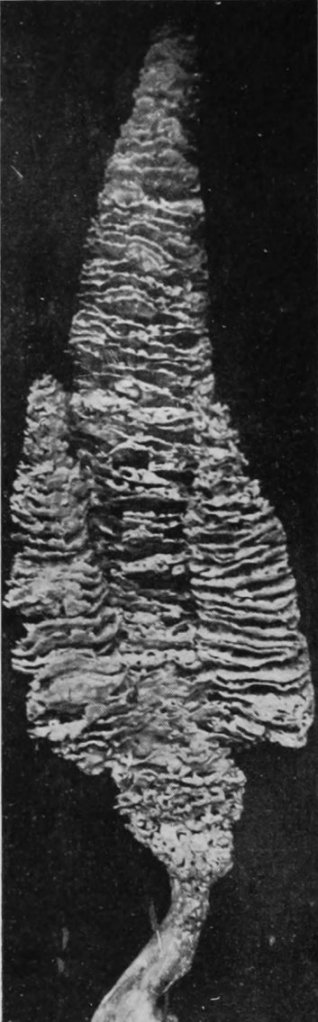
Photo by W Saville-Kent, F.Z.S., Milford-on-Sea.
FRILLED SPONGE.
A species not infrequently dredged up by the pearl-shell fishers in Sharks Bay, Western Australia.
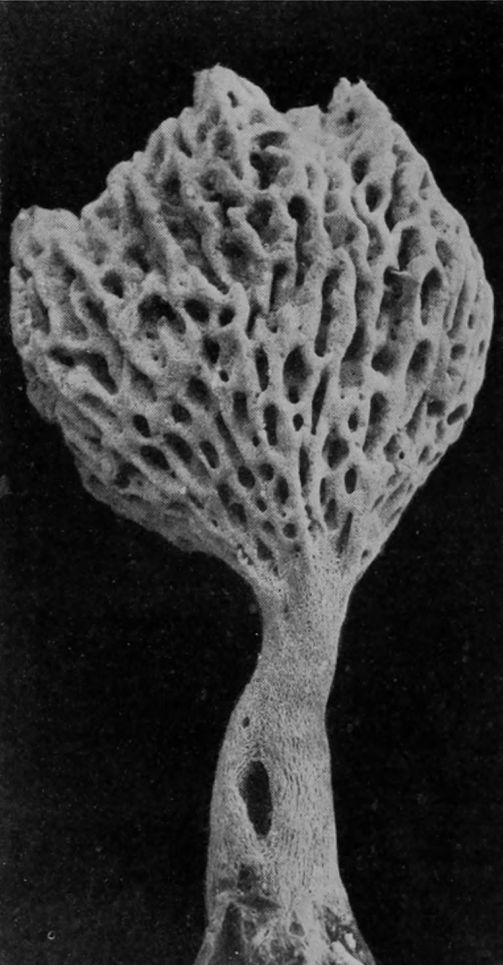
Photo by W. Saville-Kent, F.Z.S., Milford-on-Sea.
RETICULATED SPONGE.
The skeleton of this sponge is composed of fine horny fibres resembling those of ordinary commercial sponges.
Among the more remarkable sponges may be mentioned the Neptune's-cup Sponge, like a huge chalice 3 or 4 feet high, indigenous to the South Seas; the wonderful cornucopia-shaped Lace-sponge, consisting of a lace-like reticulation of flinty fibres; and its near ally the Glass-rope Sponge, forming a cup- or bird's-nest-shaped body, supported on a long cylindrical stalk of flinty fibres that may be over a foot in height. One of the compound or social sea-anemones is in the habit of forming bark-like encrustations on this glassy stem, and it was for a long time doubtful whether the sea-anemone or the sponge produced the supporting-stalk.
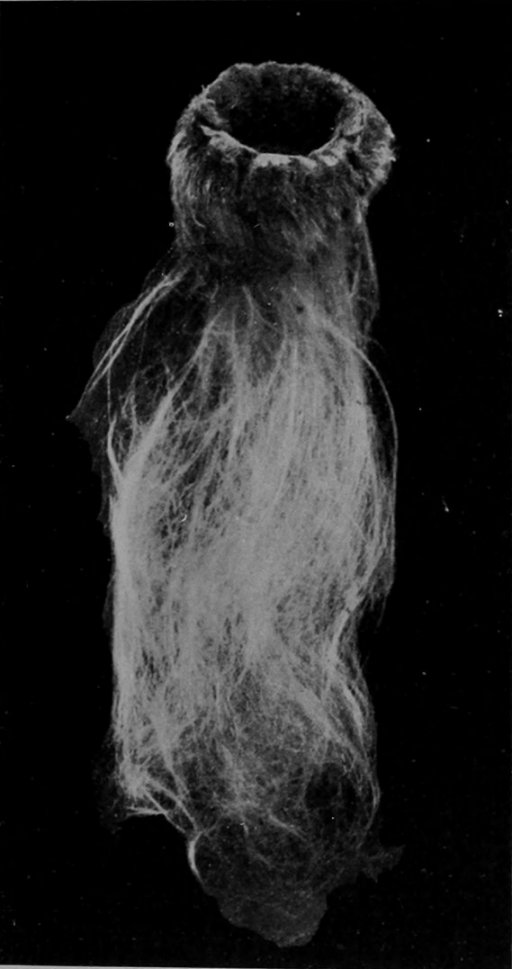
Photo by W. Saville-Kent, F.Z.S., Milford-on-Sea.
PORTUGUESE BIRD'S-NEST SPONGE.
Dredged from a depth of 600 fathoms off the coast of Portugal. In life the body, or "cup," of this sponge was deep orange colour, from which the grey beard-like mass of anchoring fibres depended.
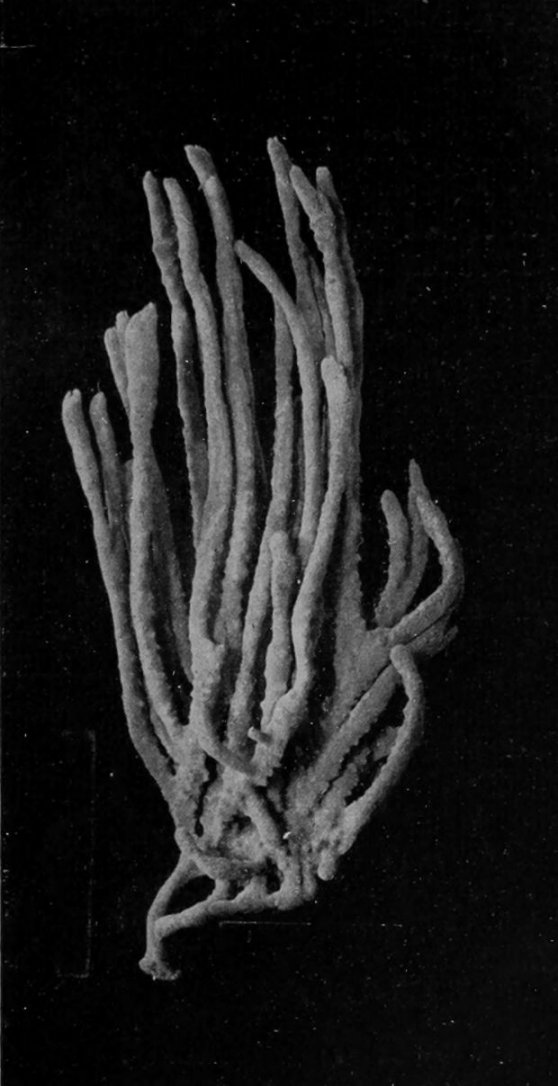
Photo by E. Connold] [St. Leonards.
CHALINA SPONGE.
A British species, composed partly of horny and partly of flinty elements.
The Animalcules, which represent the simplest and lowest forms of living animals, consist chiefly of organisms which are the equivalents of one of the single cells, or, as they might be termed, the "life-bricks," out of which all the higher animals, and also plants, are built up. They are of minute dimensions, and require the aid of the microscope for their proper investigation. Among the most highly organised members of this sub-kingdom mention must be made of the Ciliated Animalcules, or Infusoria, so called because they were first discovered inhabiting decaying vegetable and animal infusions. The so-called Slipper-animalcule is one of the commonest forms which makes its appearance amidst such environments. The length of this single-celled animal scarcely averages the one-hundredth part of an inch, but within this restricted space an amazing degree of structural and functional differentiation is included. Its outer surface is, in the first place, densely clothed with hairs, which represent its organs of locomotion. This outer cell-wall has a subjacent somewhat softer layer, in which are developed as crowded a series (as compared with the hairs) of minute rod-like bodies, which, under various stimuli, can be shot out like darts through the skin, and are adjudged to be offensive and defensive weapons, partaking much of the same nature as the thread- or stinging-cells of sea-anemones. Among other noteworthy structures, the slipper-animalcule has a distinct throat-opening, two rhythmically contracting cavities fulfilling a respiratory function and a complex reproductive nodule, or nucleus. Compared with a host of its kindred, this animalcule is a giant, the longest diameter of many of the smaller varieties measuring no more than the 1⁄5000th part of inch, or even less.
The elegant little Bell-animalcule, with its crystal wineglass-shaped body, crown of vibrating hairs, and long spirally contractile foot-stalk, is a familiar object to the possessor of a microscope. Most commonly these single-celled organisms, like the single-celled elements of organic tissues, multiply by repeated sub-division, the number that can be reproduced in a short space of time by this simple process being almost incredible. As many as a million, it has been calculated, of some species may be thus derived from an original single individual within twenty hours. In this connection these lowly organisms can among living animals most logically lay claim to immortality. The individual, in point of fact, never dies. Finding itself growing old and obese at the ripe age of, say, sixty minutes, it has simply to split itself up into two offsets, which swim away and repeat the process. Occasionally, for the rejuvenescence of the race, two individuals coalesce completely with one another, and multiplication by splitting takes place.
Some near relations of the little bell-animalcule, while sub-dividing so far as their bodies are concerned, remain united by their foot-stalks, and thus in time build up beautiful tree-like structures, laden as it were with crystal bells or fruit. In some of these the common branching foot-stalk is erect and rigid, while in others it is flexible, and contains, as in the ordinary species, a central elastic ligament. Under these circumstances the whole tree-like structure, with its crystal bells, collapses and expands again under the slightest stimulus, and constitutes one of the most beautiful objects that can be viewed through the microscope.
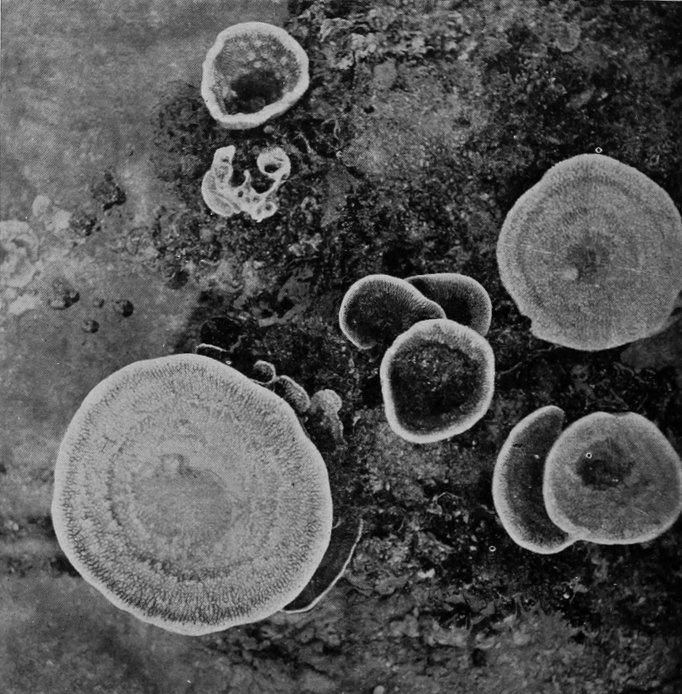
Photo by W. Saville-Kent, F.Z.S.] [Milford-on-Sea.
CUP-SPONGES, PHOTOGRAPHED AS GROWING IN A CORAL-POOL.
The Neptune's cup Sponge, allied to this species, is sometimes 2 or 3 feet in height and diameter.
In lower forms of the infusorial animalcules one or more long, lash-like organs take the place of locomotive hairs. In this category are included the Collar-bearing Animalcules. Some of these build up tree-like growths by repeated sub-divisions and imperfect separation, after the manner of the bell-animalcules, while others excrete tubular dwelling-cases, inhabited by the resultants of the splitting process. Such forms can with difficulty be distinguished from skeletonless sponges.
The animalcule Noctiluca, which by its countless myriads is the chief constituent of ocean phosphorescence, is a member of the Lash-bearing group. This noteworthy form invites a somewhat more extended notice. It is to the presence of the Noctiluca in countless myriads upon the upper stratum of the water on calm summer nights that is especially due the diffused form of phosphorescence which is more essentially characteristic of temperate latitudes. Under the most favourable of these conditions, the waves falling upon the strand leave as they retreat a glittering carpet of scintillating points; the oars of the passing boat seem as it were to dip into molten silver; while on the high seas the revolving screw or paddle of the steam-vessel leaves in its wake a broad, luminous track as far as the eye can reach. A glassful of water taken from the sea at such times immediately reveals the origin of these wonderful phenomena. Here and there will be seen floating minute bladder-like transparent spheres, resembling as nearly as possible small granules of boiled sago. Investigated more closely with the microscope, each individual speck will be found to exhibit a pouch-like contour, having a central furrow, from which the lash projects, and upon which the minute mouth-aperture opens. Irritated by agitation in any shape or form, the Noctilucas at once respond by, as it were, angry flashes of silvery-greenish light, and it is to the coruscations in their aggregate condition of many millions of these minute organisms that the several phenomena above recounted are produced.
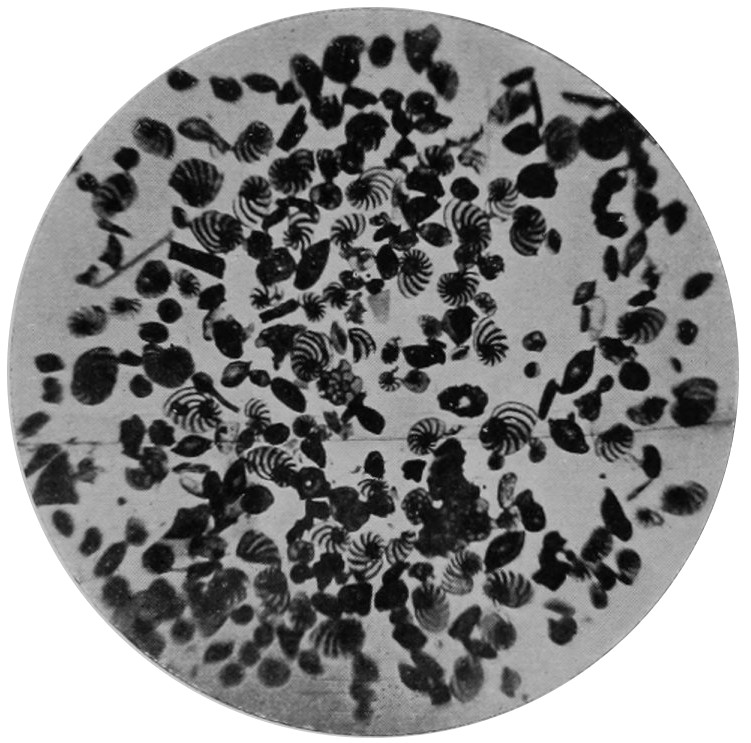
Photo by W. Saville-Kent, F.Z.S.] [Milford-on-Sea.
SHELLS OF FORAMS HIGHLY MAGNIFIED.
The chalk cliffs of Dover and many other strata are mainly composed of similar microscopically minute shells.
One other characteristic manifestation of ocean phosphorescence dependent upon the presence in countless numbers of these minute animalcules may be recorded. To those accustomed to a seafaring life the spectacle is a common one, on nights when the luminosity is most in evidence, of fishes following or darting away from the sides of the vessel apparently aglow themselves with phosphoric light, and leaving behind them, in accordance with their size, a more or less conspicuous luminous path in the murky waters. It is commonly supposed that such form of luminosity is emitted by the fishes themselves; but on closer investigation it will be found that this also is due to the presence of the animalcules under notice in countless numbers, which are disturbed into a sudden display of their phosphoric properties by the passage of the fishes through their midst. This light is reflected, as from a mirror, by the fishes' glittering scales, while the Noctilucas continue scintillating for several seconds in the path or wake through which the fishes have passed.
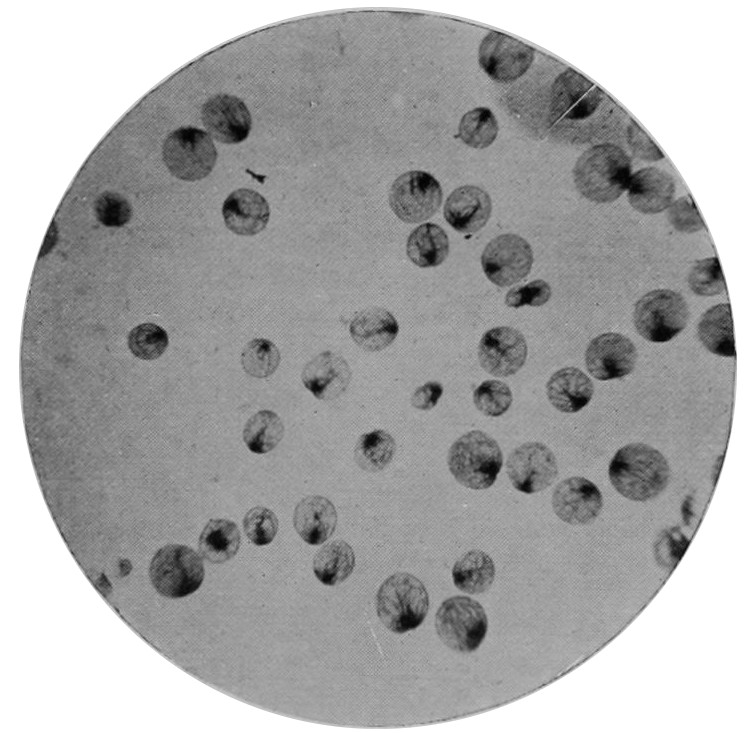
Photo by W. Saville-Kent, F.Z.S.] [Milford-on-Sea.
NOCTILUCAS.
These are the animalcules which chiefly produce marine phosphorescence.
There are other animalcules nearly allied to Noctilucas which sometimes occur in such vast abundance in both salt and fresh water as to visibly affect its character. In addition to a very long lash they have a girdle of vibratile hairs. The fresh-water representatives of this group are sometimes brilliant green, at others bright scarlet. That instance among the Biblical Egyptian plagues in which the water of the Nile was as it were "turned to blood, and all the fish died," has been attributed to a phenomenal development of these animalcules, which, on dying, polluted and putrefied the water. Instances of fishes being destroyed in vast quantities through a like agency throughout even extensive sea-areas have been occasionally recorded. While these pages are going to press an account has appeared in an American journal of red water caused by these flagellate animalcules, which occurred last July for an extent of at least 200 miles along the coast of California, producing with their decomposition a most sickening odour, and the death of shoals of fishes, octopods, sea-cucumbers, and other organisms.
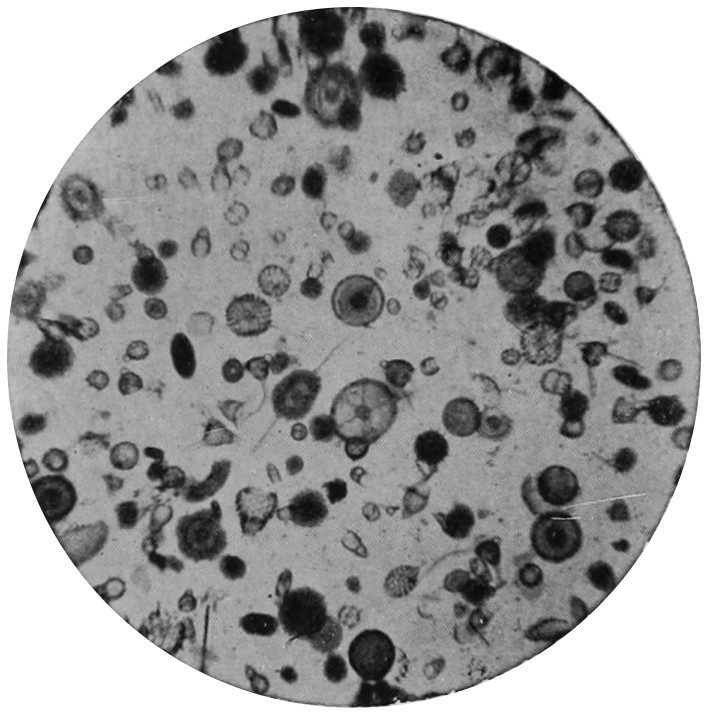
Photo by W. Saville-Kent, F.Z.S.] [Milford-on-Sea.
POLYCYSTS.
Flinty-shelled organisms of microscopic dimensions. The living animals consist of tiny specks of transparent jelly, from which radiate innumerable false feet of hair-like fineness.
Next to the Flagellates come the Root-footed Animalcules, which possess no mouth and no hairs or lashes, but progress by pushing out lobes of their jelly-like substance in any desired direction, into which the rest of the body flows. Food is picked up at any point with which an acceptable morsel may be brought in contact. The little gelatinous animal known as an Amœba is one of these. Related forms of this jelly animalcule secrete shells of varying form and structure. Some of these, known as Forams, are of carbonate of lime, and wonderfully like nautiluses and other of the higher molluscan shells in aspect. Though so minute, scarcely visible to the unassisted eye, they occur in the sea in such numbers as to form by their aggregations the more considerable ingredients of vast areas of the earth's strata, both past and present. The chalk cliffs of Albion and the white tenacious ooze of the broad Atlantic are thus to a large extent composed of the shells of minute organisms, which formerly flourished near the surface of the ocean, but sank on their death to its abysmal depths.
The simplest of the forams fabricate shells with a single chamber, which are often elegantly vase- or flask-shaped. More usually, however, the shell represents the product of repeated buddings or outgrowths, and may attain considerable dimensions. Flattened circular forms of this type much resemble time-worn coins, and are hence called Nummulites. Their fossil-shells enter mainly into the composition of rocks which extend through North Africa and Asia to the Himalaya, and supplied the stone of which the Pyramids are built.
Allied to the Forams, but distinguished by the radiating, needle-like contour of their false feet and the flinty texture of their shells, are an equally numerous assemblage of organisms known as Radiolarians. Like the Forams, they are inhabitants of the sea, and their discarded shells enter extensively into the constitution of strata. A little globular fresh-water form, devoid of a shell, and with slender bristle-like feet radiating in every direction, is known as the Sun-animalcule, and forms a connecting-link between the last two groups.
From Man to Egg-laying Mammals, Molluscs to Animalcules, the vast scheme of the Animal Creation has now been successively portrayed. With such simple gelatinous life-specks as the Amœba and its allies The Living Animals of the World make their exit: unorganised organisms, groping blindly in the darkness—"Sans teeth, sans eyes, sans taste, sans everything."
END OF VOL. II.