“I, Mary MacLane”
Reading edition
jh.
When I heard that there was to be a new Mary MacLane book I was full of excitement, remembering vaguely her first book. “What has the world done to you?” I thought as I went rapidly and curiously through the pages. I came upon parts that made me more excited. Has she made poetry—has she made literature? Then I read it through properly from first to last.
It seems to me that Mary MacLane’s Diary of Human Days is the best answer in the world to all those people who hold that to express yourself completely and sincerely is to have to created Art. Mary MacLane says: “So I write this book of Me—my Soul, my Heart, my sentient Body, my magic Mind: their potentialities and contradictions.”
Aside from the story, which is a sort of Spoon River of thoughts, emotions, rebellions, unconventionalities, humor, the writing of those parts which promised to be poetry in the whole became a too-pretty prettiness, a kind of Ladies’ Home Journalness. There is a way some maiden ladies hold a brush when painting still-life—we call it Spencerian.... But what makes me the most weary is the tape-worm words: Feel-of-my-Fingers, my Boredom-of-the-Moment, etc., etc.
It is an amusing book. It is an unhappy book, and it is surprising in all kinds of ways. It is chiefly surprising because it is not the contradictions that contradict: it is the potentialities, the affirmations. Whatever she affirms in the letter—that she is artist, pagan, radical, outlaw, humorist,—she denies in the spirit. She is really a rather set little conservative with a Presbyterian conscience. She is an interesting and entertaining neurasthenic. Her book is surprisingly ungrown, surprisingly commonplace. It is surprisingly not a surprise.
She makes much talk of her old soul “worn by long cycles of time”; she names herself an artist—a double title to a universal consciousness; and then proceeds to analyze toward a universal consciousness. She lovingly cherishes her free analytical mind and then in chapters like “I am someway the Lesbian woman” and “I am not Respectable nor Refined nor in Good Taste” she refutes her free analytical mind in the best manner of the “good non-analytic creatures.” I cannot find the interest to a free mind, to any thinking mind, in questioning the refinement of the natural feelings induced by a shower bath in the solitude of a mountain gorge. A grown mind does not consider whether it is unrefined to be natural or expect that it ought to feel “timorous, sexless, or hygenic” under such circumstances. A grown mind does not question the integrity of its emotions.
I, Mary MacLane is good fun to read and there is enough charm in its abrupt realism to make up for its cloying fancifulness. It is annoying and exasperating—annoying because it makes you feel sorry for Mary MacLane and exasperating because it makes you wish you could help her clear up the design a bit. It is too personal. It is an intrusion. The artist reveals not how he lives but how he Exists, not his objects but himself. And if he chooses himself as his object, as Mary MacLane has done, he has not made his task any different or less difficult. It is as foolish to talk about the artist as the man as to talk about Art as life. Whether an artist tells out his whole soul in a single verse or in great creations through a long life time, or only exists fully and no one has known how he passed one of his “human days”, what he has created will tell forever how he Existed. It is never what life does to the artist; it is what the artist does to life.
Mary MacLane has created nothing. She has given us an anatomical drawing of her life, has wistfully told her story with some imagination, some beauty of phrase, some poetical conceptions, with honesty, sincerity, with the humor of a martyr. The newspapers will take it up; it will be praised and jeered and quoted by wits and half-wits; moral fossils will refuse to sell it and others to read it; Lady Writers will say “she has made a contribution to literature.” She has made a contribution, but it would seem rather to the sexual theory.
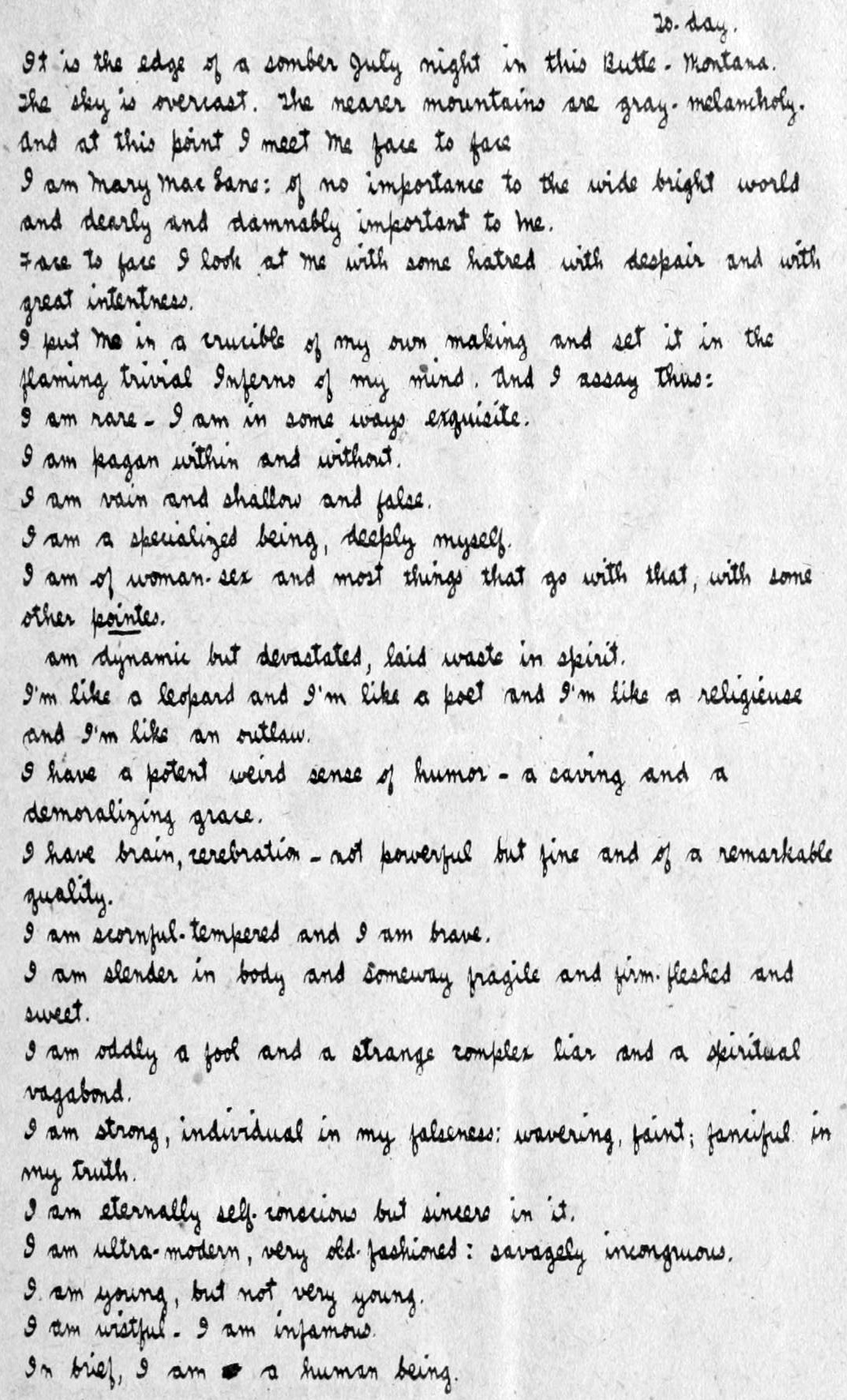
To-day.
It is the edge of a somber July night in this Butte-Montana.
The sky is overcast. The nearer mountains are gray-melancholy.
And at this point I meet Me face to face.
I am Mary MacLane: of no importance to the wide bright world and dearly and damnably important to Me.
Face to face I look at Me with some hatred, with despair and with great intentness.
I put Me in a crucible of my own making and set it in the flaming trivial Inferno of my mind. And I assay thus:
I am rare—I am in some ways exquisite.
I am pagan within and without.
I am vain and shallow and false.
I am a specialized being, deeply myself.
I am of woman-sex and most things that go with that, with some other pointes.
I am dynamic but devastated, laid waste in spirit.
I’m like a leopard and I’m like a poet and I’m like a religieuse and I’m like an outlaw.
I have a potent weird sense of humor—a saving and a demoralizing grace.
I have brain, cerebration—not powerful but fine and of a remarkable quality.
I am scornful-tempered and I am brave.
I am slender in body and someway fragile and firm-fleshed and sweet.
I am oddly a fool and a strange complex liar and a spiritual vagabond.
I am strong, individual in my falseness: wavering, faint, fanciful in my truth.
I am eternally self-conscious but sincere in it.
I am ultra-modern, very old-fashioned: savagely incongruous.
I am young, but not very young.
I am wistful. I am infamous.
In brief, I am a human being.