Front matter (continued 3)
Reading edition
He is skilled in the art of boating through the surf and has made a faithful and fearless life saver.
MONOMOY STATION.
The Monomoy Station is another of the original nine stations erected on Cape Cod when the United States Life-Saving Service was extended to these shores. It is located two and one-half miles north of Monomoy Light. Its approximate position as obtained from the latest coast survey charts is latitude north 41° 35′ 25″, longitude west 69° 59′ 10″. When the station was manned, March 20, 1873, Capt. George W. Baxter, of West Harwich, was placed in command. He resigned on account of ill-health in 1882, and his successor was Capt. William Tuttle. His death occurred July 1, 1899, and the late Capt. Marshall W. Eldredge was appointed to fill the vacancy Aug. 4, 1899. Captain Eldredge perished in an attempt to rescue five persons from the stranded barge Wadena, March 17, 1902.
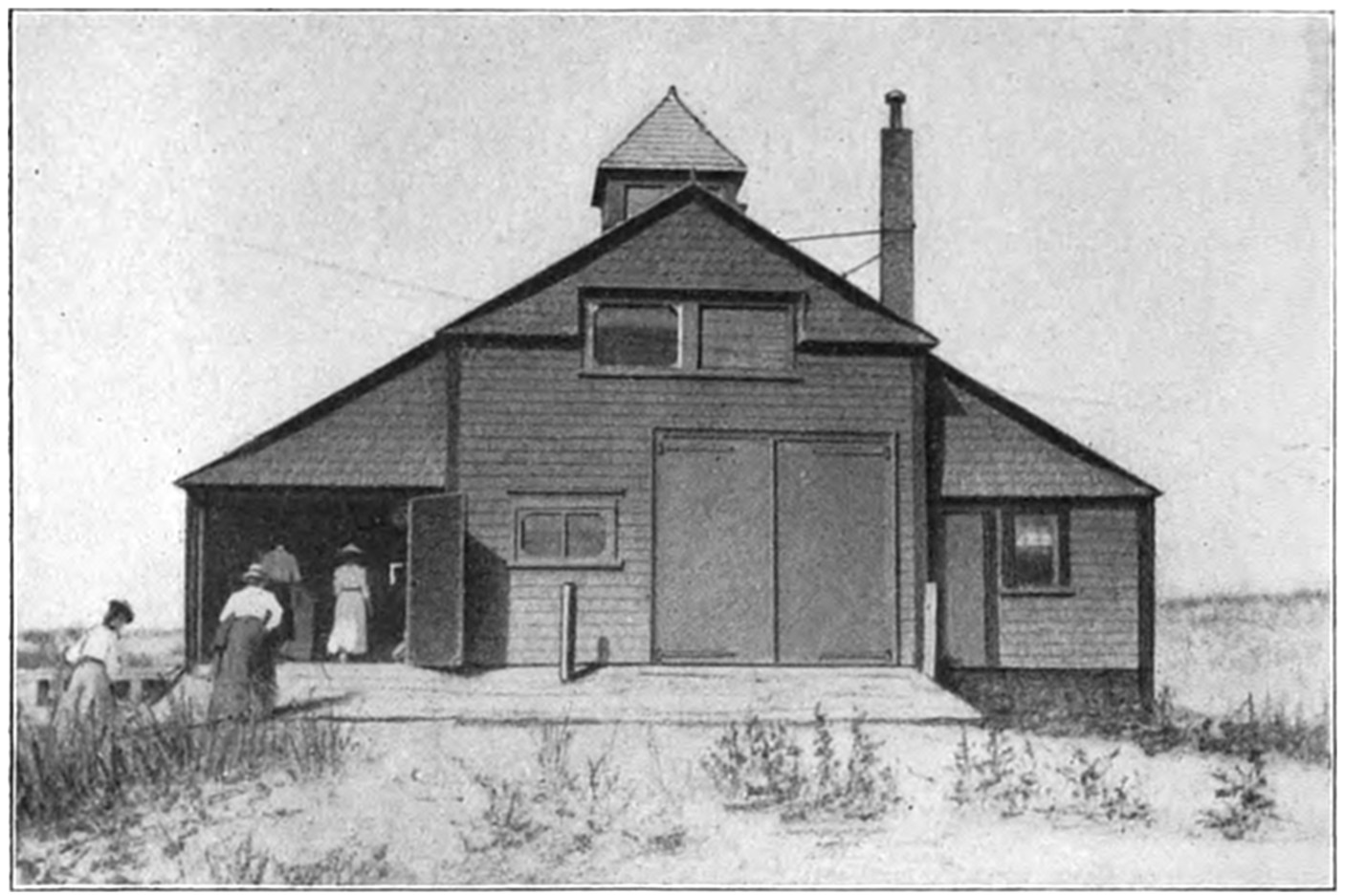
MONOMOY STATION.
The patrol north of this station is about two and one-half miles, the surfmen meeting and exchanging checks with the surfmen from the Chatham Station. The patrol south is about one and one-half miles, the surfmen meeting and exchanging checks with the surfmen from the Monomoy Point Station.
There is no more dangerous stretch of coast on Cape Cod than off Monomoy. Disaster follows disaster in that region, and the work of the life savers is attended with the greatest peril at all times.
The following disasters have occurred at the Monomoy Station since Captain Ellis has been in command: Schooner Elwood Burton, of New York, stranded on the Handkerchief Shoal, the life savers rescuing her crew of six men in their surf-boat. Five men, the crew of the barge Paxinos, which had struck on Pollock Rip, were rescued from a sinking boat by the Monomoy crew. They were later placed aboard the barge, which was soon floated by the life savers. From the schooner Dora Mathews, which stranded on the beach near the station, three men were taken ashore in the breeches-buoy. A number of other crafts which met with disaster along the shore were assisted by Captain Ellis and his crew.
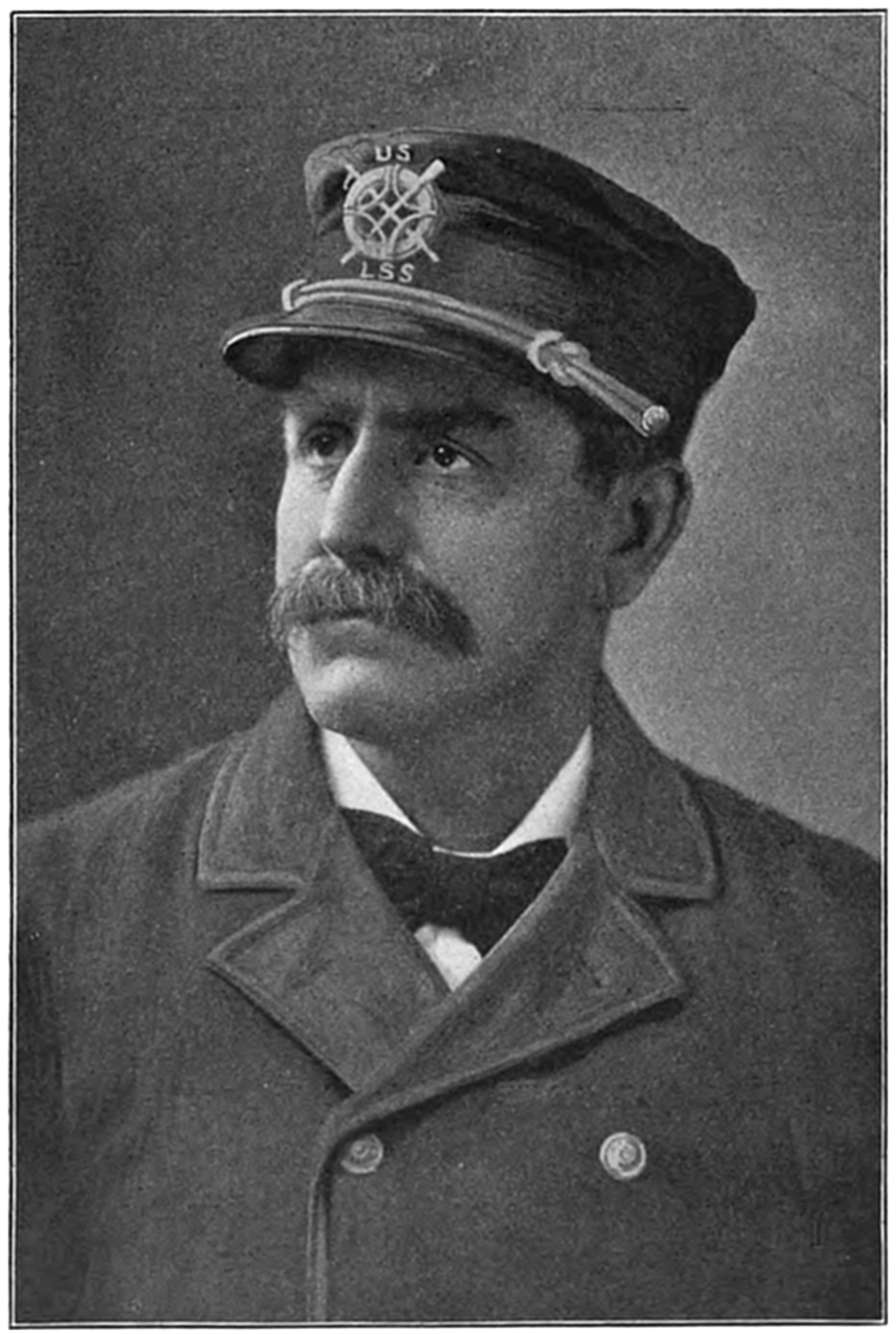
CAPT. SETH L. ELLIS, KEEPER OF MONOMOY STATION.
CAPT. SETH L. ELLIS.
Capt. Seth L. Ellis, keeper of the Monomoy Station and sole survivor of the Monomoy disaster, was born in Harwich Port, Oct. 12, 1858, and has been in the life-saving service seven years, all of which have been at this station.
Captain Ellis came from a family of seafaring people. His father, Capt. Seth N. Ellis, was an old West Indies tradesman.
Captain Ellis went to sea with his father when but nine years of age. When fifteen years of age Captain Ellis joined the fleet of mackerel fishermen, remaining with the fleet until he went coasting. While a member of the crew of the three-masted schooner Enos B. Phillips, of Boston, Capt. T. Reuben Allen, of Harwich Port, master, the vessel was struck by a blizzard that made her a helpless wreck. With her jibboom, bowsprit, foremast, and maintop masts gone, all her head sails lost, and the cabin and forecastle wrecked, the schooner was blown across the gulf stream and out of the track of all shipping. After many days, during which the crew suffered terribly, Captain Allen finally triumphed and brought the vessel into port.
Captain Ellis has been master of sailing and steam vessels, and now carries a captain’s first-class steamboat license for the Atlantic coast. Captain Ellis was also a well-known mackerel fisherman, being a member of the crew of the first steam fishing vessel employed in mackerel fishery, the Novelty, of Boston. Later Captain Ellis engaged in boat fishing along the shores of the Cape near Chatham, continuing in that work until he joined the Monomoy crew of life savers.
MONOMOY STATION CREW.
The No. 1 surfman is Walter C. Bloomer. He was born in Chatham in 1867, and has been in the life-saving service for five years. Surfman Bloomer was a “Monomoy” fisherman, boatman, and wrecker before entering the service. When he joined the service he was assigned to the Brant Rock Station, where he remained three years, being transferred to this station. At this station, under the late Captain Eldredge, he saw much active service and proved himself a fearless and skilful surfman. On the occasion of the terrible Monomoy disaster, when his keeper and six of his comrades lost their lives, Surfman Bloomer was doing cook duty, and remained at the station. He married Velma Stevens, and is the father of two girls and two boys.
The No. 2 surfman is Thomas H. Kane. He was born in Manchester, N. H., in 1870, and has been in the life-saving service four years. Surfman Kane followed the sea from the time he was fifteen years of age until he entered the life-saving service. He was a “grand banker,” a mackerel fisherman, and had a wide and varied experience on the water. He was a member of the Rockport Life-Saving crew, and was with Captain Charles at the Orleans Station for one year. Surfman Kane joined the Monomoy Station, to fill a vacancy caused by the death of one of the crew who perished with Captain Eldredge at the Monomoy disaster.
He is an expert boatman, a brave and hardy surfman. He married Sarah Whellock, and is the father of a daughter and son.
The No. 3 surfman is Edwin A. Studley. He was born in North Harwich in 1864, and has been in the life-saving service for two years, one year at the Orleans Station and one year at this station. Surfman Studley followed the sea since he was a boy. For several years he was a member of the crew of the Pollock Rip Lightship, and later he joined the crew of the Shovelful Lightship. He was also a sailor in the coastwise trade, and engaged in boating and fishing along the Chatham shores for several years. He is an efficient boatman and a fearless life saver. He married Alice Phillips, and is the father of a son.
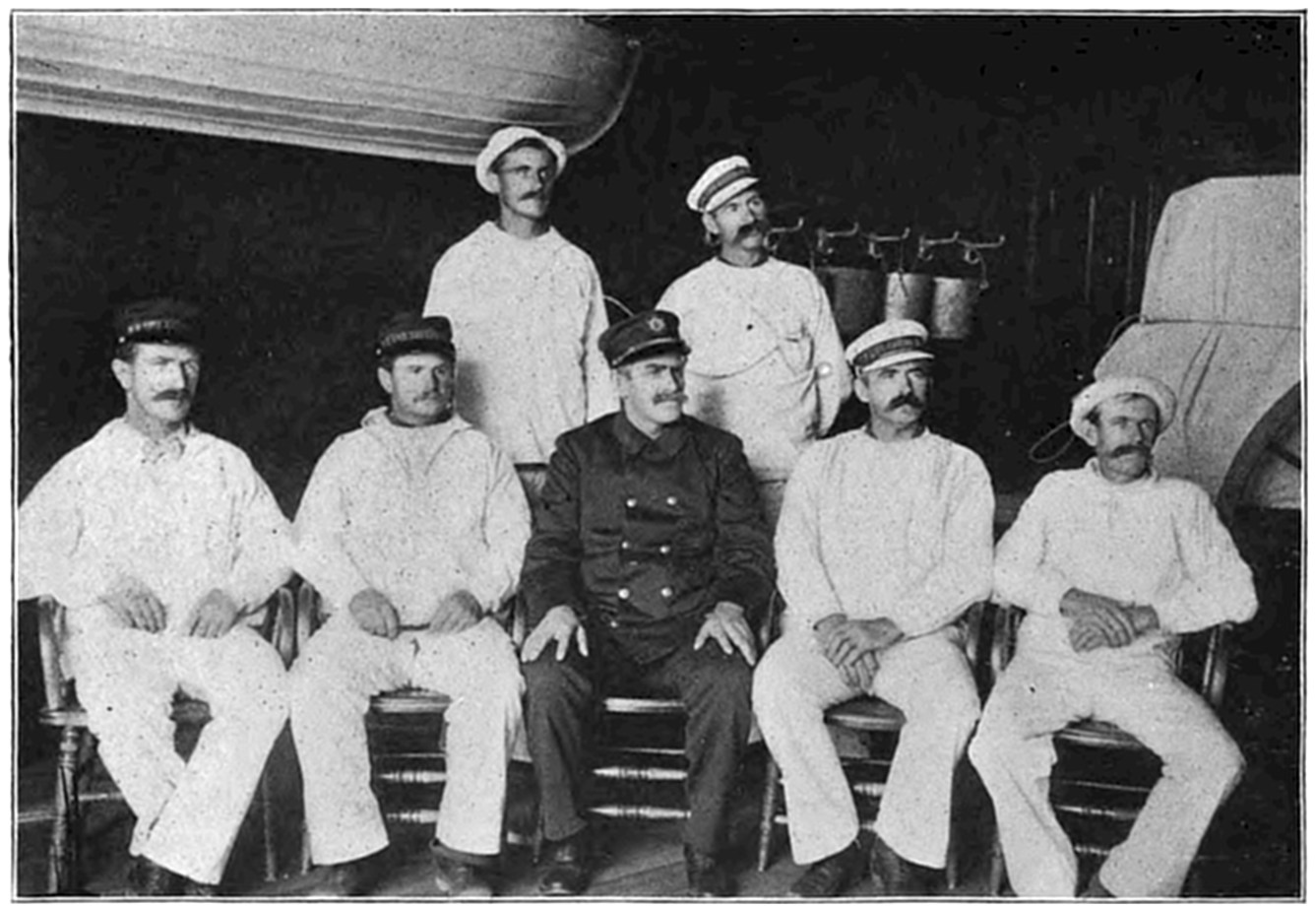
Standing: GEORGE CAHOON. WALTER F. WIXON. Seated: THOMAS H. KANE. WALTER BLOOMER. CAPTAIN ELLIS. SURFMAN RESIGNED. EDWIN A. STUDLEY.
MONOMOY CREW.
The No. 4 surfman is George C. Cahoon. He was born in Harwich in 1872, and has been in the life-saving service but a year. When he entered the service he was assigned to the Race Point Station, under Capt. “Sam” Fisher, and was transferred here this year. Surfman Cahoon was a fisherman and boatman along the shores of Cape Cod from the time he was a boy until he entered the service. He is an able boatman and has already shown himself to be an efficient life saver. He married Emma Jones, and is the father of a daughter.
The No. 5 surfman is Walter F. Wixon. He was born in South Chatham in 1866, and is serving his first year in the life-saving service. Having been a boatman and fisherman along the shores “back of the Cape” for a number of years, he is skilled in handling a boat, and has a thorough knowledge of the rips and shoals that line the shore there. He married Minnie E. Chase.
The No. 6 surfman is Thomas W. Bearse. He was born in West Harwich in 1863, and is serving his first season as a life saver. Surfman Bearse was a boatman and fisherman along the Chatham shores before he entered the service, and was well prepared for the work he has been called upon to perform as a surfman. He married Annie Cahoon, and is the father of two boys.
The No. 7 surfman is Frank Thomas. He was born in Provincetown in 1874, and entered the life-saving service Dec. 1, 1902. Surfman Thomas went to the Grand Banks when he was but eleven years of age. He followed the sea from that time until he entered the service, engaging principally in dory fishing off Cape Cod. He is an expert boatman and gives promise of becoming an able life saver. He married Rosie Gracie, and is the father of two daughters.
The No. 8 surfman is Marcus N. Smith. He was born in West Chatham in 1865, and has been in the life-saving service one year. He followed the sea and was a boatman and fisherman along the shores of Cape Cod from the time he was a boy until he joined the service. He first served at the Muskeget Station, Nantucket, joining this station as the winter man Dec. 1, 1902. He has proved his efficiency as a life saver, and is a valuable addition to the crew at this station.
Owing to the great amount of work which the crew of this station was called upon to perform, and the long patrol that the surfmen were obliged to go over before the Monomoy Point Station was built, eight surfmen were employed at this station, and they are still retained. It is the only station on Cape Cod where that number of surfmen are employed.
MONOMOY POINT STATION.
The Monomoy Point Station is located near the extreme end of Monomoy Island, about nine miles from Chatham lights, which bear about north-northeast. Monomoy Island is a long, narrow strip of beach at the elbow of Cape Cod. The dreaded Shovelful and Handkerchief shoals stretch out under the waters of Nantucket Sound along the eastern and southern shores of the island, and in the vicinity countless vessels have met their doom and many lives have been lost. Owing to the great number of disasters that occurred off the southern end of Monomoy, the present life-saving station was built. At the time that this station was erected it was intended that the old Monomoy Station should be abandoned and the crew transferred to this station.
After the appalling calamity, “The Monomoy Disaster” on March 17, 1902, when Captain Eldredge and six of his crew of life savers lost their lives, the department decided to continue the old Monomoy Station.
The station is one of the most modern buildings of its kind, with large and airy rooms for the crew and a big boat room for the surf-boats, beach carts, and other apparatus.
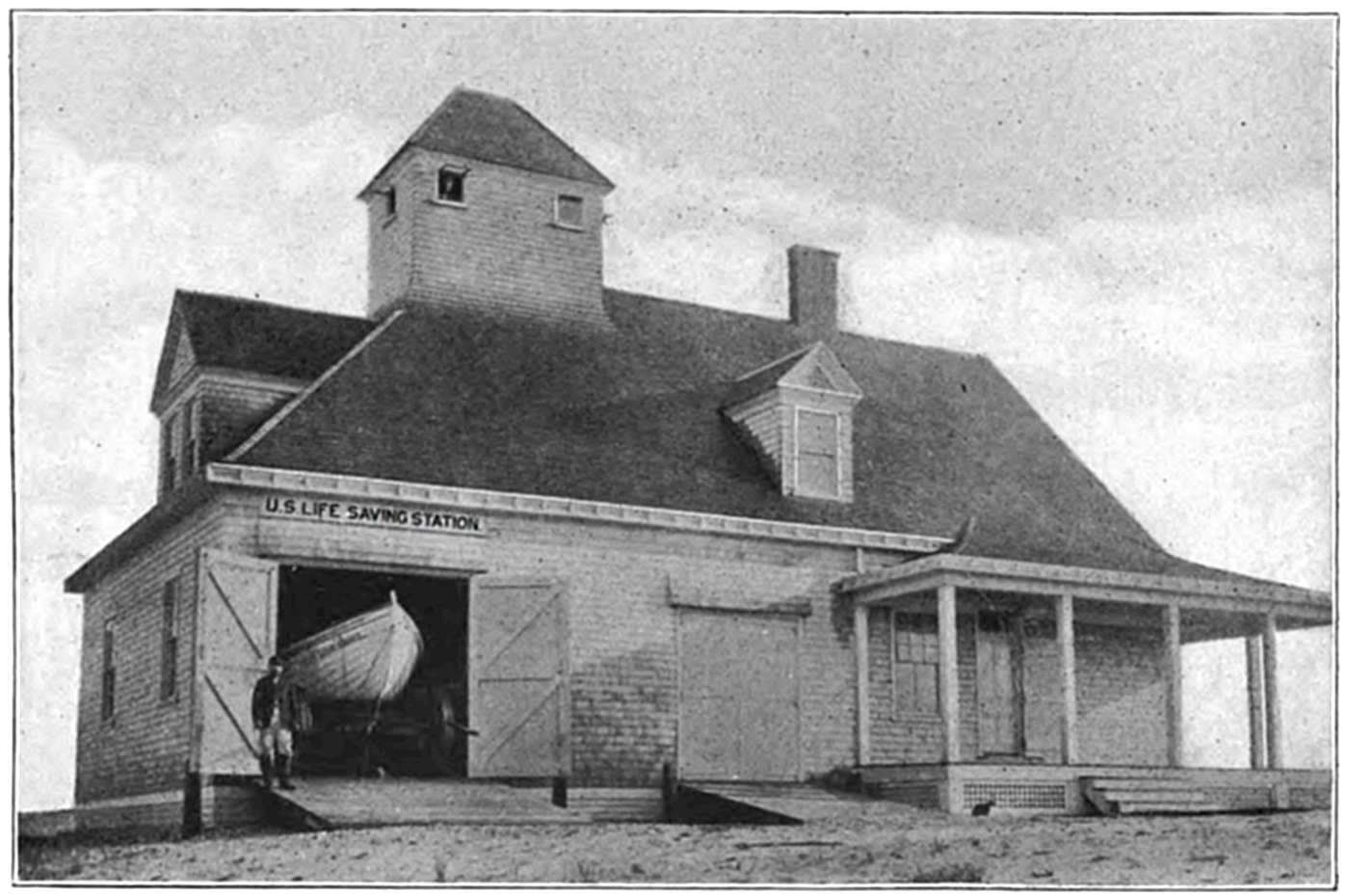
MONOMOY POINT STATION.
The patrol north from this station is about one and one-half miles, the surfmen meeting and exchanging checks with the surfmen from the Old Monomoy Station. The south patrol along the beach on the end of Monomoy is also about one and one-half miles, the surfman on that patrol carrying a time clock to record their performance of duty.
At the Monomoy Point Station there are three surf-boats. One of these boats is a self-bailer, the only one on Cape Cod. There are also two beach carts with apparatus, and one life-car. Six surfmen with Keeper Kelley go in the self-bailer at the time of shipwreck. A horse owned by the government, called “Susan,” is kept at the station to assist in hauling the apparatus to scenes of disaster. There are also two other horses owned by the surfmen kept there. Cats are the pets of the surfmen, a half dozen making their home at the station.
CAPT. JOSEPH C. KELLEY.
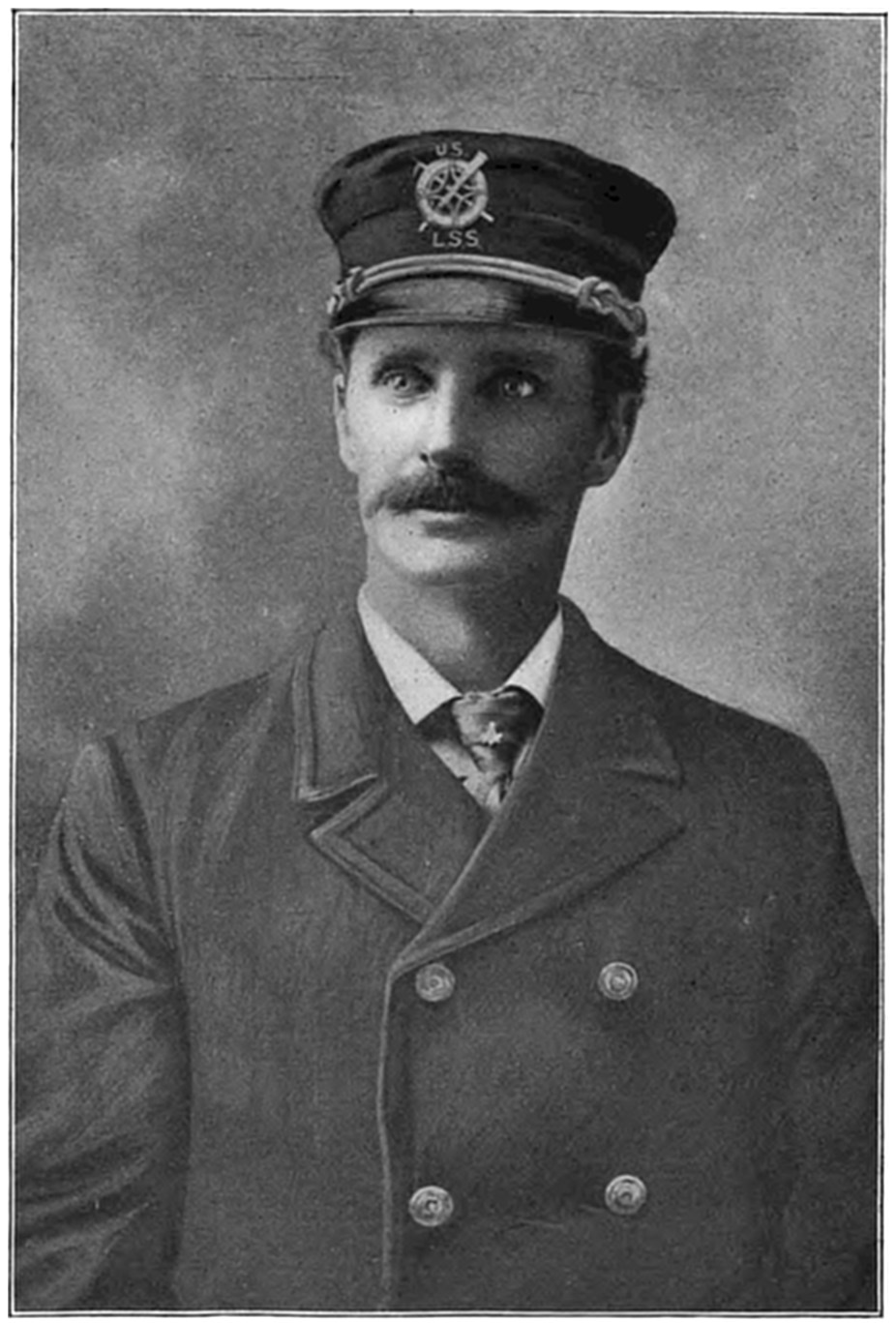
CAPT. JOSEPH C. KELLEY, KEEPER OF MONOMOY POINT STATION.
Capt. Joseph C. Kelley, keeper of the Monomoy Point Life-Saving Station, was born in West Brewster in 1873, and has been in the life-saving service for five years. When he entered the service he was assigned to the Peaked Hill Bars Station under Captain Cook. He remained there but a few months, when he was transferred to the Chatham Station under Capt. Herbert Eldredge. Captain Kelley was appointed keeper of the new Monomoy Point Station in August, 1902, although the station was not manned until Oct. 30, 1902. Captain Kelley has the distinction of being the youngest life-saving station keeper on Cape Cod, if not in the United States, having been honored with the appointment of keeper of the Monomoy Point Station when he was but twenty-nine years of age.
When a young man he was a boatman and fisherman along the shores of Cape Cod, and later became a coastwise sailor. He became accustomed to the perils incident to the work of boating along the shores of the Cape, and skilled in handling boats in the roughest water at an early age. At the Peaked Hill Bars Station under the veteran seafighter, Captain Cook, Surfman Captain Kelley received a most thorough drilling in the work of life saving, which proved of untold benefit to him when he joined the Chatham Station, and better prepared him for the responsible position he now occupies. At the Chatham Station under Captain Eldredge, Captain Kelley was No. 1 surfman. He assisted at all the wrecks that occurred along the shore there for nearly five years, demonstrating his ability to cope with the most stupendous problems of life saving. Captain Kelley has a selected crew of experienced and fearless surfmen, who in the brief history of the station have proven themselves equal to every emergency that has arisen.
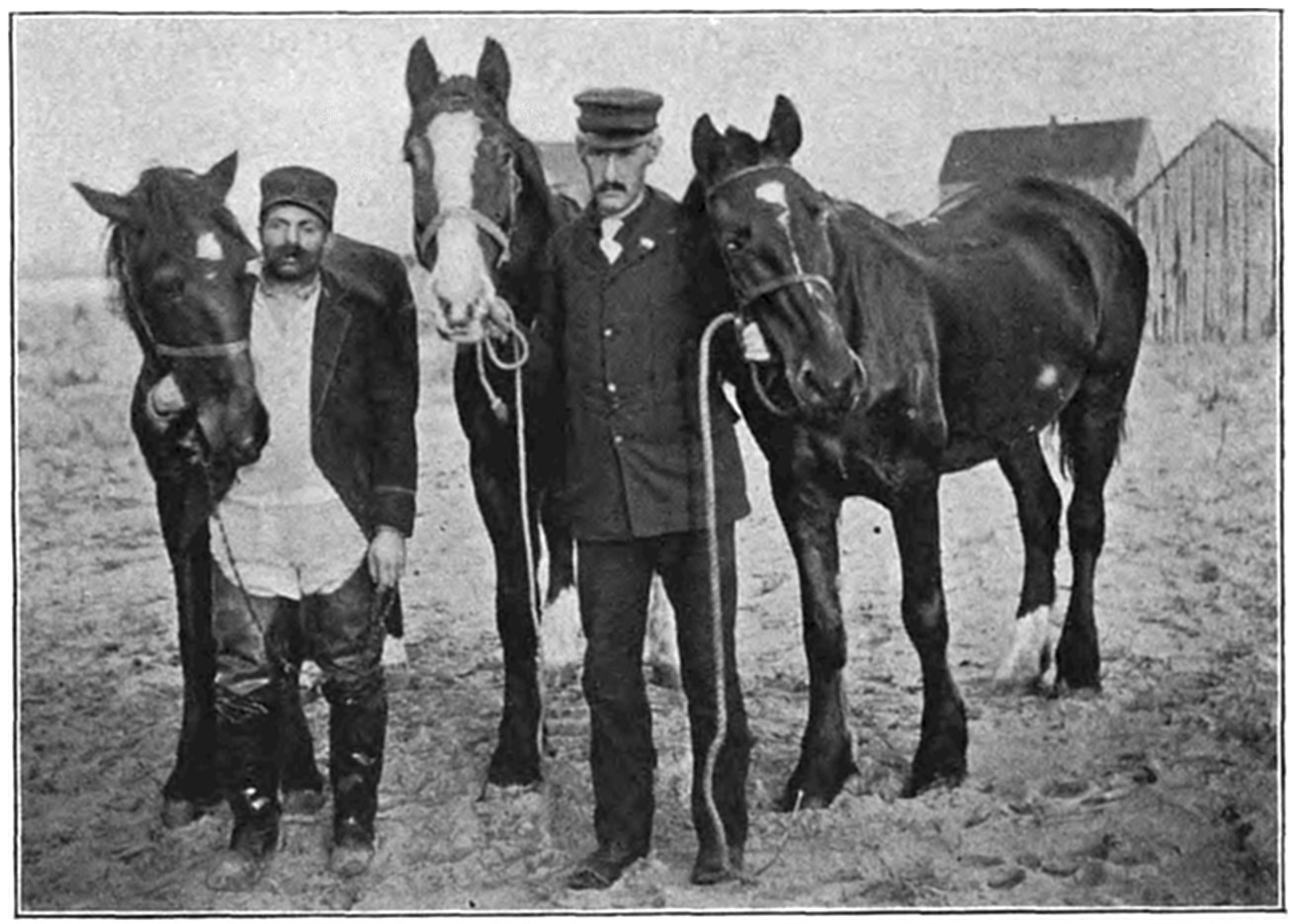
THE HORSES THAT ARE KEPT ON DUTY AT MONOMOY POINT STATION.
Five disasters occurred on the shoals near the station within as many weeks after the station was manned, and in every case the vessels were saved and not a life was lost. Captain Kelley married Chestena Batchelder.
MONOMOY POINT STATION CREW.
The No. 1 surfman is Joseph D. Bloomer. He was born in Prince Edward Island in 1857, and has been in the life-saving service since Oct. 1, 1902. Surfman Bloomer followed the sea in one capacity or another since he was a boy. For five years he was engaged in trading between Portland and the West Indies Islands. Upon coming to Cape Cod he took up his residence in Chatham, and for the past twenty-five years he has been a boatman, fisherman, anchor dragger, and wrecker on the shoals off Monomoy. Before entering the life-saving service as a regular surfman, he had substituted at the Chatham and Monomoy Stations, and was well used to the duties of a surfman. The rips and shoals off Monomoy are all familiar to Surfman Bloomer. During the twenty-five years that he has spent in that region he assisted at all the wrecks that took place near there, and was one of the best-known Monomoy wreckers so-called. Skilled in the art of boating, with a thorough knowledge of the shoals along the shores of Cape Cod, Surfman Bloomer has few equals as a life saver. He married Adeline Bloomer.
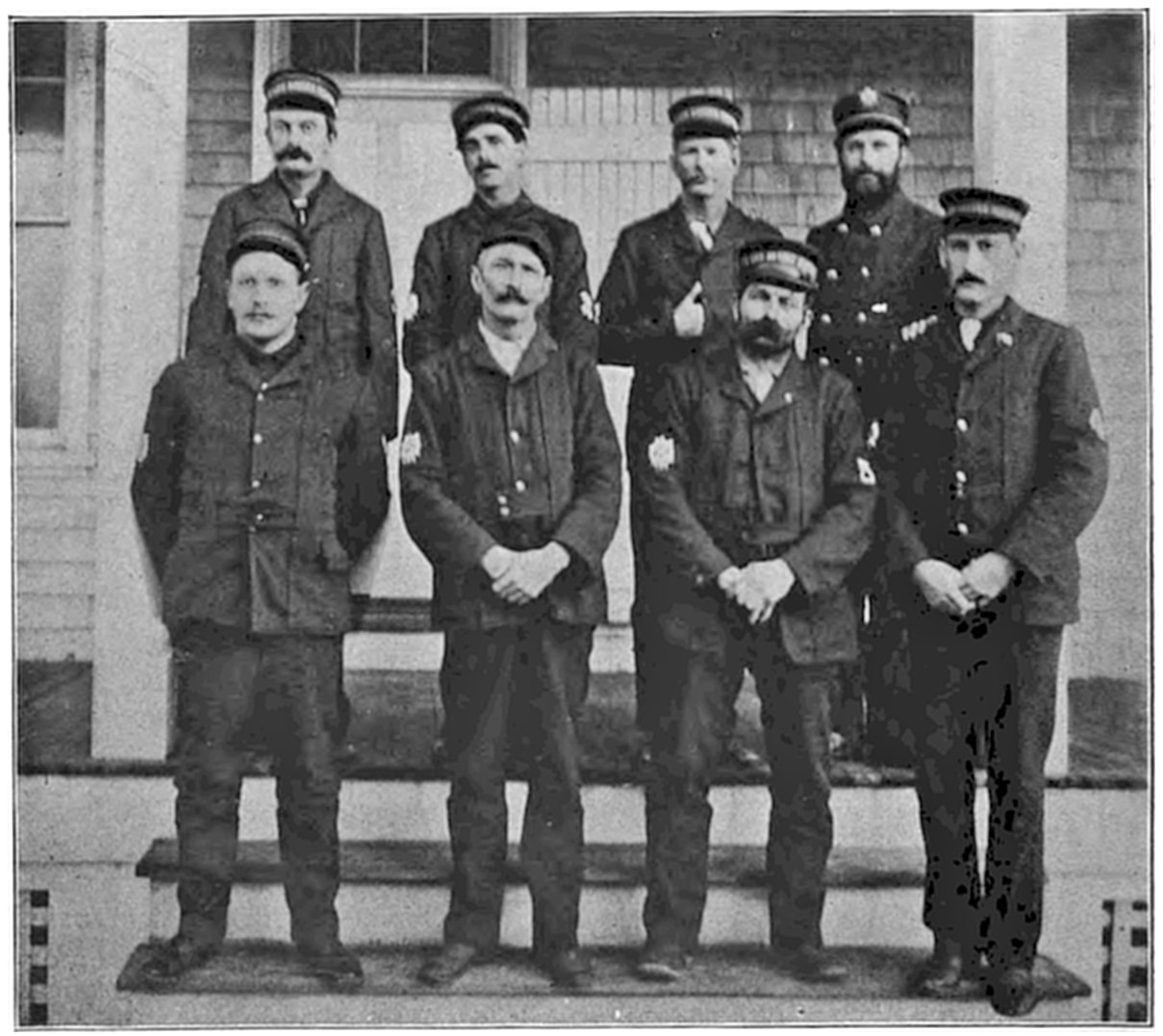
Back row: OBED H. SHIVERICK. JOHN E. ELLIS. JOSEPH D. BLOOMER. CAPTAIN KELLEY. Front row: RICHARD E. RYDER. CHARLES G. HAMILTON. REUBEN W. ELDREDGE. EDWIN L. CLARK.
MONOMOY POINT CREW.
The No. 2 surfman is John E. Ellis. He was born in West Harwich in 1874, and entered the life-saving service when this station was manned Oct. 1, 1902. Surfman Ellis followed the sea from the time that he was a boy until he joined the life-saving service. He engaged in steamboating for a few years, and later made a great number of trips on barges from the middle Atlantic ports around Cape Cod. He spent several years boating and fishing on the shoals off Monomoy, and is a skilled boatman and a fearless life saver. He married Lilian M. Ashley.
The No. 3 surfman is Obed H. Shiverick. He was born in Dennis in 1867, and entered the life-saving service when this station was manned.
Surfman Shiverick went to sea when a small boy, his first trip being to the Grand Banks. He was a fisherman for a number of years, when he joined the crew of the Cross Rip Lightship under Captain Jorgensen, and for four years was a member of the Nantucket Shoals Lightship, also under Captain Jorgensen, going with the veteran captain when he took charge of that floating beacon. Surfman Shiverick has had a wide and varied experience on the water. He is familiar with the rips and shoals along the shores of Cape Cod, is a skilled boatman, and a brave and efficient life saver. He married Sadie McQuarrie, and is the father of two daughters.
The No. 4 surfman is Edwin L. Clark. He was born in Chatham in 1876, and has been in the life-saving service since Oct. 1, 1902. Surfman Clark followed the sea from a boy. For a number of years he engaged in barge towing around Cape Cod, and later joined the crew of the Shovelful Lightship, where he remained one year. At different periods for two years he substituted at the Monomoy Station, under the late Captain Eldredge. He is well accustomed to the hardships incident to a surfman’s life, skilled in the art of handling boats, and is an able life saver. He married Minnie B. West, and is the father of a daughter.
The No. 5 surfman is Reuben W. Eldredge. He was born in South Dennis in 1864, and entered the life-saving service when this station was manned. Surfman Eldredge followed the sea from a boy. For ten successive years he went cod-fishing to the Grand Banks. While fishing on the banks one season he lost track of his vessel during a thick fog, and was tossed about in an open dory for five days without food or water. He was finally picked up in an unconscious condition by a French fishing vessel, and put aboard his own vessel. He recovered in a short time, and despite the terrible suffering through which he passed, continued to go to the “banks” for several years. Later he became a coastwise sailor, and was also a member of the crew of the steamer City of Macon for some time.
Surfman Eldredge, after giving up going to sea, became a fisherman and wrecker along the shores of Monomoy. He also substituted at the Chatham Station under the late Captain Eldredge. He is perfectly at home in a boat under any and all conditions of wind or weather. The sea has no terrors for him, and he is inured to the hardships and perils of a life saver’s life. He married Alice D. Young, and is the father of a son.
The No. 6 surfman is Joseph Christie. He was born in Scotland, is thirty-one years of age, and has been in the life-saving service since this station was manned. Surfman Christie was a boatman and fisherman for a number of years, and also served as substitute at the Cuttyhunk Life-Saving Station. He served in the United States Navy in the war with Spain. He married Lizzie Jackson. Surfman Christie is at present on sick leave, on account of injuries received in the performance of his duty.
The No. 7 surfman is John E. Ryder. He was born in Chatham in 1879, and has been in the life-saving service two years. He is the winter man, so called. During the summer season Surfman Ryder is stationed at the City Point Station, South Boston. Before entering the service he was a boatman and fisherman along the coast of Cape Cod, becoming familiar with the handling of boats in the surf, and acquiring a knowledge of the rips and shoals that abound there. He is an expert boatman and a brave and hardy life saver.
Surfman Charles G. Hamilton, who is substituting for Surfman Christie, joined the crew on Dec. 1, 1902. He was born in Chatham in 1859. He has been a boatman, lobsterman, fisherman, and wrecker off Monomoy for nearly twenty years. For the past fifteen years he has lived on Monomoy Point, and has assisted at nearly all the wrecks that have occurred in that vicinity during that time. He is a well-known wrecker, who knows the location of every rip and shoal in the region about Monomoy.
He was also a grand banker, a coastwise sailor, and engaged in steamboating around the Cape. He is thoroughly accustomed to the perils of the sea, and is an expert boatman and a fearless life saver. He married Etta Batchelder.
THE MONOMOY DISASTER.
When the late Capt. Marshall W. Eldredge was appointed keeper, Captain Ellis was his No. 1 surfman. Captain Ellis served as No. 1 surfman until May 1, 1902, when he was appointed keeper to succeed his late captain, whose life was given up in an heroic attempt to rescue an imperiled crew. Captain Ellis married Aureilla M. Cahoon, and is the father of one son. The story of the terrible tragedy in which Captain Eldredge and six members of his crew, together with five persons whom they had taken from the stranded barge Wadena, perished, is best told by the sole survivor, Captain Ellis, and is as follows:—
“On Tuesday, March 11, 1902, about one o’clock A. M. the schooner barge Wadena stranded during a northeast gale and heavy sea on the Shovelful Shoal, off the southern end of Monomoy Island. The crew were rescued by our station crew. The barge remained on the shoal without showing any signs of going to pieces, and wreckers were engaged in lightering her cargo of coal. On the night of March 16 the weather became threatening, and all except five of the persons engaged in lightering the cargo were taken ashore from the barge by the tug Peter Smith, which was in the employ of the owners of the barge.
“Shortly before eight o’clock on the morning of March 17 one of the patrolmen from our station reported that the Wadena appeared to be in no immediate danger, but later Captain Eldredge received a message from Hyannis, inquiring whether everything was all right with the men aboard the barge. Up to this time no one at the station was aware that any persons had remained on the barge over night.
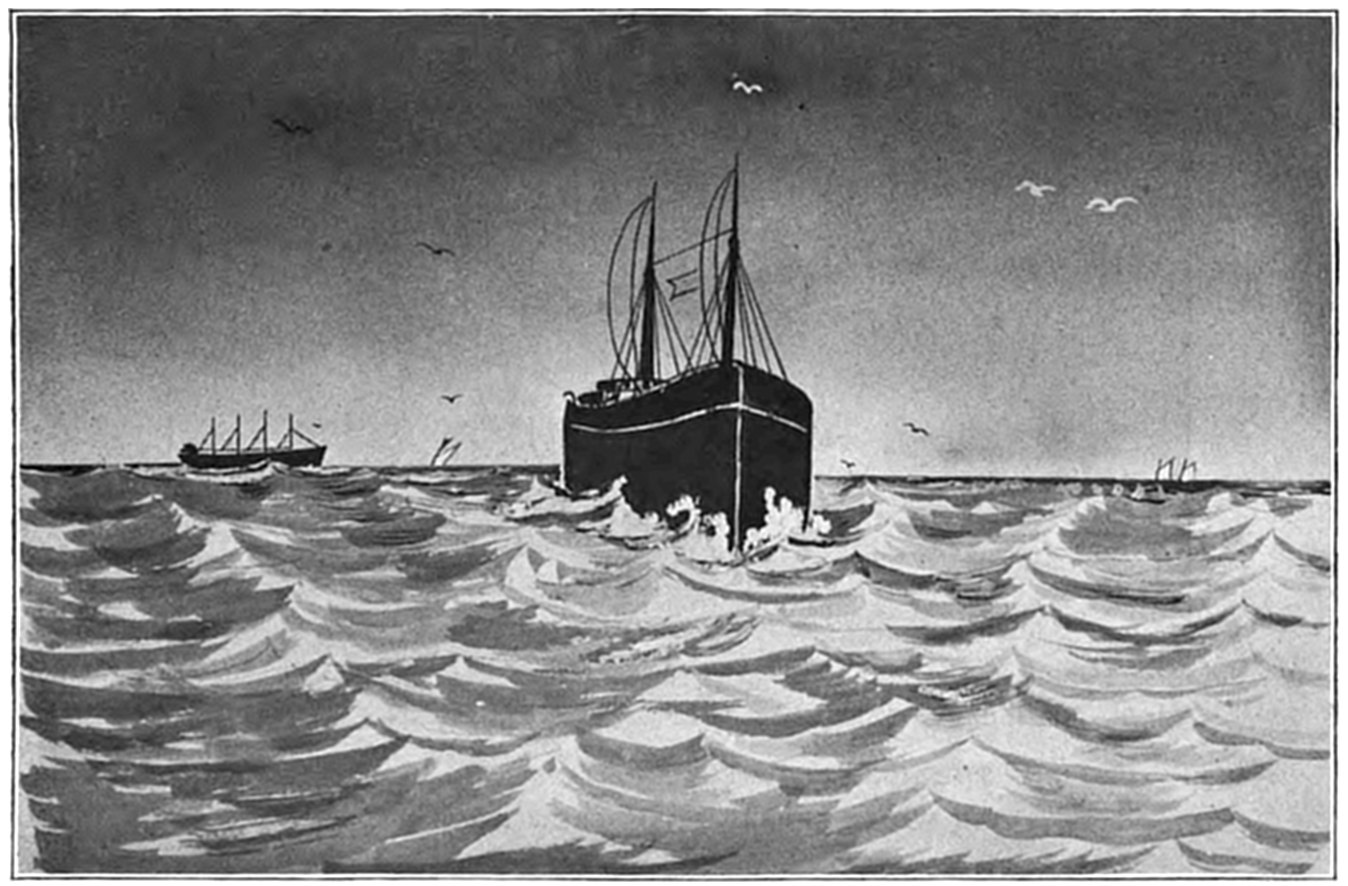
BARGES WADENA AND FITZPATRICK STRANDED ON SHOALS AT MONOMOY.
Wadena in foreground. In attempting to take an imperiled crew off the Wadena, Captain Eldredge and six of his crew of life savers perished, together with the crew of the barge, five in number. March 17, 1902.
“Upon the receipt of this inquiry Captain Eldredge, putting on his hip boots and oil clothes, set out for the end of the Point, where he could personally ascertain the conditions.
“Arriving there he found that the barge was flying a signal of distress. He at once telephoned me, as I was the No. 1 man at the station, directing me to launch the surf-boat from the inside of the beach, and with the crew pull down to the Point. About two and one-half miles south of the station we took Captain Eldredge aboard and I gave him the steering oar.
“The wind was fresh from the southeast and there was a heavy sea running, but all the crew were of the opinion that the condition of the barge Wadena was not perilous, as she seemed to be sound and lying easy.
“Captain Eldredge decided to pull around the Point to the barge. At certain places on the shoals the sea was especially rough, and some water was shipped on the way out to the distressed craft, but without any trouble we succeeded in bringing our surf-boat under the lee of the barge just abaft the forerigging, the only place where it was practical to go alongside.
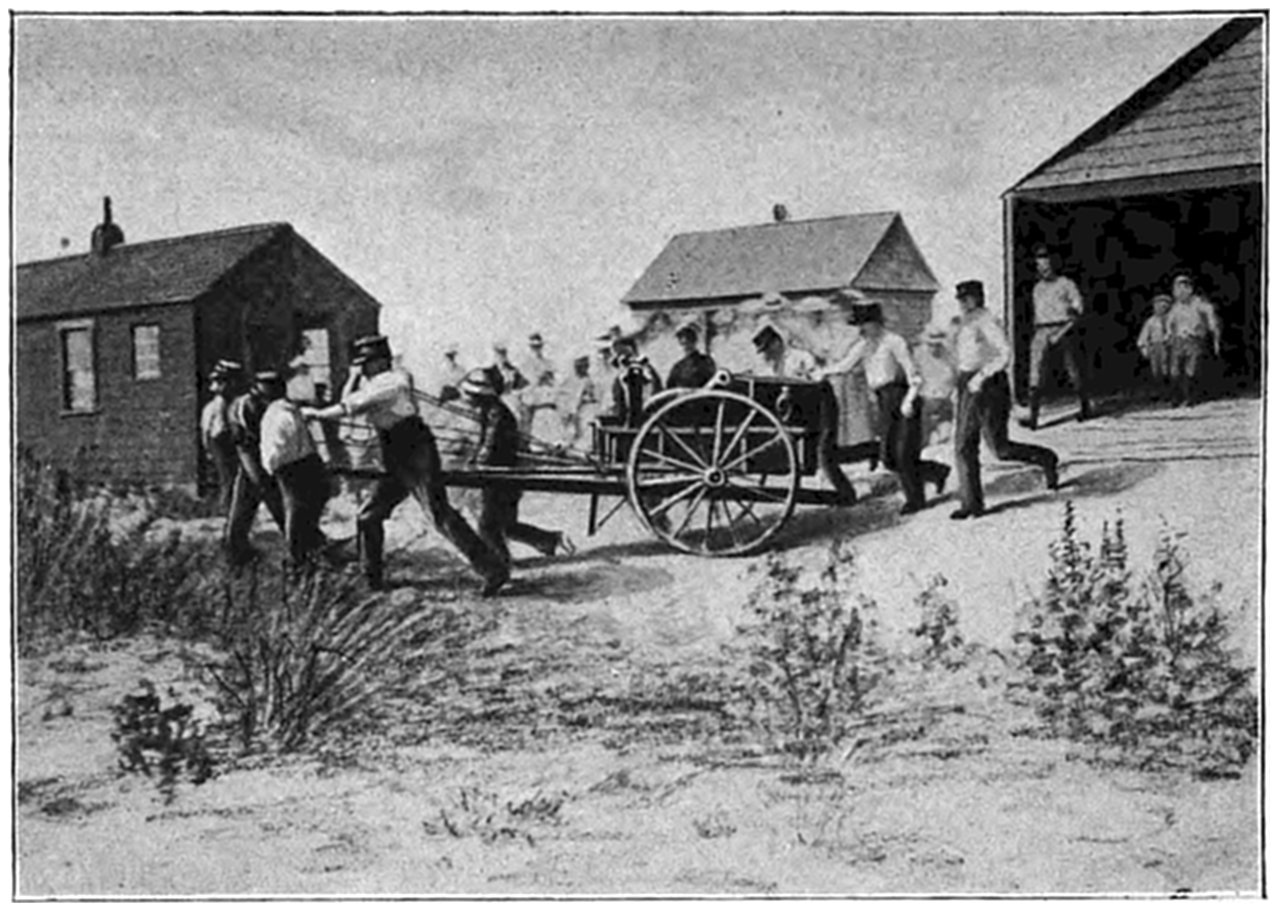
DRILL OF THE MONOMOY CREW, SHORTLY BEFORE THE DISASTER IN WHICH SEVEN OF THE CREW PERISHED.
“As soon as we got alongside the barge a line was thrown aboard and quickly made fast by the persons on board. The persons on board the barge were all excited and wanted us to take them ashore as soon as we could. Captain Eldredge, without a moment’s delay, when he found out the number of persons on board the barge and their desire to be taken ashore, directed them to get into the surf-boat.
“The seas were breaking heavily around the stern of the barge, and there was little room for operations in the smooth water, and the rail of the barge was twelve or thirteen feet above the surf-boat. Four of the five men lowered themselves over the side of the barge, one at a time, into the surf-boat, without mishap, by means of a rope, but the captain of the barge, who was a big, heavy man, let go his hold when part way down and dropped into the boat with such force as to break the after thwart. All five being safely in the boat, two were placed forward, two aft, and one amidships, and told to sit quietly and keep close down in the bottom of the boat.
“In order to get away from the barge quickly, the painter was cut, by orders of Captain Eldredge, and the surf-boat was at once shoved off. In order to clear the line of breakers that extended from the stern of the barge so that we could lay a good course for the shore, a part of the surfmen were backing hard on the port oars, while the others gave way with full power on the starboard side. Before we could get the boat turned around a big wave struck us with fearful force, and quite a lot of water poured into the surf-boat.
“Captain Eldredge stood in the stern of the boat with the steering oar in his hand giving his orders, and the surfmen stuck to their posts.
“As soon as the water came into the boat, the rescued men jumped up, and becoming panic-stricken, threw their arms about the necks of the surfmen so that none of us could use our oars. The seas, one after another, struck us, and the boat, filling with water, turned bottom up, throwing us all into the raging sea. The seas kept striking us after the boat upset, and we were soon in among the heaviest breakers. Twice we righted the boat, but the seas which struck her before we could get into her capsized her each time.
“After righting the boat twice, our strength was fast leaving us, and we all knew that we could not survive long without assistance. The five men that we had taken off the barge were the first to be swept off the overturned boat and to perish before our eyes. They did not regain a hold of the boat after she turned over the first time, and were quickly swept to death.
“All of us clung to the boat, giving each other all the encouragement that we could. Surfman Chase was the first one of our crew to perish, then Nickerson and Small were swept to death. Captain Eldredge, Surfmen Kendrick, Foye and Rogers and myself still managed to hold to the boat. Every sea which struck the boat swept completely over us, almost smothering us. Kendrick was the next one of our crew to perish, and poor Foye soon followed him. Captain Eldredge and Surfman Rogers and myself were the only ones left, and we expected that we, too, would soon share the fate of our comrades.
“Rogers was clinging to the boat about amidships, while Captain Eldredge and myself were holding on near the stern. Captain Eldredge called to me to help him to get a better hold, and I managed to pull him on to the bottom of the boat, when a sea struck us and washed us both off. I managed to regain a hold on the bottom of the boat, and looking around for Captain Eldredge, I saw that he was holding on to the spar and sail which had drifted from underneath the boat, but was still fast to it. The seas were washing me off the boat continually at this time, and when I last saw our brave captain, he was drifting away from the boat, holding on to the spar and sail.
“My strength was fast going, and when poor Rogers begged me to help him climb further up onto the boat, the only thing I could do was to tell him that we were drifting towards the beach, and that help would soon be at hand and to hold on.
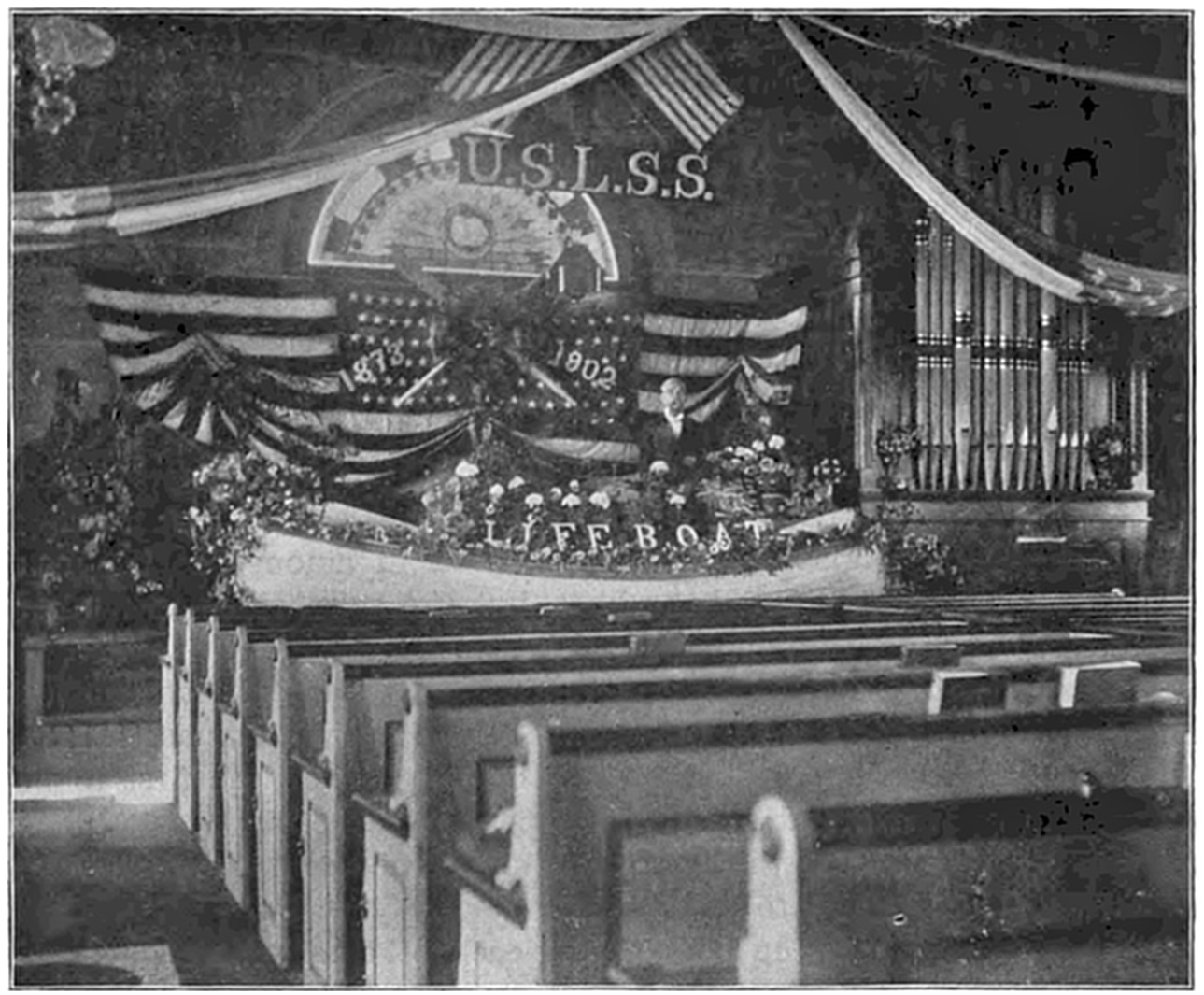
CHURCH AT ORLEANS WHERE MEMORIAL SERVICES WERE HELD FOR LOST MONOMOY CREW.
“Rogers had lost his strength, however, and failing to get a more secure place on the bottom of the boat, feebly moaning, ‘I have got to go,’ he fell off the boat and sank beneath the waters.
“I was now alone on the bottom of the boat, and seeing that the center board had slipped part way out, I managed to get hold of it, and holding it with one hand succeeded in getting my oil clothes, undercoat, vest, and boots off.
“By that time the overturned boat had drifted down over the shoals in the direction of the barge Fitzpatrick, which was also stranded on the shoals, and when I sighted the craft I waved my hand as a signal for help. I soon saw those on the barge fling a dory over the side into the water, but could see nothing more of the dory after that on account of the mist and high sea until it hove in sight with a man in it rowing towards me. The man in the dory was brave Capt. Elmer F. Mayo. He ran the dory alongside of me, and with his help I got into the boat. I was so used up that I was speechless, and all that I could do was to kneel in the bottom of the boat and hold on to the thwarts. To land in the dory through the surf was a perilous undertaking, but Mayo, who is a skilled boatman, carefully picked his way over the rips and headed his little boat for the shore.
“Surfman Bloomer of our station, who had been left ashore, had walked down to the Point to assist Captain Eldredge and crew in landing, and when he saw Mayo fighting his way through the breakers, he ran down into the surf, seized the little boat, and helped Mayo to land safely.
“Bloomer was told of the terrible tragedy by Captain Mayo, as I was unable to speak at the time. As I have often said, ‘If the persons we took off the barge had kept quiet as we told them to, all hands would have been landed in safety.’”
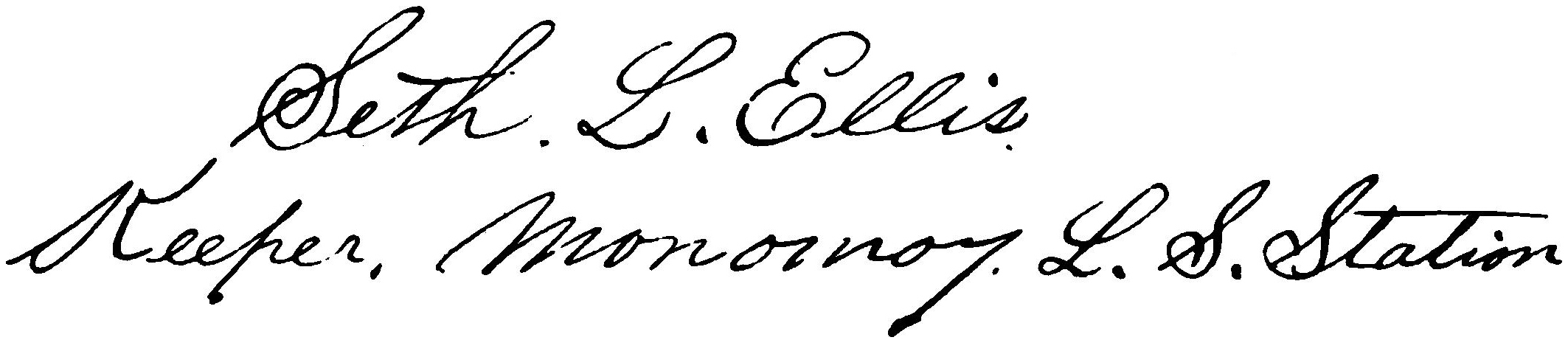
Seth L. Ellis Keeper, Monomoy L.S. Station
CAPT. ELMER F. MAYO.
Capt. Elmer F. Mayo, “The Hero of Monomoy,” was born in Chatham, and is forty years of age. From boyhood he has been a boatman, fisherman, anchor dragger, a substitute at the life-saving stations on Cape Cod, and wrecker along the shores near Monomoy, and is well accustomed to the perils and rigors incident to work of that kind.
Among the boatmen and wreckers along the Chatham and Monomoy shores he has always been regarded as an A No. 1 boatman, skilled in the art and science of handling boats in the surf, and absolutely fearless. His father was the first keeper of the Chatham Station.
Upon the discovery of gold in the Klondike region a few years ago, Mayo joined a party of prospectors, and went to the Copper River country. He remained there but a short time, returning to Cape Cod and resuming his former occupation.
At the time of the Monomoy disaster, he was on board the barge Fitzpatrick, near by the stranded barge Wadena, in company with Captain Mallows of Chatham, and the captain of the barge.
The Fitzpatrick had stranded at the time the Wadena went on the shoals, and Mayo and Mallows were aboard arranging to float the craft. They had remained on board the Fitzpatrick over night, the same as those on board the Wadena, so as to be on hand early in the morning to begin the work.
There was a small fourteen-foot dory alongside the Fitzpatrick, and the night before the fatal disaster, the wind freshening up, Mayo hauled the dory aboard, made some thole pins, and got a pair of oars ready for use should bad weather oblige them to go ashore.
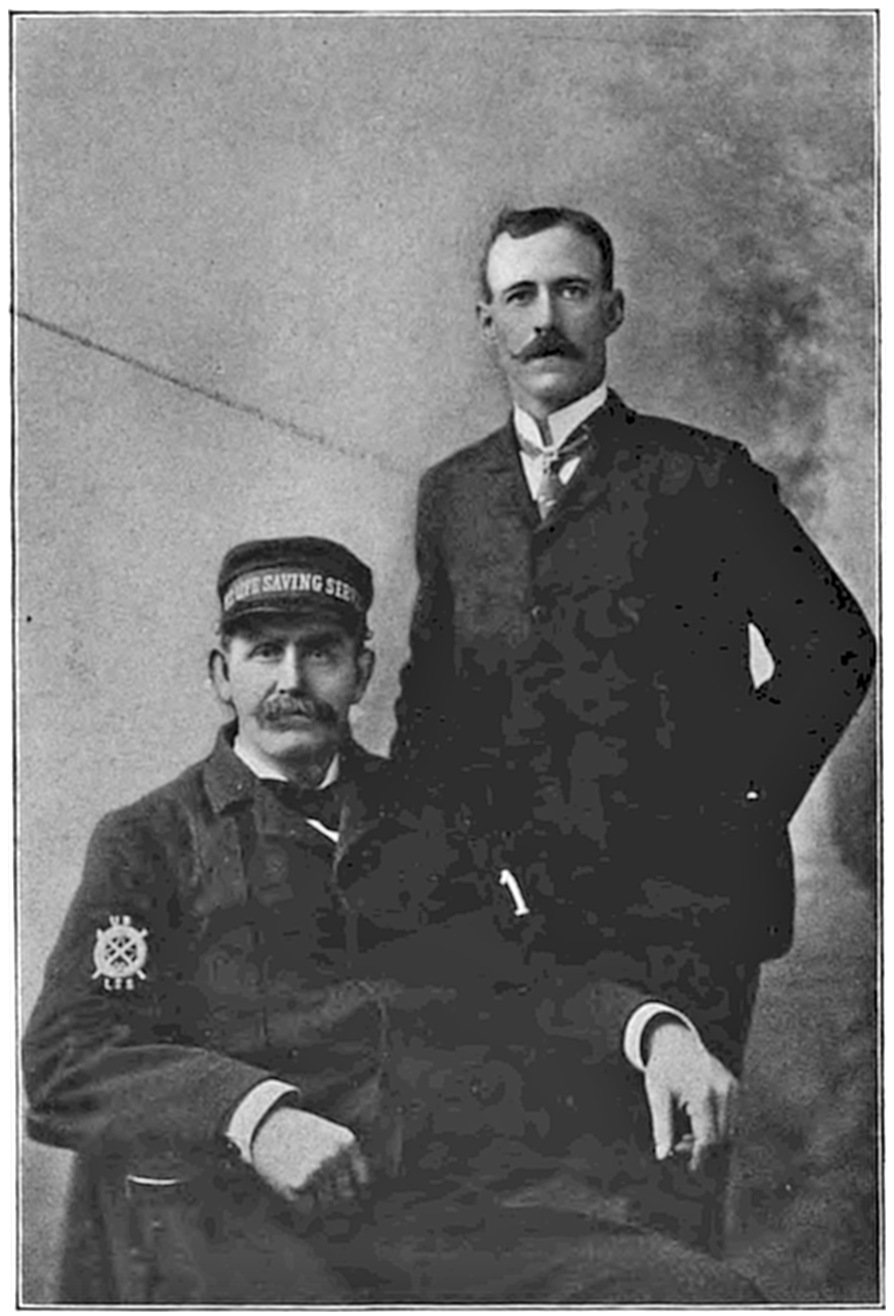
CAPT. ELMER F. MAYO, THE HERO OF MONOMOY, AND SURFMAN ELLIS, WHOM HE RESCUED.
Captain Mayo standing.
The oars were too long for the small craft, and Mayo cut a piece off each of them. The wind blew a gale during the night preceding the disaster, and there was considerable rough water around the barge the next morning. The craft was not leaking, however, and there seemed no cause for alarm. A thick fog swept in over the shoals in the morning, hiding the stranded sister barge Wadena from the view of those on the Fitzpatrick, and they were in ignorance of the fact that a signal of distress was flying in her rigging.
The first intimation that Mayo and Mallows had that a terrible tragedy had been enacted within a short distance of them was when the overturned life-boat, with the sole survivor of the Monomoy life-saving crew, Surfman Ellis, clinging to it, was seen drifting out over the shoals.
At the sight of the life-boat with a surfman clinging to it, both Mayo and Mallows knew that a terrible disaster had happened. Mayo in an instant threw off all his clothing except his underclothes, and while Mallows entreated him not to go, telling him he believed that to attempt to reach the overturned life-boat would cost him his life, Mayo grabbed the dory, threw it into the raging sea, and slid down a rope from the barge into the frail craft.
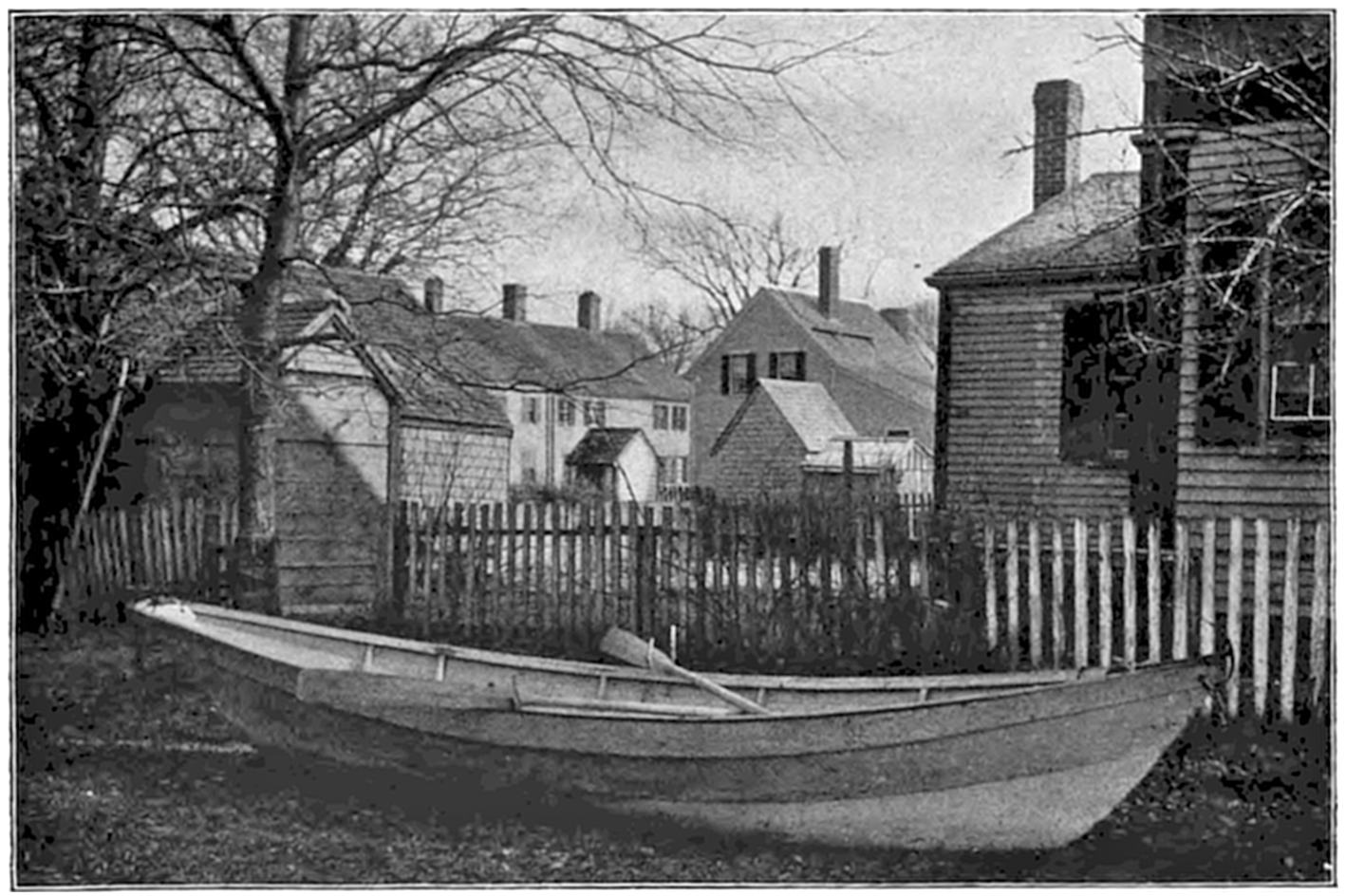
FOURTEEN-FOOT DORY USED BY CAPT. ELMER F. MAYO, IN RESCUING SURFMAN ELLIS.
With the improvised thole pins and the long oars, with handles so large that he could hardly grasp them, Mayo had a fearful struggle in preventing the dory from being swamped by the seas.
With a strong and steady stroke, and energy born of desperation, he kept the little boat head to the sea, sending her along with marvelous speed. Within a short time he was within hailing distance of the man on the bottom of the life-boat. Surfman Ellis saw the boat as it was thrown from the barge, but in the fog had lost sight of it. Mayo, however, had kept the overturned life-boat within sight all the time, and as soon as he got within hailing distance he shouted to Ellis, whom he then recognized, to hold on!
It was a hazardous task to take Ellis from the bottom of the life-boat, but both Mayo and Ellis were skilled in that kind of work, and it was successfully accomplished. To land on the beach through the surf would be attended with greater peril, but Mayo knew that Ellis must have immediate treatment, and after placing him in the bottom of the boat, he headed the dory straight for the shore. The fog still hung over the waters, and it was solely from his thorough knowledge of the waters about that region that Mayo was able to avoid the myriads of shoals and rips, and guide the boat to a point on the beach where it would be possible to land. Surfman Bloomer, of the Monomoy Station, who had walked down the beach, saw the boat headed for the beach, and running down, got there just in time to assist Mayo in landing.
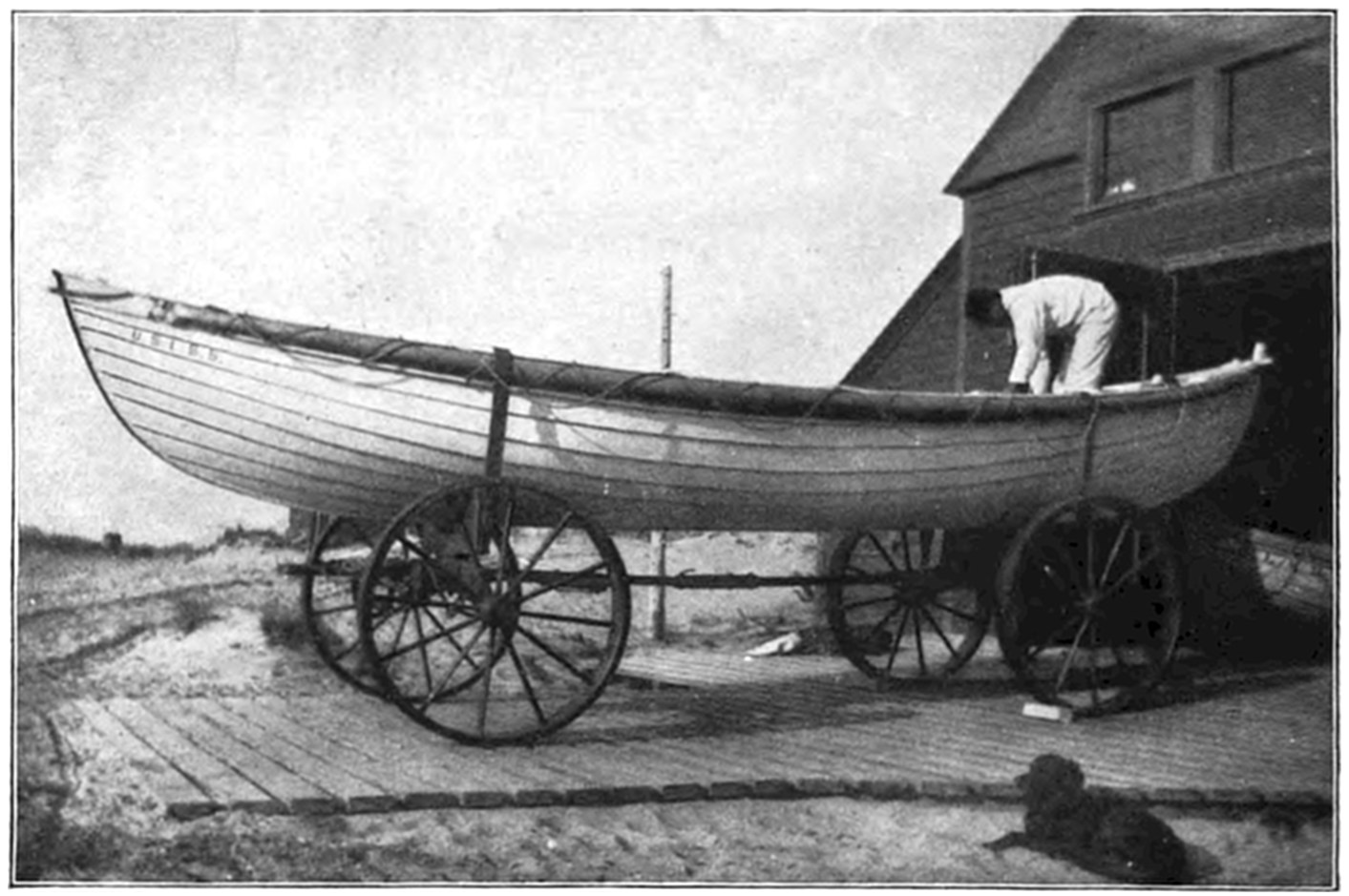
THE MONOMOY SURF-BOAT.
Both the United States Government and the Massachusetts Humane Society recognized this great heroic act of Captain Mayo, and awarded him medals. The committee having charge of the Monomoy Fund also presented him with a portion of the money received by them, in recognition of his heroism in rescuing Surfman Ellis from a watery grave.
Captain Mayo married Mrs. Priscilla Nye.
The late Capt. Isaac Green Fisher, keeper of the Wood End Station, was born in Truro in 1838, and was the son of Caleb and Mary G. Fisher, of that town. For twenty years he was keeper of the Peaked Hill Bars and Wood End Life-Saving stations, and was known the country over as a wondrous surf-fighter and saver of human life. Prior to his entering the life-saving service he had been engaged in whaling for a number of years, and won distinction in that skilled work by his fearlessness and marvelous dexterity with the steering oar.
As keeper of the dangerous Peaked Hill Bars Station, Captain Fisher rescued hundreds of shipwrecked seafarers, and assisted a countless number of stranded crafts to places of safety. He also assisted at nearly all the wrecks that took place at the stations along the back of the Cape, adjoining the Peaked Hill Bars Station.
He was retired from the service at his own request on account of physical disability, June 14, 1901, and died September 18 following.
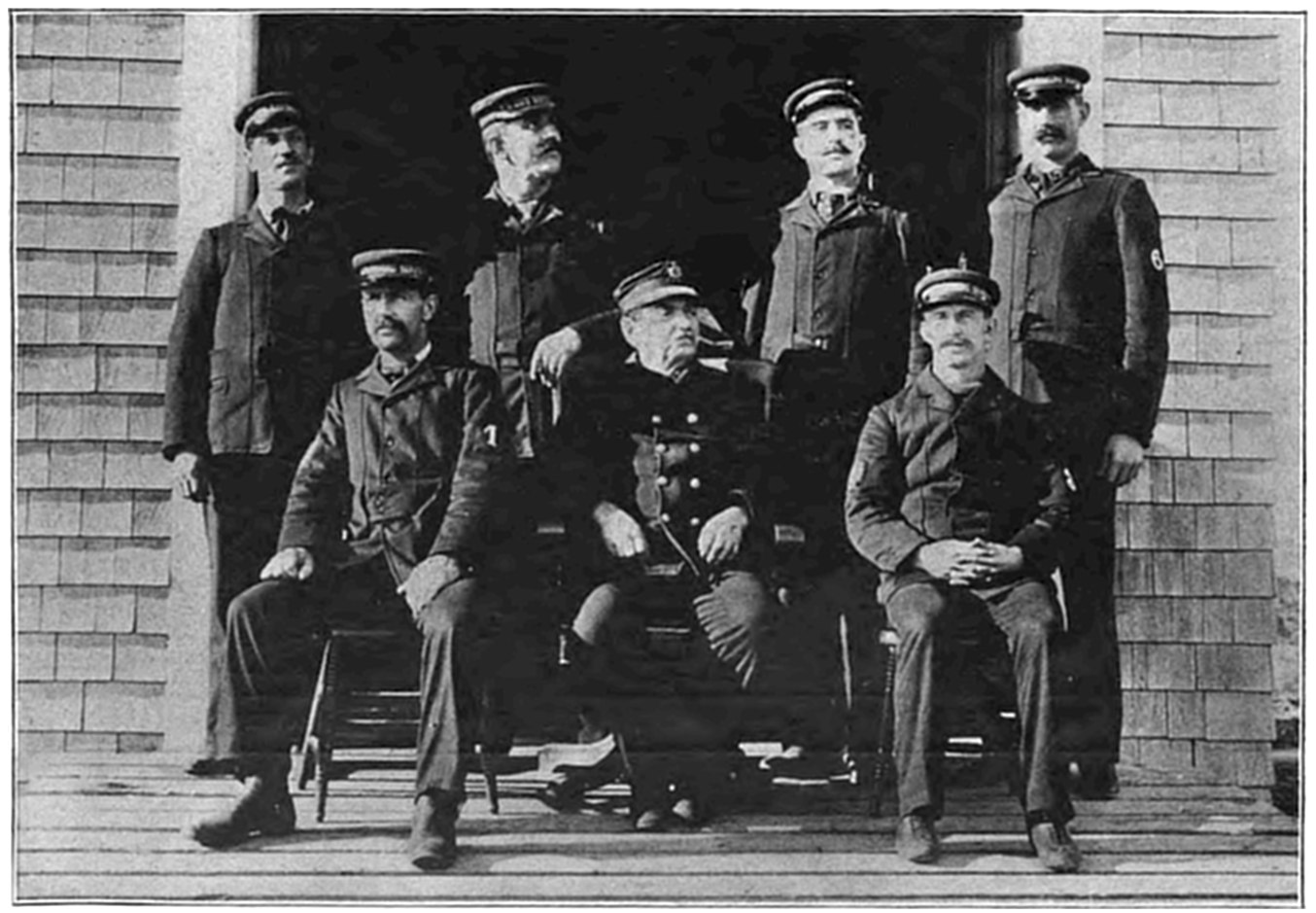
THE LATE CAPT. ISAAC G. FISHER AND HIS CREW OF SURF FIGHTERS.
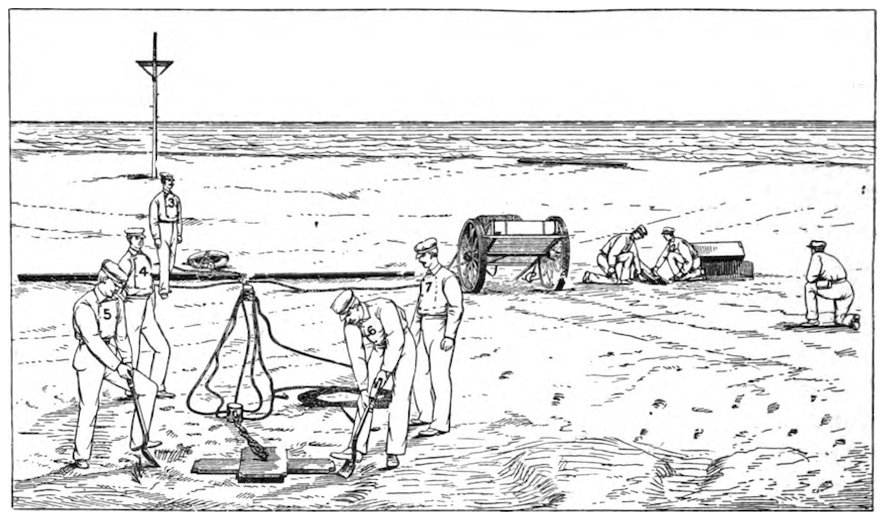
RELATIVE POSITIONS OF MEN WHILE PLACING APPARATUS.
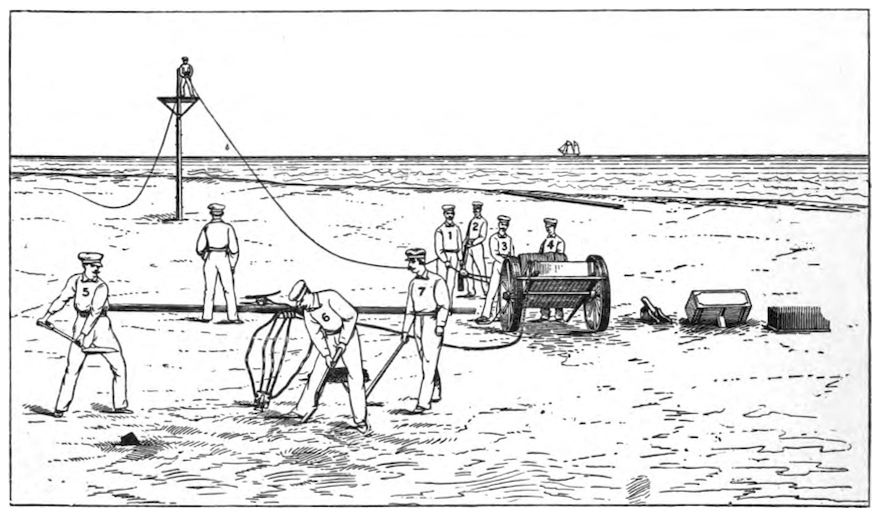
POSITION OF LIFE SAVERS WHEN SHOT LINE IS BENT TO WHIP.
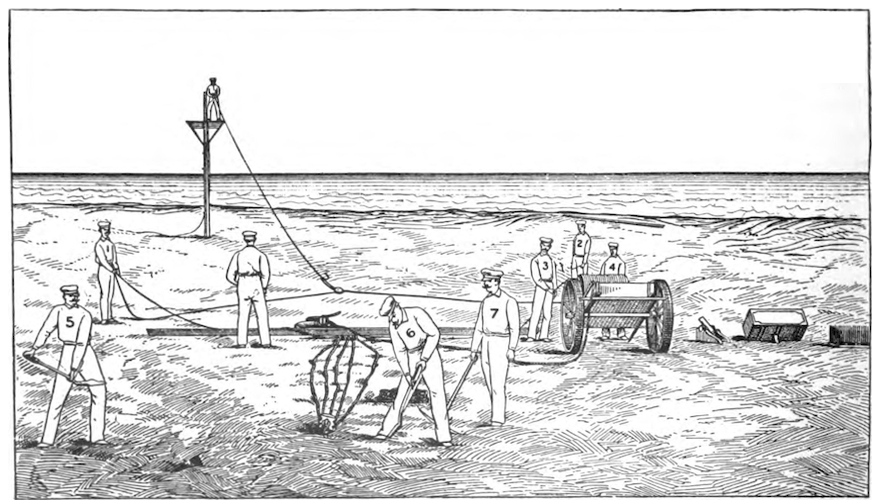
HAULING OFF WHIP.
FULL CREW OF LIFE SAVERS PRACTICING WITH BREECHES-BUOY.
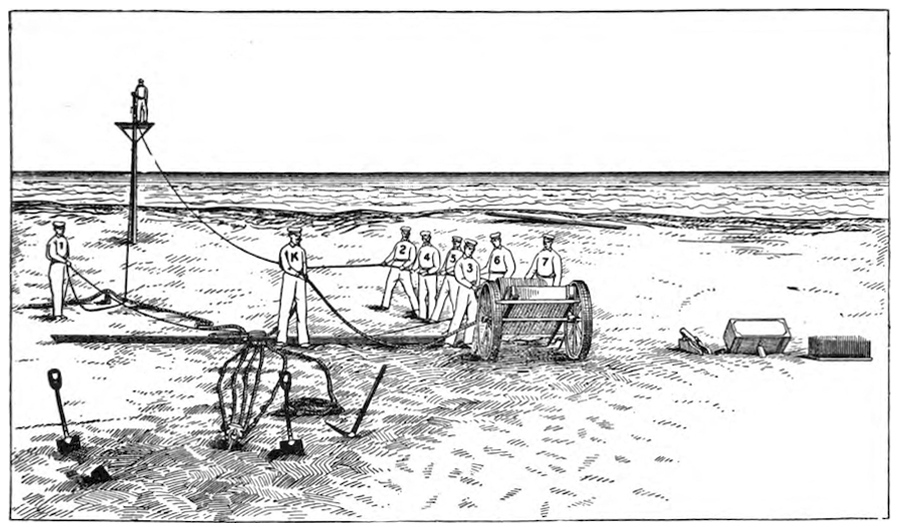
HAULING OFF THE HAWSER.
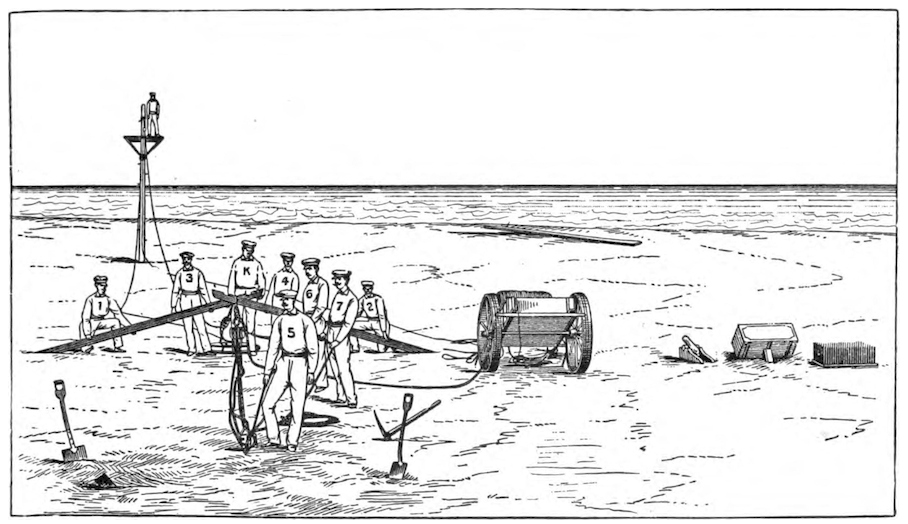
RAISING THE CROTCH.
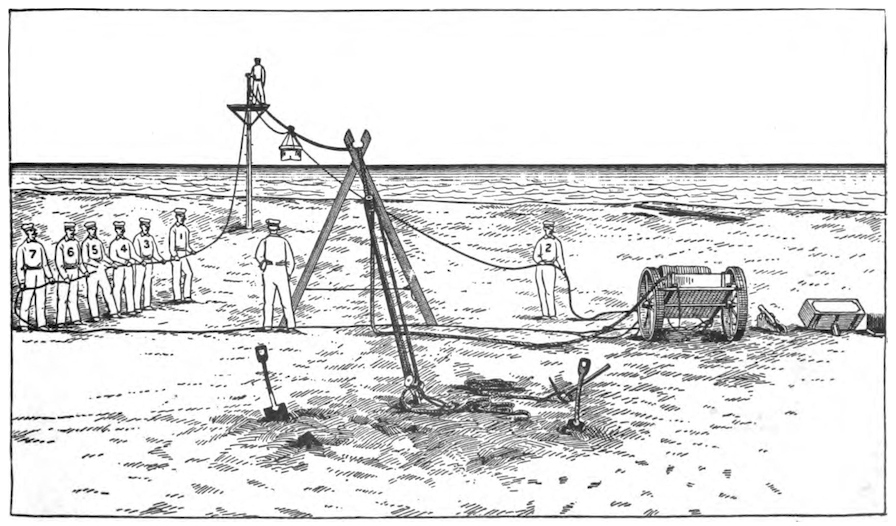
MAN THE LEE WHIP. HAUL OFF.
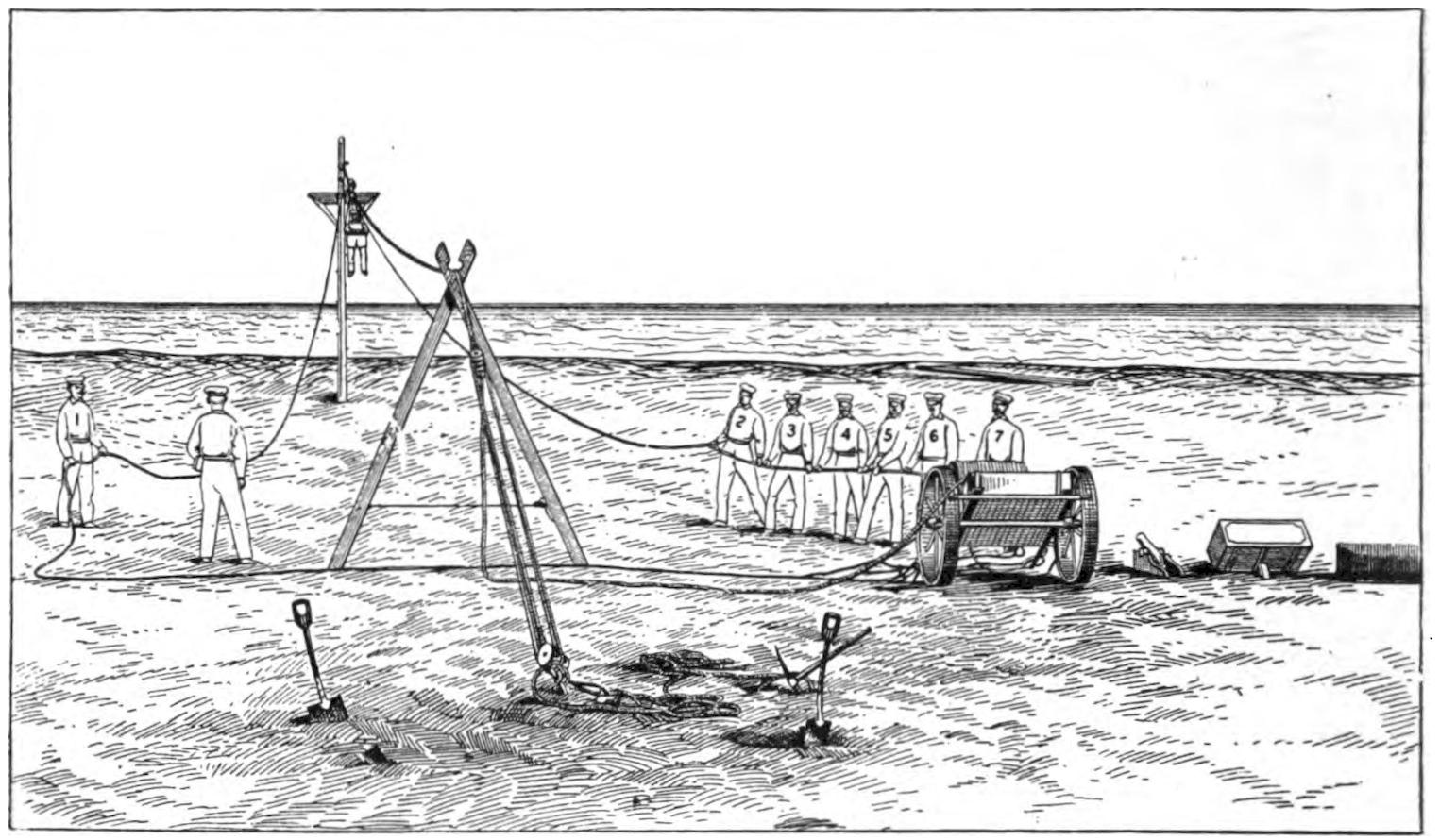
MAN WEATHER WHIP. HAUL ASHORE.
In Memoriam.
To the memory of the heroes who gave up their lives in their devotion to duty.
Capt. Marshall N. Eldredge. Surfman Elijah Kendrick. Surfman Isaac T. Foy. Surfman Valentine D. Nickerson. Surfman Osborne Chase. Surfman Edgar C. Small. Surfman Arthur Rogers.
—Monomoy, March 17, 1902.
Capt. David H. Atkins. Surfman Frank Mayo. Surfman Elisha Taylor.
—Peaked Hill Bars, Nov. 30, 1880.
HORACE S. CROWELL, Dealer, Broker, and Agent SEASHORE ESTATES 216 Washington St., S. Cor. State St., Boston. Telephone 1290 Main. W. U. Cable Address, “Crowe.”
DEVELOPMENT, IMPROVEMENT, AND CARE OF ESTATES A SPECIALTY.
* * * * *
OPEN DURING SUMMER SEASON SMALL’S PHOTOGRAPHIC STUDIO BUZZARD’S BAY, MASS. Artistic Photographs in Platinum NOVELTIES Carbon Photographs on Wood, Leather, Porcelain, and Glass TELEPHONE CONNECTIONS
* * * * *
JOHN ADAMS Staple and Fancy Groceries Meats and Provisions COMMERCIAL STREET PROVINCETOWN, MASS.
* * * * *
CAMPBELL’S Livery and Boarding Stable CARRIAGES FOR ALL OCCASIONS We furnish careful drivers to accompany tourists to the Life-Saving Stations and all other points of interest CONNECTED BY TELEPHONE PROVINCETOWN, MASS.
* * * * *
HOTEL ARAGON MIDDLEBORO, MASS. Heated by Steam Electric Lights Guests are assured of every Comfort and Convenience J. H. DALTON, Manager
* * * * *
Eldredge Bros. LIVERY AND BOARDING STABLE ORLEANS, MASS. We furnish carriages for all occasions. Tourists taken to the Life-Saving Stations and all places of interest. CONNECTED BY LONG DISTANCE TELEPHONE
* * * * *
“The Eagleston Shop” HYANNIS, MASS. Furniture and Fitments China, Pottery and Rugs For Summer Homes HYANNIS, MASS.
* * * * *
HOTEL PILGRIM PLYMOUTH, MASS. Remodeled and Refurnished by New Owners Will Open June 10, 1903
Improvements made this year include:
Enlargement of Office
Enlargement of Dining Room
New Music Hall, Open Fireplace
New Private and Public Baths
New Ladies’ Lavatory
New Plumbing throughout
Electric Lights
New Billiard and Amusement Parlors
New Carpets and Furniture
New Porte Cochere
New Sun Parlor
New Bath Houses on the Beach
New Landing Float for Boats
Sail Boats, Experienced Skippers
Row Boats
Fishing Facilities
A Good Stable
THE TABLE AND SERVICE WILL BE OF A HIGH ORDER Our Illustrated Circular will be mailed on application
Address, A. B. DAVIS, Manager
N. B. Until June 1 the manager may be seen on Saturdays from 9 a. m. to 4 p. m. at International Hotel and Tourist Bureau, 147 Summer Street, Boston.
* * * * *
ATLANTIC HOUSE FRANK SMITH, Prop’r Masonic Court, off Commercial Street PROVINCETOWN, MASS. OPEN ALL THE YEAR
* * * * *
Huyler’s Chocolates.
Cigars, Imported and Domestic.
ADAMS, Pharmacist, Opposite Post Office, Provincetown, Mass.
Prescriptions a Specialty.
Ice-cold Soda, Fruit Flavors.
The Up-to-date Pharmacy.
* * * * *
HEATED BY STEAM LIGHTED BY GAS
IYANOUGH HOUSE HYANNIS, MASS. T. H. SOULE, Jr., Prop’r FIRST-CLASS LIVERY STABLE CONNECTED
* * * * *
S. L. HAMLIN Staple and Fancy Groceries
THE LARGEST STORE AND THE LARGEST STOCK OF GROCERIES ON CAPE COD
FALMOUTH, MASS.
Branch Stores at Falmouth Heights and Teaticket
* * * * *
BOSTON BRANCH CLOTHING STORE Clothiers, Hatters, and Outfitters For Ladies, Gentlemen, Misses, and Children.
SATISFACTION GUARANTEED or money refunded.
BOSTON BRANCH CLOTHING STORE,
JOHN S. ARENOVSKI, Proprietor and Manager,
Main Street, Falmouth, Mass.
* * * * *
John H. Crocker DEALER IN SEASHORE ESTATES FALMOUTH, MASS.
Grower of choice Cape Cod CRANBERRIES
* * * * *
Patronize the Boston and Hyannis Express
Forwarders of goods of all descriptions to all points in the United States at the lowest rates.
DAILY MESSENGER FROM HYANNIS TO BOSTON.
We are better prepared than any other express to handle Household Goods, Groceries, Lumber, Boats, and heavy goods at low rates for Hyannis, Hyannisport, Sea Side Park, Craigville, Centreville, Osterville, Hyannis Park, West Yarmouth, Englewood Beach, and South Yarmouth.
General Office, 105 Arch Street, Boston.
Telephone Main 906. W. F. ORMSBY, Manager.
* * * * *
ORMSBY’S TRANSFER
Furnishes the carriage service at Hyannis station for carrying passengers and baggage in Hyannis or to any of the nearby summer resorts.
Regular Mail Carriage to Hyannisport.
Special Carriages or Hacks when ordered.
W. F. ORMSBY, Proprietor.
Telephone Connection. HYANNIS, MASS.