Front matter (continued 2)
Reading edition
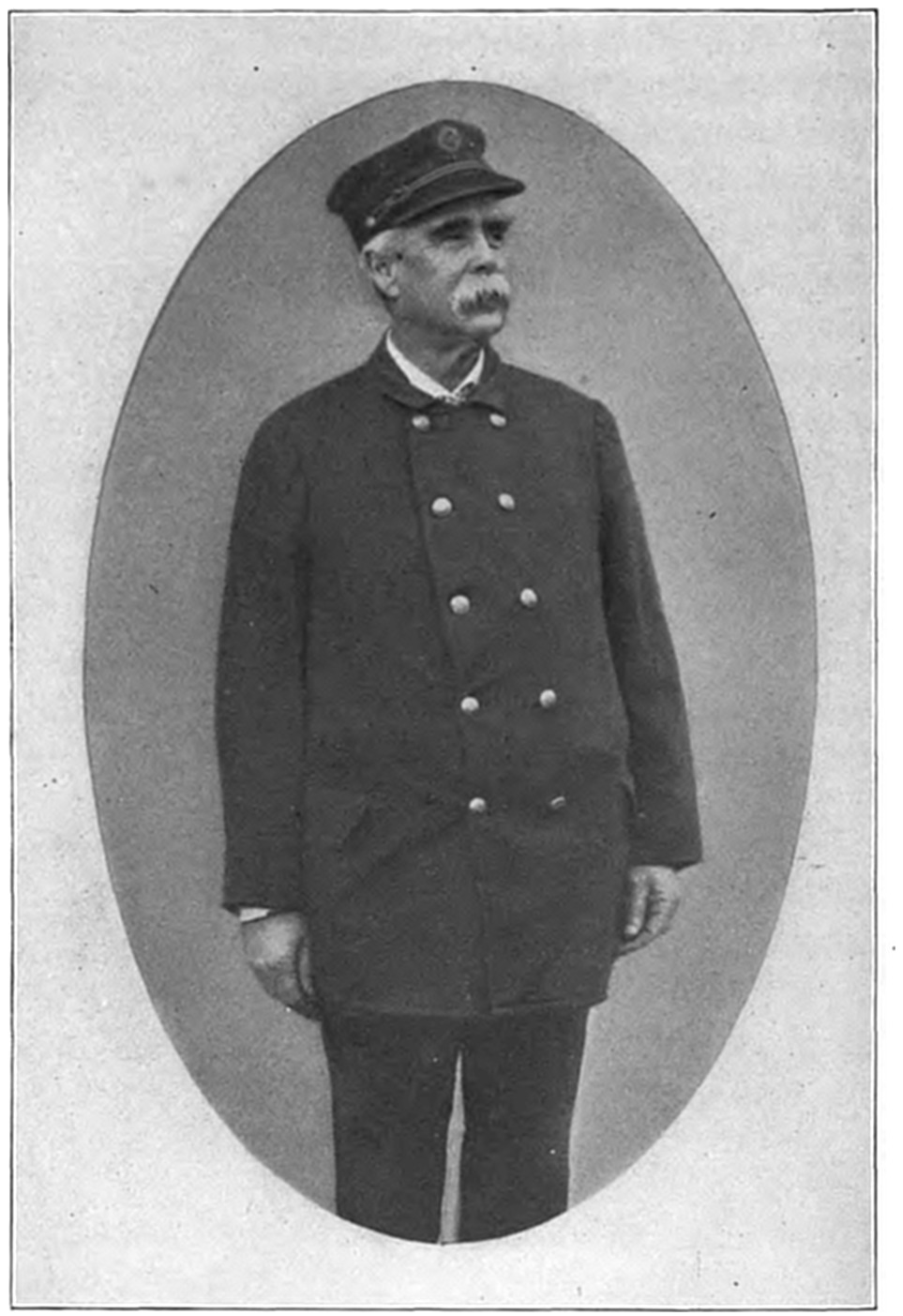
CAPT. DANIEL COLE, CAHOON’S HOLLOW STATION.
Captain Cole, in addition to being a veteran life saver, is also a veteran of the Civil War. When a boy hardly nine years of age he went to sea, his first trip being to the Grand Banks on a vessel that sailed from Cape Cod. He continued to go to the Grand Banks year after year until he went to the West, and engaged in trading on the Great Lakes. He was a trader on the lakes when the war broke out. He was but nineteen years of age, but of fine physique, strong, healthy, appeared much older, and was readily accepted in the 12th Illinois Regiment, Company K, Second Brigade, 15th Army Corps, and was soon on his way to the front. He participated in numerous engagements, and was with Sherman on his “march to the sea.” When his term of enlistment expired he was discharged, at Louisville, Ky., and at once returned to his home on Cape Cod. He again went fishing to the Banks, continuing until the life-saving service was extended to Cape Cod, when he was prevailed upon to join the new crew at Cahoon’s Hollow. He continued to serve as a surfman for a number of years, joining the station crew at the close of each fishing season. One year, while he was master of a fishing vessel, he remained out of the service. The following season he joined the station when the crew went on duty, and has been at the station continuously since that time. William Newcombe, who was placed in charge of the station when it was manned, resigned after a few years, and Captain Cole was placed in command. As a surfman, Captain Cole had shown rare judgment and exceptional skill in the work of saving life and property, and his promotion to keeper of such an important station was a merited reward. He has made an enviable record as a life saver since keeper, but one life having been lost within the patrol of his station since he took charge. Disasters are frequent along the shore near his station, and the crew have made many heroic rescues, and had numerous thrilling escapes in devotion to their duty. One of the worst wrecks that have occurred within the province of the station happened on Dec. 31, 1890, when the schooner Smuggler became a total loss. The vessel struck during a furious gale, and was discovered by one of the surfmen about four o’clock in the morning. Running to the station, a distance of about two miles, the surfman aroused the keeper and crew, and all hands started for the wreck in the teeth of the gale, with the beach apparatus in a wagon drawn by the station horse. The whirlwinds of sand sweeping along the shore blinded the men, and the horse at times refused to go. After much hardship, but with little delay, Captain Cole and his crew reached the scene. The fifteen men, the crew of the vessel, had been driven into the rigging, and the craft was fast breaking up and moving along the shore. With great despatch a shot was fired over the vessel, the breeches-buoy was put in working order, and the men pulled through the surf from the stranded vessel to the shore. The life savers suffered terribly from the cold, and the rescued crew were nearly dead when they reached the shore. As the last man was pulled out of the surf, the vessel went to pieces, not a vestige being left to mark the spot where the disaster took place.
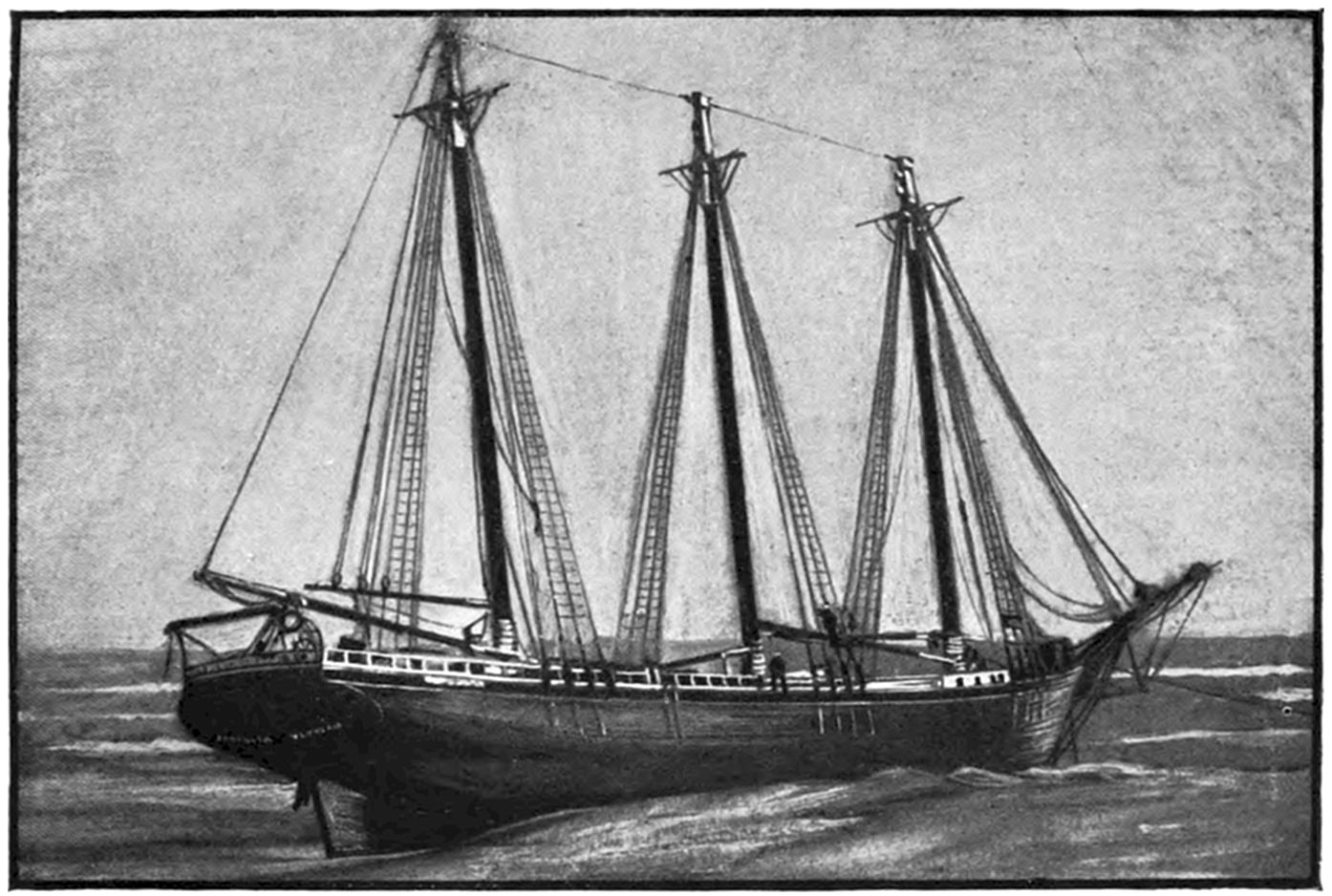
PANCHITA, DRIVEN ASHORE AT PROVINCETOWN.
Captain Cole maintains a high standard of efficiency and discipline at his station, and has a crew of fearless and skilled life savers. Captain Cole married Harriet Blodget, and is the father of two sons. He is a member of the J. C. Freeman Post, G. A. R., No. 55, of Provincetown, the Surfmen’s Mutual Benefit Association, the Royal Arcanum, and the Adams Lodge, F. A. M.
CAHOON’S HOLLOW STATION CREW.
The No. 1 surfman is Freeman W. Atwood. He was born in Wellfleet in 1846, and has been in the life-saving service for twenty-five years, all of which have been at this station. Before entering the service Surfman Atwood was a fisherman and coastwise sailor. He went to sea when a boy, and from his long experience as a fisherman and sailor along the shores of the Cape was well prepared for the work of a life saver. In all his years of experience he has never met with serious mishap. He has seen much hardship as a member of this crew and can be relied upon to unflinchingly face the greatest perils in the performance of his duty. He married Lucy N. Rich, and is the father of three boys.
The No. 2 surfman is Eugene O. Young. He was born in Yarmouth Port and is forty-nine years of age. Surfman Young has been a life saver for nineteen years, joining this station when he entered the service. He was a boatman, fisherman, and coastwise sailor before entering the service, and has made a valued member of the station crew, as he is a tried and true life saver. Surfman Young has assisted at all the wrecks that have taken place at the station during his term of service, and has suffered much hardship and had many perilous adventures within that period. He married Susan A. Rich, and has a family of two girls and one boy.
The No. 3 surfman is Edward Lombard. He was born in Truro in 1865, and has been in the life-saving service for twelve years, three at the Pamet River Station, the remaining nine at this station. Surfman Lombard was a fisherman and boatman before he entered the service. He saw much active service while a member of the Pamet River Station, and has always proven himself a brave and skilled life saver. He married Nellie Howes, and has a family of four boys.
The No. 4 surfman is Stanley M. Fisher. He was born in Nantucket in 1877, and is serving his first year as a life saver. Surfman Fisher, after spending a few years as a boatman and fisherman along the shores of Nantucket, went to Texas, where he worked on a stock ranch. Tiring of this kind of a life, he enlisted in the regular army, Company K, Sixth Regiment, and went with his regiment to the Philippine Islands, remaining there until the expiration of his term of service. Fisher, with his regiment, was stationed on Negroes Island for one year, and also at Panay for a year. He took part in six hot battles and several minor engagements with the Philippines, but escaped without the slightest injury. He was a member of a volunteer crew which rescued a crew from a sunken vessel in Vineyard Haven Harbor during the gale of November, 1898, receiving gold and silver medals as a recognition of his bravery.
Fisher is an expert boatman, and under the guidance of Captain Cole he cannot fail to become an able and skilful life saver.
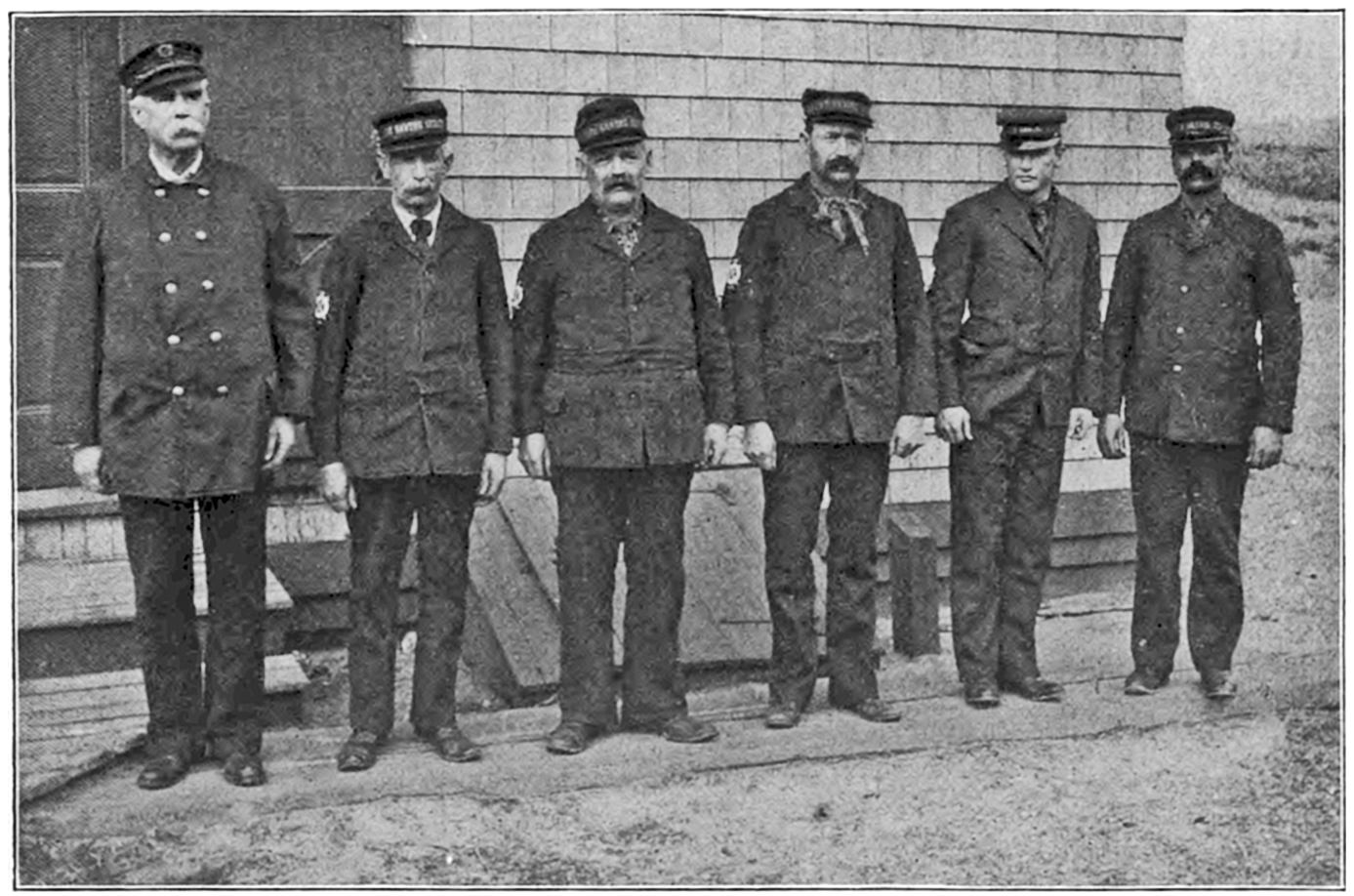
Left to right: CAPTAIN COLE. FREEMAN W. ATWOOD. EUGENE O. YOUNG. EDWARD LOMBARD. STANLEY M. FISHER. JAMES LOPES.
CAHOON’S HOLLOW CREW.
The No. 5 surfman is James Lopes. He was born in Provincetown in 1866, and is serving his first year as a life saver, having joined the crew at this station in August, 1902. Prior to his joining the service he was a boat fisherman along the shores of the Cape. He was a member of a volunteer crew which rescued a crew from a vessel wrecked in Provincetown Harbor during the November gale of 1898, and received a medal in recognition of his bravery. He had a wide experience in boating and is possessed of the qualities necessary to make an able life saver. He married Minnie Rogers, and is the father of one child, a daughter.
The No. 6 surfman is Clarence L. Burch. He was born in Provincetown in 1875. Surfman Burch is a new man in the service, having joined in the service in December, 1902. He had been a boatman and fisherman along the shores of the Cape for a number of years, and also a coastwise sailor. He went with a party of prospectors to the Klondike gold region, but remained there a short time, returning to Cape Cod to engage in fishing. He is skilled in the art of managing boats in all kinds of weather, and well qualified for the work of a life saver. He married Dorothy McKenzie, and is the father of two girls.
The No. 7 surfman is Charles H. Jennings. He was born in Provincetown in 1878, and is serving his first year as a regular surfman. Surfman Jennings was a fisherman and boatman before he entered the service, and had also substituted as a surfman at the High Head Station, under Captain Kelley. He will receive careful training under Captain Cole, and will, no doubt, make a skilled and fearless life saver. He married Edith J. Rogers.
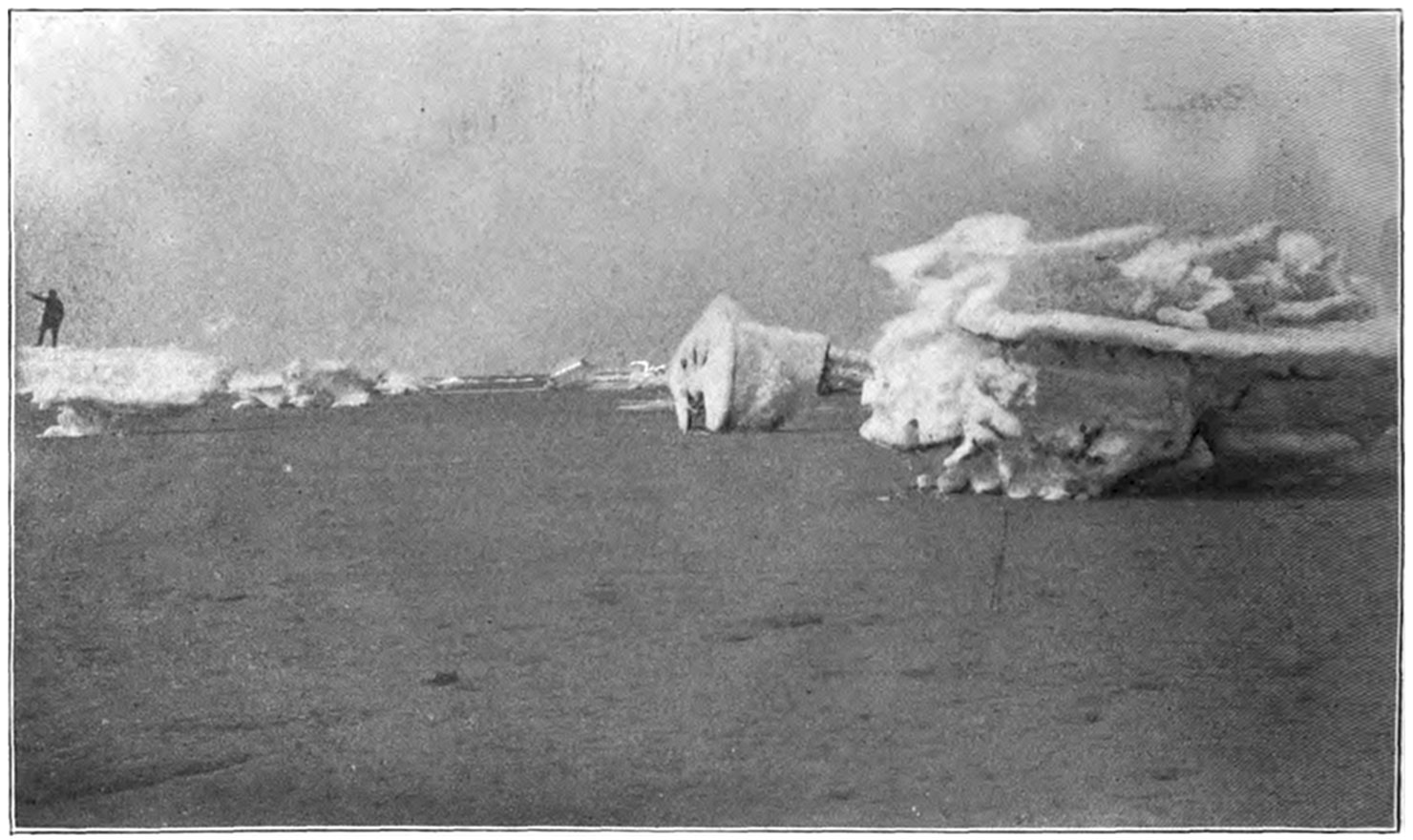
ICEBERGS ALONG THE SHORE AT PEAKED HILL.
PEAKED HILL BARS STATION.
The Peaked Hill Bars Station is another of the original nine stations which were erected on Cape Cod in 1872. A more bleak or dangerous stretch of coast can hardly be found in the United States than at this station. The coast near the station rightly bears the name “Ocean Graveyard.” Sunken rips stretch far out under the sea at this place, ever ready to grasp the keels of the ships that sail down upon them, and many appalling disasters have taken place there. There are two lines of bars that lie submerged off the shore at Peaked Hill Bars Station, the outer and inner bars they are called. They run parallel with the coast line for a distance of about six miles. The outer bars lie about fourteen hundred yards offshore, the inner bars about six hundred. These bars are ever shifting, and the depth of water on them varies in accordance. It is not often that vessels are wrecked on the outer bars, although they often strike there and are driven over them only to meet with destruction on the inner bars. The surfmen of this station have a patrol of about two miles east and west, meeting and exchanging checks on the westward patrol with the surfmen from Race Point Station on the eastward with the surfmen of the High Head Station.
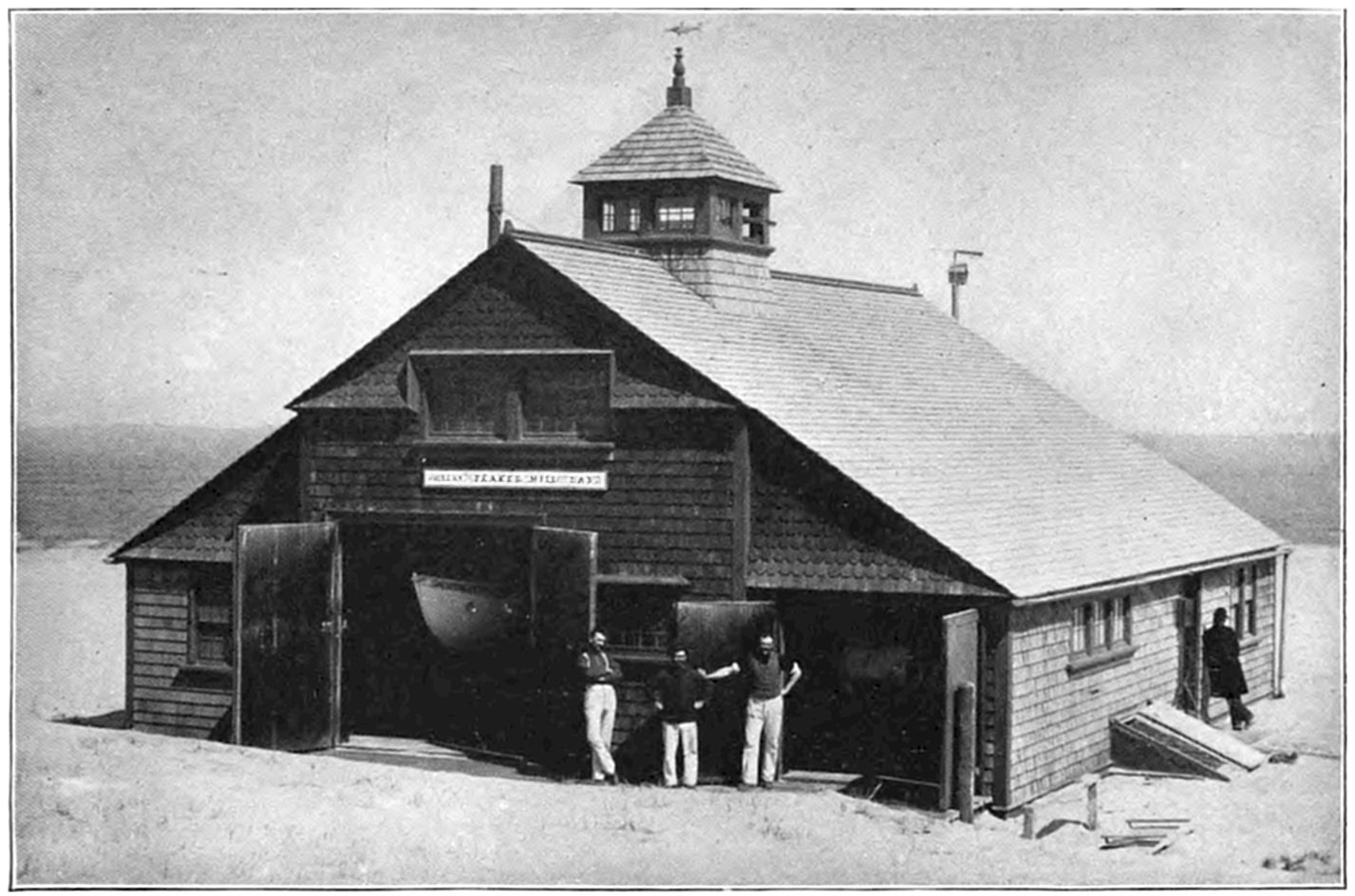
PEAKED HILL BARS STATION.
When the station was erected there was a long stretch of low beach between it and the shore, but now sand dunes made by the action of the wind shut off all view of the ocean except from the lookout tower on the station. It is at this station that the effect of the flying sand upon the glass in the windows is plainly seen, the whirlwinds of sand having made them as rough as if they had been dipped in acid, and almost shutting out the light of day. This effect of the sand in destroying the transparency of the window-panes is an object of curiosity and never-failing wonder to visitors. On the bluff overlooking the ocean the crew have erected a small building, where the day watches keep a lookout and members of the crew spend some of their leisure moments.
The station is located two and one-half miles east of Provincetown village, and its approximate position as obtained from the latest coast survey charts is latitude north 42° 04′ 40″, longitude 70° 09′ 50″. From Provincetown the road to the station crosses the great sand deserts for which that region is noted.
This station is supplied with two surf-boats, one four oared, the other five, two sets of beach apparatus, breeches-buoys, guns, etc., and a practice boat.
Captain Cook and his crew of the Peaked Hill Bars Station have taken twenty-five persons ashore in their surf-boat, and one in the breeches-buoy since Captain Cook assumed charge of the station. The following vessels, which struck on the Peaked Hill Bars, became a total loss: Willie H. Higgins, Albert L. Butler, Cathie C. Berry, Kate L. Robinson, and Jennie C. May.
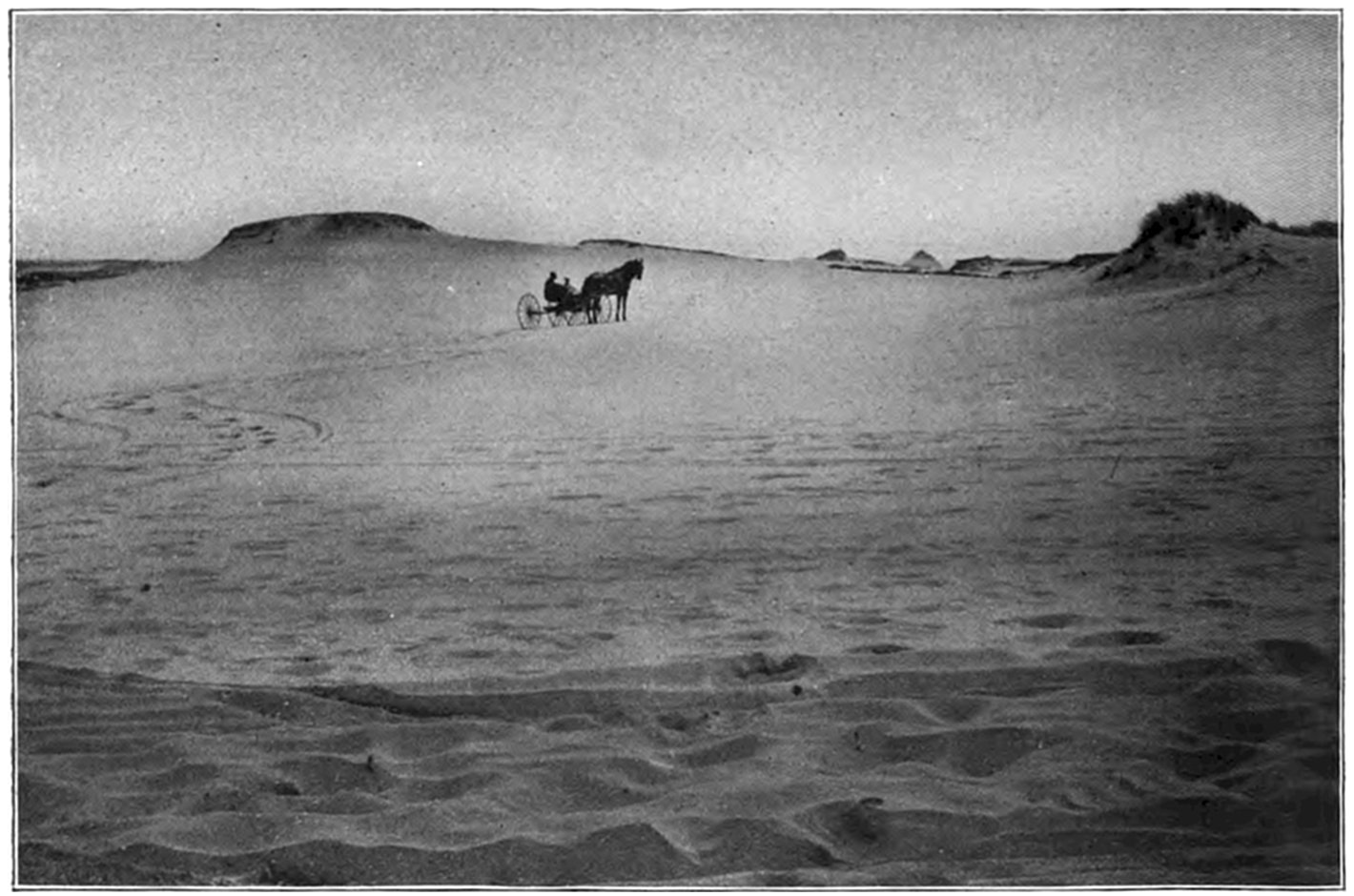
THE SAND DUNES ON THE WAY TO PEAKED HILL BARS STATION.
Seven men and one woman were taken ashore from the Higgins. The captain and one sailor were washed ashore from the schooner Albert L. Butler, which was wrecked during the memorable November gale of ’98, and one man was taken off by the breeches-buoy, while two others were taken ashore after the tide went down.
The schooner Cathie Berry stranded during a terrific gale. The life savers launched their boat and went to her only to find her abandoned. The schooner Helen came ashore during a bad time; the life savers went to her in their boat, but none of the crew came ashore.
The schooner Kate L. Robinson carried a crew of seven men, and all were rescued by Captain Cook and his crew in their surf-boat. The crew of the Theta, seven in number, together with a woman passenger, were also taken ashore in the surf-boat, as were two members of the crew of the Jennie C. May.
CAPTAIN COOK. PEAKED HILL BARS.
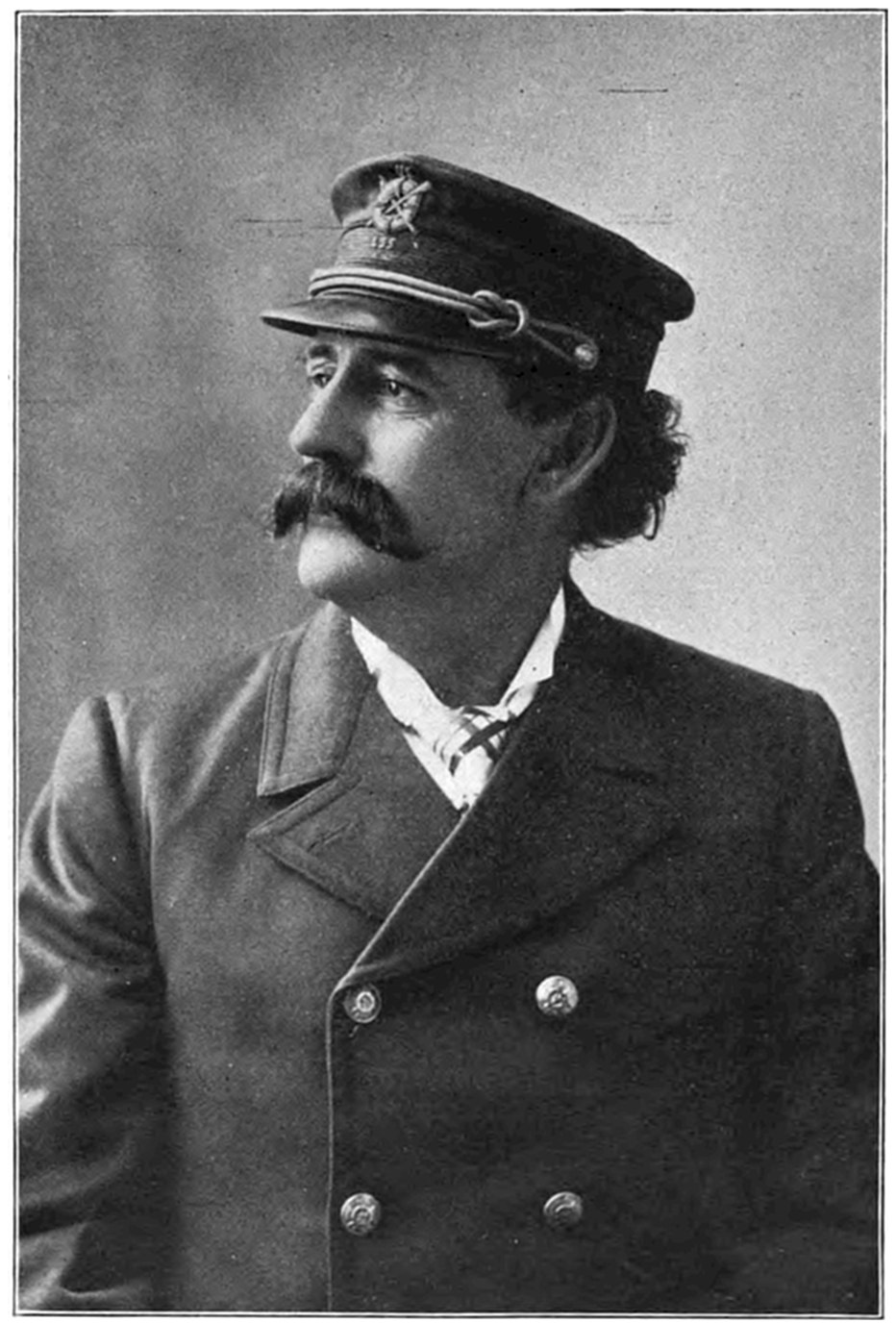
CAPT. WILLIAM W. COOK, KEEPER OF PEAKED HILL BARS STATION.
Capt. William W. Cook, keeper of the Peaked Hill Bars Station, one of the most dangerous of all, was born in Provincetown, within sight of his station, Nov. 3, 1852. He has been in the life-saving service for twenty years, fourteen years as a surfman and six as keeper at this station. When a boy he evidenced great love for boats, and after leaving school, until he entered the life-saving service, he spent nearly all his time at sea. He was first in the merchant service, but later joined the fleet of whaling vessels that cruised on the north and south Atlantic grounds, gaining a wide experience as a whaleman, and becoming thoroughly familiar with the handling of boats under the most trying conditions and roughest weather. When he decided to enter the life-saving service the department was glad to secure him, and as an evidence of their faith in his ability, they assigned him to the dangerous Peaked Hill Bars Station, under the late Capt. Isaac G. Fisher.
For fourteen years Captain Cook patrolled the beaches and faithfully performed the duties of a surfman, and then succeeded Captain Fisher as keeper, when the latter was transferred to the Wood End Station. In all his years of experience, both as a surfman and keeper of this station, Captain Cook has never had his boat capsized, has never been overboard from his boat, and has never lost or had a member of his crew seriously injured in the performance of duty.
Of all the wrecks which Captain Cook and his crew have gone to, one of the most hazardous undertakings was at the wreck of the three-masted schooner Willie H. Higgins, in March, 1898, from which they rescued seven men and one woman in the surf-boat. At the wreck of the schooner Theta, Captain Cook and his crew made a most daring rescue of her crew of seven, and the captain’s wife. The rescue was made in the surf-boat in a riotous sea that threatened to engulf the boat and drown both rescued and rescuers. The thrilling rescue was witnessed by a vast multitude that had assembled on the beach, and a mighty cheer was sent up as willing hands pulled the surf-boat out of the maddened waters onto the beach.
Captain Cook uses a twenty-one foot steering oar when going to a wreck in the surf boat, and to this he attributes his great success in handling the craft under the worst conditions of wind or wave. The steering oar is the same kind as he used when a whaleman. That he is skilled in the use of it is evidenced by the enviable record he has made since he has been keeper of the station. He is a warrior of the sea who knows no fear when duty calls, and who is ever ready to put off from the beach to aid distressed seafarers, when it is possible for a boat to live. He married Annie Young Snow, and is the father of a daughter.
PEAKED HILL BARS STATION CREW.
The No. 1 surfman is Levi A. Kelley. He was born in Provincetown, and is forty years of age. Surfman Kelley entered the service in 1884, and was assigned to this station. He is an expert boatman, and the life of a life saver has not the least terror for him. He followed the sea for a number of years as a fisherman and sailor, and became well accustomed to the hardships similar to those of a surfman before he joined the service. He married Nona B. Lewis, and is the father of a boy.
The No. 2 surfman is Benjamin S. Henderson. He was born in Wellfleet in 1855, and has been a member of this station crew for seventeen years, or since he entered the service. Surfman Henderson came from a sea-going family, and took naturally to the hard and perilous work that life savers are called upon to perform. He followed the sea for a number of years before entering the service. He married Mary Dears, and is the father of two girls and two boys.
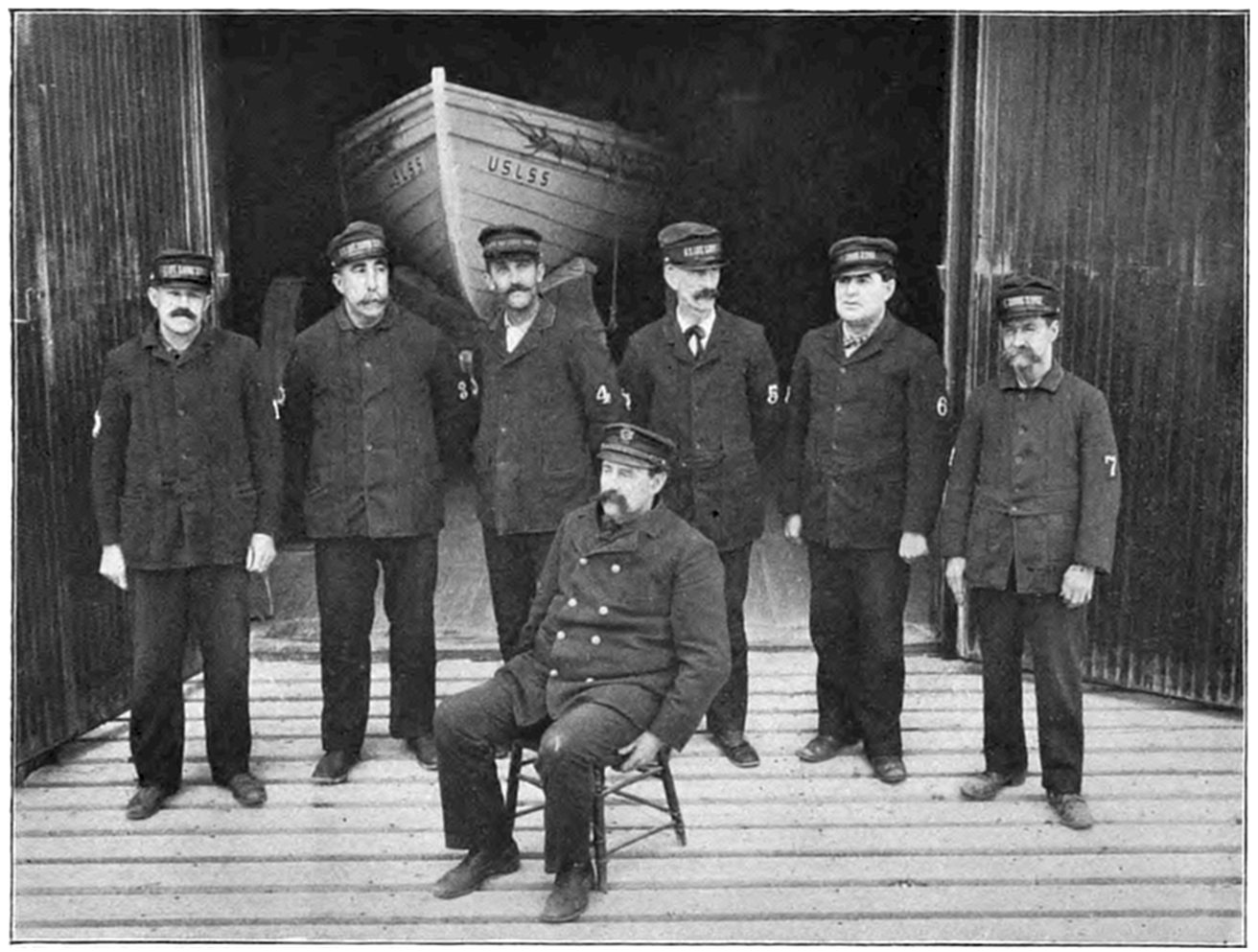
Left to right: LEVY KELLEY. JAS. F. FISH. WM. D. CARLOS. CAPT. W. W. COOK (seated). CHAS. HIGGINS. WM. E. SYLVIA BENJ. R. KELLEY.
PEAKED HILL BARS CREW.
The No. 3 surfman is James F. Fish. Surfman Fish was born in East Boston in 1853. When a young man he went to sea, making a number of trips on fishing vessels, and later entering the merchant service. He entered the life-saving service in 1881, being assigned to this station, and has served faithfully in the capacity of a surfman for nearly twenty-two years. Surfman Fish served his apprenticeship as a life saver under the late Capt. Isaac G. Fisher. He has had many thrilling adventures and narrow escapes from death in the service. He is an expert boatman and as fearless a surfman as patrols the shores of Cape Cod. He married Mary L. Enos.
The No. 4 surfman is William D. Carlos. He was born in Provincetown in 1870, and has been in the life-saving service for five years. Surfman Carlos went to sea when he was seventeen years of age, engaging in boating and fishing from that time until he entered the service. He was first assigned to the Chatham Station, where he remained for one year, being transferred to this station in 1898. He gained a thorough knowledge of handling boats in the roughest water while a fisherman, and was well fitted for the work of a surfman along the dangerous coast of Cape Cod. He married Matilda B. Travis, and is the father of a boy.
The No. 5 surfman is Charles A. Higgins. He was born in Provincetown in 1862, and has been in the life-saving service for seven years. Surfman Higgins followed the vocation of a boat fisherman from the time he was a young man until he joined the crew at Peaked Hill Bars. He is an expert boatman and a brave and faithful surfman. He married Bessie L. Bangs.
The No. 6 surfman is William E. Sylvia. He was born in Provincetown, and is thirty-two years of age. Surfman Sylvia is a new man, but has had a wide experience as a sailor and fisherman, and possesses the other qualities that go to make a successful surfman. He married Louise Smith.
The No. 7 surfman is Benjamin R. Kelley. He was born in Truro, and is fifty-seven years of age, the oldest surfman, in point of years, at this station. Surfman Kelley was assigned to this station when he entered the service eighteen years ago, and has remained a member of the crew ever since. He followed the sea for a number of years before entering the service, and is an old and tried surfman.
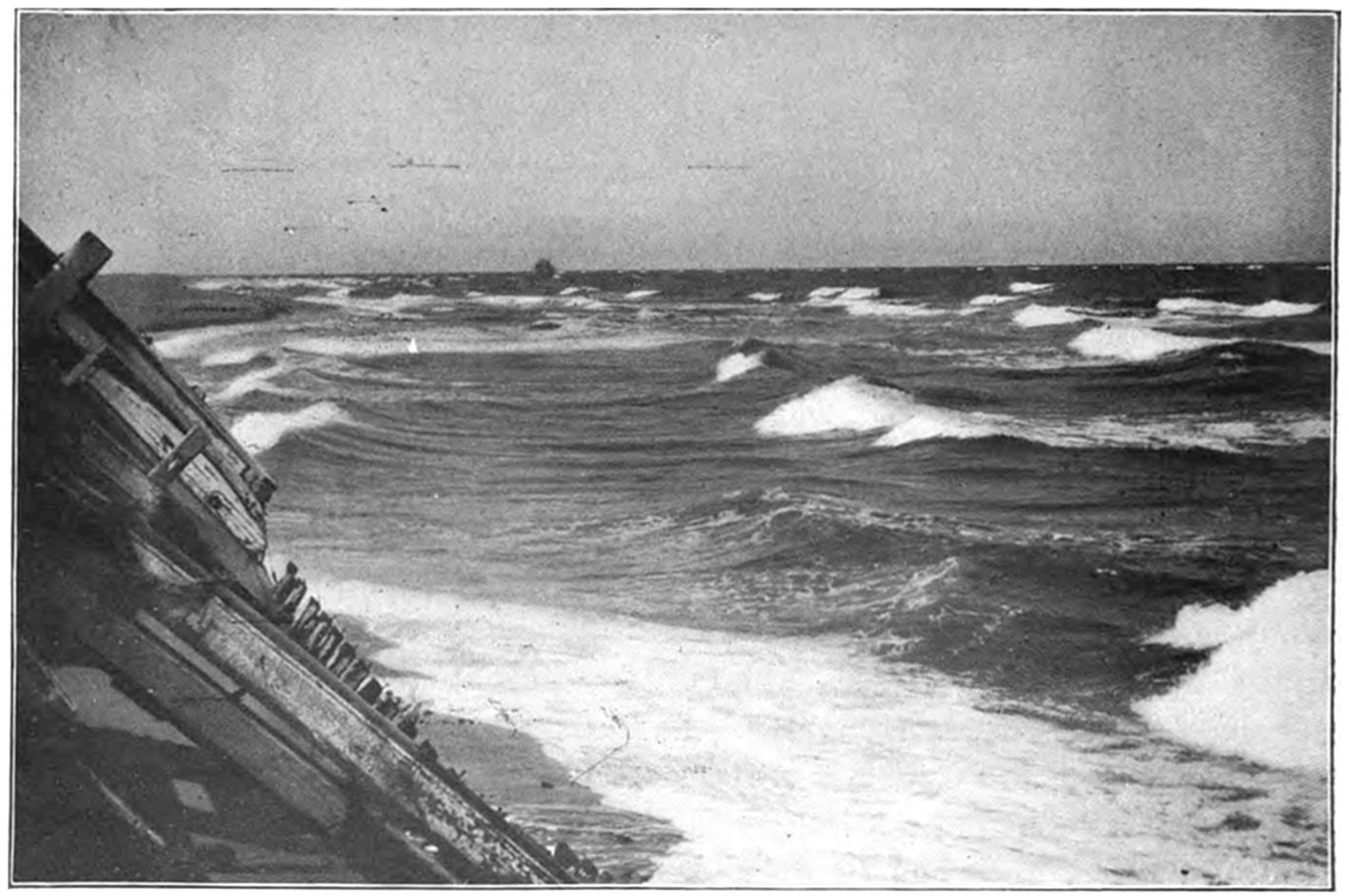
ALONG THE SHORE AT PEAKED HILL BARS.
RACE POINT STATION.
This station is one of the original nine stations erected on Cape Cod in 1872, and was manned in the winter of 1873. The station is one and five-eighths miles east of Race Point, from which it derives its name. Its approximate position as obtained from the latest coast survey charts is latitude north 42° 04′ 45″, longitude west 70° 13′ 15″. From Provincetown the station is about four miles distant, and easy of access over a highway across the sand dunes. The coast at Race Point is very treacherous, and has been the scene of many wrecks. The tides run past the point with great velocity, and vessels are frequently swept to destruction on the sunken rips which lie along the coast there.
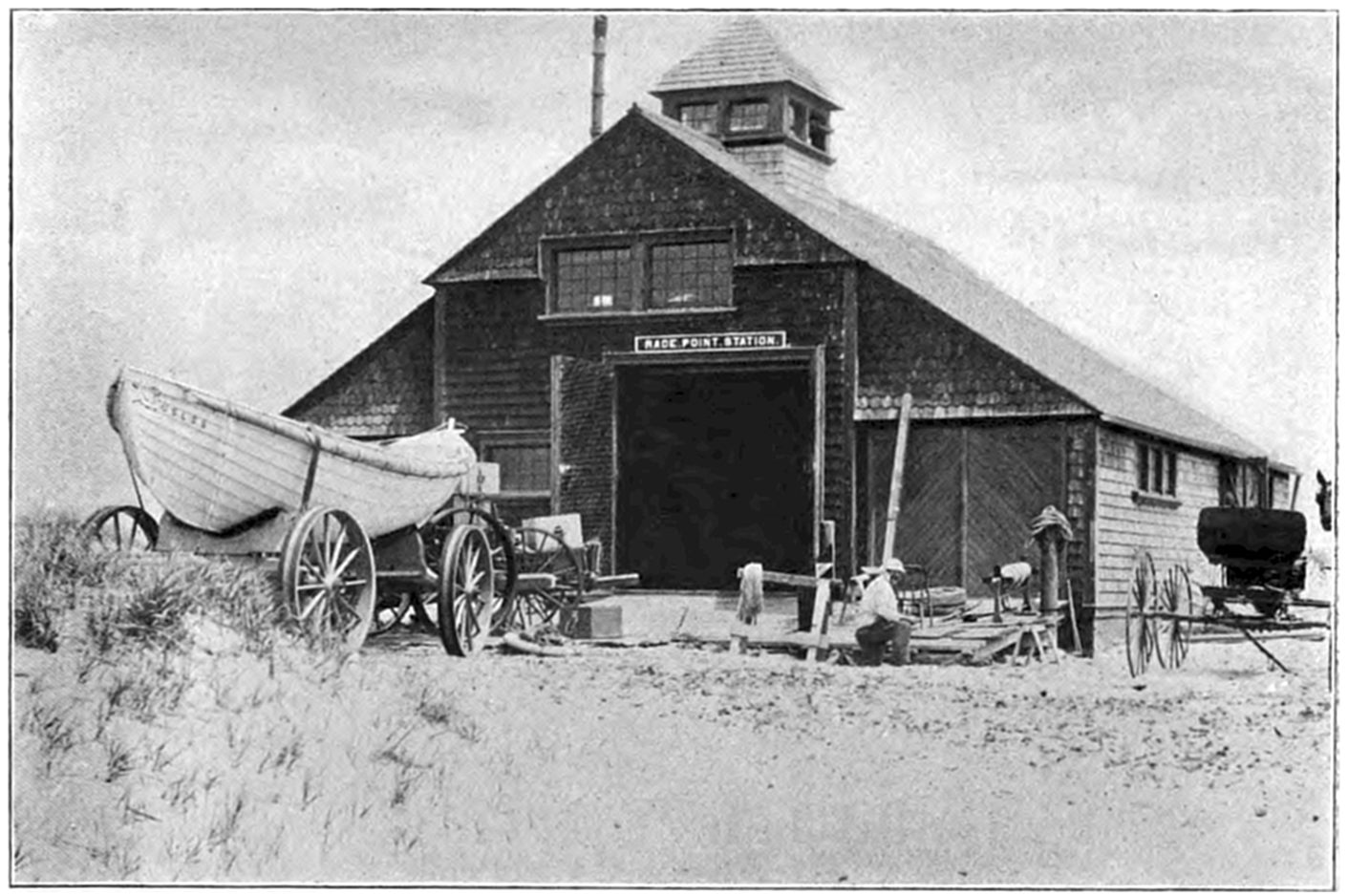
RACE POINT STATION.
The surfmen of this station go over a patrol westward of two and one-half miles, and eastward about one and three-quarters miles. On the eastward patrol the surfmen meet and exchange checks with the surfmen from Peaked Hill Bars Station; on the westward patrol the surfmen use a time clock, as “Race Run” so called, an inlet through the beach, prevents them from meeting the surfmen from Wood End Station. The station is supplied with three surf-boats of the Race Point model, two beach carts, with guns, breeches-buoys, etc., and a life-car.
Ninety-two vessels, of all descriptions, have met with disaster near this station since Capt. “Sam” Fisher has been keeper. On these vessels there were over six hundred seafarers, including two women. Of this number of persons taken ashore, thirty-seven were landed by the breeches-buoy, the surf-boat being employed to bring the others that were saved to the shore.
“Nigger,” the horse which is on duty at the Race Point Station, is a noble and intelligent animal. When storms are sweeping the coast, “Nigger” shows a restlessness that is not dispelled until fair weather again prevails. As the surfmen return from their patrol at night, “Nigger” always gives evidence in some way or another that he is awake and ready for duty. “Nigger” takes kindly to the work of dragging the heavy beach apparatus and surf-boat through the sands, and responds to the call “ship ashore” as lively as the surfmen. “Nigger” is the pet of all the surfmen, and seems to enjoy having visitors call to see him.
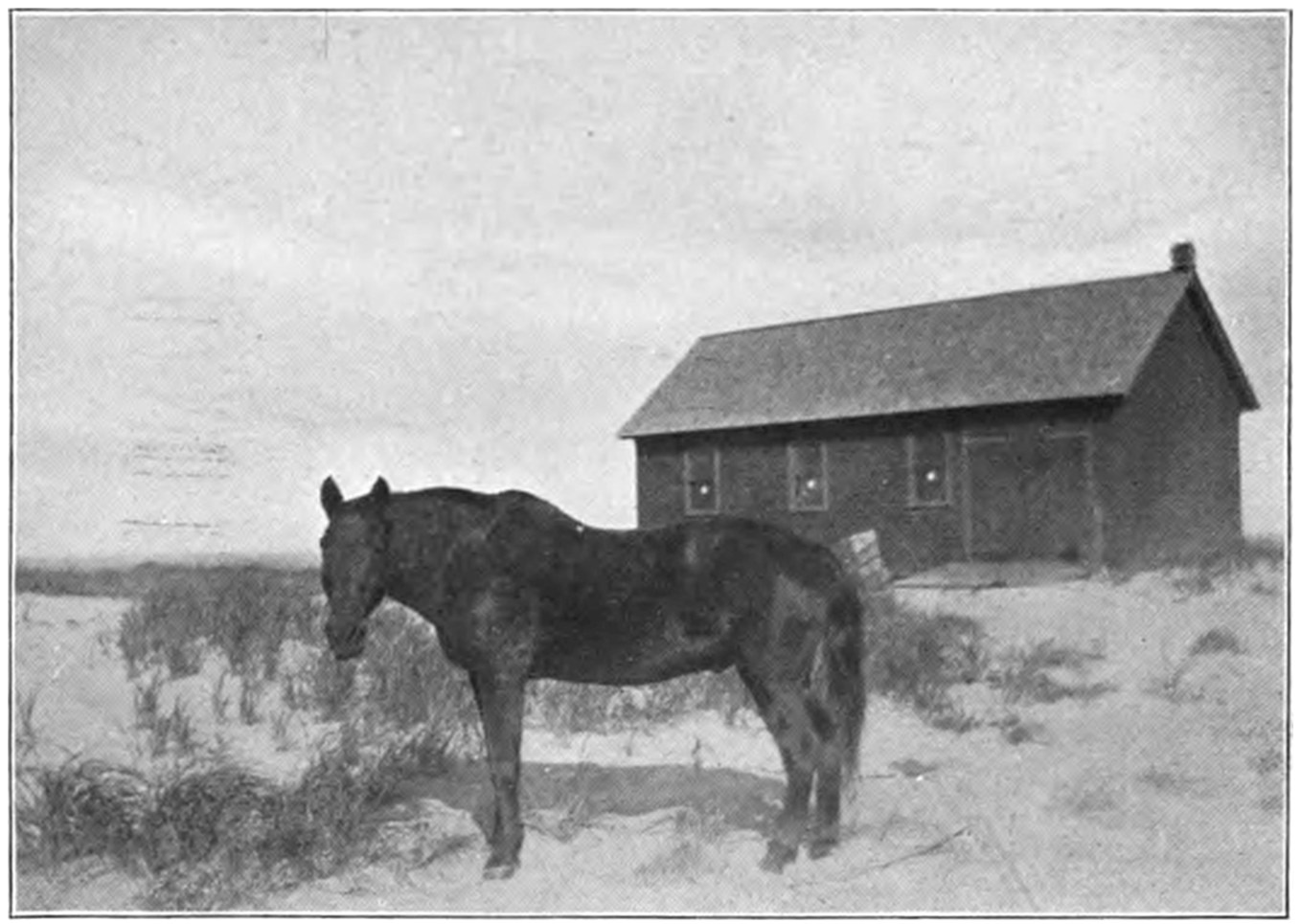
NIGGER, THE HORSE KEPT AT RACE POINT STATION.
CAPT. SAMUEL O. FISHER.
Capt. Samuel O. Fisher, keeper of the Race Point Life-Saving Station, was born in Provincetown in 1861, and has been in the life-saving service twenty-three years, eight of which he spent as surfman at Peaked Hill Bars Station and fifteen as keeper of this station. “Sam” Fisher came from a seafaring family and is a near relative of the late Isaac G. Fisher, a noted life saver. He went to sea as a sailor on a coasting vessel when a young man. He left the coastwise trade to go tow boating, which he followed for a short time, when he again entered the coastwise trade. He was also a fisherman and boatman off the shores of Cape Cod. He entered the life-saving service when nineteen years of age, being assigned to the Peaked Hill Bars Station under the late Captain Atkins. He was then an experienced boatman, strong and robust. He had been a member of the station crew but a short time when he came near losing his life in a terrible tragedy that took place on the bars near the station.
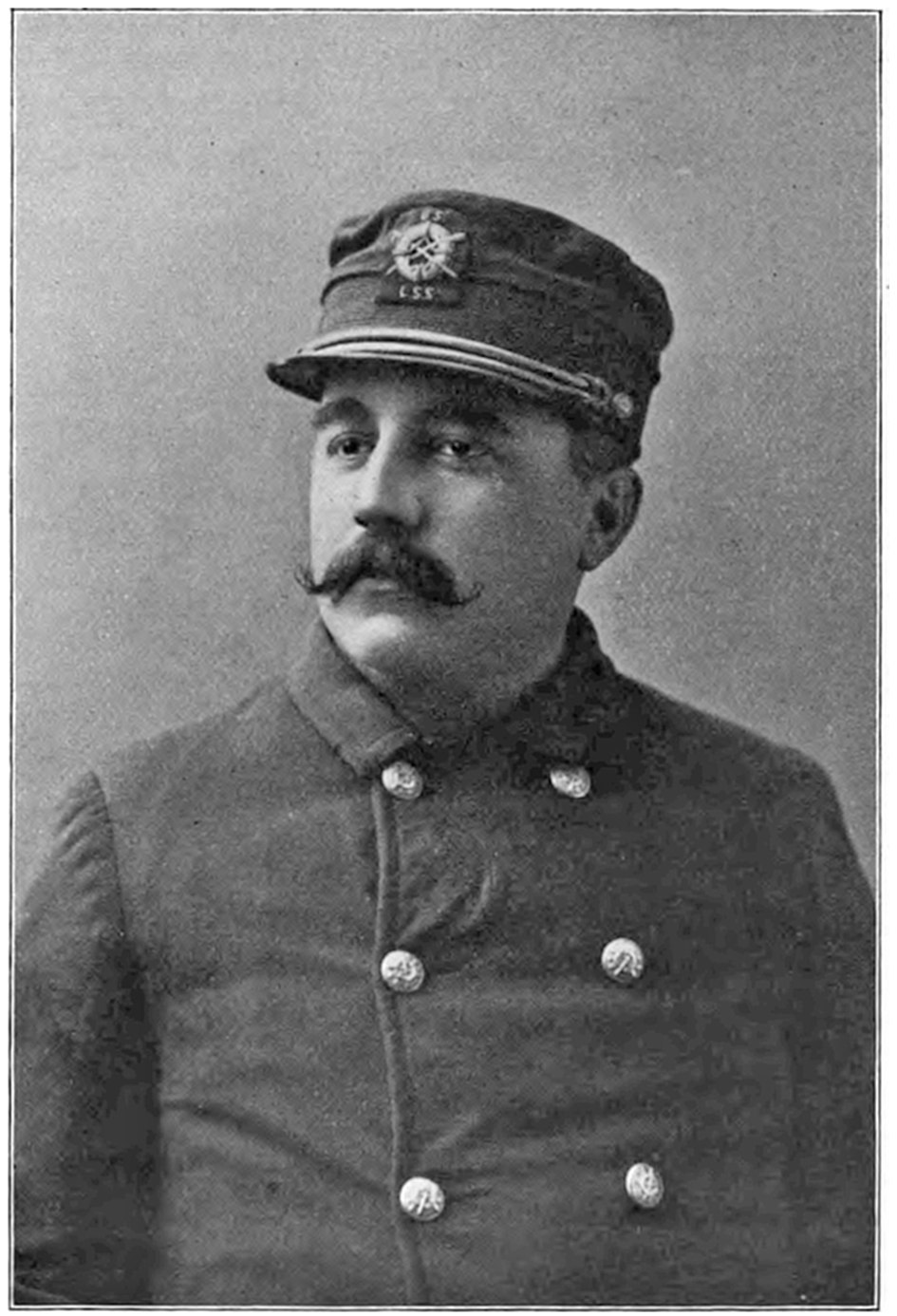
CAPT. “SAM” O. FISHER, KEEPER OF RACE POINT STATION.
It was at the time the sloop C. M. Trumbull stranded on Peaked Hill Bars. Captain Atkins and his brave crew had pulled out to the stranded sloop and was about to effect the rescue of the imperiled crew when the surf-boat was capsized, throwing all hands into the raging sea. Captain Atkins and two members of the crew perished, Fisher and two others managing to reach the shore after a desperate struggle. After the death of Captain Atkins, the late Capt. Isaac G. Fisher was prevailed upon to take charge of the station. Capt. “Sam” Fisher remained as surfman under Capt. Isaac Fisher until he was appointed keeper of the Race Point Station, succeeding John W. Young.
From his experience at Peaked Hill Bars Station Capt. “Sam” Fisher was well fitted for the arduous duties of keeper of the Race Point Station. During the fifteen years that he has been keeper of the Race Point Station he has led his crew to deeds of great heroism. He has had many narrow escapes from serious injury and death in the performance of his duty, and was once obliged to retire for a period of fifty days on account of injuries received while working on a wrecked schooner. Once he was obliged to swim ashore from an overturned boat, and several times he has narrowly escaped losing his life going to wrecks. Lawrence Maddocks, a member of the crew who was thrown out of the boat with Captain Fisher at the time of the wreck of the schooner Julia Bailey, died shortly after from the effects of exposure.
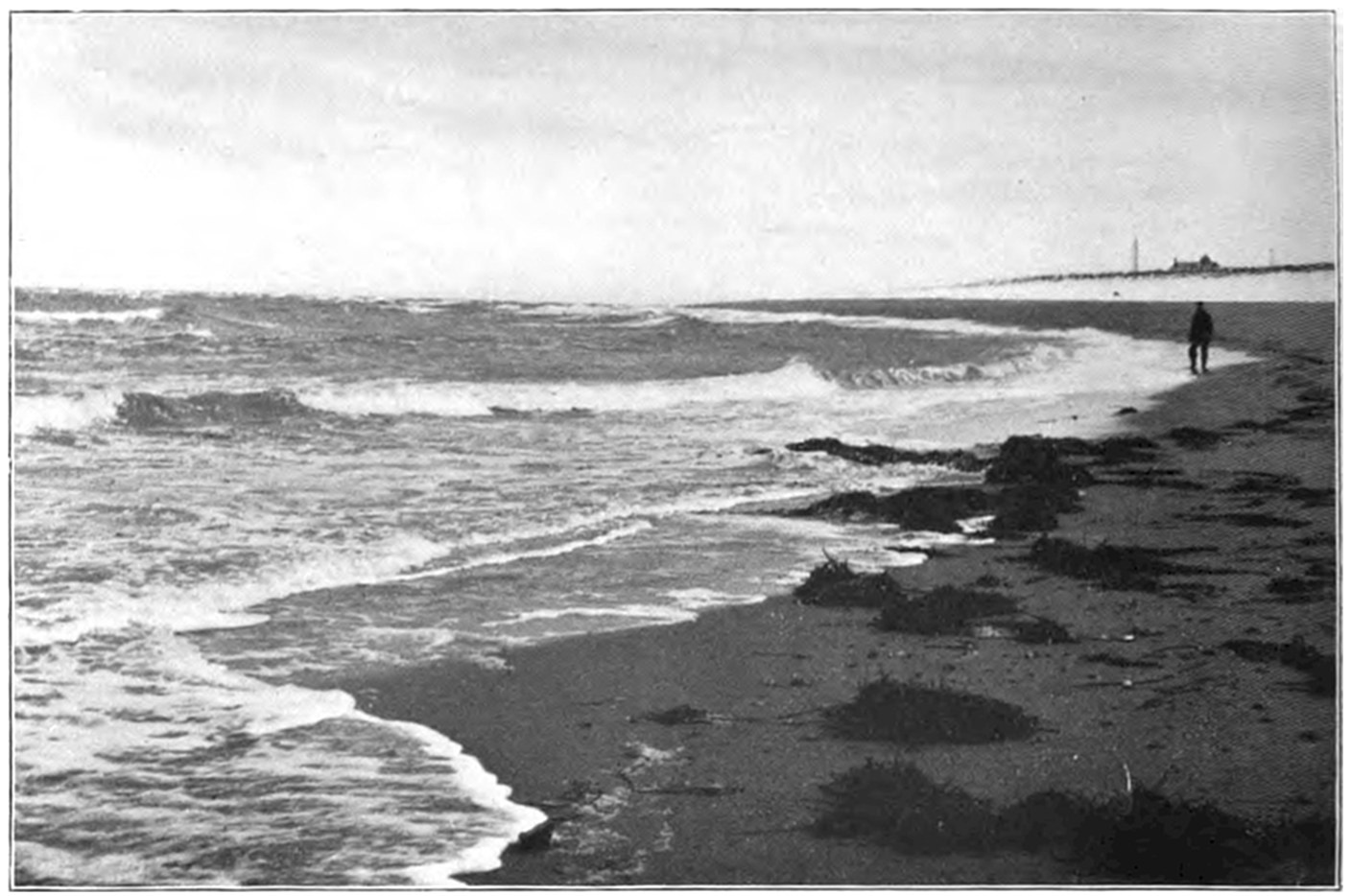
LIFE SAVER STARTING OUT ON THE SUNSET WATCH FROM RACE POINT STATION.
He married Myra L. Pierce.
RACE POINT STATION CREW.
The No. 1 surfman is Edwin B. Tyler. He was born in Provincetown, is thirty-two years of age, and has been in the United States Life-Saving Service five years. Prior to his joining the service he engaged in boating and fishing. In this way he obtained a thorough knowledge of the coast about the tip end of the Cape, and became skilled in the management of boats in the surf, all of which has been of great value to him since he entered the service. Surfman Tyler, in the few years that he has been in the service, has had his full share of the hardship that is part of the life of a life saver on Cape Cod. He married Pauline Ryder.
The No. 2 surfman is George H. Burch. Surfman Burch was born in Provincetown fifty years ago, and in point of years of service he is the oldest member of the crew of the Race Point Station. He has been a member of the Race Point Station crew for fifteen years, joining the station when he entered the service. Surfman Burch went to sea when a boy, and followed it until he entered the life-saving service. In addition to being a coastwise sailor, he also went in pursuit of the whale. He is an old and tried life saver who knows no fear, and on whom the fifteen years of hardship has left no visible trace. He married Mary Sylva of Provincetown, and is the father of a son.
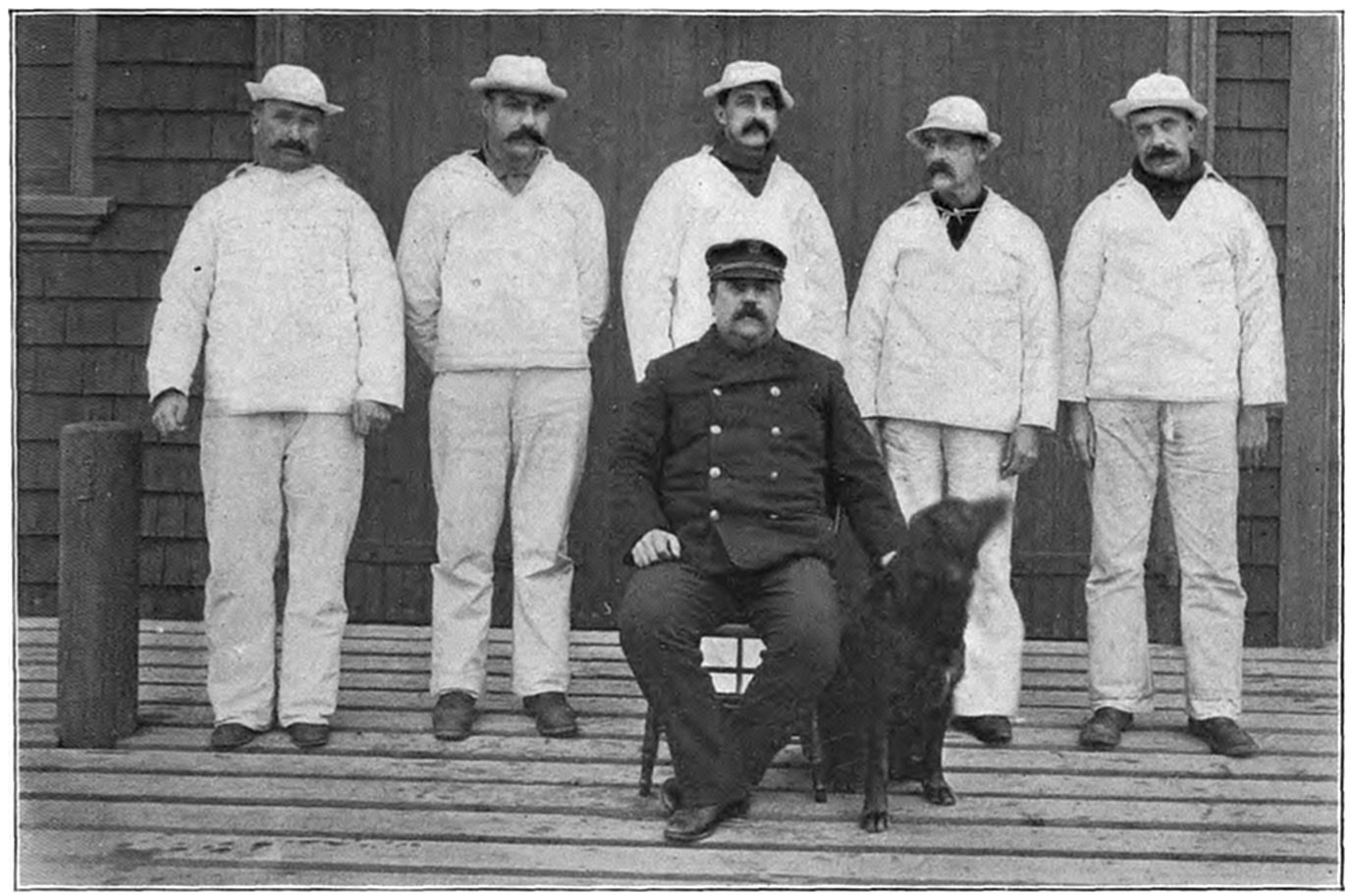
Left to right: FRANK BROWN. MARTIN NELSON. EDWIN B. TYLER. CAPTAIN FISHER (seated). GEO. H. BURCH. JOHN B. BANGS.
RACE POINT CREW.
The No. 3 surfman is Henry I. Collins. He was born in Truro in 1871. Surfman Collins entered the life-saving service three years ago, being assigned to this station. Before entering the service he had followed the sea as a boatman and fisherman from the time he was a small boy. He is an expert boatman, and was not long in the service before he demonstrated his worth as a life saver. He married Nellie Lombard, and is the father of two girls.
The No. 4 surfman is Frank Brown. Surfman Brown was born in Provincetown in 1866. He joined the life-saving service in 1899, being assigned to the Muskeget Station at Nantucket. After serving there for several months he was transferred to this station. Surfman Brown from his long experience as a fisherman and in the coasting trade is an expert boatman, and also possesses all the other qualifications necessary to make a life saver. He married Margaret Sullivan of Provincetown.
The No. 5 man is John B. Bangs. He was born in Provincetown and is twenty-nine years of age. Surfman Bangs has been in the service seven years. He was first assigned to the High Head Station under Captain Kelly and has been connected with this station but one year. Surfman Bangs from his experience as a coastwise sailor, fisherman, and boatman found no difficulty in passing the rigid examination necessary to enter the service, and is a skilled and intrepid life saver.
The No. 6 surfman is Martin Nelson. Surfman Nelson was born in Sweden in 1869. He went to sea when about fifteen years of age and sailed over a great part of the world before he reached the shores of Cape Cod. He has been in the service four years, being assigned to the Monomoy Station under the late Captain Tuttle when he entered the service. Surfman Nelson was also a member of the crew of the Monomoy Station under the late Captain Eldredge, being transferred to the Race Point Station but a short time before. Captain Eldredge and all but one of his boat’s crew lost their lives. Surfman Nelson came of a seafaring family and seems especially fitted for the hard life that he has chosen. He married Louise C. Smith, of Provincetown, and is the father of a boy.
The No. 7 surfman is Eugene R. Conwell. He was born in Provincetown in 1880, and is the youngest member of the crew of this station. Surfman Conwell entered the service in June, 1902, being stationed on the floating station at City Point during the summer season, coming to this station in December, 1902. Surfman Conwell, while a young man, is an experienced boatman and has the youth and vigor that will help to make him a valuable member of any life-saving crew to which he may become attached.
HIGH HEAD STATION.
This station was established and manned in 1883 by Captain Kelley and a crew of trained surfmen. The station is three and one-half miles northwest of Cape Cod Highland Light, and its approximate position as obtained from the latest coast survey charts is latitude 42° 03′ 55″ longitude west 70° 06′ 50″. From Provincetown the station is about five miles distant. The eastern end of the dreaded Peaked Hill Bars extend along the coast at this station, and from wrecks that have taken place on these bars the crew of the station have made many daring rescues. The surfmen at this station exchange checks with the surfmen from the Highland Station on the east and the Peaked Hill Bars Station on the west.
The patrol is about one and one-half miles each way, the shortest patrol on the entire coast of Cape Cod. The station is supplied with two surf-boats, a practice-boat, three beach carts with guns, breeches-buoys, etc., and a life-car.
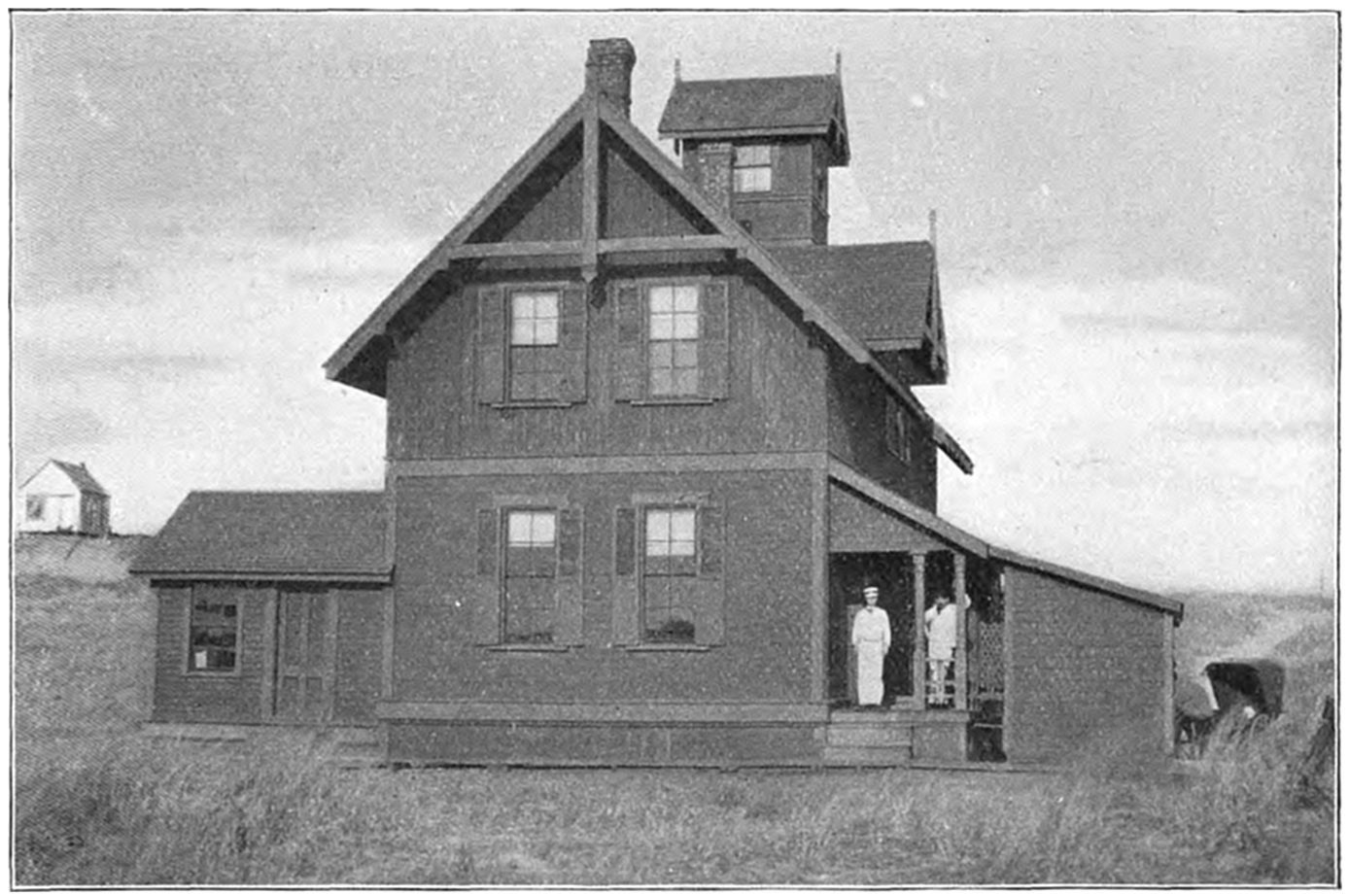
HIGH HEAD STATION.
The practice-boat came from the Peaked Hill Bars Station, and is the one which was capsized at the wreck of the schooner C. M. Trumbull at the time the late Captain Atkins, keeper of the Peaked Hill Bars Station, and two members of his crew lost their lives. A surf-boat and beach cart are kept in a house near the beach to be near at hand in the event of disaster. The horse kept at the station is owned by Captain Kelley, and is employed by the government during the winter season, to help drag the apparatus at the time of a wreck.
Capt. Charles P. Kelley, keeper of the High Head Station, with his crew of life savers, have taken thirty-seven persons ashore in their surf-boat during the twenty years that Captain Kelley has been in charge. The breeches-buoy has not been used in active service within the patrol of the station, however, since Captain Kelley assumed command. From the schooner Laura Brown five men were rescued and the vessel saved; from the brig Emily T. Sheldon eight men were taken ashore, the vessel becoming a total loss. The schooner Oliver Ames, which stranded near the station, was saved with her crew of seven.
From the schooner Plymouth Rock, which became a total wreck near the station, the crew of six were saved. The crew of the Abbie H. Hodgman, five in number, were saved and the vessel floated. The sloop Red Rover, which was a total wreck, had her crew of two men rescued. The schooner Lucia Porter, with a crew of six men, were saved by the crew of this station, as was the schooner William H. Oler and her crew, eight in number.
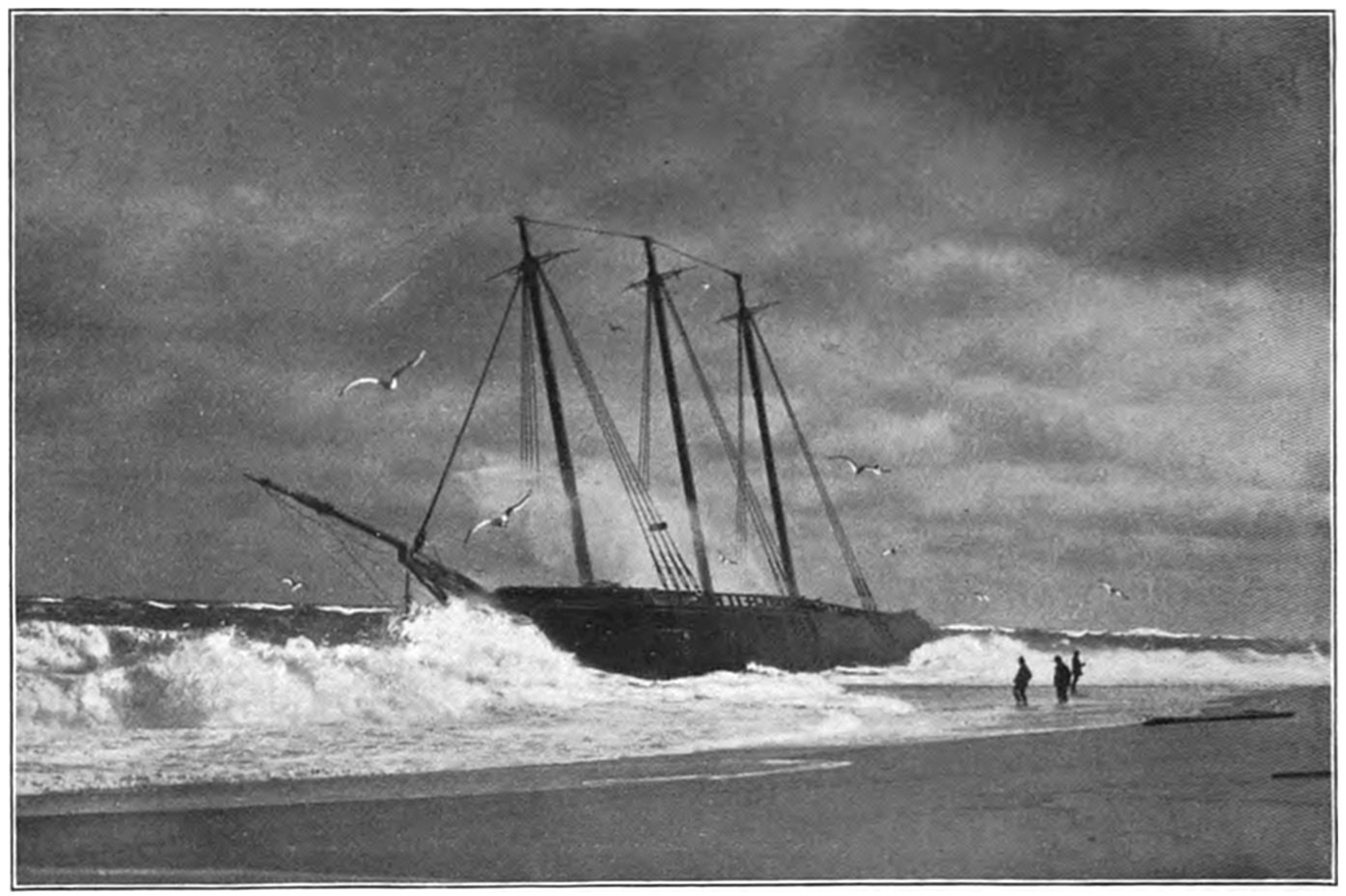
HANNAH E. SHEWBERT.
From the schooner Jennie C. May three persons were taken ashore, the vessel finally becoming a total loss. The schooner Carrie Richardson had her crew of four men taken off by the life savers, the vessel becoming a total wreck, and from the schooner Job H. Jackson, which, also, became a total wreck, the life savers, under Captain Kelley, rescued the crew of four men.
CAPT. CHARLES P. KELLEY.
Capt. Charles P. Kelley, keeper of the High Head Life-Saving Station, was born in the village of South Yarmouth, Mass., in the year 1850.
He attended the public schools in his native village until he was a young man, when he went to sea. His first experience being on a fishing vessel. Later he engaged in the coastwise service, and after a number of years joined the fleet of merchantmen which, at that time, carried on an extensive trade with the West Indies.
At the age of twenty-nine, Captain Kelley left the merchant service and joined the crew of life savers under the late Capt. David H. Atkins, at the Peaked Hill Bars Life-Saving Station.
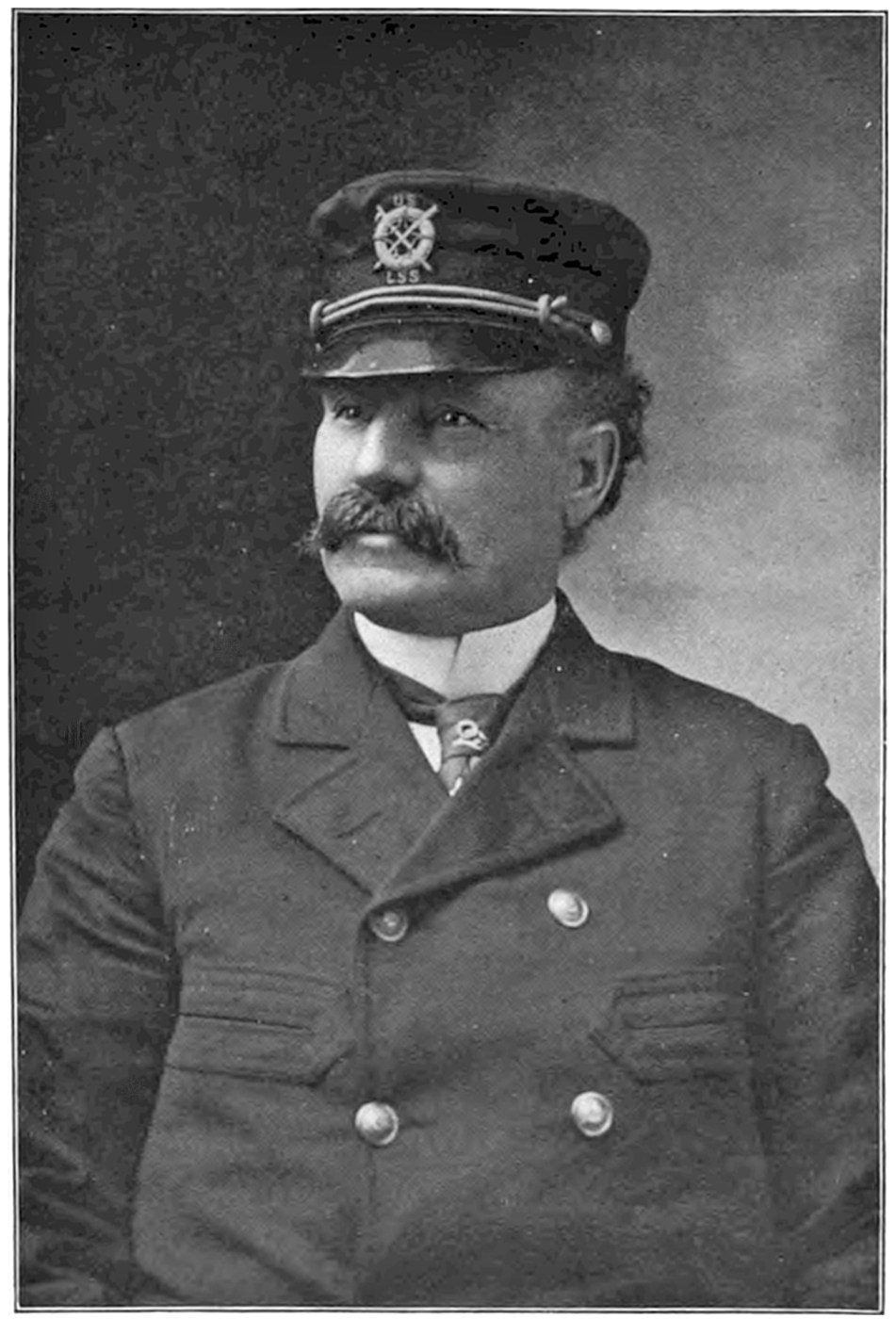
CAPT. CHARLES P. KELLEY, KEEPER OF HIGH HEAD.
Captain Kelley was attached to the Peaked Hill Bars Station for about three years, during which time he had a number of thrilling experiences and narrow escapes from death in the performance of his duty.
At the time of the wreck of the sloop C. M. Trumbull, on Peaked Hill Bars, Captain Kelley was in the life-boat with Captain Atkins going off to the rescue of the imperiled crew, when the latter and two members of the crew lost their lives.
It was Captain Kelley who discovered the sloop stranded on the bars. The life-boat was quickly manned and put off to the wrecked vessel, and in a short time three of the crew were landed on the beach. A second trip through the breakers was safely made, and the boat was alongside the sloop, ready to take off the remaining two members, when the boom of the sloop caught the life-boat under the belt, and capsized it, throwing all hands into the boiling sea.
The night was intensely dark and the weather freezing cold. Captain Atkins was never seen, and the other two members of the boat’s crew perished after repeated attempts to get into their boat.
Captain Kelley, surfman as he was then, together with “Sam” Fisher, now keeper of the Race Point Station, and Isaiah H. Young reached the shore after a terrible struggle, and were pulled out of the surf by the members of the crew who had remained ashore.
All three were more dead than alive. The bodies of Captain Atkins and the two members of the crew, Elisha Taylor and Frank A. Mayo, were afterwards found on the beach by the life savers of an adjoining station.
Captain Kelley had been in the service but about a year when he passed through this terrible experience, yet he remained at the dangerous Peaked Hill Bars Station for three years under the late Capt. Isaac G. Fisher, being transferred to the High Head Station as keeper when the station was first manned in 1883.
Captain Kelley had such a wide and varied experience when following the sea, and later as a surfman attached to the Peaked Hill Bars Station, that he was especially well qualified for the responsible position of keeper of the High Head Station, where he has been in command for over twenty years.
During his long term of service as keeper he has been called upon at times to face the elements when they were in their greatest fury, yet he has unflinchingly responded to every call, and, with the surfmen under his charge, have had many thrilling experiences, and endured untold hardship. Captain Kelley was twice married; his present wife was Hannah C. Graham. He is the father of one child, a daughter.
HIGH HEAD STATION CREW.
The No. 1 surfman is Fred C. Franzer. He was born in Provincetown, Aug. 19, 1863, and has been a member of the crew of this station for sixteen years, or ever since he joined the service. He had been a boatman, fisherman, coastwise sailor, and whaleman before entering the service. He is a most experienced life saver, an expert surfman, and a faithful coast guardian. He married Catherine Sylvey, of Provincetown.
The No. 2 surfman is Benjamin Kelley. He was born in West Dennis, and is forty-eight years of age. He went to sea at an early age and made a number of voyages to the Atlantic whaling grounds, and until he joined the service, sixteen years ago, had followed the sea in one capacity or another. Surfman Kelley is at present on sick leave, suffering from injuries received in the performance of duty, his place at the station being filled by his son. Until he received the injuries which compelled him to retire temporarily from the service, he had faithfully performed the arduous duties of the life of a surfman, and was an efficient and trustworthy life saver. He married Susan C. Snow, and is the father of two children, a son and daughter.
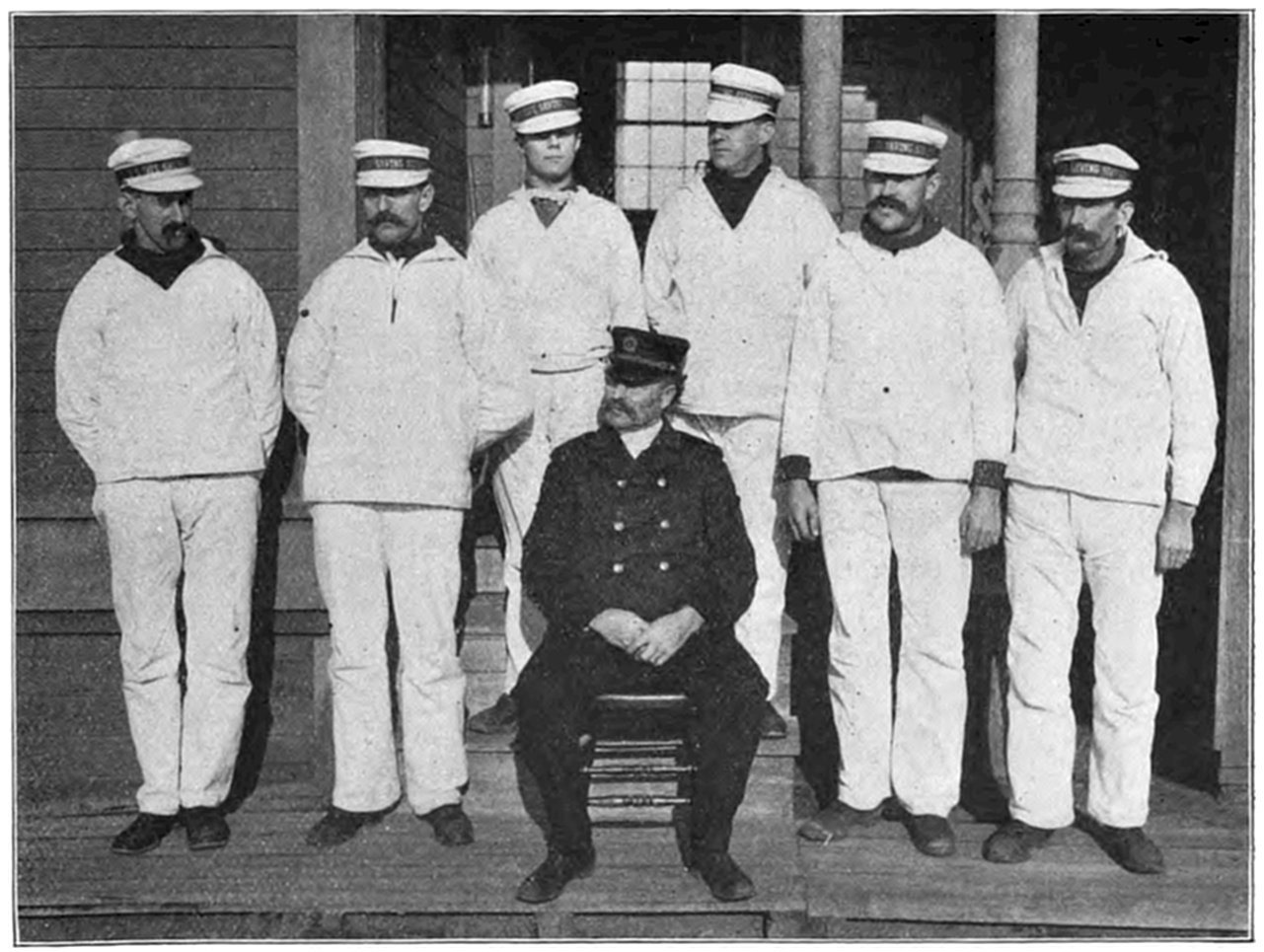
Left to right: A. A. BAKER. L. C. MULLET. H. H. KELLEY. CAPTAIN KELLEY (seated). DAVID B. SNOW. CURTIS F. HIGGINS. ROB’T E. ELLIS.
HIGH HEAD CREW.
The No. 3 surfman is Robert E. Ellis. He was born in Woburn, Mass., is thirty-four years of age, and has been a member of this crew for three years. He was a boatman and fisherman before entering the service, and under the instruction of Captain Kelley has made an able and fearless life saver.
The No. 4 surfman is Albert A. Baker. He was born in Chatham, and is thirty-four years of age. Surfman Baker has been in the service four years, joining this station when he entered. He was a coastwise sailor, boatman, and fisherman before entering the service, and has made an efficient and faithful life saver. He married Susie A. Pratt, and is the father of three boys.
The No. 5 surfman is David B. Snow. He was born in Wellfleet, is twenty-five years of age, and has been in the service two years. He followed the sea from the time he was fourteen years of age until he entered the life-saving service. He is a skilful boatman and an efficient life saver.
The No. 6 surfman is Curtis F. Higgins. He was born in Orleans, and is thirty-two years of age. He has been a member of this crew for two years, entering the service after following the sea as a boatman, yachtsman, towboatman, and a steamshipman. From his experience in the different kinds of work on the water in which he had engaged, he was well prepared for the work of a surfman, and has made an able and faithful life saver. He married Leonora B. Jason.
The No. 7 surfman is Samuel C. Mullett. He was born in Chatham, and is thirty-four years of age. Surfman Mullett is the winter man at this station, joining the station in December and remaining until May following. He has been in the service for three years. During the summer seasons he is a member of the City Point Station, South Boston. Surfman Mullett followed the sea from the time that he was a boy until he entered the service. He is an experienced surfman and well fitted for the hardships that he is called upon to endure as a life saver. He married Mrs. Bessie Cash.
WOOD END STATION.
This station is one of the new type of life-saving stations, with commodious quarters for the keeper and crew, large boat room and lookout. It was built in 1896, and manned in 1897. The late Capt. Isaac G. Fisher, who was keeper of the Peaked Hill Bars Station at the time, was placed in charge of the station and a picked crew of surfmen. Captain Fisher continued as keeper until ill-health caused him to resign from the service. Capt. William Sparrow, now keeper of the Point Allerton Station, who was No. 1 man under Captain Fisher, acted as temporary keeper until Captain Bickers was placed in charge. The station is located on the narrow strip of beach at the tip end of Cape Cod, Provincetown, one-eighth of a mile east from the Wood End lighthouse. Its approximate position as obtained from the latest coast survey charts is latitude north 42° 01′ 15″, longitude west 70° 11′ 30″. From Provincetown the distance to the station over the sand dunes and along the beach is about three and one-half miles. Across the head of the harbor, a way that is accessible when the tide has ebbed, the distance is much shorter. The station is supplied with two five-oared surf-boats of the Race Point model, two beach carts, with guns, breeches-buoys, etc., and one life-car. The patrol from this station extends three and three-quarters miles north, and two and one-quarter miles south. This is the only station on Cape Cod where the surfmen do not meet and exchange checks with the surfmen from other stations, time clocks being employed to record the performance of duty of the patrol.
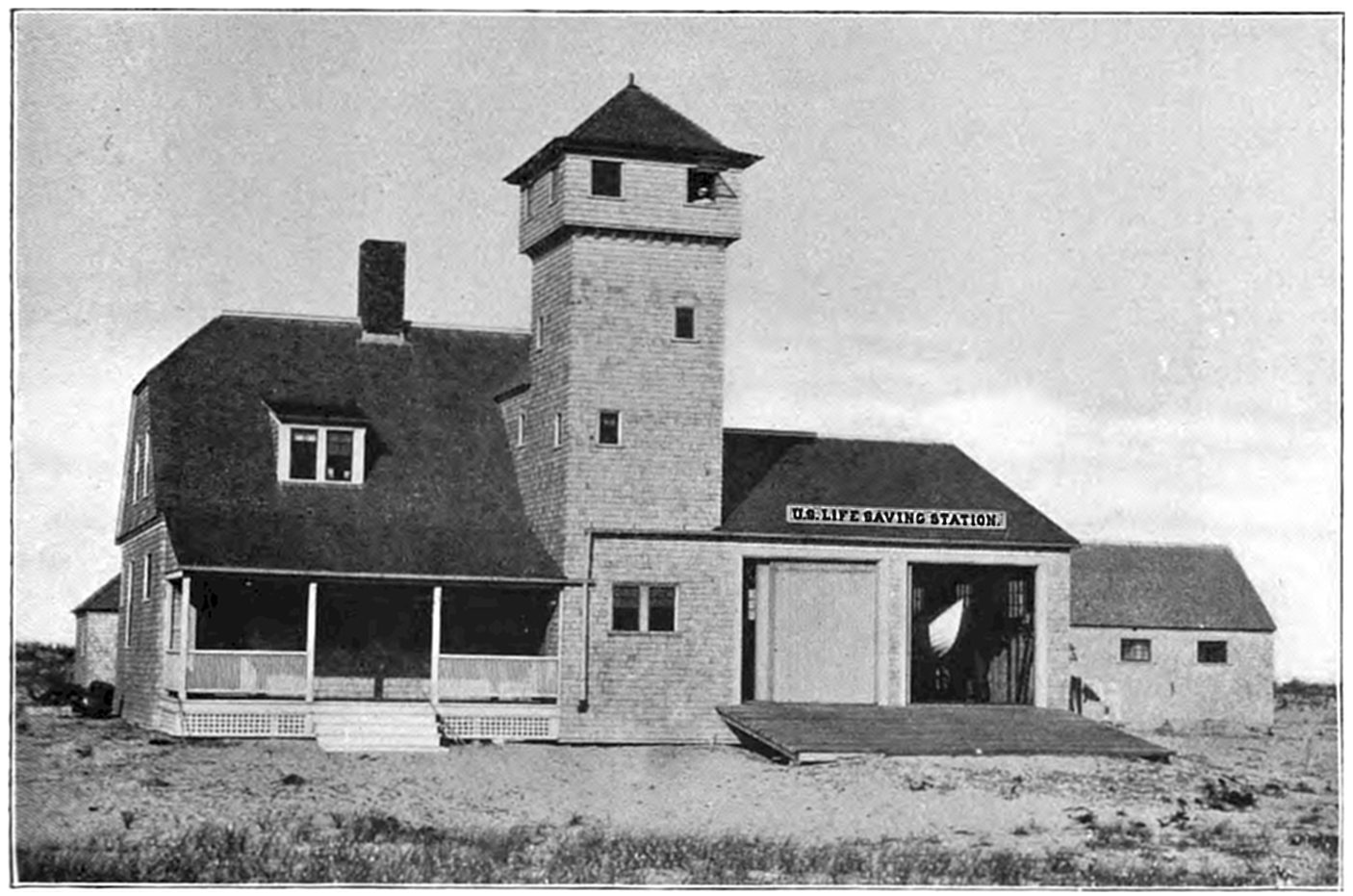
WOOD END STATION.
No total wrecks have occurred within the province of this station since Captain Bickers has been in command, and no persons have been taken ashore by the crew either in the surf-boat or breeches-buoy, although a large number of vessels have met with disaster near there. The following vessels have been assisted and floated by Captain Bickers and crew: the yawl Adventurer, the barge Paxnos, and the schooners Clara, Zephyr, Caviar, Manomet, Joseph I. Johnson, St. Bernard, Marjorie Brown, Gladstone, and Lewis H. Giles. Captain Bickers and his crew also assisted in the rescue of the two men, members of the crew of the schooner Two Forty, who had been adrift in an open boat for fourteen hours.
“Tom,” the pet cat at the Wood End Station, while not being able to aid in the work of life saving, often goes out with the surfmen on their lonely patrol along the beaches to keep them company. “Tom” knows every foot of the beaches and seems to delight in going out with the surfmen, whether the weather is fair or stormy. “Tom” often meets the surfmen half-way along the beach as they are returning from their patrol, running along ahead of the men as if to show them the way to the station. “Tom” is the pet of the crew and is well taken care of by them.
“Jim,” the horse which is at the Wood End Station, is owned by Captain Bickers, the keeper. He was raised on Cape Cod, and has been connected with the station for one year or since Captain Bickers assumed charge of the station. “Jim” is an intelligent animal, and has upon more than one occasion been of valuable service to the crew, by hauling apparatus to scenes of disaster. “Jim” knows when bad weather prevails, and is ever ready to do his share in the work of saving life or property.
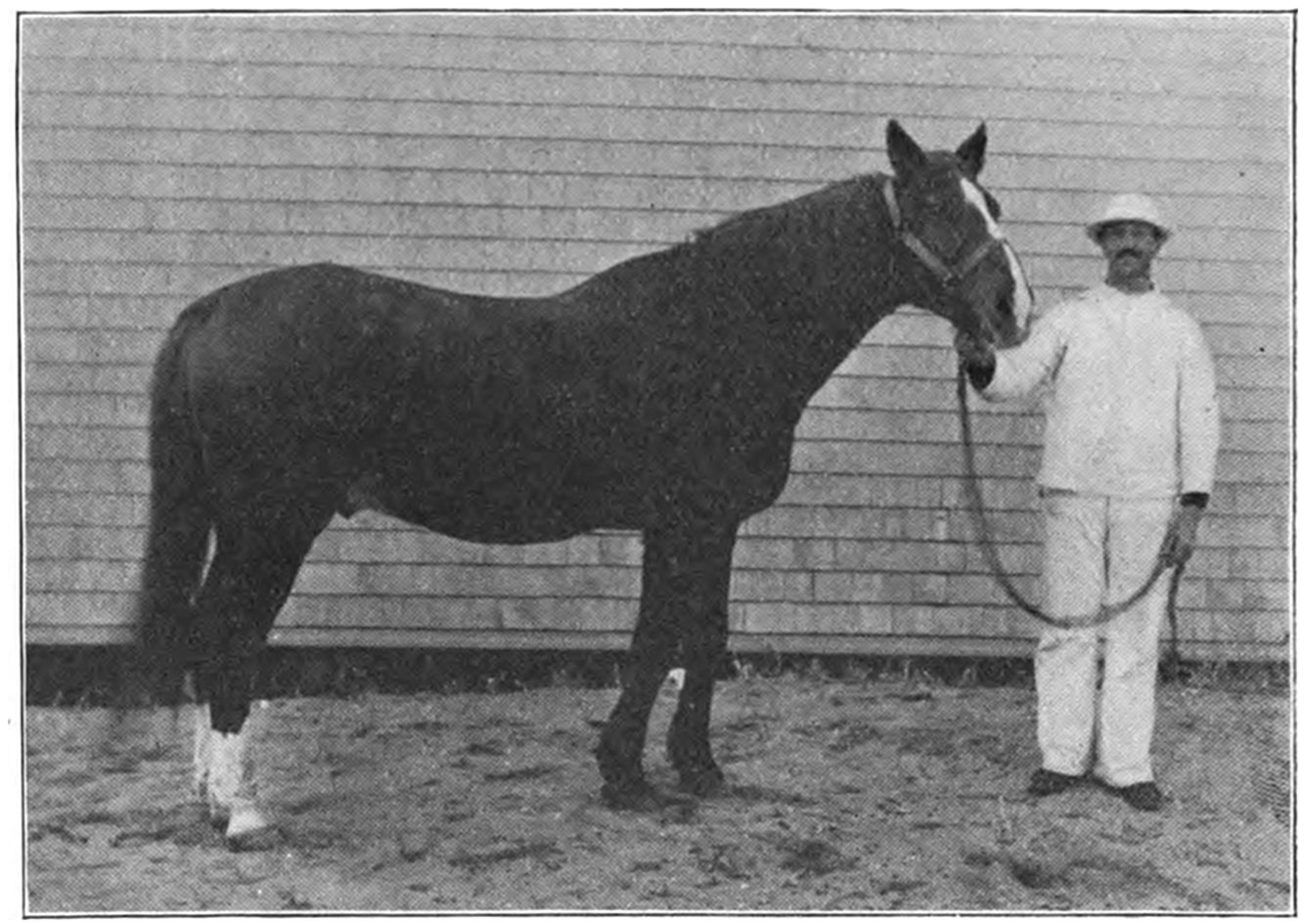
JIM, THE HORSE KEPT AT WOOD END STATION.
CAPT. GEORGE H. BICKERS.
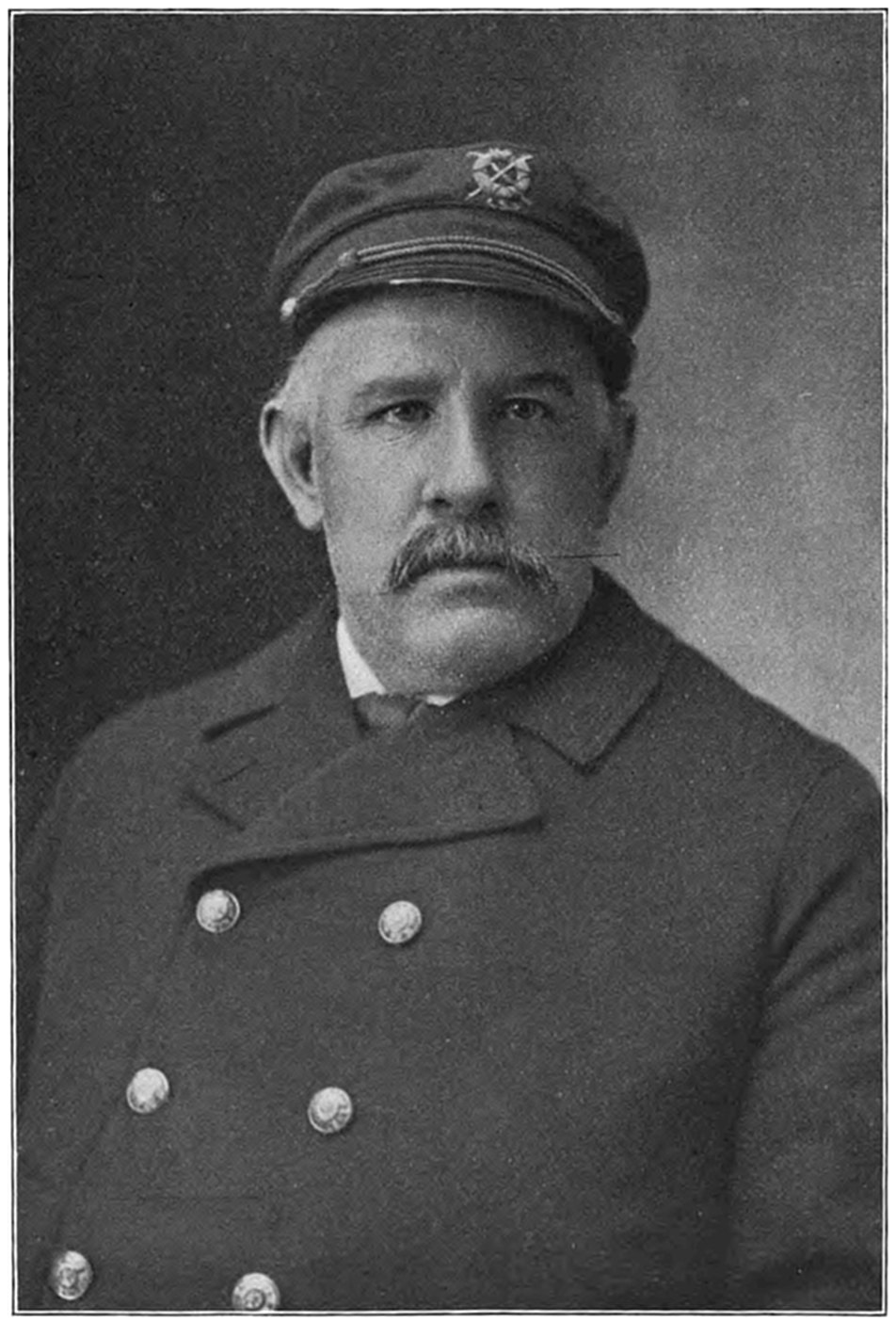
CAPT. GEORGE H. BICKERS, KEEPER OF WOOD END STATION.
Capt. George H. Bickers, keeper of the Wood End Life-Saving Station, was born in Charlestown, Mass., in 1858. He has been in the life-saving service for eleven years, ten as a surfman at Race Point and one as keeper of the Wood End Station. After leaving school, when a young boy, Captain Bickers shipped before the mast on a coasting schooner. He followed coasting for a few years, when he went whaling. As a whaleman he learned the art of handling boats in riotous waters as well as seamanship in all its branches. Captain Bickers followed the sea until he was thirty-three years of age, when he entered the life-saving service, being assigned to the Race Point Station under Capt. “Sam” Fisher. From his experience as a sailor and whaleman he was well fitted for the duties of a life saver. He remained a member of the Race Point crew until the death of Capt. Isaac G. Fisher, keeper of the Wood End Station, when he was appointed to fill the vacancy. Captain Bickers enjoyed an enviable record as a surfman, and has made a record since being keeper of the Wood End Station that places him in the front rank of life savers. One disaster followed another near his station soon after he assumed command, yet not a life was lost, and nearly every craft was saved from destruction by his brave and vigilant crew. But one mishap has occurred since Captain Bickers took charge of the station, the capsizing of the surf-boat while going to a wrecked fishing vessel. The crew quickly righted their boat, bailed her out, went to the wreck, and saved the craft from destruction. Captain Bickers has a crew of skilled and fearless life savers who are ever ready to obey his commands.
He married Abbie L. Cahoon, and is the father of a son.
WOOD END STATION CREW.
The No. 1 surfman is Francesco A. Silva. He was born in Fayal, Azore Islands, in 1863, and has been in the life-saving service for six years, all of which have been spent at this station. Surfman Silva went to sea when a boy, sailing before the mast on a merchant ship. Later he became a whaleman, voyaging from one part of the world to the other in pursuit of the monsters of the deep. Surfman Silva performed his first work as a life saver under the late Capt. Isaac G. Fisher, and soon became an experienced and efficient surfman. He married Julia A. Lornes, and is the father of a son.
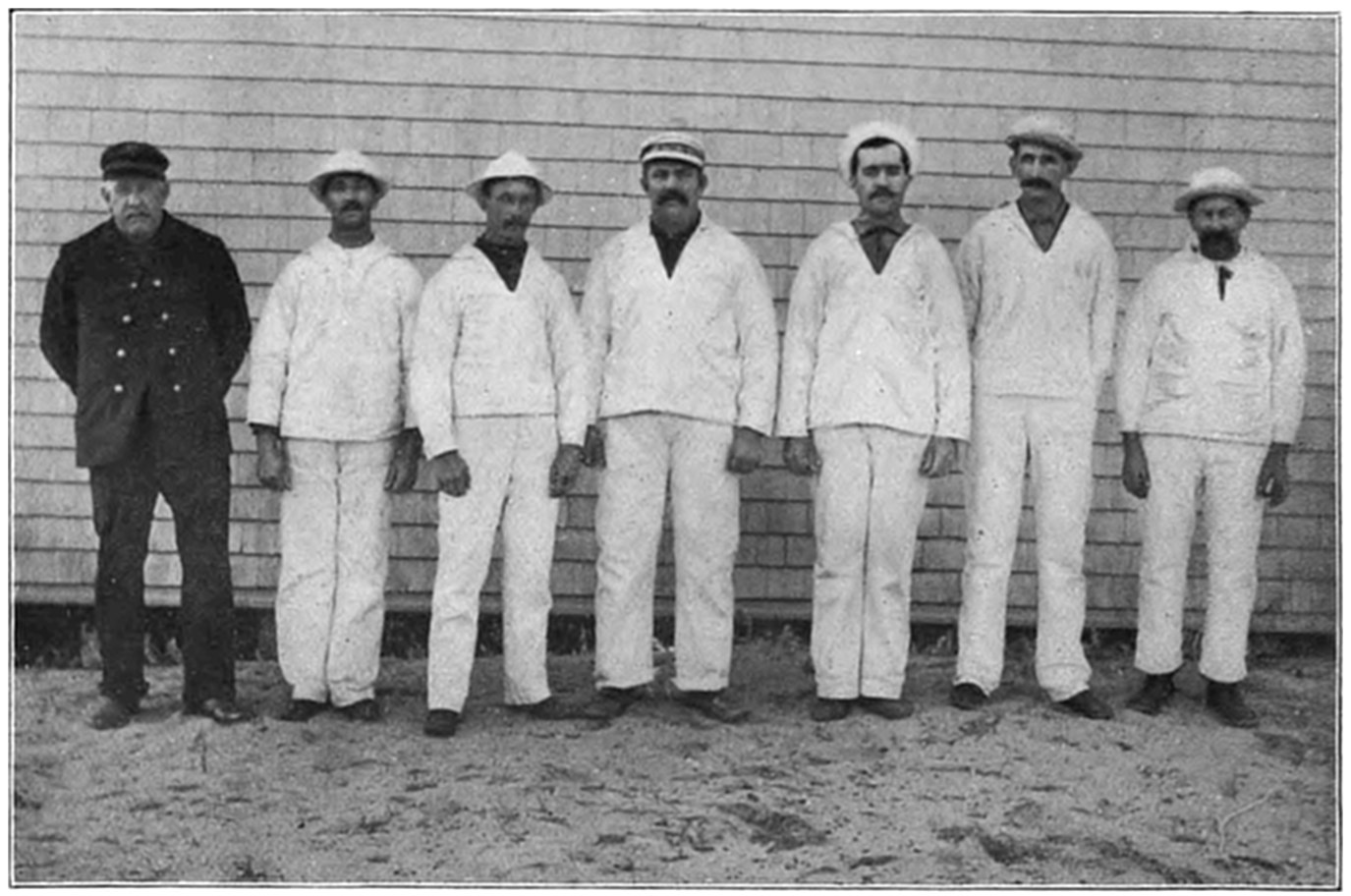
Left to right: CAPTAIN BICKERS. FRANCESCO A. SILVA. JONATHAN C. SMALL. FRANK C. WAGES. ALBERT G. MABBETT. WILLIE F. ELDREDGE. JAMES E. WORTH.
WOOD END CREW.
The No. 2 surfman is Jonathan C. Small. He was born in Provincetown, and is twenty-six years of age. Surfman Small engaged in boating and fishing off the shores of Cape Cod from the time he was a boy until he entered the life-saving service, and was well fitted for the position he now holds. He has been in the service five years, and is an experienced and fearless life saver.
The No. 3 surfman is Frank C. Wages. He was born in Provincetown in 1869, and has been in the life-saving service at this station since it was manned in 1897. Surfman Wages was a sailor and fisherman along the shores of Cape Cod before entering the service, and has made an able and faithful life saver. He married Phœbe Silva, and is the father of a son.
The No. 4 surfman is Albert G. Mabbett. He was born in Whitehall, N. Y., in 1872, and has been in the life-saving service for six years. He shipped as a sailor before the mast on a coasting vessel when he was a boy, and spent several years in the coasting trade. Later he made a number of trips on the United States school ship St. Mary, going on cruises to England, Ireland, and through the Straits of Gibraltar to the ports along the Mediterranean Sea. Prior to entering the life-saving service as a regular surfman, he had substituted at other stations along the shores of Cape Cod. As a substitute he performed meritorious service, and has made an efficient and brave life saver. He married Grace May Henderson, and is the father of two daughters and a son.
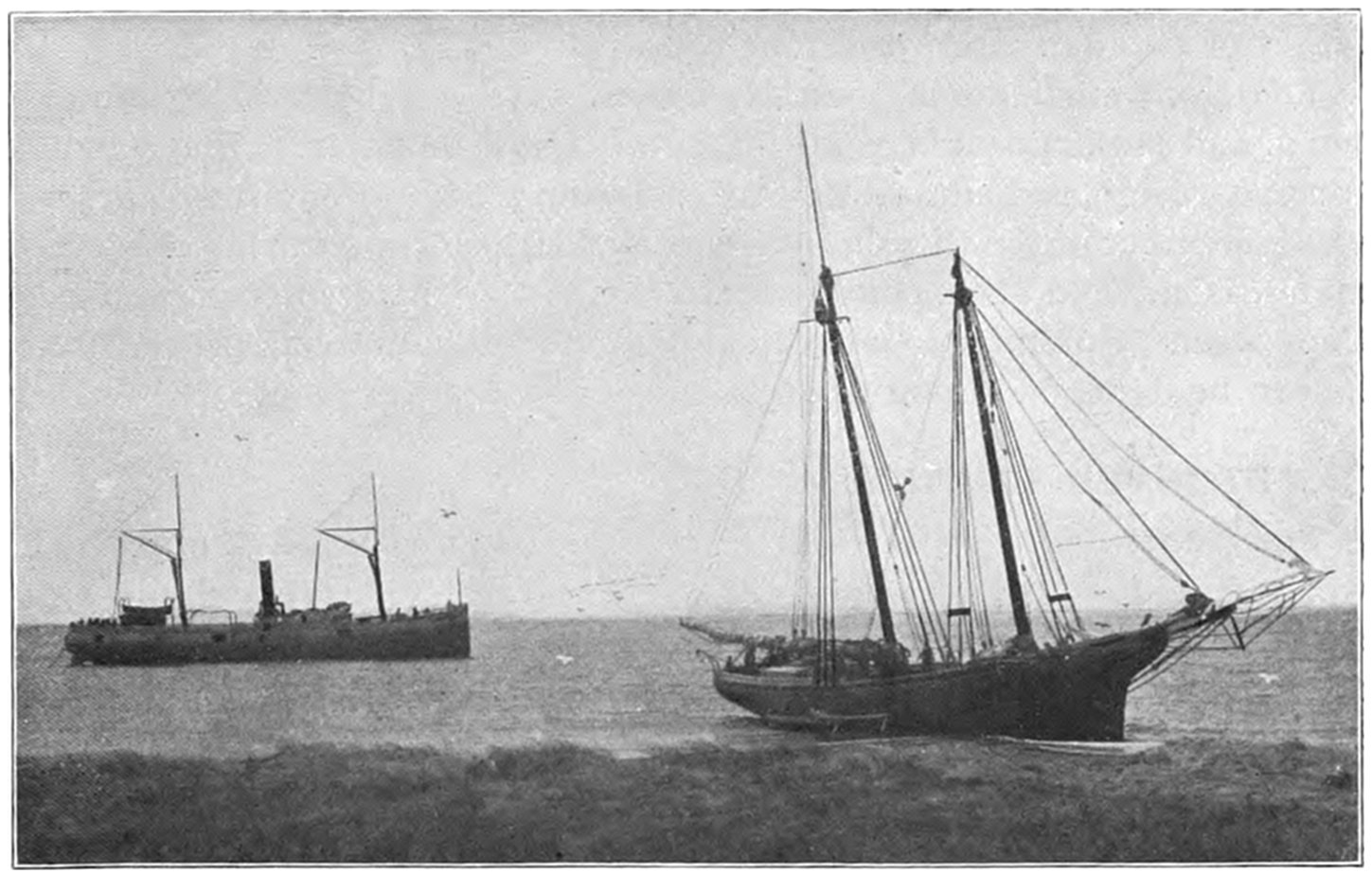
MARY NASON WRECKED AT WOOD END.
The No. 5 surfman is Willie F. Eldredge. He was born in Chatham, is thirty-six years of age, and has been in the life-saving service three years. Before entering the service he was a boatman and fisherman along the Chatham shores, and from his experience in that work was well prepared for the duties of a surfman. He also substituted at many of the life-saving stations along the shores of Cape Cod, and is an experienced and efficient life saver.
The No. 6 surfman is James E. Worth. He was born in Provincetown in 1861, and has been in the life-saving service one year. When a boy Surfman Worth went cod fishing to the Grand Banks, and later shipped on a merchant vessel and made a great number of trips to the West Indies Islands and South American ports. After a few years in the merchant service he became a whaleman, and in that service had a number of thrilling experiences. After giving up going to sea he became a baggage-master on the Old Colony Railroad. Later he entered the employ of the Cold Storage Plant at Provincetown, remaining there until he entered this service. When he entered the service he was assigned to the Muskeget Station on Nantucket, and was later transferred to this station. He is an expert boatman and a brave and hardy life saver. He married Nellie P. Lewis, and is the father of two daughters and four sons.
The No. 7 surfman is John N. Lewis. He was born in Provincetown, and is thirty-eight years of age. Until he entered the service four years ago, he had followed the sea from a boy. For three years he was a member of the City Point Station, South Boston, during the summer seasons, and also spent one season at the Straitsmouth Station, Cape Ann. Surfman Lewis is a skilled boatman, and has proved that he can be depended upon to do his duty in any emergency.
PAMET RIVER STATION.
The Pamet River Station is another of the original nine stations which were erected on Cape Cod in 1872. It is located three and one-half miles south of Cape Cod Highland Light, its approximate position as obtained from the latest coast survey charts is latitude north 42° 00′ 00″, longitude west 70° 01′ 15″.
The station stands on one of the high sand dunes which line the ocean shore in Truro village about three miles from the Truro railroad station. When the station was built it stood several hundred feet back from high water mark, but the sea has made such great inroads into the sand dunes at that point on the beach, that the high water mark is now less than one hundred feet distant from the station, which will soon have to be moved to insure its safety. Sand bars with but a small depth of water over them fringe the shore at this station, extending seaward for several hundred yards, and the history of the station records many fearful disasters on them. It was on these dreaded bars that the terrible ocean tragedy, the wreck of the ship Jason, occurred, and also where the three crafts, the Powwow, Miles Standish, and the E. Pavey, were wrecked at one time. The wreck of the Jason was one of the most appalling disasters that has ever taken place on the shores of Cape Cod, twenty-six lives being lost. Of the whole crew, Samuel Evans, the ship’s apprentice, was the only person that managed to reach the shore. Of the whole number, thirty-four, aboard the ships Powwow, Miles Standish, and Pavey, twelve were lost.
The surfmen from this station have a patrol that extends two and one-half miles north and about an equal distance south, the surfmen meeting and exchanging checks on the south patrol with the surfmen from Cahoon’s Hollow on the north with the surfmen from the Highland Station.
The patrol is exceedingly hazardous and difficult. When the tide is high the surfmen are driven to the tops of the sand dunes and obliged to grope their way along the crest of the cliffs, which in many places are a hundred feet above the sea-level.
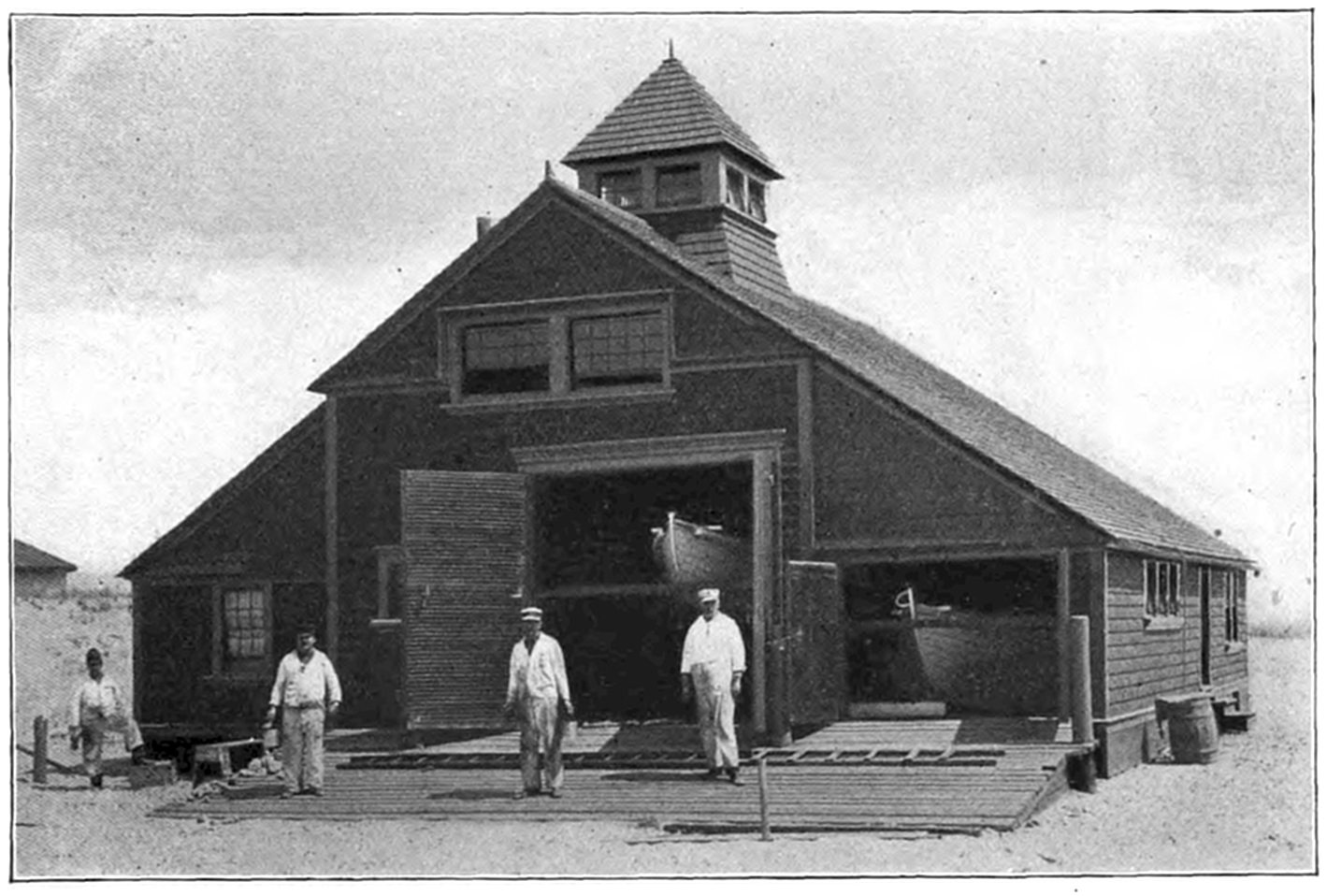
PAMET RIVER STATION.
When the station was manned, Capt. Jonathan Lee was appointed keeper. He was succeeded by Capt. Nelson W. Weston, George W. Kelley, and Capt. John H. Rich, the latter being succeeded by the present keeper, Capt. George W. Bowley.
Captain Bowley has been in charge of this station but a little over one year, during which time no wrecks have occurred within the territory covered by the patrol from the station, and the crew has been called upon but twice to assist disabled vessels. The first assistance rendered by Captain Bowley after his appointment as keeper was to a big tug boat which got caught on the bars off the shore and was in great peril. The next call was to assist a steam yacht which became disabled off the shore near the station.
This station is supplied with two surf-boats of the Monomoy model, two beach carts with full sets of apparatus, and one life-car. “Johnny,” a horse owned by Captain Bowley, is employed by the government during the winter season to assist in hauling the apparatus to wrecks.
CAPT. GEORGE W. BOWLEY.
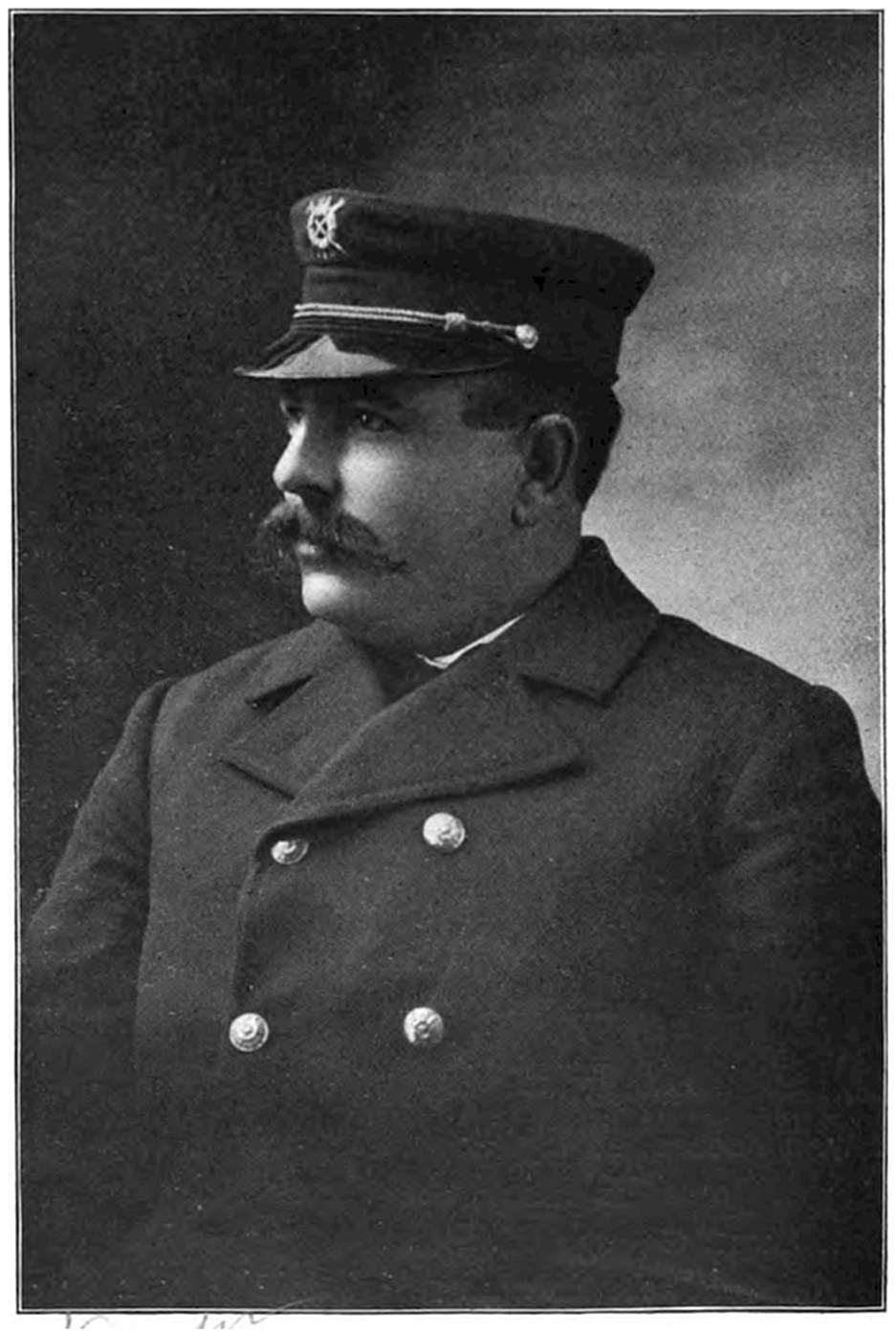
CAPT. GEORGE W. BOWLEY, KEEPER OF PAMET RIVER STATION.
Capt. George W. Bowley, keeper of the Pamet River Life-Saving Station, was born in Provincetown, Sept. 27, 1870, and has been in the United States Life-Saving Service for eleven years, ten as a surfman at the Highland Station at North Truro, and one year as keeper of this station.
Captain Bowley came from a family of life savers, his father having been a surfman at the High Head Station, in Provincetown, for eighteen years, being forced to resign on account of ill-health caused by the hardship he had suffered in that long term of service.
Captain Bowley when a boy was employed as a messenger at the telegraph station in his native town. Later he went to sea on a coasting vessel, and afterwards made a number of voyages to the West Indies. He spent a number of years fishing along the shores of Cape Cod, entering the service when he was twenty-one years of age. The training as a life saver which he received at the Highland Station, under the veteran keeper, Captain Worthen, not only made him a No. 1 surfman, but also fitted him for the higher position which he now holds.
Since he has been keeper of the Pamet River Station, Captain Bowley has spared no pains to maintain a high standard of efficiency and discipline, and he has a crew of trained surfmen ever ready to obey his commands.
PAMET RIVER STATION CREW.
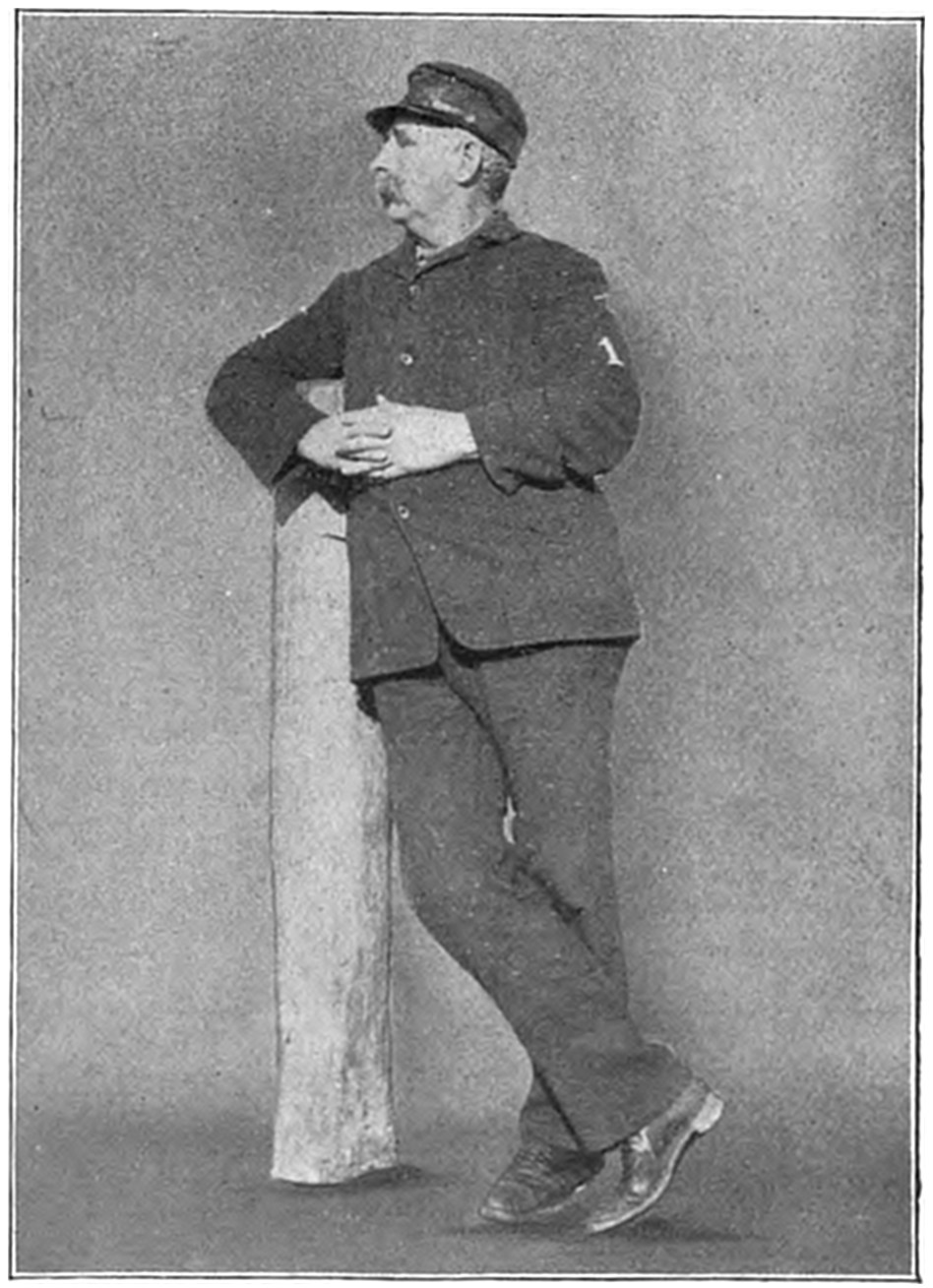
SURFMAN E. S. DYER, PAMET RIVER STATION.
Oldest surfman in the United States Life-saving Service.
The No. 1 surfman is Ephraim S. Dyer. He was born in Truro in 1845, and has the distinction of being the oldest surfman in point of years of service, among the life savers of Cape Cod, if not in the United States. He joined the service when it was established on Cape Cod, and has been attached to the Pamet River Station ever since that time. Before entering the service Surfman Dyer went to sea for a number of years, following the coastwise trade. He also spent a number of years as a fisherman and boatman along the shores of Cape Cod, and was in every way qualified for the position he has held for so long a time. During his long term of service Surfman Dyer has had many narrow escapes from death in the performance of his duty. Upon one occasion when three wrecks, the Powwow, Miles Standish, and Pavey, occurred at one time, he became entangled in the wreckage of one of the vessels, and a big rope, becoming twisted around his legs, dragged him to the bottom, nearly drowning him. During the thirty years that he has been connected with this station, Surfman Dyer has assisted at all the wrecks that have occurred near there, and beyond a sprained ankle he has never received any other injury in the work of saving life and property. The hardships which he has suffered in thirty years do not appear to have affected him in the least. He is hale and hearty and ever ready to respond to the call “vessel ashore.”
Surfman Dyer was twice married; his present wife was formerly Lydia Moore. He has one child, a daughter.
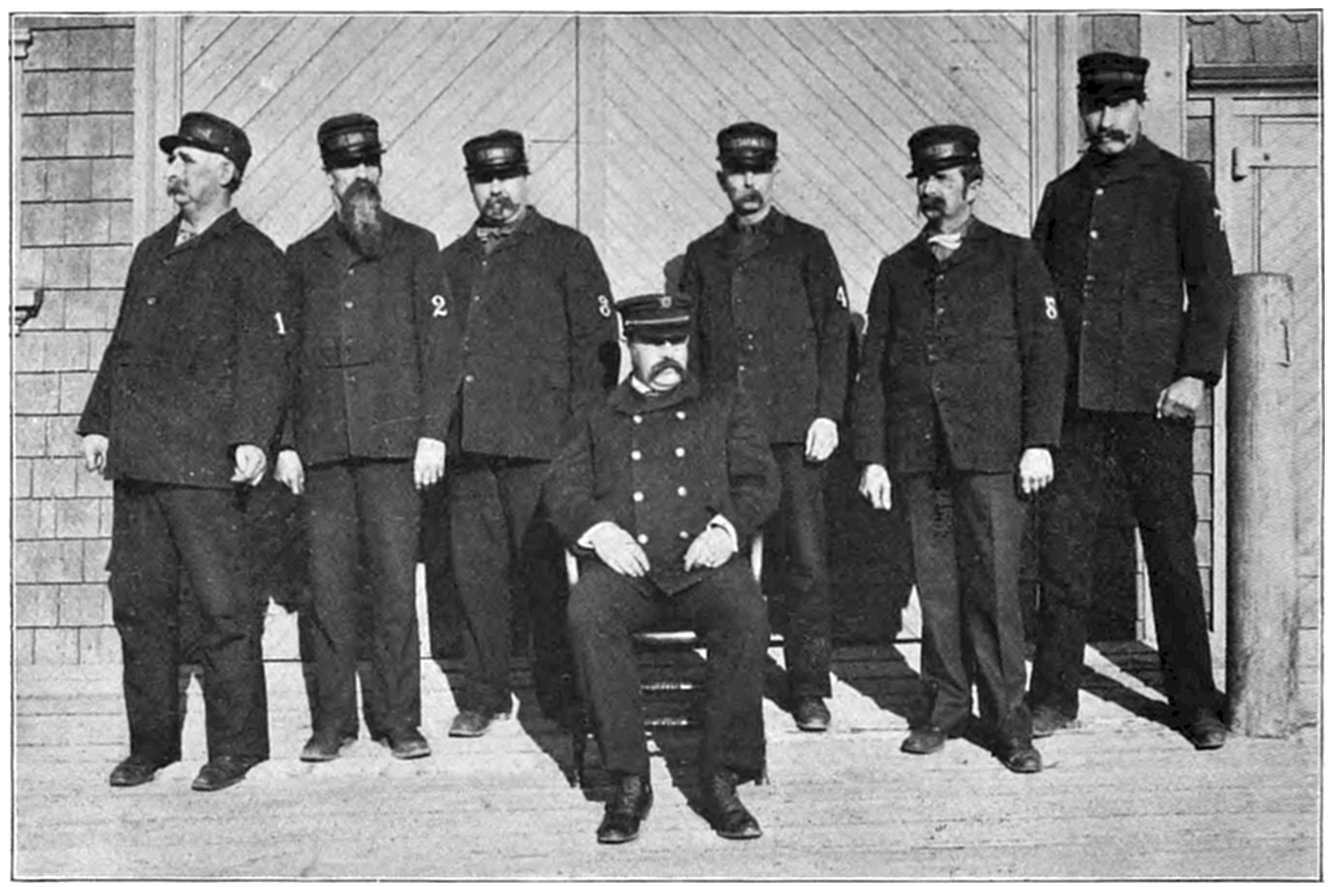
Left to right: E. S. DYER. J. H. ATWOOD. R. F. HONEY. CAPTAIN BOWLEY (seated). G. W. PAINE. I. T. HATCH. A. NICKERSON.
PAMET RIVER CREW.
The No. 2 surfman is Joseph H. Atwood. He was born in Weymouth, Mass., in 1845, and has been in the life-saving service for seventeen years, all of which have been spent at this station. Surfman Atwood went to sea when he was but nine years of age.
For thirty-one years he followed the sea in one capacity or another, making a number of voyages to the West Indies, in engaging in the coastwise trade. From his long years of service on the water he was especially adapted for the arduous duties of a surfman. He has had many thrilling experiences as a surfman. Once he had his leg fractured in assisting at a wreck, and later at the wreck of the schooner Campbell he was hit on the head by a falling spar and nearly killed. He was twice married; his present wife was formerly Mary Dyer. He is the father of two daughters.
The No. 3 surfman is Richard Honey. He was born in Truro in 1862, and has been in the life-saving service for twelve years, all of which have been at this station. Surfman Honey was a sailor before entering the service. He was an expert boatman when a boy, and after entering the service he quickly became familiar with the work incident to a surfman’s life, and has made a faithful and fearless life saver. He married Drusilla Gray.
The No. 4 surfman is George Paine. He was born in Truro, and is forty-eight years of age. Surfman Paine has been in the life-saving service and a member of the Pamet River crew for twelve years. When a young man he went to sea on a coasting schooner. Later he became a trap fisherman and was stationed at Sandwich and other points along the bay shore for a number of years.
As a trap fisherman he was obliged to battle with the surf, and he has few equals as a boatman.
He possessed the highest qualifications when he entered the service, and has made a brave and trustworthy life saver. He married Annie Allen, and is the father of five children, three girls and two boys.
The No. 5 surfman is Isaiah T. Hatch. He was born in Truro in 1857. He first entered the life-saving service in 1888, remaining at this station for one year. He reentered the service in 1892, and again became a member of this crew. Surfman Hatch followed the sea as a sailor boatman and fisherman from the time he was a young man until he entered the service, and was familiar with the duties which he has been called upon to perform as a life saver. He is a skilled boatman and a brave and hardy son of Cape Cod, who knows no peril when duty calls. He married Katie Rogers.
The No. 6 surfman is Manuel Cory. He was born in Provincetown in 1869, and has been in the life-saving service for seven years, all of which have been spent at this station. Surfman Cory was a boatman and fisherman before he entered the service. He is a perfect type of a life saver. Of perfect physique and muscles of steel, the rigors and perils of his vocation have no terrors for him. He is skilled in boating and every branch of the work of life saving, a surfman, who knows no fear when duty calls. He married Mabel F. Snow.
The No. 7 surfman is Alonzo Nickerson. He was born in Harwich in 1871, and has been in the service five years. He was a boatman and fisherman before entering the service, and has made a skilled and faithful life-saver.
ORLEANS STATION.
This station is another of the original nine stations erected on the shores of Cape Cod in 1872. It is located on what is called Little Ponchet Island, back of the Nauset Beach, about two and one-half miles south of Nauset Harbor, and about five miles from the Orleans village. Its approximate position, as obtained from the latest coast survey charts, is latitude north 41° 45′ 35″, longitude west 69° 56′ 00″.
The first keeper of the station was the late Captain Solomon Linnell, who was succeeded by Capt. Marcus Pierce. Captain Pierce was keeper of the station for fifteen years, and upon his retiring from the service, Capt. James H. Charles was placed in command.
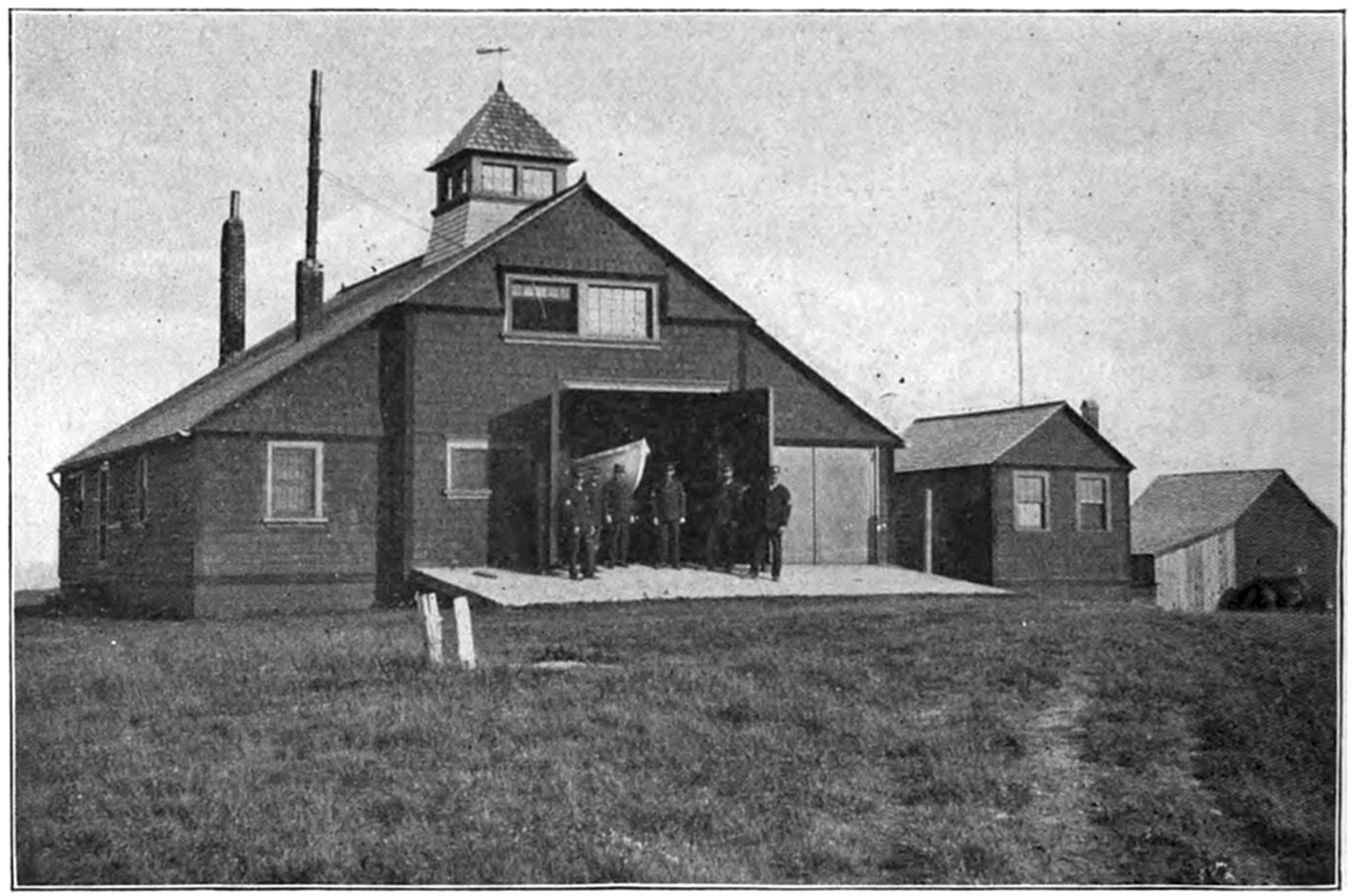
ORLEANS STATION.
The station is located at one of the most dangerous sections of the coast, sunken bars stretching along the coast there for miles. The patrol north from this station extends as far as Nauset Harbor, two and one-half miles, the surfmen using time clocks. The south patrol covers two and one-half miles of beach, the surfmen meeting and exchanging checks with the surfmen from the Old Harbor Station. Before the Old Harbor Station was built, the surfmen from this station were obliged to cover the entire beach south as far as Chatham Harbor, a distance of five miles.
At this station there are three surf-boats, two beach carts with guns, breeches-buoys, etc., and a torch light, the latter which gives a tremendously powerful light and is of great benefit to the life savers while working at wrecks in the night. Captain Charles has a horse at this station which the government employs during the winter season.
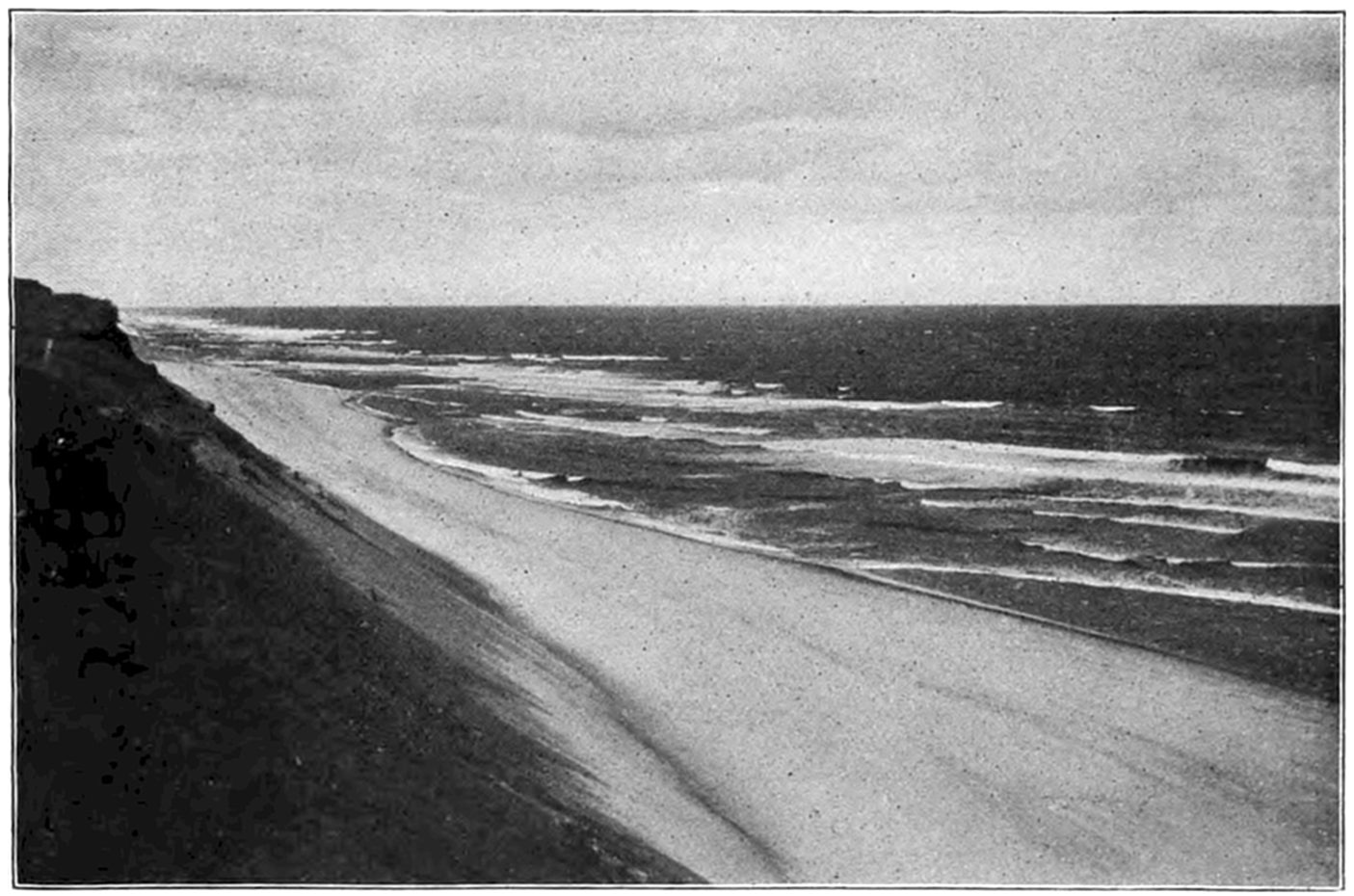
ALONG THE SHORE AT ORLEANS STATION.
Since Captain Charles has been keeper of the Orleans Station nearly one hundred lives have been saved by his crew from wrecked vessels. From the schooner Lizzie M. Center sixteen men were taken ashore in the surf-boat by his crew, the schooner being saved. From the steam launch Etta ten men were taken ashore in the surf-boat. Two men were rescued from a dory by the surf-boat, and from the schooner Ann three men were saved by the surf-boat and the vessel floated. From the schooner Lottie L. Haskins fourteen men were taken ashore in the surf-boat and the vessel saved. Two men were taken ashore from a cat-boat, but the life savers could not save the craft. From the schooner Walter Miller the crew of five and one woman were taken ashore in the breeches-buoy and the vessel saved. The schooner Iva Laffrinier, with crew of five men, was boarded by the life savers, who took the crew ashore, the vessel becoming a total loss. From the steam launch Zilpha three men were saved, and from the schooner Zenobia the crew of three men were rescued by the surf-boat, and the latter craft saved. From the sloop Carrol three men were taken ashore by the surf-boat and the craft saved. From the cat-boat Mary C three men were taken ashore in surf-boat. One man from a dory and one from a small cat-boat were also brought ashore in the surf-boat. From the schooner John L. Parker, which became a total loss, the crew of six men were taken off by the breeches-buoy. From the schooner Elsie M. Smith, which also became a total loss, sixteen men were taken ashore by the breeches-buoy, while from the steam launch No Name two men and a woman and child were taken ashore in the surf-boat.
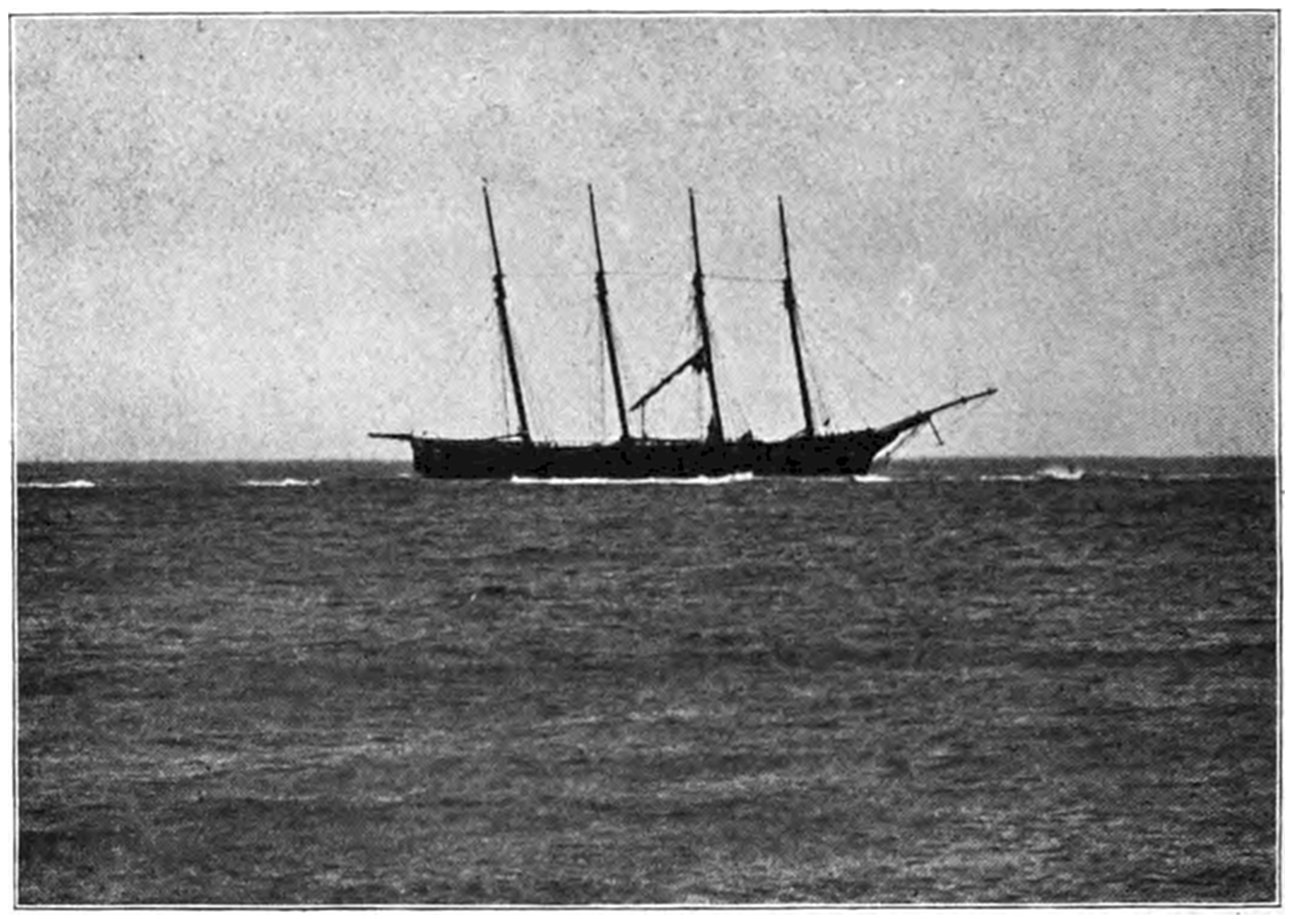
STRANDED ON THE OUTER BAR AT ORLEANS, LATER BECOMING A TOTAL WRECK.
While Captain Charles and his crew have made many daring rescues both by surf-boat and breeches-buoy, the hardest and most perilous tasks they have are going offshore to the assistance of distressed vessels. These jobs mean long and hard pulls with the perils multiplied, as after boarding the crafts they are often compelled to work them into port. No matter how far offshore the distressed vessel may be, once she is sighted with colors flying at half-mast, Captain Charles and his crew are off to her assistance. Frequently it happens that the vessels they board, after pulling in the teeth of a gale for hours, are in a sinking condition and the crews exhausted. It is then a race for life to port, and many times have the life savers felt the vessels which they have started to take into port sinking under them, before they had gotten under way.
Captain Charles and his crew have had many narrow escapes in going to the assistance of distressed vessels, and have often suffered untold hardship in the work, but that they are ever ready to battle with the wind or wave is evidenced by the great number of heroic rescues they have made.
CAPT. JAMES H. CHARLES.
Capt. James H. Charles, keeper of the Orleans Station, was born in Dennis in 1857, and has been in the life-saving service for fifteen years, six as a surfman and nine as keeper. His whole term of service has been at the Orleans Station.
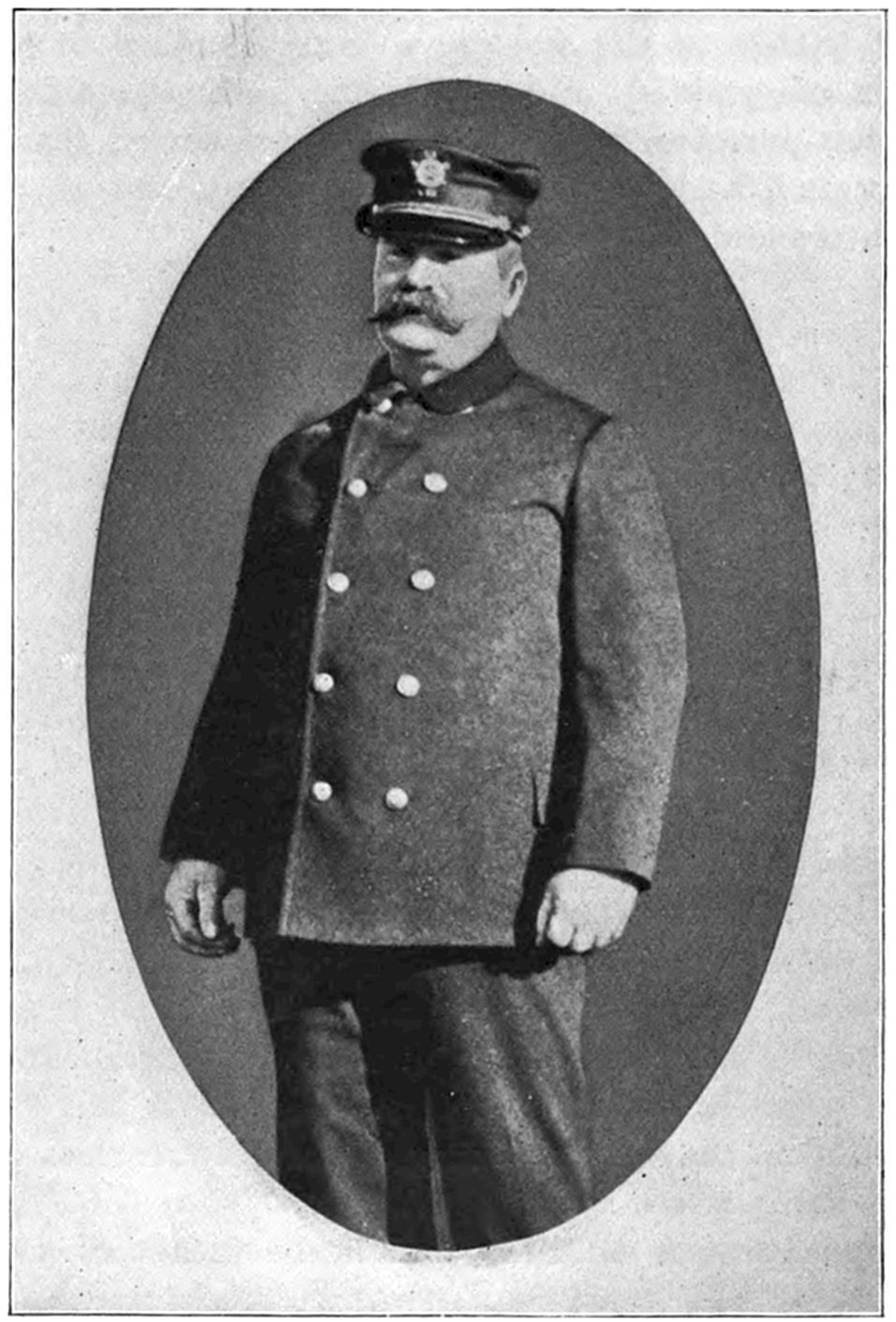
CAPT. JAMES H. CHARLES, KEEPER OF ORLEANS STATION.
His father was a well-known sea captain, and Captain Charles took naturally to the life of a sailor. When a young man his family moved to the far West.
Captain Charles remained in the West but a short time, returning to Cape Cod and engaging in boating and fishing along its shores. Later he joined the fleet of cod fishermen, and went to the Grand Banks as a skipper. After a few years as skipper of a “grand banker,” he returned to the West, taking up a government grant of land. He remained in the West but a year, returning to Cape Cod, and again joining the fishing fleet. After several seasons with the fishing fleet, he entered the life-saving service, being assigned to the Orleans Station under Capt. Marcus Pierce. As a surfman, under the veteran Captain Pierce, Captain Charles displayed exceptional ability as a boatman and life saver. The training he received with Captain Pierce soon fitted him for the position to which he was subsequently promoted, keeper of the station, succeeding Captain Pierce. Since he has had charge of the station, a high standard of efficiency has always been maintained, and the daring rescues which the crew of his station has performed testifies to their efficiency, fearlessness, and skill. Captain Charles married Lizzie Hurd, and is the father of three daughters and one son.
ORLEANS STATION CREW.
The No. 1 surfman is Abbott H. Walker. He was born in Orleans, Sept. 25, 1864, and has been in the life-saving service for eight years. Surfman Walker followed the sea from boyhood, and was a well-known boatman and fisherman. He acquired the art of handling boats in the surf when a boy and knows the location of every rip and shoal along the coast of Cape Cod. He had his first experience as a life saver under Captain Charles, and has made a skilled, fearless, and efficient coast guardian. He married Lillie Wiley, and is the father of two daughters and two sons.
The No. 2 surfman is Richard S. Gage. He was born in Dennis in 1858, and has been in the life-saving service for eleven years. Before becoming a regular surfman he substituted at the Monomoy and at this station. When he was appointed a regular surfman he was assigned to the Pamet River Station, where he served for three years. He was a boatman and fisherman for years, and also a coastwise and deep water sailor. Surfman Gage is a perfect type of life saver. Skilled in the art of boating, absolutely fearless, he has made a brave and hardy surfman.
He married Hannah M. Ellis, and is the father of two daughters and two sons.
The No. 3 surfman is Nehemiah P. Hopkins. He was born in Eastham in 1875, and has been in the life-saving service for six years. He spent his boyhood days boating and fishing along the shores of Cape Cod, and had a wide experience on the water before he entered the service. The training he has received at this station has made him a brave and efficient life saver. He married Geneva Eldredge, and is the father of two sons.
The No. 4 surfman is William B. Sherman. He was born in Orleans in 1857, and has been in the life-saving service for seven years. Surfman Sherman was assigned to this station when he entered the service, but resigned after a few months. When he reentered he was sent to the Coskata Station on Nantucket, and was later transferred to this station. He came from a seafaring family, his father having been an old “Grand Banker.” Surfman Sherman learned the art of handling boats in the surf before he joined the service, and has made an intrepid and skilled life saver. He married Minnie Cormaney, and is the father of one daughter and three sons.
The No. 5 surfman is Timothy F. Murray. He was born in Boston in 1859, and has been in the life-saving service three years. Before entering the service he had engaged in fishing and steamboating, and was a coastwise sailor and mariner. He was assigned to this station when he joined the service, and has made an able and skilled life saver. He married Phœbe F. Chase, and is the father of two daughters and one son.
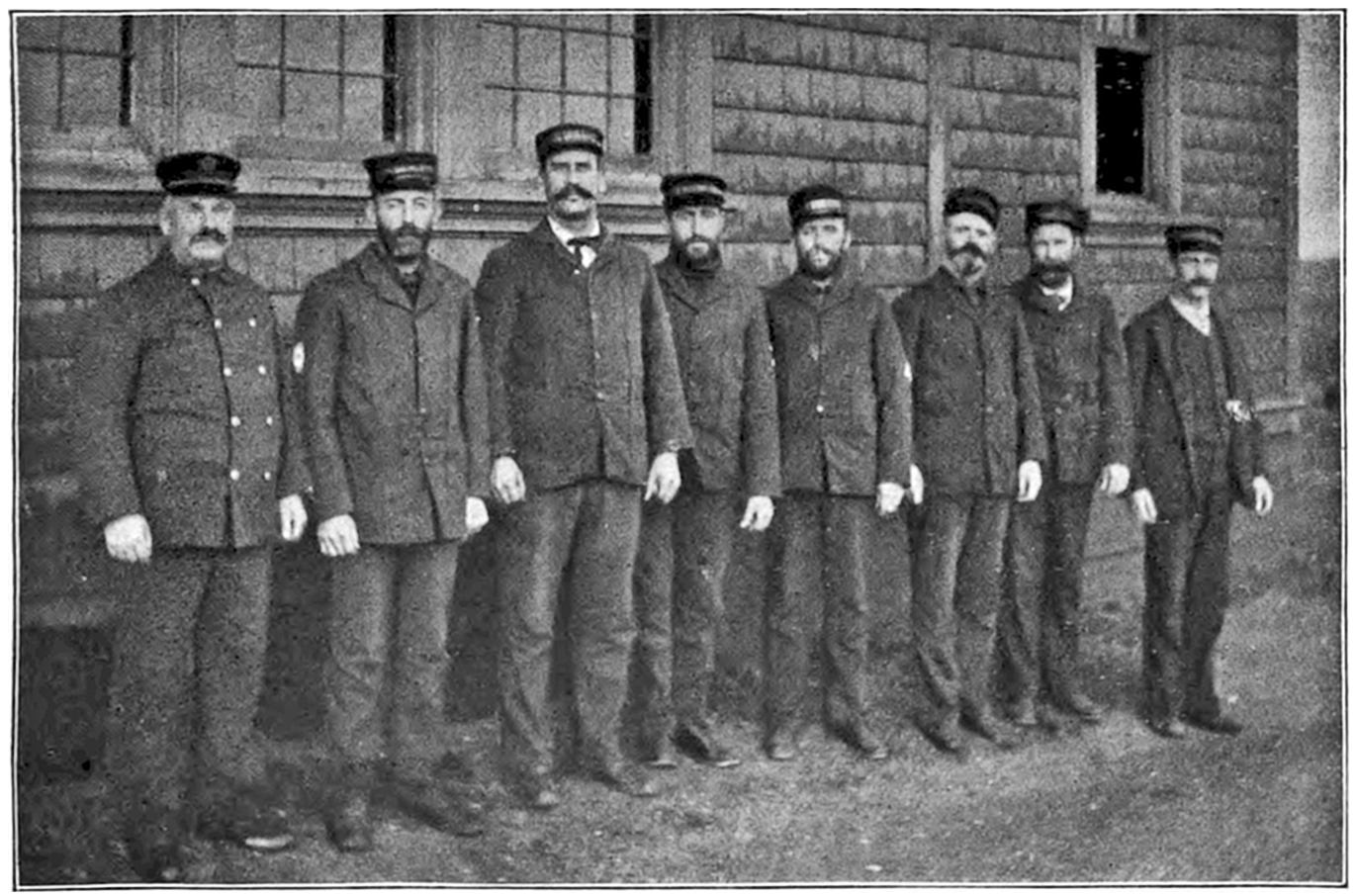
Left to right: CAPTAIN CHARLES. ABBOTT H. WALKER. RICHARD S. GAGE. NEHEMIAH P. HOPKINS. WILLIAM B. SHERMAN. TIMOTHY F. MURRAY. JOHN KILBURN. GEO. F. JORDEN.
ORLEANS STATION CREW.
The No. 6 surfman is John Kilburn. He was born in Provincetown in 1856, and has been in the life-saving service for three years. When he entered the service he was assigned to the Gay Head Station on Martha’s Vineyard, where he served one year, when he was sent to the Cahoon’s Hollow Station, remaining there one year. Surfman Kilburn was a mariner before entering the service, and was well fitted for the work he is called upon to perform as a life saver. He married Eliza Sparrow, and is the father of two sons.
The No. 7 surfman is George F. Jorden. He was born in Williamsport, Pa., in 1875, and has been in the life-saving service for two years. He entered the service as a member of the City Point, South Boston, Station crew. He served there two seasons and was the winterman at Wood End Station under Captain Bickers for two years. Last May he was transferred to the Salisbury Beach Station, where he remained until Dec. 1, 1902, when he joined this station.
Surfman Jorden had substituted at this station before he joined the service. He is an expert boatman and a fearless life saver. He married Sarah Smith, and is the father of one daughter and one son.
NAUSET STATION.
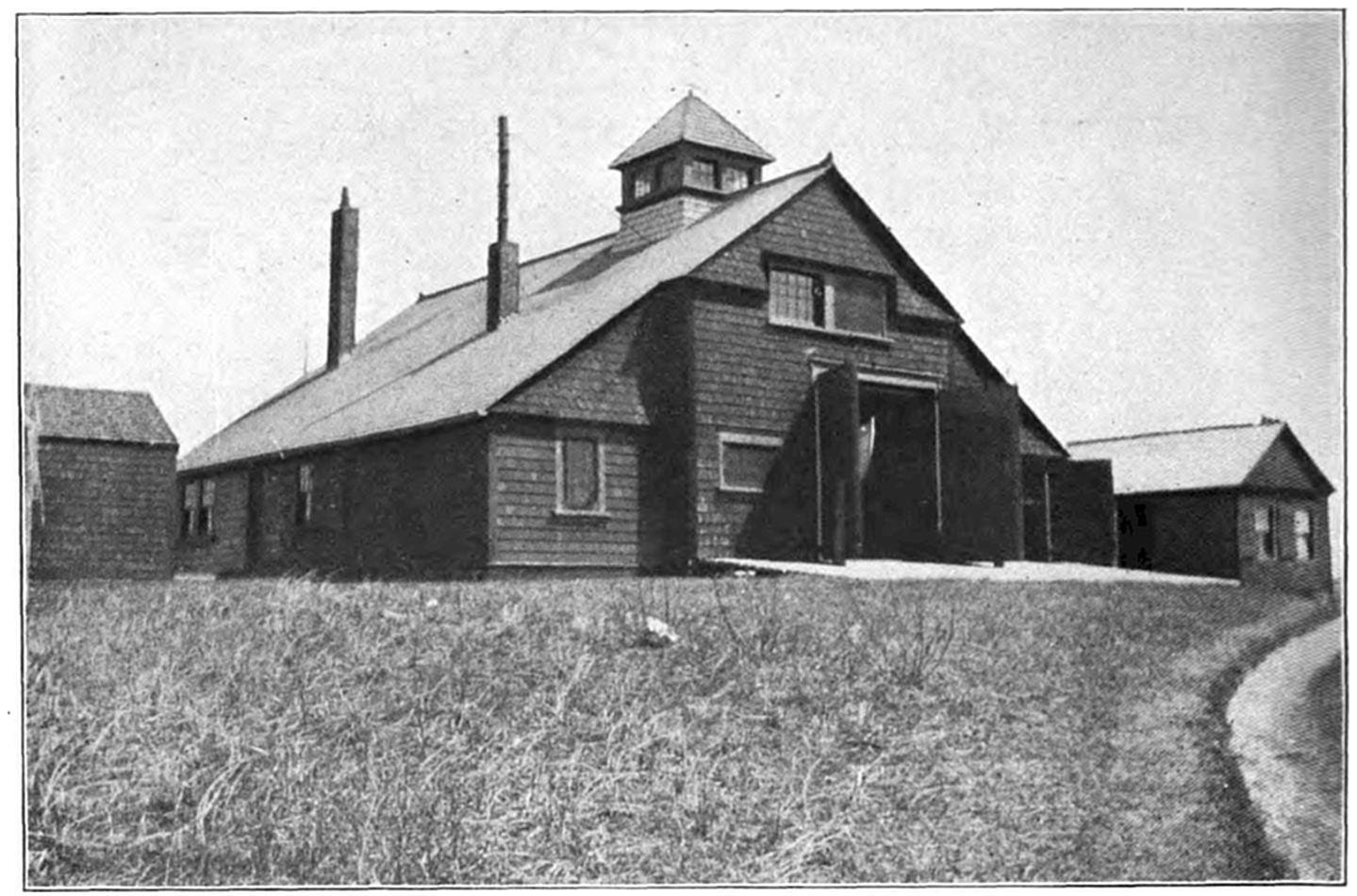
NAUSET STATION.
The Nauset Life-Saving Station is another of the original nine United States Life-Saving Stations which were built on Cape Cod in 1872. It is situated on Nauset beach about two and one-half miles from North Eastham depot and village. Its approximate position as obtained from the latest coast survey charts is latitude north 41° 50′ 40″, longitude west 69° 45′ 00″. When this station was built it was placed on a site one thousand feet south of its present location, but the shifting sands soon required its being moved inland to a more secure location, the site it now occupies. The sea at this point is constantly making great inroads into the beach, the banks having been cut away for a distance of about one hundred and fifty feet since the station was built.
The patrol north from this station is about four and one-half miles, the surfmen meeting and exchanging checks with the surfmen from Cahoon’s Hollow. The south patrol is three and one-eighth miles, the surfmen that go on that patrol using time clocks to record their performance of duty.
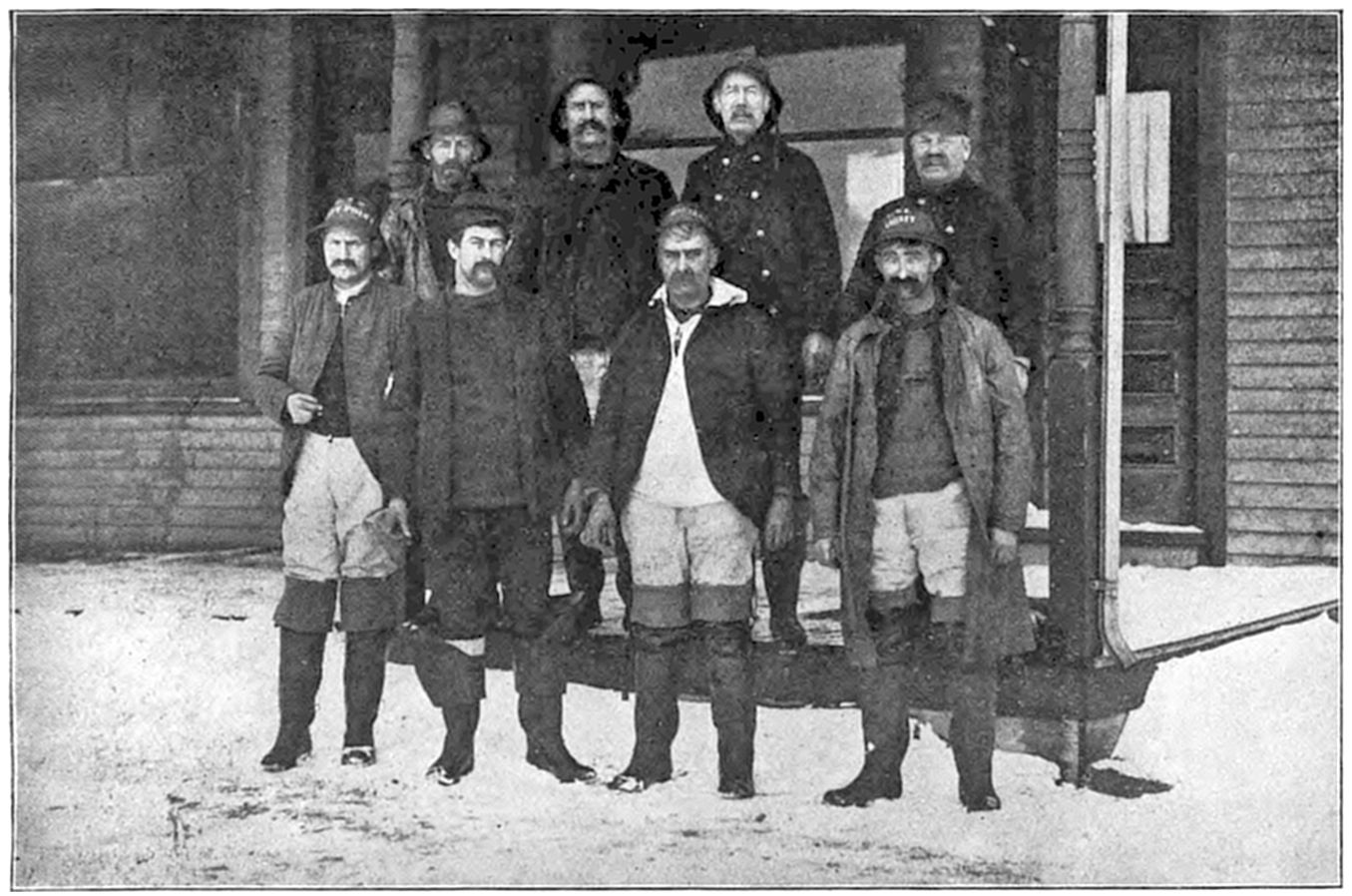
Back row: SURFMAN WALKER. SURFMAN GAGE. CAPTAIN BEARSE. CAPTAIN CHARLES. Front row: SURFMAN SNOW. SURFMAN JORDEN. SURFMAN HOWES. SURFMAN HIGGINS.
JOINT CREW.
Captains Charles, of Orleans Station, and Bearse, of Nauset Station, with their picked crews of life savers who, at the risk of their lives, brought the disabled schooner Andrew Adams and crew into port. This, the first instance in the history of the life-saving service on Cape Cod, in which two life-saving captains went to a rescue in the same life-boat, occurred during the winter of 1903.
Nauset bars extend along the shore at this station, and many terrible wrecks have taken place there. When the station was opened Capt. Marcus M. Pierce was appointed keeper. Later he was transferred to the Orleans Station, and Capt. Walter D. Knowles was placed in charge. Keeper Knowles was succeeded by the present keeper Captain Bearse. There are two surf-boats of the Monomoy model, two beach carts with breeches-buoy, etc., and a life-car at this station.
“Brad,” a horse owned by Captain Bearse, is on duty at the station during the winter season.
Captain Bearse and his crew of life savers have rescued seventeen persons in their surf-boat and seventeen shipwrecked sailors in the breeches-buoy since Captain Bearse has been keeper, while thirty-eight persons were rescued from the surf by ropes and small boats. Of the total number of vessels stranded on the bars near the station eight schooners and one cat-boat were a total loss. Not a life has been lost within the province of this station since Captain Bearse has been in charge.
CAPT. ALONZO N. BEARSE.
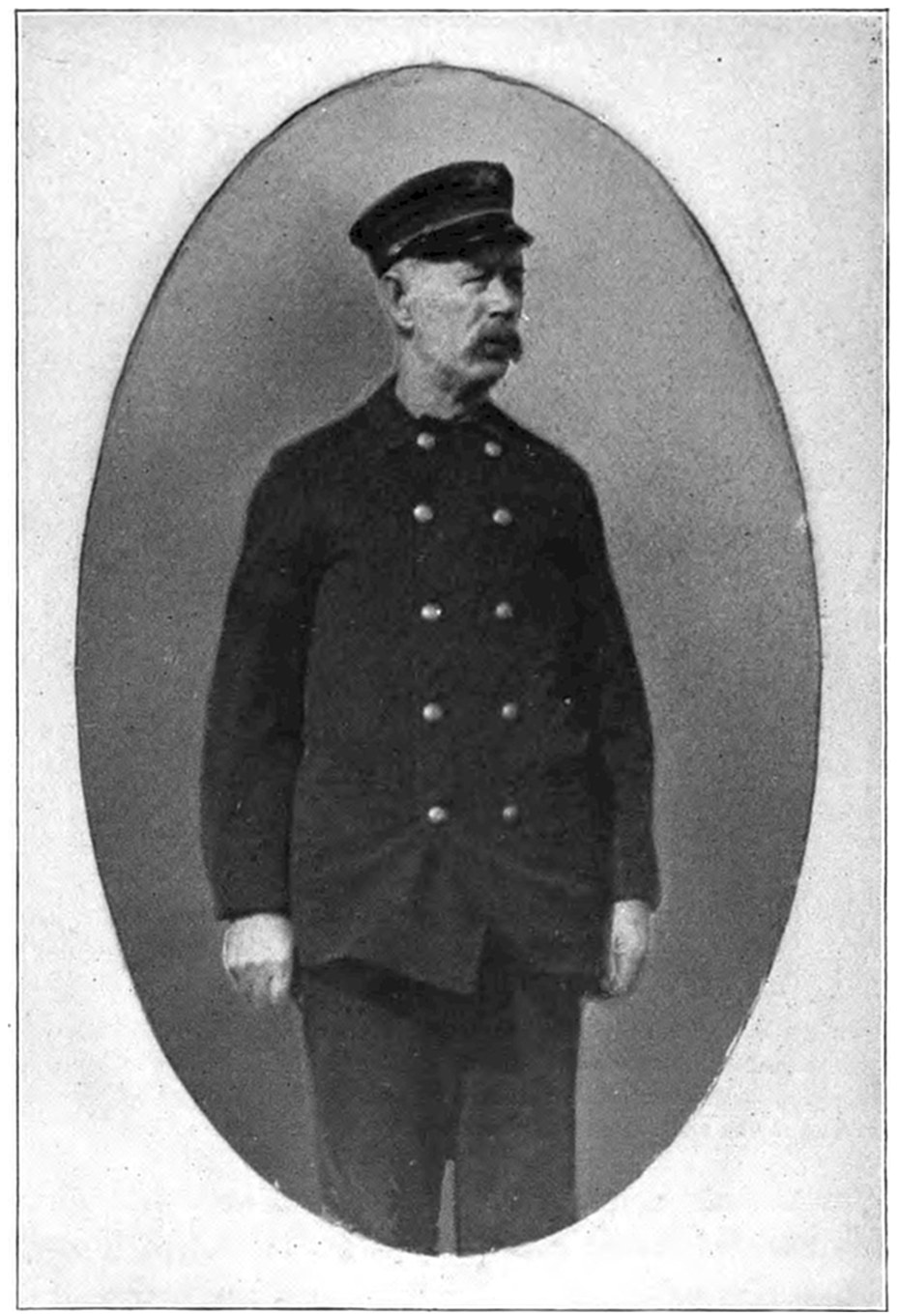
CAPT. ALONZO N. BEARSE, KEEPER OF NAUSET STATION.
Capt. Alonzo N. Bearse, keeper of the Nauset Life-Saving Station, was born on Monomoy Point in 1842, and has been in the life-saving service for nineteen years, three years as a surfman and sixteen as keeper of this station. Born on Monomoy Island, within sight of the dreaded shoals off Monomoy, as a boy he became familiar with boats and boating, and witnessed the scenes of disaster that occurred along the coast near his home. He quickly learned the art of handling boats in rough water, and in launching and landing through the surf. He went to sea at an early age, shipping on a coastwise schooner. Returning from sea shortly after the outbreak of the Civil War, he enlisted in the 43d Massachusetts Infantry, Company E, serving honorably with his company for eleven months, his term of enlistment. During the time that he was at the front he took part in the severe fighting at Kingston, Whitehall, and Goldsboro. He escaped unhurt, however, and returned to Cape Cod, and again went to sea. He had a wide and varied experience as mariner, fisherman, and boatman, and was well qualified for the work of a surfman when he joined the Nauset Station crew, under Captain Knowles, whom he subsequently succeeded as keeper.
Captain Bearse labors diligently to maintain a high standard of efficiency among his crew, and is a careful and fearless warrior of the sea. Numerous disasters have occurred within the precincts of the Nauset Station since he has been in command, and many have been averted, owing to the vigilance of his surfmen.
He was twice married, his present wife was Cordelia Ellis, and he is the father of three children.
NAUSET STATION CREW.
The No. 1 surfman is Allen T. Gill. He was born in North Eastham in 1857, and has been in the life-saving service for sixteen years, all of which have been spent at this station. Surfman Gill followed the sea and was a boatman and fisherman from the time he was a boy until he joined the service. He has assisted at all the wrecks that have occurred along the Nauset beach during the past sixteen years, and is a fearless and faithful coast guardian. He married Exa E. Lewis, and is the father of a daughter and son.
The No. 2 surfman is Charles C. Daniels. He was born in Gloucester, and is forty years of age. Surfman Daniels has been a member of the Nauset crew for fifteen years, being assigned to this station when he entered the service. He went to sea when a young man as a sailor in the coastwise surface, and was also a boat fisherman for a number of years. He was especially fitted for the work of a surfman, and has made a brave and faithful life saver. He married Mary Cole, and is the father of four daughters and two sons.
The No. 3 surfman is Lewis H. Collins. He was born in North Eastham in 1865, and is serving his fourteenth year as a life saver. Surfman Collins was a fisherman and sailor before he entered the service. In the fourteen years that he has been a member of the Nauset crew he has proven himself a faithful and fearless life saver. While working at a wreck several years ago he suffered severe injuries to his leg and back by the capsizing of the surf-boat that rendered him unfit for service for a long time. He married Eva W. Wiley, and is the father of a boy.
The No. 4 surfman is Whitman F. Howes. He was born in Chatham in 1860, and has been in the life-saving service for ten years. Surfman Howes was a boat fisherman and sailor before entering the service, and was well qualified for the work of a surfman when he became a life saver. He has assisted at all the wrecks along the shore during the past ten years and has proven his worth as a life saver whenever duty called him. He married Carrie L. Penniman, and is the father of one daughter and one son.
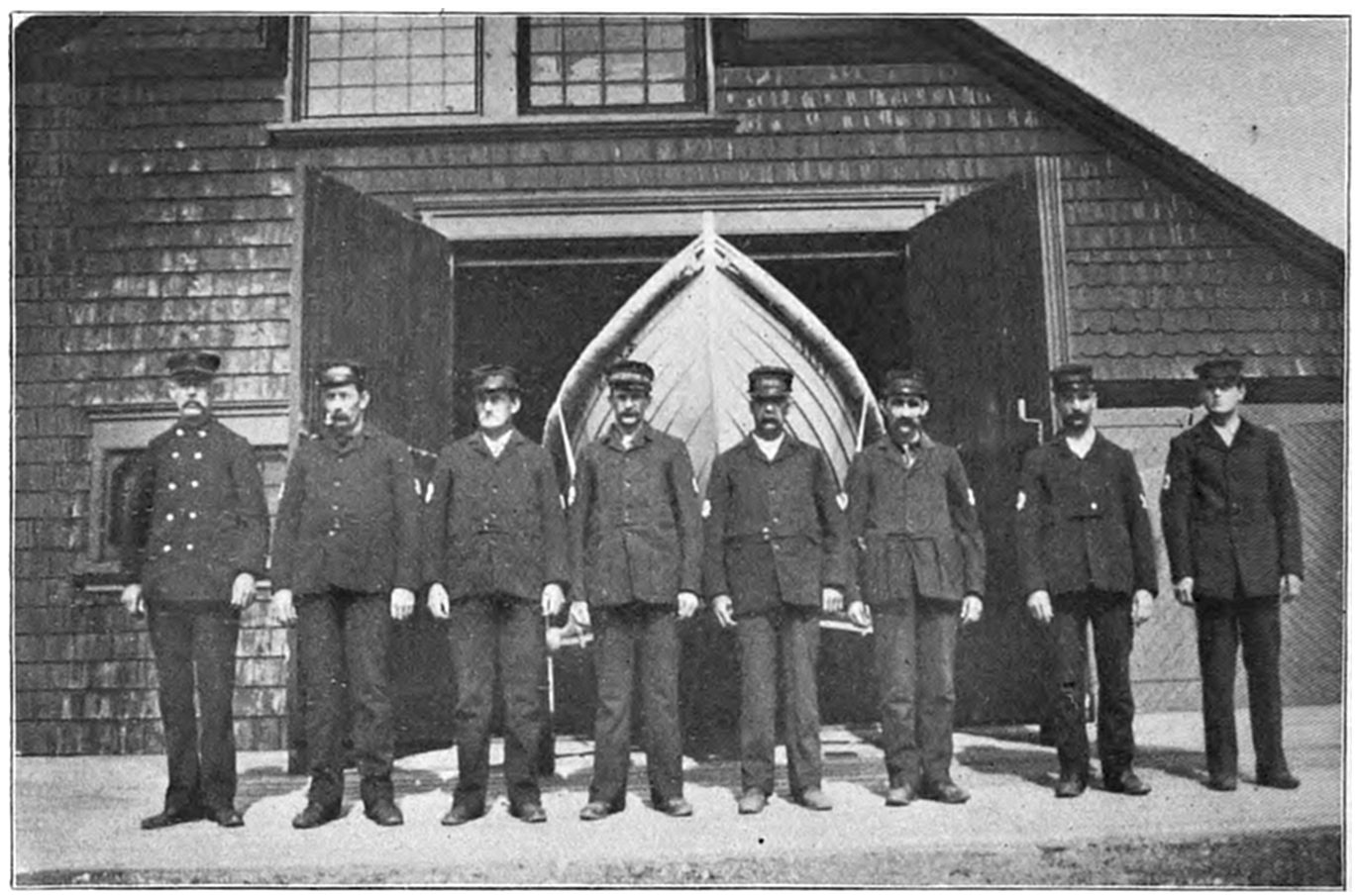
Left to right: CAPTAIN BEARSE. ALLEN T. GILL. CHAS. C. DANIELS. LEWIS H. COLLINS. WHITMAN F. HOWES. ORIN W. HIGGINS. WARREN F. MAYO. GEORGE F. SNOW.
NAUSET CREW.
The No. 5 surfman is Orin W. Higgins. He was born in Eastham in 1867, and has been in the life-saving service for nine years, all of which have been spent at this station. As a sailor and boat fisherman along the shores of Cape Cod, Surfman Higgins was well accustomed to the handling of boats in the roughest water, and has made an able and trustworthy life saver. He married Helen F. Higgins.
The No. 6 surfman is Warren W. Mayo. He was born in Eastham, and is thirty-three years of age. He entered the life-saving service seven years ago, being assigned to this station. Before entering the service he had followed the sea for a number of years, and was skilled in the art of handling boats. He has made a valuable man for Captain Bearse and is a faithful and fearless life saver. He married Marion M. Sparrow, and is the father of a son and daughter.
The No. 7 surfman is George F. Snow. He was born in Orleans in 1859, and has been in the life-saving service for four years. Surfman Snow is the winter man at this station, joining the crew in December, 1902. For two seasons he has been a member of the City Point, South Boston, Life-Saving Station. He was a boatman and fisherman along the shores of the Cape before entering the service, and has made an able and faithful life saver. He married Susan W. Alden, and is the father of one daughter and three sons.
OLD HARBOR STATION.
This station, at the entrance of Chatham Old Harbor, has been in commission less than five years, during which time Keeper Doane and his crew have rescued twenty-one persons in their surf-boat and taken thirteen shipwrecked sailors ashore in the breeches-buoy. Of the whole number of vessels that met with disaster within the province of the station, but two were total wrecks, viz., the Elsie C. Smith of Gloucester, and the Commerce of Rockland, the latter foundering off the shore near the station.
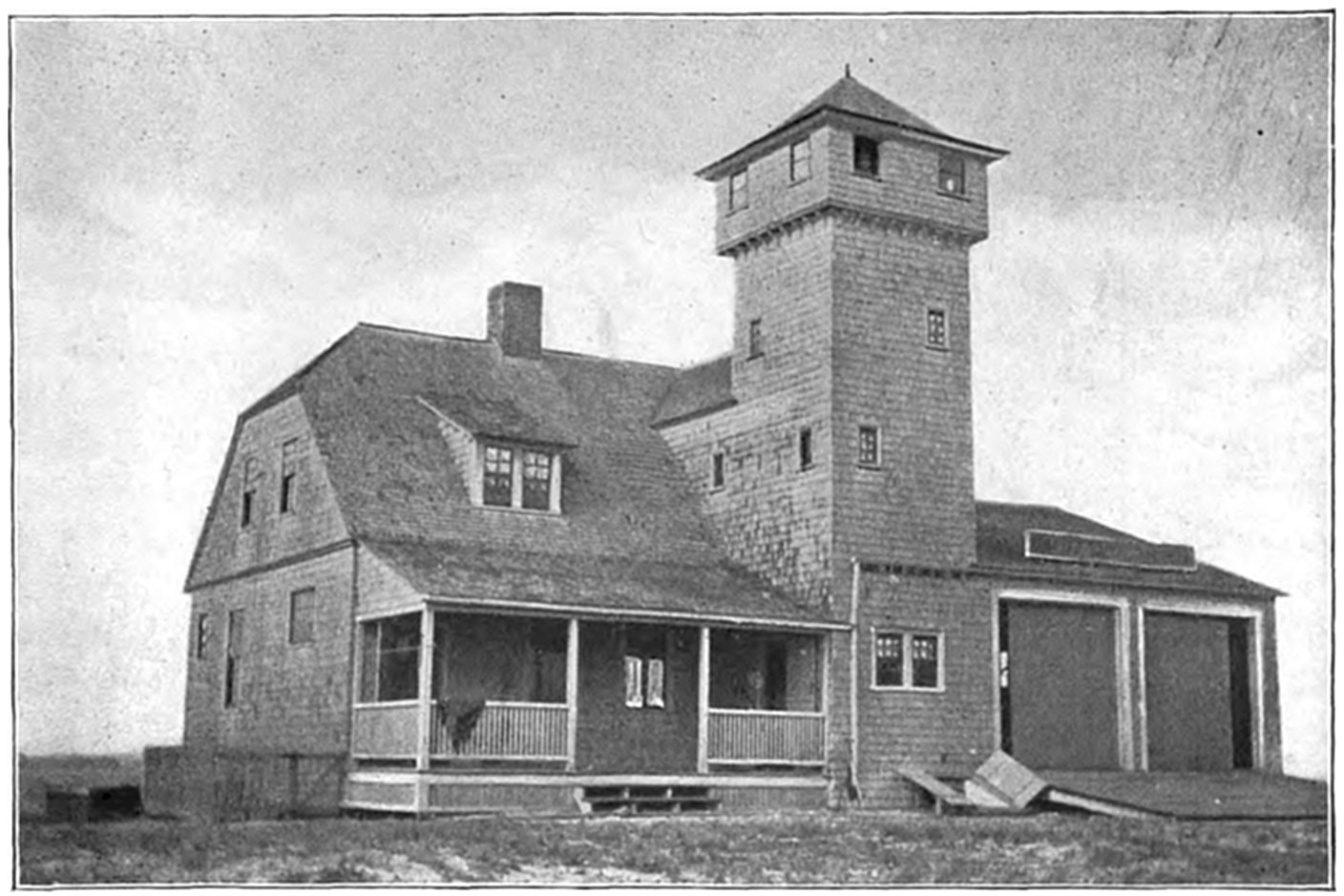
OLD HARBOR STATION.
This station is provided with two surf-boats, two beach carts with guns, breeches-buoys, etc., and a life-car. One of the surf-boats, a small one, is kept in a boathouse on the point of the beach, about a half mile from the station, where it can be quickly brought into use for rescue work in the harbor and bay. The other surf-boat, the large one, for use in the open sea, is kept in the station. A horse which the government hires during the winter season is kept in a barn close to the station.
The surfmen from this station have a patrol north for a distance of two and one-half miles, meeting and exchanging checks with the surfmen from the Orleans Station. On the south patrol, which is about a mile, the surfmen use a time clock to register their patrolling of the beach at that point.
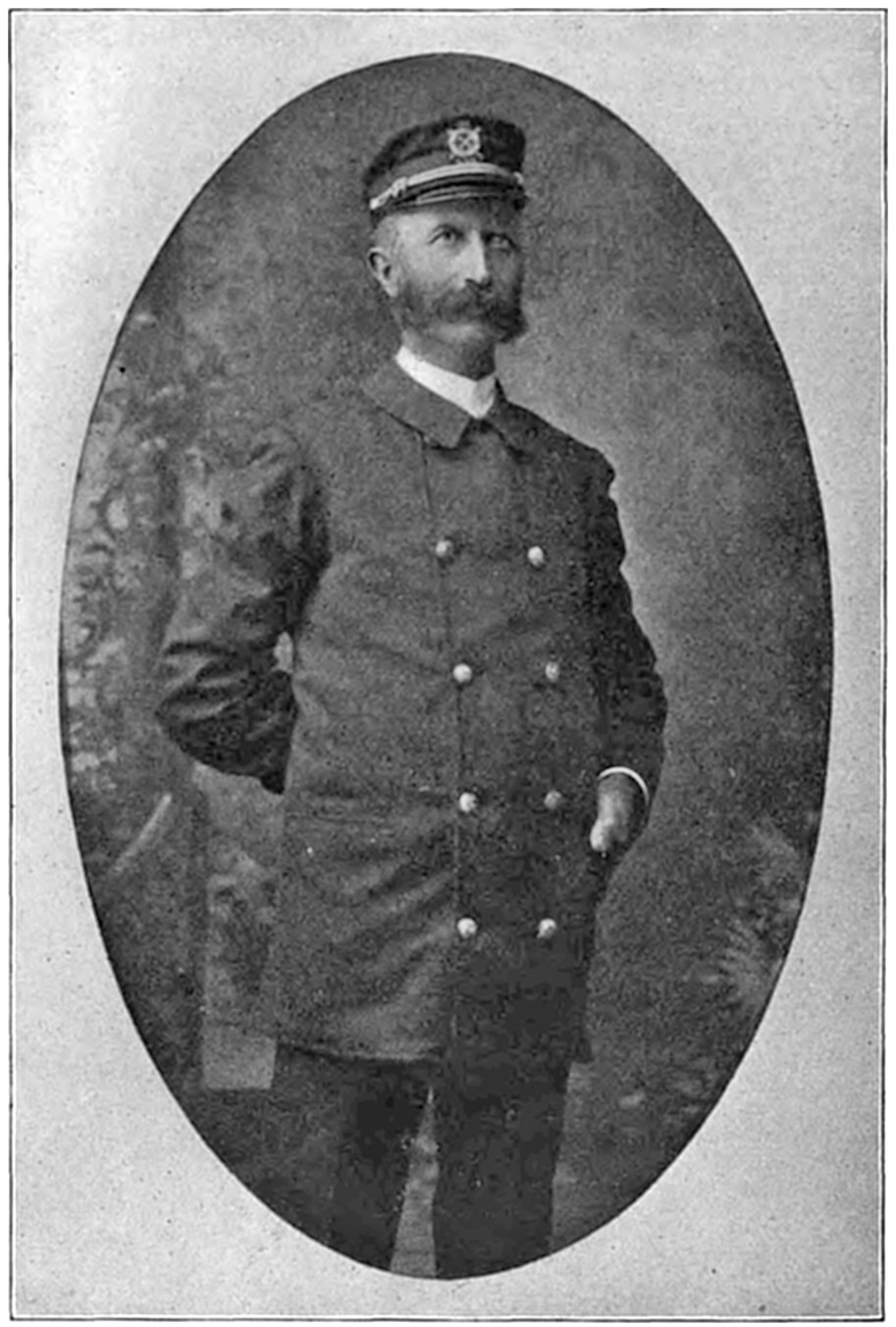
HEZEKIAH F. DOANE, KEEPER OF OLD HARBOR STATION.
CAPT. HEZEKIAH F. DOANE.
Capt. Hezekiah F. Doane, keeper of the Old Harbor Station, was born in Chatham in 1846, and has been in the life-saving service for twenty-two years, thirteen as a surfman and nine as keeper. When he entered the service he was assigned to the Chatham Station, where he served as a surfman for thirteen years, being appointed keeper of the station in 1893. Captain Doane remained keeper of the Chatham Station for five years or until he was transferred to the Old Harbor Station in 1898. He was a fisherman, yachtsman, and mariner before he entered the life-saving service and was well prepared for the work he has since been called upon to perform. As a surfman at the Chatham Station he had much work in rescuing shipwrecked crews and assisting distressed vessels, and his appointment as keeper of the Chatham Station was meritorious reward for faithful and efficient service. While keeper of the Chatham Station, Captain Doane and his brave crew of life savers made many perilous trips out over the shoals to distressed vessels, and effected daring rescues of imperiled crews. Owing to the shallow water along the Chatham shores, nearly all the work performed by Captain Doane was with the surf-boats, the breeches-buoy having been used but twice since he has been in the service. He married Pemah B. Pierce, and is the father of two sons.
OLD HARBOR STATION CREW.
The No. 1 surfman is Robert F. Pierce. He was born in Harwich and is thirty-six years of age. Surfman Pierce has been in the life-saving service for twelve years, eight as a member of the Monomoy crew, under the late Captain Tuttle, and four years at this station. When a young man he engaged in boating and fishing, and later entered the coastwise service. From his experience as a fisherman and boatman along the shores of Cape Cod he was skilled in the art of handling boats in the surf, and took naturally to the work he has been called upon to perform since joining the life-saving service. While a member of the Monomoy crew he was repeatedly called upon to face the greatest dangers, and won for himself an enviable record as a life saver. Surfman Pierce was out of the service one year, during which time he was engaged in boating. He married Minnie A. Bearse, and is the father of a boy.
The No. 2 surfman is Edwin P. Ellis. He was born in Brewster and is forty-five years of age. Surfman Ellis has been in the life-saving service for twelve years. He was a boatman and fisherman before he joined the service. When he entered the service he was assigned to the Orleans Station, under Captain Charles, serving there for five years, when he was transferred to Coskata Station on Nantucket. He was a member of the Coskata Station crew for two years. At the end of that time he was sent to join the crew at this station. At the Orleans and Coskata stations Surfman Ellis received a thorough drilling and performed much active work in life saving. He is a skilful boatman, hardened to the rigors of a life saver’s life.
The No. 3 surfman is Benjamin O. Eldredge. He was born in Chatham, on July 10, 1878, and has been in the life-saving service for five years. Prior to his becoming a regular member of this station crew, he served as a substitute at the Monomoy Station, under the late Captains Tuttle and Eldredge. As a boatman and fisherman along the Chatham shore and a substitute life saver he acquired a thorough knowledge of the art of handling boats in the surf under the most trying conditions, and was well qualified for the duties he has to perform as a life saver.
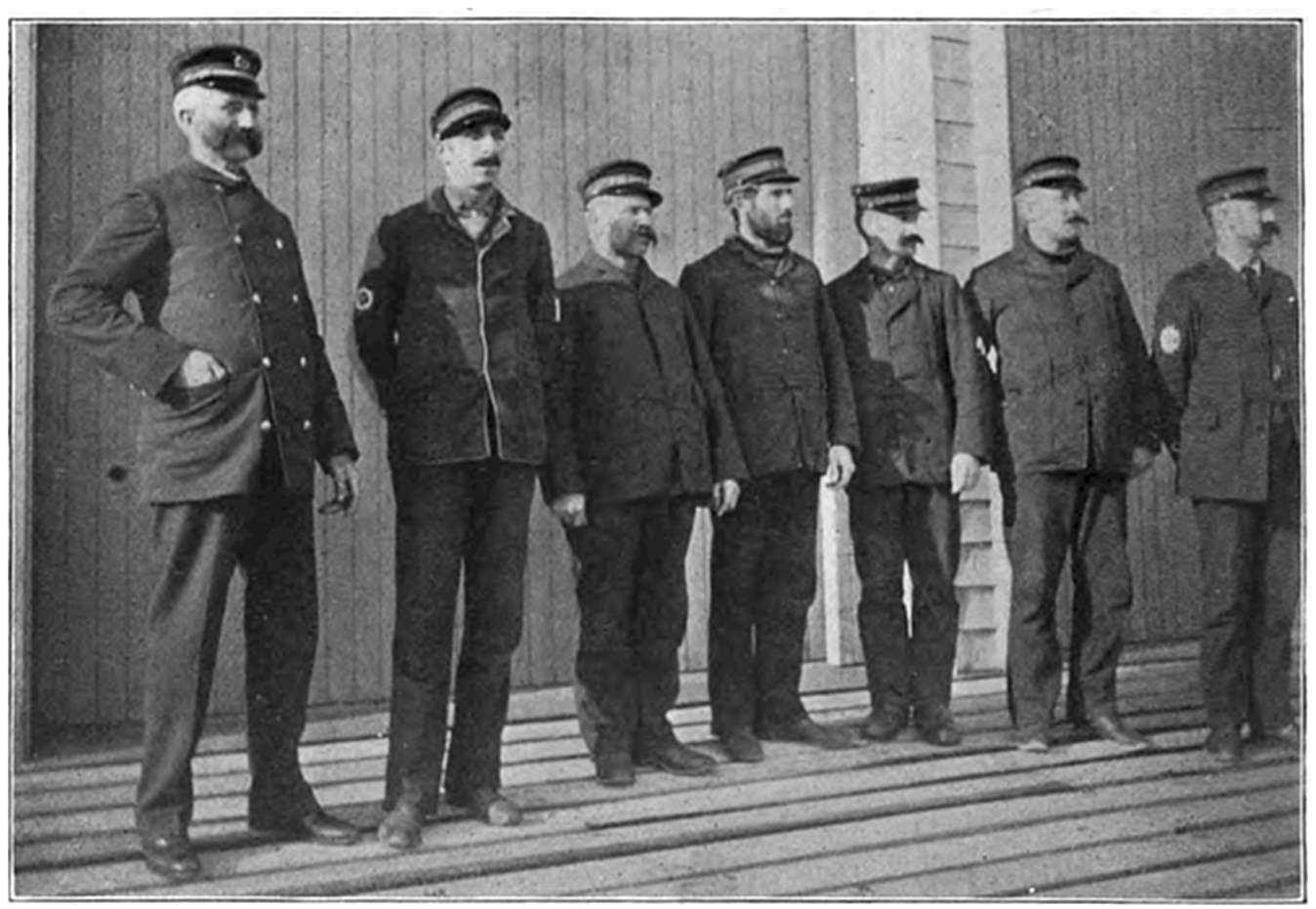
Left to right: CAPTAIN DOANE. ROB’T F. PIERCE. EDWIN P. ELLIS. BENJ. O. ELDREDGE. OTIS C. ELDREDGE. FRANCIS H. BASSETT. ZEBINA B. CHASE.
OLD HARBOR STATION CREW.
The No. 4 surfman is Otis C. Eldredge. He was born in Chatham in 1856, and has been in the life-saving service for seven years. When he entered the service he was assigned to the Jerry’s Point Station, N. H., under Capt. Silas Harding, remaining there three years, when he was transferred to this station. Before entering the service, Surfman Eldredge was a boat fisherman and “beach comber” along the Chatham shores, and his experience in the work especially fitted him for the duties of a life saver. He married Margaret Bloomer, and is the father of two daughters.
The No. 5 surfman is Dean W. Eldredge. He was born in Brewster, and is forty-seven years of age. Surfman Eldredge has been in the life-saving service for three years. Before entering the service he was a member of the crew of the Handkerchief Lightship. For years he engaged in boating, fishing, and wrecking along the shores of Cape Cod, and is a skilled surfman and a faithful life saver. When he entered the service he was assigned to the Plum Island Station, remaining there but a short time before he was sent to the Orleans Station, from which he was transferred to this station in August, 1902. He married Lena Hallet.
The No. 6 surfman is Francis H. Bassett. He was born in Harwich in 1863, and has been in the life-saving service for three years. He served two years at the Cahoon’s Hollow Station, under Captain Cole, becoming a member of this station Dec. 1, 1901. Surfman Bassett was a boatman and fisherman on Chatham bars for a number of years and had also been a grocery man. He had a wide experience as a boatman, and has made an able and fearless life saver. He married Gertrude G. Allen, and is the father of five daughters.
The No. 7 surfman is Zebina B. Chase. He was born in Chatham in 1862, and has been in the life-saving service three years. He was first a member of the Salisbury Beach Station, where he remained one and one-half years, then joining the Floating Station at City Point, South Boston. Before entering the service as a regular surfman he had substituted at different periods for four years at the Monomoy Station. Prior to this he was a member of the crew of the Shovelful Lightship for five years. From the time that he was a boy he has been engaged in boating, or fishing, or doing service of one kind or another on the water along the shores of Cape Cod. He is the winter man at this station, joining the City Point Station crew in the summer season. He is a skilful boatman and an efficient life saver. He married Etta M. Nickerson, and is the father of one daughter and four sons.
CHATHAM STATION.
The Chatham Station is another of the original nine stations erected on Cape Cod in 1872, and is situated near where it was first located. Its approximate position as obtained from the latest coast survey charts is latitude north 41° 39′ 10″, longitude west 69° 57′ 10″, one and one-quarter miles southwest of Chatham lights. A few years after the station was established it was moved across the harbor to where the Old Harbor Station now stands. It remained there a few years when it was again moved back to its original site, where it is now located, on the northern end of Monomoy, near the “cut through,” within easy distance of Chatham village.
When this station was moved from the Old Harbor site it was believed that a new station would be built there, but not until after the wreck of the schooner Calvin B. Orcutt on Old Harbor bars was the station erected. The first keeper of the station was Capt. Alpheus Mayo; he was in turn succeeded by Capt. Nathaniel Gould, Capt. Hezekiah Doane, and the present keeper, Capt. Herbert Eldredge.
The patrol, south from this station, is two and one-quarter miles; the north patrol about two miles. Checks are exchanged with the surfmen from the Monomoy Station on the south; on the north patrol time clocks are used. The station is supplied with four surf-boats, (Monomoy model), one dory, two beach carts with full sets of apparatus, and one life-car. “Baby,” a horse employed by the government, is kept at the station to assist in hauling the apparatus to wrecks.
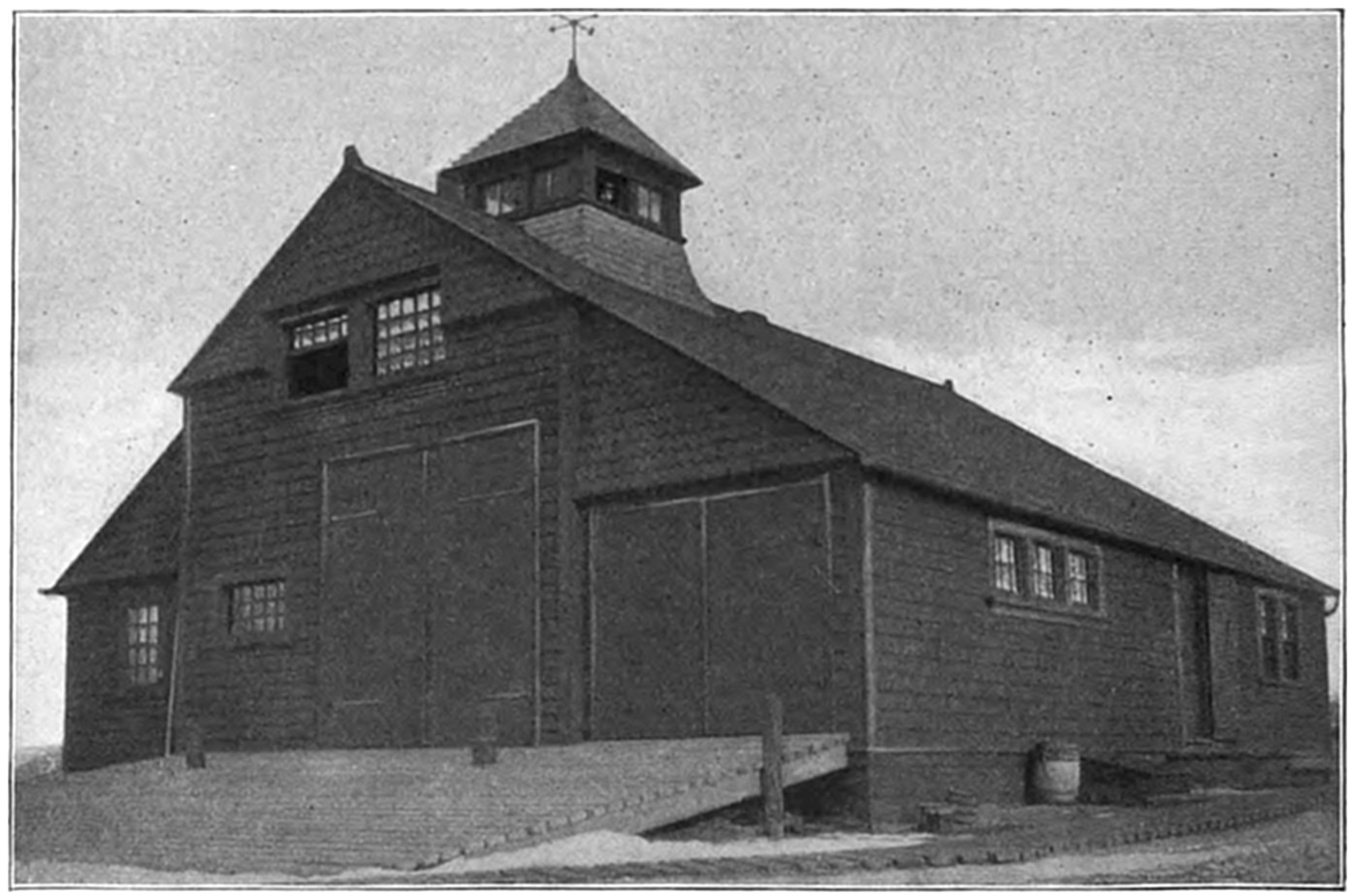
CHATHAM STATION.
WRECKS AT THE CHATHAM STATION.
Since Keeper Eldredge has had charge of this station he has made twenty-six trips to disabled or wrecked vessels in the station surf-boat. On board the vessels assisted by Keeper Eldredge and his crew there were seventy-four persons. Of this number eight were taken ashore in the surf-boat. Six of these comprised the crew of the schooner Electa Bailey, which was a total loss, one was from a crippled cat-boat, and the other was a sick sailor taken ashore from a schooner. Most of the work done by the crew of the Chatham Station was on two and three masted schooners that became stranded on the Chatham bars.
CAPT. HERBERT E. ELDREDGE.
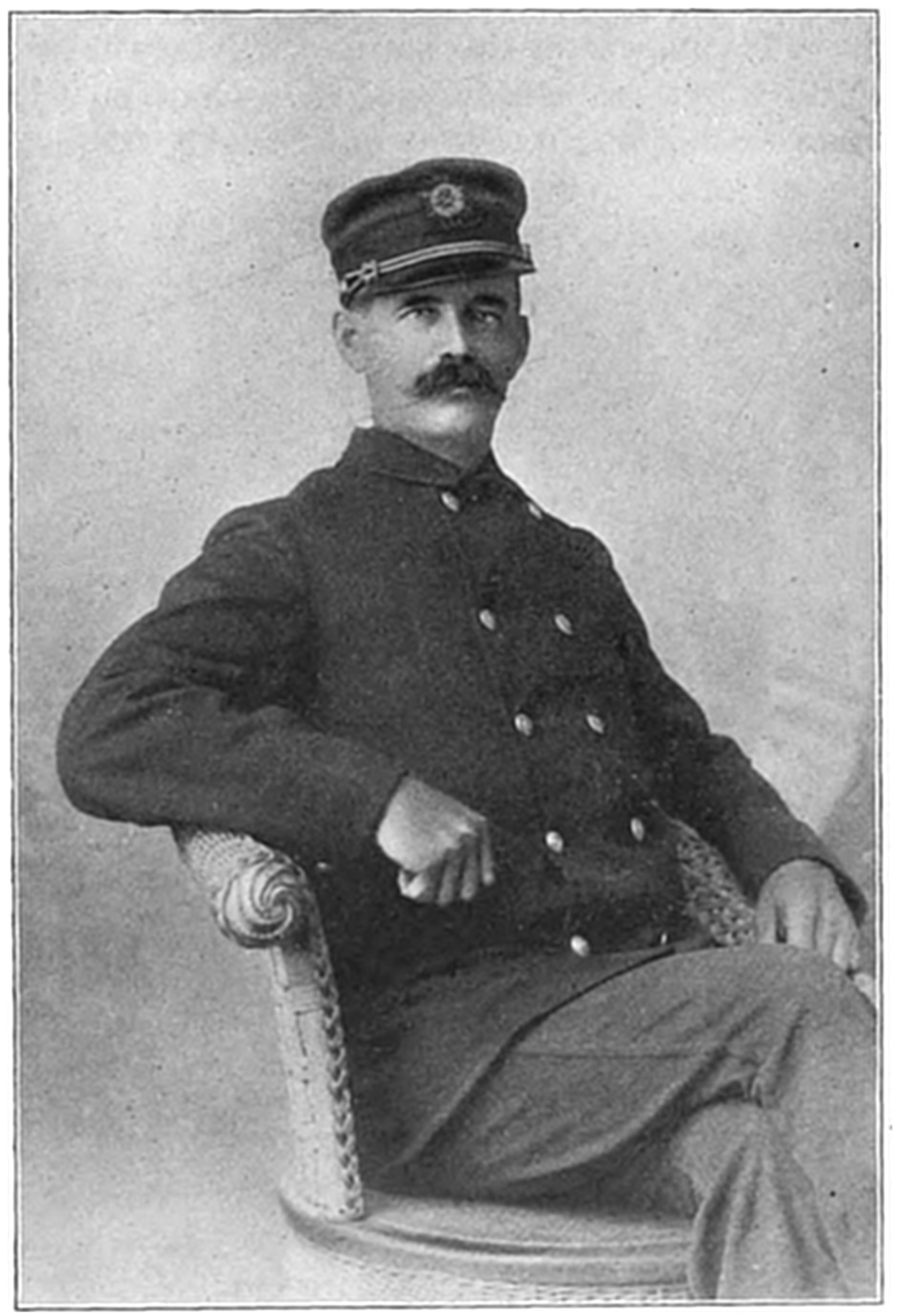
CAPT. HERBERT ELDREDGE, KEEPER OF CHATHAM STATION.
Capt. Herbert E. Eldredge, keeper of the Chatham Station, was born in Chatham in 1863, and has been in the life-saving service for thirteen years, eight as a surfman and five as keeper, all of which have been spent at this station. Captain Eldredge began his career on the water along the Chatham shore when a boy of thirteen years, and was an expert boatman, fisherman, and wrecker before he was twenty years of age. For six years he went fishing on the rips off Chatham, one of the most perilous occupations along the coast. As a member of Capt. Joseph Bloomer’s wrecking crew, Captain Eldredge had a wide experience working on wrecked vessels along the coast, and was especially fitted for the responsible position that he now holds. He has a crew of brave and hardy life savers for whom the rips and shoals that abound along the Chatham shore have no terrors. Not a life has been lost within the province of the Chatham Station during the time that Captain Eldredge has been keeper.
He married Mary A. Nye, and is the father of two daughters and a son.
CHATHAM STATION CREW.
The No. 1 surfman is Bradford N. Bloomer. He was born in Chatham in 1871, and has been in the life-saving service for six years, all of which have been spent at this station. Before entering the service Surfman Bloomer was a Monomoy fisherman, so called. In this work he became skilled in the art of handling boats in the surf, and obtained a knowledge of the shoals that lie hidden along the coast off Chatham that especially fitted him for the work of a surfman. He married Julia Pitts, and is the father of two daughters.
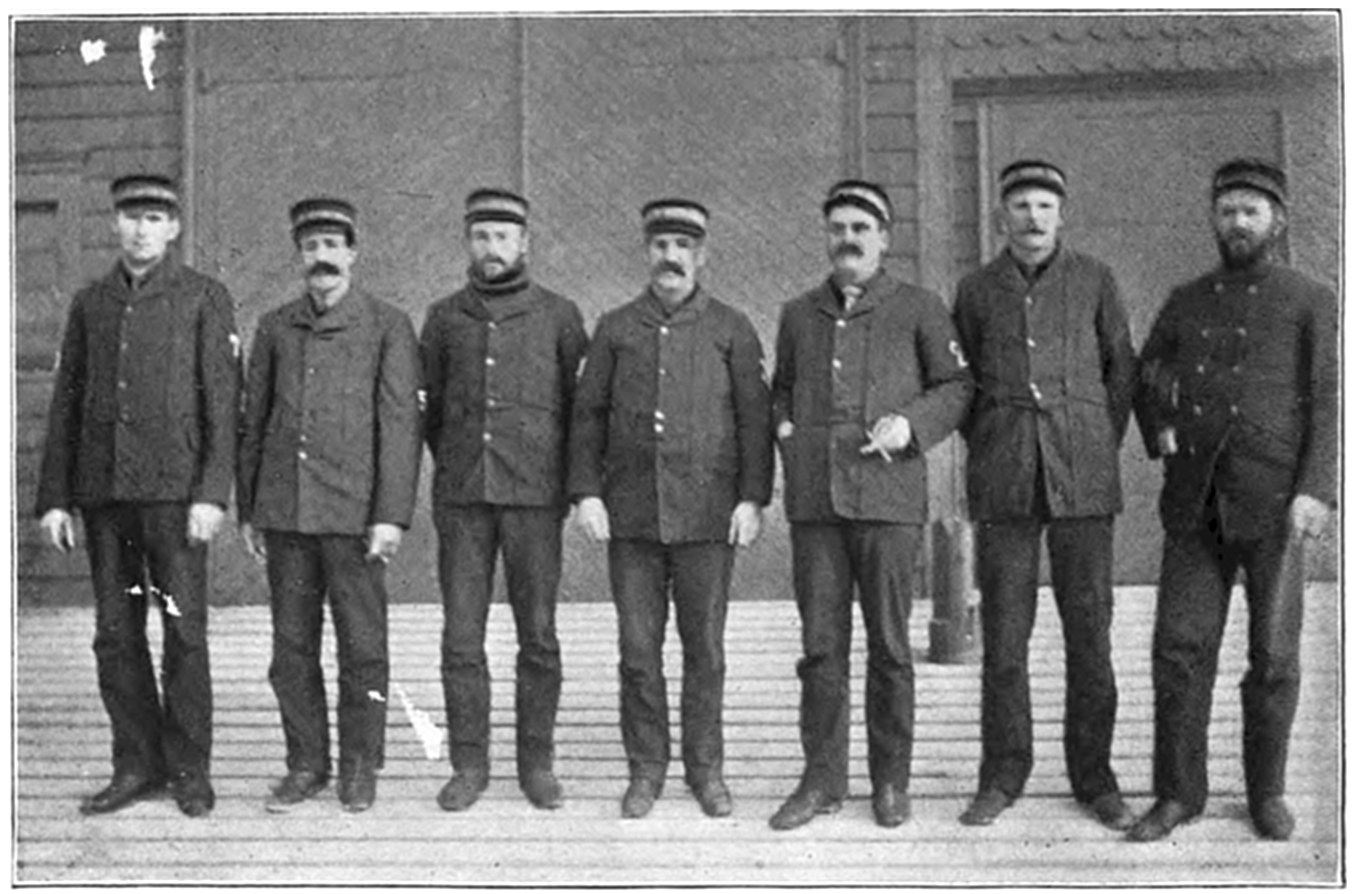
Left to right: HERBERT P. SMITH. NATHANIEL HAMILTON. JOHN W. CROWELL. SAMUEL D. ELDREDGE. CHARLES H. HOWES. BRADFORD D. BLOOMER. CAPTAIN ELDREDGE.
CHATHAM CREW.
The No. 2 surfman is Charles H. Howes. He was born in Chatham, is thirty-six years of age, and has been in the life-saving service five years. Surfman Howes was assigned to the Coskata Station on Nantucket when he entered the service; later he was transferred here. He was a boatman and fisherman over the Old Harbor bars from boyhood until he entered the life-saving service. The experience he gained in that hazardous work fully prepared him for the duties of a surfman, and he has made a brave and trustworthy life saver. He married Henrietta Jones, and is the father of a daughter and son.
The No. 3 surfman is Samuel D. Eldredge. Surfman Eldredge was born in East Harwich in 1859, and has been in the life-saving service for five years, all of that time at this station. He was a boatman and fisherman from the time that he was a boy until he entered the service, and was in every way qualified for the work of a life saver. He married Sarah J. Eldredge.
The No. 4 surfman is John W. Crowell. He was born in East Harwich, and is twenty-six years of age. Surfman Crowell has been in the life-saving service six years, serving four years at the Monomoy Station under the late Captain Eldredge, the remaining time at this station. Before entering the service he was a boatman and fisherman on the Chatham bars. As a member of the Monomoy crew he was called upon to face the greatest perils in the work of rescuing lives from wrecked vessels, and proved a faithful and brave surfman. He married Elsie Nickerson, and is the father of a son.
The No. 5 surfman is Nathaniel Hamilton. He was born in Foxboro, Mass., in 1872, and has been in the life-saving service for four years. Surfman Hamilton was formerly a member of the Coskata Station, Nantucket. Owing to injuries received by falling on a piece of wreckage, while on patrol duty at that station, he was on sick leave for one year. When he reentered the service he was assigned to this station. He was a boatman and fisherman before entering the service, and has made a brave and efficient life saver. He married Abbie L. Johnson, and is the father of three daughters.
The No. 6 surfman is Franklin W. Eldredge. He was born in Chatham in 1859, and has been in the life-saving service one year. Surfman Eldredge joined the Coskata Station crew when he entered the service, and after five months at that station was transferred here. He was a boatman and fisherman before he entered the service, spending thirteen years as a fisherman over Chatham bars. He entered the life-saving service fully prepared for the most perilous work, and has proved to be a skilled and faithful life saver. He married Modena B. Jerauld, and is the father of three daughters and two sons.
The No. 7 surfman is Herbert P. Smith. He was born in Edgartown, Martha’s Vineyard, in 1877, and has been in the life-saving service five years. Surfman Smith was a boatman and fisherman along the shores of Martha’s Vineyard from boyhood. In addition to being an expert boatman, he received a thorough nautical training, having made several foreign cruises as a cadet on the United States training ship Enterprise. Surfman Smith also served on the repair ship Vulcan during the war with Spain.