Chapter IX · : THE BEGINNINGS IN LONDON. THE YEARS EIGHTEEN FIFTY-NINE TO EIGHTEEN SIXTY-THREE CONTINUED.
Reading edition
Whistler, in 1860, devoted more time to painting on the river and less to etching, though the Rotherhithe belongs to this year. One picture he described in a letter to Fantin. "Chut! n'en parle pas à Courbet" was his warning, as if afraid to trust so good a subject to anyone. It was to be a masterpiece, he had painted it three times, and he sent a sketch which M. Duret reproduced in his Whistler. M. Duret, unable to trace the picture, thought he might never have carried it beyond the sketch. But it was finished: the Wapping shown in the Academy of 1864, a proof how long Whistler kept his pictures before exhibiting them. In 1867 he sent it to the Paris Exhibition. It was bought by Mr. Thomas Winans, taken to Baltimore, where it has remained. Whistler wanted to exhibit it at Goupil's in 1892, but could not get it. Never seen in Europe since 1867, it has been forgotten. It was painted from an inn, probably The Angel on the water-side at Cherry Gardens which exists to-day, one of a row of old houses with overhanging balconies. In the foreground, in a shadowy corner of the inn balcony, is a sailor for whom a workman from Greaves' boat-building yard, Chelsea, sat; next, M. Legros; and on the other side of M. Legros, with her back turned to the river, the girl with copper-coloured hair, Jo, the model for The White Girl and The Little White Girl. On the river are the little square-rigged ships that still anchor there; on the opposite side is the long line of Wapping warehouses, which give the name. Artists feared Jo's slightly open bodice would prevent the picture being hung in the Royal Academy. But Whistler insisted, if it was rejected on that account, he would open the bodice more and more every year until he was elected and hung it himself.
He painted The Thames in Ice this year (1860) from the same inn. It was called, when first exhibited, The Twenty-fifth of December, 1860, on the Thames. For an idle apprentice it was a strange way of spending Christmas. Whistler told us that Haden bought it for ten pounds—ample pay, Haden said: three pounds for each of the three days he spent painting it, and a pound over. To Whistler the pay seemed anything but ample. "You know, my sister was in the house, and women have their ideas about things, and I did what she wanted, to please her!"
Two other pictures of 1860 are the portrait of Mr. Luke Ionides and The Music Room. In both the influence of Courbet is evident. The portrait, painted in the Newman Street studio, has the heavy handling of The Piano, though much more brilliant. But the other picture is a tremendous advance.
Fantin could not have been more conscientious in rendering the life about him as he found it than Whistler in The Music Room; only, the room in the London house, with its gay chintz curtains, has none of the sombre simplicity of the interior where Fantin's sisters sit. Fantin's home had an austerity he made beautiful; the Haden's house had colour—Harmony in Green and Rose was Whistler's later title for the picture. He emphasised the gaiety by introducing a strong black note in the standing figure, Miss Boot, while the cool light from the window falls on "wonderful little Annie," in the same white frock she wears in The Piano Picture. Mrs. Thynne (Annie Haden) says:
"I was very young when The Music Room was painted, and beyond the fact of not minding sitting, in spite of the interminable length of time, I do not know that I can say more. It was a distinctly amusing time for me. He was always so delightful and enjoyed the 'no lessons' as much as I did. One day in The Morning Call (the first name of The Music Room) I did get tired without knowing it, and suddenly dissolved into tears, whereupon he was full of the most tender remorse, and rushed out and bought me a lovely Russia leather writing set, which I am using at this very moment! The actual music-room still exists in Sloane Street, though the present owners have enlarged it, and the date of the picture must have been '60 or '61, after his return from Paris. It was then he gave me the pencil sketches I lent to the London Memorial Exhibition. I had kept them in an album he had also brought me from Paris, with my name in gold stamped outside, of which I was very proud. We were always good friends, and I have nothing all through those early days but the most delightful remembrance of him."
This picture is described under three titles: The Morning Call, The Music Room, and Harmony in Green and Rose, The Music Room; the present confusion in Whistler's titles is usually the result of his own vagueness. It became the property of Mrs. Réveillon, George Whistler's daughter, and was carried off to St. Petersburg, never to return to London until the exhibition at the Goupil Gallery in 1892.
It has become the fashion to say that Whistler had not mastered his trade and could not use oil paint. These early pictures are technically as accomplished as the work of any of his contemporaries. He never was taught, few artists are, the elements of his trade, and some of his paintings have suffered. The Music Room and The Thames in Ice, so far as we can remember, are wonderfully fresh. They were painted more directly, more thinly, than the Wapping, in which the paint is thickly piled, as in the Piano Picture, which has cracked, no doubt the result of his working over it probably on a bad ground. Of two pictures painted at the same period, the Wapping is badly cracked, and the Thames in Ice is in perfect condition. But this is due to his want of knowledge of the chemical properties of paints and mediums. Later, he gave great attention to these matters. He kept the Wapping four years before he showed it. Though started down the river in 1860, it contains a portrait of Greaves' man, whom he did not see for two or three years after. Walter Greaves stated, or allowed to be stated, in a preface to the catalogue of his exhibition in May 1911, that he met Whistler in the late fifties when Whistler lived in Chelsea and made the Thames series of etchings. But the statement was proved to be inaccurate, and the preface was withdrawn. We have quoted Greaves on several occasions, but, before doing so, we have verified every statement of importance he made to us, and we first met him some few years ago when his memory was clearer and more reliable, and when he possessed letters from Whistler which we have seen.
Mr. Thynne stood in 1860 for the beautiful dry-point Annie Haden, in big crinoline and soup-plate hat, the print Whistler told Mr. E. G. Kennedy he would choose by which to be remembered. It was the year also of the portraits of Axenfeld, Riault, and "Mr. Mann." In 1861 there were more plates on the Upper as well as the Lower Thames. Two of the plates of 1861 were published as illustrations by the Junior Etching Club in Passages from Modern English Poets, and Whistler proved the plates at the press of Day and Son, and met the lad he called "the best professional printer in England," Frederick Goulding.
Whistler told us that he worked about three weeks on each of the Thames plates. He therefore must have spent on dated plates alone thirty-six weeks in 1861, leaving but fourteen weeks for other work and for play. Some of them are much less elaborate than the Drouet, which, Drouet said, was done in five hours, so that it seems difficult to reconcile the two statements. But it was about the Black Lion Wharf, one of the fullest of detail, that we asked Whistler. We had many discussions with him about them. Whistler maintained that they were youthful performances, and J. as strongly maintained that that had nothing to do with the matter; that he never surpassed the wonderful drawing and composition and biting. He insisted that his later work in Venice and in Holland was a great development, a great advance, and his final answer was: "Well, you like them more than I do!" But there is no doubt that the Thames plates, notably the Black Lion Wharf, have, for artistic rendering of inartistic subjects and for perfect biting, never been approached. Another thing that astonished J. was that he could see such detail and put it on a copper-plate. "H'm," was Whistler's comment, "that's what they all say."
Whistler got to know the Upper Thames when he stayed with Mr. and Mrs. Edwin Edwards at Sunbury. Edwards figures in his dry-point Encamping with M. W. Ridley, who was Whistler's first pupil, and Traer, Haden's assistant, not "Freer," as he has long masqueraded in Mr. Wedmore's catalogue. Ridley also is in The Storm and The Guitar-Player. To these visits we owe an etching of Whistler at Moulsey, by Edwards. Whistler introduced Fantin, who, in a note for 1861, refers to the "jolies journées chez Edwards à Sunbury." Mrs. Edwards wrote us shortly before her death:
"Whistler often came to see me, turning up always when least expected, perhaps driving down in a hansom cab from London. At that time there was no railway at Sunbury; Hampton Court three miles distant. He might send a line to be met by boat at Hampton Court. He was always very eccentric."
Doubtless the driving down was an eccentricity. But Whistler knew he might see some "foolish sunset," or a Nocturne, on the way. "We had a large boat with waterproof cover," Mrs. Edwards added; "my husband and friends several times went up the river and slept in the boat. Whistler went once," when he did the plate Encamping and possibly Sketching and The Punt, and in Mrs. Edwards' words, "got rheumatism." It had been his trouble since St. Petersburg. He could not risk exposure.
Whistler, though not settled in London, sent work regularly to the Academy, where it was an unfailing shock to the critics. He showed his Mère Gérard in 1861. The Athenæum described the picture as "a fine, powerful-toned, and eminently characteristic study." The Daily Telegraph thought it "far fitter hung over the stove in the studio than exhibited at the Royal Academy, though it is replete with evidence of genius and study. If Mr. Whistler would leave off using mud and clay on his palette and paint cleanly, like a gentleman, we should be happy to bestow any amount of praise on him, for he has all the elements of a great artist in his composition. But we must protest against his soiled and miry ways." It seemed a good, serious study of an old woman and nothing more, when we saw it in the London Memorial Exhibition, and the appallingly low level of the Academy alone can explain the attention it attracted.
Whistler was in France in the summer of 1861, painting The Coast of Brittany, or Alone with the Tide, which might have been signed by Courbet—an arrangement in brown under a cloudy sky, a stretch of sand at low tide in the foreground, water-washed rocks against which a peasant girl sleeps, a deep blue sea beyond. It was "a beautiful thing," Whistler said years afterwards. At Perros Guirec he made his splendid dry-point The Forge. Another print of this year is the rare dry-point of Jo, who, for awhile, appeared in Whistler's work as often as Saskia in Rembrandt's. She was Irish. Her father has been described to us as a sort of Captain Costigan, and Jo—Joanna Heffernan, Mrs. Abbott—as a woman of next to no education, but of keen intelligence, who, before she had ceased to sit to Whistler, knew more about painting than many painters, had become well read, and had great charm. Her value to Whistler as a model was enormous, and she was an important element in his life during the first London years. She was with him in France in 1861-2, going to Paris in the winter to give him sittings for the big White Girl, which he painted in a studio in the Boulevard des Batignolles hung all in white. There Courbet met her, and, looking at the copper-coloured hair, saw beauty in the beautiful. He painted her, though perhaps not that winter, as La Belle Irlandaise, and as Jo, femme d'Irlande. Whistler's study of Jo, Note Blanche, lent by Mrs. Sickert to the Paris Memorial Exhibition, was doubtless done in 1861, for the technique is like Courbet's. Drouet remembered breakfasts in the studio which Whistler cooked.
He fell ill before the end of the winter. Miss Chapman says he was poisoned by the white lead used in the picture. Her brother, a doctor, recommended a journey to the Pyrenees. At Guéthary Whistler was nearly drowned when bathing. He wrote to Fantin:
"It was sunset, the sea was very rough, I was caught in the huge waves, swallowing gallons of salt water. I swam and I swam, and the more I swam the less near I came to the shore. Ah! my dear Fantin, to feel my efforts useless and to know people were looking on saying, 'But the Monsieur amuses himself, he must be strong!' I cry, I scream in despair—I disappear three, four times. At last they understand. A brave railroad man rushes to me, and is rolled over twice on the sands. My model hears the call, arrives at a gallop, jumps in the sea like a Newfoundland, manages to catch me by the foot, and the two pull me out."[2]
At Biarritz he painted The Blue Wave, a great sea rolling in and breaking on the shore under a fine sky, but quite unlike the Coast of Brittany. Whistler painted few pictures in which the composition, the arrangement, is more obvious. It is an extraordinary piece of work. It has lately been said that he painted this picture after he had seen Courbet's Vague, now in the Louvre. But the Vague was not shown until 1870. If there was any influence, it was all the other way. At Fuenterrabia Whistler was in Spain, for the only time; "Spaniards from the Opéra-Comique in the street, men in bérets and red blouses, children like little Turks." He wanted to go farther, to Madrid, and he urged Fantin to join him. Together they would look at The Lances and The Spinners as together they had studied at the Louvre. In another letter he promised to describe Velasquez to Fantin, to bring back photographs. Such "glorious painting" should be copied. "Ah! mon cher, comme il a du travailler," he winds up in his enthusiasm. But the journey ended at Fuenterrabia. Fantin could not join him. Madrid was put off for another spring, for ever, though the journey was for ever being planned anew.
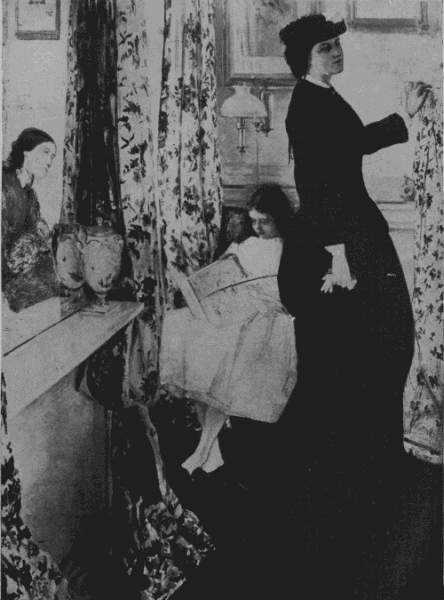
THE MUSIC ROOM
HARMONY IN GREEN AND ROSE
OIL
In the possession of Colonel F. Hecker
(See page 64)
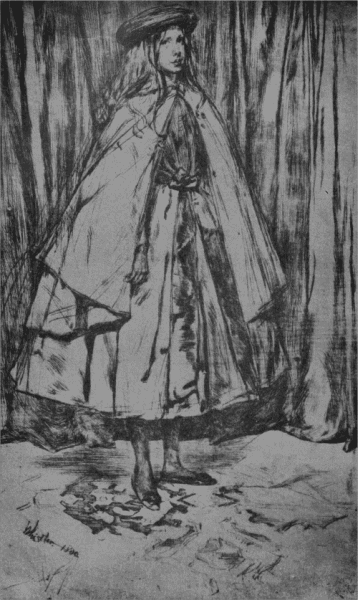
ANNIE HADEN
DRY-POINT. G. 62
(See page 65)
Whistler sent The White Girl to the Academy of 1862, with The Twenty-fifth of December, 1860, on the Thames; Alone with the Tide; and one etching, Rotherithe. The White Girl was rejected. The two other pictures and the print were accepted, hung, and praised. The Athenæum compared the Rotherithe to Rembrandt. Whistler could scarcely be mentioned as an etcher without this comparison; since Rembrandt his were "the most striking and original" etchings, everyone then said, Mr. W. M. Rossetti being among the first in England to say it boldly. Alone with the Tide was approved as "perfectly expressed," and The Twenty-fifth of December as "broad and vigorous, though perhaps vigour was pushed over the bounds of coarseness to become mere dash." Other work he showed elsewhere was praised. The Punt and Sketching, published in Passages from Modern English Poets, were singled out for admiration. Thames Warehouses and Black Lion Wharf won him recognition as "the most admirable etcher of the present day," at South Kensington Museum, where in 1862 an International Exhibition was held. Whistler had no pictures, but the collection of modern continental art was one of the finest ever seen in England.
In nothing had Whistler been so completely himself as in The White Girl, and it failed to please. The artist is born to pick and choose, and group with science, the elements in Nature that the result may be beautiful, he wrote in The Ten O'Clock, and The White Girl was his first attempt to conform to a principle no one ever put so clearly into words. It was an attempt, we know now, comparing the painting to the symphonies and harmonies that came after. But at the time it was disquieting in its defiance of modern conventions. It was without subject according to Victorian standards, and the bold massing of white upon white was more bewildering than the minute detail of the Pre-Raphaelites. This summer (1862) the Berners Street Gallery was opened, "with the avowed purpose of placing before the public the works of young artists who may not have access to the ordinary galleries." Maclise, Egg, Frith, Cooper, Poynter forced their way in. But the Manager had the courage to exhibit The White Girl, stating in the catalogue that the Royal Academy had refused it. The Athenæum was independent enough to say that it was the most prominent picture in the collection, though not the most perfect, for, "able as this bizarre production shows Mr. Whistler to be, we are certain that in a very few years he will recognize the reasonableness of its rejection. It is one of the most incomplete paintings we ever met with. A woman in a quaint morning dress of white, with her hair about her shoulders, stands alone in the background of nothing in particular. But for the rich vigour of the textures, we might conceive this to be some old portrait by Zucchero, or a pupil of his, practising in a provincial town. The face is well done, but it is not that of Mr. Wilkie Collins' Woman in White."
The criticism brought from Whistler his first letter to the press, published in the Athenæum, July 5:
"62 Sloane Street. July 1, 1862.
"May I beg to correct an erroneous impression likely to be confirmed in your last number? The Proprietors of the Berners Street Gallery have, without my sanction, called my picture 'The Woman in White.' I had no intention whatever of illustrating Mr. Wilkie Collins' novel; it so happens, indeed, that I have never read it. My painting simply represents a girl dressed in white, standing in front of a white curtain.—I am, &c.,
James Whistler."
The critics were spared the sting of his wit, but they disapproved strongly enough for him to tell his friends that The White Girl enjoyed a succès d'exécration.
A different success awaited his Thames etchings in Paris, where they were shown in a dealer's gallery. Baudelaire saw them and understood, as he was the first to understand the work of Manet, Poe, Wagner, and many others. He wrote:
"Tout récemment, un jeune artiste américain, M. Whistler, exposait à la galerie Martinet une série d'eaux fortes, subtiles, éveillées comme l'improvisation et l'inspiration, représentant les bords de la Tamise; merveilleux fouillis d'agrés, de vergues, de cordages; chaos de brumes, de fourneaux et de fumées tire-bouchonnées; poésie profonde et compliquée d'une vaste capitale."
According to Mr. W. M. Rossetti, Whistler soon moved to Queen's Road, Chelsea: "I fancy that the houses in Queen's Road have been much altered since Whistler was there in 1862-63. They were then low (say two-storeyed), quite old-fashioned houses, of a cosy, homely character, with small forecourts. I have a kind of idea that Whistler's house was No. 12, but this is quite uncertain to me.[3] As my brother and I were much in that neighbourhood, to and fro, prior to settling down in No. 16 Cheyne Walk, we came into contact with Whistler, who every now and then accompanied us on our jaunts. I forget how it was exactly that we got introduced to him; possibly by Mr. Algernon Swinburne, who was also to be an inmate of No. 16. Either (as I think) before meeting Whistler or just about the time we met him, we had seen one or two of his paintings. At the Piano must have been one, and we most heartily admired him, and discerned unmistakably that he was destined for renown."
The friendship may have led to Whistler's interest in black-and-white, for in England it was Rossetti and the Pre-Raphaelite Brotherhood who revolutionised illustration and proved it a dignified and serious form of art. The more brilliant of the younger men were working for the illustrated magazines, and Whistler found a place among them. He made six drawings in 1862. Four appeared in Once a Week: The Morning before the Massacre of St. Bartholomew, Count Burckhardt, The Major's Daughter, The Relief Fund in Lancashire, intended to be used as an illustration to the reprint of an address by Tennyson on the subject of the famine in Lancashire, but never written because of his illness. To this fund we believe Whistler contributed a drawing. The two other illustrations, for The First Sermon, were published in Good Words. They were drawn on wood in pencil, pen and wash, are full of character, and, in the use of line, are like his etchings. They were engraved by the Dalziel Brothers and Joseph Swain, and from Mr. Strahan, the publisher of Once a Week, we have these additional facts:
"They were arranged for by Edward Dalziel, and I cannot say how he came to know the artist or his work, as Mr. Whistler was young then, and, as far as I know, had not contributed to any magazine.
The average price we paid to artists was nine pounds, and we reckoned that the same amount had to be paid for engravings. As a matter of fact, the sum paid to Mr. Whistler was nine pounds for each drawing."
We showed Whistler once The Morning before the Massacre of St. Bartholomew. "Well, now, not bad, you know—not bad even then!" and he followed, with his expressive little finger, the flowing line, pointing to the hand lost in the draperies. This and The Major's Daughter were the two he preferred, and when J. was preparing The History of Modern Illustration Whistler picked them out as "very pretty ones" that should be reproduced, though, if but a single example of his work could be used, he wished The Morning before the Massacre to be selected, for it was "as delicate as an etching, and altogether characteristic and personal." Count Burckhardt he did not care for, insisting that he would rather not be represented if this were to be the only example in the book. "It was never a favourite," he added.
The four drawings of Once a Week were reprinted in Thornbury's Legendary Ballads, 1876. Thornbury implied that the drawings were made for the book, and thought that "the startling drawings by Mr. Whistler prove his singular power of hand, strong artistic feeling, and daring manner."
Our copy belonged to George Augustus Sala. On the margin of The Morning before the Massacre he wrote: "Jemmy Whistler.—Clever, sketchy, and incomplete, like everything he has done. A loaf of excellent, fine flour, but slack-baked." So Sala believed in 1883, and it is typical of the time.
Another important work of 1862 was The Last of Old Westminster. Mr. Arthur Severn knows more about it than anyone, as his account to us explains: "On my return from Rome to join my brother in his rooms in Manchester Buildings, on the Thames at Westminster Bridge (where the New Scotland Yard now is), I found Whistler beginning his picture of Westminster Bridge. My brother had given him permission to use our sitting-room, with its bow-windows looking over the river and towards the bridge. He was always courteous and pleasant in manner, and it was interesting to see him at work. The bridge was in perspective, still surrounded with piles, for it had only just been finished. It was the piles with their rich colour and delightful confusion that took his fancy, not the bridge, which hardly showed. He would look steadily at a pile for some time, then mix up the colour, then, holding his brush quite at the end, with no mahlstick, make a downward stroke and the pile was done. I remember his looking very carefully at a hansom cab that had pulled up for some purpose on the bridge, and in a few strokes he got the look of it perfectly. He was long over the picture, sometimes coming only once a week, and we got rather tired of it. One day some friends came to see it. He stood it against a table in an upright position for them to see; it suddenly fell on its face, to my brother's disgust, as he had just got a new carpet. Luckily Whistler's sky was pretty dry, and I don't think the picture got any damage, and the artist was most good-natured about my brother's anxiety lest the carpet should have suffered."
The Last of Old Westminster was ready for the Academy of 1863, to which it was sent with six prints: Weary, Old Westminster Bridge, Hungerford Bridge, Monsieur Becquet, The Forge, The Pool. The dignity of composition in the picture and the vigour of handling impressed all who saw it in the London Memorial Exhibition, though they had to regret its shocking condition, cracked from end to end. It failed to impress Academicians in 1863, and was badly hung, as were the prints, reproductive work being then, as now, preferred to original etching.
The White Girl, after its Berners Street success, was sent by Whistler to the Salon. He took it to Paris, to Fantin's studio, there having it unrolled and framed. It is hard to say why the strongest work of the strongest young men was rejected from the Salon of 1863. Fantin, Legros, Manet, Bracquemond, Jongkind, Harpignies, Cazin, Jean-Paul Laurens, Vollon, Whistler were refused. It was a scandal; 1859 was nothing to it. The town was in an uproar that reached the ears of the Emperor. Martinet, the dealer, offered to show the rejected pictures in his gallery. But before this was arranged, Napoleon III ordered that a Salon des Refusés should be held in the same building as the official Salon, the Palais de l'Industrie. The decree was published in the Moniteur for April 24, 1863. The notice was issued by the Directeur-Général of the Imperial Museums, and the exhibition opened on May 15. The success was as great as the scandal. The exhibition was the talk of the town, it was caricatured as the Exposition des Comiques, and parodied as the Club des Refusés at the Variétés; everyone rushed to the galleries. The rooms were crowded by artists, because, in the midst of much no doubt weak and foolish, the best work of the day was shown; by the public, because of the stir the affair made. The public laughed with the idea that it was a duty to laugh, and because the critics said that never was succès pour rire better deserved. Zola described in L'Œuvre the gaiety and cruelty of the crowd, convulsed and hysterical in front of La Dame en Blanc. Hamerton wrote in the Fine Arts Quarterly:
"The hangers must have thought her particularly ugly, for they have given her a sort of place of honour, before an opening through which all pass, so that nobody misses her. I watched several parties, to see the impression The Woman in White made on them. They all stopped instantly, struck with amazement. This for two or three seconds, then they always looked at each other and laughed. Here, for once, I have the happiness to be quite of the popular way of thinking."
On the other hand, Fernand Desnoyers, who wrote a pamphlet on the Salon des Refusés, thought that Whistler was "le plus spirite des peintres," and the painting the most original that had passed before the jury of the Salon, altogether remarkable, at once simple and fantastic, the portrait of a spirit, a medium, though of a beauty so peculiar that the public did not know whether to think it beautiful or ugly. Paul Mantz considered it the most important picture in the exhibition, full of knowledge and strange charm, and his article in the Gazette des Beaux-Arts is the more interesting because he described the picture as a Symphonie du Blanc some years before Whistler called it so, and pointed out that it carried on French tradition, for, a hundred years earlier, painters had shown in the Salon studies of white upon white.
The picture hardly explained the sensation of its first appearance when we saw it with Miss Alexander, the Mother, Carlyle, The Fur Jacket, and Irving in the London Memorial Exhibition. But it seemed revolutionary enough in the sixties, to become the clou of the Salon des Refusés, though nothing was further from Whistler's intention. It eclipsed Manet's Déjeuner sur l'herbe, then called Le Bain.
Whistler was in Amsterdam with Legros, looking at Rembrandt with delight, at Van der Helst with disappointment, etching Amsterdam from the Tolhuis, no doubt hunting for old paper and adding to his collection of blue and white, when the news came of the reception of his picture in Paris, and he wrote to Fantin that he longed to be there and in the movement. It was a satisfaction that the picture, slighted in London, should be honoured in Paris. He was all impatience to know what was said in the Café de Bade, the café of Manet, and by the critics.
To add to his triumph in Paris, official honours were coming to him in Holland and England. Some of his etchings were in an exhibition at The Hague, though he said he did not know how they got there, and he was given one of three gold medals awarded to foreigners—his first medal. Though atrociously hung at the Academy, his prints were honoured at the British Museum, where twelve were bought for the Print Room this year.
The excitement did not keep him from work, to which, as he wrote to Fantin, wandering was a drawback. He felt the need of his studio, of "the familiar all about him." The "familiar" he loved best was in London, and when he returned he began to look for a house of his own. It was fortunate for him that his mother was in England. At the beginning of the Civil War, in which Whistler took the keenest interest as a patriot and a "West Point man," she had been in Richmond with her son William, serving as surgeon in the Confederate Army, had run the blockade, and come to join her other children in London.
Whistler no longer made the Hadens' house his home. The relations of the brothers-in-law had become strained, both being of strong character. Haden had had much to put up with, while Whistler, the artist, resented the criticism of Haden, the surgeon. One story we have from Whistler explains the situation, and though he never gave a date, it can be told here. Haden was the schoolmaster Whistler found him when they first met; one's older relatives have a way of forgetting one can grow up. Once, when Whistler had done something more enormous than ever in Haden's eyes, he was summoned to the workroom upstairs, and lectured until he refused to listen to another word. He started down the four flights of stairs, with Haden close behind still lecturing. At last the front door was reached. And then: "Oh, dear," said Whistler, "I've left my hat upstairs, and now we have got to go all through this again!" As there was no further question of Whistler living with the Hadens, it was decided that he and his mother should live together, and some of his most delightful years were those that followed.