Chapter XXXII · : THE WORK OF THE YEARS EIGHTEEN EIGHTY TO EIGHTEEN NINETY-TWO.
Reading edition
These years were full, for though few large paintings were completed, there were many small oils, water-colours, pastels, etchings, and lithographs. Whistler, going and coming in England or on the Continent, had trunks and bags with compartments for his colours, plates, and lithographic materials. It is impossible to say, he did not know, the exact number of small works he produced during this period.
He had used water-colour since his schooldays, but, until he went to Venice, not to any extent. Some of the Venetian drawings show that he was then scarcely master of it. But the results he finally got, both in figure and landscape, were admirable. He touched perfection in many a little angry sea at Dieppe, or note in Holland, or impression of Paris. As not many are dated it may never be known when this mastery was reached. He probably would not have been sure of the dates. We have gone through drawers of the cabinet in his studio with him, when he expressed the utmost surprise on finding certain things that he had forgotten, and was unable to say when they were painted or drawn. He suffered from this confusion and realised the importance of making a complete list of his works, with their dates and there were various projects and commencements. After several attempts he found it took too much time. We know that he asked Mr. Freer to trace his pictures in America and Mr. D. Croal Thomson to do the same in England. Miss Birnie Philip finally swore in the Law Courts that what he wanted was for us to prepare a complete catalogue.
Between 1880 and 1892 he made ninety plates in England. They begin with Regent's Quadrant. Then follow little shops in Chelsea, Gray's Inn, Westminster, the Wild West (Earl's Court), Whitechapel, Sandwich, the Jubilee, and many figure subjects. There is also the Swan and Iris, the copy of an unfinished picture by Cecil Lawson for Mr. Edmund Gosse's Memoir of the painter (1883), another unsuccessful attempt at reproduction. It was the only plate, since those published by the Junior Etching Club, made as an illustration Billingsgate was issued in the Portfolio (1878) and Hamerton's Etching and Etchers (1880), Alderney Street in the Gazette des Beaux-Arts (1881), La Marchande de Moutarde in English Etchings (1888), but these were etched with no idea of their publication in magazine or book.
The English plates are simple in subject, and they have been therefore dismissed as unimportant by unimportant people. But many are delightfully composed and full of observation. Whistler carrying the small plates about with him, sketched on copper, with the knowledge of a lifetime, the subjects he found as other artists sketch on paper. Three etchings were made at the Wild West probably in an afternoon; one at Westminster Abbey during the Jubilee Service of 1887; and ten to thirteen of the Jubilee Naval Review in a day—plates that prove triumphantly his power of giving his impressions with a few lines of his etching-needle.
In the autumn of 1887 he went to Belgium with Dr. and Mrs. William Whistler, stopping at Brussels, Ostend, and Bruges. In Brussels he etched the Hôtel de Ville, the Guildhalls, the little shops and streets and courts, intending to issue the prints as a set. M. Octave Maus, who knew him, says "he was enchanted with the picturesque and disreputable quarter of les Marolles in the old town. He was frequently to be met in the alleys which pour a squalid populace into the old High Street, engaged in scratching on the copper his impressions of the swarming life around him. When the inquisitive throng pressed him too hard, the artist merely pointed his graver at the arm, or neck, or cheek of one of the intruders. The threatening weapon, with his sharp spiteful laugh, put them at once to flight."
Sometimes Dr. and Mrs. Whistler found him, safe out of the way of the crowd, in the bandstand of the Grande Place, where several of the plates were made. These are another development in technique. With the fewest, the most delicate, lines he expressed the most complicated and the most picturesque architecture. The plates were probably bitten with little stopping-out, and they are printed with a sharpness that shows their wonderful drawing. M. Duret has said to us that in them Whistler gives "les os de l'architecture." A very few proofs were pulled. The set was never issued.
The etchings described as in Touraine are those done on his wedding journey and at other times. They also have never been published as a set. As in Belgium, great architecture suggested his subjects, and his treatment shows that if, as a rule, he refrained from rendering architecture, it was from no desire to evade difficulties, as ignorant critics suppose. The line is more vital and the biting more powerful than in the Belgian plates.
The year after his marriage (1889) he etched seventeen plates in and around Dordrecht and Amsterdam, including Nocturne—Dance House, The Embroidered Curtain, The Balcony, Zaandam, in which he surpassed Rembrandt in Rembrandt's subject. His success is the more surprising because scarcely anywhere does the artist sketch under such difficulties as in Holland. The little Dutch boys are the worst in the world, and the grown people as bad. In Amsterdam, the women in the houses on one of the canals, where Whistler worked in a boat, emptied buckets of water out of the windows above him. He dodged in time, but had to call on the police, and, he told us, the next interruption was a big row above, and "I looked up, dodging the filthy pails, to see the women vanishing backward being carried off to wherever they carry people in Holland. After that, I had no more trouble, but I always had a policeman whenever I had a boat."
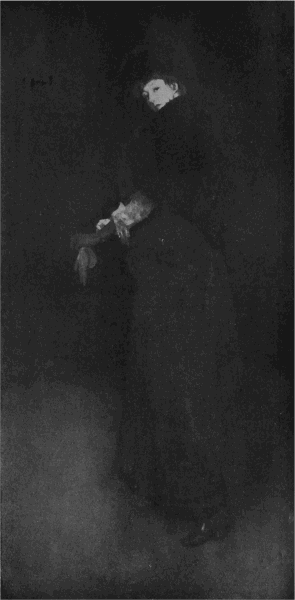
THE YELLOW BUSKIN
ARRANGEMENT IN BLACK
In the Wilstach Collection, Memorial Hall, Philadelphia
(See page 215)
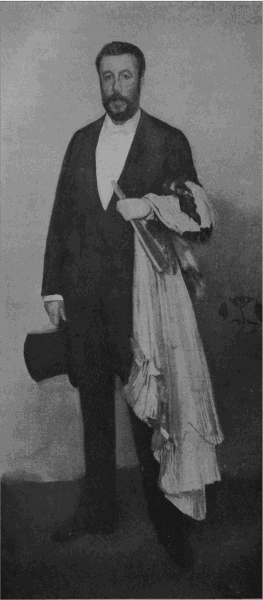
PORTRAIT OF M. THÉODORE DURET
ARRANGEMENT IN FLESH-COLOUR AND PINK
OIL
In the Metropolitan Museum, New York
(See page 217)
In the Dutch plates he returned to the methods perfected at Venice in The Traghetto and The Beggars. After he brought them back to London he was interviewed on the subject in the Pall Mall Gazette (March 4, 1890), and is reported to have said:
"First you see me at work on the Thames. Now, there you see the crude and hard detail of the beginner. So far, so good. There, you see, all is sacrificed to exactitude of outline. Presently and almost unconsciously I begin to criticise myself and to feel the craving of the artist for form and colour. The result was the second stage, which my enemies call inchoate and I call Impressionism. The third state I have shown you. In that I have endeavoured to combine stages one and two. You have the elaboration of the first stage and the quality of the second."
Though we hesitate to accept the words as his, this is an interesting statement and a suggestive description. In some of the Dutch plates there is more detail than in the Venetian, and yet form is expressed not by the detail of the Thames series but by line. No etcher had got such fullness of colour without a mass of cross-hatching that takes away from the freshness. It is interesting to contrast his distant views of the town of Amsterdam and the windmills of Zaandam with Rembrandt's etchings of the same subjects, and to note the greater feeling of space and distance that Whistler gives. The work is more elaborate and delicate than in previous plates, so delicate sometimes that it seems underbitten. But his method necessitated this. He drew with such minuteness that hardly any of the ground, the varnish, was left on the plates, and when he bit them, he could only bite slightly to prevent the modelling from being lost. He never had been so successful in applying his scientific theories to etching, and rarely more satisfied with the results. His first idea was to publish the prints in a set, through the Fine Art Society, but the Fine Art Society were so foolish as to refuse. A few were bought at once for the South Kensington and Windsor Collections, and several were shown in the spring of 1890 at Mr. Dunthorne's gallery. About this time we returned to London, and J. commenced to write occasionally in the London Press, succeeding Mr. George Bernard Shaw as art critic on the Star. This is his impression, written when he saw them (April 8):
"I stepped in at Dunthorne's the other afternoon to have a look at the etchings of Amsterdam by Mr. Whistler. There are only eight of them, I think, but they are eight of the most exquisite renderings by the most independent man of the century. With two exceptions they are only studies of very undesirable lodgings and tenements on canal banks, old crumbling brick houses reflected in sluggish canals, balconies with figures leaning over them, clothes hanging in decorative lines, a marvellously graceful figure carelessly standing in the great water-door of an overhanging house, every figure filled with life and movement, and all its character expressed in half a dozen lines. The same houses, or others, at night, their windows illuminated and casting long trailing reflections in the water, seemed to be singularly unsuccessful, the plate being apparently underbitten or played out. At any rate that was the impression produced on me. [We know now and have explained the reason for this.] Another there was, of a stretch of country looking across a canal, windmills beyond drawn as no one since Rembrandt could have done it, and in his plate the greatest of modern etchers has pitted himself against the greatest of the ancients, and has come through only too successfully for Rembrandt. There are three or four others, I understand, not yet published, but this certainly is the gem so far. The last is a great drawbridge, with a suggestion of trees and houses, figures and boats, and a tower in the distance, done, I believe, from a canal in Amsterdam. This is the fourth distinct series of etchings which Mr. Whistler has in the last thirty or thirty-five years given the world: the early miscellaneous French and English plates; the Thames series, valued by artists more than by collectors, though even to the latter they are worth more than their weight in gold; the Venetian plates; and now these; and between while, portraits as full of character as Rembrandt's, studies of London and Brussels, and I know not what else besides have come from his ever busy needle. Had Mr. Whistler never put brush to canvas, he has done enough in these plates to be able to say that he will not altogether die."
That was J.'s opinion then, and he has not had to change it. During 1890 Whistler made a large number of lithographs, excellently catalogued by T. R. Way, who printed most of them and was, consequently, qualified for the task. Three, The Winged Hat, The Tyresmith, and Maunder's Fish Shop, Chelsea, were published this year in the short-lived occasional weekly The Whirlwind, edited by Herbert Vivian and Stuart Erskine "in the Legitimist cause" and to their own great amusement. Drawings by Sidney Starr after three of Whistler's pictures appeared, and the editors boasted in their own pages within a few weeks that the lithographs, issued for a penny, could be had only for five shillings. Five guineas would now be nearer the price.
Another lithograph, Chelsea Rags, came out in the January number (1892) of the Albemarle, a monthly edited by Hubert Crackanthorpe and W. H. Wilkins, one of those gay experiments in periodical literature no longer made in this sad land. The four were called Songs on Stone, the later title for a proposed portfolio of lithographs in colour which Mr. Heinemann announced but never issued.