Chapter VII
Reading edition
General St. Clair appointed Commander-in-chief.... The President makes a tour through the southern states.... Meeting of congress.... President's speech.... Debate on the bill for apportioning representatives.... Militia law.... Defeat of St. Clair.... Opposition to the increase of the army.... Report of the Secretary of the Treasury for raising additional supplies.... Congress adjourns.... Strictures on the conduct of administration, with a view of parties.... Disagreement between the Secretaries of State and Treasury.... Letters from General Washington.... Opposition to the excise law.... President's proclamation.... Insurrection and massacre in the island of St. Domingo.... General Wayne appointed to the command of the army.... Meeting of Congress.... President's speech.... Resolutions implicating the Secretary of the Treasury rejected.... Congress adjourns.... Progress of the French revolution, and its effects on parties in the United States.
1791
More ample means for the protection of the frontiers having been placed in the hands of the executive, the immediate attention of the President was directed to this interesting object.
General St. Clair appointed commander-in-chief of the army.
Major General Arthur St. Clair, governor of the territory north-west of the Ohio, was appointed Commander-in-chief of the forces to be employed in the meditated expedition. This gentleman had served through the war of the revolution with reputation, though it had never been his fortune to distinguish himself. The evacuation of Ticonderoga had indeed, at one time, subjected him to much public censure; but it was found, upon inquiry, to be unmerited. Other motives, in addition to the persuasion of his fitness for the service, conduced to his appointment. With the sword, the olive branch was still to be tendered; and it was thought adviseable to place them in the same hands. The governor, having been made officially the negotiator with the tribes inhabiting the territories over which he presided, being a military man, acquainted with the country into which the war was to be carried, possessing considerable influence with the inhabitants of the frontiers, and being so placed as to superintend the preparations for the expedition advantageously, seemed to have claims to the station which were not to be overlooked. It was also a consideration of some importance, that the high rank he had held in the American army, would obviate those difficulties in filling the inferior grades with men of experience, which might certainly be expected, should a person who had acted in a less elevated station, be selected for the chief command.
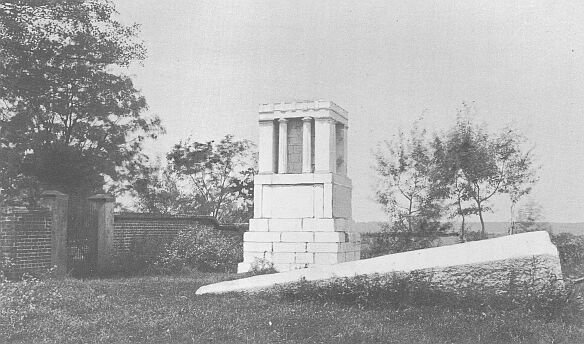
Tomb of Mary, Mother of Washington
This is the original monument as it appeared before the present granite obelisk was erected over the grave of George Washington's mother in Fredericksburg, Virginia. It was in Fredericksburg that she made her home during her declining years, and it was on the Kenmore estate of her daughter, Elizabeth, and son-in-law, Fielding Lewis, that she was buried, September, 1789, having survived her husband, Augustine Washington, forty-six years.
The president makes a tour through the southern states.
After making the necessary arrangements for recruiting the army, the President prepared to make his long contemplated tour through the southern states.[53] In passing through them, he was received universally with the same marks of affectionate attachment, which he had experienced in the northern and central parts of the union. To the sensibilities which these demonstrations of the regard and esteem of good men could not fail to inspire, was added the high gratification produced by observing the rapid improvements of the country, and the advances made by the government, in acquiring the confidence of the people. The numerous letters written by him after his return to Philadelphia, attest the agreeable impressions made by these causes. "In my late tour through the southern states," said he, in a letter of the 28th of July, to Mr. Gouverneur Morris, "I experienced great satisfaction in seeing the good effects of the general government in that part of the union. The people at large have felt the security which it gives, and the equal justice which it administers to them. The farmer, the merchant, and the mechanic, have seen their several interests attended to, and from thence they unite in placing a confidence in their representatives, as well as in those in whose hands the execution of the laws is placed. Industry has there taken place of idleness, and economy of dissipation. Two or three years of good crops, and a ready market for the produce of their lands, have put every one in good humour; and, in some instances, they even impute to the government what is due only to the goodness of Providence.
"The establishment of public credit is an immense point gained in our national concerns. This, I believe, exceeds the expectation of the most sanguine among us; and a late instance, unparalleled in this country, has been given of the confidence reposed in our measures, by the rapidity with which the subscriptions to the bank of the United States were filled. In two hours after the books were opened by the commissioners, the whole number of shares was taken up, and four thousand more applied for than were allowed by the institution. This circumstance was not only pleasing as it related to the confidence in government, but also as it exhibited an unexpected proof of the resources of our citizens."
This visit had undoubtedly some tendency to produce the good disposition which the President observed with so much pleasure. The affections are perhaps more intimately connected with the judgment than we are disposed to admit; and the appearance of the chief magistrate of the union, who was the object of general love and reverence, could not be without its influence in conciliating the minds of many to the government he administered, and to its measures. But this progress towards conciliation was, perhaps, less considerable than was indicated by appearances. The hostility to the government, which was coeval with its existence, though diminished, was far from being subdued; and under this smooth exterior was concealed a mass of discontent, which, though it did not obtrude itself on the view of the man who united almost all hearts, was active in its exertions to effect its objects.
The difficulties which must impede the recruiting service in a country where coercion is not employed, and where the common wages of labour greatly exceed the pay of a soldier, protracted the completion of the regiments to a late season of the year; but the summer was not permitted to waste in total inaction.
The act passed at the last session for the defence of the frontiers, in addition to its other provisions, had given to the President an unlimited power to call mounted militia into the field. Under this authority, two expeditions had been conducted against the villages on the Wabash, in which a few of the Indian warriors were killed, some of their old men, women, and children, were made prisoners, and several of their towns and fields of corn were destroyed. The first was led by General Scott, in May, and the second by General Wilkinson, in September. These desultory incursions had not much influence on the war.
It was believed in the United States, that the hostility of the Indians was kept up by the traders living in their villages. These persons had, generally, resided in the United States; and, having been compelled to leave the country in consequence of the part they had taken during the war of the revolution, felt the resentments which banishment and confiscation seldom fail to inspire. Their enmities were ascribed by many, perhaps unjustly, to the temper of the government in Canada; but some countenance seemed to be given to this opinion by intelligence that, about the commencement of the preceding campaign, large supplies of ammunition had been delivered from the British posts on the lakes, to the Indians at war with the United States. While the President was on his southern tour, he addressed a letter to the secretary of state, to be communicated to Colonel Beckwith, who still remained in Philadelphia as the informal representative of his nation, in which he expressed his surprise and disappointment at this interference, by the servants or subjects of a foreign state, in a war prosecuted by the United States for the sole purpose of procuring peace and safety for the inhabitants of their frontiers.
On receiving this communication, Colonel Beckwith expressed his disbelief that the supplies mentioned had been delivered; but on being assured of the fact, he avowed the opinion that the transaction was without the knowledge of Lord Dorchester, to whom he said he should communicate, without delay, the ideas of the American government on the subject.
Meeting of congress. President's speech.
On the 24th of October the second congress assembled in Philadelphia. In his speech at the opening of the session, the President expressed his great satisfaction at the prosperous situation of the country, and particularly mentioned the rapidity with which the shares in the bank of the United States were subscribed, as "among the striking and pleasing evidences which presented themselves, not only of confidence in the government, but of resources in the community."
Adverting to the measures which had been taken in execution of the laws and resolutions of the last session, "the most important of which," he observed, "respected the defence and security of the western frontiers," he had, he said, "negotiated provisional treaties, and used other proper means to attach the wavering, and to confirm in their friendship the well disposed tribes of Indians. The means which he had adopted for a pacification with those of a hostile description having proved unsuccessful, offensive operations had been directed, some of which had proved completely successful, and others were still pending. Overtures of peace were still continued to the deluded tribes; and it was sincerely to be desired that all need of coercion might cease, and that an intimate intercourse might succeed, calculated to advance the happiness of the Indians, and to attach them firmly to the United States."
In marking the line of conduct which ought to be maintained for the promotion of this object, he strongly recommended "justice to the savages, and such rational experiments for imparting to them the blessings of civilization, as might from time to time suit their condition;" and then concluded this subject with saying—"A system corresponding with the mild principles of religion and philanthropy towards an unenlightened race of men whose happiness materially depends on the conduct of the United States, would be as honourable to the national character, as conformable to the dictates of sound policy."
After stating that measures had been taken for carrying into execution the act laying duties on distilled spirits, he added—"The impressions with which this law has been received by the community have been, upon the whole, such as were to have been expected among enlightened and well disposed citizens, from the propriety and necessity of the measure. The novelty, however, of the tax, in a considerable part of the United States, and a misconception of some of its provisions, have given occasion, in particular places, to some degree of discontent. But it is satisfactory to know that this disposition yields to proper explanations, and more just apprehensions of the true nature of the law. And I entertain a full confidence that it will, in all, give way to motives which arise out of a just sense of duty, and a virtuous regard to the public welfare.
"If there are any circumstances in the law, which, consistently with its main design may be so varied as to remove any well intentioned objections that may happen to exist, it will comport with a wise moderation to make the proper variations. It is desirable on all occasions, to unite with a steady and firm adherence to constitutional and necessary acts of government, the fullest evidence of a disposition, as far as may be practicable, to consult the wishes of every part of the community, and to lay the foundations of the public administration in the affections of the people."
The answers of the two houses noticed, briefly and generally, the various topics of the speech; and, though perhaps less warm than those of the preceding congress, manifested great respect for the executive magistrate, and an undiminished confidence in his patriotic exertions to promote the public interests.
Debate on the bill "for apportioning representatives among the people of the states according to the first enumeration."
Among the first subjects of importance which engaged the attention of the legislature, was a bill "for apportioning representatives among the people of the several states according to the first enumeration." The constitution, in its original form, had affixed no other limits to the power of congress over the numbers of which the house of representatives might consist, than that there should not be more than one member for every thirty thousand persons; but that each state should be entitled to at least one. Independent of the general considerations in favour of a more or less numerous representation in the popular branch of the legislature, there was one of a local nature, whose operation, though secret, was extensive, which gave to this question a peculiar interest. To whatever number of persons a representative might be allotted, there would still remain a fraction, which would be greater or less in each state, according to the ratio which congress should adopt between representation and population. The relative power of states, in one branch of the legislature, would consequently be affected by this ratio; and to questions of that description, few members can permit themselves to be inattentive.
This bill, as originally introduced into the house of representatives, gave to each state one member for every thirty thousand persons. On a motion to strike out the number thirty thousand, the debate turned chiefly on the policy and advantage of a more or less numerous house of representatives; but with the general arguments suggested by the subject, strong and pointed allusions to the measures of the preceding congress were interspersed, which indicated much more serious hostility to the administration than had hitherto been expressed. Speaking of the corruption which he supposed to exist in the British house of commons, Mr. Giles said that causes essentially different from their numbers, had produced this effect. "Among these, were the frequent mortgages of the funds, and the immense appropriations at the disposal of the executive."
"An inequality of circumstances," he observed, "produces revolutions in governments, from democracy, to aristocracy, and monarchy. Great wealth produces a desire of distinctions, rank, and titles. The revolutions of property, in this country, have created a prodigious inequality of circumstances. Government has contributed to this inequality. The bank of the United States is a most important machine in promoting the objects of this monied interest. This bank will be the most powerful engine to corrupt this house. Some of the members are directors of this institution; and it will only be by increasing the representation, that an adequate barrier can be opposed to this monied interest." He next adverted to certain ideas, which, he said, had been disseminated through the United States. "The legislature," he took occasion to observe, "ought to express some disapprobation of these opinions. The strong executive of this government," he added, "ought to be balanced by a full representation in this house."
Similar sentiments were advanced by Mr. Findley.
After a long and animated discussion, the amendment was lost, and the bill passed in its original form.
In the senate, it was amended by changing the ratio, so as to give one representative for every thirty-three thousand persons in each state; but this amendment was disagreed to by the house of representatives; and each house adhering to its opinion, the bill fell; but was again introduced into the house of representatives, under a different title, and in a new form, though without any change in its substantial provisions. After a debate in which the injustice of the fractions produced by the ratio it adopted was strongly pressed, it passed that house. In the senate, it was again amended, not by reducing, but by enlarging the number of representatives.
The constitution of the United States declares that "representatives and direct taxes shall be apportioned among the several states which may be included within this union according to their respective numbers;" and that "the number of representatives shall not exceed one for every thirty thousand, but each state shall have at least one representative." Construing the constitution to authorize a process by which the whole number of representatives should be ascertained on the whole population of the United States, and afterwards "apportioned among the several states according to their respective numbers," the senate applied the number thirty thousand as a divisor to the total population, and taking the quotient, which was one hundred and twenty, as the number of representatives given by the ratio which had been adopted in the house where the bill had originated, they apportioned that number among the several states by that ratio, until as many representatives as it would give were allotted to each. The residuary members were then distributed among the states having the highest fractions. Without professing the principle on which this apportionment was made, the amendment of the senate merely allotted to the states respectively, the number of members which the process just mentioned would give. The result was a more equitable apportionment of representatives to population, and had the rule of construing that instrument been correct, the amendment removed objections which were certainly well founded. But the rule was novel, and overturned opinions which had been generally assumed, and were supposed to be settled. In one branch of the legislature it had already been rejected; and in the other, the majority in its favour was only one.
In the house of representatives, the amendment was supported with considerable ingenuity.
After an earnest debate, however, it was disagreed to, and a conference took place without producing an accommodation among the members composing the committee. But finally, the house of representatives receded from their disagreement; and, by a majority of two voices, the bill passed as amended in the senate.
On the President, the solemn duty of deciding, whether an act of the legislature consisted with the constitution; for the bill, if constitutional, was unexceptionable.
In his cabinet, also, a difference of opinion is understood to have existed; the secretary of state and the attorney general were of opinion that the act was at variance with the constitution; the secretary of war was rather undecided; and the secretary of the treasury, thinking that, from the vagueness of expression in the clause relating to the subject, neither construction could be absolutely rejected, was in favour of acceding to the interpretation given by the legislature.
After weighing the arguments which were urged on each side of the question, the President was confirmed in the opinion that the population of each state, and not the total population of the United States, must give the numbers to which alone the process by which the number of representatives was to be ascertained could be applied. Having formed this opinion, to a correct and independent mind the course to be pursued was a plain one. Duty required the exercise of a power which a President of the United States will always find much difficulty in employing; and he returned the bill to the house in which it originated, accompanied with his objections[54] to it. In observance of the forms prescribed in the constitution, the question was then taken on its passage by ayes and noes, and it was rejected. A third bill was soon afterwards introduced, apportioning the representatives on the several states at a ratio of one for every thirty-three thousand persons in each state, which passed into a law. Thus was this interesting part of the American constitution finally settled.
Militia law.
During this session of congress, an act passed for establishing a uniform militia.
The President had manifested, from the commencement of his administration, a peculiar degree of solicitude on this subject, and had repeatedly urged it on congress.
In his speech at the opening of the present session, he again called the attention of the legislature to it; and, at length, a law was enacted which, though less efficacious than the plan reported by the secretary of war, will probably, not soon, be carried into complete execution.
Defeat of St. Clair.
In December, intelligence was received by the President, and immediately communicated to congress, that the American army had been totally defeated on the fourth of the preceding month.
Although the most prompt and judicious measures had been taken to raise the troops, and to march them to the frontiers, they could not be assembled in the neighbourhood of fort Washington until the month of September, nor was the establishment even then completed.
The immediate objects of the expedition were, to destroy the Indian villages on the Miamis, to expel the savages from that country, and to connect it with the Ohio by a chain of posts which would prevent their return during the war.
On the seventh of September, the regulars moved from their camp in the vicinity of fort Washington, and marching directly north, towards the object of their destination, established two intermediate posts[55] at the distance of rather more than forty miles from each other, as places of deposite, and of security either for convoys of provision which might follow the army, or for the army itself should any disaster befall it. The last of these works, fort Jefferson, was not completed until the 24th of October, before which time reinforcements were received of about three hundred and sixty militia. After placing garrisons in the forts, the effective number of the army, including militia, amounted to rather less than two thousand men. With this force, the general continued his march, which was rendered both slow and laborious by the necessity of opening a road. Small parties of Indians were frequently seen hovering about them, and some unimportant skirmishes took place. As the army approached the country in which they might expect to meet an enemy, about sixty of the militia deserted in a body. This diminution of force was not, in itself, an object of much concern. But there was reason to fear that the example, should those who set it be permitted to escape with impunity, would be extensively followed; and it was reported to be the intention of the deserters, to plunder convoys of provisions which were advancing at some distance in the rear. To prevent mischiefs of so serious a nature, the general detached Major Hamtranck with the first regiment in pursuit of the deserters, and directed him to secure the provisions under a strong guard.
The army, consisting of about fourteen hundred effective rank and file, continued its march; and, on the third of November, encamped about fifteen miles south of the Miamis villages. The right wing under the command of General Butler formed the first line, and lay with a creek, about twelve yards wide, immediately in its front. The left wing commanded by Lieutenant Colonel Darke, formed the second; and between the two lines, was an interval of about seventy yards.[56] The right flank was supposed to be secured by the creek, by a steep bank, and by a small body of troops; the left was covered by a party of cavalry, and by piquets. The militia crossed the creek, and advanced about a quarter of a mile in front, where they also encamped in two lines. On their approach, a few Indians who had shown themselves on the opposite side of the creek, fled with precipitation.
At this place, the general intended to throw up a slight work for the security of the baggage; and, after being joined by Major Hamtranck, to march as unincumbered, and as expeditiously as possible, to the villages he purposed to destroy.
In both these designs he was anticipated. About half an hour before sun rise the next morning, just after the troops had been dismissed from the parade, an unexpected attack was made upon the militia, who fled in the utmost confusion, and rushing into camp through the first line of continental troops, which had been formed the instant the first gun was discharged, threw them too into disorder. The exertions of the officers to restore order were not entirely successful. The Indians pressed close upon the heels of the flying militia, and engaged General Butler with great intrepidity. The action instantly became extremely warm; and the fire of the assailants, passing round both flanks of the first line, was, in a few minutes, poured with equal fury on the rear division. Its greatest weight was directed against the centre of each wing, where the artillery was posted; and the artillerists were mowed down in great numbers. Firing from the ground, and from the shelter which the woods afforded, the assailants were scarcely seen but when springing from one cover to another, in which manner they advanced close up to the American lines, and to the very mouths of the field pieces. They fought with the daring courage of men whose trade is war, and who are stimulated by all those passions which can impel the savage mind to vigorous exertions.
Under circumstances thus arduous, raw troops may be expected to exhibit that inequality which is found in human nature. While some of the American soldiers performed their duty with the utmost resolution, others seemed dismayed and terrified. Of this conduct the officers were, as usual, the victims. With a fearlessness which the occasion required, they exposed themselves to the most imminent dangers; and, in their efforts to change the face of affairs, fell in great numbers.
For several days, the Commander-in-chief had been afflicted with a severe disease, under which he still laboured, and which must have greatly affected him; but, though unable to display that activity which would have been useful in this severe conflict, neither the feebleness of his body, nor the peril of his situation, could prevent his delivering his orders with judgment and with self possession.[57]
It was soon perceived that the American fire could produce, on a concealed enemy, no considerable effect; and that the only hope of victory was placed in the bayonet. At the head of the second regiment, which formed the left of the left wing, Lieutenant Colonel Darke made an impetuous charge upon the enemy, forced them from their ground with some loss, and drove them about four hundred yards. He was followed by that whole wing; but the want of a sufficient number of riflemen to press this advantage, deprived him of the benefit which ought to have been derived from this effort; and, as soon as he gave over the pursuit, the Indians renewed their attack. In the mean time General Butler was mortally wounded, the left of the right wing was broken, the artillerists almost to a man killed, the guns seized, and the camp penetrated by the enemy. With his own regiment, and with the battalions commanded by Majors Butler[58] and Clarke, Darke was ordered again to charge with the bayonet. These orders were executed with intrepidity and momentary success. The Indians were driven out of the camp, and the artillery recovered. But while they were pressed in one point by the bravest of the American troops, their fire was kept up from every other with fatal effect. Several times particular corps charged them, always with partial success, but no universal effort could be made, and in every charge a great loss of officers was sustained, the consequences of which were severely felt. Instead of keeping their ranks, and executing the orders which were given, a great proportion of the soldiers flocked together in crowds, and were shot down without resistance. To save the remnant of his army was all that remained to be done; and, about half past nine in the morning, General St. Clair ordered Lieutenant Colonel Darke with the second regiment, to charge a body of Indians who had intercepted their retreat, and to gain the road. Major Clarke with his battalion was directed to cover the rear. These orders were executed, and a disorderly flight commenced. The pursuit was kept up about four miles, when, fortunately for the surviving Americans, that avidity for plunder which is a ruling passion among savages, called back the victorious Indians to the ramp, where the spoils of their vanquished foes were to be divided. The routed troops continued their flight to fort Jefferson, a distance of about thirty miles, throwing away their arms on the road. At this place they met Major Hamtranck with the first regiment; and a council of war was called to deliberate on the course to be pursued. As this regiment was far from restoring the strength of the morning, it was determined not to attempt to retrieve the fortune of the day: and, leaving the wounded at fort Jefferson, the army continued its retreat to fort Washington.
In this disastrous battle, the loss on the part of the Americans was very great when compared with the numbers engaged. Thirty-eight commissioned officers were killed upon the field, and five hundred and ninety-three non-commissioned officers and privates were slain and missing. Twenty-one commissioned officers, several of whom afterwards died of their wounds, and two hundred and forty-two non-commissioned officers and privates were wounded. Among the dead was the brave and much lamented General Butler. This gallant officer had served through the war of the revolution; and had, on more than one occasion, distinguished himself in a remarkable manner. In the list of those who shared his fate, were the names of many other excellent officers who had participated in all the toils, the dangers, and the glory, of that long conflict which terminated in the independence of their country. At the head of the list of wounded were Lieutenant Colonels Gibson and Darke, Major Butler, and Adjutant General Sargent, all of whom were veteran officers of great merit, who displayed their accustomed bravery on this unfortunate day. General St. Clair, in his official letter, observed: "the loss the public has sustained by the fall of so many officers, particularly of General Butler and Major Ferguson, can not be too much regretted; but it is a circumstance that will alleviate the misfortune in some measure, that all of them fell most gallantly doing their duty."
From the weight of the fire, and the circumstance of his being attacked nearly at the same time in front and rear, General St. Clair was of opinion that he was overpowered by numbers. The intelligence afterwards collected would make the Indian force to consist of from one thousand to fifteen hundred warriors. Of their loss, no estimate could be made; the probability is, that it bore no proportion to that sustained by the American army.
Nothing could be more unexpected than this severe disaster. The public had confidently anticipated a successful campaign, and could not believe, that the general who had been unfortunate, had not been culpable.
1792
The Commander-in-chief requested with earnestness that a court martial should sit on his conduct; but this request could not be granted, because the army did not furnish a sufficient number of officers of a grade to form a court for his trial on military principles. Late in the session, a committee of the house of representatives was appointed to inquire into the cause of the failure of the expedition, whose report, in explicit terms, exculpated the Commander-in-chief. This inquiry, however, was instituted rather for the purpose of investigating the conduct of civil than of military officers; and was not conducted by military men. More satisfactory testimony in favour of St. Clair is furnished by the circumstance, that he still retained the undiminished esteem and good opinion of the President.
The Indian war now assumed a still more serious aspect. There was reason to fear that the hostile tribes would derive a great accession of strength from the impression which their success would make upon their neighbours; and the reputation of the government was deeply concerned in retrieving the fortune of its arms, and affording protection to its citizens. The President, therefore, lost no time in causing the estimates for a competent force to be prepared and laid before congress. In conformity with a report made by the secretary of war, a bill was brought into the house of representatives, directing three additional regiments of infantry, and a squadron of cavalry to be raised, to serve for three years, if not sooner discharged. The whole military establishment, if completed, would amount to about five thousand men. The additional regiments, however, were to be disbanded as soon as peace should be concluded with the Indians; and the President was authorized to discharge, or to forbear to raise, any part of them, "in case events should, in his judgment, render his so doing consistent with the public safety."
Opposition to the increase of the army.
This bill met with great opposition. A motion was made to strike out the section which authorized an augmentation of force. By those who argued in favour of the motion, the justice of the war was arraigned, and the practicability of obtaining peace at a much less expense than would be incurred in its further prosecution, was urged with vehemence. An extension of the present frontier was said not to be desirable, and if the citizens of the United States were recalled within their proper boundaries, hostilities would cease. At any rate, it was an idle waste of blood and treasure, to carry the war beyond the line of forts already established. It was only exposing their arms to disgrace, betraying their own weakness, and lessening the public confidence in the government, to send forth armies to be butchered in the forests, while the British were suffered to keep possession of posts within the territory of the United States. To this cause was to be ascribed any disposition which might exist on the part of the Indians to continue hostilities, and to its removal the efforts of the government ought to be directed.
But, admitting the war to have been just in its commencement, and its continuance to be required by the honour and interest of the nation, yet as an invasion of the Indian country ought not to be attempted, this augmentation of the military establishment could not be necessary. Regular troops could only be useful as garrisons for posts to which the militia might resort for protection or supplies. Experience had proved that the sudden desultory attacks of the frontier militia and rangers were productive of more valuable consequences, than the methodical operations of a regular force. But, should it even be conceded that invasion and conquest were to be contemplated, the existing establishment, if completed, would be sufficiently great; and it was still insisted that, even for the purposes of conquest, the frontier militia were superior to any regulars whatever.
The expense of such an army as the bill contemplated was said to be an object worthy of serious attention; and members were requested to observe the progress of this business, and to say where it would stop. At first, only a single regiment had been raised, and the expense was about one hundred thousand dollars; a second was afterwards added, which swelled the expense to three hundred thousand; and now a standing force of five thousand one hundred and sixty-eight men is contemplated, at an annual expense of above a million and a quarter. They were preparing to squander away money by millions; and no one, except those who were in the secrets of the cabinet, knew why the war had been thus carried on for three years.
Against the motion for striking out, it was urged that the justice of the war could not be questioned by any man who would allow that self preservation, and indispensable necessity, could furnish sufficient motives for taking up arms. It was proved by unquestionable documents, that from the year 1783 to 1790, there had been not less than fifteen hundred persons, either the inhabitants of Kentucky, or emigrants on their way to that country, who had been massacred by the savages, or dragged into captivity; and there was reason to believe that on the frontiers of Virginia, and of Pennsylvania, the murdered and the prisoners would furnish a list almost equally numerous.
The conciliatory disposition of the government was stated, and its repeated efforts to obtain a peace were enumerated. It was particularly observed that in 1790, when a treaty was proposed at the Miamis villages, the Indians at first refused to treat;—they next required thirty days to deliberate;—this request was acceded to; and, in the interim, offensive operations were expressly prohibited by the President. Yet, notwithstanding this forbearance on the part of the whites, not less than one hundred and twenty persons were killed and captured by the savages, and several prisoners were roasted alive, during that short period; at the expiration of which, the Indians refused to give any answer to the proposition which had been made to them.
But it was now too late to inquire into the justice of the principles on which the war was originally undertaken. The nation was involved in it, and could not recede without exposing many innocent persons to be butchered by the enemy. Should the government determine to discontinue the war, would the Indians also consent to a cessation of hostilities? The government could not, without impeachment, both of its justice and humanity, abandon the inhabitants of the frontiers to the rage of their savage enemies; and although the excise might be unpopular, although money might still be wanted, what was the excise, what was money, when put in competition with the lives of their friends and brethren? A sufficient force must be raised for their defence, and the only question was what that force should be.
The calculations of the best informed men were in favour of employing an army not inferior to that proposed in the bill. When the known attachment of Indians to war and plunder was adverted to, and the excitements to that attachment which were furnished by the trophies acquired in the last two campaigns were considered, no man would venture to pronounce with confidence how extensive the combination against the United States might become, or what numbers they would have to encounter. It certainly behoved them to prepare in time for a much more vigorous effort than had hitherto been made. The objections drawn from the increased expense which such an effort would require, must entirely vanish before the eyes of any man, who looks forward to the consequences of another unsuccessful campaign. Such a disaster would eventually involve the nation in much greater expense than that which is now made the ground of opposition. Better therefore is it, to make at once a vigorous and effectual exertion to bring the contest to a close, than to continue gradually draining the treasury, by dragging on the war, and renewing hostility from year to year.
The supporters of the bill also appealed to experience for the superiority of regular troops over militia, in accomplishing all the purposes, even of Indian war; and those arguments were urged in favour of this theory, which the subject readily suggests.
The motion for striking out the section was lost; and the bill was carried for the augmentation of force required by the executive.
The treasury was not in a condition to meet the demands upon it, which the increased expenses of the war would unavoidably occasion; and sources of additional revenue were to be explored. A select committee to whom this subject was referred, brought in a resolution directing the secretary of the treasury to report his opinion to the house on the best mode of raising those additional supplies which the public service might require for the current year.
This proposition gave rise to a very animated debate.
It will be recollected that when the act for establishing the treasury department was under consideration, the clause which rendered it the duty of the secretary to digest and report plans for the improvement and management of the revenue, and for the support of public credit, was earnestly opposed. A large majority, however, was in favour of the principle; and, after being so modified, as only to admit a report if required by the house, it was retained in the bill. In complying with the various resolutions of congress, calling for reports on subjects connected with his department, the secretary had submitted plans which, having been profoundly considered, were well digested, and accompanied by arguments, the force of which it was difficult to resist. His measures were generally supported by a majority of congress; and, while the high credit of the United States was believed to attest their wisdom, the masterly manner in which his reports were drawn contributed to raise still higher, that reputation for great talents which he had long possessed. To the further admission of these reports, it was determined, on this occasion, to make a vigorous resistance.
But the opposition was not successful. On taking the question, the resolution was carried; thirty-one members voting in its favour, and twenty-seven against it.
Report of the secretary of the treasury for raising additional supplies.
The report[59] made by the secretary in pursuance of this resolution, recommended certain augmentations of the duties on imports; and was immediately referred to the consideration of a committee of the whole house. Resolutions were then passed which were to form the basis of a bill; and which adopted, not only the principles, but, with the exception of a few unimportant alterations, the minute details of the report.
Before the question was taken on the bill, a motion was made to limit its duration, the vote upon which strongly marked the progress of opinion in the house respecting those systems of finance which were believed to have established the credit of the United States.
The secretary of the treasury had deemed it indispensable to the creation of public credit, that the appropriations of funds for the payment of the interest, and the gradual redemption of the principal of the national debt, should be not only sufficient, but permanent also. A party was found in the first congress who opposed this principle; and were in favour of retaining a full power over the subject in each branch of the legislature, by making annual appropriations. The arguments which had failed in congress appear to have been more successfully employed with the people. Among the multiplied vices which were ascribed to the funding system, it was charged with introducing a permanent and extensive mortgage of funds, which was alleged to strengthen unduly the hands of the executive magistrate, and to be one of the many evidences which existed, of monarchical propensities in those who administered the government.
The report lately made by the secretary of the treasury, and the bill founded on that report, contemplated a permanent increase of the duties on certain specified articles; and a permanent appropriation of the revenue arising from them, to the purposes of the national debt. Thirty-one members were in favour of the motion for limiting the duration of the bill, and only thirty against it. By the rules of the house, the speaker has a right first to vote as a member; and, if the numbers should then be equally divided, to decide as speaker. Being opposed to the limitation, the motion was lost by his voice.
On the eighth of May, after an active and interesting session, congress adjourned to the first Monday in November.
The asperity which, on more than one occasion, discovered itself in debate, was a certain index of the growing exasperation of parties; and the strength of the opposition on those questions which brought into review the points on which the administration was to be attacked, denoted the impression which the specific charges brought against those who conducted public affairs, had made on the minds of the people, in an extensive division of the continent. It may conduce to a more perfect understanding of subsequent transactions, to present, in this place, a sketch of those charges.
Strictures on the conduct of administration, with a view of parties.
It was alleged that the public debt was too great to be paid before other causes of adding to it would occur. This accumulation of debt had been artificially produced by the assumption of what was due from the states. Its immediate effect was to deprive the government of its power over those easy sources of revenue, which, applied to its ordinary necessities and exigencies, would have answered them habitually, and thereby have avoided those burdens on the people which occasioned such murmurs against taxes, and tax gatherers. As a consequence of it, although the calls for money had not been greater than must be expected for the same or equivalent exigencies, yet congress had been already obliged, not only to strain the impost until it produced clamour, and would produce evasion, and war on their own citizens to collect it, but even to resort to an excise law, of odious character with the people, partial in its operation, unproductive unless enforced by arbitrary and vexatious means, and committing the authority of the government in parts where resistance was most probable, and coercion least practicable.
That the United States, if left free to act at their discretion, might borrow at two-thirds of the interest contracted to be paid to the public creditors, and thus discharge themselves from the principal in two-thirds of the time: but from this they were precluded by the irredeemable quality of the debt; a quality given for the avowed purpose of inviting its transfer to foreign countries. This transfer of the principal when completed would occasion an exportation of three millions of dollars annually for the interest, a drain of coin without example, and of the consequences of which no calculation could be made.
The banishment of coin would be completed by ten millions of paper money in the form of bank bills, which were then issuing into circulation. Nor would this be the only mischief resulting from the institution of the bank. The ten or twelve per cent, annual profit paid to the lenders of this paper medium would take out of the pockets of the people, who would have had, without interest, the coin it was banishing. That all the capital employed in paper speculation is barren and useless, producing like that on a gaming table no accession to itself, and is withdrawn from commerce and agriculture, where it would have produced addition to the common mass. The wealth therefore heaped upon individuals by the funding and banking systems, would be productive of general poverty and distress. That in addition to the encouragement these measures gave to vice and idleness, they had furnished effectual means of corrupting such a portion of the legislature as turned the balance between the honest voters. This corrupt squad, deciding the voice of the legislature, had manifested their dispositions to get rid of the limitations imposed by the constitution; limitations on the faith of which the states acceded to that instrument. They were proceeding rapidly in their plan of absorbing all power, invading the rights of the states, and converting the federal into a consolidated government.
That the ultimate object of all this was to prepare the way for a change from the present republican form of government to that of a monarchy, of which the English constitution was to be the model. So many of the friends of monarchy were in the legislature, that aided by the corrupt squad of paper dealers who were at their devotion, they made a majority in both houses. The republican party, even when united with the anti-federalists, continued a minority.
That of all the mischiefs resulting from the system of measures which was so much reprobated, none was so afflicting, so fatal to every honest hope, as the corruption of the legislature. As it was the earliest of these measures, it became the instrument for producing the rest, and would be the instrument for producing in future, a king, lords, and commons; or whatever else those who directed it might choose. Withdrawn such a distance from the eye of their constituents, they would form the most corrupt government on earth, if the means of their corruption were not prevented.
These strictures on the conduct of administration were principally directed against measures which had originated with the secretary of the treasury, and had afterwards received the sanction of the legislature. In the southern division of the continent, that officer was unknown, except to a few military friends, and to those who had engaged in the legislative or executive departments of the former or present government. His systems of revenue having been generally opposed by the southern members, and the original opposition to the constitution having been particularly great in Virginia and North Carolina, the aspersions on his views, and on the views of the eastern members by whom his plans had been generally supported, were seldom controverted. The remote tendency of particular systems, and the motives for their adoption, are so often subjects of conjecture, that the judgment, when exercised upon them, is peculiarly exposed to the influence of the passions; and where measures are in themselves burdensome, and the necessity for their adoption has not been appreciated, suspicions of their unknown advocates, can seldom be unsuccessfully urged by persons, in whom the people have placed their confidence. It is not therefore cause of astonishment, that the dark motives ascribed to the authors of tax laws, should be extensively believed.
Throughout the United States, the party opposed to the constitution had charged its supporters with a desire to establish a monarchy on the ruins of republican government; and the constitution itself was alleged to contain principles which would prove the truth of this charge. The leaders of that party had, therefore, been ready from the instant the government came into operation, to discover, in all its measures, those monarchical tendencies which they had perceived in the instrument they opposed.
The salaries allowed to public officers, though so low[60] as not to afford a decent maintenance to those who resided at the seat of government, were declared to be so enormously high, as clearly to manifest a total disregard of that simplicity and economy which were the characteristics of republics.
The levees of the President, and the evening parties of Mrs. Washington, were said to be imitations of regal institutions, designed to accustom the American people to the pomp and manners of European courts. The Vice President too was said to keep up the state and dignity of a monarch, and to illustrate, by his conduct, the principles which were inculcated in his political works.
The Indian war they alleged was misconducted, and unnecessarily prolonged for the purposes of expending the public money, and of affording a pretext for augmenting the military establishment, and increasing the revenue.
All this prodigal waste of the money of the people was designed to keep up the national debt, and the influence it gave the government, which, united with standing armies, and immense revenues, would enable their rulers to rivet the chains which they were secretly forging. Every prediction which had been uttered respecting the anti-republican principles of the government, was said to be rapidly verifying, and that which was disbelieved as prophecy, was daily becoming history. If a remedy for these ills was not found in the increased representation of the people which would take place at the ensuing elections, they would become too monstrous to be borne; and when it was recollected that the division of opinion was marked by a geographical line, there was reason to fear that the union would be broken into one or more confederacies.
These irritable symptoms had assumed appearances of increased malignity during the session of congress which had just terminated; and, to the President, who firmly believed that the union and the liberty of the states depended on the preservation of the government, they were the more unpleasant and the more alarming, because they were displayed in full force in his cabinet.
Disagreement between the secretaries of state and treasury.
Between the secretaries of the state and treasury departments, a disagreement existed, which seems to have originated in an early stage of the administration, and to have acquired a regular accession of strength from circumstances which were perpetually occurring, until it grew into open and irreconcileable hostility.
Without tracing this disagreement to those motives, which, in elective governments especially, often produce enmities between distinguished personages, neither of whom acknowledges the superiority of the other, such radical differences of opinion, on points which would essentially influence the course of the government, were supposed to exist between the secretaries, as, in a great measure, to account for this unextinguishable enmity. These differences of opinion were, perhaps, to be ascribed, in some measure, to a difference in the original structure of their minds, and, in some measure, to the difference of the situations in which they had been placed.
Until near the close of the war, Mr. Hamilton had served his country in the field; and, just before its termination, had passed from the camp into congress, where he remained for some time after peace had been established. In the former station, the danger to which the independence of his country was exposed from the imbecility of the government was perpetually before his eyes; and, in the latter, his attention was forcibly directed towards the loss of its reputation, and the sacrifice of its best interests, which were to be ascribed to the same cause. Mr. Hamilton, therefore, was the friend of a government which should possess, in itself, sufficient powers and resources to maintain the character, and defend the integrity of the nation. Having long felt and witnessed the mischiefs produced by the absolute sovereignty of the states, and by the control which they were enabled and disposed separately to exercise over every measure of general concern, he was particularly apprehensive of danger from that quarter; which he, probably, believed was to be the more dreaded, because the habits and feelings of the American people were calculated to inspire state, rather than national prepossessions. Under the influence of these impressions, he is understood to have avowed opinions in the convention favourable to a system in which the executive and senate, though elective, were to be rather more permanent, than they were rendered in that which was actually proposed. He afterwards supported the constitution, as framed, with great ability, and contributed essentially to its adoption. But he still retained, and openly avowed, the opinion, that the greatest hazards to which it was exposed arose from its weakness, and that American liberty and happiness had much more to fear from the encroachments of the great states, than from those of the general government.
Mr. Jefferson had retired from congress before the depreciation of the currency had produced an entire dependence of the general on the local governments; after which he filled the highest offices in the state of which he was a citizen. About the close of the war he was re-elected to congress; but, being soon afterwards employed on a mission to the court of Versailles, where he remained, while the people of France were taking the first steps of that immense revolution which has astonished and agitated two quarters of the world. In common with all his countrymen, he felt a strong interest in favour of the reformers; and it is not unreasonable to suppose, that while residing at that court, and associating with those who meditated some of the great events which have since taken place, his mind might be warmed with the abuses of the monarchy which were perpetually in his view, and he might be led to the opinion that liberty could sustain no danger but from the executive power. Mr. Jefferson, therefore, seems to have entertained no apprehensions from the debility of the government; no jealousy of the state sovereignties; and no suspicion of their encroachments. His fears took a different direction, and all his precautions were used to check and limit the exercise of the powers vested in the government of the United States. Neither could he perceive danger to liberty except from that government, and especially from the executive department.
He did not feel so sensibly, as those who had continued in the United States, the necessity of adopting the constitution; and had, at one time, avowed a wish that it might be rejected by such a number of states as would secure certain alterations which he thought essential. His principal objections seem to have been, the want of a bill of rights, and the re-eligibility of the President. From this opinion, however, in favour of a partial rejection, he is understood to have receded, after seeing the plan pursued by the convention of Massachusetts, and followed by other states; which was to adopt unconditionally, and to annex a recommendation of the amendments which were desired.[61]
To these causes of division, another was superadded, the influence of which was soon felt in all the political transactions of the government.
The war which was terminated in 1783, had left in the bosoms of the American people, a strong attachment to France, and enmity to Great Britain. These feelings, in a greater or less degree, were perhaps universal; and had been prevented from subsiding by circumstances to which allusions have already been made. They had evinced themselves, in the state legislatures, by commercial regulations; and were demonstrated by all those means by which the public sentiment is usually displayed. They found their way also into the national councils, where they manifested themselves in the motions respecting the favours which ought to be shown to nations having commercial treaties with the United States.
Although affection for France, and jealousy of Britain, were sentiments common to the people of America, the same unanimity did not exist respecting the influence which ought to be allowed to those sentiments, over the political conduct of the nation. While many favoured such discriminations as might eventually turn the commerce of the United States into new channels, others maintained that, on this subject, equality ought to be observed; that trade ought to be guided by the judgment of individuals, and that no sufficient motives existed for that sacrifice of general and particular interests, which was involved in the discriminations proposed;—discriminations which, in their view, amounted to a tax on American agriculture, and a bounty on the navigation and manufactures of a favoured foreign nation.
The former opinion was taken up with warmth by the secretary of state; and the latter was adopted with equal sincerity by the secretary of the treasury. This contrariety of sentiment respecting commercial regulations was only a part of a general system. It extended itself to all the relations which might subsist between America and those two great powers.
In all popular governments, the press is the most ready channel by which the opinions and the passions of the few are communicated to the many; and of the press, the two great parties forming in the United States, sought to avail themselves. The Gazette of the United States supported the systems of the treasury department, while other papers enlisted themselves under the banners of the opposition. Conspicuous among these, was the National Gazette, a paper edited by a clerk in the department of state. The avowed purpose for which the secretary patronized this paper, was to present to the eye of the American people, European intelligence derived from the Leyden gazette, instead of English papers; but it soon became the vehicle of calumny against the funding and banking systems, against the duty on home-made spirits, which was denominated an excise, and against the men who had proposed and supported those measures. With perhaps equal asperity, the papers attached to the party which had defended these systems, assailed the motives of the leaders of the opposition.
Letters from Washington on this subject.
This schism in his cabinet was a subject of extreme mortification to the President. Entertaining a high respect for the talents, and a real esteem for the characters, of both gentlemen, he was unwilling to part with either; and exerted all the influence he possessed to effect a reconciliation between them. In a letter of the 23d of August, addressed to the secretary of state, after reviewing the critical situation of the United States with respect to its external relations, he thus expressed himself on this delicate subject. "How unfortunate and how much is it to be regretted then, that, while we are encompassed on all sides with avowed enemies, and insidious friends, internal dissensions should be harassing and tearing our vitals. The last, to me, is the most serious, the most alarming, and the most afflicting of the two; and, without more charity for the opinions of one another in governmental matters, or some more infallible criterion by which the truth of speculative opinions, before they have undergone the test of experience, are to be forejudged, than has yet fallen to the lot of fallibility, I believe it will be difficult, if not impracticable, to manage the reins of government, or to keep the parts of it together: for if, instead of laying our shoulders to the machine, after measures are decided on, one pulls this way, and another that, before the utility of the thing is fairly tried, it must inevitably be torn asunder; and, in my opinion, the fairest prospect of happiness and prosperity that ever was presented to man will be lost, perhaps, for ever.
"My earnest wish and my fondest hope therefore is, that instead of wounding suspicions, and irritating charges, there may be liberal allowances, mutual forbearances, and temporizing yielding on all sides. Under the exercise of these, matters will go on smoothly; and if possible, more prosperously. Without them, every thing must rub; the wheels of government will clog; our enemies will triumph; and, by throwing their weight into the disaffected scale, may accomplish the ruin of the goodly fabric we have been erecting."
"I do not mean to apply this advice, or these observations, to any particular person or character. I have given them in the same general terms to other officers[62] of the government, because the disagreements which have arisen from difference of opinions, and the attacks which have been made upon almost all the measures of government, and most of its executive officers, have for a long time past filled me with painful sensations, and can not fail, I think, of producing unhappy consequences, at home and abroad."
In a subsequent letter to the same gentleman, in answer to one which enclosed some documents designed to prove that, though desirous of amending the constitution, he had favoured its adoption, the President said—"I did not require the evidence of the extracts which you enclosed me, to convince me of your attachment to the constitution of the United States, or of your disposition to promote the general welfare of this country; but I regret, deeply regret, the difference of opinion which has arisen, and divided you and another principal officer of the government—and wish devoutly there could be an accommodation of them by mutual yieldings.
"A measure of this sort would produce harmony and consequent good in our public councils; and the contrary will inevitably produce confusion and serious mischiefs—and for what? because mankind can not think alike, but would adopt different means to attain the same end. For I will frankly and solemnly declare that I believe the views of both to be pure and well meant, and that experience only will decide with respect to the salubrity of the measures which are the subjects of this dispute.
"Why then, when some of the best citizens of the United States—men of discernment—uniform and tried patriots—who have no sinister views to promote, but are chaste in their ways of thinking and acting, are to be found some on one side, and some on the other of the questions which have caused these agitations—why should either of you be so tenacious of your opinions as to make no allowance for those of the other?
"I could, and indeed was about to add more on this interesting subject, but will forbear, at least for the present, after expressing a wish that the cup which has been presented to us may not be snatched from our lips by a discordance of action, when I am persuaded there is no discordance in your views. I have a great, a sincere esteem and regard for you both; and ardently wish that some line could be marked out by which both of you could walk."
These earnest endeavours to sooth the angry passions, and to conciliate the jarring discords of the cabinet, were unsuccessful. The hostility which was so much and so sincerely lamented sustained no diminution, and its consequences became every day more diffusive.
Among the immediate effects of these internal dissensions, was the encouragement they afforded to a daring and criminal resistance which was made to the execution of the laws imposing a duty on spirits distilled within the United States.
To the inhabitants of that part of Pennsylvania which lies west of the Alleghany mountains, this duty was, from local considerations, peculiarly odious; nor was their hostility to the measure diminished by any affection for the source in which it originated. The constitution itself had encountered the most decided opposition from that part of the state; and that early enmity to the government which exerted every faculty to prevent its adoption, had sustained no abatement. Its measures generally, and the whole system of finance particularly, had been reprobated with peculiar bitterness by many of the most popular men of that district. With these dispositions, a tax law, the operation of which was extended to them, could not be favourably received, however generally it might be supported in other parts of the union. But when, to this pre-existing temper, were superadded the motives which arose from perceiving that the measure was censured on the floor of congress as unnecessary and tyrannical; that resistance to its execution was treated as probable; that a powerful and active party, pervading the union, arraigned with extreme acrimony the whole system of finance as being hostile to liberty; and, with all the passionate vehemence of conviction, charged its advocates with designing to subvert the republican institutions of America; we ought not to be surprised that the awful impressions, which usually restrain combinations to resist the laws, were lessened; and that the malcontents were emboldened to hope that those combinations might be successful.
Opposition to the excise law.
Some discontents had been manifested in several parts of the union on the first introduction of the act; but the prudence and firmness of the government and its officers had dissipated them; and the law had been carried into general operation. But in the western district of Pennsylvania, the resistance wore the appearance of system, and was regularly progressive. In its commencement, it manifested itself by the circulation of opinions calculated to increase the odium in which the duty was held, and by endeavours to defeat its collection by directing the public resentments against those who were inclined either to comply with the law, or to accept the offices through which it was to be executed. These indications of ill temper were succeeded by neighbourhood meetings, in which resolutions of extreme violence were adopted, and by acts of outrage against the persons of revenue officers. At length, in September, 1791, a meeting of delegates from the malcontent counties was held at Pittsburg, in which resolutions were adopted breathing the same spirit with those which had previously been agreed to in county assemblies. Unfortunately, the deputy marshal, who was entrusted with the process against those who had committed acts of violence on the persons of revenue officers, was so intimidated by the turbulent spirit which was generally displayed, that he returned without performing his duty; and thus added to the confidence felt by the disaffected in their strength. Appearances were such as to justify apprehensions, that the judiciary would be found unable to punish the violators of the laws; and the means of obtaining aid from the executive had not been furnished by the legislature. This state of things was the more embarrassing, because the prejudices which had been widely disseminated, and the misconceptions of the act which had been extensively diffused, authorized some fears respecting the support which the law, while yet in the infancy of its operation, would receive from the people. These considerations, added to that repugnance which was felt by the government to the employment of harsh means, induced a forbearance to notice further these riotous proceedings, until the measure, by being carried into full effect in other parts of the union, should be better understood; and until congress should assemble, and modify the system in such a manner as to remove any real objections to it, the existence of which might be suggested by experience. Accordingly, in the legislature which convened in October, 1791, this subject was taken up in pursuance of the recommendation of the President, and an amendatory act was passed in May, 1792, in which the whole system was revised, and great pains were taken to alter such parts of it as could be deemed exceptionable.
This conciliatory measure did not produce the desired effect. No abatement took place in the violence and outrage with which the resistance to the law was conducted. To carry it into execution, officers of inspection were necessary in every county. The malcontents, for a considerable time, deterred every person from consenting to permit an office to be held at his house; and when at length this difficulty was supposed to be overcome, those who had been prevailed on to accede to the propositions of the supervisor in this respect, were compelled, by personal violence, and by threats of the destruction of property, and even of death, to retract the consent they had given.
A meeting was again convened at Pittsburg, in which, among other very exceptionable resolutions, committees were established to correspond with any committees of a similar nature that might be appointed in other parts of the United States. By this meeting it was declared, that they would persist in every legal measure to obstruct the execution of the law, and would consider those who held offices for the collection of the duty as unworthy of their friendship; that they would have no intercourse or dealings with them; would withdraw from them every assistance, and withhold all the comforts of life which depend upon those duties which, as men and fellow citizens, they owed to each other; and would, upon all occasions, treat them with contempt. It was at the same time earnestly recommended to the people at large to adopt the same line of conduct.
President's proclamation.
No man could be more sensible than the President of the dangerous tendency of these measures, nor more indignant at the outrage thus offered to the government of the United States. But his prudence, and his high respect for the laws restrained him within the narrow limits which the legislature had prescribed. A proclamation[63] was issued exhorting and admonishing all persons to desist from any combinations or proceedings whatsoever, tending to obstruct the execution of the laws, and requiring the interference of the civil magistrate; and prosecutions against the offenders were directed to be instituted in every case in which they could be supported.
This proclamation produced no salutary effect. Many of the civil magistrates were themselves concerned in stimulating the excesses they were required to suppress; and those who had not embarked in the criminal enterprise, found themselves totally unable to maintain the sovereignty of the laws.
With a laudable solicitude to avoid extremities, the government still sought for means to recall these misguided people to a sense of duty, without the employment of a military force. To obtain this desirable object, the following system was digested and pursued:
Prosecutions were instituted against delinquents in those cases in which it was believed that they could be maintained. The spirits distilled in the non-complying counties were intercepted on their way to market, and seized by the officers of the revenue; and the agents for the army were directed to purchase only those spirits on which the duty had been paid. By thus acting on the interests of the distillers, the hope was indulged that they might be induced to comply with the law. Could they have obeyed their wishes, these measures would have produced the desired effect; but they were no longer masters of their own conduct. Impelled by a furious multitude, they found it much more dangerous to obey the laws than to resist them. The efficacy of this system too was diminished by a circumstance, which induced the necessity of a second application to the legislature. The act had not been extended to the territory north-west of the Ohio, in which great part of the army lay; and the distillers eluded the vigilance of the government by introducing their spirits into that territory.
While from causes which were incessant and active in their operation, some of which seem too strongly fixed in the human mind ever to be removed, a broad foundation was thus laid for those party struggles whose fury is generally proportioned to the magnitude of the objects to be attained, and to the means which may be employed in attaining them, the external affairs of the United States sustained no material change.
Of the good understanding which was preserved with France, a fresh proof had been recently given by the employment of Mr. Ternan, a person peculiarly acceptable to the American government, to succeed the Count de Moustiers, as minister plenipotentiary of his Most Christian Majesty; and in turn, Mr. Gouverneur Morris, who was understood to have rendered himself agreeable to the French government, was appointed to represent the United States at the court of Versailles.
In addition to these interchanges of civility, a melancholy occasion had presented itself for giving much more substantial evidence of the alacrity with which the American administration would embrace any proper opportunity of manifesting its disposition to promote the interests of France.
Insurrection and massacre in the island of St. Domingo.
Early and bitter fruits of that malignant philosophy, which, disregarding the actual state of the world, and estimating at nothing the miseries of a vast portion of the human race, can coolly and deliberately pursue, through oceans of blood, abstract systems for the attainment of some fancied untried good, were gathered in the French West Indies. Instead of proceeding in the correction of any abuses which might exist, by those slow and cautious steps which gradually introduce reform without ruin, which may prepare and fit society for that better state of things designed for it; and which, by not attempting impossibilities, may enlarge the circle of happiness, the revolutionists of France formed the mad and wicked project of spreading their doctrines of equality among persons, between whom distinctions and prejudices exist to be subdued only by the grave. The rage excited by the pursuit of this visionary and baneful theory, after many threatening symptoms, burst forth on the 23d day of August 1791, with a fury alike destructive and general. In one night, a preconcerted insurrection of the blacks took place throughout the colony of St. Domingo; and the white inhabitants of the country, while sleeping in their beds, were involved in one indiscriminate massacre, from which neither age nor sex could afford an exemption. Only a few females, reserved for a fate more cruel than death, were intentionally spared; and not many were fortunate enough to escape into the fortified cities. The insurgents then assembled in vast numbers, and a bloody war commenced between them and the whites inhabiting the towns. The whole French part of the island was in imminent danger of being totally lost to the mother country. The minister of his Most Christian Majesty applied to the executive of the United States for a sum of money which would enable him to preserve this valuable colony, to be deducted out of the debt to his sovereign; and the request was granted in a manner evincing the interest taken by the administration in whatever might concern France.
On the part of Spain, a desire had been expressed to adjust the subjects in controversy between the two nations by negotiations to be carried on at Madrid; and Mr. Carmichael, and Mr. Short, had been appointed commissioners, with powers equal to the object. In the mean time, the officers of that nation persisted in measures which were calculated to embroil the United States with the southern Indians. By their intrigues with the Creeks, the treaty formed in 1790 with M'Gillivray, was prevented from being ratified, and the boundary line then agreed upon was not permitted to be run. The indefinite claim of territory set up by Spain was alleged to constitute a sufficient objection to any new line of demarcation, until that claim should be settled; and her previous treaties and relations with the Creeks were declared to be infringed by their stipulation, acknowledging themselves to be under the protection of the United States.
An official diplomatic intercourse had at length been opened with Great Britain also. Mr. Hammond, the minister plenipotentiary of that nation to the United States, arrived at Philadelphia in the autumn of 1791; upon which, Mr. Thomas Pinckney, a gentleman of South Carolina, who was highly and justly respected, had been charged with the interests of his country at the court of London.[64] Soon after the arrival of Mr. Hammond, the non-execution of the treaty of peace became the subject of a correspondence between him and the secretary of state, in which the complaints of their respective nations were urged in terms manifesting clearly the sense entertained by each of the justice of those complaints, without furnishing solid ground for the hope that they would be immediately removed on either side.
Mr. Hammond's powers on the subject of a commercial treaty were far from being satisfactory. To the inquiries of Mr. Jefferson on this point, he replied, that he was authorized to enter into a negotiation respecting the commercial intercourse between the two countries, and to discuss those principles which might serve as a basis for a treaty, but not to conclude any definitive arrangements. In fact, there was much reason to believe that the obstacles to a commercial treaty between the two countries would not be soon or easily surmounted. In America, such an alteration in the law of nations as would permit the goods of an enemy to pass freely in the bottom of a neutral, was a favourite project; and a full participation of the colonial trade was also most earnestly desired. That the latter of these objects would not be readily conceded by Great Britain did not admit of a doubt; but many intelligent men, possessing great political influence, had embraced the opinion that she could be forced out of that colonial system which every European power having settlements in America had adopted, by regulations restricting her navigation and commerce with the United States. To those who entertained this opinion, no commercial treaty could be acceptable, which did not contain the concessions they required.
In addition to a general knowledge of the sentiments of the British cabinet on these points, particular evidence had lately been received of its positive decision respecting them. A comprehensive report on American affairs had been made to the privy council by a committee of that body, which was laid before the king. A few copies of it had been printed for the members of the cabinet, which were soon called in by a sudden order of council; but one of these copies was obtained, and transmitted to the secretary of state of the United States. This report manifested a willingness to form a commercial treaty with the American government on principles of perfect equality, both with respect to navigation and commerce, so far as regarded the dominions of his Britannic Majesty in Europe; but it also discovered a determination, to adhere inflexibly to the existing regulations for the colonies; and to reject the principle that free bottoms make free goods.
In this state paper the opinion was advanced, that several important articles of exportation from the United States, especially tobacco, had been peculiarly favoured in Great Britain; but that these friendly regulations were not reciprocated by America. The means of retaliating injuries which might be inflicted on British commerce were stated, but those means, it was said, ought not hastily to be adopted, the more especially, as the existing government of the United States had discovered dispositions more favourable to a liberal and fair intercourse between the two countries, than had been manifested by the respective states. For several reasons it was deemed adviseable not suddenly to disturb the existing state of things, but to regulate the trade of the two nations by a treaty, the stipulations of which should be equal, and mutually beneficial, provided such a treaty could be formed without a departure from those principles which were considered as fundamental.
General Wayne appointed to the command of the army.
No abatement of hostility having taken place among the north-western Indians, the preparations for terminating the war by the sword were earnestly pressed. Major General Wayne was appointed to succeed General St. Clair, who resigned the command of the army; and the utmost exertions were made to complete it to the establishment; but the laws furnished such small inducements to engage in the service, that the highest military grades, next to that of Commander-in-chief, were declined by many to whom they were offered; and the recruiting business advanced too slowly to authorize a hope that the decisive expedition which was meditated, could be prudently undertaken in the course of the present year. Meanwhile, the public clamour against the war continued to be loud and violent. It was vehemently asserted, that if the intentions of the government respecting the savages were just and humane, those intentions were unknown to them, and that their resentments were kept up by the aggressions of whites, and by the opinion that their expulsion from the country they occupied was the object of the hostilities carried on against them. However satisfied the President might be of the fallacy of these opinions, they were too extensively maintained not to be respected, as far as was compatible with a due regard to the real interests of the nation. While, therefore, the preparations for offensive operations were hastened by a vigorous exertion of the means at the disposal of the executive, it was thought adviseable to make another effort to terminate the war by a direct communication of the pacific views of the United States.—The failure of these attempts was still less to be lamented than the fate of those who were employed in them. Colonel Harden and Major Trueman, two brave officers and valuable men, were severally despatched with propositions of peace, and each was murdered by the savages.
Meeting of congress. President's speech.
On the 5th of November congress again convened. In the speech delivered at the commencement of the session, Indian affairs were treated at considerable length, and the continuance of the war was mentioned as a subject of much regret. "The reiterated endeavours," it was said, "which had been made to effect a pacification, had hitherto issued in new and outrageous proofs of persevering hostility on the part of the tribes with whom the United States were in contest.
"A detail of the measures that had been pursued, and of their consequences, which would be laid before congress, while it would confirm the want of success thus far, would evince that means as proper and as efficacious as could have been devised, had been employed. The issue of some of them was still pending; but a favourable one, though not to be despaired of, was not promised by any thing that had yet happened."
That a sanction, commonly respected even among savages, had been found insufficient to protect from massacre the emissaries of peace, was particularly noticed; and the families of those valuable citizens who had thus fallen victims to their zeal for the public service, were recommended to the attention of the legislature.
That unprovoked aggression had been made by the southern Indians, and that there was just cause for apprehension that the war would extend to them also, was mentioned as a subject of additional concern.
"Every practicable exertion had been made to be prepared for the alternative of prosecuting the war, in the event of a failure of pacific overtures. A large proportion of the troops authorized to be raised, had been recruited, though the numbers were yet incomplete; and pains had been taken to discipline them, and put them in a condition for the particular kind of service to be performed. But a delay of operations, besides being dictated by the measures that were pursuing towards a pacific termination of the war, had been in itself deemed preferable to immature efforts."
The humane system which has since been successfully pursued, of gradually civilizing the savages by improving their condition, of diverting them in some degree from hunting to domestic and agricultural occupations by imparting to them some of the most simple and useful acquisitions of society, and of conciliating them to the United States by a beneficial and well regulated commerce, had ever been a favourite object with the President, and the detailed view which was now taken of Indian affairs, was concluded with a repetition of his recommendations of these measures.
The subject next adverted to in the speech, was the impediments which in some places continued to embarrass the collection of the duties on spirits distilled within the United States. After observing that these impediments were lessening in local extent, but that symptoms of such increased opposition had lately manifested themselves in certain places as, in his judgment, to render his special interposition adviseable, the President added,—"Congress may be assured that nothing within constitutional and legal limits which may depend on me, shall be wanting to assert and maintain the just authority of the laws. In fulfilling this trust, I shall count entirely on the full co-operation of the other departments of government, and upon the zealous support of all good citizens."
After noticing various objects which would require the attention of the legislature, the President addressed himself particularly to the house of representatives, and said, "I entertain a strong hope that the state of the national finances is now sufficiently matured to enable you to enter upon a systematic and effectual arrangement for the regular redemption and discharge of the public debt, according to the right which has been reserved to the government. No measure can be more desirable, whether viewed with an eye to its intrinsic importance, or to the general sentiments and wish of the nation."
The addresses of the two houses in answer to the speech, were, as usual, respectful and affectionate. The several subjects recommended to the attention of congress were noticed either in general terms, or in a manner to indicate a coincidence of sentiment between the legislative and executive departments. The turbulent spirit which had manifested itself in certain parts of the union was mentioned by both houses with a just degree of censure, and the measures adopted by the President, as well as the resolution he expressed to compel obedience to the laws, were approved; and the house of representatives, in the most unqualified terms, declared opinions in favour of systematic and effectual arrangements for discharging the public debt. But the subsequent proceedings of the legislature did not fulfil the expectations excited by this auspicious commencement of the session.
At an early day, in a committee of the whole house on the President's speech, Mr. Fitzsimmons moved "that measures for the reduction of so much of the public debt as the United States have a right to redeem, ought to be adopted: and that the secretary of the treasury be directed to report a plan for that purpose."
This motion was objected to by Mr. Madison as being premature. The state of the finances, he thought, was not sufficiently understood to authorize the adoption of the measure it contemplated. The debate however soon took a different direction. That part of the resolution which proposed a reference to the secretary of the treasury was particularly opposed; and an ardent discussion ensued, in which, without much essential variation, the arguments which had before been urged on the same subject were again employed. After a vehement contest, the motion to amend the resolution by striking out the proposed reference was overruled, and it was carried in its original form.
1793
In obedience to this order, the secretary made a report, in which he proposed a plan for the annual redemption of that portion of the debt, the payment of which was warranted by the contract between the United States and their creditors. But the expenses of the Indian war rendering it, in his opinion, unsafe to rest absolutely on the existing revenue, he proposed to extend the internal taxes to pleasure horses, or pleasure carriages, as the legislature might deem most eligible. The consideration of this report was deferred on various pretexts; and a motion was made to reduce the military establishment. The debate on this subject was peculiarly earnest; and, in its progress, the mode of conducting the Indian war, the relative merits and expensiveness of militia and of regular troops, and the danger to liberty from standing armies, were elaborately discussed. It was not until the fourth of January that the motion was rejected. While that question remained undecided, the report of the secretary was unavoidably postponed, because, on its determination would depend, in the opinion of many, the necessity of additional taxes. It would seem not improbable that the opponents of the American system of finances, who constituted rather a minority of the present congress, but who indulged sanguine hopes of becoming the majority in the next, were desirous of referring every question relating to the treasury department to the succeeding legislature, in which there would be a more full representation of the people. Whatever might be the operating motives for delay, neither the extension of the law imposing a duty on spirits distilled within the United States to the territory north-west of the river Ohio, nor the plan for redeeming the public debt, which was earnestly pressed by the administration, could be carried through the present congress. Those who claimed the favour and confidence of the people as a just reward for their general attachment to liberty, and especially for their watchfulness to prevent every augmentation of debt, were found in opposition to a system for its diminution, which was urged by men who were incessantly charged with entertaining designs for its excessive accumulation, in order to render it the corrupt instrument of executive influence. It might be expected that the public attention would be attracted to such a circumstance. But when party passions are highly inflamed, reason itself submits to their control, and becomes the instrument of their will. The assertion that the existing revenues, if not prodigally or corruptly wasted, were sufficient for the objects contemplated by the President in his speech, would constitute an ample apology for the impediments thrown in the way of a system which could not be directly disapproved, and would justify a continuance of the charge that the supporters of the fiscal system were friends to the augmentation of the public debt.
Soon after the motion for the reduction of the military establishment was disposed of, another subject was introduced, which effectually postponed, for the present session, every measure connected with the finances of the nation.
An act of congress, which passed on the fourth of August, 1790, authorized the President to cause to be borrowed any sum not exceeding twelve millions of dollars, to be applied in payment of the foreign debt of the United States.
A subsequent act, which passed on the 12th of the same month, authorized another loan not exceeding two millions, to be applied, in aid of the sinking fund, towards the extinguishment of the domestic debt.
A power to make these loans was delegated by the President to the secretary of the treasury by a general commission referring to the acts. This commission was accompanied by written instructions, directing the payment of such parts of the foreign debt as should become due at the end of the year 1791; but leaving the secretary, with respect to the residue, to be regulated by the interests of the United States.
Under this commission two loans were negotiated in 1790, and others at subsequent periods.
As many considerations of convenience opposed such an arrangement as would appropriate all the monies arising from either of these loans to one object, to the total exclusion of the other; and no motive was perceived for thus unnecessarily fettering the operations of the treasury; each loan was negotiated under both laws; and consequently the monies produced by each were applicable to both objects, in such proportions as the President might direct. It has been already observed that his written instructions had ordered the payment of those instalments of the foreign debt which should become due before the first of January, 1792; but no further sums on that account were to be borrowed until supplemental orders to that effect should be given, unless a loan could be made on such terms as would render it advantageous to the United States to anticipate the payments to their foreign creditors. It being the opinion of both the President and secretary that the official powers of the latter authorized him to draw the monies borrowed for domestic purposes into the treasury, where they would form a part of the sinking fund, and be applicable to the objects of that fund in conformity with the laws of appropriation, no written instructions were given respecting that part of the subject; but in the progress of the business, every material step which was taken was communicated to the President, and his directions obtained upon it. While the chief magistrate remained at the seat of government, these communications were verbal; when absent, they were made by letter.
At this period, the domestic debt bore a low price in the market, and foreign capital was pouring into the United States for its purchase. The immediate application of the sinking fund to this object would consequently acquire a large portion of the debt, and would also accelerate its appreciation. The best interests of the United States, and his own fame, thus impelling the secretary to give the operations of the sinking fund the utmost activity of which it was susceptible, he had, with the approbation of the President, directed a part of the first loan to be paid in discharge of the instalments of the foreign debt which were actually due, and had drawn a part of it into the public treasury in aid of the sinking fund.
In May, 1791, instructions were given to the agent of the United States in Europe, to apply the proceeds of future loans, as they should accrue, in payments to France, except such sums as should be previously and specially reserved. In the execution of these instructions, some delay intervened, which was to be ascribed, among other causes, to representations made by the French minister of marine that a plan would be adopted, to which a decree of the national assembly was requisite, for converting a large sum into supplies for St. Domingo: and to a desire on the part of the agent to settle, previously to further payments, a definitive rule by which the monies paid should be liquidated, and credited to the United States. The disordered state of French affairs protracted both the one and the other of these causes of delay, to a later period than had been expected; and, in the mean time, the secretary continued to draw into the United States such portions of these loans, as were destined to be brought in aid of the sinking fund. Such was the state of this transaction, when the commencement of those calamities, which have finally overwhelmed St. Domingo, induced the American government, on the urgent application of the French minister, to furnish supplies to that ill fated colony, in payment of the debt to France. This being a mode of payment which, to a certain extent, was desired by the creditor, and was advantageous to the debtor, a consequent disposition prevailed to use it so far as might comport with the wish of the French government; and a part of the money designed for foreign purposes, was drawn into the United States. In the course of these operations, a portion of the instalments actually due to France, had been permitted to remain unsatisfied.