Chapter IV · (continued 2)
Reading edition
To those who attribute human action in every case to the motives which most usually guide the human mind, it will appear scarcely possible that the supreme magistracy could possess no charms for a man long accustomed to command others; and that ambition had no share in tempting the hero of the American revolution to tread once more the paths of public life. Yet, if his communications to friends to whom he unbosomed the inmost sentiments of his soul be inspected, it will be difficult to resist the conviction that the struggle produced by the occasion was unaffected, and that, in accepting the presidency of the United States, no private passion was gratified; but a decided preference for private life yielded to a sense of duty, and a deep conviction of his obligations to his country.
As this is an important æra in the life of Washington, and the motives by which he was actuated will assist in developing his real character, the American reader, at least, will be gratified at seeing copious extracts from his correspondence on this interesting occasion.
In a letter detailing those arrangements which were making for the introduction of the new government, Colonel Lee proceeded thus to speak of the presidency of the United States. "The solemnity of the moment, and its application to yourself, have fixed my mind in contemplations of a public and a personal nature, and I feel an involuntary impulse which I can not resist, to communicate without reserve to you some of the reflections which the hour has produced. Solicitous for our common happiness as a people, and convinced as I continue to be that our peace and prosperity depend on the proper improvement of the present period, my anxiety is extreme that the new government may have an auspicious beginning. To effect this, and to perpetuate a nation formed under your auspices, it is certain that again you will be called forth.
"The same principles of devotion to the good of mankind, which have invariably governed your conduct, will no doubt continue to rule your mind, however opposite their consequences may be to your repose and happiness. It may be wrong, but I can not suppress, in my wishes for national felicity, a due regard for your personal fame and content.
"If the same success should attend your efforts on this important occasion which has distinguished you hitherto, then, to be sure, you will have spent a life which Providence rarely if ever before gave to the lot of one man. It is my anxious hope, it is my belief, that this will be the case; but all things are uncertain, and perhaps nothing more so than political events." He then proceeded to state his apprehensions, that the government might sink under the active hostility of its foes, and in particular, the fears which he entertained from the circular letter of New York, around which the minorities in the several states might be expected to rally.
To counteract its baneful influence with the legislature of Virginia, he expressed his earnest wish, that Mr. Madison might be prevailed on to take a seat in that assembly, and then added,
"It would certainly be unpleasant to you, and obnoxious to all who feel for your just fame, to see you at the head of a trembling system. It is a sacrifice on your part unjustifiable in any point of view. But on the other hand no alternative seems to be presented.
"Without you, the government can have but little chance of success; and the people, of that happiness which its prosperity must yield."
1789
Letters from Gen. Washington respecting the chief magistracy of the new government.
In reply to this letter General Washington said, "Your observations on the solemnity of the crisis, and its application to myself, bring before me subjects of the most momentous and interesting nature. In our endeavours to establish a new general government, the contest, nationally considered, seems not to have been so much for glory, as existence. It was for a long time doubtful whether we were to survive as an independent republic, or decline from our federal dignity into insignificant and wretched fragments of empire. The adoption of the constitution so extensively, and with so liberal an acquiescence on the part of the minorities in general, promised the former; but lately, the circular letter of New York has manifested, in my apprehension, an unfavourable, if not an insidious tendency to a contrary policy. I still hope for the best; but before you mentioned it, I could not help fearing it would serve as a standard to which the disaffected might resort. It is now evidently the part of all honest men, who are friends to the new constitution, to endeavour to give it a chance to disclose its merits and defects, by carrying it fairly into effect, in the first instance.
"The principal topic of your letter, is to me a point of great delicacy indeed;—insomuch that I can scarcely, without some impropriety, touch upon it. In the first place, the event to which you allude may never happen, among other reasons, because, if the partiality of my fellow citizens conceive it to be a mean by which the sinews of the new government would be strengthened, it will of consequence be obnoxious to those who are in opposition to it, many of whom, unquestionably, will be placed among the electors.
"This consideration alone would supersede the expediency of announcing any definitive and irrevocable resolution. You are among the small number of those who know my invincible attachment to domestic life, and that my sincerest wish is to continue in the enjoyment of it solely, until my final hour. But the world would be neither so well instructed, nor so candidly disposed, as to believe me to be uninfluenced by sinister motives, in case any circumstance should render a deviation from the line of conduct I had prescribed for myself indispensable. Should the contingency you suggest take place, and (for argument sake alone, let me say) should my unfeigned reluctance to accept the office be overcome by a deference for the reasons and opinions of my friends; might I not, after the declarations I have made, (and heaven knows they were made in the sincerity of my heart,) in the judgment of the impartial world, and of posterity, be chargeable with levity and inconsistency, if not with rashness and ambition? Nay, farther, would there not even be some apparent foundation for the two former charges? Now, justice to myself, and tranquillity of conscience require that I should act a part, if not above imputation, at least capable of vindication. Nor will you conceive me to be too solicitous for reputation. Though I prize as I ought the good opinion of my fellow citizens, yet, if I know myself, I would not seek or retain popularity at the expense of one social duty, or moral virtue. While doing what my conscience informed me was right, as it respected my God, my country, and myself, I could despise all the party clamour and unjust censure which must be expected from some, whose personal enmity might be occasioned by their hostility to the government. I am conscious, that I fear alone to give any real occasion for obloquy, and that I do not dread to meet with unmerited reproach. And certain I am, whensoever I shall be convinced the good of my country requires my reputation to be put in risque, regard for my own fame will not come in competition with an object of so much magnitude.
"If I declined the task, it would be upon quite another principle. Notwithstanding my advanced season of life, my increasing fondness for agricultural amusements, and my growing love of retirement, augment and confirm my decided predilection for the character of a private citizen, yet it will be no one of these motives, nor the hazard to which my former reputation might be exposed, or the terror of encountering new fatigues and troubles, that would deter me from an acceptance;—but a belief that some other person, who had less pretence and less inclination to be excused, could execute all the duties full as satisfactorily as myself. To say more would be indiscreet; as a disclosure of a refusal before hand might incur the application of the fable, in which the fox is represented as undervaluing the grapes he could not reach. You will perceive, my dear sir, by what is here observed (and which you will be pleased to consider in the light of a confidential communication), that my inclinations will dispose and decide me to remain as I am, unless a clear and insurmountable conviction should be impressed on my mind, that some very disagreeable consequences must in all human probability result from the indulgence of my wishes."
About the same time, Colonel Hamilton concluded a letter on miscellaneous subjects with the following observations. "I take it for granted, sir, you have concluded to comply with what will, no doubt, be the general call of your country in relation to the new government. You will permit me to say that it is indispensable you should lend yourself to its first operations. It is to little purpose to have introduced a system, if the weightiest influence is not given to its firm establishment in the outset."
"On the delicate subject," said General Washington in reply, "with which you conclude your letter, I can say nothing; because the event alluded to may never happen; and because in case it should occur, it would be a point of prudence to defer forming one's ultimate and irrevocable decision, so long as new data might be afforded for one to act with the greater wisdom and propriety. I would not wish to conceal my prevailing sentiment from you. For you know me well enough, my good sir, to be persuaded that I am not guilty of affectation, when I tell you it is my great and sole desire to live and die in peace and retirement on my own farm. Were it even indispensable a different line of conduct should be adopted, while you and some others who are acquainted with my heart would acquit, the world and posterity might probably accuse me of inconsistency and ambition. Still I hope, I shall always possess firmness and virtue enough to maintain (what I consider the most enviable of all titles) the character of an honest man."
This answer drew from Colonel Hamilton the following reply: "I should be deeply pained, my dear sir, if your scruples in regard to a certain station should be matured into a resolution to decline it; though I am neither surprised at their existence, nor can I but agree in opinion that the caution you observe in deferring the ultimate determination is prudent. I have, however, reflected maturely on the subject, and have come to a conclusion (in which I feel no hesitation) that every public and personal consideration will demand from you an acquiescence in what will certainly be the unanimous wish of your country.
"The absolute retreat which you meditated at the close of the late war was natural and proper. Had the government produced by the revolution gone on in a tolerable train, it would have been most adviseable to have persisted in that retreat. But I am clearly of opinion that the crisis which brought you again into public view left you no alternative but to comply; and I am equally clear in the opinion that you are by that act pledged to take a part in the execution of the government. I am not less convinced that the impression of the necessity of your filling the station in question is so universal, that you run no risk of any uncandid imputation by submitting to it. But even if this were not the case, a regard to your own reputation, as well as to the public good, calls upon you in the strongest manner to run that risk.
"It can not be considered as a compliment to say, that on your acceptance of the office of president, the success of the new government in its commencement may materially depend. Your agency and influence will be not less important in preserving it from the future attacks of its enemies, than they have been in recommending it in the first instance to the adoption of the people. Independent of all considerations drawn from this source, the point of light in which you stand at home and abroad, will make an infinite difference in the respectability with which the government will begin its operations, in the alternative of your being or not being at the head of it. I forbear to mention considerations which might have a more personal application. What I have said will suffice for the inferences I mean to draw.
"First. In a matter so essential to the well being of society as the prosperity of a newly instituted government, a citizen of so much consequence as yourself to its success, has no option but to lend his services if called for. Permit me to say, it would be inglorious, in such a situation, not to hazard the glory, however great, which he might have previously acquired.
"Secondly. Your signature to the proposed system, pledges your judgment for its being such an one as upon the whole was worthy of the public approbation. If it should miscarry, (as men commonly decide from success or the want of it) the blame will in all probability be laid on the system itself. And the framers of it will have to encounter the disrepute of having brought about a revolution in government, without substituting any thing that was worthy of the effort; they pulled down one Utopia, it will be said, to build up another. This view of the subject, if I mistake not, my dear sir, will suggest to your mind greater hazard to that fame, which must be, and ought to be dear to you, in refusing your future aid to the system, than in affording it. I will only add, that in my estimate of the matter, that aid is indispensable.
"I have taken the liberty to express these sentiments, and to lay before you my view of the subject. I doubt not the considerations mentioned have fully occurred to you, and I trust, they will finally produce in your mind the same result which exists in mine. I flatter myself the frankness with which I have delivered myself, will not be displeasing to you. It has been prompted by motives which you would not disapprove."
In answer to this letter General Washington opened himself without reserve. "In acknowledging," said he, "the receipt of your candid and kind letter by the last post, little more is incumbent on me than to thank you sincerely for the frankness with which you communicated your sentiments, and to assure you that the same manly tone of intercourse will always be more than barely welcome,—indeed it will be highly acceptable to me.
"I am particularly glad, in the present instance, that you have dealt thus freely and like a friend. Although I could not help observing from several publications and letters that my name had been sometimes spoken of, and that it was possible the contingency which is the subject of your letter might happen, yet I thought it best to maintain a guarded silence, and to lack the counsel of my best friends (which I certainly hold in the highest estimation) rather than to hazard an imputation unfriendly to the delicacy of my feelings. For, situated as I am, I could hardly bring the question into the slightest discussion, or ask an opinion even in the most confidential manner, without betraying, in my judgment, some impropriety of conduct, or without feeling an apprehension that a premature display of anxiety, might be construed into a vain glorious desire of pushing myself into notice as a candidate. Now; if I am not grossly deceived in myself, I should unfeignedly rejoice, in case the electors, by giving their votes in favour of some other person, would save me from the dreadful dilemma of being forced to accept or refuse. If that may not be, I am in the next place, earnestly desirous of searching out the truth, and of knowing whether there does not exist a probability that the government would be just as happily and effectually carried into execution without my aid, as with it. I am truly solicitous to obtain all the previous information which the circumstances will afford, and to determine (when the determination can with propriety be no longer postponed) according to the principles of right reason, and the dictates of a clear conscience; without too great a reference to the unforeseen consequences which may affect my person or reputation. Until that period, I may fairly hold myself open to conviction, though I allow your sentiments to have weight in them; and I shall not pass by your arguments without giving them as dispassionate a consideration as I can possibly bestow upon them.
"In taking a survey of the subject, in whatever point of light I have been able to place it, I will not suppress the acknowledgment, my dear sir, that I have always felt a kind of gloom upon my mind, as often as I have been taught to expect I might, and perhaps must ere long be called to make a decision. You will, I am well assured, believe the assertion (though I have little expectation it would gain credit from those who are less acquainted with me) that if I should receive the appointment, and should be prevailed upon to accept it; the acceptance would be attended with more diffidence and reluctance, than ever I experienced before in my life. It would be, however, with a fixed and sole determination of lending whatever assistance might be in my power to promote the public weal, in hopes that at a convenient and an early period, my services might be dispensed with; and that I might be permitted once more to retire—to pass an unclouded evening after the stormy day of life, in the bosom of domestic tranquillity."
This correspondence was thus closed by Colonel Hamilton. "I feel a conviction that you will finally see your acceptance to be indispensable. It is no compliment to say that no other man can sufficiently unite the public opinion, or can give the requisite weight to the office, in the commencement of the government. These considerations appear to me of themselves decisive. I am not sure that your refusal would not throw every thing into confusion. I am sure that it would have the worst effect imaginable.
"Indeed, as I hinted in a former letter, I think circumstances leave no option."
Although this correspondence does not appear to have absolutely decided General Washington on the part he should embrace, it could not have been without its influence on his judgment, nor have failed to dispose him to yield to the wish of his country. "I would willingly," said he to his estimable friend General Lincoln, who had also pressed the subject on him, "pass over in silence that part of your letter, in which you mention the persons who are candidates for the two first offices in the executive, if I did not fear the omission might seem to betray a want of confidence. Motives of delicacy have prevented me hitherto from conversing or writing on this subject, whenever I could avoid it with decency. I may, however, with great sincerity, and I believe without offending against modesty or propriety, say to you, that I most heartily wish the choice to which you allude might not fall upon me: and that if it should, I must reserve to myself the right of making up my final decision, at the last moment, when it can be brought into one view, and when the expediency or inexpediency of a refusal can be more judiciously determined than at present. But be assured, my dear sir, if from any inducement I shall be persuaded ultimately to accept, it will not be (so far as I know my own heart) from any of a private or personal nature. Every personal consideration conspires, to rivet me (if I may use the expression) to retirement. At my time of life, and under my circumstances, nothing in this world can ever draw me from it, unless it be a conviction that the partiality of my countrymen had made my services absolutely necessary, joined to a fear that my refusal might induce a belief that I preferred the conservation of my own reputation and private ease, to the good of my country. After all, if I should conceive myself in a manner constrained to accept, I call heaven to witness, that this very act would be the greatest sacrifice of my personal feelings and wishes, that ever I have been called upon to make. It would be to forego repose and domestic enjoyment for trouble, perhaps for public obloquy: for I should consider myself as entering upon an unexplored field, enveloped on every side with clouds and darkness.
"From this embarrassing situation I had naturally supposed that my declarations at the close of the war would have saved me; and that my sincere intentions, then publicly made known, would have effectually precluded me forever afterwards from being looked upon as a candidate for any office. This hope, as a last anchor of worldly happiness in old age, I had still carefully preserved; until the public papers and private letters from my correspondents in almost every quarter, taught me to apprehend that I might soon be obliged to answer the question, whether I would go again into public life or not?"
"I can say little or nothing new," said he in a letter to the Marquis de Lafayette, "in consequence of the repetition of your opinion on the expediency there will be, for my accepting the office to which you refer. Your sentiments indeed coincide much more nearly with those of my ether friends, than with my own feelings. In truth, my difficulties increase and magnify as I draw towards the period, when, according to the common belief, it will be necessary for me to give a definitive answer in one way or other. Should circumstances render it, in a manner, inevitably necessary to be in the affirmative, be assured, my dear sir, I shall assume the task with the most unfeigned reluctance, and with a real diffidence, for which I shall probably receive no credit from the world. If I know my own heart, nothing short of a conviction of duty will induce me again to take an active part in public affairs. And in that case, if I can form a plan for my own conduct, my endeavours shall be unremittingly exerted (even at the hazard of former fame or present popularity) to extricate my country from the embarrassments in which it is entangled through want of credit; and to establish a general system of policy, which, if pursued, will ensure permanent felicity to the commonwealth. I think I see a path, as clear and as direct as a ray of light, which leads to the attainment of that object. Nothing but harmony, honesty, industry, and frugality, are necessary to make us a great and happy people. Happily, the present posture of affairs, and the prevailing disposition of my countrymen, promise to co-operate in establishing those four great and essential pillars of public felicity."
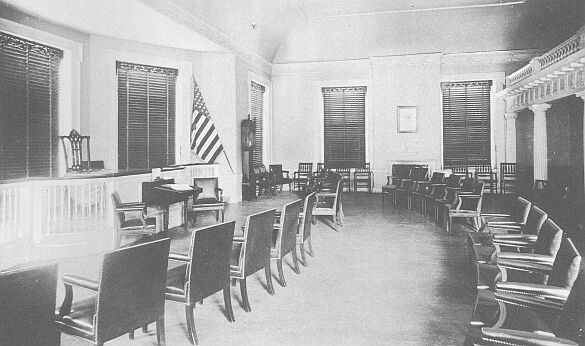
The Room in Which the First Constitutional Convention Met in Philadelphia
Delegates from twelve of the thirteen States (Rhode Island alone being unrepresented) assembled at Philadelphia, where the opening sessions of the first Constitutional Convention were held in this room in Independence Hall, May 14, 1787. George Washington presided during the four months taken to draft the Constitution of the United States. When it was completed on September 17th, it is said that many of the delegates seemed awe-struck and that Washington himself sat with his head bowed in deep meditation. As the Convention adjourned, Franklin, who was then over eighty-one years of age, arose and pointing to the President's quaint armchair on the back of which was emblazoned a half sun, brilliant with gilded rays, observed: "As I have been sitting here all these weeks, I have often wondered whether yonder sun is rising or setting, but now I know that it is a rising sun."
He is unanimously elected president.
After the elections had taken place, a general persuasion prevailed that the public will, respecting the chief magistrate of the union, had been too unequivocally manifested not to be certainly obeyed; and several applications were made to General Washington for those offices in the respective states, which would be in the gift of the president of the United States.
As marking the frame of mind with which he came into the government, the following extract is given from one of the many letters written to persons whose pretensions he was disposed to favour. "Should it become absolutely necessary for me to occupy the station in which your letter presupposes me, I have determined to go into it, perfectly free from all engagements of every nature whatsoever.—A conduct in conformity to this resolution, would enable me, in balancing the various pretensions of different candidates for appointments, to act with a sole reference to justice and the public good. This is, in substance, the answer that I have given to all applications (and they are not few) which have already been made. Among the places sought after in these applications, I must not conceal that the office to which you particularly allude is comprehended. This fact I tell you merely as matter of information. My general manner of thinking, as to the propriety of holding myself totally disengaged, will apologize for my not enlarging farther on the subject.
"Though I am sensible that the public suffrage which places a man in office, should prevent him from being swayed, in the execution of it, by his private inclinations, yet he may assuredly, without violating his duty, be indulged in the continuance of his former attachments."
Meeting of the first congress.
The impotence of the late government, added to the dilatoriness inseparable from its perplexed mode of proceeding on the public business, and to its continued session, had produced among the members of congress such an habitual disregard of punctuality in their attendance on that body, that, although the new government was to commence its operations on the 4th of March, 1789, a house of representatives was not formed until the first, nor a senate until the 6th day of April.
At length, the votes for the president and vice president of the United States were opened and counted in the senate. Neither the animosity of parties, nor the preponderance of the enemies of the new government in some of the states, could deprive General Washington of a single vote. By the unanimous voice of an immense continent, he was called to the chief magistracy of the nation. The second number of votes was given to Mr. John Adams. George Washington and John Adams were therefore declared to be duly elected president and vice president of the United States, to serve for four years from the 4th of March, 1789.[41]