Chapter XII · THE RED CROSS IN PEACE (continued 2)
Reading edition
Miss Barton received in all about $116,000, and an unexpended balance of $15,400 was committed to Mr. Peet, the treasurer of the American Missions in Turkey, to be held as an emergency fund, subject to Miss Barton’s orders. No expense has been incurred for Miss Barton or her agents save for traveling expenses and the wages of interpreters, and with this exception the entire sum expended has gone to the actual relief of the sufferers. While the fund committed to the Anglo-American Committee, of which Mr. Peet is a member—a sum four to five times the amount committed to Miss Barton—has been expended through the missionaries, largely to save the hungry from starvation, the relief through the agents of the Red Cross has for the most part been wisely devoted to the putting of the poor sufferers on their feet again, and thus helping them to help themselves. Some five hundred liras (a lira is $4.40 of good money) were given for the cure and care of the sick in Marash, Zeitoun, and elsewhere, and some two thousand liras’ worth of cloths, thread, pins and needles were sent inland; but many times this amount was expended in providing material for poor widows; seeds, agricultural implements and oxen for farmers; tools for blacksmiths and carpenters; and looms for weavers. In some places Miss Barton’s agents had the pleasure of seeing vegetable gardens coming forward from seed furnished by the Red Cross, and village farmers reaping the grain with sickles which the Red Cross had given. The great want now—a want which the funds of the Red Cross agents did not permit them to any large extent to meet—is aid to the poor villagers to help them rebuild their burned and ruined houses, and thus provide for themselves shelter against the rigors of the coming winter. The Red Cross agents have, however, gathered a great stock of information; and passing by the horrors of the massacres and the awful abuse of girls and women, as unimpeachable witnesses they can bear testimony to the frightful sufferings and needs of the people. We most sincerely hope and pray that Miss Barton and the agents and friends of the Red Cross will not esteem their work in Turkey done, but knowing now so well just what remains to be done, and what can be done, will bend every effort to secure further relief for the widows and orphans of the more than sixty thousand murdered men—mostly between the ages of eighteen and fifty—whose lives no earthly arm was outstretched to save.
While we gratefully bear witness to the wise and indefatigable efforts of Miss Barton’s agents, permit us to add that during her more than six months’ stay in Constantinople Miss Barton gave herself unremittingly to the work of her mission. She seems to have had no time for sight-seeing, and not a few of her friends are disposed to complain that she had no time to accept the invitations of those who would have been glad to entertain her. The only relaxation she seems to have given herself was on two occasions—the first, a Fourth of July picnic with a few American friends, on one of the Princes’ Islands, and the second, another picnic on the same island, on Wednesday, August 5, when, with three of her “men,” she met some twenty American lady teachers and missionaries, in order to bid them a courteous farewell. The first occasion she unqualifiedly declared to have been the happiest Fourth of July she had ever had; and inspired by the occasion, she penned some verses which she kindly read to her friends on the second gathering, and which we very much wish she would permit the editor of the “Independent” to publish. On the second occasion, at Miss Barton’s request, the financial secretary read his report and Dr. Hubbell and Mr. Wood presented reports of the work of distribution. We gratefully acknowledged the honor done us in permitting us to hear these reports; and, remembering our concern for Miss Barton while preparing for the work of distribution six months ago, we gladly expressed our joy and congratulations now on the happy return of her faithful and efficient agents, of whom it may be truly said that they went and saw and conquered. We rejoiced that these new friends had come to know so well the American missionaries in Turkey, and were truly thankful for a mutually happy acquaintance. We wished Miss Barton and her “men” a hearty welcome on their arrival, and, now, with all our hearts, we wish them God-speed on their return home.
Miss Barton was already much bedecorated before the formation of the American Red Cross, but she brought back from Turkey additional official decorations presented to her by the Turkish Government and by prominent organizations represented by the Armenians.
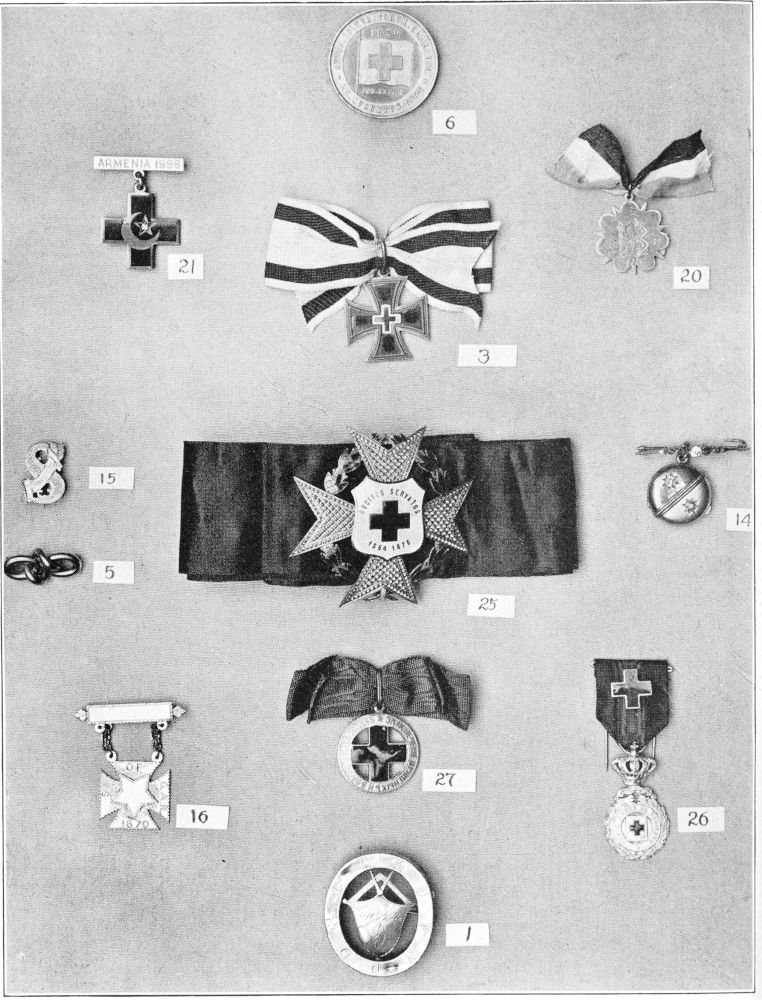
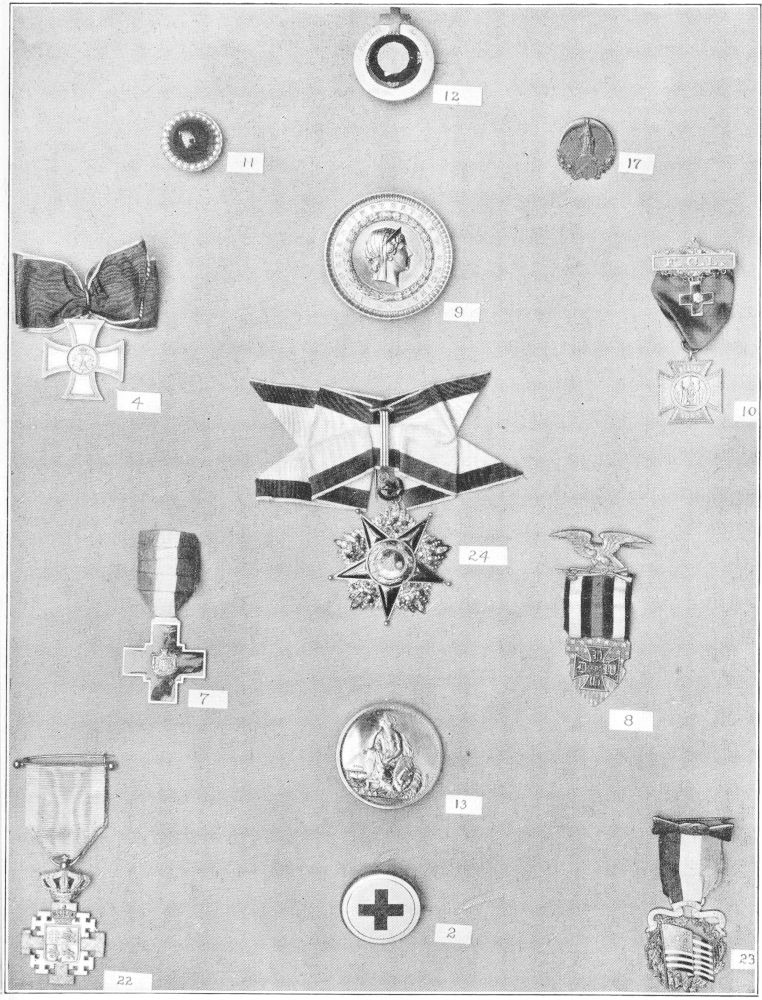
DECORATIONS OF CLARA BARTON
1. “Gold Masonic Emblem,” given her by her father and worn by Miss Clara Barton through the Civil War, 1861-1865.
2. “The German official Red Cross Field Badge,” presented by the Grand Duchess of Baden, and worn by Miss Barton through the Franco-Prussian War, 1870-1871.
3. “The Iron Cross of Germany,” conferred by Emperor William I and Empress Augusta, 1871, in recognition of Miss Barton’s services for humanity in the Franco-Prussian War.
4. “The Gold Cross of Remembrance,” conferred by the Grand Duke and Grand Duchess of Baden, 1871.
5. “Royal Jewel” (gold-knot brooch), presented by the Grand Duchess of Baden, 1897. When presenting this brooch to Miss Barton the Grand Duchess said, “An unbroken friendship of twenty-six years deserves to be tied by a knot of gold.”
6. The official medal of the “International Red Cross,” presented to Miss Barton when through her efforts the Congress of the United States adopted the treaty of Geneva in 1882. Presented by the International Committee of Geneva.
7. Serbian decoration (silver, red enamel, and silver center), conferred by Queen Nathalie of Serbia, 1883, for services for humanity.
8. Gold badge of the “Waffengenosen” German soldiers in America who took part in the Franco-Prussian War of 1870-1871, presented to their Honorary Member Miss Barton in 1885.
9. Silver Medal conferred by Augusta, Empress of Germany, 1885.
10. “Grand Army and Woman’s Relief Corps” (gold with diamonds), presented to Miss Barton, the sole Honorary Member of the Relief Corps, 1886.
11. Royal Jewel (brooch, smoky topaz surrounded with pearls), presented by the Grand Duchess of Baden, 1887.
12. Royal Jewel (red topaz and gold brooch), presented by the Empress Augusta of Germany, 1887.
13. Silver medal of the Massachusetts Charitable Mechanics Association, presented in 1887.
14. Gold brooch with diamonds and sapphire setting, presented by the ladies of Johnstown, Pa., at the close of the relief work of the Johnstown flood, 1889.
15. Gold badge of the “Sorosis,” New York, presented to Miss Barton, their Honorary Member, 1890.
16. Gold badge of “The Clara Barton Lodge of the Sisters of the G. A. R. of Gloucester, Mass.,” presented to Miss Barton, their Honorary Member, 1890.
17. Badge of the Loyal Legion of Women of Washington, D.C., presented to their Honorary Member Miss Barton, 1893.
20. Gold Medal of the Vanderbilt Benevolent Association of South Carolina, presented to Miss Barton, their Honorary Member, 1894.
21. Red Cross Insignia (silver and red enamel with diamond star), in commemoration of the American Relief Field, 1896, presented by Miss Barton’s Assistants on the field in memory of the Relief Field of Armenia.
22. Armenian Decoration (silver, blue enamel, and gold), bestowed by His Royal Highness Guy de Lusignan, Prince of Jerusalem, Cyprus, and Armenia, 1896, in recognition of services in relief of the Armenian massacres.
23. The gold badge of the War Veterans and Sons Association of Brooklyn, New York, presented to their Honorary Member Clara Barton, April, 1899.
24. Turkish Decoration (gold, diamonds, and other jewels), conferred by the Sultan Abdul Hamid in 1897 through the State Department, with the request that if America desired to send further relief to his domains, she should send back the missionaries of humanity she sent before.
25. Spanish Decoration of Honor (gold and green enamel), conferred in 1898 by the Spanish Government.
26. Belgian Decoration (silver and red enamel), conferred in 1892 by the Red Cross of Belgium.
27. Russian Decoration (silver and red enamel), conferred by the Czar Nicholas in 1902. Russian famine.
The foregoing outline briefly summarizes the work of Miss Barton and of the American Red Cross in the years following its official recognition and preceding the Spanish-American War. It was a glorious record; it gave to the Red Cross a definition in the mind of America, and a place in the admiration of the world, such as no philanthropic organization ever had attained. It brought to Clara Barton honors which she accepted with modesty and quietly laid away while she devoted herself to preparation for the next field of service.
The work of the Red Cross was now a labor that occupied the whole twelve months. Her salaried force was small; the expense of administration was kept low. She maintained a skeleton organization with a stock of supplies such as did not deteriorate by storage and was certain to be needed when the first news of disaster arrived. She did not employ a large force of idle helpers. She depended upon the emergency bringing its own troop of assistants who worked under her direction and the direction of those whom she had trained.
Clara Barton knew what not all philanthropists know that it is as important for a philanthropic organization to get out when its work is done as it is for it to go in when its work is needed. In almost every field she met with requests for the continuance of the work after she knew that the time had come for the people to rely upon their own resources. She was determined that the Red Cross should never become a pauperizing institution or furnish employment for an army of official idlers.