Chapter XVII
Reading edition
THE TWO CONTESTED POINTS BETWEEN A SMALL SECTION OF ANTAGONISTS AND MYSELF.
"Because I'm with the swallow, however far he flies; Because the lark within me leaps upwards to the skies; Because, where'er there's singing of birds on hill or plain, We catch each other's meaning and join in one refrain; Because the forest temples where God has made His throne Can rustle to a rising chant they sing to me alone; Because, where'er I find them among the waving grass, The daisies and the violets nod shyly as I pass; Because the flowers have secrets that few men seem to see, And yet they ope their bosoms and tell their tales to me; Because the earth is fairer; because the roses blow With a loveliness and purity that few men care to know; Because the heavens are higher than many dare to think; Because the heavens are nearer, I tremble on their brink; And oh, because to all the joys of birds and beasts and flies, The myriad joys that move the earth and fill the summer skies, There's something in this heart of mine, there's something that replies; Because those other singers whom death has granted fame Stand by my side in solemn hours and call me by my name; Because I dare to meet their gaze, and seem to understand The language which proclaims them all of one great father-land; Because their touch is on me; because in accents mild They hail me as a follower, a servant, yet a child; Because the fairies hearken, I call them at mine ease; Because I hear the angels' harps in the pauses of the breeze; Because a spirit's with me, where'er my steps have trod, Whose eyes have something of myself, and, oh, far more of God; Because, when night is silent, I watch the planets roll, And hear their solemn melodies in the centre of my soul; Because of one great action I feel myself the part, A life whose sphere is nature, a life whose voice is art, And in my breast re-echo the pulsings of its heart; Because my thoughts are splendour, because my thoughts are sin, With a shock, as if of armies amid the battle's din; Because the shades of former days go with me on my way, And because to-morrow's sunshine is on my path to-day; Because my heart-strings tremble to the pressure of thy hand, And because I live a sorrow which none can understand." ——Maarten Maartens.
The "Scented Garden" Controversy.
I must now revert, I hope for the last time, to the "Scented Garden." I made the greatest mistake in the world; I did not know my public, I did not know England. I was under some delusion which I have often bewailed, that I was responsible to, or owed some explanation to, the would-be buyers of that book, nor can I now think how I could have imagined that it was, or described it as, my husband's magnum opus—perhaps it was because it was the first work of the kind I had ever read—as it certainly was the least of his works, and I should say that his "Mecca and Medinah" and his "Arabian Nights" were his best. The abuse I got by a portion of the Press, and eventually volumes of anonymous letters, which were far coarser than the "Scented Garden," and which would have shocked Whitechapel, induced me a month later to write a second letter to the Echo, which I reproduce, and, as it went on, a further explanation in the New Review.
Lady Burton's Last Words to the "Echo."
My Defence about the burnt MS. to the "Echo."
"On reading my own letter in the Morning Post, which paper has always been my best friend, I see that the few lines that explained my reasons for taking the public into my confidence are cut out, probably on account of its length. I quite understand, and see exactly what the opposite side think of it. I wrote to the Morning Post, 'I am obliged to confess this, because there are fifteen hundred men expecting the book, and I do not quite know how to get at them, also I want to avoid unpleasant hints by telling the truth.' My reasons were, that there were too many people after the book, too many inconvenient letters and questions from those who expected it and wanted to buy it, and had I not told what I did, my few bitter enemies—we all have some—would hint and not speak out, which is the worst of all things. Will you believe that I have been four months in England, and quite unable to wind-up half our affairs because my whole mornings have been taken up with answering such letters? I can satisfy all the objections. Had my husband lived, the book would now have been in the printing press; I should never have been allowed to read it, and I should have done exactly what I did to the 'Arabian Nights'—worked the financial part of it. I intended privately to offer it for three thousand guineas to a bookseller with whom my husband and I had had a long-standing friendship, in order to save myself the trouble of all I went through with the 'Arabian Nights,' and it was only on getting the double offer from the unknown man, which was more than I could ever have hoped for—not the next day, as the Press has it—that I sat down to read it. The money was quite a secondary consideration with me, though I like money as much as most women, and have got none; but no woman who truly loved a man, and cared for his interests after death, would have coveted that class of monument for his beloved memory, and only the most selfish or thoughtless of men could have expected me to give it up. Such men would not have risked one little corner of their good names, or reputations, or profession, or money, or family, or society, in connection with any book on this subject. No! they would have shoved him forward into the breach; they would have egged him on with the bravado of schoolboys to his face, in good fellowship—how often have I seen it!—and, if anything went wrong, would probably have pretended that they did not know anything about it. He would have been perfectly justified, had he lived, in carrying out his work. He would have been surrounded by friends to whom he could have explained any objections or controversies, and would have done everything to guard against the incalculable harm of his purchasers lending it to their women-friends, and to their boyish acquaintances, which I could not guarantee.
"Was it a classic? No! it was not a classic; it was a translation from Arabic manuscripts very difficult to get in the original, with copious notes and explanations of his own. But it is very difficult for me, as a woman, to tell you exactly what it was.
"I have received hundreds of letters, with all sorts of opinions, all except a few thoroughly approving my act, and some of these are anonymous, showing how careful people are with their own skins, but the most curious trait is that so many agree with me privately and write in the papers against me. I did not expect my confession to be noticed at all; it was a great surprise to me to find it discussed. I only meant to stop the letters asking for it. Moreover, I only burnt what was my own property, and at my own loss. If my husband had been alive I should not have read it, and I should not have done it. He and I both supposed that he would live for many, many years; but, nevertheless, one day, several weeks before he died, when we were travelling in Switzerland, he called me into his room, and dictated to me a list of such things as he wished burnt in case I survived him, and three documents, which he signed. One of them, amongst other things, contained the following:—
"'In the event of my death, I bequeath especially to my wife, Isabel Burton, every book, paper, or manuscript, to be overhauled and examined by her only, and to be dealt with entirely at her own discretion, and in the manner she thinks best, having been my sole helper for thirty years,' etc., etc., etc., etc.
"'(Signed) Richard F Burton.'
"I need hardly tell you that the 'Scented Garden' was not included in the list of things to be burnt. I did it purely out of love for my husband, and all the censure is as nothing to me in comparison to his memory and our speedy reunion.
"Shortly after we married we lost all we possessed in the world in Grindlay's fire, and when the news was brought to him he remained silent for a few minutes, and then turning to me, said, 'The worst part of the loss is that there were boxes full of priceless Arabic and Persian manuscripts, which I picked up in out-of-the-way places; but,' he added, smiling, 'the world will be all the better for the loss.'
"When I wrote to the Morning Post I never calculated or thought of either praise, or blame, or gain; in fact, I think any one may see I never thought of myself at all, or I should have been more worldly-wise. I shall never regret what I have done, but I shall regret all my life having confessed it, though I could scarcely have helped it, as I was ordered to do so. My husband did no wrong; he had a high purpose, and he thought no evil of printing it, and could one have secured the one per cent. of individuals to whom it would have been merely a study, it probably would have done no harm; but once you get a thing in print in England you have lost all hold of it, and the merest schoolgirl, if she is bent upon seeing it, will get to do so, and the more the mystery the keener they are.
"You will pardon me, who have spent the best part of thirty years on foreign stations, for saying, that if what people tell me be true, and if England progresses in this line at the rate she has done for the last fifteen or twenty years, let us say in another sixty or seventy years, my husband's 'Scented Garden' would have become a Christmas book for boys, on the plea that the mind should be trained to everything. I shall not have done the world such an injury as they make out. Thousands, millions, admire my husband, and many talk of their great love for him, in many instances truly, but I am the only being in the world to whom he was everything, whose soul is mine, whose interests are mine, and therefore I am obliged to harden myself against all abuse, although I quite understand the people of the opposite part, from their point of view.
"I do not understand what the Press meant by my casting a slur on his memory. Did any slur attach to him from the 'Arabian Nights'? On the contrary, great praise, and fame, and gain! Why, then, should a slur come from the 'Scented Garden'? It was not the world's slur that was to be feared. I did not think I could laugh now, but I did when I read 'that I appealed to the public for sympathy and acclaim for my own purity—at his expense,' for there is no cause for sympathy—I never thought about being pure or impure—I felt no sacrifice. I know what I saw. I knew what I had to do, and I did it. It is no use explaining, because the world would not understand me—and there is no need why it should. It never understood him whilst he lived, and it will not understand me while I live.
"Some articles in the Press say that I am uneducated. I am not going to deny it, but my husband found that I had quite sufficient common sense to trust me unreservedly with the whole of his business of whatever nature for thirty years, and he never had cause to regret it, nor did he ever do the slightest thing without consulting me. This is the only instance in which I have not co-operated. I am accused of doing it to earn money, which is rather illogical. If that was my object, why did I not quietly pocket my six thousand guineas, hold my tongue, and pass the manuscript quietly to a man who is incapable of betraying me? Out of the many hundreds of letters which I have received since the 20th of June, three offered to start public subscriptions for me, but I declined them, because this subject is, to me, too sacred for barter. The only money I have ever asked for was for the monument. I forgive those who have heaped me with unmeasured abuse, but I shall never forget it, and I thank them for showing me what sort of people were waiting for the book, and how right I was to burn it. Yet I am quite sure that more than two-thirds of this particular school would condemn what has been said and written to me, did they know it. At any rate, I am quite certain that none of it (either private letters or Press) was penned by any true friend of Sir Richard's to his wife.
"Isabel Burton."
"My confession has been twisted and turned into the following:—'That my poor husband had been engaged on a most beautiful and scientific work for thirty years, that he had finished it all but the last page, that it contained gems of science, that it was full of transcendental Oriental poetry, and that I brutally burnt it, the day after he was dead, in either wanton ignorance or bigotry.' Now, the truth is this. Ever since 1842, whenever my husband came across any information on any subject, he collected it and pigeon-holed it, and at this particular time the accumulations of twenty-seven years (since Grindlay's fire, which lost all preceding ones) were pigeon-holed in different compartments, on as many as twenty different subjects. As fast as he had finished one book, he opened a compartment to produce another, and sometimes had several books on the stocks at the same time, on as many different large plain deal tables.
"It was towards the end of 1888, that he pulled out of its nook the material which would go towards the 'Scented Garden,' and occasionally he translated bits from an Arabic manuscript called the 'Perfumed Garden,'[1] by the Shaykh El Nefzáwih, a Kabyle Arab of the early sixth century (Hegira), the French translation of which is as poor, as a translation of the original, as all the translations of the 'Arabian Nights' were (except Mr. John Payne's) until Richard's came out, which was the perfect one. The only value in the book at all, consisted in his annotations, and there was no poetry. He was engaged on Catullus at the same time, and he threw all his strength and style into the more virile work at the expense of the other. His journal of 31st of March, 1890, contains this sentence—'Began, or rather resumed, "Scented Garden," and don't much care about it, but it is a good pot-boiler,' which I interpret that he knew it was not up to the mark; but the time he was actually seriously occupied on it was from 31st of March, 1890, till the 19th of October—not quite seven months. I have often bewailed my own folly in considering that I was in any way responsible to or owed any explanation to the public respecting my husband's writings, and the only object, as I said, of my letter was to deliver myself from the bother of the letters and visits of a very large number of would-be purchasers. I never supposed for an instant that my action would excite any comment, one way or the other, much less did I suppose that any one would attach any kind of blame to my husband, any more than to the printing of the 'Arabian Nights,' which gave him so much kudos and plenty of money.
"I know that no one would have dared to blame him had he been alive, nor to have represented me as throwing a blight on his reputation, for whom I would at any moment, during a period of forty years, have cheerfully given my life. I knew that this book, being the outcome of sickness during the last two years of his life, was not up to the standard of his former works. Turner's executors burnt a few of his last pictures under similar circumstances to leave his reputation as a painter at its zenith. I acted from the same motive. I should not have dared to burn any autobiography, and every word that he wrote about himself to be given to the public is given. I consider that I have done infinitely more for his reputation and memory by burning it than by printing it. People must not tell me that I am no judge, because I wrote with him, and for him, and also copied everything for him, for the first twenty-six of our thirty years' married life, till I broke down myself, and the 'Arabian Nights' was then handed over to another copyist, I doing all the rest. He laid no stress on bringing it out, except for money's sake. When he had done the 'Arabian Nights,' he said, in his joking, honest way, 'I have struggled for forty-seven years, distinguishing myself honourably in every way that I possibly could. I never had a compliment, nor a "thank you," nor a single farthing. I translate a doubtful book in my old age, and I immediately make sixteen thousand guineas. Now that I know the tastes of England, we need never be without money.'
"Had we lived to come home together, I should have talked him off printing it, as I did another manuscript, quite on a different subject, and he knew that if I had my will, I would burn it. This did not prevent him, about eight weeks before he died, leaving me sole executrix of all he possessed, with instructions 'to sift thoroughly, and publish anything that I thought would not misrepresent him to the public,' adding, 'having been my sole helper for thirty years, I wish you to act solely on your own judgment and discretion.' Now, I judged, after long thinking, that the subject would be unpopular; that had he lived to explain it, to talk about it in the clubs amongst his men-friends, it would have been different; that I probably should have worked the financial part of it, as I did that of the 'Arabian Nights,' because I should not have read it, and large sums would doubtless have accrued from it. He always wrote over the heads of his public, and sixty years in advance of his time: I think that about fifteen people would possibly have understood it and his motives (which were always noble) if the germ was big enough to produce the good intended.
"Given fifteen people to read and understand, given a dead hero who could no longer profit from the money, who could not explain or defend himself if he were attacked by the press, who could not enjoy the praise of a small section of his fellow-men; given two thousand or more other men who could buy the book and in course of time would tire of it and sell it. It would be bought by rich Tom, Dick, and Harry. It would by degrees descend amongst the populace out of Holywell Street, the very opposite result to what the upright manly translator would have desired, and the whole contents might be so misunderstood by the uneducated that the good, noble, glorious life of Richard Burton, of which I and thousands of others are most proud and delight to honour, might sixty years hence receive a very different colouring from the truth, and be handed down to posterity in a false light.
"Many people will regret that Richard did not leave his manuscripts in the hands of a literary man, a lawyer, or a so-called friend. If he had, little men without a name would have profited by it, by tacking on theirs to his big name, money would have been made, and everybody, without distinction, who could have paid would have been pandered to, but nobody would have thought of the dead man, the soldier, the chivalrous gentleman in his tomb—he knew this. I alone stand here, and I think it an honour, for his sake, to bear with the epithets of scorn that the brutality of the athlete, and the dyspepsia of the effete—mostly anonymous Braves—have showered upon me. All that he has left will be given to the public by degrees, if it is more than a mere sketch, but it is cruel to the dead to give their sketches to the world and pretend that they are their best work, simply because they fetch money."[2]
The Leicester Post, a little while ago, wrote:—
"I don't think that Lady Burton's coming book will contain any explanation of her action in destroying the manuscript which Sir Richard endeavoured to complete on his death-bed. It is now said, with some show of authority, that the work contained but one chapter, which in a virginibus puerisque light, might have given offence; if this were so, it seems appalling that the whole work should have been consigned to the flames. Lady Burton cannot know of this report, or she would hasten to relieve the literary minds, whose plaint is bitter because anything has perished which came from the translator of the 'Arabian Nights.'"
Now, it is absurd to suppose that Richard tried to complete a manuscript on a death-bed of three hours. As to authority, there were only three people who ever read that manuscript—Richard who wrote it, the copyist who copied it, and myself. I can relieve the literary minds at once. The first two chapters were a raw translation of part of the works of "Numa Numantius," without any annotations at all, or comments of any kind on Richard's part, and twenty chapters translation of Shaykh el Nafzáwih from Arabic. In fact, it was all translation, excepting the annotations on the Arabic work. I asked the copyist, who is a woman, "what she would have done with it," and she said, "I think I should most likely have been tempted with the money, but if I cared for my husband as much as you did, and if he was dead, I hope I might have burned it." I asked her "upon what grounds she would have burnt it," and she said, "Because the Press would assuredly have criticized it. If he were alive he could answer for himself, and explain—he being dead, you could not; and we all know what men-friends are, and how many would have put themselves in the slightest difficulty to take his part. Sir Richard had the courage of his opinions, but his friends have not, and would only come forward if it could aggrandize their own names a little bit. You have done very well." It makes me sick to hear all this anxiety of the Press and the literary world, lest they should miss a word he ever wrote. When he came back in 1882, after being sent to look after Palmer, he had a good deal of information to give, and he could not get a magazine or paper to take his most valuable article till it was quite stale. We used to boil over with rage when his books or articles were rejected. Only the other day I sent a most valuable letter of his, written in 1886, to a Liberal and a Conservative paper, and neither of them would take it. And now, because a few chapters, which were of no particular value to the world, have been burnt, the whole country's literary minds are "full of bitter plaint because anything has perished which came from the translator of the 'Arabian Nights.'" Such are the waves and whims of such people. They are (privately of course), selling down at Soho a "Scented Garden," translated by the bookseller himself, from a miserable little French copy, which they pretend is "Sir Richard Burton's Scented Garden," gulling people who ought to know better—but not scholars—and who deserve to lose their money, paying for trash that my husband never saw. I hope the seller charges them enormous sums, and I hope that some of the purchasers will have the common sense to bring an action against him for obtaining money under false pretences.
I have done no evil and am unharmed. I am not afraid of slander which I have not deserved; it will die out and I shall live.
Those who say I have failed in my trust, wish it to be so, mean that it shall be so, if it depends upon them. Slander is very cruel; it tracks its victims like a bloodhound, but it generally crushes its own begetter.
"The Second Bone of Contention is Religion.
"No, no; it is not there the sorrow lies, Not in the lack of hands that could applaud, But in the lack of hearts that, answering, rise As loadstones to the magnet, the replies Electric of a sympathy which cries: 'The truth is with thee!'" ——Maarten Maartens.
And to the New Review.
"Heredity is a strong thing, and cannot always be shaken off. It breeds alike forms of body, forms of soul, disease to this, good teeth or scanty hair to that, or colour, or talents, or creed. My Burtons mostly have Catholic-phobia; they hate it without knowing what it is, because their ancestors seceded from it at the time of the Reformation; but one of the most anti-Catholic of them, at the age of seventeen, wrote me more than one beautiful letter imploring me to take her, and get her baptised and received into the Catholic Church. I have them amongst my treasures now; but I did not do so, because it would have been an act of treachery to her mother, and dishonourable to take advantage of a girl, and she has since been very grateful for it. Another Burton, whilst labouring from the effects of an Indian sunstroke, used always to turn his face alternately towards Mecca (evidently thinking of my husband), and then turn the other way and say his rosary: something Catholic having come into his unbiased, unconscious brain. Richard, when he was out in India, had no one to keep him in order. As soon as he was well emancipated and untrammelled, he answered the call of his Bourbon blood, and transferred himself to the Catholic Church, and this is the way he describes it to the public—he always spoke lightly of the things he felt the most: 'What added not a little to the general astonishment was, that I left off "sitting under" the garrison chaplain, and betook myself to the Catholic chapel of the chocolate-coloured Goanese priest who adhibited spiritual consolation to the buttrels, butlers, and head servants, and other servants of the camp.' He frequently spoke in after writings of 'the Portuguese priest who had charge of his soul,' who, when Richard committed some escapade, 'was like a hen who had hatched a duckling.' These writings were lent by Richard to Mr. Hitchman, with other notes, in 1887, but he did not understand the importance of it, nor what it pointed to, and left it amongst the parts he did not use.[3] When I asked Richard how it was that it escaped public comment, he said, 'Because, when I mention that I went to the chocolate-coloured priest of the Goanese Church, the English only think it is some black tribe, where I have been probably tarred and feathered, whilst I was very much in earnest; but since it is no use annoying my people, and as it has escaped Mr. Hitchman, and as it only concerns you and me, and is no business of any outsider, I do not wish you to say anything about it till my death-bed, or some time after my death, and that only if you are put in any difficulty.' Cardinal Wiseman knew it, for he passed Richard through all the missions in wild places all over the world as a Catholic officer, and was willing to patronize my marriage. But Richard never let me know anything about it until after we were married, and I have kept it all my life a secret. I have always steadily said that 'I did not know,' because I never meant to tell it to any one but those who had a right to ask, as I did not see how it concerned the public.
"The public have allowed me to think it unworthy of having anything but public events related to it by the result of my stupid confidence about the burnt manuscript; one almost begrudges it the truth. Look at Grant Allen, a strong and clever man, who stated a while ago in the Athenæum in a paragraph, 'The worm will turn,' that he had been asked to write something personal, that he threw his whole soul and religion into a book, and that when he gave it to his publisher he besought him to destroy it, or 'no one would ever read one of his books again.' It is the same with me; but I have one advantage; I want nothing of the public except what it accords to me freely and out of its own courteous sympathy, and I do want it to understand its departed hero—therefore I sacrifice myself for the public good.
"I think that the World, if a man speaks its own shibboleth, if he wears its last new-fashioned coat in the Park, has no right to complain if he does not show it the colour of the singlet that he wears next to his skin, or the talisman that he wears round his neck, which his wife happens to see, because she helps him to dress and undress.
"Richard was so beautifully reserved, such a past master in concealing his real thoughts and feelings, whilst talking most freely, so as never to hurt his surroundings by letting them imagine that he did not trust them with everything. I used to tell him that he was like the 'Man with the Iron Mask.' He did not see what right any one had to know anything, except what he just absolutely chose them to know.
"I feel with Walt Whitman:—
'I think I could turn and live with animals, they are so placid and self-contained. I stand and look at them long and long. They do not sweat and whine about their condition; They do not lie awake in the dark and weep for their sins; They do not make me sick discussing their duty to God; Not one is dissatisfied, not one is demented with the mania of owning things.'
"I am by no means going to tell you that his Catholicity was a life-long, fixed, and steady thing, like mine. It was not. He had long and wild fits of Eastern Mysticism, but not the Agnosticism that I have seen in England since my widowhood. It was the mysticism of the East—Sufiism. Periodically he had equal Catholic fits, and practised it, hiding it sometimes even from me, though I knew it. In every place we lived in, except Trieste, he had a priest from whom he took lessons, but even this stopped, after he had resident doctors and could not go out by himself. From Trieste he used formerly to go to Gorizia, two hours express inland, and other towns. He was worse than ever in talk the three last years, but the things that he said were so innocent and so witty that I was often compelled to laugh or to go away and laugh. Still, as I saw his health declining I grew frightfully anxious, nay agonized, and in 1888, two years before he died, I made a general appeal for prayers in our Church, which he saw and kept a copy of in a drawer."
Religion.
There are three people in the world who might possibly be able to write sections of his life. Most of his intimate friends are dead, but there are still a few left. One would describe him as a Deist, one as an Agnostic, and one as an Atheist and Freethinker, but I can only describe the Richard that I knew, not the Richard that they knew. I, his wife, who lived with him day and night for thirty years, believed him to be half-Sufi, half-Catholic, or I prefer to say (as nearer the truth) alternately Sufi and Catholic, because I did not in the least count all his wild talk at table or in Society, nor what he wrote; I minded only what he thought and what he did, and this is why I cannot truthfully join in the general opinion. He was like the Druzes, who adopt the national religion for peace' sake; but they have their own private religion all the same. I can distinctly remember a speech which he made in London—I believe it was in 1865, I think at the Anthropological—in which he said, "My religious opinions are of no importance to anybody but myself; no one knows what my religious views are. I object to confessions, and I will not confess. My standpoint is, and I hope ever will be, 'The Truth' as far as it is in me, but known only to myself." This was a public statement, and might silence those who jabber upon things of which they are entirely ignorant.
How beautiful and how sad a mentor is friendship! A noble character must contain three qualities to contend with this one great element of our lives—a sincere, staunch, loyal heart, philosophy, and discernment. The World is a kind, pleasant place to live in, whatever cynics may say. Be in trouble, and you must wonder at the innumerable kind hearts who will call and write, and offer every assistance and consolation in their power. This will not prevent your nearest and dearest relative from snubbing you if you want anything; nor that friend to whom you clung with all your soul, as to a rock, failing you just at the crisis of your life when you most counted upon his support. Then you must call in your philosophy. Again, if a cloud comes over you, how many will disappear, and reappear again as soon as the world has decided in your favour, to join in the applause. Do not blame the weaklings, but your own discernment; they do not want to hurt you, but they hold themselves ready to go on the popular side, whichever way it turns. And why should they not? It is not because they dislike you, but because they fear others more than they love you. In sensitive youth these facts make our misery; but we should learn to rejoice in our riper years when a weak, uncertain friend falls away. Carry the true gold about your own strong heart, and shake off the dross, which is but the superfluous ballast which clogs and impedes the ship's free sailing.
Now, I ask, who is unjust enough, inhuman enough, to grudge me this last consolation? From 1842 to 1890, for forty-eight years, he was before the public; he had a strong band of friends, a strong band of admirers; but the world at large, and notably England, never understood him because he was so above his time, and the larger part did not know how to appreciate him. Who from 1856 to 1859 kept him so supplied with daily written journals of news, of daily cuttings from the newspapers, that when he returned, people said to him, "How come you so well informed of all that has been passing, just as if you had never been away, and you living beyond the pale of civilization?" "Ah, how?" he said. By many mails he never received a line from any one but me. Who cheered him on in danger, toil, and heart-breaking sickness? Who, when he came back from Tanganyika (Africa) in 1859, coldly looked upon by the Government, bullied by the India House, rejected by the Geographical Society, almost tabooed by Society on account of the machinations of Captain Speke, so that he scarcely had ten friends to say good-morning to him,—who sought his side to comfort him? I did! Then we married. Who for thirty years daily attended to his comforts, watched his going out and coming in, had his slippers, dressing-gown, and pipe ready for him every evening, sat sick at heart if he was an hour late, watched all night and till morning if he did not come back? Who copied and worked for and with him? Who fought for thirty years to raise his official position all she could, and wept bitter tears over his being neglected? I did. My only complaint is, that I believe he would have got infinitely more, if he had asked for things himself, and not perpetually stuck me forward; but he was too modest, and I had to obey orders. Who rode or walked at his side through hunger, thirst, cold, and burning heat, with hardships and privations and danger, in all his travels? Who nursed him through seven long illnesses, before his last illness, some lasting two or three months, and never left his bed-head day or night, and did everything for him? I did! Why, I was wife, and mother, and comrade, and secretary, and aide-de-camp, and agent to him; and I was proud, happy, and glad to do it all, and never tired day or night for thirty years. I would rather have had a crust and a tent with him, than be a Queen elsewhere. At the moment of his death I had done all I could for the body, and then I tried to follow his soul. I am following the soul, and I shall reach it before long. There we shall nevermore part. Agnostics! "Burnt manuscript" readers! where were you all then? Hail-fellow-well-met, when the world went well; running away when it pursed up its stupid lips. And do any of you pretend or wish to take him away from me in death? Oh, for shame, for shame! Let him rest where he wanted to rest, and be silent, or do not boast of your "free country" where a man may not even be buried where he will; where he may not speak his mind, and tell the truth. Be ashamed that History may have to say, that the only honour that England accorded to Richard Burton, having failed to do him justice in this life, was to bespatter his wife with mud after he was dead, and could not defend her.
Do not be so hard and prosaic as to suppose that our Dead cannot, in rare instances, come back and tell us how it is with them.
"He lives and moves, he is not dead, He does not alter nor grow strange, His love is still around me shed, Untouched by time, or chance, or change; And when he walks beside me, then As shadows seem all living men." ——Mary Macleod.
I take my Leave.
He said always, "I am gone—pay, pack, and follow."
Reader! I have paid, I have packed, I have suffered. I am waiting to join his Caravan. I am waiting for a welcome sound—
"The tinkling of his camel-bell."
"THE SELF-EXILED." "'Now, open the gate, and let her in, And fling it wide, For she hath been cleansed from stain of sin,' St. Peter cried. And the angels were all silent. "'Though I am cleansed from stain of sin,' She answered low, 'I came not hither to enter in, Nor may I go.' And the angels were all silent. * * * * * "'But I may not enter there,' she said, 'For I must go Across the gulf, where the guilty dead Lie in their woe.' And the angels were all silent. "'If I enter heaven, I may not speak My soul's desire, For them that are lying distraught and weak In flaming fire.' And the angels were all silent. "St. Peter he turned the keys about, And answered grim: 'Can you love the Lord, and abide without Afar from Him?' And the angels were all silent. "'Should I be nearer Christ,' she said 'By pitying less The sinful living, or woeful dead, In their helplessness?' And the angels were all silent. "'Should I be liker Christ, were I To love no more The loved, who in their anguish lie Outside the door?' And the angels were all silent. * * * * * "'Did He not hang on the cursed tree, And bear its shame, And clasp to His heart, for love of me, My guilt and blame?' And the angels were all silent. "'Should I be liker, nearer Him, Forgetting this, Singing all day with the Seraphim, In selfish bliss?' And the angels were all silent. "The Lord Himself stood by the gate And heard her speak Those tender words compassionate, Gentle and meek. And the angels were all silent. "Now, pity is the touch of God In human hearts, And from that way He ever trod He ne'er departs. And the angels were all silent. "And He said, 'Now will I go with you, Dear child of Love; I am weary of all this glory, too. In heaven above.' And the angels were all silent. "'We will go and seek and save the lost, If they will hear. They who are worst but need Me most; And all are dear.' And the angels were all silent." ——Walter C. Smith, Hilda among the Brother Gods.
Good-bye.
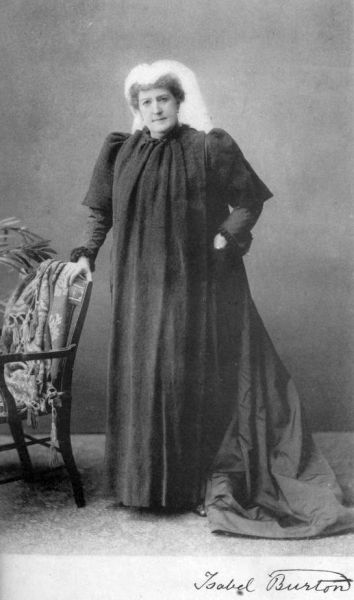
Isabel Burton "I beg of you, I beg of you, my brother, For an alms this very day; I am standing at your doorstep as a Beggar, Who will not be turned away; And the charity you give my soul shall be—Pray for me!"
APPENDIX A.
LIST OF CAPTAIN SIR RICHARD F. BURTON'S WORKS.
A Grammar of the Játaki or Belochi Dialect. Bombay Branch of the Royal Asiatic Society, India. 1849.
Grammar of the Mooltanee Language. India, 1849.
Critical Remarks on Dr. Dorn's Chrestomathy of Pushtoo or Afghan Dialect. India, 1849.
Reports to Bombay: (1) General Notes on Sind; (2) Notes on the Population of Sind. Printed in the Government records.
Goa and the Blue Mountains. 1851.
Scinde; or, the Unhappy Valley. 2 vols. 1851.
Sindh, and the Races that inhabit the Valley of the Indus. 1851.
Falconry in the Valley of the Indus. 1852.
A Complete System of Bayonet Exercise. 1853.
Pilgrimage to Mecca and El-Medinah. 3 vols. 1855.
First Footsteps in East Africa. 1856.
Lake Regions of Equatorial Africa. 2 vols. 1860.
The whole of Vol. XXXIII. of the Royal Geographical Society. 1860.
The City of the Saints (Mormon). 1861.
Wanderings in West Africa. 2 vols. 1863.
Abeokuta and the Cameroons. 2 vols. 1863.
The Nile Basin. 1864.
A Mission to the King of Dahomé. 2 vols. 1864.
Wit and Wisdom from West Africa. 1864.
The Highlands of the Brazil. 2 vols. 1869.
Vikram and the Vampire. Hindú Tales. 1870.
Marcy's Prairie Traveller. Notes by R. F. Burton. Anthropological Review, 1864.
Psychic Facts. Stone Talk, by F. Baker. 1865.
Paraguay. 1870.
Proverba Communia Syriaca. Royal Asiatic Society. 1871.
Zanzibar: City, Island, and Coast. 2 vols. 1872.
Unexplored Syria. Richard and Isabel Burton. 2 vols. 1872.
The Lands of the Cazembe, and a small pamphlet of Supplementary papers. Royal Geographical Society. 1873.
The Captivity of Hans Stadt. Hakluyt Society. 1874.
Articles on Rome. Two Papers. Macmillan's Magazine, 1874-5.
The Castellieri of Istria: a Pamphlet. Anthropological Society. 1874.
Gerber's Province of Minas Geraes. Translated and annotated by R. F. Burton. Royal Geographical Society. 1874.
New System of Sword Exercise: a Manual. 1875.
Ultima Thule: a Summer in Iceland. 2 vols. 1875.
Gorilla Land; or, the Cataracts of the Congo. 2 vols. 1875.
The Long Wall of Salona, and the Ruined Cities of Pharia and Gelsa di Lesina: a Pamphlet. Anthropological Society. 1875.
The Port of Trieste, Ancient and Modern. Journal of the Society of Arts, October 29th and November 5th, 1875.
Etruscan Bologna. 1876.
Sind Revisited. 1877.
The Gold Mines of Midian, and the Ruined Midianite Cities. 1878.
The Land of Midian (Revisited). 2 vols. 1879.
The Kasîdah.
Camoens. 6 vols. of 10. First publication. 1880. —I. The Lusiads. Englished by R. F. Burton. Edited by his wife, Isabel Burton. 2 vols. —II. The Commentary, Life, and Lusiads. R. F. Burton. 2 vols., containing a Glossary, and Reviewers reviewed by Isabel Burton. —III. The Lyrics of Camoens. 2 vols. R. F. Burton.
A Glance at the Passion Play. 1881. 8vo.
To the Gold Coast for Gold. 2 vols. 1883.
The Book of the Sword. 1 large vol. of 3. By R. F. Burton, Maître d'Armes. 1884.
Iraçema, or Honey Lips; and Manoel de Moraes, the Convert. Translated from the Brazilian by Richard and Isabel Burton. 1 vol. 1886.
Arabian Nights. Printed by private subscription, 1885-8. 1000 sets of 10 vols., followed by 1000 sets of 6 Supplementary vols. (Lady Burton's Edition).
Besides which, Sir Richard Burton has written extensively for Fraser, Blackwood, and a host of Magazines, Pamphlets, and Periodicals; has lectured in many lands: has largely contributed to the newspaper Press in Europe, Asia, Africa, and America (both North and South), to say nothing of poetry and anonymous writings.
LIST OF LADY BURTON'S BOOKS.
Inner Life of Syria. 2 vols. 1875.
A. E. I. (Arabia, Egypt, and India). 1879.
LIST OF SIR RICHARD BURTON'S UNPUBLISHED WORKS.
Uruguay. Translated from Brazilian author by Richard and Isabel Burton.
Ladislas Magyar's African Travels. Pentamerone. A book on the Jews. (These [three] are quite complete.)
Catullus. (Almost complete.)
In a semi-state of completion, or only materials and notes, are— More Notes on Paraguay. Personal Experiences in Syria. Lowlands of Brazil. North America. South America. Central America. A book on Istria—More Castellieri. Materials for four more books of Camoens. Materials towards another book on the Sword. Materials for a book of Greek Proverbs (Greek Anthology). Materials towards a book on the Gypsies. Ditto Slavonic Proverbs. Ditto Dr. Wetstein's Haurán. Ditto Apuleius, or the Golden Ass. Ditto Ausonius (Epigrams).
The Uniform Library will bring out a cheap edition for the people, first, of all his hitherto published works, to which will gradually be added his unpublished works as fast as they can be produced, that the British Public may be made familiar with all that he has written.
This Life will be followed by 2 vols, collecting all his Pamphlets, Essays, Correspondence with the Press, Letters, and the pith of the work he has endeavoured to do for the benefit of the human race during his seventy years; and this will occupy me another year, or, let us say, two whole years, and will be called "The Labours and Wisdom of Richard Burton."
APPENDIX B.
NOTES ON "THE KASÎDAH."
"NOTE I.—Hâjî Abdû, the Man.
"Hâjî Abdû has been known to me for more years than I care to record. A native, it is believed, of Darâbghird in the Yezd Province, he always preferred to style himself El-Hichmakâni, a facetious 'lackab' or surname, meaning 'Of No-hall, Nowhere.' He had travelled far and wide with his eyes open; as appears by his 'couplets.' To a natural facility, a knack of language-learning, he added a store of desultory various reading; scraps of Chinese and old Egyptian; of Hebrew and Syriac; of Sanskrit and Prakrit; of Slav, especially Lithuanian; of Latin and Greek, including Romaic; of Berber, the Nubian dialect, and of Zend and Akkadian, besides Persian, his mother-tongue, and Arabic, the classic of the schools. Nor was he ignorant of 'the -ologies' and the triumphs of modern scientific discovery. Briefly, his memory was well stored; and he had every talent save that of using his talents.
"But no one thought that he 'woo'd the Muse,' to speak in the style of the last century. Even his intimates were ignorant of the fact that he had a skeleton in his cupboard, his Kasîdah or distichs. He confided to me his secret, and when so doing he held in hand the long and hoary honours of his chin with the points towards me, as if to say with the Island-King—
'There is a touch of Winter in my beard, A sign the Gods will guard me from imprudence.'
And yet the piercing eye, clear as an onyx, seemed to protest against the plea of age. The MS. was in the vilest 'Shikastah' or running-hand; and, as I carried it off, the writer declined to take the trouble of copying out his cacograph.
"We, his old friends, had long addressed Hâjî Abdû by the sobriquet of Nabbianâ ('our Prophet'); and the reader will see that the Pilgrim has, or believes he has, a message to deliver. He evidently aspires to preach a Faith of his own; an Eastern Version of Humanitarianism blended with the sceptical or, as we now say, the scientific habit of mind. This religion, of which Fetishism, Hinduism, and Heathendom, Judaism, Christianity, and Islamism, are mere fractions, may, methinks, be accepted by the Philosopher: it worships with single-minded devotion the Holy Cause of Truth, of Truth for its own sake, not for the goods it may bring; and this belief is equally acceptable to honest ignorance, and to the highest attainments in nature-study.
"With Confucius the Hâjî cultivates what Strauss has called the 'stern common sense of mankind;' while the reign of order is a paragraph of his 'Higher Law.' He traces from its rudest beginnings the all but absolute universality of some perception by man, called 'Faith;' that sensus Numinis which, by inheritance or communication, is now universal except in those who force themselves to oppose it. And he evidently holds this general consent of mankind to be so far divine that it primarily discovered for itself, if it did not create, a divinity. He does not cry with the Christ of Novalis, 'Children, you have no father;' and perhaps he would join Renan in exclaiming, Un monde sans Dieu est horrible!
"But he recognizes the incompatibility of the Infinite with the Definite; of a Being who loves, who thinks, who hates; of an Actus purus who is called jealous, wrathful, and revengeful, with an 'Eternal that makes for righteousness.' In the presence of the endless contradictions, which spring from the idea of a Personal Deity, with the Synthesis, the Begriff of Providence, our Agnostic takes refuge in the sentiment of an unknown and an unknowable. He objects to the countless variety of forms assumed by the perception of a Causa Causans (a misnomer), and to that intellectual adoption of general propositions, capable of distinct statement but incapable of proofs, which we term Belief.
"He looks with impartial eye upon the endless variety of systems, maintained with equal confidence and self-sufficiency, by men of equal ability and honesty. He is weary of wandering over the world, and of finding every petty race wedded to its own opinions; claiming the monopoly of Truth; holding all others to be in error, and raising disputes whose violence, acerbity, and virulence are in inverse ratio to the importance of the disputed matter. A peculiarly active and acute observation taught him that many of these jarring families, especially those of the same blood, are par in the intellectual processes of perception and reflection; that in the business of the visible working world they are confessedly by no means superior to one another; whereas in abstruse matters of mere Faith, not admitting direct and sensual evidence, one in a hundred will claim to be right, and immodestly charge the other ninety-nine with being wrong.
"Thus he seeks to discover a system which will prove them all right, and all wrong; which will reconcile their differences; will unite past creeds; will account for the present, and will anticipate the future with a continuous and uninterrupted development; this, too, by a process, not negative and distinctive, but, on the contrary, intensely positive and constructive. I am not called upon to sit in the seat of judgment; but I may say that it would be singular if the attempt succeeded. Such a system would be all-comprehensive, because not limited by space, time, or race; its principle would be extensive as Matter itself, and, consequently, eternal. Meanwhile he satisfies himself,—the main point.
"Students of metaphysics have of late years defined the abuse of their science as 'the morphology of common opinion.' Contemporary investigators, they say, have been too much occupied with introspection; their labours have become merely physiologico-biographical, and they have greatly neglected the study of averages. For, says La Rochefoucauld, Il est plus aisé de connoître l'homme en général que de connoître un homme en particulier; and on so wide a subject all views must be one-sided.
"But this is not the fashion of Easterns. They have still to treat great questions ex analogiâ universi, instead of ex analogiâ hominis. They must learn the basis of sociology, the philosophic conviction that mankind should be studied, not as a congeries of individuals, but as an organic whole. Hence the Zeitgeist, or historical evolution of the collective consciousness of the age, despises the obsolete opinion that Society, the State, is bound by the same moral duties as the simple citizen. Hence, too, it holds that the 'spirit of man, being of equal and uniform substance, doth usually suppose and feign in nature a greater equality and uniformity than is in Truth.'
"Christianity and Islamism have been on their trial for the last eighteen and twelve centuries. They have been ardent in proselytizing, yet they embrace only one-tenth and one-twentieth of the human race. Hâjî Abdû would account for the tardy and unsatisfactory progress of what their votaries call 'pure truths,' by the innate imperfections of the same. Both propose a reward for mere belief, and a penalty for simple unbelief; rewards and punishments being, by the way, very disproportionate. Thus they reduce everything to the scale of a somewhat unrefined egotism; and their demoralizing effects become clearer to every progressive age.
"Hâjî Abdû seeks Truth only, truth as far as man, in the present phase of his development, is able to comprehend it. He disdains to associate utility, like Bacon ('Nov. Org.' I. Aph. 124), the High Priest of the English Creed, les gros bon sens, with the lumen siccum ac purum notionum verarum. He seems to see the injury inflicted upon the sum of thought by the à posteriori superstition, the worship of 'facts,' and the deification of synthesis. Lastly, came the reckless way in which Locke 'freed philosophy from the incubus of innate ideas.' Like Luther and the leaders of the great French Revolution, he broke with the Past; and he threw overboard the whole cargo of human tradition. The result has been an immense movement of the mind which we love to call Progress, when it has often been retrograde; together with a mighty development of egotism resulting from the pampered sentiment of personality.
"The Hâjî regrets the excessive importance attached to a possible future state: he looks upon this as a psychical stimulant, a daydream, whose revulsion and reaction disorder waking life. The condition may appear humble and prosaic to those exalted by the fumes of Fancy, by a spiritual dram-drinking which, like the physical, is the pursuit of an ideal happiness. But he is too wise to affirm or to deny the existence of another world. For life beyond the grave there is no consensus of mankind, no Catholic opinion held semper, et ubique, et ab omnibus. The intellectual faculties (perception and reflection) are mute upon the subject: they bear no testimony to facts; they show no proof. Even the instinctive sense of our kind is here dumb. We may believe what we are taught: we can know nothing. He would, therefore, cultivate that receptive mood which, marching under the shadow of mighty events, leads to the highest of goals,—the development of Humanity. With him suspension of judgment is a system.
"Man has done much during the sixty-eight centuries which represent his history. This assumes the first Egyptian Empire, following the prehistoric, to begin with B.C. 5000, and to end with B.C. 3249. It was the Old, as opposed to the Middle, the New, and the Low: it contained the Dynasties from I. to X., and it was the age of the Pyramids, at once simple, solid, and grand. When the praiser of the Past contends that modern civilization has improved in nothing upon Homer and Herodotus, he is apt to forget that every schoolboy is a miracle of learning compared with the Cave-man and the palæolithic race. And, as the Past has been, so shall the Future be.
"The Pilgrim's view of life is that of the Soofi, with the usual dash of Buddhistic pessimism. The profound sorrow of existence, so often sung by the dreamy Eastern poet, has now passed into the practical European mind. Even the light Frenchman murmurs—
'Moi, moi, chaque jour courbant plus bas ma tête Je passe—et refroidi sous ce soleil joyeux, Je m'en irai bientôt, au milieu de la fête, Sans que rien manque au monde immense et radieux.'
But our Hâjî is not Nihilistic in the 'no-nothing' sense of Hood's poem, or, as the American phrases it, 'There is nothing new, nothing true, and it don't signify.' His is a healthy wail over the shortness and the miseries of life, because he finds all created things—
'Measure the world, with "Me" immense.'
"He reminds us of St. Augustine ('Med.' c. 21). 'Vita hæc, vita misera, vita caduca, vita incerta, vita laboriosa, vita immunda, vita domina malorum, regina superborum, plena miseriis et erroribus.... Quam humores tumidant, escæ inflant, jejunia macerant, joci dissolvunt, tristitiæ consumunt; sollicitudo coarctat, securitas hebetat, divitiæ inflant et jactant. Paupertas dejicit, juventus extollit, senectus incurvat, importunitas frangit, mæror deprimit. Et his malis omnibus mors furibunda succedit.' But for furibunda the Pilgrim would, perhaps, read benedicta.
"With Cardinal Newman, one of the glories of our age, Hâjî Abdû finds 'the Light of the world nothing else than the Prophet's scroll, full of lamentations and mourning and woe.' I cannot refrain from quoting all this fine passage, if it be only for the sake of its lame and shallow deduction. 'To consider the world in its length and breadth, its various history and the many races of men, their starts, their fortunes, their mutual alienation, their conflicts, and then their ways, habits, governments, forms of worship; their enterprises, their aimless courses, their random achievements and acquirements, the impotent conclusion of long-standing facts, the tokens so faint and broken of a superintending design, the blind evolution (!) of what turn out to be great powers or truths, the progress of things as if from unreasoning elements, not towards final causes; the greatness and littleness of man, his far-reaching aims and short duration, the curtain hung over his futurity, the disappointments of life, the defeat of good, the success of evil, physical pain, mental anguish, the prevalence and intensity of sin, the pervading idolatries, the corruptions, the dreary hopeless irreligion, that condition of the whole race so fearfully yet exactly described in the Apostle's words, "having no hope and without God in the world"—all this is a vision to dizzy and appal, and inflicts upon the mind the sense of a profound mystery which is absolutely without human solution.' Hence that admirable writer postulates some 'terrible original calamity;' and thus the hateful doctrine, theologically called 'original sin,' becomes to him almost as certain as that 'the world exists, and as the existence of God.' Similarly the 'Schedule of Doctrines' of the most liberal Christian Church insists upon human depravity, and the 'absolute need of the Holy Spirit's agency in man's regeneration and sanctification.'
"But what have we here? The 'original calamity' was either caused by God or arose without leave of God, in either case degrading God to man. It is the old dilemma whose horns are the irreconcilable attributes of goodness and omniscience in the supposed Creator of sin and suffering. If the one quality be predicable, the other cannot be predicable of the same subject. Far better and wiser is the essayist's poetical explanation, now apparently despised because it was the fashionable doctrine of the sage bard's day—
'All nature is but art . . . All discord harmony not understood; All partial evil universal good.' ——(Essay, 289-292.)
The Pilgrim holds with St. Augustine Absolute Evil is impossible because it is always rising up into good. He considers the theory of a beneficent or maleficent deity a purely sentimental fancy, contradicted by human reason and the aspect of the world. Evil is often the active form of good; as F. W. Newman says, 'so likewise is Evil the revelation of Good.' With him all existences are equal: so long as they possess the Hindú Agasa, Life-fluid or vital force, it matters not they be
'Fungus or oak or worm or man.'
War, he says, brings about countless individual miseries, but it forwards general progress by raising the stronger upon the ruins of the weaker races. Earthquakes and cyclones ravage small areas; but the former builds up earth for man's habitation, and the latter renders the atmosphere fit for him to breathe. Hence he echoes—
'—The universal Cause Acts not by partial but by general laws.'
Ancillary to the churchman's immoral view of 'original sin' is the unscientific theory that evil came into the world with Adam and his seed. Let us ask what was the state of our globe in the pre-Adamite days, when the tyrants of the Earth, the huge Saurians and other monsters lived in perpetual strife, in a destructiveness of which we have now only the feeblest examples? What is the actual state of the world of waters, where the only object of life is death, where the Law of murder is the Law of Development?
"Some will charge the Hâjî with irreverence, and hold him a 'lieutenant of Satan who sits in the chair of pestilence.' But he is not intentionally irreverent. Like men of far higher strain, who deny divinely the divine, he speaks the things that others think and hide. With the author of 'Supernatural Religion,' he holds that we 'gain infinitely more than we lose in abandoning belief in the reality of revelation;' and he looks forward to the day when 'the old tyranny shall have been broken, and when the anarchy of transition shall have passed away.' But he is an Eastern. When he repeats the Greek's 'Remember not to believe,' he means, Strive to learn, to know, for right ideas lead to right actions. Among the couplets not translated for this eclogue is—
'Of all the safest ways of Life the safest way is still to doubt; Men win the future world with Faith, the present world they win without.'
This is the Spaniard's—
'De las cosas mas seguras, mas seguro es duvidar;'
a typically modern sentiment of the Brazen Age of Science following the Golden Age of Sentiment. But the Pilgrim continues—
'The sages say: I tell thee no! with equal faith all Faiths receive; None more, none less, for Doubt is Death: they live the most who most believe.'
"Here, again, is an Oriental subtlety; a man who believes in everything equally and generally may be said to believe in nothing. It is not a simple European view which makes honest Doubt worth a dozen of the Creeds. And it is in direct opposition to the noted writer who holds that the man of simple faith is worth ninety-nine of those who hold only to the egotistic interests of their own individuality. This dark saying means (if it mean anything), that the so-called moral faculties of man, fancy and ideality, must lord it over the perceptive and reflective powers,—a simple absurdity! It produced a Turricremata, alias Torquemada, who, shedding floods of honest tears, caused his victims to be burnt alive; and an Anchieta, the Thaumaturgist of Brazil, who beheaded a converted heretic lest the latter by lapse from grace lose his immortal soul.
"But this vein of speculation, which bigots brand as 'Doubt, Denial, and Destruction;' this earnest religious scepticism; this curious inquiry, 'Has the universal tradition any base of fact?' this craving after the secrets and mysteries of the future, the unseen, the unknown, is common to all races and to every age. Even amongst the Romans, whose model man in Augustus' day was Horace, the philosophic, the epicurean, we find Propertius asking—
'An ficta in miseras descendit fabula gentes Et timor haud ultra quam rogus esse potest?'
"To return: the Pilgrim's doctrines upon the subject of conscience and repentance will startle those who do not follow his train of thought—
'Never repent because thy will with will of Fate be not at one: Think, an thou please, before thou dost, but never rue the deed when done.'
This again is his modified fatalism. He would not accept the boisterous mode of cutting the Gordian-knot proposed by the noble British Philister—'we know we're free and there's an end on it!' He prefers Lamarck's, 'The will is, in truth, never free.' He believes man to be a co-ordinate term of Nature's great progression; a result of the interaction of organism and environment, working through cosmic sections of time. He views the human machine, the pipe of flesh, as depending upon the physical theory of life. Every corporeal fact and phenomenon which, like the tree, grows from within or without, is a mere product of organization; living bodies being subject to the natural law governing the lifeless and the inorganic. Whilst the religionist assures us that man is not a mere toy of fate, but a free agent responsible to himself, with work to do and duties to perform, the Hâjî, with many modern schools, holds Mind to be a word describing a special operation of matter; the faculties generally to be manifestations of movements in the central nervous system; and every idea, even of the Deity, to be a certain little pulsation of a certain little mass of animal pap,—the brain. Thus he would not object to relationship with a tailless catarrhine anthropoid ape, descended from a monad or a primal ascidian.
"Hence he virtually says, 'I came into the world without having applied for or having obtained permission; nay, more, without my leave being asked or given. Here I find myself hand-tied by conditions, and fettered by laws and circumstances, in making which my voice had no part. While in the womb I was an automaton; and death will find me a mere machine. Therefore not I, but the Law, or, if you please, the Lawgiver, is answerable for all my actions.' Let me here observe that to the Western mind 'Law' postulates a Lawgiver; not so to the Eastern, and especially to the Soofi, who holds these ideas to be human, unjustifiably extended to interpreting the non-human, which men call the Divine.
"Further he would say, 'I am an individual (qui nil habet dividui), a circle touching and intersecting my neighbours at certain points, but nowhere corresponding, nowhere blending. Physically I am not identical in all points with other men. Morally I differ from them: in nothing do the approaches of knowledge, my five organs of sense (with their Shelleyan "interpenetration"), exactly resemble those of any other being. Ergo, the effect of the world, of life, of natural objects, will not in my case be the same as with the beings most resembling me. Thus I claim the right of creating or modifying for my own and private use, the system which most imports me; and if the reasonable leave be refused to me, I take it without leave.
"'But my individuality, however all-sufficient for myself, is an infinitesimal point, an atom subject in all things to the Law of Storms called Life. I feel, I know that Fate is. But I cannot know what is or what is not fated to befall me. Therefore in the pursuit of perfection as an individual lies my highest, and indeed my only duty, the "I" being duly blended with the "We." I object to be a "self-less man," which to me denotes an inverted moral sense. I am bound to take careful thought concerning the consequences of every word and deed. When, however, the Future has become the Past, it would be the merest vanity for me to grieve or to repent over that which was decreed by universal Law.'
"The usual objection is that of man's practice. It says, 'This is well in theory; but how carry it out? For instance, why would you kill, or give, over to be killed, the man compelled by Fate to kill your father?' Hâjî Abdû replies, 'I do as others do, not because the murder was done by him, but because the murderer should not be allowed another chance of murdering. He is a tiger who has tasted blood and who should be shot. I am convinced that he was a tool in the hands of Fate, but that will not prevent my taking measures, whether predestined or not, in order to prevent his being similarly used again.'
"As with repentance so with conscience. Conscience may be a 'fear which is the shadow of justice;' even as pity is the shadow of love. Though simply a geographical and chronological accident, which changes with every age of the world, it may deter men from seeking and securing the prize of successful villany. But this incentive to beneficence must be applied to actions that will be done, not to deeds that have been done.
"The Hâjî, moreover, carefully distinguishes between the working of fate under a personal God, and under the Reign of Law. In the former case the contradiction between the foreknowledge of a Creator, and the free-will of a Creature, is direct, palpable, absolute. We might as well talk of black-whiteness and of white-blackness. A hundred generations of divines have never been able to ree the riddle; a million will fail. The difficulty is insurmountable to the Theist whose Almighty is perforce Omniscient, and as Omniscient, Prescient. But it disappears when we convert the Person into Law, or a settled order of events; subject, moreover, to certain exceptions fixed and immutable, but at present unknown to man. The difference is essential as that between the penal code with its narrow forbiddal, and the broad commandment which is a guide rather than a taskmaster.
"Thus, too, the belief in fixed Law, versus arbitrary will, modifies the Hâjî's opinions concerning the pursuit of happiness. Mankind, das rastlose Ursachenthier, is born to be on the whole equally happy and miserable. The highest organisms, the fine porcelain of our family, enjoy the most and suffer the most: they have a capacity for rising to the empyrean of pleasure and for plunging deep into the swift-flowing river of woe and pain. Thus Dante ('Inf.' vi. 106)—
'—tua scienza Che vuol, quanto la cosa è più perfetta Più senta 'l bene, e cosi la doglienza.'
So Buddhism declares that existence in itself implies effort, pain, and sorrow; and, the higher the creature, the more it suffers. The common clay enjoys little and suffers little. Sum up the whole and distribute the mass; the result will be an average; and the beggar is, on the whole, happy as the prince. Why, then, asks the objector, does man ever strive and struggle to change, to rise; a struggle which involves the idea of improving his condition? The Hâjî answers, 'Because such is the Law under which man is born: it may be fierce as famine, cruel as the grave, but man must obey it with blind obedience.' He does not enter into the question whether life is worth living, whether man should elect to be born. Yet his Eastern pessimism, which contrasts so sharply with the optimism of the West, re-echoes the lines—
'—a life, With large results so little rife, Though bearable seems hardly worth This pomp of words, this pain of birth.'
"Life, whatever may be its consequence, is built upon a basis of sorrow. Literature, the voice of humanity, and the verdict of mankind proclaim that all existence is a state of sadness. The 'physicians of the Soul' would save her melancholy from degenerating into despair by doses of steadfast belief in the presence of God, in the assurance of Immortality, and in visions of the final victory of good. Were Hâjî Abdû a mere Theologist, he would add that Sin, not the possibility of revolt, but the revolt itself against conscience, is the primary form of evil, because it produces error, moral and intellectual. This man, who omits to read the Conscience-law, however it may differ from the Society-law, is guilty of negligence. That man, who obscures the light of Nature with sophistries, becomes incapable of discerning his own truths. In both cases error, deliberately adopted, is succeeded by suffering which, we are told, comes in justice and benevolence as a warning, a remedy, and a chastisement.
"But the Pilgrim is dissatisfied with the idea that evil originates in the individual actions of free agents, ourselves and others. This doctrine fails to account for its characteristics,—essentiality and universality. That creatures endowed with the mere possibility of liberty should not always choose the Good appears natural. But that of the milliards of human beings who have inhabited Earth, not one should have been found invariably to choose Good, proves how insufficient is the solution. Hence no one believes in the existence of the complete man under the present state of things. The Hâjî rejects all popular and mythical explanation by the Fall of 'Adam,' the innate depravity of human nature, and the absolute perfection of certain Incarnations, which argues their divinity. He can only wail over the prevalence of evil, assume its foundation to be error, and purpose to abate it by uprooting that Ignorance which bears and feeds it.
"His 'eschatology,' like that of the Soofis generally, is vague and shadowy. He may lean towards the doctrine of Marc Aurelius, 'The unripe grape, the ripe and the dried: all things are changes not into nothing, but into that which is not at present.' This is one of the monstruosa opinionum portenta mentioned by the Nineteenth General Council, alias the First Council of the Vatican. But he only accepts it with a limitation. He cleaves to the ethical, not the intellectual, worship of 'Nature,' which moderns define to be an 'unscientific and imaginary synonym for the sum total of observed phenomena.' Consequently he holds to the 'dark and degrading doctrines of the Materialist,' the 'Hylotheist;' in opposition to the spiritualist, a distinction far more marked in the West than in the East. Europe draws a hard, dry line between Spirit and Matter: Asia does not.
"Among us the Idealist objects to the Materialists that the latter cannot agree upon fundamental points; that they cannot define what is an atom; that they cannot account for the transformation of physical action and molecular motion into consciousness; and vice versâ, that they cannot say what matter is; and, lastly, that Berkeley and his school have proved the existence of spirit while denying that of matter.
"The Materialists reply that the want of agreement shows only a study insufficiently advanced; that man cannot describe an atom, because he is still an infant in science, yet there is no reason why his mature manhood should not pass through error and incapacity to truth and knowledge; that consciousness becomes a property of matter when certain conditions are present; that Hyle (ὔλη) or Matter may be provisionally defined as 'phenomena with a substructure of their own, transcendental and eternal, subject to the action, direct or indirect, of the five senses, whilst its properties present themselves in three states, the solid, the liquid, and the gaseous.' To casuistical Berkeley they prefer the common sense of mankind. They ask the idealist and the spiritualist why they cannot find names for themselves without borrowing from a 'dark and degraded' school; why the former must call himself after his eye (idein); the latter after his breath (spiritus)? Thus the Hâjî twits them with affixing their own limitations to their own Almighty Power, and, as Socrates said, with bringing down Heaven to the market-place.
"Modern thought tends more and more to reject crude idealism and to support the monistic theory, the double aspect, the transfigured realism. It discusses the Nature of Things in Themselves. To the question, is there anything outside of us which corresponds with our sensations? that is to say, is the whole world simply 'I,' they reply that obviously there is a something else; and that this something else produces the brain-disturbance which is called sensation. Instinct orders us to do something; Reason (the balance of faculties) directs; and the strongest motive controls. Modern Science, by the discovery of Radiant Matter, a fourth condition, seems to conciliate the two schools. 'La découverte d'un quatrième état de la matière,' says a Reviewer, 'c'est la porte ouverte à l'infini de ses transformations; c'est l'homme invisible et impalpable de même possible sans cesser d'être substantiel; c'est le monde des esprits entrant sans absurdité dans la domaine des hypothèses scientifiques; c'est la possibilité pour le matérialiste de croire à la vie d'outre tombe, sans renoncer au substratum matériel qu'il croit nécessaire au maintien de l'individualité.'
"With Hâjî Abdû the soul is not material, for that would be a contradiction of terms. He regards it, with many moderns, as a state of things, not a thing; a convenient word denoting the sense of personality, of individual identity. In its ghostly signification he discovers an artificial dogma which could hardly belong to the brutal savages of the Stone Age. He finds it in the funereal books of ancient Egypt, whence probably it passed to the Zendavesta and the Vedas. In the Hebrew Pentateuch, of which part is still attributed to Moses, it is unknown, or, rather, it is deliberately ignored by the author or authors. The early Christians could not agree upon the subject; Origen advocated the pre-existence of men's souls, supposing them to have been all created at one time and successively embodied. Others make Spirit born with the hour of birth: and so forth.
"But the brain-action, or, if you so phrase it, the mind, is not confined to the reasoning faculties; nor can we afford to ignore the sentiments, the affections which are, perhaps, the most potent realities of life. Their loud affirmative voice contrasts strongly with the titubant accents of the intellect. They seem to demand a future life, even a state of rewards and punishments from the Maker of the world, the Ortolano Eterno,[1] the Potter of the East, the Watchmaker of the West. They protest against the idea of annihilation. They revolt at the notion of eternal parting from parents, kinsmen, and friends. Yet the dogma of a future life is by no means catholic and universal. The Anglo-European race apparently cannot exist without it, and we have lately heard of the 'Aryan Soul-land.' On the other hand, many of the Buddhist and even the Brahman Schools preach Nirwâna (comparative non-existence) and Parinirwâna (absolute nothingness). Moreover, the great Turanian family, actually occupying all Eastern Asia, has ever ignored it; and the 200,000,000 of Chinese Confucians, the mass of the nation, protest emphatically against the mainstay of the Western creeds, because it 'unfits men for the business and duty of life, by fixing their speculations on an unknown world.' And even its votaries, in all ages, races, and faiths, cannot deny that the next world is a copy, more or less idealized, of the present; and that it lacks a single particular savouring of originality. It is, in fact, a mere continuation; and the continuation is 'not proven.'
'It is most hard to be a man;'
and the Pilgrim's sole consolation is in self-cultivation, and in the pleasures of the affections. This sympathy may be an indirect self-love, a reflection of the light of egotism: still it is so transferred as to imply a different system of convictions. It requires a different name: to call benevolence 'self-love' is to make the fruit or flower not only depend upon a root for development (which is true), but the very root itself (which is false). And, finally, his ideal is of the highest: his praise is reserved for
'—Lives Lived in obedience to the inner law Which cannot alter.'
"Note II.
"A few words concerning the Kasîdah itself. Our Hâjî begins with a mise-en-scène; and takes leave of the Caravan setting out for Mecca. He sees the 'Wolf's tail' (Dum-i-gurg), the υκαυγές, or wolf-gleam, the Diluculum, the Zodiacal dawn-light, the first faint brushes of white radiating from below the Eastern horizon. It is accompanied by the morning-breath (Dam-i-Subh), the current of air, almost imperceptible except by the increase of cold, which Moslem physiologists suppose to be the early prayer offered by Nature to the First Cause. The Ghoul-i-Biyâbân (Desert-Demon) is evidently the personification of man's fears and of the dangers that surround travelling in the wilds. The 'wold-where-none-save-He (Allah)-can dwell' is a great and terrible wilderness (Dash-i-la-siwa Hu); and Allah's Holy Hill is Arafât, near Mecca, which the Caravan reaches after passing through Medina. The first section ends with a sore lament that the 'meetings of this world take place upon the highway of Separation;' and the original also has—
'The chill of sorrow numbs my thought: methinks I hear the passing knell; As dies across yon thin blue line the tinkling of the Camel-bell.'
"The next section quotes the various aspects under which Life appeared to the wise and foolish teachers of humanity. First comes Hafiz, whose well-known lines are quoted beginning with Shab-i-târîk o bîm-i-mauj, etc. Hûr is the plural of Ahwar, in full Ahwar el-Ayn, a maid whose eyes are intensely white where they should be white, and black elsewhere: hence our silly 'Houries.' Follows Umar-i-Khayyâm, who spiritualized Tasawwof, or Sooffeism, even as the Soofis (Gnostics) spiritualized Moslem Puritanism. The verses alluded to are—
'You know, my friends, with what a brave carouse I made a second marriage in my house, Divorced old barren Reason from my bed And took the Daughter of the Vine to spouse.' (St. 60, Mr. Fitzgerald's translation.)
"Here 'Wine' is used in its mystic sense of entranced Love for the Soul of Souls. Umar was hated and feared because he spoke boldly when his brethren the Soofis dealt in innuendoes. A third quotation has been trained into a likeness of the 'Hymn of Life,' despite the commonplace and the navrante vulgarité which characterize the pseudo-Schiller-Anglo-American School. The same has been done to the words of Isâ (Jesus); for the author, who is well-read in the Ingîl (Evangel), evidently intended the allusion. Mansur el-Hallâj (the Cotton-Cleaner) was stoned for crudely uttering the Pantheistic dogma Ana'l Hakk (I am the Truth, i.e. God), wa laysa fi-jubbatî il' Allah (and within my coat is nought but God). His blood traced on the ground the first-quoted sentence. Lastly, there is a quotation from 'Sardanapalus, son of Anacyndaraxes,' etc.: here παῑζε may mean sport; but the context determines the kind of sport intended. The Zâhid is the literal believer in the letter of the Law, opposed to the Soofi, who believes in its spirit: hence the former is called a Zâhiri (outsider), and the latter a Bâtini, an insider. Moses is quoted because he ignored future rewards and punishments. As regards the 'two Eternities,' Persian and Arab metaphysicians split Eternity, i.e. the negation of Time, into two halves, Azal (beginninglessness) and Abad (endlessness); both being mere words, gatherings of letters with a subjective significance. In English we use 'Eternal' (Æviternus, age-long, life-long) as loosely, by applying it to three distinct ideas; (1) the habitual, in popular parlance; (2) the exempt from duration; and (3) the everlasting, which embraces all duration. 'Omniscience-Maker' is the old Roman sceptic's Homo fecit Deos.
"The next section is one long wail over the contradictions, the mysteries, the dark end, the infinite sorrowfulness of all existence, and the arcanum of grief which, Luther said, underlies all life. As with Euripides 'to live is to die, to die is to live.' Hâjî Abdû borrows the Hindu idea of the human body. 'It is a mansion,' says Menu, 'with bones for its beams and rafters; with nerves and tendons for cords; with muscles and blood for cement; with skin for its outer covering; filled with no sweet perfume, but loaded with impurities; a mansion infested by age and sorrow; the seat of malady; harassed with pains; haunted with the quality of darkness (Tama-guna), and incapable of standing.' The Pot and Potter began with the ancient Egyptians. 'Sitting as a potter at the wheel, Cneph (at Philæ) moulds clay, and gives the spirit of life to the nostrils of Osiris.' Hence the Genesitic 'breath.' Then we meet him in the Vedas, the Being, 'by whom the fictile vase is formed; the clay out of which it is fabricated.' We find him next in Jeremiah's 'Arise and go down unto the Potter's house,' etc. (xviii. 2), and lastly in Romans (ix. 20), 'Hath not the potter power over the clay?' No wonder that the first Hand who moulded the man-mud is a lieu commun in Eastern thought. The 'waste of agony 'is Buddhism, or Schopenhauerism pure and simple. I have moulded 'Earth on Earth' upon 'Seint Ysidre''s well-known rhymes (A.D. 1440)—
'Erthe out of Erthe is wondirli wrouȝt, Erthe of Erth had gete a dignite of nouȝt, Erthe upon Erthe had sett all his thouȝt How that Erthe upon Erthe may be his brouȝt': etc.
"The 'Camel-rider,' suggests Ossian, 'yet a few years and the blast of the desert comes.' The dromedary was chosen as Death's vehicle by the Arabs, probably because it bears the Bedouin's corpse to the distant burial-ground, where he will lie among his kith and kin. The end of this section reminds us of—
'How poor, how rich, how abject, how august, How complicate, how wonderful is Man!'
"The Hâjî now passes to the results of his long and anxious thoughts: I have purposely twisted his exordium into an echo of Milton—
'Till old experience doth attain To something of prophetic strain.'
"He boldly declares that there is no God as man has created his Creator. Here he is at one with modern thought:—'En général les croyants font le Dieu comme ils sont eux-mêmes' (says J. J. Rousseau, 'Confessions,' I. 6): 'les bons le font bon: les méchants le font méchant: les dévots haineux et bilieux, ne voient que l'enfer, parce qu'ils voudraient damner tout le monde; les âmes aimantes et douces n'y croient guère; et l'un des étonnements dont je ne reviens pas est de voir le bon Fénélon en parler dans son Télémaque comme s'il y croyoit tout de bon: mais j'espère qu'il mentoit alors; car enfin quelque véridique qu'on soit, il faut bien mentir quelquefois quand on est évêque.' 'Man depicts himself in his gods,' says Schiller. Hence the Naturgott, the deity of all ancient peoples, and with which every system began, allowed and approved of actions distinctly immoral, often diabolical. Belief became moralized only when the conscience of the community, and with it of the individual items, began aspiring to its golden age,—Perfection. 'Dieu est le superlatif, dont le positif est l'homme,' says Carl Vogt; meaning, that the popular idea of a numen is that of a magnified and non-natural man.
"He then quotes his authorities. Buddha, whom the Catholic Church converted to Saint Josaphat, refused to recognize Ishwara (the deity), on account of the mystery of the 'cruelty of things.' Schopenhauer, Miss Cobbe's model pessimist, who at the humblest distance represents Buddha in the world of Western thought, found the vision of man's unhappiness, irrespective of his actions, so overpowering that he concluded the Supreme Will to be malevolent, 'heartless, cowardly, and arrogant.' Confucius, the 'Throneless king, more powerful than all kings,' denied a personal deity. The Epicurean idea rules the China of the present day. 'God is great, but He lives too far off,' say the Turanian Santâls in Aryan India; and this is the general language of man in the Turanian East.
"Hâjî Abdû evidently holds that idolatry begins with a personal deity. And let us note that the latter is deliberately denied by the 'Thirty-nine Articles.' With them God is 'a Being without Parts (personality) or Passions.' He professes a vague Agnosticism, and attributes popular faith to the fact that Timor fecit Deos; 'every religion being, without exception, the child of fear and ignorance' (Carl Vogt). He now speaks as the 'Drawer of the Wine,' the 'Ancient Taverner,' the 'Old Magus,' the 'Patron of the Mughân or Magians;' all titles applied to the Soofi as opposed to the Zâhid. His 'idols' are the eidola (illusions) of Bacon, 'having their foundations in the very constitution of man,' and therefore appropriately called fabulæ. That 'Nature's Common Course' is subject to various interpretation, may be easily proved. Aristotle was as great a subverter as Alexander; but the quasi-prophetical Stagyrite of the Dark Ages, who ruled the world till the end of the thirteenth century, became the 'twice execrable' of Martin Luther and was finally abolished by Galileo and Newton. Here I have excised two stanzas. The first is—
'Theories for truths, fable for fact, system for science, vex the thought. Life's one great lesson you despise—to know that all we know is nought.'
This is in fact—
'Well didst thou say, Athena's noblest son, The most we know is nothing can be known.'
The next is—
'Essence and substance, sequence, cause, beginning, ending, space and time, These be the toys of manhood's mind, at once ridiculous and sublime.'
"He is not the only one who so regards 'bothering Time and Space.' A late definition of the 'infinitely great,' viz. that the idea arises from denying form to any figure; of the 'infinitely small,' from refusing magnitude to any figure, is a fair specimen of the 'dismal science'—metaphysics.
"Another omitted stanza reads—
'How canst thou, Phenomen! pretend the Noumenon to mete and span? Say which were easier probed and proved, Absolute Being or mortal man?'
"One would think that he had read Kant on the 'Knowable and the Unknowable,' or had heard of the Yankee lady, who could 'differentiate between the Finite and the Infinite.' It is a commonplace of the age, in the West as well as the East, that Science is confined to phenomena, and cannot reach the Noumena, the things themselves. This is the scholastic realism, the 'residuum of a bad metaphysic,' which deforms the system of Comte. With all its pretensions, it simply means that there are, or can be conceived, things in themselves (i.e. unrelated to thought); that we know them to exist; and, at the same time, that we cannot know what they are. But who dares say 'cannot'? Who can measure man's work when he shall be as superior to our present selves as we are to the Caveman of part time?
"The 'Chain of Universe' alludes to the Jain idea that the whole, consisting of intellectual as well as of natural principles, existed from all eternity; and that it has been subject to endless revolutions, whose causes are the inherent powers of nature, intellectual as well as physical, without the intervention of a deity. But the Poet ridicules the 'non-human,' i.e. the not-ourselves, the negation of ourselves and consequently a non-existence. Most Easterns confuse the contradictories, in which one term stands for something, and the other for nothing (e.g. ourselves and not-ourselves), with the contraries (e.g. rich and not-rich = poor), in which both terms express a something. So the positive-negative 'infinite' is not the complement of 'finite,' but its negation. The Western man derides the process by making 'not-horse' the complementary entity of 'horse.' The Pilgrim ends with the favourite Soofi tenet that the five (six?) senses are the doors of all human knowledge, and that no form of man, incarnation of the deity, prophet, apostle or sage, has ever produced an idea not conceived within his brain by the sole operation of these vulgar material agents. Evidently he is neither spiritualist nor idealist.
"He then proceeds to show that man depicts himself in his God, and that 'God is the racial expression'; a pedagogue on the Nile, an abstraction in India, and an astrologer in Chaldæa: where Abraham, says Berosus (Josephus, 'Ant.' I. 7, § 2, and II. 9, § 2), was 'skilful in the celestial science.' He notices the Akârana-Zamân (endless Time) of the Guebres, and the working dual, Hormuzd and Ahriman. He brands the God of the Hebrews with pugnacity and cruelty. He has heard of the beautiful creations of Greek fancy which, not attributing a moral nature to the deity, included Theology in Physics; and which, like Professor Tyndall, seemed to consider all matter everywhere alive. We have adopted a very different Unitarianism; Theology, with its one Creator; Pantheism with its 'one Spirit's plastic stress'; and Science with its one Energy. He is hard upon Christianity and its 'trinal God': I have not softened his expression (لغز = a riddle), although it may offend readers. There is nothing more enigmatical to the Moslem mind than Christian Trinitarianism: all other objections they can get over, not this. Nor is he any lover of Islamism, which, like Christianity, has its ascetic Hebraism and its Hellenic hedonism; with the world of thought moving between these two extremes. The former, defined as predominant or exclusive care for the practice of right, is represented by Semitic and Arab influence, Korânic and Hadîsic. The latter, the religion of humanity, a passion for life and light, for culture and intelligence; for art, poetry and science, is represented in Islamism by the fondly and impiously cherished memory of the old Guebre kings and heroes, beauties, bards and sages. Hence the mention of Zâl and his son Rostam; of Cyrus and of the Jâmi-i-Jamshîd, which may be translated either grail (cup) or mirror: it showed the whole world within its rim; and hence it was called Jâm-i-Jehân-numâ (universe-exposing). The contemptuous expressions about the diet of camel's milk and the meat of the Susmâr, or green lizard, are evidently quoted from Firdausi's famous lines beginning—
'Arab-râ be-jât rasîd'est kâr.'
"The Hâjî is severe upon those who make of the Deity a Khwân-i-yaghmâ (or tray of plunder), as the Persians phrase it. He looks upon the shepherds as men,
'—Who rob the sheep themselves to clothe.'
So Schopenhauer (Leben, etc., by Wilhelm Gewinner) furiously shows how the 'English nation ought to treat that set of hypocrites, impostors and money-graspers, the clergy, that annually devours £3,500,000.'
"The Hâjî broadly asserts that there is no Good and no Evil in the absolute sense as man has made them. Here he is one with Pope:—
'And spite of pride, in erring nature's spite One truth is clear—whatever is, is right.'
Unfortunately the converse is just as true:—whatever is, is wrong. Khizr is the Elijah who puzzled Milman. He represents the Soofi, the Bâtini, while Musâ (Moses) is the Zâhid, the Zâhiri; and the strange adventures of the twain, invented by the Jews, have been appropriated by the Moslems. He derides the Freewill of man; and, like Diderot, he detects 'pantaloon in a prelate, a satyr in a president, a pig in a priest, an ostrich in a minister, and a goose in a chief clerk.' He holds to Fortune, the Τύχη of Alcman, which is, Εὐυομίας τε καὶ Πειθοῡϛ ἀδελφὰ, καὶ Προμαθνίας θυγάτηρ,—Chance, the sister of Order and Trust, and the daughter of Forethought. The Scandinavian Spinners of Fate were Urd (the Was, the Past), Verdandi (the Becoming, or Present), and Skuld (the To-be, or Future). He alludes to Plato, who made the Demiourgos create the worlds by the Logos (the Hebrew Dabar) or Creative Word, through the Æons. These Αἰῶυερ of the Mystics were spiritual emanations from Αἰών, lit. a wave of influx, an age, period, or day; hence the Latin ævum, and the Welsh Awen, the stream of inspiration falling upon a bard. Basilides, the Egypto-Christian, made the Creator evolve seven Æons or Pteromata (fulnesses); from two of whom, Wisdom and Power, proceeded the 365 degrees of Angels. All were subject to a Prince of Heaven, called Abraxas, who was himself under guidance of the chief Æon, Wisdom. Others represent the first Cause to have produced an Æon or Pure Intelligence; the first a second, and so forth till the tenth. This was material enough to affect Hyle, which thereby assumed a spiritual form. Thus the two incompatibles combined in the Scheme of Creation.