Chapter XXI · THE REIGN OF JINGOISM. (continued 2)
Reading edition
Of course Parliament was called into consultation too late. The Viceroy of India had deliberately put himself into a position to invite and receive a blow in the face from a semi-barbarous Asiatic prince. The Government were therefore compelled either to recall Lord Lytton, and treat the whole affair as a blunder, or avenge the rebuff which he had received by war. They chose the latter alternative, and the hearts of Liberal wirepullers were lifted up, because manifestly even Lord Beaconsfield’s Administration could not survive such an escapade as a third Afghan war. The debates on the policy of the Government were dismal reading for those who knew what Afghan campaigns meant. The Government shrank from resting their case on the transactions which caused the war. It could not be concealed that on the 19th of August Lord Salisbury asked Russia to withdraw her mission from Cabul, and that on the 18th of September he received a scoffing reply informing him that the Mission was only a temporary one of courtesy. As Sir Charles Dilke put it, Lord Salisbury was naturally dissatisfied with this reply, but being “afraid to hit Russia, yet determined to hit somebody,” he “hit Shere Ali.” Ministers, however, took up a broader ground of defence. They said that the Russian advances in Asia rendered it necessary for England to secure the independence of Afghanistan. All Indian statesmen were agreed that this could be done by guaranteeing his throne to Shere Ali, he on his side giving the Indian Government control over his policy. Shere Ali had been always willing to accept the guarantee and the pledge to defend him against foreign and domestic foes. But he would never consent to pay for it by putting his country under a diplomatic or military protectorate. On no consideration would he permit European agents to be stationed at Cabul, though he had no objection to receive Mussulman agents, and neither Lord Mayo nor Lord Northbrook thought it wise to press him on the point. They confined themselves to a promise of aid, reserving to themselves the right of determining when they should give it. Shere Ali was not satisfied with this arrangement, but he had to make the best of it. In 1875 Lord Salisbury urged Lord Northbrook to find some pretext for forcing European residents on the Ameer. Lord Northbrook refused and resigned. Lord Lytton took his place. Lord Lytton roused Shere Ali’s suspicions at the outset by occupying Quetta. At a conference at Peshawur in 1876, between Sir Lewis Pelly and Shere Ali’s representative, Mir Akbor, menaces were exchanged for persuasion, and even the conditional promise of support given by Lord Mayo and Lord Northbrook to Shere Ali was withdrawn. This aggravated Shere Ali’s suspicions, and it was while he was in this frame of mind that Lord Lytton attempted to force a British Mission upon him. The theory of the Government was that as diplomacy had failed to make the Ameer accept our protectorate, resort must be had to coercion. This had led to war, it was true. But war must end in victory, and victory in the occupation of the southern part of Afghanistan, which, as Lord Beaconsfield said, would give India a “scientific frontier.” The objection to his idea was that to push our outposts farther north was to put ourselves at a disadvantage in defending India. Not only would the occupation of Afghanistan be ruinously costly, but it would lengthen and attenuate the line of our communications with our base—a line, moreover, which would run through the lands of wild and fanatical hill-tribes. The debates in both Houses perhaps served to render the war unpopular. But it had begun, and it was absurd to refuse supplies to carry it on, because such a refusal merely exposed British troops to disaster in the field. However, it was notorious that in the majorities who supported the Government were many who, like Lord Derby, felt forced to support in action a policy which in opinion they disapproved.
During the Session of 1878 only one matter personally affecting the interests of the Queen came up for discussion. On the 25th she sent to both Houses a Message announcing the approaching marriage of the Duke of Connaught with the Princess Louise, third daughter of Prince Frederick Charles of Prussia, the celebrated cavalry leader, popularly known as “The Red Prince.” He was a man of large private fortune, and his daughter was described by Lord Beaconsfield as “distinguished for her intelligence and accomplishments, and her winning simplicity of thought and manner.” As for the Duke of Connaught, Lord Napier of Magdala bore testimony to his efficiency as a soldier. In the House of Commons an addition of £10,000 a year was voted to the Duke’s income, thus raising it to £25,000, of which £6,000 a year was to be settled on his wife in the event of her surviving him. The vote was passed without a division, the only protest made coming from Sir Charles Dilke, who asserted that no good precedent could be cited for such a provision for a Prince, when it was not manifestly a provision for succession to the Crown.
The only great public function of the year in which the Queen took part
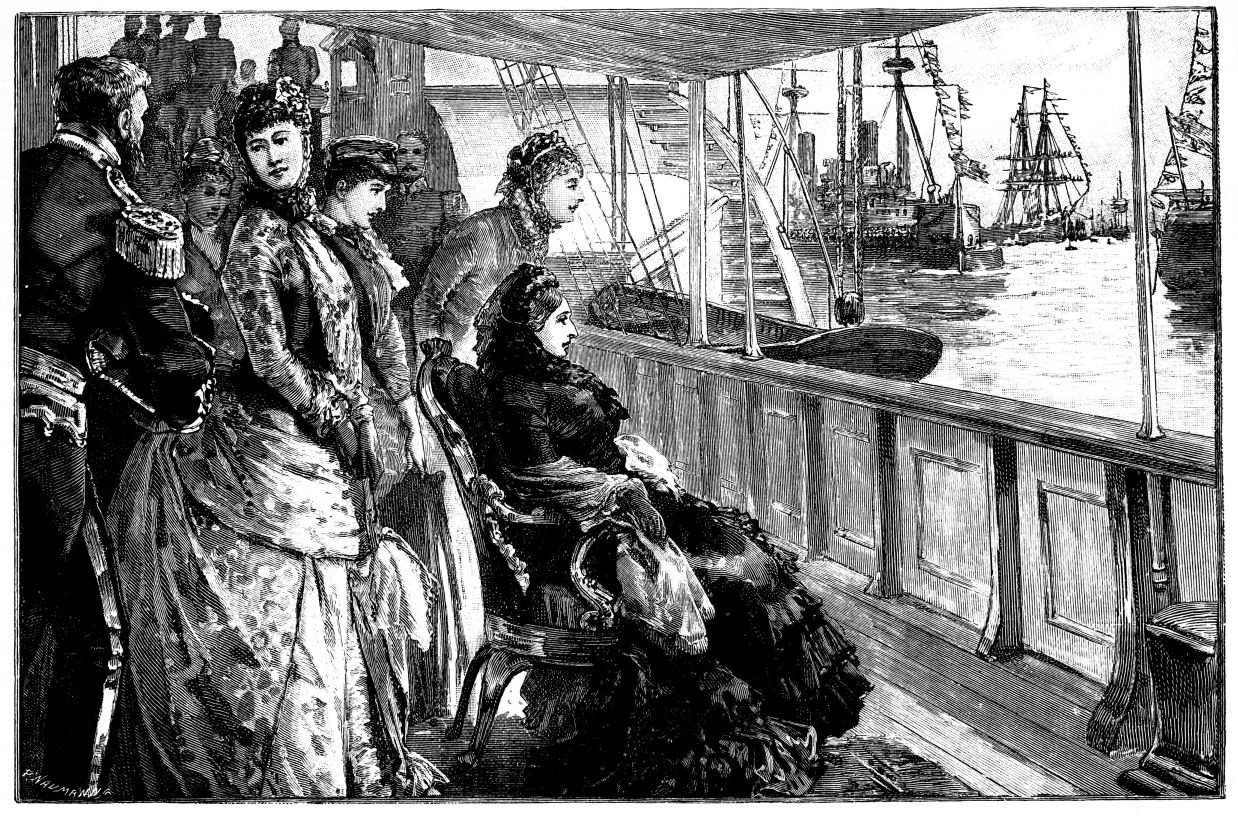
THE QUEEN REVIEWING THE FLEET AT SPITHEAD.
was the Review of the Fleet at Spithead on the 13th of August. The spectacle was marred by the storm of wind and rain, which too often spoils naval reviews, but it was one which had a special interest. It was designed to show the country what kind of naval defence could be organised on short notice, amidst rumours of war, when the Channel Fleet was absent in foreign waters. It represented a naval force which, but for its ordnance which was utterly obsolete and inefficient, would have been equal in strength to the navy of any of the Continental Powers, and the Queen saw for the first time the manœuvring of two malevolent-looking little torpedo boats, which astonished her by dashing about in all directions at the rate of twenty-one knots an hour. At noon the ships were dressed. At half-past three the Royal Yacht with the Queen on deck passed down the lines. Salutes were fired, and yards manned, and her Majesty, accompanied by the Prince and Princess of Wales, Princess Beatrice, and the Lords of the Admiralty, was enthusiastically cheered. When the Queen’s vessel emerged from the lines it was followed by a gay flotilla of yachts. Those that were sailing craft luffed their wind and, headed by Mr. Brassey’s Sunbeam, went round by starboard, the steamers going round by port, and with the Royal Yacht in the centre the brilliant pleasure fleet came back with the Squadron. All evolutions were countermanded on account of the weather, but at night the Fleet was illuminated.
At Paris, on the 12th of June, there died George V., ex-King of Hanover, Duke of Cumberland, grandson of George III. of England and first cousin of the Queen. Court mourning was ordered for him, though it was not very generally displayed. The old jealousy with which the people regarded English Princes, who had interests separate from England, accounted for their indifference to his death. Nor was there any strong family sentiment at Court to counteract this feeling. On the contrary, the sentiment of the Queen’s family was as anti-Hanoverian as that of the nation. She had not forgiven the treasonable intrigues which his father, her uncle, King Ernest Augustus of Hanover—the most universally hated of all the sons of George III.—carried on with the Orange Tories to set up Salic law in England, and usurp her throne. She had unpleasant memories of his arrogance in persistently conferring the Guelphic Order on Englishmen, not only without asking her permission, but in defiance of her prohibition, as if in suggestive assertion of an unsurrendered hereditary right of English sovereignty. More recently the Queen had been still further offended by the pretensions of his son, her cousin George V., to sanction or veto the marriages of English princes and princesses, as male head of the House of Brunswick-Sonneberg. His attempt to treat the marriage of the Duchess of Teck (the Princess Mary of Cambridge) as a mere morganatic connection, and his refusal to let the Duke of Teck sit beside the Duchess at dinner, had also strained the relations between the Queen and her cousin. Still, in 1866, she had, in response to his appeal, used her influence on his behalf with the German Emperor. She had even pressed Lord Derby and Lord Stanley to save Hanover from Prussian annexation, and though they refused, she had induced them to mediate on his behalf in order to secure for him a comfortable personal position as a dethroned monarch. His misfortunes roused her sympathies, and when he died, so far as the Queen was concerned, all feuds with the Hanoverian branch of the Royal Family were buried in his grave.
But the end of the year brought a more bitter sorrow to the Queen than the death of George V. The Princess Alice, Grand Duchess of Hesse, died in extremely touching circumstances. She had spent the summer months with her children at Eastbourne, where she had endeared herself to the people by her sweetness of disposition, and by the personal interest she manifested in the poor of the town. She was usually to be seen visiting the cottages of the sick in the fishing quarter. She had taken a keen interest in studying the management of certain charitable institutions, evidently with a view to making use of her knowledge when she returned to Darmstadt, and a charming visit to Osborne completed a holiday that was for her full of happiness. Her life was uneventful at Darmstadt till the 8th of November, when her daughter, the Princess Victoria, was smitten with diphtheria. The Grand Duchess was herself a skilled and scientifically-trained nurse, and she tended her child personally. She was the first to detect the appearance of the diphtheritic membrane in the little Princess’s throat, and she promptly attacked it with inhalations of chlorate of potash. In spite of careful isolation, the whole family, including the Grand Duke, with the exception of the Princess Elizabeth, caught the disease, and it need hardly be said that the strength of the Grand Duchess soon began to give way under the strain of mental anxiety and bodily fatigue. The Princess May died, but on the 25th of November the Grand Duke recovered. On the 7th of December the Grand Duchess went to the railway station to see the Duchess of Edinburgh, and next day she too was prostrate with diphtheria. Lord Beaconsfield, in his speech of condolence in the House of Lords on the 16th of December, described her, with ornate rhetoric, as receiving “the kiss of death” from one of her children, and he recommended the tragic incident as fit to be commemorated by the painter, the sculptor, or the artist in gems. There was no foundation for this histrionic flight. Nobody knew how the Princess caught the contagion, but her biographer states “it is supposed that she must have taken the infection when one day, in her grief and despair, she had laid her head on her sick husband’s pillow.”[137] Her sufferings were severe and protracted, and on the 13th of December it was seen that she must die. Still she lingered on. In the afternoon she welcomed her husband with great joy. She saw her lady-in-waiting, and even read two letters, the last one being from the Queen, her mother. Then she fell asleep and never woke again. At half-past eight on the morning of the 14th, the anniversary of her father’s death, she passed away, quietly murmuring to herself these words: “From Friday to Saturday, four weeks—May—dear papa!” All through her life she had worshipped her father’s memory with passionate devotion, and in death his name was the last on her lips.
The grief of the Queen was only equalled by that of the Prince of Wales, who seems to have regarded the Grand Duchess as his favourite sister. As for the English people, they mourned for her with simple-minded sincerity. The character of the Princess Alice—so full of sense and enterprise, and high-spirited self-helpfulness—had been to them peculiarly attractive. She had won their gratitude by her devotion to her mother in the first hours of her widowhood, and to the Heir Apparent, when in 1871 his life hung in the balance. That her daily existence was clouded with sordid cares due to straitened means was not known to her countrymen till after her death. But they were well aware that much domestic sorrow had entered into her life. Her efforts to raise the condition of her sex in Germany procured for her many enemies in a country where it is deemed desirable to reduce the house-mothers to the position of upper servants in their families, who, however, do their work without claiming wages. Sticklers for Court etiquette were shocked by the unconventional activity manifested by the Princess in furthering the organisation of charitable and educational movements. Even the poor in most instances viewed her visits to their homes—visits which she ultimately found prudent to make incognito—with suspicious hostility. She had the character in fact of being bent on revolutionising the domestic and social life of Darmstadt by English ideas. She loved learning, and delighted in the society of men of letters and artists, who were always her most favoured guests. Hence it was bruited about that she was an infidel, and a foe to religion. Undoubtedly at one time, when she cultivated close relations with Friedrich Strauss, under whom she studied the works of Voltaire, her theological views ceased to be orthodox. But her musings on the mystery of life, the problem of duty, the conflict between Will and Law in the world, reveal a profoundly reverent and eagerly upstriving spirit, ever struggling towards the light. Some day the story of the spiritual conflict that went on in the still depths of this pure and gentle soul may be told. Here it is enough to say that personal influences played a great part in bringing it to a happy issue. Some time after her philosophical conclusions had crumbled away like dust, one of her most intimate relatives writes, “She told me herself, in the most simple and touching manner, how this change had come about. I could not listen to her story without tears. The Princess told me she owed it all to her child’s death, and to the influence of a Scotch gentleman, a friend of the Grand Duke’s and Grand Duchess’s,” who was residing with his family at Darmstadt.[138] “I owe all
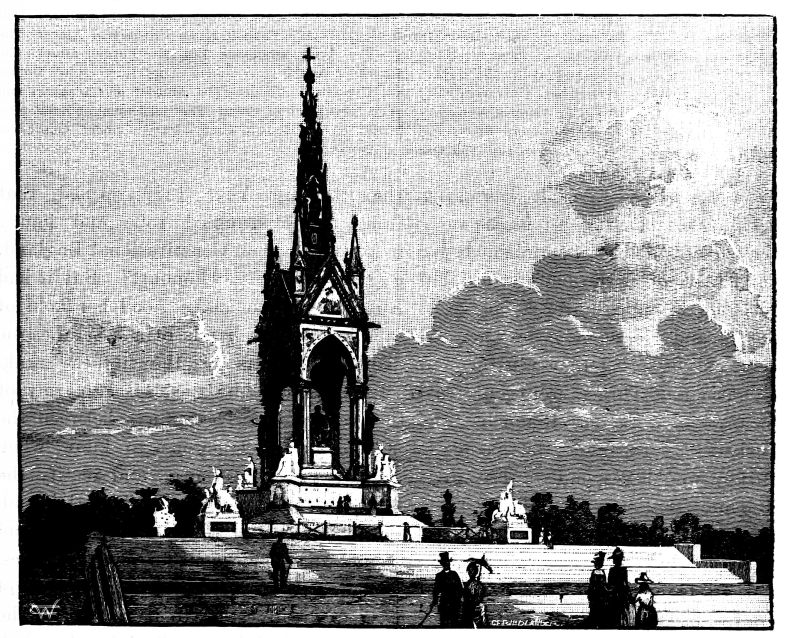
THE ALBERT MEMORIAL, KENSINGTON.
to this kind friend,” she said, “who exercised such a beneficial influence on my religious views; yet people say so much that is cruel and unjust of him, and of my acquaintance with him.”[139] In Germany, her biographer[140] admits “her life and work were not easy,” and she had not the intrepid intellect, the ardent temperament, the caustic wit and the soaring ambition, which enabled her sister, the Crown Princess, to conquer for herself a position of dominant influence in the midst of an unsympathetic Court, and an antipathetic Society. Perhaps this explains why through life she had every year been drawn more closely to the land of her birth, where her worth was more justly appreciated than in the land of her exile. “How deep was her feeling in this respect,” writes the Princess Christian in her touching preface to her sister’s memoirs, “was testified by a request which she made to her husband, in anticipation of her death, that an English flag might be laid on her coffin; accompanying the wish with a modest expression of a hope that no one in the land of her adoption would take umbrage at her desire to be borne to her rest with the old English colours above her.”