VIII. THE FALL OF THE RELIGION OF AKHNATON.
Reading edition
VIII. THE FALL OF THE RELIGION OF AKHNATON.
“Thus disappeared the most remarkable figure in early Oriental history.... There died with him such a spirit as the world had never seen before.”—Breasted: ‘History of Egypt.’
1. THE BURIAL OF AKHNATON.
The body of Akhnaton was embalmed in the city which he had founded; and while these mortal parts of the great idealist were undergoing the lengthy process of mummification, the new Pharaoh Smenkhkara made a feeble attempt to retain the spirit of his predecessor in the new régime. Practically nothing is known of his brief reign, but it is apparent from subsequent events that he entirely failed to carry on the work of Akhnaton, and the period of his sovereignty is marked by a general tendency to abandon the religion of the Aton. Smenkhkara had dated the first year of his reign from the day of his accession as co-ruler with Akhnaton, and thus it is that there are no inscriptions found which record his first year, although there are many references to his second year. The main event must have occurred some three months after the commencement of his sole reign, when the body of Akhnaton was carried in solemn state through the streets of the city and across the desert to the tomb which had been made for him in the distant cliffs.
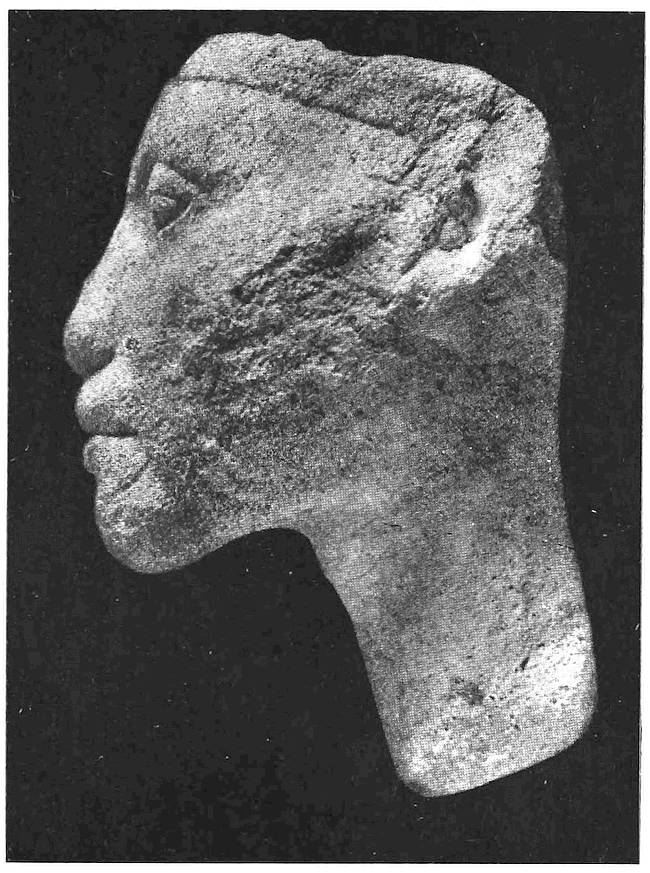
Death Mask of Akhnaton.
The mummy had been wrapped, as was usual, in endless strips of linen; and amongst these there was placed upon the royal breast a necklace of gold, and over the face an ornament cut in flat gold foil representing a vulture with wings outstretched—a Pharaonic symbol of divine protection. In many burials of this dynasty a vulture such as this was placed upon the mummy; and representations of an exactly similar ornament are shown in the tombs of Sennefer and others at Thebes. It is somewhat surprising that the body of Akhnaton, who was so averse to all old customs, should thus have this royal talisman upon it; and it would seem that some of the strict rules of the Aton worshipper had already been relaxed by his successor. Akhnaton had retained but three of the ancient divine symbols, so far as one can tell from the reliefs and paintings—namely, the uræus or cobra, the sphinx, and the hawk, which were often used as ornaments. But one may ask whether the vulture had really been dispensed with by him. It is true that he banned the vulture-hieroglyph in the inscriptions, as we have already seen on the outer coffin of Queen Tiy;[80] but his reason for so doing was that by such a hieroglyph the name of the goddess Mut was called to mind, and that goddess, being the consort of Amon, was not to be tolerated. The vulture which was laid upon the mummy, however, had nothing to do with Mut, nor had it any likeness to the hieroglyph. It was originally a representation of the presiding genius of Upper Egypt, and corresponded to the uræus, which primarily represented the power of Lower Egypt. It is true, again, that it was the custom for the Pharaohs to be shown in the sculptures and paintings with this vulture hovering in protection over their heads, and that Akhnaton seems to have dispensed with such a symbol. But this was perhaps due to the fact that the disk and rays, symbolic of Aton, had taken its place above the royal figure. There is no reason, after all, to suppose that this form of vulture was absolutely banned, since the uræus and the hawk were retained;[81] and though, as will presently be seen, it will be natural to think that it was placed on Akhnaton’s mummy at his successor’s suggestion, there is nothing to show that Akhnaton himself did not desire it to be laid there.
Over the linen bandages on the body there were placed ribbons of gold foil encircling the mummy—probably around the shoulders, the middle, and the knees,—joined to other ribbons running the length of the body at the back and front. These ribbons were inscribed with Akhnaton’s name and titles, and thus recorded for all time the identity of the mummy to which they adhered. Money being somehow found, the body was wrapped in sheets of pure gold, sufficiently thin to be flexible, and was placed in a splendid coffin, designed in the usual form of a recumbent figure, and inlaid in a dazzling manner with rare stones and coloured glass. Down the front of this coffin ran a simple inscription, the hieroglyphs of which were also inlaid. It read: “The beautiful prince, The Chosen One of Ra, the King of Upper and Lower Egypt, living in Truth, Lord of the Two Lands, Akhnaton, the beautiful child of the living Aton, whose name shall live for ever and ever.”[82] There is one curious feature about this inscription. When Akhnaton made the outer coffin for his mother, in or about the twelfth year of his reign, he was particularly careful not to use the hieroglyph representing the goddess Maat when writing the word maat, “truth.” But this sign is employed now upon his own coffin; and one can only presume, therefore, that the coffin was made after Akhnaton’s death, and that the new Pharaoh Smenkhkara had not the same objection to the representation of the goddess as had his predecessor. We may now better understand the presence of the vulture symbol also; for it is obvious that before Akhnaton’s funeral had taken place his strict régime had been relaxed.
The royal mummy was now carried to its tomb and there deposited, together with such funeral furniture and offerings as were considered necessary. The four alabaster canopic jars, always conspicuous in an Egyptian burial, were here not wanting. The stopper of each jar was exquisitely carved to represent the head of Akhnaton, wearing the usual male wig of the period, and having the royal cobra upon the forehead. From these heads one sees that the art of Akhnaton was modified immediately after his death, and its more pronounced characteristics were already being toned down. This slackening in the rules which Akhnaton had made shows us how entirely dependent the movement had been upon its leader; and we realise the more clearly how strong a character was his. Ere even the king’s burial had taken place the death of his religion was assured.
2. THE COURT RETURNS TO THEBES.
Smenkhkara died, or was deposed, about a year after Akhnaton’s death. He was succeeded by another noble, Tutankhaton,[83] who, in order to legitimise his accession, obtained in marriage Akhnaton’s second daughter Ankhsenpaaton, a girl barely twelve years old. Thus Smenkhkara’s wife, Merytaton, became a dowager-queen at the age of thirteen or so, and her little sister took her place upon the throne.
By this time the priests of Amon had begun to hold up their heads once more, and to scheme for the downfall of Aton with renewed energy. Pressure was soon brought to bear on Tutankhaton, and he had not been upon the throne more than a year or so when he was persuaded to consider the abandonment of the City of the Horizon and his return to Thebes. He did not yet turn entirely from the religion of the Aton, but attempted to take a middle course between the two factions, giving full licence both to the worshippers of the Aton and to those of Amon. Horemheb, the commander-in-chief of the idle army, seems to have been one of the leaders of the reactionary movement. He did not concern himself so much with the religious aspect of the question: there was as much to be said on the one side as on the other. But it was he who knocked at the doors of the heart of Egypt and urged the nation to awake to the danger in Asia. For him there were no scruples as to warfare, and the doctrine of the sword found favour in his sight. An expedition was fitted out, and the reigning Pharaoh was persuaded to lead it. Thus we read that Horemheb was “the companion of his Lord upon the battlefield on that day of the slaying of the Asiatics.”[84] Akhnaton had dreamed of the universal peace which still is a far-off wraith to mankind; but Horemheb was a practical man in whom that dream would have been but weakness which was such mighty strength in the dead king.
The new Pharaoh now changed his name from Tutankhaton to Tutankhamon, and, to the sound of martial music, returned to Thebes. The City of the Horizon was left to its fate, and it was not long before the palaces and the villas became the home of the jackals and the owls, while the temples were partly pulled down to provide stone for other works. However much the reigning Pharaoh differed in views from Akhnaton, it would not have been possible to leave the royal body lying in sight of this wreck of all the hopes that had been his. Akhnaton, moreover, was Tutankhamon’s father-in-law, and it was only through the rights of Akhnaton’s daughter that the Pharaoh held the throne. His memory was still regarded with reverence by many of his late followers, and there could be no question of leaving his body in the deserted city. It was therefore carried to Thebes in its coffin, together with the four canopic jars, and was placed, for want of a proper sepulchre, in the tomb of Queen Tiy, which had been reopened for the purpose.
Tutankhamon showed the trend of his policy by both restoring the temple of the Aton at Karnak and at the same time repairing the damage done by Akhnaton to the works of Amon. The style of art which he favoured was a modified form of Akhnaton’s method, and the influence of his movement is still apparent in the new king’s work. He did not reign long enough, however, to display much originality, and after a few years he disappears, almost unnoticed, from the stage. On his death the question of inviting Horemheb to fill the vacant throne must have been seriously considered, but there was another candidate in the field. This was Akhnaton’s father-in-law, Ay, who had been one of the most important nobles in the group of courtiers at the City of the Horizon. It was he who had sheltered Queen Nefertiti before she had passed into Akhnaton’s palace, and it was in his tomb that the great hymn to the Aton was inscribed. He had been loudest in the praises of the preacher king and of his doctrines, and he still retained the title “Father-in-law” as his most cherished designation.
Religious feeling at this time was running high, for the partisans of Amon and those of Aton seem still to have been struggling for the supremacy, and Ay appeared to have been regarded as the most likely man to bridge the gulf between the two factions. A favourite of Akhnaton, and still tolerant of all that was connected with the late movement, he was not averse to the cult of Amon, and by conciliating both parties he managed to obtain the throne for himself. His power, however, did not last for long, and as the priests of Amon regained the confidence of the nation at the expense of the worshippers of the Aton, so the prestige of Ay declined. His past relationship to Akhnaton, which even as king be carefully recorded within his cartouche, now told against him rather than for him, and about eight years after the death of Akhnaton he disappeared like his predecessors.
3. THE REIGN OF HOREMHEB.
There was now no question who should succeed. All eyes were turned to Horemheb, who had already almost as much power as the Pharaoh. The commander-in-chief at once ascended the throne, and was received by the populace with the utmost rejoicings. At this time there was living at Thebes the Princess Nezemmut, the sister of Akhnaton’s Queen Nefertiti, and hence the daughter of Dushratta, King of Mitanni. Owing to previous inter-marriages between the royal house of Egypt and that of Mitanni, both Nefertiti and Nezemmut were descendants of Pharaohs of the Eighteenth Dynasty. Nezemmut had come to Egypt early in the reign of Akhnaton, and later had perhaps married some Egyptian nobleman; but she was now a widow, and had recently been appointed to the post of “Divine Consort,”—that is to say, High Priestess—of Amon. As she was probably the younger sister of Nefertiti, she may have been about six years of age when Nefertiti was married to Akhnaton at the age of eight. Hence she would have been about twenty-three at his death, and would now be just over thirty.
To this princess, as representing both the rights of the old line of Pharaohs and those of the god Amon, without the now condemning close relationship to Akhnaton which characterised the other existing royal princesses, Horemheb was at once married. The religion of the Aton was now fast disappearing. In a tomb dating from the third year of Horemheb’s reign, the words “Ra whose body is Aton” occur; but this is the last mention of the Aton, and henceforth Amon-Ra is unquestionably supreme. A certain Pa-atonemheb, who had been one of Akhnaton’s favourites, was at about this time appointed High Priest of Ra-Horakhti at Heliopolis, and thus the last traces of the religion of the Aton were merged into the Heliopolitan theology, from which that religion at the beginning had emanated.
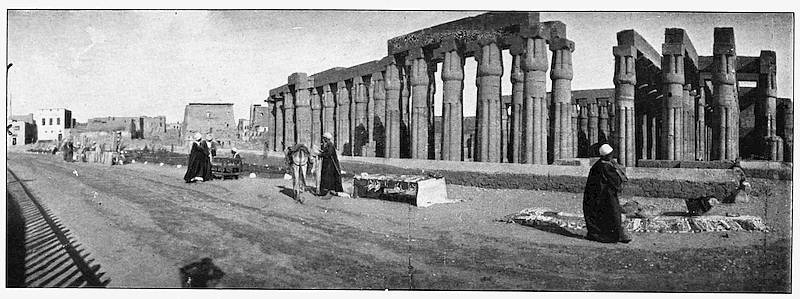
The Temple at Luxor.
The neglected shrines of the old gods once more echoed with the chants of the priests throughout the whole land of Egypt. Inscriptions tell us that Horemheb “restored the temples from the pools of the Delta marshes to Nubia. He fashioned a hundred images ... with all splendid and costly stones. He established for them daily offerings every day. All the vessels of their temples were wrought of silver and gold. He equipped them with priests and with ritual priests, and with the choicest of the army. He transferred to them lands and cattle, supplied with all necessary equipment.” By these gifts to the neglected gods Horemheb was striving to bring Egypt back to its natural condition; and with a strong hand he was guiding the country from chaos to order, from fantastic Utopia to the solid old Egypt of the past. He was, in fact, the preacher of sanity, the very apostle of the Normal.
He led his armies into the Sudan, and returned with a procession of captive chieftains roped before him. He had none of Akhnaton’s qualms regarding human suffering, and these unfortunate prisoners are seen to have their arms bound in the most cruel manner. Finding the country to be lawless he drafted a number of stern laws, and with sound justice administered his kingdom. Knowing that Syria could not long remain quiet, he organised the Egyptian troops, and so prepared them that, but a few years after his death, the soldiers of the reigning Pharaoh were swarming once more over the lands which Akhnaton had lost.
4. THE PERSECUTION OF AKHNATON’S MEMORY.
The priests of Amon-Ra had now begun openly to denounce Akhnaton as a villain and a heretic, and as they restored the name of their god where it had been erased, so they hammered out the name and figure of Akhnaton wherever they saw it. Presently they pulled down the Aton temple at Karnak, and used the blocks of stone in the building of a pylon for Amon-Ra. Soon it was felt that Akhnaton’s body could no longer lie in state, together with that of Queen Tiy, in the Valley of the Tombs of the Kings. The sepulchre was therefore opened once more and the name “Akhnaton” was everywhere erased from the inscriptions, as was his figure from the scenes upon the shrine of Queen Tiy. The mummy was lifted from its coffin and the royal name was cut out of the gold ribbons which passed round it, both at the back and the front. It was then replaced in the coffin, and from this the name was also erased.
The question may be asked why it was that the body was not torn to pieces and scattered to the four winds, since the king was now so fiercely hated. The Egyptians, however, entertained a peculiar reverence for the bodies of their dead, and it would have been a sacrilege to destroy the mummy even of this heretic. No thought could be entertained of breaking up the body upon which the divine touch of kingship had fallen: that would have been against all the sentiments which we know the Egyptians to have held. The cutting out of the name of the mummy was sufficient punishment: for thereby the soul of the king was debarred from all the benefits of the earthly prayers of his descendants, and became a nameless outcast, wandering unrecognised and unpitied through the vast underworld. It was the name “Akhnaton” which was hated so fiercely; and one may perhaps suppose that the priests would have been willing to substitute the king’s earlier name, Amonhotep, upon the mummy had they been pressed to do so. His name and figure as Amonhotep IV. is not damaged upon the monuments; but only the representations of him after the adoption of the name Akhnaton have been attacked.
The tomb, polluted by the presence of the heretic, was no longer fit for Tiy to rest in; and the body of the queen was therefore carried elsewhere, perhaps to the sepulchre of her husband Amonhotep III. The shrine, or outer coffin, in which her mummy had lain was pulled to pieces, and an attempt was made to carry it out of the tomb to its owner’s new resting-place, but this arduous task was presently abandoned, and one portion of the shrine was left in the passage, while the rest remained in sections in the burial-chamber. Some of the queen’s toilet utensils which had been buried with her were also left, probably by mistake. The body of Akhnaton, his name taken from him, was now the sole occupant of the tomb. The coffin in which it lay rested upon a four-legged bier some two feet or so from the ground, and in a niche in the wall above it stood the four canopic jars. And thus, with a curse, the priests left their great enemy. The entrance of the tomb was blocked with stones, and sealed with the seal of the necropolis; and all traces of its mouth were hidden by rocks and débris.
The priests would not now permit the name of Akhnaton to pass a man’s lips, and by the end of the reign of Horemheb, the unfortunate boy was spoken of in official documents as “that criminal.” Not forty years had passed since Akhnaton’s death, yet the priesthood of Amon was as powerful as it had ever been at any period of its existence. There were still living men who had been old enough at the time of the Aton power to grasp its doctrines; and those same eyes which had looked upon the fair City of the Horizon might now disturb the creatures of the desert in the ruined courts where the grave boy-Pharaoh had presided so lately. These men joined their voices to that crowd of priests who, not daring to allow the word Akhnaton to form itself upon their lips, poured curses upon the excommunicated and nameless “criminal.” Through starry space their execrations passed, searching out the wretched ghost of the boy, and banning him, as they supposed, even in the dim uncertainties of the Lands of Death. Over the hills of the west, up the stairs of the moon, and down into the caverns under the world, the poor twittering shadow was hunted and chased by the relentless magic of the men whom he had tried to reform. There was no place for his memory upon earth, and in the under-world the priests denied him a stone upon which to lay his head. It is not easy now to realise the full meaning to the Egyptians of the excommunication of a soul: cut off from the comforts of human prayers; hungry, forlorn, and wholly desolate; forced at last to whine upon the outskirts of villages, to snivel upon the dung-heaps, to rake with shadowy fingers amidst the refuse of mean streets for fragments of decayed food with which to allay the pangs of hunger caused by the absence of funeral-offerings. To such a pitiful fate the priests of Amon consigned “the first individual in history”; and as an outcast amongst outcasts, a whimpering shadow in a place of shadows, the men of Thebes bade us leave the great idealist, doomed to the horrors of a life which will not end, to the misery of a death that brings no oblivion.
5. THE FINDING OF THE BODY OF AKHNATON.
Thus, sheathed in gold, the nameless body lay, while the fortunes of Egypt rose and fell and the centuries slid by. A greater teacher than Akhnaton arose and preached that peace which the Pharaoh had foreshadowed, and soon all Egypt rang with the new gospel. Then came the religion of Muhammed, and the days of the sword returned. So the years passed, and many a wise man lived his life and disappeared; but the first of the wise men of history lay undiscovered in the heart of the Theban hills.
Now it happened that there was a fissure in the rocks in which the sepulchre was cut, and during the rains of each season a certain amount of moisture managed to penetrate into the chamber. This gradually rotted the legs of the bier upon which Akhnaton’s body lay, and at last there came a time when the two legs at the head of the coffin gave way and precipitated the royal body on to the ground. The bandages around the mummy had already fallen almost to powder, and this jerk sent the golden vulture which was resting upon the king’s face on to his forehead, where it lay with the tail and claws resting over the left eye-socket of the skull. Presently the two remaining legs of the bier collapsed, and the whole coffin fell to the ground, the lid being partly jerked off, thus revealing the king’s head at one end and his feet at the other, from all of which the flesh had rotted away.
In January 1907 the excavations in the Valley of the Tombs of the Kings which were being conducted by Mr Theodore Davis, of Newport, Rhode Island, U.S.A., on behalf of the Egyptian Government, brought to light the doorway of the tomb, and it was not long before an entrance was effected. A rough stairway led down into the hillside, bringing the excavators[85] to the mouth of the passage, which was entirely blocked by the wall which the priests had built after they had entered the tomb to erase Akhnaton’s name. Beyond this wall the passage was found to be nearly choked with the débris of the three earlier walls, the first of which had been built after Queen Tiy had been buried here, the second after Akhnaton’s agents had entered the tomb to erase the name of Amon, and the third after Akhnaton’s body had been laid beside that of his mother. On top of this heap of stones lay the side of the funeral shrine of the queen which the priests had abandoned after attempting to carry it out with her mummy. In the burial-chamber beyond, the remaining portions of this shrine were found. Upon these one saw the figures of Akhnaton and his mother worshipping beneath the rays of the Aton. The inscriptions showed the erasure of the name of Amonhotep III., and the substitution in red ink of that king’s second name, Nebmaara; and one observed that at a later date the name and figures of Akhnaton had been hammered out.
At one side lay the coffin of Akhnaton, as it had fallen from the bier. The name of Akhnaton upon the coffin had been erased, but was still readable; and the gold ribbons from which his name had been cut out still encircled the body, back and front. The golden vulture lay as has been described above, and the necklace still rested on the breast, while the whole decaying body was found to be wrapped in sheets of gold. In a recess above this coffin stood the canopic jars, and in another part of the tomb Queen Tiy’s toilet utensils were found, from one of which the name of Amonhotep III. had been erased.
The bones, when examined by Dr Elliot Smith, F.R.S., were found to be those of a young man of not more than about twenty-eight years of age,—that is to say, the age at which Akhnaton has been shown in the above pages to have died. The skull was pronounced to be that of a man who suffered from epileptic fits, and who was probably subject to hallucinations. Curiously enough, the idiosyncrasies of this misshapen skull are precisely those which Lombroso has stated to be so usual in a religious reformer. The face had crumbled away, but the lower jaw was intact; and when this was placed in position one could see at once the great resemblance to the well-known portraits of Akhnaton which had survived the wreck of his city.
There could thus be no doubt that the mummy of this wonderful Pharaoh had at last been found; but since Akhnaton had always been thought, though without particular reason, to have been a much older man, the identity was questioned. It was suggested that the body was perhaps that of Smenkhkara, the successor of Akhnaton, which by some error had managed to be placed in Akhnaton’s coffin. But how, then, did the gold ribbons inscribed with Akhnaton’s name manage to be placed around the body? And apart from the extreme improbability that the mummy which was thus labelled with Akhnaton’s name, and which lay in his coffin, should be that of any other king but Akhnaton, one may ask in this case how it is that the body has the well-known physical characteristics of the great heretic if it be that of Smenkhkara, who was not related to the king?
It has been stated that the presence of the vulture upon the body is against the identification with Akhnaton. This has already been shown to be capable of explanation; but it may here be noted that if Smenkhkara would not have placed the vulture upon Akhnaton’s body, then by the same token the mummy is not likely to be that of Smenkhkara, and there is certainly no other prince of this period with whom to identify the body. In conclusion, it may be added that of all the royal mummies now known there is not one which can be so clearly shown to belong to the Pharaoh with whom it has been identified as this mummy can be shown to belong to Akhnaton. The body was lying in a coffin inscribed with Akhnaton’s name; it was bound round with ribbons inscribed with his name; it had the physical characteristics of the portraits of Akhnaton; it had the idiosyncrasies of a religious reformer such as he was; it was that of a man of Akhnaton’s age as deduced from the monuments; it lay in the tomb of Akhnaton’s mother; those who had erased the names must have thought it to be Akhnaton’s body, unless one supposes an utter chaos of cross-purposes in their actions; and finally, there is nobody else who, with any degree of probability, it could be.
Thus one may say that, without the vaguest shadow of a doubt, the body of this the most remarkable figure of early Oriental history has been brought to light; and with this assurance we may close this sketch of his life, which has been written partly for the purpose of thus explaining the significance of Mr Davis’s great discovery, and partly to introduce the general reader to one of the most interesting characters ever known. In this brief outline it has only been possible to touch upon the main characteristics which the few remaining inscriptions and monuments seem to reveal; but to the most casual reader it will be apparent that there stands before him a personality of surprising vigour and amazing originality, and one deserving of careful study. In an age of superstition, and in a land where the grossest polytheism reigned absolutely supreme, Akhnaton evolved a monotheistic religion second only to Christianity itself in purity of tone. He was the first human being to understand rightly the meaning of divinity. When the world reverberated with the noise of war, he preached the first known doctrine of peace; when the glory of martial pomp swelled the hearts of his subjects, he deliberately turned his back upon heroics. He was the first man to preach simplicity, honesty, frankness, and sincerity; and he preached it from a throne. He was the first Pharaoh to be a humanitarian; the first man in whose heart there was no trace of barbarism. He has given us an example three thousand years ago which might be followed at the present day: an example of what a husband and a father should be, of what an honest man should do, of what a poet should feel, of what a preacher should teach, of what an artist should strive for, of what a scientist should believe, of what a philosopher should think. Like other great teachers he sacrificed all to his principles, and thus his life plainly shows—alas!—the impracticability of his doctrines; yet there can be no question that his ideals will hold good “till the swan turns black and the crow turns white, till the hills rise up to travel, and the deeps rush into the rivers.”
MAP OF AKHETATON, THE CITY OF THE HORIZON OF ATON. (Tel el Amarna)
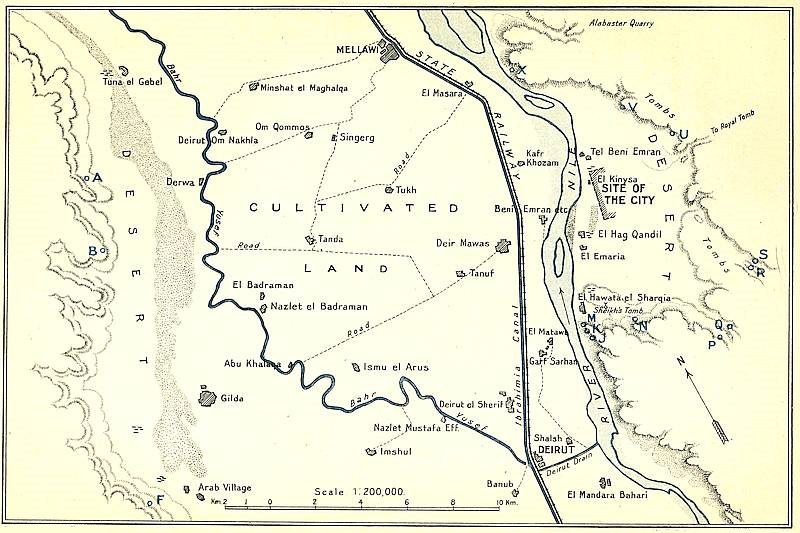
click here for larger image.
SURVEY DEP. CAIRO 1909 (151) FROM THE CAIRO SCIENTIFIC JOURNAL. NOTE: Of the Boundary Stelae only those lettered A, B, F, J, K, M, N, P, Q, R, S, U, V and X, still remain. The position of these is shown upon the Map.