ADDENDA.
Reading edition
I.
Headquarters Dept. of the Cumberland, Murfreesboro, June 12, 1864.
General: In your confidential letter of the 8th inst., to the corps and division commanders and generals of cavalry, of this army, there were substantially five questions propounded for their consideration and answer, viz:—
1. Has the enemy of our front been materially weakened by detachments to Johnston, or elsewhere?
2. Can this army advance on him at this time, with strong reasonable chances of fighting a great and successful battle?
3. Do you think an advance of our army at present likely to prevent additional reinforcements being sent against General Grant by the enemy in our front?
4. Do you think an immediate advance of the army advisable?
5. Do you think an early advance advisable?
Many of the answers to these questions are not categorical, and cannot be clearly set down either as affirmative or negative. Especially in answer to the first question, there is much indefiniteness resulting from the difference of judgment as to how great a detachment could be considered a material reduction of Bragg's strength. For example, one officer thinks it has been reduced ten thousand and not "materially weakened." The answers to the second question are modified in some instances by the opinion that the rebels will fall back behind the Tennessee River, and thus no battle can be fought, either successful or unsuccessful.
So far as these opinions can be stated in tabular form, they will stand thus,—
Yes.No.
Answertofirstquestion,611
""second"211
""third"410
""fourth"-15
""fifth"-2
On the fifth question, three gave it as their opinion that this army ought to advance as soon as Vicksburg falls, should that event happen. The following is a summary of the reasons assigned why we should not at this time advance upon the enemy:—
1. With Hooker's army defeated, and Grant's bending all its energies in a yet undecided struggle, it is bad policy to risk our only reserve army to the chances of a general engagement. A failure here would have most disastrous effect on our lines of communication and on politics in the loyal States.
2. We should be compelled to fight the enemy on his own grounds or follow him in a fruitless chase; or, if we attempted to outflank him and turn his position, we should expose our line of communication, and run the risk of being pushed back into a rough country well known to the enemy and little to ourselves.
3. In case the enemy should fall back without accepting battle he could make our advance very slow, and with a comparatively small force posted in the gaps of the mountains could hold us back while he crossed the Tennessee River, where he would be measurably secure and free to send reinforcements to Johnston. His force in East Tennessee could seriously harass our left flank and constantly disturb our communication.
4. The withdrawal of Burnside's ninth army corps deprives us of an important reserve and flank protection, thus increasing the difficulty of an advance.
5. General Hurlburt has sent the most of his force away to General Grant, thus leaving West Tennessee uncovered, and laying our right flank and rear open to raids of the enemy.
The following incidental opinions are expressed,—
1. One officer thinks it probable that the enemy has been strengthened rather than weakened, and that he (the enemy) would have reasonable prospect of victory in a general battle.
2. One officer believes the result of a general battle would be doubtful, a victory barren, and a defeat most disastrous.
3. Three officers believe that an advance would bring on a general engagement. Three others believe it would not.
4. Two officers express the opinion that the chances of success in a general battle are nearly equal.
5. One officer expresses the belief that our army has reached its maximum strength and efficiency, and that inactivity will seriously impair its effectiveness.
6. Two officers say that an increase of our cavalry by about six thousand men would materially change the aspect of our affairs, and give us a decided advantage.
In addition to the above summary, I have the honor to submit an estimate of the strength of Bragg's army, gathered from all the data I have been able to obtain, including the estimate of the general commanding, in his official report of the battle of Stone River, and facts gathered from prisoners, deserters, and refugees, and from rebel newspapers. After the battle Bragg consolidated many of his decimated regiments and irregular organizations; and at the time of his sending reinforcements to Johnston, his army had reached the greatest effective strength. It consisted of five divisions of infantry, composed of ninety-four regiments, and two independent battalions of sharp-shooters,—say ninety-five regiments. By a law of the confederate Congress, regiments are consolidated when their effective strength falls below two hundred and fifty men. Even the regiments formed by such consolidation (which may reasonably be regarded as the fullest) must fall below five hundred. I am satisfied that four hundred is a large estimate of the average strength.
The force, then, would be,—
Infantry, 95 regiments, 400 each,38,000
Cavalry, 35 regiments, say 500 each,17,500
Artillery, 26 batteries, say 100 each,2,600
———
Total58,600
This force has been reduced by detachments to Johnston. It is as well known as we can ever expect to ascertain such facts, that three brigades have gone from McConn's division, and two or three from Breckinridge's,—say two. It is clear that there are now but four infantry divisions in Bragg's army, the fourth being composed of fragments of McConn's and Breckinridge's divisions, and must be much smaller than the average. Deducting the five brigades, and supposing them composed of only four regiments each, which is below the general average, it gives an infantry reduction of twenty regiments, four hundred each—eight thousand—leaving a remainder of thirty thousand. It is clearly ascertained that at least two brigades of cavalry have been sent from Van Dorn's command to the Mississippi, and it is asserted in the Chattanooga Rebel, of June 11th, that General Morgan's command has been permanently detached and sent to eastern Kentucky. It is not certainly known how large his division is, but it is known to contain at least two brigades. Taking this minimum as the fact, we have a cavalry reduction of four brigades.
Taking the lowest estimate, four regiments to the brigade, we have a reduction, by detachment, of sixteen regiments, five hundred each, leaving his present effective cavalry force nine thousand five hundred. With the nine brigades of the two arms thus detached, it will be safe to say there have gone,—
Six batteries, 80 men each,480
Leaving him 20 batteries,2,120
Making a total reduction of16,480
Leaving, of the three arms,41,680
In this estimate of Bragg's strength, I have placed all doubts in his favor, and I have no question that my estimate is considerably beyond the truth. General Sheridan, who has taken great pains to collect evidence on this point, places it considerably below these figures. But assuming these to be correct, and granting what is still more improbable, that Bragg would abandon all his rear posts, and entirely neglect his communications, and could bring his last man into battle, I next ask: What have we with which to oppose him?
The last official report of effective strength now on file in the office of the assistant adjutant-general, is dated from June 11th, and shows that we have in this department, omitting all officers and enlisted men attached to department, corps, division and brigade headquarters,—
1. Infantry—One hundred and seventy-three regiments; ten battalions sharp-shooters; four battalions pioneers; and one regiment of engineers and mechanics, with a total effective strength of seventy thousand nine hundred and eighteen.
2. Cavalry—Twenty-seven regiments and one unattached company, eleven thousand eight hundred and thirteen.
3. Artillery—Forty-seven and a half batteries field artillery, consisting of two hundred and ninety-two guns and five hundred and sixty-nine men,—making a general total of eighty-seven thousand eight hundred.
Leaving out all commissioned officers, this army represents eighty-two thousand seven hundred and sixty-seven bayonets and sabres. This report does not include the Fifth Iowa cavalry, six hundred strong, lately armed; nor the First Wisconsin cavalry; nor Coburn's brigade of infantry, now arriving; nor the two thousand three hundred and ninety-four convalescents, now on light duty in "Fortress Monroe."
There are detached from this force as follows,—
At Galatin,969
At Carthage,1,149
At Fort Donelson,1,485
At Clarkesville,1,138
At Nashville,7,292
At Franklin,900
At Lavergne,2,117
———
Total15,130
With these posts as they are, and leaving two thousand five hundred efficient men, in addition to the two thousand three hundred and ninety-four convalescents, to hold the works at this place, there will be left sixty-five thousand one hundred and thirty-seven bayonets and sabres to show, against Bragg's forty-one thousand six hundred and eighty.
I beg leave, also, to submit the following considerations,—
1. Bragg's army is weaker now than it has been since the battle of Stone River, or is likely to be, at present; while our army has reached its maximum strength, and we have no right to expect reinforcements for several months, if at all.
2. Whatever be the result at Vicksburg, the determination of its fate will give large reinforcements to Bragg. If Grant is successful, his army will require many weeks to recover from the shock and strain of his late campaign, while Johnston will send back to Bragg a force sufficient to insure the safety of Tennessee. If Grant fails, the same result will inevitably follow, so far as Bragg's army is concerned.
3. No man can predict, with a certainty, the results of any battle, however great the disparity in numbers. Such results are in the hand of God. But, reviewing the question in the light of human calculation, I refuse to entertain a doubt that this army, which in January last defeated Bragg's superior numbers, cannot overwhelm his present greatly inferior forces.
4. The most unfavorable course for us that Bragg could take, would be to fall back without giving us battle; but this would be very disastrous to him. Besides the loss of material of war, and the abandonment of the rich and abundant harvest, now nearly ripe in Central Tennessee, he would lose heavily by desertion. It is well known that a wide-spread dissatisfaction exists among his Kentucky and Tennessee troops. They are already deserting in large numbers. A retreat would greatly increase both the desire and the opportunity for desertion, and would very materially reduce his physical and moral strength. While it would lengthen our communication, it would give us possession of McMinnville, and enable us to threaten Chattanooga and East Tennessee; and it would not be unreasonable to expect an early occupation of the former place.
5. But the chances are more than even that a sudden and rapid movement would compel a general engagement, and the defeat of Bragg would be, in the highest degree, disastrous to the rebellion.
6. The turbulent aspect of politics in the loyal States renders a decisive blow against the enemy, at this time, of the highest importance to the success of the government at the polls, and in the enforcement of the Conscript Act.
7. The government and the War Department believe that this army ought to move upon the enemy. The army desire it, and the country is anxiously hoping for it.
8. Our true objective point is the rebel army, whose last reserves are substantially in the field, and an effective blow will crush the shell, and soon be followed by the collapse of the rebel government.
9. You have, in my judgment, wisely delayed a general movement hitherto, till your army could be massed, and your cavalry could be mounted. Your mobile force can now be concentrated in twenty-four hours, and your cavalry, if not equal in numerical strength to that of the enemy, is greatly superior in efficiency and morale. For this reason I believe an immediate advance of all our available forces is advisable, and, under the providence of God, will be successful.
Very respectfully, your obedient servant,
J. A. Garfield, Brigadier-General, Chief of Staff. Major-General Rosecrans, Commanding Dept. of Cumberland.
II.
The following is the official record of the post-mortem examination of the body of President James A. Garfield, made Sept. 20, 1881, commencing at 4:30 P. M. eighteen hours after death, at Francklyn Cottage, Elberon, N. J.
There were present and assisting, Dr. D. W. Bliss; Surgeon-General J. K. Barnes, U. S. A.; Surgeon J. J. Woodward, U. S. A.; Dr. Robert Reyburn; Dr. Frank H. Hamilton; Dr. D. Hayes Agnew; Dr. Andrew H. Smith, of Elberon and New York, and acting as the assistant surgeon, and D. S. Lamb, of the Army Medical Museum, Washington, D. C.
Before commencing the examination a consultation was held by the physicians in the room adjoining that in which the body lay, and it was unanimously agreed that the dissection should be made by Dr. Lamb, and that Surgeon Woodward should record the observations made. It was further unanimously agreed that the cranium should not be opened. Surgeon Woodward then proposed that the examination should be conducted as follows: That the body should be viewed externally, and any morbid appearances existing recorded; that a catheter should then be passed into the wound, as was done during life to wash it out, for the purpose of assisting to find the position of the bullet; that a long incision should next be made from the superior extremity of the sternum to the pubis, and this crossed by a transverse one just below the umbilicus; that the abdominal flaps thus made should then be turned back and the abdominal viscera examined; that after the abdominal cavity was opened, the position of the bullet should be ascertained, if possible, before making any further incision, and that, finally, the thoracic viscera should be examined. This order of procedure was unanimously agreed to, and the examination was proceeded with.
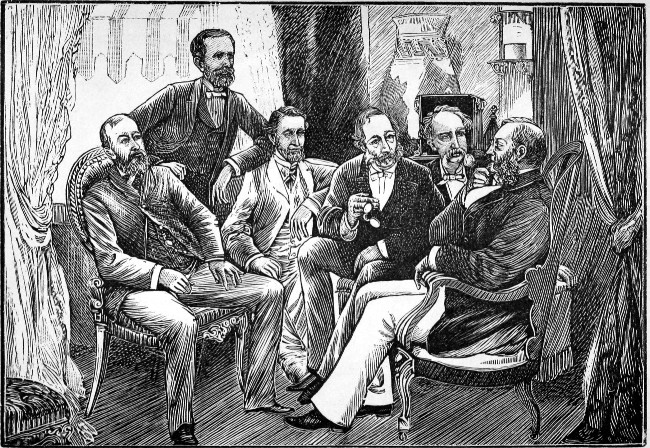
Dr. Woodward. Dr. Reyburn. Dr. Barnes. Dr. Bliss. Dr. Hamilton. Dr. Agnew.
The following external appearances were first observed: The body was considerably emaciated, but the face was much less wasted than the limbs. A preservative fluid had been injected by the embalmer a few hours before into the left femoral artery. The pipes used for the purpose were still in position. The anterior surface of the body presented no abnormal appearances, and there was no ecchymosis or other discoloration of any part of the front of the abdomen. Just below the right ear, and a little behind it, there was an oval ulcerated opening about half an inch in diameter, from which some sanious pus was escaping, but no tumefaction could be observed in the parotid region. A considerable number of purpura-like spots were scattered thickly over the left scapula, and thence forward as far as the axilla. They ranged from one-eighth to one-fourth of an inch in diameter, were slightly elevated and furfuraceous on the surface, and many of them were confluent in groups of two to four or more. A similar, but much less abundant, eruption was observed sparsely scattered over the corresponding region on the right side. An oval excavated ulcer, about an inch long, the result of a small carbuncle, was seated over the spinous process of the tenth dorsal vertebra. Over the sacrum there were four small bed sores, the largest about half an inch in diameter. A few acute pustules and a number of irregular spots of post-mortem hypostatic congestion were scattered over the shoulders, back and buttocks. The inferior part of the scrotum was much discolored by hypostatic congestion. A group of hemorrhoidal tumors rather larger than a walnut protruded from the anus. The depressed cicatrix of the wound made by the pistol bullet was recognized over the tenth intercostal space at three and a half inches to the right of the vertebral spines. A deep linear incision made in part by the operation of July 24, and extended by that of August 8, occupied a position closely corresponding to the upper border of the right twelfth rib. It commenced posteriorly about two inches from the vertebral spines and extended forward a little more than three inches. At the anterior extremity of this incision there was a deep, nearly square, abraded surface, about an inch across. A flexible catheter, fourteen inches long, was then passed into this wound, as had been done to wash it out during life. More resistance was at first encountered than had usually been the case, but after several trials the catheter entered, without any violence, its full length. It was then left in position, and the body disposed supinely for the examination of the viscera. The cranium was not opened. A long incision was made from the superior extremity of the sternum to the pubis, followed by a transverse incision crossing the abdomen, just below the umbilicus. The four flaps thus formed were turned back, and the abdominal viscera exposed. The subcutaneous adipose tissue, divided by the incision, was little more than one-eighth of an inch thick over the thorax, but was thicker over the abdomen, being about a quarter of an inch thick along the linear alba and as much as half an inch thick towards the outer extremity of the transverse incision. On inspection of the abdominal viscera in situ, the transverse colon was observed to lie a little above the line of the umbilicus. It was firmly adherent to the anterior edge of the liver. The greater omentum covered the intestines pretty thoroughly from the transverse colon almost to the pubis. It was still quite fat and was very much blackened by venous congestion. On both sides its lateral margins were adherent to the abdominal parietes opposite the eleventh and twelfth ribs. On the left side the adhesions were numerous, firm, well organized, and probably old. [A foot-note here says: These adhesions and the firm ones on the right side, as well as those of the spleen, possibly date back to an attack of chronic dysentery, from which the patient is said to have suffered during the civil war.] On the right side there were a few similar adhesions and a number of more delicate and probably recent ones. A mass of black, coagulated blood covered and concealed the spleen and the left margin of the greater omentum. On raising the omentum it was found that a blood mass extended through the left lumbar and iliac regions, and dipped down into the pelvis, in which there was some clotted blood and rather more than a pint of bloody fluid. [A foot-note here says: A large part of this fluid had probably transuded from the injection material of the embalmer.] The blood coagula, having been turned out and collected, measured very nearly a pint. It was now evident that secondary hemorrhage had been the immediate cause of death, but the point from which the blood had escaped was not at once apparent. The omentum was not adherent to the intestines, which were moderately distended with gas. No intestinal adhesions were found other than those between the transverse colon and the liver, already mentioned.
The abdominal cavity being now washed out as thoroughly as possible, a fruitless attempt was made to obtain some indication of the presence of the bullet before making any further incision. By pushing the intestines aside, the extremity of the catheter, which had been pressed into the wound, could be felt between the peritoneum and the right iliac fossa, but it had evidently doubled upon itself, and, although a prolonged search was made, nothing could be seen or felt to indicate the presence of the bullet, either in that region or elsewhere. The abdominal viscera were then carefully removed from the body, placed in suitable vessels and examined seriatim, with the following result: The adhesions between the liver and the transverse colon proved to bound an abscess cavity between the under surface of the liver, the transverse colon and the transverse mesocolon, which involved the gall-bladder, and extended to about the same distance on each side of it, measuring six inches transversely, and four inches from before backward. This cavity was lined by a thick pyogenic membrane, which completely replaced the capsule of that part of the under surface of the liver occupied by the abscess. It contained about two ounces of greenish-yellow fluid, a mixture of pus and biliary matter. This abscess did not involve any portion of the substance of the liver, except the surface with which it was in contact. No communication could be traced between it and any part of the wound. Some recent peritoneal adhesions existed between the upper surface of the right lobe of the liver and the diaphragm. The liver was larger than normal, weighing eighty-four ounces; its substance was firm, but of a pale yellowish color on its surface, and throughout the interior of the organ, from fatty degeneration. No evidence that it had been penetrated by the bullet could be found, nor were there any abscesses or infractions in any part of its tissue. The spleen was connected to the diaphragm by firm, probably old, peritoneal adhesions. There were several rather deep congenial fissures in its margins, giving it a lobulated appearance. It was abnormally large, weighing eighteen ounces, of a very dark, lake-red color. Its parenchyma was soft and flabby, but contained no abscesses or infractions. There were some recent peritoneal adhesions between the posterior wall of the stomach and the posterior abdominal parietes. With this exception, no abnormities were discovered in the stomach or intestines, nor were any other evidences of general or acute peritonitis found besides those already specified. The right kidney weighed six ounces, the left kidney seven. Just beneath the capsule of the left kidney, at about the middle of its convex border, there was a little abscess one-third of an inch in diameter. There were three small serous cysts on the convex border of the right kidney, just beneath its capsule. In other respects the tissue of both kidneys was normal in appearance and in texture. The urinary bladder was empty. Behind the right kidney, after the removal of that organ from the body, the dilated track of the bullet was discovered. It was found that, from the point at which it had fractured the right eleventh rib, three inches and a half to the right of the vertebral spines, the missile had gone to the left obliquely forward, passing through the body of the first lumbar vertebra, and lodging in the adipose collective tissue, immediately below the lower border of the pancreas, about two inches and a half to the left of the spinal column, and behind the peritoneum. It had become completely encysted. The track of the bullet between the point at which it had fractured the eleventh rib and that at which it entered the first lumbar vertebra was considerably dilated, and the pus had burrowed downward through the adipose tissue behind the right kidney, and thence had found its way between the peritoneum and the right iliac fossa, making a descending channel, which extended almost to the groin. The adipose tissue behind the kidney, in the vicinity of the descending channel, was much thickened and condensed by inflammation. In the channel, which was found almost free from pus, lay the flexible catheter introduced into the wound at the commencement of the autopsy. Its extremity was found doubled upon itself immediately beneath the peritoneum, reposing upon the iliac fossa, where the channel was dilated into a pouch of considerable size. This long descending channel, now clearly seen to have been caused by the burrowing of pus from the wound, was supposed, during life, to have been the track of the bullet. The last dorsal, together with the first and second lumbar vertebra and the twelfth rib, were then removed from the body for more thorough examination. When this examination was made, it was found that the bullet had penetrated the first lumbar vertebra in the upper part of the right side of the body. The aperture by which it entered the intervertebral cartilage next above, was situated just below and anterior to the intervertebral foramen, from which the upper margin was about one-quarter of an inch distant. Passing obliquely to the left, and forward through the upper part of the body of the first lumbar vertebra, the bullet emerged by the aperture, the centre of which was about half an inch to the left of the median line, and which also involved the intervertebral cartilage next above. The cancellated tissue of the body of the first lumbar vertebra was very much comminuted, and the fragments somewhat displaced. Several deep fissures extended from the track of the bullet into the lower part of the body of the twelfth dorsal vertebra. Others extended through the first lumbar vertebra into the intervertebral cartilage, between it and the second lumbar vertebra. Both this cartilage and the next above were partly destroyed by ulceration. A number of minute fragments from the fractured lumbar vertebra had been driven into the adjacent soft parts. It was further found that the right twelfth rib also was fractured at a point one and a quarter inches to the right of the transverse process of the twelfth dorsal vertebra. This injury had not been recognized during life. On sawing through the vertebra, a little to the right of the median line, it was found that the spinal canal was not involved by the track of the ball. The spinal cord and other contents of this portion of the spinal canal presented no abnormal appearance. The rest of the spinal cord was not examined. Beyond the first lumbar vertebra, the bullet continued to go to the left, passing behind the pancreas to the point where it was found. Here it was enveloped in a firm cyst of connective tissues, which contained, beside the ball, a minute quantity of inspissated somewhat cheesy pus, which formed a thin layer of a portion of the surface of the lead. There was also a black shred adherent to a part of the cyst wall, which proved, on microscopal examination, to be the remains of a blood clot. For about an inch from this cyst, the track of the ball behind the pancreas was completely obliterated by the healing process. Thence as far backward as the body of the first lumbar vertebra the track was filled with coagulated blood, which extended on the left into an irregular space rent in the adjoining adipose tissue behind the peritoneum and above the pancreas. The blood had worked its way to the left, bursting finally through the peritoneum behind the spleen into the abdominal cavity.
The rending of the tissues by the extravasation of this blood was undoubtedly the cause of the paroxysms of pain which occurred a short time before death. This mass of coagulated blood was of irregular form, and nearly as large as a man's fist. It could be distinctly seen from in front through the peritoneum, after the greater curvature of the stomach had been exposed by the dissolution of the greater omentum from the stomach, and especially after some delicate adhesions between the stomach and the part of the peritoneum covering the blood mass had been broken down by the fingers. From the relations of the mass, as thus seen, it was believed that the hemorrhage had proceeded from one of the mesenteric arteries; but, as it was clear that a minute dissection would be required to determine the particular branch involved, it was agreed that the infiltrated tissues and the adjoining soft parts should be preserved for subsequent study. On the examination and dissection made in accordance with this agreement, it was found that the fatal hemorrhage proceeded from a rent, nearly four tenths of an inch long, in the main trunk of the splenic artery, two inches and a half to the left of the cœliac axis. The rent must have occurred at least several days before death, since the everted edges in the slit in the vessel were united by firm adhesions to the surrounding connective tissue, thus forming an almost continuous wall, bounding the adjoining portion of the blood clot. Moreover, the peripheral portion of the clot in this vicinity was disposed in pretty firm concentric layers. It was further found that the cyst below the lower margin of the pancreas, in which the bullet was found, was situated three and one-half inches to the left of the cœliac axis. Beside the mass of coagulated blood just described, another about the size of a walnut was found in the greater omentum, near the splenic extremity of the stomach. The communication, if any, between this and the larger hemorrhagic mass could not be made out.
The examination of the thoracic viscera resulted as follows: The heart weighed eleven ounces. All the cavities were entirely empty, except the right ventrical, in which a few shreds of soft reddish coagulated blood adhered to the internal surface. On the surface of the mitral valve there were several spots of fatty degeneration. With this exception the cardiac valves were normal. The muscular tissues of the heart were soft and tore easily. A few spots of fatty degeneration existed in the lining membrane of the aorta, just above the semilunar valves, and a slender clot of fibrine was found in the aorta, where it was divided, about two inches from these valves, for the removal of the heart. On the right side slight pleuritic adhesions existed between the convex surface of the lower lobe of the lung and the costal pleura, and firm adhesions between the anterior edge of the lower lobe, the pericardium and the diaphragm. The right lung weighed thirty-two ounces. The posterior part of the fissure between its upper and lower lobes was congenitally incomplete. The lower lobe of the right lung was hypostatically congested, and considerable portions, especially toward its base, were the seat of broncho-pneumonia. The bronchial tubes contained a considerable quantity of stringy mucous pus. Their mucous surface was reddened by catarrhal bronchitis. The lung tissue was œdematous. [A foot-note here says: A part at least of this condition was doubtless due to the extravasation of the injecting fluids by the embalmer. But it contained no abscesses or infractions.] On the left side the lower lobe of the lung was bound behind to the costal pleura, above to the upper lobe, and below to the diaphragm by pretty firm pleuritic adhesions. The left lung weighed twenty-seven ounces. The condition of its bronchial tubes and of the lung tissues was very nearly the same as on the right side, the chief difference being that the area of broncho-pneumonia in the lower lobe was much less extensive in the left lung than in the right. In the lateral part of the lower lobe of the left lung, and about an inch from its pleural surface, there was a group of four minute areas of gray hepatization, each about one-eighth of an inch in diameter. There were no infractions and no abscesses in any part of the lung tissue.
The surgeons assisting at the autopsy were unanimously of the opinion that, in reviewing the history of the case in connection with the autopsy, it was quite evident that the different suppurating surfaces, and especially the fractured, spongy tissue of the vertebra, furnished a sufficient explanation of the septic conditions which existed during life. About an hour after the post-mortem examination was completed the physicians named at the commencement of this report assembled for further consultation in an adjoining cottage. A brief outline of the results of the post-mortem examination was drawn up, signed by all the physicians, and handed to Private Secretary J. Stanley Brown, who was requested to furnish copies to the newspaper press.
D. W. Bliss. J. K. Barnes. J. J. Woodward. Robert Reyburn. D. S. Lamb.
As the above report contains paragraphs detailing the observations made at Washington on the pathological specimens preserved for that purpose, the names of Drs. J. H. Hamilton, D. Hayes Agnew, and A. H. Smith, are not appended to it. It has, however, been submitted to them, and they have given their assent to the other portions of the report.
III.
SENATOR HOAR'S ADDRESS.
I should indulge myself in a strange delusion if I hoped to say anything of President Garfield which is not already well known to his countrymen, or to add further honor to a name to which the judgment of the world, with marvelous unanimity, has already assigned its place. The public sorrow and love have found utterance, if not adequate, yet such as speech, and silence, and funeral rite, and stately procession, and prayers, and tears could give. On the twenty-sixth day of September, the day of the funeral, a common feeling stirred mankind as never before in history. That mysterious law, by which, in a great audience, every emotion is multiplied in each heart by sympathy with every other, laid its spell on universal humanity. At the touch which makes the whole world kin, all barriers of rank, or party, or State, or Nation disappeared. His own Ohio, the State of his birth and of his burial, New England, from whose loins came the sturdy race from which he descended, whose college gave him his education, can claim no pre-eminence in sorrow.
From farthest south comes the voice of mourning for the soldier of the Union. Over fisherman's hut and frontiersman's cabin is spread a gloom because the White House is desolate. The son of the poor widow is dead, and palace and castle are in tears. As the humble Campbellite disciple is borne to his long home, the music of the requiem fills cathedral arches and the domes of ancient synagogues. On the coffin of the canal-boy a queen lays her wreath. As the bier is lifted, word comes beneath the sea that the nations of the earth are rising and bowing their heads. From many climes, in many languages they join in the solemn service. This is no blind and sudden emotion, gathering and breaking like a wave. It is the mourning of mankind for a great character already perfectly known and familiar. If there be any persons who fear that religious faith is dying, that science has shaken the hold of the moral law upon the minds of men, let them take comfort in asking themselves if any base or ignoble passion could have so moved mankind. Modern science has called into life these mighty servants, press and telegraph, who have created a nerve which joins together all human hearts and pulses simultaneously over the globe. To what conqueror, to what tyrant, to what selfish ambition, to what mere intellectual greatness would it not have refused response? The power in the universe that makes for evil, and the power in the universe that makes for righteousness, measure their forces. A poor, weak fiend shoots off his little bolt, a single human life is stricken down, and a throb of divine love thrills a planet.
Every American State has its own story of the brave and adventurous spirits who were its early settlers; the men who build commonwealths, the men of whom commonwealths are builded. The history of the settlement of Massachusetts, of central New York, and of Ohio, is the history of the Garfield race. They were, to borrow a felicitous phrase, "hungry for the horizon." They were natural frontiersmen. Of the seven generations born in America, including the President, not one was born in other than a frontiersman's dwelling.
Two of them, father and son, came over with Winthrop in 1630. Each of the six generations who dwelt in Massachusetts has left an honorable record still preserved. Five in succession bore an honorable military title. Some were fighters in the Indian wars. "It is not in Indian wars," Fisher Ames well says, "that heroes are celebrated, but it is there they are formed." At the breaking out of the Revolution the male representatives of the family were two young brothers. One, whose name descended to the President, was in arms at Concord bridge, at sunrise, on the 19th of April. The other, the President's great grandfather, dwelling thirty miles off, was on his way to the scene of action before noon. When the Constitution rejected by Massachusetts in 1778 was proposed, this same ancestor, with his fellow-citizens of the little town of Westminster, voted unanimously for the rejection, and put on record their reasons. "It is our opinion that no constitution whatever ought to be established till previously thereto a bill of rights be set forth, and the constitution be framed therefrom, so that the lowest capacity may be able to determine his natural rights, and judge of the equitableness of the constitution thereby." "And as to the Constitution itself, the following appears to us exceptionable, viz, the fifth article," [Excepting negroes, mulattoes and Indians from the right to vote], "which deprives a portion of the human race of their natural rights on account of their color, which, in our opinion, no power on earth has a just right to do. It therefore ought to be expunged the Constitution." No religious intolerance descended in the Garfield race. But the creed of this Westminster catechism they seem never to have forgotten. When the war was over, the same ancestor took his young family and penetrated the forest again. He established his home in Otsego county, in central New York, at the period and amid the scenes made familiar by Cooper, in his delightful tale, The Pioneers. Again the generations moved westward, in the march of civilization, keeping ever in the van, until in 1831, James Garfield was born, in a humble Ohio cabin where he was left fatherless in his infancy. In a new settlement the wealth of the family is in the right arm of the father. To say that the father, who had himself been left an orphan when he was an infant, left his son fatherless in infancy, is to say that the family was reduced to extreme poverty.
I have not given this narrative as the story of a mean or ignoble lineage. Such men, whether of Puritan, or Huguenot, or Cavalier stock, have ever been the strength and the security of American States. From such homes came Webster, and Clay, and Lincoln and Jackson. It is no race of boors that has struck its axes into the forests of this continent. These men knew how to build themselves log houses in the wilderness. They were more skillful still to build constitutions and statutes. Slow, cautious, conservative, sluggish, unready, in ordinary life, their brains move quick and sure as their rifles flash, when great controversies that determine the fate of States are to be decided, when great interests that brook no delay are at stake, and great battles that admit no indecision, are to be fought. The trained and disciplined soldiers of England could not anticipate these alert farmers. On the morning of the Revolution they were up before the sun. When Washington was to be defended in 1861 the scholar, or the lawyer, or the man of the city, dropped his book, left his court-house or his counting-room, and found his company of yeomen waiting for him. They are ever greatest in adversity. I would not undervalue the material of which other republics have been built. The polished marbles of Greece and Italy have their own grace. But art or nature contain no more exquisite beauty than the color which this split and unhewn granite takes from the tempest it withstands. There was never a race of men on earth more capable of seeing clearly, of grasping, and of holding fast the great truths and great principles which are permanent, sure, and safe for the government of the conduct of life, alike in private and public concerns. If there be, or ever shall be, in this country, a demos, fickle, light-minded, easily moved, blind, prejudiced, incapable of permanent adherence to what is great or what is true, whether it come from the effeminacy of wealth or the scepticism of a sickly and selfish culture, or the poverty and ignorance of great cities, it will find itself powerless in this iron grasp.
Blending with this Saxon stock, young Garfield inherited on the mother's side the qualities of the Huguenots, those gentle but not less brave or less constant Puritans, who, for conscience sake, left their beloved and beautiful France, whose memory will be kept green so long as Maine cherishes Bowdoin College, or Massachusetts Faneuil Hall; or New York the antique virtue of John Jay, or South Carolina her Revolutionary history—who gave a lustre and a glory to every place and thing they touched. The child of such a race, left fatherless in the wilderness, yet destined to such a glory, was committed by Providence to three great teachers, without either of whom he would not have become fitted for his distinguished career. These teachers were a wise Christian mother, poverty, and the venerable college president who lived to watch his pupil through the whole of his varied life, to witness his inauguration amid such high hopes, and to lament his death. To no nobler matron did ever Roman hero trace his origin. Few of the traditions of his Puritan ancestry could have come down to the young orphan. It is said there were two things with which his mother was specially familiar—the Bible and the rude ballads of the war of 1812. The child learned the Bible at his mother's knee, and the love of country from his cradle-hymns.
I cannot, within the limits assigned to me, recount every circumstance of special preparation which fitted the young giant for the great and various parts he was to play in the drama of our republican life. It would be but to repeat a story whose pathos and romance are all known by heart to his countrymen. The childhood in the cabin; the struggle with want almost with famine, the brother proudly bringing his first dollar to buy shoes for the little bare feet; the labor in the forest, the growth of the strong frame and the massive brain; the reading of the first novel; the boy's longing for the sea; the canal-boat; the carpenter's shop; the first school; the eager thirst for knowledge; the learning that an obstacle seems only a thing to be overcome; the founding of the college at Hiram; the companionship in study of the gifted lady whose eulogy he pronounced; the Campbellite preaching; the ever-wise guidance of the mother; the marriage to the bright and beautiful schoolmate; we know them better even, than we know the youth of Washington and of Webster. General Garfield said in 1878, that he had not long ago conversed with an English gentleman, who told him that in twenty-five years of careful study of the agricultural class in England he had never known one who was born and reared in the ranks of farm laborers that rose above his class and became a well-to-do citizen. The story of a childhood passed in poverty, of intellect and moral nature trained in strenuous contests with adversity, is not unfamiliar to those who have read the lives of the men who have been successful in this country in any of the walks of life. It is one of the most beneficent results of American institutions that we have ceased to speak of poverty and hardship, and the necessity for hard and humble toil as disadvantages to a spirit endowed by nature with the capacity for generous ambitions. In a society where labor is honorable, and where every place in social or public life is open to merit, early poverty is no more a disadvantage than a gymnasium to an athlete, or drill and discipline to a soldier.
General Garfield was never ashamed of his origin. He
"Did not change, but kept in lofty place The wisdom which adversity had bred."
The humblest friend of his boyhood was ever welcome to him when he sat in the highest seats, where Honor was sitting by his side. The poorest laborer was sure of the sympathy of one who had known all the bitterness of want and the sweetness of bread earned by the sweat of the brow. He was ever the simple, plain, modest gentleman. When he met a common soldier it was not the general or military hero that met him, but the comrade. When he met the scholar, it was not the learned man, or the college president, but the learner. It was fitting that he who found open the road through every gradation of public honor, from the log cabin to the Presidency, simply at the price of deserving it, should have answered in the same speech the sophistries of communism and the sinister forebodings of Lord Macaulay. "Here," he said, "society is not fixed in horizontal layers, like the crust of the earth, but as a great New England man said years ago, it is rather like the ocean, broad, deep, grand, open, and so free in all its parts that every drop that mingles with the yellow sand at the bottom, may ride through all the waters, till it gleams in the sunshine on the crest of the highest waves. So it is here in our free society, permeated with the light of American freedom. There is no American boy, however poor, however humble, orphan though he may be, that, if he have a clear head, a true heart, a strong arm, he may not rise through all the grades of society, and become the crown, the glory, the pillar of the State. Here there is no need for the Old World war between capital and labor. Here is no need of the explosion of social order predicted by Macaulay."
When seeking a place of education in the East, young Garfield wrote to several New England colleges. The youth's heart was touched, and his choice decided by the tone of welcome in the reply of Dr. Hopkins, the president of Williams. It was fortunate that his vigorous youth found itself under the influence of a very great but very simple and sincere character. The secret of Dr. Hopkins' power over his pupils lay, first, in his own example, profound scholarship, great practical wisdom, perfect openness and sincerity, and humility, second, in a careful study of the disposition of each individual youth, third, justice, absolute, yet accompanied by sympathy and respect, seldom severity, never scorn, in dealing with the errors of boyhood. No harsh and inflexible law, cold and pitiless as a winter's sea, dealt alike with the sluggish and the generous nature. No storm of merciless ridicule greeted the shy, awkward, ungainly, backwoodsman. And, beyond all, Dr. Hopkins taught his pupils that lesson in which some of our colleges so sadly fail—reverence for the republican life of which they were to form a part, and for the great history of whose glory they were inheritors. It was my fortune, on an evening last spring, to see the illustrious pupil, I suppose for the last time on earth, take leave of the aged teacher whose head the frosts of nearly fourscore winters had touched so lightly, and to hear him say at parting, "I have felt your presence at the beginning of my administration like a benediction." The President delighted in his college. He kept unbroken the friendships he formed within her walls. He declared that the place and its associations were to him a fountain of perpetual youth. He never forgot his debt to her. When he was stricken down he was on his way, all a boy again, to lay his untarnished laurels at her feet.
It would have been hard to find in this country a man so well equipped by nature, by experience, and by training, as was Garfield when he entered the Ohio Senate, in 1860, at the age of twenty-eight. He was in his own person the representative of the plainest life of the backwoods and the best culture of the oldest eastern community. He had been used in his youth to various forms of manual labor. The years which he devoted to his profession of teacher and of college president, were years of great industry, in which he disciplined his powers of public speaking and original investigation. Dr. Hopkins said of him: "There was a large general capacity applicable to any subject and sound sense. What he did was done with facility, but by honest and avowed work. There was no pretence of genius or alternation of spasmodic effort and of rest, but a satisfactory accomplishment in all directions of what was undertaken." His sound brain and athletic frame could bear great labor without fatigue. He had a thoroughly healthy and robust intellect, capable of being directed upon any of the pursuits of life or any of the affairs of State in any department of the public service. We have no other example in our public life of such marvellous completeness of intellectual development. He exhibited enough of his varied mental capacity to make it sure that he could have attained greatness as a metaphysician or a mathematician in any of the exact sciences, as a linguist, as an executive officer, as he did in fact attain it as a military commander, as an orator, as a debater and a parliamentary and popular leader.
The gigantic scale on which the operations of our late war were conducted, has dwarfed somewhat the achievements of individual actors. If in the history of either of the other wars in which our people have engaged, whether before or after the Declaration of Independence, such a chapter should be found as the narrative of Garfield's Kentucky campaign, it would alone have made the name of its leader immortal. It is said that General Rosecrans received the young schoolmaster with some prejudice. "When he came to my headquarters," he says, "I must confess that I had a prejudice against him, as I understood he was a preacher who had gone into politics, and a man of that cast I was naturally opposed to." In his official report Rosecrans says:—
"I especially mention Brigadier-General Garfield, ever active, prudent and sagacious. I feel much indebted to him for both counsel and assistance in the administration of this army. He possesses the energy and the instinct of a great commander."
We must leave to soldiers and to military historians to assign then relative historic importance to the movements of the war. But we may safely trust the popular judgment which pronounces Garfield's role at Chickamauga one of the most conspicuous instances of personal heroism, and the Kentucky campaign a most brilliant example of fertility of resource, combined audacity and prudence, sound military judgment, and success against great odds. We may safely trust, too, the judgment of the accomplished historian, who pronounces his report in favor of the advance that ended with the battle of Chickamuauga "the ablest military document submitted by a chief of staff to his superior during the war." We may accept, also, the award of Lincoln, who made him major-general for his brilliant service at Chickamauga, and the confidence of Thomas, who offered him the command of an army corps. Great as was his capacity for military service, the judgment of Abraham Lincoln did not err, when it summoned him to the field of labor where his greatest laurels were won. It is the fashion, in some quarters, to lament the decay of statesmanship, and to make comparisons, by no means complimentary, between persons now entrusted with the conduct of public affairs, and their predecessors. We may at least find consolation in the knowledge that when any of our companions die they do not fail to receive full justice from the hearts of the people.
Suppose any of the statesmen who preceded the war, or some intelligent and not unfriendly foreign observer—some De Tocqueville or Macaulay—to look forward with Garfield to the duties which confronted him when he entered Congress in 1863. With what despair, in the light of all past experience, would he have contemplated the future. How insignificant the difficulties which beset the men of the preceding seventy years compared with those which have crowded the seventeen which were to follow. How marvellous the success the American people have achieved in dealing with these difficulties compared with that which attended the statesmanship of the times of Webster and Clay and Calhoun, giants as they were. The greatness of these men is not likely to be under-valued anywhere, least of all in Massachusetts. They contributed each in his own way those masterly discussions of the great principles by which the Constitution must be interpreted, and the economic laws on which material prosperity depends, which will abide as perpetual forces so long as the republic shall endure. Mr Webster, especially, aided in establishing in the jurisprudence of the country the great judgments, which, on the one hand, asserted for the national government its most necessary and beneficent powers, and, on the other hand, have protected property and liberty from invasion. He uttered in the Senate the immortal argument which convinced the American people of the unity of the republic and the supremacy and indestructibility of the national authority. It has been well said that the cannon of the nation were shotted with the reply to Hayne. But the only important and permanent measure with which the name of Webster is connected is the Ashburton treaty—an achievement of diplomacy of little consequence in comparison with those which obtained from the great powers of Europe the relinquishment of the doctrine of perpetual allegiance, or with the Alabama treaty of 1871. Mr. Clay's life was identified with two great policies—the protection of American industry and the compromise between slavery and freedom in their strife for control of the Territories. When he died the free-trade tariff of 1844 was the law of the land, and within two years the Missouri compromise was repealed. Mr Calhoun has left behind him the memory of a stainless life, great intellectual power and a lost cause.
To each generation is committed its peculiar task. To these men it was given to wake the infant republic to a sense of its own great destiny, and to teach it the laws of its being, by which it must live or bear no life. To the men of our time the abstract theories, which were only debated in other days, have come as practical realities, demanding prompt and final decision on questions where error is fatal. From the time of Jay's treaty no such problem has presented itself to American diplomacy as that which the war left as its legacy. The strongest power on earth, accustomed, in dealing with other nations, to take counsel only of her pride and her strength, had inflicted on us vast injury, of which the honor of this country seemed pledged to insist on reparation, which England conceived hers equally pledged to deny. But in domestic affairs, the difficulties were even greater. For six of the sixteen years that followed the death of Lincoln, the President was not in political accord with either house of Congress. For four others the house was of different politics from President and Senate. During the whole time the dominant party had to encounter a zealous and able opposition, and to submit its measures to a people having apparently the strongest inducements to go wrong. The rights of capital were to be determined by the votes of labor, debtors to fix the value of their payments to their creditors, a people under no constraint but their own sense of duty to determine whether they would continue to bear the weight of a vast debt, the policy of dealing with the conquered to be decided at the close of a long war by the votes of the conquerors, among whom every other family was in mourning for its dead, finance and currency with their subtleties, surpassing the subtleties of metaphysics to be made clear to the apprehension of plain men; business to be recalled from the dizzy and dangerous heights of speculation to moderate gains and safe laws; great public ways connecting distant oceans to be built; commerce to be diverted into unaccustomed channels; the mouth of the Mississippi to be opened; a great banking system to be devised and put in operation, such as was never known before, alike comprehensive and safe, through whose veins and arteries credit, the life-blood of trade should ebb and flow in the remotest extremities of the land; four millions of people to be raised from slavery to citizenship; millions more to be welcomed from foreign lands; a disputed presidential succession to be settled, after an election contest in which the country seemed turned into two hostile camps, by a tribunal for which the founders of the government had made no provision; all this to be accomplished under the restraints of a written Constitution.
When this list has been enumerated the eulogy of Garfield the statesman has been spoken. There is scarcely one of these questions, certainly not more than one or two, which he did not anticipate, carefully and thoroughly study for himself before it arose, and to which he did not contribute an original argument, unsurpassed in persuasive force. Undoubtedly there were others who had more to do with marshalling the political forces of the house. But almost from the time he entered it he was the leader of its best thought. He was ever serious, grave, addressing himself only to the reason and conscience of his auditors.
He lived in a State whose people were evenly divided in politics, and on whose decision, as it swayed alternately from side to side, the fate of the country often seemed to depend. You will search his speeches in vain for an appeal to a base motive or an evil passion. Many men who are called great political leaders are really nothing but great political followers. They study the currents of a public sentiment which other men form. They use as instruments opinions which they never espoused till they became popular. General Garfield always consulted with great care the temper of the house in the conduct of measures which were under his charge. But he was remarkably independent in forming his judgments, and inflexible in adhering to them on all great essential questions. His great friend and commander, General Thomas, whose stubborn courage saved the day in the great battle for the possession of Tennessee, was well-called the "rock of Chickamauga." In the greater battle in 1876 for the nation's honor, Garfield well deserved to be called the "rock of Ohio." Everything he did and said manifested the serious, reverent love of excellent. He had occasion often to seek to win to his opinions masses of men composed largely of illiterate persons. No man ever heard from his lips a sneer at scholarship. At the same time, he never made the scholar's mistake of undervaluing the greatness of the history of his own country, or the quality of his own people.
The limits of this discourse do not permit me to enter into the detail of the variety and extent of his service in debate, in legislation, and in discussions before the people. I could detain you until midnight were I to recount from my own memory the great labors of the twelve years that it was my privilege to share with him in the public service, for four of which I sat almost by his side. Everybody who had a new thought brought it to him for hospitable welcome. Did science or scholarship need anything of the government, Garfield was the man to whom they came. While charged with the duty of supervising the details of present legislation he was always foreseeing and preparing for the future. In the closing years of the war, while chairman of the committee of military affairs, he was studying finance. Later he had prepared himself to deal with the defects in the civil service. I do not think the legislation of the next twenty years will more than reach the ground which he had already occupied in his advanced thought.
General Garfield gave evidence of vast powers of oratory on some very memorable occasions. But he made almost no use of them as a means of persuading the people to conclusions where great public interests were at stake. Sincerity, directness, full and perfect understanding of his subject, clear logic, manly dignity, simple and apt illustration, marked all his discourse. But on a few great occasions, such as that in New York, when the people were moved almost to frenzy by the assassination of Lincoln, or in the storm which moved the great human ocean at the convention at Chicago, he showed that he could touch with a master's hands the chords of that mighty instrument—
"Such as raised To height of noblest temper heroes old, Arming to battle, and instead of rage Deliberate valor breathed, firm and unmoved With dread of death to flight or foul retreat; Nor wanting power to mitigate and suage With solemn touches, troubled thoughts, and chase Anguish and doubt and fear and sorrow and pain From mortal or immortal minds."
When General Garfield took the oath of office as President, he seemed to those who knew him best, though in his fiftieth year, still in the prime of a splendid and vigorous youth. He was still growing. We hoped for him eight years of brilliant administration, and then, in some form or place of service, an old age like that of Adams, whom, in variety of equipment, alone of our Presidents he resembled. What was best and purest and loftiest in the aspiration of America seemed at last to have laid its hand on the helm. Under its beneficent rule we hoped, as our country entered on its new career of peace and prosperity, a nobler liberty, a better friendship, a purer justice, a more lasting brotherhood. But he was called to a sublimer destiny. He had ascended along and up the heights of service, of success, of greatness, of glory; ever raised by the people to higher ranks for gallant and meritorious conduct on each field, until by their suffrages he stood foremost among men of the foremost among nations. But in the days of his sickness and death he became the perpetual witness and example how much greater than the achievements of legislative halls, or the deeds of the field of battle, are the household virtues and simple family affections which all men have within their reach; how much greater than the lessons of the college or the camp, or the congress, are the lessons learned at mother's knees. The honors paid to Garfield are the protest of a better age and a better generation against the vulgar heroisms of the past. Go through their mausoleums and under their triumphal arches, and see how the names inscribed there shrink and shrivel compared with that of this Christian soldier, whose chiefest virtues, after all, are of the fireside and the family circle, and of the dying bed. Here the hero of America becomes the hero of humanity.
We are justified, then, in saying of this man that he has been tried and tested in every mode by which the quality of a human heart and the capacity of a human intellect can be disclosed; by adversity, by prosperity, by poverty, by wealth, by leadership in deliberative assemblies, and in the perilous edge of battle, by the height of power and of fame. The essay was to be completed by the certain and visible approach of death. As he comes out into the sunlight, more and more clearly does his country behold a greatness and symmetry which she is to see in their true and full proportions only when he lies in the repose of death.
"As sometimes in a dead man's face, To those that watch it more and more, A likeness, hardly seen before, Comes out, to some one of his race, So, dearest, now thy brows are cold, I see thee what thou art, and know Thy likeness to the wise below, Thy kindred with the great of old."
Let us not boast at the funeral of our dead. Such a temper would be doubly odious in the presence of such expressions of hearty sympathy from governments of every form. But we should be unfaithful to ourselves if in asking for this man a place in the world's gallery of illustrious names we did not declare that we offer him as an example of the products of Freedom. With steady and even step he walked from the log-cabin and the canal-path to the school, to the college, to the battle-field, to the halls of legislation, to the White House, to the chamber of death. The ear in which the voices of his countrymen, hailing him at the pinnacle of human glory had scarcely died out, heard the voice of the dread archangel, and his countenance did not change. Is not that country worth dying for whose peasantry are of such a strain? Is not the Constitution worth standing by under whose forms Freedom calls such men to her high places? Is not the Union worth saving which gives all of us the property of countrymen in such a fame?
IV.
HON. JAMES G. BLAINE'S EULOGY.
Mr. President: For the second time in this generation the great departments of the Government of the United States are assembled in the Hall of Representatives to do honor to the memory of a murdered President. Lincoln fell at the close of a mighty struggle in which the passions of men had been deeply stirred. The tragical termination of his great life added but another to the lengthened succession of horrors which had marked so many lintels with the blood of the first born. Garfield was slain in a day of peace, when brother had been reconciled to brother, and when anger and hate had been banished from the land. "Whoever shall hereafter draw the portrait of murder, if he will show it as it has been exhibited where such example was last to have been looked for, let him not give it the grim visage of Moloch, the brow knitted by revenge, the face black with settled hate. Let him draw, rather, a decorous, smooth-faced, bloodless demon; not so much an example of human nature in its depravity and in its paroxysms of crime, as an infernal being, a fiend in the ordinary display and development of his character."
From the landing of the Pilgrims at Plymouth till the uprising against Charles First, about twenty thousand emigrants came from Old England to New England. As they came in pursuit of intellectual freedom and ecclesiastical independence rather than for worldly honor and profit, the emigration naturally ceased when the contest for religious liberty began in earnest at home. The man who struck his most effective blow for freedom of conscience by sailing for the colonies in 1620 would have been accounted a deserter to leave after 1640. The opportunity had then come on the soil of England for that great contest which established the authority of Parliament, gave religious freedom to the people, sent Charles to the block, and committed to the hands of Oliver Cromwell the Supreme Executive authority of England. The English emigration was never renewed, and from these twenty thousand men with a small emigration from Scotland and from France are descended the vast numbers who have New England blood in their veins.
In 1685 the revocation of the edict of Nantes by Louis XIV. scattered to other countries four hundred thousand Protestants, who were among the most intelligent and enterprising of French subjects—merchants of capital, skilled manufacturers and handicraftsmen, superior at the time to all others in Europe. A considerable number of these Huguenot French came to America, a few landed in New England and became honorably prominent in its history. Their names have in large part become anglicized, or have disappeared, but their blood is traceable in many of the most reputable families, and their fame is perpetuated in honorable memorials and useful institutions.
From these two sources, the English-Puritan and the French-Huguenot, came the late President—his father, Abram Garfield, being descended from the one, and his mother, Eliza Ballou, from the other.
It was good stock on both sides—none better, none braver, none truer. There was in it an inheritance of courage, of manliness, of imperishable love of liberty, of undying adherence to principle. Garfield was proud of his blood, and, with as much satisfaction as if he were a British nobleman reading his stately ancestral record in Burke's Peerage, he spoke of himself as ninth in descent from those who would not endure the oppression of the Stuarts, and seventh in descent from the brave French Protestants who refused to submit to tyranny even from the Grand Monarque.
General Garfield delighted to dwell on these traits, and, during his only visit to England, he busied himself in discovering every trace of his forefathers in parish registries and on ancient army rolls. Sitting with a friend in the gallery of the House of Commons one night after a long day's labor in this field of research, he said with evident elation that in every war in which for three centuries patriots of English blood had struck sturdy blows for constitutional government and human liberty, his family had been represented. They were at Marston Moor, at Naseby, and at Preston, they were at Bunker Hill, at Saratoga and at Monmouth, and in his own person had battled for the same great cause in the war which preserved the Union of the States.
Losing his father before he was two years old, the early life of Garfield was one of privation, but its poverty has been made indelicately and unjustly prominent. Thousands of readers have imagined him as the ragged, starving child, whose reality too often greets the eye in the squalid sections of our large cities. General Garfield's infancy and youth had none of their destitution, none of their pitiful features appealing to the tender heart and to the open hand of charity. He was a poor boy in the same sense in which Henry Clay was a poor boy; in which Andrew Jackson was a poor boy; in which Daniel Webster was a poor boy: in the sense in which a large majority of the eminent men of America in all generations, have been poor boys. Before a great multitude of men, in a public speech, Mr Webster bore this testimony;
"It did not happen to me to be born in a log cabin, but my elder brothers and sisters were born in a log cabin raised amid the snowdrifts of New Hampshire, at a period so early that when the smoke rose first from its rude chimney and curled over the frozen hills there was no similar evidence of a white man's habitation between it and the settlements on the rivers of Canada. Its remains still exist. I make to it an annual visit. I carry my children to it to teach them the hardships endured by the generations which have gone before them. I love to dwell on the tender recollections, the kindred ties, the early affections, and the touching narratives and incidents which mingle with all I know of this primitive family abode."
With the requisite change of scene, the same words would aptly portray the early days of Garfield. The poverty of the frontier, where all are engaged in a common struggle, and where a common sympathy and hearty co-operation lighten the burdens of each, is a very different poverty; different in kind, different in influence and effect, from that conscious and humiliating indigence which is every day forced to contrast itself with neighboring wealth, on which it feels a sense of grinding dependence. The poverty of the frontier is indeed no poverty. It is but the beginning of wealth, and has the boundless possibilities of the future always opening before it. No man ever grew up in the agricultural regions of the West, where a house-raising, or even a corn-husking, is matter of common interest and helpfulness, with any other feeling than that of broad-minded, generous independence. This honorable independence marked the youth of Garfield, as it marks the youth of millions of the best blood and brain now training for the future citizenship and future government of the republic. Garfield was born heir to land, to the title of free-holder, which has been the patent and passport of self-respect with the Anglo Saxon race ever since Hengist and Horsa landed on the shores of England. His adventure on the canal—an alternative between that and the deck of a Lake Erie schooner—was a farmer boy's device for earning money, just as the New England lad begins a possibly greater career by sailing before the mast on a coasting vessel or on a merchantman bound to the farther India or to the China Seas.
No manly man feels anything of shame in looking back to early struggles with adverse circumstances, and no man feels a worthier pride than when he has conquered the obstacles to his progress. But no one of noble mould desires to be looked upon as having occupied a menial position, as having been repressed by a feeling of inferiority, or as having suffered the evils of poverty until relief was found at the hand of charity. General Garfield's youth presented no hardships which family love and family energy did not overcome, subjected him to no privations which he did not cheerfully accept, and left no memories save those which were recalled with delight, and transmitted with profit and with pride.
Garfield's early opportunities for securing an education were extremely limited, and yet were sufficient to develop in him an intense desire to learn. He could read at three years of age, and each winter he had the advantage of the district school. He read all the books to be found within the circle of his acquaintance; some of them he got by heart. While yet in childhood he was a constant student of the Bible, and became familiar with its literature. The dignity and earnestness of his speech in his maturer life gave evidence of this early training. At eighteen years of age he was able to teach school, and thenceforward his ambition was to obtain a college education. To this end he bent all his efforts, working in the harvest field, at the carpenter's bench, and, in the winter season, teaching the common schools of the neighborhood. While thus laboriously occupied he found time to prosecute his studies, and was so successful that at twenty-two years of age he was able to enter the junior class at Williams College, then under the presidency of the venerable and honored Mark Hopkins, who, in the fullness of his powers, survives the eminent pupil to whom he was of inestimable service.
The history of Garfield's life to this period, presents no novel features. He had undoubtedly shown perseverance, self-reliance, self-sacrifice, and ambition, qualities, which, be it said for the honor of our country, are everywhere to be found among the young men of America. But from his graduation at Williams onward, to the hour of his tragical death, Garfield's career was eminent and exceptional. Slowly working through his educational period, receiving his diploma when twenty-four years of age, he seemed as one bound to spring into conspicuous and brilliant success. Within six years he was successively president of a college, State Senator of Ohio, major-general of the army of the United States, and Representative elect to the National Congress. A combination of honors so varied, so elevated, within a period so brief and to a man so young, is without precedent or parallel in the history of the country.
Garfield's army life was begun with no other military knowledge than such as he had hastily gained from books in the few months preceding his march to the field. Stepping from civil life to the head of a regiment, the first order he received when ready to cross the Ohio was to assume command of a brigade, and to operate as an independent force in Eastern Kentucky. His immediate duty was to check the advance of Humphrey Marshall, who was marching down the Big Sandy with the intention of occupying, in connection with other confederate forces, the entire territory of Kentucky, and of precipitating the State into secession. This was at the close of the year 1861. Seldom, if ever, has a young college professor been thrown into a more embarrassing and discouraging position. He knew just enough of military science, as he expressed it himself, to measure the extent of his ignorance, and with a handful of men he was marching, in rough winter weather, into a strange country, among a hostile population, to confront a largely superior force under the command of a distinguished graduate of West Point, who had seen active and important service in two preceding wars.
The result of the campaign is matter of history. The skill, the endurance, the extraordinary energy shown by Garfield, the courage he imparted to his men, raw and untried as himself, the measures he adopted to increase his force and to create in the enemy's mind exaggerated estimates of his numbers, bore perfect fruit in the routing of Marshall, the capture of his camp, the dispersion of his force, and the emancipation of an important territory from the control of the rebellion. Coming at the close of a long series of disasters to the Union arms, Garfield's victory had an unusual and extraneous importance, and in the popular judgment elevated the young commander to the rank of a military hero. With less than two thousand men in his entire command, with a mobilized force of only eleven hundred, without cannon, he had met an army of five thousand and defeated them—driving Marshall's forces successively from two strongholds of their own selection, fortified with abundant artillery. Major-General Buell, commanding the Department of the Ohio, an experienced and able soldier of the regular army, published an order of thanks and congratulation on the brilliant result of the Big Sandy campaign, which would have turned the head of a less cool and sensible man than Garfield. Buell declared that his services had called into action the highest qualities of a soldier, and President Lincoln supplemented these words of praise by the more substantial reward of a brigadier-general's commission, to bear date from the day of his decisive victory over Marshall.
The subsequent military career of Garfield fully sustained its brilliant beginning. With his new commission he was assigned to the command of a brigade in the Army of the Ohio, and took part in the second and decisive day's fight in the great battle of Shiloh. The remainder of the year 1862 was not especially eventful to Garfield, as it was not to the armies with which he was serving. His practical sense was called into exercise in completing the task assigned him by General Buell, of reconstructing bridges and reëstablishing lines of railway communication for the army. His occupation in this useful but not brilliant field was varied by service on courts-martial of importance, in which department of duty he won a valuable reputation attracting the notice and securing the approval of the able and eminent Judge Advocate General of the Army. That of itself was warrant to honorable fame; for among the great men who in those trying days gave themselves, with entire devotion, to the service of their country, one who brought to that service the ripest learning, the most fervid eloquence, the most varied attainments, who labored with modesty and shunned applause, who, in the day of triumph, sat reserved and silent and grateful—as Francis Deak in the hour of Hungary's deliverance—was Joseph Holt, of Kentucky, who, in his honorable retirement, enjoys the respect and veneration of all who love the Union of the States.
Early in 1863 Garfield was assigned to the highly important and responsible post of chief of staff to General Rosecrans, then at the head of the Army of the Cumberland. Perhaps in a great military campaign no subordinate officer requires sounder judgment and quicker knowledge of men than the chief of staff to the commanding general. An indiscreet man in such a position can sow more discord, breed more jealousy, and disseminate more strife, than any other officer in the entire organization. When General Garfield assumed his new duties, he found various troubles already well developed and seriously effecting the value and efficiency of the Army of the Cumberland. The energy, the impartiality, and the tact with which he sought to allay these dissensions, and to discharge the duties of his new and trying position, will always remain one of the most striking proofs of his great versatility. His military duties closed on the memorable field of Chickamauga, a field which, however disastrous to the Union arms, gave to him the occasion of winning imperishable laurels. The very rare distinction was accorded him of a great promotion for his bravery on a field that was lost. President Lincoln appointed him a major-general in the army of the United States for gallant and meritorious conduct in the battle of Chickamauga.
The Army of the Cumberland was reorganized under the command of General Thomas, who promptly offered Garfield one of its divisions. He was extremely desirous to accept the position, but was embarrassed by the fact that he had, a year before, been elected to Congress, and the time when he must take his seat was drawing near. He preferred to remain in the military service, and had within his own breast the largest confidence of success in the wider field which his new rank opened to him. Balancing the argument on the one side and the other, anxious to determine what was for the best, desirous above all things to do his patriotic duty, he was decisively influenced by the advice of President Lincoln and Secretary Stanton, both of whom assured him that he could, at that time, be of especial value in the House of Representatives. He resigned his commission of major-general on the fifth day of December, 1863, and took his seat in the House of Representatives on the seventh. He had served two years and four months in the army, and had just completed his thirty-second year.
The Thirty-eighth Congress is preëminently entitled in history to the designation of the War Congress. It was elected while the war was flagrant, and every member was chosen upon the issues involved in the continuance of the struggle. The Thirty seventh Congress had, indeed, legislated to a large extent on war measures, but it was chosen before any one believed that secession of the States would be actually attempted. The magnitude of the work which fell upon its successor was unprecedented, both in respect to the vast sums of money raised for the support of the army and navy, and of the new and extraordinary powers of legislation which it was forced to exercise. Only twenty-four States were represented, and one hundred and eighty-two members were upon its roll. Among these were many distinguished party leaders on both sides, veterans in the public service, with established reputations for ability, and with that skill which comes only from parliamentary experience. Into this assemblage of men Garfield entered without special preparation, and it might almost be said unexpectedly. The question of taking command of a division of troops under General Thomas or taking his seat in Congress, was kept open till the last moment, so late, indeed, that the resignation of his military commission and his appearance in the House were almost contemporaneous. He wore the uniform of a major-general of the United States army on Saturday, and on Monday in civilian's dress he answered to the roll-call as a Representative in Congress from the State of Ohio.
He was especially fortunate in the constituency which elected him. Descended almost entirely from New England stock, the men of the Ashtabula district were intensely radical on all questions relating to human rights. Well-educated, thrifty, thoroughly intelligent in affairs, acutely discerning of character, not quick to bestow confidence, and slow to withdraw it, they were at once the most helpful and most exacting of supporters. Their tenacious trust in men in whom they have once confided, is illustrated by the unparalleled fact that Elisha Whittlesey, Joshua R. Giddings and James A. Garfield represented the district for fifty-four years.
There is no test of a man's ability in any department of public life more severe than service in the House of Representatives; there is no place where so little deference is paid to reputation previously acquired, or to eminence won outside; no place where so little consideration is shown for the feelings or the failures of beginners. What a man gains in the House, he gains by sheer force of his own character, and if he loses and falls back he must expect no mercy, and will receive no sympathy. It is a field in which the survival of the strongest is the recognized rule, and where no pretense can deceive and no glamour can mislead. The real man is discovered, his worth is impartially weighed, his rank is irreversibly decreed.
With possibly a single exception, Garfield was the youngest member in the House when he entered, and was but seven years from his college graduation. But he had not been in his seat sixty days before his ability was recognized and his place conceded. He stepped to the front with the confidence of one who belonged there. The House was crowded with strong men of both parties; nineteen of them have since been transferred to the Senate, and many of them have served with distinction in the gubernatorial chairs of their respective States, and on foreign missions of great consequence; but among them all none grew so rapidly, none so firmly as Garfield. As is said by Trevelyan of his parliamentary hero, Garfield succeeded "because all the world in concert could not have kept him in the background, and because when once in the front he played his part with a prompt intrepidity and a commanding ease that were but the outward symptoms of the immense reserves of energy, on which it was his power to draw." Indeed the apparently reserved force which Garfield possessed, was one of his great characteristics. He never did so well but that it seemed he could easily have done better. He never expended so much strength but that he seemed to be holding additional power to call. This is one of the happiest and rarest distinctions of an effective debater, and often counts for as much in persuading an assembly as the eloquent and elaborate argument.
The great measure of Garfield's fame was filled by his service in the House of Representatives. His military life, illustrated by honorable performance, and rich in promise, was, as he himself felt, prematurely terminated, and necessarily incomplete. Speculation as to what he might have done in a field where the great prizes are so few, cannot be profitable. It is sufficient to say that as a soldier he did his duty bravely; he did it intelligently; he won an enviable fame, and he retired from the service without blot or breath against him. As a lawyer, though admirably equipped for the profession, he can scarcely be said to have entered on its practice. The few efforts he made at the bar were distinguished by the same high order of talent which he exhibited on every field where he was put to the test, and if a man may be accepted as a competent judge of his own capacity and adaptations, the law was the profession to which Garfield should have devoted himself. But fate ordained otherwise, and his reputation in history will rest largely upon his service in the House of Representatives. That service was exceptionally long. He was nine times consecutively chosen to the House, an honor enjoyed by not more than six other Representatives of the more than five thousand who have been elected from the organization of the government until this hour.
As a parliamentary orator, as a debater on an issue squarely joined, where the position had been chosen and the ground laid out, Garfield must be assigned a very high rank. More, perhaps, than any man with whom he was associated in public life, he gave careful and systematic study to public questions, and he came to every discussion in which he took part, with elaborate and complete preparation. He was a steady and indefatigable worker. Those who imagine that talent or genius can supply the place or achieve the results of labor, can find no encouragement in Garfield's life. In preliminary work he was apt, rapid, and skillful. He possessed in a high degree the power of readily absorbing ideas and facts, and, like Dr. Johnson, had the art of getting from a book all that was of value in it, by a reading apparently so quick and cursory that it seemed like a mere glance at the table of contents. He was a preëminently fair and candid man in debate, took no petty advantages, stooped to no unworthy methods, avoided personal allusions, rarely appealed to prejudice, did not seek to inflame passion. He had a quicker eye for the strong point of his adversary than for his weak point, and on his own side he so marshaled his weighty arguments as to make his hearers forget any possible lack in the complete strength of his position. He had a habit of stating his opponent's side with such amplitude of fairness and such liberality of concession that his followers often complained that he was giving his case away. But never in his prolonged participation in the proceedings of the House did he give his case away or fail, in the judgment of competent and impartial listeners, to gain the mastery.
These characteristics, which marked Garfield as a great debater, did not, however, make him a great parliamentary leader. A parliamentary leader, as that term is understood wherever free representative government exists, is necessarily and very strictly the organ of his party. An ardent American defined the instinctive warmth of patriotism when he offered the toast, "Our country, always right, but right or wrong, our country." The parliamentary leader who has a body of followers that will do and dare and die for the cause, is one who believes his party always right, but right or wrong, is for his party. No more important or exacting duty devolves upon him than the selection of the field and the time for contest. He must know not merely how to strike, but where to strike and when to strike. He often skillfully avoids the strength of his opponent's position and scatters confusion in his ranks by attacking an exposed point when really the righteousness of the cause and the strength of logical intrenchment are against him. He conquers often both against the right and the heavy battalions; as when young Charles Fox, in the days of his toryism, carried the House of Commons against justice, against its immemorial rights, against his own convictions, if, indeed, at that period Fox had convictions, and, in the interest of a corrupt administration, in obedience to a tyrannical sovereign, drove Wilkes from the seat to which the electors of Middlesex had chosen him, and installed Luttrell, in defiance, not merely of law but of public decency. For an achievement of that kind Garfield was disqualified—disqualified by the texture of his mind, by the honesty of his heart, by his conscience, and by every instinct and aspiration of his nature.
The three most destinguished parliamentary leaders hitherto developed in this country are Mr. Clay, Mr. Douglass, and Mr. Thaddeus Stevens. Each was a man of consummate ability, of great earnestness, of intense personality, differing widely, each from the others, and yet with a signal trait in common—the power to command. In the give and take of daily discussion, in the art of controling and consolidating reluctant and refractory followers; in the skill to overcome all forms of opposition, and to meet, with competency and courage the varying phases of unlooked-for assault or unsuspected defection, it would be difficult to rank with these a fourth name in all our Congressional history. But of those Mr. Clay was the greatest. It would, perhaps, be impossible to find in the parliamentary annals of the world a parallel to Mr. Clay, in 1841, when, at sixty-four years of age, he took the control of the Whig party from the President who had received their suffrages, against the power of Webster in the Cabinet, against the eloquence of Choate in the Senate, against the Herculean efforts of Caleb Cushing and Henry A. Wise in the House. In unshared leadership, in the pride and plentitude of power, he hurled against John Tyler with deepest scorn the mass of that conquering column which had swept over the land in 1840, and drove his administration to seek shelter behind the lines of his political foes. Mr. Douglas achieved a victory scarcely less wonderful, when, in 1854, against the secret desires of a strong administration, against the wise counsel of the older chiefs, against the conservative instincts and even the moral sense of the country, he forced a reluctant Congress into a repeal of the Missouri compromise. Mr. Thaddeus Stevens in his contests from 1865 to 1868, actually advanced his parliamentary leadership into Congress, tied the hands of the President, and governed the country by its own will, leaving only perfunctory duties to be discharged by the Executive. With two hundred millions of patronage in his hands at the opening of the contest, aided by the active force of Seward in the Cabinet and the moral power of Chase on the Bench, Andrew Johnson could not command the support of one-third in either House against the parliamentary uprising of which Thaddeus Stevens was the animating spirit and the unquestioned leader.
From these three great men Garfield differed radically; differed in the quality of his mind, in temperament, in the form and phase of ambition. He could not do what they did, but he could do what they could not, and in the breadth of his Congressional work he left that which will longer exert a potential influence among men, and which, measured by the severe test of posthumous criticism, will secure a more enduring and more enviable fame.
Those unfamiliar with Garfield's industry, and ignorant of the details of his work, may, in some degree, measure them by the annals of Congress. No one of the generation of public men to which he belonged has contributed so much that will be valuable for future reference. His speeches are numerous, many of them brilliant, all of them well studied, carefully phrased, and exhaustive of the subject under consideration. Collected from the scattered pages of ninety royal octavo volumes of Congressional Record, they would present an invaluable compendium of the political history of the most important era through which the national government has ever passed. When the history of this period shall be impartially written, when war legislation, measures of reconstruction, protection of human rights, amendments to the Constitution, maintenance of public credit, steps toward specie resumption, true theories of revenue may be reviewed, unsurrounded by prejudice and disconnected from partisanism, the speeches of Garfield will be estimated at their true value, and will be found to comprise a vast magazine of fact and argument, of clear analysis and sound conclusion. Indeed, if no other authority were accessible, his speeches in the House of Representatives from December, 1863, to June, 1880, would give a well-connected history and complete defence of the important legislation of the seventeen eventful years that constitute his parliamentary life. Far beyond that, his speeches would be found to forecast many great measures yet to be completed—measures which he knew were beyond the public opinion of the hour, but which he confidently believed would secure popular approval within the period of his own lifetime, and by the aid of his own efforts.