ELIZABETH BARRETT BARRETT (continued 6)
Reading edition
Well, dearest, at all events I get up with the assurance I shall see you, and go on till the fatal 11-1/4 p.m. believing in the same, and then, if after all there does come such a note as this with its instructions, why, first, it is such a note and such a gain, and next it makes a great day out of to-morrow that was to have been so little of a day, that is all. Only, only, I am suspicious, now, of a real loss to me in the end; for, putting off yesterday, I dared put off (on your part) Friday to Saturday ... while now ... what shall be said to that?
Dear Mr. Kenyon to be the smiling inconscious obstacle to any pleasure of mine, if it were merely pleasure!
But I want to catch our next post—to-morrow, then, excepting what is to be excepted!
Bless you, my dearest—
Your own
R.B.
E.B.B. to R.B.
Wednesday Evening. [Post-mark, October 8, 1845.]
Mr. Kenyon never came. My sisters met him in the street, and he had been 'detained all day in the city and would certainly be here to-morrow,' Wednesday! And so you see what has happened to Wednesday! Moreover he may come besides on Thursday, ... I can answer for nothing. Only if I do not write and if you find Thursday admissible, will you come then? In the case of an obstacle, you shall hear. And it is not (in the meantime) my fault—now is it? I have been quite enough vexed about it, indeed.
Did the Monday work work harm to the head, I wonder? I do fear so that you won't get through those papers with impunity—especially if the plays are to come after ... though ever so 'gently.' And if you are to suffer, it would be right to tongue-tie that silver Bell, and leave the congregations to their selling of cabbages. Which is unphilanthropic of me perhaps, ... ω φιλτατε.
Be sure that I shall be 'bold' when the time for going comes—and both bold and capable of the effort. I am desired to keep to the respirator and the cabin for a day or two, while the cold can reach us; and midway in the bay of Biscay some change of climate may be felt, they say. There is no sort of danger for me; except that I shall stay in England. And why is it that I feel to-night more than ever almost, as if I should stay in England? Who can tell? I can tell one thing. If I stay, it will not be from a failure in my resolution—that will not be—shall not be. Yes—and Mr. Kenyon and I agreed the other day that there was something of the tigress-nature very distinctly cognisable under what he is pleased to call my 'Ba-lambishness.'
Then, on Thursday!... unless something happens to Thursday ... and I shall write in that case. And I trust to you (as always) to attend to your own convenience—just as you may trust to me to remember my own 'boon.' Ah—you are curious, I think! Which is scarcely wise of you—because it may, you know, be the roc's egg after all. But no, it isn't—I will say just so much. And besides I did say that it was a 'restitution,' which limits the guesses if it does not put an end to them. Unguessable, I choose it to be.
And now I feel as if I should not stay in England. Which is the difference between one five minutes and another. May God bless you.
Ever yours,
E.B.B.
E.B.B. to R.B.
[Post-mark, October 11, 1845.]
Dear Mr. Kenyon has been here again, and talking so (in his kindness too) about the probabilities as to Pisa being against me ... about all depending 'on one throw' and the 'dice being loaded' &c. ... that I looked at him aghast as if he looked at the future through the folded curtain and was licensed to speak oracles:—and ever since I have been out of spirits ... oh, out of spirits—and must write myself back again, or try. After all he may be wrong like another—and I should tell you that he reasons altogether from the delay ... and that 'the cabins will therefore be taken' and the 'circular bills' out of reach! He said that one of his purposes in staying in town, was to 'knout' me every day—didn't he?
Well—George will probably speak before he leaves town, which will be on Monday! and now that the hour approaches, I do feel as if the house stood upon gunpowder, and as if I held Guy Fawkes's lantern in my right hand. And no: I shall not go. The obstacles will not be those of Mr. Kenyon's finding—and what their precise character will be I do not see distinctly. Only that they will be sufficient, and thrown by one hand just where the wheel should turn, ... that, I see—and you will, in a few days.
Did you go to Moxon's and settle the printing matter? Tell me. And what was the use of telling Mr. Kenyon that you were 'quite well' when you know you are not? Will you say to me how you are, saying the truth? and also how your mother is?
To show the significance of the omission of those evening or rather night visits of Papa's—for they came sometimes at eleven, and sometimes at twelve—I will tell you that he used to sit and talk in them, and then always kneel and pray with me and for me—which I used of course to feel as a proof of very kind and affectionate sympathy on his part, and which has proportionably pained me in the withdrawing. They were no ordinary visits, you observe, ... and he could not well throw me further from him than by ceasing to pay them—the thing is quite expressively significant. Not that I pretend to complain, nor to have reason to complain. One should not be grateful for kindness, only while it lasts: that would be a short-breathed gratitude. I just tell you the fact, proving that it cannot be accidental.
Did you ever, ever tire me? Indeed no—you never did. And do understand that I am not to be tired 'in that way,' though as Mr. Boyd said once of his daughter, one may be so 'far too effeminate.' No—if I were put into a crowd I should be tired soon—or, apart from the crowd, if you made me discourse orations De Coronâ ... concerning your bag even ... I should be tired soon—though peradventure not very much sooner than you who heard. But on the smooth ground of quiet conversation (particularly when three people don't talk at once as my brothers do ... to say the least!) I last for a long while:—not to say that I have the pretension of being as good and inexhaustible a listener to your own speaking as you could find in the world. So please not to accuse me of being tired again. I can't be tired, and won't be tired, you see.
And now, since I began to write this, there is a new evil and anxiety—a worse anxiety than any—for one of my brothers is ill; had been unwell for some days and we thought nothing of it, till to-day Saturday: and the doctors call it a fever of the typhoid character ... not typhus yet ... but we are very uneasy. You must not come on Wednesday if an infectious fever be in the house—that must be out of the question. May God bless you—I am quite heavy-hearted to-day, but never less yours,
E.B.B.
R.B. to E.B.B.
Sunday. [Post-mark, October 13, 1845].
These are bad news, dearest—all bad, except the enduring comfort of your regard; the illness of your brother is worst ... that would stay you, and is the first proper obstacle. I shall not attempt to speak and prove my feelings,—you know what even Flush is to me through you: I wait in anxiety for the next account.
If after all you do not go to Pisa; why, we must be cheerful and wise, and take courage and hope. I cannot but see with your eyes and from your place, you know,—and will let this all be one surprizing and deplorable mistake of mere love and care ... but no such another mistake ought to be suffered, if you escape the effects of this. I will not cease to believe in a better event, till the very last, however, and it is a deep satisfaction that all has been made plain and straight up to this strange and sad interposition like a bar. You have done your part, at least—with all that forethought and counsel from friends and adequate judges of the case—so, if the bar will not move, you will consider—will you not, dearest?—where one may best encamp in the unforbidden country, and wait the spring and fine weather. Would it be advisable to go where Mr. Kenyon suggested, or elsewhere? Oh, these vain wishes ... the will here, and no means!
My life is bound up with yours—my own, first and last love. What wonder if I feared to tire you—I who, knowing you as I do, admiring what is so admirable (let me speak), loving what must needs be loved, fain to learn what you only can teach; proud of so much, happy in so much of you; I, who, for all this, neither come to admire, nor feel proud, nor be taught,—but only, only to live with you and be by you—that is love—for I know the rest, as I say. I know those qualities are in you ... but at them I could get in so many ways.... I have your books, here are my letters you give me; you would answer my questions were I in Pisa—well, and it all would amount to nothing, infinitely much as I know it is; to nothing if I could not sit by you and see you.... I can stop at that, but not before. And it seems strange to me how little ... less than little I have laid open of my feelings, the nature of them to you—I smile to think how if all this while I had been acting with the profoundest policy in intention, so as to pledge myself to nothing I could not afterwards perform with the most perfect ease and security, I should have done not much unlike what I have done—to be sure, one word includes many or all ... but I have not said ... what I will not even now say ... you will know—in God's time to which I trust.
I will answer your note now—the questions. I did go—(it may amuse you to write on)—to Moxon's. First let me tell you that when I called there the Saturday before, his brother (in his absence) informed me, replying to the question when it came naturally in turn with a round of like enquiries, that your poems continued to sell 'singularly well'—they would 'end in bringing a clear profit,' he said. I thought to catch him, and asked if they had done so ... 'Oh; not at the beginning ... it takes more time—he answered. On Thursday I saw Moxon—he spoke rather encouragingly of my own prospects. I send him a sheetful to-morrow, I believe, and we are 'out' on the 1st of next month. Tennyson, by the way, has got his pension, £200 per annum—by the other way, Moxon has bought the MSS. of Keats in the possession of Taylor the publisher, and is going to bring out a complete edition; which is pleasant to hear.
After settling with Moxon I went to Mrs. Carlyle's—who told me characteristic quaintnesses of Carlyle's father and mother over the tea she gave me. And all yesterday, you are to know, I was in a permanent mortal fright—for my uncle came in the morning to intreat me to go to Paris in the evening about some urgent business of his,—a five-minutes matter with his brother there,—and the affair being really urgent and material to his and the brother's interest, and no substitute being to be thought of, I was forced to promise to go—in case a letter, which would arrive in Town at noon, should not prove satisfactory. So I calculated times, and found I could be at Paris to-morrow, and back again, certainly by Wednesday—and so not lose you on that day—oh, the fear I had!—but I was sure then and now, that the 17th would not see you depart. But night came, and the last Dover train left, and I drew breath freely—this morning I find the letter was all right—so may it be with all worse apprehensions! What you fear, precisely that, never happens, as Napoleon observed and thereon grew bold. I had stipulated for an hour's notice, if go I must—and that was to be wholly spent in writing to you—for in quiet consternation my mother cared for my carpet bag.
And so, I shall hear from you to-morrow ... that is, you will write then, telling me all about your brother. As for what you say, with the kindest intentions, 'of fever-contagion' and keeping away on Wednesday on that account, it is indeed 'out of the question,'—for a first reason (which dispenses with any second) because I disbelieve altogether in contagion from fevers, and especially from typhus fevers—as do much better-informed men than myself—I speak quite advisedly. If there should be only that reason, therefore, you will not deprive me of the happiness of seeing you next Wednesday.
I am not well—have a cold, influenza or some unpleasant thing, but am better than yesterday—My mother is much better, I think (she and my sister are resolute non-contagionists, mind you that!)
God bless you and all you love! dearest, I am your
R.B.
E.B.B. to R.B.
Saturday. [Post-mark, October 14, 1845.]
It was the merest foolishness in me to write about fevers and the rest as I did to-day, just as if it could do any good, all the wringing of hands in the world. And there is no typhus yet ... and no danger of any sort I hope and trust!—and how weak it is that habit of spreading the cloud which is in you all around you, how weak and selfish ... and unlike what you would do ... just as you are unlike Mr. Kenyon. And you are unlike him—and you were right on Thursday when you said so, and I was wrong in setting up a phrase on the other side ... only what I said came by an instinct because you seemed to be giving him all the sunshine to use and carry, which should not be after all. But you are unlike him and must be ... seeing that the producers must differ from the 'nati consumere fruges' in the intellectual as in the material. You create and he enjoys, and the work makes you pale and the pleasure makes him ruddy, and it is so of a necessity. So differs the man of genius from the man of letters—and then dear Mr. Kenyon is not even a man of letters in a full sense ... he is rather a Sybarite of letters. Do you think he ever knew what mental labour is? I fancy not. Not more than he has known what mental inspiration is! And not more than he has known what the strife of the heart is ... with all his tenderness and sensibility. He seems to me to evade pain, and where he suffers at all to do so rather negatively than positively ... if you understand what I mean by that ... rather by a want than by a blow: the secret of all being that he has a certain latitudinarianism (not indifferentism) in his life and affections, and has no capacity for concentration and intensity. Partly by temperament and partly by philosophy he contrives to keep the sunny side of the street—though never inclined to forget the blind man at the corner. Ah, dear Mr. Kenyon: he is magnanimous in toleration, and excellent in sympathy—and he has the love of beauty and the reverence of genius—but the faculty of worship he has not: he will not worship aright either your heroes or your gods ... and while you do it he only 'tolerates' the act in you. Once he said ... not to me ... but I heard of it: 'What, if genius should be nothing but scrofula?' and he doubts (I very much fear) whether the world is not governed by a throw of those very same 'loaded dice,' and no otherwise. Yet he reveres genius in the acting of it, and recognizes a God in creation—only it is but 'so far,' and not farther. At least I think not—and I have a right to think what I please of him, holding him as I do, in such true affection. One of the kindest and most indulgent of human beings has he been to me, and I am happy to be grateful to him.
Sunday.—The Duke of Palmella takes the whole vessel for the 20th and therefore if I go it must be on the 17th. Therefore (besides) as George must be on sessions to-morrow, he will settle the question with Papa to-night. In the meantime our poor Occy is not much better, though a little, and is ordered leeches on his head, and is confined to his bed and attended by physician and surgeon. It is not decided typhus, but they will not answer for its not being infectious; and although he is quite at the top of the house, two stories above me, I shall not like you to come indeed. And then there will be only room for a farewell, and I who am a coward shrink from the saying of it. No—not being able to see you to-morrow, (Mr. Kenyon is to be here to-morrow, he says) let us agree to throw away Wednesday. I will write, ... you will write perhaps—and above all things you will promise to write by the 'Star' on Monday, that the captain may give me your letter at Gibraltar. You promise? But I shall hear from you before then, and oftener than once, and you will acquiesce about Wednesday and grant at once that there can be no gain, no good, in that miserable good-bye-ing. I do not want the pain of it to remember you by—I shall remember very well without it, be sure. Still it shall be as you like—as you shall chose—and if you are disappointed about Wednesday (if it is not vain in me to talk of disappointments) why do with Wednesday as you think best ... always understanding that there's no risk of infection.
Monday.—All this I had written yesterday—and to-day it all is worse than vain. Do not be angry with me—do not think it my fault—but I do not go to Italy ... it has ended as I feared. What passed between George and Papa there is no need of telling: only the latter said that I 'might go if I pleased, but that going it would be under his heaviest displeasure.' George, in great indignation, pressed the question fully: but all was vain ... and I am left in this position ... to go, if I please, with his displeasure over me, (which after what you have said and after what Mr. Kenyon has said, and after what my own conscience and deepest moral convictions say aloud, I would unhesitatingly do at this hour!) and necessarily run the risk of exposing my sister and brother to that same displeasure ... from which risk I shrink and fall back and feel that to incur it, is impossible. Dear Mr. Kenyon has been here and we have been talking—and he sees what I see ... that I am justified in going myself, but not in bringing others into difficulty. The very kindness and goodness with which they desire me (both my sisters) 'not to think of them,' naturally makes me think more of them. And so, tell me that I am not wrong in taking up my chain again and acquiescing in this hard necessity. The bitterest 'fact' of all is, that I had believed Papa to have loved me more than he obviously does: but I never regret knowledge ... I mean I never would unknow anything ... even were it the taste of the apples by the Dead sea—and this must be accepted like the rest. In the meantime your letter comes—and if I could seem to be very unhappy after reading it ... why it would be 'all pretence' on my part, believe me. Can you care for me so much ... you? Then that is light enough to account for all the shadows, and to make them almost unregarded—the shadows of the life behind. Moreover dear Occy is somewhat better—with a pulse only at ninety: and the doctors declare that visitors may come to the house without any manner of danger. Or I should not trust to your theories—no, indeed: it was not that I expected you to be afraid, but that I was afraid—and if I am not ashamed for that, why at least I am, for being lâche about Wednesday, when you thought of hurrying back from Paris only for it! You could think that!—You can care for me so much!—(I come to it again!) When I hold some words to my eyes ... such as these in this letter ... I can see nothing beyond them ... no evil, no want. There is no evil and no want. Am I wrong in the decision about Italy? Could I do otherwise? I had courage and to spare—but the question, you see, did not regard myself wholly. For the rest, the 'unforbidden country' lies within these four walls. Madeira was proposed in vain—and any part of England would be as objectionable as Italy, and not more advantageous to me than Wimpole Street. To take courage and be cheerful, as you say, is left as an alternative—and (the winter may be mild!) to fall into the hands of God rather than of man: and I shall be here for your November, remember.
And now that you are not well, will you take care? and not come on Wednesday unless you are better? and never again bring me wet flowers, which probably did all the harm on Thursday? I was afraid for you then, though I said nothing. May God bless you.
Ever yours I am—your own.
Ninety is not a high pulse ... for a fever of this kind—is it? and the heat diminishes, and his spirits are better—and we are all much easier ... have been both to-day and yesterday indeed.
R.B. to E.B.B.
Tuesday Morning, [Post-mark, October 14, 1845.]
Be sure, my own, dearest love, that this is for the best; will be seen for the best in the end. It is hard to bear now—but you have to bear it; any other person could not, and you will, I know, knowing you—will be well this one winter if you can, and then—since I am not selfish in this love to you, my own conscience tells me,—I desire, more earnestly than I ever knew what desiring was, to be yours and with you and, as far as may be in this life and world, you—and no hindrance to that, but one, gives me a moment's care or fear; but that one is just your little hand, as I could fancy it raised in any least interest of yours—and before that, I am, and would ever be, still silent. But now—what is to make you raise that hand? I will not speak now; not seem to take advantage of your present feelings,—we will be rational, and all-considering and weighing consequences, and foreseeing them—but first I will prove ... if that has to be done, why—but I begin speaking, and I should not, I know.
Bless you, love!
R.B.
To-morrow I see you, without fail. I am rejoiced as you can imagine, at your brother's improved state.
E.B.B. to R.B.
Tuesday, [Post-mark, October 15, 1845.]
Will this note reach you at the 'fatal hour' ... or sooner? At any rate it is forced to ask you to take Thursday for Wednesday, inasmuch as Mr. Kenyon in his exceeding kindness has put off his journey just for me, he says, because he saw me depressed about the decision, and wished to come and see me again to-morrow and talk the spirits up, I suppose. It is all so kind and good, that I cannot find a voice to grumble about the obligation it brings of writing thus. And then, if you suffer from cold and influenza, it will be better for you not to come for another day, ... I think that, for comfort. Shall I hear how you are to-night, I wonder? Dear Occy 'turned the corner,' the physician said, yesterday evening, and, although a little fluctuating to-day, remains on the whole considerably better. They were just in time to keep the fever from turning to typhus.
How fast you print your book, for it is to be out on the first of November! Why it comes out suddenly like the sun. Mr. Kenyon asked me if I had seen anything you were going to print; and when I mentioned the second part of the 'Duchess' and described how your perfect rhymes, perfectly new, and all clashing together as by natural attraction, had put me at once to shame and admiration, he began to praise the first part of the same poem (which I had heard him do before, by the way) and extolled it as one of your most striking productions.
And so until Thursday! May God bless you—
and as the heart goes, ever yours.
I am glad for Tennyson, and glad for Keats. It is well to be able to be glad about something—is is it not? about something out of ourselves. And (in myself) I shall be most glad, if I have a letter to-night. Shall I?
R.B. to E.B.B.
[Post-mark, October 15, 1845.]
Thanks, my dearest, for the good news—of the fever's abatement—it is good, too, that you write cheerfully, on the whole: what is it to me that you write is of me ... I shall never say that! Mr. Kenyon is all kindness, and one gets to take it as not so purely natural a thing, the showing kindness to those it concerns, and belongs to,—well! On Thursday, then,—to-morrow! Did you not get a note of mine, a hurried note, which was meant for yesterday-afternoon's delivery?
Mr. Forster came yesterday and was very profuse of graciosities: he may have, or must have meant well, so we will go on again with the friendship, as the snail repairs his battered shell.
My poems went duly to press on Monday night—there is not much correctable in them,—you make, or you spoil, one of these things; that is, I do. I have adopted all your emendations, and thrown in lines and words, just a morning's business; but one does not write plays so. You may like some of my smaller things, which stop interstices, better than what you have seen; I shall wonder to know. I am to receive a proof at the end of the week—will you help me and over-look it. ('Yes'—she says ... my thanks I do not say!—)
While writing this, the Times catches my eye (it just came in) and something from the Lancet is extracted, a long article against quackery—and, as I say, this is the first and only sentence I read—'There is scarcely a peer of the realm who is not the patron of some quack pill or potion: and the literati too, are deeply tainted. We have heard of barbarians who threw quacks and their medicines into the sea: but here in England we have Browning, a prince of poets, touching the pitch which defiles and making Paracelsus the hero of a poem. Sir E.L. Bulwer writes puffs for the water doctors in a style worthy of imitation by the scribe that does the poetical for Moses and Son. Miss Martineau makes a finessing servant girl her physician-general: and Richard Howitt and the Lady aforesaid stand God-father and mother to the contemptible mesmeric vagaries of Spencer Hall.'—Even the sweet incense to me fails of its effect if Paracelsus is to figure on a level with Priessnitz, and 'Jane'!
What weather, now at last! Think for yourself and for me—could you not go out on such days?
I am quite well now—cold, over and gone. Did I tell you my Uncle arrived from Paris on Monday, as they hoped he would—so my travel would have been to great purpose!
Bless my dearest—my own!
R.B.
E.B.B. to R.B.
Wednesday. [Post-mark, October 16, 1845.]
Your letter which should have reached me in the morning of yesterday, I did not receive until nearly midnight—partly through the eccentricity of our new postman whose good pleasure it is to make use of the letter-box without knocking; and partly from the confusion in the house, of illness in different ways ... the very servants being ill, ... one of them breaking a blood-vessel—for there is no new case of fever; ... and for dear Occy, he grows better slowly day by day. And just so late last night, five letters were found in the letter-box, and mine ... yours ... among them—which accounts for my beginning to answer it only now.
What am I to say but this ... that I know what you are ... and that I know also what you are to me,—and that I should accept that knowledge as more than sufficient recompense for worse vexations than these late ones. Therefore let no more be said of them: and no more need be said, even if they were not likely to prove their own end good, as I believe with you. You may be quite sure that I shall be well this winter, if in any way it should be possible, and that I will not be beaten down, if the will can do anything. I admire how, if all had happened so but a year ago, (yet it could not have happened quite so!), I should certainly have been beaten down—and how it is different now, ... and how it is only gratitude to you, to say that it is different now. My cage is not worse but better since you brought the green groundsel to it—and to dash oneself against the wires of it will not open the door. We shall see ... and God will oversee. And in the meantime you will not talk of extravagances; and then nobody need hold up the hand—because, as I said and say, I am yours, your own—only not to hurt you. So now let us talk of the first of November and of the poems which are to come out then, and of the poems which are to come after then—and of the new avatar of 'Sordello,' for instance, which you taught me to look for. And let us both be busy and cheerful—and you will come and see me throughout the winter, ... if you do not decide rather on going abroad, which may be better ... better for your health's sake?—in which case I shall have your letters.
And here is another ... just arrived. How I thank you. Think of the Times! Still it was very well of them to recognise your principality. Oh yes—do let me see the proof—I understand too about the 'making and spoiling.'
Almost you forced me to smile by thinking it worth while to say that you are 'not selfish.' Did Sir Percival say so to Sir Gawaine across the Round Table, in those times of chivalry to which you belong by the soul? Certainly you are not selfish! May God bless you.
Ever your
E.B.B.
The fever may last, they say, for a week longer, or even a fortnight—but it decreases. Yet he is hot still, and very weak.
To to-morrow!
E.B.B. to R.B.
Friday. [Post-mark, October 17, 1845.]
Do tell me what you mean precisely by your 'Bells and Pomegranates' title. I have always understood it to refer to the Hebraic priestly garment—but Mr. Kenyon held against me the other day that your reference was different, though he had not the remotest idea how. And yesterday I forgot to ask, for not the first time. Tell me too why you should not in the new number satisfy, by a note somewhere, the Davuses of the world who are in the majority ('Davi sumus, non Oedipi') with a solution of this one Sphinx riddle. Is there a reason against it?
Occy continues to make progress—with a pulse at only eighty-four this morning. Are you learned in the pulse that I should talk as if you were? I, who have had my lessons? He takes scarcely anything yet but water, and his head is very hot still—but the progress is quite sure, though it may be a lingering case.
Your beautiful flowers!—none the less beautiful for waiting for water yesterday. As fresh as ever, they were; and while I was putting them into the water, I thought that your visit went on all the time. Other thoughts too I had, which made me look down blindly, quite blindly, on the little blue flowers, ... while I thought what I could not have said an hour before without breaking into tears which would have run faster then. To say now that I never can forget; that I feel myself bound to you as one human being cannot be more bound to another;—and that you are more to me at this moment than all the rest of the world; is only to say in new words that it would be a wrong against myself, to seem to risk your happiness and abuse your generosity. For me ... though you threw out words yesterday about the testimony of a 'third person,' ... it would be monstrous to assume it to be necessary to vindicate my trust of you—I trust you implicitly—and am not too proud to owe all things to you. But now let us wait and see what this winter does or undoes—while God does His part for good, as we know. I will never fail to you from any human influence whatever—that I have promised—but you must let it be different from the other sort of promise which it would be a wrong to make. May God bless you—you, whose fault it is, to be too generous. You are not like other men, as I could see from the beginning—no.
Shall I have the proof to-night, I ask myself.
And if you like to come on Monday rather than Tuesday, I do not see why there should be a 'no' to that. Judge from your own convenience. Only we must be wise in the general practice, and abstain from too frequent meetings, for fear of difficulties. I am Cassandra you know, and smell the slaughter in the bath-room. It would make no difference in fact; but in comfort, much.
Ever your own—
R.B. to E.B.B.
Saturday. [Post-mark, October 18, 1845.]
I must not go on tearing these poor sheets one after the other,—the proper phrases will not come,—so let them stay, while you care for my best interests in their best, only way, and say for me what I would say if I could—dearest,—say it, as I feel it!
I am thankful to hear of the continued improvement of your brother. So may it continue with him! Pulses I know very little about—I go by your own impressions which are evidently favourable.
I will make a note as you suggest—or, perhaps, keep it for the closing number (the next), when it will come fitly in with two or three parting words I shall have to say. The Rabbis make Bells and Pomegranates symbolical of Pleasure and Profit, the gay and the grave, the Poetry and the Prose, Singing and Sermonizing—such a mixture of effects as in the original hour (that is quarter of an hour) of confidence and creation. I meant the whole should prove at last. Well, it has succeeded beyond my most adventurous wishes in one respect—'Blessed eyes mine eyes have been, if—' if there was any sweetness in the tongue or flavour in the seeds to her. But I shall do quite other and better things, or shame on me! The proof has not yet come.... I should go, I suppose, and enquire this afternoon—and probably I will.
I weigh all the words in your permission to come on Monday ... do not think I have not seen that contingency from the first! Let it be Tuesday—no sooner! Meanwhile you are never away—never from your place here.
God bless my dearest.
Ever yours
R.B.
R.B. to E.B.B.
Monday Morning. [In the same envelope with the preceding letter.]
This arrived on Saturday night—I just correct it in time for this our first post—will it do, the new matter? I can take it to-morrow—when I am to see you—if you are able to glance through it by then.
The 'Inscription,' how does that read?
There is strange temptation, by the way, in the space they please to leave for the presumable 'motto'—'they but remind me of mine own conception' ... but one must give no clue, of a silk's breadth, to the 'Bower,' yet, One day!
—Which God send you, dearest, and your
R.B.
E.B.B. to R.B.
[Post-mark, October 22, 1845.]
Even at the risk of teazing you a little I must say a few words, that there may be no misunderstanding between us—and this, before I sleep to-night. To-day and before to-day you surprised me by your manner of receiving my remark about your visits, for I believed I had sufficiently made clear to you long ago how certain questions were ordered in this house and how no exception was to be expected for my sake or even for yours. Surely I told you this quite plainly long ago. I only meant to say in my last letter, in the same track ... (fearing in the case of your wishing to come oftener that you might think it unkind in me not to seem to wish the same) ... that if you came too often and it was observed, difficulties and vexations would follow as a matter of course, and it would be wise therefore to run no risk. That was the head and front of what I meant to say. The weekly one visit is a thing established and may go on as long as you please—and there is no objection to your coming twice a week now and then ... if now and then merely ... if there is no habit ... do you understand? I may be prudent in an extreme perhaps—and certainly everybody in the house is not equally prudent!—but I did shrink from running any risk with that calm and comfort of the winter as it seemed to come on. And was it more than I said about the cloak? was there any newness in it? anything to startle you? Still I do perfectly see that whether new or old, what it involves may well be unpleasant to you—and that (however old) it may be apt to recur to your mind with a new increasing unpleasantness. We have both been carried too far perhaps, by late events and impulses—but it is never too late to come back to a right place, and I for my part come back to mine, and entreat you my dearest friend, first, not to answer this, and next, to weigh and consider thoroughly 'that particular contingency' which (I tell you plainly, I who know) the tongue of men and of angels would not modify so as to render less full of vexations to you. Let Pisa prove the excellent hardness of some marbles! Judge. From motives of self-respect, you may well walk an opposite way ... you.... When I told you once ... or twice ... that 'no human influence should' &c. &c., ... I spoke for myself, quite over-looking you—and now that I turn and see you, I am surprised that I did not see you before ... there. I ask you therefore to consider 'that contingency' well—not forgetting the other obvious evils, which the late decision about Pisa has aggravated beyond calculation ... for as the smoke rolls off we see the harm done by the fire. And so, and now ... is it not advisable for you to go abroad at once ... as you always intended, you know ... now that your book is through the press? What if you go next week? I leave it to you. In any case I entreat you not to answer this—neither let your thoughts be too hard on me for what you may call perhaps vacillation—only that I stand excused (I do not say justified) before my own moral sense. May God bless you. If you go, I shall wait to see you till your return, and have letters in the meantime. I write all this as fast as I can to have it over. What I ask of you is, to consider alone and decide advisedly ... for both our sakes. If it should be your choice not to make an end now, ... why I shall understand that by your not going ... or you may say 'no' in a word ... for I require no 'protestations' indeed—and you may trust to me ... it shall be as you choose. You will consider my happiness most by considering your own ... and that is my last word.
Wednesday morning.—I did not say half I thought about the poems yesterday—and their various power and beauty will be striking and surprising to your most accustomed readers. 'St. Praxed'—'Pictor Ignotus'—'The Ride'—'The Duchess'!—Of the new poems I like supremely the first and last ... that 'Lost Leader' which strikes so broadly and deep ... which nobody can ever forget—and which is worth all the journalizing and pamphleteering in the world!—and then, the last 'Thought' which is quite to be grudged to that place of fragments ... those grand sea-sights in the long lines. Should not these fragments be severed otherwise than by numbers? The last stanza but one of the 'Lost Mistress' seemed obscure to me. Is it so really? The end you have put to 'England in Italy' gives unity to the whole ... just what the poem wanted. Also you have given some nobler lines to the middle than met me there before. 'The Duchess' appears to me more than ever a new-minted golden coin—the rhythm of it answering to your own description, 'Speech half asleep, or song half awake?' You have right of trove to these novel effects of rhythm. Now if people do not cry out about these poems, what are we to think of the world?
May God bless you always—send me the next proof in any case.
Your
E.B.B.
R.B. to E.B.B.
[Post-mark, October 23, 1845.]
But I must answer you, and be forgiven, too, dearest. I was (to begin at the beginning) surely not 'startled' ... only properly aware of the deep blessing I have been enjoying this while, and not disposed to take its continuance as pure matter of course, and so treat with indifference the first shadow of a threatening intimation from without, the first hint of a possible abstraction from the quarter to which so many hopes and fears of mine have gone of late. In this case, knowing you, I was sure that if any imaginable form of displeasure could touch you without reaching me, I should not hear of it too soon—so I spoke—so you have spoken—and so now you get 'excused'? No—wondered at, with all my faculty of wonder for the strange exalting way you will persist to think of me; now, once for all, I will not pass for what I make no least pretence to. I quite understand the grace of your imaginary self-denial, and fidelity to a given word, and noble constancy; but it all happens to be none of mine, none in the least. I love you because I love you; I see you 'once a week' because I cannot see you all day long; I think of you all day long, because I most certainly could not think of you once an hour less, if I tried, or went to Pisa, or 'abroad' (in every sense) in order to 'be happy' ... a kind of adventure which you seem to suppose you have in some way interfered with. Do, for this once, think, and never after, on the impossibility of your ever (you know I must talk your own language, so I shall say—) hindering any scheme of mine, stopping any supposable advancement of mine. Do you really think that before I found you, I was going about the world seeking whom I might devour, that is, be devoured by, in the shape of a wife ... do you suppose I ever dreamed of marrying? What would it mean for me, with my life I am hardened in—considering the rational chances; how the land is used to furnish its contingent of Shakespeare's women: or by 'success,' 'happiness' &c. &c. you never never can be seeing for a moment with the world's eyes and meaning 'getting rich' and all that? Yet, put that away, and what do you meet at every turn, if you are hunting about in the dusk to catch my good, but yourself?
I know who has got it, caught it, and means to keep it on his heart—the person most concerned—I, dearest, who cannot play the disinterested part of bidding you forget your 'protestation' ... what should I have to hold by, come what will, through years, through this life, if God shall so determine, if I were not sure, sure that the first moment when you can suffer me with you 'in that relation,' you will remember and act accordingly. I will, as you know, conform my life to any imaginable rule which shall render it possible for your life to move with it and possess it, all the little it is worth.
For your friends ... whatever can be 'got over,' whatever opposition may be rational, will be easily removed, I suppose. You know when I spoke lately about the 'selfishness' I dared believe I was free from, I hardly meant the low faults of ... I shall say, a different organization to mine—which has vices in plenty, but not those. Besides half a dozen scratches with a pen make one stand up an apparent angel of light, from the lawyer's parchment; and Doctors' Commons is one bland smile of applause. The selfishness I deprecate is one which a good many women, and men too, call 'real passion'—under the influence of which, I ought to say 'be mine, what ever happens to you'—but I know better, and you know best—and you know me, for all this letter, which is no doubt in me, I feel, but dear entire goodness and affection, of which God knows whether I am proud or not—and now you will let me be, will not you. Let me have my way, live my life, love my love.
When I am, praying God to bless her ever,
R.B.
E.B.B. to R.B.
[Post-mark, October 24, 1845.]
'And be forgiven' ... yes! and be thanked besides—if I knew how to thank you worthily and as I feel ... only that I do not know it, and cannot say it. And it was not indeed 'doubt' of you—oh no—that made me write as I did write; it was rather because I felt you to be surely noblest, ... and therefore fitly dearest, ... that it seemed to me detestable and intolerable to leave you on this road where the mud must splash up against you, and never cry 'gare.' Yet I was quite enough unhappy yesterday, and before yesterday ... I will confess to-day, ... to be too gratefully glad to 'let you be' ... to 'let you have your way'—you who overcome always! Always, but where you tell me not to think of you so and so!—as if I could help thinking of you so, and as if I should not take the liberty of persisting to think of you just so. 'Let me be'—Let me have my way.' I am unworthy of you perhaps in everything except one thing—and that, you cannot guess. May God bless you—
Ever I am yours.
The proof does not come!
E.B.B. to R.B.
Friday. [Post-mark, October 25, 1845.]
I wrote briefly yesterday not to make my letter longer by keeping it; and a few last words which belong to it by right, must follow after it ... must—for I want to say that you need not indeed talk to me about squares being not round, and of you being not 'selfish'! You know it is foolish to talk such superfluities, and not a compliment.
I won't say to my knowledge of you and faith in you ... but to my understanding generally. Why should you say to me at all ... much less for this third or fourth time ... 'I am not selfish?' to me who never ... when I have been deepest asleep and dreaming, ... never dreamed of attributing to you any form of such a fault? Promise not to say so again—now promise. Think how it must sound to my ears, when really and truly I have sometimes felt jealous of myself ... of my own infirmities, ... and thought that you cared for me only because your chivalry touched them with a silver sound—and that, without them, you would pass by on the other side:—why twenty times I have thought that and been vexed—ungrateful vexation! In exchange for which too frank confession, I will ask for another silent promise ... a silent promise—no, but first I will say another thing.
First I will say that you are not to fancy any the least danger of my falling under displeasure through your visits—there is no sort of risk of it for the present—and if I ran the risk of making you uncomfortable about that, I did foolishly, and what I meant to do was different. I wish you also to understand that even if you came here every day, my brothers and sisters would simply care to know if I liked it, and then be glad if I was glad:—the caution referred to one person alone. In relation to whom, however, there will be no 'getting over'—you might as well think to sweep off a third of the stars of Heaven with the motion of your eyelashes—this, for matter of fact and certainty—and this, as I said before, the keeping of a general rule and from no disrespect towards individuals: a great peculiarity in the individual of course. But ... though I have been a submissive daughter, and this from no effort, but for love's sake ... because I loved him tenderly (and love him), ... and hoped that he loved me back again even if the proofs came untenderly sometimes—yet I have reserved for myself always that right over my own affections which is the most strictly personal of all things, and which involves principles and consequences of infinite importance and scope—even though I never thought (except perhaps when the door of life was just about to open ... before it opened) never thought it probable or possible that I should have occasion for the exercise; from without and from within at once. I have too much need to look up. For friends, I can look any way ... round, and down even—the merest thread of a sympathy will draw me sometimes—or even the least look of kind eyes over a dyspathy—'Cela se peut facilement.' But for another relation—it was all different—and rightly so—and so very different—'Cela ne se peut nullement'—as in Malherbe.
And now we must agree to 'let all this be,', and set ourselves to get as much good and enjoyment from the coming winter (better spent at Pisa!) as we can—and I begin my joy by being glad that you are not going since I am not going, and by being proud of these new green leaves in your bay which came out with the new number. And then will come the tragedies—and then, ... what beside? We shall have a happy winter after all ... I shall at least; and if Pisa had been better, London might be worse: and for me to grow pretentious and fastidious and critical about various sorts of purple ... I, who have been used to the brun foncé of Mme. de Sévigné, (foncé and enfoncé ...)—would be too absurd. But why does not the proof come all this time? I have kept this letter to go back with it.
I had a proposition from the New York booksellers about six weeks ago (the booksellers who printed the poems) to let them re-print those prose papers of mine in the Athenæum, with additional matter on American literature, in a volume by itself—to be published at the same time both in America and England by Wiley and Putnam in Waterloo Place, and meaning to offer liberal terms, they said. Now what shall I do? Those papers are not fit for separate publication, and I am not inclined to the responsibility of them; and in any case, they must give as much trouble as if they were re-written (trouble and not poetry!), before I could consent to such a thing. Well!—and if I do not ... these people are just as likely to print them without leave ... and so without correction. What do you advise? What shall I do? All this time they think me sublimely indifferent, they who pressed for an answer by return of packet—and now it is past six ... eight weeks; and I must say something.
Am I not 'femme qui parle' to-day? And let me talk on ever so, the proof won't come. May God bless you—and me as I am
Yours,
E.B.B.
And the silent promise I would have you make is this—that if ever you should leave me, it shall be (though you are not 'selfish') for your sake—and not for mine: for your good, and not for mine. I ask it—not because I am disinterested; but because one class of motives would be valid, and the other void—simply for that reason.
Then the femme qui parle (looking back over the parlance) did not mean to say on the first page of this letter that she was ever for a moment vexed in her pride that she should owe anything to her adversities. It was only because adversities are accidents and not essentials. If it had been prosperities, it would have been the same thing—no, not the same thing!—but far worse.
Occy is up to-day and doing well.
R.B. to E.B.B.
[Post-mark, October 27, 1845.]
How does one make 'silent promises' ... or, rather, how does the maker of them communicate that fact to whomsoever it may concern? I know, there have been many, very many unutterable vows and promises made,—that is, thought down upon—the white slip at the top of my notes,—such as of this note; and not trusted to the pen, that always comes in for the shame,—but given up, and replaced by the poor forms to which a pen is equal; and a glad minute I should account that, in which you collected and accepted those 'promises'—because they would not be all so unworthy of me—much less you! I would receive, in virtue of them, the ascription of whatever worthiness is supposed to lie in deep, truest love, and gratitude—
Read my silent answer there too!
All your letter is one comfort: we will be happy this winter, and after, do not fear. I am most happy, to begin, that your brother is so much better: he must be weak and susceptible of cold, remember.
It was on my lip, I do think, last visit, or the last but one, to beg you to detach those papers from the Athenæum's gâchis. Certainly this opportunity is most favourable, for every reason: you cannot hesitate, surely. At present those papers are lost—lost for practical purposes. Do pray reply without fail to the proposers; no, no harm of these really fine fellows, who could do harm (by printing incorrect copies, and perhaps eking out the column by suppositious matter ... ex-gr. they strengthened and lengthened a book of Dickens', in Paris, by adding quant. suff. of Thackeray's 'Yellowplush Papers' ... as I discovered by a Parisian somebody praising the latter to me as Dickens' best work!)—and who do really a good straightforward un-American thing. You will encourage 'the day of small things'—though this is not small, nor likely to have small results. I shall be impatient to hear that you have decided. I like the progress of these Americans in taste, their amazing leaps, like grasshoppers up to the sun—from ... what is the 'from,' what depth, do you remember, say, ten or twelve years back?—to—Carlyle, and Tennyson, and you! So children leave off Jack of Cornwall and go on just to Homer.
I can't conceive why my proof does not come—I must go to-morrow and see. In the other, I have corrected all the points you noted, to their evident improvement. Yesterday I took out 'Luria' and read it through—the skeleton—I shall hope to finish it soon now. It is for a purely imaginary stage,—very simple and straightforward. Would you ... no, Act by Act, as I was about to propose that you should read it; that process would affect the oneness I most wish to preserve.
On Tuesday—at last, I am with you. Till when be with me ever, dearest—God bless you ever—
R.B.
R.B. to E.B.B.
Tuesday 9 a.m. [In the same envelope with the preceding letter.]
I got this on coming home last night—have just run through it this morning, and send it that time may not be lost. Faults, faults; but I don't know how I have got tired of this. The Tragedies will be better, at least the second—
At 3 this day! Bless you—
R.B.
E.B.B. to R.B.
I write in haste, not to lose time about the proof. You will see on the papers here my doubtfulnesses such as they are—but silence swallows up the admirations ... and there is no time. 'Theocrite' overtakes that wish of mine which ran on so fast—and the 'Duchess' grows and grows the more I look—and 'Saul' is noble and must have his full royalty some day. Would it not be well, by the way, to print it in the meanwhile as a fragment confessed ... sowing asterisks at the end. Because as a poem of yours it stands there and wants unity, and people can't be expected to understand the difference between incompleteness and defect, unless you make a sign. For the new poems—they are full of beauty. You throw largesses out on all sides without counting the coins: how beautiful that 'Night and Morning' ... and the 'Earth's Immortalities' ... and the 'Song' too. And for your 'Glove,' all women should be grateful,—and Ronsard, honoured, in this fresh shower of music on his old grave ... though the chivalry of the interpretation, as well as much beside, is so plainly yours, ... could only be yours perhaps. And even you are forced to let in a third person ... close to the doorway ... before you can do any good. What a noble lion you give us too, with the 'flash on his forehead,' and 'leagues in the desert already' as we look on him! And then, with what a 'curious felicity' you turn the subject 'glove' to another use and strike De Lorge's blow back on him with it, in the last paragraph of your story! And the versification! And the lady's speech—(to return!) so calm, and proud—yet a little bitter!
Am I not to thank you for all the pleasure and pride in these poems? while you stand by and try to talk them down, perhaps.
Tell me how your mother is—tell me how you are ... you who never were to be told twice about walking. Gone the way of all promises, is that promise?
Ever yours,
E.B.B.
R.B. to E.B.B.
Wednesday Night. [Post-mark, October 30, 1845.]
Like your kindness—too, far too generous kindness,—all this trouble and correcting,—and it is my proper office now, by this time, to sit still and receive, by right Human (as opposed to Divine). When you see the pamphlet's self, you will find your own doing,—but where will you find the proofs of the best of all helping and counselling and inciting, unless in new works which shall justify the unsatisfaction, if I may not say shame, at these, these written before your time, my best love?
Are you doing well to-day? For I feel well, have walked some eight or nine miles—and my mother is very much better ... is singularly better. You know whether you rejoiced me or no by that information about the exercise you had taken yesterday. Think what telling one that you grow stronger would mean!
'Vexatious' with you! Ah, prudence is all very right, and one ought, no doubt, to say, 'of course, we shall not expect a life exempt from the usual proportion of &c. &c.—' but truth is still more right, and includes the highest prudence besides, and I do believe that we shall be happy; that is, that you will be happy: you see I dare confidently expect the end to it all ... so it has always been with me in my life of wonders—absolute wonders, with God's hand over all.... And this last and best of all would never have begun so, and gone on so, to break off abruptly even here, in this world, for the little time.
So try, try, dearest, every method, take every measure of hastening such a consummation. Why, we shall see Italy together! I could, would, will shut myself in four walls of a room with you and never leave you and be most of all then 'a lord of infinite space'—but, to travel with you to Italy, or Greece. Very vain, I know that, all such day dreaming! And ungrateful, too; with the real sufficing happiness here of being, and knowing that you know me to be, and suffer me to tell you I am yours, ever your own.
God bless you, my dearest—
E.B.B. to R.B.
[Post-mark, November 1, 1845.]
All to-day, Friday, Miss Mitford has been here! She came at two and went away at seven—and I feel as if I had been making a five-hour speech on the corn laws in Harriet Martineau's parliament; ... so tired I am. Not that dear Miss Mitford did not talk both for me and herself, ... for that, of course she did. But I was forced to answer once every ten minutes at least—and Flush, my usual companion, does not exact so much—and so I am tired and come to rest myself on this paper. Your name was not once spoken to-day; a little from my good fencing: when I saw you at the end of an alley of associations, I pushed the conversation up the next—because I was afraid of questions such as every moment I expected, with a pair of woman's eyes behind them; and those are worse than Mr. Kenyon's, when he puts on his spectacles. So your name was not once spoken—not thought of, I do not say—perhaps when I once lost her at Chevy Chase and found her suddenly with Isidore the queen's hairdresser, my thoughts might have wandered off to you and your unanswered letter while she passed gradually from that to this—I am not sure of the contrary. And Isidore, they say, reads Béranger, and is supposed to be the most literary person at court—and wasn't at Chevy Chase one must needs think.
One must needs write nonsense rather—for I have written it there. The sense and the truth is, that your letter went to the bottom of my heart, and that my thoughts have turned round it ever since and through all the talking to-day. Yes indeed, dreams! But what is not dreaming is this and this—this reading of these words—this proof of this regard—all this that you are to me in fact, and which you cannot guess the full meaning of, dramatic poet as you are ... cannot ... since you do not know what my life meant before you touched it, ... and my angel at the gate of the prison! My wonder is greater than your wonders, ... I who sate here alone but yesterday, so weary of my own being that to take interest in my very poems I had to lift them up by an effort and separate them from myself and cast them out from me into the sunshine where I was not—feeling nothing of the light which fell on them even—making indeed a sort of pleasure and interest about that factitious personality associated with them ... but knowing it to be all far on the outside of me ... myself ... not seeming to touch it with the end of my finger ... and receiving it as a mockery and a bitterness when people persisted in confounding one with another. Morbid it was if you like it—perhaps very morbid—but all these heaps of letters which go into the fire one after the other, and which, because I am a woman and have written verses, it seems so amusing to the letter-writers of your sex to write and see 'what will come of it,' ... some, from kind good motives I know, ... well, ... how could it all make for me even such a narrow strip of sunshine as Flush finds on the floor sometimes, and lays his nose along, with both ears out in the shadow? It was not for me ... me ... in any way: it was not within my reach—I did not seem to touch it as I said. Flush came nearer, and I was grateful to him ... yes, grateful ... for not being tired! I have felt grateful and flattered ... yes flattered ... when he has chosen rather to stay with me all day than go down-stairs. Grateful too, with reason, I have been and am to my own family for not letting me see that I was a burthen. These are facts. And now how am I to feel when you tell me what you have told me—and what you 'could would and will' do, and shall not do?... but when you tell me?
Only remember that such words make you freer and freer—if you can be freer than free—just as every one makes me happier and richer—too rich by you, to claim any debt. May God bless you always. When I wrote that letter to let you come the first time, do you know, the tears ran down my cheeks.... I could not tell why: partly it might be mere nervousness. And then, I was vexed with you for wishing to come as other people did, and vexed with myself for not being able to refuse you as I did them.
When does the book come out? Not on the first, I begin to be glad.
Ever yours,
E.B.B.
I trust that you go on to take exercise—and that your mother is still better. Occy's worst symptom now is too great an appetite ... a monster-appetite indeed.
R.B. to E.B.B.
Tuesday. [Post-mark, November 4, 1845.]
Only a word to tell you Moxon promises the books for to-morrow, Wednesday—so towards evening yours will reach you—'parve liber, sine me ibis' ... would I were by you, then and ever! You see, and know, and understand why I can neither talk to you, nor write to you now, as we are now;—from the beginning, the personal interest absorbed every other, greater or smaller—but as one cannot well,—or should not,—sit quite silently, the words go on, about Horne, or what chances—while you are in my thought.
But when I have you ... so it seems ... in my very heart; when you are entirely with me—oh, the day—then it will all go better, talk and writing too.
Love me, my own love; not as I love you—not for—but I cannot write that. Nor do I ask anything, with all your gifts here, except for the luxury of asking. Withdraw nothing, then, dearest, from your
R.B.
E.B.B. to R.B.
Wednesday. [Post-mark, November 6, 1845.]
I had your note last night, and am waiting for the book to-day; a true living breathing book, let the writer say of it what he will. Also when it comes it won't certainly come 'sine te.' Which is my comfort.
And now—not to make any more fuss about a matter of simple restitution—may I have my letter back?... I mean the letter which if you did not destroy ... did not punish for its sins long and long ago ... belongs to me—which, if destroyed, I must lose for my sins, ... but, if undestroyed, which I may have back; may I not? is it not my own? must I not?—that letter I was made to return and now turn to ask for again in further expiation. Now do I ask humbly enough? And send it at once, if undestroyed—do not wait till Saturday.
I have considered about Mr. Kenyon and it seems best, in the event of a question or of a remark equivalent to a question, to confess to the visits 'generally once a week' ... because he may hear, one, two, three different ways, ... not to say the other reasons and Chaucer's charge against 'doubleness.' I fear ... I fear that he (not Chaucer) will wonder a little—and he has looked at me with scanning spectacles already and talked of its being a mystery to him how you made your way here; and I, who though I can bespeak self-command, have no sort of presence of mind (not so much as one would use to play at Jack straws) did not help the case at all. Well—it cannot be helped. Did I ever tell you what he said of you once—'that you deserved to be a poet—being one in your heart and life:' he said that of you to me, and I thought it a noble encomium and deserving its application.
For the rest ... yes: you know I do—God knows I do. Whatever I can feel is for you—and perhaps it is not less, for not being simmered away in too much sunshine as with women accounted happier. I am happy besides now—happy enough to die now.
May God bless you, dear—dearest—
Ever I am yours—
The book does not come—so I shall not wait. Mr. Kenyon came instead, and comes again on Friday he says, and Saturday seems to be clear still.
R.B. to E.B.B.
Just arrived!—(mind, the silent writing overflows the page, and laughs at the black words for Mr. Kenyon to read!)—But your note arrived earlier—more of that, when I write after this dreadful dispatching-business that falls on me—friend A. and B. and C. must get their copy, and word of regard, all by next post!—
Could you think that that untoward letter lived one moment after it returned to me? I burned it and cried 'serve it right'! Poor letter,—yet I should have been vexed and offended then to be told I could love you better than I did already. 'Live and learn!' Live and love you—dearest, as loves you
R.B.
You will write to reassure me about Saturday, if not for other reasons. See your corrections ... and understand that in one or two instances in which they would seem not to be adopted, they are so, by some modification of the previous, or following line ... as in one of the Sorrento lines ... about a 'turret'—see! (Can you give me Horne's address—I would send then.)
E.B.B. to R.B.
Thursday Evening. [Post-mark, November 7, 1845.]
I see and know; read and mark; and only hope there is no harm done by my meddling; and lose the sense of it all in the sense of beauty and power everywhere, which nobody could kill, if they took to meddling more even. And now, what will people say to this and this and this—or 'O seclum insipiens et inficetum!' or rather, O ungrateful right hand which does not thank you first! I do thank you. I have been reading everything with new delight; and at intervals remembering in inglorious complacency (for which you must try to forgive me) that Mr. Forster is no longer anything like an enemy. And yet (just see what contradiction!) the British Quarterly has been abusing me so at large, that I can only take it to be the achievement of a very particular friend indeed,—of someone who positively never reviewed before and tries his new sword on me out of pure friendship. Only I suppose it is not the general rule, and that there are friends 'with a difference.' Not that you are to fancy me pained—oh no!—merely surprised. I was prepared for anything almost from the quarter in question, but scarcely for being hung 'to the crows' so publicly ... though within the bounds of legitimate criticisms, mind. But oh—the creatures of your sex are not always magnanimous—that is true. And to put you between me and all ... the thought of you ... in a great eclipse of the world ... that is happy ... only, too happy for such as I am; as my own heart warns me hour by hour.
'Serve me right'—I do not dare to complain. I wished for the safety of that letter so much that I finished by persuading myself of the probability of it: but 'serve me right' quite clearly. And yet—but no more 'and yets' about it. 'And yets' fray the silk.
I see how the 'turret' stands in the new reading, triumphing over the 'tower,' and unexceptionable in every respect. Also I do hold that nobody with an ordinary understanding has the slightest pretence for attaching a charge of obscurity to this new number—there are lights enough for the critics to scan one another's dull blank of visage by. One verse indeed in that expressive lyric of the 'Lost Mistress,' does still seem questionable to me, though you have changed a word since I saw it; and still I fancy that I rather leap at the meaning than reach it—but it is my own fault probably ... I am not sure. With that one exception I am quite sure that people who shall complain of darkness are blind ... I mean, that the construction is clear and unembarrassed everywhere. Subtleties of thought which are not directly apprehensible by minds of a common range, are here as elsewhere in your writings—but if to utter things 'hard to understand' from that cause be an offence, why we may begin with 'our beloved brother Paul,' you know, and go down through all the geniuses of the world, and bid them put away their inspirations. You must descend to the level of critic A or B, that he may look into your face.... Ah well!—'Let them rave.' You will live when all those are under the willows. In the meantime there is something better, as you said, even than your poetry—as the giver is better than the gift, and the maker than the creature, and you than yours. Yes—you than yours.... (I did not mean it so when I wrote it first ... but I accept the 'bona verba,' and use the phrase for the end of my letter) ... as you are better than yours; even when so much yours as your own
E.B.B.
May I see the first act first? Let me!—And you walk?
Mr. Horne's address is Hill Side, Fitzroy Park, Highgate.
There is no reason against Saturday so far. Mr. Kenyon comes to-morrow, Friday, and therefore—!—and if Saturday should become impracticable, I will write again.
R.B. to E.B.B.
Sunday Evening. [Post-mark, November 10, 1845.]
When I come back from seeing you, and think over it all, there never is a least word of yours I could not occupy myself with, and wish to return to you with some ... not to say, all ... the thoughts and fancies it is sure to call out of me. There is nothing in you that does not draw out all of me. You possess me, dearest ... and there is no help for the expressing it all, no voice nor hand, but these of mine which shrink and turn away from the attempt. So you must go on, patiently, knowing me more and more, and your entire power on me, and I will console myself, to the full extent, with your knowledge—penetration, intuition—somehow I must believe you can get to what is here, in me, without the pretence of my telling or writing it. But, because I give up the great achievements, there is no reason I should not secure any occasion of making clear one of the less important points that arise in our intercourse ... if I fancy I can do it with the least success. For instance, it is on my mind to explain what I meant yesterday by trusting that the entire happiness I feel in the letters, and the help in the criticising might not be hurt by the surmise, even, that those labours to which you were born, might be suspended, in any degree, through such generosity to me. Dearest, I believed in your glorious genius and knew it for a true star from the moment I saw it; long before I had the blessing of knowing it was my star, with my fortune and futurity in it. And, when I draw back from myself, and look better and more clearly, then I do feel, with you, that the writing a few letters more or less, reading many or few rhymes of any other person, would not interfere in any material degree with that power of yours—that you might easily make one so happy and yet go on writing 'Geraldines' and 'Berthas'—but—how can I, dearest, leave my heart's treasures long, even to look at your genius?... and when I come back and find all safe, find the comfort of you, the traces of you ... will it do—tell me—to trust all that as a light effort, an easy matter?
Yet, if you can lift me with one hand, while the other suffices to crown you—there is queenliness in that, too!
Well, I have spoken. As I told you, your turn comes now. How have you determined respecting the American Edition? You tell me nothing of yourself! It is all me you help, me you do good to ... and I take it all! Now see, if this goes on! I have not had every love-luxury, I now find out ... where is the proper, rationally to-be-expected—'lovers' quarrel'? Here, as you will find! 'Iræ; amantium'.... I am no more 'at a loss with my Naso,' than Peter Ronsard. Ah, but then they are to be reintegratio amoris—and to get back into a thing, one must needs get for a moment first out of it ... trust me, no! And now, the natural inference from all this? The consistent inference ... the 'self-denying ordinance'? Why—do you doubt? even this,—you must just put aside the Romance, and tell the Americans to wait, and make my heart start up when the letter is laid to it; the letter full of your news, telling me you are well and walking, and working for my sake towards the time—informing me, moreover, if Thursday or Friday is to be my day—.
May God bless you, my own love.
I will certainly bring you an Act of the Play ... for this serpent's reason, in addition to the others ... that—No, I will tell you that—I can tell you now more than even lately!
Ever your own
R.B.
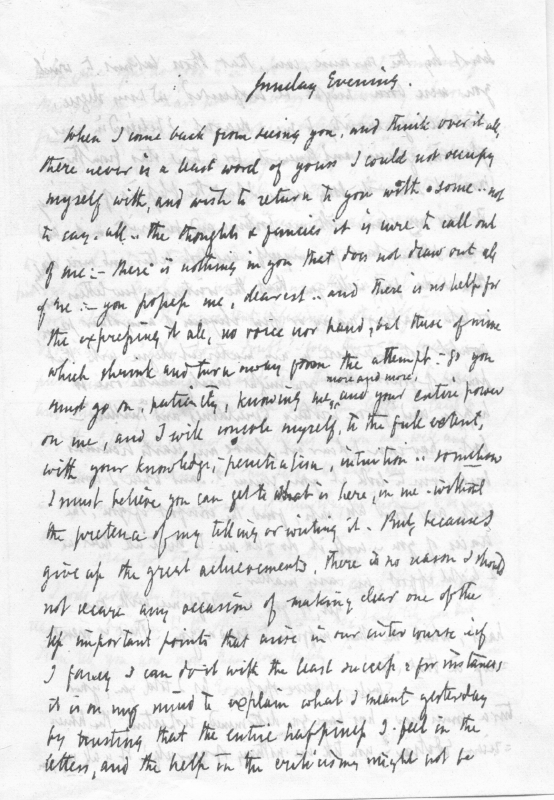
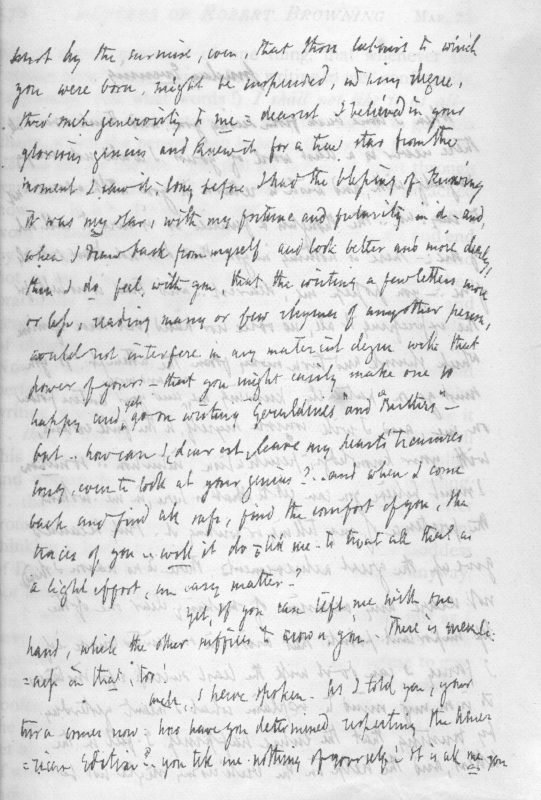
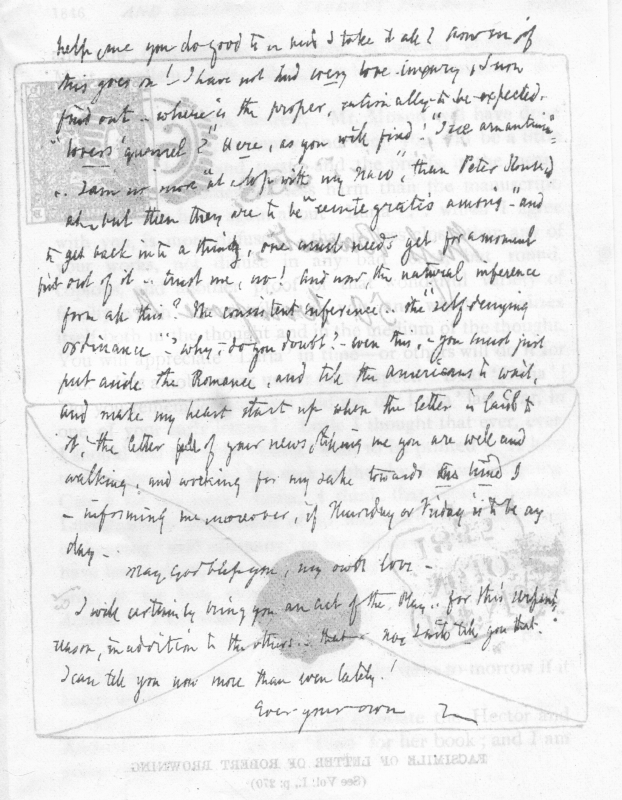
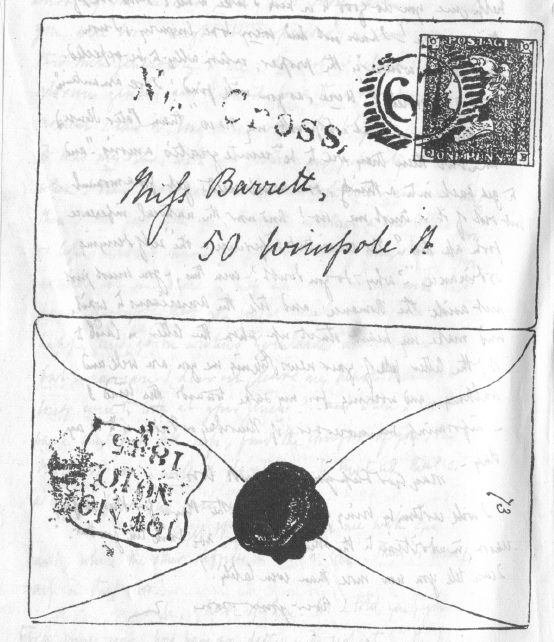
Facsimile of Letter of Robert Browning
(See Vol. I., p. 270)
E.B.B. to R.B.
Monday. [Post-mark, November 11, 1845.]
If it were possible that you could do me harm in the way of work, (but it isn't) it would be possible, not through writing letters and reading manuscripts, but because of a reason to be drawn from your own great line
What man is strong until he stands alone?
What man ... what woman? For have I not felt twenty times the desolate advantage of being insulated here and of not minding anybody when I made my poems?—of living a little like a disembodied spirit, and caring less for suppositious criticism than for the black fly buzzing in the pane?—That made me what dear Mr. Kenyon calls 'insolent,'—untimid, and unconventional in my degree; and not so much by strength, you see, as by separation. You touch your greater ends by mere strength; breaking with your own hands the hampering threads which, in your position would have hampered me.
Still ... when all is changed for me now, and different, it is not possible, ... for all the changing, nor for all your line and my speculation, ... that I should not be better and stronger for being within your influences and sympathies, in this way of writing as in other ways. We shall see—you will see. Yet I have been idle lately I confess; leaning half out of some turret-window of the castle of Indolence and watching the new sunrise—as why not?—Do I mean to be idle always?—no!—and am I not an industrious worker on the average of days? Indeed yes! Also I have been less idle than you think perhaps, even this last year, though the results seem so like trifling: and I shall set about the prose papers for the New York people, and the something rather better besides we may hope ... may I not hope, if you wish it? Only there is no 'crown' for me, be sure, except what grows from this letter and such letters ... this sense of being anything to one! there is no room for another crown. Have I a great head like Goethe's that there should be room? and mine is bent down already by the unused weight—and as to bearing it, ... 'Will it do,—tell me; to treat that as a light effort, an easy matter?'
Now let me remember to tell you that the line of yours I have just quoted, and which has been present with me since you wrote it, Mr. Chorley has quoted too in his new novel of 'Pomfret.' You were right in your identifying of servant and waistcoat—and Wilson waited only till you had gone on Saturday, to give me a parcel and note; the novel itself in fact, which Mr. Chorley had the kindness to send me 'some days or weeks,' said the note, 'previous to the publication.' Very goodnatured of him certainly: and the book seems to me his best work in point of sustainment and vigour, and I am in process of being interested in it. Not that he is a maker, even for this prose. A feeler ... an observer ... a thinker even, in a certain sphere—but a maker ... no, as it seems to me—and if I were he, I would rather herd with the essayists than the novelists where he is too good to take inferior rank and not strong enough to 'go up higher.' Only it would be more right in me to be grateful than to talk so—now wouldn't it?
And here is Mr. Kenyon's letter back again—a kind good letter ... a letter I have liked to read (so it was kind and good in you to let me!)—and he was with me to-day and praising the 'Ride to Ghent,' and praising the 'Duchess,' and praising you altogether as I liked to hear him. The Ghent-ride was 'very fine'—and the
Into the midnight they galloped abreast
drew us out into the night as witnesses. And then, the 'Duchess' ... the conception of it was noble, and the vehicle, rhythm and all, most characteristic and individual ... though some of the rhymes ... oh, some of the rhymes did not find grace in his ears—but the incantation-scene, 'just trenching on the supernatural,' that was taken to be 'wonderful,' ... 'showing extraordinary power, ... as indeed other things did ... works of a highly original writer and of such various faculty!'—Am I not tired of writing your praises as he said then? So I shall tell you, instead of any more, that I went down to the drawing-room yesterday (because it was warm enough) by an act of supererogatory virtue for which you may praise me in turn. What weather it is! and how the year seems to have forgotten itself into April.
But after all, how have I answered your letter? and how are such letters to be answered? Do we answer the sun when he shines? May God bless you ... it is my answer—with one word besides ... that I am wholly and ever your
E.B.B.
On Thursday as far as I know yet—and you shall hear if there should be an obstacle. Will you walk? If you will not, you know, you must be forgetting me a little. Will you remember me too in the act of the play?—but above all things in taking the right exercise, and in not overworking the head. And this for no serpent's reason.
E.B.B. to R.B.
Two letters in one—Wednesday. [Post-mark, November 15, 1845.]
I shall see you to-morrow and yet am writing what you will have to read perhaps. When you spoke of 'stars' and 'geniuses' in that letter, I did not seem to hear; I was listening to those words of the letter which were of a better silver in the sound than even your praise could be; and now that at last I come to hear them in their extravagance (oh such pure extravagance about 'glorious geniuses'—) I can't help telling you they were heard last, and deserved it.
Shall I tell you besides?—The first moment in which I seemed to admit to myself in a flash of lightning the possibility of your affection for me being more than dream-work ... the first moment was that when you intimated (as you have done since repeatedly) that you cared for me not for a reason, but because you cared for me. Now such a 'parceque' which reasonable people would take to be irrational, was just the only one fitted to the uses of my understanding on the particular question we were upon ... just the 'woman's reason' suitable to the woman ...; for I could understand that it might be as you said, and, if so, that it was altogether unanswerable ... do you see? If a fact includes its own cause ... why there it stands for ever—one of 'earth's immortalities'—as long as it includes it.
And when unreasonableness stands for a reason, it is a promising state of things, we may both admit, and proves what it would be as well not too curiously to enquire into. But then ... to look at it in a brighter aspect, ... I do remember how, years ago, when talking the foolishnesses which women will talk when they are by themselves, and not forced to be sensible, ... one of my friends thought it 'safest to begin with a little aversion,' and another, wisest to begin with a great deal of esteem, and how the best attachments were produced so and so, ... I took it into my head to say that the best was where there was no cause at all for it, and the more wholly unreasonable, the better still; that the motive should lie in the feeling itself and not in the object of it—and that the affection which could (if it could) throw itself out on an idiot with a goître would be more admirable than Abelard's. Whereupon everybody laughed, and someone thought it affected of me and no true opinion, and others said plainly that it was immoral, and somebody else hoped, in a sarcasm, that I meant to act out my theory for the advantage of the world. To which I replied quite gravely that I had not virtue enough—and so, people laughed as it is fair to laugh when other people are esteemed to talk nonsense. And all this came back to me in the south wind of your 'parceque,' and I tell it as it came ... now.
Which proves, if it proves anything, ... while I have every sort of natural pleasure in your praises and like you to like my poetry just as I should, and perhaps more than I should; yet why it is all behind ... and in its place—and why I have a tendency moreover to sift and measure any praise of yours and to separate it from the superfluities, far more than with any other person's praise in the world.
Friday evening.—Shall I send this letter or not? I have been 'tra 'l si e 'l no,' and writing a new beginning on a new sheet even—but after all you ought to hear the remote echo of your last letter ... far out among the hills, ... as well as the immediate reverberation, and so I will send it,—and what I send is not to be answered, remember!
I read Luria's first act twice through before I slept last night, and feel just as a bullet might feel, not because of the lead of it but because shot into the air and suddenly arrested and suspended. It ('Luria') is all life, and we know (that is, the reader knows) that there must be results here and here. How fine that sight of Luria is upon the lynx hides—how you see the Moor in him just in the glimpse you have by the eyes of another—and that laugh when the horse drops the forage, what wonderful truth and character you have in that!—And then, when he is in the scene—: 'Golden-hearted Luria' you called him once to me, and his heart shines already ... wide open to the morning sun. The construction seems to me very clear everywhere—and the rhythm, even over-smooth in a few verses, where you invert a little artificially—but that shall be set down on a separate strip of paper: and in the meantime I am snatched up into 'Luria' and feel myself driven on to the ends of the poet, just as a reader should.
But you are not driven on to any ends? so as to be tired, I mean? You will not suffer yourself to be overworked because you are 'interested' in this work. I am so certain that the sensations in your head demand repose; and it must be so injurious to you to be perpetually calling, calling these new creations, one after another, that you must consent to be called to, and not hurry the next act, no, nor any act—let the people have time to learn the last number by heart. And how glad I am that Mr. Fox should say what he did of it ... though it wasn't true, you know ... not exactly. Still, I do hold that as far as construction goes, you never put together so much unquestionable, smooth glory before, ... not a single entanglement for the understanding ... unless 'the snowdrops' make an exception—while for the undeniableness of genius it never stood out before your readers more plainly than in that same number! Also you have extended your sweep of power—the sea-weed is thrown farther (if not higher) than it was found before; and one may calculate surely now how a few more waves will cover the brown stones and float the sight up away through the fissure of the rocks. The rhythm (to touch one of the various things) the rhythm of that 'Duchess' does more and more strike me as a new thing; something like (if like anything) what the Greeks called pedestrian-metre, ... between metre and prose ... the difficult rhymes combining too quite curiously with the easy looseness of the general measure. Then 'The Ride'—with that touch of natural feeling at the end, to prove that it was not in brutal carelessness that the poor horse was driven through all that suffering ... yes, and how that one touch of softness acts back upon the energy and resolution and exalts both, instead of weakening anything, as might have been expected by the vulgar of writers or critics. And then 'Saul'—and in a first place 'St. Praxed'—and for pure description, 'Fortú' and the deep 'Pictor Ignotus'—and the noble, serene 'Italy in England,' which grows on you the more you know of it—and that delightful 'Glove'—and the short lyrics ... for one comes to 'select' everything at last, and certainly I do like these poems better and better, as your poems are made to be liked. But you will be tired to hear it said over and over so, ... and I am going to 'Luria,' besides.
When you write will you say exactly how you are? and will you write? And I want to explain to you that although I don't make a profession of equable spirits, (as a matter of temperament, my spirits were always given to rock a little, up and down) yet that I did not mean to be so ungrateful and wicked as to complain of low spirits now and to you. It would not be true either: and I said 'low' to express a merely bodily state. My opium comes in to keep the pulse from fluttering and fainting ... to give the right composure and point of balance to the nervous system. I don't take it for 'my spirits' in the usual sense; you must not think such a thing. The medical man who came to see me made me take it the other day when he was in the room, before the right hour and when I was talking quite cheerfully, just for the need he observed in the pulse. 'It was a necessity of my position,' he said. Also I do not suffer from it in any way, as people usually do who take opium. I am not even subject to an opium-headache. As to the low spirits I will not say that mine have not been low enough and with cause enough; but even then, ... why if you were to ask the nearest witnesses, ... say, even my own sisters, ... everybody would tell you, I think, that the 'cheerfulness' even then, was the remarkable thing in me—certainly it has been remarked about me again and again. Nobody has known that it was an effort (a habit of effort) to throw the light on the outside,—I do abhor so that ignoble groaning aloud of the 'groans of Testy and Sensitude'—yet I may say that for three years I never was conscious of one movement of pleasure in anything. Think if I could mean to complain of 'low spirits' now, and to you. Why it would be like complaining of not being able to see at noon—which would simply prove that I was very blind. And you, who are not blind, cannot make out what is written—so you need not try. May God bless you long after you have done blessing me!