ELIZABETH BARRETT BARRETT (continued 12)
Reading edition
But ... but ... you know very fully that you are breaking faith in the matter of the 'Tragedy' and 'Luria'—you promised to rest—and you rest for three days. Is it so that people get well? or keep well? Indeed I do not think I shall let you have 'Luria.' Ah—be careful, I do beseech you—be careful. There is time for a pause, and the works will profit by it themselves. And you! And I ... if you are ill!—
For the rest I will let you walk in my field, and see my elms as much as you please ... though I hear about the shower bath with a little suspicion. Why, if it did you harm before, should it not again? and why should you use it, if it threatens harm? Now tell me if it hasn't made you rather unwell since the new trial!—tell me, dear, dearest.
As for myself, I believe that you set about exhorting me to be busy, just that I might not reproach you for the over-business. Confess that that was the only meaning of the exhortation. But no, you are quite serious, you say. You even threaten me in a sort of underground murmur, which sounds like a nascent earthquake; and if I do not write so much a day directly, your stipendiary magistrateship will take away my license to be loved ... I am not to be Ba to you any longer ... you say! And is this right? now I ask you. Ever so many chrystals fell off by that stroke of the baton, I do assure you. Only you did not mean quite what you said so too articulately, and you will unsay it, if you please, and unthink it near the elms.
As for the writing, I will write ... I have written ... I am writing. You do not fancy that I have given up writing?—No. Only I have certainly been more loitering and distracted than usual in what I have done, which is not my fault—nor yours directly—and I feel an indisposition to setting about the romance, the hand of the soul shakes. I am too happy and not calm enough, I suppose, to have the right inclination. Well—it will come. But all in blots and fragments there are verses enough, to fill a volume done in the last year.
And if there were not ... if there were none ... I hold that I should be Ba, and also your Ba ... which is 'insolence' ... will you say?
R.B. to E.B.B.
Thursday. [Post-mark, February 26, 1846.]
As for the 'third person,' my sweet Ba, he was a wise speaker from the beginning; and in our case he will say, turning to me—'the late Robert Hall—when a friend admired that one with so high an estimate of the value of intellectuality in woman should yet marry some kind of cook-maid animal, as did the said Robert; wisely answered, "you can't kiss Mind"! May you not discover eventually,' (this is to me) 'that mere intellectual endowments—though incontestably of the loftiest character—mere Mind, though that Mind be Miss B's—cannot be kissed—nor, repent too late the absence of those humbler qualities, those softer affections which, like flowerets at the mountain's foot, if not so proudly soaring as, as, as!...' and so on, till one of us died, with laughing or being laughed at! So judges the third person! and if, to help him, we let him into your room at Wimpole Street, suffered him to see with Flush's eyes, he would say with just as wise an air 'True, mere personal affections may be warm enough, but does it augur well for the durability of an attachment that it should be wholly, exclusively based on such perishable attractions as the sweetness of a mouth, the beauty of an eye? I could wish, rather, to know that there was something of less transitory nature co-existent with this—some congeniality of Mental pursuit, some—' Would he not say that? But I can't do his platitudes justice because here is our post going out and I have been all the morning walking in the perfect joy of my heart, with your letter, and under its blessing—dearest, dearest Ba—let me say more to-morrow—only this now, that you—ah, what are you not to me! My dearest love, bless you—till to-morrow when I will strengthen the prayer; (no, lengthen it!)
Ever your own.
'Hawthorn'25—to show how Spring gets on!
E.B.B. to R.B.
Thursday Evening. [Post-mark, February 27, 1846.]
If all third persons were as foolish as this third person of yours, ever dearest, first and second persons might follow their own devices without losing much in the way of good counsel. But you are unlucky in your third person as far as the wits go, he talks a great deal of nonsense, and Flush, who is sensible, will have nothing to do with him, he says, any more than you will with Sir Moses:—he is quite a third person singular for the nonsense he talks!
So, instead of him, you shall hear what I have been doing to-day. The sun, which drew out you and the hawthorns, persuaded me that it was warm enough to go down-stairs—and I put on my cloak as if I were going into the snow, and went into the drawing-room and took Henrietta by surprise as she sate at the piano singing. Well, I meant to stay half an hour and come back again, for I am upon 'Tinkler's ground' in the drawing-room and liable to whole droves of morning visitors—and Henrietta kept me, kept me, because she wanted me, besought me, to stay and see the great sight of Capt. Surtees Cook—plus his regimentals—fresh from the royal presence at St. James's, and I never saw him in my life, though he is a sort of cousin. So, though I hated it as you may think, ... not liking to be unkind to my sister, I stayed and stayed one ten minutes after another, till it seemed plain that he wasn't coming at all (as I told her) and that Victoria had kept him to dinner, enchanted with the regimentals. And half laughing and half quarrelling, still she kept me by force, until a knock came most significantly ... and 'There is Surtees' said she ... 'now you must and shall stay! So foolish,' (I had my hand on the door-handle to go out) 'he, your own cousin too! who always calls you Ba, except before Papa.' Which might have encouraged me perhaps, but I can't be sure of it, as the very next moment apprized us both that no less a person than Mrs. Jameson was standing out in the passage. The whole 36th. regiment could scarcely have been more astounding to me. As to staying to see her in that room, with the prospect of the military descent in combination, I couldn't have done it for the world! so I made Henrietta, who had drawn me into the scrape, take her up-stairs, and followed myself in a minute or two—and the corollary of this interesting history is, that being able to talk at all after all that 'fuss,' and after walking 'up-stairs and down-stairs' like the ancestor of your spider, proves my gigantic strength—now doesn't it?
For the rest, 'here be proofs' that the first person can be as foolish as any third person in the world. What do you think?
And Mrs. Jameson was kind beyond speaking of, and talked of taking me to Italy. What do you say? It is somewhere about the fifth or sixth proposition of the sort which has come to me. I shall be embarrassed, it seems to me, by the multitude of escorts to Italy. But the kindness, one cannot laugh at so much kindness.
I wanted to hear her speak of you, and was afraid. I could not name you. Yet I did want to hear the last 'Bell' praised.
She goes to Ireland for two months soon, but prints a book first, a collection of essays. I have not seen Mr. Kenyon, with whom she dined yesterday. The Macreadys were to be there, and he told me a week ago that he very nearly committed himself in a 'social mistake' by inviting you to meet them.
Ah my hawthorn spray! Do you know, I caught myself pitying it for being gathered, with that green promise of leaves on it! There is room too on it for the feet of a bird! Still I shall keep it longer than it would have stayed in the hedge, that is certain!
The first you ever gave me was a yellow rose sent in a letter, and shall I tell you what that means—the yellow rose? 'Infidelity,' says the dictionary of flowers. You see what an omen, ... to begin with!
Also you see that I am not tired with the great avatar to-day—the 'fell swoop' rather—mine, into the drawing-room, and Mrs. Jameson's on me.
And I shall hear to-morrow again, really? I 'let' you. And you are best, kindest, dearest, every day. Did I ever tell you that you made me do what you choose? I fancied that I only thought so. May God bless you. I am your own.
Shall I have the 'Soul's Tragedy' on Saturday?—any of it? But do not work—I beseech you to take care.
R.B. to E.B.B.
[Post-mark, February 27, 1846.]
To be sure my 'first person' was nonsensical, and, in that respect made speak properly, I hope, only he was cut short in the middle of his performance by the exigencies of the post. So, never mind what such persons say, my sweetest, because they know nothing at all—quod erat demonstrandum. But you, love, you speak roses, and hawthorn-blossoms when you tell me of the cloak put on, and the descent, and the entry, and staying and delaying. I will have had a hand in all that; I know what I wished all the morning, and now this much came true! But you should have seen the regimentals, if I could have so contrived it, for I confess to a Chinese love for bright red—the very names 'vermilion' 'scarlet' warm me, yet in this cold climate nobody wears red to comfort one's eye save soldiers and fox hunters, and old women fresh from a Parish Christmas Distribution of cloaks. To dress in floating loose crimson silk, I almost understand being a Cardinal! Do you know anything of Nat Lee's Tragedies? In one of them a man angry with a Cardinal cries—
Stand back, and let me mow this poppy down, This rank red weed that spoils the Churches' corn.
Is not that good? and presently, when the same worthy is poisoned (that is the Cardinal)—they bid him—'now, Cardinal, lie down and roar!'
Think of thy scarlet sins!
Of the justice of all which, you will judge with no Mrs. Jameson for guide when we see the Sistina together, I trust! By the way, yesterday I went to Dulwich to see some pictures, by old Teniers, Murillo, Gainsborough, Raphael!—then twenty names about, and last but one, as if just thought of, 'Correggio.' The whole collection, including 'a divine picture by Murillo,' and Titian's Daughter (hitherto supposed to be in the Louvre)—the whole I would, I think, have cheerfully given a pound or two for the privilege of not possessing—so execrable as sign-paintings even! 'Are there worse poets in their way than painters?' Yet the melancholy business is here—that the bad poet goes out of his way, writes his verses in the language he learned in order to do a hundred other things with it, all of which he can go on and do afterwards—but the painter has spent the best of his life in learning even how to produce such monstrosities as these, and to what other good do his acquisitions go? This short minute of life our one chance, an eternity on either side! and a man does not walk whistling and ruddy by the side of hawthorn hedges in spring, but shuts himself up and conies out after a dozen years with 'Titian's Daughter' and, there, gone is his life, let somebody else try!
I have tried—my trial is made too!
To-morrow you shall tell me, dearest, that Mrs. Jameson wondered to see you so well—did she not wonder? Ah, to-morrow! There is a lesson from all this writing and mistaking and correcting and being corrected; and what, but that a word goes safely only from lip to lip, dearest? See how the cup slipped from the lip and snapped the chrystals, you say! But the writing is but for a time—'a time and times and half a time!'—would I knew when the prophetic weeks end! Still, one day, as I say, no more writing, (and great scandalization of the third person, peeping through the fringes of Flush's ears!) meanwhile, I wonder whether if I meet Mrs. Jameson I may practise diplomacy and say carelessly 'I should be glad to know what Miss B. is like—' No, that I must not do, something tells me, 'for reasons, for reasons'—
I do not know—you may perhaps have to wait a little longer for my 'divine Murillo' of a Tragedy. My sister is copying it as I give the pages, but—in fact my wise head does ache a little—it is inconceivable! As if it took a great storm to topple over some stone, and once the stone pushed from its right place, any bird's foot, which would hardly bend the hawthorn spray, may set it trembling! The aching begins with reading the presentation-list at the Drawing-room quite naturally, and with no shame at all! But it is gentle, well-behaved aching now, so I do care, as you bid me, Ba, my Ba, whom I call Ba to my heart but could not, I really believe, call so before another, even your sister, if—if—
But Ba, I call you boldly here, and I dare kiss your dear, dear eyes, till to-morrow—Bless you, my own.
E.B.B. to R.B.
Sunday. [Post-mark, March 2, 1846.]
You never could think that I meant any insinuation against you by a word of what was said yesterday, or that I sought or am likely to seek a 'security'! do you know it was not right of you to use such an expression—indeed no. You were angry with me for just one minute, or you would not have used it—and why? Now what did I say that was wrong or unkind even by construction? If I did say anything, it was three times wrong, and unjust as well as unkind, and wronged my own heart and consciousness of all that you are to me, more than it could you. But you began speaking of yourself just as a woman might speak under the same circumstances (you remember what you said), and then I, remembering that all the men in the world would laugh such an idea to scorn, said something to that effect, you know. I once was in company with a man, however, who valued himself very much on his constancy to a woman who was so deeply affected by it that she became his wife at last ... and the whole neighbourhood came out to stare at him on that ground as a sort of monster. And can you guess what the constancy meant? Seven years before, he loved that woman, he said, and she repulsed him. 'And in the meantime, how many?' I had the impertinence to ask a female friend who told me the tale. 'Why,' she answered with the utmost simplicity, 'I understand that Miss A. and Miss B. and Mrs. C. would not listen to him, but he took Miss D.'s rejection most to heart.' That was the head and front of his 'constancy' to Miss E., who had been loved, she boasted, for seven years ... that is, once at the beginning and once at the end. It was just a coincidence of the 'premier pas' and the 'pis aller.'
Beloved, I could not mean this for you; you are not made of such stuff, as we both know.
And for myself, it was my compromise with my own scruples, that you should not be 'chained' to me, not in the merest metaphor, that you should not seem to be bound, in honour or otherwise, so that if you stayed with me it should be your free choice to stay, not the consequence of a choice so many months before. That was my compromise with my scruples, and not my doubt of your affection—and least of all, was it an intention of trifling with you sooner or later that made me wish to suspend all decisions as long as possible. I have decided (for me) to let it be as you shall please—now I told you that before. Either we will live on as we are, until an obstacle arises,—for indeed I do not look for a 'security' where you suppose, and the very appearance of it there, is what most rebuts me—or I will be yours in the obvious way, to go out of England the next half-hour if possible. As to the steps to be taken (or not taken) before the last step, we must think of those. The worst is that the only question is about a form. Virtually the evil is the same all round, whatever we do. Dearest, it was plain to see yesterday evening when he came into this room for a moment at seven o'clock, before going to his own to dress for dinner ... plain to see, that he was not altogether pleased at finding you here in the morning. There was no pretext for objecting gravely—but it was plain that he was not pleased. Do not let this make you uncomfortable, he will forget all about it, and I was not scolded, do you understand. It was more manner, but my sisters thought as I did of the significance:—and it was enough to prove to me (if I had not known) what a desperate game we should be playing if we depended on a yielding nerve there.
And to-day I went down-stairs (to prove how my promises stand) though I could find at least ten good excuses for remaining in my own room, for our cousin, Sam Barrett, who brought the interruption yesterday and put me out of humour (it wasn't the fault of the dear little cousin, Lizzie ... my 'portrait' ... who was 'so sorry,' she said, dear child, to have missed Papa somewhere on the stairs!) the cousin who should have been in Brittany yesterday instead of here, sate in the drawing-room all this morning, and had visitors there, and so I had excellent excuses for never moving from my chair. Yet, the field being clear at half-past two! I went for half an hour, just—just for you. Did you think of me, I wonder? It was to meet your thoughts that I went, dear dearest.
How clever these sketches are. The expression produced by such apparently inadequate means is quite striking; and I have been making my brothers admire them, and they 'wonder you don't think of employing them in an illustrated edition of your works.' Which might be, really! Ah, you did not ask for 'Luria'! Not that I should have let you have it!—I think I should not indeed. Dearest, you take care of the head ... and don't make that tragedy of the soul one for mine, by letting it make you ill. Beware too of the shower-bath—it plainly does not answer for you at this season. And walk, and think of me for your good, if such a combination should be possible.
And I think of you ... if I do not of Italy. Yet I forget to speak to you of the Dulwich Gallery. I never saw those pictures, but am astonished that the whole world should be wrong in praising them. 'Divine' is a bad word for Murillo in any case—because he is intensely human in his most supernatural subjects. His beautiful Trinity in the National Gallery, which I saw the last time I went out to look at pictures, has no deity in it—and I seem to see it now. And do you remember the visitation of the angels to Abraham (the Duke of Sutherland's picture—is it not?) where the mystic visitors look like shepherds who had not even dreamt of God? But I always understood that that Dulwich Gallery was famous for great works—you surprise me! And for painters ... their badness is more ostentatious than that of poets—they stare idiocy out of the walls, and set the eyes of sensitive men on edge. For the rest, however, I very much doubt whether they wear their lives more to rags, than writers who mistake their vocation in poetry do. There is a mechanism in poetry as in the other art—and, to men not native to the way of it, it runs hard and heavily. The 'cudgelling of the brain' is as good labour as the grinding of the colours, ... do you not think?
If ever I am in the Sistine Chapel, it will not be with Mrs. Jameson—no. If ever I should be there, what teaching I shall want, I who have seen so few pictures, and love them only as children do, with an unlearned love, just for the sake of the thoughts they bring. Wonderfully ignorant I am, to have had eyes and ears so long! There is music, now, which lifts the hair on my head, I feel it so much, ... yet all I know of it as art, all I have heard of the works of the masters in it, has been the mere sign and suggestion, such as the private piano may give. I never heard an oratorio, for instance, in my life—judge by that! It is a guess, I make, at all the greatness and divinity ... feeling in it, though, distinctly and certainly, that a composer like Beethoven must stand above the divinest painter in soul-godhead, and nearest to the true poet, of all artists. And this I felt in my guess, long before I knew you. But observe how, if I had died in this illness, I should have left a sealed world behind me! you, unknown too—unguessed at, you, ... in many respects, wonderfully unguessed at! Lately I have learnt to despise my own instincts. And apart from those—and you, ... it was right for me to be melancholy, in the consciousness of passing blindfolded under all the world-stars, and of going out into another side of the creation, with a blank for the experience of this ... the last revelation, unread! How the thought of it used to depress me sometimes!
Talking of music, I had a proposition the other day from certain of Mr. Russell's (the singer's) friends, about his setting to music my 'Cry of the Children.' His programme exhibits all the horrors of the world, I see! Lifeboats ... madhouses ... gamblers' wives ... all done to the right sort of moaning. His audiences must go home delightfully miserable, I should fancy. He has set the 'Song of the Shirt' ... and my 'Cry of the Children' will be acceptable, it is supposed, as a climax of agony. Do you know this Mr. Russell, and what sort of music he suits to his melancholy? But to turn my 'Cry' to a 'Song,' a burden, it is said, is required—he can't sing it without a burden! and behold what has been sent 'for my approval'.... I shall copy it verbatim for you....
And the threads twirl, twirl, twirl, Before each boy and girl; And the wheels, big and little, still whirl, whirl, whirl.
... accompaniment agitato, imitating the roar of the machinery!
This is not endurable ... ought not to be ... should it now? Do tell me.
May God bless you, very dearest! Let me hear how you are—and think how I am
Your own....
R.B. to E.B.B.
[Post-mark, March 2, 1846.]
Dearest, I have been kept in town and just return in time to say why you have no note ... to-morrow I will write ... so much there is to say on the subject of this letter I find.
Bless you, all beloved—
R.B.
Oh, do not sleep another night on that horrible error I have led you into! The 'Dulwich Gallery'!—!!!—oh, no. Only some pictures to be sold at the Greyhound Inn, Dulwich—'the genuine property of a gentleman deceased.'
R.B. to E.B.B.
Sunday Evening. [Post-mark, March 2, 1846.]
One or two words, if no more, I must write to dearest Ba, the night would go down in double blackness if I had neither written nor been written to! So here is another piece of 'kindness' on my part, such as I have received praise for of late! My own sweetest, there is just this good in such praise, that by it one comes to something pleasantly definite amid the hazy uncertainties of mere wishes and possibilities—while my whole heart does, does so yearn, love, to do something to prove its devotion for you; and, now and then, amuses itself with foolish imaginings of real substantial services to which it should be found equal if fortune so granted; suddenly you interpose with thanks, in such terms as would all too much reward the highest of even those services which are never to be; and for what?—for a note, a going to Town, a ——! Well, there are definite beginnings certainly, if you will recognise them—I mean, that since you do accept, far from 'despising this day of small things,' then I may take heart, and be sure that even though none of the great achievements should fall to my happy chance, still the barrenest, flattest life will—must of needs produce in its season better fruits than these poor ones—I keep it, value it, now, that it may produce such.
Also I determine never again to 'analyse,' nor let you analyse if the sweet mouth can be anyway stopped: the love shall be one and indivisible—and the Loves we used to know from
One another huddled lie ... Close beside Her tenderly—
(which is surely the next line). Now am I not anxious to know what your father said? And if anybody else said or wondered ... how hould I know? Of all fighting—the warfare with shadows—what a work is there. But tell me,—and, with you for me—
Bless me dearest ever, as the face above mine blesses me—
Your own
Sir Moses set off this morning, I hear—somebody yesterday called the telescope an 'optical delusion,' anticipating many more of the kind! So much for this 'wandering Jew.'
E.B.B. to R.B.
Monday Evening. [Post-mark, March 3, 1846.]
Upon the whole, I think, I am glad when you are kept in town and prevented from writing what you call 'much' to me. Because in the first place, the little from you, is always much to me—and then, besides, the letter comes, and with it the promise of another! Two letters have I had from you to-day, ever dearest! How I thank you!—yes, indeed! It was like yourself to write yesterday ... to remember what a great gap there would have been otherwise, as it looked on this side—here. The worst of Saturday is (when you come on it) that Sunday follows—Saturday night bringing no letter. Well, it was very good of you, best of you!
For the 'analyzing' I give it up willingly, only that I must say what altogether I forgot to say in my last letter, that it was not I, if you please, who spoke of the chrystals breaking away! And you, to quote me with that certainty! "The chrystals are broken off," you say.' I say!! When it was in your letter, and not at all in mine!!
The truth is that I was stupid, rather, about the Dulwich collection—it was my fault. I caught up the idea of the gallery out of a heap of other thoughts, and really might have known better if I had given myself a chance, by considering.
Mr. Kenyon came to-day, and has taken out a licence, it seems to me, for praising you, for he praised and praised. Somebody has told him (who had spent several days with you in a house with a large library) that he came away 'quite astounded by the versatility of your learning'—and that, to complete the circle, you discoursed as scientifically on the training of greyhounds and breeding of ducks as if you had never done anything else all your life. Then dear Mr. Kenyon talked of the poems; and hoped, very earnestly I am sure, that you would finish 'Saul'—which you ought to do, must do—only not now. By the way Mrs. Coleridge had written to him to enquire whether you had authority for the 'blue lilies,' rather than white. Then he asked about 'Luria' and 'whether it was obscure'; and I said, not unless the people, who considered it, began by blindfolding themselves.
And where do you think Mr. Kenyon talks of going next February—a long while off to be sure? To Italy of course. Everybody I ever heard of seems to be going to Italy next winter. He visits his brother at Vienna, and 'may cross the Alps and get to Pisa'—it is the shadow of a scheme—nothing certain, so far.
I did not go down-stairs to-day because the wind blew and the thermometer fell. To-morrow, perhaps I may. And you, dearest dearest, might have put into the letters how you were when you wrote them. You might—but you did not feel well and would not say so. Confess that that was the reason. Reason or no reason, mention yourself to-morrow, and for the rest, do not write a long letter so as to increase the evil. There was nothing which I can remember as requiring an answer in what I wrote to you, and though I will have my letter of course, it shall be as brief as possible, if briefness is good for you—now always remember that. Why if I, who talk against 'Luria,' should work the mischief myself, what should I deserve? I should be my own jury directly and not recommend to mercy ... not to mine. Do take care—care for me just so much.
And, except that taking care of your health, what would you do for me that you have not done? You have given me the best of the possible gifts of one human soul to another, you have made my life new, and am I to count these things as small and insufficient? Ah, you know, you know that I cannot, ought not, will not.
May God bless you. He blesses me in letting me be grateful to you as your Ba.
R.B. to E.B.B.
Tuesday. [Post-mark, March 3, 1846.]
First and most important of all,—dearest, 'angry'—with you, and for that! It is just as if I had spoken contemptuously of that Gallery I so love and so am grateful to—having been used to go there when a child, far under the age allowed by the regulations—those two Guidos, the wonderful Rembrandt of Jacob's vision, such a Watteau, the triumphant three Murillo pictures, a Giorgione music-lesson group, all the Poussins with the 'Armida' and 'Jupiter's nursing'—and—no end to 'ands'—I have sate before one, some one of those pictures I had predetermined to see, a good hour and then gone away ... it used to be a green half-hour's walk over the fields. So much for one error, now for the second like unto it; what I meant by charging you with seeing, (not, not 'looking for')—seeing undue 'security' in that, in the form,—I meant to say 'you talk about me being 'free' now, free till then, and I am rather jealous of the potency attributed to the form, with all its solemnity, because it is a form, and no more—yet you frankly agree with me that that form complied with, there is no redemption; yours I am then sure enough, to repent at leisure &c. &c.' So I meant to ask, 'then, all now said, all short of that particular form of saying it, all goes for comparatively nothing'? Here it is written down—you 'wish to suspend all decisions as long as possible'—that form effects the decision, then,—till then, 'where am I'? Which is just what Lord Chesterfield cautions people against asking when they tell stories. Love, Ba, my own heart's dearest, if all is not decided now—why—hear a story, à propos of storytelling, and deduce what is deducible. A very old Unitarian minister met a still older evangelical brother—John Clayton (from whose son's mouth I heard what you shall hear)—the two fell to argument about the true faith to be held—after words enough, 'Well,' said the Unitarian, as winding up the controversy with an amicable smile—'at least let us hope we are both engaged in the pursuit of Truth!'—'Pursuit do you say?' cried the other, 'here am I with my years eighty and odd—if I haven't found Truth by this time where is my chance, pray?' My own Ba, if I have not already decided, alas for me and the solemn words that are to help! Though in another point of view there would be some luxurious feeling, beyond the ordinary, in knowing one was kept safe to one's heart's good by yet another wall than the hitherto recognised ones. Is there any parallel in the notion I once heard a man deliver himself of in the street—a labourer talking with his friends about 'wishes'—and this one wished, if he might get his wish, 'to have a nine gallon cask of strong ale set running that minute and his own mouth to be tied under it'—the exquisiteness of the delight was to be in the security upon security,—the being 'tied.' Now, Ba says I shall not be 'chained' if she can help!
But now—here all the jesting goes. You tell me what was observed in the 'moment's' visit; by you, and (after, I suppose) by your sisters. First, I will always see with your eyes there—next, what I see I will never speak, if it pain you; but just this much truth I ought to say, I think. I always give myself to you for the worst I am,—full of faults as you will find, if you have not found them. But I will not affect to be so bad, so wicked, as I count wickedness, as to call that conduct other than intolerable—there, in my conviction of that, is your real 'security' and mine for the future as the present. That a father choosing to give out of his whole day some five minutes to a daughter, supposed to be prevented from participating in what he, probably, in common with the whole world of sensible men, as distinguished from poets and dreamers, consider every pleasure of life, by a complete foregoing of society—that he, after the Pisa business and the enforced continuance, and as he must believe, permanence of this state in which any other human being would go mad—I do dare say, for the justification of God, who gave the mind to be used in this world,—where it saves us, we are taught, or destroys us,—and not to be sunk quietly, overlooked, and forgotten; that, under these circumstances, finding ... what, you say, unless he thinks he does find, he would close the door of his house instantly; a mere sympathizing man, of the same literary tastes, who comes good-naturedly, on a proper and unexceptionable introduction, to chat with and amuse a little that invalid daughter, once a month, so far as is known, for an hour perhaps,—that such a father should show himself 'not pleased plainly,' at such a circumstance ... my Ba, it is shocking! See, I go wholly on the supposition that the real relation is not imagined to exist between us. I so completely could understand a repugnance to trust you to me were the truth known, that, I will confess, I have several times been afraid the very reverse of this occurrence would befall; that your father would have at some time or other thought himself obliged, by the usual feeling of people in such cases, to see me for a few minutes and express some commonplace thanks after the customary mode (just as Capt. Domett sent a heap of unnecessary thanks to me not long ago for sending now a letter now a book to his son in New Zealand—keeping up the spirits of poor dear Alfred now he is cut off from the world at large)—and if this had been done, I shall not deny that my heart would have accused me—unreasonably I know but still, suppression, and reserve, and apprehension—the whole of that is horrible always! But this way of looking on the endeavour of anybody, however humble, to just preserve your life, remedy in some degree the first, if it was the first, unjustifiable measure,—this being 'displeased'—is exactly what I did not calculate upon. Observe, that in this only instance I am able to do as I shall be done by; to take up the arms furnished by the world, the usages of society—this is monstrous on the world's showing! I say this now that I may never need recur to it—that you may understand why I keep such entire silence henceforth.
Get but well, keep but as well, and all is easy now. This wonderful winter—the spring—the summer—you will take exercise, go up and down stairs, get strong. I pray you, at your feet, to do this, dearest! Then comes Autumn, with the natural expectations, as after rouge one expects noir: the likelihood of a severe winter after this mild one, which to prevent, you reiterate your demand to go and save your life in Italy, ought you not to do that? And the matters brought to issue, (with even, if possible, less shadow of ground for a refusal than before, if you are well, plainly well enough to bear the voyage) there I will bid you 'be mine in the obvious way'—if you shall preserve your belief in me—and you may in much, in all important to you. Mr. Kenyon's praise is undeserved enough, but yesterday Milnes said I was the only literary man he ever knew, tenax propositi, able to make out a life for himself and abide in it—'for,' he went on, 'you really do live without any of this titillation and fussy dependence upon adventitious excitement of all kinds, they all say they can do without.' That is more true—and I intend by God's help to live wholly for you; to spend my whole energies in reducing to practice the feeling which occupies me, and in the practical operation of which, the other work I had proposed to do will be found included, facilitated—I shall be able—but of this there is plenty time to speak hereafter—I shall, I believe, be able to do this without even allowing the world to very much misinterpret—against pure lying there is no defence, but all up to that I hope to hinder or render unimportant—as you shall know in time and place.
I have written myself grave, but write to me, dear, dearest, and I will answer in a lighter mood—even now I can say how it was yesterday's hurry happened. I called on Milnes—who told me Hanmer had broken a bone in his leg and was laid up, so I called on him too—on Moxon, by the way, (his brother telling me strangely cheering news, from the grimmest of faces, about my books selling and likely to sell ... your wishes, Ba!)—then in Bond Street about some business with somebody, then on Mrs. Montagu who was out walking all the time, and home too. I found a letter from Mr. Kenyon, perfectly kind, asking me to go on Monday to meet friends, and with yours to-day comes another confirming the choice of the day. How entirely kind he is!
I am very well, much better, indeed—taking that bath with sensibly good effect, to-night I go to Montagu's again; for shame, having kept away too long.
And the rest shall answer yours—dear! Not 'much to answer?' And Beethoven, and Painting and—what is the rest and shall be answered! Bless you, now, my darling—I love you, ever shall love you, ever be your own.
E.B.B. to R.B.
Tuesday Evening. [Post-mark, March 4, 1846.]
Yes, but, dearest, you mistake me, or you mistake yourself. I am sure I do not over-care for forms—it is not my way to do it—and in this case ... no. Still you must see that here is a fact as well as a form, and involving a frightful quantity of social inconvenience (to use the mildest word) if too hastily entered on. I deny altogether looking for, or 'seeing' any 'security' in it for myself—it is a mere form for the heart and the happiness: illusions may pass after as before. Still the truth is that if they were to pass with you now, you stand free to act according to the wide-awakeness of your eyes, and to reform your choice ... see! whereas afterward you could not carry out such a reformation while I was alive, even if I helped you. All I could do for you would be to walk away. And you pretend not to see this broad distinction?—ah. For me I have seen just this and no more, and have felt averse to forestall, to seem to forestall even by an hour, or a word, that stringency of the legal obligation from which there is in a certain sense no redemption. Tie up your drinker under the pour of his nine gallons, and in two minutes he will moan and writhe (as you perfectly know) like a Brinvilliers under the water-torture. That he asked to be tied up, was unwise on his own principle of loving ale. And you sha'n't be 'chained' up, if you were to ask twenty times: if you have found truth or not in the water-well.
You do not see aright what I meant to tell you on another subject. If he was displeased, (and it was expressed by a shadow a mere negation of pleasure) it was not with you as a visitor and my friend. You must not fancy such a thing. It was a sort of instinctive indisposition towards seeing you here—unexplained to himself, I have no doubt—of course unexplained, or he would have desired me to receive you never again, that would have been done at once and unscrupulously. But without defining his own feeling, he rather disliked seeing you here—it just touched one of his vibratory wires, brushed by and touched it—oh, we understand in this house. He is not a nice observer, but, at intervals very wide, he is subject to lightnings—call them fancies, sometimes right, sometimes wrong. Certainly it was not in the character of a 'sympathising friend' that you made him a very little cross on Monday. And yet you never were nor will be in danger of being thanked, he would not think of it. For the reserve, the apprehension—dreadful those things are, and desecrating to one's own nature—but we did not make this position, we only endure it. The root of the evil is the miserable misconception of the limits and character of parental rights—it is a mistake of the intellect rather than of the heart. Then, after using one's children as one's chattels for a time, the children drop lower and lower toward the level of the chattels, and the duties of human sympathy to them become difficult in proportion. And (it seems strange to say it, yet it is true) love, he does not conceive of at all. He has feeling, he can be moved deeply, he is capable of affection in a peculiar way, but that, he does not understand, any more than he understands Chaldee, respecting it less of course.
And you fancy that I could propose Italy again? after saying too that I never would? Oh no, no—yet there is time to think of this, a superfluity of time, ... 'time, times and half a time' and to make one's head swim with leaning over a precipice is not wise. The roar of the world comes up too, as you hear and as I heard from the beginning. There will be no lack of 'lying,' be sure—'pure lying' too—and nothing you can do, dearest dearest, shall hinder my being torn to pieces by most of the particularly affectionate friends I have in the world. Which I do not think of much, any more than of Italy. You will be mad, and I shall be bad ... and that will be the effect of being poets! 'Till when, where are you?'—why in the very deepest of my soul—wherever in it is the fountain head of loving! beloved, there you are!
Some day I shall ask you 'in form,'—as I care so much for forms, it seems,—what your 'faults' are, these immense multitudinous faults of yours, which I hear such talk of, and never, never, can get to see. Will you give me a catalogue raisonnée of your faults? I should like it, I think. In the meantime they seem to be faults of obscurity, that is, invisible faults, like those in the poetry which do not keep it from selling as I am so, so glad to understand. I am glad too that Mr. Milnes knows you a little.
Now I must end, there is no more time to-night. God bless you, very dearest! Keep better ... try to be well—as I do for you since you ask me. Did I ever think that you would think it worth while to ask me that? What a dream! reaching out into the morning! To-day however I did not go down-stairs, because it was colder and the wind blew its way into the passages:—if I can to-morrow without risk, I will, ... be sure ... be sure. Till Thursday then!—till eternity!
'Till when, where am I,' but with you? and what, but yours
Your
Ba.
I have been writing 'autographs' (save my mark) for the North and the South to-day ... the Fens, and Golden Square. Somebody asked for a verse, ... from either 'Catarina' or 'Flush' ... 'those poems' &c. &c.! Such a concatenation of criticisms. So I preferred Flush of course—i.e. gave him the preferment.
R.B. to E.B.B.
Wednesday Morning. [Post-mark, March 4, 1846.]
Ah, sweetest, don't mind people and their lies any more than I shall; if the toad does 'take it into his toad's head to spit at you'—you will not 'drop dead,' I warrant. All the same, if one may make a circuit through a flower-bed and see the less of his toad-habits and general ugliness, so much the better—no words can express my entire indifference (far below contempt) for what can be said or done. But one thing, only one, I choose to hinder being said, if I can—the others I would not if I could—why prevent the toad's puffing himself out thrice his black bigness if it amuses him among those wet stones? We shall be in the sun.
I dare say I am unjust—hasty certainly, in the other matter—but all faults are such inasmuch as they are 'mistakes of the intellect'—toads may spit or leave it alone,—but if I ever see it right, exercising my intellect, to treat any human beings like my 'chattels'—I shall pay for that mistake one day or another, I am convinced—and I very much fear that you would soon discover what one fault of mine is, if you were to hear anyone assert such a right in my presence.
Well, I shall see you to-morrow—had I better come a little later, I wonder?—half-past three, for instance, staying, as last time, till ... ah, it is ill policy to count my treasure aloud! Or shall I come at the usual time to-morrow? If I do not hear, at the usual time!—because, I think you would—am sure you would have considered and suggested it, were it necessary.
Bless you, dearest—ever your own.
I said nothing about that Mr. Russell and his proposition—by all means, yes—let him do more good with that noble, pathetic 'lay'—and do not mind the 'burthen,' if he is peremptory—so that he duly specify 'by the singer'—with that precaution nothing but good can come of his using it.
E.B.B. to R.B.
Thursday. [Post-mark, March 6, 1846.]
Ever dearest I lose no time in writing, you see, so as to be written to at the soonest—and there is another reason which makes me hasten to write ... it is not all mercantile calculation. I want you to understand me.
Now listen! I seem to understand myself: it seems to me that every word I ever said to you on one subject, is plainly referable to a class of feelings of which you could not complain ... could not. But this is my impression; and yours is different:—you do not understand, you do not see by my light, and perhaps it is natural that you should not, as we stand on different steps of the argument. Still I, who said what I did, for you, and from an absorbing consideration of what was best for you, cannot consent, even out of anxiety for your futurity, to torment you now, to vex you by a form of speech which you persist in translating into a want of trust in you ... (I, want trust in you!!) into a need of more evidence about you from others ... (could you say so?) and even into an indisposition on my part to fulfil my engagement—no, dearest dearest, it is not right of you. And therefore, as you have these thoughts reasonably or unreasonably, I shall punish you for them at once, and 'chain' you ... (as you wish to be chained), chain you, rivet you—do you feel how the little fine chain twists round and round you? do you hear the stroke of the riveting? and you may feel that too. Now, it is done—now, you are chained—Bia has finished the work—I, Ba! (observe the anagram!) and not a word do you say, of Prometheus, though you have the conscience of it all, I dare say. Well! you must be pleased, ... as it was 'the weight of too much liberty' which offended you: and now you believe, perhaps, that I trust you, love you, and look to you over the heads of the whole living world, without any one head needing to stoop; you must, if you please, because you belong to me now and shall believe as I choose. There's a ukase for you! Cry out ... repent ... and I will loose the links, and let you go again—shall it be 'My dear Miss Barrett?'
Seriously, you shall not think of me such things as you half said, if not whole said, to-day. If all men were to speak evil of you, my heart would speak of you the more good—that would be the one result with me. Do I not know you, soul to soul? should I believe that any of them could know you as I know you? Then for the rest, I am not afraid of 'toads' now, not being a child any longer. I am not inclined to mind, if you do not mind, what may be said about us by the benevolent world, nor will other reasons of a graver kind affect me otherwise than by the necessary pain. Therefore the whole rests with you—unless illness should intervene—and you will be kind and good (will you not?) and not think hard thoughts of me ever again—no. It wasn't the sense of being less than you had a right to pretend to, which made me speak what you disliked—for it is I who am 'unworthy,' and not another—not certainly that other!
I meant to write more to-night of subjects farther off us, but my sisters have come up-stairs and I must close my letter quickly. Beloved, take care of your head! Ah, do not write poems, nor read, nor neglect the walking, nor take that shower-bath. Will you, instead, try the warm bathing? Surely the experiment is worth making for a little while. Dearest beloved, do it for your own
Ba.
R.B. to E.B.B.
Friday Morning. [Post-mark, March 6, 1846.]
I am altogether your own, dearest—the words were only words and the playful feelings were play—while the fact has always been so irresistibly obvious as to make them break on and off it, fantastically like water turning to spray and spurts of foam on a great solid rock. Now you call the rock, a rock, but you must have known what chance you had of pushing it down when you sent all those light fancies and free-leaves, and refusals-to-hold-responsible, to do what they could. It is a rock; and may be quite barren of good to you,—not large enough to build houses on, not small enough to make a mantelpiece of, much less a pedestal for a statue, but it is real rock, that is all.
It is always I who 'torment' you—instead of taking the present and blessing you, and leaving the future to its own cares. I certainly am not apt to look curiously into what next week is to bring, much less next month or six months, but you, the having you, my own, dearest beloved, that is as different in kind as in degree from any other happiness or semblance of it that even seemed possible of realization. Then, now, the health is all to stay, or retard us—oh, be well, my Ba!
Let me speak of that letter—I am ashamed at having mentioned those circumstances, and should not have done so, but for their insignificance—for I knew that if you ever did hear of them, all any body would say would not amount to enough to be repeated to me and so get explained at once. Now that the purpose is gained, it seems little worth gaining. You bade me not send the letter: I will not.
As for 'what people say'—ah—Here lies a book, Bartoli's 'Simboli' and this morning I dipped into his Chapter XIX. His 'Symbol' is 'Socrate fatto ritrar su' Boccali' and the theme of his dissertating, 'L'indegnità del mettere in disprezzo i più degni filosofi dell'antichità.' He sets out by enlarging on the horror of it—then describes the character of Socrates, then tells the story of the representation of the 'Clouds,'and thus gets to his 'symbol'—'le pazzie fatte spacciare a Socrate in quella commedia ... il misero in tanto scherno e derisione del pubblico, che perfino i vasai dipingevano il suo ritratto sopra gli orci, i fiaschi, i boccali, e ogni vasellamento da più vile servigio. Così quel sommo filosofo ... fu condotto a far di se par le case d'Atene una continua commedia, con solamente vederlo comparir così scontraffatto e ridicolo, come i vasai sel formavano d'invenzione'—
There you have what a very clever man can say in choice Tuscan on a passage in Ælian which he takes care not to quote nor allude to, but which is the sole authority for the fact. Ælian, speaking of Socrates' magnanimity, says that on the first representation, a good many foreigners being present who were at a loss to know 'who could be this Socrates'—the sage himself stood up that he might be pointed out to them by the auditory at large ... 'which' says Ælian—'was no difficulty for them, to whom his features were most familiar,—the very potters being in the habit of decorating their vessels with his likeness'—no doubt out of a pleasant and affectionate admiration. Yet see how 'people' can turn this out of its sense,—'say' their say on the simplest, plainest word or deed, and change it to its opposite! 'God's great gift of speech abused' indeed!
But what shall we hear of it there, my Siren?
On Monday—is it not? Who was it looked into the room just at our leave-taking?
Bless you, my ever dearest,—remember to walk, to go down-stairs—and be sure that I will endeavour to get well for my part. To-day I am very well—with this letter!
Your own.
E.B.B. to R.B.
Friday Evening. [Post-mark, March 7, 1846.]
Always you, is it, who torments me? always you? Well! I agree to bear the torments as Socrates his persecution by the potters:—and by the way he liked those potters, as Plato shows, and was fain to go to them for his illustrations ... as I to you for all my light. Also, while we are on the subject, I will tell you another fault of your Bartoli ... his 'choice Tuscan' filled one of my pages, in the place of my English better than Tuscan.
For the letter you mentioned, I meant to have said in mine yesterday, that I was grateful to you for telling me of it—that was one of the prodigalities of your goodness to me ... not thrown away, in one sense, however superfluous. Do you ever think how I must feel when you overcome me with all this generous tenderness, only beloved! I cannot say it.
Because it is colder to-day I have not been down-stairs but let to-morrow be warm enough—facilis descensus. There's something infernal to me really, in the going down, and now too that our cousin is here! Think of his beginning to attack Henrietta the other day.... 'So Mr. C. has retired and left the field to Surtees Cook. Oh ... you needn't deny ... it's the news of all the world except your father. And as to him, I don't blame you—he never will consent to the marriage of son or daughter. Only you should consider, you know, because he won't leave you a shilling, &c. &c....' You hear the sort of man. And then in a minute after ... 'And what is this about Ba?' 'About Ba' said my sisters, 'why who has been persuading you of such nonsense?' 'Oh, my authority is very good,—perfectly unnecessary for you to tell any stories, Arabel,—a literary friendship, is it?' ... and so on ... after that fashion! This comes from my brothers of course, but we need not be afraid of its passing beyond, I think, though I was a good deal vexed when I heard first of it last night and have been in cousinly anxiety ever since to get our Orestes safe away from those Furies his creditors, into Brittany again. He is an intimate friend of my brothers besides the relationship, and they talk to him as to each other, only they oughtn't to have talked that, and without knowledge too.
I forgot to tell you that Mr. Kenyon was in an immoderate joy the day I saw him last, about Mr. Poe's 'Raven' as seen in the Athenæum extracts, and came to ask what I knew of the poet and his poetry, and took away the book. It's the rhythm which has taken him with 'glamour' I fancy. Now you will stay on Monday till the last moment, and go to him for dinner at six.
Who 'looked in at the door?' Nobody. But Arabel a little way opened it, and hearing your voice, went back. There was no harm—is no fear of harm. Nobody in the house would find his or her pleasure in running the risk of giving me pain. I mean my brothers and sisters would not.
Are you trying the music to charm the brain to stillness? Tell me. And keep from that 'Soul's Tragedy' which did so much harm—oh, that I had bound you by some Stygian oath not to touch it.
So my rock ... may the birds drop into your crevices the seeds of all the flowers of the world—only it is not for those, that I cling to you as the single rock in the salt sea.
Ever I am
Your own.
R.B. to E.B.B.
Saturday Morning. [Post-mark, March 7, 1846.]
You call me 'kind'; and by this time I have no heart to call you such names—I told you, did I not once? that 'Ba' had got to convey infinitely more of you to my sense than 'dearest,' 'sweetest,' all or any epithets that break down with their load of honey like bees—to say you are 'kind,' you that so entirely and unintermittingly bless me,—it will never do now, 'Ba.' All the same, one way there is to make even 'Ba' dearer,—'my Ba,' I say to myself!
About my fears—whether of opening doors or entering people—one thing is observable and prevents the possibility of any misconception—I desire, have been in the habit of desiring, to increase them, far from diminishing—they relate, of course, entirely to you—and only through you affect me the least in the world. Put your well-being out of the question, so far as I can understand it to be involved,—and the pleasure and pride I should immediately choose would be that the whole world knew our position. What pleasure, what pride! But I endeavour to remember on all occasions—and perhaps succeed in too few—that it is very easy for me to go away and leave you who cannot go. I only allude to this because some people are 'naturally nervous' and all that—and I am quite of another kind.
Last evening I went out—having been kept at home in the afternoon to see somebody ... went walking for hours. I am quite well to-day and, now your letter comes, my Ba, most happy. And, as the sun shines, you are perhaps making the perilous descent now, while I write—oh, to meet you on the stairs! And I shall really see you on Monday, dearest? So soon, it ought to feel, considering the dreary weeks that now get to go between our days! For music, I made myself melancholy just now with some 'Concertos for the Harpsichord by Mr. Handel'—brought home by my father the day before yesterday;—what were light, modern things once! Now I read not very long ago a French memoir of 'Claude le Jeune' called in his time the Prince of Musicians,—no, 'Phoenix'—the unapproachable wonder to all time—that is, twenty years after his death about—and to this pamphlet was prefixed as motto this startling axiom—'In Music, the Beau Ideal changes every thirty years'—well, is not that true? The Idea, mind, changes—the general standard ... so that it is no answer that a single air, such as many one knows, may strike as freshly as ever—they were not according to the Ideal of their own time—just now, they drop into the ready ear,—next hundred years, who will be the Rossini? who is no longer the Rossini even I remember—his early overtures are as purely Rococo as Cimarosa's or more. The sounds remain, keep their character perhaps—the scale's proportioned notes affect the same, that is,—the major third, or minor seventh—but the arrangement of these, the sequence the law—for them, if it should change every thirty years! To Corelli nothing seemed so conclusive in Heaven or earth as this

I don't believe there is one of his sonatas wherein that formula does not do duty. In these things of Handel that seems replaced by
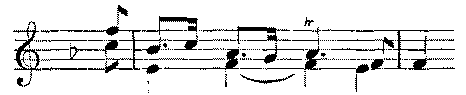
—that was the only true consummation! Then,—to go over the hundred years,—came Rossini's unanswerable coda:
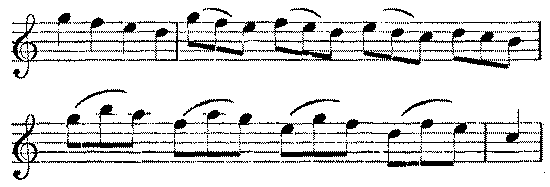
which serves as base to the infinity of songs, gone, gone—so gone by! From all of which Ba draws this 'conclusion' that these may be worse things than Bartoli's Tuscan to cover a page with!—yet, yet the pity of it! Le Jeune, the Phoenix, and Rossini who directed his letters to his mother as 'mother of the famous composer'—and Henry Lawes, and Dowland's Lute, ah me!
Well, my conclusion is the best, the everlasting, here and I trust elsewhere—I am your own, my Ba, ever your
R.
E.B.B. to R.B.
Tuesday Morning. [Post-mark, March 10, 1846.]
Now I shall know what to believe when you talk of very bad and very indifferent doings of yours. Dearest, I read your 'Soul's Tragedy' last night and was quite possessed with it, and fell finally into a mute wonder how you could for a moment doubt about publishing it. It is very vivid, I think, and vital, and impressed me more than the first act of 'Luria' did, though I do not mean to compare such dissimilar things, and for pure nobleness 'Luria' is unapproachable—will prove so, it seems to me. But this 'Tragedy' shows more heat from the first, and then, the words beat down more closely ... well! I am struck by it all as you see. If you keep it up to this passion, if you justify this high key-note, it is a great work, and worthy of a place next 'Luria.' Also do observe how excellently balanced the two will be, and how the tongue of this next silver Bell will swing from side to side. And you to frighten me about it. Yes, and the worst is (because it was stupid in me) the worst is that I half believed you and took the manuscript to be something inferior—for you—and the adviseableness of its publication, a doubtful case. And yet, after all, the really worst is, that you should prove yourself such an adept at deceiving! For can it be possible that the same
'Robert Browning'
who (I heard the other day) said once that he could 'wait three hundred years,' should not feel the life of centuries in this work too—can it be? Why all the pulses of the life of it are beating in even my ears!
Tell me, beloved, how you are—I shall hear it to-night—shall I not? To think of your being unwell, and forced to go here and go there to visit people to whom your being unwell falls in at best among the secondary evils!—makes me discontented—which is one shade more to the uneasiness I feel. Will you take care, and not give away your life to these people? Because I have a better claim than they ... and shall put it in, if provoked ... shall. Then you will not use the shower-bath again—you promise? I dare say Mr. Kenyon observed yesterday how unwell you were looking—tell me if he didn't! Now do not work, dearest! Do not think of Chiappino, leave him behind ... he has a good strong life of his own, and can wait for you. Oh—but let me remember to say of him, that he and the other personages appear to me to articulate with perfect distinctness and clearness ... you need not be afraid of having been obscure in this first part. It is all as lucid as noon.
Shall I go down-stairs to-day? 'No' say the privy-councillors, 'because it is cold,' but I shall go peradventure, because the sun brightens and brightens, and the wind has gone round to the west.
George had come home yesterday before you left me, but the stars were favourable to us and kept him out of this room. Now he is at Worcester—went this morning, on those never ending 'rounds,' poor fellow, which weary him I am sure.
And why should music and the philosophy of it make you 'melancholy,' ever dearest, more than the other arts, which each has the seal of the age, modifying itself after a fashion and to one? Because it changes more, perhaps. Yet all the Arts are mediators between the soul and the Infinite, ... shifting always like a mist, between the Breath on this side, and the Light on that side ... shifted and coloured; mediators, messengers, projected from the Soul, to go and feel, for Her, out there!
You don't call me 'kind' I confess—but then you call me 'too kind' which is nearly as bad, you must allow on your part. Only you were not in earnest when you said that, as it appeared afterward. Were you, yesterday, in pretending to think that I owed you nothing ... I?
May God bless you. He knows that to give myself to you, is not to pay you. Such debts are not so paid.
Yet I am your
Ba.
People's Journal for March 7th.
R.B. to E.B.B.
Tuesday Morning. [Post-mark, March 10, 1846.]
Dear, dear Ba, if you were here I should not much speak to you, not at first—nor, indeed, at last,—but as it is, sitting alone, only words can be spoken, or (worse) written, and, oh how different to look into the eyes and imagine what might be said, what ought to be said, though it never can be—and to sit and say and write, and only imagine who looks above me, looks down, understanding and pardoning all! My love, my Ba, the fault you found once with some expressions of mine about the amount of imperishable pleasures already hoarded in my mind, the indestructible memories of you; that fault, which I refused to acquiesce under the imputation of, at first, you remember—well, what a fault it was, by this better light! If all stopped here and now; horrible! complete oblivion were the thing to be prayed for, rather! As it is, now, I must go on, must live the life out, and die yours. And you are doing your utmost to advance the event of events,—the exercise, and consequently (is it not?) necessarily improved sleep, and the projects for the fine days, the walking ... a pure bliss to think of! Well, now—I think I shall show seamanship of a sort, and 'try another tack'—do not be over bold, my sweetest; the cold is considerable,—taken into account the previous mildness. One ill-advised (I, the adviser, I should remember!) too early, or too late descent to the drawing-room, and all might be ruined,—thrown back so far ... seeing that our flight is to be prayed for 'not in the winter'—and one would be called on to wait, wait—in this world where nothing waits, rests, as can be counted on. Now think of this, too, dearest, and never mind the slowness, for the sureness' sake! How perfectly happy I am as you stand by me, as yesterday you stood, as you seem to stand now!
I will write to-morrow more: I came home last night with a head rather worse; which in the event was the better, for I took a little medicine and all is very much improved to-day. I shall go out presently, and return very early and take as much care as is proper—for I thought of Ba, and the sublimities of Duty, and that gave myself airs of importance, in short, as I looked at my mother's inevitable arrow-root this morning. So now I am well; so now, is dearest Ba well? I shall hear to-night ... which will have its due effect, that circumstance, in quickening my retreat from Forster's Rooms. All was very pleasant last evening—and your letter &c. went à qui de droit, and Mr. W. Junior had to smile good-naturedly when Mr. Burges began laying down this general law, that the sons of all men of genius were poor creatures—and Chorley and I exchanged glances after the fashion of two Augurs meeting at some street-corner in Cicero's time, as he says. And Mr. Kenyon was kind, kinder, kindest, as ever, 'and thus ends a wooing'!—no, a dinner—my wooing ends never, never; and so prepare to be asked to give, and give, and give till all is given in Heaven! And all I give you is just my heart's blessing; God bless you, my dearest, dearest Ba!
E.B.B. to R.B.
Tuesday Evening. [Post-mark, March 11, 1846.]
You find my letter I trust, for it was written this morning in time; and if these two lines should not be flattery ... oh, rank flattery! ... why happy letter is it, to help to bring you home ten minutes earlier, when you never ought to have left home—no, indeed! I knew how it would be yesterday, and how you would be worse and not better. You are not fit to go out, dear dearest, to sit in the glare of lights and talk and listen, and have the knives and forks to rattle all the while and remind you of the chains of necessity. Oh—should I bear it, do you think? I was thinking, when you went away—after you had quite gone. You would laugh to see me at my dinner—Flush and me—Flush placing in me such an heroic confidence, that, after he has cast one discriminating glance on the plate, and, in the case of 'chicken,' wagged his tail with an emphasis, ... he goes off to the sofa, shuts his eyes and allows a full quarter of an hour to pass before he returns to take his share. Did you ever hear of a dog before who did not persecute one with beseeching eyes at mealtimes? And remember, this is not the effect of discipline. Also if another than myself happens to take coffee or break bread in the room here, he teazes straightway with eyes and paws, ... teazes like a common dog and is put out of the door before he can be quieted by scolding. But with me he is sublime! Moreover he has been a very useful dog in his time (in the point of capacity), causing to disappear supererogatory dinners and impossible breakfasts which, to do him justice, is a feat accomplished without an objection on his side, always.
So, when you write me such a letter, I write back to you about Flush. Dearest beloved, but I have read the letter and felt it in my heart, through and through! and it is as wise to talk of Flush foolishly, as to fancy that I could say how it is felt ... this letter! Only when you spoke last of breaking off with such and such recollections, it was the melancholy of the breaking off which I protested against, was it not? and not the insufficiency of the recollections. There might have been something besides in jest. Ah, but you remember, if you please, that I was the first to wish (wishing for my own part, if I could wish exclusively) to break off in the middle the silken thread, and you told me, not—you forbade me—do you remember? For, as happiness goes, the recollections were enough, ... are enough for me! I mean that I should acknowledge them to be full compensation for the bitter gift of life, such as it was, to me! if that subject-matter were broken off here! 'Bona verba' let me speak nevertheless. You mean, you say, to run all risks with me, and I don't mean to draw back from my particular risk of ... what am I to do to you hereafter to make you vexed with me? What is there in marriage to make all these people on every side of us, (who all began, I suppose, by talking of love,) look askance at one another from under the silken mask ... and virtually hate one another through the tyranny of the stronger and the hypocrisy of the weaker party. It never could be so with us—I know that. But you grow awful to me sometimes with the very excess of your goodness and tenderness, and still, I think to myself, if you do not keep lifting me up quite off the ground by the strong faculty of love in you, I shall not help falling short of the hope you have placed in me—it must be 'supernatural' of you, to the end! or I fall short and disappoint you. Consider this, beloved. Now if I could put my soul out of my body, just to stand up before you and make it clear.
I did go to the drawing-room to-day ... would ... should ... did. The sun came out, the wind changed ... where was the obstacle? I spent a quarter of an hour in a fearful solitude, listening for knocks at the door, as a ghost-fearer might at midnight, and 'came home' none the worse in any way. Be sure that I shall 'take care' better than you do, and there, is the worst of it all—for you let people make you ill, and do it yourself upon occasion.
You know from my letter how I found you out in the matter of the 'Soul's Tragedy.' Oh! so bad ... so weak, so unworthy of your name! If some other people were half a quarter as much the contrary!
And so, good-night, dear dearest. In spite of my fine speeches about 'recollections,' I should be unhappy enough to please you, with only those ... without you beside! I could not take myself back from being
Your own—
R.B. to E.B.B.
[Post-mark, March 11, 1846.]
Dear, dear Ba, but indeed I did return home earlier by two or three good hours than the night before—and to find no letter,—none of yours! That was reserved for this morning early, and then a rest came, a silence, over the thoughts of you—and now again, comes this last note! Oh, my love—why—what is it you think to do, or become 'afterward,' that you may fail in and so disappoint me? It is not very unfit that you should thus punish yourself, and that, sinning by your own ambition of growing something beyond my Ba even, you should 'fear' as you say! For, sweet, why wish, why think to alter ever by a line, change by a shade, turn better if that were possible, and so only rise the higher above me, get further from instead of nearer to my heart? What I expect, what I build my future on, am quite, quite prepared to 'risk' everything for,—is that one belief that you will not alter, will just remain as you are—meaning by 'you,' the love in you, the qualities I have known (for you will stop me, if I do not stop myself) what I have evidence of in every letter, in every word, every look. Keeping these, if it be God's will that the body passes,—what is that? Write no new letters, speak no new words, look no new looks,—only tell me, years hence that the present is alive, that what was once, still is—and I am, must needs be, blessed as ever! You speak of my feeling as if it were a pure speculation—as if because I see somewhat in you I make a calculation that there must be more to see somewhere or other—where bdellium is found, the onyx-stone may be looked for in the mystic land of the four rivers! And perhaps ... ah, poor human nature!—perhaps I do think at times on what may be to find! But what is that to you? I offer for the bdellium—the other may be found or not found ... what I see glitter on the ground, that will suffice to make me rich as—rich as—
So bless you my own Ba! I would not wait for paper, and you must forgive half-sheets, instead of a whole celestial quire to my love and praise. Are you so well? So adventurous? Thank you from my heart of hearts. And I am quite well to-day (and have received a note from Procter just this minute putting off his dinner on account of the death of his wife's sister's husband abroad). Observe this sheet I take as I find—I mean, that the tear tells of no improper speech repented of—what English, what sense, what a soul's tragedy! but then, what real, realest love and more than love for my ever dearest Ba possesses her own—
E.B.B. to R.B.
[Post-mark, March 12, 1846.]
When my Orpheus writes 'Περι λιθων' he makes a great mistake about onyxes—there is more true onyx in this letter of his that I have just read, than he will ever find in the desert land he goes to. And for what 'glitters on the ground,' it reminds me of the yellow metal sparks found in the Malvern Hills, and how we used to laugh years ago at one of our geological acquaintances, who looked mole-hills up that mountain-range in the scorn of his eyes, saying ... 'Nothing but mica!!' Is anybody to be rich through 'mica', I wonder? through 'Nothing but mica?' 'As rich as—as rich as' ... Walter the Pennyless?
Dearest, best you are nevertheless, and it is a sorry jest which I can break upon your poverty, with that golden heart of yours so apprehended of mine! Why if I am 'ambitious'—is it not because you love me as if I were worthier of your love, and that, so, I get frightened of the opening of your eyelids to the unworthiness? 'A little sleep, a little slumber, a little folding of the hands to sleep'—there, is my 'ambition for afterward.' Oh—you do not understand how with an unspeakable wonder, an astonishment which keeps me from drawing breath, I look to this Dream, and 'see your face as the face of an angel,' and fear for the vanishing, ... because dreams and angels do pass away in this world. But you, I understand you, and all your goodness past expression, past belief of mine, if I had not known you ... just you. If it will satisfy you that I should know you, love you, love you—why then indeed—because I never bowed down to any of the false gods I know the gold from the mica, ... I! 'My own beloved'—you should have my soul to stand on if it could make you stand higher. Yet you shall not call me 'ambitious.'
To-day I went down-stairs again, and wished to know whether you were walking in your proportion—and your letter does call you 'better,' whether you walked enough or not, and it bears the Deptford post-mark. On Saturday I shall see how you are looking. So pale you were last time! I know Mr. Kenyon must have observed it, (dear Mr. Kenyon ... for being 'kinder and kindest') and that one of the 'augurs' marvelled at the other! By the way I forgot yesterday to tell you how Mr. Burges's 'apt remark' did amuse me. And Mr. Kenyon who said much the same words to me last week in relation to this very Wordsworth junior, writhed, I am sure, and wished the ingenious observer with the lost plays of Æschylus—oh, I seem to see Mr. Kenyon's face! He was to have come to tell me how you all behaved at dinner that day, but he keeps away ... you have given him too much to think of perhaps.
I heard from Miss Mitford to-day that Mr. Chorley's hope is at an end in respect to the theatre, and (I must tell you) she praises him warmly for his philosophy and fortitude under the disappointment. How much philosophy does it take,—please to instruct me,—in order to the decent bearing of such disasters? Can I fancy one, shorter than you by a whole head of the soul, condescending to 'bear' such things? No, indeed.
Be good and kind, and do not work at the 'Tragedy' ... do not.
So you and I have written out all the paper in London! At least, I send and send in vain to have more envelopes 'after my kind,' and the last answer is, that a 'fresh supply will arrive in eight days from Paris, and that in the meanwhile they are quite out in the article.' An awful sign of the times, is this famine of envelopes ... not to speak of the scarcity of little sheets:—and the augurs look to it all of course.
For my part I think more of Chiappino—Chiappino holds me fast.
But I must let you go—it is too late. This dearest letter, which you sent me! I thank you for it with ever so much dumbness. May God bless you and keep you, and make you happy for me.
Your Ba.
R.B. to E.B.B.
[Post-mark, March 12, 1846.]
How I get to understand this much of Law—that prior possession is nine points of it! Just because your infinite adroitness got first hold of the point of view whence our connection looks like 'a dream' ... I find myself shut out of my very own, unable to say what is oftenest in my thought; whereas the dear, miraculous dream you were, and are, my Ba! Only, vanish—that you will never! My own, and for ever!
Yesterday I read the poor, inconceivably inadequate notice in the People's Journal. How curiously wrong, too, in the personal guesses! Sad work truly. For my old friend Mrs. Adams—no, I must be silent: the lyrics seem doggerel in its utter purity. And so the people are to be instructed in the new age of gold! I heard two days ago precisely what I told you—that there was a quarrel, &c. which this service was to smooth over, no doubt. Chorley told me, in a hasty word only, that all was over, Mr. Webster would not have anything to do with his play. The said W. is one of the poorest of poor creatures, and as Chorley was certainly forewarned, forearmed I will hope him to have been likewise—still it is very disappointing—he was apparently nearer than most aspirants to the prize,—having the best will of the actresses on whose shoulder the burthen was to lie. I hope they have been quite honest with him—knowing as I do the easy process of transferring all sorts of burthens, in that theatrical world, from responsible to irresponsible members of it, actors to manager, manager to actors, as the case requires. And it is a 'hope deferred' with Chorley; not for the second or third time. I am very glad that he cares no more than you tell me.
Still you go down-stairs, and still return safely, and every step leads us nearer to my 'hope.' How unremittingly you bless me—a visit promises a letter, a letter brings such news, crowns me with such words, and speaks of another visit—and so the golden links extend. Dearest words, dearest letters—as I add each to my heap, I say—I do say—'I was poor, it now seems, a minute ago, when I had not this!' Bless you, dear, dear Ba. On Saturday I shall be with you, I trust—may God bless you! Ever your own
E.B.B. to R.B.
Sunday. [Post-mark, March 16, 1846.]
Ever dearest I am going to say one word first of all lest I should forget it afterward, of the two or three words which you said yesterday and so passingly that you probably forget to-day having said them at all. We were speaking of Mr. Chorley and his house, and you said that you did not care for such and such things for yourself, but that for others—now you remember the rest. And I just want to say what it would have been simpler to have said at the time—only not so easy—(I couldn't say it at the time) that you are not if you please to fancy that because I am a woman I have not the pretension to do with as little in any way as you yourself ... no, it is not that I mean to say.... I mean that you are not, if you please, to fancy that, because I am a woman, I look to be cared for in those outside things, or should have the slightest pleasure in any of them. So never wish nor regret in your thoughts to be able or not to be able to care this and this for me; for while you are thinking so, our thoughts go different ways, which is wrong. Mr. Fox did me a great deal too much honour in calling me 'a religious hermit'; he was 'curiously' in fault, as you saw. It is not my vocation to sit on a stone in a cave—I was always too fond of lolling upon sofas or in chairs nearly as large,—and this, which I sit in, was given to me when I was a child by my uncle, the uncle I spoke of to you once, and has been lolled in nearly ever since ... when I was well enough. Well—that is a sort of luxury, of course—but it is more idle than expensive, as a habit, and I do believe that it is the 'head and foot of my offending' in that matter. Yes—'confiteor tibi' besides, that I do hate white dimity curtains, which is highly improper for a religious hermit of course, but excusable in me who would accept brown serge as a substitute with ever so much indifference. It is the white light which comes in the dimity which is so hateful to me. To 'go mad in white dimity' seems perfectly natural, and consequential even. Set aside these foibles, and one thing is as good as another with me, and the more simplicity in the way of living, the better. If I saw Mr. Chorley's satin sofas and gilded ceilings I should call them very pretty I dare say, but never covet the possession of the like—it would never enter my mind to do so. Then Papa has not kept a carriage since I have been grown up (they grumble about it here in the house, but when people have once had great reverses they get nervous about spending money) so I shall not miss the Clarence and greys ... and I do entreat you not to put those two ideas together again of me and the finery which has nothing to do with me. I have talked a great deal too much of all this, you will think, but I want you, once for all, to apply it broadly to the whole of the future both in the general view and the details, so that we need not return to the subject. Judge for me as for yourself—what is good for you is good for me. Otherwise I shall be humiliated, you know; just as far as I know your thoughts.
Mr. Kenyon has been here to-day—and I have been down-stairs—two great events! He was in brilliant spirits and sate talking ever so long, and named you as he always does. Something he asked, and then said suddenly ... 'But I don't see why I should ask you, when I ought to know him better than you can.' On which I was wise enough to change colour, as I felt, to the roots of my hair. There is the effect of a bad conscience! and it has happened to me before, with Mr. Kenyon, three times—once particularly, when I could have cried with vexation (to complete the effects!), he looked at me with such infinite surprise in a dead pause of any speaking. That was in the summer; and all to be said for it now, is, that it couldn't be helped: couldn't!
Mr. Kenyon asked of 'Saul.' (By the way, you never answered about the blue lilies.) He asked of 'Saul' and whether it would be finished in the new number. He hangs on the music of your David. Did you read in the Athenæum how Jules Janin—no, how the critic on Jules Janin (was it the critic? was it Jules Janin? the glorious confusion is gaining on me I think) has magnificently confounded places and persons in Robert Southey's urn by the Adriatic and devoted friendship for Lord Byron? And immediately the English observer of the phenomenon, after moralizing a little on the crass ignorance of Frenchmen in respect to our literature, goes on to write like an ignoramus himself, on Mme. Charles Reybaud, encouraging that pure budding novelist, who is in fact a hack writer of romances third and fourth rate, of questionable purity enough, too. It does certainly appear wonderful that we should not sufficiently stand abreast here in Europe, to justify and necessitate the establishment of an European review—journal rather—(the 'Foreign Review,' so called, touching only the summits of the hills) a journal which might be on a level with the intelligent readers of all the countries of Europe, and take all the rising reputations of each, with the national light on them as they rise, into observation and judgment. If nobody can do this, it is a pity I think to do so much less—both in France and England—to snatch up a French book from over the Channel as ever and anon they do in the Athenæum, and say something prodigiously absurd of it, till people cry out 'oh oh' as in the House of Commons.
Oh—oh—and how wise I am to-day, as if I were a critic myself! Yesterday I was foolish instead—for I couldn't get out of my head all the evening how you said that you would come 'to see a candle held up at the window.' Well! but I do not mean to love you any more just now—so I tell you plainly. Certainly I will not. I love you already too much perhaps. I feel like the turning Dervishes turning in the sun when you say such words to me—and I never shall love you any 'less,' because it is too much to be made less of.
And you write to-morrow? and will tell me how you are? honestly will tell me? May God bless you, most dear!
I am yours—'Tota tua est'
Ba.
R.B. to E.B.B.
Sunday. [Post-mark, March 16, 1846.]
How will the love my heart is full of for you, let me be silent? Insufficient speech is better than no speech, in one regard—the speaker had tried words, and if they fail, hereafter he needs not reflect that he did not even try—so with me now, that loving you, Ba, with all my heart and soul, all my senses being lost in one wide wondering gratitude and veneration, I press close to you to say so, in this imperfect way, my dear dearest beloved! Why do you not help me, rather than take my words, my proper word, from me and call them yours, when yours they are not? You said lately love of you 'made you humble'—just as if to hinder me from saying that earnest truth!—entirely true it is, as I feel ever more convincingly. You do not choose to understand it should be so, nor do I much care, for the one thing you must believe, must resolve to believe in its length and breadth, is that I do love you and live only in the love of you.
I will rest on the confidence that you do so believe! You know by this that it is no shadowy image of you and not you, which having attached myself to in the first instance, I afterward compelled my fancy to see reproduced, so to speak, with tolerable exactness to the original idea, in you, the dearest real you I am blessed with—you know what the eyes are to me, and the lips and the hair. And I, for my part, know now, while fresh from seeing you, certainly know, whatever I may have said a short time since, that you will go on to the end, that the arm round me will not let me go,—over such a blind abyss—I refuse to think, to fancy, towards what it would be to loose you now! So I give my life, my soul into your hand—the giving is a mere form too, it is yours, ever yours from the first—but ever as I see you, sit with you, and come away to think over it all, I find more that seems mine to give; you give me more life and it goes back to you.