Volume 3 — CHAPTER VIII
Reading edition
1839
Queen Victoria to the King of the Belgians.
Pavilion [Brighton], 1st January 1839.
My dear Uncle,—... I don't like your croaking so about damp climates; if a niece may venture to say such a thing, I might almost say it is ungrateful to your faithful and attached Belgians.
The Queen-Dowager's letters do tantalize one a good deal, I must own.1 You will see that old Lord Clarendon2 is dead, which makes our friend Villiers Earl of Clarendon, but I am afraid not with a large income.
Lord Palmerston has been unwell and obliged to go to Broadlands, where he still is. He had gone through so much grief and labour, that it was absolutely necessary for him to recruit his strength. The Normanbys spent two nights here.3 Lord Melbourne is the only person staying in the house besides several of my Court and my suite, and, I am sorry to say, is not very well; he has also had, I fear, too much business to do.
Lady Breadalbane4 is my new Lady of the Bedchamber, and a very nice person. Ever your devoted Niece,
Victoria R.
Forgive this short scrawl.
Footnote 1: Queen Adelaide had described the orange-trees and tropical fruits in the gardens of the Palace of St Antonio, Valetta.
Footnote 2: John Charles, third Earl, Chief Justice-in-eyre, North of Trent. His successor, who had been Minister to Spain since 1833, was afterwards the celebrated Foreign Secretary.
Footnote 3: Lord Normanby, at this time Lord-Lieutenant of Ireland, became successively during the year, Colonial and Home Secretary. Lady Normanby, who had been a Lady-in-Waiting since the accession, was a daughter of the first Lord Ravensworth.
Footnote 4: Eliza, daughter of George Baillie of Jerviswood. Her brother afterwards became tenth Earl of Haddington.
Viscount Melbourne to Queen Victoria.
MURDER OF LORD NORBURY
6th January 1839.
Lord Melbourne presents his humble duty to your Majesty, and returns his best and warmest thanks for the very kind and gracious communication which he had the honour and pleasure of receiving from your Majesty yesterday evening. Your Majesty will have seen in the newspapers that Lord Norbury was shot at in his own grounds and dangerously wounded.5 Lord Melbourne learns to-day by a letter from Lord Morpeth that Lord Norbury is since dead. This is a shocking event, and will, of course, create a strong sensation, much stronger than the death in the same manner of several persons of inferior degree. It is almost the first time that an attempt of this kind has been directed against an individual of that rank or station....
Lord Melbourne has seen Sir Henry Halford,6 who says that his pulse is low and his system languid. He has prescribed some draughts, which Lord Melbourne trusts will be of service, but he feels much depressed to-day. He dined yesterday at Lady Holland's, where he met Mr Ellice,7 civil and friendly enough in appearance, but Lord Melbourne fears hostile at heart, and a determined partisan of Lord Durham. Lord Durham has not yet made to Lord Glenelg the promised communication of his report and plan, but it is said that he will do so soon....
Footnote 5: At Kilbeggan Abbey, County Meath. The murderer escaped.
Footnote 6: The celebrated physician: he attended George IV. and William IV., as well as Queen Victoria.
Footnote 7: Son-in-law of Lord Grey, as was also Lord Durham.
Queen Victoria to the King of the Belgians.
Buckingham Palace, 11th January 1839.
My dear Uncle,—The dreadful moment has arrived, and dear Marie8 is no more to bless her loving relations with her presence on this earth of grief and troubles! It is a heavy dispensation, and one that it is difficult to comprehend, but we must submit.
I thought it best to write to my poor dear Aunt, for whom this will be a sad blow; but I abstained from doing so to the dear Queen of the French just as yet. I have no letters, and only learnt the melancholy event by the papers. Poor wretched Alexander! What a loss, what a change for him, poor fellow!
You will, I am sure, regret that sweet amiable creature, as poor Marie was, very much, having known her so well, and her attachment to you was great.
I will not prolong this letter, but merely repeat how much I feel for you all, and beg you to believe me, your most affectionate Niece,
Victoria R.
Footnote 8: Princess Marie of Orleans, born 1813, sister to the Queen of the Belgians, had married Prince Alexander of Wurtemberg, in 1837.
The King of the Belgians to Queen Victoria.
HOLLAND AND BELGIUM
Laeken, 18th January 1839.
... Your Aunt as well as myself are very anxious to be of use to poor Alexander. The dispositions of the whole family are extremely kind towards him, but he is shy and a little helpless; his present melancholy situation is of course calculated to increase this. His position puts me in mind of mine in 1817.... He, besides, is surrounded by people who are kind to him. Of George IV., then Regent, it was observed that for years he had not been in such good spirits than by the loss of his daughter. She was more popular than himself—that was, since her mariage, her only crime....
I feel very grateful for Lord Melbourne's kindness on the subject of our sad loss. He is so feeling and kindhearted that he, much more than most men who have lived so much in the grand monde, has preserved a certain warmth and freshness of feeling....
Your cousins kiss your hands, and I remain, my dearest Victoria, your devoted Uncle,
Leopold R.
Viscount Palmerston to Queen Victoria.
Stanhope Street, 27th January 1839.
Viscount Palmerston presents his humble duty to your Majesty, and returns to your Majesty the accompanying papers which he received from Viscount Melbourne. Your Majesty will have seen by Sir Edward Disbrowe's9 despatches that the concentration of Dutch troops mentioned in these reports was purely defensive, and was the consequence of the military demonstrations previously made by the Belgians; and it appears, moreover, that the Dutch force is inferior in number to the Belgian force opposite to it; and that affords an additional security against the chance of an invasion of Belgium by the Dutch. It is, however, undeniable that when two armies are drawn up in face of each other, separated by a small distance, and animated by mutual hatred, the chances of collision become great and imminent. But it is to be hoped in the present case that the communication made by the Conference to the two parties on Thursday last may avert danger of hostilities between the Dutch and Belgians.10
Footnote 9: Minister at the Hague.
Footnote 10: See next letter.
Queen Victoria to the King of the Belgians.
BELGIUM AND ENGLAND
Buckingham Palace, 7th February 1839.
My dear Uncle,—I am much grieved to learn that poor Philippe11 has given you such anxiety. My poor Aunt! it really is too much upon her to have these cares added to her recent severe affliction. I hope to God that I shall get news of Philippe's complete recovery to-morrow.
I regret to hear that your Government gives you so much trouble, but trust that you will exert all your influence, as you have so frequently done, to persuade your Ministers to be reasonable, and not to resist the favourable offers made to the Government. Everybody here is exceedingly anxious for the conclusion of these long pending affairs, and hope that the answer from Belgium will soon arrive.12 You will forgive me, dear Uncle, if I express to you my earnest hope that these expectations may not be disappointed, for I feel that since the Dutch have so instantly accepted the proposition of the Conference, Belgium would suffer in the eyes of this country were she to delay, and, what I am still more fearful of, my beloved Uncle, you might be blamed, and suffer for what your Government may do. You will, I know, forgive this freedom, which is prompted by my great anxiety for your welfare and happiness (which I know you are well aware of), and for the preservation of the inestimable blessings of peace. No one feels more for you than I do at this difficult moment, nor than I have done throughout these trying and embarrassing affairs. That all may be peaceably and amicably settled is my earnest prayer.
Everything went off well yesterday,13 and we are again launched into a political campaign, which it is impossible not to contemplate with a certain degree of anxiety.
Adieu! my dear Uncle. Give my love to my dear Aunt, and believe me, always, your most devoted Niece,
Victoria R.
Footnote 11: See ante, p. 65.
Footnote 12: The twenty-four Articles, to which Belgium had acceded in 1831, had then been rejected by Holland. Now, however, Holland wished to adopt them. The Belgian Government vainly proposed different schemes, but at last the Bill for ratifying the proposal of the Powers (made 23rd January 1839, and accepted by Holland on 11th February) passed the Belgian Chambers.
Footnote 13: The Queen opened Parliament in person on 6th February.
Viscount Melbourne to Queen Victoria.
CABINET DISSENSION
10th February 1839.
Lord Melbourne presents his humble duty to your Majesty, and thinks it right and necessary to acquaint your Majesty that the Cabinet yesterday was very stormy and unpleasant. Lord John Russell brought on the question of the Civil Government of the Army, in a temperate and judicious manner, but Lord Howick made a most violent speech, strongly condemning the whole of the present system and arraigning the conduct of the Treasury and other Departments, saying that he should not throw up his office because no measure was brought forward, but that, when questioned upon the subject by Mr Hume in the House of Commons, as it was certain that he would be, he should say that Government would do nothing upon the subject, until he (Mr Hume) compelled them, and that he should express his entire disapprobation of the present system, and his reasons in detail for that disapprobation. Your Majesty will perceive that nothing could be more violent than this course. It was borne with great patience by the rest of the Cabinet, although Mr. Rice,14 against whom the greater part of Lord Howick's speech was directed, felt himself most deeply hurt, and so expressed himself in private afterwards to Lord Melbourne. Upon the whole, Lord Melbourne cannot but consider that affairs are in a most precarious state, and that whilst there is so much discontent fermenting within the Cabinet itself, there must be great doubt of Lord Melbourne's being much longer able to hold the Administration together.
Footnote 14: The Chancellor of the Exchequer.
Viscount Melbourne to Queen Victoria.
10th February 1839.
Lord Melbourne presents his humble duty to your Majesty, and is very sorry that his communication has occasioned your Majesty so much alarm and uneasiness. Lord Melbourne hopes that there is nothing imminent and immediate, but this sort of outbreak and contention may so soon become serious, that Lord Melbourne thought it his duty to take an early opportunity of informing your Majesty of what had taken place. Lord Melbourne would wait upon your Majesty without delay, but trusts that this letter will be sufficient to dispel any disquietude which his former communication may have excited.
Lord John Russell to Queen Victoria.
Wilton Crescent, 20th February 1839.
Lord John Russell presents his humble duty to your Majesty, and has the honour to report that Mr Charles Villiers15 moved yesterday, after a very able speech, that the petitioners against the Corn Laws should be heard at the Bar of the House.
Sir Robert Peel opposed the Motion on the ground that he meant to resist any change in the Corn Laws. He made a very skilful use of the returns of cotton, etc., exported.
Footnote 15: M.P. for Wolverhampton 1835-1898, becoming "Father of the House."
Viscount Palmerston to Queen Victoria.
THE DUKE OF LUCCA
Stanhope Street, 5th March 1839.
Viscount Palmerston presents his humble duty to your Majesty, and requests to be honoured with your Majesty's commands upon the accompanying letter from Count Pollon.16 Viscount Palmerston at the same time begs to state that he has reason to believe, from what Count Pollon said to him in conversation two days ago, that the Duke of Lucca17 has a notion that Sovereign Princes who have had the honour of dining with your Majesty, have been invited by note and not by card. If that should be so, and if your Majesty should invite the Duke of Lucca to dine at the Palace before his departure, perhaps the invitation might be made by note, instead of by card, as it was when the Duke last dined at the Palace. Your Majesty may think this a small matter, but the Duke is a small Sovereign.
Footnote 16: For many years Sardinian Minister in England.
Footnote 17: Lucca was an independent Italian State.
Viscount Melbourne to Queen Victoria.
PORTUGAL
9th March 1839.
Lord Melbourne presents his humble duty to your Majesty, and feels very deeply the very kind and gracious concern which your Majesty expresses for his health, as well as your Majesty's solicitude and interest upon all occasions. Lord Melbourne will take your Majesty's advice, but his experience teaches him that illness is not so easily put off, and that it will have its course in spite of precaution....
Lord Melbourne thinks, upon the whole, that your Majesty had perhaps better write by messenger a few lines of kindness and recollection. It can be no descent on your Majesty's part to do so, and as we may be obliged to take very strong measures with respect to Portugal, it is as well that there should be no appearance of any deficiency of affection or attention. Lord Melbourne [thinks] that, for the reason given by your Majesty, your Majesty may perhaps as well not go to the play this evening, but is very sorry to hear that your Majesty is low and out of spirits.
Queen Victoria to the King of the Belgians.
Buckingham Palace, 14th March 1839.
My dear Uncle,—Many thanks for two letters, one which I received last Sunday, and the other enclosing a letter from Stockmar this morning. I am glad you agree with me about Victoire.18 Since I wrote to you, I got these two letters from the Portuguese children—as I disrespectfully but very deservedly call them—which I send you, in order that you may see how they wish Victoire to come to them, which I fear and think is totally impracticable, for it would never do for Victoire to go so far without her mother. Nevertheless, I thought it but right by them to send you these letters, and I have written to them giving them little hope.
The French Ministry are gone, and I am sure the poor King will be much vexed by it. They talk of Broglie as Minister for Foreign Affairs,19 but I am afraid Thiers is inevitable. We are rather in fear of Thiers here, but it is a pity that Louis Philippe should show so much dislike to a man he must take, for it will have the effect of a defeat.
I have no time to add more, but to beg you to believe me, always, your most affectionate Niece,
Victoria R.
Footnote 18: Daughter of Prince Ferdinand of Saxe-Coburg, and married in April 1840 to the Duc de Nemours.
Footnote 19: After a provisional Cabinet, in which the Duc de Montebello was Foreign Minister, the King appointed a Ministry with Soult as Premier and Foreign Minister.
Viscount Melbourne to Queen Victoria.
DIFFICULTIES OF THE MINISTRY
22nd March 1839.
Lord Melbourne presents his humble duty to your Majesty, and begs to acquaint your Majesty that the Cabinet have decided—
1. That it is impossible to acquiesce in the vote of last night in the House of Lords.20
2. That it would not be justifiable to resign in the face of the declaration which I made in the year 1836, in the House of Lords, that I would maintain my post as long as I possessed the confidence of the Crown and of the House of Commons, particularly as there is no reason to suppose that we have lost the confidence of the House.
3. That the course to be pursued is to give notice in the House of Commons to-night, that the sense of that House will be taken immediately after the Easter Holidays, upon a vote of approbation of the principles of Lord Normanby's government of Ireland.
If we lose that question, or carry it by a small majority, we must resign. If we carry it, we may go on.
This is a plain statement of the case, and this course will at least give your Majesty time to consider what is to be done.
Footnote 20: By 63 to 58 Lord Roden carried a motion for a Select Committee to enquire into the state of Ireland; the Ministry replied by obtaining a vote of the House of Commons in their favour by 318 to 296.
Viscount Melbourne to Queen Victoria.
Brocket Hall,21 1st April 1839.
Lord Melbourne presents his humble duty to your Majesty, and has just received your Majesty's letters, for which he returns many and warm thanks. Nothing could be more prosperous than his journey down, although it rained hard the greater part of the way. Lord Melbourne slept well, and has walked out this morning, although it was still showery. Nothing is so fatiguing as the first exposure to the air of the country, and Lord Melbourne feels the influence of it.
Lord Melbourne returns the letters of the King of the Belgians. He accounts very naturally for the conduct of the poor Duchess,22 but she should have recollected the extreme disadvantage and discredit which attaches to a change of religion. Un gentilhomme ne change jamais la religion, was the saying of Napoleon, and is very just. It is difficult to understand the movements and motives of parties in a foreign country, and therefore Lord Melbourne does not feel able to pronounce any opinion upon the transactions in France. Lord Melbourne had seen G——'s letters, a pert jackanapes, who always takes the worst view of every subject, and does as much mischief as he can....
Lord Melbourne is just starting for Panshanger.23 The evening is better than the morning was, but cold.
Footnote 21: Lord Melbourne's house on the Lea, about three miles north of Hatfield. Its construction was begun by Sir Matthew Lamb, and completed by his son, Sir Peniston, the first Lord Melbourne.
Footnote 22: Princess Alexander of Würtemberg. On her death-bed, she had expressed a wish to her husband that he should join the Roman Catholic Church.
Footnote 23: Panshanger, not far distant from Brocket, the house of Lord Melbourne's brother-in-law, Lord Cowper, and celebrated for its pictures, was bought by Lord Chancellor Cowper, temp. Queen Anne.
Queen Victoria to the King of the Belgians.
ENGLAND AND BELGIUM
Buckingham Palace, 9th April 1839.
My dear Uncle,—... I regret to learn you are still not easy about your own affairs, but trust all will now be speedily adjusted. You always allow me, dear Uncle, to speak frankly to you; you will, therefore, I hope, not be displeased if I venture to make a few observations on one or two parts of your letter.
You say that the anger of the Belgians is principally directed against England.24 Now, I must say you are very unjust towards us, and (if I could) I might be even a little angry with you, dear Uncle. We only pressed Belgium for her own good, and not for ours. It may seem hard at first, but the time will come when you will see that we were right in urging you not to delay any longer the signature of the treaty.
I think that you will see in this frank expression of my sentiments no wish to annoy or hurt you, but only an anxious desire to prove to you that England is Belgium's sincere friend, and that my Government are ever desirous of doing what is in their power for the welfare, security, and prosperity of yourself and your kingdom.
I regret much the state of affairs in France,25 which cannot but make us all somewhat anxious; you will, I hope tell me what news you hear from Paris.
Pray, dearest Uncle, receive my best, my very warmest, wishes for many happy returns of dear Leopold's birthday, and also, though somewhat late, for Philippe's birthday.
Give my love to my dear Aunt, and believe me, always, your most devoted Niece,
Victoria R.
Footnote 24: He had written on 5th April:—"The feeling is strongest against England, in which the people expected to see a support, and only found a strong determination to decide everything against them and at their expense. If there was a great explosion in France, it would not be astonishing to see the people here join it; it would rather be astonishing to see it otherwise, after the kind treatment they received from the Powers."
Footnote 25: The King was for a time without any Ministry, and the meeting of the Chambers had to be postponed.
Baron Stockmar to Queen Victoria.
PRINCE ALBERT IN ITALY
Naples, 16th April 1839.
Madam,—As it is some time that I had the honour to address your Majesty, I hope that a further account of our crusades will meet with a favourable reception.
It is now somewhat better than a month that we left Florence, I may say with regret, for we were there very comfortably in every respect. On our route to Rome we enjoyed the beautiful sight of the cataract at Terni, the place where Queen Caroline sojourned for some time. We were particularly fortunate that day, as the brightest sunshine heightened its picturesque effects beyond description. We found old Rome very full, and to see it and its ecclesiastic governors to advantage, the Holy Week is certainly the properest time. From morning to noon the Prince was at seeing sights, and he made so good a use of his time, that I don't think that something really remarkable was left unseen. Upon this very principle, we paid our respects to the Holy Father,26 of which interview the Prince made so admirable a sketch, so very worthy of H.B.,27 that I am very much tempted to send it for the inspection of your Majesty. We assisted at the Church ceremonies of the Holy Week from the beginning to the end. The music of the Sistine Chapel, which is only vocal, may be well considered as unique, and has not failed to make a lasting impression upon a mind so musical as the Prince's....
I never think of your Majesty—and I take the liberty of thinking very frequently of you—without praying for health, serenity of mind, comfort and success for you, and I can well say that I am from my heart, your Majesty's sincerely attached and devoted Servant,
Stockmar.
Footnote 26: Gregory XVI.
Footnote 27: Initials adopted by Mr Doyle, father of Richard Doyle, in his Reform Caricatures.
The King of the Belgians to Queen Victoria.
BELGIUM
19th April 1839.
... I am glad I extracted some spark of politics from your dear Majesty, very kindly and nicely expressed. I know that your generous little heart would not have wished at any time but what was good for a country in which you were much beloved. But the fact is, that certainly your Government have taken the lead in maintaining a condition which time had rendered difficult to comply with. Physicians will tell you that often an operation, which might have been performed at one time, could not, without great danger for the patient, be undertaken some years later. We have not been listened to, and arrangements are forced on us, in themselves full of seeds of danger, when by consulting the real interests of Holland and Belgium, both countries might have been placed on a footing of sincere peace and good neighbourhood. This country feels now humbled and désenchanté with its soi-disant political independence as it pleased the Conference to settle it. They will take a dislike to a political state which wounds their vanity, and will, in consequence of this, not wish it to continue. Two things will happen, therefore, on the very first opportunity, either that this country will be involved in war to better a position which it thinks too humiliating, or that it will voluntarily throw up a nominal independence in which it is now hemmed in between France and Holland, which begins on the North Sea, and ends, of all the things in this world, on the Moselle!
I think old Pirson, who said in the Chamber that if the treaty was carried into execution I was likely to be the first and last King of the country, was not wrong. Whenever this will happen, it will be very awkward for England, and deservedly so. To see, after eight years of hard work, blooming and thriving political plantations cut and maimed, and that by those who have a real interest to protect them, is very melancholy. I do not say these things with the most distant idea of bringing about any change, but only because in the high and very responsible position in which Providence has placed you, it is good to tell you the truth, as you ought to have weight and influence on the affairs of Europe; and England, not being in the possibility of making territorial acquisition, has a real and permanent interest in the proper maintenance of a balance of political power in Europe. Now I will leave you to enjoy the beginning of Spring, which a mild rain seems to push on prodigiously. Believe me ever, my dear Victoria, your very attached Uncle,
Leopold R.
Viscount Melbourne to Queen Victoria.
JAMAICA
26th April 1839.
Lord Melbourne presents his humble duty to your Majesty, and begs to inform your Majesty that the result of the Cabinet has been a decision to stand by the Bill as we have introduced it, and not to accede to Sir Robert Peel's proposal. The Bill is for suspending the functions of the Legislative Assembly of Jamaica, and governing that island for five years by a Governor and Council.28 If Sir Robert Peel should persist in his proposal, and a majority of the House of Commons should concur with him, it will be such a mark of want of confidence as it will be impossible for your Majesty's Government to submit to.
Footnote 28: See Introductory Note, ante, p. 141.
Queen Victoria to the King of the Belgians.
Buckingham Palace, 30th April 1839.
My dear Uncle,—I have to thank you for your last letter, which I received on Sunday. Though you seem not to dislike my political sparks, I think it is better not to increase them, as they might finally take fire, particularly as I see with regret that upon this one subject we cannot agree. I shall therefore limit myself to my expressions of very sincere wishes for the welfare and prosperity of Belgium.
The Grand Duke,29 after a long delay, is at length to arrive on Friday night; I shall put myself out of my way in order to be very civil to such a great personage. I am already thinking how I shall lodge all my relations; you must prepare Uncle Ferdinand for its not being very ample, but this Palace, though large, is not calculated to hold many visitors....
Believe me, always, your very affectionate Niece,
Victoria R.
Footnote 29: The Hereditary Grand Duke of Russia, afterwards the Emperor Alexander II.
Viscount Melbourne to Queen Victoria.
MINISTERIAL CRISIS
7th May 1839.
Lord Melbourne presents his humble duty to your Majesty, and has to acquaint your Majesty that the division upon the Jamaica Bill, which took place about two this morning, was two hundred and ninety-nine against the measure, and three hundred and four in favour of it.30 Lord Melbourne has not heard from Lord John Russell since this event, but a Cabinet will of course be summoned early this morning, and Lord Melbourne cannot conceal from your Majesty that in his opinion the determination of the Cabinet must be that the relative numbers upon this vote, joined to the consideration of no less than nine members of those who have hitherto invariably supported the Government having gone against it now, leave your Majesty's confidential servants no alternative but to resign their offices into your Majesty's hands. They cannot give up the Bill either with honour or satisfaction to their own consciences, and in the face of such an opposition they cannot persevere in it with any hope of success. Lord Melbourne is certain that your Majesty will not deem him too presuming if he expresses his fear that this decision will be both painful and embarrassing to your Majesty, but your Majesty will meet this crisis with that firmness which belongs to your character, and with that rectitude and sincerity which will carry your Majesty through all difficulties. It will also be greatly painful to Lord Melbourne to quit the service of a Mistress who has treated him with such unvarying kindness and unlimited confidence; but in whatever station he may be placed, he will always feel the deepest anxiety for your Majesty's interests and happiness, and will do the utmost in his power to promote and secure them.
Footnote 30: The numbers are apparently incorrectly stated. The division was 294 to 289.
Viscount Melbourne to Queen Victoria.
RESIGNATION IMMINENT
7th May 1839.
The present circumstances have been for some time so probable, or rather so certain, that Lord Melbourne has naturally been led to weigh and consider maturely the advice which, if called upon, he should tender to your Majesty when they did arrive. That advice is, at once to send for the Duke of Wellington. Your Majesty appears to Lord Melbourne to have no other alternative. The Radicals have neither ability, honesty, nor numbers. They have no leaders of any character. Lord Durham was raised, one hardly knows how, into something of a factitious importance by his own extreme opinions, by the panegyrics of those who thought he would serve them as an instrument, and by the management of the Press, but any little public reputation which he might once have acquired has been entirely dissipated and destroyed by the continued folly of his conduct in his Canadian Government. There is no party in the State to which your Majesty can now resort, except that great party which calls itself Conservative, and of that party, his rank, station, reputation, and experience point out the Duke of Wellington as the person to whom your Majesty should apply.
Lord Melbourne therefore advises that your Majesty should send for the Duke of Wellington, and should acquaint him, provided your Majesty so feels, that you were entirely satisfied with your late Government, and that you part from them with reluctance; but that as he and the party of which he is the head have been the means of removing them from office, you naturally look to him to advise you as to the means of supplying their places and carrying on the business of the country.
If the Duke should be unwilling to form the Government himself, and should desire to devolve the task upon Sir Robert Peel, Lord Melbourne would advise your Majesty to accede to that suggestion; but Lord Melbourne would counsel your Majesty to be very unwilling to suffer the Government to be formed by Sir Robert Peel, without the active assistance in office of the Duke of Wellington.
With respect both to measures and appointments, your Majesty should place the fullest confidence in those to whom you entrust the management of affairs, exercising at the same time, and fully expressing, your own judgment upon both.
Your Majesty will do well to be from the beginning very vigilant that all measures and all appointments are stated to your Majesty in the first instance, and your Majesty's pleasure taken thereon previously to any instruments being drawn out for carrying them into effect, and submitted to your Majesty's signature. It is the more necessary to be watchful and active in this respect, as the extreme confidence which your Majesty has reposed in me may have led to some omission at times of these most necessary preliminaries.
The patronage of the Lord Chamberlain's Department is of the greatest importance, and may be made to conduce at once to the beneficial influence of the Crown, and to the elevation and encouragement of the professions of the Church and of Medicine. This patronage, by being left to the uncontrolled exercise of successive Lord Chamberlains, has been administered not only wastefully but perniciously. The physicians to the late King were many of them men of little eminence; the chaplains are still a sorry set. Your Majesty should insist with the new Ministers that this patronage should be disposed of, not by the Lord Chamberlain, but, as it has hitherto been during your Majesty's reign, by your Majesty upon consultation with your Prime Minister.
Queen Victoria to Viscount Melbourne.
DISTRESS OF THE QUEEN
Buckingham Palace, 9th May 1839.
The Queen thinks Lord Melbourne may possibly wish to know how she is this morning; the Queen is somewhat calmer; she was in a wretched state till nine o'clock last night, when she tried to occupy herself and try to think less gloomily of this dreadful change, and she succeeded in calming herself till she went to bed at twelve, and she slept well; but on waking this morning, all—all that had happened in one short eventful day came most forcibly to her mind, and brought back her grief; the Queen, however, feels better now; but she couldn't touch a morsel of food last night, nor can she this morning. The Queen trusts Lord Melbourne slept well, and is well this morning; and that he will come precisely at eleven o'clock. The Queen has received no answer from the Duke, which is very odd, for she knows he got her letter. The Queen hopes Lord Melbourne received her letter last night.
Viscount Melbourne to Queen Victoria.
8th May 1839.
Lord Melbourne presents his humble duty to your Majesty, and is much grieved that he did not answer your Majesty's letter yesterday evening, as your Majesty desired, but he did not get it till late, and he felt much tired and harassed by all that had passed during the day. The situation is very painful, but it is necessary for your Majesty to be prudent and firm. It is of all things necessary not to be suspected of any unfair dealing. Whilst Lord Melbourne holds his office, everything of course may be written to him as usual; but still the resolutions for the formation of the new Government will now commence, and it will never do, whilst they are going on, either for appearance or in reality, that Lord Melbourne should dine with your Majesty, as he did before this disturbance. It would create feeling, possibly lead to remonstrance, and throw a doubt upon the fairness and integrity of your Majesty's conduct. All this is very painful both to do and to say, but it is unavoidable; it must be said, and it must be done. Lord Melbourne will wait upon your Majesty at eleven.31
Footnote 31: Lord Melbourne had made the not unnatural mistake of recommending to the Queen, as members of her first Household, ladies who were nearly related to himself and his Whig colleagues. No doubt these were the ladies whom he knew best, and in whom he had entire confidence; but he ought to have had sufficient prescience to see that the Queen would probably form strong attachments to the ladies who first served her: and that if the appointments had not in the first instance a political complexion, yet that the Whig tendencies which these Ladies represented were likely to affect the Queen, in the direction of allying her closely with a particular party in the State.
Queen Victoria to Viscount Melbourne.
THE DUKE OF WELLINGTON
8th May 1839.
The Queen told Lord Melbourne she would give him an account of what passed, which she is very anxious to do. She saw the Duke for about twenty minutes; the Queen said she supposed he knew why she sent for him, upon which the Duke said, No, he had no idea. The Queen then said that she had had the greatest confidence in her late Ministry, and had parted with them with the greatest reluctance; upon which the Duke observed that he could assure me no one felt more pain in hearing the announcement of their resignation than he did, and that he was deeply grieved at it. The Queen then continued, that as his party had been instrumental in removing them, that she must look to him to form a new Government. The Duke answered that he had no power whatever in the House of Commons, "that if he was to say black was white,32 they would say it was not," and that he advised me to send for Sir Robert Peel, in whom I could place confidence, and who was a gentleman and a man of honour and integrity. The Queen then said she hoped he would at all events have a place in the new Cabinet. The Duke at first rather refused, and said he was so deaf, and so old and unfit for any discussion, that if he were to consult his own feelings he would rather not do it, and remain quite aloof; but that as he was very anxious to do anything that would tend to the Queen's comfort, and would do everything and at all times that could be of use to the Queen, and therefore if she and her Prime Minister urged his accepting office, he would. The Queen said she had more confidence in him than in any of the others of his party. The Queen then mentioned the subject of the Household, and of those who were not in Parliament. The Duke did not give any decisive answer about it, but advised the Queen not to begin with conditions of this sort, and wait till the matter was proposed. The Queen then said that she felt certain he would understand the great friendship she had for Lord Melbourne, who had been to her quite a parent, and the Duke said no one felt and knew that better than he did, and that no one could still be of greater use to the Queen than Lord Melbourne. The Duke spoke of his personal friendship for Lord Melbourne, and that he hoped I knew that he had often done all he could to help your (Lord Melbourne's) Government. The Queen then mentioned her intention to prove her great fairness to her new Government in telling them, that they might know there was no unfair dealing, that I meant to see you often as a friend, as I owed so much to you. The Duke said he quite understood it, and knew I would not exercise this to weaken the Government, and that he would take my part about it, and felt for me. He was very kind, and said he called it "a misfortune" that you had all left me.
SIR ROBERT PEEL
The Queen wrote to Peel, who came after two, embarrassed and put out. The Queen repeated what she had said to the Duke about her former Government, and asked Sir Robert to form a new Ministry. He does not seem sanguine; says entering the Government in a minority is very difficult; he felt unequal to the task, and far from exulting in what had happened, as he knew what pain it must give me; he quite approved that the Duke should take office, and saw the importance of it; meant to offer him the post of Secretary for Foreign Affairs, and if he refused, Lord Aberdeen; Lord Lyndhurst, Chancellor; hoped to secure Stanley and Graham; Goulburn to be the candidate for the Speaker's Chair; he expects a severe conflict then, and if he should be beat must either resign or dissolve Parliament. Before this the Queen said she was against a dissolution, in which he quite agreed, but of course wished no conditions should be made; he felt the task arduous, and that he would require me to demonstrate (a certain degree, if any I can only feel) confidence in the Government, and that my Household would be one of the marks of that. The Queen mentioned the same thing about her Household, to which he at present would give no answer, and said nothing should be done without my knowledge or approbation. He repeated his surprise at the course you had all taken in resigning, which he did not expect. The Queen talked of her great friendship for, and gratitude to Lord Melbourne, and repeated what she had said to the Duke, in which Peel agreed; but he is such a cold, odd man she can't make out what he means. He said he couldn't expect me to have the confidence in him I had in you (and which he never can have) as he has not deserved it. My impression is, he is not happy and sanguine. He comes to me to-morrow at one to report progress in his formation of the new Government. The Queen don't like his manner after—oh! how different, how dreadfully different, to that frank, open, natural and most kind, warm manner of Lord Melbourne.33 The Duke I like by far better to Peel. The Queen trusts Lord Melbourne will excuse this long letter, but she was so very anxious he should know all. The Queen was very much collected, and betrayed no agitation during these two trying Audiences. But afterwards again all gave way. She feels Lord Melbourne will understand it, amongst enemies to those she most relied on and esteemed, and people who seem to have no heart; but what is worst of all is the being deprived of seeing Lord Melbourne as she used to do.
Footnote 32: Sic: an obvious mistake for "black was black."
Footnote 33: Lady de Grey had written to Peel on 7th May:—"The Queen has always expressed herself much impressed with Lord Melbourne's open manner, and his truth. The latter quality you possess, the former not.
"Now, dear Peel, the first impression on so young a girl's mind is of immense consequence, accustomed as she has been to the open and affectionate manner of Lord Melbourne, who, entre nous, treats her as a father, and, with all his faults, feels for her as such."—Sir Robert Peel, Parker, vol. ii. p. 389.
Viscount Melbourne to Queen Victoria.
LORD MELBOURNE'S ADVICE
9th May 1839.
Lord Melbourne presents his humble duty to your Majesty. He has read with the greatest attention the very clear and distinct account which your Majesty has written of that which passed at the Audiences which your Majesty has given to the Duke of Wellington and Sir Robert Peel. Nothing could have been more proper and judicious than your Majesty's conduct, and they appear to have acted upon their part with propriety and sincerity. Lord Melbourne has no doubt that both with respect to him (Lord Melbourne) and to themselves and their own feelings and position, they expressed what they really think. The Duke was right in saying that in general, in affairs of this nature, it is best not to begin with conditions; but this matter of the Household is so personal to yourself, that it was best to give an intimation of your feelings upon it in the first instance. Lord Melbourne has little doubt that if they could have acted from themselves, they would have acceded to your Majesty's wish at once; but your Majesty must recollect that they have others to satisfy, and must not attribute entirely to them anything that is harsh and unreasonable. Lord Melbourne advises your Majesty to urge this question of the Household strongly as a matter due to yourself and your own wishes; but if Sir Robert is unable to concede it, it will not do to refuse and to put off the negotiation upon it. Lord Melbourne would strongly advise your Majesty to do everything to facilitate the formation of the Government. Everything is to be done and to be endured rather than run the risk of getting into the situation in which they are in France, of no party being able to form a Government and conduct the affairs of the country.34
The Dissolution of Parliament is a matter of still more importance, and if this should be again pressed upon your Majesty, Lord Melbourne would advise your Majesty to reserve your opinion, not to give a promise that you will dissolve, nor to say positively that you will not. You may say that you do not think it right to fetter the Prerogative of the Crown by previous engagements, that a dissolution of Parliament is to be decided according to the circumstances at the time, that you mean to give full confidence to the Government that shall be formed, and to do everything in your power to support them, and that you will consider whether Parliament shall be dissolved, when you are advised to dissolve it, and have before you the reasons for such a measure.
Lord Melbourne earnestly entreats your Majesty not to suffer yourself to be affected by any faultiness of manner which you may observe. Depend upon it, there is no personal hostility to Lord Melbourne nor any bitter feelings against him. Sir Robert is the most cautious and reserved of mankind. Nobody seems to Lord Melbourne to know him, but he is not therefore deceitful or dishonest. Many a very false man has a very open sincere manner, and vice versâ....
Lord Melbourne earnestly hopes that your Majesty is better this morning.
Footnote 34: Alluding to the successive failures of Soult, Thiers, and Broglie.
Queen Victoria to Viscount Melbourne.
Buckingham Palace, 9th May 1839.
The Queen cannot sufficiently thank Lord Melbourne for his most kind letter, and for his excellent advice, which is at once the greatest comfort and of the greatest use to her; the Queen will follow it in every respect, and nothing of importance shall be done without due reflection; and she trusts Lord Melbourne will help her and be to her what she told him he was, and begged him still ever to be—a father to one who never wanted support more than she does now.
Lord Melbourne shall hear again after she sees Peel this morning....
The Queen has just now heard Lord Liverpool is not in town.
The Queen hopes Lord Melbourne is able to read her letters; if ever there is anything he cannot read, he must send them back, and mark what he can't read.
Viscount Palmerston to Queen Victoria.
LORD PALMERSTON'S GRATITUDE
Stanhope Street, 9th May 1839.
Viscount Palmerston presents his humble duty to your Majesty, and begs to return your Majesty his grateful thanks for your Majesty's gracious communication of this morning. It affords Viscount Palmerston the most heartfelt satisfaction to know that his humble but zealous endeavours to promote the interests of his country and to uphold the honour of your Majesty's Crown, have had the good fortune to meet with your Majesty's approbation; and he begs most respectfully to assure your Majesty that the deep impression produced by the condescending kindness which he has upon all occasions experienced from your Majesty can never be effaced from his mind.
Viscount Melbourne to Queen Victoria.
THE HOUSEHOLD
9th May 1839.
Lord Melbourne presents his humble duty to your Majesty, and begs to suggest that if Sir Robert Peel presses for the dismissal of those of your Household who are not in Parliament, you may observe that in so doing he is pressing your Majesty more hardly than any Minister ever pressed a Sovereign before.
When the Government was changed in 1830, the principal posts of the Household were placed at the disposal of Lord Grey, but the Grooms and Equerries were not removed.
When Sir Robert Peel himself became Minister in 1834, no part of the Household were removed except those who were in Parliament.
When I became Prime Minister again in 1835, none of the Grooms or Equerries were removed because none of them were in Parliament.
They press upon your Majesty, whose personal feelings ought from your circumstances to be more consulted, a measure which no Minister before ever pressed upon a Sovereign.
If this is put to him by your Majesty, Lord Melbourne does not see how he can resist it.
Queen Victoria to Viscount Melbourne.
Buckingham Palace, 9th May 1839.
The Queen writes one line to prepare Lord Melbourne for what may happen in a very few hours. Sir Robert Peel has behaved very ill, and has insisted on my giving up my Ladies, to which I replied that I never would consent, and I never saw a man so frightened. He said he must go to the Duke of Wellington and consult with him, when both would return, and he said this must suspend all further proceedings, and he asked whether I should be ready to receive a decision, which I said I should; he was quite perturbed—but this is infamous. I said, besides many other things, that if he or the Duke of Wellington had been at the head of the Government when I came to the Throne, perhaps there might have been a few more Tory Ladies, but that then if you had come into Office you would never have dreamt of changing them. I was calm but very decided, and I think you would have been pleased to see my composure and great firmness; the Queen of England will not submit to such trickery. Keep yourself in readiness, for you may soon be wanted.
Extract from the Queen's Journal.
PROPOSED NEW CABINET
Thursday, 9th May 1839.
At half-past two I saw the Duke of Wellington. I remained firm, and he told Sir Robert that I remained firm. I then saw Sir Robert Peel, who stopped a few minutes with me; he must consult those (of whom I annex the List) whom he had named:
The Duke of Wellington Secretary for Foreign Affairs
Sir James Graham Secretary for the Home Department
Lord Stanley Secretary for the Colonies
Lord Lyndhurst Lord Chancellor
Lord Ellenborough President of the Board of Control
Sir H. Hardinge Secretary at War
and he said he would return in two or three hours with the result, which I said I should await.35
Footnote 35: It was a curious circumstance, much commented on at the time, that in the Globe of 9th May, a Ministerial evening paper, which would probably have gone to press at two o'clock in the afternoon, the following paragraph appeared: "The determination which it is well known Her Majesty has taken, not to allow the change in the Government to interfere with the ladies of her Court, has given great offence to the Tories."
Queen Victoria to Viscount Melbourne.
Buckingham Palace, 9th May 1839.
The Queen has received Lord Melbourne's letter. Lord Melbourne will since have heard what has taken place. Lord Melbourne must not think the Queen rash in her conduct; she saw both the Duke and Sir Robert again, and declared to them she could not change her opinion. The Ladies are not (as the Duke imagined was stated in the Civil List Bill) in the place of the Lords; and the Queen felt this was an attempt to see whether she could be led and managed like a child; if it should lead to Sir Robert Peel's refusing to undertake the formation of the Government, which would be absurd, the Queen will feel satisfied that she has only been defending her own rights, on a point which so nearly concerned her person, and which, if they had succeeded in, would have led to every sort of unfair attempt at power; the Queen maintains all her ladies,—and thinks her Prime Minister will cut a sorry figure indeed if he resigns on this. Sir Robert is gone to consult with his friends, and will return in two or three hours with his decision. The Queen also maintained the Mistress of the Robes, for as he said only those who are in Parliament shall be removed, I should like to know if they mean to give the Ladies seats in Parliament?
We shall see what will be done. The Queen would not have stood so firmly on the Grooms and Equerries, but her Ladies are entirely her own affair, and not the Ministers'.
Viscount Melbourne to Queen Victoria.
THE CRISIS
9th May 1839.
Lord Melbourne presents his humble duty to your Majesty. Lord Melbourne had certainly never expected that this demand would be urged, and therefore had never advised your Majesty as to what was to be done in such a case. Lord Melbourne strongly advises your Majesty to hear what the Duke of Wellington and Sir Robert Peel urge, but to take time before you come to a peremptory and final decision.
Viscount Melbourne to Queen Victoria.
9th May 1839.
Lord Melbourne presents his humble duty to your Majesty. This is a matter of so much importance, and may have such grave results, that any advice which Lord Melbourne could give would be of little importance unless it coincided with the opinions of others, and particularly of all those who were and intend still [to] continue to be his colleagues.
It will depend upon their determination whether your Majesty is to be supported or not. The best course will perhaps be that you should hear Sir Robert Peel's determination, say nothing, but send for Lord Melbourne, and lay the matter before him. Lord Melbourne will then summon a Cabinet to consider of it.
Extract from the Queen's Journal.
THE LADIES OF THE BEDCHAMBER
9th May 1839.
At half-past six came Lord Melbourne and stayed with me till ten minutes past seven.
I then began by giving him a detailed account of the whole proceeding, which I shall state here as briefly as possible. I first again related what took place in the two first interviews, and when I said that the Duke said he had assisted my Government often very much, Lord Melbourne said: "Well, that is true enough, but the Duke did all he could about this vote." "Well, then," I said, "when Sir Robert Peel came this morning, he began first about the Ministry. I consented, though I said I might have my personal feelings about Lord Lyndhurst and Lord Aberdeen, but that I would suppress every personal feeling and be quite fair. I then repeated that I wished to retain about me those who were not in Parliament, and Sir Robert pretended that I had the preceding day expressed a wish to keep about me those who were in Parliament. I mentioned my wish to have Lord Liverpool, to which Sir Robert readily acceded, saying he would offer him the place of Lord Steward, or of Lord in Waiting. He then suggested my having Lord Ashley,36 which I said I should like, as Treasurer or Comptroller.THE LADIES Soon after this Sir Robert said: 'Now, about the Ladies,' upon which I said I could not give up any of my Ladies, and never had imagined such a thing. He asked if I meant to retain all. 'All,' I said. 'The Mistress of the Robes and the Ladies of the Bedchamber?' I replied, 'All,'—for he said they were the wives of the opponents of the Government, mentioning Lady Normanby37 in particular as one of the late Ministers' wives. I said that would not interfere; that I never talked politics with them, and that they were related, many of them, to Tories, and I enumerated those of my Bedchamber women and Maids of Honour; upon which he said he did not mean all the Bedchamber women and all the Maids of Honour, he meant the Mistress of the Robes and the Ladies of the Bedchamber; to which I replied they were of more consequence than the others, and that I could not consent, and that it had never been done before. He said I was a Queen Regnant, and that made the difference. 'Not here,' I said—and I maintained my right. Sir Robert then urged it upon public grounds only, but I said here I could not consent. He then begged to be allowed to consult with the Duke upon such an important matter. I expressed a wish also to see the Duke, if Sir Robert approved, which he said he did, and that he would return with the Duke, if I would then be prepared for the decision, which I said I would. Well," I continued, "the Duke and Sir Robert returned soon, and I first saw the Duke, who talked first of his being ready to take the post of Secretary for Foreign Affairs, which I had pressed Peel to urge on him (the Duke having first wished to be in the Cabinet, without accepting office), and the Duke said, 'I am able to do anything,' for I asked him if it would not be too much for him. Then I told him that I had been very well satisfied with Sir Robert yesterday, and asked the Duke if Sir Robert had told him what had passed about the Ladies. He said he had, and then I repeated all my arguments, and the Duke his; but the Duke and Sir Robert differed considerably on two points. The Duke said the opinions of the Ladies were nothing, but it was the principle, whether the Minister could remove the Ladies or not, and that he (the Duke) had understood it was stated in the Civil List Bill, 'that the Ladies were instead of the Lords,' which is quite false, and I told the Duke that there were not twelve Lords, as the expense with the Ladies would have been too great." Lord Melbourne said: "There you had the better of him, and what did he say?" "Not much," I replied. I repeated many of my arguments, all which pleased Lord Melbourne, and which he agreed to, amongst others, that I said to the Duke, Was Sir Robert so weak that even the Ladies must be of his opinion? The Duke denied that. The Duke then took my decision to Sir Robert, who was waiting in the next room; after a few minutes Sir Robert returned. After stopping a few minutes, as I have already stated, Sir Robert went to see his colleagues, and returned at five: said he had consulted with those who were to have been his colleagues, and that they agreed that, with the probability of being beat the first night about the Speaker, and beginning with a Minority in the House of Commons, that unless there was some (all the Officers of State and Lords I gave up) demonstration of my confidence, and if I retained all my Ladies this would not be, "they agreed unanimously they could not go on." I replied I would reflect, that I felt certain I should not change my mind, but that I should do nothing in a hurry, and would write him my decision either that evening or the next morning. He said, meanwhile, he would suspend all further proceedings.
Footnote 36: Afterwards Earl of Shaftesbury, the well-known Philanthropist.
Footnote 37: J. W. Croker wrote to the King of Hanover:—
"11th May 1839.
"... This is the sum of the whole affair. Sir R. Peel could not admit that broad principle that all were to remain. Lady Normanby (whom the Queen particularly wishes for), for instance, the wife of the very Minister whose measures have been the cause of the change, two sisters of Lord Morpeth, the sisters-in-law of Lord John Russell, the daughter of the Privy Seal and the Chancellor of the Exchequer....
"Her Majesty's ball last night was, I am told, rather dull, though she herself seemed in high spirits, as if she were pleased at retaining her Ministers. She has a great concert on the 13th, but to both, as I hear, the invitations have been on a very exclusive principle, no Tories being invited who could on any pretence be left out. These are small matters, but everything tends to create a public impression that Her Majesty takes a personal and strong interest in the Whigs—a new ingredient of difficulty."—Croker Papers, II. 347.
I also told Lord Melbourne that I feared I had embarrassed the Government; that I acted quite alone. Lord Melbourne saw, and said I could not do otherwise. "I must summon the Cabinet," said Lord Melbourne, at half-past nine. "It may have very serious consequences. If we can't go on with this House of Commons, we may have to dissolve Parliament, and we don't know if we may get as good a House of Commons." I begged him to come, and he said: "I'll come if it is in any time—if it's twelve; but if it's one or two, I'll write."
After dinner (as usual with the Household) I went to my room, and sat up till a quarter past two. At a quarter to two I received the following letter from Lord Melbourne, written at one o'clock:—
Viscount Melbourne to Queen Victoria.
THE QUEEN'S ULTIMATUM
10th May 1839 (1 a.m.).
Lord Melbourne presents his humble duty to your Majesty. The Cabinet has sate until now, and, after much discussion, advises your Majesty to return the following answer to Sir Robert Peel:—
"The Queen having considered the proposal made to her yesterday by Sir Robert Peel to remove the Ladies of her Bedchamber, cannot consent to adopt a course which she conceives to be contrary to usage, and which is repugnant to her feelings."38
Footnote 38: Greville asserts that the plan adopted by the outgoing Cabinet, of meeting and suggesting that this letter should be despatched, was "utterly anomalous and unprecedented, and a course as dangerous as unconstitutional.... They ought to have explained to her that until Sir Robert Peel had formally and finally resigned his commission into her hands, they could tender no advice.... The Cabinet of Lord Melbourne discussed the proposals of that of Sir Robert Peel, and they dictated to the Queen the reply in which she refused to consent to the advice tendered to her by the man who was at that moment her Minister."—Greville's Journal, 12th May 1839.
Queen Victoria to Sir Robert Peel.
10th May 1839.
The Queen having considered the proposal made to her yesterday by Sir Robert Peel, to remove the Ladies of her Bedchamber, cannot consent to adopt a course which she conceives to be contrary to usage, and which is repugnant to her feelings.39
Footnote 39: Sixty years later the Queen, during a conversation at Osborne with Sir Arthur Bigge, her Private Secretary, after eulogising Sir Robert Peel, said: "I was very young then, and perhaps I should act differently if it was all to be done again."
Queen Victoria to Viscount Melbourne.
Buckingham Palace, 10th May 1839.
The Queen wrote the letter before she went to bed, and sent it at nine this morning; she has received no answer, and concludes she will receive none, as Sir Robert told the Queen if the Ladies were not removed, his party would fall directly, and could not go on, and that he only awaited the Queen's decision. The Queen therefore wishes to see Lord Melbourne about half-past twelve or one, if that would do.
The Queen fears Lord Melbourne has much trouble in consequence of all this; but the Queen was fully prepared, and fully intended to give these people a fair trial, though she always told Lord Melbourne she knew they couldn't stand; and she must rejoice at having got out of the hands of people who would have sacrificed every personal feeling and instinct of the Queen's to their bad party purposes.
How is Lord Melbourne this morning?
Queen Victoria to Viscount Melbourne.
AN ANXIOUS WEEK
Buckingham Palace, 10th May 1839.
Half-past one will do as well as one; any hour will do that Lord Melbourne likes, for the Queen will not go out.
There is no answer from Peel.
The Queen is wonderfully well, considering all the fatigue of yesterday, and not getting to bed till near half-past two, which is somewhat of a fatigue for to-night when the Queen must be very late. Really all these Fêtes in the midst of such very serious and anxious business are quite overwhelming.
Queen Victoria to Viscount Melbourne.
Buckingham Palace, 10th May 1839.
The Queen forgot to ask Lord Melbourne if he thought there would be any harm in her writing to the Duke of Cambridge that she really was fearful of fatiguing herself, if she went out to a party at Gloucester House on Tuesday, an Ancient Concert on Wednesday, and a ball at Northumberland House on Thursday, considering how much she had to do these last four days. If she went to the Ancient Concert on Wednesday, having besides a concert of her own here on Monday, it would be four nights of fatigue, really exhausted as the Queen is.
But if Lord Melbourne thinks that as there are only to be English singers at the Ancient Concert, she ought to go, she could go there for one act; but she would much rather, if possible, get out of it, for it is a fatiguing time....
As the negotiations with the Tories are quite at an end, and Lord Melbourne has been here, the Queen hopes Lord Melbourne will not object to dining with her on Sunday?
Sir Robert Peel to Queen Victoria.
RESIGNATION OF PEEL
10th May 1839.
Sir Robert Peel presents his humble duty to your Majesty, and has had the honour of receiving your Majesty's note of this morning.
In respectfully submitting to your Majesty's pleasure, and humbly returning into your Majesty's hands the important trust which your Majesty had been graciously pleased to commit to him, Sir Robert Peel trusts that your Majesty will permit him to state to your Majesty his impression with respect to the circumstances which have led to the termination of his attempt to form an Administration for the conduct of your Majesty's Service.
In the interview with which your Majesty honoured Sir Robert Peel yesterday morning, after he had submitted to your Majesty the names of those whom he proposed to recommend to your Majesty for the principal executive appointments, he mentioned to your Majesty his earnest wish to be enabled, with your Majesty's sanction, so to constitute your Majesty's Household that your Majesty's confidential servants might have the advantage of a public demonstration of your Majesty's full support and confidence, and that at the same time, as far as possible consistently with that demonstration, each individual appointment in the Household should be entirely acceptable to your Majesty's personal feelings.
On your Majesty's expressing a desire that the Earl of Liverpool40 should hold an office in the Household, Sir Robert Peel requested your Majesty's permission at once to offer to Lord Liverpool the office of Lord Steward, or any other which he might prefer.
Sir Robert Peel then observed that he should have every wish to apply a similar principle to the chief appointments which are filled by the Ladies of your Majesty's Household, upon which your Majesty was pleased to remark that you must reserve the whole of those appointments, and that it was your Majesty's pleasure that the whole should continue as at present, without any change.
The Duke of Wellington, in the interview to which your Majesty subsequently admitted him, understood also that this was your Majesty's determination, and concurred with Sir Robert Peel in opinion that, considering the great difficulties of the present crisis, and the expediency of making every effort in the first instance to conduct the public business of the country with the aid of the present Parliament, it was essential to the success of the Commission with which your Majesty had honoured Sir Robert Peel, that he should have that public proof of your Majesty's entire support and confidence which would be afforded by the permission to make some changes in that part of your Majesty's Household which your Majesty resolved on maintaining entirely without change.
Having had the opportunity through your Majesty's gracious consideration, of reflecting upon this point, he humbly submits to your Majesty that he is reluctantly compelled, by a sense of public duty and of the interests of your Majesty's service, to adhere to his opinion which he ventured to express to your Majesty.
He trusts he may be permitted at the same time to express to your Majesty his grateful acknowledgments for the distinction which your Majesty conferred upon him by requiring his advice and assistance in the attempt to form an Administration, and his earnest prayers that whatever arrangements your Majesty may be enabled to make for that purpose may be most conducive to your Majesty's personal comfort and happiness, and to the promotion of the public welfare.
Footnote 40: Charles Cecil Cope Jenkinson, third Earl, 1784-1851, became Lord Steward in 1841.
Extract from the Queen's Journal.
THE QUEEN'S JOURNAL
Friday, 10th May 1839.
Lord Melbourne came to me at two and stayed with me till ten minutes to three. I placed in his hands Sir Robert Peel's answer, which he read. He started at one part where he (Sir Robert) says, "some changes"—but some or all, I said, was the same; and Lord Melbourne said, "I must submit this to the Cabinet." Lord Melbourne showed me a letter from Lord Grey about it—a good deal alarmed, thinking I was right, and yet half doubtful; one from Spring Rice, dreadfully frightened, and wishing the Whig ladies should resign; and one from Lord Lansdowne wishing to state that the ladies would have resigned. Lord Melbourne had also seen the Duke of Richmond, and Lord Melbourne said we might be beat; I said I never would yield, and would never apply to Peel again. Lord Melbourne said, "You are for standing out, then?" I said, "Certainly." I asked how the Cabinet felt. "John Russell, strongly for standing out," he said; "Duncannon, very much so; Holland, Lord Minto, Hobhouse, and the Chancellor, all for standing out; Poulett Thomson too, and Normanby also; S. Rice and Howick alarmed."
Cabinet Minute.
CABINET MINUTE
Present.
The Lord Chancellor.
The Lord President.
The Lord Privy Seal.
Viscount Melbourne.
The Marquis of Normanby.
The Earl of Minto.
The Chancellor of the Duchy of Lancaster.
The Lord John Russell.
The Viscount Palmerston.
The Viscount Howick.
The Viscount Morpeth.
Sir John Hobhouse, Bart.
The Chancellor of the Exchequer.
Mr. Poulett Thomson.
Her Majesty's Confidential Servants having taken into consideration the letter addressed by Her Majesty to Sir Robert Peel on the 10th of May, and the reply of Sir Robert Peel of the same day, are of opinion that for the purpose of giving to an Administration that character of efficiency and stability and those marks of the constitutional support of the Crown, which are required to enable it to act usefully for the public service, it is reasonable that the great offices of the Court and the situations in the Household held by members of either House of Parliament should be included in the political arrangements made on a change of Administration; but they are not of opinion that a similar principle should be applied or extended to the offices held by Ladies in Her Majesty's Household.41
Footnote 41: This paragraph was read by Lord John Russell to the House of Commons during the course of the Ministerial explanations on 13th May.
Her Majesty's Confidential Servants are therefore prepared to support Her Majesty in refusing to assent to the removal of the Ladies of her Household, which Her Majesty conceived to be contrary to usage, and which is repugnant to her feelings, and are prepared to continue in their offices on these grounds.
Viscount Howick concurs in the opinion expressed in the foregoing Minute that the removal of the Ladies of Her Majesty's Household ought not to form part of the arrangements consequent upon a change of Administration, and shares in the readiness his colleagues have declared to support Her Majesty in acting upon this opinion; but he thinks it his duty to state his conviction that the immediate resumption of their offices by Her Majesty's Confidential Servants is not the mode in which their support can be most effectively afforded and is not calculated to promote the good of Her Majesty's service.
He conceives that before it is determined that the present Administration should be continued, further explanation should be sought with Sir Robert Peel, by which it is not impossible that his concession to Her Majesty's just objection to the removal of the Ladies of her Household might have been obtained, while the endeavour to arrive at this result, even though unsuccessful, would at all events tend to secure additional support to Her Majesty's present Servants, and thus to enable them to surmount those difficulties, which have recently compelled them humbly to tender their resignations to Her Majesty, and which he fears will be found not to have been diminished by the course it has now been determined to pursue.
In humbly submitting this opinion to Her Majesty, Viscount Howick begs permission to add that he nevertheless acquiesces in the determination of his colleagues, and will render them the best assistance in his power in their endeavour to carry on Her Majesty's service.
Queen Victoria to Viscount Melbourne.
MELBOURNE RESUMES OFFICE
Buckingham Palace, 11th May 1839.
The Queen is very anxious to hear that Lord Melbourne has not suffered from the ball last night, as it was very hot at first. The beginning was rather dull and heavy, but after supper it got very animated, and we kept it up till a quarter past three; the Queen enjoyed herself very much and isn't at all tired; she felt much the kindness of many of her kind friends, who are her only real friends. Lady Cowper and Lord and Lady Minto, the Duchess of Somerset, and Lord Anglesey were particularly kind. On the other hand, there were some gloomy faces to be seen, and the Duchess of Gloucester was very cross.
The Queen is ashamed to say it, but she has forgotten when she appointed the Judge Advocate; when will the Cabinet be over?
The Queen danced the first and the last dance with the Grand Duke,42 made him sit near her, and tried to be very civil to him, and I think we are great friends already and get on very well; I like him exceedingly.
Footnote 42: The Hereditary Grand Duke of Russia, afterwards the Emperor Alexander II.
Queen Victoria to Viscount Melbourne.
Buckingham Palace, 12th May 1839.
The Queen anxiously hopes Lord Melbourne is quite well this morning, and has not suffered from the dinner at Pozzo's.
The Queen wishes to know if she ought to say anything to the Duchess, of the noble manner in which her Government mean to stand by her? The account in the Observer of the whole proceeding is the most correct both as to details and facts, that the Queen has yet seen; were they told what to put in? There was considerable applause when the Queen entered the Theatre, which she, however, thought best and most delicate not to encourage, and she was cheered when she drove up to the Theatre and got out, which she never is in general.
The Grand Duke came and sat with the Queen in her box, for at least half an hour last night—and the Queen asked him if he knew exactly what had happened, which he said he did not—and the Queen accordingly gave him an account of what passed, and he was shocked at Sir Robert Peel's proposal, thought his resignation on that account absurd, and was delighted at the continuance in office of my present Government.
The Queen supposes and fears that Lord Melbourne dines with the Lansdownes to-morrow, but she wishes to know if Wednesday, Saturday, and Sunday would suit him?
Lord Melbourne must not forget the List of our supporters in the House of Commons, which the Queen is very anxious to have as soon as possible. If Lord Melbourne can dine here to-morrow the Queen would be glad, of course.
Lord John Russell to Queen Victoria.
LORD JOHN RUSSELL'S OPINION
13th May 1839.
Lord John Russell presents his humble duty to your Majesty, and has the honour to report that he this day made his statement to the House, in answer to Sir Robert Peel.
Sir Robert Peel made a skilful, and not unfair statement. He, however, spoke only of his intention of changing some of the Ladies of the Bedchamber. But he did not say that he had made this intention clear to your Majesty; only that he had so arranged the matter with his political friends. The popular impression is greatly in favour of the course pursued by your Majesty.
Viscount Melbourne to Queen Victoria.
14th May 1839.
Lord Melbourne presents his humble duty to your Majesty, and is most sorry to hear that your Majesty does not feel well. It is very natural that your Majesty does not. Lord Melbourne does not believe that there was anything wanting in your Majesty's manner yesterday evening,43 but depend upon it, if there was, every allowance would be made for the fatigue and anxiety which your Majesty has gone through, and for the painful and embarrassing situation in which your Majesty is still placed.
Lord Melbourne will wait upon your Majesty at two, and will have the honour of conversing with your Majesty upon Peel's speech.
Footnote 43: At the State Concert.
Queen Victoria to the King of the Belgians.
THE QUEEN'S VIEW
Buckingham Palace, 14th May 1839.
My dear Uncle,—I begin to think you have forgotten me, and you will think I have forgotten you, but I am certain you will have guessed the cause of my silence. How much has taken place since Monday the 7th to yesterday the 13th. You will have easily imagined how dreadful the resignation of my Government—and particularly of that truly inestimable and excellent man, Lord Melbourne—was for me, and you will have felt for me! What I suffered I cannot describe! To have to take people whom I should have no confidence in, ... was most painful and disagreeable; but I felt I must do it, and made up my mind to it—nobly advised and supported by Lord Melbourne, whose character seems to me still more perfect and noble since I have gone through all this.
I sent for the Duke of Wellington, who referred me to Peel, whom I accordingly saw.
Everything fair and just I assented to, even to having Lord Lyndhurst as Chancellor, and Sir H. Hardinge and Lord Ellenborough in the Cabinet; I insisted upon the Duke in the Foreign Office, instead of Lord Aberdeen.... All this I granted, as also to give up all the Officers of State and all those of my Household who are in Parliament.
When to my utter astonishment he asked me to change my Ladies—my principal Ladies!—this I of course refused; and he upon this resigned, saying, as he felt he should be beat the very first night upon the Speaker, and having to begin with a minority, that unless he had this demonstration of my confidence he could not go on!
You will easily imagine that I firmly resisted this attack upon my power, from these people who pride themselves upon upholding the prerogative! I acted quite alone, but I have been, and shall be, supported by my country, who are very enthusiastic about it, and loudly cheered me on going to church on Sunday. My Government have nobly stood by me, and have resumed their posts, strengthened by the feelings of the country....
Pray tell my dearest Aunt that I really cannot write to her to-day, for you have no conception of what I have to do, for there are balls, concerts, and dinners all going on besides. Adieu! my beloved Uncle. Ever your devoted Niece,
Victoria R.
The King of the Belgians to Queen Victoria.
APPROVAL OF KING LEOPOLD
Laeken, 17th May 1839.
My dearest Victoria,—I feel deeply grateful for your very kind and interesting letter, which reached me yesterday, inclusive of the papers.
You have passed a time of great agitation and difficulty, which will, however, contribute to enlarge the circle of your experience. I approve very highly of the whole mode in which you proceeded; you acted with great good faith and fairness, and when finally propositions were made which you considered you could not submit to, you were very right to resist them. The march of the whole affair is very clear and fair, and does you great credit.... Peel in making his demand misjudged you; he remembered George IV., and even the late King, and dreamt of Court influence of people near the Sovereign. You have the great merit, for which you cannot be too much praised, of being extremely honest and honourable in your dealings. If you had kept Peel, you would have acted honestly by him, without any Lady's having a chance of doing him a bad turn. When he asked the measure as an expression of your great confidence in him, it was not fair, because you had not wished to take him; he was forced upon you, and therefore, even if you had granted his request, nobody would have seen in it a proof of your confidence in him, but rather a sacrifice to a far-stretched pretence.
Besides, that he was to have encountered difficulties as a Minister was partly the consequence of the policy of his party, and you were not bound to give him any assistance beyond what he had a right to ask as a Minister. I was sure that Lord Melbourne would give you both the fairest and the most honourable advice in this painful crisis. He was kind enough last year to speak to me on the subject, and I could but approve what he said on the subject. Altogether, keeping now your old Ministers, you will have reason to congratulate yourself on the result; it is likely to strengthen them, by showing the Radicals what may be the consequences.
Rumour spoke of their wishing to add some Radicals to the Cabinet; I don't see that they could improve the Ministry by it, which is perfectly well composed as it is at present, and new elements often have a dissolving effect. It was very kind of you to have explained everything so clearly to me, but I deserve it for the great interest I take in all that concerns you....
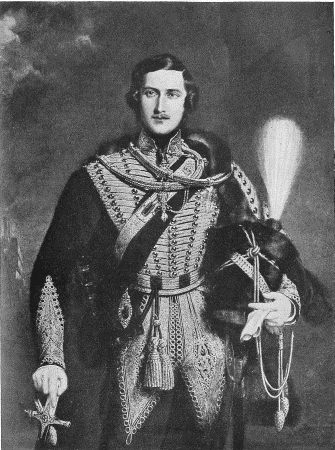
H.R.H. The Prince Consort, 1840.
From the portrait by John Partridge at Buckingham Palace
To face p. 176, Vol. I
Lord John Russell to Queen Victoria.
6th June 1839.
Lord John Russell presents his humble duty to your Majesty, and has the honour to report that Sir Robert Peel's Bill44 was discussed yesterday in the House of Commons, with great fairness and an entire absence of party spirit.
Viscount Melbourne will have acquainted your Majesty with the result of the Cabinet of yesterday. It appears to Lord John Russell that the Liberal party, with some explanation, will be satisfied with the state of things for the present, and that the great difficulties which attend the complete union of the majority will be deferred till the commencement of next Session. It is always well to have some breathing-time.
Footnote 44: The Jamaica Bill for the temporary suspension of the Constitution.
Lord John Russell to Queen Victoria.
Wilton Crescent, 11th June 1839.
Lord John Russell presents his humble duty to your Majesty, and has the honour to state that the division of last night was extremely encouraging to the future prospects of the Government.
Combined with the division on the Speakership,45 it shows that the Liberal party have still a clear though small majority in the House of Commons, and that it may probably not be necessary to resort to a dissolution. Indeed, such a measure in present circumstances would be of very doubtful issue.
Lord John Russell stated last night that he would not divide on the Canada resolutions, but move for leave to bring in a Bill.
Footnote 45: Mr Shaw Lefevre was elected by 317 against 299 for Mr Goulburn.
Lord John Russell to Queen Victoria.
6th July 1839.
Lord John Russell presents his humble duty to your Majesty, and has the honour to report that Mr. Rice yesterday brought forward his financial statement with great ability.
He moved a resolution in favour of a penny postage, which Sir Robert Peel declared it to be his intention to oppose on the report. This will be on Friday next. This seems a mistake on the part of the Opposition.46
Footnote 46: The penny postage scheme came into operation on 10th January 1840.
Queen Victoria to Viscount Melbourne.
THE QUEEN AND PRINCE ALBERT
Buckingham Palace, 12th July 1839. (20 minutes to 12.)
The Queen is really quite shocked to see that her box was taken to Lord Melbourne to Park Lane, and she fears (by the manner in which Lord Melbourne's note is written) that he was at dinner at Lady Elizabeth H. Vere's when he got it. The Queen had imagined that the House of Lords was still sitting, and therefore desired them to take the box there, but never had intended it should follow him to dinner; she begs Lord Melbourne to excuse this mistake which must have appeared so strange.
Did the dinner go off well at Lady Elizabeth H. Vere's, and were there many people there? Did Lord Melbourne go to Lady R. Grosvenor's party or did he go home?
The Queen hopes Lord Melbourne is quite well and not tired.
Monday at two o'clock for the Judge Advocate.
The Queen hears Lady Sandwich is very much delighted at her appointment.
Queen Victoria to the King of the Belgians.
Buckingham Palace, 15th July 1839.
My dear Uncle,—I have no letter from you, but hope to get one soon....
I shall send this letter by a courier, as I am anxious to put several questions to you, and to mention some feelings of mine upon the subject of my cousins' visit, which I am desirous should not transpire. First of all, I wish to know if Albert is aware of the wish of his Father and you relative to me? Secondly, if he knows that there is no engagement between us? I am anxious that you should acquaint Uncle Ernest, that if I should like Albert, that I can make no final promise this year, for, at the very earliest, any such event could not take place till two or three years hence. For, independent of my youth, and my great repugnance to change my present position, there is no anxiety evinced in this country for such an event, and it would be more prudent, in my opinion, to wait till some such demonstration is shown,—else if it were hurried it might produce discontent.
Though all the reports of Albert are most favourable, and though I have little doubt I shall like him, still one can never answer beforehand for feelings, and I may not have the feeling for him which is requisite to ensure happiness. I may like him as a friend, and as a cousin, and as a brother, but not more; and should this be the case (which is not likely), I am very anxious that it should be understood that I am not guilty of any breach of promise, for I never gave any. I am sure you will understand my anxiety, for I should otherwise, were this not completely understood, be in a very painful position. As it is, I am rather nervous about the visit, for the subject I allude to is not an agreeable one to me. I have little else to say, dear Uncle, as I have now spoken openly to you, which I was very, very anxious to do.
You will be at Paris, I suppose, when you get this letter, and I therefore beg you to lay me at the feet of the whole family, and to believe me ever your very devoted Niece,
Victoria R.
Queen Victoria to Viscount Melbourne.
Buckingham Palace, 20th July 1839.
The Queen anxiously hopes Lord Melbourne has slept well, and has not suffered from last night. It was very wrong of him not to wish the Queen good-night, as she expected he would in so small a party, for she saw that he did not go away immediately after supper. When did he get home? It was great pleasure to the Queen that he came last night. We kept up the dancing till past three, and the Queen was much amused, and slept soundly from four till half-past ten, which she is ashamed of. She is quite well, but has got a good deal of cold in her head; she hopes to see Lord Melbourne at two.
Queen Victoria to Viscount Melbourne.
THE DUCHESS OF BRAGANZA
Buckingham Palace, 25th July 1839.
The Queen has seen the Duchess of Braganza,47 who, though a good deal changed, is still handsome, and very amiable; she seemed so glad, too, to see the Queen again. The child48 is grown a dear fine girl. Lord Palmerston thought it right that I should ask her to dinner also on Saturday and take her to the Opera; and on Sunday, as she came on purpose to see the Queen, and goes on Monday.
On Sunday (besides Lord Melbourne) the Queen proposes asking Palmerston, Normanby, Uxbridge, and Surrey, and no one else except the Duchess's suite. The Queen hopes Lord Melbourne will approve of this. He will not forget to let the Queen know how the debate is going on, at about nine or ten, as she will be curious to know. She trusts he will not suffer from the fatigue of to-night.
Footnote 47: The step-mother of Donna Maria. Pedro I. assumed the title of Duke of Braganza after his abdication.
Footnote 48: Probably the princess known as "Chica," afterwards Princesse de Joinville.
The King of the Belgians to Queen Victoria.
SYRIAN AFFAIRS
St Cloud, 26th July 1839.
... Everything is pretty quiet, and the grâce accordée à Barbès49 has put down the rage against the King personally, at least for some little time. The affairs of the Orient interest a good deal. I think that it is better the Porte should be on a favourable footing with Mehemet Ali than if that gentleman had pushed on in arms, as it will put the casus foederis out of the question, and the Turks will not call in the assistance of the Russians. Whoever pushed the late Sultan into this war has done an act of great folly, as it could only bring the Porte into jeopardy.
Footnote 49: Armand Barbès, the leader of a fatal riot in Paris, was sentenced to death, a sentence afterwards remitted.
Viscount Melbourne to Queen Victoria.
3rd August 1839.
Lord Melbourne will wait upon your Majesty at a quarter before five, if possible, but there is much to discuss at the Cabinet. The Caspian Pasha has taken the Turkish fleet to Alexandria,50 and Mehemet Ali says that he will not give it up to the Sultan until he dismisses the Grand Vizier, and acknowledges the hereditary right of the Pasha to the countries which he at present governs. This is to make the Sultan his subject and his vassal.
The accounts from Birmingham are by no means good.51 There has been no disturbance of the peace, but the general disposition is both violent and determined.
Footnote 50: The Viceroy of Egypt had revolted against the Porte, and on 8th June the Sultan purported to deprive him and Ibrahim, his son, of their dignities. War was declared, and the Turkish fleet despatched to Syria. But the Admiral treacherously sailed to Alexandria, and the Ottoman troops, under Hafiz, who had succeeded Mehemet Ali in the Government of Egypt, were utterly routed. With the traitorous conduct of the Turkish admiral, Disraeli, a few years later, compared Peel's conversion to Free Trade.
Footnote 51: Chartist riots were very frequent at the time. See Introductory Note, ante, p. 141.
Queen Victoria to Viscount Melbourne.
THE OPERA
Buckingham Palace, 4th August 1839.
The Queen hopes Lord Melbourne is quite well this morning, and did not sit up working very late last night; the Queen met him twice yesterday in the Park, and really wondered how anybody could ride, for she came home much hotter than she went out, and thought the air quite like as if it came out of an oven; to-day we can breathe again. It was intensely hot at the Opera; the Queen-Dowager visited the Queen in her box, as did also the young Grand Duke of Weimar, who is just returned from Scotland, and whom the Queen has asked to come after dinner to-morrow. The Queen has not asked the Duke of Sussex to come after dinner to-morrow, as she thought he would be bored by such a sort of party; does not Lord Melbourne think so? and she means to ask him to dinner soon.
The Queen has not asked Lord Melbourne about any days this week besides to-morrow (when she trusts he may be able to come, but she does not know what there is in the House) and Wednesday; but perhaps Lord Melbourne will consent to leave Thursday and Friday open in case he should be able to come one or both of those days.
Queen Victoria to Viscount Melbourne.
Buckingham Palace, 4th August 1839.
The Queen has just received Lord Melbourne's letter; and wishes to know if Lord Melbourne means by "to-day" that he is also coming to see her this afternoon, (which she does not expect) as well as this evening? for she did not ask him in her note of this morning if he would come to-night (for she felt sure of that), but if he could come to-morrow, about which he has not answered her, as to whether he expects there will be anything of great length in the House of Lords. Lord Melbourne will forgive the Queen's troubling him again, but she felt a little puzzled by his letter; she sent him a card for Wednesday without previously asking him, as she thought that would suit him, and hopes it does?
The Queen will follow Lord Melbourne's advice respecting the Duke of Sussex.
We have just returned from hearing not only a very long, and very bad, but also, a very ludicrous, sermon.
The heat is somewhat less, but the Queen is undecided as to driving out or not.
The King of the Belgians to Queen Victoria.
KING LOUIS PHILIPPE
Laeken, 9th August 1839.
... I am sorry that you are less pleased with the old Duke, but party spirit is in England an incurable disease. These last two years he had rendered essential service to the present Administration; perhaps he has been soured by last summer's events. It was my intention to have answered your questions sooner, but from Paris I had not the means. Now the time draws so near when I hope to have the happiness of seeing you, that I think it will be better to treat the matter verbally, the more so as my most beloved Majesty is easily displeased with what may be written with the best intention, instead that in conversation the immediate reply renders any misunderstanding, however small, very difficult; and as I do not wish to have any great or small with you, and see no occasion for it, I will give my answer de vive voix.