Volume 3 — CHAPTER X
Reading edition
1841
Queen Victoria to the King of the Belgians.
5th January 1841.
My dearest Uncle,—I have to thank you for two very kind letters, of the 26th December and 1st January, and for all your very kind and good wishes. I am sorry to hear you have all been plagued with colds; we have as yet escaped them, and I trust will continue to do so. I think, dearest Uncle, you cannot really wish me to be the "Mamma d'une nombreuse famille," for I think you will see with me the great inconvenience a large family would be to us all, and particularly to the country, independent of the hardship and inconvenience to myself; men never think, at least seldom think, what a hard task it is for us women to go through this very often. God's will be done, and if He decrees that we are to have a great number of children, why we must try to bring them up as useful and exemplary members of society. Our young lady flourishes exceedingly, and I hope the Van de Weyers (who have been here for three days), who have seen her twice, will give you a favourable description of her. I think you would be amused to see Albert dancing her in his arms; he makes a capital nurse (which I do not, and she is much too heavy for me to carry), and she already seems so happy to go to him.
The christening will be at Buckingham Palace on the 10th of February, our dear marriage-day.
Affairs are certainly still precarious, but I feel confident all will come right....
Ever your devoted Niece,
Victoria R.
The King of the Belgians to Queen Victoria.
Laeken, 8th January 1841.
... I trust also that affairs will come right; what is to be feared is the chapter of accidents. Your name bears glorious fruits in all climes; this globe will soon be too small for you, and something must be done to get at the other planets....
Memorandum—Mr Anson.
THE QUEEN'S EDUCATION
Windsor Castle, 15th January 1841.
Lord Melbourne said, "The Prince is bored with the sameness of his chess every evening. He would like to bring literary and scientific people about the Court, vary the society, and infuse a more useful tendency into it. The Queen however has no fancy to encourage such people. This arises from a feeling on her part that her education has not fitted her to take part in such conversation; she would not like conversation to be going on in which she could not take her fair share, and she is far too open and candid in her nature to pretend to one atom more knowledge than she really possesses on such subjects; and yet, as the world goes, she would, as any girl, have been considered accomplished, for she speaks German well and writes it; understands Italian, speaks French fluently, and writes it with great elegance. In addition to this old Davys instilled some Latin into her during his tutorship. The rest of her education she owes to her own natural shrewdness and quickness, and this perhaps has not been the proper education for one who was to wear the Crown of England.
"The Queen is very proud of the Prince's utter indifference to the attractions of all ladies. I told Her Majesty that these were early days to boast, which made her rather indignant. I think she is a little jealous of his talking much even to men."
Viscount Melbourne to Queen Victoria.
THE QUEEN'S SPEECH
19th January 1841.
Lord Melbourne presents his humble duty to your Majesty. He has just received your Majesty's letter. Lord Melbourne is very sorry not to come down to Windsor, but he really thinks that his absence from London at this moment might be prejudicial.
Lord Melbourne will do his utmost to have the Speech worded in the most calm manner, and so as in no respect to offend or irritate any feelings. Some mention of the good conduct and gallantry of the Navy there must be—to omit it would be injurious and disheartening—but as to any expressions complimentary to France or expressive of regret at our separation from it, it will be hardly possible to introduce anything of that nature.1 It is quite unusual in our Speeches from the Throne to express either approbation or disapprobation of the conduct of foreign nations and foreign Governments. It is surprising how very seldom it has been done, and the wisdom and prudence of abstaining from it is very manifest. It would be giving an opinion upon that which does not belong to us. Anything which would have the effect of producing satisfaction in France must be of an apologetic character, which there is no ground for, and for which neither the Government nor the country is prepared.
The best course will be a total reserve upon this head, certainly abstaining from anything that can be in the slightest degree offensive.
Footnote 1: France was not mentioned, though the Convention with the other Powers, and the naval operations in conjunction with Austria, were referred to.
Viscount Melbourne to Queen Victoria.
22nd January 1841.
Lord Melbourne presents his humble duty to your Majesty.
Lord Melbourne will be most happy to wait upon your Majesty on Saturday and Sunday.
Lord Melbourne is very sorry that your Majesty is compelled to come to London contrary to your inclinations; but Lord Melbourne much rejoices that your Majesty expresses that reluctance, as there is no surer sign of complete happiness and contentment in the married life than a desire to remain quietly in the country, and there is nothing on the earth Lord Melbourne desires more anxiously than the assurance of your Majesty's happiness.
The King of the Belgians to Queen Victoria.
THE QUEEN'S INFANCY
Brussels, 22nd January 1841.
My dearest Victoria,—I thank you very sincerely for your kind letter of the 19th, which I hasten to answer. I should not have bored you by my presence, but the act of the christening is, in my eyes, a sort of closing of the first cyclus of your dear life. I was shooting at the late Lord Craven's in Berkshire, when I received the messenger who brought me the horrifying news of your poor father's deadly illness. I hastened in bitter cold weather to Sidmouth, about two days before his death. His affairs were so much deranged that your Mother would have had no means even of leaving Sidmouth if I had not taken all this under my care and management. That dreary journey, undertaken, I think, on the 26th of January, in bitter cold and damp weather, I shall not easily forget. I looked very sharp after the poor little baby, then about eight months old. Arrived in London we were very unkindly treated by George IV., whose great wish was to get you and your Mamma out of the country, and I must say without my assistance you could not have remained.... I state these facts, because it is useful to remember through what difficulties and hardships one had to struggle. You will also remember that though there existed the possibility of your eventually succeeding to the Crown, that possibility was very doubtful, the then Duchess of Clarence having been confined after your Mother, and there being every reason to think that, though poor little Princess Elizabeth did not live more than some months, other children might appear.2
It was a long time from 1820 to 1837! We got over it, however, and, as far as you are concerned, God be praised! safely and happily. You are married, with every prospect of many happy years to come, and your happiness is crowned, and consolidated, as it were, by the birth of the dear little lady. Having from motives of discretion, perhaps carried even too far, not assisted at your coming to the throne, nor at your Coronation, nor afterwards at your marriage, I wished to assist at the christening of the little Princess, an event which is of great importance....
Footnote 2: Two children were born to the Duke and Duchess of Clarence—Charlotte Augusta Louisa, born and died 29th March 1819, and Elizabeth Georgina Adelaide, born 10th December 1820, and died 4th March 1821.
Viscount Palmerston to Queen Victoria.
Carlton Terrace, 1st February 1841.
Viscount Palmerston presents his humble duty to your Majesty, and in submitting this letter from Earl Granville, which coupled with the despatches from Sir Robert Stopford virtually show that the Turkish Question is brought to a close, begs most humbly to congratulate your Majesty upon this rapid and peaceful settlement of a matter which at different periods has assumed appearances so threatening to the peace of Europe.3
Footnote 3: See ante, pp. 252, 254.
Viscount Melbourne to Queen Victoria.
2nd February 1841.
Lord Melbourne presents his humble duty to your Majesty. Lord Melbourne will be happy to wait upon your Majesty on Thursday, Saturday and Sunday, but he finds that there is to be a Cabinet dinner to-morrow.
Lord Melbourne will speak to Lord Palmerston about Lord John Russell.
Lord Melbourne does not see the name of the Archbishop of Canterbury as a subscriber to this "Parker" Society, and if your Majesty will give him leave, he will ask him about it before he gives your Majesty an answer. It is in some degree a party measure, and levelled against these new Oxford doctrines. The proposal is to republish the works of the older divines up to the time of the death of Queen Elizabeth. Up to that period the doctrines of the Church of England were decidedly Calvinistic. During the reign of James II.,4 and particularly after the Synod of Dort (1618-1619), the English clergy very generally adopted Arminian opinions.
It is proposed to republish the works of the divines who wrote during the first period, and to stop short when they come to the second. There is meaning in this. But, after all, the object is not a bad one, and it may not be worth while to consider it so closely.
Footnote 4: Lord Melbourne must have meant James I.
Viscount Melbourne to Queen Victoria.
ILLNESS OF DUKE OF WELLINGTON
5th February 1841 (6 o'clock).
Lord Melbourne presents his humble duty to your Majesty, and is very sorry to have to acquaint your Majesty that the Duke of Wellington was taken ill in the House of Lords this evening with a seizure, probably paralytic, and of the same nature with those which he has had before. Lord Brougham, who was standing opposite to the Duke and addressing the House, observed the Duke's face to be drawn and distorted, and soon afterwards the Duke rose from his seat and walked staggeringly towards the door. He walked down the gallery, supported on each side, but never spoke. A medical man was procured to attend him; he was placed in his carriage and driven home....
Lord John Russell to Queen Victoria.
THE UNITED STATES
6th March 1841.
Lord John Russell presents his humble duty to your Majesty, and has the honour to state that the remainder of the Navy Estimates, and nearly the whole of the Army Estimates, were voted last night without any serious opposition. Indeed the chief fault found with the Army Estimates was that they are not large enough.
Sir Robert Peel made a remarkable speech. Adverting to the present state of our affairs with the United States,5 he said that much as he disliked war, yet if the honour or interests of the country required it, he should sink all internal differences, and give his best support to the Government of his country.
This declaration was received with loud cheers. It must be considered as very creditable to Sir Robert Peel.
Footnote 5: See Introductory Note, ante, p. 254.
Viscount Palmerston to Queen Victoria.
CHINA
Foreign Office, 10th April 1841.
Viscount Palmerston presents his humble duty to your Majesty, and has the honour to submit the accompanying letters, which he received yesterday, about the operations in China, and which have just been returned to him by Viscount Melbourne, whose letter he also transmits.6
Viscount Palmerston has felt greatly mortified and disappointed at this result of the expedition to China, and he much fears that the sequel of the negotiation, which was to follow the conclusion of these preliminary conditions, will not tend to render the arrangement less objectionable. Captain Elliot seems to have wholly disregarded the instructions which had been sent to him, and even when, by the entire success of the operations of the Fleet, he was in a condition to dictate his own terms, he seems to have agreed to very inadequate conditions.7 The amount of compensation for the opium surrendered falls short of the value of that opium, and nothing has been obtained for the expenses of the expedition, nor for the debts of the bankrupt Hong8 merchants. The securities which the plenipotentiaries were expressly ordered to obtain for British residents in China have been abandoned; and the Island of Chusan which they were specifically informed was to be retained till the whole of the pecuniary compensation should have been paid, has been hastily and discreditably evacuated. Even the cession of Hong Kong has been coupled with a condition about the payment of duties, which would render that island not a possession of the British Crown, but, like Macao, a settlement held by sufferance in the territory of the Crown of China.
Viscount Palmerston deems it his duty in laying these papers before your Majesty, to state some few of the objections which he feels to the arrangement, but the Cabinet will have to consider, as soon as they meet after the Recess, what advice they may wish humbly to tender to your Majesty upon these important matters. There is no doubt, however, that much has been accomplished, but it is very mortifying to find that other things which the plenipotentiaries were ordered to obtain, and which the force placed at their command was amply sufficient to enable them to accomplish, have not been attained.
Viscount Palmerston has sent a small map of the Canton River, which your Majesty may like to keep for future reference.
Footnote 6: Captain Elliot, after capturing the Chinese position at the mouth of Canton River, concluded a preliminary treaty with the Chinese Government, which did not satisfy the Chinese, and which was strongly disapproved of by the English Ministry, as containing no mention of the opium traffic, which had been the cause of all the difficulties; Elliot was accordingly recalled, and succeeded by Sir Henry Pottinger.
Footnote 7: They were the cession of Hong-Kong, and payment of an indemnity of 6,000,000 dollars to Great Britain, with provision for commercial facilities and collection of customs.
Footnote 8: The native Canton merchants,—Hong here probably meaning a "row of houses," a "street." Hong Kong (Hiang Kiang) means the "fragrant lagoon."
Queen Victoria to the King of the Belgians.
13th April 1841.
My dearest Uncle,—I thank you much for your kind letter of the 9th, received yesterday. I have just heard from Stockmar (who, I hope, reported favourably of us all) that your Ministry is at last settled, of which I wish you joy. I think, dear Uncle, that you would find the East not only as "absurd" as the West, but very barbarous, cruel, and dangerous into the bargain.
The Chinese business vexes us much, and Palmerston is deeply mortified at it. All we wanted might have been got, if it had not been for the unaccountably strange conduct of Charles Elliot (not Admiral Elliot,9 for he was obliged to come away from ill-health), who completely disobeyed his instructions and tried to get the lowest terms he could.... The attack and storming of the Chorempee Forts on the 7th of January was very gallantly done by the Marines, and immense destruction of the Chinese took place.10 The accounts of the cruelty of the Chinese to one another are horrible. Albert is so much amused at my having got the Island of Hong Kong, and we think Victoria ought to be called Princess of Hong Kong in addition to Princess Royal.
She drives out every day in a close carriage with the window open, since she has been here, which does her worlds of good, and she is to have a walk to-day.
Stockmar writes me word that Charlotte11 is quite beautiful. I am very jealous.
I think Vecto quite right not to travel without Nemours; for it would look just as if she was unhappy, and ran to her parents for help. I am sure if Albert ever should be away (which, however, will and shall never happen, for I would go with him even if he was to go to the North Pole), I should never think of travelling; but I can't make mamma understand this. Now farewell. Ever your devoted Niece,
Victoria R.
Footnote 9: They were both cousins of Lord Minto, the First Lord of the Admiralty.
Footnote 10: Commodore Bremer very speedily reduced some of the forts, but his further operations were stopped.
Footnote 11: Daughter of King Leopold, who married in 1857 the Archduke Ferdinand of Austria (afterwards Emperor Maximilian of Mexico).
Viscount Melbourne to Queen Victoria.
LORD CARDIGAN
24th April 1841.
Lord Melbourne presents his humble duty to your Majesty. Mr Labouchere12 has desired that the five-pound piece which is about to be issued from the Mint should be submitted for your Majesty's inspection and approbation.
ARMY DISCIPLINE
We have had under our consideration at the Cabinet the unfortunate subject of the conduct of Lord Cardigan.13 The public feeling upon it is very strong, and it is almost certain that a Motion will be made in the House of Commons for an Address praying your Majesty to remove him from the command of his regiment. Such a Motion, if made, there is very little chance of resisting with success, and nothing is more to be apprehended and deprecated than such an interference of the House of Commons with the interior discipline and government of the Army. It was also felt that the general order issued by the Horse Guards was not sufficient to meet the case, and in these circumstances it was thought proper that Lord Melbourne should see Lord Hill, and should express to him the opinion of the Cabinet, that it was necessary that he should advise your Majesty to take such measures as should have the effect of removing Lord Cardigan from the command of the 11th Hussars. The repeated acts of imprudence of which Lord Cardigan has been guilty, and the repeated censures which he has drawn down upon himself, form a ground amply sufficient for such a proceeding, and indeed seem imperiously to demand it.14
Lord Melbourne has seen Lord Hill and made to him this communication, and has left it for his consideration. Lord Hill is deeply chagrined and annoyed, but will consider the matter and confer again with Lord Melbourne upon it to-morrow.
Footnote 12: President of the Board of Trade, afterwards created Lord Taunton.
Footnote 13: "Within the space of a single twelvemonth, one of his [Lord Cardigan's] captains was cashiered for writing him a challenge; he sent a coarse and insulting verbal message to another, and then punished him with prolonged arrest, because he respectfully refused to shake hands with the officer who had been employed to convey the affront; he fought a duel with a lieutenant who had left the corps, and shot him through the body; and he flogged a soldier on Sunday, between the Services, on the very spot where, half an hour before, the man's comrades had been mustered for public worship."—Sir G. Trevelyan, Life and Letters of Lord Macaulay, chap. viii.
Footnote 14: In February he had been acquitted on technical grounds by the House of Lords of shooting a Captain Harvey Garnett Phipps Tuckett. He had accused Tuckett of being the author of letters which had appeared in the papers reflecting on his character; a duel on Wimbledon Common followed, and Tuckett was wounded. The evidence, consisting in part of a visiting card, showed that a Captain Harvey Tuckett had been wounded, which was held to be insufficient evidence of identity.
Viscount Melbourne to Queen Victoria.
25th April 1841.
Lord Melbourne presents his humble duty to your Majesty. He is most anxious upon all subjects to be put in possession of Your Majesty's full and entire opinions. It is true that this question may materially affect the discipline of the Army, by subjecting the interior management of regiments to be brought continually under the inspection and control of the House of Commons upon complaints of officers against their superiors, or even of private men against the officers.
The danger of the whole of Lord Cardigan's proceedings has been lest a precedent of this nature should arise out of them. The question is whether it is not more prudent to prevent a question being brought forward in the House of Commons, than to wait for it with the certainty of being obliged to yield to it or of being overpowered by it. But of course this cannot be done unless it is consistent with justice and with the usage and prestige of the Service.
Lord Melbourne has desired the Cabinet Ministers to assemble here to-day at four o'clock, in order to consider the subject. Lord Melbourne has seen Lord Hill again this morning, and Lord Hill has seen and consulted the Duke of Wellington, who has stated his opinion very fully.
The opinion of the Duke is that the Punishment on Sunday was a great impropriety and indiscretion upon the part of Lord Cardigan, but not a Military offence, nor a breach of the Mutiny Act or of the Articles of War; that it called for the censure of the Commander-in-Chief, which censure was pronounced by the General Order upon which the Duke was consulted before it was issued, and that according to the usage of the Service no further step can be taken by the Military Authorities. This opinion Lord Melbourne will submit to-day to the Cabinet Ministers.
Lord Melbourne perceives that he has unintentionally written upon two sheets of paper, which he hopes will cause your Majesty no inconvenience.
Lord Melbourne to Queen Victoria.
THE NOTTINGHAM ELECTION
South Street, 28th April 1841.
Lord Melbourne presents his humble duty to your Majesty. He has himself seen the result of the election at Nottingham15 without the least surprise, from his knowledge of the place and his observation of the circumstances of the contest. What John Russell reported to your Majesty was the opinion of those who act for us in that place, but as soon as Lord Melbourne saw that there was a disposition upon the part of the violent party, Radicals, Chartists, and what not, to support the Tory candidate, he knew that the contest was formidable and dubious. The Tory party is very strong, naturally, at Nottingham, and if it received any accession of strength, was almost certain to prevail. This combination, or rather this accession of one party to the Tories, which has taken place at Nottingham, is very likely, and in Lord Melbourne's opinion almost certain, to take place in many other parts of the country in the case of a general election, and forms very serious matter for consideration as to the prudence of taking such a step as a dissolution of the Parliament.
Lord Melbourne will wait upon your Majesty after the Levée. It signifies not how late, as there is no House of Lords.
Footnote 15: Where Mr Walter, a Tory, was elected with a majority of 238.
Lord John Russell to Queen Victoria.
THE BUDGET
Wilton Crescent, 1st May 1841.
Lord John Russell presents his humble duty to your Majesty, and has the honour to report that Mr Baring yesterday brought forward the Budget in a remarkably clear and forcible speech.
The changes in the duties on Sugar and Timber,16 and the announcement made by Lord John Russell of a proposal for a fixed duty on Corn, seemed to surprise and irritate the Opposition.
Sir Robert Peel refused to give any opinion on these propositions, and satisfied himself with attacking the Government on the state of the finances.
The supporters of the Government were greatly pleased with Mr Baring's plan, and loud in their cheers.
It is the general opinion that Lord Stanley will not proceed with his Bill,17 and there seems little doubt of this fact.
But the two parties are now evenly balanced, and the absence or defection of some two or three of the Ministerial party may at any time leave the Government in a minority.
Footnote 16: The proposals were to increase the duty on colonial timber from 10s. to 20s. a load, reducing it on foreign timber from 55s. to 50s., to leave the duty on colonial sugar unloaded at 24s. a cwt., reducing that on foreign sugar from 63s. to 36s. a cwt.
Footnote 17: On Irish Registration.
Viscount Melbourne to Queen Victoria.
3rd May 1841.
Lord Melbourne presents his humble duty to your Majesty. We decided at the Cabinet on Friday that we could not sanction the agreement which Captain Elliot has probably by this time concluded with the Government of China, but that it would be necessary to demand a larger amount of indemnity for the past injury, and also a more complete security for our trade in future. For this purpose it was determined to send out instructions, in case the armament should not have left the Chinese coasts and have been dispersed, to reoccupy the Island of Chusan,18 a measure which appears to have had a great effect upon the minds of the Chinese Government. It was also determined to recall Captain Elliot, and to send out as soon as possible another officer with full instructions from hence as to the views and intentions of your Majesty's Government. Sir Henry Pottinger,19 an officer in the East India Company's Service, much distinguished in the recent operations in Afghanistan, is designated with your Majesty's approbation for this service, which he has signified his willingness to undertake. It was also thought that it would be proper to entrust Lord Auckland20 with general discretionary powers as to the further conduct of the expedition. These determinations Lord Melbourne hopes that your Majesty will approve.
Lord John Russell informed Lord Melbourne yesterday that he knew that it was not the intention of the Opposition to press Lord Stanley's Bill; but it is not to be expected in the present position of affairs that they will not determine upon taking some decisive and united measure in advance.
In the present state of public measures and of public feeling, when debate may arise at any moment, it would not be fitting for Lord Melbourne to absent himself on any sitting day from the House of Lords. But unless there should be anything so urgent as to prevent him, he will come down after the House on Tuesday evening and stay until Thursday morning.
Fanny is highly delighted and immeasurably grateful for your Majesty's offer of the Lodge in Richmond Park, and most desirous to avail herself of your Majesty's kindness, and so is Jocelyn. Lord Melbourne has little doubt that they will thankfully accept it.21
Footnote 18: The Island of Chusan, off the coast of China, had been occupied in July 1840 as a base of operations, but evacuated by Elliot in 1841. It was retaken in September 1841, after Elliot's recall, by Sir Henry Pottinger.
Footnote 19: He had served in the Mahratta War, and been political agent in Scinde.
Footnote 20: Governor-General of India.
Footnote 21: Lady Fanny Cowper, Lord Melbourne's niece, was married to Lord Jocelyn on 27th April.
The Queen of the Belgians to Queen Victoria.
CHRISTENING OF COMTE DE PARIS
Paris, 3rd May 1841.
My beloved Victoria,—As you know surely already, the day of yesterday went off very well. The christening22 was very splendid, the weather beautiful, and everything extremely well managed.... The arrival at Notre-Dame, and the coup d'œil of the old church, all hung interiorly with crimson velvet draperies and trophies of flags, was very splendid. There was in the church three rows de tribunes all full of well-dressed people. Les grands corps de l'État étaient rangés de chaque côté et dans le chœur; l'Autel était placé au centre de l'église. Les cardinaux et tout le clergé étaient alentour. When my father arrived, the Archbishop of Paris received him at the door of the church, and we all walked in state. My father ouvrait la marche with the Queen. Prie-dieu and chairs were disposed for us en demi-cercle before the altar, or rather before the baptismal font, which was placed in front of it, in the very middle of the Church. My father and mother stood in the centre of the row near each other. Your uncle, Chartres, and all the Princes followed on the side of my father, and the princesses on the side of my mother. Paris remained with Hélène till the moment of the christening. When the ceremony began he advanced near the font with my father and mother (sponsors), and was taken up in the arms of his nurse. After the christening a Mass and Te Deum were read, and when we came back to the Tuileries the corps municipal brought the sword which the City of Paris has given to the Comte de Paris....
Footnote 22: Of the Comte de Paris, at this time nearly three years old, son of the Duc d'Orléans.
Lord John Russell to Queen Victoria.
THE SUGAR DUTIES
Wilton Crescent, 4th May 1841.
Lord John Russell presents his humble duty to your Majesty, and has the honour to report that Lord Stanley yesterday postponed his Bill for a fortnight, which at this period of the year is equivalent to its abandonment.
On the other hand, Lord Sandon gave a notice for Friday for a Resolution on Sugar Duties.
If, as is probable, this Motion is made as a party movement, it is probable that, with the addition of those on the Ministerial side who have an interest in the West Indies, the Motion will be successful.
The whole scheme of finance for the year will thus be overturned.
The Tory party seem to expect a dissolution of Parliament, but your Majesty's advisers will hardly be able to recommend to your Majesty such a step.
The cry against the Poor Law is sure to be taken up by the worst politicians of the Tory party, and, as at Nottingham, may be successful against that most useful law.
The friends of Government who represent counties will be taunted with the proposal to alter the Corn Law.
Bribery is sure to be resorted to beyond anything yet seen.
A defeat of the Ministry on a dissolution would be final and irreparable.
On the other hand, their successors in the Government would have to provide for the excess in the expenditure pledged against the best measures that could be resorted to for the purpose. It would be a difficulty of their own seeking, and their want of candour and justice to their opponents would be the cause of their own embarrassments.
The moment is a very important one, and the consequences of the vote of Friday, or probably Monday, cannot fail to be serious.
Memorandum by Mr Anson.
A MINISTERIAL CRISIS
"The Ministry in jeopardy." (Heading in the Prince Albert's hand.)
Windsor Castle, 4th May 1841.
Lord Melbourne came down from town after the House of Lords. I went with him to his room for an hour after the Queen had retired. He said the main struggle would take place on the Sugar Duties on Friday. His impression was that the Government would be beat, and he must then decide whether to go out or dissolve. He leaned to the former. I said, "I trusted he would not dissolve unless he thought there was some prospect of increasing his strength, and begged him to remember what was done would not be considered the act of the Government but that of himself and the Queen, and that he individually would be held as the responsible person."
He said he had not written to the Queen to prepare H.M. for coming events and the course that it would be incumbent upon her to take, for he felt it extremely difficult and delicate, especially as to the use she should make of the Prince, and of her mode of communication when she required it with Lord Melbourne. He thought she ought never to ask his advice direct, but if she required his opinion there would be no objection to her obtaining it through the Prince.
He said H.M. had relied so implicitly upon him upon all affairs, that he felt that she required in this emergency advice upon almost every subject. That he would tell H.M. that she must carefully abstain from playing the same part she did, again, on Sir R. Peel's attempt to form a Ministry, for that nothing but the forbearance of the Tories had enabled himself and his colleagues to support H.M. at that time. He feared Peel's doggedness and pertinacity might make him insist, as a point of honour, on having all discretion granted to him in regard to the removal of Ladies. I told him of the Prince's suggestion that before the Queen saw Sir R. Peel some negotiation might be entered into with Sir Robert, so that the subject might be avoided by mutual consent, the terms of which might be that Sir Robert should give up his demand to extort the principle. The Queen, on the other hand, should require the resignation of those Ladies objected to by Sir Robert. Lord Melbourne said, however, that the Prince must not have personal communication with Sir Robert on this subject, but he thought that I might through the medium of a common friend.
Memorandum by Mr Anson.
LORD MELBOURNE'S ADVICE
Windsor Castle, 5th May 1841.
Saw Lord Melbourne after his interview this morning with the Queen. He says Her Majesty was perfectly calm and reasonable, and seemed quite prepared for the resignation of the Government. He said she was prepared to give way upon the Ladies if required, but much wished that that point might be previously settled by negotiation with Sir R. Peel, to avoid any discussion or difference. Lord Melbourne thinks I might do this. He would also like Peel to be cautioned not to press Her Majesty to decide hastily, but to give Her Majesty time, and that he should feel that if he acted fairly he would be met in the same spirit by the Queen.
With regard to future communication with Lord Melbourne, the Queen said she did not mean that a change should exclude her from Lord Melbourne's society, and when Lord Melbourne said that in society Her Majesty could not procure Lord Melbourne's opinion upon any subject, and suggested that that should be obtained through the Prince, Her Majesty said that that could pass in writing under cover to me, but that she must communicate direct.
The Queen, he says, leans to sending for the Duke of Wellington. Lord Melbourne advised that Her Majesty should make up her mind at once to send for Sir Robert. He told me that it would not be without precedent to send for both at once; this it appears to me would obviate every objection. The Queen, he thinks, has a perfect right to exercise her judgment upon the selection of all persons recommended to Her Majesty for Household appointments, both as to liking, but chiefly as to their character and as to the character of the husband or wife of the person selected. He would advise the Queen to adopt the course which King William did with Lord Melbourne in 1835, viz. desiring Lord Melbourne, before His Majesty approved of any appointments, to send a list of those proposed even to the members of every Board, and the King having them all before him expressed his objections to certain persons, which Lord Melbourne yielded to.
Told Lord Melbourne that the Prince wished him to impress upon the Queen's mind not to act upon the approaching crisis without the Prince, because she would not be able to go through difficulties by herself, and the Prince would not be able to help her when he was ignorant of the considerations which had influenced her actions. He would wish Lord Melbourne when with the Queen to call in the Prince, in order that they might both be set right upon Lord Melbourne's opinions, that he might express in the presence of each other his views, in order that he should not convey different impressions by speaking to them separately, so that they might act in concert.
The Prince says the Queen always sees what is right at a glance, but if her feelings run contrary she avoids the Prince's arguments, which she feels sure agree with her own, and seeks arguments to support her wishes against her convictions from other people.
Viscount Melbourne to Queen Victoria.
DISSOLUTION OR RESIGNATION
South Street, 7th May 1841.
Lord Melbourne presents his humble duty to your Majesty, and laments much the prospect that lies before us, more especially as it is so repugnant to your Majesty's feelings. Your Majesty has often observed that these events must come in the course of affairs at some moment or another, but Lord Melbourne knows not whether it is much consolation to reflect that what is very disagreeable is also natural and unavoidable. Lord Melbourne feels certain that your Majesty will consider the situation calmly and impartially, will do that which shall appear the best for your own interests and those of the country, which are identical.
Everything shall be done that can be; the questions which may arise shall be considered well, and upon as full information as can be obtained. But Lord Melbourne has little to add to what he wrote to your Majesty yesterday. So many interests are affected by this Sugar question, the West Indian, the East Indian, the opponents of Slavery and others, that no small number of our supporters will be induced either to stay away or to vote against us, and this must place us in a minority upon the main points of our Budget. In this we can hardly acquiesce, nor can we adopt a different policy and propose other taxes, when in our opinion the necessary revenue can be raised without imposing them. This state of things imposes upon us the alternative of dissolution or of resignation, and to try the former without succeeding in it would be to place both your Majesty and ourselves in a worse situation than that in which we are at present.
Viscount Melbourne to Queen Victoria.
South Street, 8th May 1841.
Lord Melbourne presents his humble duty to your Majesty. We have been considering this question of dissolution at the Cabinet, and we have had before us a general statement of the public returns for England and Wales. It is not very favourable, but Lord Melbourne fears that it is more favourable than the reality would prove. The Chancellor,23 Palmerston, and Hobhouse are strongly for dissolution, but the opinion of the majority is the other way, and in that opinion Lord Melbourne is strongly inclined to agree.
Lord Melbourne will have the honour of waiting upon your Majesty to-morrow at three.
Footnote 23: The Earl of Cottenham.
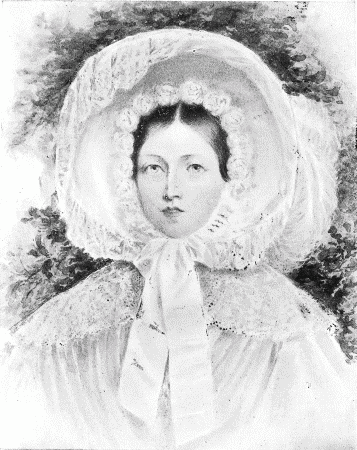
H.M. Queen Victoria, 1841.
From the drawing by E. F. T., after H. E. Dawe, at Buckingham Palace
To face p. 272, Vol. I
Memorandum by Mr Anson.
SIR ROBERT PEEL
Notes upon an Interview with Sir Robert Peel (No. 1).24
9th May 1841.
Told Sir Robert that I had wished to have sought him through the medium of a common friend, which would have given him a greater confidence than I had now a right to expect at his hands, but I felt upon so delicate a mission it was safer, and would be more in accordance with his wishes, to come direct.
That the Prince had sent me to him, with the object of removing difficulties upon his coming into office.
That Her Majesty was anxious that the question of the removal of the Ladies of the Bedchamber should not be revived, and would wish that in any personal communication with Sir Robert this question might be avoided.
That it might be arranged that if Sir Robert would not insist upon carrying out his principle, Her Majesty might procure the resignation of any Ladies whom Sir Robert might object to; that I thought there might be a disposition to yield to the removal of the Mistress of the Robes, Lady Normanby, and the Duchess of Bedford, as being connected with leading political persons in Government.
Endeavoured to impress upon Sir Robert that if he acts fairly and kindly towards the Queen, he will be met in the same spirit.
Sir Robert said he had considered the probable object of my interview, and thought, from my former position with Lord Melbourne, that Lord Melbourne would be aware of my coming. He must be assured of this before he could speak confidentially to me.
Upon this I admitted that Lord Melbourne had knowledge of my intention, but that I was not authorised to say that he had.
Sir Robert said, "I shall put aside all form, and treat you frankly and confidentially. You may depend upon every word you say being held as sacred. No part, without further permission, shall be mentioned even to the Duke, much less to any of my other colleagues.
"I would waive every pretension to office, I declare to God! sooner than that my acceptance of it should be attended with any personal humiliation to the Queen."
He thought that giving in the names of those Ladies whom he considered obnoxious was an offensive course towards the Queen.
For the sake of office, which he did not covet, he could not concede any constitutional principle, but it was not necessary that that principle should be mooted.
"It would be repulsive to my feelings that Her Majesty should part with any of her Ladies, as the result of a forced stipulation on my part; in a party sense it would doubtless be advantageous to me to say that I had demanded from the Queen, and the Queen had conceded to me the appointments of these three Ladies."
The mode he would like, and which he considered as least objectionable for Her Majesty, was for Her Majesty to say to him, "There is no occasion to revive this constitutional question, as those ladies immediately connected with prominent members of the Administration have sent in their resignation."
The vacancies existing before Sir Robert Peel sees Her Majesty, there is no necessity for discussion.
On the one hand, by this means, there was less appearance of insult to the Queen, and on the other, there was no appearance of concession of principle upon his.
Sir Robert was ready to make any personal sacrifice for Her Majesty's comfort, except that of his honour. "Can the Queen for an instant suppose that I would permit my party to urge me on to insist upon anything incompatible with Her Majesty's dignity, which it would be my great aim and honour to defend?"
[This was his indignant reply to my remark upon the rumours that his party would press him to coerce and subdue Her Majesty.]
Sir Robert thinks it better for the Queen to avoid anything in the shape of a stipulation. He would like what he would have done upon a former occasion (and upon which, on the honour of a gentleman, his views had undergone no change) to be taken as a test of what he would be ready to concede to.
Nothing but misconception, he said, could in his opinion have led to failure before. "Had the Queen told me" (after the question was mooted, which it never need have been) "that those three ladies immediately connected with the Government had tendered their resignation, I should have been perfectly satisfied, and should have consulted the Queen's feelings in replacing them."
Sir Robert said this conversation shall remain sacred, and to all effect, as if it had never happened, until he saw me again to-morrow morning.
There is nothing said, he added, which in any way pledges or compromises the Queen, the Prince, or Lord Melbourne.
Footnote 24: See Parker's Sir Robert Peel, vol. ii. p. 455, et seq., where Peel's memorandum of the interview is set out.
Memorandum by Mr Anson.
SIR ROBERT PEEL
Interview with Sir Robert Peel (No. 2).
10th May 1841.
Peel said: "It is essential to my position with the Queen that Her Majesty should understand that I have the feelings of a gentleman, and where my duty does not interfere, I cannot act against her wishes. Her Majesty doubtless knows how pressed I am as the head of a powerful party, but the impression I wish to create in Her Majesty's mind is, that I am bound to defend her against their encroachments."
HOUSEHOLD APPOINTMENTS
In regard to Household appointments the holders of which are not in Parliament, he had not considered the question, but in the meantime he would in no way commit himself to anyone, or to any understanding upon the subject, without previous communication. He had no personal objects to serve, and the Queen's wishes would always be consulted.
He again repeated, that if the Queen's personal feelings would suffer less by forming an Administration to his exclusion, he should not be offended. Private life satisfied him, and he had no ambition beyond it.
Lord Melbourne might rest assured that he fully appreciated his aim, that his only object was to do that which was most for Her Majesty's advantage, and no human being should know that he was privy to this overture. Lord Melbourne might depend upon his honour. If Lord Melbourne was pressed to a dissolution he should still feel the same impression of Lord Melbourne's conduct, that it was honourable and straightforward.
He wished the Prince to send him a list of those Ladies whom it would be agreeable to Her Majesty to have in her Household. Sir Robert must propose it to the Ladies, but will be entirely guided by Her Majesty's wishes. There should be no appearance that Her Majesty has any understanding, as he was bound to his party to make it appear that the appointments emanated from himself.25
Footnote 25: There was a further interview on the following day at which various detailed points were arranged.
Memorandum by the Queen.
11th May 1841.
The Queen considers it her right (and is aware that her predecessors were peculiarly tenacious of this right) to appoint her Household. She, however, gives up the great officers of State and those of her Lords-in-Waiting, Equerries, and Grooms-in-Waiting, who are in Parliament, to the appointment of the Prime Minister, subject to her approval.
The Queen has always appointed her Ladies of the Bedchamber herself, but has generally mentioned their names to the Prime Minister before appointing them, in order to leave him room for objection in case he should deem their appointment injurious to his Government, when the Queen would probably not appoint the Lady.
The Maids of Honour and Women of the Bedchamber are of course not included amongst those who are mentioned to the Prime Minister before their appointment, but are at once appointed by the Queen.
Extract from the Queen's Journal.
PRESSURE OF BUSINESS
Wednesday, 12th May 1841.
"At seven minutes to five Lord Melbourne came to me and stayed till half-past five. He gave me the copies of Anson's conversations with Peel. Lord Melbourne then gave me a letter from the Chancellor to read, strongly advocating a dissolution, and wishing that there should be a division also on Lord John Russell's amendment.26
"Lord Melbourne left the letter with me. The first part of the letter, relative to Lord John's amendment, we think good, but the other part we can't quite agree in. 'There is to be a Cabinet to-morrow to consider what is to be done,' said Lord Melbourne, 'for the Chancellor's opinion must be considered. There is a preferment amongst our people for dissolution,' Lord M. added. The feeling in the country good. I asked Lord M., 'Must they resign directly, the next day, after the division (if they intended resigning)?' 'Why,' he said, 'it was awkward not to do so if Parliament was sitting; if the division were only to take place on Friday, then they needn't announce it till Monday,' which we hope will be the case, as we agreed it wouldn't do for me to have a ball the day Lord M. had resigned, and before I had sent for anybody else, and therefore I hoped that it could be managed that the division did not take place till Friday. Lord M. said that in case they resigned, he wished Vernon Smith27 to be made a Privy Councillor; the only addition to the Peers he mentioned the other day he wished to make is Surrey;28 we agreed that too many Peers was always a bad thing."
Footnote 26: To Lord Sandon's resolution on the Sugar Duties.
Footnote 27: Robert Vernon Smith (1800-1873), Under-Secretary for War and the Colonies, afterwards Lord Lyveden.
Footnote 28: The Earl of Surrey (1791-1856) was now M.P. for West Sussex, and Treasurer of the Household, and was afterwards thirteenth Duke of Norfolk.
Queen Victoria to the King of the Belgians.
11th May 1841.
... I am sure you will forgive my writing a very short letter to-day, but I am so harassed and occupied with business that I cannot find time to write letters. You will, I am sure, feel for me; the probability of parting from so kind and excellent a being as Lord Melbourne as a Minister (for a friend he will always remain) is very, very painful, even if one feels it will not probably be for long; to take it philosophically is my great wish, and quietly I certainly shall, but one cannot help feelings of affection and gratitude. Albert is the greatest possible comfort to me in every way, and my position is much more independent than it was before.
I am glad you see the French feeling in the right light. I rejoice that the christening, etc., went off so well. Believe me, ever, your devoted Niece,
Victoria R.
Extract from the Queen's Journal.
QUESTION OF DISSOLUTION
Thursday, 13th May 1841.
"Saw Lord Melbourne at a little past four.
"... 'We have had a Cabinet,' Lord Melbourne said, 'and we have been considering the question of dissolution and what is the best course to be pursued; if we were to dissolve, John Russell,' he said, 'would pursue quite a different course; he would then announce the Sugar Duties at once. I (Lord Melbourne) said, that I had been considering well the whole question, and the Chancellor's letter, but that altogether I did not think it advisable to have recourse to a dissolution—and I think the greater part lean towards that opinion; but there are a few who are very much for a dissolution—the Chancellor and Hobhouse very much so, and Palmerston. They have, however, not quite finally decided the matter. I understand the debate will certainly go over to-night,' he said, 'and that they would have time on Saturday and Sunday to consider about Lord John's amendment.'"
Extract from the Queen's Journal.
Saturday, 15th May 1841.
"Lord Melbourne came to me at twenty minutes past one, and we talked about this question of dissolution. 'We shall have a long debate upon it this morning at the Cabinet,' Lord Melbourne said. 'The worst thing is, that if we carry the Sugar Duties, we must dissolve. If we were to dissolve,' he continued, 'and were to have the parties equal as they are now, it would be very bad; if we were to have a majority, it would be a great thing; but if we were to have a minority it would be still worse.... We know that Charles I. and Charles II., and even Cromwell, appealed to the country, and had a Parliament returned into their very teeth' (so strong an Opposition), 'and that produced deposition, and convulsion, and bloodshed and death; but since then the Crown has always had a majority returned in favour of it. Even Queen Anne,' he continued, 'who removed Marlborough in the midst of his most glorious victories and dissolved Parliament, had an immense majority, though her measures were miserable; William IV.,' he said, 'even though he had a majority against him which prevented him from keeping his Ministers, had a much stronger feeling for him in that Parliament, than he ever had before. But I am afraid,' he added, 'that for the first time the Crown would have an Opposition returned smack against it; and that would be an affront to which I am very unwilling to expose the Crown.' This is very true."
The King of the Belgians to Queen Victoria.
KING LEOPOLD'S SYMPATHY
Tuileries, 14th May 1841.
My dearest Victoria,—I am deeply grateful for your kind letter, which reached me this morning. Letters from hence ought not to be longer on their way than, at the longest, forty hours; forty-eight is the maximum. I fear that they are delayed at the Foreign Office; here it cannot be, as for instance these lines go this evening.
I can easily understand that the present crisis must have something very painful for you, and you will do well for your health and comfort to try to take it as philosophically as possible; it is a part of the Constitutional system which is for the Sovereign very hard to get over.
Nous savons tous des paroles sur cet air, as the French say. I was convinced that Lord Melbourne's right and good feeling would make him pause before he proposed to you a dissolution. A general election in England, when great passions must be roused or created to render it efficacious for one party or another, is a dangerous experiment, always calculated to shake the foundations on which have hitherto reposed the great elements of the political power of the country. Albert will be a great comfort to you, and to hear it from yourself has given me the sincerest delight. His judgment is good, and he is mild and safe in his opinions; they deserve your serious attention; young as he is, I have really often been quite surprised how quick and correct his judgment is....
Lord John Russell to Queen Victoria.
TORY DISSENSIONS
Wilton Crescent, 16th May 1841.
Lord John Russell presents his humble duty to your Majesty, and has the honour to state that the general effect of last week's debate29 has been greatly in favour of the measures of your Majesty's Ministers.
The speeches of Mr Labouchere, Sir George Grey, and Lord Howick, with the powerful argument of the Chancellor of the Exchequer on Friday night, have not been met by any corresponding ability on the other side.
In fact the Opposition seem to have concealed their own views of policy, and to have imagined that the Anti-Slavery feeling would carry them through successfully. But this expectation has been entirely disappointed; debate has unmasked the hollow pretence of humanity, and the meetings at Exeter Hall and in the country have completely counteracted the impressions which Dr Lushington's speech30 had produced.
Lancashire, Cheshire, and the West Riding of Yorkshire have been roused to strong excitement by the prospect of a reduction of the duty on corn. Several of the large towns have expressed their opinions without distinction of party.
These symptoms are said to have created some dissensions among the opponents of your Majesty's present Government.
Sir Robert Peel, Lord Stanley, and nearly all the eminent leaders of the party, profess their adherence to the principles of Mr Huskisson.31 On the other hand, the Duke of Buckingham,32 with many Lords and Commoners, is opposed to any relaxation of the present Corn Laws. This difference must ultimately produce serious consequences, and it is possible they may break out before the present debate is ended.
One consequence of the propositions of the Ministry is the weakening of the power of the Chartists, who have relied on the misrepresentation that neither Whigs nor Tories would ever do anything for the improvement of the condition of the working classes.
All these circumstances have a bearing on the question of a dissolution of Parliament, and are to be weighed against the risks and inconveniences of so bold a measure.
Footnote 29: On Lord Sandon's resolution.
Footnote 30: Against the Budget, on the ground that it tended to encourage slavery.
Footnote 31: Which were opposed to Protection and the Navigation Laws.
Footnote 32: Richard Plantagenet (1797-1861), second Duke of the 1822 creation, M.P. for Bucks 1818-1839, and author of the "Chandos clause," became Lord Privy Seal this year, but resigned shortly after. He dissipated his property, and had to sell the contents of Stowe.
Extract from the Queen's Journal.
THE QUEEN'S JOURNAL
Monday, 17th May 1841.
"Lord Melbourne came to me at twenty minutes to three. There were no new news. He gave me a letter from the Duke of Roxburgh,33 saying he could not support Government on the Corn Laws, and writing an unnecessarily cold letter. Lord Melbourne fears this would lose Roxburgh in case of an election. A great many of the friends of the Government, however, are against any alteration in the Corn Laws. Talked of the excellent accounts from the country with which the papers are full, and I said I couldn't help thinking the Government would gain by a dissolution, and the feeling in the country so strong, and daily increasing. They would lose the counties, Lord Melbourne thinks, and the question is whether their successes in the manufacturing towns would be sufficient to counterbalance that. The debate may last longer, Lord Melbourne says, as J. Russell says he will continue it as long as their friends wish it. Many of their friends would be very angry if we did not dissolve, Lord Melbourne says. 'I say always,' said Lord Melbourne, 'that your Majesty will be in such a much worse position' (if a majority should be returned against us), 'but they say not, for that the others would dissolve.' I said that if that was so we must dissolve, for then that it would come to just the same thing, and that that changed my opinion very much. 'You would like us then to make the attempt?' Lord Melbourne asked. I said 'Almost.' I asked if he really thought they would dissolve. 'I've great reason to believe they would,' he replied. 'Hardinge34 told Vivian35 "we shall prevent your dissolving, but we shall dissolve."' ... I asked did Lord Melbourne think they (the Conservatives) would remain in long, and Melbourne said: 'One can't tell beforehand what may happen, but you would find their divisions and dissensions amongst themselves sufficient to prevent their staying in long.' ...
"Saw Lord John Russell, who didn't feel certain if the debate would end to-night. Talked of the very good feeling in the country. He said he understood Sir Edward Knatchbull36 was exceedingly displeased at what Peel had said concerning Free Trade, and said in that case Peel would be as bad as the present Government. He thinks the Tories, if in power, might try and collect the Sugar duties without Law, which would do them a great deal of harm and be exceedingly unpopular. He does not think the Tories intend certainly to dissolve. He thinks they would not dissolve now, and that they would hereafter get so entangled by their own dissensions, as to render it unfavourable to them."
Footnote 33: James, sixth Duke. The Duchess was afterwards a Lady of the Bedchamber.
Footnote 34: Sir Henry Hardinge (1785-1856) had been Secretary at War, and Chief Secretary for Ireland, under former Tory Governments.
Footnote 35: Master-General of the Ordnance.
Footnote 36: M.P. for East Kent. He became Paymaster-General in Peel's Cabinet.
Queen Victoria to the King of the Belgians.
18th May 1841.
... I was sure you would feel for me. Since last Monday, the 10th, we have lived in the daily expectation of a final event taking place, and the debate still continues, and it is not certain whether it will even finish to-night, this being the eighth night, it having begun on Friday the 7th, two Saturdays and two Sundays having intervened! Our plans are so unsettled that I can tell you nothing, only that you may depend upon it nothing will be done without having been duly, properly, and maturely weighed. Lord Melbourne's conduct is as usual perfect; fair, calm, and totally disinterested, and I am certain that in whatever position he is you will treat him just as you have always done.
My dearest Angel is indeed a great comfort to me. He takes the greatest interest in what goes on, feeling with and for me, and yet abstaining as he ought from biassing me either way, though we talk much on the subject, and his judgment is, as you say, good and mild....
P.S.—Pray let me hear soon when you come. You, I know, like me to tell you what I hear, and for me to be frank with you. I therefore tell you that it is believed by some people here, and even by some in the Government, that you wish my Government to be out. Now, I never for an instant can believe such an assertion, as I know your liberal feelings, and your interest in my welfare and in that of the country too well to think you could wish for such a thing, and I immediately said I was sure this was not so; but I think you would do well to say to Seymour something which might imply interest in my present Government.
I know you will understand my anxiety on your account, lest such a mischievous report should be believed. It comes, you see, from the idea that your feelings are very French.
Extract from the Queen's Journal.
THE CORN LAWS
Tuesday, 18th May 1841.
"Saw Lord Melbourne.37 He said Lord John Russell had been to see him, and, 'He now wishes us not to resign, but to give notice immediately of a Motion on the Corn Laws. This, he thinks, will make the others propose a vote of confidence, or make them oppose the Sugar Duties, which, he thinks, will be better for us to resign upon, and when it would be clear to our people that we couldn't dissolve. Everybody says it would be a very bad thing for us to resign now, upon such a question as this, and we must consider the party a little.' I said, of course, this would be agreeable to me as it gave us another chance. I said it would be awkward if they resigned Thursday, on account of the Birthday. Lord Melbourne said I could wait a day and only send for Peel on Saturday, that that wouldn't signify to Peel, as he could come down to Claremont.... I asked, in case they meant to bring on this Corn Law question, when would they do so. 'Perhaps about the 30th,' Lord Melbourne said. It would be a more dangerous question, but it would make them (the Tories) show their colours, which is a great advantage. He said they prevented Sir Edward Knatchbull from speaking last night."
Footnote 37: After eight days' discussions of Lord Sandon's Motion, the Ministers were defeated by 317 to 281.
RESIGNATION POSTPONED
Wednesday, 19th May.
"At twenty minutes to one came Lord Melbourne.... I returned him Lord John Russell's letter, and talked of it, and of John Russell's saying the division and Peel's speech made it absolutely necessary to decide to-day whether to resign or dissolve. I asked what Peel had said in his speech about the Corn Laws. 'I'll tell you, Ma'am, what he said,' Lord Melbourne replied, 'that he was for a sliding duty and not for a fixed duty; but he did not pledge himself as to what rate of duty it should be. I must say,' Lord Melbourne continued, 'I am still against dissolution. I don't think our chances of success are sufficient.' I replied that I couldn't quite believe that, but that I might be wrong. Lord John is for dissolving. 'You wish it?' I said I always did. Talked of the feeling in the City and in the country being so good. Lord Melbourne don't think so much of the feeling in the country. Talked of the majority of thirty-six having not been more than they expected.... Lord Melbourne said people thought the debate was lengthened to please me. I said not at all, but that it was more convenient for me. Anyhow I need do nothing till Saturday. The House of Commons was adjourned to the next day, and the House of Lords to Monday. 'Mr Baring says,' he said, 'if there was only a majority one way or another, it would be better than this state of complete equality.'
"At twenty minutes past four Lord Melbourne returned. 'Well, Ma'am,' he said, 'we've considered this question, and both the sides of it well, and at last we voted upon it; and there were—the Lord Chancellor for dissolution, Lord Minto38 for it, Lord Normanby against it, but greatly modified; Lord John for, Lord Palmerston for, Lord Clarendon for, Lord Morpeth for, Lord Lansdowne for, Labouchere for, Hobhouse for, Duncannon39 for, Baring for, Macaulay for; and under those circumstances of course I felt I could not but go with them.40 Lord Melbourne was much affected in saying all this. 'So we shall go on, bring on the Sugar Duties, and then, if things are in a pretty good state, dissolve. I hope you approve?' I said I did highly ... and that I felt so happy to keep him longer. 'You are aware we may have a majority against us?' he said; he means in our election. The Sugar Duties would probably take a fortnight or three weeks to pass, and they would dissolve in June and meet again in October. He thought they must."
Footnote 38: Lord Minto was First Lord of the Admiralty.
Footnote 39: Then First Commissioner of Land Revenue.
Footnote 40: See Sir John Hobhouse's account of this Cabinet meeting, Edinburgh Review, vol. 133, p. 336.
Viscount Melbourne to Queen Victoria.
THE QUEEN AND THE CHURCH
21st May 1841.
Lord Melbourne thinks that what your Majesty proposes to say will do very well, but it is thought best to say "Church as Reformed" at the Reformation.
If your Majesty could say this, it would be well:
"I am very grateful for your congratulations on the return of this day. I am happy to take this opportunity of again expressing to you my firm determination to maintain the Church of England as settled at the Reformation, and my firm belief in her Articles and Creeds, as hitherto understood and interpreted by her soundest divines."
Nothing could go off better than the dinner. Everybody was much pleased with the Prince.
Lord Melbourne is not conscious of having slept.41
Footnote 41: It seems that some one had told the Queen that Lord Melbourne had fallen asleep at dinner.
The King of the Belgians to Queen Victoria.
FEELING IN FRANCE
Brussels, 20th May 1841.
My dearest Victoria,—I receive this very moment your dear letter of the 18th, and without loss of time I begin my answer here, though the messenger can only go to-morrow. I cannot sufficiently express to you my gratitude for the frankness with which you have written to me—and let me entreat you, whenever you have anything sur le cœur, to do the same. I shall begin with your postscript concerning the idea that I wished your present Ministers to retire, because they had become disagreeable to France. The people who avancent quelque chose de la sorte probably have some ill-natured motive which it is not always easy to guess; perhaps in the present instance does it mean, let us say, that? whatever opinion he may then express we can easily counteract it, representing it as the result of strong partiality to France. Let us therefore examine what France has to gain in a change of Administration. Certainly your present Ministers are not much loved now in France, not so much in consequence of the political events of last year themselves, than for the manner in which they came to pass. Nevertheless, when I was at Paris, King and Council were decided to sign the treaty with the four other Powers, which would put an end to the isolement, though many people are stoutly for the isolement. There end the relations which will exist for some time between the two countries—they will be on decent terms; that is all I wish for the present, and it is matter of moonshine who your Ministers are. No doubt, formerly there existed such a predilection in favour of Lord Grey's42 Administration and those who continued it, that the coming in of the Tories would have been considered as a great public calamity; but even now, though this affection is gone, the Tories will also be looked on with some suspicion. Lord Melbourne's Administration has had the great merit of being liberal, and at the same time prudent, conservative in the good sense of the word, preserving what was good. Monarchy, by an adherence to this system, was very safe, and the popular liberal cry needless.
Footnote 42: 1830-1834.
KING LEOPOLD'S ADVICE
(Continued at) Laeken, 21st May.
I regret that the Corn question was brought forward somewhat abruptly;43 it is a dangerous one, as it roused the most numerous and poorest classes of society, and may easily degenerate into bloodshed. The dissolution under such circumstances would become still more a source of agitation, as it generally always is in England. Lord Melbourne, I am sure, will think so too.
I am delighted by what you say of Albert; it is just the proper line for him to take, without biassing you either way, to show you honestly the consequences which in his opinion the one or the other may have. As he has really a very clear and logical judgment, his opinion will be valuable for you. I feel very much for you, and these Ministerial complications are of a most painful and perplexing nature, though less in England than on the Continent, as the thing is at least better understood. To amuse you a little, and to prove to you how impartial I must be to be in this way accused by both parties, I must tell you that it is said in France that, conjointly with Lord Melbourne, we artfully ruined the Thiers Administration,44 to the great detriment of the honour and welfare of France. But what is still stranger is, that the younger branches of the family, seeing that my arrival at Paris was delayed from time to time, became convinced that I would not come at all, and that my intention was to cut them completely, not to compromettre myself with England! Truly people are strange, and the unnecessary suspicions and stories which they love to have, and to tell, a great bore....
Pray have the goodness of giving my kindest regards to Lord Melbourne. I will love him very tenderly in and out of office, as I am really attached to him. Now last, though first, I offer my sincerest wishes on the happy return of your birthday; may every blessing be always bestowed on your beloved head. You possess much, let your warm and honest heart appreciate that. Let me also express the hope that you always will maintain your dear character true and good as it is, and let us also humbly express the hope that our warmth of feeling, a valuable gift, will not be permitted to grow occasionally a little violent, and particularly not against your uncle. You may pull Albertus by the ear, when so inclined, but be never irritated against your uncle. But I have not to complain when other people do not instigate such things; you have always been kind and affectionate, and when you look at my deeds for you, and on behalf of you, these twenty-two years, I think you will not have many hardships to recollect. I am happy to hear of my god-daughter's teeth, and that she is so well. May God keep the whole dear little family well and happy for ever. My dearest Victoria, your devoted Uncle,
Leopold R.
Footnote 43: The Ministerial proposal of a fixed duty instead of a sliding scale.
Footnote 44: The Thiers Government had resigned in the preceding October, owing to the King objecting to the warlike speech which they wished him to pronounce to the Chambers. The Soult-Guizot Cabinet was accordingly formed.
Memorandum of Mr Anson's last secret interview with Sir R. Peel. (No. 4.)
SIR ROBERT PEEL
Sunday, 23rd May 1841.
Called upon Sir Robert Peel this morning. I said I could not feel satisfied without seeing him after the very unexpected course which political affairs had taken. I wished to know that he felt assured, though I trusted there could be no doubt upon his mind, that there had been perfect honesty of purpose on my part towards him, and more especially upon the part of those with whose knowledge I had been acting. I assured Sir Robert that H.M. had acted in the most perfect fairness towards him, and I was most anxious that there should be no erroneous impression upon his mind as to the conduct of either H.M. or the Prince.
I said (quoting the Prince's expression), "that the Queen has a natural modesty upon her constitutional views, and when she receives an advice from men like the Lord Chancellor, Lord John Russell, Mr Baring, Mr Labouchere, and Lord Clarendon, and knows that they have been weighing the question through so many days, she concludes that her judgment cannot be better than theirs, and that she would do wrong to reject their advice."
The Prince, I said, however strongly impressed for or against a question, thinks it wrong and impolitic, considering his age and inexperience and his novelty to the country, to press upon the Queen views of his own in opposition to those of experienced statesmen. Sir Robert said he could relieve my mind entirely; that he was convinced that all that had taken place had been with the most perfect honesty; that he had no feeling whatever of annoyance, or of having been ill-used; that, on the contrary, he had the feeling, and should always retain it, of the deepest gratitude to the Queen for the condescension which Her Majesty had been pleased to show him, and that it had only increased his devotion to Her Majesty's person. He said that much of the reserve which he had shown in treating with me was not on his own account, but that he felt from his own experience that events were by no means certain, and he most cautiously abstained from permitting her Majesty in any way to commit herself, or to bind herself by any engagement which unforeseen circumstances might render inconvenient. Sir Robert said it was very natural to try and remove obstacles which had before created so much confusion, and he was convinced that they would have been practically removed by what had passed. He said that neither Lord Stanley nor Sir James Graham knew a word of what had passed. That Mr Greville had asked his friend Mr Arbuthnot whether some understanding had not been entered into between Lord Melbourne and him. That Mr Arbuthnot had replied that he was certain that nothing of the sort could have passed,45 as, if it had, Sir Robert Peel would have informed him (Mr Arbuthnot) of the fact. Again, Lady de Grey, the night of the ball at the Palace, came up to him and said the Duke of Bedford had been speaking to her about the resignation of the Duchess of Bedford, and asking her whether she thought it necessary. She volunteered to find out from Sir Robert whether he thought it requisite. She asked the question, which Sir Robert tried to evade, but not being able, he said it struck him that if it was a question of doubt the best means of solving it, was for the Duke of Bedford to ask Lord Melbourne for his opinion.
I added that if the dissolution was a failure, which it was generally apprehended would be the case, I felt convinced that Sir Robert would be dealt with in the most perfect fairness by Her Majesty.
Footnote 45: "After I had been told by the Duke of Bedford that Peel was going to insist on certain terms, which was repeated to me by Clarendon, I went to Arbuthnot, told him Melbourne's impression, and asked him what it all meant. He said it was all false, that he was certain Peel had no such intentions, but, on the contrary, as he had before assured me, was disposed to do everything that would be conciliatory and agreeable to the Queen."—Greville's Journal, 19th May 1841.
Viscount Melbourne to Queen Victoria.
VOTE OF WANT OF CONFIDENCE
South Street, 24th May 1841.
Lord Melbourne presents his humble duty to your Majesty, and has to acquaint your Majesty that in the House of Commons this evening Sir Robert Peel gave notice that on Thursday next he would move a resolution to the following effect: "That Her Majesty's Ministers not possessing power sufficient to carry into effect the measures which they considered necessary, their retention of office was unconstitutional and contrary to usage."46 These are not the exact words, but they convey the substance. This is a direct vote of want of confidence, and Lord Melbourne would be inclined to doubt whether it will be carried, and if it is, it certainly will not be by so large a majority as the former vote. When the Chancellor of the Exchequer moved the resolution upon the Sugar Duties, Sir Robert Peel seconded the motion, thereby intending to intimate that he did not mean to interfere with the Supplies. This course was determined upon at a meeting held at Sir R. Peel's this morning.
Footnote 46: The closing words of the resolution were as follows: "... That Her Majesty's Ministers do not sufficiently possess the confidence of the House of Commons to enable them to carry through the House measures which they deem of essential importance to the public welfare, and that their continuance in office under such circumstances is at variance with the spirit of the Constitution."
Lord John Russell to Queen Victoria.
PROSPECT OF DISSOLUTION
Wilton Crescent, 28th May 1841.
Lord John Russell presents his humble duty to your Majesty, and has the honour to state that Sir Robert Peel yesterday brought forward his motion in a remarkably calm and temperate speech.
Sir John Hobhouse and Mr Macaulay completely exposed the fallacy of his resolution, and successfully vindicated the government. Lord Worsley47 declared he would oppose the resolution, which declaration excited great anger, and produced much disappointment in the Tory party.
If the debate is carried on till next week, it is probable the Ministers may have a majority of one or two.
The accounts from the country are encouraging.
It does not appear that Sir Robert Peel, even if he carries this motion, intends to obstruct the measures necessary for a dissolution of Parliament.
Footnote 47: M.P. for Lincolnshire, who had voted for Lord Sandon's motion.
Queen Victoria to the King of the Belgians.
31st May 1841.
... I beg you not to be alarmed about what is to be done; it is not for a Party triumph that Parliament (the longest that has sat for many years) is to be dissolved; it is the fairest and most constitutional mode of proceeding; and you may trust to the moderation and prudence of my whole Government that nothing will be done without due consideration; if the present Government get a majority by the elections they will go on prosperously; if not, the Tories will come in for a short time. The country is quiet and the people very well disposed. I am happy, dearest Uncle, to give you these quieting news, which I assure you are not partial....
The King of the Belgians to Queen Victoria.
KING LEOPOLD'S VIEWS
Laeken 31st May 1841.
My dearest Victoria,—Your Mother48 is safely arrived, though she was received close to Ostende by a formidable thunderstorm. I had given directions that everywhere great civilities should be shown her. She stood the fatigues better than I had expected, and is less sleepy than in England. She seems to be pleased with her séjour here, and inclined in fact to remain rather than to go on; but I am sure, when once in Germany she will be both pleased and interested by it. It will amuse you to hear from herself her own impressions.
I cannot help to add a few political lines. I regret much, I must confess, that the idea of a dissolution has gained ground, and I will try to show in a very few words why I am against it.
In politics, a great rule ought to be to rule with the things which one knows already, and not to jump into something entirely new of which no one can do more than guess the consequences. The present Parliament has been elected at a moment most favourable to the present Administration after a most popular accession to the throne, everything new and fresh, and with the natural fondness of the great mass of people, a change is always popular; it was known that you were kindly disposed towards your Ministers, everything was therefore à souhait for the election of a new Parliament. In this respect Ministers have nothing like the favourable circumstances which smiled upon them at the last general election. Feeling this, they raise a cry, which may become popular and embarrass their antagonists about cheap bread! I do not think this is quite befitting their dignity; such things do for revolutionaries like Thiers, or my late Ministers.... If the thing rouses the people it may do serious mischief; if not, it will look awkward for the Ministers themselves. If you do not grant a dissolution to your present Ministers you would have, at the coming in of a new Administration, the right to tell them that they must go on with the present Parliament; and I have no doubt that they could do so. The statistics of the present House of Commons are well known to all the men who sit in it, and to keep it a few years longer would be a real advantage.
You know that I have been rather maltreated by the Tories, formerly to please George IV., and since I left the country, because I served, in their opinion, on the revolutionary side of the question. I must say, however, that for your service as well as for the quiet of the country, it would be good to give them a trial. If they could not remain in office it will make them quieter for some time. If by a dissolution the Conservative interest in the House is too much weakened the permanent interests of the country can but suffer from that. If, on the contrary, the Conservatives come in stronger, your position will not be very agreeable, and it may induce them to be perhaps less moderate than they ought to be. I should be very happy if you would discuss these, my hasty views, with Lord Melbourne. I do not give them for more than what they are, mere practical considerations; but, as far as I can judge of the question, if I was myself concerned I should have no dissolution; if even there was but the very banale consideration, qu'on sait ce qu'on a, mais qu'on ne sait nullement ce qu'on aura. The moment is not without importance, and well worthy your earnest consideration, and I feel convinced that Lord Melbourne will agree with me, that, notwithstanding the great political good sense of the people in England, the machine is so complicated that it should be handled with great care and tenderness.
To conclude, I must add that perhaps a permanent duty on corn may be a desirable thing, but that it ought to be sufficiently high to serve as a real protection. It may besides produce this effect, that as it will be necessary, at least at first, to buy a good deal of the to be imported corn with money, the currency will be seriously affected by it. The countries which would have a chance of selling would be chiefly Poland in all its parts, Prussia, Austria, and Russia, the South of Russia on the Black Sea, and maybe Sicily. Germany does not grow a sufficient quantity of wheat to profit by such an arrangement; it will besides not buy more from England for the present than it does now, owing to the Zollverein,49 which must first be altered. But I will not bore you too long, and conclude with my best love to little Victoria, of whom her Grandmama speaks with raptures. Ever, my dearest Victoria, your devoted Uncle,
Leopold R.
Footnote 48: The Duchess of Kent had left England for a tour on the Continent.
Footnote 49: After the fall of Napoleon, the hopes of many Germans for a united national Germany were frustrated by the Congress of Vienna, which perpetuated the practical independence of a number of German States, as well as the predominance within the Germanic confederation of Austria, a Power largely non-German. One of the chief factors in the subsequent unification of Germany was the Zollverein, or Customs Union, by which North Germany was gradually bound together by commercial interest, and thus opposed to Austria. The success of this method of imperial integration has not been without influence on the policies of other lands.
Lord John Russell to Queen Victoria.
THE OPPOSITION ELATED
Wilton Crescent, 5th June 1841.
Lord John Russell presents his humble duty to your Majesty, and has the honour to state that the House divided about three this morning.
For Sir Robert Peel 312
Against 311
—–
Majority 1
The Opposition were greatly elated by this triumph. Lord Stanley, and Sir Robert Peel who spoke last in the debate, did not deny that the Crown might exercise the prerogative of dissolution in the present case. But they insisted that no time should be lost in previous debates, especially on such a subject as the Corn Laws.
Lord John Russell spoke after Lord Stanley, and defended the whole policy of the Administration.
After the division he stated that he would on Monday propose the remaining estimates, and announce the course which he meant to pursue respecting the Corn Laws.
Queen Victoria to the King of the Belgians.
MARRIAGE OF LORD JOHN RUSSELL
6th June 1841.
... Now, many thanks for two letters of the 31st ult. and 4th June. The former I shall not answer at length, as Albert has done so, and I think has given a very fair view of the state of affairs. Let me only repeat to you again that you need not be alarmed, and that I think you will be pleased and beruhigt when you talk to our friend Lord Melbourne on the subject...
I fear you will again see nothing of the Season, as Parliament will probably be dissolved by the 21st....
As to my letters, dear Uncle, I beg to assure you (for Lord Palmerston was most indignant at the doubt when I once asked) that none of our letters nor any of those coming to us, are ever opened at the Foreign Office. My letters to Brussels and Paris are quite safe, and all those to Germany, which are of any real consequence, I always send through Rothschild, which is perfectly safe and very quick.
We are, and so is everybody here, so charmed with Mme. Rachel;50 she is perfect, et puis, such a nice modest girl; she is going to declaim at Windsor Castle on Monday evening.
Now adieu in haste. Believe me, always, your very devoted Niece,
Victoria R.
Really Leopold must come, or I shall never forgive you.
Footnote 50: The young French actress, who made her début in England on 4th May as Hermione in Racine's Andromaque. She was received with great enthusiasm.
Viscount Melbourne to Queen Victoria.
Windsor Castle, 8th June 1841.
Lord Melbourne presents his humble duty to your Majesty. He is quite well, and has nothing particular to relate to your Majesty, at least nothing that presses; except that he is commissioned by Lord John Russell respectfully to acquaint your Majesty that his marriage is settled, and will take place shortly.
Queen Victoria to Viscount Melbourne.
Does Lord Melbourne really mean J. Russell's marriage? and to whom?
Viscount Melbourne to Queen Victoria.
VISIT TO NUNEHAM
The Lady Fanny Eliot.51 Lord Melbourne did not name her before, nor does not now, because he did not remember her Christian name.
Footnote 51: Daughter of Lord Minto. Lord Melbourne originally wrote The Lady —— Eliot at the head of his letter (spelling the surname wrong, which should be Elliot). The word "Fanny" is written in subsequently to the completion of the letter.
Queen Victoria to the King of the Belgians.
Nuneham,52 15th June 1841.
Affairs go on, and all will take some shape or other, but it keeps one in hot water all the time. In the meantime, however, the people are in the best possible humour, and I never was better received at Ascot, which is a great test, and also along the roads yesterday. This is a most lovely place; pleasure grounds in the style of Claremont, only much larger, and with the river Thames winding along beneath them, and Oxford in the distance; a beautiful flower and kitchen garden, and all kept up in perfect order. I followed Albert here, faithful to my word, and he is gone to Oxford53 for the whole day, to my great grief. And here I am all alone in a strange house, with not even Lehzen as a companion, in Albert's absence, but I thought she and also Lord Gardner,54 and some gentlemen should remain with little Victoria for the first time. But it is rather a trial for me.
I must take leave, and beg you to believe me always, your most devoted Niece,
Victoria R.
Footnote 52: The house of Edward Vernon Harcourt, Archbishop of York.
Footnote 53: To receive an address at Commemoration.
Footnote 54: Alan Legge, third and last Lord Gardner (1810-1883) was one of the Queen's first Lords-in-Waiting.
Viscount Melbourne to Queen Victoria.
THE PRINCE VISITS OXFORD
South Street, 16th June 1841.
Lord Melbourne presents his humble duty to your Majesty. He has just received your Majesty's letter, and will wait upon your Majesty at half-past five. Lord Melbourne is sorry to hear that your Majesty has been at all indisposed. It will suit him much better to wait upon your Majesty at dinner to-morrow than to-day, as his hand shows some disposition to gather, and it may be well to take care of it.
Lord Melbourne is very glad to learn that everything went off well at Oxford. Lord Melbourne expected that the Duke of Sutherland55 would not entirely escape a little public animadversion. Nothing can be more violent or outrageous than the conduct of the students of both Universities upon such occasions; the worst and lowest mobs of Westminster and London are very superior to them in decency and forbearance.
The Archbishop56 is a very agreeable man; but he is not without cunning, and Lord Melbourne can easily understand his eagerness that the Queen should not prorogue Parliament in person. He knows that it will greatly assist the Tories. It is not true that it is universal for the Sovereign to go down upon such occasions. George III. went himself in 1784; he did not go in 1807, because he had been prevented from doing so by his infirmities for three years before. William IV. went down himself in 1830.57
Lord Melbourne sends a note which he has received from Lord Normanby upon this and another subject.
Footnote 55: Who was, of course, associated with the Whig Ministry.
Footnote 56: Archbishop Vernon Harcourt, of York, the Queen's host.
Footnote 57: The Queen prorogued Parliament in person on 22nd June.
Queen Victoria to the King of the Belgians.
Buckingham Palace, 17th June 1841.
My dearest Uncle,—A few lines I must write to you to express to you my very great delight at the certainty, God willing, of seeing you all three next week, and to express a hope, and a great hope, that you will try and arrive a little earlier on Wednesday.... I must again repeat I am so sorry you should come when Society is dispersed and at sixes and sevens, and in such a state that naturally I cannot at the moment of the elections invite many Tories, as that tells so at the elections. But we shall try and do our best to make it as little dull as we can, and you will kindly take the will for the deed.
We came back from Nuneham yesterday afternoon. Albert came back at half-past five on Tuesday from Oxford, where he had been enthusiastically received, but the students ... had the bad taste to show their party feeling in groans and hisses when the name of a Whig was mentioned, which they ought not to have done in my husband's presence.
I must now conclude, begging you ever to believe me, your devoted Niece,
Victoria R.
My Coiffeur will be quite at Louise's disposal, and he can coiffer in any way she likes, if her dresser tells him how she wishes it.
Lord Brougham to Queen Victoria.58
LORD BROUGHAM
Grafton Street, 19th June 1841.
LETTER FROM LORD BROUGHAM
Most gracious Sovereign,—I crave leave humbly to approach your Majesty and to state in writing what I should have submitted to your Royal consideration at an Audience, because I conceive that this course will be attended with less inconvenience to your Majesty.
In the counsel which I ventured with great humility, but with an entire conviction of its soundness, to tender, I cannot be biassed by any personal interest, for I am not a candidate for office; nor by any Parliamentary interest, for I have no concern with elections; nor by any factious interest, for I am unconnected with party. My only motive is to discharge the duty which I owe to both the Crown and the country. Nor am I under the influence of any prejudice against your Majesty's servants or their measures; for I charge your Majesty's servants with nothing beyond an error, a great error, in judgment, and I entirely approve of the measures which they have lately propounded (with a single exception partially applicable to one of them), while I lament and disapprove of the time and manner of propounding them, both on account of the Government and of the measures themselves.
I feel myself, Madam, under the necessity of stating that the dissolution of the Parliament appears to me wholly without justification, either from principle or from policy. They who advise it must needs proceed upon the supposition that a majority will be returned favourable to the continuance of the present Administration and favourable to their lately announced policy. On no other ground is it possible that any such advice should be tendered to your Majesty. For no one could ever think of such a proceeding as advising the Crown to dissolve the Parliament in order to increase the force of the Opposition to its own future Ministers, thus perverting to the mere purposes of party the exercise of by far the most eminent of the Royal prerogatives; and I pass over as wholly unworthy of notice the only other supposition which can with any decency be made, when there is no conflict between the two Houses, namely, that of a dissolution in entire ignorance of the national opinion and for the purpose of ascertaining to which side it inclines. Your Majesty's advisers must, therefore, have believed, and they must still believe, that a majority will be returned favourable both to themselves and their late policy. I, on the other hand, have the most entire conviction that there will be a considerable majority against them, and against their policy a majority larger still, many of their supporters having already joined to swell that majority. Whoever examines the details of the case must be satisfied that the very best result which the Government can possibly hope for is a narrow majority against them—an event which must occasion a second dissolution by whatever Ministry may succeed to the confidence of your Majesty. But those best acquainted with the subject have no doubt at all that the majority will be much more considerable.