PREFACE. (continued 2)
Reading edition
Strong Verbs: third person singular, past tense, bar, 815, bad, 1415, yaf, or gaf, spak; kam, 766 (spelt cham, 1873), nam, kneu, hew, 2729, lep, 1777, let, 2447 (spelt leth, 2651), slep, 1280, wex, 281: drou, 705, for, 2943, low, 903, slow, 1807, hof, 2750, stod, 986, tok; 751, wok, 2093; pl. beden, 2774, youen, or gouen; comen, 1017 (spelt keme, 1208), nomen, 2790 (spelt neme, 1207), knewen, 2149, lopen, 1896, slepen, 2128; drowen, 1837, foren, 2380, lowen, 1056, slowen, 2414, &c. And secondly, of the class which more usually change the vowel in the plural of the preterite, we find the singular forms bigan, 1357, barw, 2022, karf, 471, swank, 788, warp, 1061, shon, 2144, clef, 2643, sau, 2409, grop, 1965, drof, 725, shof, 892; pl. bigunnen, 1011, sowen, 1055, gripen, 1790, driue, for driuen, 1966; also bunden, 2436, scuten, 2431 (spelt schoten, 1864, shoten, 1838), leyen, 2132, &c. Compare the past participles boren, 1878, youen or gouen, cumen, 1436, nomen, 2265 (spelt numen, 2581), laten, 1925, waxen, 302, drawen, 1925, slawen, 2000, which two last become drawe, slawe in ll. 1802, 1803.
We should also observe the past tenses spen, 1819, stirt, 812, fauth for faut or fauht, 1990, citte, 942, bere, 974, kipte, 1050, flow, 2502, plat, 2755; and the past participles demd for demed, 2488, giue for giuen, 2488, henged, 1429, keft, 2005.
Imperative Mood. Examples of the imperative mood singular, 2nd person, are et, sit, 925, nim, 1336, yif, 674; in the plural, the usual ending is -es, as in liþes, 2204, comes, 1798, folwes, 1885, lokes, 2292, bes, 2246, to which set belong slos, 2596, dos, 2592; but there are instances of the ending -eth also, as in cometh, 1885, yeueþ, 911, to which add doth, 2037, goth, 1780. Indeed both forms occur in one line, as in Cometh swiþe, and folwes me (1885). Instead of -eth we even find -et, as in herknet, 1. These variations afford a good illustration of the unsettled state of the grammar in some parts of England at this period; we need not suppose the scribe to be at fault in all cases where there is a want of uniformity.
Of reflexive verbs, we meet with me dremede, 1284, me met, 1285, me þinkes, 2169, him hungrede, 654, him semede, 1652, him stondes, 2983, him rewede, 503. The present participles end most commonly in -inde, as fastinde, 865, grotinde (? gretinde), 1390, lauhwinde, 946, plattinde, 2282, starinde, 508; but we also find gangande, 2283, driuende, 2702. Compare the nouns tiþande, 2279, offrende, 1386, which are Norse forms, tíðindi (pl.) being the Icelandic for tidings, and offrandi the present participle of offra, to offer. But the true Icelandic equivalent of the substantive an offering is offran, and the old Swedish is offer; and hence we see at how very early a date the confusion between the noun-ending and the ending of the present participle arose; a confusion which has bewildered many generations of Englishmen. Yet this very poem in other places has -ing as a noun-ending only, never (that I remember) for the present participle. Examples of it are greting, 166, dreping, i.e. slaughter, 2684, buttinge, skirming, wrastling, putting, harping, piping, reding; see ll. 2322-2327. Such words are frequently called verbal nouns, but the term is very likely to mislead. I have found that many suppose it to imply present participles used as nouns, instead of nouns of verbal derivation. If such nouns could be called by some new name, such as nouns of action, or by any other title that can be conventionally restricted to signify them, it would, I think, be a gain. Amongst the auxiliary verbs, may be noted the use of cone, 622, as the subjunctive form of canst; we mone, 840, as the subjunctive of mowen; cf. ye mowen, 11; but especially we should observe the use of the comparatively rare verbs birþe, it behoves, pt. t. birde, it behoved, and þurte, he need, the latter of which is fully explained in the Glossary to William of Palerne, s.v. þort.
The prefix to- is employed in both senses, as explained in the same Glossary, s.v. To-. In to-brised, to-deyle, &c., it is equivalent to the German zer- and Mœso-Gothic dis-; of its other and rarer use, wherein it answers to the German zu- and Mœso-Gothic du-, there is but one instance, viz. in the word to-yede, 765, which signifies went to; cf. Germ. zugehen, to go to, zugang (A.S. to-gang), access, approach. There are some curious instances of a peculiar syntax, whereby the infinitive mood active partakes of a passive signification, as in he made him kesten, and in feteres festen, he caused him to be cast in prison (or perhaps, overthrown), and to be fastened in fetters; l. 81. But it is probable that this is to be explained by considering it as a phrase in which we should now supply the word men, and that we may interpret it by “he caused [men] to cast him in prison, and to fasten him with fetters;” for in ll. 1784, 1785, the phrase is repeated in a less ambiguous form. See also l. 86. So also, in ll. 2611, 2612, I consider keste, late, sette, to be in the infinitive mood. Such a construction is at once understood by comparing it with the German er liess ihn binden, he caused him to be bound. In l. 2352, appears the most unusual form ilker, which is literally of each, and hence, apiece; cf. unker, which also is a genitive plural. It will be observed that the verb following is in the plural, the real nominative to it being þei þre. In l. 2404, the expression þat þer þrette, “that there threat,” recalls a colloquialism which is still common. The word þrie, 730, is, apparently, the O.E. adverb thrie, thrice; liues, 509, is an adverb ending in -es, originally a genitive case. Þus-gate is, according to Mr Morris, unknown to the Southern dialect; it occurs in ll. 785, 2419, 2586. I may add that Havelok contains as many as five expressions, which seem to refer to proverbs current at the time of writing it. See ll. 307, 648, 1338, 1352, 2461.
§ 28. On the Metre of Havelok.
The poem is written in the familiar rhythm of which I have already spoken elsewhere, viz. at p. xxxvii of the Preface to Mr Morris’s edition of Genesis and Exodus. The metre of Havelok is rather more regular, but many of the remarks there made apply to it. The chief rule is that every line shall contain four accents,37 the two principal types being afforded (1) by the eight-syllable and nine-syllable lines—
(a) For hém | ne yé|dë góld | ne fé, 44; (b) It wás | a kíng | bi á|rë dáwës, 27;
and (2) by the seven-syllable and eight-syllable lines—
(c) Hérk|net tó | me gó|dë men, 1; (d) Al|lë thát | he mícth|ë fyndë, 42.
To one of these four forms every line can be reduced, by the use of that slighter utterance of less important syllables which is so very common in English poetry. It is not the number of syllables, but of accents, that is essential. In every line throughout the poem there are four accents, with only two or three exceptions, viz. ll. 1112, 1678, &c, which are defective. In a similar manner, we may readily scan any of the lines, as e.g. ll. 2-4;
(c) Wi|uës, mayd|nës, and al|lë men (b) Of a ta|lë þat | ich you | wile tellë38 (b) Wo-so | ’t wil’ her’ | and þer|to duellë, &c.
Here the syllables -nes and in l. 3, of a in l. 4, and it wile in l. 5, are so rapidly pronounced as to occupy only the room of one unaccented syllable in lines of the strict type. However awkward this appears to be in theory, it is very easy in practice, as the reciter readily manages his voice so as to produce the right rhythmical effect; and, indeed, this variation of arrangement is a real improvement, preventing the recitation from becoming monotonous. Those who have a good ear for rhythm will readily understand this, and it seems unnecessary to dwell upon it more at length. But it may be remarked, that the three lines above quoted are rather more irregular than usual, and that the metre is such as to enable us to fix the instances in which the final -e is pronounced with great accuracy, on which account I shall say more about this presently. I would, however, first enumerate the rimes which seem to be more or less inexact or peculiar, or otherwise instructive.
I. Repetitions. Such are men, men; holden, holde, 29;39 erþe, erþe, 739; heren, heren, 1640; nithes, knithes, 2048; youres, youres, 2800. To this class belong also longe, londe, 172, heye, heie, 1151, 2544; where longe, londe is, however, only an assonance.
II. Assonant rimes. Here the rime is in the vowel-sound; the consonantal endings differ. Such are rym, fyn, 21; yeme, quene, 182; shop, hok, 1101 (where shop is probably corrupt); odrat, bad, 1153; fet, ek, 1303; yer, del, 1333; maked, shaped, 1646; beþe, rede, 1680; riche, chinche, 1763, 2940; feld, swerd, 1824, 2634; seruede, werewed, 1914; wend, gent, 2138; þank, rang, 2560; boþen, ut-drowen, 2658. To the same class belong name, rauen, 1397, grauen, name, 2528; slawen, rauen, 2676. Henged, slenget, 1922, should rather be called an imperfect rime.40 There is also found the exact opposite to this, viz., an agreement or consonance at the end, preceded by an apparent diversity in the vowel; as longe, gange, 795 (but see longe, gonge, 843), bidde, stede, 2548, open, drepen, 1782, gres, is, 2698, boþe, rathe, 2936 (but see rathe, bathe, 1335, 2542), fet (long e), gret, 2158; and not unlike these are some instances of loose rimes, as beþe, rede, 360, knaue, plawe, 949, sawe, hawe (where hawe is written for haue), 1187, sawe, wowe, 1962 (but see wowe, lowe, 2078, lowe, sawe, 2142, wawe, lowe, 2470). Observe also bouth, oft (read vt or ut = out?), 883, tun, barun, 1001 (cf. toun, brun, 1750, champiouns, barouns, 1032); plattinde, gangande, 2282, &c. Eir, toþer, 410, harde, crakede, 567, are probably due to mistakes.41
III. Rimes which shew that the final -en was pronounced so slightly as to be nearly equivalent to -e. Examples: holden, holde, 29; gongen, fonge, 855; bringe, ringen, 1105; mouthen, douthe, 1183; riden, side, 1758; wesseylen, to-deyle, 2098; slawen, drawe, 2476. In the same way hon rimes to lond, 1341, owing to the slight pronunciation of the final d.42
IV. Rimes which appear imperfect, but may be perfect. Riche answers to like, 132, but the true spelling is rike, answering to sike, 290. Mithe, 196, should probably be moucte, as in l. 257, and it would thus rime with þoucte. Blinne, 2670, should certainly be blunne; cf. A.S. blinnan, pt. t. s. ic blan, pt. t. pl. we blunnon; and thus it rimes to sunne. Misdede, 993, is clearly an error for misseyde, as appears from the parallel passage in ll. 49, 50; and it then rimes with leyde. So in l. 1736, for deled read deyled, as in l. 2098. Boþe, 430, has no line answering to it, and a line may have been lost. Nicth, lict, 575, is a perfect rime. Halde, bolde, 2308, may also be perfect. For-sworen answers to for-lorn (pronounced for-loren), 1423; bitawte to authe (pronounced aute), 1409; yemede (pronounced yem-dè) is not an improper rime to fremde, 2276; anon rimes with iohan (if pronounced ion or John, as indicated by the spelling ion in l. 177), 2562, 2956. Yet in another instance it seems to be two syllables, Jo-han; see wimman, iohan, 1720.43 Speche should be speke, and thus rimes to meke, 1065. Stareden should perhaps be stradden, or some such form, rightly riming to ladden, 1037. Under this head we may notice some rimes which throw, possibly, some light on the pronunciation. Thus, for the sound of ey, ei, observe hayse, preyse, 60; leyke, bleike, 469; laumprei, wei, 771; deye rimes to preye, 168; day to wey, 663; seyd to brayd, 1281; but we also find hey, fri, 1071; hey, sley, 1083, heye, heie, 1151; heye, eie, 2544; leye, heye, 2010; heye, fleye, 2750. Fram rimes to sham, 55; yet the latter word is really shame, 83; gange is also spelt gonge, halde rimes with bolde, 2308. The pronunciation of ware, were, or wore, seems ambiguous; we find sore, wore, 236; wore, more, 258; ware, sare, 400; wore, sore, 414; were, þere, 741; more, þore, 921. For the sound of e, observe suere, gere, 388; suereth, dereth, 648; eten, geten, 930; yet, fet, 1319; stem, bem, 592; glem, bem, 2122; also yeue, liue, 198; liue, gyue, 356; lyue, yeue, 1217; her, ther, 1924; fishere, swere, 2230. For that of i, observe cri, merci, 270; sire, swire, 310; swiþe, vnbliþe, 140; fir, shir, 587; sire, hire, 909; rise, bise, 723; fyr, shir, 915; lye, strie, 997; hey, fri, 1071; for-þi, merci, 2500. For that of o, observe two, so, 350; do, so, 713; shon, on, 969; hom, grom, 789; lode, brode, 895; anon, ston, 927; ston, won, 1023; do, sho (shoe), 1137; do, sho (she), 1231; stod, mod, 1702; ilkon, ston, 1842; shon (shoon), ston, 2144; croud, god, 2338; don, bon, 2354; sone (soon), bone, 2504; bole, hole, 2438.44 Only in a few of these instances would the words rime in modern standard English. For the ou and u sounds, observe couþe, mouþe, 112; yow, now, 160; wolde, fulde, 354; yw, nou, 453; bounden, wnden, 545; sowel, couel, 767; low, ynow, 903; sowen, lowe, 957; strout, but, 1039; þou, nou, 1283; doun, tun, 1630; crus, hous, 1966; wounde, grunde, 1978; bowr, tour, 2072; spuse, huse, 2912. Lowe, 1291, 2431, 2471, should rather be lawe, as in l. 2767. These hints will probably suffice for the guidance of those who wish to follow up the subject. It is evident that full dependence cannot be placed upon the exactness of the rimes.
§ 29. On the final -e, &c.
There can be little doubt that the final -e is, in general, fully pronounced in this poem wherever it is written, with but a very few exceptions; but at the same time it is liable to be elided when followed by a vowel or (sometimes) by the letter h, as is usual in old English poetry. In the following remarks, I shall use an apostrophe to signify that e is written, but not pronounced; thus “wil’” signifies that “wile” is the MS. form, but “wil” the apparent pronunciation. I shall use an italic e to signify that the e is elided because followed by a vowel or h, as “cuppe” (l. 14); and in the same way, “riden,” “litel,” &c, signify that the syllables -en, -el are slurred over in a like manner. It will be seen that such syllables are, in general, slurred over when they occur before a vowel or h; under the same circumstances, that is, as the final -e. When I simply write the word in the form “gode” as in the MS., I mean that the -e is fully pronounced; so that “gode” stands for “godë.”
The following, then, are instances. I follow the order in Mr Morris’s Introduction to Chaucer’s Prologue, &c. (Clarendon Press Series).
(A) In nouns and adjectives (of A.S. origin) the final -e represents one of the final vowels a, u, e, and hence is fully sounded even in the nominative case in such instances. Examples; gome (A.S. goma), 7, blome (A.S. bloma), 63, trewe (A.S. treowe), 179, knaue (A.S. cnafa), 308, 450, sone (A.S. sunu), 394.
(B) In words of French origin it is sounded as in French verse. Such words are scarce in Havelok. Examples: hayse, 59, beste, 279, mirácle, 500, rose, 2919, curtesye (miswritten curteyse), 2876, cf. 194, drurye, 195, male, 48, large, 97, noble, 1263.
(C) It is a remnant of various grammatical inflexions:—
(1) it is a sign of the dative case in nouns; as, nede, 9, stede, 10, trome, 8, wronge, 72, stede, 142, dede (not elided, because of the cæsura), 167, arke, 222, erþe, 248, lite þrawe, 276. It also sometimes marks the accusative, or the genitive of feminine nouns: accusatives, cuppe, 14, wede, 94, brede, 98, shrede, 99, mede, 102, quiste, 219, sorwe, 238 (cf. sorw’ in l. 240), sone, 308, knaue, 308, sone, 350, wille, 441: genitives, messe, 186, 188, helle, 405.
(2) In adjectives it marks—
(a) the definite form of the adjective; as, þe meste, 233, þe riche (not elided45), 239, te beste, 87, þe hexte [man], 1080, þat wicke, 1158, þat foule, 1158, þe firste, 1333, þe rede, 1397. This rule is most often violated in the case of dissyllabic superlatives; as, þe wictest’, 8, þe fairest, þe strangest, 1081, 1110; cf. 199, 200.
(b) the plural number. Examples abound, as, gode, 1, alle, 2, are, 27, yung = yunge, 30, holde, 30, gode, 34, 55, harde, 143, grene, 470, bleike, 470, halte, 543, doumbe, 543, &c.
The same use is often extended to possessive pronouns; we find the plurals mine, 385, 514 (but min’, 392), þine, 620, hise, 34, 67, hure, 1231; and even the singulars hire, 84, 85, hure, 338, yure, 171. But the personal pronoun feminine is often hir’, 172, 209; yet see l. 316.
(c) the vocative case, as, dere, 839, 2170; leue, 909.
(3) In verbs it marks—
(a) the infinitive mood; as, telle, 3, duelle, 4, falle, 39, beye, 53, swere, 254, be-bedde, 421, bere, 549, &c. On this point there cannot be a moment’s doubt, for the form -en is found quite as often, and they rime together, as in 254, 255, cf. 29, 30. But it is well worth remarking that -en is slurred over exactly where -e would be, with much regularity. Examples are: riden, 10, biginnen, 21, maken, 29, hengen, 43, lurken, 68, crepen, 68, riden, 88, hauen, 270. Other examples are very numerous. But we sometimes find -en not slurred over, as, drinken, 15; and the same is true even of -e, but such cases are exceptional and rare.
(b) the gerund; as, to preyse, 60.
(c) the past participle of a strong verb; as, drawe, 1802, slawe, 1803. But these are rare, as they are commonly written drawen, slawen, 2224.
(d) the past tense of weak verbs, where the -e follows -ed, -t, or -d. Examples are very numerous; as, louede = lov’de, 30, 35 (not elided), 37, hauede = hav’de, 343; cf. haued = havd’, 336; þurte, 10, durste, 65, refte, 94; dede, 29, sende, 136, seyde, 228, herde, 286. Observe hated = hatede, 40. The plurals of these tenses are rarely in -e, generally in -en, as, haueden, 241, deden, 242, sprauleden = spraul’den, 475.
(e) the subjunctive or optative mood, or the 3rd person of the imperative mood, which is really the 3rd person of the subjunctive. This rule seems to be carefully observed. Examples are yeue, 22, thaue, 296, yerne, 299, leue, 406, were, 513, wite, 517, &c. So for the first person, as, late, 509, lepe (not elided), 2009, speke, 2079; and for the second person, as, understonde, 1159, fare, 2705, cone, 622, 623.
(f) other parts of a few verbs; thus, the 1st person singular present, as, liue, 301, ete, 793, rede, 1660, wille, 388, where wille is equivalent to wish.
(g) present participles: thus, plattínde, 2282, is a half-rime to gangánde. In other places, the author is careful to place them before a vowel, as gretinde, 1390, lauhwinde, 946, starinde, 508, driuende, 2702, fastinde, 865.
(4) In adverbs the final -e denotes—
(a) an older vowel-ending; as, sone (A.S. sóna), 136, sone, 218, 251, yete (A.S. géta, as well as gét), 495, ofte (Swed. ofta, Dan. ofte), 227.
(b) an adverb as distinguished from its corresponding adjective, as, yerne, 153, loude, 96, longe, 241, more, 301, softe, 305, heye, 335, swiþe, 455, harde, 639. Hence, in l. 640, we should read neye.
(c) an older termination in -en or -an; as, þer-hinne, 322, 709, 712, henne, 843, inne, 855. Cf. A.S. heonan, innan.
(d) It is also sounded in the termination -like, as, sikerlike, 422. Hence, in baldelike, 53, both the ees are sounded; cf. feblelike, 418. When the final -e is slurred over before an h in Chaucer, h is found commonly to begin the pronoun he, or its cases, the possessive pronouns his, hire, or their cases, a part of the verb to have, or else the adverbs how or heer. The same rule seems to hold in Havelok. Observe, that e often forms a syllable in the middle of a word, as, bondeman, 32, engelondes, 63, pourelike, 322.
With regard to the final -en, it is most commonly slurred over before a vowel or the h in he or haue, not only when it is the termination of the infinitive mood, but in many other cases. One striking example may suffice:
He greten and gouleden and gouen hem ille, 164.
A still more striking peculiarity is that the same rule often holds for the ending -es. We find it, of course, forming a distinct syllable in plurals; as, limes, 86; and in adverbs, as, liues, 509. But observe such instances as maydnes, 2, prestes, 33, vtlawes, 41, siþes, 213, &c.
In the same way, when rapid final syllables such as -el, -er, -ere, &c., are slurred over, it will generally be found that a vowel or h follows them. Examples: litel, 6, woneth, 105, bedels, 266, bodi, 345, deuel, 446, hunger, 449. Compare oueral, 38, 54. There are many other peculiarities which it would take long to enumerate, such as, that sworn is pronounced sworen, 204; that the final -e is sometimes preserved before a vowel, as in dedë am, 167; that the word ne is very frequently not counted, as it were, in the scansion, as in 57, 113, 220, 419, the second ne in l. 547, and in several other places. But it must suffice to state merely, that when the above rules (with allowance of a few exceptions) are carefully observed, it will be found that the metre of Havelok is very regular, and valuable on account of its regularity.
It would therefore be easy to correct the text in many places by help of an exact analysis of the rhythm. But this, except in a very few places, has not been attempted, because the imperfect, but unique, MS. copy is more instructive as it stands. In l. 19, e.g. wit should be wite; in l. 47, red should be rede; in l. 74, his soule should be of his soule, &c. The importance of attending to the final -e may be exemplified by the lines—
Allë greten swiþë sore, 236; But sonë dedë hirë fetë, 317; þinë cherlës, þinë hinë, 620; Grimës sonës allë þre, 1399; Hisë sistres herë lif, 2395.
Mr Ellis writes— “These final examples suggested to me to compose the following German epitaph, which contains just as many final e’s, and which I think no German would find to have anything peculiar in the versification:
GRABSCHRIFT.
Diese alte reiche Frau Hasste jede eitle Schau, Preiste Gottes gute Gabe, Mehrte stets die eig’ne Habe, Liegt hier unbeweint im Grabe.
I think Havelok may be well compared with Goethe’s ballad,
Es war ein König in Thule, Gar treu bis an das Grab, Dem, sterbend, seine Buhle Einen goldenen Becher gab. Es ging ihm nichts darüber, Er leert’ ihn jeden Schmaus, Die Augen gingen ihm über So oft er trank daraus. Und als er kam zu sterben, Zählt’ er seine Städt’ im Reich, Gönnt’ alles seinem Erben, Den Becher nicht zugleich:—
and the end:—
Die Augen thäten ihm sinken, Trank nie einen Tropfen mehr.
The italicised trisyllabic measures are fine. Observe also the elisions of final -e before a following vowel (Städt’ being very unusual), and the omission of the dative -e in im Reich, to rhyme with zugleich.”
I have only to add that my special thanks are due to Sir F. Madden for his permission to make use of his valuable notes, glossary, and preface, and for his assistance; as also to Mr Ellis for his notes, which, however, reached me only at the last moment, when much alteration of the proofs was troublesome. There are many things probably which Mr Ellis does not much approve of in this short popular sketch of the metre, in which attention is drawn only to some of the principal points. In particular, he disapproves of the term slurring over, though I believe that I mean precisely the same thing aa he does, viz. that these light syllables are really fully pronounced, and not in any way forcibly suppressed; but that, owing to their being light syllables, and occurring before vowel sounds, the full pronunciation of them does not cause the verse to halt, but merely imparts to it an agreeable vivacity. As I have already said elsewhere46— “A poet’s business is, in fact, to take care that the syllables which are to be rapidly pronounced are such as easily can be so; and that the syllables which are to be heavily accented are naturally those that ought to be. If he gives attention to this, it does not much matter whether each foot has two or three syllables in it.”
Footnotes to Introduction
Skip to Emendations
EMENDATIONS, ETC.
This section is shown as printed. The editor’s corrections were variously handled. Minor changes to the primary text are shown in brackets and marked with mouse-hover popups. The more complicated or tentative emendations are given as supplementary footnotes, separately outlined. Additions to the Glossary are marked in the same way. The following paragraph is part of the original text.
Some emendations have been made in the text by inserting letters and words within square brackets. A few more may be noticed here.
p. 2, l. 47. The MS. has red; but it should be rede.
p. 3, l. 66. For the MS. reading here Mr Garnett proposed to read othere, which is clearly right.
p. 3, l. 74. For his soule (as in the MS.) we should probably read of his soule.
p. 3, l. 79. For wo diden (as in the MS.) we should read wo so dide.
p. 6, l. 177. Read— “Bi [ihesu] crist,” &c, to fill up; but this is doubtful; see l. 1112.
p. 18, l. 560. For with, Mr Garnett proposed to read wilt.
p. 20, l. 640. For ney (as in MS.) read neye, the adverbial form.
p. 21, l. 660. Perhaps there should be a comma after Slep, making the sense to be sleep, son, not sleep soon.
p. 23, l. 746. For alle, Mr Garnett proposed to read shalle.
p. 24, l. 784. Perhaps we should, however, read se-weren, and the note on the line (p. 93) may be wrong. See Weren in the Glossary. See Endnote.
p. 32, l. 1037. For stareden we should perhaps read stradden; see the Glossary.
p. 33, l. 1080. For hexte we should rather read hexte [man]; cf. l. 199.
p. 38, l. 1233. Mr Garnett suggested that cloþen may mean clothes. If so, dele the comma after it.
p. 43, l. 1420. For wolde we should rather read [he] wolde.
p. 46, l. 1687. þarned is an error of the scribe for þoled; see the Glossary.
p. 47, l. 1720. Perhaps we should rather read—is womman [non].
p. 47, l. 1733. Bidde must mean offer, rather than bid (as in the Glossary); unless it be miswritten for bide = tarry.
p. 47, l. 1736. The MS. reading deled should be deyled; cf. l. 2099.
p. 76, l. 2670. The MS. reading blinne should clearly be blunne. A few other suggestions of emendations will be found in the Glossarial Index. See the words Arwe, Birþe, Felde, Sor, Tauhte, Þenne, Thit, Werewed, Wreken, &c. See also the suggestions in the preface, pp. xxxix, xli, xlvi, xlvii.
p. 132, s.v. Loken. The reference to the Ancren Riwle is to MS. Titus D 18, fol. 17; cf. the edition by Morton (Camd. Soc. 1853), p. 56.
In the Glossary, Dunten is wrongly placed after Dint.
See Endnote for following items.
Also, Greting is wrongly placed before Gres.
Hal, more probably, is shortened from half, like twel from twelue.
Shoten, in l. 1838, means rushed, darted, flew.
Teyte may mean lively. My explanation is not generally accepted.
Bise occurs in l. 724.
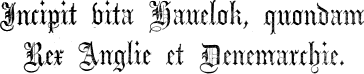
[Fol. 204, col. 1.] Hearken!
Herknet to me, gode men,
Wiues, maydnes, and alle men,
Of a tale þat ich you wile telle,
4
Wo so it wile here, and þer-to duelle.
I will tell you the tale of Havelok,
Þe tale is of hauelok i-maked;
Wil he was litel he yede ful naked:
Hauelok was a ful god gome,
8
He was ful god in eueri trome,
9
a wight man at need.
He was þe wicteste man at nede,
Þat þurte riden on ani stede.
Þat ye mowen nou y-here,
12
And þe tale ye mowen y-lere.
At the beginning1 of vre tale,
First, fill me a cup of ale.
Fil me a cuppe of ful god ale;
15
And [y] wile drinken her y spelle,
16
Þat crist vs shilde alle fro helle!
Krist late vs heuere so for to do,
Christ grant we may do right!
Þat we moten comen him to,
19
And wit[e]2 þat it mote ben so!
20
Benedicamus domino!
Here y schal biginnen a rym,
Krist us yeue wel god fyn!
The rime is about Havelok.
The rym is maked of hauelok,
24
A stalworþi man in a flok;
He was þe stalworþeste man at nede,
Þat may riden on ani stede.
THE GOOD KING ATHELWOLD IS KING OVER ALL ENGLAND.
There was once a king who made good laws.
IT was a king bi are dawes,
28
That in his time were gode lawes
He dede maken, an ful wel holden;
Hym louede yung, him louede holde,
31
Erl and barun, dreng and kayn,
32
Knict, bondeman, and swain,
All loved him.
Wydues, maydnes, prestes and clerkes,
And al for hise gode werkes.
He louede god with al his micth,
36
And holi kirke, and soth, ant ricth;
Ricth-wise3 man he louede alle,
And oueral made hem forto calle;
He hated traitors and robbers.
Wreieres and wrobberes made he falle,
40
And hated hem so man doth galle;
Vtlawes and theues made he bynde,
Alle that he micthe fynde,
And heye hengen on galwe-tre;
44
For hem ne yede gold ne fe.
45
At that time, men could carry gold about safely,
In that time a man þat bore
[Wel fyfty pund, y woth, or more,]4
[Fol. 204, col. 2.]
Of red[e] gold up-on hijs bac,
48
In a male with or blac,
Ne funde he non that him misseyde,
N[e] with iuele on [him] hond leyde.
Þanne micthe chapmen fare
52
Þuruth englond wit here ware,
and boldly buy and sell.
And baldelike beye and sellen,
Oueral þer he wilen dwellen,
In gode burwes, and þer-fram
56
Ne funden he non þat dede hem sham,
Þat he ne weren sone to sorwe brouth,
An pouere maked, and browt to nouth.
Þanne was engelond at hayse;5
Then was England at ease.
60
Michel was svich a king to preyse,
Þat held so eng[e]lond in grith!
Krist of heuene was him with.
He was engelondes blome;
64
Was non so bold lond to rome,
Þat durste upon his [menie] bringhe
Hunger, ne here* wicke þinghe.
Hwan he felede hise foos,
The king made his foes hide themselves.
68
He made hem lurken, and crepen in wros:
Þe hidden hem alle, and helden hem stille,
And diden al his herte wille.
Ricth he louede of alle þinge,
72
To wronge micht him no man bringe,
Ne for siluer, ne for gold:—
So was he his soule† hold.
He befriended the fatherless.
To þe faderles was he rath,
76
Wo so dede hem wrong or lath,
Were it clerc, or were it knicth,
He dede hem sone to hauen ricth;
And wo [so] diden‡ widuen wrong,
80
Were he neure knicth so strong,
Þat he ne made him sone kesten,
And in feteres ful faste festen;
Them who wrought shame he punished.
And wo so dide maydne shame
84
Of hire bodi, or brouth in blame,
Bute it were bi hire wille,
He6 made him sone of limes spille.
He was te7 beste knith at nede,
88
Þat heuere micthe riden on stede,
Or wepne wagge, or folc vt lede;
Of knith ne hauede he neuere drede,
91
Þat he ne sprong forth so sparke of glede,
[Fol. 204b, col. 1.]
92
And lete him [knawe] of hise hand-dede,
Hw he couþe with wepne spede;
He made his foes cry for mercy.
And oþer he refte him hors or wede,
Or made him sone handes sprede,
96
And “louerd, merci!” loude grede.
He was large, and no wicth gnede;
Hauede he non so god brede,
Ne on his bord non so god shrede,
He fed the poor.
100
Þat he ne wolde þorwit fede,
Poure þat on fote yede;
Forto hauen of him þe mede
Þat for vs wolde on rode blede,
104
Crist, that al kan wisse and rede,
Þat euere woneth in ani þede.
ATHELWOLD IS ABOUT TO DIE.
His name was Athelwold.
¶ Þe king was hoten aþelwold,
Of word, of wepne he was bold;
108
In engeland was neure knicth,
Þat betere hel þe lond to ricth.
110
He had but a young daughter to succeed him.
Of his bodi ne hauede he eyr
Bute a mayden swiþe fayr,
112
Þat was so yung þat sho ne couþe
Gon on fote, ne speke wit mouþe.
Þan him tok an iuel strong,
Þat he we[l] wiste, and under-fong,
He feels he is dying, and says,
116
Þat his deth was comen him on:
And seyde, “crist, wat shal y don!
118
Louerd, wat shal me to rede!
I woth ful wel ich haue mi mede.
120
W shal nou mi douhter fare?
“I am in trouble about her.
Of hire haue ich michel kare;
Sho is mikel in mi þouth,
Of me self is me rith nowt.
124
No selcouth is, þou me be wo;
Sho ne kan speke, ne sho kan go.
Were she but of age,
Yif scho couþe on horse ride,
And a thousande men bi hire syde;
128
And sho were comen intil helde,
And engelond sho couþe welde;
130
And don hem of þar hire were queme,
An hire bodi couþe yeme;
132
No wolde me neuere iuele like
I would not care for myself.”
Me þou ich were in heuene-riche!”
HE SUMMONS HIS LORDS TO WINCHESTER.
Quanne he hauede þis pleinte maked,
Þer-after stronglike [he] quaked.
136
He sende writes sone on-on
[Fol. 204b, col. 2.]
After his erles euere-ich on;
He summons his lords, from Roxburgh to Dover.
And after hise baruns, riche and poure,
Fro rokesburw al into douere,
140
That he shulden comen swiþe
Til him, that was ful vnbliþe;
To þat stede þe[r] he lay,
In harde bondes, nicth and day.
144
He was so faste wit yuel fest,
Þat he ne mouthe hauen no rest;
He can no longer eat.
He ne mouthe no mete hete,
Ne he ne mouchte no lyþe gete;
148
Ne non of his iuel þat couþe red;
Of him ne was nouth buten ded.
All sadly obey his summons.
Alle þat the writes herden,
Sorful an sori til him ferden;
152
He wrungen hondes, and wepen sore,
And yerne preyden cristes hore,
Þat he [wolde] turnen him
Vt of þat yuel þat was so grim!
156
Þanne he weren comen alle
They come to Winchester.
Bifor þe king into the halle,
At winchestre þer he lay:
“Welcome,” he seyde, “be ye ay!
160
Ful michel þank[e] kan [y] yow
That ye aren comen to me now!”
ATHELWOLD SELECTS EARL GODRICH TO BE HIS DAUGHTER’S GUARDIAN.
They all mourn and lament.
Quanne he weren alle set,
And þe king aueden i-gret,
164
He greten, and gouleden, and gouen hem ille,
And he bad hem alle ben stille;
And seyde, “þat greting helpeth nouth,
For al to dede am ich brouth.
168
Bute nov ye sen þat i shal deye,
He prays them to tell him who can guard his daughter best.
Nou ich wille you alle preye
Of mi douther þat shal be
Yure leuedi after me,
172
Wo may yemen hire so longe,
Boþen hire and engelonde,
Til þat she [mowe] winan of helde,
175
And þa she mowe yemen and welde?”
176
He ansuereden, and seyden an-on,
They answer, “Earl Godrich of Cornwall.”
Bi crist* and bi seint ion,
That þerl Godrigh of cornwayle
Was trewe man, wit-uten faile;
180
Wis man of red, wis man of dede,
And men haueden of him mikel drede.
[Fol. 205, col. 1.]
“He may hire alþer-best[e] yeme,
Til þat she mowe wel ben quene.”
184
Þe king was payed of that Rede;
The king sends for chalice and paten,
A wol fair cloth bringen he dede,
And þer-on leyde þe messebok,
Þe caliz, and þe pateyn ok,
188
Þe corporaus, þe messe-gere;
189
Þer-on he garte þe erl suere,
for the earl to swear upon.
Þat he sholde yemen hire wel,
With-uten lac, wit-uten tel,
192
Til þat she were tuelf8 winter hold,
And of speche were bold;
And þat she covþe of curteysye,
His daughter is to marry the best and fairest man that can be found.
Gon, and speken of luue-drurye;
196
And til þat she louen þoucte,9
Wom so hire to gode thoucte;
And þat he shulde hire yeue
Þe beste man that micthe liue,
200
Þe beste, fayreste, the strangest ok:—
Þat dede he him sweren on þe bok.
And þanne shulde he engelond
Al bitechen in-to hire hond.
204
Quanne10 þat was sworn on his wise,
He gives up all England to the earl, to keep for her.
Þe king dede þe mayden arise,
And þe erl hire bitaucte,
And al the lond he euere awcte;
208
Engelonde eueri del;
And preide, he shulde yeme hire wel.
Þe king ne mowcte don no more,
But yerne preyede godes ore;
212
And dede him hoslen wel and shriue,
The king does penance.
I woth, fif hundred siþes and fiue;
An ofte dede him sore swinge,
And wit hondes smerte dinge;
216
So þat þe blod ran of his fleys,
Þat tendre was, and swiþe neys.
11And sone gaf it euere-il del;
He made his quiste swiþe wel.
He makes his will.
220
Wan it was gouen, ne micte men finde
So mikel men micte him in winde,
Of his in arke, ne in chiste,
In engelond þat noman wiste:
224
For al was youen, faire and wel,
Þat him was leued no catel.
KING ATHELWOLD DIES.
Þanne he hauede ben ofte swngen,
[Fol. 205, col. 2.]
Ofte shriuen, and ofte dungen,
228
“In manus tuas, lou[er]de,” he seyde,
Her þat he þe speche leyde.
The king dies.
To ihesu crist bigan to calle,
And deyede biforn his heymen alle.
232
Þan he was ded, þere micte men se
Þe meste sorwe that micte be;
Þer was sobbing, siking, and sor,
Handes wringing, and drawing bi hor.
All mourn for him.
236
Alle greten swiþe sore,
Riche and poure þat þere wore;
An mikel sorwe haueden alle,
Leuedyes in boure, knictes in halle.
240
Quan þat sorwe was somdel laten,
And he haueden longe graten,
Masses are sung for him.
Belles deden he sone ringen,
Monkes and prestes messe singen;
244
And sauteres deden he manie reden,
Þat god self shulde his soule leden
Into heuene, biforn his sone,
And þer wit-uten hende wone.
He is buried and the earl takes possession,
248
Þan he was to þe erþe brouth,
Þe riche erl ne foryat nouth,
Þat he ne dede al engelond
Sone sayse intil his hond;
252
And in þe castels leth he12 do
Þe knictes he micte tristen to;
And alle þe englis dede he swere[n],
Þat he shulden him ghod fey baren;
till the maiden is twenty years old.
256
He yaf alle men, þat god þoucte,
Liuen and deyen til þat him moucte,13
Til þat þe kinges dowter wore
Tuenti winter hold, and more.
EARL GODRICH TAKES POSSESSION.
260
Þanne he hauede taken þis oth
Of erles, baruns, lef and loth,
Of knictes, cherles, fre and þewe,
Earl Godrich appoints justices, sheriffs, &c.
263
Justises dede he maken newe,
264
Al engelond to faren þorw,
Fro douere into rokesborw.
Schireues he sette, bedels, and greyues,
Grith-sergeans, wit longe gleyues,
268
To yemen wilde wodes and paþes
Fro wicke men, that wolde don scaþes;
And forto hauen alle at his cri,
At his wille, at his merci;
[Fol. 205b, col. 1.]
272
Þat non durste ben him ageyn,
Erl ne baron, knict ne sweyn.
He grows very rich,
Wislike for soth, was him wel
Of folc, of wepne, of catel,
276
Soþlike, in a lite þrawe
Al engelond of him stod [in] awe;
and all England fears him.
Al engelond was of him adrad,14
So his þe beste fro þe gad.
The maiden grows up very fair.
280
Þe kinges douther bigan þriue,
And wex þe fayrest wman on liue.
Of alle þewes w[as] she wis,
Þat gode weren, and of pris.
Her name is Goldborough.
284
Þe mayden Goldeboru was hoten;
For hire was mani a ter igroten.
GODRICH PLOTS AGAINST HIS WARD.
Quanne the Erl godrich him herde
Of þat mayden, hw we[l s]he ferde;
288
Hw wis sho was, w chaste, hw fayr,
And þat sho was þe rithe eyr
Of engelond, of al þe rike:—
Godrich is vexed.
Þo bigan godrich to sike,
292
And seyde, “weþer she sholde be
Quen and leuedi ouer me?
Hweþer sho sholde al engelond,
And me, and mine, hauen in hire hond?
296
Daþeit hwo it hire thaue!
Shal sho it neuere more haue.
“Shall I give England to a fool, a girl?
Sholde ic yeue a fol, a þerne,
Engelond, þou sho it yerne?
300
Daþeit hwo it hire yeue,
Euere more hwil i liue!
Sho is waxen al to prud,
For gode metes, and noble shrud,
304
Þat hic haue youen hire to offte;
Hic haue yemed hire to softe.
Shal it nouth ben als sho þenkes,
‘Hope maketh fol man ofte blenkes.’
My son shall have England.
308
Ich haue a sone, a ful fayr knaue,
He shal engelond al haue.
He shal [ben] king, he shal ben sire,
So brouke i euere mi blake swire!”
312
Hwan þis trayson was al þouth,
He lets his oath go for nothing.
Of his oth ne was him nouth.
He let his oth al ouer-ga,
Þerof ne yaf he nouth a stra;
316
But sone dede hire fete,
[Fol. 205b, col. 2.]
Er he wolde heten ani mete,
Fro winchestre þer sho was,
Also a wicke traytur iudas;
He sends the maiden to Dover.
320
And dede leden hire to doure,
Þat standeth on þe seis oure;
And þerhinne dede hire fede
Pourelike in feble wede,
He shuts her up in the castle.
324
Þe castel dede he yemen so,
Þat non ne micte comen hire to
Of hire frend, with [hire] to speken,
Þat heuere micte hire bale wreken.
328
Of Goldeboru shul we nou laten,
Þat nouth ne blinneth forto graten,
Þet sho liggeth in prisoun:
May Christ release Goldborough from prison!
Ihesu crist, that lazarun
332
To liue broucte fro dede bondes,
He lese hire wit hise hondes;
And leue sho mo him y-se
Heye hangen on galwe tre,
336
Þat hire haued in sorwe brouth,
So as sho ne misdede nouth!
BIRKABEYN IS KING OF DENMARK.
338
Sawe nou forth in hure spelle;
At that time there was a king of Denmark, called Birkabeyn.
In þat time, so it bifelle,
340
Was in þe lon of denemark
A riche king, and swyþe stark.
Þ[e] name of him was birkabeyn,
He hauede mani knict and sueyn;
344
He was fayr man, and wicth,
Of bodi he was þe beste knicth
Þat euere micte leden uth here,
Or stede onne ride, or handlen spere,
He had three children.
348
Þre children he hauede bi his wif,
He hem louede so his lif.
He hauede a sone [and] douhtres two,
Swiþe fayre, as fel it so.
352
He þat wile non forbere,
Riche ne poure; king ne kaysere,
Death came upon him.
Deth him tok þan he bes[t] wolde
Liuen, but hyse dayes were fulde;
356
Þat he ne moucte no more liue,
For gol ne siluer, ne for no gyue.
He sends for the priests.
Hwan he þat wiste, raþe he sende
After prestes fer an hende,
360
Chanounes gode, and monkes beþe,15
Him for to16 wisse, and to Rede;
[Fol. 206, col. 1.]
Him for to hoslon, an forto shriue,
Hwil his bodi were on liue.
BIRKABEYN SELECTS EARL GODARD TO BE GUARDIAN OF HIS THREE CHILDREN.
364
Hwan he was hosled and shriuen,
365
His quiste maked, and for him gyuen,
His knictes dede he alle site,
For þorw hem he wolde wite,
He asks who will guard his children?
368
Hwo micte yeme hise children yunge,
Til þat he kouþen speken wit tunge;
Speken and gangen, on horse riden,
Knictes an sweynes bi here siden.
372
He spoken þer-offe, and chosen sone
A riche man was under mone,
He chooses Godard.
Was þe trewest þat he wende,
Godard, þe kinges oune frende;
376
And seyden, he Moucthe hem best loke,
Yif þat he hem vndertoke,
Til hise sone Mouthe bere
Helm on heued, and leden vt here,
380
In his hand a spere stark,
And king ben maked of denemark.
He wel trowede þat he seyde,
And on Godard handes leyde;
He commends the children to Godard.
384
And seyde, “Here bi-teche i þe
Mine children alle þre,
Al denemark, and al mi fe,
Til þat mi sone of helde be;
He makes him swear to take care of them,
388
But þat ich wille, þat þo[u] suere
On auter, and on messe-gere,
On þe belles þat men ringes,
On messe-bok þe prest on singes,
392
Þat þou mine children shalt we[l] yeme,
Þat hire kin be ful wel queme,
Til mi sone mowe ben knicth,
and to give up the kingdom to the boy.
Þanne biteche him þo his Ricth,
396
Denemark, and þat þertil longes,
Casteles and tunes, wodes and wonges.”
Godard swears to do so.
Godard stirt up, an swor al þat
Þe king him bad, and siþen sat
400
Bi the knictes, þat þer ware,
Þat wepen alle swiþe sare
For þe king þat deide sone:
Ihesu crist, that makede mone
404
On þe mirke nith to shine,
Wite his soule fro helle pine;
And leue þat it mote wone
[Fol. 206, col. 2.]
In heuene-riche with godes sone!
GODARD IMPRISONS THE THREE CHILDREN.
Godard shuts up the children, Havelok, Swanborough, and Helfled, in a castle.
408
Hwan birkabeyn was leyd in graue,
Þe erl dede sone take þe knaue,
Hauelok, þat was þe eir,
Swanborow, his sister, helfled, þe toþer,17
412
And in þe castel dede he hem do,
Þer non ne micte hem comen to
Of here kyn, þer þei sperd wore;18
Þer he greten ofte sore,
416
Boþe for hunger and for kold,
Or he weren þre winter hold.
Feblelike he gaf hem cloþes,
He cares not for his oaths.
He ne yaf a note of hise oþes;
420
He hem [ne] cloþede rith, ne fedde,
Ne hem ne dede richelike be-bedde.
Þanne godard was sikerlike
He is a traitor.
Vnder god þe moste swike,
424
Þat eure in erþe shaped was,
With-uten on, þe wike Iudas.
May he be accursed!
Haue he þe malisun to-day
Of alle þat eure speken may!
428
Of patriark, and of pope!
And of prest with loken kope!
Of monekes, and hermites boþe!19
And of þe leue holi rode,
432
Þat god him-selue ran on blode!
433
Cursed be he by north and south!
Crist warie him with his mouth!
Waried wrthe he of norþ and suth!
Offe alle man, þat speken kunne!
436
Of crist, þat made20 mone and sunne!
Þanne he hauede of al þe lond
Al þe folk tilled in-til his hond,
And alle haueden sworen him oth,
440
Riche and poure, lef and loth,
Þat he sholden hise wille freme,
He plots against the children.
And þat he shulde[n] him nouth greme,
He þouthe a ful strong trechery,
444
A trayson, and a felony,
Of þe children forto make:
Þe deuel of helle him sone take!
He goes to the tower where they are.
Hwan þat was þouth, onon he ferde
448
To þe tour þer he woren sperde,
Þer he greten for hunger and cold:
Þe knaue þat was sumdel bold,
Kam him ageyn, on knes him sette,
[Fol. 206b, col. 1.]
452
And godard ful feyre he fer grette;
And Godard seyde, “Wat is yw?
Hwi grete ye and goulen nou?”
Havelok says they are hungry.
“For us hungreth swiþe sore:”—
456
Seyden he wolden [haue] more,
“We ne haue to hete, ne we ne haue
Herinne neyther knith ne knaue
Þat yeueth us drinken, ne no mete,
460
Haluendel þat we moun ete.
“Alas, that we were born!”
Wo is us þat we weren born!
Weilawei! nis it no korn,
Þat men micte maken of bred?
464
Vs21 hungreth, we aren ney ded.”
GODARD KILLS SWANBORGUGH AND HELFLED.
Godard cares not.
Godard herde here wa,
Ther-offe yaf he nouth a stra,
But tok þe maydnes bothe samen,
468
Al-so it were up-on hiis gamen;
Al-so he wolde with hem leyke,
Þat weren for hunger grene and bleike.
He cuts the throats of the two girls.
Of boþen he karf on two here þrotes,
472
And siþen [karf] hem alto grotes.
Þer was sorwe, we so it sawe!
Hwan þe children bi þ[e]22 wawe
Leyen and sprauleden in þe blod:
Havelok sees it, and is afraid.
476
Hauelok it saw, and þe[r] bi stod.
Ful sori was þat seli knaue,
Mikel dred he mouthe haue,
For at hise herte he saw a knif,
480
For to reuen him hise lyf.
But þe knaue,23 þat litel was,
He begs Godard to spare him,
He knelede bifor þat iudas,
And seyde, “louerd, merci nov!
484
Manrede, louerd, biddi you!
Al denemark i wile you yeue,
To þat forward þu late me liue;
Here hi wile on boke swere,
488
Þat neure more ne shal i bere
GODARD SPARES HAVELOK FOR A TIME.
offering never to oppose him,
Ayen þe, louerd, shel ne spere,
Ne oþer wepne24 that may you dere.
Louerd, haue merci of me!
and to flee from Denmark.
492
To-day i wile fro denemark fle,
Ne neuere more comen ageyn:
Sweren y wole, þat bircabein
Neuere yete me ne gat:”—
496
Hwan þe deuel he[r]de25 that,
[Fol. 206b, col. 2.]
Sum-del bigan him forto rewe;
With-drow þe knif, þat was lewe
Godard has pity on him.
Of þe seli children blod;
500
Þer was miracle fair and god!
Þat he þe knaue nouth ne slou,
But fo[r] rewnesse him wit-drow.26
Of auelok rewede him ful sore,
504
And þoucte, he wolde þat he ded wore,
But on þat he nouth wit his hend
506
Ne drepe him nouth,27 þat fule fend!
Þoucte he, als he him bi stod,
508
Starinde als he were wod:
But he reflects
“Yif y late him liues go,
He micte me wirchen michel wo.
Grith ne get y neuere mo,
512
He may [me] waiten for to slo;
that, were Havelok dead, his children would be the heirs.
And yf he were brouct of liue,
And mine children wolden thriue,
Louerdinges after me
516
Of al denemark micten he be.
God it wite, he shal ben ded,
Wile i taken non oþer red;
GODARD TELLS GRIM TO DROWN HAVELOK.
He determines to drown him.
I shal do casten him in þe se,28
520
Þer i wile þat he drench[ed] be;
Abouten his hals an anker god,
Þat he ne flete in the flod.”
He sends for a fisherman, and says to him,
Þer anon he dede sende
524
After a fishere þat he wende,
Þat wolde al his wille do,
And sone anon he seyde him to:
“Grim, I will make you free.
“Grim, þou wost þu art mi þral,
528
Wilte don mi wille al,
Þat i wile bidden þe,
To-morwen [i] shal maken þe fre,
And aucte þe yeuen, and riche make,
532
With-þan þu wilt þis child[e] take,
And leden him with þe to-nicht,
Throw this child into the sea”.
Þan þou sest se29 Mone lith,
In-to þe se, and don him þer-inne,
536
Al wile [i] taken on me þe sinne.”
Grim binds the child.
Grim tok þe child, and bond him faste,
Hwil þe bondes micte laste;
Þat weren of ful strong line:—
540
Þo was hauelok in ful strong pine.
Wiste he neuere her wat was wo:
[Fol. 207, col. 1.]
Christ wreak thee of Godard, Havelok!
Ihesu crist, þat makede to go
Þe halte, and þe doumbe speken,
544
Hauelok, þe of Godard wreken!
HAVELOK IS TAKEN TO GRIM’S COTTAGE.
Hwan grim him hauede faste bounden,
And siþen in an eld cloth wnden
Grim gags the child.
A keuel of clutes, ful, un-wraste,
548
Þat he [ne] mouthe speke, ne fnaste,
Hwere he wolde him bere or lede.
550
Hwan he hauede don þat dede,
Hwan30 þe swike him hauede hethede,31
552
Þat he shulde him forth [lede]
And him drinchen in þe se;
Þat forwarde makeden he.
He puts him in a bag, and takes him on his back.
In a poke, ful and blac,
556
Sone he caste him on his bac,
Ant bar him hom to hise cleue,
And bi-taucte him dame leue,
He puts him in charge of his wife.
And seyde, “wite þou þis knaue,
560
Al-so thou with* mi lif haue;
I shal dreinchen him in þe se,
For him shole we ben maked fre,
Gold hauen ynou, and oþer fe;
564
Þat hauet mi louerd bihoten me.”
GRIM SEES THAT HAVELOK IS THE KING’S SON.
She throws down Havelok violently.
Hwan dame [leue] herde þat,
Vp she stirte, and nouth ne sat,
567
And caste þe knaue adoun so harde,
568
Þat hise croune he þer crakede
Ageyn a gret ston, þer it lay:
Þo hauelok micte sei, “weilawei!
Þat euere was i kinges bern!”
572
Þat him ne hauede grip or ern,
Leoun or wlf, wluine or bere,
Or oþer best, þat wolde him dere.
The child lies there till midnight.
So lay þat child to middel nicth,
576
Þat grim bad leue bringen lict,
For to don on [him] his cloþes:
“Ne thenkeste nowt of mine oþes
Þat ich haue mi louerd sworen?
580
Ne wile i nouth be forloren.
I shal beren him to þe se,
Þou wost þat [bi-]houes me;
And i shal drenchen him þer-inne;
Grim tells his wife to light the fire and a candle.
584
Ris up swiþe, an go þu binne,
And blou þe fir, and lith a kandel:”
Als she shulde hise cloþes handel
[Fol. 207, col. 2.]
On forto don, and blawe þe32 fir,
She sees a light shining round the lad.
588
She saw þer-inne a lith ful shir,
Also brith so it were day,
Aboute þe knaue þer he lay.
591
Of hise mouth it stod a stem,
592
Als it were a sunnebem;
Also lith was it þer-inne,
So þer brenden cerges inne:33
“Ihesu crist!” wat dame leue,
596
“Hwat is þat lith in vre cleue!
She bids Grim come and see.
Sir34 up grim, and loke wat it menes,
Hwat is þe lith as þou wenes?”
He stirten boþe up to the knaue,
600
For man shal god wille haue,
Vnkeueleden him, and swiþe unbounden,
They find a mark on his shoulder.
And sone anon [upon] him funden,
Als he tirneden of his serk,
604
On his rith shuldre a kyne merk;
A swiþe brith, a swiþe fair:
“Goddot!” quath grim, “þis [is] ure eir
Þat shal [ben] louerd of denemark,
Grim says the lad is to be king.
608
He shal ben king strong and stark;
He shal hauen in his hand
A[l] denemark and engeland;
He shal do godard ful wo,
612
He shal him hangen, or quik flo;
Or he shal him al quic graue,
Of him shal he no merci haue.”
Þus seide grim, and sore gret,
616
And sone fel him to þe fet,
He prays Havelok to forgive him.
And seide, “louerd, haue merci
Of me, and leue, that is me bi!
Louerd, we aren boþe þine,
620
Þine cherles, þine hine.
GRIM AND HIS WIFE FEED HAVELOK.
Lowerd, we sholen þe wel fede,
Til þat þu cone riden on stede,
Til þat þu cone ful wel bere
624
Helm on heued, sheld and spere.
Godard shall never know about this.
He ne shal neuere wite, sikerlike,
Godard, þat fule swike.
Þoru oþer man, louerd, than þoru þe,
628
Sal i neuere freman be.
Þou shalt me, louerd, fre maken,
For i shal yemen þe, and waken;
Þoru þe wile i fredom haue:”
[Fol. 207b, col. 1.]
632
Þo was haueloc a bliþe knaue.
Havelok is glad, and asks for bread.
He sat him up, and crauede bred.
And seide, “ich am [wel] ney ded,
Hwat for hunger, wat for bondes
636
Þat þu leidest on min hondes;
And for [þe] keuel at þe laste,
Þat in mi mouth was þrist faste.
y was þe[r]-with so harde prangled,
640
Þat i was þe[r]-with ney[e] strangled.”
“Wel is me þat þu mayth hete:
Dame Leve brings him bread and cheese, butter, &c.
Goddoth!” quath leue, “y shal þe fete
Bred an chese, butere and milk,
644
Pastees and flaunes, al with suilk
Shole we sone þe wel fede,
Louerd, in þis mikel nede,
Soth it is, þat men seyt and suereth:
648
‘Þer god wile helpen, nouth no dereth.’”
GRIM SAYS HE HAS DROWNED HAVELOK.
Þanne sho hauede brouth þe mete,
Havelok eats all up greedily.
Haueloc anon bigan to ete
Grundlike, and was ful bliþe;
652
Couþe he nouth his hunger Miþe.
A lof he het, y woth, and more,
For him hungrede swiþe sore.
Þre dayes þer-biforn, i wene,
656
Et he no mete, þat was wel sene.
Hwan he hauede eten, and was fed,
Grim puts him to bed.
Grim dede maken a ful fayr bed;
Vncloþede him, and dede him þer-inne,
660
And seyde, “Slep* sone, with michel winne;
Slep wel faste, and dred þe nouth,
Fro sorwe to ioie art þu brouth.”
Sone so it was lith of day,
Grim tells Godard he has killed Havelok,
664
Grim it under-tok þe wey
To þe wicke traitour godard,
Þat was denemak a35 stiward,
And seyde, “louerd, don ich haue
668
Þat þou me bede of þe knaue;
He is drenched in þe flod,
Abouten his hals an anker god;
He is witer-like ded,
672
Eteth he neure more bred;
He liþ drenched in þe se:—
and asks for his reward.
Yif me gold [and] oþer fe,36
Þat y mowe riche be;
676
And with þi chartre make [me] fre,
[Fol. 207b, col. 2.]
For þu ful wel bi-hetet me,
Þanne i last[e] spak with þe.”
Godard bids him go home, and remain a thrall;
Godard stod, and lokede on him
680
Þoruth-like, with eyne grim;
And seyde, “Wiltu [nou] ben erl?
Go hom swiþe, fule drit, cherl;
Go heþen, and be euere-more
684
Þral and cherl, als þou er wore.
Shal [þou] haue non oþer mede;
For litel i [shal]37 do þe lede
To þe galues, so god me rede!
for he has done wickedly.
688
For þou haues don a wicke dede.
Þou Mait stonden her to longe,
Bute þou swiþe eþen gonge.”
GRIM SETS SAIL FOR ENGLAND.
Grim thoucte to late þat he ran
692
Fro þat traytour, þa wicke man;
Grim fears that both himself and Havelok will be hung.
And þoucte, “wat shal me to rede?
694
Wite he him onliue, he wile beþe
Heye hangen on galwe-tre:
696
Betere us is of londe to fle,
And berwen boþen ure liues,
And mine children, and mine wiues.”
Grim sells his live stock.
Grim solde sone al his corn,
700
Shep wit wolle, neth wit horn,
701
Hors, and swin, [and gate] wit berd,
Þe gees, þe hennes of þe yerd;
Al he solde, þat outh douthe,
704
That he eure selle moucte,
And al he to þe peni drou:
He fits up his ship carefully.
706
Hise ship he greyþede wel inow,
He dede it tere, an ful wel pike,
708
Þat it ne doutede sond ne krike;
Þer-inne dide a ful god mast,
Stronge kables, and ful fast,
Ores god, an ful god seyl,
712
Þer-inne wantede nouth a nayl,
Þat euere he sholde þer-inne do:
He takes with him his wife, his three sons, his two daughters, and Havelok.
Hwan he hauedet greyþed so,
715
Hauelok þe yunge he dide þer-inne,
716
Him and his wif, hise sones þrinne,
And hise two doutres, þat faire wore,
And sone dede he leyn in an ore,
And drou him to þe heye se,
720
Þere he mith alþer-best[e] fle.
Fro londe woren he bote a mile,
[Fol. 208, col. 1.]
Ne were neuere but ane hwile,
A north wind arises, called the bise, and drives them to England.
Þat it ne bigan a wind to Rise
724
Out of þe north, men calleth ‘bise’
And drof hem intil engelond,
Þat al was siþen in his hond,
His, þat hauelok was þe name;
728
But or he hauede michel shame,
Michel sorwe, and michel tene,
And þrie he gat it al bidene;
Als ye shulen nou forthwar lere,38
732
Yf that ye wilen þer-to here.
GRIM FOUNDS THE TOWN OF GRIMSBY.
733
Grim went up the Humber to Lindesey.
IN humber grim bigan to lende,
In lindeseye, Rith at þe north ende.
Þer sat is ship up-on þe sond,
736
But grim it drou up to þe lond;
And þere he made a litel cote,
To him and to hise flote.
Bigan he þere for to erþe,
740
A litel hus to maken of erþe,
There he built a house.
So þat he wel þore were
Of here herboru herborwed þere;
And for þat grim þat place aute,
744
Þe stede of grim þe name laute;
That place was called Grimsby, after Grim.
So þat [hit] grimesbi calleth alle
Þat þer-offe speken alle,*
And so shulen men callen it ay,
748
Bituene þis and domesday.
HAVELOK DOES NOT LIKE BEING IDLE.
Grim was a good fisherman.
Grim was fishere swiþe god,
And mikel couþe on the flod;
Mani god fish þer-inne he tok,
752
Boþe with neth, and with hok.
753
He caught sturgeons, turbot, &c.
He tok þe sturgiun, and þe qual,
And þe turbut, and lax with-al,
He tok þe sele, and þe hwel;
756
He spedde ofte swiþe wel:
Keling he tok, and tumberel,
Hering, and þe makerel,
Þe Butte, þe schulle, þe þornebake:
He had four panniers made for himself and his sons.
760
Gode paniers dede he make
Ontil him, and oþer þrinne,
Til hise sones to beren fish inne,
Vp o-londe to selle and fonge;
764
Forbar he neyþe[r] tun, ne gronge,
Þat he ne to-yede with his ware;
Kam he neuere hom hand-bare,
[Fol. 208, col. 2.]
Þat he ne broucte bred and sowel,
768
In his shirte, or in his couel;
In his poke benes and korn:—
Hise swink ne hauede he nowt forlorn.
He used to sell lampreys at Lincoln,
And hwan he tok þe grete laumprei,
772
Ful we[l] he couþe þe rithe wei
To lincolne, þe gode boru;
Ofte he yede it þoru and þoru,
Til he hauede wol39 wel sold,
776
And þer-fore þe penies told.
Þanne he com, þenne he were bliþe,
For hom he brouthe fele siþe
and bring home simnels, meal, meat, and hemp.
Wastels, simenels with þe horn,
780
Hise pokes fulle of mele an korn,
Netes flesh, shepes, and swines,
And hemp to maken of gode lines;
And stronge ropes to hise netes,
784
In þe se weren he ofte setes.40 *
HAVELOK SELLS FISH LIKE THE BEST.
Thus they lived for 12 years.
Þus-gate grim him fayre ledde.
Him and his genge wel he fedde
Wel twelf winter, oþer more:
788
Hauelok was war þat grim swank sore
Havelok thinks he eats too much to be idle.
For his mete, and he lay at hom:
Thouthe, “ich am nou no grom;
Ich am wel waxen, and wel may eten
792
More þan euere Grim may geten.
Ich ete more, bi god on liue,
Þan grim an hise children fiue!
It ne may nouth ben þus longe,
796
Goddot! y wile with þe gange,
For to leren sum god to gete;
Swinken ich wolde for mi mete.
It is no shame for a man to work.
It is no shame forto swinken;
800
Þe man þat may wel eten and drinken,
Þat nouth ne haue but on swink long,
To liggen at hom it is ful strong.
God yelde him þer i ne41 may,
804
Þat haueth me fed to þis day!
He determines to carry about panniers like the rest.
Gladlike i wile þe paniers bere;
Ich woth, ne shal it me nouth dere,
Þey þer be inne a birþene gret,
808
Al so heui als a neth.
Shal ich neuere lengere dwelle,
To morwen shal ich forth pelle.”
HAVELOK GOES TO LINCOLN TO GET WORK.
On þe morwen, hwan it was day,
[Fol. 208b, col. 1.]
812
He stirt up sone, and nouth ne lay;
He carries a pannier full of fish,
And cast a panier on his bac,
With fish giueled als a stac;
Also michel he bar him one,
816
So he foure, bi mine mone!42
and sells them.
Wel he it bar, and solde it wel,
Þe siluer he brouthe hom il del;
Al þat he þer-fore tok
820
With-held he nouth a ferþinges nok.
So yede he forth ilke day,
Þat he neuere at home lay.
So wolde he his mester lere;
A great dearth arises.
824
Bifel it so a strong dere
Bigan to rise of korn of bred,
That grim ne couþe no god red,
Hw he sholde his meine fede;
828
Of hauelok hauede he michel drede:
For he was strong, and wel mouthe ete
More þanne heuere mouthe he gete;
They have not enough to eat.
Ne he ne mouthe on þe se take
832
Neyþer lenge, ne þorn[e]bake,43
Ne non oþer fish þat douthe
His meyne feden with he[r]44 mouthe.
Grim is sorry for Havelok.
Of hauelok he hauede kare,
836
Hwilgat þat he micthe fare;
Of his children was him nouth,
On hauelok was al hise þouth,
839
And seyde, “hauelok, dere sone,
840
I wene that we deye mone
For hunger, þis dere is so strong,
And hure mete is uten long.
He advises him to go to Lincoln,
Betere is þat þu henne gonge,
844
Þan þu here dwelle longe;
Heþen þow mayt gangen to late;
Thou canst ful wel þe ricthe gate
To lincolne, þe gode borw,
848
Þou hauest it gon ful ofte þoru;
Of me ne is me nouth a slo,
Betere is þat þu þider go,
and work there.
For þer is mani god man inne,
852
Þer þou mayt þi mete winne.
But wo is me! þou art so naked,
He makes him a coat of an old sail.
Of mi seyl y wolde þe were maked
A cloth, þou mithest inne gongen,
856
Sone, no cold þat þu ne fonge.”
HE HELPS THE EARL OF CORNWALL’S COOK.
[Fol. 208b. col. 2.]
He tok þe sh[e]res45 of þe nayl,
And made him a couel of þe sayl,
And hauelok dide it sone on;
860
Hauede neyþer hosen ne shon,
Ne none kines oþe[r] wede;
Havelok goes to Lincoln barefoot.
To lincolne barfot he yede.
Hwan he kam þe[r], he was ful wil,
864
Ne hauede he no frend to gangen til;
He fasts for two days.
Two dayes þer fastinde he yede,
Þat non for his werk wolde him fede;
Þe þridde day herde he calle:
868
“Bermen, bermen, hider forth alle!”
[Poure þat on fote yede]46
Sprongen forth so sparke on glede.
Havelok becomes the earl’s cook’s porter.
Hauelok shof dun nyne or ten,
872
Rith amidewarde þe fen,
And stirte forth to þe kok,
[Þer the herles mete he tok,]
Þat he bouthe at þe brigge:
876
Þe bermen let he alle ligge,
And bar þe mete to þe castel,
He gets a farthing cake.
And gat him þere a ferþing wastel.
HAVELOK IS HIRED BY THE EARL’S COOK.
Another day, he watches the earl’s cook,
Þet oþer day kepte he ok
880
Swiþe yerne þe erles kok,
Til þat he say him on þe b[r]igge,
And bi him mani fishes ligge.
Þe herles mete hauede he bouth
884
Of cornwalie, and kalde oft:
who calls for a porter.
“Bermen, bermen, hider swiþe!”
Hauelok it herde, and was ful bliþe,
Þat he herde “bermen” calle;
888
Alle made he hem dun falle
Havelok upsets 16 lads.
Þat in his gate yeden and stode,
Wel sixtene laddes gode.
Als he lep þe kok [vn-]til,
892
He shof hem alle upon an hyl;
Astirte til him with his rippe,
He catches up the cook’s fish,
And bigan þe fish to kippe.
He bar up wel a carte lode
896
Of segges, laxes, of playces brode,
Of grete laumprees, and of eles;
Sparede he neyþer tos ne heles,
and carries them to the castle.
Til þat he to þe castel cam,
900
Þat men fro him his birþene nam.
Þan men haueden holpen him doun
With þe birþene of his croun,
903
Þe kok [bi] stod, and on him low,
[Fol. 209, col. 1.]
904
And þoute him stalworþe man ynow,
And seyde, “wiltu ben wit me?
The cook takes him into his service.
Gladlike wile ich feden þe;
Wel is set þe mete þu etes,
908
And þe hire þat þu getes.”
HE CUTS WOOD, AND DRAWS WATER.
“Goddot!”47 quoth he, “leue sire,
Bidde ich you non oþer hire;
But yeueþ me inow to ete,
Havelok tells the cook what he can do.
912
Fir and water y wile yow fete,
Þe fir blowe, an ful wele maken;
Stickes kan ich breken and kraken,
And kindlen ful wel a fyr,
916
And maken it to brennen shir;
Ful wel kan ich cleuen shides,
Eles to-turnen48 of here hides;
Ful wel kan ich dishes swilen,
920
And don al þat ye euere wilen.”
The cook is content to hire him.
Quoth þe kok, “wile i no more;
Go þu yunder, and sit þore,
And y shal yeue þe ful fair bred,
924
And make þe broys in þe led.
Sit now doun and et ful yerne:
Daþeit hwo þe mete werne!”
HAVELOK GROWS VERY TALL AND STRONG.
Havelok eats a good dinner.
Hauelok sette him dun anon,
928
Also stille als a ston,
Til he hauede ful wel eten;
Þo hauede hauelok fayre geten.
He fills a large tub with water for the kitchen.
Hwan he hauede eten inow,
932
He kam to þe welle, water up-drow,
And filde þe[r] a michel so;
Bad he non ageyn him go,
But bi-twen his hondes he bar it in,
936
A[l] him one to þe kichin.
Bad he non him water to fete,
Ne fro b[r]igge to bere þe mete,
939
He bar þe turues, he bar þe star,
940
Þe wode fro the brigge he bar;
He draws water, and cuts wood.
Al that euere shulden he nytte,
Al he drow, and al he citte;
Wolde he neuere hauen rest,
944
More þan he were a best.
945
He is always laughing and blithe.
Of alle men was he mest meke,
Lauhwinde ay, and bliþe of speke;
Euere he was glad and bliþe,
948
His sorwe he couþe ful wel miþe.
[Fol. 209, col. 2.]
It ne was non so litel knaue,
For to leyken, ne forto plawe,
Þat he ne wo[l]de with him pleye:
952
Þe children that y[e]den in þe weie
Children play with him.
Of him he deden al he[r] wille,
And with him leykeden here fille.
Him loueden alle, stille and bolde,
956
Knictes, children, yunge and holde;
All like him.
Alle him loueden þat him sowen,
Boþen heyemen and lowe.
959
Of him ful wide þe word sprong,
960
Hw he was mike, hw he was strong,
Hw fayr man god him hauede maked,
He has nothing to wear but the old sail.
But on þat he was almest naked:
For he ne hauede nouth to shride,
964
But a kouel ful unride,
Þat [was] ful, and swiþe wicke,
Was it nouth worth a fir sticke.
The cook buys him new clothes.
Þe cok bigan of him to rewe,
968
And bouthe him cloþes, al spannewe;
He bouthe him boþe hosen and shon,
And sone dide him dones on.
He looks very well in his new suit.
Hwan he was cloþed, osed, and shod,
972
Was non so fayr under god,
Þat euere yete in erþe were,
Non þat euere moder bere;
It was neuere man þat yemede
976
In kinneriche, þat so wel semede
King or cayser forto be,
Þan he was shrid, so semede he;
Havelok is the tallest man in Lincoln,
For þanne he weren alle samen
980
At lincolne, at þe gamen,
And þe erles men woren al þore,
Þan was hauelok bi þe shuldren more
Þan þe meste þat þer kam:
984
In armes him noman [ne] nam,
Þat he doune sone ne caste;
Hauelok stod ouer hem als a mast.
Als he was heie, al49 he was long,
988
He was boþe stark and strong;
and the strongest in England.
In engelond [was] non hise per
Of strengþe þat euere kam him ner.
Als he was strong, so was he softe;
HE SEES SOME MEN “PUTTING THE STONE.”
992
Þey a man him misdede ofte,
Neuere more he him misdede,
[Fol. 209b, col. 1.]
Ne hond on him with yuele leyde.
He is good-natured and pure.
Of bodi was he mayden clene,
996
Neuere yete in game, ne in grene,
Þit50 hire ne wolde leyke ne lye,
No more þan it were a strie.
In þat time al hengelond
Godrich summons a parliament at Lincoln.
1000
Þerl Godrich hauede in his hond,
And he gart komen into þe tun
Mani erl, and mani barun;
And alle [men] þat liues were
1004
In eng[e]lond, þanne wer þere,
Þat þey haueden after sent,
1006
To ben þer at þe parlement.
Some champions begin to contend in games.
With hem com mani chanbioun,
1008
Mani with ladde, blac and brown;
An fel it so, þat yunge men,
Wel abouten nine or ten,
Bigunnen þe[r] for to layke:
1012
Þider komen bothe stronge and wayke;
Þider komen lesse and more,
Þat in þe borw þanne weren þore;
Strong lads and bondmen are there.
Chaunpiouns, and starke laddes,
1016
Bondemen with here gaddes,
Als he comen fro þe plow;
Þere was sembling i-now!
For it ne was non horse-knaue,
1020
Þo þei sholden in honde haue,
Þat he ne kam þider, þe leyk to se:
1022
Biforn here fet þanne lay a tre,
They begin to “put the stone.”
And putten51 with a mikel ston
1024
Þe starke laddes, ful god won.
HE “PUTS THE STONE” FURTHER THAN ANY.
Þe ston was mikel, and ek greth,
And al so heui so a neth;
Grund stalwrthe man he sholde be,
1028
Þat mouthe liften it to his kne;
Few can lift it.
Was þer neyþer clerc, ne prest,
Þat mithe liften it to his brest:
Þerwit putten the chaunpiouns,
1032
Þat þider comen with þe barouns.
Hwo so mithe putten þore
Biforn a-noþer, an inch or more,
Wore ye yung, [or] wore he hold,
1036
He was for a kempe told.
Whilst this is going on,
Al-so þe[i] stoden, an ofte stareden,*
Þe chaunpiouns, and ek the ladden,
[Fol. 209b, col. 2.]
And he maden mikel strout
1040
Abouten þe alþerbeste but,
Havelok looks on at them.
Hauelok stod, and lokede þer-til;
And of puttingge he was ful wil,
For neuere yete ne saw he or
1044
Putten the stone, or þanne þor.
His master tells him to try.
Hise mayster bad him gon þer-to,
Als he couþe þer-with do.
Þo hise mayster it him bad,
1048
He was of him sore adrad;
Þerto he stirte sone anon,
And kipte up þat heui ston,
Þat he sholde puten wiþe;
He puts the stone 12 feet beyond the rest.
1052
He putte at þe firste siþe,
Ouer alle þat þer wore,
Twel fote, and sumdel more.
Þe chaunpiouns þat [þat] put sowen,
1056
Shuldreden he ilc oþer, and lowen;
Wolden he no more to putting gange,
But seyde, “we52 dwellen her to longe!”
GODRICH HEARS OF HAVELOK’S STRENGTH.
This feat is everywhere talked about.
Þis selkouth mithe nouth ben hyd,
1060
Ful sone it was ful loude kid
Of hauelok, hw he warp þe ston
Ouer þe laddes euerilkon;
Hw he was fayr, hw he was long,
1064
Hw he was with, hw he was strong;
Þoruth england yede þe speke,53
Hw he was strong, and ek meke;
In the castel, up in þe halle,
1068
Þe knithes speken þer-of alle,
Godrich hears the knights talking of it.
So that Godrich it herde wel
Þe[r] speken of hauelok, eueri del,
Hw he was strong man and hey,
1072
Hw he was strong and ek fri,
And þouthte godrich, “þoru þis knaue
Shal ich engelond al haue,
And mi sone after me;
1076
For so i wile þat it be.
1077
“Athelwold said I was to marry his daughter to the strongest man alive.
The king aþelwald me dide swere
Vpon al þe messe-gere,
Þat y shu[l]de his douthe[r] yeue
1080
Þe hexte [man] þat mithe liue,
Þe beste, þe fairest, þe strangest ok;
Þat gart he me sweren on þe bok.
Hwere mithe i finden ani so hey
[Fol. 210, col. 1.]
1084
So hauelok is, or so sley?
Þou y southe heþen in-to ynde,
So fayr, so strong, ne mithe y finde.
Hauelok is þat ilke knaue,
1088
Þat shal goldeborw haue.”
That is Havelok.”
Þis þouthe [he] with trechery,
With traysoun, and wit felony;
For he wende, þat hauelok wore
1092
Sum cherles sone, and no more;
Ne shulde he hauen of engellond
Onlepi forw in his hond,
With hire, þat was þerof eyr,
1096
Þat boþe was god and swiþe fair.
He thought Havelok was only a thrall.
He wende, þat hauelok wer a þral,
Þer-þoru he wende hauen al
In engelond, þat hire rith was;
1100
He was werse þan sathanas,
Þat ihesu crist in erþe shop:54
Hanged worþe he on an hok!
GOLDBOROUGH IS SENT FOR TO LINCOLN.
1103
He sends for Goldborough to Lincoln.
After goldebo[r]w sone he sende,
1104
Þat was boþe fayr and hende,
And dide hire to lincolne bringe,
Belles dede he ageyn hire ringen,
And ioie he made hire swiþe mikel,
1108
But neþeles he was ful swikel.
He seyde, þat he sholde hire yeue
Þe fayrest man that mithe liue.
She says she will marry none but a king.
She answerede, and seyde anon,
1112
Bi crist, and bi seint iohan,
Þat hire sholde noman wedde,
Ne noman bringen to hire55 bedde,
But he were king, or kinges eyr,
1116
Were he neuere man so fayr.
GODRICH ASKS HAVELOK IF HE WILL MARRY.
Godrich is wrath at this.
Godrich þe erl was swiþe wroth,
Þat she swore swilk an oth,
And seyde, “hwor þou wilt be
1120
Quen and leuedi ouer me?
Þou shalt hauen a gadeling,
Ne shalt þou hauen non oþer king;
He says she shall marry his cook’s servant.
Þe shal spusen mi cokes knaue,
1124
Ne shalt þou non oþer louerd haue.
Daþeit þat þe oþer yeue
Euere more hwil i liue!
To-mo[r]we ye sholen ben weddeth,
1128
And, maugre þin, to-gidere beddeth.”
[Fol. 210, col. 2.]
Goldeborw gret, and was56 hire ille,
She wolde ben ded bi hire wille.
On the morwen, hwan day was sprungen,
1132
And day-belle at kirke rungen,
He sends next day for Havelok, and says,
After hauelok sente þat iudas,
Þat werse was þanne sathanas:
“Master, wilt wive?”
And seyde, “mayster, wilte wif?”
1136
“Nay,” quoth, hauelok, “bi my lif!
Hwat sholde ich with wif do?
I ne may hire fede, ne cloþe, ne sho.
Wider sholde ich wimman bringe?
Havelok refuses.
1140
I ne haue none kines þinge.
I ne haue hws, y ne haue cote,
Ne i ne57 haue stikke, y ne haue sprote,
I ne haue neyþer bred ne sowel,
1144
Ne cloth, but of an hold with couel.
Þis cloþes, þat ich onne haue,
Aren þe kokes, and ich his knaue.”
Godrich beats him, and threatens to hang him.
Godrich stirt up, and on him dong
1148
[With dintes swiþe hard and strong,]
And seyde, “But þou hire take,
Þat y wole yeuen þe to make,
I shal hangen þe ful heye,
1152
Or y shal þristen vth þin heie.”
Hauelok was one, and was odrat,
Havelok consents.
And grauntede him al þat he bad.
Þo sende he after hire sone,
1156
Þe fayrest wymman under mone;
And seyde til hire, [false]58 and slike,
Godrich next threatens Goldborough.
Þat wicke þral, þat foule swike:
“But þu þis man under-stonde,
1160
I shal flemen þe of londe;
Or þou shal to þe galwes renne,
And þer þou shalt in a fir brenne.”
Sho was adrad, for he so þrette,
1164
And durste nouth þe spusing lette,
But þey hire likede swiþe ille,
She consents, thinking it is God’s will.
Þouthe it was godes wille:
God, þat makes to growen þe korn,
1168
Formede hire wimman to be born.
Hwan he hauede don him for drede,
Þat he sholde hire spusen, and fede,
And þat she sholde til him holde,
A dowry is given her.
1172
Þer weren penies þicke tolde,
Mikel plente upon þe bok:
1174
He ys hire yaf, and she as tok.
[Fol. 210b, col. 1.]
He weren spused fayre and wel,
1176
Þe messe he deden eueridel,
Þat fel to spusing, and god cle[r]k,
The archbishop of York marries them.
Þe erchebishop uth of yerk,
Þat kam to þe parlement,
1180
Als god him hauede þider sent.
HAVELOK RESOLVES TO GO TO GRIMSBY.
Hwan he weren togydere in godes lawe,
Þat þe folc ful wel it sawe,
He ne wisten hwat he mouthen,
Havelok knows not what to do.
1184
Ne he ne wisten wat hem douthe;
Þer to dwellen, or þenne to gonge,
Þer ne wolden he dwellen longe,
For he wisten, and ful wel sawe,
1188
Þat godrich hem hatede, þe deuel him hawe!
And yf he dwelleden þer outh—
Þat fel hauelok ful wel on þouth—
Men sholde don his leman shame,
1192
Or elles bringen in wicke blame.
Þat were him leuere to ben ded,
He determines to go to Grimsby.
For-þi he token anoþer red,
GRIM’S CHILDREN WELCOME HAVELOK.
Þat þei sholden þenne fle
1196
Til grim, and til hise sones þre;
Þer wenden he alþer-best to spede,
Hem forto cloþe, and for to fede.
Þe lond he token under fote,
1200
Ne wisten he non oþer bote,
And helden ay the riþe [sti]59
Til he komen to grimesby.
1203
He finds that Grim is dead, but his five children are alive.
Þanne he komen þere, þanne was grim ded,
1204
Of him ne haueden he no red;
But hise children alle fyue
Alle weren yet on liue;
Þat ful fayre ayen hem neme,
1208
Hwan he wisten þat he keme,
And maden ioie swiþe mikel,
Ne weren he neuere ayen hem fikel.
On knes ful fayre he hem setten,
1212
And hauelok swiþe fayre gretten,
They welcome Havelok very kindly.
And seyden, “welkome, louerd dere!
And welkome be þi fayre fere!
Blessed be þat ilke þrawe,
1216
Þat þou hire toke in godes lawe!
Wel is hus we sen þe on lyue,
Þou mithe us boþe selle and yeue;
Þou mayt us boþe yeue and selle,
[Fol. 210b, col. 2.]
1220
With þat þou wilt here dwelle.
We hauen, louerd, alle gode,
They beg him to stay with them.
Hors, and neth, and ship on flode,
Gold, and siluer, and michel auchte,
1224
Þat grim ute fader us bitawchte.
Gold, and siluer, and oþer fe
Bad he us bi-taken þe.
We hauen shep, we hauen swin,
1228
Bi-leue her, louerd, and al be þin;
They will serve him and his wife.
Þo shalt ben louerd, þou shalt ben syre,
And we sholen seruen þe and hire;
And hure sistres sholen do
1232
Al that euere biddes sho;
He sholen hire cloþen,* washen, and wringen,
And to hondes water bringen;
He sholen bedden hire and þe,
1236
For leuedi wile we þat she be.”
Hwan he þis ioie haueden maked,
Sithen stikes broken and kraked,
They make a fire, and spare neither goose nor hen.
And þe fir brouth on brenne,
1240
Ne was þer spared gos ne henne,
Ne þe hende, ne þe drake,
Mete he deden plente make;
Ne wantede þere no god mete,
They fetch wine and ale.
1244
Wyn and ale deden he fete,
And made[n] hem [ful] glade and bliþe,
Wesseyl ledden he fele siþe.
GOLDBOROUGH SEES THE WONDROUS LIGHT.
1247
At night Goldborough lies down sorrowful.
On þe nith, als goldeborw lay,
1248
Sory and sorwful was she ay,
For she wende she were bi-swike,
Þat sh[e w]ere60 yeuen un-kyndelike.
She sees a great light.
O nith saw she þer-inne a lith,
1252
A swiþe fayr, a swiþe bryth,
Al so brith, al so shir,
So it were a blase of fir.
She lokede no[r]þ,61 and ek south,
It comes out of Havelok’s mouth.
1256
And saw it comen ut of his mouth,
Þat lay bi hire in þe bed:
No ferlike þou she were adred.
Þouthe she, “wat may this bi-mene!
1260
He beth heyman yet, als y wene,
He beth heyman er he be ded:”—
She sees a red cross on his shoulder, and hears an angel, saying,
On hise shuldre, of gold red
She saw a swiþe noble croiz,
1264
Of an angel she herde a uoyz:
HAVELOK TELLS HER HIS STRANGE DREAM.
[Fol. 211, col. 1.] “Goldborough, be not sad.
“Goldeborw, lat þi sorwe be,
For hauelok, þat haueþ spuset þe,
He62 kinges sone, and kinges eyr,
1268
Þat bikenneth þat croiz so fayr.
It63 bikenneth more, þat he shal
Denemark hauen, and englond al;
Havelok shall be a king,
He shal ben king strong and stark
1272
Of engelond and denemark;
Þat shal þu wit þin eyne sen,
and thou, queen.”
And þo shalt quen and leuedi ben!”
Þanne she hauede herd the steuene
1276
Of þe angel uth of heuene,
She rejoices, and kisses Havelok.
She was so fele siþes blithe,
Þat she ne mithe hire ioie mythe;
But hauelok sone anon she kiste,
1280
And he slep, and nouth ne wiste.
Hwan þat aungel hauede seyd,
He awakes, and says he has had a dream.
Of his slep a-non he brayd,
And seide, “lemman, slepes þou?
1284
A selkuth drem dremede me nou.
SHE SAYS HAVELOK WILL BE A GREAT KING.
Herkne nou hwat me haueth met:
He dreamt he was on a high hill in Denmark,
Me þouthe y was in denemark set,
But on on þe moste hil
1288
Þat euere yete kam i til.
It was so hey, þat y wel mouthe
Al þe werd se, als me þouthe.
Als i sat up-on þat lowe,
and began to possess all that country.
1292
I bigan denemark for to awe,
Þe borwes, and þe castles stronge;
And mine armes weren so longe,
That i fadmede, al at ones,
1296
denemark, with mine longe bones;
And þanne y wolde mine armes drawe
Til me, and hom for to haue,
All things in Denmark cleaved to his arms.
Al that euere in denemark liueden
1300
On mine armes faste clyueden;
And þe stronge castles alle
On knes bigunnen for to falle,
Þe keyes fellen at mine fet:—
He also dreamt that he went to England,
1304
Anoþer drem dremede me ek,
Þat ich fley ouer þe salte se
Til engeland, and al with me
Þat euere was in denemark lyues,
1308
But bondemen, and here wiues,
And þat ich kom til engelond,
[Fol. 211, col. 2.]
Al closede it intil min hond,
and that became his too.
And, goldeborw, y gaf [it] þe:—
1312
Deus! lemman, hwat may þis be?”
Sho answerede, and seyde sone:
“Ihesu crist, þat made mone,
Þine dremes turne to ioye;
1316
Þat wite þw that sittes in trone!
She says, he will be king of England and Denmark.
Ne non strong king, ne caysere,
So þou shalt be, fo[r] þou shalt bere
In engelond corune yet;
1320
Denemark shal knele to þi fet;
Alle þe castles þat aren þer-inne,
Shal-tow, lemman, ful wel winne.
I woth, so wel so ich it sowe,
1324
To þe shole comen heye and lowe,
“All men in Denmark shall come to thee.
And alle þat in denemark wone,
Em and broþer, fader and sone,
Erl and baroun, dreng an kayn,
1328
Knithes, and burgeys, and sweyn;
And mad king heyelike and wel,
Denemark shal be þin euere-ilc del.
Haue þou nouth þer-offe douthe
1332
Nouth þe worth, of one nouthe;
Þer-offe with-inne þe firste yer
Thou shalt be king within the year.
1334
Shalt þou ben king, of euere-il del.
But do nou als y wile rathe,
1336
Nim in with þe to denema[r]k baþe,
And do þou nouth onfrest þis fare,
Lith and selthe felawes are.
For shal ich neuere bliþe be
1340
Til i with eyen denemark se;
For ich woth, þat al þe lond
Shalt þou hauen in þin hon[d].
Pray Grim’s sons to go with you to Denmark.
Prey grimes sones alle þre,
1344
That he wenden forþ with þe;
I wot, he wilen þe nouth werne,
With þe wende shulen he yerne,
For he louen þe herte-like,
1348
Þou maght til he aren quike,
Hwore so he o worde aren;
Go at once.
Þere ship þou do hem swithe yaren,
Delays are dangerous.”
And loke þat þou dwellen nouth:
1352
Dwelling haueth ofte scaþe wrouth.”
HAVELOK PRAYS FOR VENGEANCE ON GODARD.
Hwan Hauelok herde þat she radde,
Sone it was day, sone he him cladde,
[Fol. 211b, col. 1.]
And sone to þe kirke yede,
1356
Or he dide ani oþer dede,
And bifor þe rode bigan falle,
Croiz and crist bi[gan] to kalle,
Havelok prays for success,
And seyde, “louerd, þat al weldes,
1360
Wind and water, wodes and feldes,
For the holi milce of you,
Haue merci of me, louerd, nou!
and for vengeance on his foe,
And wreke me yet on mi fo,
1364
Þat ich saw biforn min eyne slo
Mine sistres, with a knif,
And siþen wolde me mi lyf
Haue reft, for in the [depe] se
1368
Bad he grim haue drenched me.
He [hath] mi lond with mikel vn-Rith,
With michel wrong, with mikel plith,
For i ne64 misdede him neuere nouth,
1372
And haued me to sorwe brouth.
who had caused him to be a beggar.
He haueth me do mi mete to þigge,
And ofte in sorwe and pine ligge.
Louerd, haue merci of me,
1376
And late [me] wel passe þe se,
He prays for a fair passage across the sea.
Þat ihc haue ther-offe douthe and kare,
With-uten stormes ouer-fare,
Þat y ne drenched [be] þer-ine,
1380
Ne forfaren for no sinne.
And bringge me wel to þe lond,
Þat godard haldes in his hond;
Þat is mi Rith, eueri del:
1384
Ihesu crist, þou wost it wel!”
Þanne he hauede his bede seyd,
He leaves his offering on the altar.
His offrende on þe auter leyd,
His leue at ihesu crist he tok,
1388
And at his suete moder ok,
And at þe croiz, þat he biforn lay,
Siþen yede sore grotinde awey.
HAVELOK ADDRESSES GRIM’S THREE SONS.
He finds Grim’s sons ready to fish.
Hwan65 he com hom, he wore yare,
1392
Grimes sones, forto fare
In-to þe se, fishes to gete,
Þat hauelok mithe wel of ete.
But auelok þouthe al anoþer,
Havelok calls Grim’s three sons.
1396
First he ka[l]de þe heldeste broþer,
Roberd þe rede, bi his name,
HE ASKS THEM TO GO WITH HIM TO DENMARK.
Wiliam wenduth, and h[uwe r]auen,66
Grimes sones alle þre,
[Fol. 211b, col. 2.]
1400
And sey[d]e, “liþes nou alle to me,
Louerdinges, ich wile you sheue,
A þing of me þat ye wel knewe.
He says, “My father was king of Denmark.
Mi fader was king of denshe lond,
1404
Denemark was al in his hond
Þe day þat he was quik and ded;
But þanne hauede he wicke red,
Þat he me, and denemark al,
He left me and my sisters in charge of a foul fiend,
1408
And mine sistres bi-tawte a þral:
A deueles lime [he] hus bitawte,
And al his lond, and al hise authe.
For y saw that fule fend
1412
Mine sistres slo with hise hend;
who slew my sisters,
First he shar a-two here þrotes,
And siþen [karf] hem al to grotes,
And siþen bad [he] in þe se
and bade Grim drown me.
1416
Grim, youre fader, drenchen me.
Deplike dede he him swere
On bok, þat he sholde me bere
Vnto þe se, an drenchen ine,
1420
And [he] wolde taken on him þe sinne.
But Grim was wise.
But grim was wis, and swiþe hende,
Wolde he nouth his soule shende;
Leuere was him to be for-sworen,
1424
Þan drenchen me, and ben for-lorn;
But sone bigan he forto fle
He fled from Denmark with me,
Fro denemark, forto berwen67 me,
For yif68 ich hauede þer ben funden,
1428
Hauede ben slayn, or harde bunden,
And heye ben henged on a tre,
1430
Hauede go for him gold ne fe.
For-þi fro denemark hider he fledde,
and took care of me.
1432
And me ful fayre and ful wel fedde,
So þat vn-to þis [ilke] day,
Haue ich ben fed and fostred ay.
But nou ich am up to þat helde
1436
Cumen, that ich may wepne welde,
And y may grete dintes yeue,
And now, I must go to Denmark.
Shal i neuere hwil ich lyue
Ben glad, til that ich denemark se;
Go with me, and I will make you rich men.”
1440
I preie you þat ye wende with me,
And ich may mak you riche men,
Ilk of you shal haue castles ten,
And þe lond þat þor-til longes,
1444
Borwes, tunes, wodes and wonges.”69
*****
*****
HAVELOK GIVES UBBE A GOLD RING.
[Fol. 212, col. 1.]
“With swilk als ich byen shal:
Þer-of bi-seche you nou leue;
Havelok asks Ubbe to give him leave to buy and sell there.
Wile ich speke with non oþer reue,
1628
But with þe, þat iustise are,
Þat y mithe seken70 mi ware
In gode borwes up and doun,
And faren ich wile fro tun to tun.”
1632
A gold ring drow he forth anon,
An hundred pund was worth þe ston,
He gives Ubbe a gold ring.
And yaf it ubbe for to spede:—
He was ful wis þat first yaf mede,
1636
And so was hauelok ful wis here,