THE LAST SECRETS (continued 3)
Reading edition
By midday on 18th March, Scott, Wilson, and Bowers had struggled on to within 21 miles of One Ton depot, and during the afternoon of the following day they managed to advance another 10 miles. And then they made what was destined to be their last camp. The men themselves were in a pitiable condition, and blizzard following blizzard, they were utterly unable to march a step farther.
On 29th March, Scott wrote: "Since the 21st we have had a continuous gale from W.S.W. and S.W. We had fuel to make two cups of tea apiece, and bare food for two days on the 20th. Every day we have been ready to start for our depot, eleven miles away, but outside the door of the tent it remains a scene of whirling drift.... We shall stick it out to the end, but we are getting weaker, of course, and the end cannot be far. It seems a pity, but I do not think I can write more." And then follows those pathetic words: "Last entry. For God's sake, look after our people."
It was not until 30th October that Atkinson, on whom the leadership of the expedition had fallen, was able to take out a search party. And nearly a fortnight later the bodies of these three friends and explorers were found.
No more fitting words could be found with which to conclude this chapter of great deeds than those which were left in the metal cylinder on the grave of these heroes:—
"November 12, 1912, latitude 79° 50' S. This cross and cairn are erected over the bodies of Captain Scott, C.V.O., R.N.; Doctor E. A. Wilson, M.B., B.C. (Cantab.); and Lieutenant H. R. Bowers, Royal Indian Marine. A slight token to perpetuate their successful and gallant attempt to reach the Pole. This they did on January 17, 1912, after the Norwegian expedition had already done so. Inclement weather, with lack of fuel, was the cause of their death. Also to commemorate their two gallant comrades, Captain L. E. G. Oates, of the Inniskilling Dragoons, who walked to his death in a blizzard to save his comrades, about 18 miles south of this position; also of Seaman Edgar Evans, who died at the foot of the Beardmore Glacier.
"The Lord gave and the Lord taketh away; blessed be the name of the Lord."
VI MOUNT McKINLEY
MOUNT McKINLEY
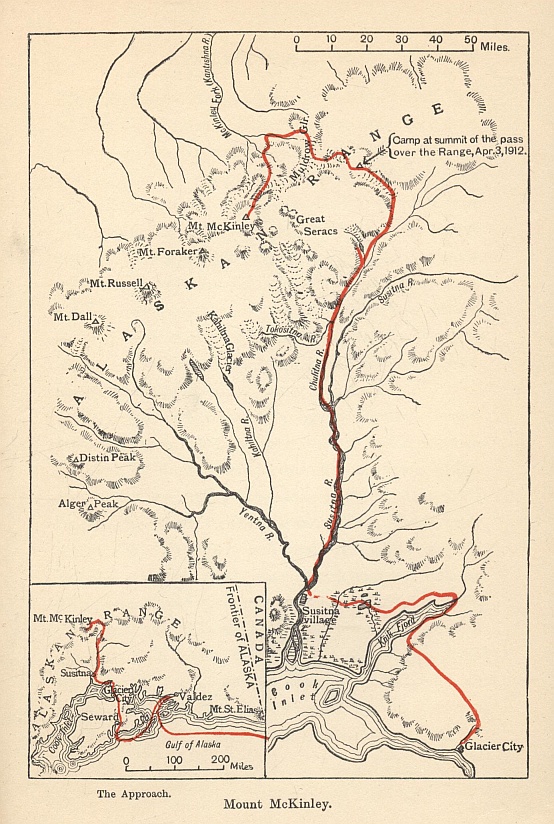
(Map, p. 184.)
The ascent of Ruwenzori unriddled the mystery of equatorial snows. There now remained the question of great peaks in the extreme North, where the mountaineering problems must obviously be very different from those found at a similar altitude in the temperate zones. Something had been done to solve the problem by the ascent of Mount St. Elias, in Alaska, on July 31, 1897. But Mount St. Elias was only just over 18,000 feet, and it was peculiarly accessible, for it lies close to the coast, on the borders of British and American territory. The eyes of explorers began to turn towards Mount McKinley, the highest peak in North America, which reached a height of 20,300 feet. Its latitude was 63° N., and so within 250 miles of the Arctic Circle. The nearest salt water, Cook Inlet, was 140 miles from the southern face as the crow flies. It was therefore almost unreachable, lying as it did in the midst of an unexplored wilderness and surrounded by a mighty glacier system.
On the south these glaciers were drained by the Susitna River, with its tributaries the Yentna and the Chulitna, and on its northern face by the affluents of the Yukon. If the traveller attempted to reach it in summer he might find a difficult waterway up to the beginning of the glaciers, but then he had thirty miles of ice to cross before he reached the base, and over these he must transport everything on his back. In winter the journey might be made by dogs, but winter in those latitudes was scarcely the time to travel. Moreover, Mount McKinley, unlike the other great peaks in the world, rose from a low elevation. In the case of the South American and Himalayan peaks climbing does not begin until an altitude of at least 10,000 feet has been reached, and their line of perpetual snow is very high. It is possible, for example, to cover the 22,860 feet of Aconcagua without ever touching snow. But in Mount McKinley the snow-line was not much more than 2,500 feet, and there was something like 15,000 feet of climbing. Again, its position so far north did not permit the snows to melt properly in the summer, or to grow hard and pack. Its snowfall was so great that the snow never got into the condition which eases the path of the mountaineer. Finally—and this applied especially to a winter journey—it was situated in a land of desperate storms. The severest weather conditions ever recorded by the American Meteorological Bureau occurred at Mount Washington, which is only 6,000 feet above the sea, where the temperature was 40 degrees below zero and the wind 180 miles an hour. What might the climber expect 20,000 feet up in the sky, with nothing between him and the North Pole?
The attempt on Mount McKinley, therefore, was not a thing to be lightly undertaken. It meant a journey to the remote Alaskan coast, and then some 200 miles through difficult and little known country before even the base was reached. What the climbing would be like no one could tell. The obvious route, as the map will show, was the Susitna River, by which, indeed, its first explorer, a young Princeton graduate called Dickey, had approached it in 1896. It was he who christened it Mount McKinley. He fell into an argument with another prospector who was a rabid champion of free silver, and after many weary days' dispute retaliated by naming the mountain after the champion of the gold standard. In 1903 an expedition, led by the too famous Dr. Cook, reached the base from the north, but failed to do any climbing. Then, in 1906, began the explorations of Professor Parker and Mr. Belmore Browne, who were destined six years later to be the conquerors of the peak.
I
The 1906 expedition may be roughly sketched, for, though it was a failure, it at least taught its leaders what routes were not possible. They started with pack-horses and a motor-boat, with the intention of trying the north-western face. They ascended the Yentna River, which enters the Susitna from the west, but found it impossible to cross the southern flanks of the Alaskan range. They then turned up the south side of the range, and reached the glacier out of which the Tokositna River flows. By this time their transport was in a precarious condition, and their horses could go no farther. They were within view of Mount McKinley, and saw not only the impossibility of the southern face, but the extraordinary difficulties of approaching even its base from that direction. They accordingly returned to the coast, where Dr. Cook left them, announcing that he intended to make one final desperate attempt on the mountain.
Mount McKinley.
Presently Professor Parker and Mr. Belmore Browne heard, to their surprise, the rumour that Dr. Cook had succeeded. Knowing that the feat was impossible in so short a time, they disbelieved the tale, and stated their views publicly in New York. Then appeared Dr. Cook's notorious book; but before it was published he had departed for the Arctic regions. Geographical circles in America were torn with the controversy. A committee of the Explorers' Club investigated the question, but Dr. Cook refused to give evidence. Professor Parker and Mr. Belmore Browne were meantime busy with their own plans for another attempt.
The 1910 expedition was again directed to the southern face. Their reasons were that for most of the journey to that face a water route was possible, and that if they failed there they believed they would be able to go on to the southern North-East ridge, which, from what they had heard and seen, they believed to be the most promising avenue of attack. They also wished to duplicate the photographs which Dr. Cook had published, and so prove or disprove his bona fides. Also, the northern side of the great mountain had been already fairly well mapped, but nothing had been done on the south side.
The notion of a pack train was discarded, and all their energies were directed towards designing the right kind of boat in which to ascend the Susitna and its tributary the Chulitna till they reached the glaciers. The party consisted of eight, including a young man from Seattle, Mr. Merl La Voy, who was exceptionally fitted by Providence for the work of a pioneer. The present writer had many dealings with Mr. La Voy during the Great War, and can confidently say that he never met any one more intrepid, audacious, and resourceful.
It was a summer-time expedition, and the party left Susitna station on the 26th May. The ascent of the two rivers was difficult and exciting enough, but they reached without misadventure the foot of the Tokositna tributary, where they established their base camp. This camp was thirty-seven and a half miles from Mount McKinley, and a few miles away was the terminal moraine of a great glacier, which they hoped would give them a roadway to the mountain. Up that glacier they would have to carry all their belongings on their backs. In Mr. Belmore Browne's narrative there is an interesting passage describing the process by which men are hardened to wilderness work.
"The day's work consisted in travelling through brush, soft sand, swamps, and glacier streams for about ten hours. With the exception of one or two men, who put a biscuit in their pockets, we took no food with us. The day's work was in no way difficult, for we carried (during the preliminary reconnaissance) no loads; our condition from the civilized standpoint was splendid; we were well-fed, sun-browned, and fairly hard—and yet we all came into camp thoroughly tired out. Two months after our adventures on Mount McKinley's ice flanks we came down through the same stretch of country. The snow, however, had melted, leaving dense thickets through which we had to chop our way; mosquitoes hung in clouds, and four of us ... were carrying packs running from 95 to 120 lbs. From the civilized standpoint we were not well-fed and we did not look well—our eyes and cheeks were sunken and our bodies were worn down to bone and sinew; and yet we came into camp as fresh and happy as children, and after a bite to eat and a smoke we could have gone on cheerfully."
It was no light task carrying an outfit of 1,200 lbs. over the thirty-seven and a half miles of glacier, a distance which by the actual route used was much farther. Most of the weight was in pemmican and alcohol for the stoves. The pemmican consisted of pulverized raw meat, mixed with sugar, raisins, currants, and tallow. Their principal drink was tea. On 11th June they had their last wood fire, and after that there was only the stove. The days were spent in sheer hard navvy labour, trudging along on snow-shoes under heavy packs, and trotting back for others. They had various misadventures. Frequent blizzards of wind and snow compelled them to shut up their tent fast at night, with the result that on one occasion they were nearly asphyxiated.
On 27th June they reached the head of the main glacier, beyond which, through a narrow gorge, a secondary glacier descended from the mountains, Another glacier came down on their right, and here they achieved an interesting piece of detective work. At the top of it they saw some peaks which recalled an illustration in Dr. Cook's book. The illustration purported to be the summit of Mount McKinley, and showed on the left a rock shoulder which Dr. Cook described as a cliff of 8,000 feet. It was really a faked picture of the small peaks at the head of this glacier, miles and miles from the main mountain, and the cliff of 8,000 feet turned out only to rise 300 feet above the floor, and to be only 5,300 feet above sea-level. One legend at any rate had been dispelled for ever.
Now began the patient relaying of provisions up the great gorge. It was desperately hard manual labour, their faces were burnt black by the glare of the sun, and every now and then there would be a slip into a crevasse, which only the highest good fortune saved from being a tragedy. After thirty-six days of hard travelling, they were at last within two miles of the base of the southern cliffs of Mount McKinley. They found themselves in a great ice basin, hemmed in by colossal precipices down which avalanches thundered. Before them rose the mountain, 15,000 feet of rock and ice. Their glasses showed them that the South-West ridge became utterly unclimbable after an altitude of about 15,000 feet. The southern North-East ridge looked more promising, and to this they turned their attention. In that Northern summer there was no dark. "The advance and retreat of the night shadows went on with scarcely a pause, and sometimes we would be uncertain whether the Alpine glow on the big mountain's icy crest was the light of the rising or the setting sun." They had now a short spell of rest from their toil; and as the mind of man on such occasions turns to food, they invented out of their scanty larder a new pudding. Here is the recipe.
"First soak three broken hard-tack in snow-water until they are soft. Add 60 raisins and pemmican the size of 4½ eggs. Stir slowly but energetically until the mess is thoroughly amalgamated. Boil slowly over an alcohol stove, add three tablespoonfuls of granulated sugar, and serve in a granite-ware cup."
But between them and the North-East ridge lay a gigantic serac. For a day and a half they lay storm-bound under it, and then, on the morning of 11th July, tried to cut their way up the ice wall. It proved most difficult and dangerous work, and presently, owing to the diminishing provisions, they realized it was impossible. Again and again they attempted it, for only that way was there a road to the North-East ridges. But at last they had to give it up as hopeless, and turn their attention to the South-West arête.
This, too, proved too hard for them. They laboured on under constant ice-falls and avalanches, and reached a height of 10,300 feet, where they had perforce to halt. During these days they saw some marvellous mountain scenery. "The whole of the great cliffs of the box-cañon appeared at first glance to be on fire. Unnumbered thousands of tons of soft snow were avalanching from the southern flanks of Mount McKinley on to the glacier floor 5,000 feet below. The snow fell so far that it was broken into heavy clouds that rolled downward like heavy waves. The force of the rolling mass was terrific, and as it struck the blue-green glacier mail it threw a great snow cloud that raced like a live thing for 500 feet; whirling in the wind the avalanche had caused, the white wall swept across the valley, and almost before we were aware of it we were struggling and choking in a blinding and stinging cloud of ice dust."
They began their retreat, and their return to greenery and summer out of a hyperborean hell was like a man's recovery from a dangerous illness. Though the expedition failed, they were a merry party, for though every man was sunken-eyed and lean and hatchet-faced, he was in the pink of condition. It was nothing to them to carry a load of 120 lbs., which would have broken their backs in the first days. The party included men of diverse temperaments and multifarious attainments, and Mr. La Voy observed, "It is an education to travel with a bunch like ours; if anything should happen you can listen to a whole dictionary." In the end they came to their cache on the Chulitna, and they emptied it as children empty their Christmas stockings. "We were actually ravenous," says Mr. Belmore Browne, "and as jars of chow-chow, cans of maple-syrup, and tins of meat appeared we hugged them in our arms and danced delirious dances on the sand! One of the great truths of life that one learns to understand in the North is that it is well worth while to go without the things one wants, for the greater the sacrifice the greater the reward when the wish is consummated. I have eaten with all manner of hungry men, from the sun-browned riders of the sage to the bidarka-men of the Aleutians, and I have feasted joyously on 'seal-liver,' 'seagull-omelets,' and 'caribou spinach'; but never have I seen men eat more, or better food!"
II
As soon as the explorers returned to civilization they began to plan a third attempt. It was clear to them that the western and southern faces of the mountain were impracticable, and that their best chance was on the North-East ridge. This, however, could not be approached from the south; so it became their object to get in on the north side. Their explorations in 1910 had proved the difficulties of a summer trip, for loads had to be transported on men's backs over many miles of glacier. They therefore decided to make a winter expedition of it and to use Alaskan dog teams. The best route seemed to be up the Susitna and Chulitna rivers, and they hoped somewhere near the head of the Chulitna to find a pass in the Alaskan range which would take them round the north face of Mount McKinley.
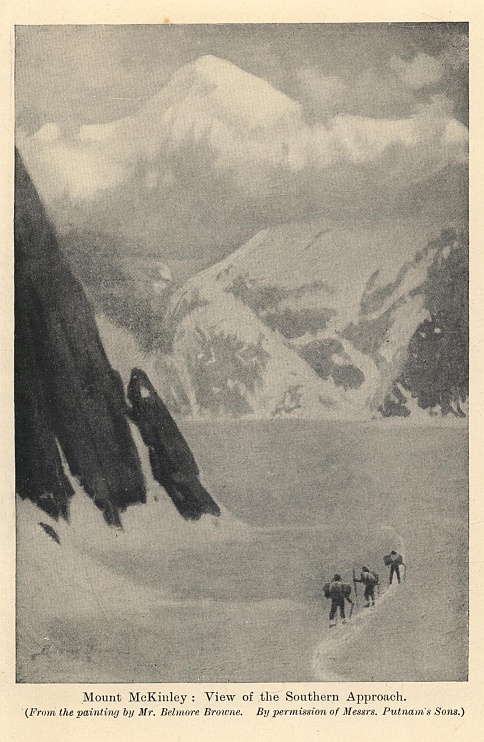
Mount McKinley: View of the Southern Approach. (From the painting by Mr. Belmore Browne. By permission of Messrs. Putnam's Sons.)
In October, 1911, Mr. La Voy began to relay supplies up the Chulitna, the plan being for him to join Professor Parker and Mr. Belmore Browne at Susitna in February of 1912. As Cook Inlet is choked by ice during winter the travellers had to leave the steamer at Seward, and make a long and difficult overland journey by way of Glacier City and the Knik fjord to the Susitna River. There they found Mr. La Voy with the dog teams. He reported that he had taken the bulk of the outfit to a cache on the Chulitna, several miles beyond the mouth of the Tokositna.
The journey up the Susitna, which was now a flat snow trail, went easily and pleasantly. When they reached the cache they found to their disgust that a wolverine, which is the arch-fiend of those northern wildernesses, had managed to break in, though it was placed for greater security on a platform of logs among the trees. The brute had destroyed a good deal of the dog-feed and bacon, and a new and expensive camera of Mr. La Voy's, which had been swung on the top of a 30-foot pole. The wolverine had climbed the pole, cut off the corners of the leather case, and gnawed its way into the camera!
From the cache began a long system of relays, for it was impossible to carry all the equipment in one journey. There was now no trail, and a road had to be "broken" before each stage. The route lay up the Chulitna, and the travellers hoped to find some large stream coming down on their left which would indicate a gap in the Alaskan range. Any such gap would, of course, be filled with glaciers, the water from which must form a river. On the whole, winter travelling compared favourably with summer. The men used snow-shoes to break the trail, and after equipment had been transported for five miles, returned on the empty sleds for new loads. Winter had not killed all signs of wild life, though hunting was difficult, and the snow was dotted with the tracks of innumerable wild things. Even a finch was heard singing. Camping was perfectly comfortable, and in a tent with the stove lit and beds of green spruce prepared, the nights were warm and peaceful.
At last, as the trees began to thin, they came to a point where the valley split and a great cañon turned north towards the range. Travel now became rougher, for the broad level flats gave way to snow-covered rapids and big drifts. As they advanced up the gorge a glacier was seen winding down from the centre of the mountains. One night Mr. Belmore Browne had an accident which might have proved serious. He went out to shoot an owl for food, and as the ejector of his little rifle had been removed the cartridge came back on his eye and just missed his right eyeball. It gave him an eerie feeling to see the friendly dogs lapping up the bloodstained snow. Shortly after he made a reconnaissance of twenty-five miles ahead, and found the glacier they had seen from afar off running like a great white road into the hills. The route seemed possible, but there were ugly ice precipices at the head which suggested that the crossing of the pass might not be easy.
A second reconnaissance took him to the head of the glacier. At first no crossing could be discerned, but suddenly at the head of the right-hand basin the mountains broke away and he saw a smooth snow-field leading to the crest. He climbed to the top of it, and at first saw nothing but a sheer precipice. At length, however, he discovered on the right a gentle snow slope leading down into a great snow cup, and realized that the pass could be crossed.
On 3rd April the main camp was pushed up to a height of 6,000 feet. Then came a delay from a blizzard, which confined the explorers for twenty-four hours to their tents. It was bitterly cold, and everything, including the alarm clock, froze stiff. They managed, however, to get a little fire with an empty pemmican case, and, with the stove, had a sort of party in the tent—men, dogs, and everything. The party was, however, unceremoniously broken up by one of the dogs backing into the stove, and filling the tent with a cloud of smoke from singed hair.
Next morning they crossed the divide, partly shooting and partly lowering their belongings over the 1,000-feet drop into the hollow. They were no sooner across when another blizzard arrived, and they were storm-bound for thirty-six hours. But their spirits were high. For the time they were done with uphill climbs, and they saw that by crossing a low pass at the head of another glacier they could reach the great Muldrow Glacier, which had been known to the world since 1902. This glacier would take them into the very heart of the mountain.
Without much difficulty they crossed the pass, and, descending to the Muldrow moraine, they realized with joy that they were on the northern side of the Alaskan range. It was now nearly the middle of April, and they found themselves in the kind of country that hunters dream of. There was a chance of fresh meat, and, to men who had been seventeen days on the ice, the hope of a change in their menu and the sight of vegetation were an intoxication. Mr. Belmore Browne went out one morning, and fell in with a herd of white sheep (Ovis Dalli). He secured three, and that night the camp feasted. "In cold weather," he writes, "one has a craving for fat, and in the wilderness one is less particular about the way meat is cooked. Our desire for fat was so intense that we tried eating the raw meat, and finding it good beyond words, we ate freely of the fresh mutton. I can easily understand now why savage tribes make a practice of eating uncooked flesh." The white sheep was not the only game. There was a special variety of caribou; there was the Alaskan moose; there was an occasional grizzly; and there were quantities of ptarmigan. The travellers showed the most sportsmanlike spirit in refraining from killing females or immature beasts.
From the Muldrow Glacier they turned westward and struck the McKinley fork of the Kantishna River, which flows to the Yukon. Presently they were in timber country, and realized that they had crossed the Alaskan range "from wood to wood," and incidentally had added two new glacier systems to the map. After snow and ice and pemmican they had greenery and fresh meat, and, as they worked their way to the lowlands, the first flush of spring. Above all, they had the North-East ridges (of which there were three) above them to offer an apparently possible route to the summit. They saw a glacier running between the central and northern North-East ridges which they decided would be their road. Mr. Belmore Browne went out to prospect, and, climbing the head of a valley, found himself looking down upon the upper Muldrow Glacier, which he now realized was split in two by the central North-East ridge. He saw also that the northern branch of it gave a road to the very base of the central peak.
A base camp was established on 24th April, and four days later began the chief reconnaissance. They took with them a dog team, and, for equipment, their mountain tent, instruments, alcohol lamps, and provisions of pemmican, chocolate, hard-tack, sugar, and raisins. The total outfit weighed about 600 lbs. They started at night, when the snow was in better condition, and found the northern branch of the Muldrow, which they called the McKinley Glacier, rising in steps like a huge staircase. Camp was pitched at the base of a serac between two great cliffs of solid blue ice.
On 3rd May they reached the top of the serac at an altitude of 8,500 feet, after a very difficult journey. Mr. La Voy, who was leading, fell into a crevasse, and the strain on the rope pulled Mr. Belmore Browne to the very edge. Mr. La Voy, however, stuck on a ledge of ice, which eased the strain; without that ledge it may well be that the whole expedition would have ended in tragedy. Bit by bit they fought their way to the head of the glacier, suffering severely from the glare of the sun, though the temperature was only one degree above freezing. They had now attained an altitude of 11,000 feet, and saw a low col on the mountain ridge, where they decided to make a high camp. This would be about 12,000 feet high, which would leave them between 3,000 and 5,000 more feet to climb before they reached the basin between the north and south peaks. It was now time to send the dogs home; so, after caching their equipment, they started back for the base camp, which they reached on the evening of 8th May.
Some pleasant days were spent at the base camp. When they left it the countryside had still been in the grip of winter, but now everywhere there were grass and flowers and running streams. So far they had managed well. They had crossed the Alaskan range early enough to find the snow in good condition for dog sledding, and they had cached 300 lbs. weight of mountain provisions at 11,000 feet. They could therefore afford to wait till the days lengthened before venturing on a final climb. Here is Mr. Belmore Browne's picture of the landscape:—
"The mountain country at the northern base of Mount McKinley is the most beautiful stretch of wilderness that I have ever seen, and I will never forget those wonderful days when I followed up the velvety valleys or clambered among the high rocky peaks as my fancy led me. In the late evening I have trotted downward through valleys that were so beautiful that I was forced against my will to lie down in the soft grass and drink in the wild beauty of the spot, although I knew that I would be late for supper, and that the stove would be cold. The mountains were bare of vegetation, with the exception of velvety carpets of green grass that swept downward from the snow-fields; in the centres of the cup-shaped hollows ran streams of crystal-clear water; as the sun sank lower and lower the hills would turn a darker blue, until the cold, clean air from the snow-fields would remind you that night was come and that camp was far away."
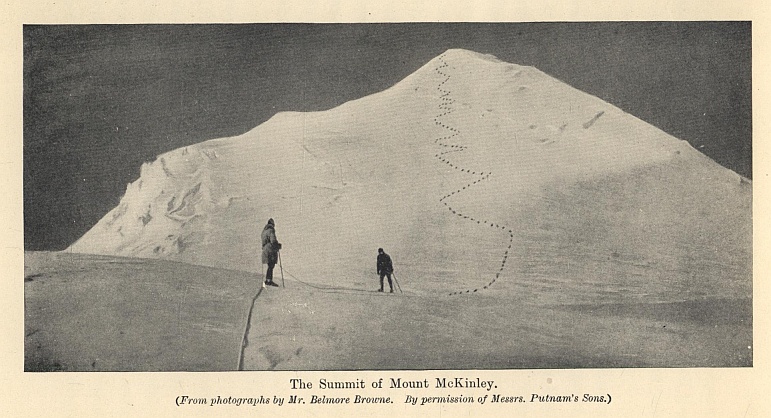
The Summit of Mount McKinley. (From photographs by Mr. Belmore Browne. By permission of Messrs. Putnam's Sons.)
The sight of big avalanches on Mount McKinley warned the explorers that great risks had to be faced. On the 5th day of June they started out for their final attack. Unfortunately the weather became very bad, and soon they were enveloped in a heavy snowstorm. Mr. La Voy had hurt his knee hunting, and the ascent through the seracs was for him very arduous. The nervous strain, too, was great, for they had to be perpetually on the outlook for avalanches. They feared that one might have buried their cache, and it was an immense relief when they reached the 11,000-feet point and saw the top of their sled sticking out of the snow.
They now moved their supplies up to a camp on the col of the ridge at a height of 11,800 feet. On 19th June they made a reconnaissance, taking with them food for six days, and intending to climb up to the big basin between the two main peaks. They reached a height of 13,200 feet up a sensational arête, when Mr. La Voy's knee gave out and they were compelled to return. Three days later they made a camp on the ridge at 13,600 feet. It was a wild and most laborious journey, with a drop of 5,000 feet on the left and of 2,000 on the right. It would take them two hours of hard work to make 500 feet. Apart from the handicap of Mr. La Voy's knee, Mr. Belmore Browne's eyes were very bad. They now realized that they could not reach the summit with their food supply of six days' rations, and they were forced to change their plans, and go back for more food.
They returned to the camp on the col and packed up ten days' rations. With tremendous difficulty they transported them up to a 15,000-feet camp on the ridge, where they were on the edge of the big glacier-filled basin between the two summits. All three found their health beginning to suffer. The pemmican proved to be impossible food, giving them all violent stomach pains, and they were forced to confine themselves to tea and hard-tack. The cold was intense, and inside the tent, with the alcohol stove burning and the warmth of three bodies, the temperature at 7.30 p.m. was five degrees below zero, and three hours later nineteen degrees below zero. "Despite elaborate precautions," says Mr. Belmore Browne, "I can say in all honesty that I did not have a single night's normal sleep above 15,000 feet on account of the cold." By this time their appearance was, as Mr. La Voy said, "sufficient to frighten children into the straight and narrow path." All were more or less snow-blind, burnt black, unshaven, with lips, noses, and hands swollen, cracked, and bleeding.
On 27th June the packs were carried in relays to just under the last serac, which was the highest point in the big basin. The altitude was 16,615 feet. Their one comfort was that a snow-field seemed to lead easily up to the sky-line of the central North-East ridge, and that from there they saw what appeared to be a reasonable gradient to the final summit. On 28th June they rested and prepared for their last effort. They were now convinced that nothing could stop them except storm. The night was fine, and the weather promised well for the morrow. The summit appeared to them to be nearly flat with a slight hummocky rise, which must be the highest point in North America.
On 29th June they left camp at 6 a.m., moving very quietly and steadily and conserving their strength. Mr. La Voy and Mr. Belmore Browne led alternately. Slowly they made their way up the snow slopes at the rate of about 400 feet an hour. At 18,500 feet they stopped and congratulated each other, for they had beaten the Duke of the Abruzzi's record on Mount St. Elias. Presently they were on the sky-line of the ridge, and looking down on the arena where they had struggled two years before. Now, for the first time, came a threat from the weather. The sky was clear to the north, but from the south a great sea of clouds rolled against the mountain like surf on a shore.
As they moved up the ridge breathing became more difficult. At 19,000 feet they had passed the last rock, and were looking at the summit. It rose as innocently as a snow-covered tennis court, but now the wind was rising and the southern sky darkening, and just at the base of the last lift the gale broke. In a fierce scurry of snow they crawled up the round dome, Mr. La Voy leading and hacking steps. Then came Mr. Belmore Browne's turn, and he realized that his hands were freezing, and that the bitter wind was cutting through his flesh. He dare not get dry mittens from his rucksack lest his hands should be frozen during the change. When his second turn was three-fourths finished, Professor Parker's barometer registered 20,000 feet, and they were within 300 feet of the top.
The rest was an evil dream. To each man the other two seemed to be lost in the ice mist, and the cold was freezing their marrow. The storm was growing fiercer, and as they topped a little rise its full fury burst upon them. The story must be given in Mr. Belmore Browne's own words:—
"The breath was driven from my body, and I held to my axe with stooped shoulders to stand against the gale; I could not go ahead. As I brushed the frost from my glasses and squinted upward through the stinging snow I saw a sight that will haunt me to my dying day. The slope above me was no longer steep! That was all I could see. What it meant I will never know for certain—all I can say is that we were close to the top!"
There was no going on in the teeth of that gale. The three chopped a seat in the ice, trying to find a shelter; but they were not huddled there a second before they discovered they were freezing. There was nothing for it but to return, for the snow was obliterating their back trail. Dead tired and sick at heart they began the journey back, and found that the steps they had cut had disappeared. It took them nearly two hours to go down an easy slope of 1,000 feet. They reached the base of the dome, guiding themselves only by the direction of the wind, and at last at 7.35 p.m. crawled into their upper camp. All their apparel down to their underclothes was filled with ice. They were beaten by the wind, and by the wind only. On a conservative estimate its pace was fifty-five miles an hour, and the temperature fifteen degrees below zero. Otherwise they suffered little from the altitude. Mr. Belmore Browne was able to roll and smoke a cigarette between 18,000 and 19,000 feet.
They spent a day in their tent, trying to thaw their clothes. Pemmican they could not touch, their chocolate was finished, and their food was tea, sugar, hardtack, and raisins. It was a cruel fate that they had lost ten days' rations in useless pemmican since leaving their 13,200-feet camp, and they had not only lost the food but carried useless weight.
They made one more attempt on the summit, and reached the base of the final dome; but there another storm assailed them, and, after waiting an hour, they went back. There was now a real risk of being caught with insufficient food in a blizzard which would destroy life, and they made haste down the mountain. They had spent seven days above 15,000 feet, six days above 16,000 feet, and four days above 16,650 feet.
As they descended their health improved, and at last they came off the glacier on to the moraine, and lay down on the bare earth. It was the first time for thirty days that they had lain on anything but snow and ice. They slept like logs till the afternoon, and when they awoke a warm wind was blowing up the pass, carrying with it the smell of grass and flowers. "Never can I forget," says Mr. Belmore Browne, "the flood of emotions that swept over me. Professor Parker and La Voy were equally affected by this first smell of the lowlands, and we were wet-eyed and chattered like children as we prepared our packs for the last stage of our journey."
How dangerous was the climatic condition of the mountain may be judged from what happened on the evening of 6th July. From their camp in the foothills they saw the sky suddenly turn a sickly green. There came a deep rumbling from the Alaskan range, and as they looked the mountains melted into mist and the earth began to heave and roll. In front of them a boulder weighing 200 lbs. broke loose from the earth and moved. The surface of the hills seemed to open and the cracks to spout liquid mud. The whole range was wrapped in dust, and as it cleared they saw the peaks spouting avalanches. Had this earthquake overtaken them on the high ground all must have perished.
III
The story has always seemed to me one of the boldest and most patient adventures in the history of mountaineering. Slowly the travellers fought their way to the discovery of the only practical route. Mount McKinley was conquered, though they had failed to cover the hundred or so feet which would have given them the actual summit. They had blazed the path to the top and solved its mysteries. Only that maleficent blizzard at the last moment robbed them of the full fruit of six years' pioneering.
Next year the actual summit was reached. The late Dr. Hudson Stuck, the Archdeacon of the Yukon, ever since he came to the country nine years before, had contemplated an attempt on the mountain. In the autumn of 1912 he sent on supplies by way of the Kantishna River to a point fifty miles from the base. In March, 1913, he and Mr. W. P. Karstens set out to reach the peak from the north. At their base camp, 4,000 feet up, they made a fresh supply of caribou pemmican which proved more satisfactory than that used by Professor Parker and Mr. Belmore Browne. The road taken was the same as that of their predecessors—up the Muldrow Glacier and then up the central North-East ridge. They found that the earthquake of 1912 had completely changed the character of that ridge, and instead of being a reasonable snow gradient, it had become a confused mass of rock and ice, most difficult to surmount. Bit by bit they forced their way up it till they reached the upper basin, and then, being favoured with clear, bright, still weather, they managed to attain the highest point, the southern summit. There had been a story of two miners, called McGonogall and Anderson, who had reached the top in 1910. Dr. Stuck discovered that the top they had reached was the lesser northern peak, for he saw the remains of their flagstaff.
With this ascent the story of the conquest of Mount McKinley is complete.*
VII THE HOLY CITIES OF ISLAM
THE HOLY CITIES OF ISLAM
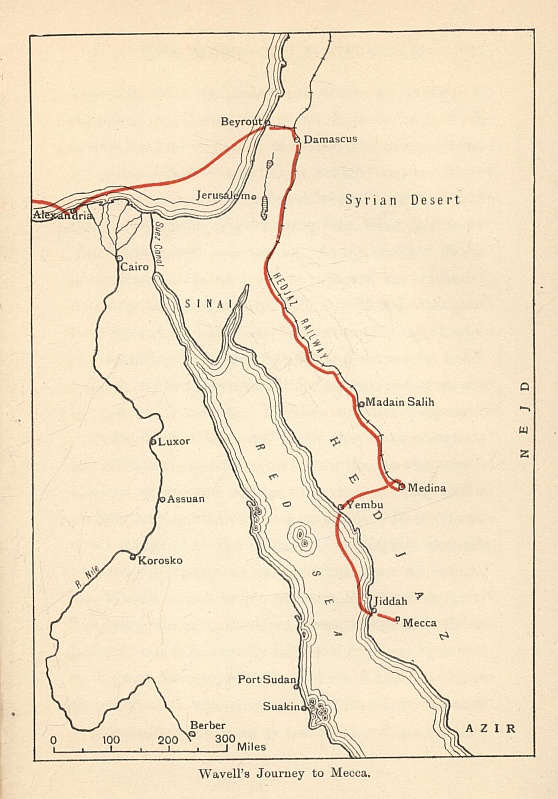
(Map, p. 216.)
The "spell of far Arabia" has been a potent thing from the days when the Egyptians drew wealth from the spice-land of Punt, and Greek traders brought stories of the gums and jewels of Araby the Blessed. But ever since it became the Holy Land of Islam a veil of secrecy, other than that of its stern climate and inhospitable deserts, has descended upon it. It is one of the oldest of arenas of adventure, and it is still one of the least exploited; indeed, in its great Southern Desert it holds one of the few unriddled mysteries of the globe. Except for the semi-mythical Gregorio, who may be read of in Albuquerque's Commentaries, no one who did not profess the creed of Islam has entered its two Holy Cities and lived. But the greatest tale of Arabian exploration is not concerned with Mecca and Medina. It is to be found rather in the journeys of the English soldier Captain Sadlier in Nejd; of Sir Richard Burton in the land of Midian; of Wallin, who crossed the great Nafud sands; of William Gilford Palgrave, who may, or may not, have been an agent of Napoleon III.; and, above all, of Charles Montague Doughty, who, as an avowed Christian, explored the Northern Hedjaz, and in his Arabia Deserta has written one of the foremost classics of travel in the English tongue.
Compared with some of these wanderings, a visit to the Holy Cities was a simple matter, requiring only a firm nerve, a good knowledge of Arabic and of Mohammedan ritual, and a real or professed adherence to the creed of Islam. At the beginning of this century the list of Europeans who had entered Mecca and Medina was a long one. They were mostly renegades—French, English, Irish, Scottish, and Italian. In 1807 a certain Domingo Badia y Leblich of Cadiz, travelling as a Moslem prince called Ali Bey, and probably in the pay of Napoleon, entered Mecca in state; but he had become a genuine Mussulman. In 1815 one Thomas Keith, a deserter from the 72nd Highlanders, was Governor of Medina—surely one of the strangest posts ever held even by a Scot! The great European travellers like Burckhardt, Wallin, and Burton went to the Holy Cities in order that by attaining the rank and fame of a Hadji they might win an advantage for travelling in other Moslem lands. More than one of them has described minutely the interior of both Mecca and Medina and the ritual of the great ceremonies. The Holy Places, though few Western eyes had seen them, were sufficiently well known to the Western world. Their true unveiling may be said to have come about during the Great War, when Hussein, the Sherif of Mecca, fought as an ally with the British, and, as King of the Hedjaz, proclaimed his independence of Turkey.
Yet one journey was taken just before the Great War which must rank by itself. It told the world nothing that was not known before; but it had the merit of giving a picture of Mecca and Medina under the latest conditions—a picture drawn with such vigour and in such detail that it may fairly claim to have revealed the Holy Cities in a new light to the ordinary man.
Mr. A. J. B. Wavell greatly distinguished himself in command of Arab scouts in East Africa in the early part of the Great War, and was responsible for the brilliant affair at Gazi. In that campaign he gave his life for his country.* He had been at Winchester, and in 1908, when he made the plan for visiting Mecca, had been living for some time at Mombasa, where he had acquired Arabic and Swahili, and a considerable knowledge of Moslem customs. His motive was partly curiosity, partly, as he says, to accustom himself to Arab ways, with a view to further explorations in Arabia, and partly in order to obtain the useful prestige of a Hadji. He chose as his companions a certain Abdul Wahid, an Arab from Aleppo who was established in Berlin, and Masaudi, a Mombasa native. The three met at Marseilles on September 23, 1908. They started in good time, for though the pilgrimage was not to take place till the beginning of the following January, Mr. Wavell wanted to go first to Medina, and also to prepare himself by a preliminary discipline in Eastern life. He managed to secure a Turkish passport, which described him as one Ali bin Mohammed, aged twenty-five, a subject of Zanzibar on his way to Mecca.
The three found a vessel at Genoa which took them to Alexandria, where they managed, not without trouble, to get their medicine chest, pistols, and ammunition past the Customs. They then took passages on a Khedivial mail ship for Beyrout. Mr. Wavell had feared that the language difficulty would be serious, but he found it less formidable than he expected, since the dialects of Arabic are many. He explained to those who found imperfections in his accent that in Zanzibar the colloquial language was Swahili and that no one talked Arabic; and on the few occasions when he had to speak Swahili he inverted the story, announcing that, having been born in Muscat, his real language was Arabic. As Sir Richard Burton discovered in his own journey, it was rare indeed to find any one sufficiently well acquainted with both languages to find him out. Meantime he had changed at Alexandria into Arab clothes and shaved his head.
Wavell's Journey to Mecca.
They reached Beyrout safely, and proceeded at once by rail to Damascus. As they did not propose to start for Medina for some weeks, they took rooms and settled down, devoting great attention to the various Moslem ceremonies, and picking up the right kind of phrases and quotations and greetings. It is on such small things that the efficacy of a disguise depends. "There are nearly as many white men at Mecca," Mr. Wavell writes in his account of his adventures,* "as there are men black or brown in colour. Syrian 'Arabs' not infrequently have fair hair and blue eyes, as likewise have some of the natives of the Holy Cities themselves. I was once asked what colour I stained myself for this journey. The question reveals the curious ignorance that lies at the bottom of the so-called race prejudice, of which some people are so proud. You might as well black yourself all over to play Hamlet!"
Abdul Wahid had brought letters of introduction to a local merchant, who was most hospitable, and supervised the preparations for the journey. They passed safely through the period of Ramadan, and so complete was Mr. Wavell's get-up, and so stalwart his Moslem respectability, that it was with some difficulty that he prevented a middle-aged lady and her two daughters from joining his party for the pilgrimage. He bought the "Ihram," the white robes which are required when entering Mecca, a full camp equipment, and a certain number of stores, and deposited his money with his merchant friend, who gave him two cheques on his agents, one at Medina and one at Mecca. He proposed to travel to Medina by the Hedjaz railway, a very different method from those used by earlier adventurers when aiming at Mecca.
The third-class carriages were desperately crowded, and the train started to the accompaniment of gramophones—a modern invention which is very popular in the Hedjaz. On the way Mr. Wavell had a touch of malaria, and his fellow pilgrims showed him every kindness. Presently the train reached Medain Salih, the boundary of the Hedjaz, which no infidel is permitted to pass. On the fourth day the rocky hills opened, and through a gap appeared the minarets of the Prophet's mosque. They arrived at Medina in the middle of a battle, for the Turkish garrison had come to loggerheads with the neighbouring Bedawin, and the Holy City was more or less in a state of siege. The railway was spoiling trade for the neighbouring tribes, and they were demanding compensation, which Constantinople would not pay.
Medina lies in an open plain some 3,000 feet above sea-level. To the south the country is open, but on the north and west, between five and ten miles distant, rise rocky mountains. The city, which has a population of some 30,000, lives entirely on the pilgrims, as an English watering-place lives on summer visitors. The pilgrims are classified by their lands of origin, and there are official guides, called Mutowifs, attached to each group. The first trouble arose from these guides. If Mr. Wavell went about with the Zanzibar Mutowifs he was certain to meet some one who knew him in Mombasa, even if he were not caught out in the language. So it was arranged that Abdul Wahid should profess to come from Bagdad, while Mr. Wavell passed as "a Derweish," and Masaudi as his slave. A "Derweish," which denotes properly a member of certain monastic orders, is a title occasionally assumed by pilgrims who do not wish to be identified with any particular nationality.
Happily, at the station there were no Zanzibar guides, and the party were able to find rooms in a retired corner at the moderate rate of £2 a month. The landlord was an Abyssinian called Iman, a man of some private means, who had been captured as a child by Arab slavers and sold in Mecca. He proved a most useful friend to the party during their stay.
So began a curious life of endless religious observations. Apart from the sacred places, which few European eyes had beheld, there was a perpetual interest in the study of the pilgrims. "A large caravan came in from Yembu, bringing crowds of Indians, Javanese, and Chinamen. Every Eastern race might be identified in the motley crowd, and every variety of costume, till the whole resembled nothing so much as a fancy dress ball. In the same line of prayer stand European Turks, with their frock coats and stick-up collars; Anatolians, with enormous trousers and fantastic weapons; Arabs from the West, who look as if they were arrayed for burial; the Bedou (Bedawin), with their spears and scimitars; and Indians, who, in spite of their being the richest class there, managed, as usual, to look the most unkempt and the least clean. Then, besides, were the Persians, Chinese, Javanese, Japanese, Malayans, a dozen different African races, Egyptians, Afghans, Baluchies, Swahilis, and 'Arabs' of every description." Representatives of half the races of the globe may be picked out in the mosque any day during the month before the pilgrimage.
The behaviour of the pilgrims, who now saw with their own eyes the tomb of the Prophet, which from their childhood they had been taught to regard with awe, was a proof of the living reality of the Islamic faith. "Many burst into tears and frantically kissed the railings: I have seen Indians and Afghans fall down apparently unconscious. They seem to be much more affected here than before the Kaaba itself. At Mecca the feeling is of awe and reverence; here the personal element comes in. The onlooker might fancy that they were visiting the tomb of some dear friend, one whom they had actually known and been intimate with in his lifetime. With frantic interest they listen to their guides as they describe the surroundings. Here is the place where the Prophet prayed, the pulpit he preached from, the pillar against which he leant; there, looking to the mosque, is the window of Abu Bakar's house, where for long he stayed as a guest; and beyond is the little garden planted by his daughter Fatima." Moreover, there is no suggestion of infidel authority, the Moslem standards float over the town, Moslem cannon protect its gates, and no unbeliever may enter. But there are startling touches of modernity. In the shops you may buy European tinned goods and note advertisements of Cadbury's chocolates and Huntley and Palmer's biscuits!
The party had brought introductions from Damascus and Abdul Wahid had made various friends, so they saw a good deal of society. The time was just after the rising of the Young Turks and the grant of the Constitution. Mr. Wavell, who was a staunch Tory, found to his disgust that every one talked parliamentarianism and Liberal principles. England and the English were everywhere in high favour because of our attitude in the recent quarrel with Austria over the annexation of Bosnia. "I am afraid I managed to give the impression that Zanzibar is a sadly backward state, or that I myself am peculiarly stupid. Not to know a word of any European language is to be held very ignorant, even in Medina. Most people of the class with whom I associated had at any rate a smattering of French, and sometimes of English too. I was careful never to know anything."
Their stay in Medina was much enlivened by the Bedawin siege. Mr. Wavell tried to get enlisted in the defence force, and when that plan failed, succeeded in getting into a very warm corner just outside the gates. They visited like industrious tourists every possible place of interest, and few pilgrims can have spent a more enlightening three weeks. During the whole time they were never in real danger. They had, indeed, a scuffle with a Persian Mutowif, who would insist that Mr. Wavell was a Persian; but by vigorous bluffing they made him apologize, and afterwards employed him as a guide. Once only was there a hint of trouble. Masaudi, standing in the mosque one day before the noonday prayer, found himself face to face with five Mombasa Swahilis who knew him intimately, and, what was worse, knew Mr. Wavell. Masaudi showed remarkable gifts of mendacity. He said he had left Mr. Wavell in England, and having saved a little money thought the present was a good time to perform the pilgrimage. He was in Medina, he said, as a servant of some rich Egyptian pilgrims. As he walked back after prayer he dropped his string of beads. The Swahilis asked where his house was, and he promised to show it them; but half-way up the street he suddenly remembered the beads, bolted back, and lost himself in the crowd.
The incident convinced Mr. Wavell that he had better start without delay for Mecca. Their plan was to go to the coast at Yembu, for which a caravan was starting at once. They arranged for three camels, one to carry a shugduf, which is a cross between a pannier and a howdah, and the other two for luggage; and they bought the necessary food. They took with them a Persian called Jaffa as cook, and his brother Ibrahim as general servant. The luggage was carried down to the big square where the caravan was parked, and where the travellers had to pass the night. That evening there occurred an untoward event. Mr. Wavell was going to a shop for some small purchase, when he met two Mutowifs who demanded to know his nationality. The Mutowifs, being a strict trades union, were convinced that he was defrauding the brotherhood. He took a high line and showed his pistol, and, fortunately, his late landlord came down the street at the moment and took his side. What might have been an ugly experience ended in a minor street brawl.
View of Medina. (By permission of Messrs. Arch. Constable & Co., Ltd.)
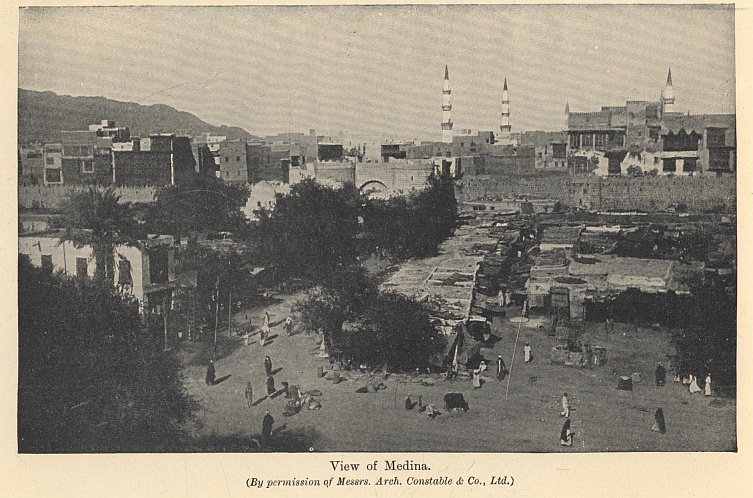
The journey to Yembu was little better than a nightmare. The fashionable road from Medina to Mecca is overland, or back to Damascus and so direct to Jiddah by the Suez Canal. Only poor people go by the Yembu route, which is supposed to be the most hazardous and the roughest in the Hedjaz. There were no escort or police arrangements, no daily market, and each traveller had to carry his own provisions and water. The Bedawin hired out the camels, which numbered about 5,000, and a Bedawi sheikh was in charge. The countryside was infested by robbers who constantly cut off stragglers. The ground, too, was difficult going, being a rough mountain-land, and, while the noons were scorching, the nights were bitterly cold. Every night an encampment was made, roughly circular in shape, into which the whole caravan was packed in the smallest possible space. "While I was trying to get warm a man stumbled against me and nearly knocked me into the fire. Turning round, I was shocked to see a figure, stained almost from head to foot with blood from a tremendous gash in the head, obviously a sword cut. He asked for water, and I went into the tent to get him some, but returning, found him gone. We heard the next day that no less than six men had been murdered that night and many others wounded; and so it went on till we reached Yembu. These unfortunates were mostly people who could not afford camels, and so had to perform the journey on foot. Straying from the main body in search of firewood they got picked up by the marauders hanging on the flanks, who seized every opportunity to plunder such stragglers of their miserable possessions, and killed unhesitatingly any who resisted."
It was in this country that Charles Doughty spent part of his time, and Mr. Wavell thinks that one reason of his success was that he carried nothing worth stealing. The fact that Doughty denied neither his religion nor his nationality seemed to him not the most remarkable fact about the achievement. "The Bedou themselves are not fanatical on these points, and he did not attempt to enter the forbidden cities. Of course, the fact of a stranger being a Christian is always a good excuse for knocking him on the head; but failing it they will soon find another if they want to do so, and will be quite uninfluenced by it if they don't."
They had one row with their camel man, Saad, who tried to extort bakhsheesh. Suddenly he quieted down, and became all politeness to the end of the journey. The reason for this was that that resourceful liar Ibrahim had told him that Mr. Wavell was a nephew of the Governor of Yembu. This story served the travellers well. It spread through the caravan, and many of the pilgrims who were being blackmailed by their camel-men came to him and begged his protection, and received it. At last, on the dawn of the sixth day, after trekking without a stop for the last twenty hours, they reached the gates of Yembu.
Here they were delayed some time, owing to the fact that the pilgrim ship to take them to Jiddah—an old Greek vessel chartered by a syndicate of Persians—would not start till its owners considered that sufficient pilgrims had arrived. Abdul Wahid now became the popular leader. At the head of a mob of passengers he seized the Persians and carried them off to the Governor. Mounted on a pile of sugar bags he delivered an impassioned address, concluding with "We had better be dealing with Christians than Moslems, who cheat their brethren in this fashion." "Murmurs of protest," says Mr. Wavell, "deprecated this revolting comparison. We all thought he was going a little too far." The Persians finally capitulated, and the ship got under way. But there came one last contretemps. A party of Megribi Arabs had passed the quarantine and were half-way out to the ship when one of them died. The shore authorities refused to let them land again and the Persians declined to take the corpse aboard. The Arabs could not throw it into the sea because there were certain ceremonial washings to be performed and certain prayers to be said. An Egyptian lawyer on board gave it as his opinion that the man, having taken his ticket, was entitled to his passage, dead or alive, there being no saving clause in the contract. Finally the Megribis got sick of arguing, swarmed over the bulwarks, and hoisted up their departed comrade. Their fierce faces and long knives settled the point of law.
At half-past four in the afternoon the syren blew to announce that the pilgrims were within that latitude where they must exchange their ordinary clothes for the Ihram—the garb which has to be worn by all travellers who attain a certain distance from Mecca. The costume consists of two white bath towels, one worn round the loins and the other over the shoulders. The head is unprotected, but deaths from sunstroke are singularly few. The costume is not becoming, especially in the case of a fat man. "A party of elderly European Turks close to us looked peculiarly ludicrous, their appearance suggesting members of the Athenæum Club suddenly evicted from a Turkish bath."
The party remained four days at Jiddah, visiting among other places the tomb of Eve, who apparently was about a quarter of a mile in height, so it was a tiring business to make the necessary perambulation of her sepulchre. Owing to their behaviour at Yembu they had acquired much kudos among the pilgrims and had no difficulties during their stay. The only anxiety was about the Mombasa Swahilis, and also about a certain Mombasa sheikh who knew Mr. Wavell and was proposing to go to Mecca that year. As neither sheikh nor Swahilis arrived, they decided to risk it and go on to Mecca, after Mr. Wavell had left a letter for the sheikh requesting him to hold his tongue. They found a Mutowif who was a local agent of one of the principal Mecca guides, to whom he wrote recommending them. They never intended to employ this guide, but the recommendation gave them an excuse to refuse to employ others. Having taken every precaution they could think of, they prepared for the last stage of the journey. "Abdul Wahid made a vow that if he returned safely he would present three dollars to the poor of Jiddah. We told him we thought he was asking the Almighty to do it too cheaply and that he had much better make it a sovereign. To our disgust, when he did get back, he utterly declined to disgorge the promised sum."
The journey from Jiddah to Mecca can be performed in a day, for it is only some forty miles. The road is protected by a line of blockhouses, every mile or so there is a restaurant or a booth for refreshment, and all day long during the pilgrimage season there is a continuous caravan. A strange silence broods over everything. There is no shouting or singing or firing of guns, and the camels move over the deep soft sand with scarcely a sound, for to the Moslem it is the approach to the holy of holies. "To him it is a place hardly belonging to this world, overshadowed like the Tabernacle of old by the almost tangible presence of the deity. Five times daily throughout his life has he turned his face towards this city, whose mysteries he is now about to view with his own eyes. Moreover, according to the common belief, pilgrimage brings certain responsibilities and even perils along with its manifold blessings. Good deeds in Mecca count many thousand times their value elsewhere, but sin that is committed there will reap its reward in hell." Mr. Wavell and his companions, decently but simply clad in their bath towels, approached the city repeating the ceremonial prayers. To one which began, "O Lord, Who hast brought me in safety to this place, do Thou bring me safely out again," he said a fervid "Amen."
Mecca lies in a deep-cut hollow of the hills, and is not visible till travellers are at its gates. Presently they found themselves in the great square which contains the Kaaba, the black covering of which is in startling contrast with the dazzling white marble of the pavement. The Kaaba itself is a cube about forty feet square, built of granite blocks, and let into the wall is a great black stone. This stone is believed to have fallen from heaven, which it probably did, as it is clearly a meteorite. Barefooted, the little party moved round it the requisite seven times, chanting the proper prayers. Then a small circular patch of hair was shaved from their heads, and the first part of the ceremony was over.
Mecca was then under the semi-independent rule of Sherif Hussein, and, on the whole, seemed to be well governed; but the problem of the municipal authorities in looking after the vast crowd of pilgrims was no easy one. As at Medina, every race on earth was represented there. Mr. Wavell was most struck by the Javanese, who were present in great numbers, for there was then a strong Islamic revival in the Far East. The party found comfortable lodgings in a quiet street, and, as at Medina, went much into society, owing to the wide acquaintance of Abdul Wahid. Mecca is one of the few places remaining where there is an open slave-market, and female slaves may be bought for prices ranging from £20 to £100, though Georgians and Circassians fetch more. Masaudi discovered an acquaintance in a boy called Kepi from Mombasa, whose father had died on the pilgrimage, and was now left destitute. Kepi was accordingly attached to the party. Mr. Wavell heard the good news that the Mombasa sheikh, whose coming he had been warned of, had now written saying that he would not arrive that year.
View of Mecca. (By permission of Messrs. Arch. Constable & Co., Ltd.)
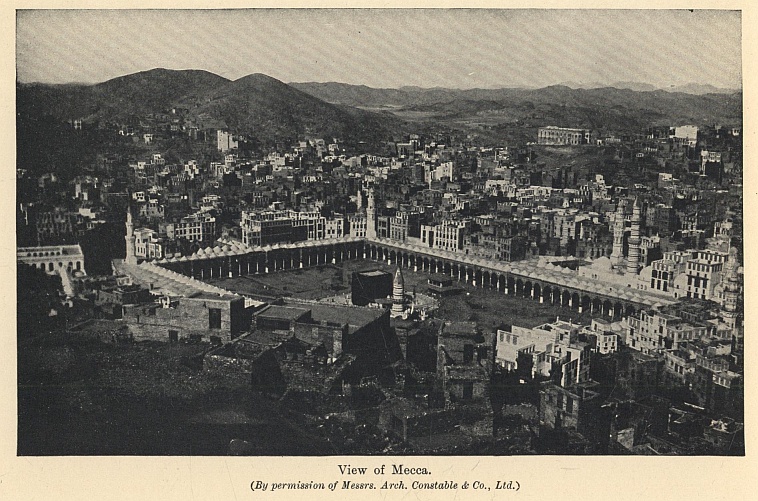
The time passed pleasantly in sight-seeing and giving and receiving hospitality. Mr. Wavell gave one dinner to no less than twelve guests, which, since he had an excellent cook, was very successful. There are few more curious incidents in the literature of travel than this party given by a disguised Christian in the Moslem holy of holies to a company which included Arabs from Bussorah and Mecca, two Persian merchants, and a Turkish officer from the Bagdad Corps. Most Western luxuries can be obtained in Mecca, including ice cream, which, according to Mr. Wavell, is a frozen mixture of tinned milk, dirty water, and cholera germs! Alcoholic liquor can also be got if you know where to go for it.
The great festival was now approaching. A white linen band was fastened round the black covering of the Kaaba, which remained there till the great day, when the covering was changed. A new covering is brought every year from Egypt, made of dull black silk and cotton, embroidered with the name of God on every square foot. It is prepared in Constantinople, and is said to cost £3,600. The main ceremony of the festival is as follows: On a certain fixed day all adults must leave the city before nightfall, and go to a village called Mina, some five miles to the north. They pass the night there, and go nine miles farther on the next morning to Mount Arafat, where they remain till sunset. They then return, and sleep at Nimrah, half-way between Arafat and Mina. The third day they must be back at Mina in the morning, go through the ceremony of throwing stones at the Three Devils, proceed to Mecca for other ceremonies, and return to Mina for the night. The fourth day is spent at Mina, and at noon on the fifth day they return to Mecca. The bath towels of the Ihram are now relinquished, and the pilgrim dons the best new clothes which he can afford. He is then entitled to the name of Hadji, and thereafter through life can wear a special headgear, such as a green turban.
The exodus from the city to Mina was a strange sight. The different holy carpets were escorted by regiments and brass bands, that of Egypt marching to the tune of the "Barren Rocks of Aden." Sherif Hussein was there on horseback, accompanied by a crowd of spearmen and a squadron of racing camels. The ride to Mina beggared description. "The best idea of what it is like," Mr. Wavell wrote, "will be gained by considering that at least half a million people are traversing these nine miles of road between sunrise and ten o'clock this day; that about half of them are mounted, and that many of them possess baggage animals as well. The roar of this great column is like a breaking sea, and the dust spreads for miles over the surrounding country. When, passing through the second defile, we came in sight of Arafat itself, the spectacle was stranger still. The hill was literally black with people, and tents were springing up around it, hundreds to the minute, in an ever-widening circle. As we approached, the dull murmur caused by thousands of people shouting the formula, 'Lebéka, lebéka, Allahooma lebéka,' which had long been audible, became so loud that it dominated every other sound. In the distance it sounded rather ominous, suggestive of some deep disturbance of great power, like the rumble of an earthquake."
The hygienic conditions of the exodus were of course abominable. Tanks and springs were soon fouled by people bathing in them, and the condition of the hill-side was filthy beyond description. Often some infectious disease like cholera decimates the pilgrims, but our travellers were fortunate in escaping it. They went through all the proper ceremonies, and stoned the Three Devils at Mina with gusto. The Three Devils are three stone pillars, and, in a mob of many thousands of bad shots, a good many pilgrims are bound to suffer. They bought a sheep to sacrifice, like the others, and a mess of offal and blood was soon added to the attractions of the countryside. They then went back to Mecca, kissed the Black Stone, had another square inch of hair shaved from their temples, and were free to put off the bath towels. Now was the moment for the new clothes. Abdul Wahid appeared in a bilious yellow garment brought from Damascus; Masaudi in an obsolete regimental mess waistcoat; while Mr. Wavell was chastely arrayed in white cloth robes, a black jubba, and a gold sash with a dagger.
Thus attired they set out again for Mina for the last ceremonies. In the night a thief got into their tent, and carried off Masaudi's new turban, £5 in gold, and various oddments, including a couple of pistols. In the morning they went to salute the Sherif, and when they had returned and were sitting in their tent, passed through the most dangerous moment of the adventure. The wall of the tent was down, as is usual in the heat of the day, and they were squatting on the carpet, when suddenly they heard an exclamation from Masaudi. Looking round, they saw, standing within a few feet of them and looking straight into the tent, three of the Mombasa Swahilis whom they had met at Medina. It scarcely seemed possible that they could miss seeing Masaudi, and if they did they would certainly come into the tent to greet him, when Mr. Wavell was bound to be recognized. The morning sun, however, was shining right in their eyes, so they saw nothing, and passed on. As soon as they had turned their backs Mr. Wavell and Masaudi ran out of the tent on the other side and mingled with the crowd. They returned to Mecca, to be congratulated by their friends on the successfully accomplished pilgrimage, and Mr. Wavell was free to go into the world as Hadji Ali bin Mohammed.
It was now their business to get out of Mecca as soon as possible, especially as money was running low. They paid the necessary farewell visits, hired the transport, and started, intending to do the journey in one day. They were, however, held up by a sentry on the road, and had to spend a cold and comfortless night in the open, and did not enter Jiddah till sunrise. At Jiddah they separated; Masaudi went to Mombasa, Abdul Wahid to Persia, and Mr. Wavell to Egypt.
In summing up the expedition, Mr. Wavell was disposed to attribute his success not to any histrionic gifts of his own, but to the ignorance of the inhabitants of the Holy Cities, and their lack of interest in the outside world, even the Islamic world. "There are so many different sects in Islam, and its adherents are found in so many different countries, that I seriously believe that if some one invented for himself a country and a language that did not exist at all, and journeyed thus to Mecca, no one there would know enough geography to find him out. Yet with all, they are quick enough in their way, and if some Mutowif would take the trouble to write a book on ethnography in its relation to the Islam of to-day, and classify the different races that come to Mecca, such a deception as I practised would become impossible." They did, as a matter of fact, excite a certain suspicion, and their two servants, though they were Persians and knew little Arabic, must have had their own views. The great assets of the travellers were their knowledge of Arabic and Moslem ceremonial, and the fact that Mr. Wavell took up his disguise long before he approached the Hedjaz. He considered that Medina was much the more dangerous place of the two, and that no traveller should go there who was not thoroughly at home in his oriental character.
Whatever may be said, the journey is one of extreme danger and delicacy, and demands not only great knowledge, but perpetual vigilance. It must be remembered that a European is all the time in the midst of a fanatical and devout people, and that the highest merit would be acquired by any one who might discover and denounce the unbeliever. In spite of every precaution there must be an enormous element of luck, and Mr. Wavell's conclusion is that his escape was due rather to a series of happy chances than to his own good management.
VIII THE EXPLORATION OF NEW GUINEA
THE EXPLORATION OF NEW GUINEA
(Map, p. 248.)
Almost every part of the globe has suffered some change in the past century. It may have altered its appearance by settlement and cultivation and the growth of cities; or, if it still remains a wilderness, there are routes of commerce through it which bring it to the knowledge of the world. But the great island of New Guinea is almost as little changed to-day by the advent of white adventurers as when, in the year 1527, Jorge de Meneses, the Portuguese Governor of the Spice Islands, first landed on its swampy shores. In 1545, eighteen years later, it received the name by which it is known to-day. The Portuguese Empire decayed, and during the seventeenth century the Dutch appeared. In the eighteenth century many famous voyagers, like Dampier, Carteret, and Captain Cook, touched the island, and in the last century the rapid opening up of the world by travellers and missionaries bore fruit even in those remote seas. The Dutch held the western end; in 1884 Germany laid claim to the north-eastern part; and that same year the south-eastern section, which had been formally taken over in 1883 by Queensland, was annexed to the British Crown. In 1899 the Dutch boundary was delimited, and Holland, with the assent of the Powers, assumed direct control of her share. The one change to-day in these arrangements is that the former German section is now administered under mandate by the Commonwealth of Australia.
The first decade of this century saw great exploring activity on the part of all three European masters. The Dutch especially did excellent work, and Dr. Lorentz was the first man to reach the snows of the inland mountains. But few of the secrets of the island—geographical, zoological, and botanical—have yet been unriddled. The place is so remote from Europe, its climate is so deadly, its inhabitants so treacherous, and its forests and swamps so impenetrable, that exploration there is in many ways a more desperate undertaking than anywhere else on the globe.
I have selected two expeditions as an example of what the pioneer must undergo. In 1910 the Ornithologists' Union sent out an expedition to investigate the New Guinea fauna and collect specimens. Captain Cecil Rawling, whose thirst for the unknown was unquenchable, accompanied it on the geographical side, and Mr. A. F. R. Wollaston as medical officer. There was no proper survey equipment, as the mission was primarily one of naturalists. Ten Gurkhas were enlisted from India, and the Dutch Government supplied a certain number of Javanese troops. Coolies also were recruited in Java, who turned out to be hopelessly unsuitable both in physique and character for any serious travel in the wilds. The majority were about sixteen years of age, and they appeared in the jungle decently dressed in black frock coats and bowler hats!
The part selected was the southern coast of the Dutch territory, and it was Captain Rawling's hope that they would be able to penetrate to that belt of snow mountains, at the head of the coastal rivers, running from the Nassau Range in the west to Wilhelmina Peak in the east, where Dr. Lorentz had been the pioneer. Obviously it was vital to find a river which would take them direct to the hills. But they had no previous information to go upon, and were compelled to select their stream at random. Had they gone farther east, and chosen the Utakwa, they would have found a current navigable for an ocean-going steamer for seventeen miles from its mouth, and for launches for many miles more—a river, moreover, running directly from the highest snows of Mount Carstensz. As it was, they hit upon a river called the Mimika, a small jungle-fed stream rising in the low foothills sixty miles to the west of Carstensz, and twenty miles or so short of the main range. The Mimika, too, was full of endless windings and liable to sudden and violent floodings. Hence it was of little use to the expedition in the way of transport. This was the more regrettable since transport was the essence of the problem. From the foothills of the mountains to the sea lies a belt of forest like a barbed-wire entanglement. This forest is so dense that the cutting of a road can only progress at the rate of 100 yards a day. It is swampy, and often, in flood-time, under water, and filled with every form of noxious insect life. Unless this nightmare land can be circumvented by the use of a broad river channel, it must take even a strong party many months before they reach the base of the hills.
This was what happened to Captain Rawling. On January 26, 1910, after a base camp had been established at Wakatimi, not far from the Mimika mouth, he set off to ascend the river. Here is his description of the country:—
"It is quite impossible for any one who has not visited these parts of New Guinea to realize the density of the forest growth. The vegetation, through which only the scantiest glimpses of the sky can be obtained, appears to form, as it were, two great horizontal strata. The first comprises the giant trees, whose topmost boughs are 150 feet or more above the ground; the other, the bushes, shrubs, and trees of lesser growth, which never attain a greater height than 30 to 40 feet. Such is the richness of the soil that not one square foot remains untenanted, and the never-ending struggle to reach upwards towards the longed-for light goes on silently and relentlessly. Creepers and parasites in endless variety cling to every stem, slowly but surely throttling their hosts. From tree to tree their tentacles stretch out, seizing on to the first projecting branch and limb, and forming such a close and tangled mass that the dead and dying giants of the forest are prevented from falling to the ground....
"The various devices recommended in the books of one's childhood, and, it may be added, in learned books as well, whereby the traveller is enabled to recover a lost trail or regain the right direction, are here of no avail. For instance, moss does not grow more on one side of a tree-trunk than on the other; trees do not lean away from the prevailing wind; nor is the position of the sun a guide, for it is seldom visible. In fact, the traveller has nothing to rely upon but the compass or a local guide, and even the latter is often at fault. Hopeless indeed does the outlook appear when the wanderer, hedged in by a wall of scrub and creeper which limits his vision to a distance of ten or twelve yards, realizes that he has lost his bearings; when the vastness of the forest seems to press upon him, and there is no sound to be heard but the drip, drip of the water-laden trees and the bubbling of the stinking bog underfoot. His only chance of escape is to find a stream, and follow it down till it joins a main river."
The first big episode was the discovery of the Pygmies who lived in the foothills, and were assiduously hunted by the forest tribes. The average height of these little men was 4 feet 7 inches, and Captain Rawling penetrated to their village in a clearing above the head waters of the Mimika. The Mimika source was reached, but led them nowhere, and they fared no better with another small stream to the west, called the Kapare. Then by accident a secret native path was discovered running eastward—a mere tunnel in the matted forest. By this route they were able to reach a parallel river, called the Tuaba, which was a tributary of the larger Kamura. From a village called Ibo as a centre, the expedition made various casts east and north, but found it impossible to get near the skirts of the hills.
Captain Rawling returned to the coast and made excursions along the eastern shore, but found no adjacent river mouth which promised better. By this time it was June, and the floods began with such vigour that practically the whole country between the mountains and the sea was under water. When the floods ebbed, a resolute attempt was made to push east from Ibo, and with a good deal of trouble another parallel stream was reached, called the Wataikwa. The party founded a camp there, and explored the upper waters of that stream. Travelling was extremely difficult, because the only decent road was the river bed, and this route was promptly made impossible by a new spate. The travellers had to face the fact that the farther they went eastward the greater became the labour of carrying supplies, for their base camp remained on the Mimika.
Still, an effort must be made unless the expedition was to admit failure. It was decided that the best plan was to try and cut a road through the forest to the next stream on the east, in the hope that it would lead them into the hills. This was done, and the Iwaka River was reached after much severe toil. They had entered a desperate country, strewn with moss-covered boulders and seamed with gullies covered with an impenetrable mass of timber. The density of this growth was unbelievable; through it no man could force a way unless with an axe in hand, and as most of the trees were of very hard wood—the stems varying from four to eight inches in diameter—and clothed from top to bottom with damp earth covered with moss, progress at times became impossible. An idea of the labour involved in the task of clearing a two-foot path through this forest may be judged by the fact that a stretch of five thousand yards required three weeks' constant work before a man could pass freely along. On one day two cutters achieved a length of two hundred and ten yards, and on another, when Captain Rawling was working by himself, all he could add was a piece of ninety yards in length. No wonder he asks, "Can this forest, with its horrible monotony and impregnability, be equalled by any other in the world?"
The Exploration of New Guinea
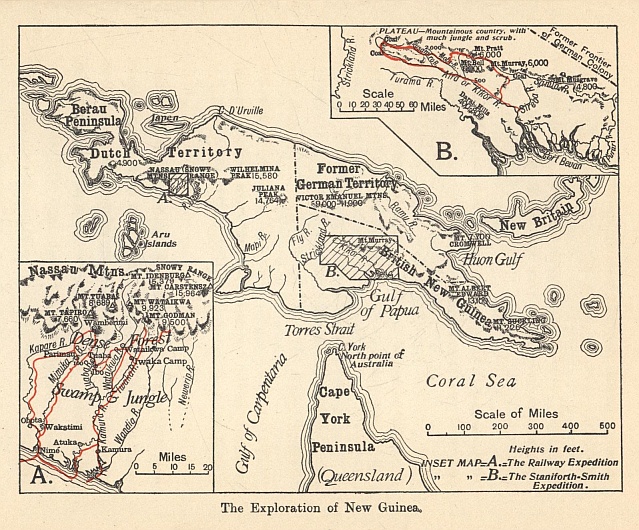
Down came the rain again, and in August the country was all under water. The advance was not renewed till the beginning of 1911, when fresh supplies had arrived from England, and the old motor-boat had been put in repair. So far, a year's hard labour had not taken the explorers within measurable distance of their goal. With the help of a launch, food supplies for eight weeks were stored at the head of the Mimika. One story may be quoted as a piece of comic relief in a very grim campaign. On 4th January two men quarrelled in camp and killed each other.
"The sergeant who, by the way, was a foreigner, took charge of the burial ceremonials, and was evidently quite determined that, for his part, nothing should be lacking which the importance of the occasion demanded. Drawing his sword, and placing himself between the graves, he harangued the spectators. 'Men,' he said, 'this day two servants of the Government have lost their lives at the hands of each other. Were they not both good men? hein.' 'One man very bad man,' chipped in an officious convict, but a glance from the offended sergeant made him wish that he had never spoken. 'Whether they will both go to heaven I cannot say,' exclaimed he, 'but I think Allah'—pointing upwards with his sword—'will first purge them with a fire. Take this as a lesson.' Then, drawing himself up to his full height as befitted the occasion, he returned his sword with a clank to the scabbard, and, as far as the public was concerned, the ceremony was at an end. The sergeant, however, had not yet finished. Returning to his hut, he refreshed himself with a few glasses of gin, and played on the mouth-organ the national anthems of the three flags under which he had served. This terminated the funeral obsequies, and with the exception of the official report and the entry in the accounts 'To one bottle gin for disinfecting corpse,' nothing remained to mark the sanguinary affair."
The Iwaka was safely reached, and the last stage began. At first the advance was up its right bank, but this only brought the travellers back to the upper glen of the Wataikwa, which they had already found impossible. It was clear that the Iwaka must be crossed and the ridges to the east ascended. Getting over that stream was an ugly business, and it was achieved only by the heroism of one of the Gurkhas, who managed to haul himself hand over hand along a thin rope. Captain Rawling records that it was "one of the best actions carried out in cold blood that I have ever had the good fortune to witness." A rough bridge was constructed, and on the morning of February 8, 1911, thirteen months after their first landing on the coast, the party had at last a road to the upper ridges. It was thick, misty weather, and of the farther mountains they only had occasional glimpses. Camp was pitched at an altitude of 5,400 feet, but not on solid ground, for all the climbing had been done on the top of live or dead timber. The following morning they hacked their way to a clear space on the ridge at a height of 5,600 feet, and there they were at last favoured with the view for which they had longed, and were able to fix the position of the main peaks.
Looking southward they saw the sea, and between it and them the dark green of the forest through which they had struggled for so many months. The gloom was broken at rare intervals by a streak of light, which was a river. Nearly five miles away stood Mount Godman, and beyond it the huge southern face of the range, a gigantic black cliff, eighty miles from east to west, with a clear drop of nearly a mile and three-quarters—by far the greatest precipice in the world. Behind this scarp rose the snow mountains—Mount Leonard Darwin, to the north-west, 13,882 feet; and to the north-east Mount Idenburg, 15,379 feet, and the glittering top of Carstensz, which is almost 16,000 feet. The great peaks seemed, below, a mass of wild, black precipices, cleft with fissures; but, above, a long, easy snow-field, curving gently to the summits. It was such a view as the old Portuguese adventurers might have had when, after struggling for months through the coastal jungles, they suddenly came in sight of Kenya or Kilimanjaro. But for Captain Rawling and his party it would be no more than a Pisgah-sight. Advance was impossible. The fatal choice of the Mimika route meant that they had taken the worst road conceivable to the great snows. The attainment of the peaks must be left to their successors. He who would understand the full difficulties and miseries of that expedition must read Captain Rawling's own narrative.*
Rarely has a more thoroughly comfortless expedition been undertaken. To begin with, the food was bad and unsuitable, for they had the surplus stores from Shackleton's Antarctic expedition, and the joys of bully-beef, pea-soup, and pickles under an equatorial sky may be imagined. It was impossible to get good local assistance, for the natives were a preposterous race, treacherous and unreliable when they were not actively malevolent. They were subject to sudden panics, when they fled to the jungle, and to wild outbursts of sorrow, when they would weep and sob for hours. The imported Javanese were, if possible, more hopeless. Then there was every kind of noxious insect—mosquitoes without end, gigantic leeches dangling from every leaf which made a speciality of attacking the eyeballs, ticks, stinking caterpillars, immense blue-bottles which swarmed in clouds over any food left uncovered, crickets which ate a man's clothes up in a night, and a plague of minute bees which settled in myriads on the heated face of the traveller. Above all, there was the rain. The whole country was water-logged by the flooding rivers and the incessant deluge. In the dry season the average rainfall was about two and a half inches a day! Mr. Wollaston took the trouble to keep a meteorological diary, and found that during the first year rain fell on 330 days, and that on 295 days it was accompanied by thunder and lightning. Of the 400 men of all races employed during the first year, 12 per cent. died in the country from hardships, and 83 per cent. of the total force was invalided from New Guinea. Of the Europeans and natives who landed during that year, only eleven lasted out the whole fifteen months of the expedition. Of these eleven, four were Europeans, four Gurkhas, two Javanese soldiers, and one a convict. When it is remembered that eight months is the maximum period allowed by the Dutch authorities for continued service in New Guinea, the marvel is that these eleven escaped with their lives. It was with no regret that Captain Rawling said farewell to what must be by far the most unpleasant land on earth. "Wild shrieks had greeted us on our first arrival in the country, and wild shrieks echoed down the still reach of the river as the boats crept towards the sea."
New Guinea Canoes. [It was in such canoes that Mr. Staniforth Smith made part of his journey.] (By permission of Messrs. Seeley, Service, & Co.)
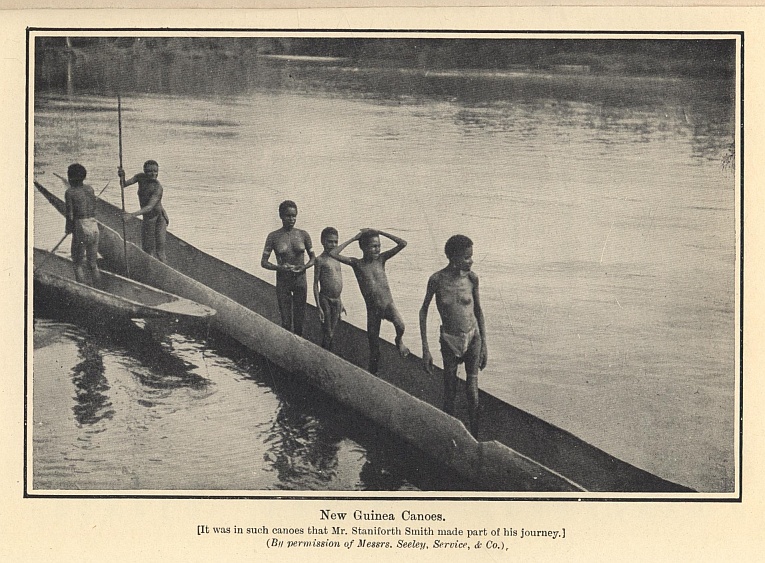
Mount Carstensz still awaits its conqueror. Since the Rawling expedition much has been done in the exploration of the central mountains. In 1913 Mount Wilhelmina (15,580 feet), of which Dr. Lorentz had trodden the lower snows, was finally ascended by Captain Herderschee. In 1921 Captain Kremer reached the same summit from the north, and found a means of crossing the range at a height of 13,480 feet. A German expedition under Dr. Moszkowski, which was projected in 1913 to attempt Carstensz from the north, was stopped by the war. Meantime, in September, 1912, Mr. Wollaston, Captain Rawling's companion, had returned to New Guinea and ascended the Utakwa River. Its head waters led him direct to Carstensz, and by establishing a series of depots for food in the foothills, he was able to reach the main massif of the mountain. Above 8,000 feet he left the jungles behind; but the mountain proved very difficult, and the rain, as usual, fell without intermission. At 14,200 feet he reached the snow-line, and on February 1, 1913, from a camp above 12,000 feet, he climbed to 14,866 feet, a thousand feet or so below the summit. There he was stopped by an ice fall, and lack of provisions and the weakness of his party prevented him from finding a way to turn it. The top of the mountain is an ice cap which breaks down very sheer on the south side, and Mr. Wollaston is of opinion that the easiest ascent would be from the north. This closes for the present the history of the exploration of Carstensz.
For the second story we move east into British territory. There the general configuration is the same—swamps near the shore, then a tangled forest, then a range of inland mountains, though these are much less conspicuous than the ranges in Dutch territory, and scarcely rise above 6,000 feet. In 1911 the Hon. Miles Staniforth Smith, who had been Mayor of Kalgoorlie, and a senator representing West Australia in the Commonwealth Parliament, and was at the time Administrator of Papua, set out across the centre of the unexplored part of his province to investigate the sources of the rivers emptying into the Papuan Gulf. As the travelling was of the roughest, and the aim was exploration rather than scientific research, the party was kept very small—three white men, Mr. Staniforth Smith, Mr. Bell, the Chief Inspector of Native Affairs, and Mr. Pratt, a Staff Surveyor, together with eleven native police and seventeen carriers. They started from the head of the navigable waters of the Kikor or Aird River, meaning to push north to the top of Mount Murray, and then traverse to the west along the ridge. Mount Murray, which is some 6,000 feet high, was safely reached, and the explorers found themselves moving along a high limestone plateau, much fissured by streams and diversified by parallel ranges. They hoped ultimately to reach the Strickland River, which is a tributary of the great Fly River, and so complete the rest of their journey by rafts.