PART I Transcript of the Depositions of Eye-Witnesses of the Crime, Taken from the Archives by M. George Gustav Telberg, Minister of Justice at Omsk
G. G. (Georgii Gustavovich) Tel'berg translation
DEPOSITIONS OF EYE-WITNESSES
I EXAMINATION OF M. GILLIARD
[M. Gilliard was attached to the imperial household in the capacity of French tutor to the grand duchesses and the czarevitch. He was with the family at Czarskoe-Selo at the outbreak of the revolution, and like most of the other members of the household, he elected to remain under arrest. M. Gilliard especially mentions the emperor’s love for his country and his bitterness of heart after the Treaty of Brest-Litovsk, and he insists that the attitude of the emperor and the empress towards Germany was one of hatred and contempt.
M. Gilliard’s deposition is important inasmuch as it includes a conversation which he had with Tchemodouroff in the latter part of August, 1918. Tchemodouroff then believed that the imperial family had not been murdered, but had been removed to an unknown destination. M. Gilliard did not, however, place much reliance in this statement. He describes his visit to Ipatieff’s house and relates a curious superstition of the empress, who seems to have placed credence in the efficacy of two Egyptian symbols as luck-bringers.—Editor’s Note.]
On March 5, 1919, the Investigating Magistrate for cases of special importance of the Omsk District Court, in conformity with Paragraph 443 of the Criminal Code Procedure, questioned the man named below in the capacity of a witness, notifying him that during the investigation he might be interrogated under oath.
Replying to the questions that were put to him, the witness gave his name as: Peter Andreievitch Gilliard, and said:
Since 1905 I have been giving French lessons to the daughters of his majesty. From 1912 I began to teach French to the Grand Duke Alexis. I started my instructions in Spala, but very shortly afterwards they were interrupted, as the grand duke met with an accident. I heard about it from other people who were attached to the emperor’s family. I heard that the Grand Duke Alexis, while swimming in a pool, fell and hurt his stomach. The result of this accident caused his foot to be temporarily paralysed. He was ill a very long time, consequently all studies were interrupted. They were, however, resumed in 1913, at the time when I became assistant tutor to the grand duke.
After that I moved to the palace, where I occupied the rooms next to the czarevitch. In 1913 we went to Crimea and later came to Czarskoe-Selo. In the spring of 1913 we went to Crimea, Constance and Finland. From Finland we returned to Peterhoff, in order to meet the President of France, M. Poincaré. It was in Peterhoff that the imperial family resided at the beginning of the war.
In 1915 we lived at Czarskoe-Selo up to the time when the emperor assumed supreme command of the army. During this time I often went with the czarevitch to the Stavka (general army headquarters), to the front, and generally to every place that the emperor took his son.
At the outbreak of the revolution the emperor was at the Stavka and his family lived in Czarskoe-Selo. The imperial family passed through many alarming moments during this period. All the children had the measles. At first the czarevitch got it and later all the grand duchesses in succession. Everybody was worried by the uncertainty of the situation and ignorance of the fate of the emperor. There was unrest amongst the Guards Rifles quartered in Czarskoe-Selo. One night was particularly alarming. Fortunately the commotion amongst the soldiers was calmed down by the officers.
The emperor’s abdication in behalf of the czarevitch was learned of by the imperial family from the general in command of the Svodny guard regiment. Later the Grand Duke Dmitry Pavlovitch came to the palace and officially announced to her majesty the news of the abdication of the emperor.
General Korniloff also came to the palace and informed the empress that she must consider herself under arrest. After General Korniloff’s arrival her majesty instructed me to say that everyone must leave the palace except those who would like to stay of their own free will, and who would consequently have to submit to the routine of those who were arrested. Nearly everybody elected to stay in the palace, and so did I. During this time the Grand Duchess Maria Nicholaevna was taken ill with inflammation of the lungs. After some time the emperor arrived at Czarskoe-Selo.
The restrictions imposed upon the imperial family consisted of a certain limitation of their freedom. The palace was surrounded by sentries. They were allowed to leave the palace to walk in the park only during a fixed time and always accompanied by a sentry. All the mail went through the hands of the commandant of the palace. Kotsebue was the first commandant. He was replaced by Korovitchenko and the latter was replaced by Kobylinsky who was formerly in command of the garrison.
Kerensky came to Czarskoe-Selo on several occasions. He visited us in the capacity of the head of the new government to observe the conditions of our life. His manners and attitude towards the emperor were cold and official. His behaviour towards him gave me the impression of the treatment of the accused by a judge who is convinced of his guilt. It looked as if Kerensky believed the emperor was guilty of something and therefore treated him coldly. Nevertheless, I must state that Kerensky was always perfectly correct in his manner. When addressing the emperor he called him His Majesty, Nicholas Alexandrovitch. At the same time I must say that during this period Kerensky, as well as everybody else, avoided calling the emperor by his name, as though it were embarrassing to them to address him as Nicholas Alexandrovitch.
On one occasion Kerensky arrived at the palace in the company of Korovitchenko and Kobylinsky and confiscated all the emperor’s private papers. It seemed to me that after Kerensky was through with those papers he understood that the emperor had done no wrong to his country and he immediately changed his attitude and manners towards him.
During the stay of the imperial family in Czarskoe-Selo several disagreeable incidents took place. The first was the confiscation of a toy rifle from the Czarevitch, which was done on the request of the soldiers. The second incident was the refusal of the soldiers to answer the emperor’s greeting. The emperor always addressed the soldiers with words of greeting. After the abdication the soldiers used to answer: “Sdrávstvouyte Gospodín Polkóvnik” (Good-day, Colonel). On one occasion, after being addressed by the emperor, the soldiers remained silent. It appears, however, that this took place not on account of their own decision but by orders of some assistant commandant of the palace, whose name I do not remember.
There were days when the imperial family had to wait a considerable time in the semicircular hall where everybody used to assemble before taking the walk in the park. It was always the guards who were late and who kept everybody else waiting.
However, all these incidents were mere trifles in comparison to the sufferings that were later inflicted on the imperial family.
In the middle of July it became known, I cannot tell how, that the emperor and imperial family had to change their residence from Czarskoe-Selo to some other place. At first it was rumoured that it was to be a voyage to the south, but later it transpired that we were to proceed to Tobolsk.
The reason that we had to move was due to the fears of the government for the safety of the imperial family. During this time the government intended to take a firm course in handling the affairs of the nation. At the same time it feared that such a policy would create some outburst amongst the population which would have to be checked by armed force. Thinking that in the course of the struggle we might also be injured, the government made up its mind to send the imperial family to a quieter place than the vicinity of Petrograd. All this I relate to you from the words of her majesty, who was informed through Kerensky, as to the decision of the government.
I remember that the following persons moved to Tobolsk with the imperial family: Prince Dolgoruky, M. Tatischeff, Dr. Botkin, Miss Schneider and myself. Later we were joined in Tobolsk by Derevenko, Mr. Gibbes and Baroness Buxhoevden, who volunteered to stay with the imperial family.
The imperial family was placed in Tobolsk in the house of the governor. I lived with the imperial family. All the other people were placed in a house belonging to M. Korniloff, opposite the governor’s house. The life in Tobolsk was very much as it had been in Czarskoe-Selo. The same restrictions were imposed.
Our guards were composed of soldiers who were formerly in the Czarskoe-Selo sharpshooter regiments. Kobylinsky was, as previously, the commandant of the house. We were accompanied during our journey to Tobolsk by representatives of the government, Makaroff and Vershinin (the latter being a member of the Duma). They spent a few days in Tobolsk and then departed. Their attitude towards the imperial family was quite correct, and even kindly disposed—this was particularly true of Makaroff, and especially so in his manner towards the children.
In the middle of October there arrived one Pankratoff, a commissar of the government, accompanied by his assistant, Nikolsky. They were to supervise our life and Kobylinsky was subordinate to them. These two men did not wilfully interfere with the welfare of the imperial family, but a great deal of harm was done by them unknowingly by their behaviour towards the guards and they demoralised the morale of the soldiers.
As far as we could judge, being prisoners, the inhabitants of Tobolsk were well disposed towards the imperial family. Now and then they sent us bon bons, cakes and various sweets. When they passed by the house and noticed any members of the imperial family, they bowed.
The Rifles, who composed our guards, were en masse rather benevolent. There were some good men among the soldiers, but some of them were very bad. Until the Bolshevist revolution the latter kept quiet.
The Bolsheviki brought misfortune to the imperial family as well as to the whole of Russia. The Bolshevist revolution immediately reflected on the minds of the soldiers and those that were bad and evilly disposed became rough in their ways.
On January 25th the soldiers turned out Pankratoff and Nikolsky and made up their minds to ask for a Bolshevik commissar from Moscow. The soldiers forbade the Baroness Buxhoevden to live in Korniloff’s house.
The worst came after the Brest-Litovsk treaty. The soldiers began to behave in a disgraceful manner. On one occasion the Czarevitch noticed on the board of the swing on which the Grand Duchesses liked to pass the time, some inscriptions. He did not have time to read them. When the emperor noticed them he asked Dolgoruky to remove the board. Vulgar, disgraceful, cynical and stupid words were cut on this board by soldiers’ bayonets.
The imperial family was forbidden by the soldiers to visit church. They were allowed to go to church only on Dvounadesiaty holidays (very important feast-days in the Orthodox religion). The soldiers insisted that the emperor should remove the shoulder straps from his uniform. Twice he refused, but finally, after Kobylinsky informed the emperor that his refusal might result in serious trouble for himself and his family, the emperor had to submit to this demand.
A little hill was made in the garden for the amusement of the children. Once the emperor and the empress viewed from the top of this small hill the departure of a large number of the soldiers (at that time many soldiers left on account of the demobilisation of the army); but afterward the remaining soldiers levelled the hill to the ground.
Things became worse and worse. It was especially severe after all sources of revenue were confiscated from the imperial family. This occurred on February 12th. That day a wire from Moscow was received. I can not tell you who sent it. In this wire a new order of life for the imperial family was prescribed. Up to this time the imperial family had been maintained by the government treasury. Their life was quite appropriate and fitting for them and ran along in the same way that the former emperor and his family had been accustomed to.
By the order of the Bolshevist authorities, lodging, heating and lighting were to be provided for the imperial family, everything else had to be obtained at the expense of the family or of those persons connected with them. We were also restricted in earning of money. I wanted to earn some by giving private lessons in the town, but the soldiers would not allow me to do so, and told me I was to leave the house altogether in the event that I could not adapt myself to conditions as they were.
By Bolshevist orders the imperial family could not spend for themselves and their servants more than four thousand, two hundred roubles per month. This state of affairs affected life very detrimentally. Coffee, butter and cream disappeared from the table. Scarcity of sugar was felt very seriously, as sugar was distributed in the quantity of half a pound per person for each month. Dinner consisted of two courses, and for those who were accustomed from the time of their birth to entirely different conditions of life, it was far more difficult to bear the situation than it was for those who were not familiar with the luxuries that the imperial family had always enjoyed.
The lack of resources and the necessity of economising made it impossible to continue to pay the church chorus for their singing during the divine services held at home. The church choristers volunteered to sing free of charge. After that a small fee was still paid to them.
The number of servants was considerably reduced and ten of their staff were discharged.
Finally the attitude of the soldiers became so menacing that Kobylinsky, after losing all hope of retaining or regaining control, declared to the emperor that he desired to resign from his present position. The emperor asked him to stay, and Kobylinsky yielded to his request.
In order to make life a little more cheerful, playlets were staged, in which the children took an active part. The emperor tried to find forgetfulness in physical labour. He sawed wood with Tatischeff and Dolgoruky, the daughters or myself. He also attended to the lessons of the czarevitch and personally instructed him in history and geography.
But all the efforts made by the emperor to conceal his feelings could not hide from any observant person his terrible sufferings. Especially after the Brest-Litovsk peace treaty a very marked change was noticed in him that indicated his mood and mental suffering. I could say that his majesty was affected by this treaty with an overwhelming grief.
During this time the emperor on several occasions spoke of politics to me—a thing he had never allowed himself to do before. It seemed as if his soul was yearning for the companionship of another soul, hoping by such companionship to find relief from the intensity of his grief. I could not relate everything he told me, but the central idea of his words and thoughts was that up to the moment of the Brest-Litovsk treaty he believed in the future prosperity of Russia—after that treaty he lost all faith.
During this time he criticised Kerensky and Goutchkoff in sharp terms, considering them to be the most guilty for the collapse of the army. The emperor thought that by their weakness and incapacity the army disintegrated, and the result was that it opened the way for the Germans to corrupt Russia. He regarded the Treaty of Brest-Litovsk as a disgrace and as treason on the part of Russia towards her Allies. He said: “And those who dared to accuse her majesty of treason have in the end turned out to be the real traitors.”
The emperor looked upon Lenin and Trotzky, the leaders of the Bolshevist movement, as German agents who had sold Russia for a large sum of money.
After the Brest-Litovsk treaty a profound disdain was felt by the emperor and empress towards the German government and Emperor Wilhelm. They both felt deeply that the German government and Emperor Wilhelm had lowered themselves by dealing with the Bolsheviki and by resorting to such outrageous methods of warfare.
Such was the tenor of our life during February and March. On March 30th a delegate, previously sent to Moscow by the committee of our soldiers, returned to Tobolsk. He brought a written order to Kobylinsky which stated that our life from this time on must be more severely supervised. We were all to live in the governor’s house and a new plenipotentiary commissar had been ordered to Tobolsk for the purpose of enforcing new restrictions. On April 9th this commissar arrived. His name was Iakovleff. On April 10th he came to our house for the first time and was received by the emperor. On the same day he visited the czarevitch who at that time was sick. He returned shortly after his departure with an assistant (whose name I do not remember). They both visited the czarevitch. On the same day Iakovleff was received by the empress. Iakovleff made quite a favourable impression on the emperor, who told me that he thought Iakovleff not so bad, and that he believed him to be quite straight.
The reason for Iakovleff’s arrival was quite a puzzle to us. This puzzle was solved on April 12th. On that date Iakovleff went to the emperor and announced that he had orders to take him away from Tobolsk. The emperor replied that he would not leave Tobolsk, as he could not be separated from his son who was so ill (the czarevitch during this period suffered from the same affliction he had in Spala in 1912, with the difference that this time the bruise involved paralysis of the right foot), and that he did not intend to leave his family. Iakovleff answered that he was merely fulfilling his instructions, and as the emperor refused to leave Tobolsk, a choice of two decisions had to be made: Either Iakovleff must refuse to obey the orders, in which case another commissar with fewer scruples would be sent; or he must employ force in imposing the order. At the same time Iakovleff told the emperor that he might be accompanied by any other persons he desired. The only thing that could be done was for the emperor to submit to Iakovleff’s demands. Everything that I have told in this connection I know from the words of her majesty.
Nobody knew where the emperor was to be taken. His majesty inquired of Iakovleff in advance, but the latter answered in a way that did not make the matter clear. Kobylinsky told us that Iakovleff at first informed him the destination was to be Moscow, but that he later said he did not know where the emperor was going to be taken.
All this sort of thing was intensely painful and humiliating for the imperial family, all of whom suffered most acutely. Her majesty was greatly tortured by having to decide whether to accompany the emperor or stay with the czarevitch.
She made up her mind that she would go with the emperor and it was decided that the Grand Duchess Maria Nicholaevna should accompany them. The rest of the family was to stay in Tobolsk until the recovery of the czarevitch.
Iakovleff fixed the time of departure for four o’clock in the morning of April 13th. The evening before we all had tea together. The emperor and empress wished us farewell and thanked us all for our services.
At three o’clock in the morning the carts arrived at the door. They were wretched looking vehicles with plated bodies and had no seats and no springs. One had to sit on the bottom, stretching out the feet. Only one telega (peasant cart) had a “capot” (hood). In this cart we decided to place her majesty. There was hardly anything on the bottom of the carriages. We went to the court yard where an employé by the name of Kirpitchnikoff kept his pigs. There was some straw in stock. This straw we used for covering the bottom of the cart that was supplied with a hood and, I think, we put some straw also on the bottoms of some other carts. In the covered cart we also put a mattress. The emperor desired to go with her majesty and Maria Nicholaevna. Iakovleff insisted that the emperor should ride in the same cart as he did. They all left on April 13th shortly after four o’clock in the morning.
At this time the following persons departed from Tobolsk: The emperor and empress, Grand Duchess Maria Nicholaevna, Botkin, Dolgoruky, Tchemodouroff, Sedneff and Demidova. They were accompanied by six Rifles men and two officers—Matveieff and Nabokoff, as well as by soldiers of Iakovleff’s detachment.
Some time after the departure one of the coachmen brought us a short note from Maria Nicholaevna. She said in her note that the conditions of travelling were extremely hard, that the road was bad and the carriage was awful.
Later Kobylinsky received a wire from Nabokoff announcing the arrival of the party at Tumen. Greatly to the surprise of everybody Kobylinsky suddenly received a telegram from Matveieff stating that the emperor and all the persons in his party were held up in Yekaterinburg. This was quite unexpected, as we all thought that the emperor was to be taken to Moscow.
On April 24th a letter came from the empress. She wrote that they had all been placed in two rooms of the Ipatieff house, that they felt very much crowded, and that the only place where they could walk was a small garden that was very dusty. She wrote also that all their belongings had been searched, even “medicines.” In the same letter in very discreet language she made us understand that we should take from Tobolsk all our precious things. As previously agreed, she used in her letter the word “medicines” instead of “jewels.” Later Tegleva received a letter from Demidova, undoubtedly written by order of her majesty. In this letter we were instructed how to deal with jewels, instead of which she used the expression “Sedneff’s belongings.”
On April 25th two officers, as well as five soldiers who escorted the emperor, returned to Tobolsk and told us the following story: Iakovleff took the emperor to Omsk. About one hundred versts before arriving at Omsk he took the train and proceeded to Omsk alone. After that he came back and turned the train towards Yekaterinburg. The commissars in Yekaterinburg held up the train. Dolgoruky was arrested and taken to prison directly from the station. All the officers and men were also put under arrest in some cellar, where they were kept for two days, and let free only on the third day and after some protest was made. The general idea to be gathered from their narrative was that the detention of the train and the party was unexpected by Iakovleff. They told us that he was hustling around all over the place, but was unable to accomplish anything. It was also told us that later, Iakovleff proceeded independently from Moscow and wired to Kobylinsky and Hohriakoff (the Chairman of the Tobolsk Soviet), that he resigned from his mission of commissar to the imperial family.
We started with the preparations for our trip. On April 25th the chairman of the local soviet, Hohriakoff, visited our house for the first time. After that he called on us frequently, urging us and hurrying our departure. I remember that on May 6th, the birthday of the emperor, the grand duchesses wanted to have divine service. Hohriakoff forbade it, saying that no time should be wasted. On May 7th, at eleven o’clock in the morning, we moved to the steamer Russ and about three or four o’clock that day departed from Tobolsk. We were escorted by a detachment commanded by Rodionoff, which was composed chiefly of Letts. Rodionoff did not behave well; he locked the cabin door, in which were the czarevitch and Nagorny. All the other cabins, including those of the Grand Duchesses, were locked also, by his order.
On May 9th we reached Tumen and the same day took a train. We arrived at Yekaterinburg on May 10th at two a. m. During the whole night we were switching from one station to another and being transferred from one track to another. Approximately at nine o’clock the train was stopped between two stations. It was muddy and there was a continuous drizzling rain. Five isvostchiks (cabs) were awaiting us at the station. Rodionoff, with some commissars, approached the car where the children were placed. The grand duchesses walked out of the car. Tatiana Nicholaevna carried in one hand her pet dog and in the other a hand bag, the latter with great difficulty, dragging it on the pavement. Nagorny wanted to help her, but was roughly pushed aside. I noticed that Nagorny went in the same cab as the czarevitch. I remember that in every one of the other cabs there was a commissar or some other Bolshevik agent. I wanted to leave the car and wish them good-bye, but I was held up by a sentry. I never thought at that moment that I was seeing all of them for the last time; and I did not even know that I was then already discharged from the service of the imperial family.
At last our train came into the station. About three hours later I saw Tatischeff, Hendrikova and Schneider being taken out of the train and escorted by soldiers. A little later Haritonoff, the little Sedneff, Volkoff and Troupp were also taken away. I had almost forgotten to say that the children were accompanied by Dr. Derevenko. In a little while Rodionoff came and announced to us that: we “were not wanted,” and that we were “free.” The Baroness Buxhoevden was then transferred to our car.
In about three days we received an order from the Soviet to leave the Perm district and return to Tobolsk. We could not fulfil the order as the way was cut off by the advancing Czechs, so we stayed in Yekaterinburg. During this time I visited the town and had a look at the Ipatieff house.
On the 14th or 15th of May I witnessed the following: I was walking on the streets of Yekaterinburg with Derevenko and Mr. Gibbes. While we were passing Ipatieff’s house we noticed that Sedneff was sitting in a cab surrounded by soldiers who carried rifles with fixed bayonets; in another cab Nagorny was seated. When the latter looked up he saw us and looked at us for quite a long time but did not make a single movement that could betray to the people surrounding him that he knew us.
The cabs, surrounded by horsemen, quickly drove to the centre of the town. We followed them as fast as we could and finally saw them disappearing in the direction of the prison.
Our party consisted of eighteen persons and we proceeded to Tumen. At Kamishlov the soviet did not allow us to go any further. We stayed there for ten days. It was dirty and the whole place was infected by disease. Finally we were attached to a train full of Serbs and we arrived at Tumen.
We suffered very severely, but at present I do not want to speak about my personal suffering.
In the latter part of August I was visited by Tchemodouroff. His first words were: “Thank God, the emperor, her majesty and the children are alive—all the others are killed.” He told me also that he was in the rooms of the Ipatieff house where “Botkin and others” were shot. He told me that he had seen the bodies of Sedneff and Nagorny, whom he recognised by their clothes and that their bodies were put in a coffin and buried. He told me that all the others were obliged to dress themselves in soldiers’ uniforms and had been taken away. It was difficult for me to understand Tchemodouroff, as he talked very wildly.
Tchemodouroff also told me that the life of the imperial family in Yekaterinburg was terrible, that all of them were very badly treated and that they had their meals together with the servants. The commandant, Avdeieff, had his meals also with the imperial family; he was often drunk and sometimes came into the room where the imperial family was without his tunic.
Tchemodouroff also told me that Avdeieff often behaved towards the emperor in an indecent and insulting manner. For example, during the meals, when he wanted to help himself from the dish, he stretched his hands before the emperor and her majesty and in doing so touched the emperor’s face with his elbow.
The grand duchesses after their arrival at Yekaterinburg slept on the floor. The Bolsheviki took away from her majesty a little bag which she used to hold in her hand, and also a gold chain that supported the holy images by the czarevitch’s bed.
After Tchemodouroff’s arrival Mr. Gibbes and myself went to Yekaterinburg for the purpose of giving assistance to Sergeeff, a member of the court. Tchemodouroff told us that Sergeeff was in charge of the investigation of the fate of the imperial family. Together with Sergeeff we visited the Ipatieff house and inspected the room that had the bullet holes on the wall and on the floor. In this house I found two “Egyptian signs” which the empress had the habit of drawing on various things for good luck. One of these signs I noticed on the wall paper of her majesty’s room, the other on the side of the window in a room where, under the Egyptian sign, the date was written in pencil: 17/30 April—the date of the arrival of her majesty in Yekaterinburg. My attention was also attracted to the stoves; they were all full of various burned articles. I recognised a considerable number of burned things such as tooth- and hair-brushes, pins and a number of small things bearing the initials: “A. F.” [Alexandra Feodorovna.]
I got the impression that if the imperial family had been taken away from Yekaterinburg, they must have been taken as they were, without any of their belongings. All the things they might have taken with them were burned. Nevertheless, at the time I left the house I could not believe that the imperial family had perished. It seemed to me that there was such a small number of bullet holes in the room I had inspected that everybody could not have been executed. When, a considerable time later, I returned from Yekaterinburg to Tumen, Volkoff called on me. I did not recognise him at first, as I had read in the newspapers that after the attempt on the life of Lenin, Hendrikova, Schneider and Volkoff were shot.
Volkoff told me that he was taken directly from the train and put in the Yekaterinburg prison. From this prison he, Hendrikova and Schneider were transferred to a prison at Perm. Tatischeff was also in prison in Yekaterinburg. He was once taken out of prison but was never put back. I could hardly understand from Volkoff’s words what happened to Tatischeff. Volkoff told me that he had seen in Tatischeff’s hands a written Bolshevik order commanding him to leave the Perm district. In the prison Volkoff was put in the same cell with the valet of the Grand Duke Michael Alexandrovitch. The valet said that when the grand duke resided in Perm, four armed men called on him late at night. One of them aimed his pistol at the valet and ordered him to stand still. The others told the grand duke that he had to follow them. The grand duke refused to obey their orders unless he were asked to do so by a member of the soviet personally known to him. In reply one of the armed men went up to the grand duke, took him by the collar and grumbled: “Here is one more of the Romanoffs.”
On one occasion Volkoff, Hendrikova, Schneider and some other people were taken out of prison to the woods. Volkoff understood they were all going to be shot, so he started running. After he got out of danger and stopped, he heard the sounds of volleys from the place where the others had been left. He believes that Hendrikova and the rest were murdered. He thinks that the Bolsheviki considered him dead, because they were firing at him when he was running, and when he accidentally fell, he heard a voice say: “He’s done for.”
About the fate of the Grand Duke Michael, Volkoff related the following: The grand duke had to submit to force and followed the armed men. One of these men remained with the valet to prevent him from calling for help. When this man left the valet ran to the soviet and told everything that had happened. A tumult started in the soviet, but nevertheless, the members of the soviet were in no hurry to start a pursuit. About an hour later they began looking for the grand duke. It was very hard to get any definite information from Volkoff about the fate of the Grand Duke Michael.
I recall another detail of Volkoff’s narrative: When the grand duke followed the strangers the valet said to him: “Your highness, don’t forget to take your medicine from the stove shelf.”
I have nothing more to declare. My statement has been read to me and it is correctly written.
(Signed) Gilliard, “ N. Sokoloff.
II EXAMINATION OF MR. GIBBES
[The deposition of Mr. Gibbes should prove interesting to the public as being that of an Englishman who was wholly and unselfishly devoted to the imperial family. Sidney Gibbes acted as tutor to the czarevitch, and after the arrest of the emperor and his family, he followed them to Tobolsk without a thought for his own safety.
Mr. Gibbes knew the emperor and the empress intimately during these days of sorrow, and his deposition shows that the czar was genuinely affected by the Treaty of Brest-Litovsk and the subsequent Red ruin of Russia. These recollections are absolutely unbiased, and there is no reason to doubt their accuracy.—Editor’s Note.]
On July 1, 1919, the Investigating Magistrate for Cases of Special Importance of the Omsk Tribunal, N. A. Sokoloff, questioned in Yekaterinburg the man named below in conformity with Paragraph 443 of the Code of Criminal Procedure, in the capacity of a witness, and the witness stated, in reply to questions:
My name is Sidney Ivanovitch Gibbes. Up to the year 1916 I was a visiting teacher of the English language to the grand duchesses and the czarevitch. I started my lessons with the Grand Duchesses Olga Nicholaevna, Tatiana Nicholaevna and Maria Nicholaevna in 1908. When Anastasia grew up I began to give her lessons also. I started to give instructions to the czarevitch in 1914. In 1916 I was appointed tutor to the czarevitch. The same year I moved to the Yekaterinensky Palace. In 1917 the duties of tutor to the czarevitch were performed partly by myself and partly by Gilliard.
During the early part of the revolution the imperial family resided in Czarskoe-Selo. The empress and all the children were there. The emperor was at the Stavka. At the beginning of the revolution all the children were taken ill with the measles. The first to be attacked by that disease was the czarevitch and after him, all the daughters in succession.
Personally I did not observe how the news of the revolution was taken by the empress. I heard from someone who was near to her that she wept. As far as I know the empress, my conviction is that she did not expect the revolution. It seemed to me that the empress thought that only a few concessions ought to have been made. The revolution was a blow to her and therefore she suffered, but being a firm character she did not cry very much.
The empress and the imperial family were arrested by General Korniloff. I was not present at the palace during the time of the arrest. I can not tell how it happened. I know that Korniloff was received by her majesty and that he announced to her that she was under arrest. The empress told me about that. She did not give me any details; she just related all that in a general way and, at the same time, added that she was very cold towards Korniloff and did not give him her hand. After Komiloff’s announcement of the arrest I was not allowed into the palace. My request for admittance met with a negative response. The provisional government would not allow me to stay with the imperial family. I remember this fact distinctly. I saw the letter which stated so. It bore the signature of five ministers. At the present time I do not remember their names, but I have it plainly in my memory that there were the signatures of five ministers. It was stated in my application that I was giving lessons to the children. I can not tell whether the answer also carried the signature of the minister of public education. Being an Englishman I considered all this very funny.
Such is the reason why I was not allowed to be with the imperial family during the time of their stay in Czarskoe-Selo, and consequently, I did not see anything of their life during that period of time.
Later I heard in Tobolsk that some soldiers and officers in Czarskoe-Selo behaved roughly towards the imperial family. The emperor himself told me in Tobolsk that on one occasion an officer refused to shake hands with him, explaining to him that he was on duty, and, therefore, had no right to shake hands. The emperor also spoke to me a little about Kerensky. He said that Kerensky was very nervous when he spoke with him. In fact, once he was so nervous that he grabbed an ivory knife from the wall and nervously began bending it so badly that the emperor was afraid he would break the knife, and so he took it away from him. The emperor also told me that Kerensky believed that he (the emperor) wanted to make a separate peace with Germany. The emperor denied that this was so. Kerensky insisted, and got nervous. I can not tell whether the private papers of the emperor were searched by Kerensky or not; but the emperor told me that Kerensky believed he had some papers that indicated his desire of making peace with Germany. I knew the emperor well and I understood the feeling of disdain he had towards Kerensky, when he spoke to me on those subjects.
Kerensky was very nervous the day of the departure of the imperial family from Czarskoe-Selo. During the night he telephoned to the minister of communication, insisting upon his coming at once to Czarskoe-Selo. The minister of communication was in bed at this time, but that fact did not deter Kerensky.
I can not tell anything else about the life of the imperial family in Czarskoe-Selo. I was devoted to the family and I wanted to be near them. I went to Tobolsk of my own free will. I arrived in Tobolsk in the beginning of October. From Tumen I travelled with Klavdia Michaelovna Bitner.
For two days I lived in Korniloff’s house. On the third day, at one p.m. I was called by the emperor. He received me in his workroom. The empress and the czarevitch were also present. I was very glad to see them and they were very glad to see me. At this time the empress began to realise that not all the people who had been devoted to her were unfaithful.
Our stay in Tobolsk was altogether very agreeable. I did not see anything very objectionable in the conditions of our life. Certainly there were some disadvantages as compared to what it had previously been; there were lots of trifles that created friction, but one could get used to them.
We all used to work very hard. The empress was teaching theology to the children (all the children took lessons except Olga Nicholaevna who had completed her course of studies in 1914). She also taught a little German to Tatiana Nicholaevna. The emperor personally gave lessons in history to the czarevitch. Klavdia Michaelovna Bitner was giving instruction in mathematics and the Russian language to the Grand Duchesses Maria, Anastasia and the czarevitch. Hendrikova gave lessons in history to Tatiana Nicholaevna. I was instructor in English.
The lessons started at nine a. m. and continued up to eleven o’clock. From eleven till twelve o’clock the children were free to take a walk. Studies were resumed at twelve and continued for an hour. At one p. m. lunch was served, and after that coffee was drunk. According to the doctor’s advice the czarevitch had to rest a little on the sofa after lunch. During his rest Gilliard or myself used to read to him aloud. After that Nagorny dressed the czarevitch and we went out for a walk till about four or five o’clock. After we returned the emperor gave a lesson in history to the czarevitch. After the lesson the czarevitch liked very much to play a game called: “The slower you ride the farther you go.” We divided into two parties: The czarevitch, Gilliard or myself were one party; Dolgoruky and Schneider the other. The czarevitch used to be extremely fond of that game. Schneider also used to put her heart into the game and fussed a little with Dolgoruky over it. This was quite funny. We played the game nearly every day and Schneider always used to say that she would never play the game again.
From six to seven p. m. the czarevitch took lessons with me or with Gilliard. From seven to eight p. m. he prepared his lessons for the next day. Dinner was served at eight p. m. After dinner the family assembled upstairs. Sometimes we played cards. I played double patience with Schneider. Tatischeff, Olga Nicholaevna, Botkin, Schneider, Gilliard and Dolgoruky played bridge. The children and the emperor occasionally played bézique. At times the emperor read aloud.
Sometimes the Grand Duchesses Olga, Maria, and Anastasia would go up to Demidova’s room where Toutelberg, Ersberg and Tegleva had their meals. Occasionally Gilliard, Dolgoruky, the czarevitch or myself used to accompany them. We stayed some time in this room and had plenty of jokes and laughter.
The emperor got up early. At nine a. m. he always had tea in his workroom and read till eleven a. m. He then had a walk in the garden and during the walk always took some physical exercise. In Tobolsk he frequently used to saw logs. With some assistance the emperor built up a platform on the roof of the orangery. A staircase which was constructed by our combined efforts led to the platform. The emperor liked very much to sit on this platform when the weather was stormy. Up till noon the emperor took his exercises, after which he always used to go to his daughters’ room where sandwiches were served. Later he retired to his quarters and worked till lunch time. After lunch the emperor took a walk or worked in the garden till dusk. At five p. m. the family had tea, after which the emperor used to read till supper time.
The empress got up at different times, sometimes much later than others. Sometimes she was ready with everybody else, but she was never seen by strangers in the morning. There were times when the empress came out only for lunch. In the morning she occupied herself with her children or worked at something. She preferred fancy work: embroidery or painting. When there was nobody in the house, and she was left all by herself, she played the piano.
The lunch and dinner were good. At lunch we used to have soup, fish, meat and dessert. Coffee was served upstairs. The dinner was similar to the lunch, with the difference that some fruits were served.
If the empress was present at dinner we used to sit in the following order: The emperor in the middle of the table; opposite him, the empress. To the right of the emperor, Hendrikova, and next to her the Grand Duchess Maria. To the left of the emperor, Schneider and Dolgoruky. To the empress’s right, the czarevitch; to her left, Tatischeff and the Grand Duchess Tatiana. Gilliard was seated at the end of the table and opposite to him were the Grand Duchess Anastasia and myself. If the empress dined upstairs her place was taken by the Grand Duchess Olga.
Botkin always dined with the imperial family, but had his lunch with his own family. He was seated with the Grand Duchess Olga and the czarevitch. Sometimes on holy days Dr. Derevenko and his son Kolia were invited to dinner. Dinner was cooked by Haritonoff. The food was good and there was plenty of everything.
Besides dinner and lunch, tea was served twice daily. In the morning the emperor had tea with the Grand Duchess Olga in his workroom. Tea in the evening was always served in the emperor’s workroom and only the family was present.
At the time of my arrival in Tobolsk two commissars, Pankratoff and Nikolsky, stayed there. Pankratoff was not a bad sort of a fellow, but showed weakness, and was influenced by Nikolsky. Pankratoff did not cause us any uneasiness. The emperor used to talk to him and Pankratoff told him many interesting things about Siberia, where he used to live in exile. The emperor spoke in a rather sarcastic way about Pankratoff calling him, “the little man”—he was rather small in stature. Nikolsky was rough and the family did not like him. I do not remember if Nikolsky ever made us feel uncomfortable or if ever the czarevitch cried on account of his rudeness. During the Bolshevik period no commissars were allowed in our house. It seems to me that some commissars arrived in Tobolsk, but were not recognised by the soldiers. The first commissar that ever entered the house was Iakovleff.
The Bolshevist revolution at first paid no attention to us and it looked as if we were completely forgotten. However, finally the Bolsheviki remembered us, and our money allowance was stopped short. We were given a soldier’s ration and were ordered to limit our necessities to 150 roubles per week. Several servants were discharged, and we began to get very inferior food. Only two courses were served—soup and meat.
I did not speak to the emperor about the Brest-Litovsk Treaty but I noticed that the emperor suffered greatly after the Bolshevist revolution. The emperor abdicated because he thought it would be better for Russia. It turned out to be worse. He did not expect that and suffered dreadful remorse. After we received the news that the state of affairs in Russia was very bad, I twice saw the emperor looking very much upset, remaining silent for a long time. His personal situation did not grieve him and he endured it without repining.
Iakovleff arrived in Tobolsk in the beginning of April, at the time when the czarevitch was sick. I was sitting by the czarevitch’s bed. The emperor, accompanied by Iakovleff and another man, who seemed to be his assistant, entered the room. Iakovleff looked at the czarevitch. The emperor said: “My son and his tutor.”
Iakovleff did not appear to me to be a man of culture. He looked more like a clever sailor. I do not remember the appearance of the other man. Iakovleff gazed attentively at the czarevitch, after which they departed. Later the emperor and Iakovleff returned to the room, but without the third man. They looked at the czarevitch and kept silent. A few days later I was again in the czarevitch’s bedroom. He was very ill and suffered greatly. The empress promised to see him after lunch. He waited and waited, but no one came. All the time he called: “Mamma, mamma.” I went out of the room and looked down the hall. I noticed the emperor, the empress and Iakovleff standing in the middle of the hall. I did not hear what they were talking about. I returned to the czarevitch’s room. He began to cry and asked: “Where is Mamma?” Once more I left the room. Somebody told me that the empress was anxious about something and this was the reason why she had not come to see the czarevitch. I was told that she was alarmed because the emperor had to be taken away from Tobolsk. I returned to the room. Between four and five o’clock the empress came. She was quite calm, but her face showed traces of tears. Being afraid to disturb the czarevitch she began to tell me in an undertone that the emperor must leave Tobolsk, and that she and the Grand Duchess Maria were to go with him, and that as soon as the czarevitch was well the others would all follow them. The czarevitch overheard her but did not ask her to tell us where we were going, and wishing to avoid embarrassment, I did not ask her either. Soon after that I left the room. I thought that during the time they were preparing themselves for the journey, they probably would not like anyone to be present. They dined alone upstairs.
In the evening we were all invited to the empress’s boudoir (the green room), where the tea was served. Conversation ran on travelling. We spoke mostly of luggage. At two o’clock the coaches arrived, one of them had a hood. I wished them good-bye in the lobby. The emperor took a place with Iakovleff, the empress with the Grand Duchess Maria, and they departed. They were accompanied by Botkin, Tchemodouroff, Dolgoruky, Demidova and Sedneff. We did not know the place of their destination. Not one of us had any idea that they were to be taken to Yekaterinburg. We all thought they were going to Moscow or to the east. The children were of the same opinion. We were all very anxious. We did not know what was going to happen to them. Of the persons left behind Tatischeff was the senior; and of the remaining part of the imperial family, Tatiana was considered senior in the place of the Grand Duchess Olga.
The czarevitch was gradually recovering, though very slowly. The first news we received was brought by an isvostchik who drove one of the coaches used by the family.
We heard that the family reached Tumen safely. Later, somebody sent a wire that they were “held up” at Yekaterinburg. We were badly stricken by this news.
Iakovleff told us nothing of Yekaterinburg and I heard someone saying that Iakovleff himself was sent from Moscow and not from Yekaterinburg, and I don’t think there is any doubt about this.
Some time after that Hohriakoff came to our house. It turned out that previously to that time this man had spent quite a considerable time in Tobolsk, but we had never seen him in the house before. It was thought that he was sent by Iakovleff. When he came he wanted to see the czarevitch. Possibly he did not believe in his illness as, after he left him, he immediately returned expecting that the czarevitch would get right up. About three days before our departure our guards were replaced by a detachment of Reds. This detachment was under the command of a certain Rodionoff. This man did not make a very bad impression on me. We were all very much interested in him. Tatischeff had known him before, but could not remember who he was nor where he had seen him. Hendrikova also knew him. Tatischeff thought he had seen Rodionoff in Berlin; and Hendrikova believed she had seen him in Verjbolovo. Tatischeff was formerly attached to the Emperor Wilhelm, and he thought he had seen Rodionoff in the Russian Embassy in Berlin. Tatischeff asked him what he did before. Rodionoff, not wishing to give a reply, answered: “I have forgotten.” We were very much interested in all that. When speaking about Rodionoff, Tatischeff used good-naturedly the expression: “My acquaintance.” Personally, I remember the following: In 1916 I was in Petrograd, where I visited an acquaintance of mine by the name of Ditveiler. I believe he was a Jew and a Russian subject. He used to work in a rope concern. During our conversation I asked him where he had been. He answered that he spent his time with so and so (I have forgotten the name at present). I asked Ditveiler who the man was and Ditveiler answered: “Probably a German spy,” and he added that an officer by the name of Rodionoff was present at one of their meetings.
Rodionoff did not allow us to lock the doors of our bedrooms at night.
We left for Tumen on a steamer. A few days before our departure Hohriakoff told us that he did not know whether we were going to be allowed to stay in the house which was occupied by the emperor, the empress and the Grand Duchess Maria in Yekaterinburg or not. Rodionoff told us that from now on things were going to be much worse for us than they had been. In Tumen the children, Hendrikova, Schneider, Tatischeff, Buxheovden, Nagorny and Volkoff were placed in a passenger wagon, the rest of us were placed in a box car (Teploushka). We arrived at Yekaterinburg during the night of May 9th. It was cold. The whole night we were moving and changing tracks. At seven a.m. our cars were taken out of town. Some isvostchiks were waiting, and I watched through the window the departure of the children. I was not allowed to wish them good-bye. At ten o’clock we were moved to a station platform and Tatischeff and Schneider were taken out of the train. I can not tell anything about Hendrikova. After that Rodionoff came and announced that little Sedneff and Troupp must proceed to the house. Later Nagorny came and took with him some of the luggage as well as the children’s beds. The beds were all alike, made of nickeled iron, similar to the bed the Emperor Alexander II had used during the Turkish war. The beds were comfortable and not heavy. After Nagorny’s departure, Rodionoff said to us: “You are free and you can go wherever you like.”
I stayed in Yekaterinburg. Two or three days later I was walking with Derevenko and Gilliard on the Vosnesensky Prospect and suddenly noticed that Nagorny and Sedneff, surrounded by soldiers, were leaving Ipatieff’s house, on two isvotschiks. We followed them and saw that they were taken to prison.
A considerable amount of time elapsed when the former Prime Minister Prince George Eugenievitch Lvoff, who was in prison in Yekaterinburg together with Nagorny, told me that Nagorny often had disputes with the Bolsheviki on account of their bad treatment of the czarevitch. The Bolsheviki left for the czarevitch only one pair of boots. Nagorny insisted upon two pairs of shoes being left, telling the Bolsheviki that the boy was of delicate health and, in case he got his feet wet, he would very badly need another pair of shoes. Some time later the Bolsheviki took from the czarevitch a long gold chain which supported the holy images which hung by his bed. Nagorny had several arguments with the Bolsheviki: “So finally I understood why he was shot,” added Prince Lvoff.
After the Bolsheviki left Yekaterinburg I met Tchemodouroff, who came to see me. His words were: “Thank God, the children are saved.” I understood him badly. In the course of his conversation he suddenly asked me: “Do you think they are saved?” About ten days before his death he sent me a letter asking if there was any hope of their being alive.
Tchemodouroff told me that the conditions of their life in Yekaterinburg were bad. For example: at Easter they had cakes. The commissar came and cut himself big lumps. In general he spoke about rough treatment, but it was very hard for me to understand him. He told me that the grand duchesses had no beds.
I have visited Ipatieff’s house but found nothing out of the ordinary. The house was battered. The stoves were full of burned objects, and I saw many remainders of burned objects, such as portrait frames, all sorts of brushes and a little basket in which the czarevitch used to keep his brushes. A few things were just scattered around, but I did not see much of their personal belongings.
The emperor used to wear uniform trousers and high boots, which had been often patched, and a soldier’s shirt. The czarevitch wore khaki trousers, high boots and a soldier’s shirt.
In regard to the rubies you have shown me, I can state that the imperial family had quite a number of them in their various articles of jewelry. The Grand Duchess Olga had a brooch with similar rubies, which was given to her by Queen Victoria.
The sapphires looked very much like fragments of the stone that the emperor had in his ring. It was shaped the same way, and I think there is a complete resemblance between them. The emperor wore the ring on the same finger with his wedding ring, and he told me that he could not take it off.
My personal impressions of the imperial family are as follows:
The Grand Duchess Olga Nicholaevna was about twenty-three years old, she was fair and had the lightest hair in the family. After her illness she got much thinner. She had beautiful blue eyes. All her personality was seen in her eyes. She was straight, just, honest, simple, sincere and kind. She was easily irritated and her manners were a little harsh. She was a good musician. She had a talent for music. She composed, though I do not think she wrote poetry. I believe that Hendrikova wrote some poetry, as she was well able to do. The Grand Duchess Olga was very modest. She liked simplicity and did not pay much attention to dress. Her morals reminded me of those of her father. She was very religious and it seems to me that she loved her father more than anybody else.
The Grand Duchess Tatiana Nicholaevna was very thin. You could hardly imagine anybody as thin as she was. She was twenty-one years of age, was tall, darker than the rest of the family, and elegant. The colour of her eyes was dark grey. Her eyes made her look different from all of her sisters, who showed their souls through their eyes. She was reserved, haughty, and not open hearted, but she was the most positive. She was also religious, but the motive back of her religion was: “It is my duty,” while Olga Nicholaevna had it in her heart. She was always preoccupied and pensive and it was impossible to guess her thoughts. She played the piano and played it better than anyone else in the family. However, she had only a better technique and did not show feeling in her music. She painted and embroidered well. She was her mother’s favourite and the one in whom, of all the daughters, she confided the most. If any favours were to be obtained they had to be gotten through Tatiana Nicholaevna.
The Grand Duchess Maria Nicholaevna was a young woman of broad build. She was very strong; for example, she could lift me up from the ground. She had lighter hair than Tatiana, but darker than Olga. (Olga Nicholaevna had brown hair, of a golden shade, and Maria Nicholaevna had brown hair with a light shade.) She had very nice, light grey eyes. She was very good looking, but got too thin after her illness. She had a great talent for painting and always liked to exercise it. She played the piano indifferently and was not as capable as Olga or Tatiana. She was modest and simple and probably had the qualities of a good wife and mother. She was fond of children and was inclined to be lazy. She liked Tobolsk and told me that she would be quite happy to stay there. It is quite difficult for me to tell you whom she preferred—her father or her mother.
The Grand Duchess Anastasia Nicholaevna was sixteen or seventeen years old; she was short, stout and was, in my opinion, the only one in the family that appeared to be ungraceful. Her hair was of a lighter color than that of Maria Nicholaevna. It was not wavy and soft, but lay flat on the forehead. Her eyes were grey and beautiful, her nose straight. If she had grown and got slim she would have been the prettiest in the family. She was refined and very witty. She had the talents of a comic actor, she made everybody laugh, but never laughed herself. It appeared as if her development had stopped and, therefore, her capacity faded a little. She played the piano and painted, but was only in the stage of studying both.
The czarevitch, Alexis Nicholaevitch, was not healthy. He was tall for his age and very thin. He suffered much in his childhood. He was sick with a disease inherited from his mother’s family. He grew worse in Tobolsk, as there it was very difficult to obtain means to effect a cure. He had a kind heart and was very fond of animals. He could be influenced only by his feelings, and would not yield to authority. He submitted only to the emperor. He was a clever boy but was not fond of books. His mother loved him passionately. She tried, but could not be strict with him, and most of his desires were obtained through his mother. Disagreeable things he bore silently and without grumbling. He was kind-hearted and during the last period of his life he was the only one who liked to give things away. In Tobolsk he had some odd fancies—for example, he collected old nails, saying: “They may be useful.”
The grand duchesses spoke English and French well, but German badly. Alexis Nicholaevitch did not speak German at all—he never had German lessons. His father spoke Russian to him, his mother English or French.
The empress formerly used to be very good looking and graceful, though her feet were large. I was quite surprised when I saw her in Tobolsk. She looked much older and had many grey hairs. She had wonderful, soft, grey eyes. She was clever, but seemed cleverer to the people who knew her least. She was not haughty in the ordinary meaning of the word, but she always realised and did not for one moment forget her position in life. She always looked queenly. I never had a feeling of uneasiness when I was in her presence. I liked very much to be with her. She was kind-hearted and liked to perform kind deeds. She always had something in sight when she worked. She was extremely fond of house secrets, for example: to prepare a present for somebody and keep it a secret until it was ready. I felt a German in her. She was more economical than an English woman, She loved Russia and considered herself Russian. The thing she dreaded most was losing Russia. Though during the reign of the emperor she was a number of times in Germany I never heard a single word from her about the Emperor Wilhelm. She was sincerely religious in the Orthodox way and was a true believer in God. She was most devoted to her family and religion entered into her feelings immediately after the family.
Her feeling of religion was quite normal and was not a product of hysteria. She had a stronger and more aggressive character than the emperor, but she had such a deep feeling of love for the emperor that when she knew beforehand his opinion she always submitted. I never witnessed a single quarrel between them. It was quite obvious that she was very much opposed to his abdication, but she never reproached him. This was very clear to all the persons who were near them. And nobody could ever think of her being untrue to the emperor. They were an ideal couple and never separated. My opinion is that it would be hard to meet, especially in Russia, such a devoted pair who missed each other so much when they were parted. That is the reason why the emperor took Alexis Nicholaevitch with him so frequently on his trips. I suppose the latter in a way served as a substitute for the rest of his family.
The emperor was very well educated. He spoke (and wrote) English and French to perfection. I could not judge of his knowledge of German. He was very orderly and did not like to have any one touch his things. He had an exceptionally good memory. He did not care much for light reading. He read a great deal on social sciences and studied history. He gave the impression of an extremely honest character. He was very kind and had a compassionate heart. He was modest but reserved, and hated any sort of familiarity. His disposition was gay and he was fond of games. He was fond of conversation and sometimes had a chat with the soldiers in the guardroom. He loved his country devotedly and suffered for it greatly during the revolution. After the Bolshevik revolution it was felt that his sufferings were not due to his situation but that he suffered for Russia.
The emperor was a good hunter and was fond of hunting, though I could not tell which forms of it he preferred.
In regard to their attitude towards each other, this was an ideal family, very rarely met with. They did not need the presence of other people.
Of the aides-de-camp, the most closely attached to the family were Dimitry Pavlovitch (Grand Duke Dimitry), Mordvinoff and Sabline. The nearest to the empress was Anna Alexandrovna Viroubova.
With regard to Rasputin, it seems to me that the empress believed in his holiness, his power of healing, and in the efficacy of his prayers. Rasputin did not visit the house as frequently as reported by gossipers. His visits to the palace, I think, were due to the illness of Alexis. I thought him to be a clever, cunning and good-natured moujik (peasant). I have nothing to add to the above statement. My statement has been read to me and it is written correctly....
The imperial family used to drink tea three times during the day. The third time at approximately eleven p. m., in the emperor’s workroom.
(Signed) S. I. Gibbes, “ N. Sokoloff.
III EXAMINATION OF COLONEL KOBYLINSKY
[The deposition of Colonel Kobylinsky affords complete documentary evidence of the conditions of life experienced by the imperial family from March 1917 until May 1918, during which time they were under his charge. Colonel Kobylinsky appears to have been a brave soldier and a just man who did what he considered to be his duty, but who treated the unfortunate prisoners with humanity and courtesy. His statement will be of enormous value to historians of the future, inasmuch as it reveals a new aspect of the character of the Emperor Nicholas II, and negatives the pro-German tendencies of which both he and the empress have been so persistently accused.—Editor’s Note.]
On April 6-10, 1919, the Investigating Magistrate for Cases of Special Importance of the Omsk Tribunal questioned in Yekaterinburg, in conformity with Paragraph 443 of the Penal Law Regulations, the person named below in the capacity of witness. The witness stated:
My name is Eugene Stefanovitch Kobylinsky, age forty years, colonel attached to the commander of the Tumen military district. I belong to the Orthodox Church. At the beginning of the great war I was in command of a company of Petrogradsky Guard Regiment.
On November 8, 1914, I was wounded in my foot by a rifle bullet. In July, 1916, I was severely shell-shocked on the Austrian front during the battles near Gouta-Staraya. The shell-shock was followed by a very severe case of kidney trouble. In September, 1916, I was sent to the hospital in Czarskoe-Selo. From this hospital I was sent to Ialta and on my return to Czarskoe-Selo, after a medical examination, I was reported in 1916 as physically unfit for active service, and was transferred to the reserve battalion of my former regiment. I was in this battalion at the beginning of the revolution.
Late in the evening of March 5th I was told to report to the headquarters of the Petrograd military district. At eleven p. m. I went to the headquarters and was told that I was called by order of General Korniloff (the famous Korniloff, who was at the time commanding the forces of the Petrograd military district).
I was received by Korniloff, who said: “I have assigned you to a very important and responsible position.” I asked him what it was. “I will tell you tomorrow,” answered the general. I tried to learn from Korniloff why the choice fell on me. “Mind your business and get ready,” answered the general. I saluted and left. The next day, March 6th, I received no orders. No orders arrived on March 7th either. I began to think then that my appointment had lapsed, when suddenly I was informed by telephone that Korniloff ordered me to be at Czarskoe-Selo station at eight a. m. on March 8th. I arrived at the station, where I met General Korniloff and his A. D. C. Korniloff said, “When we get into a compartment of the car I will tell you the destination.” We boarded the train, where Korniloff told me: “We are going to Czarskoe-Selo. I am going there to announce to the empress that she is under arrest. You are going to be in command of the Czarskoe-Selo garrison. Captain Kotsebue will be Commandant of the palace, but you will also supervise the palace and Kotsebue will be subordinate to you.”
We arrived at the palace. In the waiting-room we were met by the grand marshal of the imperial court, General Benckendorf. Korniloff explained to him that he would like the emperor’s suite to be assembled and begged to be received by her majesty. Benckendorf sent a footman to ask everybody down and personally went to present to the empress our plea for an audience. After he returned he told us that the empress would see us in ten minutes. Shortly after this we were told by a footman that her majesty desired to see us. Together with Korniloff we entered the children’s room. There was nobody there, but the moment we came in the empress entered from another door. We bowed. She gave her hand to Korniloff and nodded to me. Korniloff said: “I have the heavy burden of informing you of the decision of the council of ministers. From this moment you must consider yourself under arrest. If you are in need of anything kindly apply to the new commandant.” After that, addressing me, Korniloff said: “Colonel, leave us together and take a position by the door.” I retired. About five minutes later Korniloff called me in and when I entered the empress held out her hand to me. We bowed and went downstairs. In the waiting-room some of the emperor’s suite were assembled. Korniloff announced to them: “Gentlemen, this is the new commandant; from this time on the empress is under arrest. If anybody desires to share the fate of the family he may stay with them, but make up your minds at once, as later I will not let anyone enter the palace.” At this time the guard was kept by his majesty’s Svodny Guard Regiment commanded by Major General Ressin. The Major General declared that he wanted to leave. The grand marshal of the imperial court, Count Benckendorf and Count Apraksin, who was in charge of the empress’s personal affairs, announced that they would remain with the empress.
On the same day Korniloff confirmed the instructions regarding the status of the arrested persons and the restrictions imposed upon them. The guards of this Svodny regiment were relieved by the First Rifles regiment. Korniloff left Czarskoe-Selo and I remained there as commandant.
Before the change of the guards Colonel Lazareff asked my permission to say good-bye to the empress. I allowed him to do so. He saw the empress and
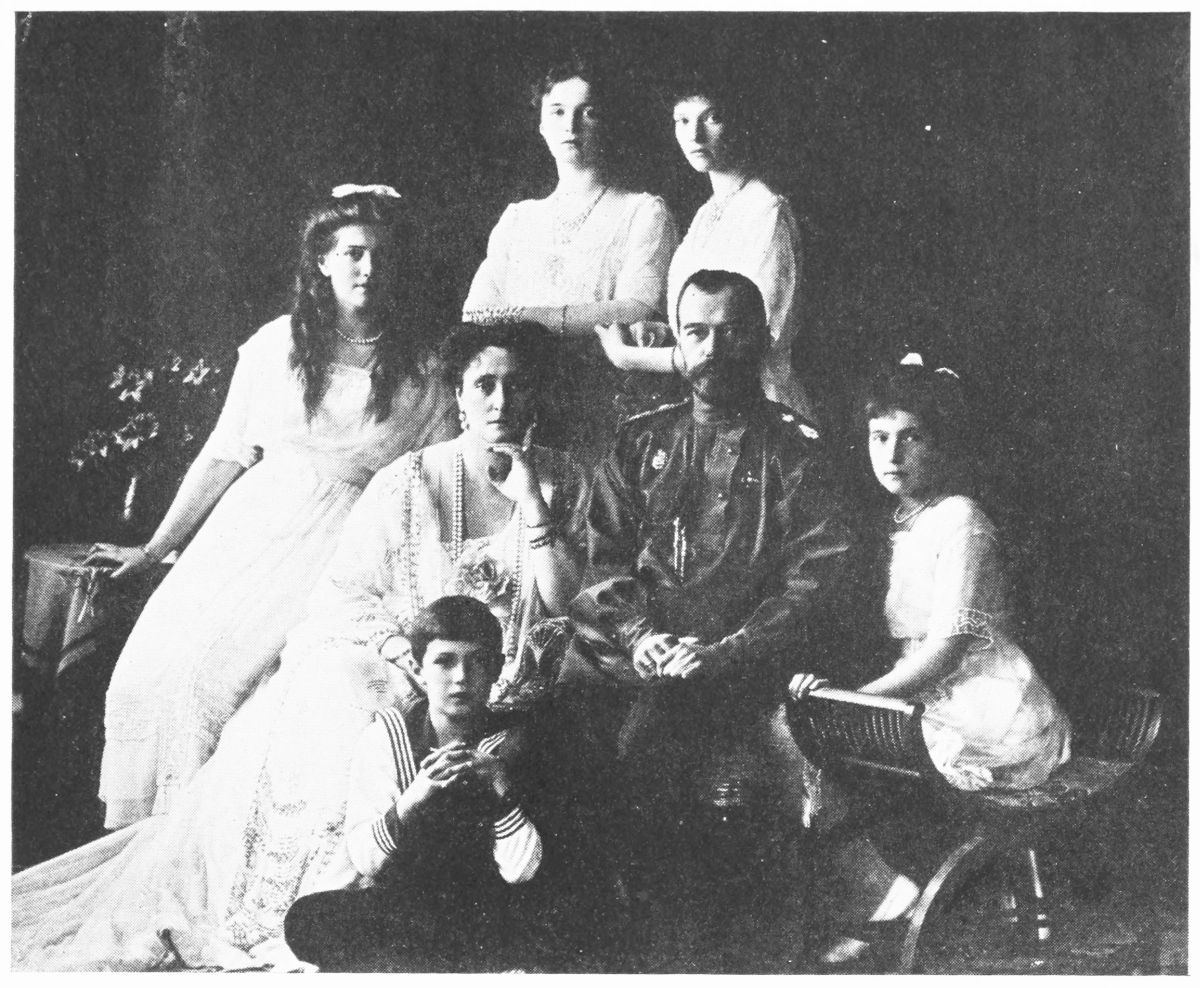
THE MARTYRED FAMILY
In this group, photographed four years before their death, the Tsar Nicholas II, the Tsaritsa Alexandra Feodorovna, and their youngest daughter, the Grand Duchess Anastasia, are seated in the centre; behind them stand (from left to right) the Grand Duchesses Maria, Tatiana and Olga. The Tsarevich Alexis, then ten years old, wears a sailor suit. Nicholas II is in the uniform of the Fusilier Guards. The Mother and Daughters have on some of the matchless pearls afterwards stolen from their dead bodies by the murderers.
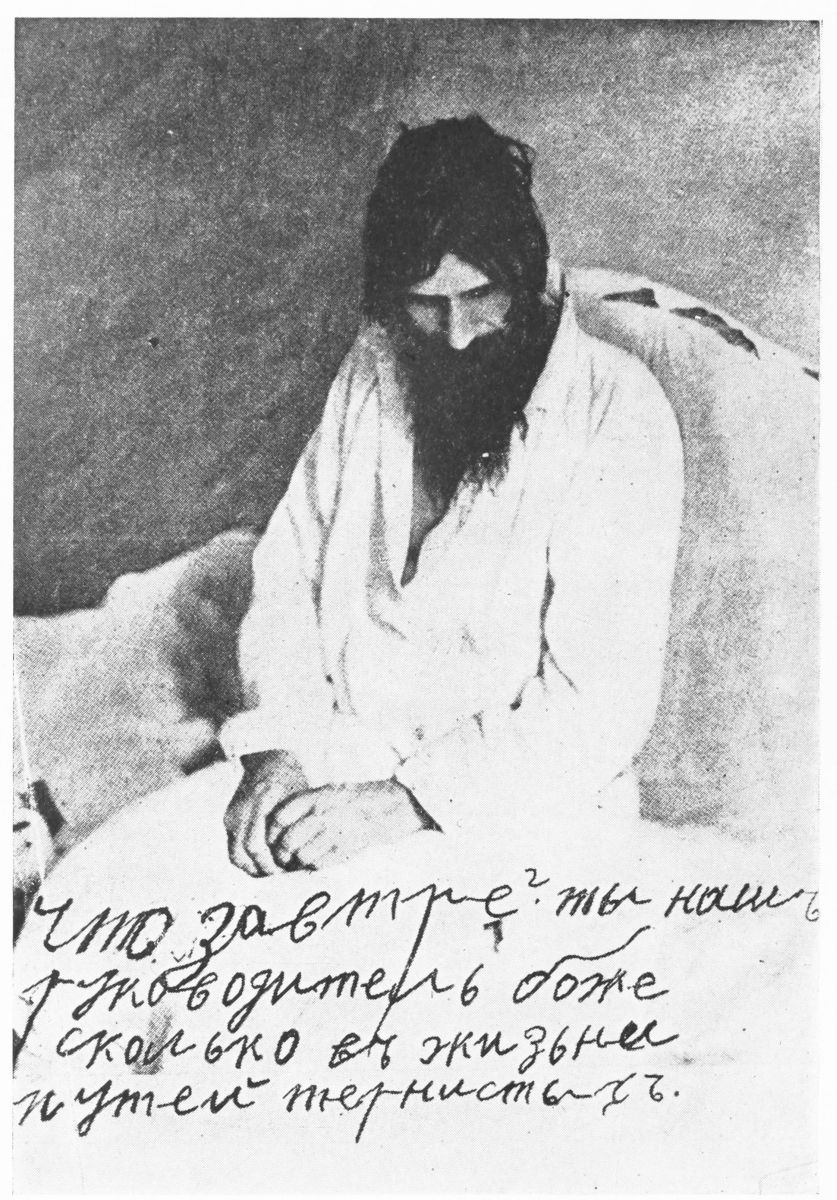
RASPUTIN—WOUNDED AT HIS VILLAGE HOME
Just before the outbreak of hostilities in 1914 the “saint” had been stabbed by a peasant girl whom he had wronged, and was being nursed by his wife and daughters at Pokrovskoe (Tobolsk province). Here he received the only letter that he ever had from Nicholas II, and here he boasted that if he had been in Petrograd at the time, he would have stopped the war. Nicholas and Alexandra had no suspicion that “Grishka” was a German agent. On this portrait, the “saint” has inscribed some of his pious reflections, translated as follows: “What of tomorrow? Thou art our Guide, O God. How many Thorny paths in this Life?”
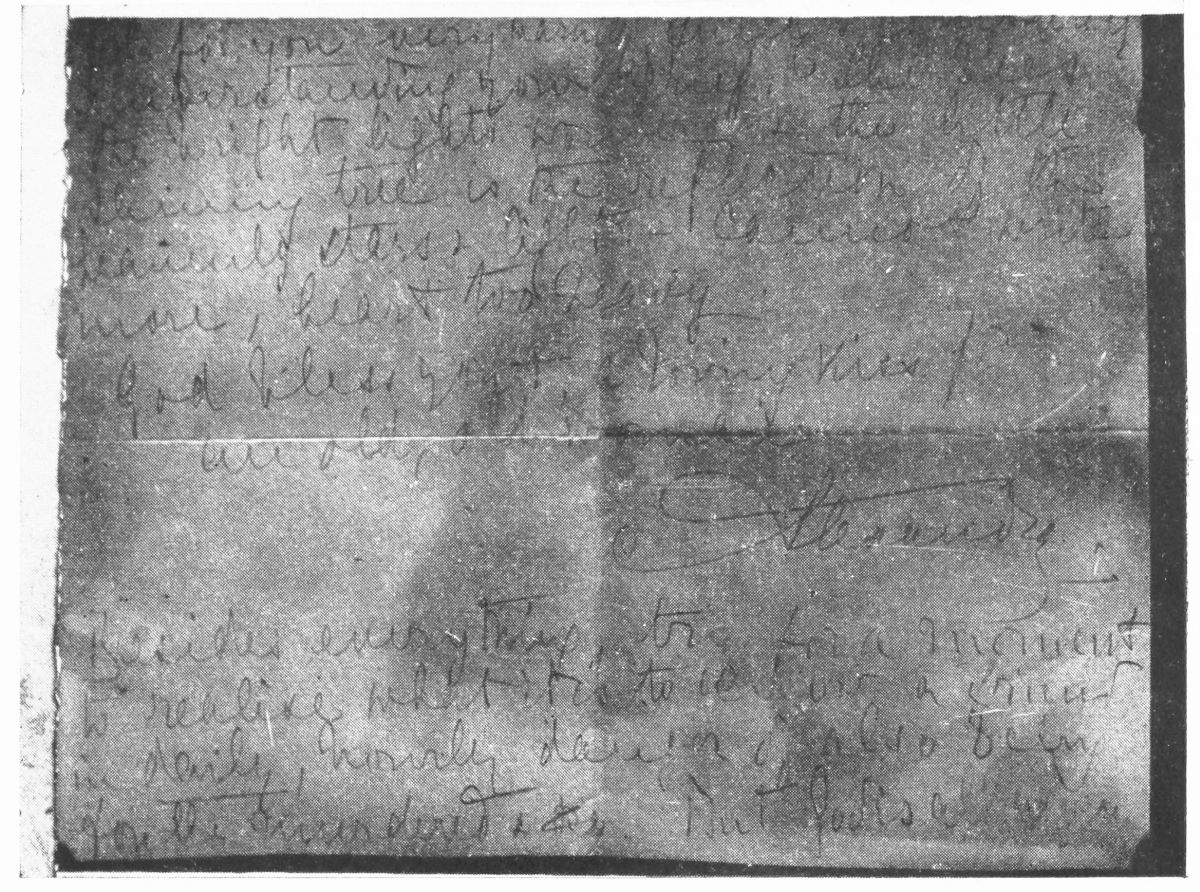
ALEXANDRA’S DESPAIR OVER RASPUTIN’S DEATH
Facsimile of a letter in which the Empress for once betrays her feelings. The closing sentence, written disjointedly, refers to his “murder” which occurred a week before, and her anxiety for the safety of the Tsar, showing that she knew of a plot against his life. “Besides everything, try for a moment to realise what it is to know a friend in daily, hourly danger of also being foully murdered. But God is all mercy.”
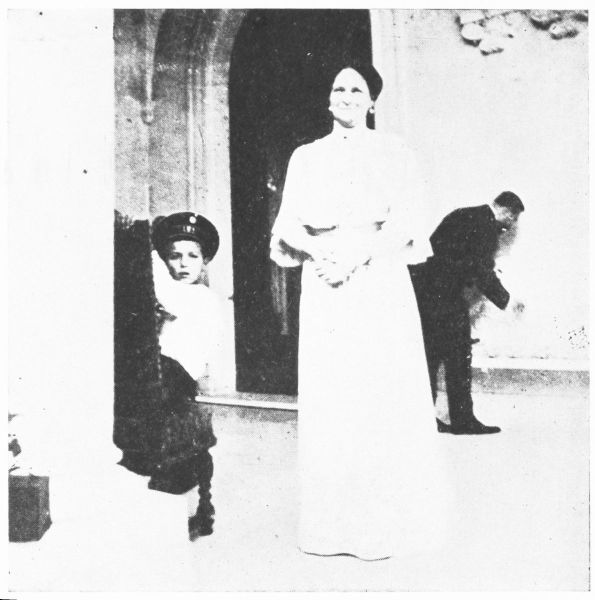
EMPRESS ALEXANDRA FEODOROVNA AND THE TSAREVICH ALEXIS NIKOLAEVICH IN LIVADIA (CRIMEA)
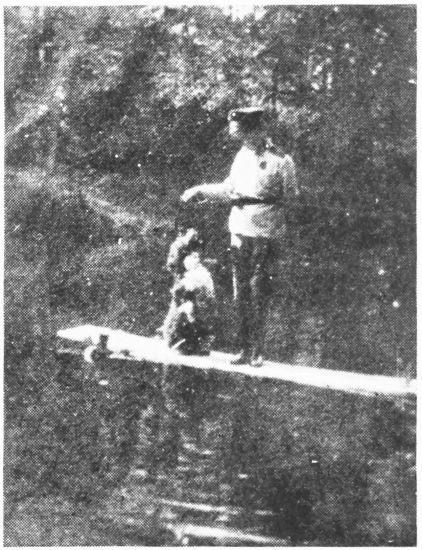
THE TSAREVICH ALEXIS AND HIS SPANIEL JOY, IN THE PARK AT TSARSKOE
wept bitterly. He also wept another time when he saw the colours of the Svodny regiment being taken out of the waiting-room. Some days later, I do not remember the date, I was notified by telephone of the arrival of the emperor. I went to the station. After the arrival of the train the emperor left his car and walked very quickly through the station without throwing a single glance at anybody, and took his seat in an automobile. He was accompanied by a marshal of the court, Count Vasily Alexandrovitch Dolgoruky. Together with Dolgoruky the emperor seated himself in the automobile.
Two men dressed in plain clothes came towards me; one of them was Vershinin, a member of the Duma. They told me that their mission was ended and that from this time on the emperor was to be under my guard.
I can not forget a certain circumstance I witnessed at that time. There were quite a number of persons who had been in the emperor’s train. When the emperor left the train these people crowded out to the station platform and quickly dispersed, throwing frightened looks in all directions. It appears that they were very much afraid of being recognised. All this looked rather disgusting.
I accompanied the emperor to the palace. He immediately went upstairs to see his children who were sick.
Shortly afterwards the emperor’s baggage was brought from the station.
The life of the imperial family during their stay in Czarskoe-Selo was in keeping in every way with the conditions that the imperial family had the right to expect. The instructions limited the connections of the imperial family with the outer world, and, of course, brought some restrictions in their interior life. The mail always went through the hands of the commandant of the palace. It was allowed to leave the palace only through the park. The palace and the park were always surrounded by sentinels. Walking in the park was allowed only from morning till dark.
These were the only restrictions, and the government by no means interfered in the intimate life of the family. Except the above-mentioned limitations as to the time of walking in the park, the government imposed no hardships.
During the first days in Czarskoe-Selo the children were sick with measles; Maria Nicholaevna and, I think, Olga Nicholaevna had also inflammation of the lungs. Very soon they all recovered.
Usually the day was spent in the following manner: The family got up early, with the exception of the empress. Indeed she also occasionally would get up early but she usually stayed a long time in bed. At eight a. m. the emperor always had a walk in the company of Dolgoruky. They walked for about an hour and a half, taking also some physical exercise. At one o’clock the family had lunch. After lunch until three o’clock the family used to work in the garden. After that the children took lessons. Tea was served at four p. m. Sometimes after tea the family went out to the park. Dinner was served at seven o’clock.
During the stay in Czarskoe-Selo, some incidents took place to which I would like to draw your attention: A few days after the arrest of the imperial family a disagreeable incident took place in regard to the body of Rasputin. His corpse was in Czarskoe-Selo. A church was being built and he was buried in one of its sections. After that became known to the soldiers they dug up the grave, removed the cover of the coffin and began to examine the body. They found a holy image in the coffin that bore the signatures of Alexandra, Olga, Tatiana, Maria, Anastasia and Ania. This image was placed by his right cheek. In some way all this became known to the commander of an anti-aircraft battery and he took the image away from the soldiers. I saw it personally. I think the image represented the holy virgin. I reported by telephone all these facts to the district headquarters. I was instructed to take the body of Rasputin to the station and to ship it to Sredniaya-Rogatka, where it was to be interred. I was told to do this in secret. Obviously it was impossible to carry out this order without the soldiers and the populace learning of it. Later I was told to take the body to Czarskoe-Selo station; I did this and put it in a box car. In another car I placed some soldiers without explaining to them what they had to guard.
The next day a commissar by the name of Kouptchinsky (who was also in charge of automobiles) forwarded me a written order signed by the chairman of the council of ministers. The order stated that I was to transmit the body of Rasputin (the name was written as “Novykh”), to Kouptchinsky so that he might deliver it on a truck to the place of its destination. We could not do all that in Czarskoe-Selo, so we moved the car with the corpse to the station Pavlovsk Second. In that station we found an old case and put in this case the coffin containing Rasputin’s body. All this was covered with mats and old empty bags. Kouptchinsky went with the body to Petrograd, but on the way the secret became known to the mob which threatened to snatch away the body, so Kouptchinsky had to burn it on the way.
The other incident in our peaceful life was the sudden arrival of a stranger. This stranger came to me, presented himself as Maslovsky and handed me a letter from the executive committee of the soviet of the workmen and soldiers’ deputies. This man wore the uniform of a colonel. I do not remember his features. The letter contained a demand that I assist the bearer in the execution of his orders. I remember very well that the letter was signed by Tscheidze, a member of the duma. It also bore a proper seal. This man who called himself Maslovsky told me that he had the order of the executive committee to take the emperor to the St. Peter and Paul fortress. I told Maslovsky firmly that I would not let him do it.
“Well, colonel, understand that the blood that will be shed will be on your conscience,” answered Maslovsky. I said that I could not help it, and he retired. I thought he had left for good but it appeared that he went to the palace, where he was met by the commander of the first regiment, Captain Aksiouta. He showed him the letter and told him that he wanted to see the emperor. After searching Maslovsky’s pockets, Aksiouta showed him the emperor in such a way that the emperor did not notice it. I reported this event to headquarters, where my actions were approved.
Kotsebue did not occupy the position of commandant of the palace for a very long time. He was dismissed on account of the following: There lived in the palace a maid of honour to the empress, Viroubova, and with her stayed a lady by the name of Den, who wore a Red Cross uniform.
The soldiers learned through the servants that Kotsebue often stayed for quite a long time with Viroubova and spoke English with her. After I heard it I verified this rumour. The footman (I do not remember his name), who told the story to the soldiers, confirmed to me the fact that Kotsebue was often seen with Viroubova. Fearing agitation amongst the men I reported it to Korniloff. Korniloff called for Kotsebue, forbade him to enter the palace, and ordered me temporarily to fulfil the duties of commandant of the palace.
I was not on my new post more than a week when Paul Alexandrovitch Korovitchenko was appointed to be commandant of the palace. Korovitchenko was a colonel in one of the regiments which was stationed in Finland. He was graduated from the military law academy, after which he stayed some time on active service. He was called back into active service at the beginning of the war. He had some private connection with Kerensky, who at this period succeeded Prince Lvoff, leaving his position of minister of justice to Pereverseff. Korovitchenko was also on good terms with the latter.
Kerensky came to Czarskoe-Selo several times. The first time he arrived when Korovitchenko was there. I can not tell you anything about his behaviour towards the emperor, as I was never present at their conversations. I can not tell you anything about it from Korovitchenko’s words either. As far as I can remember Tegleva told me that Kerensky always behaved to the emperor in a very correct manner. During one of the visits of Kerensky Viroubova was arrested.
This took place while I was present. Together with Korovitchenko we entered her room. Korovitchenko announced to her that she had to be taken to Petrograd. She dressed for the occasion and asked permission to say good-bye to the empress. This was granted. We were both present at their parting, watching it from a certain distance. They both spoke English and cried. Madame Den was taken to Petrograd together with Viroubova.
Korovitchenko was once present at a conversation between Kerensky and the emperor. Kerensky declared to the emperor that, he must confiscate some of his private papers and that he had detailed Korovitchenko to do it. I was also told to be present and distinctly remember the scene. It all turned out very unpleasantly. The private papers of the emperor were kept in a special, very large case. There were a large number of papers and they were placed in bundles in very good order. While indicating the papers, the emperor took a letter from the case, saying: “This letter is of a private character.” The emperor by no means wanted to keep the letter from being confiscated, but simply took it as it was lying separately from the others and intended to put it back in the case. At the same time Korovitchenko abruptly grabbed the letter and for a moment it seemed that the emperor was holding one end of the letter and Korovitchenko was pulling the other. The emperor looked vexed. He let go his end of the letter with the words: “Well, it looks as if I am not needed any longer; I had better go and have a walk.” Saying this he departed.
Korovitchenko took all the papers he considered interesting and delivered them to Kerensky. Kerensky and Pereverseff expected to find in them something that would indicate the treachery of the emperor or empress in favour of the Germans, especially as at this time it was insinuated by all the newspapers. They found nothing that could compromise the emperor or empress. At last they got hold of a telegram that was sent in code from the emperor to the empress. After some hard work in deciphering it they made out a sentence, “Feeling well, kisses.”
The family did not like Korovitchenko, but personally I can state that Korovitchenko exerted his best efforts to please the imperial family. For example: he obtained for them permission to work in the garden and go out in rowboats. But the best disposed towards the imperial family were some soldiers and officers of the first regiment.
Following an old custom the officer of the day in the palace used to be given at Easter time a pint of wine. This custom was not changed and after the soldiers learned about it they started fussing and it took fifty bottles of vodka to pacify them.
Once the soldiers accused Ensign Zeleny of kissing the empress’s hand.
This last-mentioned incident and the story about the wine made a lot of trouble and an investigation was ordered.
The morale of the soldiers grew worse and worse. They were quite intoxicated by their peculiar understanding of freedom and they began to invent all sorts of crazy demands. The worst in this respect was the second regiment, where not only the soldiers behaved badly, but also the officers.
On one occasion an officer of the second regiment declared: “We must see them ourselves. As they are under guard they have to be seen.” It is obvious that only vulgar curiosity or a desire to inflict useless mental sufferings, prompted the officer to make such a demand. My efforts to oppose their desires were fruitless, and my argument that the parents would never desert their sick children had no effect whatever. Fearing that they would be able to accomplish their purpose without my authority I reported this matter to General Polovtseff, who at that time occupied General Korniloff’s position. It was decided to do everything in the following manner: When the new captain of the guards came for the relief of the one on duty they were both to be taken to the emperor, with the empress present also. To avoid unnecessary embarrassment we decided to conduct this formality just before lunch—the time when the family was always gathered together. It was decided that the captain of the guard on duty was to take his leave from the emperor and the new one was to greet the emperor. After all this had been decided upon and carried out for a certain while, a very disagreeable incident took place. When the guards of the first regiment were being relieved by the guards of the second, as usual, both captains went to see the emperor. The emperor wished good-bye to the captain of the departing guard and shook hands with him. When the emperor extended his hand to the new captain it remained stretched out in the air, as the officer stepped backward. Being unpleasantly impressed by this the emperor went towards the officer, put his hands on his shoulder and with tears in his eyes asked him: “Why did you do that?” The officer once more drew backwards and answered: “I was born of common people and when they stretched out their hand to you you did not take it, so now I will not shake hands with you.” I relate this story as I heard it from the officer of the first regiment who witnessed this revolting incident.
As the revolution proceeded the agitation grew deeper amongst the soldiers. Having no opportunities to find anything wrong in the life of the arrested ones they tried to find new ways of inflicting suffering upon the imperial family. On one occasion they saw the czarevitch carrying a small rifle. This rifle was a model of the standard infantry rifle and was presented to the czarevitch by some munition works. It was absolutely harmless, as special cartridges had to be used for it and none of those cartridges were available. Of course, the trouble was started by the soldiers of the second regiment. All the efforts of the officer (I do not remember his name) to persuade the men that their demand was ridiculous, had no results. In order to avoid violence he took the rifle from the czarevitch. After this thing occurred I came to the palace where Gilliard and Tegleva told me the story and added that the czarevitch was crying. I ordered that the rifle should be forwarded to me, took it apart, and in this way, smuggled it back to the czarevitch.
Finally the soldiers and through them the soviet of Czarskoe-Selo ceased entirely to comply with my orders and appointed Ensign Domodziantz, an Armenian, to act as my assistant. He was a rough man and made the utmost efforts to get into the palace, where I tried my best to prevent him from going. After that he began to pass his time in the park, especially when the family were walking there. Once as the emperor was walking by and held out his hand to him, he refused to shake hands with the emperor, saying he had no right to do it, being an assistant commandant.
After this incident was related to Kerensky he came to the palace at Czarskoe-Selo and called for the chairman of the local soviet (he did not come in regard to this incident, but on some other business). The chairman of the soviet said to Kerensky: “I want to let you know, minister, that we elected Ensign Domodziantz to be assistant commandant of the palace.” Kerensky answered: “Yes, I know it, but was it so necessary to elect him; couldn’t you elect somebody else?” However, no changes were made, as Kerensky himself had no power.
It was Domodziantz who told the soldiers not to answer the emperor’s greeting. Of course the soldiers followed his advice, and, of course, it was the soldiers of the second regiment. I had to ask the emperor not to greet the soldiers, as I was losing control over the men, so the emperor refrained from further greetings to them.
At the same time I must state that it was not only the soldiers who were unfair in their attitude towards the imperial family.
People began to get frightened to show their feelings towards the imperial family. The Grand Duchess Olga was very much liked by Margaret Hitrovo. Often she came to me and asked me to deliver letters to Olga Nicholaevna. She always used to sign her letters: “Margaret Hitrovo.” In the same way, all the letters that were brought to me by Olga Kolsakova, bore also her full signature. But there were some letters brought to me to be delivered that were signed merely: “Lili” (Den) or “Titi” (Velitchkovskaya). I said to Miss Hitrovo: “You always sign your letters with your full name, the same as is done by Olga Kolsakova, but there are others who hide their names. This is not fair. Suppose the mail should be seen by somebody else and I should be asked who are the authors of those letters? My position would be extremely embarrassing. Please inform the writers of those letters that I desire them to call on me. I must know who they are.” After that I ceased to receive letters from “Lili” or “Titi.”
Count Apraksin very shortly after the arrest made a request to be allowed to resign, as all his business in the palace was finished and his family resided in Petrograd. By order of the minister of justice (the order was given to me through Korniloff) he was allowed to leave the palace.
Now I have related everything that I remember about the state of the imperial family in Czarskoe-Selo.
I can only add that the imperial family received all the newspapers that appeared at this time, as well as English and French magazines. Of the Russian newspapers I can name: “Russkoe-Slovo,” “Russkaia-Volia,” “Retch,” and “Novoe-Vremia,” “Petrogradsky Listok,” and “Petrogradskaia-Gaseta.”
Now I am going to tell you how the imperial family was moved to Tobolsk. This was preceded by the following events:
About a week before the departure of the imperial family, Kerensky arrived at Czarskoe-Selo. He called me up as well as the chairman of the soviet and the chairman of the military section of the Czarskoe-Selo garrison, Ensign Efimoff (Efimoff was an officer of the second regiment). Kerensky said to us: “Before speaking to you I ask your word that everything I say will be kept secret.” We gave our word to Kerensky. Then he told us that according to the resolution of the council of ministers, the imperial family were to be taken out of Czarskoe-Selo, but that the government did not consider it a secret from the “democratic organizations.” He said also that I had to go with the imperial family. After that I retired but Kerensky continued a conversation with the chairman of the soviet and Efimoff. In about an hour I met Kerensky and asked him where we were going, adding that I must give notice to the family so that they could prepare themselves for the trip. Kerensky responded that he would do it personally and proceeded to the palace. In the palace he had a personal talk with the emperor, but he did not give any answer to my question as to when and where we were going.
Later I saw Kerensky about two or three times and always asked him where we were going and what things were to be taken by the imperial family. Kerensky did not answer my questions but only replied: “Tell them that they must take plenty of warm things.”
About two days before our departure Kerensky called me up and ordered me to form a detachment of men out of the first, second and fourth regiments that would perform guard duty and that I was to appoint officers in the companies. The word: “Appointment” at this time had quite a special meaning. The agitation in the army was so great that we could not make appointments. A commander of a regiment had no influence whatever—his power being in the hands of the soldiers’ committee.