PART I Transcript of the Depositions of Eye-Witnesses of the Crime, Taken from the Archives by M. George Gustav Telberg, Minister of Justice at Omsk (continued 3)
G. G. (Georgii Gustavovich) Tel'berg translation
Before the arrival of the Letts all the sentry duties were performed exclusively by the Sissert workmen. After their arrival all the posts on the upper floor, where the czar’s family lived, were taken up by Letts. We, Russian workmen, were not allowed to go to the upper floor. Such were the orders of Iourovsky.
The machine gun teams, who performed no other duty than at the machine guns, were composed of our Sissert workmen.
At the time when Avdeieff was the chief all the other posts were occupied by the rest of the workmen. But after the arrival of Iourovsky and of the Letts, we workmen began to occupy only the posts outside of the house. All posts inside of the house were assigned to the Letts. Before the arrival of the Letts I, as well as other workmen, performed my sentry duties inside the house about six times, keeping guard by the commandant’s room and the lavatory. I performed this duty in the morning, daytime, evening and night. During this time I saw all the imperial family: The emperor, the empress, czarevitch, as well as the daughters: Olga, Tatiana, Maria and Anastasia. I saw them very closely when they went for a walk or to the lavatory or passed from one room to another. They all used to walk in the garden, except the empress. I never saw her walking in the garden. The czarevitch I saw only once, as he was carried by the oldest daughter of the emperor—Olga. The czarevitch was ill all the time.
I can tell about the way they spent their time from the words of Medvedeff, who of course saw them more frequently than I did. They got up about eight or nine o’clock in the morning. They had family prayers. They all assembled in one room and sang prayers. They had dinner at three o’clock. They all dined together in one room; I mean to say that they dined with the servants that were with them. At nine o’clock in the evening they had supper and tea, after that they went to bed. According to the words of Medvedeff they occupied themselves in the following way: The emperor read, the empress also read, or sometimes embroidered or knitted something together with her daughters. The czarevitch, when he could, made little wire chains for his toy ship. They walked every day for about an hour or an hour and a half. They were not allowed to take any other physical exercise. I remember that Pashka Medvedeff once said that the Czar Nicholas Alexandrovitch once asked Iourovsky’s permission to clean the garden. Iourovsky forbade it.
I heard their singing several times. They sang only sacred songs. On Sundays they had divine service, performed by a clergyman and a deacon, who I think were from the Verhne—Vosnesensky church.
At first the food was brought to them from a soviet dining-room; two women brought it; their cook heated it. Later, they were allowed to prepare their meals in the house.
Besides the imperial family on the upper floor of the house there lived with them the following persons, whom I have personally seen. There was a doctor, a stout man, with grey hair, aged about fifty-five. He wore spectacles, that had, as far as I remember, gold rims. There was a waiter, aged thirty-five, tall, slim, and dark. A cook stayed with them. He was aged forty, was short, thin, a little bald, he had black hair and small black moustache. There was also a maid with them, aged about forty, tall, thin, and dark; I did not see the colour of her hair, because she always tied a handkerchief on her head. There was also a boy with them. The boy was about fifteen, his hair was black and he wore it parted, his nose was long, his eyes black.
Two other men stayed with the imperial family. As Medvedeff explained to me, they also were servants. One of them was tall, thin, about thirty-five; his hair was light red, and cut short. He shaved his beard and trimmed his moustache; his nose was of medium size and straight; I don’t remember his other distinguishing marks, but his skin was clear and looked as delicate as a woman’s. The other was also tall, about thirty, his hair was black and parted. He was clean-shaven. The first man wore a black jacket, trousers and shoes. The second man wore a jacket, a stiff shirt, with a tie, trousers and shoes. I also saw the first man carry away a rubber pillow with the urine of the czarevitch. These two men I saw only once, when I was on guard in the house during the first days. After that I did not see them. Medvedeff told me that both of them were taken to Number Two Prison, but what reason there was for imprisoning them I was not told and I was not interested either in knowing. On several occasions I have seen the Bolshevik Beloborodoff, who came to the house probably to inspect the life of the imperial family. Anyhow I was told by Medvedeff that such was the reason of his visits. Beloborodoff I recall very distinctly. He looked about twenty-five. He was of medium height, thin, his face was pale. Beloborodoff visited the house while Avdeieff was on duty there, as well as when Iourovsky was on duty.
Regarding the restrictions and treatment of the emperor and his family by the executives and the guards, as a matter of conscience I can say this: Avdeieff was a simple workman, very poorly developed, mentally. Sometimes he was intoxicated. But neither he nor the guards during his time offended or did any wrong to the imperial family. Iourovsky and Nikoulin behaved themselves differently. During their time the imperial family suffered more. They both used to drink in the commandant’s room and while intoxicated they sang. Nikoulin played the piano (that was in the commandant’s room). Sometimes as Nikoulin was playing and Iourovsky’s eyes were bleared with drink they both started yelling out songs, as: “Let us forget the old world; Let us shake its dust from our feet. We do not need a golden idol. We abhor the czar’s palace.” And so on. Or sometimes they sang: “You died as the victim of a struggle....” Moshkin also sometimes allowed himself to sing these songs but only in the absence of Avdeieff, who did not know anything about it; but the first two took things easy. In the time of Avdeieff women never entered the house, but Nikoulin had a mistress who came to see him and stayed with him after Iourovsky’s departure. She was about twenty, was short, stout and blonde; her eyes were brown, her nose was small and straight. I do not know her name. I don’t know either where she lived or from whence she came. Medvedeff told nothing about her. In the time of Iourovsky divine service was performed less often.
As a result the guards under the command of Iourovsky began to behave much worse. Fayka Safonoff began to behave indecently. There was only one lavatory for the imperial family. On the walls near this lavatory Fayka Safonoff began to write all sorts of bad words, that were very much out of place. He was seen writing those words on the wall near the lavatory by Alexeeff, who was on duty on the upper floor together with Fayka (Fayka occupied the post near the lavatory and Alexeeff near the commandant’s room). After Alexeeff returned from duty he told us all about it. Once Fayka climbed up a fence which was quite close to the windows of the emperor’s rooms and began to sing all sorts of vulgar songs.
Andrew Strekotin drew on the walls of the lower room numbers of indecent pictures. Belomoin participated in the drawing and he laughed and taught Strekotin how to draw better. I have personally seen Strekotin drawing those things.
Once I was walking near the house when I saw the youngest daughter of the emperor, Anastasia, look out the window. When the sentry on duty noticed it he fired his rifle at her. The bullet missed her and lodged above her in the wood-work of the window frame.
All of these unbecoming deeds were known to Iourovsky. Medvedeff reported to him about Podkorytoff but Iourovsky only answered: “They must not look out of the window.”
As I said before, from the time that the Letts entered and joined the guards, they lived in the lower floor of the Ipatieff house, and we, workmen, were all transferred to the house opposite, belonging to Popoff (or Obouhoff). In this house we occupied all the rooms of the upper floor; the lower floor was taken up by tenants.
The Zlokasoff workmen were placed in the same rooms with us.
The last time I saw the imperial family, except the emperor, was a few days before they were murdered. On that day they all went for a walk in the garden—all of them walked—except the empress. There were the emperor, his son, his daughters: Olga, Maria, Tatiana and Anastasia; there were also the doctor, the waiter, cook, maid, and the boy. I observed distinctly that the heir was dressed in a shirt and had a black leather belt, with a small metal buckle, around his waist. I saw that very distinctly because the Grand Duchess Olga carried him close past me. The heir was ill and the boy pushed his roller-chair. I could not tell you exactly the date when I saw them walking in the garden. But it was not long before their death. The murder took place the night between Tuesday and Wednesday. I do not remember the date. I remember that we received our wages on Monday. So it must have been the 15th of the month of July, reckoning by the New Style. The day after we received the wages, at ten o’clock in the morning of July 16th, I was standing on duty by the sentry-box near to the Vosnesensky Prospect and Vosnesensky Lane. Egor Stoloff, with whom I lived in the same room, was at the same time on duty in the lower rooms of the house. After we finished our shift of duty, together with Stoloff we went to get some drinks in the house number eighty-five of the Vodotchnaia street.
We returned at dusk, as we had to resume our duties at five o’clock. Medvedeff noticed that we were drunk and put us under arrest in the bathhouse, which was situated in the yard of Popoff’s house. We fell asleep and slept till three a. m. At three o’clock in the night we were awakened by Medvedeff who said: “Get up and follow me.” We asked him where and he answered: “They call you, so you must go.” I am quite sure that it was three o’clock because Stoloff had a watch with him, and when I looked at this watch it was exactly three o’clock. We got up and followed Medvedeff. He brought us to the lower room of the Ipatieff house. All the workmen guards were there, except those on duty. There was a cloud of powder smoke in the room and it smelt of powder. In the rear room that had a barred window, which is situated close to the store-room, the walls and floor were pierced by bullets. In one wall there were an especially large number of bullet holes, but there were also bullet marks in the others. There were no marks of bayonet strokes on the walls. In the places where the walls and floor showed bullet holes, there was blood around them; there were splashes and spots of blood on the wall and small pools on the floor. There were drops and spots of blood in other rooms that had to be passed on the way from the room that had the bullet marks, to the court yard. There were also traces of blood on the pavement of the court yard on the way to the gate. It was obvious that quite recently before our arrival a large number of people had been shot in the room with the barred window. After I witnessed all that I began to question Medvedeff and Strekotin about what happened. They told me that just a few moments before, the whole imperial family and the people attached to them had been shot, except the boy.
Medvedeff ordered us to clean up the rooms. We began to wash the floor; several mops were brought in to remove the traces of the bloodstains. I can not tell who brought them. Medvedeff ordered that some sawdust be brought. We washed the floor with cold water and sawdust, removing the bloodstains. The bloodstains on the wall we washed off with a wet rag. All the workmen participated in the cleaning except those that were on duty. A number of men did the cleaning in the room where the imperial family was killed. Amongst others I saw there Medvedeff and two Letts. I also helped to clean this room. In the same manner, using water, we washed the blood from the pavement of the court yard. I did not find any bullets. If any bullets were found by other people or not I don’t know.
When Stoloff and myself came down to the lower room we did not find anybody there except a few Letts. Medvedeff and our workmen were absent. Nikoulin at that time, as it was said by Medvedeff, was in the upper room, the door of which leading to the lower rooms was locked from inside.
I saw no gold or any other valuable articles taken from the bodies of the murdered people in the lower rooms. I now remember that on Tuesday morning, when I was on sentry duty, I personally saw Iourovsky come to the house at eight o’clock in the morning. Some time after his arrival Beloborodoff entered the house. I left my post at ten o’clock in the morning; but Medvedeff told me that afterwards Iourovsky and Beloborodoff went for a ride in an automobile. At this time Nikoulin remained in the house. They returned before evening. During the evening Iourovsky told Medvedeff that in the night time the imperial family would be shot, and ordered him to notify the workmen and to take the revolvers from the sentries.
All this was not clear to me then. I can not tell if it was true or not, as I did not think of questioning any of the workmen whether Medvedeff took their revolvers or not. Personally I don’t understand why it was necessary; according to Medvedeff’s words the imperial family were shot by the Letts and they all had Nagan revolvers. At this time I did not know that Iourovsky was a Jew. Being the instigator of the crime he may have selected the Letts to do the actual killing, having more confidence in them than in us Russians. Perhaps for the same reason he also wanted to disarm the Russian workmen that were on duty. Medvedeff faithfully performed Iourovsky’s order, took the revolvers from the sentries, forwarded them to Iourovsky and at eleven o’clock in the evening notified the workmen that the imperial family were going to be shot. At twelve o’clock midnight Iourovsky awoke the imperial family, requesting all of them to dress and to go down to the lower room. According to Medvedeff, Iourovsky explained to the imperial family that there would be danger during the night and that in case firing were to take place on the streets it would be dangerous to remain in the upper floors. So he insisted that everybody should come down. They complied with the demand and descended to the lower room, accompanied by Iourovsky, Nikoulin and Beloborodoff. There were the emperor, the empress, the heir, the four daughters, the doctor, the waiter, the maid, and the cook. The boy by order of Iourovsky about a day and a half before that, was transferred to the rooms where we were quartered, and I saw him there personally before the murder. All of them were brought into the room that bore the marks of bullets. They stood in two rows. Iourovsky started to read to them a paper. The emperor did not hear well, and asked: “What?” According to the words of Medvedeff, Iourovsky lifted his hand with the revolver and showing it to the emperor, answered: “This is what,” and afterwards added: “Your race must cease to live.”
I remember also that when telling about the paper which Iourovsky read to the emperor, Medvedeff called it a “protocol.”
As soon as Iourovsky finished speaking he, Beloborodoff, Nikoulin, Medvedeff and all the Letts fired at the emperor and directly afterwards began to shoot at everybody else. They all fell dead on the floor. Medvedeff told me himself that he shot two or three times at the emperor and other persons whom they were executing.
After all of them were shot, Alexander Strekotin, as he told it to me himself, took all the precious things from the bodies; these were at once taken away from him by Iourovsky and carried upstairs. After that all the bodies were loaded on a motor truck and taken out somewhere. On this truck, along with the bodies of the killed, went Iourovsky, Beloborodoff and a number of Letts. No one from our workmen went with them.
After the cleaning of the rooms was over, together with Stoloff, we went to town, and sauntered about until evening. We did not meet any of our acquaintances and did not tell anybody about the murder. In the evening we came back to our quarters, had some food, and slept. At six o’clock in the morning on Thursday, July 18th, Medvedeff ordered me on duty on a post inside of the house by the commandant’s room. Up to this time, after the arrival of the Letts, not a single workman ever was allowed to do sentry duty inside of the house while the imperial family was still alive. Now, after they were killed, we were again ordered on duty inside the house.
There was no sentry near the lavatory. Iourovsky, Nikoulin, Medvedeff and the Letts were already in the house when I took up my post. There was nobody from our or Zlokasoff’s workmen. I remember very well that when I came to my post Iourovsky was already in the house. Probably he spent the night in the house. They were all ransacking the emperor’s belongings; they were in a great hurry and were packing all the things that could be packed. I could not hear the conversation between Iourovsky, Nikoulin and Medvedeff. They were all calm but I had the impression that Iourovsky and Nikoulin were a little drunk.
During this day nothing was taken out—only packing was going on.
After I left my post I went to the guardroom, slept, ate, and went to see my brother Alexander who served in the militia. I did not tell anything about the murder to my brother. Until the evening I sauntered around the town and in the evening I returned to the guardroom. In the guardroom Medvedeff announced that we all had to leave Yekaterinburg.
On July 19th we were sent to the station Yekaterinburg First. Our party was assigned to guard the staff of the third Red army. The staff was in railway cars and we were posted by them. At this time I saw the emperor’s belongings, loaded on trucks, being shipped to the station. There were the same things that had been previously packed in handbags and trunks. They were all brought to the station and loaded in a train of cars. The cars were big, of the American type.
I personally saw Iourovsky depart. As I remember, he left during the night of July 21st and proceeded towards Perm. His family and Nikoulin accompanied him. I also personally saw all the Letts who lived in the Ipatieff house and killed the imperial family, departed with Iourovsky. We all left Yekaterinburg when the staff of the third army departed, at the time when the town was already being occupied by the Siberian forces. We went to Perm, but when the troops of General Pepelaieff were taking Perm the staff of the third army and all the workmen of our party left Perm and proceeded towards Viatka. I remained in Perm and after Perm was taken, returned to Yekaterinburg and stopped with my brother Alexander. The secret service learned of my presence and I was ordered to come to the police station. An elderly official started to question me. I got very much afraid and began to lie to him, saying that I had never been amongst the guards of the imperial family. Afterwards, I confessed that I was amongst the guards, but I denied knowledge of anything. Now I have told you everything I know about this matter.
I fully realise how wrong I was not to follow the advice of my father and mother and to have enlisted in the guards. Now I realise what a wicked action it was to kill the imperial family and I understand that I was also wrong in washing out the bloodstains resulting from the crime. I am not a Bolshevik and I never was one. All that I did, I did because of my youth and stupidity. If at present I could help in any way to find and get hold of the people who committed the murder, I would spare no effort to do it.
All the workmen that performed duty had Nagan revolvers that were distributed by Medvedeff a few days before the murder. Iourovsky carried a Browning pistol; Medvedeff, a Nagan revolver.
I don’t know what happened to the boy who was waiting on the imperial family and who was transferred to our quarters before the murder. He slept on my bed and I spoke to him. I don’t know if he knew about the murder of the imperial family. He did not cry and we did not talk with him about the murder. He told me that the commandant intended to send him home and mentioned to me some district or other, but I have forgotten its name. At the same time he complained to me that Iourvosky took his clothes from him. I can not name a single man among the Letts.
When I performed duty inside the house I never saw the empress enter the commandant’s room. I do not think it ever happened, as Iourvosky treated them badly. The empress’s rosary, which was found in the commandant’s room, was probably forgotten there at the time of the packing after the murder.
Usually I saw the emperor wearing a grey or black jacket with a standing collar and brass buttons. He wore boots and grey hair was noticeable in his beard. When the grand duchesses walked in the garden they wore summer clothes, usually blouses and skirts of various colours.
I can not explain anything more. My statement has been read to me and is written correctly.
Signed: Philip Proskouriakoff. N. Sokoloff. Present at the examination: Iordansky, Public Prosecutor.
V EXAMINATION OF ANATOLIE IAKIMOFF
[Anatolie Yakimoff whose deposition is now given, was a workman, who became one of the senior guards of the imperial family during their last days in Yekaterinburg. His statement bears the impress of truth, and one gathers from it that he possessed some education and was more enlightened and tolerant in his views than were his fellows. Although Yakimoff never spoke to any of the members of the imperial family, we are able to see them vividly by his crude descriptions of their daily life. This workman-guard denies that he was present at the actual execution, but he insists that he and the others to whom it was related, were convinced that the czar and his family met their deaths in the manner described by Medvedeff.
It is curious to notice the respect with which this peasant-workman always mentioned the imperial family. Avdeieff, so he says, referred, to the imperial family as “They,” and Yakimoff follows his example, but it is apparent that this implies no disrespect on his part.—Editor’s Note.]
In 1919 from the 7th to the 11th of May, the Investigating Magistrate for Important Cases of the Omsk Tribunal sitting in the town of Yekaterinburg, examined, in accordance with Articles 403-409 of the Code of Criminal Procedure, Anatolie Alexandrovitch Iakimoff, peasant, thirty-one years old, belonging to the Orthodox Church, married. The accused deposed as follows:
I am a workman.
I specialised in work on milling machines; my father was also a workman. He was born in the Ugovsk factory of the Perm District. My mother’s name was Maria Nicholaevna. I am the eldest son of the family.
When I was born my father worked at Motoviliha works. At eight I began my studies in a school that was attached to the ecclesiastical seminary. I went to school for three years. When my father died I was twelve. My mother sent me to the public school, but having passed the third grade, I left the school; we had no money to live on and at the same time I was not ambitious enough to study. I wanted to get some occupation and mother sent me to the Motoviliha works, where I was accepted as a bell boy in the drafting room. When I was sixteen I was transferred to the machine shop and began to learn to work on milling machines. In 1906 I married the daughter of a workman of the Motoviliha factory. In 1916 I volunteered in the army and was recruited in the 494th Vereisky Regiment of the 124th Division. Our regiment fought on the Roumanian front. I participated in several battles but I was never wounded. In July, 1917, after the revolution, I was elected to the regiment’s committee. You ask me the reason why I was chosen? I was chosen for the regiment’s committee, as I understand, because I was better mentally developed than the rest of the soldiers. I never joined any of the political parties, but my sympathies were with the social democrats.
At the beginning of November, 1917, I got a position in Zlokasoff’s factory in Yekaterinburg. The factory was still in the hands of its owners, the Zlokasoffs, but a committee of workmen existed and a commissar was commissioned to the factory also. The position of commissar was taken by Alexander Dmitrieff Avdeieff, a locksmith by trade. He was about thirty-four or thirty-five, was taller than the average, thin, his face was thin and pale.
In December Avdeieff took to prison the owner of the factory, Nicholas Theodorovitch Zlokasoff. The owners were replaced by an “executive” soviet. This soviet began to rule the factory. The leading man of the factory was Avdeieff. The following workmen were the nearest to him: the brothers Ivan, Vasily and Vladimir Loginoff, Sergius Ivanoff Luhanoff and his son Valentine. The Loginoffs were from the Kishtym factory of the Yekaterinburg district. All those people were in extremely close relations with Avdeieff and occupied the privileged positions. They were either members of the factory’s committee and executive soviet or had some other “easy” jobs, but did not work. Alexander Michailoff Moshkin was also on good terms with Avdeieff. As far as I remember, Moshkin was born in Semipalatinsk. He was twenty-seven or twenty-eight, short and husky. He was a locksmith. In April it became known in town that the czar had been brought to Yekaterinburg. This was explained by the workmen to be quite necessary, as somebody wanted to abduct the czar from Tobolsk and, therefore, they had to transfer him to a reliable place such as Yekaterinburg. Such were the conversations amongst the workmen. In the first days of May, shortly after we heard of the arrival of the czar, we learned that our Avdeieff was appointed to take charge of the house occupied by the czar. At that time for some reason or other they used to call this house “The House of Special Purpose.” It was said also that Avdeieff was appointed to be commandant of the house.
Shortly afterwards Avdeieff confirmed to us this news at a meeting. I can not explain the reason for this appointment. Avdeieff was a true Bolshevik. He considered that the ideal life could only be realised under Bolshevism. On many occasions he openly said that the Bolsheviki had destroyed the rich bourgeoisie, and had taken the power from Nicholas the “Sanguinary,” etc. He always associated in town with the leaders of the local soviet. I believe that for this reason, being a violent Bolshevik, he was appointed by the local soviet to be commandant of the house of “Special Purpose.” During the meeting which was assembled by him at that time he told us that together with Iakovleff he went to bring the czar from Tobolsk. Personally I do not know who Iakovleff was, but Avdeieff told us at the meeting that Iakovleff was a workman from the town of Zlatooust. Avdeieff said very bad things about him; that Iakovleff wanted to take the czar out of Russia and, therefore, took him to Omsk. But somehow the Yekaterinburg Bolsheviki learned about his intentions and also notified Omsk about them. Avdeieff raged when he spoke about the czar. He slandered him as much as he could, calling him: “The Blood Drinker.” War was the main point of his denunciation; he said that the czar wanted this war and for three years spilled the blood of the “workmen” and that during this war a great number of workmen were shot for striking. In general he said the things which were always said by Bolsheviki. It could be understood from his words that for his merits before the “Revolution,” in other words, because he did not let Iakovleff take away the czar, he was appointed commandant of the house of “Special Purpose.” It was seen that Avdeieff was very glad of his appointment. He was much pleased when he addressed us at the meeting and promised the workmen to show them the czar, saying: “I will take you all to the house and will show you the czar.”
Judging by the words of Avdeieff, at the time when he was appointed commandant of the “House of Special Purpose,” the guards of this house consisted of Magyars. Avdeieff spoke definitely about this and said he intended to relieve the Magyar guard by Russians. He spoke particularly about Magyar guards and not any others. Avdeieff kept his word to “show the czar to the workmen.” Always workmen used to visit the house, but not all of them—only those that were chosen by Avdeieff. He used to choose only the workmen who were friendly with him, who did not perform guard duties at the house of “Special Purpose,” but only “helped” Avdeieff, as his assistants. They never came to the house all together, but only one or two at a time. They did not stay in the house for a long time, just a day or two. I think that their main ambition was money. For their being at the house brought them a special salary, amounting to four hundred roubles a month, excluding allowance for rations. Besides that they received salary in the factory, being members of the factory or business soviet. Altogether these workmen enjoyed their connection with Avdeieff and drew from it a lot of advantages.
On May 30th our factory committee received a letter from Oukraintzeff (the same Oukraintzeff who previously had been one of our workmen), the chief of the central staff of the Red army, wherein it was requested to detail ten men to perform guard duty in the “House of Special Purpose.” Among the number I was selected.
When we arrived at the Ipatieff house the Magyar guard had already left. The guards that were there were workmen from the Sissert factory as well as workmen from various other works and factories: the Makaroff factory, Isset works and the mint. After our arrival the Sissert workmen remained in the house, but all the other workmen left. Together with the Sissert workmen we all took quarters in the lower room of Ipatieff’s house. One could enter the upper floor from the lobby.
At the time of our arrival at Ipatieff’s house there was no special chief amongst us Zlokasoff workmen or Sissert workmen. There were only seniors. During the first week I was the senior of the Zlokasoff workmen. The seniors of the Sissert workmen were Medvedeff and another man. It looked as if Medvedeff was altogether a leading man amongst the Sissert workmen, and I should say that it was he that gave them the orders; different questions were addressed to him; nevertheless he had no special power. Previous to this Nikiforoff occupied this position but soon he got ill and was relieved by Medvedeff. Such was the state of affairs only during the first days after our arrival at Ipatieff’s house. About a week later this order was changed. To begin with we were transferred to Popoff’s house. Medvedeff became Chief of All of Us, in fact, of Zlokasoff’s and Sissert’s workmen. Three seniors were elected whose duties were shifting the guards. I was such a senior, as well as Benjamin Safonoff and Constantine Dobrynin. When shortly before the murder Safonoff became ill, he was relieved by Ivan Starkoff. In this manner, up till the time of the murder of the imperial family, the seniors were: Ivan Starkoff, Constantine Dobrynin, and myself.
The following were the duties of the seniors: We were eight hours on duty: from six a. m. till two p. m.; from two p. m. till ten p. m.; and from ten p. m. till six a. m. When on duty we shifted the guards and now and then inspected the sentries. Outside of that we were obliged to stay in the commandant’s room and meet all the visitors to the house. Their arrival was announced to us by a bell rung by the sentry.
At the time of our arrival at Ipatieff’s house there were altogether ten posts which were numbered as follows:
Post number one was situated in the first room of the upper floor adjoining the lobby.
Post number two was in the corridor that led to the bathroom and lavatory.
Post number three was situated in the court yard facing the street by the fence gate. The gate was always closed and had a little window to enable the sentry to see who came to the gate.
When we arrived at Ipatieff’s house the house was already surrounded by two fences. The first fence was very close to the wall of the house. It began on the side of the Vosnesensky Lane, right from the wall of the house and separated the house from the Vosnesensky Lane, turning at an angle at the place where the Lane crossed the Vosnesensky Prospect; after that it separated the house from the Vosnesensky Prospect and finished near the entrance leading to the upper part of the house. In this way the fence made a little court yard in front of the house which could be entered only from the main entrance of the house which was facing the Vosnesensky Lane. In this court yard, just by the intersection of Vosnesensky Lane and Vosnesensky Prospect, stood an old sentry box.
The second fence also began near the Vosnesensky Lane. It started at the first fence and went further, also turning at an angle and separating the house from the Vosnesensky Prospect. It passed the gate, and finally ran into the wall of the house on the side that faced Vosnesensky Prospect. In this manner the second fence covered the main entrance of the upper floor of the house, as well as the gate and the wicket. This second fence had two gates—one facing the Vosnesensky Lane, the second right opposite them, in the opposite side of the fence, close to the gate of the house.
Both gates were shut from the inside of the fence.
There was only the gate which was near to the door of the house at the time we began to perform guard duty. At that time the gates that faced Vosnesensky Lane did not yet exist. They were built when we were there, as it was found that automobiles had much difficulty in leaving through the first entrance on account of a steep hill. That was the reason why the gates facing the Vosnesensky Lane were constructed. The motor cars entered through both gates, but they left only through the gate facing the Vosnesensky Lane.
The fence which was near the gate, and was built before our arrival, had a wicket with a little window.
On both angles of the exterior fence sentry boxes were constructed.
Post number four was situated outside of the outer fence by the wicket of the gates which were constructed at first.
Post number five was situated by the sentry box, near to those gates, in a way that the sentry might observe the whole Vosnesensky Prospect.
Post number six was situated at the other sentry box, which was outside of the fence at the intersection of Vosnesensky Lane and Vosnesensky Prospect, just by the chapel.
Post number seven was situated by the old sentry box in the outer yard, between the walls of the house and the first fence.
Post number eight was in the garden. The sentry had to walk around the whole garden.
Post number nine was on the terrace, where a machine gun was mounted.
Post number ten was situated in a room of the lower floor.
At the time when we arrived at Ipatieff’s house there were altogether ten posts.
We were transferred to Popoff’s house at our own request. The Sissert workmen were especially insistent upon it. Their houses were far from town, so they were visited by their wives. At the same time, as strangers were not allowed at Ipatieff’s house, the wives could not stop there. For this particular reason we were all transferred to Popoff’s house.
Up to the second half of June we—Zlokasoff’s and Sissert’s workmen—performed guard duty on all the ten posts. From the second part of June a certain change took place. The reason was that a feeling of discontent towards Avdeieff grew very strong at that time amongst the Zlokasoff’s workmen, so finally he was discharged from the position of Commissar to the factory. He remained only commandant of Ipatieff’s house. His group, consisting of the above-mentioned people, was also discharged from all the positions they occupied. After that Avdeieff took them all to Ipatieff’s house. All the people mentioned by me came here: The three brothers Loginoff, Mishkevitch, Soloviev, Gonihkevitch, Koriakin, Krashensnnikoff, Sidoroff, Oukrainzeff, Komendantoff, Labousheff, Valentine Luhanoff and Skorohodoff. All of them, except Skorohodoff, who got sick and was removed to a hospital, took their places in the commandant’s room and the lobby.
From their arrival at Ipatieff’s house they began to perform duty on posts number one and two. They all quartered in the commandant’s room and the lobby and slept on the floor, for which purpose they took two or three mattresses from the storeroom.
In this way we performed duty until the first days of July, approximately until the third or fourth of July, when Avdeieff, Moshkin and the others were discharged.
This happened in the following way:
Avdeieff was a drunkard. He liked drinking and did not miss an opportunity. He drank a sort of yeast paste which he obtained at the Zlokasoff’s factory. He drank in Ipatieff’s house. His followers drank also. When the latter moved to the Ipatieff house they began stealing the emperor’s belongings. Often they used to go to the storeroom and take out various things in sacks or bags. The bags they took away in a motor car or on horses. They took the things to their houses or flats. The fact of these thefts soon became the subject of gossip. Our guards also began to speak about the stealing going on and especially Paul Medvedeff spoke about it. Thefts in the Zlokasoff’s factory were also investigated and Avdeieff and Luhanoff were pointed to as the thieves. This was certainly right, as Avdeieff and his gang were suspected by the workmen at the time they were in the factory. Even at this time all of them stuck to easy jobs in the committee or business soviet. They got plenty of money and drank yeast. They continued this behaviour after they moved to the Ipatieff house: drank yeast and stole the czar’s belongings.
About the third or the fourth of July, at the time I was on duty, Avdeieff went somewhere out of the house. I suppose he was called by telephone to the district soviet. Shortly after Moshkin also left. I know that he went to the district soviet whither he was called by telephone. Vasily Loginoff remained in place of Avdeieff. Some time after Avdeieff and Moshkin departed, Beloborodoff, Safaroff, Iourovsky, Nikoulin and two other men entered the house. Beloborodoff asked us who remained in the house instead of Avdeieff. Vasily Loginoff answered that he was staying instead of Avdeieff. At that Beloborodoff explained to us that Avdeieff was not a commandant any longer and that he and Moshkin were arrested. The reason of the arrest was not explained by Beloborodoff. As far as I remember the same thing was told by Beloborodoff to Medvedeff, who at this time came from the Popoff house. Beloborodoff also explained to us that Iourovsky was the new commandant and Nikoulin his assistant. From this moment Iourovsky began to give orders in the house in the capacity of commandant. He immediately ordered Loginoff and others of Avdeieff’s party—I can’t remember which of them, at this moment, were in the house—to “get out.”
I remember that all the people mentioned: Beloborodoff, Safaroff, Nikoulin, Iourovsky and the two men unknown to me, visited all the rooms of the house; they were in the rooms occupied by the czar and his family, but I did not accompany them to those rooms. They did not stay for a long time. I believe that Beloborodoff informed the family of the appointment of Iourovsky and Nikoulin. At that time Iourovsky questioned Medvedeff about the man who performed guard duty on posts numbers one and two. (Inside the house.) After he learned that those posts were kept by the “privileged” of Avdeieff’s party, Iourovsky said: “For the present you will have to perform duty on those posts; later I will request men from the extraordinary committee for them.”
In a few days the men from the extraordinary investigation committee arrived at the Ipatieff house. They were ten in number. Their baggage was brought on a horse. I could not identify the horse or tell the name of the coachman; but everybody at that time knew that the men came from the “Tchresvytchayka” (Institution of Secret Political Police) in the American hotel.
I can not say why, but we used to call all those men Letts. But whether they were Letts none of us knew. It is quite possible that they were not Letts, but Magyars.
They took their quarters in the lower floor of the house, and had their meals in the commandant’s room. They were in a privileged position in comparison with us. I think it would be right to say that we had three parties: the so-called Letts, the Zlokasoff and Sissert workmen. The Letts Iourovsky treated as equals. The Sissert workmen he treated a little better than us, and us worst of all. I account for the difference in his manner towards the Sissert workmen by the fact that he considered us as workmen from the Zlokasoff factory who had been discharged together with Avdeieff. Medvedeff also influenced his attitude. He ingratiated himself with Iourovsky and Nikoulin and made an effort to be very affable. That is why they had a better attitude towards the Sissert workmen.
At the beginning he increased the number of posts. He mounted another machine gun in the attic of the house and established a post in the rear yard. This post in the rear yard was number ten, the post by the machine gun, eleven, and the post in the attic twelve. Duties on posts numbers one, two and twelve, after the arrival of Iourovsky, were performed exclusively by Letts.
You ask me why I volunteered to guard the czar? I did not see at that time anything wrong in doing so. As I told you before, I read a little, different books. I read party pamphlets and had an idea about the views of the different parties. For example, I know the difference between the ideas of the social revolutionists and the Bolsheviki. The former believe that the peasants are a working-class and the latter consider them as bourgeoisie and believe that only workmen are real proletarians. My sympathies were with the Bolsheviki, but I did not believe that the Bolsheviki could build up by their methods of violence a “good” and “just” life. I still believe that a “good” and “just” life will exist only when there are not so many rich and so many poor people as there are at present; and this will only come when all the population are educated to the point where they understand that the life they are leading at present is not the true one. I believed the czar to be the first capitalist who would always play into the hands of capital and not into those of the workmen. For this reason I did not want a czar and thought that he ought to be kept under guard, or at least imprisoned, until the time when he could be judged by the nation and punished by it according to his crimes, after deciding: “Was he guilty before his people, or not?” I thought his imprisonment was necessary for the safety of the revolution, and if I had known before that he would be killed in the way he was, I never would have gone to guard him. I believed that he could be judged only by the whole of Russia, as he was the czar of the entire Russian nation. All that happened I consider a wicked deed, “unjust and cruel.” The murder of the rest of his family I consider still worse. For what reason were his children murdered? I must also state that I joined the guards as I wanted to earn money. At that time I did not feel well and joined the guards because I thought it an easy job.
In this way we kept guard of the Czar Nicholas Alexandrovitch and his family. They all lived in Ipatieff’s house—I mean to say the Czar Nicholas Alexandrovitch, his wife Alexandra Theodorovna, his son Alexis and his daughters, Olga, Tatiana, Maria and Anastasia.
Of the others who lived with them there were: Dr. Botkin, Demidova, “Freylina” we used to call her, Haritonoff, the cook, and Troupp, the waiter. The name of the waiter I remember very well because the list of all the people who lived in Ipatieff’s house was hung up in the commandant’s room.
Botkin was an aged man, stout, grey-haired and tall. He wore a blue suit: jacket, waistcoat and trousers, stiff shirt and tie; he always wore shoes.
Demidova was a tall and stout blonde; she was thirty to thirty-five, dressed herself very cleanly and nicely, not like a servant, wore a corset; and it was seen by her figure that she was very tight-laced.
The cook was about fifty. He was small, strong and had brown hair.
The waiter was about sixty; he was tall and thin.
There also lived with the imperial family a boy about fourteen, whose name I don’t know. He was tall for his age, thin and his face was pale. He wore a dark grey jacket, with a high collar.
I can not tell you anything as to how the imperial family lived and spent their time. I never entered the rooms where they lived, and I could not see anything from a distance, as the door from the lobby to their first room was always shut.
I don’t know how the imperial family spent their time in the house. Dinner was brought for them by some women from the soviet dining-room that is located at the crossing of Vosnesensky and Glavny Prospects, in the place occupied now by the motion pictures and the Café Lorange. But later, during Avdeieff’s time, permission was given to them to prepare their dinner in the house. For this purpose the provisions were brought to them from the district soviet by some special man. Nuns used to bring them from the monastery milk, eggs and bread. The only thing I personally observed in the life of the imperial family was their singing. I heard sometimes sacred songs which they sang. They sang the “Herouvimskaya” (cherubims) song. But they sang also a secular song. I could not get the words, but the tune was sad. This was the name of a song: “A Man Died in a Soldier’s Hospital.” I never heard men’s voices singing—only women’s.
The divine service was performed in the house, but during the whole time I was there divine service was performed only three times. Twice the clergyman Storogeff officiated at the service and once the clergyman Meledin. But there were services also before our arrival. I know this because I had to get a priest to officiate at the service. The first time I was sent to get a priest by Avdeieff he named the church from which the clergyman was to be asked. He did not give me the name of the priest. At the church I learned that it was Meledin who officiated. I wanted to get him but at this time he was busy. After that I called up Storogeff. I called him also later a second time. When I was looking for a priest I used to address myself to the churchwarden who stood near the candle-box. I can not tell who he was. But once he asked me if he couldn’t officiate instead of a deacon, saying: “I would like so much to see the czar.” In the time of Avdeieff, when I was in the house, two services were held. While Iourovsky was there, only one. Personally I was never present at divine service. We were not allowed in the room. Avdeieff and Iourovsky were present at the service. From the distance I heard men’s and women’s voices during the service; probably they sung themselves. I saw all the members of the imperial family, as well as all the people who lived with them.
I saw them in the house when they passed to the toilet room, or went for a walk in the garden, as well as during the walk itself. They passed near the commandant’s room and close to post number one as they went to the toilet room. They could also go to the toilet room through the kitchen. I don’t know the reason, but they never did it. If the heir was not with them, they used to go for their walk by the staircase that led down from the toilet room, through the lobby that led into the yard and from the yard to the garden. Sometimes when the heir went with them to walk they all went through the main entrance of the house to the street, then through the gate (and not the wicket) to the yard, and then to the garden. He was probably ill and he was carried out to his roller chair, which was brought up to the main entrance. The czar used to carry him personally. I never saw him carried by anyone else.
Personally I could not observe the attitude of other people towards the emperor and his family, though I watched Avdeieff, who had to deal with them. Avdeieff was a rough and uncouth man and a drunkard; his soul was not kind. If on any occasion during the absence of Avdeieff any member of the imperial family asked Moshkin for a favour, he always used to answer that they would have to wait the return of Avdeieff. When Avdeieff returned and their plea was made to him, Avdeieff’s answer was: “Let them go to hell.” Sometimes returning from the imperial family’s room, Avdeieff used to say that they asked him for something or another and he refused. Apparently the process of refusal gave him much pleasure. He spoke about it, looking very happy. For example, I remember that he was asked once for permission to open the windows—telling us about it, he said that he forbade it. I can not say how he addressed the czar, but in the commandant’s room he referred to the imperial family as: “They”; the czar he used to call “Nikolashka.” I have told you already that as soon as he got into the house he began to bring in his favourite workmen, who moved into the house altogether, after being discharged from the committee and soviet. All those people had a merry time with Avdeieff in the Ipatieff house. They drank and stole the emperor’s belongings. Once Avdeieff got so tight that he fell in one of the lower rooms of the house. At the same time Beloborodoff arrived and called for him. Someone of Avdeieff’s favourites lied to Beloborodoff that Avdeieff had gone out of the house. It appeared that he fell drunk in the lower floor directly after he had visited the imperial family, whom he went to see in that state. The drunkards made a great noise in the commandant’s room; they shouted, slept one on the other as they toppled over and were very dirty in their habits. The songs they chose for their singing, of course, could not have been agreeable to the czar. They all sang: “You fell as a victim in the struggle,” “Let us forget the old world,” “Get cheerfully in step, comrades.” Oukrainzeff could play the piano which was in the commandant’s room and accompany the singers. Knowing Avdeieff was a Bolshevik and also a harsh man, who was always drunk, I believe that he treated the imperial family badly. He could not treat them well, as it was against his nature and behaviour. After I watched him in the commandant’s room I believed the way he treated the imperial family was insulting. I also remember that Avdeieff spoke with his friends about Rasputin. He spoke about the same things which other people discussed and which were written a number of times in the newspapers.
Not a single time did I speak with the czar or anyone of his family. I met them only occasionally, and we never spoke. Only once I saw and heard the czar speaking to Moshkin. They were walking in the garden. The czar walked in the garden. Moshkin sat in the garden on a bench. The czar approached him and said something about the weather.
Though I did not speak when I met them I still got an impression, that entered my soul, of all of them. The czar was not young any more; he had grey hair in his beard. I have seen him wearing a “gimnasterka” (soldier’s shirt), an officer’s belt, with a buckle, around his waist. The buckle was yellow and the belt was yellow, not of a light yellow color, but of a dark one. The color of the gimnasterka was khaki. His trousers were the same colour and he had old worn-out boots. His eyes were kind and he had altogether a kind expression. I got the impression he was a kind, modest, frank and talkative person. Sometimes I felt that he would speak to me right away. He looked as if he would like to talk with any one of us.
The czaritza was not a bit like him. Her look was severe. She had the appearance and manners of a haughty and grave woman. Sometimes we used to speak about them amongst ourselves, and we all thought that Nicholas Alexandrovitch was a modest man, but that she was different and looked exactly like a czaritza. She seemed older than he was. There was grey hair on her temples and her face was not the face of a young woman. He looked younger when they were together. I can not describe the way she used to dress.
Tatiana looked like the czaritza. She had the same serious and haughty look as her mother. The other daughters: Olga, Maria and Anastasia, had no haughtiness about them. One had the impression that they were modest and kind. I also can not describe the way they dressed, as I did not notice it.
The czarevitch was sick all the time. I can tell you nothing about him. The czar used to carry him up to his roller chair, and there he lay covered with a blanket. I cannot describe his clothes either.
I thought a great deal about the czar after I stayed a certain time amongst the guards. After I personally saw them several times I began to feel entirely different towards them: I began to pity them. I pitied them as human beings. I tell you the entire truth. You may believe me or not. I had the idea in my head to let them escape, or to do something to allow them to escape. I did not tell anybody about this, but I had an idea to tell it to Dr. Derevenko, who visited them at that time, but I was doubtful of him. I can not tell you why I was doubtful. I just thought: “I don’t know what type of man he is.” When he left them his face did not express anything, and he never spoke a single word about them, so I got doubtful. I am relating to you the exact truth. I had in my head the thoughts I am expressing now. Previously, when I first entered into the guards, I did not see them and did not know them. I was also a little guilty before them. When Avdeieff and the “Tovaristchy” (comrades) used to sing the revolutionary songs, I also used to join a little in the chorus, but after I learned how the matter stood, I stopped it and all of us, or if not all then a great number, condemned Avdeieff for his behaviour.
In the time of Iourovsky we were not allowed into the house. I never used to stay longer than necessary in the commandant’s room, as I did during the days of Avdeieff. Whenever a bell rang (an electric bell was connected with the commandant’s room and Popoff’s house), one used to come to the commandant’s room, get an order and immediately retire. We seniors did not have to go to the commandant’s room to answer the bell ring. It was always Medvedeff who went and we were asked for through him. Iourovsky was always with Nikoulin; Medvedeff also made his best efforts to be in their company. The Letts from the Tchresvytchayka were also near to them. That is why I can not describe to you how Iourovsky felt about the czar. Avdeieff was nearer to us, as he was the same sort we were—a workman, and he lived with us. Iourovsky behaved himself like a chief and did not let us in the house.
I can only say that immediately after he got in command of the house he mounted a machine gun in the attic and established a new post in the rear yard. He stopped all drunkenness and I never saw him drunk or intoxicated. Nikoulin was visited by a girl whose name was “Seveleva” but she was never let into the commandant’s room. But on one occasion Iourovsky either changed or forbade altogether the donation of the nuns to the imperial family; he did something that made the position of the imperial family worse, but what he changed or forbade, I do not remember. Something that I could not understand happened also in regard to the priest. As I remember, in the time of Iourovsky there was only one divine service. I was called by Iourovsky, who ordered me to get “any” priest. At first he asked me who were the priests that officiated. I named Father Meledin and Father Storogeff. After that he ordered me to get one of them. As Father Meledin happened to be the nearest, I called him up the same day, on Saturday evening. In the evening I told Iourovsky that I called up Meledin. Next day, in the morning, Iourovsky called me up and again asked me the name of the priest I had told to come. I answered that I called up Father Meledin. Hearing that, Iourovsky asked me: “Is that the one who lives on the Vodotchnaya in the place where Dr. Tchernavin lives?” I answered that it was the same one, after which Iourovsky sent me to inform Meledin that he should not come. “Go and tell Meledin that there won’t be any service, service is postponed. If he should ask you who postponed the service, you will say that they did it and not myself. Instead of Meledin, fetch Storogeff.” Well, I went to Meledin and told him there would be no service. He asked me why? I answered in the way I was ordered by Iourovsky: that “they” postponed it. Directly after I went to Storogeff and asked him to come. What the reason was for all that, and why Iourovsky preferred Storogeff to Meledin, I don’t know. Towards me also he acted very arbitrarily, neglecting the desires of the men. On July 12th the men elected me instead of Medvedeff to be chief. On Sunday, July 14th, I returned after my leave later than it was allowed, so Iourovsky dismissed me and appointed Medvedeff instead to be chief. So it continued till the end.
The last time I saw the czar and his daughters was on July 16th. They were walking in the garden about four o’clock. I don’t remember whether I saw the heir. The czaritza, I did not see, as she did not walk at that time.
On Monday, July 15th, the boy who lived with the imperial family and used to push the roller chair, appeared in our quarters at Popoff’s house. I specially noticed this fact. Probably the other guards also noticed it. But nobody knew why the boy was transferred to our house. There is no doubt that it was done on Iourovsky’s orders. On July 16th I was on duty. My hours at that time were from two p. m. up till ten p. m. At ten o’clock I placed the sentries on all the eight posts (duties on posts numbers one, two, eleven and twelve were not performed by us). The sentries that I placed at ten p. m. had to be relieved at two a. m. by the new senior, Constantine Dobrynin, to whom I shifted my duties. After I was relieved I went to our quarters. I remember that I had tea and afterwards, at about eleven o’clock, went to bed. Klescheeff, Romanoff and Osokin were in the same room with me. About four a. m., when it began to be daylight, I was wakened by Klescheeff’s voice. Romanoff and all the other men, including Osokin, who slept in the same room with me, were also awakened. Klescheeff was saying in a nervous voice: “Get up, fellows, I will tell you the news; get out into the other room.” We got up and followed him to the next room where there were more men, and when we all got assembled, Klescheeff announced: “Today the czar was shot.” We all started to ask how it happened and he and Deriabin told us the following, mutually completing each other’s narrative.
At two a. m. a notice was given to them by Medvedeff and Dobrynin whilst they were standing on their posts, that they would have to perform their duty longer than two o’clock a. m., as during the night the czar was going to be shot. After receiving the notice Klescheeff and Deriabin approached the windows: Klescheeff, to the window of the lobby of the lower floor which was opposite to the door that led to the room where the murder took place; and Deriabin to the window of the room that faced the Vosnesensky Lane. Shortly afterwards, they say it was a little past midnight by the Old Time, or a little past two by the New Time (instituted by the Bolsheviki, who changed the time two hours ahead), some persons entered the lower room and proceeded to the room where the murder took place. The procession was seen very well by Klescheeff. Iourovsky and Nikoulin went ahead and were followed by the emperor, empress and the daughters—Olga, Tatiana, Maria and Anastasia, as well as by Botkin, Demidova, Troupp and Haritonoff, the cook. The heir was carried in the arms of the emperor. Behind them went Medvedeff and the Letts, the ten men that lived in the lower room and were requested by Iourovsky from the “Tchresvytchayka.” Two of the number carried rifles. When the imperial family were in the room, they placed themselves as follows: In the middle of the room stood the czar; the heir was seated on a chair to the right of the czar; to the right of the heir stood Dr. Botkin; behind them against the wall stood the empress with her daughters; at one side of the empress stood the cook and the waiter; on the other Demidova.
Besides them, the following people were in the room: Iourovsky, Nikoulin, and the Letts. Behind the Letts stood Medvedeff.
Deriabin couldn’t tell the words with which Iourovsky addressed the family, he didn’t hear them, but Klescheeff positively affirms that he heard Iourovsky’s words and that Iourovsky said to the czar: “Nicholas Alexandrovitch, your relatives are trying to save you, therefore we are compelled to shoot you.” The same minute several shots were heard. All the revolvers were fired.
A woman’s scream and loud cries of several women’s voices were heard after the first shots. They executed the victims one after the other. The emperor fell first, after him fell the heir. Demidova was tossing herself about, but was dispatched by bayonets. After they all fell they were examined and some of them who gave signs of life were again shot and pierced by bayonets. Of the members of the imperial family they mentioned Anastasia as being pierced by bayonets. After that they again started to examine the dead: unbuttoned their clothes, looking for jewelry. All the things found on the dead persons, Iourovsky took himself and carried upstairs. Somebody brought from the upper rooms a few bed sheets and the dead were wrapped in those and carried out into the yard through the same rooms through which they had passed to their execution. From the yard they were carried to a motor truck which was standing behind the gate of the house. All of them were transported on a truck; some cloth was taken from the store room and spread on the truck; the bodies were put on the cloth and covered with the same cloth. Sergius Luhanoff was the driver. The truck with the bodies was taken out by Luhanoff through the gates that opened on the Vosnesensky Lane. Iourovsky and about three Letts went out with the bodies. After the bodies were taken out of the house two Letts began to mop up the blood and wash it with water and sawdust.
The narratives of Klescheeff and Deriabin about the murder sounded so much like truth and they both were so excited by everything they had seen, that nobody had even a shadow of a doubt that they were speaking the truth. Deriabin felt especially upset about it; he swore and called them murderers, butchers, and spoke about them with profound disgust.
On one of the following days, either Medvedeff or somebody who heard him, told me that Luhanoff took the bodies to the Verkh-Issetsk Works. The truck went through a wooded country. The ground began to get soft and swampy. The car was proceeding with difficulty, as its wheels sank into the mud. With many difficulties the automobile arrived at its destination, where a hole was already dug. All the bodies were laid in the hole and covered.
All that I am telling is the exact truth. Neither myself nor any other of our Zlokasoff workmen knew anything in the evening about the intended murder. After that evening Medvedeff did not come to our quarters and did not explain anything to us. I admit that some of the Sissert workmen may have known about it through Medvedeff, but the Sissert workmen were holding themselves aloof from us, and we from them. Among the Sissert workmen there was a greater number of Bolsheviki than among us.
Regarding the weapons, I can say the following: Iourovsky had two revolvers; one of them was a big Mauser and the other a Nagan. Besides that I have seen a big revolver in the commandant’s room and it is possible that it was a Colt. All the Letts had revolvers and judging by the holsters they had Nagans. Besides that a few more revolvers were brought from some place at the time Iourovsky was commandant.
The description of the murder of the czar and his family impressed me very much. I was sitting trembling. I did not go to bed, and at eight o’clock in the morning I went to see my sister, Kapitolina, with whom I was on very good terms. So I went to her to share my feelings with her. I was deeply pained in my soul. I found my sister alone; her husband was working in the commissariat of justice. When my sister saw my distressed expression she asked me: “What is the matter?” I answered her: “The czar is shot.” My sister asked me: “Is it possible that you were there?” I told her the same thing I am telling you, but not in such detail. I told her the imperial family were shot by decision and order of the “district soviet of workmen deputies.” I have the same opinion at present; it could not be possible that Iourovsky did it on his own decision. As at that time all the power was in the hands of the district soviet, I believe that the murder was done by the order of the soviet.
Previously among the Red Guards there was the following conversation: “What will happen if the Czechs enter the town? What will they do with the imperial family?” Some suggested that they would execute the family.
I remember that Deriabin said that Demidova had about thirty bayonet wounds. I told that to my sister.
At about ten o’clock in the morning I returned from my sister’s to the Popoff house. I do not remember what I did until two p. m., when my duty commenced. I placed the guards on all the posts and entered the commandant’s room. There I met Nikoulin, two Letts and Medvedeff. They were not gay, any of them; they looked preoccupied and depressed. None of them was speaking. A large number of precious things were placed on the table. They were pins, stones, ear-rings, beads and all sorts of jewels. A part of them lay in boxes, which were all open. The door from the lobby leading to the rooms where the imperial family used to live was closed as before, but there was nobody in the rooms; not a single sound was heard. Before, when the imperial family used to live there, sounds of life were always heard in those rooms. There was not any life there at present. Only their little dog was standing near the door in the lobby, waiting to be let into those rooms. I remember very well that I thought at the time: “You are waiting in vain.” Before the murder there was a bed and a couch in the commandant’s room. On this day at two o’clock of July 17th, when I came to the commandant’s room, I noticed there two more beds, on one of which a Lett was lying. Later Medvedeff told us that the Letts did not want to live any longer in the room where the murder took place (they had lived before in this room). Obviously this was the reason why the two beds were transferred to the commandant’s room.
From two o’clock p. m. up till ten o’clock p. m. on July 17th I performed duty. On this day I did not see Iourovsky in the house.
The same day Medvedeff told us that all of us guards would be sent to the front. So, on July 18th, I went in the morning to the Zlokasoff factory for the purpose of drawing the money that was due me. At two o’clock of the same day I again went on duty. On this day the czar’s belongings were being taken from the Ipatieff house and loaded on an automobile. Beloborodoff was sitting in the automobile. A number of things were also taken away on carriages.
On July 18th I saw Iourovsky in the house about six o’clock in the evening; he was constantly coming and going. At about eight o’clock in the evening he called up Medvedeff and gave him the money for our wages. On July 18th all the things had been taken out of the house.
On July 20th, during the night, together with the other guards, I was sent to the station Yekaterinburg First. A part of the guard remained in the Ipatieff house.
At the end of July we arrived at Perm and about a week after our arrival we were joined by the remainder of the guards from the Ipatieff house. All were assigned to the command of the commissar of supplies of the third army, by the name of Gorbounoff, and taken on a steamer to Levshino. Klesscheeff alone did not go with them to Levshino as he had to stay in Perm owing to illness from venereal disease.
For about a month I was guarding the steamer and railroad cars of the commissar Gorbounoff. On
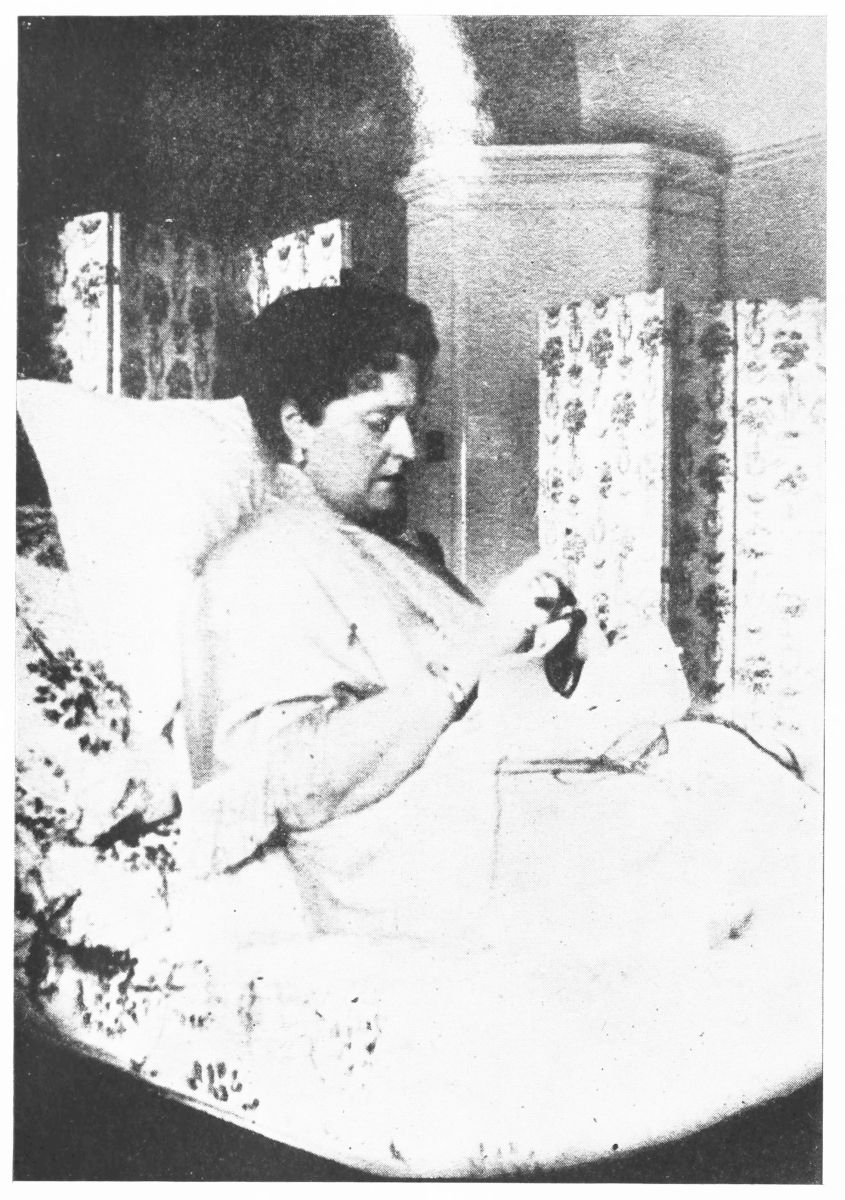
EMPRESS ALEXANDRA FEODOROVNA IN TOBOLSK
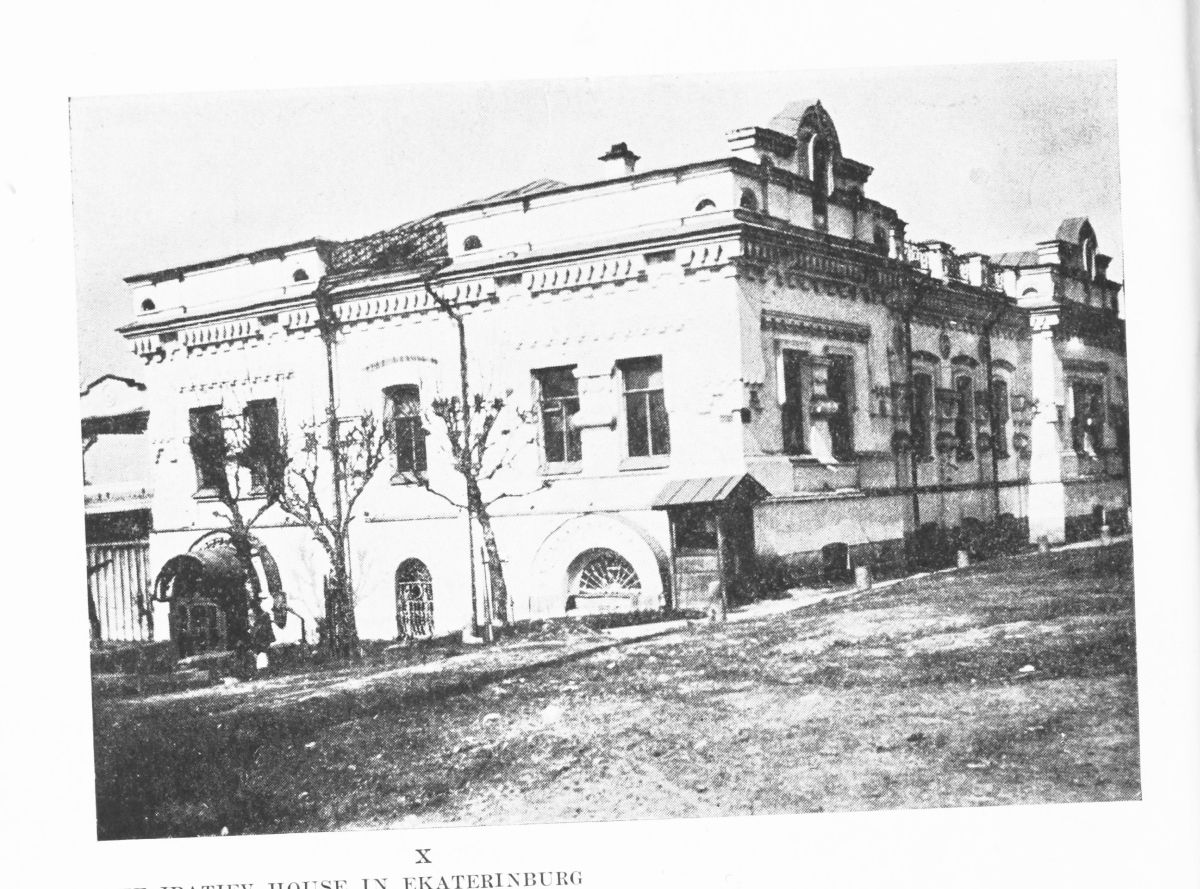
X
THE IPATIEV HOUSE IN EKATERINBURG (GENERAL VIEW)
(X) The Basement room in which the murders took place.
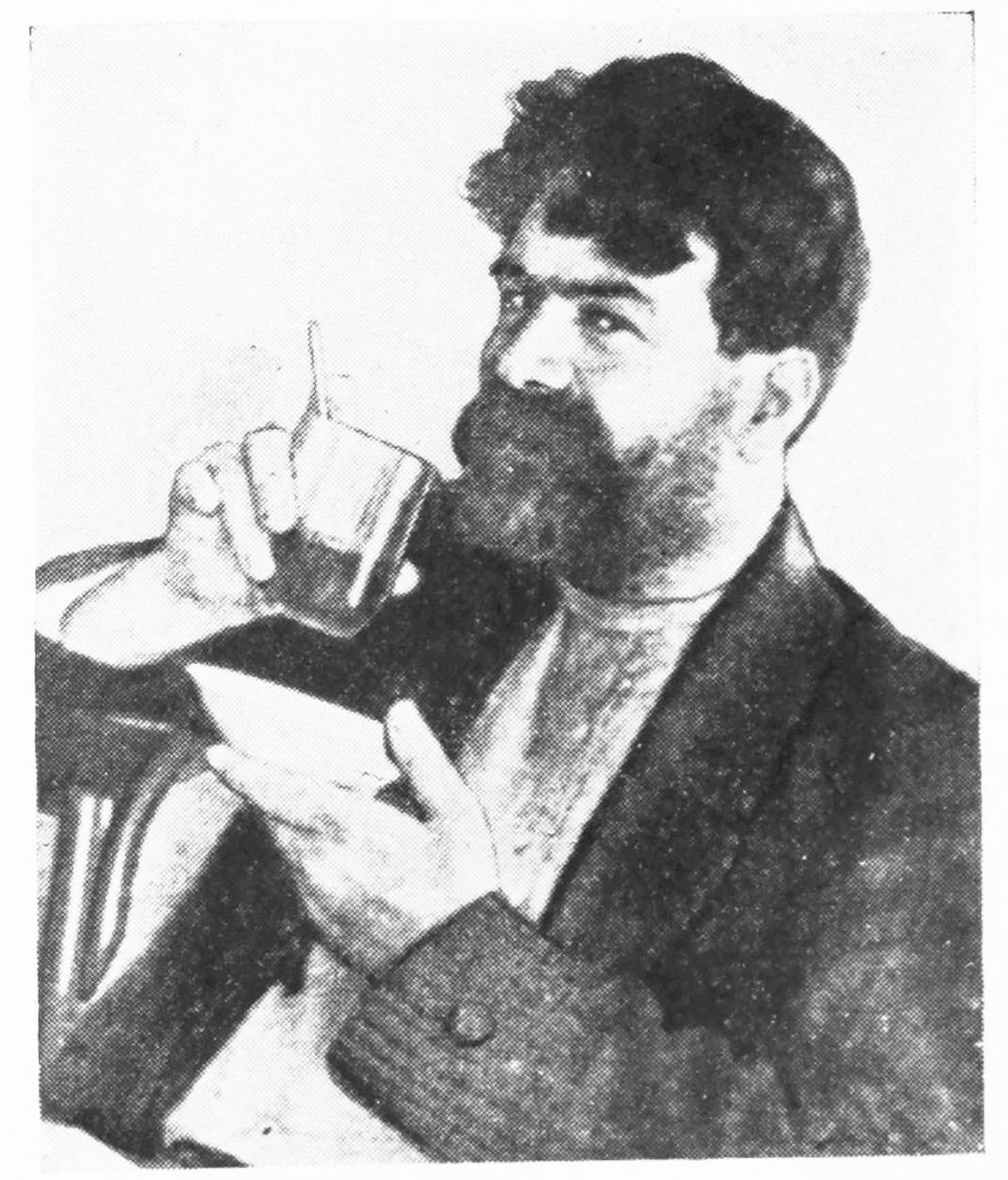
YANKEL YUROVSKY, THE MURDERER
He shot the Tsar and the Tsarevich with his own hand.
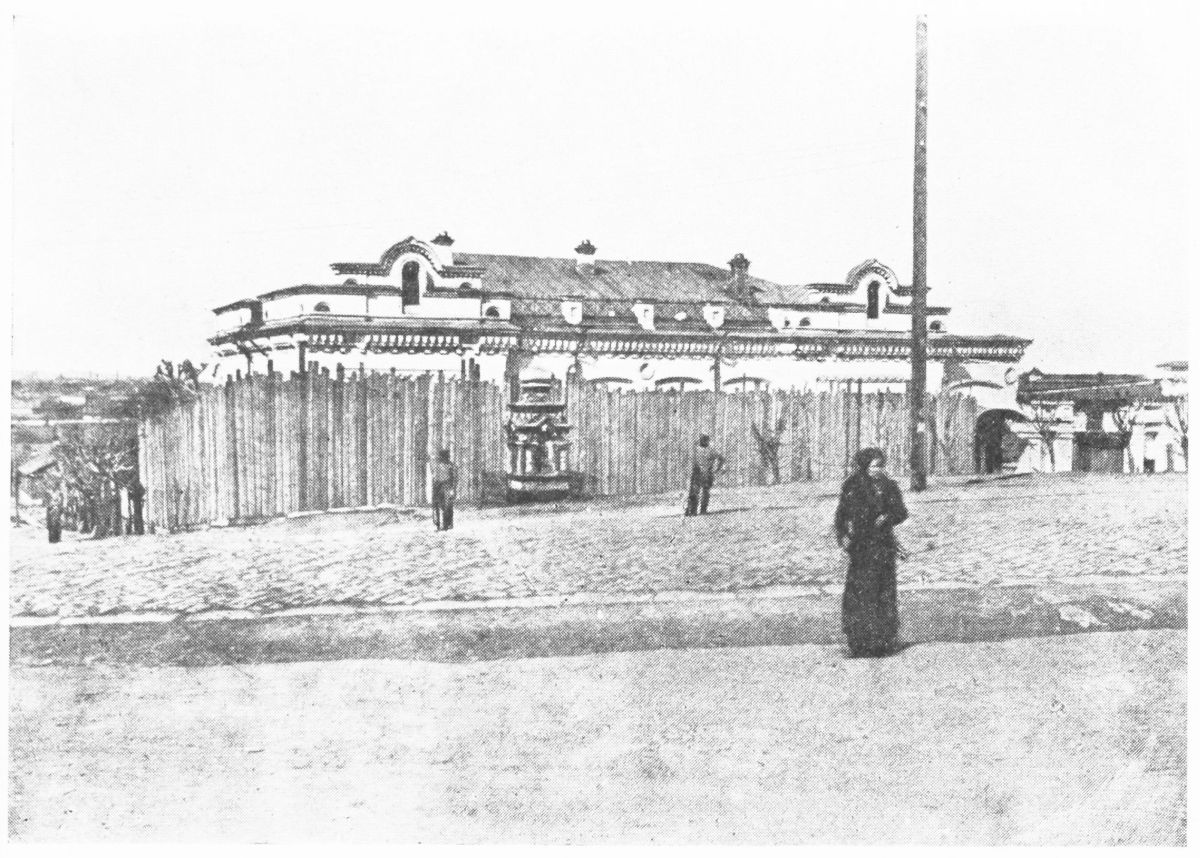
THE IPATIEV HOUSE: SHOWING THE STOCKADE AROUND THE HOUSE
The above photograph was taken in May, 1918, directly after the arrival of Nicholas, Alexandra and Maria. Their jailers had had time to put up only the inner fence. The outer stockade, erected later, inclosed the gateway and approaches to the house. Machine-guns were mounted at different points within the inclosure and in the garret. Note the shrine on the left.
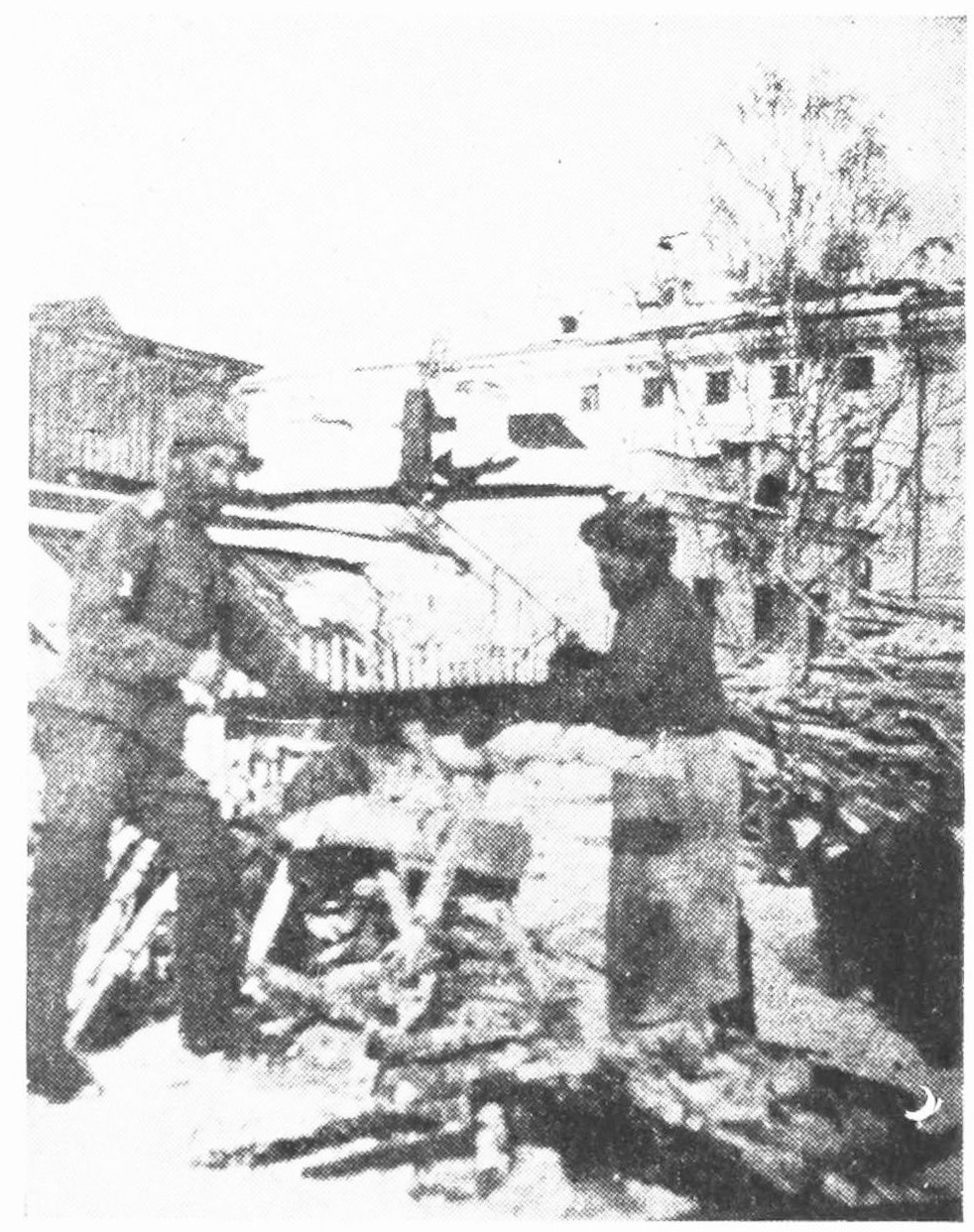
THE TSAR SAWING WOOD IN THE COURTYARD OF THE governor’s PALACE, TOBOLSK
It is winter. He wears the papaha (military fur hat) and felt boots.
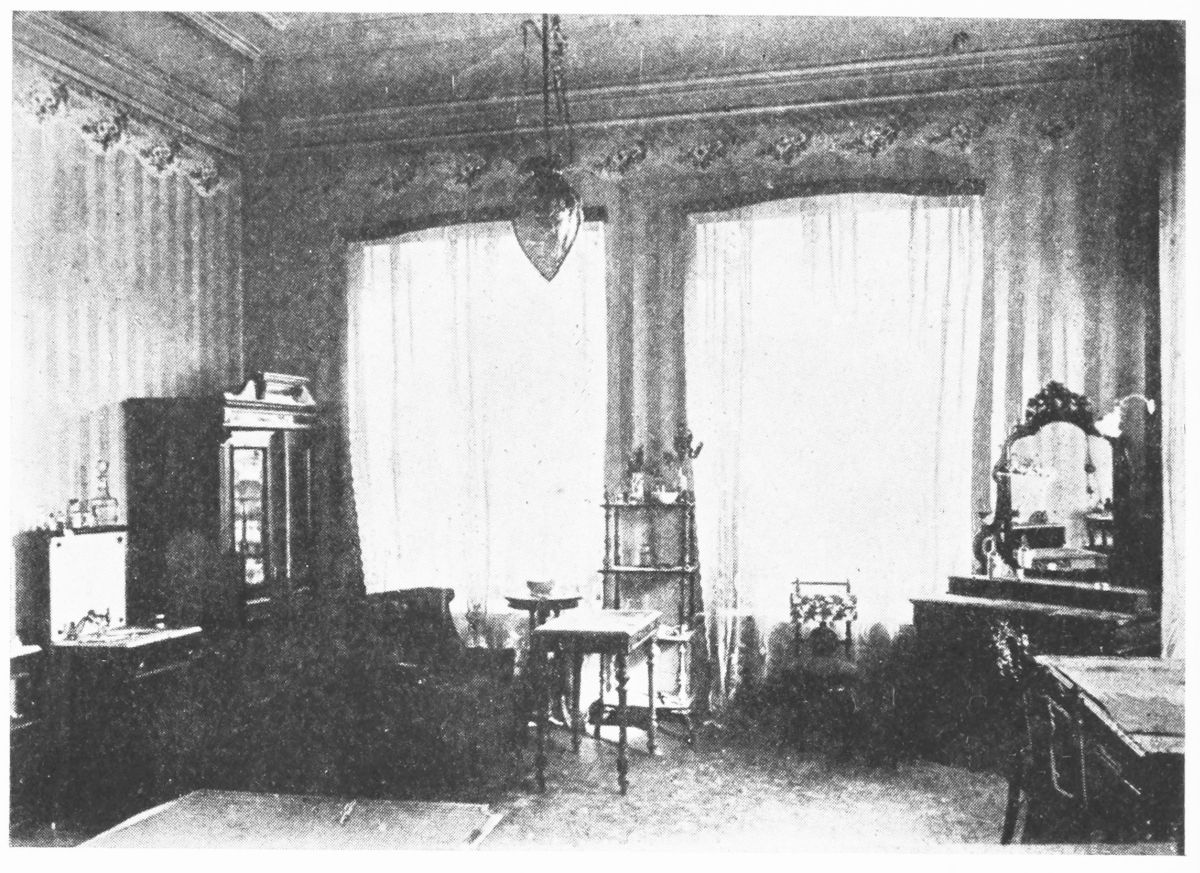
BED-ROOM OF THE EMPEROR AND THE EMPRESS IN THE IPATIEV HOUSE
November 1st, of my own will, I went to Motoviliha and remained there. After the place came under the rule of the supreme ruler I was mobilised, participated in battles with the Reds and finally was arrested.
I remember another fact in the life of the emperor. On one occasion I entered the commandant’s room and met there Nikoulin and Kabanoff. I heard Nikoulin asking Kabanoff what he spoke about with the czar during the time of his walk. Kabanoff replied that the emperor asked him if he had not been previously in a certain cuirassier regiment. Kabanoff answered that he had been and added also that once, during the time he was in the regiment, the regiment was reviewed by the czar. We were all surprised at the czar’s memory.
I can not say what became of the boy who stayed with the imperial family. On one of the days immediately following the murder I saw the boy from a distance; he was sitting in the room where the Sissert workmen were dining and was weeping bitterly so that his sobs were heard by me. I did not go towards him, nor did I ask him any questions. I was told that the boy learned about the murder of the imperial family and began to cry.
On July the 17th, after I became calmer, I went to Medvedeff’s room. In this room I met another man who had previously obtained the supplies for the imperial family and the guardsmen. I began to question Medvedeff about the murder. Medvedeff told me that shortly after twelve in the night, Iourovsky woke up the imperial family and said to the czar: “An attack is being prepared on the house, I must transfer you all to the lower room.” They all came down. In reply to my question who did the shooting, Medvedeff answered that it was the Letts. When I asked where the bodies were taken, he told me that the bodies were taken by Iourovsky and the Letts on an automobile to the Verkh-Issetsk Works and there in a wooded place by the swamp all the bodies were put in one hole that was previously prepared and covered with earth. I remember he said that the automobile sank and only with great difficulty arrived at the grave.
I know that Avdeieff, before being appointed commandant of the Ipatieff house, went to Tobolsk to get the czar and his family. He was accompanied by Hohriakoff, who was afterwards killed at the front and buried with great ceremony in Perm by the Bolsheviki.
I also remember that when I went to Yekaterinburg I heard in the car two workmen saying that the czar had left Yekaterinburg. All of us who were of the guards began to tell them that the czar had been shot.
I can’t explain anything else. My testimony has been read to me, and is correct.
(Signed) Anatolie Alexandrovitch Iakimoff. N. Sokoloff.
VI EXAMINATION OF PAVEL MEDVEDEFF
[The deposition of Pavel Medvedeff, the former workman at the Sissert Factory, reveals a more hardened character than that of Yakimoff. He regards events in the cold light of reason, and offers no comment either of pity or of dislike. As he informed the member of the District Court, the fate of the czar and his family did not “interest” him. But it is worthy of notice that this unemotional workman insists that he took no part whatever in the actual murder, which implies that the tragedy was repugnant even to a man of his type.
His account also bears the imprint of truth. It is evident from it that Medvedeff possessed no imagination, and he describes the blood-stained room, and the bleeding corpses exactly as everyday occurrences. There is no attempt to impress his interrogator. His standpoint is: “I saw these things, this is how they happened. I have nothing more to say.”
His account of the disposal of the corpses differs from that of Yakimoff. It agrees, however, that the route taken by the motor lorry was in the direction of the Verkh-Issetsk Works.—Editor’s Note.]
On February 21, 1919, in the town of Yekaterinburg, a member of Yekaterinburg district court, J. Sergeeff, examined the person named below as one of the accused, in accordance with Article No. 403-409 of the Code of Criminal Procedure. The accused deposed as follows:
I am Pavel Spiridonovitch Medvedeff, thirty-one years of age, and belong to the Orthodox Church; able to read and write; born a peasant of the Sissert factory of the Yekaterinburg district. I have a house belonging to me at the factory.
In September, 1914, I was mobilised and assigned to the Opolchenskaia Drujina (33rd territorial battalion), located in the town of Verhotourie. I stayed with the battalion for two months. I was then discharged and exempted from military service, on account, I believe, of being employed as a munition worker.
After the February revolution, in April, 1917, I joined the Bolshevik party, as the majority of the workmen in our factory did. During three months I paid to the party treasury one per cent of my wages. Then I ceased to pay because I was not willing to participate in the activities of the party.
After the October revolution, in January, 1918, I was enlisted in the Red army and in February they sent me to the front to fight against Dutoff. Commissar Sergius Mrachkovsky was in command of my detachment. We were fighting in the vicinity of Troizk, but our fighting was not a success, as we did more wandering on the steepes than actual fighting. In April I came home on leave and spent three weeks there. In the second half of May the above-mentioned Commissar Mrachkovsky came to our factory and began to recruit workmen for a special detachment which was assigned to guard the house where the former emperor, Nicholas II, and his family lived. The conditions appeared attractive to me and I enlisted. Altogether thirty workmen were enlisted.
On May 19, 1918, the detachment recruited by Commissar Mrachkovsky came to Yekaterinburg and was quartered in the Novy Gostiny Dvor (new market house), where we lived till May 24th. According to the order of the Ural district soviet, we elected from amongst our number two seniors. Alexis Nikiforoff and I were elected. On May 24th our detachment was transferred to new quarters, to the lower floor of the Ipatieff house. The same day the former emperor with his family arrived. They were placed in the upper floor of this same house. The whole upper floor of the house was at their disposal, except one room (to the left from the entrance), which was occupied by the commandant of the house and his assistant. Alexander Avdeieff, workman of the Zlokasoff factory, was the commandant. Moshkin (I don’t remember his Christian name) was his assistant. Two other men were also quartered in the commandant’s room. I do not know their names, but I know they were Zlokasoff workmen.
As soon as our party arrived at the Ipatieff house the commandant ordered me, as I was senior, to receive the prisoners. Together with Avdeieff and Moshkin I entered the corner room (the czar’s bedroom). The following persons were there: The emperor, his wife, son, four daughters, Dr. Botkin, the cook, the waiter and a boy. (I do not know their names.) After having counted the party and finding that they were twelve in number, we left, without having spoken to them. In the room adjoining the czar’s bedroom were placed the czar’s four daughters. At first there were no beds for them. After two or three days the beds were put in. The commandant was in charge of the internal life in the house; the guards performed only sentry duty. At first the guards were on duty in three turns, but later in four. We stayed in Ipatieff’s house two or three weeks, after which we were transferred to Popoff’s house, which was exactly opposite Ipatieff’s house. In a few days after this the guard was augmented by fourteen more workmen from the Zlokasoff factory, which is situated in Yekaterinburg. These Zlokasoff workmen also elected their senior, by the name of Iakimoff. There were altogether eleven sentry posts; two were inside the house; two by the machine guns; and four outside the house.
Every day the czar’s family used to walk in the garden. The heir was sick all the time and the emperor carried him to his wheel chair. At the beginning, dinner for the family was brought from the soviet’s dining-room; but afterwards they were allowed to prepare their own dinner in the kitchen of the upper floor. The seniors’ (guard captains’) duties were to take charge of the food and supplies of the guardsmen, to change the sentries, and supervise them. When on duty the senior had to stay in the commandant’s room. At first the seniors took turns every twelve hours in performing their duties. Then the third senior was elected, Constantine Dobrynin, and after this we did duty in eight-hour shifts. At the end of June or at the beginning of July (I don’t remember exactly), the commandant, Avdeieff, and his assistant, Moshkin were removed (it seems that they were suspected of stealing the czar’s belongings). A new commandant was assigned; his name was Iourovsky. The new commandant’s assistant arrived with him. His name I do not remember. In the evening of July 16th the time of my duty had just begun, when between seven and eight p. m. the commandant, Iourovsky, ordered me to take all the Nagan revolvers from the guardsmen and to bring them up to him. I took twelve revolvers from the sentries as well as from some other guardsmen and brought them to the commandant’s office. Iourovsky announced to me: “We will have to shoot them all tonight; notify the guardsmen not to be alarmed if they should hear the shots.” I understood that Iourovsky had in mind to shoot the whole of the czar’s family as well as the doctor and servants who lived with them, but I did not ask him where or by whom the decision was made. I must tell you that the boy who assisted the cook, in accordance with Iourovsky’s order, was transferred in the morning to the guardsmen’s rooms in the Popoff house. The lower floor of Ipatieff’s house was occupied by the Letts from the Letts commune who took up their quarters there after Iourovsky was made commandant. They were ten in number. At about ten o’clock in the evening, in accordance with Iourovsky’s order, I informed the guardsmen not to be alarmed if they should hear firing. About midnight Iourovsky woke up the czar’s family. I do not know if he told them the reason they were wakened and where they were to be taken, or not. I positively affirm that it was Iourovsky who entered the rooms where the czar’s family was. Iourovsky had not ordered me or Dobrynin to waken the family. In about an hour the whole of the family, the doctor, maid and two waiters got up, washed and dressed themselves. Just before Iourovsky went to wake the family up, two members of the extraordinary commission arrived at Ipatieff’s house. Shortly after one o’clock in the night the czar, czaritza, their four daughters, the maid, the doctor, the cook and the waiter left their rooms. The czar carried the heir in his arms. The emperor and heir were dressed in “Gimnasterkas” (soldiers’ shirts) and wore caps. The empress and the daughters were dressed, but their heads were uncovered. The emperor with the heir proceeded first. The empress, her daughters and the others followed him. Iourovsky, his assistant, and the two above-mentioned members of the extraordinary commission were accompanying them. I was also present. During my presence nobody of the czar’s family asked anybody any questions. They did not either weep or cry. Having descended the stairs to the first floor, we went out into the court, and from there by the second door (counting from the gate) we entered the lower floor of the house. When the corner room, adjoining the storeroom with a sealed door, was entered, Iourovsky ordered chairs to be brought. His assistant brought three chairs. One chair was given to the emperor, one to the empress, and the third to the heir. The empress sat by the wall with the window, near the back pillar of the arch. Behind her stood three of her daughters (I knew their faces very well, because I saw them every day when they were walking, but I didn’t know them by name). The heir and the emperor sat side by side, almost in the middle of the room. Dr. Botkin stood behind the heir. The maid, a very tall woman, stood by the left post of the door leading to the storeroom; by her side stood one of the czar’s daughters (the fourth). Two servants stood at the left from the entrance of the room, against the wall separating the storeroom.
The maid had a pillow. The czar’s daughters also brought small pillows with them. One pillow was put on the empress’s chair; another on the heir’s chair. It looked as if all of them guessed their fate, but not a single sound was uttered. At the same time eleven men entered the room: Iourovsky, his assistant, two members of the extraordinary commission, and seven Letts. Iourovsky ordered me to leave, saying: “Go to the street, see if there is anybody there and if the shots can be heard.” I went out to the court which was enclosed by a fence, and before I could get out to the street I heard the firing. Immediately I returned to the house (only two or three minutes having elapsed), and on entering the room where the execution took place, I saw all the members of the czar’s family lying on the floor, having many wounds in their bodies. The blood was running in streams, the doctor, the maid and the waiters were also shot. When I entered the heir was still alive and moaned. Iourovsky went up and fired two or three more times at him. The heir grew still.
The aspect of the murder and the smell and sight of the blood made me sick. Before the assassination Iourovsky distributed the revolvers; he gave me one also, but, as I said before, I did not take part in the murder. After the assassination Iourovsky said to me that I was to bring some guardsmen to wash up the blood in the room. On the way to Popoff’s house I met two seniors, Ivan Starkoff and Constantine Dobrynin. They were running in the direction of Ipatieff’s house. Dobrynin asked me: “Has Nicholas II been shot?” I answered that Nicholas II and the whole of his family had been shot. I brought twelve or fifteen guardsmen with me. These men carried the bodies to the motor truck that stood near the entrance of the house. The bodies were carried on stretchers that were made from bed sheets and shafts of sledges taken from the court. When loaded on trucks they were wrapped in soldiers’ clothing. The driver was Luhanoff, a Zlokasoff workman. The members of the extraordinary commission sat on the truck and the truck went away. I do not know in what direction the truck went, neither do I know where the bodies were taken.
The blood in the room was washed out and everything was put in order. At three o’clock in the morning everything was in order. Then Iourovsky went to his room and I went to the guardroom.
I woke up after eight o’clock and went to the commandant’s room. I met there the president of the district soviet, Beloborodoff and Commissar Goloschekin and Ivan Starkoff; the last-named was on duty (he had been selected to be senior two or three weeks before). All the rooms in the house were in disorder. Things were scattered. Suit-cases and trunks were opened. Piles of gold and silver things were laid on the tables of the commandant’s room. Objects of jewelry which were taken from the members of the czar’s family just before the murder, were also there; as well as things that were on them after their death, such as bracelets, earrings and watches. The precious objects were put into trunks that were brought from the coach house. The assistant commandant was present. In one of the rooms I found under the Holy Bible six ten-rouble bank notes and appropriated them. I took also several silver rings and a few other trifles.
On the morning of the 18th my wife arrived and I went with her to the Sissert factory. I was instructed to distribute wages to the guardsmen’s families. On July 21st I returned to Yekaterinburg. All the czar’s belongings were already taken from the house and the guards relieved. On July 21st I left Yekaterinburg together with the commissar, Mrachkovsky. In Perm the Commissar Goloschokin assigned me to the party that was in charge of preparations for the destruction of the stone bridge, in case of the appearance of the White troops. I had not time enough to blow up the bridge, according to the instructions received by me, and furthermore I did not wish to do it either, as I was to surrender myself voluntarily. I received the order to blow up the bridge when it was under the fire of the Siberian troops and I surrendered voluntarily.
Answering the question as to where the bodies of the killed were taken, I can say only the following: On the way from Yekaterinburg railway station to the Alapaievsk I met Peter Ermakoff and asked him where the bodies had been carried. Ermakoff explained to me that the bodies were thrown down the shaft of a mine near the Verkh Issetsk works and after that the shaft was destroyed by bombs or explosives in order to fill it up. I do not know and never heard anything concerning the wood piles that were burned near the shaft. I do not know anything more as to where the bodies are. It did not interest me on whom depended the fate of the czar’s family and who had the right to dispose of them. I executed only the order of those in whose service I was.
The above is all that I can tell in reference to the accusation that is made against me. I can not say any more. My testimony has been read to me and it is taken correctly.
(Signed) Medvedeff. Member of the Yekaterinburg District Court, J. Sergeeff.
RESOLUTION:
On February 22, 1919, in the town of Yekaterinburg, a member of the District Tribunal, Sergeeff, having questioned the peasant, Pavel Medvedeff, prosecuted as an accomplice in the assassination of the former emperor and the members of his family, and considering what measures must be taken to prevent his escape from further inquiry has found:
(1) That Medvedeff is indicted for a crime that may be punished by a very serious penalty; (2) that before having been arrested, he was hiding himself in the Red army; and, previous to that, he escaped from Yekaterinburg just before the said town was taken by government troops. On account of the foregoing, it was resolved to put Pavel Medvedeff, thirty-one years old, under arrest in the Yekaterinburg prison.
(Signed) Member of the Yekaterinburg District Court,
J. Sergeeff.
VII RECEIPT OF BELOBORODOFF FOR THE ARRESTED RUSSIAN IMPERIAL FAMILY
THE WORKMEN’S AND PEASANTS’ GOVERNMENT OF THE RUSSIAN FEDERATIVE REPUBLIC OF SOVIETS URAL DISTRICT SOVIET OF THE WORKMEN’S, PEASANTS’ AND SOLDIERS’ DEPUTIES
Presidio
Yekaterinburg, April 30, 1918.
“On the 30th of April, 1918, I, the undersigned, Chairman of the Ural District Soviet of Workmen’s, Peasants’ and Soldiers’ Deputies, Alexander Georgievitch Beloborodoff, received from the Commissar of the All Russian Central Executive Committee, Vasily Vaselievitch Iakovleff, the following persons transferred from the town of Tobolsk: (1) The former czar, Nicholas Alexandrovitch Romanoff; (2) former czaritza, Alexandra Theodorovna Romanova; (3) former grand duchess, Maria Nicholaevna Romanova—all of them to be kept under guard in the town of Yekaterinburg.
(Signed) A. Beloborodoff, Member of District Executive Committee, D. Didkovsky.