Holly.... Foresight.
Reading edition
The Holly, with its scarlet berries, is the most beautiful of the evergreens that have been used for ages to adorn the churches of old England, during the Christmas season. It is an ornament to the woods, stripped bare by the rude breath of winter; its berries serve for food for the little birds that never leave us, and its foliage affords them an hospitable shelter during the cold season. Nature, by a seeming forethought, has been careful to preserve the verdure of this handsome tree all the year round, and to arm it with thorns, that it may furnish both food and protection to the innocent creatures which resort to it for shelter. It may be added, however, that from the bark of the common Holly, when fermented and washed from the woody fibres, is made the bird-lime which is used for catching small birds.
With Holly and ivy, So green and so gay, We deck up our houses As fresh as the day; With bays and rosemary, And laurel complete, And every one now Is a king in conceit. Poor Robin’s Almanac, 1695.
the holly tree. O Reader! hast thou ever stood to see The Holly tree? The eye that contemplates it well perceives Its glossy leaves, Ordered by an intelligence so wise As might confound the atheist’s sophistries. Below, a circling fence its leaves are seen, Wrinkled and keen; No grazing cattle, through their prickly round Can reach to wound; But as they grow where nothing is to fear, Smooth and unarmed the pointless leaves appear. I love to view these things with curious eyes And moralize; And in this wisdom of the Holly tree Can emblems see, Wherewith, perchance, to make a pleasant rhyme, One which may profit in the after-time. Thus, though abroad, perchance I might appear Harsh and austere, To those who on my leisure would intrude Reserved and rude, Gentle at home amid my friends I’d be, Like the high leaves upon the Holly tree. And should my youth, as youth is apt, I know, Some harshness show, All vain asperities I day by day Would wear away, Till the smooth temper of my age should be Like the high leaves upon the Holly tree. And as when all the summer trees are seen So bright and green, The Holly leaves a sober hue display, Less bright than they; But when the bare and wintry woods we see, What then so cheerful as the Holly tree? So serious should my youth appear among The thoughtless throng, So would I seem amid the young and gay More grave than they, That in my age as cheerful I might be As the green winter of the Holly tree. Southey.
To know the road ere on’t we trust the foot, And where it leads, and what, while journeying, We may meet, is Wisdom’s eager wish. Peerbold.
Walk Boldly and wisely in that light thou hast; There is a hand above will help thee on. Bailey.
Meadow Saffron.... My best days are past.
The Meadow Saffron, or Colchicum Autumnale, springs up about the time the leaves begin to fall from the trees, and may, therefore, be said to proclaim to all nature, that the bright days of summer are past. According to Ovid, this autumnal flower owes its origin to some drops of the magic liquor prepared by Medea, to restore the aged Æson to the bloom and vigour of youth, which were spilled in the fields. As a medicine, the Colchicum is powerful, but dangerous, and must be used with caution. The poisonous quality of the plant seems to be known, as if by instinct, to all kinds of cattle. They all shun it, and in many pastures this alone will be found standing, when all other herbage has been consumed.
Why grieve that time has brought so soon The sober age of manhood on? As idly should I weep at noon To see the blush of morning gone. True, time will sear and blanch my brow: Well—I shall sit with aged men, And my good glass will tell me how A grisly beard becomes me then. And should no foul dishonour lie Upon my head when I am gray, Love yet may search my fading eye, And smooth the path of my decay. Bryant.
SWEET PEA PANSY I depart. Think on me.
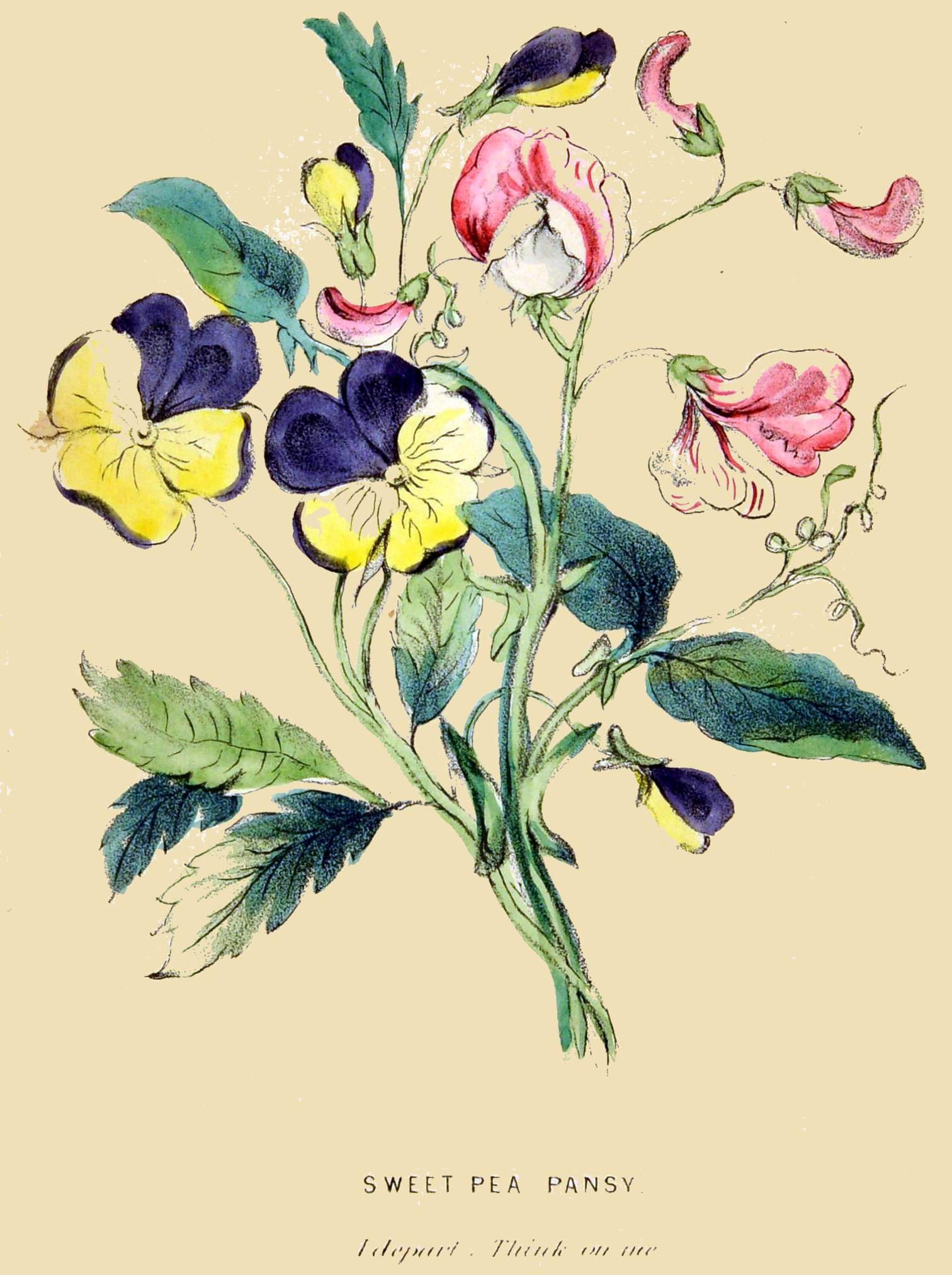
Oh! thou who dry’st the mourner’s tear, How dark this world would be, If, when deceived and wounded here, We could not fly to thee! The friends who in our sunshine live, When winter comes, are flown; And he who has but tears to give, Must weep those tears alone: But thou wilt heal that broken heart, Which, like the plants that throw Their fragrance from the wounded part, Breathes sweetness out of wo. Moore.
Then bright from earth, amid the troubled sky, Ascends fair Colchicum, with radiant eye, Warms the cold bosom of the hoary year, And lights with beauty’s blaze the dusky sphere. Darwin.
The world around me groweth gray and old: My friends are dropping one by one away; Some live in distant lands—some in the clay Rest quietly, their mortal moments told. And when my children gather at my knee To worship God and sing our morning psalm, Their rising stature whispers unto me My life is waning towards its evening calm. MacKellar.