Mrs. George de Horne Vaizey (continued 5)
Reading edition
Spectacular indeed! I was too perturbed, too anxious to speak. Evidently Delphine had been going in for an orgie of extravagance; a pretty serious one too, since it had attracted the attention of a mere man; and some of the responsibility seemed to fall on my own shoulders! I determined to write her a letter that very night, and in absent-minded fashion began to compose its sentences as I poured out second cups of tea. “Although I have not written, you must not think that I have forgotten you. I am leading a busy life, and have little time to spare, but if you should ever need me; if there ever comes a time when you feel I can be of real help, write to me through my lawyers, and I could meet you in town, or even run down for the day.”
Yes, that would do! That would open the way for confidences, if she were in a mood to make them. In any case, I should feel more satisfied in my own mind when I had sent off the message, and shown that I was to be found if needed.
Looking up suddenly from the tea tray I beheld Ralph Maplestone smiling to himself across the table, with precisely the same mysterious accession of complaisance that I had noticed on his first visit to the flat. Our eyes met, and he turned aside, drawing in his lips to hide the smile, but the light danced in his eyes, and refused to be quenched.
Most mysterious and perplexing! His moods are evidently very variable. I am glad he was pleased, but I should very much like to know why!
Chapter Twenty Two.
Mrs Merrivale’s Appeal.
Every one has noticed that the thought of a friend after a spell of forgetfulness is frequently the harbinger of a sudden meeting, or of the receipt of a letter or message. Such happenings are called “curious coincidences”; but personally I don’t consider them curious at all, or at least no more curious than it is to send a message by telephone, and to hear in reply a familiar voice speaking across the space. When the heart sends forth a wireless message of love and goodwill, surely, if we have in any sense grasped the wonderful power of thought, we must believe that the message reaches its destination, and calls forth a response! Right thoughts—thoughts of love and pity and helpfulness—are prayers winged to heaven and earth; bad thoughts—mean and grudging and censorious—well, they injure the person who thinks them so much, that there can’t be much poison left for the recipient. In any case, such leaden things can’t rise.
This moralising leads up to the fact that while my own letter to Delphine lay unfinished on my desk, a note arrived from Ralph Maplestone, to give me grave news of her husband.
“I am summoned home,” he wrote, “in my capacity of vicar’s warden. While I have been in town, poor Merrivale has had an attack of influenza, which has been pretty serious, and has left him rather alarmingly weak. I insisted upon calling in a consultant from B—, whose verdict is that the lungs are seriously threatened. I have feared it for some time, and am glad that he is now forced to take care. He is ordered complete rest, and is to get out of England for the spring months. I shall be kept busy here for some weeks, but expect to run up to town for a day’s business now and then, when I will give myself the pleasure of calling on you. Meanwhile, will you kindly pass on the news to Miss Wastneys. I know she will be interested. I rely on you to fulfil your kind promise.” By the same post came a letter from Charmion, tentatively breaking the news that she would not return for Christmas. Several minor reasons had contributed to this decision, but the big one was that she was still “working out her cure” and could do it better in solitude. What about me? Would I go to Ireland? Could I work in a visit to friends? Rather than think of me sitting alone in my dreary little flat, she would put everything on one side, and come rushing home.
“Dreary little flat, indeed!” I looked round the dainty, rose-lit room, and laughed a derisive laugh. It was strange. I did not feel a bit depressed. Life in the basement flat was very full, very interesting, of late days thrillingly exciting into the bargain. I was not at all sure that I wanted to go back to “Pastimes” so soon. Christmas in the flat offered endless possibilities. I would have a tree! Mrs Manners should help me. Her children would come, and all the Thorolds, and their father, and Mr Hallett. There should be lots of toys, and lots of baubles, but useful things too! Things which should truthfully be “just what I wanted!” Perhaps I would be noble and forgiving and ask Eric and Claudia and Moreen. Poor mites, it wasn’t their fault that their mother wore false pearls! The tree should be on Christmas Eve, and on Christmas night I would invite the grown-ups to dinner, and give them a light, dainty feast, with never a shadow of roast beef or plum pudding! They could do their duty by convention at the midday meal.
In two minutes’ time I had thought out the whole menu, even the decorations on the table. What fun it would be! How they would all enjoy it! How little Mrs Manners would revel in the shopping expeditions! Her present should be a pretty blouse—something pretty, bought with a view to what is becoming, and not to what will be useful, and wear for several seasons, and then cut up into dusters. An occasional extravagance is such a tonic to a feminine mind! As for the men, Mr Thorold should have a box of cigars. Mr Hallett should have the same. And in the deadliest secrecy I would commission each to buy for the other. Then they would be sure to get the right brand.
As for “Pastimes”—our guest tenant would be delighted to have her stay extended. I wondered if the gardener would pine for Bridget! I wondered if—anyone—would pine for me! Personally the prospect of occasional “calls” pleased me better than the thought of meetings in the country, under the Argus eye of village gossips. In the latter case one would be self-conscious and restrained; in the former, safe from observation, doubly sheltered behind wig and spectacles, there could be no doubt as to which position afforded the better opportunity of getting to know a man’s character.
I wrote a letter to Charmion, reassuring her as to Christmas in my “dreary flat”; I tore up the unfinished note to Delphine, and sent another, assuring her of my sympathy, repeating my offers of help. Poor little girl! Her real love for “Jacky” would be in the ascendant now, and all the pleasure and vanities for which she had pined would seem trivial things, compared with his dear life.
I did not write to Mr Maplestone. The difficulty of handwriting came in, and there was no real necessity to answer his note. If I knew Delphine, she would find it a relief to pour forth her woes on paper. I waited confidently for a letter to appear.
Two days passed by, three; I was growing anxious, and debating if I should write again, when there came a loud rat-tat at the door, and a reply-paid telegram was handed in, addressed to Miss Wastneys:—
“Letter received. Need urgent. Unable to leave. Can you come to-morrow. Beg you not to refuse. Delphine.”
I seized a pencil, scribbled a hasty “Expect me by train arriving twelve,” and having despatched the promise, sat down to consider how I was to keep it. What an excitement to think of feeling young again, and being able to devote my attention to looking as nice as I could, instead of laboriously contriving disfigurements! Under my bed lived a box wardrobe on wheels, in which, carefully stretched and padded to avoid creases, reposed a selection of garments which were certainly not suited to old Miss Harding’s requirement. Mentally I reviewed them, selected the prettiest and most becoming, saw a vision of myself putting the last touches before the glass, with Bridget’s beaming face watching every stage. Oh, it would be an exhilarating variety, and easy, too—perfectly easy. I would give the orphan leave of absence for two days, and send her rejoicing to stay with “me aunt”. Then in leisurely enjoyment I would make my toilette and march complacently into the street. We possess no porter in our modest mansions; ten to one I should pass through the hall unseen, and even if I had the ill-luck to encounter a neighbour—well, if my disguise is good enough to deceive Ralph Maplestone, it can surely defy less interested eyes!
Bridget was as excited as I was. She hustled the orphan out of the flat, and superintended my toilette as eagerly as though I were dressing for a wedding, instead of a country visit.
“Praise the fates, we’ll see you looking yourself again! I never was in favour of this dressing up, and playing tricks with a face which anyone else would be proud to have, and to take care of. Not that you hadn’t more sense than I gave you credit for! We’ve been a godsend to this place, and if anyone doubts it, let ’em look at the kitchen book, and see the pounds of good meat I’ve made into beef tea with me own hands. And you running about by day and by night, waiting on ’em all in turns. There’s no doubt but we’ve done good, but what I say is—why not do it with your own face?”
“Don’t be foolish, Bridget! I couldn’t do it! Look at me now!”—I swirled round to face her, with a rustle of silk and a flare of skirts. “Do I look the sort of person to wheel out prams, and give tea parties to widowers, and be looked upon as a prop and support by my neighbours?”
Bridget chuckled.
“Go away wid you then!” said she, and that was the end of the discussion.
I met no one in the hall. I met no one in the street. I jumped into a taxi at the corner and drove off to the station without running the remotest chance of detection. It was so easy that I determined to do it again! Every now and then just for a change—just to remember what it was like to look nice! I arrived at the station and took my ticket. There was no one I knew upon the platform. I walked to the further end, and took a seat in an empty first-class carriage. The collector came round and looked at the tickets; there was a banging all down the length of the train, a sharp call, “Take your seats, please; take your seats!” The door of my compartment opened and shut. Ralph Maplestone seated himself in the corner opposite mine!
“How do you do, Miss Wastneys,” said he, as cool as a cucumber.
“How do you do, Mr Maplestone,” said I, as red as a beetroot.
Was it chance? Was it coincidence? Was it a deep and laborious plan? Had he heard from Delphine of my coming and rushed to town for the express purpose of returning in my company? It looked very like it. My wire could not have arrived at the Vicarage until after five in the afternoon, and the next train to town left at nine p.m. There was also an early morning one at eight-thirty. My brain seethed with curious questions, but there seemed only a moment’s pause before I spoke again:—
“Have you been staying in town?”
“Er—” his eyes showed a faint flicker of amusement—“not long. You are going down to see Delphine, I suppose. That’s good of you. She needs bucking up. The Vicar’s pretty bad, but with rest and change there’s no reason why he shouldn’t pick up. We are arranging to make things easy for them. It will do him no good if she makes herself miserable.”
“That’s the sort of futile remark that outsiders generally make on these occasions. They make me furious!” I cried, glad of an excuse to work off my self-consciousness in a show of indignation. “Perhaps it won’t; but as he belongs to her, and she loves him, she can hardly be expected to be happy! In illness all the sympathy is lavished on the invalid. In reality, the relations are more to be pitied. It’s far easier to lie still and bear physical pain than it is to be wracked with anxiety, and fatigue, and responsibility all at the same time.”
He said, looking at me with an air of the most profound attention:—
“You are thinner than you were. Your face is thinner—”
“We were not talking about my face. How long has Mr Merrivale really been ill?”
“It’s difficult to say. He is the sort of fellow who never thinks about himself, and Delphine is not—not exactly noticing! I fancy she blames herself now; but he never complained, and always went on working at full pressure, till this attack came on, and he went down with a crash.”
“And now? How does he seem now?”
His forehead wrinkled into lines.
“Depressed. Nervous. Inclined to be jumpy. He has lived for his work, and hates the idea of giving up, even for a time. He has overtaxed his strength for years, and his nerves are bound to play up. However, once we get them off to the sun, he’ll soon pull round.”
“And when do they—”
“As soon as possible. It is Delphine who is putting things off. So far as Merrivale himself is concerned, the sooner he starts the better. He’ll not grow any stronger where he is. When are you coming back to ‘Pastimes’?”
“It’s uncertain. Not before Christmas. Is your mother quite well?”
“Quite, thanks. You know that I have made Miss Harding’s acquaintance. She is a charming old lady.”
“I’m so glad you like her. I knew you had called. Nice little flat, isn’t it?”
He growled, his face eloquent with disapproval.
“If you call it ‘nice’ to live burrowed underground! How sane people can consent to live in town, herded together in a building more like a prison than a home—”
“‘The goodness and the grace’ did not make us all country squires!” I said shortly, whereat he laughed—quite an easy, genial laugh, and twinkled at me with his blue eyes. It was extraordinary how natural and at his ease he appeared; so different from the stiff, silent man I had known at Escott!
The journey takes exactly sixty minutes, and we talked the whole way. For the first twenty minutes I was on my guard, nerving myself to say “No” for the second time, with due firmness and finality. For the next twenty I was friendly and natural. He was behaving so well that he deserved encouragement. During the third twenty I said less, stared out of the carriage window, and felt a disagreeable feeling of irritation and depression. He went on talking about books and gardens and parish difficulties, and I wasn’t interested one bit. One may not wish a man to propose to one for the second time; but, with the echo of vows of undying devotion ringing in one’s ears, it is rather daunting to go through an hour’s tête-à-tête without one personal remark! He had said that I was thin. Perhaps he found me changed in other ways. Perhaps on meeting me again he found he did not like me as much as he had believed. Perhaps he was glad that I had said “No”. We parted at the Vicarage gate; he apparently quite comfortable and composed, I in the lowest depths. What a change from last time!
The door opened, and before I had time to blink Delphine’s arms were round me, and a hot, wet cheek pressed against mine. She was sobbing in a hard, breathless way which made my heart leap; but even on the way to her sitting-room I gathered that my first fear was unfounded.
“Jacky was—the same! In bed. So tired—always so tired! Seems to care for nothing. Hardly even”—the blue eyes opened in incredulous misery—“for me!”
“When people are very weak, they can’t care. It takes strength even to love—at least, to realise that one loves. I never knew a man who adored his wife more than Mr Merrivale does you; but I expect it suits him better just now to lie quietly and snooze rather than to hold your hand and watch you cry.”
She looked guilty at that, and tossed her head with a spice of her old spirit. But the next moment her breath caught in a sob, and she cried desperately:—
“Oh, Evelyn, it’s all awful! Other things—everything—far worse than you know. I’m the most miserable creature in the world. I think I shall go mad. I sent for you because—”
“Hold hard for one moment! I’m hungry! I need my lunch! So do you, by the look of you. Shall we have it first, and tackle the serious business afterwards in your room, where we shan’t be interrupted. There will be plenty of time; I needn’t leave till five.”
“I ordered cutlets, and an omelette, and coffee afterwards. All the things you liked best when you were here. But I can’t eat a bite. It would choke me. I hate the sight of food.”
“Very well then—you can watch me eat mine,” I said, with the callousness of one who had heard dozens of people declare the same thing, and then watched them tuck into a square meal. Delphine proved another protester to add to the list. She ate her share of the meal with no sign of choking, and brightened into acutest interest at hearing of my escort from town. The fork stopped half-way to her mouth; her eyes widened to saucer size. In the sheer surprise of the moment she forgot her grief and anxieties.
“But—but—how could he be there? He was here last night. Quite late. Ten o’clock. Walked down after dinner to hear how Jacky was!”
I made a vague sweeping gesture, which was designed to express a lack of all responsibility concerning the Squire’s eccentricities, but Delphine’s suspicions were aroused, and she was not to be easily put off.
“He must have gone up by the workman’s train. And yours left at eleven. How very peculiar! And he said nothing last night. ... Did I tell him you were coming?” She wrinkled her brows in the effort to remember. “Yes, I did. He said something about taking me for a drive to freshen me up, and I said you would be here before lunch. Evelyn, he couldn’t possibly have gone to meet you!”
Evidently she suspected nothing. I tried to look composed and natural, and said lightly:—
“It seems preposterous, doesn’t it. He certainly did not say so.”
She stared at me curiously.
“What did you talk about? About us? Did he say anything about me?”
“Of course. What do you suppose? We had quite an argument, because he seemed to think it a pity that you should injure yourself by fretting, and I said I didn’t see how you could do anything else.”
She smiled, and tilted her head, her complacency restored.
“That was it, I suppose! He wanted to talk to you before you saw me. He is good. And you argued with him, you say? Disagreed, I suppose. Oh, well—men are always more tender-hearted than women.”
I felt annoyed, and munched in silence, staring fixedly at my plate. If this particular man was so much more understanding, why had she summoned me from town?
After lurch Delphine ran upstairs to see her husband for a few minutes, and then returned to me in her little sitting-room. He was tired, she said, and hoped to sleep until tea. She had not told him of my visit; he was so listless and apathetic that it worried him to talk, or to have people talk to him. “I don’t believe he will ever be the same again!”
“People always say that in the middle of an illness, but they find their mistake later on. After a long rest the Vicar will be better than he has been for years, and it will be your business to see that he never works so hard again. You were always longing for a change, Delphine. Think how you will enjoy Switzerland, sitting out in the crisp clear air, looking at those glorious mountains, with no house or parish to worry over—nothing to do but wait on your dear man, and watch him growing stronger every day!”
She looked at me dumbly, while the colour faded out of her cheeks, and the pretty curved lips twitched and trembled. I saw her clasp her hands, and brace herself against her chair, and knew that the moment for confession had come, and that it was difficult to find words.
“No worry!” she repeated slowly. “No worry! But that’s just what is killing me. I’m so worried, so worried that I feel sometimes, Evelyn, as if I were going out of my mind!”
“You mean—about your husband?” I asked, but the question was really put as a lead; I knew she was not referring to illness.
Delphine shook her head.
“That is bad enough, but it is not the worst. The worst is that through me—through my wretched, selfish, vain, discontented folly, I—I have made it difficult for him even to get well. I—I have got into a horrible mess, Evelyn, and when he hears of it—when he has to hear, he will be so worried, so miserable, so disappointed, that it will bring on a relapse, and he will probably be worse than before. We can neither of us be happy again—never, never, any more!”
“Sounds pretty bad!” I said, startled. “But there must be some way out, or you would not have sent for me to help you. You are going to tell me the whole truth, Delphine! Half confidences are no use. You will speak honestly, and—let me speak honestly to you?”
“Oh, yes! You will do, whether I allow you or not. I know you!”
“Well, then”—I bent forward, staring full in her face—“let’s get to the point. Is it another man?”
Her face answered, without the need of words. Amazed resentment blazed out of her blue eyes.
“Another man! I should think not! How hateful of you, Evelyn! I’m despicable enough, but I love Jacky. There’s no other man in the world for me. Of course,” she paused, and faintly smiled, as at a soothing recollection, “people admire me. I can’t help that, and there’s no harm so long as I don’t flirt. There’s the Squire. I think if I were not married, he might want—but I am married, and it’s the honest truth that I’ve never said a word to a man since our marriage that I shouldn’t be willing for Jacky to hear. No! it’s not that—”
“It’s money, then,” I said quickly. (So the Squire would “want,” would he? Oh, indeed!) “Delphine! you have been getting into debt?”
“Oh, how did you guess?” She turned her head over her shoulder, as though afraid some one might overhear. “Oh, Evelyn, nobody knows but you. I think I have been mad. Goodness knows what I expected to happen in the end. I was in a crazy, rebellious mood, tired to death of being dull and careful, and I had a wild spell of extravagance, ordered whatever I wanted, ran up bills in town. I went to your dressmaker. I was sick of making my own clothes, and looking a frump. I’m young, and I’m pretty, I wanted to look nice while I could. Every one said I did look nice; but she is a terror, that woman of yours! I had no idea of the bill!”
“You did not ask for estimates in advance?”
“How could I? I didn’t even know what to order. I just said, ‘A pretty dress for the afternoon.’ ‘A hat with roses.’ ‘An evening cloak.’ Descriptions like that. And there was the habit, too, and little things—oddments. They grow into mountains! And I bought furniture to make my room look pretty and homelike. You remember you said I deserved to have one nice room!”
Apparently this extravagance also could be traced to my influence! It was useless to waste any more words. I went straight to the point.
“How much?”
“Oh!” she started and shivered. “I’m ashamed to say. And now—we are going away, and the bills have to be paid. I’m a new customer, and they keep sending them in. And the house books! They have run on. Jacky gave me some money. I meant to pay them, honestly I did, Evelyn, but somehow the money frittered away till there wasn’t enough left. I paid some—but there are others left. Jacky would hate it, if we left the parish in debt.”
“How much?” I repeated, and she flushed to the roots of her hair.
“Over—a hundred! Nearer—two, I’m afraid, Evelyn!”
It was more than I had expected. I had to make fresh calculations, and revise several plans. Subconsciously, I had known that the trouble was monetary, and had made a special study of my pass book before leaving the flat.
“I can let you have a hundred at once, and settle the rest of the bills for you next month, if that will do.”
She looked at me with tear-filled eyes.
“Do you think I deserve it?”
“I’m not sure that you do, but Mr Merrivale does! He shan’t have any new worry just now, if I can prevent it. You are sure you have told me everything, Delphine? That is all!”
“I’ll show you the bills. I knew you would help. You were the only person I could bear to ask; but you did not wait to be asked. I do love you, Evelyn, and I shall never forget! You understand, don’t you, that it is only a loan? I shall pay you back!”
“I know you will, when you can. It’s a comfort that you need not hurry. I can wait for years.”
“You will have to, I’m afraid. Three years! I hadn’t a penny of my own when I married, but an old aunt left us all two hundred and fifty pounds, to be paid when we were twenty-five. That’s my fortune! Jacky teases me about it, for I was always planning what I will do when it comes. I had decided to buy a tiny two-seater, and learn to drive. I told him that it would be useful in the parish, but really I was thinking of the fun for myself. Are you shocked?”
“Not a bit!”
“Well, it would be a waste of energy if you were, for I shall never have it now. The money will go to repay you—and to pay interest on the loan. I shall pay five per cent.”
“I only get four.”
“I insist upon five! I should like to feel that you had made a good investment.” She waved her hand with a lordly air which made me laugh. And she laughed, too, with obvious enjoyment. “Oh, my dear, what a relief! I shall sleep happily to-night for the first time for weeks. I can never tell you how wretched I’ve felt; so worried, and guilty, and trapped! Honestly it will be a lesson for life. You have helped me for the moment, but my worst punishment is to come. When he is well again, quite strong and fit, I must tell Jacky!” Her face clouded. “He won’t say much, but his face! It will be an awful ordeal, but I suppose it will be good for me!”
I thought—but did not say—that it would be good for him too. The shock might teach him to be more understanding in his treatment of his girl wife.
Soon after that I suggested paying a flying call on the General, and Delphine assented eagerly, no doubt feeling, as I did myself, that it would be a relief to be spared a further tête-à-tête. The dear old man was delighted to see me, and was eager to hear when Charmion and I were coming back to “Pastimes”. Something in his manner, in the way his old eyes searched my face, made me suspect that he knows.
I travelled to town alone, and arrived at the flat feeling tired and dispirited. Bridget wanted to know if I had seen anything of her man. She also seemed a trifle out of temper.
“Some people,” she said darkly, “don’t know when they are well off!”
Chapter Twenty Three.
A Brute—and a Revelation.
Christmas has come and gone. The little girls left us a fortnight before, and the flat felt very quiet without them, but I busied myself arranging for the fray. The tree was a huge success; so was the dinner next day. Nevertheless, I shed tears on my pillow when I went to bed, for if a solitary woman is ever justified in feeling “lone and lorn,” it is certainly at the season when everybody who possesses a family rushes to it as a matter of course.
It was very gratifying to have made other people happy, but I had a hungry longing to be made happy myself. By an unfortunate coincidence, neither Kathie’s greeting, nor Charmion’s, nor Delphine’s, arrived until the twenty-seventh, and Aunt Eliza’s turkey never arrived at all, having presumably lost its label, and been eaten by the postman as treasure trove. The one and only parcel from a distance came from—Mr Maplestone! He had called the week before, and asked permission to send evergreens from the “Hall”. He said it was so difficult to get holly with berries on it in town, and all children loved red berries. Presumably his trees grew crackers as well as berries, for about a dozen boxes of the most gorgeous varieties were enclosed in the crate. There was no letter, but just a card with “For the children,” written in a corner.
On Boxing Day I made Winifred and Marion write letters of thanks—a weary process from which they emerged splattered with tears and ink.
“Why are you laughing, Miss Harding?” they inquired resentfully. I did not tell them that I was chuckling at my own cleverness in avoiding a personal acknowledgment. I did not know that the Squire had ever seen my writing, but he might have done. No risks should be run.
Delphine and her husband are settled at Davos, and he is beginning to improve. She writes sweet little letters, and I’m sure this illness has arrived at a providential moment. The shock of realising that her Jacky’s life was in danger was like a lightning flash lighting up a dark landscape. In its blaze she saw revealed the true value of things, and the sloping path on which her feet were set. I don’t expect her to grow up all at once, settle down to all work and no play, and behave as though she were forty instead of twenty-two; I don’t expect the Vicar to give up being absent-minded and exacting; but I do honestly believe that it will do him good to have his shock, and that he is just enough to realise his own share of the blame. Then they will kiss and begin again, and things will go better, because there will be understanding to leaven love.
Talking of understandings, there was a marvellous calm in the flat overhead for some nights in early January, and Bridget informed me that Mr Nineteen had been taken to a nursing home to have an operation. Since our tragic encounter, Mrs Nineteen (her real name is Travers) and I have exchanged furtive bows when we have met in the hall. I always felt guilty, and anxious to “make it up,” and had an instinct that she felt the same, though neither had the courage to speak; but, of course, after the operation I had to stop and inquire. She flushed, and said, “Pretty well, thank you. The doctors are satisfied, but it will be a long cure.” A week later I met her coming in with a book under her arm. She had been “reading aloud. Her husband felt the time so long. For an active man, it was a great trial to lie in bed.” To judge by her face, it was an exhausting experience to his wife to sit by his side. I said impetuously: “If Mr Travers would allow me, I should be so glad to read aloud to him sometimes, when you are not able to go. I am fond of reading aloud; I believe I do it pretty well.”
“I don’t,” she said dejectedly. “It makes me yawn. John says I mumble.” She looked at me sharply, distrustfully. “You are very kind, but—it’s too much! Why should you—”
“I’d like to, if you will let me. I—I was rude to you—that day! I’ve been remorseful ever since. If you’d allow me to do this, I should feel that I was forgiven.”
“You spoke the truth,” she said shortly. “And I brought it on myself. I had no business to complain about those poor children, knowing why they were here; but there are some moods in which one is bound to have a vent. You hurt my pride, of course, but—it’s not the first time!” She bit her lip, turned aside for a moment, then added quickly, “I didn’t tell John!”
“Thank you. I’m glad of that. He’ll be more willing to let me come. Please tell him that I’m so sorry to have disturbed him, and want to ‘make up’ by helping him while he is ill. My time is my own. I can go any day—at any time—to read any book.”
She made no promise, and for several days seemed to avoid meeting me face to face, then one morning she came to the door and asked to see me. Some business had arisen which necessitated a day out of town. Her husband dreaded being left alone. Did I really mean my kind offer, and if so would to-morrow afternoon—
I went. He is a dark, sharp-featured man, with thick eyebrows and a chronic scowl. He also looks shockingly ill, and is growing a beard. The combination is enough to strike terror into the feminine soul. The very maid who opened the door looked pityingly at me when I pronounced his name; as for his nurse, she fairly bounced with relief when I was announced. Her expression said as plainly as words, “I’ve had my turn—now you can have yours!”
“Harding?” he said graciously. “Oh, yes! You are the woman who bangs the doors.” He let me read for two hours on end, and then said, “Stupid book. I can’t think how they ever get published!” but when I left, he asked, “When will you come again?” which was as far in the way of thanks as it is possible for him to get.
For the next three weeks I went constantly to the Home, and never once did that man say a gracious word. If I arrived late, he growled and said, “Thought you were never coming! Hardly worth beginning at all.” If I was early, his greeting was, “I was just having a nap! Haven’t closed my eyes since two this morning, and now you have roused me up!” If I read a book, he preferred a newspaper. If I read a newspaper, it crackled, and worried his head. If I made a remark, he disagreed; if I was silent, “Was there no news?—nothing going on to tell a poor wretch tied to his bed?” If I said he looked better, he would have me to know that nurses and doctors alike were deluding him with lies. He knew for a fact that he was dying fast. If I said he looked tired, he felt better than he had done all the week. It was impossible to please him—impossible to win a smile or a gracious word. Never have I met a human being so twisted and warped in mind. To go into his room is like entering a black tunnel—one leaves it with the feeling of breaking bonds. The matron of the Home is a brisk, capable woman, with a face full of kindly strength; we generally met and exchanged a few words on stairs or landing, and it was easy to see that her patience was wearing thin. There came a day when she met me with a red face, beckoned me into her private room, and poured forth a stream of angry confidences.
“I really must speak to some one about Mr Travers. His poor wife has enough to bear. I can’t trouble her. The man is insufferable; he upsets the whole house. His nurse has just been to me in tears. Nothing will please him. He rings his bell all day, and half the night, and for nothing—literally nothing! Just an excuse to give trouble. We have honestly done our best—more than our best. With such a patient it is easier to give in than to protest, but I’m beginning to think we’ve been wrong. He is not getting on as quickly as he should. I believe his temper is keeping him back.”
“I’m sure of it! You are an expert at healing, and I’m a beginner, but I’m a great believer in the power of the mind. He is poisoning himself.”
“He is poisoning every one else! I can’t submit to have my whole house upset. If he were fit to be moved, he should be out of it to-day. It’s all I can do to be civil, and not blaze out, and tell him what I think!”
“I shouldn’t try!”
“What?” She looked at me sharply. “Ah! You agree? You feel the same? You think I dare?”
“I do. I go a step further, and say it’s your duty. He is a bully, and probably no one has ever dared to show him how he appears to other people, but for the time being you are in command; while he is here, he is supposed to obey. Give it to him hot and strong! Tell him that he is injuring himself, and is a misery to every one else—that you are only keeping him, because it would do him harm to be removed.”
“It’s true!” she cried. “It’s every word true. The man is a miasma.” She stared at me in sudden amaze. “Why do you laugh?”
“Oh, I was just thinking! Thinking of a man whom I used to denounce as bad-tempered! A dear, kind, thoughtful, unselfish Englishman with a—a bluster! I can never call it temper again, after knowing Mr Travers! He has taught me a lesson.”
She laughed, too, and shrugged her shoulders.
“Oh, that! I like a man with a will of his own, and the pluck to speak out. A ‘bluster,’ as you call it, clears the air, and is quite a healthful influence; but this other!— Well, Miss Harding, you have given the casting vote. When are you coming again?”
“Thursday afternoon, I think. Mrs Travers is busy then. Has to go out of town.”
“That’s all right! Then I’ll have it out with him before lunch, and leave you to calm him down in the afternoon.”
“Oh—mean!” I cried, but she only laughed, opened the door, and hustled me into the hall. Evidently her mind was made up.
When Thursday afternoon arrived, it found Miss Harding entering the ogre’s bedroom with a smile tightly glued on her lips, and a heart beating uncomfortably fast beneath her ugly flannel blouse. From the bed a pair of gimlet-like eyes surveyed her sharply, pale lips twisted, and showed a snarl of teeth. He volunteered no remark, however, and I wasted not a second in opening my book, and beginning to read as a refuge against conversation. I could feel the scrutiny of his eyes on my face, but I read on steadily, never looking up for nearly an hour, when the story came to an end.
“Have you had enough reading for to-day, or would you care to hear one of the articles in this review?”
He glared at me, and said coldly:—
“So you are in the conspiracy, too! Women are all alike! Sitting here, all smiles and flummery to my face, and then going away to abuse me behind my back!”
“That’s not true!”
I cried hotly. “At least, it’s a very unfair representation. There was no necessity for me to come here at all. I have done it because you were a neighbour, and ill, and I wanted to help you—and even more to help your wife. As for ‘smiles and flummery,’ as you express it, there has been no chance of anything so friendly. You have allowed no chance!”
“You don’t deny, I suppose, that you joined with matron in abusing me as a monster of wickedness?”
“I said you had the worst temper I had ever met. So you have. I said I believed that you poisoned yourself, as well as every one near you. So I do. All the more credit to me for giving you so much of my time.”
He lay silent, staring into my face. It was plain that the man had received a shock. For once in his life he had been shown a picture of himself as others saw him, and in the seeing something had been hurt—conscience, vanity, amour-propre—it was impossible to say which, and now his brain was at work, trying to assimilate the new thought. All the time I had been reading, he had been pondering and raging. Probably he had not heard a single word.
“You women,” he began again. “You women! Talk of ministering angels—all very fine for a few days, while the novelty lasts—after that a poor beggar can suffer tortures, and get nothing but revilings for bad temper. Would you be an angel of meekness if you had to go through what I am bearing now?”
“I should probably be exceedingly difficult and fretful. At times! There would be other times—especially when I was getting better—when I should feel overflowing with gratitude, and should say so, to the people who had been patient with me through the bad times!”
“Words! Words!” he snarled scornfully. “Men judge by deeds. If you want my character, you can hear it from the men with whom I have had to do. I am a Churchman. I go to church every Sunday of my life. I was once Vicar’s churchwarden for three years.”
Poor Vicar! What those three years must have been! I have known whole parishes “set by the ears” by just one warped, self-opinionated man, who put his own pet theories before anything else, and went about sowing dissension—splitting up a hitherto united people into two opposing camps. I said, with an air of polite inquiry:—
“And—did you part good friends?”
He did not answer, but the expression on his face was eloquent enough. I knew, without being told. Suddenly he broke out at a fresh tangent.
“I suppose my wife—”
I held up my hand authoritatively.
“No, please! Don’t blame your wife. She has never mentioned you, except to pity and sympathise. Her one thought has been for you—how to help, how to please. Of course, Mr Travers, the people here and myself have only known you lately, and this illness must have been coming on for some time. Probably it has—well, it has made you bad-tempered, hasn’t it? But your wife knew you before, when you were loving and gentle, so her judgment must be more true.”
With my usual “softness” I was beginning to pity the poor wretch, and to try to let him down gently; but once again his face was eloquent. At the words “loving and gentle,” an involuntary grimace twisted the grim features. Memory refused to reproduce the picture. He said abruptly:—
“My wife is a good woman. That virago of a matron told me this morning that if she’d been in her place, she’d have run away years ago. Well, Mary has stuck to me. She doesn’t want to go! It’s not always the softest-spoken men who make the best husbands. That Hallett fellow, whom Thorold is so thick with—he belongs to my club; I knew something about him when I lived in America long ago. How do you suppose he treated his wife?”
“His wife? He hasn’t got a wife!”
“Oh, hasn’t he? Not now, perhaps. But he had! A little of him went a long way. She ran away from him on her honeymoon. What do you think of that? What kind of a man can he have been to make a woman leave him in a month?”
Something happened inside my head. There was a shock, a whirl, a blinding darkness, followed by a flash of light. Mr Travers had said “America,” and the word had a terrible significance. I sat stunned into silence, and Mr Travers obviously gloated over my discomfiture.
“Pretty condemning, eh? She was an heiress—pots of money. Fine-looking girl, too. I saw her once. Too pale and washed out for my taste, but with an air. Forget her name—something high-flown and romantic, like herself. Well, she left him, and that was the end of it. Never heard a word of her since.”
Romantic name—an heiress—fine-looking—pale. One by one the clues accumulated—step by step the evidence mounted up. I said faintly:—
“Has he tried?”
“Tried to find her? Searched the world! Almost went off his head, I believe. He’d made a mess of it, of course, but he was crazy about her—broken his heart ever since. You can see it in his face. My wife has no patience with her. She’d married for better or worse. Whatever happened, she was a poor thing to throw up the sponge in a month. What’s the matter? You look faint.”
“I—I am! I must go. Some other day,” I gasped vaguely. I went out into the passage, and sat down on an oak chest. The world seemed rocking around me. I was so stunned that I could not feel!
Chapter Twenty Four.
It’s a Queer World.
Edward Hallett and—Charmion! Charmion and—Edward Hallett! The combination of those two names struck me dumb. Oh, it was madness—the most inconceivable, the most preposterous madness. And yet, and yet—the more I thought, the more the links seemed to “fit in”. He was of the right age, the right nationality: the few words of description which had fallen from her lips applied accurately to his appearance.
I went home, and sat in stunned silence, staring into space. I went to bed and lay awake for hours, still pondering, still puzzling. I rose in the morning, and wandered about the flat like a lost dog, unable to work, unable to rest, unable to eat. By evening I was in such a state of nerves that it seemed impossible to endure the suspense a moment longer. The prospect of another wakeful night gave the final touch to my impatience. I scribbled a note to Mr Thorold, begging him to come down at once, and sent the orphan upstairs to deliver it.
He came at once; quite anxious and perturbed. Was I ill? Had I had bad news? Was there anything he could do? I motioned him to a chair, and began vaguely:—
“Not bad news—at least—a shock! I’ve had a shock! It has distressed me terribly! I couldn’t sleep. It was Mr Travers. I was reading to him again yesterday, and he said something about Mr Hallett. It appears that he knew him years ago.”
Mr Thorold’s face hardened. I had seen him in almost every phase of sadness and anxiety, but never with that flash in the eye, that sternness of the lips. His voice was cold and sharp.
“Travers? Indeed! And what had Travers to say? Nothing good, if I know the man.”
“He—he spoke of Mr Hallett’s wife—”
“And you were not aware that he had a wife? It is an old story, Miss Harding; an old sore. Is it necessary to tell one’s whole life history to—er—an—”
“An acquaintance? No, no—of course not. Don’t think me presumptuous and inquisitive. I should never have mentioned it, if I had not a reason—a good reason. Have I ever seemed to pry into your affairs?”
He softened at that.
“Never! Never! You have been all that is tactful—all that is kind. I do trust you, Miss Harding, but this affair of Hallett’s gets me on the raw. He has suffered tortures. I have seen his suffering, and I can’t help feeling bitter against that woman. She—left him! That’s what you heard, I suppose?”
“Yes. And so soon! It was a tragedy indeed. Mr Thorold, will you answer just one question? It can do no harm; it can give away no secrets. What was her Christian name?”
He looked at me keenly for a moment, and then said quietly:—
“Charmion.”
I lay back in my chair, and shut my eyes. Never in my life have I fainted, but I think I must have come very near it then. Everything turned black; for a moment my very heart seemed to stop. Mr Thorold’s voice sounded far away, as he cried anxiously:—
“You are ill—faint! I’ll open the window—give you more air.” Then with an eagerness which could not be suppressed, “You know her? Hallett’s wife? Is it possible? You have met her; or—have you only heard—”
His anxiety made his voice shake. He was as much overcome as I was myself.
“For six years,” he added tragically—“six years he has searched the world—.”
“I—I know a Charmion. She left her husband. It may be a coincidence, but it seems strange. She had good cause—”
“Oh, I don’t deny it. Enough to alienate any woman. I don’t wonder at her going—at first—but, it was cruel to give him no chance to explain.”
“It was about money. He pretended to love her for herself, to know nothing about her fortune, and afterwards—a letter came. That is my Charmion’s story. Is it his?”
“Yes! yes! this is a wonderful thing! That the discovery should have come through you, and that you should have appealed to me of all people—the only man on this side who can tell you the truth! Is it coincidence, Miss Harding?”
I clasped my hands to still their trembling.
“Better than coincidence! It is Providence. We have prayed for them, you and I, for the friends we love most, and now—now it seems as if through us—Oh, Mr Thorold, explain! Explain! You believe in him still, yet you confess that he was wrong. What ‘explanation’ can he give!”
“I love Hallett,” he said solemnly, “like a brother—more than a brother! I believe him to be, at this moment, the best man I know. We were at school together. He was the only son of a wealthy man. Until he was twenty-one he was brought up in an atmosphere of such luxury as we in England can hardly imagine. Americans are fond of going ‘one better’ than the rest of the world. In some cases the extravagance of their moneyed classes amounts to profligacy. Hallett’s father was a notorious example for many years, then—just as Edward came of age, there was a colossal smash; he lost everything, practically fretted himself to death, left the lad to fight his own way.
“To expect the boy to understand economy after such an upbringing was preposterous. He literally did not understand the value of money. He got into debt, more and more deeply into debt, as the years went on. I am not defending him as blameless; of course, he should have pulled up, faced the worst, and started afresh; but I do say that it was a hard test, and that he had many excuses.”
I nodded. Ideas of economy, like most other ideas, are comparative. I have never known fabulous riches, but I should manage badly as a poor woman. Up to this point I could sympathise with Edward Hallett. Mr Thorold continued eagerly:—
“Well! just when matters were at their worst, a casual acquaintance happened to speak of a young English heiress, and it occurred to Edward for the first time that marriage might cut the knot. He arranged to meet the girl—it was a deliberate plan. Ah! I see you have heard her story; but what she evidently did not, would not, understand, was, that when they did meet, he fell in love with her for herself! She was his mate, his ideal, the one woman in the world who had power to awake his best self; to make him selfless, and in earnest about life. He was overcome with shame at the remembrance of his own scheming. At one time he believed it to be his duty to punish himself by leaving her without saying a word, but his passion was too strong, and circumstances hurried on the marriage. Her aunt died—”
“Yes. She told me. Oh, but why did he pretend? Why didn’t he tell her that he knew about the money?”
His face fretted into lines. He looked terribly distressed.
“Ah! that hits me hard. He wrote to me, Miss Harding—we had kept up a correspondence at intervals since our school days—and he had an exaggerated faith in my advice. His conscience was torturing him. He put the whole case to me. Should he tell her—should he confess? He hated the idea of marrying under false pretences. On the other hand he hated, as any lover would hate, to lower her opinion, perhaps to plant the seeds of future suspicions. Her silence as to her own wealth seemed to show that she had dreaded a mercenary love, that it was sweet to her to feel that he was in ignorance. He guessed that she was storing up the news as a sweet secret to be revealed to her husband. Well, as I say, he put the whole case before me, and I—I advised him to keep silent. He had wronged her in intent, but not in deed, for no man could love more deeply, more disinterestedly than he then loved her. Every word proved that. It was a wonderful letter, written straight from the heart—”
I interrupted in breathless haste:—
“Have you got it? Did you keep it? Can you find it now?”
To my unspeakable relief he nodded his head.
“I can. It’s not often that I keep letters, but this was an exception. I was naturally anxious about giving the right advice. I put the letter in my pocket-book, to read and re-read. Then, just the day before the wedding, I caught a chill, was in bed for a month with pleurisy. The first news I heard on getting up was—that she had gone! At once I thought of the letter, and was thankful I had kept it; I locked it away in my safe. I felt that some day, when she was found—Later on I wrote to her lawyers, and tried to bully them into giving me her address. I meant to send it to her myself, and force her to believe. But they swore that they knew no more than I did myself. Liars!”
“No! It was true. She was ill for months; in bed! absolutely cut off—”
“Ah, well!” He shrugged helplessly. “We were all at cross purposes, it seems. I believed that they were lying, and would continue to lie. I never tried them again. But the letter is there in my safe, and it is his best witness, Miss Harding. Where is she? How do you come to know her?”
“She’s in Italy. She’s coming home. To me. She’s my friend. We—we live together. Not here, but in the country. We share a house—”
He stared. I realised how incongruous the arrangement must appear. I realised something else, too, and that was that the time had come when to this man, at least, Miss Harding must show herself in her true colours. Charmion must hurry home. I must wire to demand her presence. Happiness was waiting for her, and not one day, one hour, should the darling wait in ignorance. The dreary little flat was about to become the scene of blissful reconciliation; of a new radiance of life and hope. It was not conceivable that I could mar the sacredness of such a time by masquerading in an assumed character. As Mr Thorold was bound to know, it would simplify arrangements if he knew at once!
I jumped up; tingling with excitement, almost too impatient to speak.
“Mr Thorold—this is a most adventurous afternoon! I have something to tell you about myself. It will explain how it comes about that Charmion and I—Wait for me here for a quarter of an hour. I’ll come back,—but there is something I must do first. You’ll understand when I come back. Please wait!”
I hurried out, rang for Bridget, ordered her to get rid of the orphan, and come back to help. The wardrobe was pulled from beneath the bed, off came spectacles and wig, my face was washed free from the disfiguring marks, my hair was coiled, a dainty blue gown slipped over my head. The quarter of an hour grew into a half, the sound of pacing footsteps sounded through the wall. I laughed, slipped my feet into satin slippers, and threw open the drawing-room door.
He had his back towards me at that moment; he wheeled round, started, stared, made a curious jerking bow. His face showed no sign of recognition, only surprise and a veiled impatience.
“Mr Thorold, I believe?” I said smiling.
His forehead knitted into lines; he stared more closely.
“Billy’s father, I believe?” I said, smiling more broadly. “The man who ate up my sandwiches!”
“Oh! you—you—you minx!” he gasped loudly.
Oh! it was gloriously amusing! Edward Hallett and Charmion were nowhere for the moment; he could do nothing but gasp and stare, walk round me, examine me from one point of view and then another, gasp and exclaim again.
“You—; you are Miss Harding! Miss Harding was you! Am I dreaming, or is this real life? How did you do it? Why did you do it? But your mouth is a different shape! This beats anything I ever knew! You used to look round-shouldered. Why? Why? Why? How could you be so mad?”
Then I made him sit down, and told him the whole story from the beginning; and, like every one else, he disapproved violently at first, and then, by slow degrees, came round to my own point of view. Like Bridget, he wanted to know why I couldn’t play fairy godmother to the “Mansions” with my own face; but when I asked him if I could have done so much for him, he acknowledged hastily that I could not. His expression, half horrified, half shy, spoke more eloquently than his words.
“No! you see it would not have worked. Old Miss Harding had a pull over Evelyn Wastneys. My name is Evelyn Wastneys, by the way, but that is a secret between us for the moment. And I am Charmion Fane’s friend, just as you are Edward Hallett’s, and the good, good God is going to give us the joy of seeing them happy together again. Mr Thorold! they have both been to blame, they have both had a share in spoiling their own lives—we won’t give them another chance! You and I, as staid, level-headed outsiders, are going to stage-manage their reconciliation.”
“How are we going to manage it?”
“Listen!” I said. “Listen!”
It’s a queer world. It’s a very queer world! People have said so before, but I wish to say it again, to shout it aloud at the pitch of my voice.
Hardly had I changed back into Miss Harding, and finished my evening meal, when a knock came to the door, and there entered Mrs Travers. Furious! She had returned from her day in the country; had seen her husband that afternoon; had heard from his lips what I had dared to think and to say! If she had been defending a homing dove, she could not have been more outraged, more aflame. She wished me to understand, once and for all, that for the future no communication, no acquaintance of any kind was possible between us. She would pass me by in the street without a glance.
Oh, very well!
Chapter Twenty Five.
Two Glorified Beings.
I wired to Charmion, “Return at once. Urgently needed,” and her reply came back with all possible speed, “Meet me Euston—Thursday”. I knew she would come! She would imagine that the need was mine, and, bless her! would speed night and day to my aid. And what would she find? My reeling brain refused to realise the dramatic scenes which lay ahead!
After much cogitation I determined to close the flat, and take a small suite of rooms at an hotel for the next week. Under the circumstances, it would be a relief to be among strangers, and away from interested neighbours who might take it into their heads to pay a call at the most crucial moment, to say nothing of the orphan and her friends in adjoining flats, who would be exercised about the strange doings in the basement flat!
So it was as Evelyn Wastneys that I sallied to Euston on that eventful Thursday, and a somewhat tired and sleepy Charmion was obviously a trifle disappointed to find that she was not to be taken “home.”
“I have had such a dose of hotels!”
“Darling, you talked of my ‘dreary little flat!’”
“And you wrote back that it was a bower! It has suited you—it is easy to see that, and your mad scheme has been a success. You were very vague in your reports; gave me no particulars.”
“You didn’t want letters. For a long time you didn’t write at all.”
“Oh, well! Now we can talk. You must tell me all your adventures. You look well—very well! What’s the trouble, Evelyn?”
“I never said it was trouble.”
She looked at me sharply, fearfully. Instead of being reassured, my answer seemed to have excited her fears.
“Not trouble! Then—Evelyn! what is it? Tell me quickly. Don’t quibble! Are you in love—engaged?”
“Don’t be absurd. I’ve been Miss Harding, remember! Wait till you see me! I had lessons in making up, and I really look the part. In love, indeed!”
But I knew that my colour was mounting, I could feel the burn of it in my cheeks. Charmion’s lips twitched, and her dear eyes grew misty and sad.
“It’s hateful of me, but—I don’t want to lose you! I’d be a lonely soul!”
I put my hand over hers, but said nothing. Her words had saddened me, for they accurately described my own feelings.
“You are well—there is no trouble—you are not in love. Then what was the urgent need?”
“Are you sorry to be here?”
“Yes! if you are going to prevaricate and hedge. I’ve thrown every plan to the winds to come tearing back. The least you can do—”
“I know!—I know! And I will—after dinner. Give me till eight o’clock, to enjoy you, and to calm my nerves. It’s good news, but—it upsets our plans. I needed you here to talk over and to arrange. Can’t you leave business, and just be ‘homey’ with me for an hour or two, after all this time?”
She laughed. How good it was to hear that soft, low laugh, and to feast my eyes on her exquisite self! Even after a two days’ journey Charmion looked elegant. I believe she would look well groomed on a desert island. Some women seem born with this gift. It wasn’t given to me. I can be untidy on the slightest provocation!
“Indeed I can. There’s any amount of chit-chat to get through, apart from serious problems. You have done me out of my Paris shopping, Evelyn, but I’ve a box full of trophies for you all the same. Wherever I went, I picked up some token to prove that I remembered you all the time.”
“Oh! cheers! cheers!” I cried fervently. “That’s a good hearing! It is more blessed to give than to receive, but now and then, as a variety, it is refreshing to have an innings one’s self!”
She laughed at that, gripped my arm, and said:—“Oh, Evelyn, you are a dear! It’s good to be with you. It’s good to be back.” And we chatted in great contentment for the rest of the drive.
There were several hours to spare before dinner. I made Charmion take a bath, and then go really and truly to bed, until seven o’clock, when I woke her and issued orders for her prettiest, most becoming frock, grey, of course, a mist of silver and cloudy gauze. When she came into the little sitting-room she looked fresh and radiant—younger than I had ever beheld her. Looking at her, I was suddenly reminded of a line in one of dear Robert Louis Stevenson’s beautiful prayers—“Cleanse from our hearts the lurking grudge!” How can any immortal being, made in God’s own image, expect to be happy and healthful while he or she is cherishing bitter grudging feelings against a fellow-man? Charmion’s battle had been a long, up-hill fight, but it was won at last. The sign of victory was in her face. Now for the victor’s crown!
Dinner was cleared away. The waiter placed coffee on a small table and disappeared. Charmion piled up the cushions at one end of the sofa, nestled against them, and said smilingly:—
“Now! I’ve been very patient, but not another moment can I wait. There’s an air of mystery about you, Evelyn, a muffled excitement which intrigues me vastly. Oh! you’ve tried very hard! you kept up the chatter, but it’s been hard work. Your thoughts have strayed; half the time you have not heard my replies. Your eyes are dark and big—dilated, like an excited child’s! If you had not denied it so stoutly, I should feel convinced that there was a man—”
“My dear, this concerns you, not me. Charmion, can’t you guess? It is wonderful, wonderful news. Can’t you imagine whom it is about? You told me your story, but not his name—your name! When I heard it, it conveyed nothing to me. When I met him—”
She held out her hands, as if to ward off a blow. After all my fencing, the great news had come blurting out, without preface or preparation. White as a sheet, she stared at me with anguished eyes.
“Met! You? Edward? You have met, and—spoken?”
“I know him well. He is a close friend, almost a brother of the man whose child was ill, and whom I helped to nurse—another tenant in the flats. I think I mentioned him—a darling child. We thought he would die. We grew intimate, comforting one another, waiting day after day—”
“You mentioned me? He recognised the name?”
“No! I was Miss Harding. Evelyn and her life were things apart. I have never spoken of them to my neighbours. It was pure chance—pure Providence!”
“But he knows? You have told him. He knows I am here?”
“Not yet. You had to know first, and to hear—to read his defence; but he is to know to-night. His friend will tell him. It will break your heart, Charmion, for you have done him a wrong, and have wasted all these years; but it will fill you with joy as well, for at last you can believe—you must believe in his loyalty. It is there for you to see, in a letter to his friend, received just before you were married. Mr Thorold has kept it—he gave it to me, so that you might see it with your own eyes.”
But still she sat motionless, half paralysed, it would appear, by the suddenness, the unexpectedness of the revelation, making no effort to take the letters which I held out. I put them into her hand, speaking in slow, gentle tones:—
“Read, darling—read! There are two letters, for Mr Thorold has drafted out the substance of his own reply. He feels that much of the responsibility lies on his shoulder. It is such a joy to him—such a joy!—to feel that he has this chance to ‘make good’. It’s not a dream, darling—it’s true! The long, long nightmare is over; read your letters and—wake up!”
I pressed the envelope into her slack hands, kissed her cold cheek, and hurried from the room. She must be alone when she read those healing words; even the dearest friend would be an intruder at that moment!
My own heart was beating at express speed as I descended the stairs, and walked along the corridors which led to the drawing-room. I did not hurry, but rather intentionally lingered by the way. The great mirrors on the walls reflected a bright-eyed, eager girl, whom even at this engrossed moment it was a pleasure to recognise as myself. I am so tired of the reflection of old Miss Harding!
In a far corner of the room the two men were waiting. Mr Thorold came quickly forward. I nodded, and he took his friend by the arm, and led him towards the door. Edward Hallett’s face was fixed—tense with emotion. He glanced neither to right nor to left—was oblivious of the outer world. Mr Thorold was to lead him to the room where Charmion sat, close the door, and leave them face to face. Hardly would she have finished reading the letters than her husband would stand before her. Oh, what a meeting—what a meeting! What a rolling away of the stone! Thank God for giving me my share in bringing it about!
Wenham Thorold came back, and sat by my side. We were both shaking with excitement, but we talked resolutely to pass the time. I asked him if Mr Hallett had been told of my dual personality, and he smiled, and said:—
“Oh, yes, he was interested—as much interested as he could be in anything outside! But not surprised! He and I were constantly puzzled by your extraordinary youth! The get-up was excellent, but your manner, your movements—they did not belong to an elderly woman. Circumstances favoured you, of course! You were naturally quiet and reserved on our first meeting, and then Billy’s illness cast a gloom over us all. Every one seems older in a period of anxiety; but as soon as the cloud lifted your vitality asserted itself.” He looked at me anxiously. “This—this reunion will make a difference to your life? It will take away your friend.”
“Yes, it will. My friends all go,” I said a little bitterly. “I am trying not to think of myself, but only to rejoice for her; but it is hard!”
“That house in the country! You shared it together? Couldn’t you make it your home instead of the flat? It would be more—suitable. This fairy godmother scheme is possible for a few months, with a home in the background, to which you can return at any moment, but now that you will be alone, you are too young. It does not seem right. Couldn’t you”—he looked at me apologetically—“carry on the same work in the country in your own name? Make the house a country resort for lame dogs who need a rest, for example? There would be plenty of applicants.”
“It’s impossible! I can’t explain. I can never return to ‘Pastimes’ alone.” I spoke shortly. The subject was difficult. So far, I had not thrashed it out even in thought. Mr Thorold shot a quick, keen glance. Instinctively, I knew where his thoughts were wandering. He was thinking of the bluff country Squire who had been so kind to his own little girls, remembering that he came from the same neighbourhood; that Evelyn Wastneys and he had been friends.
The stupid colour flamed in my cheeks. I made haste to turn the conversation from myself.
“It will make a difference to you, too. You will miss your friend!”
“Yes, but—I have borne the great loss, Miss Wastneys; I can spare him gladly, to his joy. When one has known the completeness of a real marriage, and then been left alone, it would be impossible to grudge—My friends urge me to marry again; my girl herself said she wished it. If I had been less completely happy, I might have done it for the children’s sake. As it is, I can never put another in her place. But I need a woman in my life. I feel that—but I want a mother, a sister, not a wife. Can’t you evolve a real Miss Harding, who will look after me and my poor bairns?”
It was an hour later when the message came summoning us to return to the sitting-room. The two were standing to receive us—glorified beings, exalted above the earth. Oh, I can’t write about it! We clung together. They spoke glowing words of love and thanks and appreciation; they looked past us into each other’s eyes. It was wonderful, wonderful; but, oh, it made me feel desperately, desperately lonely!
Chapter Twenty Six.
Love’s a New Life.
Late that night, after the two men had left, Charmion and I sat together over the bedroom fire, and talked and talked. Her lips were opened now, and she could talk without the old restraint. It seemed a relief to her to talk. I asked if “Edward” had ever discovered who was the sender of the fatal letter. “No,” she said, “not actually. He is practically certain, but he did not trouble to bring it home. The mischief was done. Anyone who had a heart must have been sufficiently punished by the knowledge of the misery she had caused. He left her to that, but, oh! Evelyn, what a conception of love! to try to poison a man’s home because he had chosen another woman as his wife! Not that I am much better! I have no right to speak.”
Her lips quivered. She confessed to me that, on reading the two letters, she had been overcome with sorrow and remorse, but that Edward had refused to listen to her laments. They had both been wrong; each had an equal need of forgiveness, the suffering in either case had been intense—not another moment must be wasted! Away with bitterness, away with remorse, the future lay ahead, it should not be wasted in vain regrets. Then, blushing and aglow, she told me her plans. “To-morrow—to-day,” she raised her eyes to the clock, and glowed anew, “we are going by train to a sunny bay in Cornwall, to spend a second honeymoon. Edward’s writing engagement could be fulfilled better in the country than in town. He had lingered in London for Thorold’s sake, not his own. One month, two months to themselves, they must have, and then”—she straightened herself as in eager anticipation—“America! I must take him back, Evelyn! Back to his old home, and his old friends—to let them all see! Oh! all my life must be spent in making good the shame I have brought upon him, the misery and blame!”
I laid a restraining touch on her arm.
“Remember you are not to grieve! You have promised. That is forbidden ground!”
“Yes—yes, I know, but my heart, Evelyn! My heart will always remember.” She turned to me tenderly. “Darling girl! we talked about you—it is through you that this happiness has come. We cannot be parted. When we are settled in our new home we want you to come over, to pay us a long, long visit. You could see your sister, too. You would enjoy that?”
I felt a momentary rising of bitterness, a momentary impulse to say caustically that it would indeed be soothing for a lonely woman to visit two devoted married couples, but there was a wistful tone in her voice which showed that she understood. I made a big effort to laugh naturally, and made a vague promise. This was Charmion’s night. I should be a poor thing if I damped her joy!
“And about ‘Pastimes,’” she said slowly. “The agreement stands, of course. I pay half expenses for the next three years. Live in it, lend it, rent it as you think best. I should love best to think of you living there, until you come to us. You could find some friend—”
“Oh, yes! I have made enough friends at the ‘Mansions’ to keep me supplied with visitors for months to come. If I go back. But I’m not sure. This has come upon me with a rush, Charmion. I shall have to sit down, and think quietly. I shall see you again before you sail?”
“Of course.” She looked at me with reproach. “You are the dearest person in the world to me, Evelyn—except one. Do you suppose I could leave England without seeing you again? We’ll arrange a meeting somewhere, and have a week together. You and I, and Mr Thorold, and Edward.” She turned a sudden scrutinising glance upon me. “Evelyn, I have a haunting conviction that you are changed; that some man has come into your life. You aren’t by any possibility going to marry Wenham Thorold?”
“Indeed I am not. He hasn’t the faintest desire to marry me, or I to marry him. We are excellent friends, but nothing more. I honestly believe he regrets Miss Harding. You are growing too personal, my dear. I shall go to bed.”
She laughed, kissed me, but refused to move.
“I’m not tired. I don’t want to sleep. Sleep means forgetfulness,” she said. “It will rest me more to remember!”
I left her leaning forward, with hands clasped round her knees, gazing into the fire.
Charmion left the next morning, and I prepared, with the strangest reluctance, to turn back into Miss Harding, and return to the basement flat. For the last week I had been living in an atmosphere of romance, which had put me out of tune with ordinary life. Bridget showed her usual understanding. “’Deed, I always did say a wedding was the most upsetting thing in life!” she declared. “A funeral’s not in it for upsetting your nerves, and setting you on to grizzle, the same as a wedding. Not that Mrs Fane’s—Hallett, I suppose—was a wedding exactly, but it sort of churned you up more than if it was. To see her all a-smiling and a-flushing, and looking so young! Her as always held herself so cold. And now to have to go back to live underground, with you mumping about in a shawl!”
“Cheer up, Bridget dear,” I said soothingly. “It won’t be for long. I feel myself that I need a change. Perhaps we’ll go to Ireland. The Aunts are grumbling because I don’t go. Just a few weeks more, while I think things over and make my plans. Make the best of it, there’s a good soul!”
She looked at me, more in sorrow than in anger.
“I’ll make the best of it, with the best, when there’s a call to do it,” she said firmly; “but you’ll only be young once, my dear. You may throw away things now as you’ll pine to get back all the days of your life. When you’re thinking things over just remember that!” She stumped from the room, leaving me to digest her words.
The next week passed heavily. I saw little of Mr Thorold, and suspected that the revelation of Evelyn would work against further intimacy. It was impossible that he could feel the same freedom and ease; impossible that he should commandeer my help as he had done in days past. There was no blame attached to the position, it was natural and inevitable; but the loss of the easy, pleasant intercourse left a gap in my life.
Mrs Manners had gone with her children to visit her mother; Mrs Travers cut me in the hall. Poor Miss Harding was having a bad time! Nobody needed her; her absence had passed unnoticed; her return awoke no welcome. Bridget besought me to go out and amuse myself, but I obstinately refused to go, and stayed glued in the flat. Not for worlds would I have acknowledged it to a living creature, but—I was afraid that while I was out some one might call. Ralph Maplestone had said that business would bring him to town. Now that the Merrivales were in Switzerland, and that anxiety was off his hands, he could come when he liked. If he did not come it must be because he did not like!
The reflection did not help to raise my spirits, nor to pass the long-houred days; but it did give me an insight into my own heart. For the first time I was honest with myself, and acknowledged that I wanted him to come! I faced the possibility that I might wait in vain, and felt suddenly faint and weak. It had come to this, that I needed his strength, that I felt it impossible to face life without him by my side. I determined, if he did come, to show signs of weakness in my resolution; possibly to go so far as to arrange a meeting with my niece.
He came one afternoon when I was darning stockings by the dining-room table, and the disobedient orphan showed him straight in on the domestic scene. I hurriedly hitched round my chair and drew the casement curtains, making an excuse of “too much sun,” then folded the shawl round my shoulders, and sat at attention. He said he was pleased to see me. Was I quite well? The weather was very bright. Good news from Switzerland, wasn’t it? General Underwood was suffering from gout. What were Miss Wastneys’ plans for the summer?
“She—she doesn’t know herself!” I sighed vaguely. “Circumstances have—er—altered. Her friend Mrs Fane”—(I realised that Escott would have to hear some explanation of Charmion’s departure, but was loth to set tongues wagging)—“has decided to return to America. She has spent most of her life there, and has many ties.”
He looked supremely uninterested. Mrs Fane might go to Kamtschatka for all he cared!
“And will Miss Wastneys keep on the house alone?”
“Nothing is yet decided; but I think—not!”
He looked unperturbed. Showed none of the agitation I had hoped to see.
“Does she intend to join Mrs Fane in America?”
Now I felt hurt! Obviously, oh, quite obviously, he did not like me so much as he did! It was nothing to him where I lived—nothing to him where I went! A terrible feeling of loneliness overwhelmed me. Nobody cared! I pressed my lips together to prevent their trembling; behind my spectacles I blinked smarting eyes. A big brown hand stretched out and was laid over mine; a big soft voice asked tenderly:—
“Evelyn! How long is this tomfoolery to go on?”
We were standing facing one another across the table. I had darted behind its shelter in that first moment of shock and dismay. His face was lit with a mischievous smile; his hands were thrust into his trouser pockets; his eyes surveyed me with a horrible, twinkling triumph.
“Oh! Oh! Oh! You know!”
“Of course I know!”
“You have known all the time? From the very beginning?”
“Not just at first! I’ll give you credit for taking me in for a short time—a very short time! Then you gave yourself away.”
“How? How?”
“When you do a thing at all, you ought to do it thoroughly. Your disguise was incomplete.”
“Incomplete? But I had lessons. I paid to be taught.”
“Then your instructor, whoever he may be, omitted one important item. The moment I noticed it, the whole thing became plain. I knew I was talking to Evelyn Wastneys, and not to her aunt.”
I remembered the sudden flashes of complacency which had mystified me so completely. This was the explanation! I was devoured with curiosity.
“What was it? You must tell me!”
“Your hands!” He smiled, showing his strong, white teeth. “Your pretty hands, with the dimples, and the pink nails, and—the sapphire ring!”
“Ah!” I looked down at the big square stone in its setting of diamonds, and felt inclined to stamp with rage at my own forgetfulness. It was my mother’s engagement ring, and for years I had worn it every day. To my new friends, of course, it had no associations; but for this man who had noticed it on Evelyn’s finger, who had gazed with a lover’s admiration at Evelyn’s hand, the clue was unmistakable! So far as Ralph Maplestone was concerned, all my care, all my pains, had been rendered useless by that one stupid little omission!
I stood dumb and discomfited, and the Chippendale mirror on the opposite wall reflected a round-shouldered figure, a spectacled, disfigured face. I felt a sudden, overwhelming impatience with my disguise.
“For pity’s sake, Evelyn, run away and turn into yourself!” came the command from the big voice. (It is extraordinary how he follows my thoughts!) “I can’t make love to you in those things.”
“I don’t want you to make love to me!” I said—and lied!
“But I do, you see, and it’s my turn! I’ve waited long enough.”
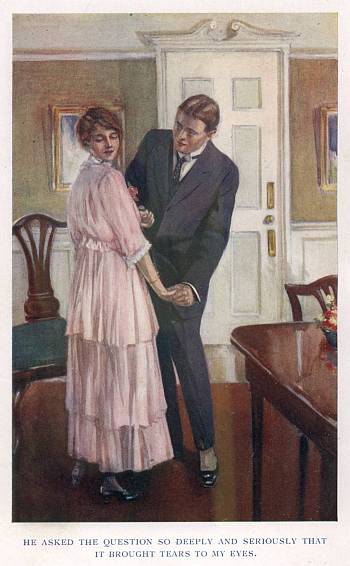
He crossed the room, opened the door, and stood with the knob in his hand, waiting for me to pass through. I stiffened my back and stood still. I told myself that to give in—after that—meant that I agreed—practically gave my consent. I would not do it! I would not! I would stand all day rather than move an inch. Nothing should induce me. He rattled the knob, and stared steadily in my face. I turned and—went!
“Evelyn Wastneys, will you take this man to be your wedded husband?”
I had come back again—in my blue dress!—and he met me on the threshold, where I verily believe he had been standing waiting, all the time I changed. He took both my hands in his, and asked the question so deeply and seriously that it brought the tears to my eyes.
“I think I—will!” I said shakily. “But you must not be too sudden with me, please, because I was so certain that I never would. You must give me time to get used to the idea.”
“You can really love me? You can really manage to care?”
“I can! The difficulty lately has been—the other way! When you didn’t come I was afraid. I had a horrible conviction that you’d changed your mind.”
He laughed, and drew me closer, wrapping me close in his strong arms. I lay still, and felt as if all my burdens were rolling away, and a big strong barrier hedged me in and protected me from the buffets and responsibilities of life. It was a blissful feeling—full of joy, full of rest. Now it seemed worth while having been a lonely woman. No sheltered, home-living girl could possibly have rejoiced as I rejoiced.
“You are mine! I’ll take care of you. No more rushing about, and living in disguise.”
“I don’t want to ramble. Never did! I want a home, and my own man. Do you remember when you said you would give me my own way—in reason?”
“And you objected that I would wish to come first? I do.”
“Bless your lonely heart! So do I. I’m afraid I shall spoil you, Ralph!”
“Oh, do!” he cried, and there was a hunger in his voice that sank deep in my heart. He needed me! How good it was to know that, to realise that in all the teeming millions in the world no woman could be to him that I was!
Later on—after a blissful interlude—I began to ask questions:—
“What will your mother say? Will she be surprised?”
“She’ll be delighted, for my sake, and her own! At the bottom of her heart she has always longed to be with her girl. And she’s prepared. She recognised the signs.”
“As Charmion did in me. Why? Do we show it in our faces?”
“Of course we do. Why not? Love’s a new sense, a new life. If one has any expression at all it must show. I’ve gone about feeling as if I were labelled ‘Evelyn Wastneys. By express route,’ for a year past! Now I’ve got you! You’re coming back to take care of me at the ‘Hall’!”
I rather liked the idea of myself as mistress of that old house! With my head on his shoulder I devoted several moments to the consideration of how I should arrange the drawing-room. It was amazing that I could not conjure up one pang of regret for dear “Pastimes!”
“There’s a lot to be done first,” I told him. “Two homes to break up. I shall have to find new tenants.”
“What about General Underwood for ‘Pastimes’?” he asked.
I raised my head and looked at him. He was manfully trying to smile.
“Wretch!” I exclaimed. “So you’ve got your way after all!”
| Chapter 1 | | Chapter 2 | | Chapter 3 | | Chapter 4 | | Chapter 5 | | Chapter 6 | | Chapter 7 | | Chapter 8 | | Chapter 9 | | Chapter 10 | | Chapter 11 | | Chapter 12 | | Chapter 13 | | Chapter 14 | | Chapter 15 | | Chapter 16 | | Chapter 17 | | Chapter 18 | | Chapter 19 | | Chapter 20 | | Chapter 21 | | Chapter 22 | | Chapter 23 | | Chapter 24 | | Chapter 25 | | Chapter 26 |