Mrs. George de Horne Vaizey (continued 3)
Reading edition
He quite chuckled with delight. Viewed from the vantage ground of a bath-chair, a Treasure Hunt was delirious excitement, but he was heavy! I remembered a sharp upward curve some way further on, and had a vision of myself pushing, with arms extended to full length, and feet at a considerable distance between the arms, as I have seen small nursemaids push pram-loads of fat twins. How undignified it would be if I slipped half-way, and the chair backed over my prone body! Then, of course, the thing happened which I might have been sure and certain would happen under the circumstances. We came face to face with Mr Maplestone, and the General called out:—
“Hi, Ralph! There you are. Just the man we want. Miss Wastneys and I are hunting. Come and give a hand.”
“Oh, if you have the Squire, you won’t need me. I’ll go off on my own,” I cried quickly; but it was no use, the old man wanted both, and both he would have. The Squire was to push behind; I was to take the handle and pull in front; he himself must be free to hunt, since he was handicapped by old eyes. He issued orders with the assurance of a Commander-in-Chief, and we listened and obeyed.
I started by feeling annoyed and impatient, but honestly, after the first few minutes, it was great fun. The Squire was an abominable pusher; first he pushed too little and left all the work to me; and then, being upbraided, he pushed too hard and tilted me into a run; then we changed places, and he took the wrong turnings, wheeled past plain grass beds where nothing could possibly be hidden; then we both took the back, and the General peered from side to side, and saw nothing, and grew discouraged, and sighed, and said his luck had gone. No treasures for him any more!
I will say for Ralph Maplestone that he is sweet to that old man! He treats him just in the right way, as deferentially as though he were in full health and strength, a martial figure riding gloriously to conquest! We cheered him up between us (I did it rather nicely, too!) and became quite friendly in the process. Two people can’t join in pushing a bath-chair and remain de haut en bas. The thing is impossible. I was most nice to Ralph Maplestone, and he appeared to be nice to me.
Suddenly, in the middle of a bush, I saw a glint of brighter green, the tissue-paper wrapping of a treasure, and instantly my fingers gripped the chair. Mr Maplestone would have pushed on, but I frowned and grimaced, and he looked and saw too, and we both puffed and panted, and demanded a rest, during which I stood elaborately at one side of the bush, and he stood at the other, so that the old dear could hardly miss seeing the paper.
Even then I had to give, it a surreptitious push before discovery came; but he had no suspicions, not one, and was as pleased as a boy at the thought that his old eyes had been sharper than our young ones. We all took a turn at opening the parcel, and it turned out to be a vanity bag, fitted with a mirror and other frivolities, so of course it was presented to me, and I arranged my hair in the mirror, and powdered my nose with the puff, just to shock them, which, by the way, it fully succeeded in doing.
“Girls didn’t do that in my day!” croaked the General.
“All girls don’t do it now!” grunted the Squire.
“My dear, you look far nicer without it.” This was the General’s second venture. I turned to the Squire and asked solemnly, “Do I?” and he gave one quick look, and then stared past me—through me—blankly into space.
“I am no judge,” he said curtly.
Well, let me be honest! It was flirtatious of me, I knew it was, and hurried to rub off the powder, and get back to my briskest, most business-like manner. As we had paid three entrance fees, we were entitled to a treasure apiece, if we could find them, and I insisted upon keeping up the search to the very last moment. It amused the General; it amused me; I honestly believe that it amused Mr Maplestone, as far as he was capable of being amused. He was quite human; once or twice, as we rushed after a “scent,” he was even lively. I began to think he might really be quite nice.
We found one other parcel—a box of cigarettes—and then made our way back to the lawn, where the General’s valet was waiting, and took over the chair. Delphine came up to me and slipped her hand through my arm.
“Evelyn, you have managed beautifully, but you must be dead tired and longing for tea. I’m going to stand over you and make you rest. Stupid of Jacky to send the Squire to help you! You’d have been happier with anyone else, but he’s so dense, so in the clouds, that he doesn’t notice these things. Evelyn, isn’t it strange how he dislikes you?”
“Who? Your husband?”
“Nonsense. No. You know quite well—Mr Maplestone. At first, of course, one can understand he was prejudiced; but now! And when you have been so nice!”
“Thank you for that. I’m glad you appreciate me. Why are you so sure the Squire does not?”
“Because,” she said imperturbably, “he tells me so!”
Curiosity is a terrible thing. It’s bad enough when it concerns itself about other people, but when it comes to oneself, it’s ten times worse. I ached to ask, “When?” and “Where?” and “How?” and exactly in what words Mr Maplestone’s dislike had been expressed, but pride closed my lips, and I would not let myself go. Of course I had known before, but I had imagined that after the chair episode—What stings is not the dislike itself, but the putting it into words to such a confidante as Delphine. No, let me be honest; the dislike itself does sting. I have my own petty feminine craving, and it is to be liked, to have people appreciate and approve of me, if they do nothing more. Even indifference is difficult to bear, but dislike— Well, thank goodness, I have lived in a warm-hearted country among warm-hearted people who have loved me for my name if for nothing else. Really and truly, I believe this ugly, red-headed man is the first person who has ever dared to speak openly of dislike for Evelyn Wastneys!
I pity and despise him. I wouldn’t have his approval if I could. Henceforth I shall never think of him, nor mention his name. To me he is dead. All is over between us before anything ever began! It is finished. This is the end. The fête ended at nine o’clock, and Charmion and I, with the other stall-holders, went into the vicarage to enjoy a supper of scraps. As a rule I adore scrap suppers after everyone has gone, and the servants have gone to bed, and the guests make sorties into the pantry, and bring out plates of patties and fruit, and derelict meringues, and wobbling halves of jellies and creams. They taste so good, eaten in picnic fashion before the fire, with a shortage of forks and spoons, and a plate as a lucky chance. But somehow last night things didn’t go! I think perhaps there were too many “scraps” which should by rights have been sold and paid for in good hard cash. The Vicar was full of hospitable zeal, and evidently enjoyed pressing the good things upon his guests, but there was something in Delphine’s pale glance which checked merriment. She had had her fun, the interest of planning, the excitement of playing hostess to the country-side, the satisfaction of knowing herself to be the best-dressed, most admired woman present, and of queening it over women who had hitherto patronised herself. Poor little butterfly! she had enjoyed her hour, but now the sun had gone down, and she was counting the cost. The treasurer added up the coins handed in from the various stalls and announced the total. There was a little pause.
“Ah!” said the Vicar slowly. “More than last year, but not so much as we hoped. How will it work out, dear, after paying expenses?”
“Oh, Jacky, I’m tired! Can’t we have supper in peace, before worrying about money!” she cried pettishly.
Not another word was said.
When we were driving home, Charmion gave me a shock.
“I rather like Mrs Maplestone,” she said dreamily. “She is stiff and conventional, and it has never even occurred to her that anyone can disagree with her views, and still have a glimmering of right, but, at least, she is sincere. If one could burrow deep enough beneath the surface, she’d be worth knowing.”
“I don’t like people who have to be burrowed. Life is too short. And I am perfectly certain that I should shock her into fits. Personally, I don’t intend to take the trouble of excavating!”
“That’s unfortunate, for she wishes to know you. She has invited us to dinner next Wednesday to meet some friends.”
“Charmion! You didn’t accept?”
“Certainly I did. Wasn’t it your express desire to be sociable, and to know your neighbours?”
“Oh, not them—not there! It’s pleasant knowing a few people, but one is at liberty to choose. I think you might have consulted me!”
In the soft dusk she laughed, and stretched out a caressing hand.
“Tired, dear, and—cross? I thought you’d be pleased. Why and wherefore? Tell me the truth?”
“Oh, don’t be so tiresome, Charmion. Of course I am tired. I’ve been on my feet all day long. Cross! Why should I be cross? Only—I don’t choose to accept hospitality from that man. I tell you plainly I won’t go.”
She bowed her head, deliberately, once and again.
“Oh, yes, Evelyn, you will! I gave you your choice, and having made it you will play fair. I should have preferred to remain peacefully at Coventry, but having taken the first step at your request, I don’t propose to allow you to force me into society alone.”
What could I say? What was it possible to say? There is no way out of it. I shall just have to go!
Chapter Twelve.
A Revelation.
The Vicar has called to tell us that Delphine has made up her accounts, and that the fête has cleared fifty pounds more than the smaller affair last year. He seemed pleased and proud, and I was delighted, too, and immensely relieved, because I had really been horribly afraid there would be no profit at all! Curious to think where all the money came from to pay heavy expenses, and still clear so much! It just shows how small sums add up. I asked if Delphine were very pleased, and he hesitated, and said:—
“She seems tired. Feeling the reaction, no doubt. She worked so hard.”
An imp of curiosity tempted me to see if he were really as blind as he appeared.
“She made a splendid hostess. And didn’t she look charming, too? I am sure you were proud of her in that lovely new frock!”
His eyes softened with a deep glowey look, which was reserved for Delphine alone.
“I am always proud of her. She always looks charming; but the dress—I am afraid I must plead guilty. I know nothing about her dress.”
“Really? Truly? You couldn’t tell what it was like?”
“Not for a thousand pounds!”
I stared at him, frowning.
“If I had a husband I should like him to know. I should be furious if I made a special effort, and he didn’t even notice that I had anything new.”
He smiled with a forbearing air.
“Surely not! I think better of you, Miss Wastneys. Dress is altogether unimportant.”
“Not to me. Not to your wife. There are some women to whom it is the greatest temptation in life.”
He looked outraged, disgusted, and changed the subject with a resolute air, but I was glad that I had spoken. A husband can be too unworldly, and lost in the clouds. It would be the best thing in the world for Delphine if he did notice, and that in more ways than one!
In the afternoon Charmion and I called at the vicarage to congratulate Delphine, and found her distinctly the worse for wear. Pale, heavy-eyed, and inclined to snap, a very different creature from the radiant butterfly of three days ago. She was glad to see me, however, I was someone to snap at, which was what she wanted most at the moment, and she worked off quite a lot of steam, hectoring me about things I might have done better, or not done at all, and impressing on me for future occasions that I should be less independent, and take more advice. She likewise informed us, quite incidentally and “by the way,” that Mrs Ross had disliked my hat and Mrs Bruce had asked if Charmion were anaemic—such a colourless skin!—and Mrs Someone Else thought it so “queer” that we should live together! Altogether she behaved like a spoiled, ill-tempered child, but she looked so young and worried and pretty through it all, that on the whole I felt more sorry for her than myself. As for Charmion, she smiled, with an air of listening from an illimitable distance, which I can quite understand has an exasperating effect on people who do not understand and care. It exasperated Delphine now. I saw the blue eyes flash, and the pink lips set, with a peevish desire to “hit back!”
“Mrs Bruce said her family know the Fane family quite well. They come from the same county. She was telling them about you, but, of course, not knowing your husband’s Christian name made it difficult. She thought it so queer to have your own Christian name printed on your cards—”
“Did she?” said Charmion blandly.
“It is an American custom,” I put in hastily. “I should do the same if I had such a fascinating name.”
“I wouldn’t!” Delphine said—“it’s so queer. Unless, of course, one’s husband had a hideous name—Elisha, or Jonathan, or something like that. Even then one might leave it out.”
“I shouldn’t dream of marrying anyone called Elisha.”
“What was—is—your favourite man’s name?”
“Jacky,” said Charmion naughtily.
Delphine’s eyes flashed.
“Was that your husband’s name?”
“Oh no.”
The pink lips opened to ask a further, more definite question, but it died unsaid. The steady gaze of Charmion’s eyes prevented that. She would be a bold woman who could defy that silent challenge!
We made our escape, and walked home in silence. Charmion seemed very depressed, and went to bed at nine o’clock. Next time I see Delphine Merrivale, I shall tell her plainly that I will—not—have Mrs Fane annoyed with questions about the past!
Last night we dined at the Hall. Last night things happened. We started feeling quite festive and excited, for, after a strictly domestic life for nearly five months, it becomes quite thrilling to dine in another house, and to eat food which one has not ordered oneself. As we drove along the lanes, we amused ourselves like schoolgirls, guessing what we “would have,” and who would “take us in”. Charmion, as the married woman, would obviously fall to the Squire. I hoped I should be at the other end of the table, with a partner who was sweet tempered and appreciative. Bridget had come back from posting a letter, bearing the thrilling news that the Squire’s car had been to the station to meet a party of guests. Two fine, upstanding ladies, and a gentleman with a figure like a wooden Noah in the Ark. The shoulders of him!—that square you might have cut them with a knife! It was refreshing to know that we were to meet people who did not live within a radius of five miles. I rather hoped those shoulders would fall to my share!
They did. He is an American. I might have guessed that by the description, and one of the “fine upstanding ones” is his bride, and they have been “doing” England for a few weeks, before starting on a year’s honeymoon in the East. The explanation of their appearance at the Hall is that they “chanced” to have met the Squire years ago in America, and wished to renew the acquaintance. So things came about! Mr Elliott is an interesting man, and, like all Americans, loves to talk about his own country. He was pained and shocked to hear I had never crossed the Atlantic, until I told him that half myself, in the person of an only sister, had gone in my place. I was just going to add that Charmion also had spent a great part of her life in the States, when—something stopped me—one of those mysterious impulses which, at times, lay a finger on our lips, and check the coming words.
Charmion sat on one side of the Squire, Mrs Elliott on the other. I was half-way down the table, sandwiched in between a dozen comfortable, middle-aged worthies, who were all intimate friends, if not actually related to each other, and their conversation, though interesting to themselves, was not thrilling to an outsider. I saw the American’s quick eye dart from one to the other, and hoped he was not classifying the company as typical English wits! The dinner itself was long, heavy, and unenterprising; a Victorian feast, even to the “specimen glass” decorations. One rose and one spray of maidenhair, in a tall thin glass, before each separate diner. Charmion and the Squire talked and laughed together, and seemed quite happy. She is a lovely creature when she is animated; there is a dainty charm about every movement which makes her seem of a different clay from human creatures. Even to see Charmion eat is a beautiful thing!
All the same, that dinner was a trial of patience, and I was thankful when it was over. In the old-fashioned way, we left the men to their smoke, and wandered through the drawing-room into a big domed palm-house, which in its fragrant dimness, with the giant palms reaching to the very roof, looked much more inviting than the drawing-room with its glaring incandescent lights.
The American bride attached herself to me and chatted amusingly enough. Before her marriage she had lived “out west,” so I plied her with questions about ranch life. Kathie writes regularly enough, but she is a wretch about answering questions, and is not half detailed enough to satisfy my curiosity. We stood leaning against one of the tiered flower-stands, enjoying the scent and the beauty, chatting together so lightly and calmly, blankly unsuspicious, as we so often are in the big moments of life, of what lies immediately ahead. Between the spreading branches I caught sight of Charmion looking at me with raised, inquiring brows. She had noted my eagerness, and was wondering what point of interest had been discovered between the wordy American and myself. I raised my voice, and cried happily:—
“Oh, Charmion! Mrs Elliott knows Kathie’s home. She has stayed there herself. I am asking her all about it.”
She smiled, and moved forward as if to join us. Mrs Elliott gave a little start, and repeated curiously, “Charmion! Is Mrs Fane called Charmion? That’s a very unusual name. I have only heard it once before. Very sweet, isn’t it, but association goes for so much!”
“It does. In this case it makes the name all the more charming.”
“Why, yes, that is so. Mrs Fane is a lovely woman. But I guess I was less fortunate in my specimen. I never met her myself, but she married a man I knew well, and—ran away from him on their honeymoon!”
I laughed. I am so glad I laughed. So glad there was time to say lightly, “She was soon tired!” before, between the spreading leaves of a palm, I caught Charmion’s eyes—my Charmion!—staring into mine, and knew that she had overheard—knew more—knew, in a blundering flash of intuition, that the words which had just been spoken referred to no stranger, but to herself! Fortunately for us both, Mrs Elliott was facing me, so she did not see, as I did, the sudden pause, the blanching face, the dumb appeal of the stricken eyes.
I flashed back reassurement, and at once led the way forward—out of the conservatory, back to the drawing-room, affecting to be tired, to want to sit down. Mrs Elliott followed, unperturbed. It didn’t matter to her where she went, the one indispensable necessity was to talk, and to have someone to listen. She continued her history with voluble emphasis.
“I should think it was soon! Well, I guess she might have thought it out before she went so far. Too hard on a man to be treated like that. Kind of humiliates him before his friends, that a woman couldn’t put up with him one month—”
“I shouldn’t worry about his pride,” I said curtly. “What about hers? It would be worse than humiliating for a woman to be obliged to go! He must have been a poor thing!”
“Well, I don’t know. He was a real popular man. He may have been a bit careless and extravagant; quite a good many young men are that, but they settle down into staid, steady-going husbands if the right woman comes along to help. Doesn’t seem to me, Miss Wastneys, that it’s possible for any man to be so bad, that in three weeks the woman who had promised to stick to him till death should throw up the sponge!”
It did not seem so to me, either, so I made no comment. I should not have been human if I had not burned to ask questions, but I would not allow myself to do it. What Charmion wished me to hear, she would tell me herself. The time had come when she would tell me. I knew that. This chance encounter had decided the moment when her silence should be broken.
Mrs Elliott smothered a yawn, and straightened a diamond bracelet on her wrist. The diamonds were massed together so heavily that the weight dragged them to the inside of her arm, leaving only the plain gold band in sight, a hiding of treasures which did not please the owner.
“Well,” she said deliberately once more, “I guess it was a real cruel trick. Whatever he’d done, she put herself in the wrong that time. The poor fellow’s not done a mite of good ever since.”
I had to hold myself tight to prevent a start. Not done! She talked of the man in the present case, as though he were alive, as though—stupefying thought!—Charmion was not a widow after all! The thought was stupefying, but even as it passed through my brain, I realised that no word of her own had been responsible for my conviction that her husband was dead. It was rather because she never did mention him that Kathie and I had made so sure that he did not exist. My thoughts dived into the past, recalling faded impressions. I remembered how Kathie had said, “She must have loved him dreadfully not to be able to refer to him even now!” And how I had been silent, fighting the impression that it was the ghost of sorrow, rather than of joy, which sealed Charmion’s lips.
The door opened, and the men came into the room. The different groups broke up and drifted here and there; into the palm-house to look at the flowers, back into the drawing-room to talk, drink coffee, and glance surreptitiously at the clock. In this old-fashioned household, no one thought of providing any other amusement for a dinner party than the dinner itself. Having been well fed, the guests were expected to amuse themselves for the hour that remained. In an ordinary way I could have taken my share in the amusing; I like talking, and am never troubled by not knowing what to say. Given people to listen, and look appreciative, I can monologue for an indefinite time. But—to-night!
Inside the palm-house I could see Charmion’s grey figure reclining in a wicker chair, her face ivory-white against the cushions. She was waving her fan to and fro, and listening with apparent attention to the conversation of her companions. I guessed how little she would hear; how bitter must be the dread at her heart; how endlessly, interminably long the moments must seem.
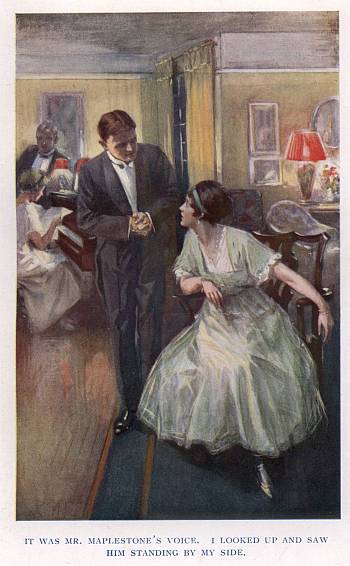
“Miss Wastneys, would you care to see the picture we were talking about at dinner?”
It was Mr Maplestone’s voice. I looked up and saw him standing by my side, and rose at once, thankful for any movement which would pass the time. We left the room together, walked to the end of the long corridor, and drew up before the picture of an uninteresting old man with several chins, and the small, steel-blue eyes which seem a family inheritance. This was a celebrated Romney, which had been the subject of a protracted law-suit between different branches of the family, which had cost the losing party over a thousand pounds. I thought, but did not say, that I would have been obliged to anyone who would have taken him away, free, gratis, for nothing, rather than that he should hang on my walls. Spoken comment, under the circumstances, was a little difficult and halting!
“This is the Romney.”
“Oh yes.”
“My grandfather.”
“I see. Yes. How interesting.”
He laughed—a short, derisive bark.
“That’s the last thing you can call it! A more uninteresting production I never beheld. What right had he to waste good canvas? That is one point in which we do show more common sense than our ancestors. We do not consider it necessary to inflict our portraits on posterity.”
“No. We don’t. At least—”
He swung round, facing me, with his back to the open drawing-room door, his face suddenly keen and alert.
“Miss Wastneys—never mind the picture! I brought you out as an excuse. I wanted to ask—Whats the matter?”
The question rapped out, short and sharp. I looked at him, made a big effort to be bright, and natural, and defiant, and realised suddenly that I was trembling; that, while my cheeks were hot, my hands were cold as ice; that, in short, the shock and excitement of the last half-hour was taking its physical revenge. For two straws I could have burst out crying there and then. It is a ridiculous feminine weakness to be given to tears at critical moments, but if you have it, you have it, and so far I have not discovered a cure. I could have kept going if he had taken no notice, and gone on talking naturally; but that question knocked me over, so I just stared at him and gulped, and pressed my hands together, with that awful, awful sensation which comes over one when one knows it is madness to give way, and yet feels that the moment after next you are just going to do it, and nothing can stop you!
I thought of Charmion, sitting calm and quiet in the palm-house; I thought of that first horrible interview in the inn parlour; I thought of my heroic ancestors. It was no use; every moment I drew, nearer and nearer to the breaking-point. I still stared, but the Squire’s face was growing misty, growing into a big, red-brown blur. Then suddenly a hand gripped my arm, and a voice said sharply:—
“Don’t cry, please! No necessity to cry. You are tired. I will order the car. It shall be round in five minutes. You can surely pull yourself together for five minutes?”
The voice was like a douche of cold water. I shivered under it, but felt wonderfully braced.
“Oh, thank you, but we ordered a fly.”
“That’s all right. I’ll see to that. No one shall know anything about it. You will leave earlier than you expected—that’s all. I’m sorry”—his lean face twitched—“the time has seemed so long!”
“It’s not”—I said feebly—“it’s not that!” But he led the way back to the drawing-room, taking no notice. Five minutes later “Mrs Fane’s carriage” was announced, and we bade a protesting hostess good-night.
Charmion and I sat silent, hand in hand, all the way home. She felt cold as ice, but she clung to me; her fingers closed over mine. Just as we reached our own door she whispered a few words.
“I’ll come to your room, dear. Wait up for me.”
The time had come when I was to hear Charmion’s story from her own lips!
Chapter Thirteen.
More Bitter than Death.
Charmion came to my room in her white dressing-gown, with her long hair hanging plaited down her back. Remembering the icy hands I had held in mine, I had lit the gas fire, and she cowered gratefully over its warmth.
“Kind of you, dear! Warmth is comforting. Well, Evelyn, so the time has come. I have waited, screwing up my courage; but the hour has been decided for us.”
“Not unless you choose,” I cried hastily. “I would far rather never hear—”
She checked me with a wan smile.
“I do choose. When it is over, it will be a relief. I want you to know. You will understand better, and I shall not pain you so much, dear, kind Evelyn, by my harsh ways. So all this time you have believed that I was a happy widow?”
The expression jarred. She saw the shrinking in my eyes, and smiled again, in the same wan, hopeless fashion.
“Oh, I mean it. Death comes like a sword, but in the end it is merciful, for it brings peace. The one who is left suffers many pangs, but in time—in time, learns to be thankful for all that the beloved is spared. It is the living troubles which sear the heart. I have envied the widows who could look up and say, ‘It is well with him. We shall meet again.’ With me it has been all bitterness, all rebellion.”
I sat silent, not daring to interrupt, and after a moment’s pause she began again, speaking in a still, level tone, with hardly any variety of expression.
“I am an orphan like you, Evelyn. Both my parents died before I was fourteen, and I was sent over to America to live with a grandmother aunt. I was an heiress, unfortunately—you know my views about riches!—and by my father’s will I came into my money at eighteen. My aunt was a wise woman, and even to her intimate friends she never gave a hint of my fortune. She was a wealthy woman herself, and had no daughter, only one son, so it seemed natural that she should give me a good time, dress me prettily, and take me about. She had a horror of fortune-hunters, and wanted me to be loved for myself, and be as happily married as she had been before me. When I came out she brought me over to London for a season, and I was presented; but that was my one and only visit to England in fifteen years. I was glad to go back to New York, for my real friends were there. We had grown up together, and had the associations of years. In England I had only acquaintances. Well! So it went on, the happiest of lives, till I was twenty-four. Several men wanted to marry me, but I never met anyone whom it was possible to think of as a husband until—”
“Your husband?”
“Yes. We were away for the summer—a whole party of us—camping in the most delicious spot. I wish you could join an American camping party some time, Evelyn. It’s just the happiest, freest, most ideal of lives! He came down as the guest of some other people. The daughter was one of my own friends. I thought at first that she cared for him herself, but he never paid her any attention—not the slightest; rather avoided her indeed, even before—”
“He cared for you. Did it begin—soon—Charmion?”
“I cared for him the first moment we met. I was sitting at a long tea-table set out in the open, and my friend brought him up to a seat right opposite to mine. She said, ‘Charmion, this is Phil—Phil, this is Charmion!’ It was one of the rules of the camp that we called each other by our Christian names. The life was so informal that ‘Mr’ and ‘Miss’ seemed out of place. I looked up and met his eyes, and—it was different from anything I had felt before.
“He came for a week, but he stayed on and on until it was nearly a month. I can’t talk about it, Evelyn. Such times can never last. Even at the best it is impossible that they can last. Perfect happiness is not for this world. It was all beautiful. The place where we camped was like another Garden of Eden; the weather was exquisite, such days, such mornings! Oh, Evelyn, such nights! The sky a dome of deepest blue, with the stars shining as you never saw them in this damp, misty atmosphere. And he and I—”
Her voice broke. Her hand went up to her face to hide the quivering of her lips. It was a petrifying thing to see Charmion break down. I turned away my eyes, unable to bear it. There was silence in the room for several moments, then she began again.
“Nothing was said in words. I didn’t want him to speak. I was perfectly happy, perfectly sure, and I dreaded the publicity of an engagement. Every one talking, questioning, teasing. It would have seemed profanation. Besides—if Marjorie had really cared as I suspected, it would have been painful for her. I wouldn’t let him speak until we got back to New York, and then, the very night I arrived, Aunt Mary was taken dangerously ill. She lingered a few weeks, but there was never any hope. Then she died and I was left alone, for her son, my cousin, lived in India.
“All that time he—my husband—had been coming to see me every day. The doctor insisted that I should go out to be braced by the fresh air, so he took me long drives, long walks, and then sat by me indoors, comforting me, helping, advising. He was everything to me, Evelyn! Aunt Mary was dying, and she had been like a mother, but when he was with me I was satisfied; I was content. When she died, he urged an immediate marriage, and I was quite ready. She had left no money to me, but I told him I had some of my own. He kissed me, and”—again her hand went up to hide that quivering lip—“he said that did not concern him. He could keep his wife. What money I had I must keep for myself, to pay for ‘little extravagancies’.
“I was thankful that he did not know, thankful that he did not care. I looked forward to telling him after we were married, and seeing his face of surprise. We had planned to live in an apartment until we had time to choose a house for ourselves. I laughed to think how much bigger and finer it would be than the little house of his dreams. He was not at all rich—did I tell you that? He had had a pretty hard struggle all his life, and had only quite a moderate income. I went to my lawyer and settled a fourth of my income on him for life. I knew if we lived in a bigger way there would be calls upon him which he would not otherwise have had. Calls for subscriptions, for charities, a dozen other claims. I hated to think that he should have to come to me for money, or that cheques should be drawn in my name. He asked me what I was going to give him as a wedding present, and I laughed, and said, ‘Nothing interesting. Only a little note!’ The settlement was to be my gift.”
Silence again. I felt for her hand and held it tight? Tragedy was coming; I knew it. I waited, tense with suspense.
“We were married very quietly. Only two or three people in the church. He called for me. It was unconventional, but I was nervous and weak, and he knew he could give me strength. We went up the aisle together, hand in hand. The man who was to give me away followed behind. Many people in America are married in their own homes, but I preferred a church. I’ve been sorry since. It has seemed a profanation. To stand before the altar in God’s house and take those solemn vows, while all the time—all the time—”
She shuddered, and paused to regain self-possession.
“Well, Evelyn—well! I had two weeks’ happiness, two weeks in my fool’s paradise, and then—the end came! He had gone over to New York for a day. Some important business had arisen and he was obliged to go. He said good-bye.” She paused again, struggling for composure. “It was good-bye—good-bye for ever. He did not know that, but he parted from me as—a husband might from the wife of his heart. It was impossible to doubt. I was as sure of him, Evelyn—as sure as that the sun is in the sky!
“After he had gone a letter was handed to me. I did not know the writing, but inside—I could not understand it—was a letter in his own writing. Nothing else, just this one sheet, with one long passage underscored. I did not stop to think; the words leapt at me, my own name first of all; and after I had begun to read there was no stopping short. It was the second sheet of a letter, so I could not tell to whom it had been written; but evidently it was to a man to whom money was owing, and who had been pressing for a settlement. It was full of apologies for having failed to pay before; and then—then came the passage that had been underlined. Perhaps, he said, in a few months’ time things would look up. There was a girl. In a roundabout way, through an English acquaintance, he had heard that she had a pile of money, though the fact had been kept dark in America. There was no doubt about it, since his informant was a member of the legal firm who had wound up her father’s estate. By a stroke of good luck the girl was staying at a summer camp with some of his own friends. He had engineered an invitation, and was there at the moment of writing.
“Think of it, Evelyn—at that very moment I was, perhaps, sitting innocently by his side. We used to scribble our letters together, sitting out in the woods, and break off every few minutes to laugh and chatter. Probably, after it was finished, we walked together to the nearest post, and as we went he looked at me—he looked. Oh!”—she winced in irrepressible misery—“is it possible—is it possible that any man could act so well? Can you wonder that I am hard and cold—that I have so little sympathy for outside troubles? I was once as loving and impetuous as you are yourself, but that shock turned me to stone. It killed my faith in human nature!”
She was silent, struggling for composure, and I laid my hand on her knee, and sat silent, not daring to speak. What was there to say? I realised now how infinitely more bitter than death was the loss which Charmion had to bear.
“Well,”—she roused herself to go on with her story—“you can imagine the rest. ‘The heiress was,’ he wrote, ‘quite a possible girl,’ and seemed ‘agreeably disposed’. There was evidently no previous entanglement, and the circumstances were propitious. It was his intention to go in and win. If it came off he would be in a position to pay up old scores and to start life afresh. It would be worth giving up his liberty, to end the everlasting worry of the last ten years. The letter ended with more promises and his signature. No loophole of doubt was left, you see. There could be no mistaking that signature. I had been married exactly two weeks, and had believed myself the happiest woman in the world. I now discovered that I had been tracked down by an adventurer, who had married me only because, unfortunately, it was impossible to get hold of my fortune without putting up with me at the same time.”
“What did he say, how did he look, when you told him about your money and the settlement? Of course, you had told him by that time.”
“Not much. Very little indeed. I thought at the time that he was overwhelmed, and a little sorry that the wealth was on my side. Looking back, I do him the justice to believe that he was ashamed! Even such a deliberate schemer might well feel a pang under the circumstances. I remember that he put his elbows on the table, and hid his face in his hands. He never alluded to the subject again, neither did I. There seemed plenty of time. I loved him all the more because he was not wildly elated. All my life I had been trained to dread fortune-hunters, to value sincerity above every other virtue.”
“But during those two weeks after you were married, he still seemed to—care? You believed in him still?”
“Absolutely! Utterly! I must be easily duped, Evelyn, for with all my heart I believed that that man loved me as deeply as I loved him. Every word—every look! Oh, he was a finished actor! It all seemed so real—so real—”
“Charmion, after you had read that letter and understood all that it meant, what did you do?”
“I went to my room, packed a bag with a few changes of clothing, collected all the money I had with me, quite a large sum in notes, and caught the afternoon train for New York. I had no idea where I was going. My one longing was to escape before he came back, but things were decided for me. The shock made me faint, and in the heat of the train I felt worse every hour. When we stopped at a half-way station I stepped out on to the platform in the same dull, dazed way, hardly realising what I was doing, and carried my bag out into the street. Half a mile away I saw a notice of rooms to let in the window of a small house, and I knocked and went in.
“I stayed in that house for over six months, Evelyn. The woman was a saint—the kindliest, gentlest creature I have ever met. I told her that I was ill and in trouble, and wanted to rest, and she put me to bed and nursed me like a child. I was a long time in getting well. The very strings of my being seemed to have snapped. I lay torpid week after week, and the good soul took care of me and asked no questions. She was one of those rare spirits who pray to God to guide them day by day, and mean literally what they ask. God had sent me to her in my need—that was her firm belief—and what she did for me she did for Him. I had left no message behind—only that terrible letter sealed up, to be given to my husband on his return. I heard afterwards that he had searched for me far and wide, had even crossed over to England, thinking I must be here. When I was well enough I sent for my aunt’s lawyer and took him into my confidence. He let me know when my husband returned to America, and as soon as possible after that I came to England myself, under another name. I was no longer his wife in heart. Why should I keep a name which was given to me under false pretences? Five years have passed since then. It seems like a century, and—here I am!”
“And all this time you have heard nothing? Nothing has happened?”
“Yes. I have heard. He seems to have—felt it a good deal! It is always painful to be discovered, and for a man’s wife to leave him before the honeymoon is over is hurtful to his pride. He makes periodic efforts to find me, but my lawyers are loyal, and will give no clue.”
“And the settlement? The money you made over to him? Does he draw that still?”
She flushed and frowned.
“No. It appears not. He tells the lawyers that he will never touch it. I suppose if he changed his manner of living it would be remarked, and people might guess something of the truth. His object is, of course, to throw all the blame on me.”
The bitterness of her voice hurt me so that I ventured a timid protest.
“Charmion, I am not taking his part. I think he was contemptible beyond words; but—isn’t it possible that he has regretted, that he has not taken the money because he was ashamed?”
“Possible, of course; but I should say extremely improbable. However, I am no longer concerned in his motives. He gave up his liberty for a certain price, and the price is his. The money accumulates at the bank. Some day, no doubt, he will find it convenient to draw it.”
I felt a movement of revolt, and cried quickly:—
“There is one person I despise even more than the man himself, and that is the creature who kept that letter, and sent it to you too late to prevent the marriage! If it were to be done at all, why could it not have been done before?”
Her lips curved.
“Yes. It was very cruel. That was another disillusion, Evelyn. I have always been convinced that Marjorie was the sender. Probably the letter had been written to her brother, or to some near relation, and in some way had come into her possession. She behaved very strangely about our engagement. But I had been her friend—how she could find it in her heart! If there had been any possibility of doubt I would have gone straight to her, and demanded the truth, but—what was the use? The letter was there. I should only have brought more suffering upon myself. She wanted him for herself, and could not forgive me for taking him away; but if she had come to me at the beginning, when she saw how things might go, I should have gone away myself and left the coast clear. Even if it hurt myself, I should have been loyal to another woman who had cared first! Even now I have done my best for her. I offered, through my lawyers, to make no objection if he chose to free himself legally. It could be done in America, you know. I explained that it would make no difference to the settlement. That was made, and should remain unchanged!”
I looked at her sharply, for the sneer in her voice hurt me more than the pain.
“Charmion! Forgive me, dearest. You have been cruelly treated, but—don’t be vexed—aren’t you in the wrong, too, in feeling so bitter after all these years?”
To my surprise she assented instantly.
“Oh, yes; very wrong. More wrong than they, perhaps, for I have had so long to think; and what they did was done on an impulse. Don’t think I excuse myself, Evelyn. I don’t! I see quite well how hard and bitter I am, but—”
“You can’t forgive?”
She hesitated, her grey eyes gazing into space.
“What exactly is forgiveness? If by lifting a little finger I could make him suffer as he has made me, nothing would induce me to do it. If by lifting a little finger I could bring him happiness and success, I think—no, I am sure that I would not hesitate. But to purge my heart of bitterness, that is beyond me! It’s always there, deep down, a hard, hard wall, hiding the light, shutting me out from man—and from God!”
The last words came in a whisper. I knew the effort with which they were spoken, and sat silent, clinging to her hand. What could I say? I, with my easy, sunshiny life; how dared I dictate to her great grief. And yet I knew—I knew only in one way could peace come back.
The remembrance of the Vicar’s first sermon came back to my heart like a breath of fresh air.
“Forgetting the things that are behind!” I said softly. “Couldn’t you try that, Charmion? Forgetting, and—pressing forward! If forgiving seems beyond you for the moment, couldn’t you take the first step?”
For the first time since she entered the room her face lightened into something like her own natural smile.
“Ah, Evelyn, that’s like you! Thank you, dear, for the reminder. That was the text on our first Sunday here. There is one thing I would like you to know. You have helped me more than anything else. You attracted me because you possess to excess the very qualities which I have lost—trust, faith, overflowing kindliness and love. It has been a tonic to be with you. There have been times—working in the garden by your side, seeing all the live green things springing out of darkness—when I’ve been happy again, better than happy—at peace! But now—this upheaval—it has renewed it all. Evelyn, do you think she suspected? Do you think she will talk?”
“I am sure she won’t. Absolutely sure. She had not a flickering doubt. The name is different, you see, and she is too much absorbed in herself and her own affairs to waste any thought upon us. In a few days they sail for India.”
“Yes.” She drew a sigh of relief. “That’s good. I’m thankful. It would have been so hard to be uprooted again. But you can understand, Evelyn, that for a time—” She rose, stretched herself to her full height, and threw out her arms restlessly. “The roving fit is on me. I must be off into the wilds and fight it out by myself.”
I had known it was coming—subconsciously had known it for weeks, but it was hard all the same. We had been so happy, and in six short months my roots seemed to have gone down surprisingly deep. I hated the idea of leaving “Pastimes,” but I reminded myself that it was only for a time—only for a time.
“Of course” Charmion assured me heartily. “It is August now. We will make a rendezvous for Christmas. Perhaps I may turn up before that, like a bad penny, but you may depend on me for Christmas. You—you will go to your flat, Evelyn?”
I nodded silently. The Pixie scheme had for the moment lost its charm, but I would not give in.
“Silly one!” murmured Charmion fondly. “You dear goose! Well, good luck to you. May you make other people as happy as you have made me.”
Chapter Fourteen.
A Young Wife’s Dilemma.
Not another word about herself did Charmion say, but she began at once to make preparations for going abroad, and before a week is over she will be off. She has friends in Italy, it appears, and will probably spend some time near them, but even I am only to have an official address, from which letters are to be forwarded. She warns me that I may hear very seldom, since when a “dark mood” is on, the very essence of a cure seems to be to hide herself in utter solitude.
Well, I also am going to hide, and to shelter myself behind an official address, so I ought not to complain; but all the same I do feel lorn and lone. First Kathie torn away to another continent, and now Charmion, who is so wonderfully dear! The next thing will be that Bridget will announce, some fine morning, that she is going to marry the gardener! I told her so, in a moment of dejection, and she petrified me by replying calmly:—
“Indeed, and he’s been after pestering me to do it since the moment we set foot. There’s a deal worse things I might do!”
“Bridget!” I gasped; and I lay back in my chair. I had spoken in the most absolute unbelief. There were no illusions between Bridget and me, each knew the other’s age to an hour, and Queen Anne herself had not seemed to me more dead to romance than my staid maid. I stared at her broad, worn face, her broad, elderly figure in a petrified surprise.
“Bridget, do you really mean—do you honestly mean that you like him, too?”
She simpered like any bit of a girl.
“And why wouldn’t I be liking him, Miss Evelyn? Isn’t he the fine figure of a man, and as pleasant a way with him as if he’d been Irish himself?”
“But, Bridget, you’re forty-five! Do women—can women—is it possible to—to care at forty-five?”
Bridget chuckled; not a bit offended, but simply amused and superior.
“What’s forty-foive, but the proime of life? Care—are you asking? ’Deed, it’s not forty-five that’s going to see a heart frozen stiff. Ye mind me of the old dame of eighty, who was asked what was the age when a woman stopped caring about a man. ‘’Deed,’ says she, ‘I can’t tell ye that. You’ll have to be asking someone older than me!’”
She laughed again, and I took my turn at looking superior.
“Then, of course, under the circumstances, you will not be inclined to come with me to town?”
“’Deed, and I will then. I’d rather be with you than any man that walks. And besides,” added Bridget shrewdly, “won’t he be all the keener for doing without me a bit?”
I jumped up and marched out of the room, feeling jarred and irritated, and utterly out of sympathy. That’s the worst of being a spinster, you can never count on your companions as a continuance! Kathie left me at the invitation of a man she had known a few months; Charmion regards me as a narcotic to distract her thoughts from another man, and flies off the moment his memory becomes troublesome; and now even Bridget! Men are a nuisance. They upset everything.
I’ve come to the vicarage. When Delphine heard of our departure from “Pastimes” she developed a sudden and violent desire to have me for a visitor for a short time before I left. She is nervy and depressed (“tired out after her hard work!” the dear Vicar translates it), and has got it into her head that my society is the one and only thing that can set her right. It is flattering, and convenient into the bargain, for we are lending “Pastimes” to the widow of a poor clergyman, and it will be a help to her to have me at hand until she has settled down. It seemed a waste of good things to leave the house empty through all the lovely autumn months. This poor soul is delighted to come; we are delighted to have her; the cook and housemaid are—resigned to the change of mistress; more one cannot expect.
I’ve been here a week, and am already endorsing the theory that you can never really know a person until you have lived together beneath the same roof. Before I came, I thought the Vicar as nearly perfect a husband as a man could be, and Delphine about as unsatisfactory a wife. Now, after studying them for one short week, I have modified both opinions. She is a lovable, warm-hearted, well-meaning, weak, vain, dissatisfied child! He is a very fine, a very noble, a very blind, and irritatingly inconsiderate man! On Wednesday he ordered dinner an hour earlier for his own convenience, and he never came home at all. On Friday he said he would be out all day, and walked in at one o’clock, bringing three visitors in his train, demanding a hot lunch. He also, it appears, is difficult about money, which is not in any sense meant to imply that he is mean, but simply that he wishes to give away as much as possible to other people, and to deny his own household in order to be able to do it. I was in the room one day when Delphine presented the monthly bills, and his face was a network of worry and depression. The grocer’s book was not included; he asked for it, and said it had been missing some time. Delphine prevaricated. I knew as well as if I’d been told that she was afraid to show it!
After he had gone out her mood changed. She lifted the little red books from the table, flung them one after the other to the ceiling, caught them with an agile hand, and sent them spinning into the corner of the room. This done, she danced round the table, came to a standstill in front of my chair, and defiantly snapped her fingers.
“I—don’t—care! I don’t care a snap! I’ve done my best, and now I shan’t worry any more. It isn’t as if it were necessary. He could allow me more if he chose. Why should a man stint his wife to give the money away to outsiders? Charity begins at home. He expects me to manage on a pittance, yet there must always be plenty of everything—soup to send at a moment’s notice to anyone who is ill, puddings and jellies. And all the stupid old bores coming to meals. Could you keep house for this household on—”
I was startled at the smallness of the sum she mentioned; horrified when I contrasted it with our own bills at “Pastimes.”
“My dear—no! My opinion of you has gone up by leaps and bounds if you can keep anywhere near that. You manage wonderfully. I had no idea you were so clever!”
“Oh, well!” she said uncomfortably. “Oh, well, perhaps not so clever as you think. One gets tired of struggling after the impossible. In for a penny, in for a pound! Life is too short to worry oneself over halfpennies. I shall tell the men to send in the books quarterly after this. I’m tired of being hectored every month. Better get it over in one big dose.”
I thought of the Vicar’s pensive “Darling, isn’t this very high?” and laughed at the idea of “hectoring”; but the quarterly bills seemed a dangerous remedy.
“Won’t your husband object? Men hate bills to run on.”
“Oh!” she waved a complacent hand, “I’ll put him off. He’ll remember every now and then, and then it will float out of his mind. It’s always an effort to Jacky to come down to mundane things. Evelyn, be warned by me, and never, never marry an unworldly man. It’s impossible to live with them with any peace or comfort.”
“Well, if I do, I’ll see to it that he is worldly enough to understand household bills. I’ll keep house for a month within his own limits, and let him see how he likes the fare.”
Delphine stared.
“Jacky wouldn’t mind. So long as there was enough to give away, he’d eat cold meat, and mashed potatoes, and contentment withal, every day of the week, and never complain. I should punish myself, not him, Evelyn.” She subsided on the floor at my feet, laid her hands on my knee, and lifted her flushed, childish face to mine. Such a delicate rose-leaf of a face, more like a child’s than that of a grown-up woman. “Now that you’ve stayed here, and seen for yourself what it’s like, truthfully, aren’t you just a little sorry for me? Week after week, month after month, always the same routine of meeting and parish work, and keeping house. It is Jacky’s work—his vocation; but for me, a girl of twenty-two, do you think it is quite fair?”
“I don’t think you ought to ask me such questions. I would rather not interfere,” I said feebly. I knew it was feeble, but it is a very, very delicate business to interfere between husband and wife, and moreover the blame seemed fairly evenly divided. The Vicar had undoubtedly made a mistake in marrying a young girl for her beauty and charm, without considering if she were a true helpmeet for his life’s work. Delphine had undoubtedly made a mistake in “never thinking” of her future as a clergyman’s wife; and now he was blindly expecting a miraculous transformation of the butterfly into a drone, while the butterfly was poising her wings, impatient for flight. I sat silent, and Delphine said pettishly:—
“I don’t ask you to interfere. Only to sympathise. Is this a life for a girl of my age?”
“It depends entirely upon the girl and her ideas of ‘life’. Some girls would—”
“What?”
“Love what you call ‘parish’. Find in it her greatest interest.”
She stared at me, the colour slowly mounting to her face. Her voice dropped to a whisper.
“Yes, I know. If I were good, and really cared! Evelyn, I am going to confess something dreadful. At home, when I had no responsibility, I cared far more than I do now. I thought it would be the other way about, but the feeling that I must do things, must go to meetings and committees, must go to church for all the services, makes me feel that I’d rather not! I daren’t say so to Jacky. He’d be so grieved. I’m grieved myself. I daren’t tell anyone but you. Do you think any clergyman’s wife ever felt the same before?”
I laughed.
“I’m sure of it! Thousands of them. It’s not right to expect a clergyman’s wife to be an unpaid curate—plus a housekeeper, and it needs special grace to stand a succession of committees. How would it be to drop some of the most boring duties and concentrate upon the things that you could do with all your heart? You’d be happier, and would do more good!”
“Do you think I should?” She clutched eagerly at the suggestion. “Really, I believe you are right. As you say, I have not the strength to play the part of an unpaid curate.”
But that misquotation roused me, and I contradicted her sharply.
“Excuse me! I said nothing of the sort. You are strong enough to do anything you chose. It is not strength that is wanting, but—”
“Go on! You might as well finish, now you’ve begun. But what?”
“Love!”
She gave a little gasp of astonishment.
“Love! For whom?”
“Your neighbours. Your husband. God!”
“Oh, it you are going to preach next!” she cried impatiently. She jumped up from her seat, whirled round, and flounced from the room.
Mr Maplestone came in to tea. He is quite a frequent visitor here I find. Besides the fact that he is a vicar’s churchwarden, it appears that he has known Delphine since she was a child, so that he is absolutely at home with her, and evidently very fond of her, too, in a cousinly, elder-brotherly, absolutely matter-of-fact way. The first time I saw him was quite early one morning when, hearing unusual sounds of merriment from the dining-room, I opened the door, and beheld the Vicar seated in an arm-chair, looking on with much amusement, while the Squire held a box of chocolates in one upraised hand, and Delphine capered round him, snatching, and leaping into the air like an excited little dog. It was a festive little scene until my head came peeping round the corner of the door, and then the fun collapsed like the pricking of a bubble. The Squire’s face fell, likewise his hand; he jerked stiffly to attention, stiffly handed over the chocolates, stiffly bowed to me, stared at my uncovered head.
“Oh, I didn’t tell you! Evelyn is staying here for a fortnight before going away.”
He mumbled. I mumbled. The Vicar rose from his seat and made for the door.
“Well, we shall see you to lunch to-morrow, Ralph. I have several points to discuss. Delphine, we shall meet at the Parish Room at twelve?”
“Oh! That committee? I suppose so,” Delphine said ungraciously. She tore open her box, helped herself to the largest chocolate in the centre row, and offered me the next choice. Ralph Maplestone took up his hat.
“Oh, for goodness sake, don’t you run away, too! You haven’t a committee. There are heaps of things I want to say still. Ralph”—she went to his side and stared eagerly in his face—“did you mean what you said the other day, about teaching me to ride?”
“Why not?” he said easily. “If you’d care about it, I’d be only too glad. Bess would carry you well, and she’s as safe as a house. You could come up and practise in the park. If I were busy, Jevons could take you round. He’d teach you quite as well, or better, than I should myself.”
“Oh!”—she beamed at him, a picture of happiness—“it will be fine! I’ve always longed to ride. And afterwards, when I’m quite good—I feel it in my bones that I shall be good—will you still—”
He laughed good-naturedly. He is extraordinarily good-natured to Delphine.
“Lend you Bess? Certainly. As often as you like. Do her good to have the exercise.”
“And when I’m very good—very good indeed—will you—”
He shook his head.
“Ah, hunting is a different matter. Rather a responsibility. What? We must see what John says. In the meantime, you’ll get a habit?”
“Yes.” She glanced at me quickly, and glanced away. “Where shall I go? Would Matthews—”
Matthews was the local tailor. The Squire waved aside the suggestion with masculine scorn.
“Certainly not. Do the thing properly when you are about it. Nothing worse than a badly-cut habit. Better go up to town!”
Again Delphine glanced at me. The obvious thing was for me to return her invitation and invite her to stay with me for the transaction, but obviously I couldn’t do it. Moreover I did not want to, so I stared blankly before me, and resigned myself to being thought a mean thing.
“Oh, well—I’ll manage somehow,” Delphine said in a tone of finality, which was obviously intended to stop the discussion.
Mr Maplestone looked at me and said:—
“Mrs Fane has already left, I believe. I suppose you will join her later.”
“I think not. She has gone abroad. I shall remain in England.”
Delphine gave a short, irritable laugh. I had annoyed her, and child-like, she wished to hit back.
“Abroad, and England! That’s all the address we are vouchsafed. Mrs Fane and Miss Wastneys evidently wish to shake off the dust of this village as soon as they drive away from ‘Pastimes’. Even if we wish to communicate with them, we shall not be able to do it.”
“Oh, yes, Delphine, you will,” I contradicted. “I have told you that letters will always reach us through our lawyers.”
“Lawyers!” she repeated eloquently. “As if one could send ordinary letters in a roundabout way like that! I wouldn’t dare to write through a lawyer, unless it were a matter of life and death. I must say, Evelyn, you are queer! When we have got to know each other so well, too!”
“You thought it ‘queer’ that Charmion and I should live here together; and now you think it ‘queer’ when we go away. Isn’t that a little unreasonable?”
“It is ‘queer’ to be so mysterious about where you are going. People ordinarily—”
“Very well, then! We are not ordinary. Let us leave it at that. It is much more interesting to be mysterious. Perhaps we are really two authors of world-wide fame, who but ourselves in the country for a short rest now and then between our dazzling spells of industry.”
Delphine gaped, hesitated, then laughed complacently.
“Oh, well, Mrs Fane is the sort of person who might be anything. But not you, Evelyn; certainly not you! You are not—”
“What?”
“Clever enough!” she cried bluntly. The next minute, with one of the swift, child-like impulses which made her so lovable, she threw her arms round my neck and kissed me vehemently. “But you are good—good and kind. That’s better than all the cleverness. Forgive me, Evelyn; I’m a rude, bad-tempered thing. Kiss and be friends!”
Ralph Maplestone seized his hat and marched out of the room.
Chapter Fifteen.
A Startling Proposal of Marriage.
His afternoon the Squire, in his capacity of churchwarden, spent an hour with the Vicar in his study, and then joined us for tea on the lawn. It was a hot, airless, summer afternoon, and we were all rather silent and disinclined to eat, and I felt my eyes wandering to the big grey car which stood waiting outside the gate and wishing—many things!
I wished that I had a car of my own. I wished I had my dear old Dinah, on whose back I had been wont to roam the country-side. So long as Charmion and the garden had absorbed my attention I had been contented enough, but now an overwhelming restlessness seized me. I was tired of the slow movement of my own feet. I longed to move quickly, to feel the refreshing rush of air on my cheeks once more. I wished the woman-hating, unappreciative Ralph Maplestone, had been a kind, considerate, understanding, put-your-self-in-her-place sort of man, who would have offered his time, and his car, and his services as chauffeur.
“Delphine, would you like to have a run in the car for a couple of hours or so before dinner?”
We jumped on our chairs, Delphine and I, automatically, like marionettes, the one from pleasure, the other from surprise. Had he seen? Had he noticed? The light blue eyes stared coolly ahead. For pure callous indifference their expression could not have been beaten. Coincidence! Nothing more.
“Oh, Ralph, you dear! How angelic of you! I should love it of all things. It’s so close and stuffy in this garden. It will be perfectly delicious to have a blow. Which way shall we go?”
“If you are not in a hurry we might get as far as the ponds.” He paused, frowned, glanced hesitatingly towards me. “Perhaps Miss Wastneys—Is there any special place you would like to see?”
“Dearest!” the Vicar’s voice broke gently into the conversation, “I’m sorry, but was not it this afternoon you arranged to meet Mrs Rawlins at the ‘Hall,’ to discuss the new coverings for the library books? I think you said half-past five. It is nearly five now. You would not have time.”
“I can send down word that I can’t come. I’ll meet her to-morrow at the same time.”
“I think not.” The Vicar’s face set; his voice did not lose its gentle tone, but it was full of decision. “I think not. Mrs Rawlins is a busy woman, and she has a long distance to come. You would not wish to inconvenience her for the sake of a trifling pleasure!”
Delphine gave him a look, the look of a thwarted child, flushed to the roots of her hair, and turned hastily aside. Open rebellion was useless, but it spoke in every line of her body, every movement of the small, graceful head. I was sorry for her, for being young and feminine myself, I could understand how dull was the claim of linen covers for injured bindings, compared with that swift, exhilarating rush. I looked at the Vicar, and began pleadingly, “Couldn’t I—”; then the Squire looked at me, pulled out his watch, and said sharply:—
“Ten minutes to five. Hurry up, Delphine! If you put on your hat at once you can have half an hour. It will freshen you up for your duties. I’ll land you at the ‘Hall,’ and”—he switched his eyes on me with a keen, gimlet-like glance—“take Miss Wastneys a little further while you are engaged.”
I blinked, but did not speak; Delphine frowned; the Vicar said happily, “That will do well. That will do very well! Now, darling, we shall all be pleased!”
Deluded man! Two less-pleased-looking females it would have been difficult to find, as we made our way to the house, and up the narrow, twisting staircase. Delphine was injured at the prospective shortness of her drive; I was appalled at the length of mine. Why had he asked me? Why hadn’t I refused, and what—oh! what should we ever find to say?
“It’s always the same thing; if a bit of pleasure comes along, there’s bound to be a committee meeting in the way! Half an hour! Pleased, indeed! I’ve always been longing for Ralph to take me drives, and now that he has been disappointed like this, the very first time, is he likely to try again? Of course, Evelyn” (tardy sense of hospitality!) “I am glad for you to have the change. It’s awfully good of him.”
“Quite heroic, isn’t it?” I said tartly, as I turned into my room. No doubt the poor man was disappointed, but she need not have rubbed it in! I leave it to psychologists to decide whether or no there was any connection between my natural annoyance at the slight, and the fact that I went to the trouble of opening a special box in order to put on my best and newest motor bonnet and coat; but there it is, I did do it, and they were all the more becoming for the accompaniment of flushed cheeks and extra bright eyes. The colour was a soft dove grey, the bonnet a delicious concoction of drawn silk, which looked as if it had begun life meaning to adorn a Quaker’s head, and had then suddenly succumbed to the fascinations of a pink lining and a wreath of tiny pink roses. When Delphine came into the room a moment later, she stopped short on the threshold, and gasped with astonishment.
“Goodness!” Her face flushed, she stared with wide, bright eyes; admiring, critical, disapproving, all at once. “Evelyn, what a get up! I never saw anything like it. You look—you look—”
“Well! How do I look?”
There was an edge in my voice. She felt it, and softened at once, in her quick lovable fashion.
“You look a duck! Simply a duck. But, my dear, it’s too good! Why waste it here? Any old thing will do for these lanes. There’s time to change!”
“I don’t intend to change,” I said obstinately, and at that very moment there sounded an imperious whistle from below. Without another word we marched downstairs and out to the front gate, where the two men stood waiting beside the car. Automatically their eyes rolled towards my bonnet; the Vicar smiled, and bent his head in a courtly little bow, which said much without the banality of words. The Squire had no expression! Whether he approved, disapproved, or furiously disliked, he remained insoluble as the Sphinx. Oh, some day—somehow—some one—I hope, will wake him into life, and whoever she is, may she shake him well up, and ride rough-shod over him for a long, long time before she gives in! He needs taking down!
After a faint—very faint—protest, Delphine took her seat in front, while I sat in solitary state inside, leaning back against the cushions with an outward appearance of ease, but inwardly uncomfortably conscious of a heart which beat more quickly than necessary. This was all very well, but what next? What was to happen when the half-hour was up, and Delphine went off to her library books and left us alone?
Could I sit still where I was? It would seem absurd, not to say discourteous. Would he ask me to change seats? Would he expect me to suggest it? Suppose he did? Suppose he didn’t? And when we were settled, what should I find to say? My mind mentally rehearsed possible openings. “How beautiful the country is looking.”
“English villages are so charming.”
“How was the General when you saw him last?” On and on like a whirligig went the silly, futile thoughts, while before me the two heads wagged, and nodded, and tossed, and a laughing conversation was kept up with apparently equal enjoyment on both sides. Delphine had a child’s capacity for enjoying the present; even when the car pulled up and she alighted before the door of the “Parish Hall,” the smile was still on her face. The little treat had blown away the cobwebs; she was refreshed and ready, if not precisely anxious, for work.
“Thanks awfully, Ralph. That was as good as a hundred tonics! I do think a car is a glorious possession.” Then she looked at me and nodded encouragingly. “Now it is your turn! It’s ever so much more fun in front. Ralph will be quite proud of sitting beside your bonnet!”
So after all neither of us said it, and I should never have the satisfaction of knowing if he had meant—
He opened the door, and I meekly got out and took the other seat. What was the use of making a fuss? Delphine disappeared behind the oak door, the engines whirled, and we were off again, steaming out of the village, and down the sloping road which led to the lovely sweep of the heath, the speed steadily increasing, until we were travelling at a good forty miles an hour. Four milestones flashed past before either of us spoke a word; then in desperation I made a beginning.
“She needs change, doesn’t she? It’s quite touching to see how it cheers her up.”
“She?” he repeated. “Who?” He turned his eyes on me as he spoke, and they were absolutely, genuinely blank. Astounding as it appeared, he really did not know.
“Delphine, of course! Who else could I mean?”
“Oh–oh. Yes, I had forgotten all about her.”
He might have been talking of a fly that for a moment had buzzed by his side. The cruel indifference of his manner stung me into quick retort.
“Yet you seemed very kind—you were very kind to her a few minutes ago. Do you always forget so quickly?”
A movement of his hand reduced the speed of the engine. We had left the village far behind, and the wide high road stretched before us like a brown ribbon, sloping gently up and down the grassy slopes. For miles ahead there was not a soul in view. Ralph Maplestone stared at me and I stared back at him. Seen close at hand, his plain face had an attraction of its own. It looked strong and honest; its tints were all fresh and clean, speaking of a healthy, out-of-door life. No little child had ever clearer eyes. They didn’t look so stern as I had believed.
“What have I to remember? Delphine came for a drive; I’m glad she enjoyed it, but it is over. Why should I think of her any more?”
“Oh, no reason at all!” I said testily. I felt testy, as if from a personal injury. “Only when one has a friend, it is agreeable to believe that out of sight is not immediately out of mind. But, of course, I am a woman. Women’s memories are proverbially longer than men’s.”
The speed slackened still further. Now we were rumbling along at a speed which made conversation easy. The blue eyes gave me another keen glance.
“Women burden their memories with a thousand trivialities. Men brush them aside, and keep to the few that count. In the big things of life they are less forgetful than women!”
I smiled, a slow, superior smile, and spoke in a forbearing voice:—
“Do you think you—er—really understand very much about women?”
“No—I don’t. How can I? I don’t know any,” he replied bluntly, and the answer was so surprisingly, illogically different from what I expected, that involuntarily I laughed, and went on laughing while he stammered and tried to explain.
“Of course I have my opinion—every fellow has. One has eyes. One can’t go through life without seeing. But, personally, it’s quite true. I don’t know any. Never have done!”
“Your mother?”
“You would think so, but we are too much alike—tongue-tied—can’t say what we feel. She is more at home with my sister, who chatters from morning till night, and has no reticences, no susceptibilities. We care for each other; to a point we are good friends, but beyond that—strangers.”
I didn’t laugh any more.
“Your sister, then. Don’t you two—?”
“No. She was educated abroad. She married the year she came out. She lives in Scotland. Nominally we are brother and sister; actually the merest acquaintances. She’s a nice girl—generous, affectionate. But we don’t touch.”
“Delphine?”
“That child!” His shoulders moved with a gesture of dismissal, as if the suggestion was too absurd for discussion. Poor Delphine, how her vanity would have suffered if she had been there at the moment! I suppose my face was expressive, for he added in quick explanation: “She’s a nice child. I’m fond of her, but she is still waiting to grow up. It’s perfectly true, Miss Wastneys, I know no women. They have been a sealed book to me.”
I was sorry for the big lonely thing. It must be hard to be born with a temperament which keeps one closed, as it were, within iron doors, while all the time the poor hungry soul longs to get out. I felt glad that I was made the other way round. At the same time it seemed a good opportunity to put in a word for my own sex. I straightened my back, and tried to look solemn and elderly. I spoke in deep, impressive tones:—
“Mr Maplestone, I’m sorry, but you are illogical. You acknowledge that this is a subject about which you know nothing, yet almost in the same breath you criticise and condemn. Men blame women for having no sense of justice, but they are just as bad. They are worse, and with less excuse. Women’s perceptions are so keen that they see every side of a situation, so it happens sometimes that they get confused, and appear contradictory. Men are so blind that they only see one side—their own side—and in utter ignorance of all the others they proceed to lay down the law. For my part, I prefer the woman’s standpoint.”
Such a blankly amazed face stared into mine! The blue eyes widened, a glimpse of strong white teeth showed between the parted lips. He gaped like a child, and said vaguely:—
“Yes, but—I don’t understand! That may all be quite true, but what on earth has it got to do with what we were talking of last?”
I bridled. Nothing on earth is more exasperating than to enlarge on one’s own pet theories, and then to find that they have fallen flat. I made my voice as chilling as possible.
“To me the connection seems obvious.”
“Sorry. My stupidity, I suppose. I fail to grasp it. Will you explain?”
“You said that Delphine was not a woman. If that is so, it’s her husband’s fault—and yours! And every other man’s with whom she comes in contact. You all treat her like a child, and expect her to behave as a child, and then turn round and abuse her because she dances to your tune.”
“Excuse me. Who abuses her?”
“You did. You said—”
“I said she was a charming child of whom I was very fond. Is that abuse?”
“In the—er—the connection in which you used it—in the way in which you said it, and meant it, and avoided saying something else—yes, it is.”
For a moment he looked as if he were going to laugh, then met my eyes, thought better of it, and grunted instead.
“Sorry. Again I don’t quite follow. But no doubt it is my illogical mind. I should be interested to know in what way you hold me responsible for Delphine’s shortcomings?”
“I have just told you. You treat her as a child who must be fed on sweetmeats, and bribed with treats and diversions; conversationally you talk down to her level. It never occurs to you to expect her to be in earnest about any one thing.”
“Well?”
“Well! Isn’t that enough? Can’t you see how such an attitude must affect her character and development?”
“No, I can’t. To my mind it wouldn’t matter what the whole world thought. For good or ill, I stand for myself. What other people happened to think about me wouldn’t affect me one jot.”
I said loftily:—
“You are a man. Women are different. We do care. We are affected. That’s why it is so dreadfully important that we should be understood. I know it by experience. In different surroundings, with different people, I myself am two or three totally different women—”
He asked no questions, but looked at me, silent, expectant, and lured by that fatal love of talking about oneself which exists in so many feminine hearts, I fell into the trap, and prattled thoughtlessly on:—
“At home with my younger sister, I was the one who had all the responsibility and management. She depended on me. I was the Autocrat of the Household, and everything I said was law.”
“You would like that?”
I gave him a withering glance.
“Pray what makes you think so?”
“You like your own way, don’t you? I—er—I have received that impression.”
“I was about to add,” I said coldly, “that, since I have lived at ‘Pastimes,’ I have not had my own way at all. I have not wanted it. Mrs Fane’s character is stronger than mine. I have been content to abdicate in her favour. If you asked her opinion of me, she would probably tell you that I was too pliable—too easily influenced.”
Silence. The blunt, roughly-hewn profile stared stolidly ahead. A granite wall would have shown as much expression. I was seized with an immense, a devastating curiosity to discover what he was thinking. I fixed my eyes steadily upon him, mentally willing him to turn round.
He knew I was doing it. I could see the red rise above his collar rim, and mount steadily to his ears.
He was determined that he would not speak. I was equally determined that he should.
“Mr Maplestone! I am waiting for a remark.”
“Miss Wastneys, I—er—I have no remark to make.”
“You don’t recognise me in the latter rôle?”
“I—er—I can’t say that I do! On the few occasions on which we have met, you have appeared to me to be abundantly—er—to be, in short, the ruling spirit.”
I thought of that first interview in the inn when the brunt of the bargaining had fallen on me; I thought of the tragic evening at the “Hall,” when I had arranged a hurried departure, without apparently consulting Charmion’s wishes. Appearances were against me, and it was impossible to explain them away. I said, in a cross, hurt voice:—
“Oh, of course, you think me everything that is disagreeable and domineering. It is just as I said—men see only one thing, and it colours their whole view. If I lived a lifetime of meekness and self-abnegation, you would never forget that affair of the lease. And it was your own fault, too! You were the unreasonable one, not I; but all the same, you have never forgiven. Delphine told me how much you disliked me.”
His eyes met mine, frankly, without a flicker of shame.
“Did she? That was wrong of her. She had no business to repeat—”
“You acknowledge it, then! You did say so?”
“I did. Oh, yes. It’s quite true.”
It was a shock. At that moment I realised that, in my vanity, I had never really believed Delphine’s statement. The Squire had made some casual remark which she had misunderstood, misquoted—such had been the subconscious explanation with which I had assuaged my complacency; but now out of his own lips, openly, unhesitatingly, the verdict was confirmed! I felt as if a pail of water had been emptied over my head.
“And you—you really meant—”
“If I had not meant it, I should hardly have said—”
“I can’t think why! What had I done? If it was that affair of the lease—”
“It was not. I was amazed at the time, but I got over that. It was just—”
“What?”
“It is difficult to say. It’s not an easy subject to discuss. Need we go on?”
“I think so. I think it is my right. In justice to myself, I think you ought to tell me how I have made myself so disagreeable. It might be useful to me in the future!”
For all answer he steered the car to the side of the road, brought it to a standstill, and descended from his seat. There was an air of deliberation about the proceeding which sent a shiver down my spine. The inference was that the enumeration of my faults was so lengthy a business that it could not be undertaken by a man who had other work in hand. I sat in nervous fascination, watching him slowly cross to my side of the car, lean forward, and place both hands on the screen. His face was quite close to mine. It looked suddenly white and tense. He opened his lips and spoke:—
“Evelyn, will you be my wife?”
If I live to be a hundred, never—no, never shall I forget the electric shock of that moment! To be prepared to listen to a lecture on one’s faults and failings, and to hear in its place a proposal of marriage—could anything be more paralysing? And to have it hurled at one with no warning, no preliminary “leading up,” and from Ralph Maplestone of all people—the most reserved, the most unsusceptible, the most woman-hating of mankind! I sat petrified, unable to move or to speak, unable to do anything but stare, and stare, and stare, and listen with incredulous ears to a string of passionate protestations. Half of what he said was lost in the dazed bewilderment of the moment, but what I did hear, went something like this:—
“You are the first woman—the only woman. Before you came I was content. Since we met, I have been in torment. You woke me up. When a man is roused from a trance it gives him pain. You brought pain to me—sleeplessness, discontent, a craving that grew and grew. I wished we had never met—you had upset my life; I believed that I hated you for it. Delphine questioned me. It was then I told her that I disliked you. I meant it—I thought I meant it! I longed for you to disappear and leave me in peace, yet all the time I thought of you more and more. Your smile! Whenever we met, you smiled, and the remembrance of it followed me home. Wherever I went your face haunted me. I planned to go away, to travel, to break myself loose; but it was no use, I could not go. I dreaded to see you, but I dreaded more to go away. I hung about the places you might pass. That dress with the flounces! I could see the blue of it coming toward me through the branches. That night you were ill! All the colour went out of your cheeks. I would have given my life—my life! I have never loved before. I did not know what love meant, but you have taught me. You have waked me from sleep. I’m not good enough—a surly brute! Couldn’t expect any girl to care; but for seven years—twice seven years—I’d serve, I’d wait. Oh, my beautiful, my beautiful—if you could see yourself! How can I stay here, and let you go? Marry me! Marry me! This week, to-morrow—what are conventions to us? I’ll be good to you. All the love of my life is waiting—I’ve never squandered it away. It has been stored up in my heart for you.”
I held up my hand, imploring him to stop.
“Oh, Mr Maplestone, don’t! It’s all a mistake. It must be! How can you care? You know so little of me; we have met so seldom. How can you possibly know that you would like me as a wife?”
He gave a quick, excited laugh.
“It’s all true what those poet fellows write about love! I used to laugh and call it nonsense; but when it comes to one’s own turn, it’s the truest thing in the whole world! How do I know? I can’t tell you, Evelyn; but I do know. It’s just the one certain fact in life. I want you! I’m going to have you!”
He stretched out his arms as if to seize me then and there, and I shrank back, looking, I suppose, as I felt, frightened to death, for instantly his manner changed, his arms dropped to his side, and he cried in the gentlest, softest of tones:—
“Don’t be frightened of me! Don’t be frightened! Forgive me if I seem rough. Rough to you! Oh, my sweet, give me a chance to show what I could be! You have done enough caring for other people; now let me take care of you! Be my wife, Evelyn!”
It was all too painful and miserable, and—yes, too beautiful to put into words. I cried, and said, No! no! I was sorry, but I didn’t love him; I had never thought. There was no one else—oh, no; but it was hopeless all the same. I could never—never—Oh, indeed, I was not worth being miserable about. He must forget me. On Wednesday I was going away. He would find when I was not there that he would soon forget.
He looked at me with sad, stern eyes.
“That’s not true! You know it’s not true. I am not the sort to forget. And if there is no one else, why should I try? Evelyn, you don’t know me, if you think one ‘no’ will put me off. I said I would wait seven years, and I meant what I said. If you go away, I shall follow. What’s this nonsense of leaving no address? Do you imagine, if I choose to look for you, you can hide yourself from Me?”
He looked so big and masterful that for a moment I felt a qualm of doubt; then I comforted myself with the reflection that it would be impossible to discover what did not exist. For a period of time Evelyn Wastneys was about to disappear from the face of the earth. The spinster of the basement flat was about to take her place.
“I don’t love you! I don’t love you!” I repeated helplessly. “I have never once thought of you except as a—a rather cross, overbearing man who had taken a dislike to me at first sight. How can I turn round all in a moment and look upon you as a—a lover? And I have my friend and my work—and we have just taken our house. I don’t want to be married! I couldn’t be married even if I cared!”